Volume 2 / Part 3 — XXXV.—EFFECT OF TEMPERATURE ON PHOTOTROPIC CURVATURE
Reading edition
By Sir J. C. Bose, Assisted by Guruprasanna Das.
I shall in this chapter deal with certain anomalies in phototropic curvature, brought about by variation of temperature and by seasonal change; certain organs again are apparently erratic in their phototropic response.
SEASONAL CHANGE OF PHOTOTROPIC ACTION.
Sachs observed a positive phototropic curvature in the stems of Tropæolum majus in autumn; but this was reversed into negative in summer; similarly in the hypocotyl of Ivy, the positive curvature in autumn is converted into negative curvature in summer.
Certain organs are apparently insensitive to the action of light. Thus no phototropic response is found in the tendril of Passiflora even under the action of strong light. The tendrils of Vitis and Ampelopsis exhibit, according to Wiesner, positive phototropism under feeble, and negative phototropism under strong light.
The anomalies referred to above may be explained by taking into consideration the modifying influence of temperature on the excitability, and the conductivity of the organ.
EFFECT OF TEMPERATURE ON EXCITABILITY.
The excitability of an organ is abolished at a low temperature; it is enhanced by a rise of temperature up to an optimum. The temperature minimum and optimum varies in different tissues. The following table shows the enhancement of excitability of Mimosa at different temperatures, the testing stimulus being the same.
TABLE XXXII—SHOWING VARIATION OF EXCITABILITY OF PULVINUS OF Mimosa AT DIFFERENT TEMPERATURES.
Temperature.Amplitude of response.
22°C. 2 divisions.
27°C. 16 "
32°C. 36 "
Below 20°C. the excitability of the pulvinus of Mimosa is practically abolished. The excitability increases till an optimum temperature is reached, above which it undergoes a decline.
Though rise of temperature enhances excitability up to an optimum, there is an antagonistic reaction induced by it which opposes the excitatory contraction. The physiological reaction of a rise of temperature, within normal range, is expansion and this must oppose the contraction induced by stimulus. Hence the effect of rise of temperature is complex; it enhances the excitability which favours contraction, while tending to oppose this contraction by the induced physiological expansion. As a result of these opposite reactions there will be a critical temperature, below which the contractile effect will relatively be greater than expansion; above the critical point, expansion will be the predominant effect. The critical temperature will obviously be different in different organs. The positive curvature may thus be increased by a slight rise, while it may be neutralised, or even reversed by a greater rise of temperature.
The induced variation of excitability due to change of temperature is not the only factor in modifying tropic curvature, for variation of conductivity also exerts a marked effect.
EFFECT OF TEMPERATURE ON CONDUCTION.
The conducting power of an organ is greatly enhanced with rise of temperature. Thus in Mimosa the velocity of transmission of excitation is doubled by a rise of temperature through 9°C. (p. 100). An organ which is practically non-conducting at a low temperature will become conducting at a higher temperature.
Thus at a low temperature the organ may be non-conducting, and the excitatory contraction under unilateral stimulus will remain localised at the proximal side; this will give rise to a positive curvature. But under rising temperature, the power of transverse conduction will be increased and the excitation will be conducted to the distal side. The result of this will be a neutralisation or reversal into negative curvature (p. 139). A positive curvature is thus reversed into negative by change of excitability and conductivity, induced by rise of temperature; examples of this will be given presently.
PHOTOTROPIC RESPONSE OF TENDRILS.
I shall here adduce considerations which will show that the apparent anomalies regarding the response of tendrils to light is due to the variation of transverse conductivity of the organ. In a semi-conducting tissue, while the excitatory effect of feeble stimulus remains localised at the proximal side, the effect of stronger stimulus is conducted to the distal side. This explains the positive phototropic curvature of tendrils of Vitis and Ampelopsis under feeble light, and its reversal into negative curvature under intense light.
As the conducting power is increased with rise of temperature it is evident that at a certain temperature the tropic effect will be exactly neutralised by transverse conduction. Lowering of temperature, by reducing the transmission of excitation to the distal side, will restore the positive curvature. Enhancement of conduction under rise of temperature will, on the other hand, increase the antagonistic reaction of the distal side and give rise to a negative curvature.
I shall in verification of the above, describe experiments which I have carried out on the phototropic response of the tendril of Passiflora, supposed to be insensitive to the action of light.
Phototropic response of the tendril of Passiflora: Experiment 145.—The tendril was cooled by keeping it for a long time in a cold chamber, maintained at 15°C. The effect of unilateral light on the cooled specimen was found to be positive; the tendril was next allowed to assume the temperature of the room which was 30°C. The response was now found to have undergone a change into negative. The positive and negative phototropic curvatures of an identical organ at different temperatures is seen in the two records given in figure 145. Neutralisation takes place at an intermediate temperature, and the organ thus appears insensitive to light.
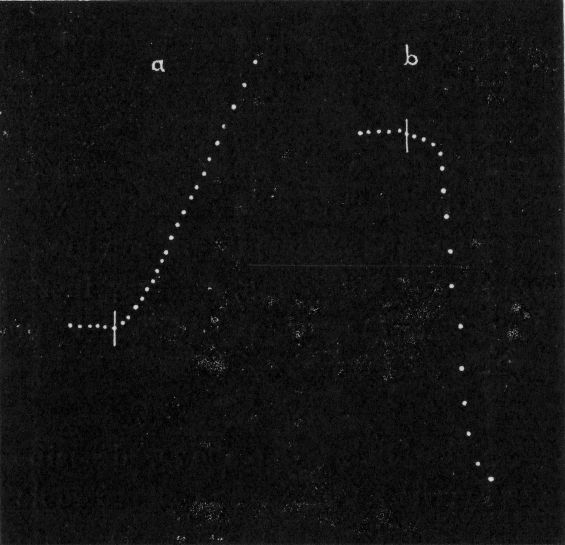
Fig. 145.—(a) Positive curvature of tendril of Passiflora at 15°C.; (b) negative phototropic curvature at 30°C.
SEASONAL VARIATION OF PHOTOTROPIC CURVATURE.
Reference has been made of the phototropic curvature of Tropæolum and of Ivy undergoing a change from positive in autumn to negative in summer. The experiment described above shows that rise of temperature, by enhancing transverse conductivity, transforms the positive into negative heliotropic curvature. The reversal of the phototropic curvature of Tropæolum and Ivy, from positive in autumn to negative in summer, finds a probable explanation in the higher temperature condition of the latter season. This inference finds independent support from the fact previously described (p. 100) that while the velocity of conduction of excitation in the petiole of Mimosa is as high as 30 mm. per second in summer, it is reduced to about 4 mm. in late autumn and early winter.
ANTAGONISTIC EFFECTS OF LIGHT AND OF RISE OF TEMPERATURE.
I have explained the complex effect of rise of temperature on phototropic curvature. Rise of temperature, within limits, enhances the excitability, and therefore the positive curvature under light. Its expansive reaction, on the other hand, opposes the contraction of the proximal side, which produces the normal positive curvature. Rise of temperature, as previously stated, introduces another element of variation by its effect on conductivity. Transverse conduction favoured by rise of temperature promotes neutralisation and reversal; the resultant effect will thus be very complicated. I give below account of an experiment where the induced positive curvature under light underwent a reversal during rise of temperature.
Reversal of tropic curvature under rise of temperature: Experiment 146.—The specimen employed for this experiment was a seedling of pea, enclosed in a glass chamber, the temperature of which could be gradually raised by means of an electric heater. Provisions were made to maintain the chamber in a humid condition. The temperature of the chamber was originally at 29°C., and application of light on one side of the organ gave rise to positive curvature, followed by complete recovery on the cessation of light (Fig. 146a). The next experiment was carried out with the same specimen; while the plant was undergoing increasing positive curvature under the continued action of light, the temperature of the chamber was gradually raised from 29° to 33°C. at the point marked with arrow. It will be seen that the positive curvature became arrested, neutralised, and finally reversed into negative (Fig. 146b).
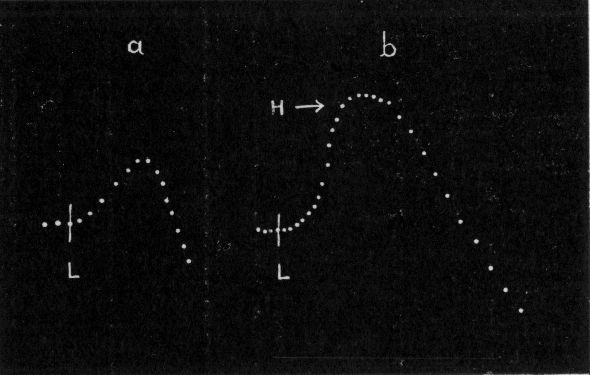
Fig. 146.—Effect of rise of temperature on phototropic curvature. (a) normal positive curvature followed by recovery, (b) reversal of positive into negative curvature by rise of temperature at (H). (Pea seedling).
After-effect of rise of temperature: Experiment 147.—The after-effect of rise of temperature exhibited by this specimen was extremely curious. The temperature of the chamber was allowed to return to the normal, and the experiment repeated after an hour; the response was now found to be negative (Fig. 147a). It appeared probable that the temperature in the interior of the tissue had not yet returned to the normal, and an interval of four hours was therefore allowed for the restoration of the tissue to the normal temperature of the room. The response still persisted to be negative, as seen in the series of records obtained under successive stimulations of light of short duration; these negative responses exhibited recovery on the cessation of light (Fig. 147b). This reversal of response as an after-effect of rise of temperature was in this case found to persist for several hours. I experimented with the same specimen next day when the response was found restored to the normal positive.
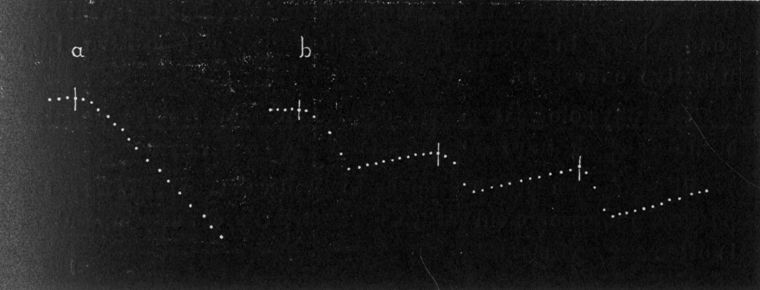
Fig. 147.—After-effect of rise of temperature, persistent negative curvature: (a) response one hour after rise of temperature; (b) series of negative responses after 4 hours (successive stimuli applied at vertical lines).
SUMMARY.
Rise of temperature, within limits, enhances the general excitability of the organ. This has the effect of increasing positive phototropic curvature. But the physiological expansion induced by rise of temperature exerts an antagonistic effect.
The transverse conductivity is increased with the rise of temperature; this favours neutralisation and reversal of phototropic curvature.
Tendrils of Passiflora, supposed to be phototropically insensitive, exhibit positive curvature at low, and negative curvature at a moderately high temperature.
The change of phototropic curvature exhibited by Tropæolum majus and Ivy, from positive in autumn to negative in summer, is probably due to the effect of temperature. Higher temperature with enhanced transverse conductivity in summer, may thus convert positive into negative curvature.
The physiological effects of rise of temperature and the stimulus of light are antagonistic to each other.
Rise of temperature tends to neutralise or reverse the positive phototropic curvature. The after-effect of temperature is often very persistent.