Volume 2 / Part 3 — XXIV.—TROPIC CURVATURE WITH LONGITUDINAL TRANSMISSION OF EFFECT OF STIMULUS
Reading edition
By Sir J. C. Bose, Assisted by Guruprasanna Das.
I have in previous chapters explained that the direct application of stimulus gives rise in different organs to contraction, diminution of turgor, fall of motile leaf, electro-motive change of galvanometric negativity, and retardation of the rate of growth. I have also shown that indirect stimulation (i.e. application of stimulus at some distance from the responding organ) gives rise to a positive or erectile response of the responding leaf or leaflet (indicative of an increase of turgor), often followed by normal negative response. The positive impulse travels quickly. The interval of time that elapses, between the application of stimulus and the erectile response of the responding leaf, depends on the distance of the point of application, and the character of the transmitting tissue: it varies in different cases from 0·6 second to about 40 seconds. The positive is followed by a slower wave of protoplasmic excitation, which causes the excitatory fall. The velocity of this excitatory impulse is about 30 mm. per second in the petiole of Mimosa, and about 3 mm. per second in Biophytum. The positive followed by the negative thus gives rise to a diphasic response. The excitatory impulse is much enfeebled during transit: the negative impulse may thus fail to reach the responding organ, if the stimulus be feeble or if the intervening distance be long or semi-conducting. Hence moderate stimulus applied at a distance gives rise only to positive response; direct application of strong stimulus gives rise, on the other hand, to the normal negative. By employing the electric method of investigation, I have obtained with ordinary tissues the positive, the diphasic, and the negative electric response, in correspondence with the responses given by a motile organ (p. 214). The mechanics of propagation of the positive and the negative impulse are different. It is therefore necessary to distinguish the quick transmission of the positive impulse from the slow conduction of the negative impulse due to the propagation of excitatory protoplasmic change.
It should be borne in mind in this connection that all responsive movements are ultimately due to protoplasmic changes which are beyond our scrutiny. We can infer the nature of the change by the concomitant outward manifestations, which are of two kinds: the positive, associated with increase of turgor, expansion, and galvanometric positivity, and the negative with concomitant decrease of turgor, contraction, and galvanometric negativity. Thus positive and negative reactions indicate the fundamental protoplasmic changes of opposite characters.
The movement and curvature induced by stimulus have, for convenience, been distinguished as positive curvature, (movement towards stimulus), and negative curvature (movement away from stimulus). Though these curvatures result from protoplasmic reactions, yet the positive curvature is not necessarily associated with positive protoplasmic reaction. It will be shown that the curvature of an organ is determined by the algebraical summation of effects induced at the proximal and distal sides of the responding organ.
Physiologists have not been aware of the dual character of the impulse generated by stimulus, and the term "transmission of stimulus" is thus misleading since its effect may be an expansion, or its very opposite, contraction. It is therefore necessary to discriminate the effect of one from the other: the impulse which induces an increase of turgor, expansion, and galvanometric positivity will be distinguished as positive, in the sense that it causes an enhancement of turgor. The other, which induces diminution of turgor and contraction, will be termed as the excitatory impulse. Transmission of the latter is dependent on conducting power of the tissue; the positive impulse is practically independent of the conducting power.
In animal physiology again, there is no essential difference between the effect of the direct and indirect stimulation. In a nerve-and-muscle preparation, for example, indirect stimulation at the nerve induces the same contraction as the direct stimulation of the muscle. The only difference lies in the latent period, which is found to be longer under indirect stimulation by the time interval necessary for the excitation to travel along the conducting nerve. It is probable that stimulus gives rise to dual impulses in the animal tissue as in the plant. But the detection of the positive impulse in the animal nerve is rendered exceedingly difficult on account of the high velocity of conduction of excitation. I have explained that the separate effects of the two impulses can only be detected if there is a sufficient lag of the excitatory negative behind the positive, so that the relatively sluggish responding organ may exhibit the two impulses one after the other. In a highly conducting tissue the lag is very slight, and the negative will therefore mask the positive by its predominant effect. In spite of the difficulty involved in the problem, I have recently been successful in demonstrating the dual impulses in the animal nerve.
In any case it is important to remember the following characteristic effects of indirect stimulation.
TABLE XXII.—SHOWING THE EFFECT OF INDIRECT STIMULATION.
Intensity of Stimulus. Character of intervening tissue. Responsive effect.
ModerateHighly Conducting Contraction.
"Non-conducting Expansion.
"Semi-conducting Expansion followed by contraction.
Feeble " " Expansion.
These effects of indirect stimulation have been fully demonstrated in the case of pulvinated organs (p. 136) and growing organs (p. 215).
Having demonstrated the fundamental reactions of direct and indirect stimulation, we shall next study the tropic effects induced in growing organs by the effect of unilateral application of indirect stimulus.
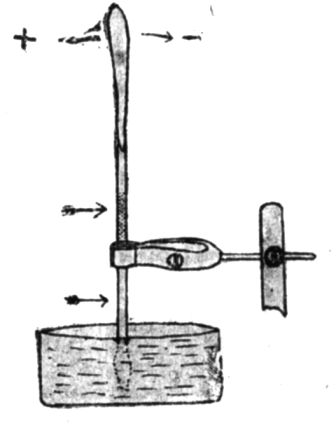
Fig. 98.—Diagrammatic representation of effects of indirect and direct stimulation. Continuous arrow represents the indirect stimulation, and the curved continuous arrow above, the induced negative curvature: dotted arrow indicates the application of direct stimulus, and the dotted curve above, the induced positive curvature.
Experiment 103.—I have already explained, how thermal radiation is almost as effective in inducing contraction and retardation of growth as the more refrangible rays of the spectrum. The thermal radiation was produced by the heating of a platinum spiral, short of incandescence, by the passage of an electric current. The intensity of radiation is easily varied by adjustment of the current by means of a rheostat. The experimental specimen was a flower bud of Crinum. It was held by a clamp, a little below the region of growth. Stimulus was applied below the clamp so that the transmitted effect had to pass through S, the securely held tissue (Fig. 98). A feeble stimulus was applied on one side, at the indifferent point about 3 cm. below the region of growth. The positive effect of indirect stimulus reached the region of growth on the same side, bringing about an acceleration of growth with expansion and convexity, the resulting movement being negative or away from the stimulus. The latent period was ten seconds, and maximum negative movement was completed in the further course of ten seconds, after which there was a recovery in the course of 75 seconds. A stronger stimulus S' gave a larger response; but when the intensity was raised still higher to S", the excitatory negative impulse overtook the positive within 15 seconds of its commencement; the convex was thus succeeded by the concave curvature (Fig. 99). Direct application of stimulus at the growing region gave rise to a positive curvature.
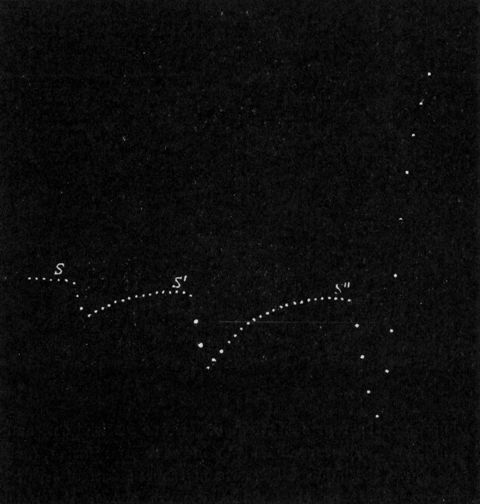
Fig. 99.—Tropic curvature of Crinum to unilateral indirect stimulation of increasing intensities: S, S' of moderate intensity induced negative tropic effect (movement away from the stimulated side); stronger stimulus S" gave rise to negative followed by positive. Successive dots at intervals of 5 seconds Magnification 100 times.
The effect of feeble stimulus transmitted longitudinally is thus found always to induce convexity, a negative curvature and movement away from stimulus. I have obtained similar responsive movement of negative sign with various plant organs, and under various forms of stimuli. Thus in the stem of Dregea volubilis the longitudinally transmitted effect of light of moderate intensity was a negative curvature; direct application of light on the growing region gave, on the other hand, a positive curvature and movement towards light.
Thus while the effect of direct unilateral stimulation is a positive curvature, the effect of indirect stimulation is a negative curvature. The following table gives a summary of results of tropic effects under unilateral application of indirect stimulus.
TABLE XXIII.—SHOWING TROPIC EFFECT OF UNILATERAL APPLICATION OF INDIRECT STIMULUS.
Stimulus.Character of intervening tissue.Sign of tropic response.
Moderate Conducting Positive curvature.
" Semi-conducting Negative followed by positive.
Feeble Semi-conducting Negative Curvature.
Moderate Non-conducting " "
Direct application of unilateral stimulus induces a positive curvature.
SUMMARY.
In sensitive plants stimulus applied at a distance induces in the responding region an expansion indicative of increase of turgor.
The effect of indirect stimulation is also exhibited by an electric change of galvanometric positivity, indicative of enhancement of turgor and expansion.
Indirect stimulus induces in growing organs an enhancement of rate of growth.
Unilateral application of stimulus causes an expansion higher up on the same side to which the stimulus is applied; the result is an induced convexity, a movement away from the stimulus, i.e., a negative curvature. Direct stimulus applied unilaterally at the responding region induces, on the other hand, a positive curvature.