Volume 2 / Part 3 — XXX.—DIA-PHOTOTROPISM AND NEGATIVE PHOTOTROPISM
Reading edition
By Sir J. C. Bose, Assisted by Guruprasanna Das.
I have explained how under the action of unilateral light the positive curvature attains a maximum. There are, however, cases where under the continued action of strong light the tropic movement undergoes a reversal. Thus to quote Jost: "Each organism may be found in one of the three different conditions determined by the light intensity, viz. (1) a condition of positive heliotropism, (2) a condition of indifference, (3) a condition of negative heliotropism"[12]. No explanation has however been offered as to why the same organ should exhibit at different times, a positive, a neutral, and a negative irritability. These changing effects exhibited by an identical organ is thus incompatible with the theory of specific sensibility, assumed in explanation of characteristic differences in phototropic response.
In regard to this I would draw attention to an important factor which modifies the tropic response, namely, the effect of transverse conduction of excitation. I shall presently describe in detail a typical experiment of the effect of unilateral stimulus of light on the responsive movement of main pulvinus of Mimosa pudica. The results will be found of much theoretical interest, since a single experiment will give an insight to all possible types of phototropic response. Before describing the experiment I shall demonstrate the tropic reactions of the two halves of the pulvinus of Mimosa.
UNEQUAL EXCITABILITY OF UPPER AND LOWER HALVES OF PULVINUS TO PHOTIC STIMULATION.
I have by method of selective amputation shown that as regards electric stimulation the excitability of the upper half of the pulvinus is very much less than that of the lower half (p. 85). I have obtained similar results with photic stimulation.
Tropic effect of light acting from above: Experiment 124.—Light of moderate intensity from an incandescent electric lamp was applied on the upper half of the pulvinus of Mimosa for 4 minutes; this induced a contraction of the stimulated upper half and gave rise to an up or erectile response. On the stoppage of light recovery took place in the course of ten minutes. The phototropic curvature is thus seen to be positive. A series of such positive responses of the upper half of the pulvinus is given in figure 118.
Effect of light acting from below: Experiment 125.—Light was now applied from below; this also induced a contraction of the lower half of the pulvinus, causing a down-movement (Fig. 119). As the responsive movement is towards light, the phototropic effect must be regarded as positive. The greater excitability of the lower half of the pulvinus is shown by the fact that the response of the lower half of the pulvinus to ten seconds' exposure is even larger than that given by the upper half under the prolonged exposure of 240 seconds.
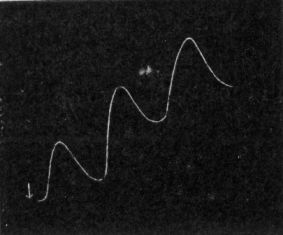
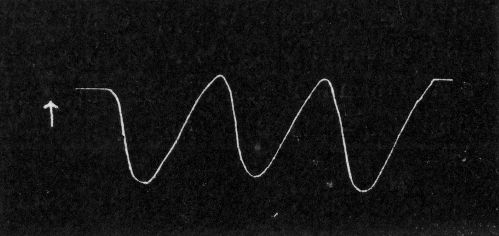
Fig. 118.Fig. 119.
Fig. 118.—Series of up-responses of Mimosa leaf to light applied on upper half of pulvinus.
Fig. 119.—Down-responses given by the same plant on application of light from below.
TRANSFORMATION OF POSITIVE TO NEGATIVE PHOTOTROPIC CURVATURE.
Experiment 126.—A beam of light from a small arc lamp was thrown on the upper half of the pulvinus. After a latent period of 5 seconds, a positive curvature was initiated, by the contraction of the upper and expansion of the lower side of the organ. But under continued action of light, the excitatory impulse reached the lower half of the organ, causing a rapid fall of the leaf, and a negative curvature. The arrival of transmitted excitation at the more excitable distal half of the organ is clearly demonstrated by the very rapid down-movement, seen as the up-curve in the record (Fig. 120). In sensitive specimens this movement is so abrupt and rapid, that the writing lever is jerked off above the recording plate before making a dot on it. The thickness of the pulvinus was 1·5 mm., the distance which the excitatory impulse has to traverse to reach the lower half would thus be about 0·75 mm. The period for transverse transmission of excitation under strong light was found to vary in different cases from 50 to 80 seconds. The velocity of transmission of excitation in a transverse direction through the pulvinus is about 0·011 mm. per second, which is not very different from 0·010 mm. per second in the stem (p. 282).
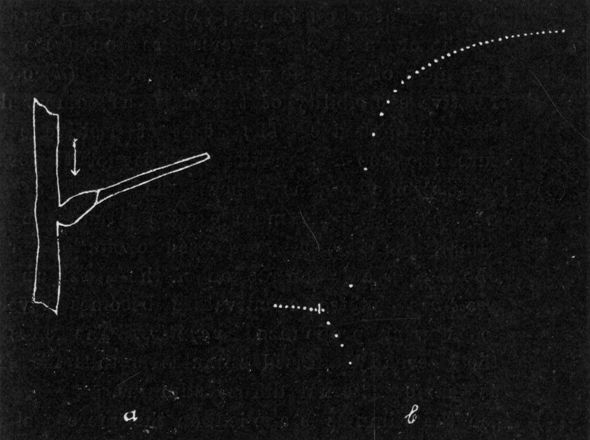
Fig. 120.—Record of effect of continuous application of light on upper half of pulvinus of Mimosa leaf. Note erectile response (positive curvature) followed by neutralisation and pronounced reversal into negative due to transverse conduction of excitation. Up-movement shown by down curve, and vice versâ.
Returning to the main experiment we find that:
(1) As a result of unilateral action of light, there was positive phototropic curvature which lasted for 50 seconds.
(2) Owing to the internal conduction of excitation the positive effect underwent neutralisation by the excitatory contraction of the distal side. This neutralisation depends on four factors: (a) on the intensity of the stimulus, (b) on the conductivity of the organ in a transverse direction, (c) on the thickness of the intervening tissue, and (d) on the relative excitability of the distal as compared to the proximal side. The extent of positive curvature also depends on the pliability of the organ.
(3) In anisotropic organs where the distal side is physiologically the more excitable than the proximal, the internally diffused excitation brings about a greater contraction of the distal, and the positive phototropic curvature becomes reversed to a very pronounced negative. The effect of the internally diffused stimulus is thus the same as that of external diffuse stimulus.
(4) When the stimulus is applied on the more excitable half of the organ, the result is a predominant contraction of that half, which cannot be neutralised by the excitation conducted to the less excitable half of the organ. As the curvature is towards the stimulus, the phototropic curvature thus remains positive, even under continued stimulation.
The positive curvature is due to the differential action of unilateral stimulus on the proximal and distal sides. But when a strong light is made to act continuously on one side of an organ, the excitation becomes internally diffused, and the differential effect on the two sides is reduced in amount or vanishes altogether. Owing to the weak transverse conductivity of the tissue, while the effect of a feeble stimulus remains localised, that of a stronger stimulus is conducted across it.
Oltmanns found that the seedling of Lepidium sativum assumed a transverse or dia-phototropic position under intense and long continued action of light of 600,000 Hefner lamps. He regards this as the indifferent position. But the neutralisation of curvature is not, as explained before, due to a condition of indifference, but to the antagonistic effects of the two opposite sides of the organ, the proximal being stimulated by the direct, and the distal by the transversely conducted excitation. I obtained such neutralisation with Dregea volubilis under the prolonged unilateral action of arc-light. The first effect was positive; this was gradually and continuously neutralised under exposure for two hours; even then the neutralisation was not complete. I shall presently adduce instances where the neutralisation was not merely complete, but the final effect was an actual reversal into negative response.
SUPPOSED PHOTOTROPIC INEFFECTIVENESS OF SUNLIGHT.
I may here consider the remarkable fact that has been observed, but for which no explanation has been forthcoming, that "direct sunlight is too bright to bring about heliotropic curvature, only diffuse, not direct sunlight has the power of inducing heliotropic movements."[13] But we cannot conceive of light suddenly losing its phototropic effect by an increase of intensity. The experiment just described will offer full explanation for this apparent anomaly. Feeble or moderate stimulus remains, as we have seen, localised, hence the contraction of the proximal side gives rise to positive curvature. But the intense excitation caused by sunlight would be transmitted to the distal side and thus bring about neutralisation. It is the observation of the final result that has misled observers as to the inefficiency of direct sunlight. A continuous record of the response of the organ shows, on the other hand, that the first effect of strong light is a positive curvature, and that under its continuous action the positive effect becomes neutralised (cf. Fig. 121). In the study of phototropic action, the employment of strong light has many advantages, since the period of experiment is, by this means, materially shortened. The continuous record then gives an epitome of the various phases of reaction.
NEGATIVE PHOTOTROPISM.
I shall next show the continuity of responsive phototropic effects, from the positive curvature to the negative, through the intermediate phase of neutralisation. I have in the preceding paragraph described an experiment where under a given intensity and duration of exposure the excitations of the proximal and distal sides bring about neutralisation, the organ assuming a dia-phototropic position. If the intensity or duration of the stimulating light be further increased, it is easy to see that while excitation transmitted to the distal side is being increased, the excitatory contraction on the proximal side may, at the same time, be decreased owing to fatigue brought on by over-stimulation.
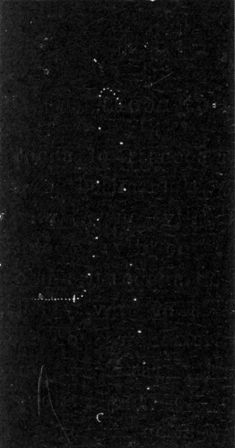
Fig. 121.—Positive and negative phototropic responses of Oryza under continued unilateral stimulus of intense light from arc lamp.
In connection with this it should be borne in mind that the pulvinus of Mimosa exhibits under continuous stimulation, a fatigue relaxation instead of normal contraction. Similar effects are known to take place in animal muscles. The effect of relatively greater excitation will thus give rise to negative phototropic curvature. The transverse conductivity of organs of diverse plants will necessarily be different. The neutralisation and reversal into negative will thus depend on three factors: the transverse conductivity of the organ, the intensity, and duration of stimulus.
Neutralisation and reversal under increased intensity of light: Experiment 127.—It is advisable to employ thin specimens (in which the transverse distance is small) for the exhibition of reversal effect. I took a hypocotyl of Sinapis nigra and subjected it to unilateral action of light from a 16 candle-power incandescent electric lamp placed at a distance of 10 cm. A maximum positive curvature was induced in the course of 50 minutes. The intensity of light was afterwards increased by bringing the lamp nearer to a distance of 6 cm. This resulted in a process of neutralisation of the preceding response; after an exposure of 70 minutes the specimen assumed a dia-phototropic position in which it remained in equilibrium. Sunlight was next applied, and in the further course of 30 minutes there was a pronounced reversal into negative phototropic curvature.
Neutralisation and reversal under continuous stimulation: Experiment 128.—In the last experiment the different changes in the response were brought about by successive increase in the intensity of light. In the present experiment, very strong light was applied from the beginning, and continuous record was taken of the change in the response. In order to reduce the period of experiment I employed a mercury vapour lamp which emits the most effective violet and ultra-violet rays. The specimen used was a seedling of the rice plant (Oryza sativa). The first effect of light was a positive curvature which attained its maximum; after this there was a neutralisation in less than six minutes after the application of light. The further continuation of light induced a pronounced negative curvature (Fig. 121).
I shall in the next chapter give other instances which will show that all organs (pulvinated and growing) possessed of power of transverse conduction, exhibit a transformation of response from positive to negative under continued action of strong light.
Thus an identical organ, under different conditions of intensity and duration of stimulus, exhibits positive phototropic, dia-phototropic, and negative phototropic curvatures, proving conclusively that the three effects are not due to three distinct irritabilities. The responsive movements are, on the other hand, traced to a fundamental excitatory reaction, remaining either localised or increasingly transmitted to the distal side.
NEGATIVE PHOTOTROPISM OF ROOTS.
From the analogy of opposite responses of shoot and root to stimulus of gravity, it was surmised that the root would respond to light by a negative curvature. This was apparently confirmed by the negative phototropic curvature of the root of Sinapis. The supposed analogy is however false; for while the stimulus of gravity acts, in the case of root, only on a restricted area of the tip, the stimulus of light is not necessarily restricted in the area of its action. That there is no true analogy between the action of light and gravitation is seen from the fact that while gravitation induces in the root a movement opposite to that in the stem, in the case of light, this is not always so; for though a few roots turn away from light, others move towards the light.
As regards negative phototropic response of the root of Sinapis, it will be shown (p. 376) to be brought about by algebraical summation of the effects of direct and indirect photic stimulus.
SUMMARY.
The normal positive phototropic curvature is modified by transverse conduction of true excitation to the distal side of the organ.
The extent of neutralisation or reversal due to internal conduction of excitation from the proximal to the distal side of the organ depends: (a) on the intensity of the incident stimulus, (b) on the conductivity of the organ in a transverse direction, (c) on the thickness of the intervening tissue, and (d) on the relative excitability of the distal as compared to the proximal side.
The dia-phototropic position is not one of indifference, but of balanced antagonistic reactions of two opposite sides of the organ.
The supposition that direct sunlight is phototropically ineffective is unfounded. The response is fully vigorous, but the first positive curvature may in certain cases be neutralised by the transmission of excitation to the distal side.
Under light of strong intensity and long duration, the transmitted excitation to the distal side neutralises, and finally reverses the positive into negative curvature.
The positive-phototropic, the dia-phototropic, and the negative phototropic curvatures are not due to three distinct irritabilities but are brought about by a fundamental excitatory reaction remaining localised or increasingly transmitted to the distal side.