Volume 2 / Part 3 — XLV.—ON THERMO-GEOTROPISM
Reading edition
By Sir J. C. Bose.
I shall in this chapter investigate the effect of variation of temperature on geotropic response. We have to bear in mind in this connection, that for the exhibition of geotropic curvature two conditions are necessary: (1) the presence of a perceptive organ to undergo excitation under the stimulus of gravity, and (2) the motility of the organ. A motile organ, including both the pulvinated and growing, will exhibit no geotropic effect on account of the depression of the power of perception through seasonal or other changes, or in the entire absence of the perceptive organ. The organ may, on the other hand, possess the geo-perceptive apparatus, but no visible movement can take place in the absence of motility of the tissue.
As regards the modifying influence of temperature on geotropic curvature, the effect will depend on two factors:
(1) the influence of variation of temperature on geo-perception by the sensitive layer, and
(2) the modifying effect of temperature variation on the motile reaction.
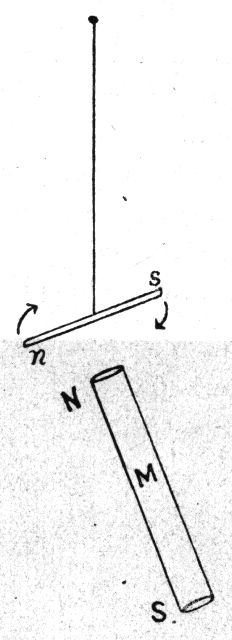
Fig. 184.—Magnet M causes deflection of the needle n s, suspended by a thin wire. Increase of magnetisation of M increases deflection, while decrease of magnetisation diminishes the deflection.
I have in Chapter XLIII adduced facts which appear to show that the power of geo-perception declines at high temperatures. As regards motile reaction, we have seen that in Mimosa it increases from a minimum to an optimum temperature beyond which there is a depression (p. 55). As the optimum temperature for geo-perception is not necessarily the same as that for responsive curvature, the result is likely to be very complex.
The case becomes simpler after the attainment of maximum curvature. Enhanced temperature has a tendency to diminish the tropic curvature, as we found in the arrest and reversal of phototropic curvature under the application of warmth (p. 393); it appears as if rise of temperature induced a relatively greater expansion of the contracted side of the organ.
I shall now describe the effect of rising temperature on geotropic curvature in general, including torsion. A horizontally laid shoot curves upwards under geotropic action; a dorsiventral organ, owing to the differential excitabilities of its upper and lower sides, places itself in the so-called dia-geotropic position. A dorsiventral organ, moreover, exhibits a torsional movement under lateral stimulus of gravity.
In the geotropic movements we are able, as stated before, to distinguish three different phases (cf. Fig. 161). In the first, the movement initiated undergoes an increase; in the second, the rate of movement becomes more or less uniform; and in the last phase, a balance takes place between the tropic reaction, and the increasing resistance of the curved or twisted organ to further distortion.
The question now arises whether this position of geotropic equilibrium is permanent, or whether it undergoes modification in a definite way by variation of temperature. I shall proceed to show that the position of equilibrium undergoes a change in one direction by a rise, and in the opposite direction by a fall of temperature. I shall use the term thermo-geotropism as a convenient phrase to indicate the effect of temperature in modification of geotropic curvature and torsion.
I shall first deal with the effect of variation of temperature on geotropic torsion. Under the continued action of stimulus of gravity the torsion increases till it reaches a limit; for the twisted organ resists further distortion and a balance is struck when the twisting and untwisting forces are equal and opposite. In this state of equilibrium the effect of an external agent, say of variation of temperature, will bring about an upset of the balance. The torsion will be increased if the external agent induces an enhancement of geotropic action; it will, on the other hand, be decreased when it induces a diminished reaction.
A physical analogy will make this point clear; imagine a small magnetic needle suspended by a thin wire; the earth's directive force is supposed to be annulled by the well known device of a compensating magnet. A second and larger magnet M is now placed at right angles to the suspended needle; N will repel n and attract s, and a deflection will be produced, the deflecting force of the magnet M being balanced by the force of torsion of suspending wire (Fig. 184).
The state of equilibrium will however be disturbed by variation of the magnetic force of M. It is known that a rise of temperature diminishes magnetisation while lowering of temperature increases it. Hence the deflecting force of the magnet will be diminished under rise of temperature with concomitant diminution of deflection of the needle and the torsion of the wire. Fall of temperature, on the other hand, will cause an increase of deflection and of torsion. The physical illustration given above will help us to understand how the physiological effect of variation of temperature may bring about changes in geotropic curvature and torsion.
TROPIC EQUILIBRIUM UNDER VARYING INTENSITIES OF STIMULUS.
The following experiment will show that the position of tropic equilibrium is not fixed but subject to variation under changes of effective stimulation.
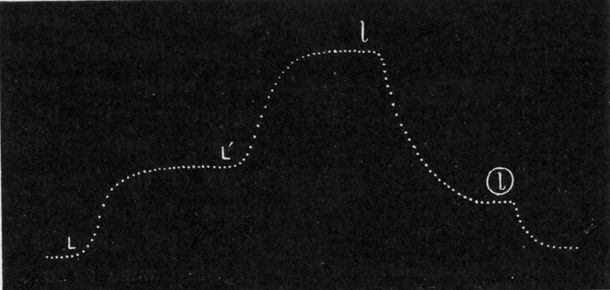
Fig. 185.—Effect of variation of intensity of light on phototropic equilibrium. Increase of intensity of light from L to L' produces an increased positive curvature and a new state of balance. Diminished intensity of light l brings about a new balance at a lower level. The cessation of light (l within a circle) restores the normal position of the organ.
Experiment 198.—I have explained how a maximum tropic curvature is induced under continued action of light. Employing the pulvinus of Erythrina indica I applied light on the upper half of the pulvinus: (1) of medium intensity L, (2) of strong intensity L', and (3) of feeble intensity l. The source of light was an arc lamp; the intensity of light was varied by means of a focussing lens, which gave a parallel, a convergent or a divergent beam, with corresponding increase or diminution of intensity of light. Light was in each case continued till equilibrium was reached. Inspection of figure 185 shows that the position of equilibrium depends on the intensity of stimulation; the balance is 'raised' under increased and 'lowered' under decreased intensity.
In the case of geotropism the stimulus is constant, but its tropic effect, we shall presently see, undergoes variation with changing temperature.
EFFECT OF VARIATION OF TEMPERATURE ON GEOTROPIC TORSION.
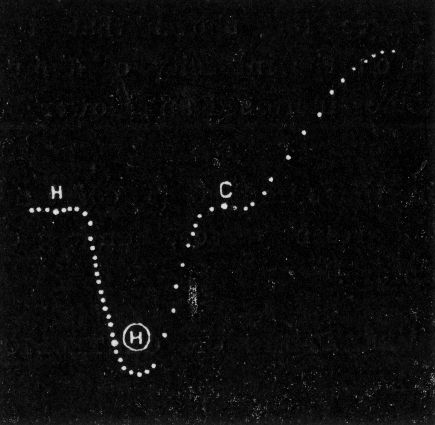
Fig. 186.—Effect of variation of temperature on geotropic torsion. Application of warmth at H diminishes the geotropic torsion; return to normal temperature (H) restores the original torsion; cooling at C, increases the geotropic torsion.
Modification of geotropic torsion: Experiment 199.—The Mimosa plant was placed on its side, so that the pulvinus was subjected to lateral geotropic action. In response to this it underwent torsion, the upper half of the pulvinus tending to place itself so as to face the vertical lines of gravity. This torsional response was recorded as an up-movement; on the attainment of equilibrium the record became horizontal. The plant was now subjected to a cyclic variation of temperature, and the resulting variation of torsion recorded at the same time. The temperature of the plant chamber was gradually raised from the normal 30° to 34° C. and then allowed to return to the normal; finally the temperature was lowered to 26°C. Rise of temperature was effected by means of an electrical heater placed inside the chamber with a vessel of water placed above it. Care has to be taken that the rise of temperature is gradual, since a sudden variation often acts as a stimulus. The water in the vessel not only keeps the chamber in a humid condition but also prevents sudden fluctuation of temperature. After the temperature had been raised to 34°C., the heating current was stopped and the door of the plant chamber gradually opened, so as to allow the temperature to be restored to the normal. Cooled air was next introduced into the chamber till the temperature fell to 26°C. Figure 186 exhibits clearly the effect of variation of temperature on geotropic torsion. The maximum torsion had been attained at 30°C. and the first part of the record is therefore horizontal. Warmth was applied at H, and after a latent period of ten minutes, the geotropic torsion underwent a continuous diminution till a new state of equilibrium was reached at 34°C. This took place shortly after the stoppage of the heating current at (H). On return to normal temperature the torsional balance was restored to its original position of equilibrium. Application of cold at C, is seen to bring about a new state of balance with an increase of geotropic torsion.
The position of geotropic equilibrium is thus seen to be modified by variation of temperature, the tropic effect being diminished with the rise, and enhanced with the fall of temperature.
It may be thought that the phenomenon just described may not be different from ordinary thermonasty, exhibited by the perianth leaves of Crocus and Tulip in which a rise of temperature induces a movement of unfolding, and a fall of temperature brings about the opposite movement of closure. In these cases the movement is determined solely by the natural anisotropy of the organ, and not by the paratonic action of a directive external force. Thus the inner side of the perianth leaves undergoes an expansion with rise of temperature attended by the opening of the flower; this movement of opening does not undergo any change on holding the flower in an inverted position.
But the torsional movement of the leaf of Mimosa, and the induced variation of torsion under change of temperature are not solely determined by the natural anisotropy of the organ; it is, on the contrary, regulated by the directive action of the stimulus of gravity. The pulvinus in normal position does not exhibit any geotropic torsion and in the absence of an antecedent torsion change of temperature cannot induce any variation in it. It is only after the pulvinus had become torsioned under the lateral action of geotropic stimulus that a responsive variation is induced in it by the action of changing temperature.
The change in torsion is, moreover, determined in reference to the paratonic action of incident geotropic stimulus. This will be clearly understood from the tabular statement given below.
TABLE XLVI.—SHOWING THE EFFECT OF RISE OF TEMPERATURE ON GEOTROPIC TORSION.
Position of the organ. Geotropic effect.Effect of rise of temperature.
Right flank above:Right-handed torsion.Left-handed torsional movement (untwist).
(a) position.
Left flank above:Left-handed torsion.Right-handed torsional movement (untwist).
(b) position.
By right flank in the above table is meant the side of the pulvinus to the right of the observer facing the leaf of the plant held in the normal position. When the plant is laid on its left side in the a-position, the right flank will be above and the responsive torsion under geotropic stimulus becomes right handed or with the hands of a clock (Cf. Fig. 179). When the plant is laid on its right side, the left flank will be above and the geotropic torsion becomes left handed or against the hands of the clock.
It will be seen from the above that in whatever way the experimental condition may be varied, the movement in response to variation of temperature is determined in relation to the antecedent geotropic torsion. The geotropic effect whether left-handed or right-handed torsion is always diminished by the rise of temperature, and enhanced by the fall of temperature.
VARIATION OF APO-GEOTROPIC CURVATURE UNDER THERMAL CHANGE.
I shall now proceed to show that variation of temperature not merely induces variation of geotropic torsion but also of geotropic curvature. I shall first demonstrate the effect of thermal change on geotropic curvature of the shoot, and then demonstrate its effect on dia-geotropic curvature of leaves.
Experiment 200.—A specimen of Tropæolum majus grown in a small flower pot, is laid on its side. Under geotropic action the shoot becomes curved, the upper side becoming concave and the lower side convex. The end of the stem is attached to the recording apparatus; when the plant is subjected to a rise of temperature, the movement induced shows that the geotropic effect has undergone a diminution, the curvature exhibiting a flattening; lowering of temperature, on the other hand, increases the geotropic curvature. Other instances of this will be found in a subsequent chapter. The diurnal movement of the 'Praying Palm' is a striking example of the effect of variation of temperature in modification of geotropic curvature (p. 30). Rise of temperature is thus shown to diminish geotropic torsion of dorsiventral organs, and the apo-geotropic curvature of radial organs. We have next to study the effect of temperature variation on the dia-geotropic equilibrium of leaves.
EFFECT OF VARIATION OF TEMPERATURE ON DIA-GEOTROPIC EQUILIBRIUM.
In the normal position of the plant, the leaf of Mimosa assumes, under geotropic action, an equilibrium position which is approximately horizontal. I shall proceed to show that this position of equilibrium also undergoes appropriate variation under changing temperature, the leaf undergoing a fall during rise, and an erection during fall of temperature.
I stated that the torsional response is one of the means of recording geotropic effect and its variations. In the ordinary position of the plant, the geotropic variation will be indicated by the responsive up or down movement of the leaf in a vertical plane. Taking the leaf of Mimosa, we have thus the means of studying the effect of variation of temperature by two independent means of inquiry, namely, by record of ordinary responsive movement in a vertical plane, and also by record of torsional response. The variation of temperature which induces these movements may be simultaneously recorded by means of a differential metallic thermometer. The Multiplex Recorder employed for this research consists of three recording levers. A photographic reproduction of the apparatus will be found in a subsequent chapter (see Fig. 190). The first lever is attached to the leaf of Mimosa placed in the normal position; the second lever records the torsional response of Mimosa leaf, the plant being placed on its side; the third lever attached to the differential metallic thermometer gives a continuous record of variation of temperature.
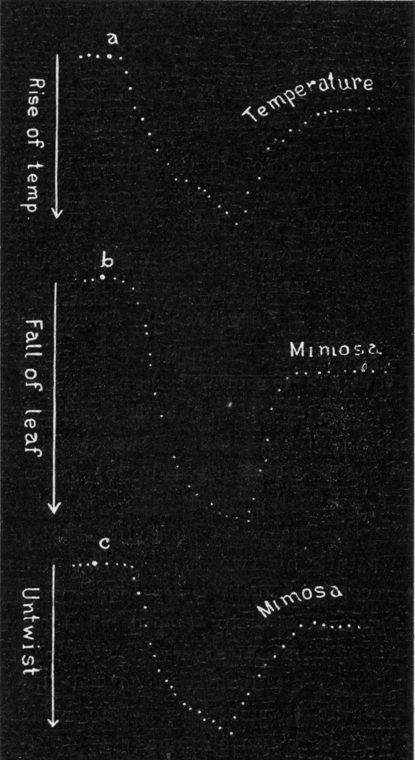
Fig. 187.—Simultaneous record (a) of variation of temperature, (b) of up or down movement of leaf of Mimosa, and (c) of variation of torsion. Rise of temperature is attended by fall of leaf and diminution of torsion, fall of temperature inducing the opposite effect.
Effect of variation of temperature: Experiment 201.—Special arrangement was made for gradual variation of temperature in the plant chamber. Two rectangular metallic vessels each 50 × 30 × 6 cm. were placed on opposite sides of the plant chamber, and warm water was made to circulate through them; this device ensured a steady rise of temperature. The flow of warm water was then stopped and the plant chamber was allowed to cool down; the fall of temperature was at first moderately rapid, but later on the rate of cooling became extremely slow; on account of this the temperature of the plant chamber, towards the end of the experiment remained higher than the normal temperature outside. The rate of rise and fall of temperature during the entire course is illustrated in the thermo-graphic (a) tracing (Fig. 187); the record (b) exhibits the movement of the leaf in a vertical plane, rise of temperature being attended by a diminution of geotropic curvature resulting in the fall of the leaf, the fall of temperature inducing the opposite effect. In record (c) is seen the responsive variation of geotropic torsion, rise of temperature inducing a diminution and fall of temperature causing an enhancement of torsion. The results obtained by diverse methods thus prove that the geotropic effect is diminished under rise, and increased under fall of temperature.
SUMMARY.
The position of equilibrium under geotropic action is not fixed but undergoes change with variation of temperature.
The geotropic curvature and torsion are increased by lowering of temperature, and decreased by rise of temperature. This is equally true of apo-geotropic and dia-geotropic curvatures.