Volume 2 / Part 4 — LI.—THE DIURNAL MOVEMENT OF THE LEAF OF MIMOSA
Reading edition
By Sir J. C. Bose.
In the standard curve of nyctitropic movement under thermo-geotropism described in a previous paper, the diurnal record consisted of an up-curve from thermal-noon to thermal-dawn, and a down-curve from the thermal-dawn to thermal-noon. The responding organ, which may be an inclined stem or a horizontally spread petiole, underwent an erection during the decline of temperature, and a fall with the rise of temperature. The diurnal record of the Mimosa leaf appears, however, to be totally different.
Experiment 220.—I obtained the diurnal record of Mimosa (Fig. 210) for twenty-four hours commencing at 2 p.m. which is the thermal-noon. The summer and winter records are essentially the same; the only difference is in the greater vigour of movement exhibited by summer specimens. The diurnal movement of the leaf is very definite and characteristic; for the curves taken five years ago do not differ in any way from those obtained this year. The record may conveniently be divided into four phases.
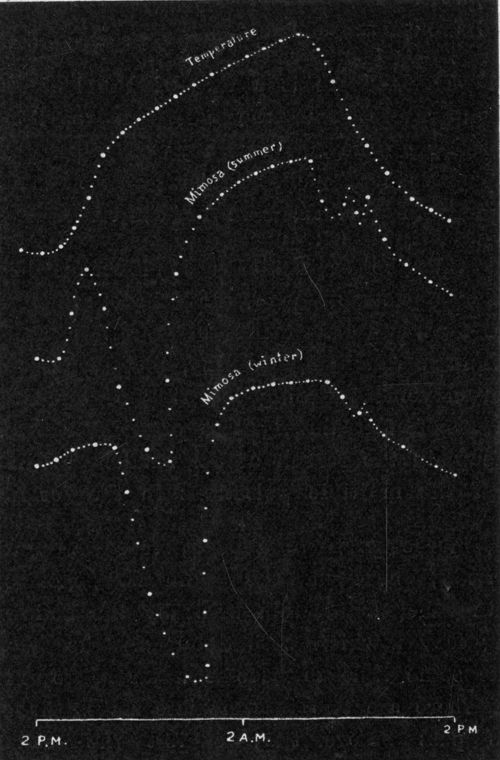
Fig. 210.—Diurnal record of Mimosa in summer, and in winter. Leaf rises from 2 to 5 p.m., when there is a spasmodic fall. Leaf re-erects itself from 9 p.m. to 6 a.m. after which there is a gradual fall till 2 p.m. with pulsations. The upper-most record gives temperature variation, up-curve representing fall of temperature and vice versâ.
First phase.—The leaf erects itself after the thermal-noon up to 5 or 5-30 p.m. The temperature, it should be remembered, is undergoing a fall during this period.
Second phase.—There is a sudden fall of the leaf in the evening which continues till 9 p.m. or thereabout.
Third phase.—The leaf erects itself till thermal-dawn at about 6 a.m. next morning.
Fourth phase.—There is a fall of the leaf during the rise of temperature from thermal-dawn to thermal-noon. The uniformity of the fall is, however, interrupted by one or more pulsations in the forenoon. These pulsations are more frequent in summer than in winter.
It will thus be seen that the difference between the normal thermo-geotropic curve, and the curve of Mimosa is not so great as appears at first sight. With the exception of the spasmodic fall in the evening, the diurnal curve shows an erectile movement during lowering of temperature, and a movement of fall during rise of temperature. I shall presently explain the reason of the sudden fall in the evening, and of the multiple pulsations in the forenoon.
I have, moreover, been able to trace a continuity in Mimosa itself, between the standard thermo-geotropic reactions and the modification of it by the action of light. The young leaves which sprout out at the beginning of spring take some time to become adjusted to the diurnal variation. There are two intermediate stages through which the leaves pass before they exhibit their characteristic diurnal curve. Slow rhythmic pulsations are at first seen to occur during day and night. At the next stage the leaves exhibit the diurnal movement of fall from thermal-dawn to thermal-noon, and movement of erection from thermal-noon to thermal-dawn next morning, the record being in every way similar to the standard thermo-geotropic curve. It is only at the final stage that there is a spasmodic fall in the evening which we shall find is the characteristic after-effect of light.
Before proceeding further I shall refer briefly to the theory of Millardet in explanation of the diurnal movement of the leaf of Mimosa. He found that the tension in stems, and presumably its turgor, is increased with rise and decreased with fall of temperature. The movement of the lateral leaf may, therefore, be due to the induced variation of tension in the main axis. Had this been the case the minimum tension would have occurred at the minimum temperature in the morning, and the leaf should have undergone a maximum fall. The maximum temperature attained in the afternoon should have, on the other hand, brought about the maximum erection. The observed facts are, however, the very opposite to these. Kraus and Millardet also found that light and darkness had great influence on the tension, which increases in darkness and diminishes in light. The tension at dawn may therefore be a resultant of the depressing effect of low temperature opposed by the promoting effect of darkness, the latter being the predominant factor. The erect position of Mimosa leaf in the morning may thus be accounted for by the resultant increase of tension of the stem. The explanation of the movements of the leaves is thus to be attributed to the variation of tension in the main axis to which the leaves are attached; this leads to the conclusion that the leaf movement should be determined in relation to the plant, and not in relation to the external stimulus. I shall, however, describe a crucial experiment in the course of this paper, which will show that the direction of stimulus of gravity has a determining influence on the periodic movement. The sudden fall of the leaf before evening is again inexplicable from the theory of periodic variation of tension.
The complexity in the diurnal movement in Mimosa arises from the fact that there are three factors whose fluctuating effects are different at different parts of the day. The effect at any particular hour results from the algebraical summation of the following factors: (1) the thermo-geotropic action, (2) the immediate effect of photic stimulus and (3) the after-effect of light. The leaf of Mimosa has, moreover, as I shall show, an autonomous movement of its own. I shall take up the full consideration of the subject in the following order:
1. The thermo-geotropic reaction.—A crucial experiment will be described which demonstrates the effect of thermo-geotropism in the diurnal movement of the leaf of Mimosa.
2. Autonomous pulsation of Mimosa.—The natural pulsation of the plant is obscured by the paratonic effect of external stimuli. I shall explain the method by which the natural pulsation of the leaf becomes fully revealed.
3. The immediate effect of light.—This is not constant, but will be shown to undergo a definite variation with the intensity and duration of light. A very great difficulty in the study of effect of daylight at different parts of the day is introduced on account of the absence of any reliable recorder for measurement of fluctuation of light. I shall describe a device which gives a continuous record of photic variation for the whole day.
4. The after-effect of light.—The spasmodic fall of the leaf of Mimosa towards the evening presents the most difficult problem for solution. I shall first describe the diurnal movement of another plant which presents characteristics similar to those of Mimosa. I shall also demonstrate the various after-effects of light at different parts of the day. These results will offer the fullest explanation of the sudden fall of the leaf towards evening.
As regards the sudden fall of the leaf about evening, Pfeffer regarded it as due to increased mechanical moment of the secondary petioles moving forward on the withdrawal of light. I shall, however, in the course of this paper show, that the characteristic movements occur even after complete removal of the sub-petioles. In the following experiment, carried out with the intact plant, the effect of possible variation of weight is completely eliminated. In spite of this, the diurnal movement exhibited its characteristic phases including sudden movement in the evening.
The experiment I am going to describe will exhibit the diurnal curve obtained by an entirely different method, and will clearly exhibit the thermo-geotropic effect, as well as the immediate and after-effect of light.
DIURNAL VARIATION OF GEOTROPIC TORSION.
I have shown that the pulvinus of Mimosa, subjected laterally to the action of stimulus of gravity, exhibits a torsional response. When the Mimosa plant is laid sideways, so that the plane of separation of the upper and lower halves of the pulvinus is vertical, geotropic stimulus acts laterally on the two halves of the differentially excitable pulvinus. When the less excitable upper half is to the left of the observer (see Fig. 179), the responsive torsion under geotropic stimulus will be clock-wise, the less excitable upper half of the pulvinus being thereby made to face the vertical lines of gravity. When the plant is turned over to the other side (the less excitable upper half being now to the right of the observer) the induced torsion will be counter clock-wise. The response is therefore determined by the directive action of stimulus of gravity. Light has also been shown to give rise to torsion (p. 400). Light acting in the same direction as the stimulus of gravity, i.e., from above, enhances the rate of torsion, the curve of response being due to the joint effects of light and gravity.
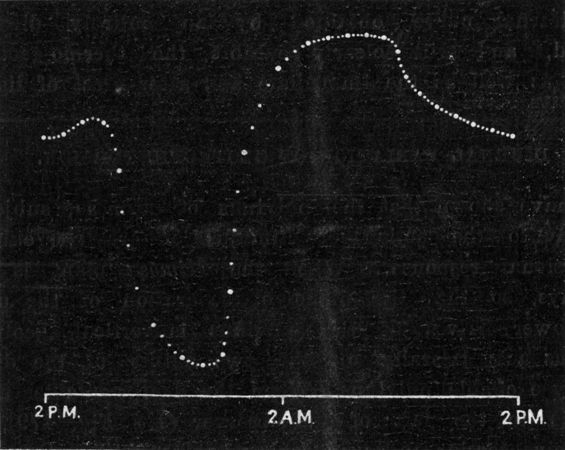
Fig. 211.—Record of diurnal variation of torsion in Mimosa leaf. Up-curve represents increase and down-curve decrease of geotropic torsion.
Experiment 221.—I obtained 24 hours' record of variation of torsional response of Mimosa, commencing with thermal-noon at 2 p.m. It is to be borne in mind that increase of torsion indicates increase of geotropic action, just as the erectile movement of the leaf in the normal position indicates the enhanced geotropic effect. Inspection of figure 211 shows that the fall of temperature after thermal-noon was attended by increase of torsion. The curve went up till about 5 p.m., as in the ordinary record of Mimosa. The torsion suddenly decreased with the rapid diminution of light after 5 p.m. The torsion then increased with falling temperature from 9 p.m. till thermal-dawn next morning. After 6 a.m. there is a continuous diminution of torsion till 5 p.m.
We may now summarise the diurnal variation of torsion exhibited by Mimosa. The torsion undergoes a periodic increase during the fall of temperature from afternoon till next morning, and a diminution during rising temperature from morning till afternoon. A sudden diminution of torsion occurs at about 5 p.m. due to the disappearance of light. The torsional record is, to all intents and purposes, a replica of the record of periodic up and down movements of the leaf.
This method of torsion has several advantages over the ordinary method. First, the petiole being supported by the loop of wire, the weight of the leaf has no effect on the curve of response. In the second place, the periodic variation of turgor of the stem, as suggested by Millardet, will not in any way affect the record. Variation of turgor can only cause a swing to and fro, in a direction perpendicular to the plane which divides the pulvinus into upper and lower halves; it can in no way induce a torsional movement, or a variation of the rate of that movement.
The automatic pulsation of the leaf of Mimosa.—The occurrence of the pulsatory response in the morning record of Mimosa led me to search for multiple activity in the response of the pulvinus. I have in my previous investigation on the electric response of Mimosa obtained multiple series of responses to a single strong stimulus. Blackman and Paine have recently shown that an isolated pulvinus of Mimosa exhibit multiple mechanical twitches under excitation.[45]
Even under normal conditions, the sprouting young leaves in March, as already stated, exhibit automatic pulsations throughout the day and night; in older leaves tuned to diurnal periodic movements, these natural pulsations are more or less suppressed. But in the forenoon, several pulsations are exhibited even by the old leaves.
The question may now be asked: Why should the pulsations occur preferably in the morning? In connection with this I shall refer to the suppression of the pulsatory activity of Desmodium gyrans when the leaflet was pulled up by the action of light (cf. Fig. 188). The leaf of Mimosa executes a very rapid movement of erection at night, and the natural pulsations are thereby rendered very inconspicuous. These pulsations may, however, be found in the night record of young leaves. The general occurrence of pulsations in the forenoon is probably due to the fact that the resultant force which causes the down-movement is at the time relatively feeble—the operative factors being: (1) the action of the rising temperature which induces down-movement, and (2) the action of light which in the forenoon opposes this movement. It will thus be seen that the forces in operation in the forenoon are more or less in a state of balance, hence conditions for exhibition of natural pulsations are more favourable in the morning than in other parts of the day.
Experiment 222.—I next tried to discover conditions under which the plant would exhibit its normal rhythmic activity during the whole course of 24 hours. The external stimuli which may interfere with the exhibition of its automatic pulsations are those due to gravity and light. They act most effectively on the pulvinus, when that organ is more or less horizontal and therefore at right angles to the direction of the incident stimulus; they act least effectively on the pulvinus when the organ is parallel to the direction of the external force. This latter condition may be secured by holding the plant upside down, when the pulvinus bends up and the leaf becomes erect and almost parallel to the vertical lines of gravity and to vertical light from above. The leaf, now relatively free from the effects of external stimulus, was found to exhibit its autonomous pulsations for more than seven days. I reproduce two sets of records (Fig. 212) for 24 hours each, obtained on the first and the third day. The average period of a single pulsation is slightly less than six hours; but this is likely to be modified by the age of the specimen and the temperature of the environment.
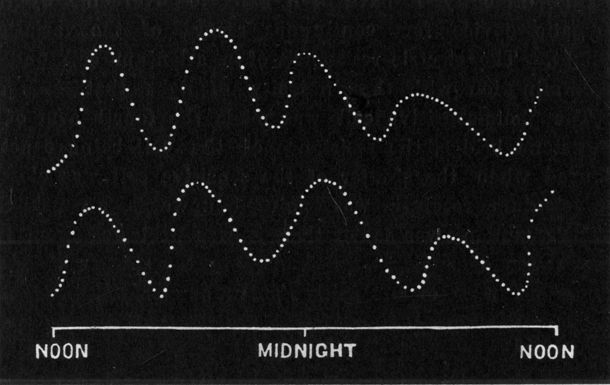
Fig. 212.—Continuous record of automatic pulsation of Mimosa leaf. The two series are for the first and the third day.
One of the factors that determines the diurnal movement of the leaf is the immediate and after-effect of light. The movement under the action of light, is modified by the intensity and duration of illumination. The experimental investigation of the subject offers many difficulties, principally owing to the absence of any reliable indicator for the varying intensity of light during the course of the day.
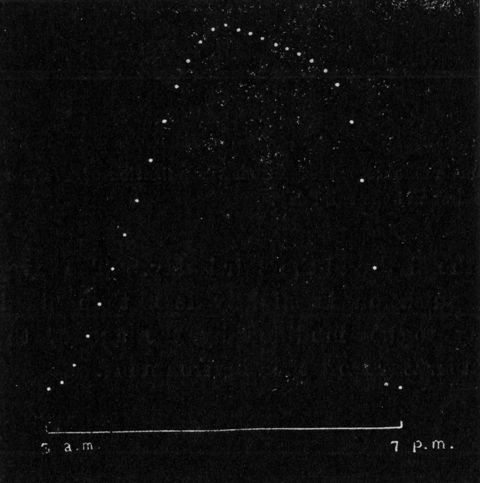
Fig. 213.—Photometric record showing variation of intensity of light from morning to evening. Successive dots are at intervals of 30 minutes.
THE PHOTOMETRIC RECORDER.
This difficulty I have been able to overcome by the automatic device for continuous record of the variation of light. The electric resistance of a selenium cell undergoes diminution with the intensity of light that falls on it. The photo-sensitive cell was made the fourth arm of a Wheatstone bridge, the resistance of the cell being exactly balanced when the shutter of the sensitive cell was closed. The selenium receiver was pointed upwards against the sky. Precaution was taken that it was protected from the direct action of sunlight. On opening the shutter a deflection of the index of a sensitive galvanometer was produced, and the deflection increased with increasing intensity of diffuse skylight. The special difficulty was in securing automatic record of the galvanometer deflections. This was obtained by a special contrivance of an oscillating smoked glass plate, the up and down oscillation being at intervals of 30 minutes. A detailed account of this apparatus will, with its possibilities for meteorology, be given in a future paper. I reproduce the record obtained in my greenhouse on the 5th March (1919), which gives a general idea of the variation of the light from morning to evening (Fig. 213). The record shows that the light began to be perceptible at 5-30 a.m., and that the intensity increased rapidly and continuously till it reached a climax at noon, after which it began to decline slowly. The decline of intensity of light was very abrupt after 5 p.m., the effect being reduced to zero at 6-30 p.m.
THE EFFECT OF DIRECT LIGHT.
Under natural conditions, the leaf of Mimosa is acted on by light from above, and it is generally supposed that the pulvinus is positively phototropic, that is to say, it curves upwards till the leaf is placed at right angles to the direction of light. My investigations show, however, that the phototropic effects vary from positive to negative through an intermediate stage of neutralisation, these depending on the intensity and duration of exposure. When light acts continuously on the upper half of the pulvinus, there follows the following sequences of reaction:
(1) The leaf is at first erected by the contraction of the upper half of the pulvinus due to direct action of light acting from above.
(2) Under continuous stimulation of the upper half of the pulvinus by light, the excitation is slowly conducted to the lower half across the pulvinus. In consequence of this transmitted excitation, the lower half begins to contract and thus neutralises the first effect of erection. The upper half of the pulvinus is less contractile than the lower half, and the neutralisation is due to the full contraction of the upper half antagonised by slight contraction of the lower half. The horizontal position of the leaf under light is therefore the result of balance of the two antagonistic reactions. If the incident light be very strong, the more intense transmitted excitation induces greater contraction of the lower half, and bring about a resultant down-movement (cf. p. 331).
Let us consider the effect of daily variation of light on Mimosa; we have here to take account both of intensity and duration. The intensity of light is seen to undergo a continuous increase which reaches a climax at noon; it then begins to decline slowly and the diminution of intensity of light is very abrupt after 5 p.m.
Under natural conditions the following phototropic effects are observed during the course of the day: light acting from above induces an up-movement of the leaf; but this is opposed by the thermo-geotropic fall of the leaf due to rise of temperature. As the two opposing effects are nearly balanced, any fluctuation of the relative intensity of the two gives rise to the pulsatory movements often seen in the forenoon; the Mimosa leaf has moreover an autonomous movement of its own. Under continued action of light neutralisation begins to take place after 1 p.m. (cf. Expt. 135). Later in the day the phototropic effect may become negative; reversal into this negative takes place under the joint action of intensity and duration of light; it takes place earlier under strong, and later under feeble, light.
THE EVENING SPASMODIC FALL OF THE LEAF.
I shall now deal with the difficult problem of the sudden fall of the leaf after 5 p.m. Pfeffer regarded this sudden fall in the evening as due to the increased mechanical moment of the secondary petioles moving forward on the withdrawal of light. But the following experiment shows that the increased mechanical moment cannot be the true explanation of the fall.
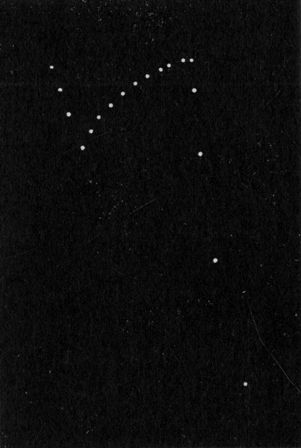
Fig. 214.—Record of leaf of Mimosa after amputation of sub-petioles. The leaf fell up to 2-30 p.m., and rose till 5 p.m., after which there is a spasmodic fall. (Successive dots at intervals of 15 minutes.)
Diurnal movement of the amputated petiole: Experiment 223.—In my present experiment the possibility of variation of mechanical movement was obviated by cutting off the end of the petiole, which carried the sub-petioles. The cut end was coated with collodion flexile to prevent evaporation. The intense stimulus caused by amputation induced the excitatory fall of the leaf, but it recovered its normal activity after a period of three hours or so. The diurnal record of the leaf was commenced shortly after 1 p.m.; it will be noticed that the leaf, though deprived of the weight of its sub-petioles, still exhibited a sudden fall at about 5 p.m. (Fig. 214). The fall of the leaf cannot therefore be due to increased mechanical moment. The effect of weight was, moreover, eliminated in torsional response (Expt. 221). In spite of this the leaf exhibited a sudden movement after 5 p.m.
Pfeffer has in his 'Entstehung der Schlafbewegung' (1907) offered another explanation of the sudden fall of the leaf of Mimosa. This, according to him, is not the direct effect of diminished intensity of light in the evening, but is due to the release of the leaf from the phototropic action of light, which, so long as it is sufficiently intense, holds the leaf in the normal position with its upper surface at right angles to the incident rays. Thus, on being set free from the strong action of light, the leaf moves in accordance with the preceding condition of tension; and as this is low the leaf falls, soon to rise again as the tension increases in prolonged darkness.
The above explanation presupposes: (1) that the tension was continuously decreasing till the evening, and (2) that as soon as the phototropic restraint which held the leaf up was removed it fell down in accordance with the prevailing diminished tension.
Referring to the first point, an inspection of the diurnal curve of Mimosa shows that the leaf had no natural tendency to fall towards the evening. There was on the contrary a movement of erection, on account of fall of temperature after the thermal-noon (Fig. 210). As the natural tendency of the leaf was to erect itself, the removal of phototropic restraint cannot therefore induce a movement of fall.
As regards the factor of light, the effect in the afternoon is a down-movement on account of transverse conduction of excitation; but the leaf is prevented from exhibiting this down-movement by the thermo-geotropic up-movement due to fall of temperature after the thermal noon. I shall presently describe experiments on the pure effect of light, which will show that the action of continued photic stimulus induces a down-movement of the leaf in the afternoon.
The results of experiments that have been described show that the sudden fall of the leaf in the evening could not be due to:
(1) increased mechanical moment,
(2) the natural tendency of the leaf to fall towards evening against phototropic action by which the leaf is held up.
The above explanations having proved unsatisfactory we have to search for other factors to account for the fall of the leaf on the cessation of light. In this connection I was struck by the extraordinary similarity of the diurnal curve of the petiole of Cassia alata with that of Mimosa.
DIURNAL CURVE OF THE PETIOLE OF Cassia alata.
Experiment 224.—The leaf of Cassia exhibits as in the leaf of Mimosa a slight erectile movement after the thermal-noon at 2 p.m., there is next a sudden fall after 5 p.m., which continues about 9 p.m.; after this the leaf exhibits a continuous rise with the fall of temperature, till the climax is reached about 6 a.m. in the morning; the leaf then undergoes a fall with rise of temperature, there being a number of pulsatory movements in the forenoon, evidently due to unstable balance under the opposing effects of light and of rise of temperature (Fig. 215).
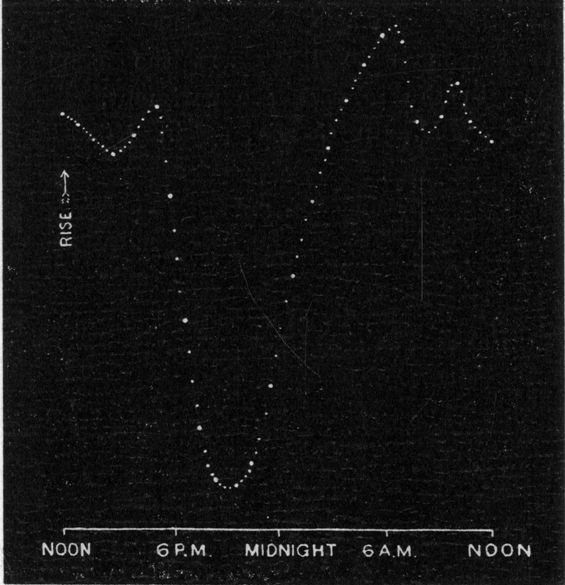
Fig. 215.—Diurnal record of Cassia leaf. Note similarity with diurnal record of Mimosa.
The reason of this similarity between the records of Cassia and Mimosa was found in the fact:
(1) That the main pulvinus of the leaf of Cassia is, like the pulvinus of Mimosa, differentially excitable, the lower half being more excitable than the upper. This is demonstrated by sending a diffuse electric shock through the leaf, the response being by a fall of the leaf due to the greater contraction of the lower half of the pulvinus. The leaf recovered after an interval of 20 minutes, the curve of response being similar to that of Mimosa. The only difference between the two organs is in the lesser excitability of the pulvinus of Cassia, on account of which a greater intensity of shock is necessary for producing the responsive fall.
(2) The responses to light are the same in both as will be seen in the following experiment.
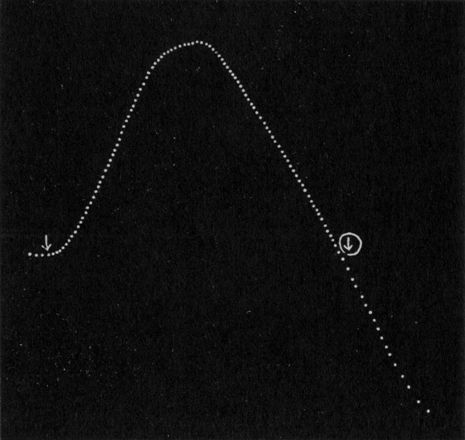
Fig. 216.—Post-maximum after-effect of light on response of leaf of Cassia. There is an over-shooting on cessation of light at arrow within a circle.
Experiment 225.—In Cassia, as in Mimosa, light acting from above induces at first an erectile movement which reaches a maximum; after this there is a neutralisation and reversal. In the record given in figure 216, light from a small arc lamp acting on the upper half of the pulvinus for 48 minutes gave the maximum positive curvature; this was completely neutralised by further exposure to light for 20 minutes. Light was cut off at neutralisation and there was a sudden fall beyond the equilibrium position, which was more rapid than the movement under light. The after-effect of prolonged exposure is thus an 'over-shooting' beyond the normal position of equilibrium.
RESPONSE OF Mimosa TO DARKNESS AT DIFFERENT PARTS OF THE DAY.
I now tried the effect of darkness on the movement of Mimosa, and was surprised to find that while artificial darkness caused a sudden fall of the leaf in the afternoon, it had no such effect in the forenoon.
Experiment 226.—Successive records were taken of the effect of artificial darkness for two hours, alternating with exposure to light for two hours. The plant was subjected to darkness by placing a piece of black cloth over the glass cover from 12 to 2 p.m., it was exposed to light from 2 to 4 p.m. and darkened once more from 4 to 6 p.m.
The record given in figure 217 shows that the leaf had been moving upwards under the action of light (positive phototropism); darkness commenced at the point marked with a thick dot. The after-effect on the stoppage of light is seen to be in the same direction as under light; this persisted for ten minutes followed by recovery which was complete by 2 p.m., as seen in the horizontal character of the curve. On restoration of light (at the point marked with the second thick dot) the leaf moved upwards till the positive phototropic movement attained a maximum in the course of an hour and twenty minutes, after which neutralisation set in, and by 4 p.m. the positive phototropic effect had become partially neutralised. Artificial darkness at the third thick dot caused a rapid down-movement which overshot the position of equilibrium. The difference of after-effect in the forenoon and in the afternoon lies in the fact that in the first case it was the pre-maximum after-effect; but in the second case the after-effect was post-maximum. I have already shown in the previous chapter that the pre-maximum after-effect of light is a short-lived movement in the same direction as under light, while post-maximum after-effect was a rapid over-shooting downwards beyond the equilibrium position. These characteristics are also found in the after-effects of light in Mimosa.
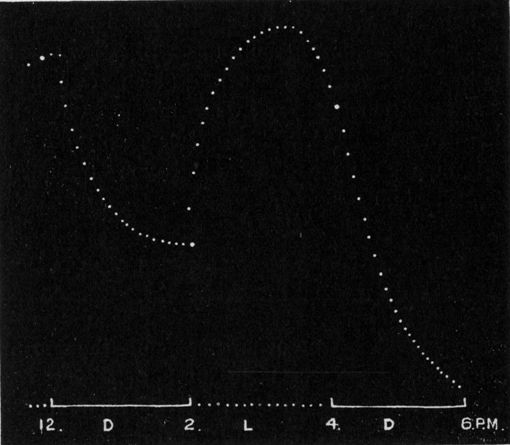
Fig. 217.—Effect of periodic alternation of light L, and of darkness D, on the response of Mimosa leaf. The first darkness causes the pre-maximal after-effect of slight erection followed by recovery. The subsequent application of light from 2 to 4 p.m. caused erectile movement followed by partial neutralisation by 4 p.m. Stoppage of light at the third thick dot caused a sudden fall of leaf below the position of equilibrium.
The responses of Mimosa on the cessation of light described above took place in the course of experiments which lasted for more than six hours. Objection may be raised that during this long period the temperature variation must have produced certain effects on the response. In order to meet this difficulty, I carried out the following experiments which were completed in a relatively short time. I have already explained how the period of experiment could be shortened by suitable increase of the intensity of light. The experiment was commenced inside a room at noon and completed by 2 p.m.; the temperature variation during this period was less than 1°C.
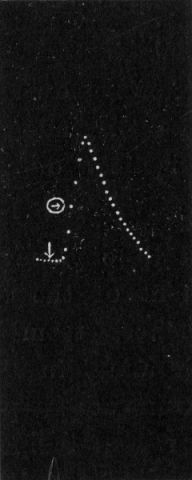
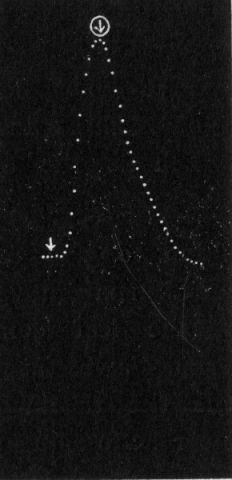
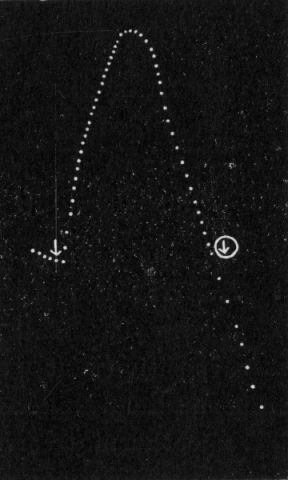
Fig. 218. Fig. 219. Fig. 220.
Fig. 218.—Pre-maximum after-effect of light in Mimosa.
Fig. 219.—After-effect at maximum.
Fig. 220.—Post-maximum after-effect exhibiting an 'over-shooting' below position of equilibrium.
In the above records light was applied at arrow, and stopped at the second arrow enclosed in a circle.
After-effect at pre-maximum: Experiment 227.—Light from an 100 c.p. incandescent lamp was focussed on the upper half of the pulvinus of Mimosa for 8 minutes, after which the light was turned off. The after-effect was a persistence of previous movement followed by recovery (Fig. 218).
After-effect at maximum: Experiment 228.—Continued action of light for 18 minutes induced maximum positive curvature as seen in the upper part of the curve becoming horizontal. On the stoppage of light, there was a recovery to the original position of equilibrium (Fig. 219).
After-effect at post-maximum: Experiment 229.—A fresh specimen of plant was taken for this experiment; it exhibited maximum positive curvature after an exposure of 20 minutes; continuation of light for a further period of 17 minutes produced complete neutralisation. Stoppage of light at this point, gave rise to a rapid down-movement (Fig. 220) below the equilibrium position.
The experiments that have been described show that the rapid fall of the leaf of Mimosa in the afternoon is due to 'over-shooting' which is the after-effect of prolonged action of light.
We are now in a position to give a full explanation of the different phases of diurnal movement of the leaf of Mimosa. The fall of the leaf commences from its highest position at thermal-dawn at 6 a.m. in the morning and continued till the thermal-noon at 2 p.m. This is the thermo-geotropic reaction due to rise of temperature. In the forenoon the phototropic action is positive, and the fall of the leaf, due to rise of temperature, is brought about in opposition to the action of light. The temperature begins to fall after 2 p.m. and the leaf begins to erect itself, and in the absence of any disturbing factor would have continued its up-movement till next morning. But light undergoes a rapid diminution after 5 p.m. and the after-effect of light is an 'over-shooting' in a downward direction. This fall continues till about 9 p.m., after which the leaf erects itself under thermo-geotropic action of falling temperature, the maximum erection being attained at the thermal-dawn at about 6 a.m.
SUMMARY.
The very complex type of nyctitropic movement of the primary petiole of Mimosa results from the combined effects of thermo-geotropism and phototropism.
With the exception of a small portion of the curve in the evening, the diurnal curve of Mimosa is similar to the standard thermo-geotropic curve, where the leaf exhibits an erectile movement from thermal-noon to thermal-dawn, and a fall from thermal-dawn to thermal-noon.
Investigations show that the leaf of Mimosa has an autonomous movement of its own, which persists throughout twenty-four hours.
The torsional response of Mimosa exhibits a diurnal variation similar to that exhibited by the leaf in normal position.
The leaf of Cassia alata exhibits a diurnal movement of the same type as that of Mimosa.
The spasmodic fall of the leaf towards evening is not due to the increased mechanical moment caused by the forward position of the sub-petioles. The record of the leaf with amputated sub-petioles exhibits the sudden fall in the evening as that of the intact leaf.
The evening fall of the leaf of Mimosa is shown to be due to the post-maximum after-effect of light, which causes an 'over-shooting', the leaf undergoing a fall below the position of equilibrium.
B. S. Press—5-11-1919—19754J—750—R. D'S.