Volume 2 / Part 3 — XXIX.—ON PHOTOTROPISM
Reading edition
By Sir J. C. Bose.
In different organs of plants the stimulus of light induces movements of an extremely varied character. Radial organs exhibit tropic movements in which the position of equilibrium is definitely related to the direction of incident stimulus. Nastic movements under the action of light are, on the other hand, regarded as curvatures of the organ which show "no relation to the stimulus but is determined by the activity of the plant itself".[9] There are thus two classes of response to light which seem to be unrelated to each other. Returning to the directive action of light, radial stems often bend towards the light, while certain roots bend away from it. It may be thought that this difference is due to specific difference of irritability between shoot and root, the irritability of the former being of a positive, and of the latter, of a negative character. But there are numerous exceptions to this generalisation. Certain roots bend towards the light, while a stem, under different circumstances, moves towards light or away from it. Again an identical organ may exhibit a positive or a negative curvature. Thus the leaflets of Mimosa pudica acted on by light from above fold upwards, the phototropic effect being positive. But the same leaflets acted on by light from below exhibit a folding upwards, the phototropic effect being now negative. Effects precisely the opposite are found with the leaflets of Biophytum and Averrhoa. They fold downwards whether light acts from above or below. Finally, a radial organ in found to exhibit under light of increasing intensity or duration, a positive, a dia-phototropic, or a negative phototropic curvature.
In these circumstances the theory of specific positive and negative irritabilities is untenable; in any case, it throws no light on the phenomenon of movement. The difficulties of the problem are thus clearly stated by Pfeffer: "When we say that an organ curves towards a source of illumination, because of its heliotropic irritability and we are simply expressing an ascertained fact in a conveniently abbreviated form, without explaining why such curvature is possible or how it is produced.... Many observers have unfortunately devoted their attention to artificially classifying the phenomenon observed, and have entirely neglected the explanation of causes underlying them."[10]
COMPLEXITY OF PROBLEM OF PHOTOTROPIC REACTION.
The complexity of phototropic reaction arises from the summated effects of numerous factors; for explanation of the resultant response it is therefore necessary to take full account of the individual effect of each of them.
Among these operative factors in phototropic reaction may be mentioned:—
(1) The difference of effects induced by light at the proximal and distal sides of the organ.
(2) The modification of the latent period with the intensity of stimulus.
(3) The after-effect of stimulus.
(4) The modifying influence of tonic condition on response.
(5) The effect of direction of light.
(6) The effect of intensity of light.
(7) The effect of duration of stimulation.
(8) The transmitted effect of light.
(9) The effect of unequal excitability in different zones of the organ.
(10) The effect of transverse conduction in modification of the sign of response.
(11) The effect of temperature on phototropic action.
(12) The modification of response due to differential excitability of the organ.
(13) Nastic and tropic reactions.
(14) The torsional effect of light.
The sketch given above will give us some idea of the complexity of the problem. In this and in the following papers I shall describe the investigations I have carried out on the subjects detailed above.
ACTION OF LIGHT.
I have shown that there is no essential difference between the responses of pulvinated and growing organs, that diminution of turgor induced by stimulus brings about contraction in the one, and retardation of the rate of growth in the other. Indirect stimulation, on the other hand, induces an expansion and acceleration of the rate of growth. The experimental investigation on the tropic effect of light may therefore be carried out both with pulvinated and growing organs.
As regards the effect of direct stimulus of light on growing organs we found (p. 208) that it induces an incipient contraction, seen in diminution of the rate of growth; this incipient contraction culminates in an actual contraction under increasing intensity of light. The contraction under direct stimulation is also observed in pulvinated organs. When light acts from above the upper half of the pulvinus undergoes contraction, resulting in erection of the motile leaf or leaflets. As regards the effect of indirect unilateral stimulus of light on the distal side of the organ, we found that its effect is an enhancement of turgor (p. 281). Hence the positive tropic curvature under light is brought about, as in the case of other forms of stimuli, by the contraction of the proximal, and expansion of the distal sides of the organ.
Various analogies have been noticed between phototropic and geotropic reactions, and it has been supposed that the two phenomena are closely related to each other. This has even led to assumption that there are phototropic particles which function like statoliths in geotropic organs. There is, however, certain outstanding difference between the two classes of phenomena. In the case of light, the incident energy is entirely derived from the outside. But in geotropism, the force of gravity by itself is ineffective without the intervention of the weight of cell-contents to exert pressure on the sensitive ectoplasm, and thus induce stimulation. This aspect of the subject will be treated in greater detail in a subsequent chapter.
POSITIVE PHOTOTROPIC CURVATURE.
I shall now describe the phototropic effect of unilateral light in pulvinated, and in growing organs. From the explanation that has already been given, it will be understood that the side of the organ directly acted on by light undergoes contraction and concavity.
Tropic curvature of pulvinated organs: Experiment 117.—For this experiment I employed the terminal leaflet of the bean plant. The source of illumination was 32 c.p. electric lamp, enclosed in a metallic tube with circular aperture for passage of light. The leaflet was attached to an Oscillating Recorder. Light was applied on the upper half of the pulvinus for 20 seconds; this induced an up-movement of the leaflet, due to the contraction of the upper half of the organ. Recovery took place in course of 8 minutes (Fig. 112).
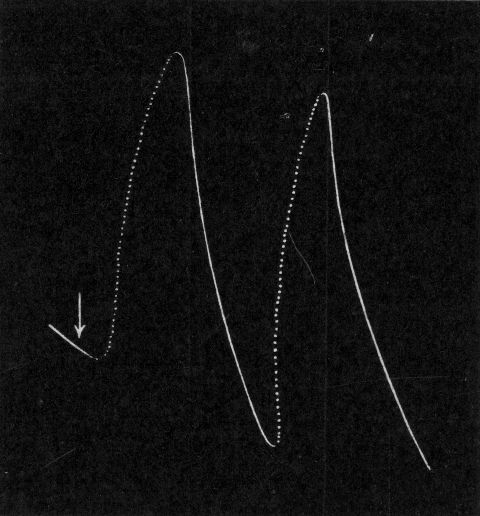
Fig. 112.—Successive positive responses of the terminal leaflet of bean. Light applied from above for 20 seconds; complete recovery in 8 minutes.
POSITIVE PHOTOTROPIC CURVATURE OF GROWING ORGANS.
Effect of moderate stimulation: Experiment 118.—I shall presently show that the intensity of phototropic reaction depends on the intensity and duration of the incident light. A moderate and effective stimulation may thus be produced by short exposure to strong light. For my present experiment I took a stem of Dregea volubilis, and applied light from a small arc lamp to one side of the organ for 1 minute; this induced a positive curvature followed by complete recovery on the cessation of light (Fig. 113).
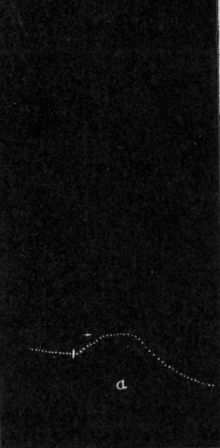
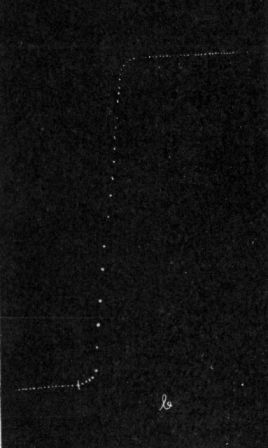
Fig. 113.Fig. 114.
Fig. 113.—Positive curvature under moderate phototropic stimulation. Note complete recovery (Dregea).
Fig. 114.—Persistent positive curvature under stronger stimulation (Dregea).
Effect of strong stimulation: Experiment 119.—After recovery of the stem of the last experiment, the same light was applied for 5 minutes. It is seen that the curvature is greatly increased (Fig. 114). Thus the phototropic curvature increases, within limits, with the duration of stimulation. The curvature induced under stronger stimulation remained more or less persistent. In certain instances there was a partial recovery after a considerable length of time; in others curvature was fixed by growth.
PHENOMENON OF RECOVERY.
On the cessation of stimulus of moderate intensity the heliotropically curved organ straightens itself; similar effects are also found in other tropic curvatures. Thus a tendril straightens itself after curvature induced by contact of short duration. The theory of rectipitality has been proposed to account for the recovery, which assumes the action of an unknown regulating power by which the organ is brought back to a straight line; but beyond the assumption of an unknown specific power, the theory affords no explanation of the mechanism by which this is brought about.
The problem before us is to find out the means by which the organ straightens itself after brief stimulation. It will also be necessary to find out why there is no recovery after prolonged stimulation. We have thus to investigate the after-effect of stimulus of various intensities on growth, and the Balanced Method of recording Growth offers us an unique opportunity of studying the characteristic after-effects.
IMMEDIATE AND AFTER-EFFECT OF LIGHT ON GROWTH.
As regards the effect of light I have already shown:
(1) that a sub-minimal stimulus induces an acceleration of growth, but under long continued action the acceleration is converted into normal retardation (p. 225),
(2) that a stimulus of moderate intensity induces the normal retardation of the rate of growth.
It is evident that there is a critical intensity of stimulus, above which there is a retardation, and below which there is the opposite reaction of acceleration. This critical intensity, I have found to be low in vigorous specimens, and high in sub-tonic specimens. Thus the same intensity of stimulus may induce a retardation of growth in specimens the tonic condition of which is above par, and an acceleration in others, in which it is below par. The following experiments will demonstrate the immediate and after-effect of light of increasing intensity and duration.
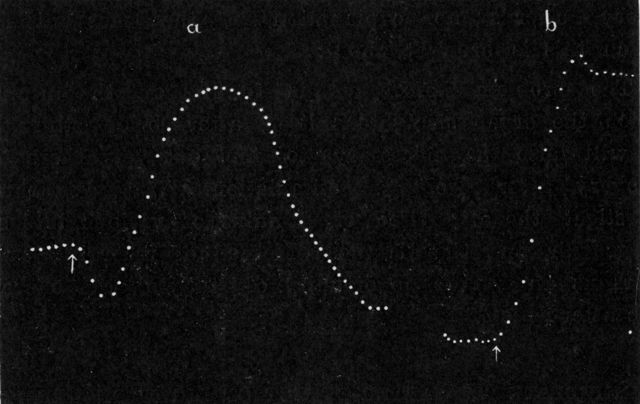
Fig. 115.—Immediate and after-effect of stimulus of light on growth. (a) shows immediate effect of moderate light to be a transitory acceleration (down-curve) followed by retardation (up-curve). The after-effect on cessation of light is an acceleration (down-curve) followed by restoration to normal. (b) Immediate and after-effect of stronger light: immediate effect, a retardation; after-effect, recovery to normal rate without acceleration.
Effect of light of moderate intensity: Experiment 120.—The source of light was a small arc lamp placed at a distance of 50 cm., the intensity of incident light was increased or decreased by bringing the source of light nearer or further away from the plant. Two inclined mirrors were placed behind the plant so that the specimen was acted on by light from all sides. A seedling of wheat was mounted on the Balanced Crescograph, and record was first taken under exact balance; this gives a horizontal record. The up-curve represents retardation, and down-curve acceleration of rate of growth. The source of light was at first placed at a distance of 50 cm. from the plant, and exposure was given for 4 minutes at the point marked with an arrow (Fig. 115a). We shall find in the next chapter that the intensity of phototropic effect is proportional to the quantity of incident light. This quantity at the beginning proved to be sub-minimal, and hence there was an acceleration at the beginning. Continued action induced the normal effect of retardation, as seen in the subsequent resulting up-curve. On the cessation of light, the balance was upset in an opposite direction, the resulting down-curve showing an acceleration of the rate of growth above the normal. This acceleration persisted for a time, after which the normal rate of growth was restored, as seen in the curve becoming once more horizontal. The after-effect of light of moderate intensity is thus a temporary acceleration of rate of growth above the normal.
Effect of strong light: Experiment 121.—The same specimen was used as in the last experiment. By bringing the source of light to a distance of 25 cm. the intensity of light was increased fourfold; the duration of exposure was kept the same as before. The record (Fig. 115b) shows that a retardation of rate of growth occurred from the very beginning without the preliminary acceleration. This is for two reasons: (1) the increased intensity was now above the critical minimum, and (2) the tone of the organ had become improved by previous stimulation. On the cessation of light, the after-effect showed no enhancement of rate of growth, the recovery from retardation to the normal rate being gradual. In the next experiment (the result of which is not given in the record) the intensity of light was increased still further; the retardation now became very marked, and it persisted for a long time even on the cessation of light.
We thus find that:
(1) The immediate effect of light of moderate intensity is a preliminary acceleration, followed by normal retardation. The acceleration is the effect of sub-minimal stimulation. The immediate after-effect is an acceleration above the normal.
(2) The immediate effect of strong light is a retardation from the beginning; the immediate after-effect shows no acceleration, the growth rate being gradually restored to the normal.
(3) Under very strong light the induced retardation is very great, and this persists for a long time even on the removal of light.
The experiments described explains the reasons of complete recovery after moderate stimulation, and also the absence of recovery after strong stimulation. The immediate after-effect of moderate stimulation is shown to be an acceleration of rate above the normal. Returning to tropic curvature, the contraction at the proximal side induced by unilateral light is thus compensated by the accelerated rate of growth on the cessation of light. There is no such compensation in the case of strong and long continued action of light; for the after-effect of strong light shows no such acceleration as the immediate after-effect.
We may perhaps go a step further in explaining this difference. Stimulus was found to induce at the same time two physico-chemical reactions of opposite signs (p. 144). One is the 'up' or A-change, associated with increase of potential energy of the system, and the other is associated with 'down' or D-change, by which there is a run-down or depletion of energy. With moderate stimulation the A-and-D effects are more or less comparable to each other. But under strong stimulation the down-change is relatively greater. Hence on cessation of moderate stimulation the increase of potential energy, associated with A-change, finds expression in enhancement of the rate of growth. The depletion of energy under strong stimulation is, however, too great to be compensated by the A-change.
LATENT PERIOD OF PHOTOTROPIC REACTION.
With reference to the latent period Jost thus summarizes the known results:[11] "The latent period of the heliotropic stimulus has already been determined. According to Czapek it amounts to 7 minutes in the cotyledons of Avena and in Phycomyces; 10 minutes in hypocotyls of Sinapis alba and Beta vulgaris, 20 minutes in the hypocotyl of Helianthus, and 50 minutes in the epicotyl of Phaseolus. If one of these organs be unilaterally illuminated for the specified time, heliotropic curvature ensues afterwards in the dark, that is to say, we meet with an after-effect in this case as in geotropism. We are quite ignorant, however, as to whether and how the latent period is dependent on the intensity of light."
With regard to the question of relation of the latent period to the intensity of stimulus I have shown (p. 166) that the latent period is shortened under increasing intensity of stimulus. In the case of tropic curvature induced by light, I find that the latent period is reduced under increasing intensity of light. The shortest latent period found by Czapek, as stated before, was 7 minutes. But by employing high magnification for record, I find that the latent period of phototropic action under strong light to be a question of seconds.
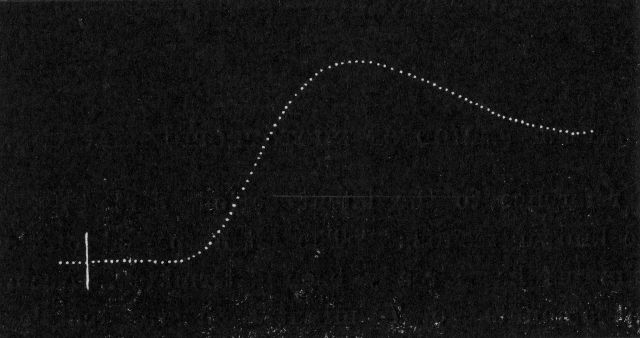
Fig. 116.—Latent period for photic stimulation at vertical line. Successive dots at intervals of 2 seconds. (Erythrina indica).
Determination of the latent period: Experiment 122.—I give a record of response (Fig. 116) of the terminal leaflet of Erythrina inidca to light acting from above. The recording plate was made to move at a fast rate, the successive dots being at intervals of 2 seconds. The latent period in this case is seen to be 35 seconds. By the employment of stronger light I have obtained latent period which is very much shorter.
The term latent period is used in two different sense. It may mean the interval between the application of stimulus and the initiation of response. In the experiment described above, the latent period is to be understood in this sense. But in the extract given above, Jost uses the term latent period as the shortest period of exposure necessary to induce phototropic reaction as an after-effect. What then is the shortest exposure that will induce a retardation of growth? For this investigation I employed the very sensitive method of the Balanced Crescograph.
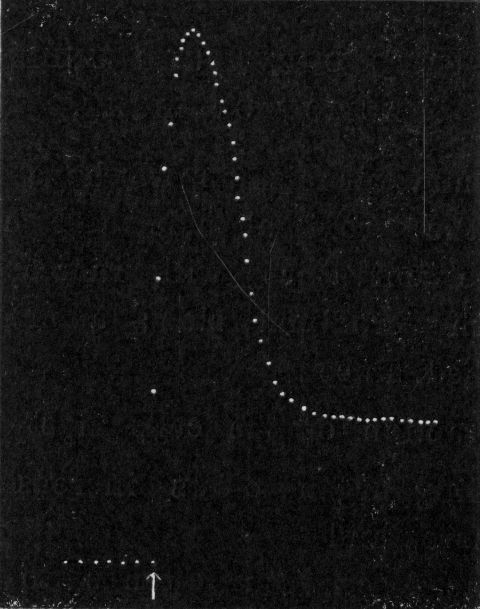
Fig. 117.—Effect of a single electric spark on variation of growth. Record taken by Balanced Crescograph. Up-curve shows induced retardation of growth; the after-effect is an acceleration (down-curve) followed by restoration to normal.
GROWTH-VARIATION BY FLASH OF LIGHT FROM A SINGLE SPARK.
Experiment 123.—I stated that the more intense is the light, the shorter is the latent period. The duration of a single spark discharge from a Leyden jar is almost instantaneous, the duration of discharge being of the order of 1⁄100,000th of a second. The single discharge was made to take place between two small steel spheres, the light given out by the spark being rich in effective ultra-violet rays. The plant used for the experiment was a seedling of wheat. It was mounted on the Balanced Crescograph, and its normal growth was exactly compensated as seen in the first part of the record. The spark gap was placed at a distance of 10 cm. from the plant; there was the usual arrangement of inclined mirrors for illumination of the plant. The flash of light from a single spark is seen to induce a sudden retardation of rate of growth which lasted for one and half minutes. The record (Fig. 117) shows another interesting peculiarity of acceleration as an after-effect of moderate stimulation. After the retardation which lasted for 90 seconds, there is an acceleration of growth above the normal, which persisted for 6 minutes, after which the rate of growth returned to the normal.
In order to show that the induced variation is due to the action of light and not to any other disturbance, I interposed a sheet of ebonite between the spark-gap and the plant. The production of spark produced no effect, but the removal of the ebonite screen was at once followed by the characteristic response.
MAXIMUM POSITIVE CURVATURE UNDER CONTINUED ACTION OF LIGHT.
The positive curvature is, as we have seen, due to the contraction of the proximal side and expansion of the distal side. The curvature will increase with growing contraction of the proximal side; a maximum curvature is however reached since:
(1) the contraction of the cells must have a limit,
(2) the bending organ offers increasing resistance to curvature, and
(3) the induced curvature tends to place the organ parallel to the direction of light when the tropic effect is reduced to a minimum.
The pulvinus of Erythrina exemplifies the type of reaction in which the positive curvature reaches a maximum, (see below Fig. 132) beyond which there is no further change. This is due to absence of transverse conductivity in the organ. The modifying effect of transverse conductivity on response will be dealt with in the next chapter.
SUMMARY.
The positive phototropic curvature is brought about by the joint effects of the directly stimulated proximal, and indirectly stimulated distal side.
The phototropically curved organ undergoes recovery after brief stimulation.
The recovery after moderate stimulation is hastened by the previously stimulated side exhibiting an acceleration of the rate of growth above the normal. The after-effects of photic and mechanical stimulation are similar.
The latent period of photic reaction is shortened with the increasing intensity of light. The seedling of wheat responds to a flash of light from an electric spark, the duration of which is about a hundred thousandth part of a second.
Tissues in which the power of transverse conduction is negligible, the positive phototropic curvature under continued action of light attains a maximum without subsequent neutralisation or reversal.