Volume 2 / Part 3 — XXVII.—ON GALVANOTROPISM
Reading edition
By Sir J. C. Bose, Assisted by Guruprasanna Das.
Before describing the effect of unilateral application of an electrical current in inducing tropic curvature, I shall give an account of the polar effect of anode and cathode on the pulvinated and growing organs. In my previous work[6] on the action of electrical current on sensitive pulvini I have shown that:—
(1) at the 'make' of a current of moderate intensity a contraction takes place at the cathode; the anode induces no such contractile effect;
(2) at the 'make' of a stronger current both the anode and cathode induce contraction.
I have also carried out further investigations on the polar effect of current on the autonomous activity of the leaflet of Desmodium gyrans. These rhythmic pulsations can be recorded by my Oscillating Recorder. Each pulsation consists of a sudden contractile movement downwards, corresponding to the systole of a beating heart, and a slower up movement of diastolic expansion. Application of cathode at the pulvinule was found to exert a contractile reaction, exhibited either by the reduction of normal limit of diastolic expansion, or by an arrest of movement at systole. The effect of anode was precisely the opposite; the induced expansion was exhibited either by reduction of normal limit of systolic contraction, or by arrest of pulsation at diastole.
From the above results it is seen that with a feeble current:
(1) contraction is induced at the cathode, and
(2) expansion is brought about at the anode.
These effects take place under the action of a feeble current. Under strong currents, contraction takes place both at the anode and the cathode.
POLAR EFFECT OF ELECTRICAL CURRENT ON GROWTH.
The object of this investigation was to determine whether anode and cathode exerted similar discriminative and opposite effects on growth. For this experiment I took a specimen of Kysoor and determined the region where growth was maximum. A piece of moist cloth was wrapped round this region to serve as one of the two electrodes. The second electrode was placed in the neighbouring indifferent region where there had been a cessation of growth.
Effect of Cathode: Experiment 111.—The particular specimen of Kysoor had a normal rate of growth of 0·48 µ per second. On application of the cathode the rate was reduced to 0·14 µ per second, or to less than a third. This will be seen in record (Fig. 107), where N is the normal rate of growth and K, retarded rate under the action of the cathode.
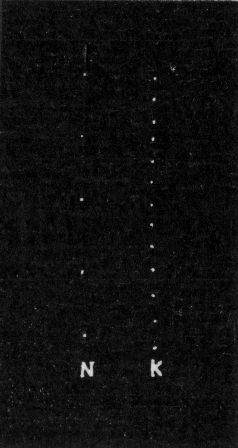
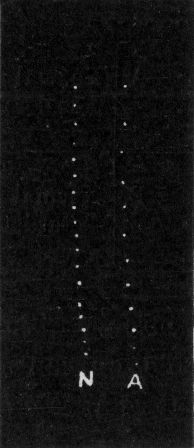
Fig. 107.Fig. 108.
Fig. 107.—Retardation of rate of growth under the action of cathode (Kysoor).
Fig. 108.—Acceleration of rate of growth under anode (Kysoor).
Effect of anode: Experiment 112.—If the cathode induced a retardation, the anode might be expected to induce an acceleration of growth. But in my first experiment on the action of anode, I could detect no perceptible variation of rate of growth. In trying to account for this failure, I found that the specimen employed for the experiment had normally a very rapid rate of growth. It appeared that an induced acceleration would be brought out more conspicuously by choosing a specimen in which the growth-rate was low, rather than in one in which it was near its maximum. Acting on this idea, I took another specimen of Kysoor in which the normal rate was as slow as 0·10 µ per second. On applying the anode to the growing region, there was an enhancement to one and half times the normal rate (Fig. 108).
TABLE XXVIII.—EFFECT OF ANODE AND CATHODE ON GROWTH (Kysoor).
Specimen ANormal rate Acceleration under anode0·10 µ per sec. 0·155 µ per sec.
Specimen BNormal rate Retardation under cathode0·48 µ per sec. 0·14 µ per sec.
The effects given above take place under the action of a feeble current. Strong current on the other hand induces a retardation or an arrest of growth.
I have in the above experiments demonstrated the normal effect of anode in inducing expansion and acceleration of rate of growth; the cathode was shown to induce contraction and retardation of growth. Unilateral application of anode and cathode thus induces appropriate curvatures in pulvinated and in growing organs.
SUMMARY.
The effects of an electric current on growth is modified by the direction of current. A feeble anodic current enhances the rate of growth; a cathodic current on the other hand induces a retardation of the rate. Strong current, both anodic and cathodic, induces a retardation.