Volume 2 / Part 3 — XXXVI.—ON PHOTOTROPIC TORSION
Reading edition
By Sir J. C. Bose, Assisted by Surendra Chandra Das.
In addition to positive or negative curvatures light induces a responsive torsion. With regard to this Jost says:—
"The mechanics of the torsions have not as yet been fully explained. It has long been believed that these torsions were occasioned only by the action of a series of external factors, such as light, gravity, weight of the organ which individually led to curvatures, but in combination induced torsions; but later investigations have shown that torsions might appear when light only was the functional external factor.... If the torsions cannot generally be regarded as due to the combination of two curvatures, we are completely in the dark as to the mechanics of their production."[23]
A leaf when struck laterally by light undergoes a twist, so that the upper surface is placed, more or less, at right angles to the incident rays; as no explanation was available for this movement, the suggestion has been made that the particular reaction is for the advantage of the plant. I shall presently show, that it is possible to reverse this normal torsion and thus make the upper surface of the leaf move away from light.
The experiments which I shall presently describe will, it is hoped, throw light on the obscure phenomenon. I shall be able to show:
(1) that the torsional response is not dependent on the combination of two curvatures,
(2) that it is also independent of the effect of weight,
(3) that it may be induced not merely by stimulus of light but by all forms of stimulation,
(4) that the direction of the torsional response depends on the direction of the incident stimulus and the differential excitability of the organ, and
(5) that there is a definite law which determines the torsional movement.
EXPERIMENTAL ARRANGEMENTS.
I shall first describe a typical experiment on the responsive torsion under the action of light. We have seen that in the pulvinus of Mimosa, light of moderate intensity and of short duration applied on the upper half induces a slow up-movement, while the stimulus of light applied below induces a more rapid down-movement. The difference is due to the fact that the lower half of the pulvinus is relatively the more excitable. Vertical light thus induces a movement in a vertical plane. But an interesting variation is induced in the response under the action of lateral light. A stimulus will be called lateral when it acts on either the right or left flank of a dorsiventral organ. We shall presently find that a dorsiventral organ responds to lateral stimulus by torsion.
The present series of experiments were carried out with the leaf of Mimosa, and in order to eliminate the effect of weight and also for obtaining record of pure torsion, I employed the following device. The petiole was enclosed in a hooked support made of thin rod of glass, the petiole resting on the concavity of the smooth surface. Friction and the effect of weight is thus practically eliminated; the looped support prevented up or down movements, and yet allowed perfect freedom for torsional response. This latter is magnified by a piece of stout aluminium wire fixed at right angles to the petiole (Fig. 148). The end of the aluminium wire is attached to the short arm of a recording lever; there is thus a compound magnification of the torsional movement. The Oscillating Recorder gave successive dots at intervals which could be varied from 20 seconds to 2 minutes. Time-relations of the response may thus be obtained from the dotted record.
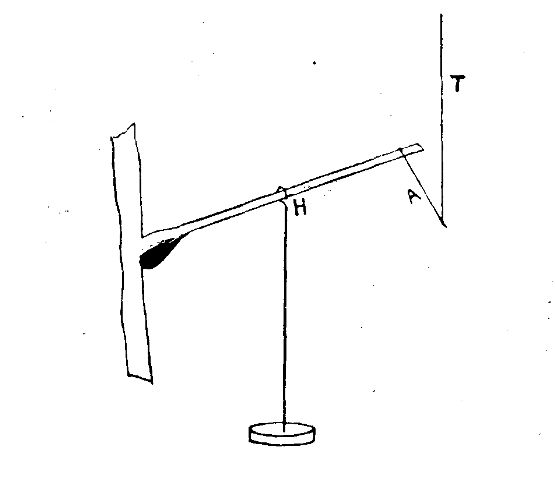
Fig. 148.—Diagrammatic representation for record of torsional response. H, thin glass hook: A, aluminium wire attached to petiole for magnification of torsional movement. T, silk thread for attachment to recording lever.
With the experimental device just described, we shall be in a position to study the effect of various stimuli applied at one flank of the pulvinus—at the junction of the upper and lower halves of the organ. The observer standing in front of the leaf is supposed to look at the stem. Torsional response will then appear as a movement either with or against the hands of the clock. The torsional response, right-handed or left-handed, will presently be shown to depend on the direction of incident stimulus. In figure 149, anti-clockwise torsion is recorded as an up-curve; clockwise rotation is recorded as a down-curve.
ACTION OF STIMULUS OF LIGHT.
Experiment 148.—The pulvinus of the leaf was stimulated by a horizontal beam of light thrown in a lateral direction; the areas contiguous to line of junction of the upper and lower halves of the anisotropic organ thus underwent differential excitation. When light struck on the left flank, the responsive torsion was anti-clockwise; the responsive reaction thus made the upper and the less excitable half of the pulvinus face the stimulus. Figure 149 gives a record of the torsional movement when light struck the left flank of the organ; on the cessation of stimulus the response is followed by recovery.
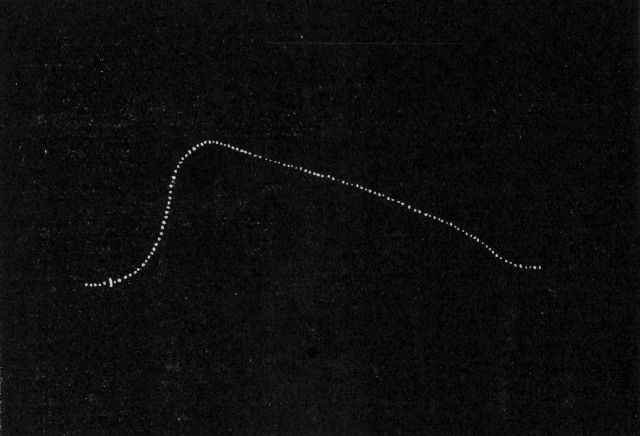
Fig. 149.—Record of torsional response of pulvinus of Mimosa pudica.
DIRECTIVE ACTION OF STIMULUS.
Experiment 149.—If now the direction of stimulus be changed so that light strikes on the right flank instead of the left, the responsive torsion is found to be reversed, the direction of movement being clockwise. Here also the responsive movement is such that it is the less excitable upper half of the organ that is made to face the stimulus. It will thus be seen that the torsion, anti-clockwise or clockwise, depends on two factors, namely the direction of stimulus, and the differential excitability of the organ.
EFFECT OF DIFFERENT MODES OF LATERAL STIMULATION.
I shall now proceed to show that the torsional response is induced not merely by the action of light, but by all forms of stimulation.
Effect of chemical stimulation: Experiment 150.—Dilute hydrochloric acid was at first applied on the left flank of the pulvinus along the narrow strip of junction of the upper and lower halves. This gave rise to a responsive torsion against the hands of a clock. Chemical stimulation of the right flank induced, on the other hand, a torsional movement with the hands of a clock. Here also the direction of stimulus is found to determine the direction of responsive torsion.
Effect of thermal radiation: Experiment 151.—I next employed thermal radiation as the stimulus; the source of radiation was a length of electrically heated platinum wire. It is advisable to interpose a narrow horizontal slit, so as to localise the stimulus at the junction of the upper and lower halves of the pulvinus. Stimulus applied at the left flank induced left-handed or anti-clockwise torsion; application at the right flank gave rise to right-handed torsion.
Geotropic stimulus.—The stimulus of gravity induces, as I shall show in a subsequent chapter, a similar responsive torsion, the direction of which is determined by the direction of the incident stimulus.
EFFECT OF DIFFERENTIAL EXCITABILITY ON THE DIRECTION OF TORSION.
Under normal conditions, the torsional response under light places the upper surface of the leaf or leaflets at right angles to light. That this movement is not due to some specific sensibility to light is shown by the fact that all modes of stimulation, chemical, thermal or gravitational, induce similar responsive torsion. The torsional response is, moreover, shown to be determined by the direction of incident stimulus, and the differential excitability of the organ. This latter may be reversed by the local application of various depressing agents on the normally more excitable lower half of the pulvinus. Under this treatment, the lower half of the pulvinus may be rendered relatively the less excitable. Lateral application of light now induces a torsional movement which is the reverse of the normal, so that the upper surface of the leaf moves away from light. The advantage of the plant cannot, therefore, be the factor which determines the directive movement; the teleological argument often advanced is, in any case, no real explanation of the phenomenon.
In all the instances given above, and under every mode of stimulation, the responsive movement makes the less excitable half of the pulvinus face the stimulus. The torsional response is, in reality, the mechanical result of the differential contraction of a complex organ, which is fixed at one end and subjected to lateral stimulation. I have been able to verify this, by the construction of an artificial pulvinus consisting of a compound strip, the upper half of which is ebonite, and lower half the more contractile stretched India-rubber; if such a strip be held securely at one end in a clamp, and if the lateral flank, consisting half of ebonite and half of India-rubber, be subjected to radiation, and record taken in the usual manner, it will be found that a torsional response takes place which is similar to that of the pulvinus of Mimosa. The above experiment was devised to offer an explanation of the mechanics of the movement. It should, however, be borne in mind in this connection that the torsional response of pulvinus is brought about by differential physiological contraction of the organ, the movement being abolished at death.
From the results given above, we arrive at the following:—
LAWS OF TORSIONAL RESPONSE.
1. AN ANISOTROPIC ORGAN, WHEN LATERALLY EXCITED BY ANY STIMULUS, UNDERGOES TORSION BY WHICH THE LESS EXCITABLE SIDE IS MADE TO FACE THE STIMULUS.
2. THE INTENSITY OF TORSIONAL RESPONSE INCREASES WITH THE DIFFERENTIAL EXCITABILITY; WHEN THE ORIGINAL DIFFERENCE IS REDUCED, OR REVERSED, THE TORSIONAL RESPONSE UNDERGOES CONCOMITANT DIMINUTION OR REVERSAL.
Having thus established the laws that guide torsional response, I shall try to explain certain related phenomena which are regarded as highly obscure. I shall also describe the application of the method of torsional response in various investigations.
COMPLEX TORSION UNDER LIGHT.
The leaves of the so-called "Compass plants" exhibit very complex movements, these being modified according to the intensity of incident light. Thus in compass plants the leaves, under moderate intensity of light in the morning or in the evening, turn themselves so as to expose their surfaces to the incident rays. But under intense sun light, the leaves perform bendings and twistings so that they stand at profile at midday.
I have not yet been able to secure "Compass plants" at Calcutta. I shall, however, describe my investigations on the complicated torsional movements exhibited by certain leaflets by the action of vertical light. The results obtained from these will show that torsional movements, even the most complex, are capable of explanation from the general laws that have been established.
Torsional movement of leaflet of Cassia alata: Experiment 152.—These leaflets are closed laterally at night but place themselves in an outspread position at day time. The character of the movement is, however, modified by the intensity of light. With moderate light in the morning the leaflets open out laterally. But under more intense light, the pulvinules of the leaflets exhibit a torsion by which the formerly infolded surfaces of the leaflets are exposed at right angles to light from above (Fig. 150). Such complicated movements, in two directions of space, are also exhibited by other leaflets which are closed at night in a lateral direction.
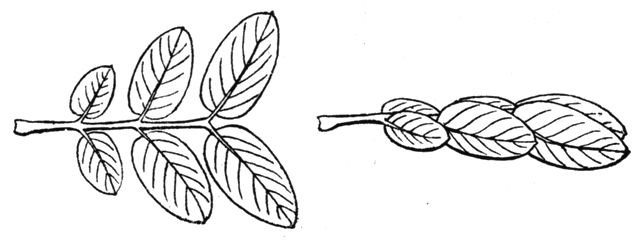
Fig. 150.—Leaflets of Cassia alata: open in daytime, and closed in evening.
For obtaining an explanation of these complex movements under different intensities of light, we have first to discover the particular disposition of the two halves of the pulvinule which are unequally excitable; we have next to explain the responsive movements under the directive action of moderate and of intense light.
Determination of differential excitabilities of the organ: Experiment 153.—In the leaflet of Cassia the movement of opening under diffuse stimulation of light can only be brought about by the contraction of the outer half, which must therefore be the more excitable. This is independently demonstrated by the reaction to an electric-shock. On subjecting the half closed leaflets to diffuse electric stimulation, they open outwards in a lateral direction. The disposition of the unequally excitable halves of the pulvinule is thus different from that of the main pulvinus of Mimosa. In the latter, the plane that divides the two halves is horizontal, the lower half being the more excitable. Thus in the pulvinule of Cassia the plane that separates the two unequally excitable halves is vertical, the outer half being the more excitable than the inner. By inner half is here meant that half which is inside when the leaflets are closed.
Effect of strong vertical light: Experiment 154.—When the plant is placed in a moderately lighted room, the leaflets open out laterally to the outmost. This is brought about by the contraction of the more excitable outer half of the organ. If strong light be thrown down from above, a new movement is superposed, namely, of torsion by which the leaflets undergo a twist and thus place their inner surface at right angles to the vertical light. In order to investigate this phenomenon in greater detail I placed the plant in a well lighted room, the leaflets being three quarters open under the diffuse light. A very light index was attached to the leaflet for magnifying the subsequent torsional movement. A strong beam of parallel light from an arc lamp was thrown down on the pulvinule from above; this fell at the junction of the more excitable outer with the less excitable inner half of the organ, the plane of separation of the two unequally excitable halves being, as previously explained, vertical. I have shown that under lateral stimulation, a differentially excitable organ undergoes torsion by which the less excitable half is made to face the stimulus. Since it is the inner half of the organ that is the less excitable, the attached leaflet becomes twisted so as to expose its (former infolded) surface upwards, at right angles to the incident light.
As a confirmatory test, strong light was made to strike the pulvinule from below with the result that the leaflets exhibited an opposite torsion by which their surfaces faced downwards, so as to be at right angles to light that struck them from below.
Under normal conditions sunlight comes from above; stimulation thus takes place at the junction of the two differentially excitable halves of the organ, the plane of separation of which is vertical. The torsion induced makes the less excitable inner half turn in such a way that the inner surfaces of the leaflets are placed perpendicular to the incident light.
ADVANTAGES OF THE METHOD OF TORSIONAL RESPONSE.
The torsional response not only affords a new method of enquiry on the reaction of various stimuli, but it also possesses certain advantages. For instance in studying the response of the leaf of Mimosa under light, the records were taken of the movement of the leaf in a vertical plane. But the responsive up-movement, induced by light acting from above, is opposed by the weight of the leaf. But in the torsional response, the leaf rests on the hooked glass support and the movement is thus free from the complicating factor of the weight of the leaf. Again the pulvinus of Mimosa, for example, is sometimes subject to spontaneous variation of turgor, on account of which it exhibits an autonomous up or down movement. In the ordinary method of record the true response to external stimulus may thus be modified by natural movement of the leaf. But in the torsional method, the autonomous up or down movement is restrained by the hooked support, and the response to lateral stimulus is unaffected by the spontaneous movement of the leaf. The torsional method, moreover, opens out possibilities of inquiry in new directions, such as the comparison of the excitatory effects of different stimuli by the Method of Balance, and the determination of the effective direction of geotropic stimulus.
THE TORSIONAL BALANCE.
A beam of light falling on the left flank of the pulvinus of Mimosa induces a torsion against the hands of the clock. A second beam falling on the right flank opposes the first movement; the resultant effect is therefore determined by the effective stimulation of the two flanks. The pulvinus thus becomes a delicate index by which two stimuli may be compared with each other. The following experiment is cited as an example of the application of the method of phototropic balance.
Experiment 155.—Parallel beam of light from a small arc lamp passing through blue glass falls on the left flank of the pulvinus; a beam of blue light also strikes the pulvinus from the right side, and the intensity of the latter is so adjusted that the resultant torsion is zero. Blue glass is now removed from the left side, the unobstructed white light being allowed to fall on the left flank of the pulvinus. This was found to upset the balance, the resultant torsion being anti-clockwise. This showed that white light induced greater excitation than blue light. We next interpose a red glass on the left side, with the result that the balance is upset in the opposite direction. This is because the phototropic effect of red light is comparatively feeble. We may thus compare the tropic effect of one form of stimulus against a totally different form, phototropic against geotropic action for example. It is enough here to draw attention to the various investigations rendered possible by the method of balance. Concrete examples of some of these will be given in a subsequent chapter.
DETERMINATION OF THE DIRECTION OF STIMULUS.
I have shown that the torsion, clockwise or anti-clockwise, is determined by the direction of incident stimulus. Hence it would be possible to determine the direction of incident stimulus from the observed torsional movement. In the case of light, the direction of incident stimulus is quite apparent. But it is difficult to determine the direction of stimulus which is itself invisible. In such cases, the torsional movement gives us infallible indication of the effective direction of stimulus. The application of this principle will be found in a later chapter.
SUMMARY.
Lateral stimulus induces a torsional response in a dorsiventral organ. This is true of all modes of stimulation.
The responsive torsion is determined by the direction of incident stimulus, and the differential excitability of two halves of the organ, the torsion being such that the less excitable half of the organ is made to face the stimulus.
The twist exhibited by various leaves and leaflets under light finds its explanation from the demonstrated laws of torsional response.
The direction of incident stimulus may be determined from the responsive torsion of a dorsiventral organ.
The Method of Torsional Balance enables us to compare the excitatory efficiencies of two different stimuli which act simultaneously on the two flanks of the organ.