Chapter II
Reading edition
A year after my friend went into business, as I passed his store one morning, I was not a little surprised to find it closed. Before the window was that ominous white cloth, denoting that the occupant had failed.
I entered the store. Frank stood at his desk, glancing with a most woe-begone aspect at the pages of his ledger.
“How’s this, Frank?” I asked; and I never was more surprised in my life.
“Bu’st up! don’t you see?” replied he, rather petulantly.
“But what does it mean?”
“Mean! Why, that I had a note of a thousand dollars, due yesterday, which I could not pay; and this morning early, my amiable friend, Mr. Allen, put in a keeper—that’s all.”
“How does it happen? I thought you were doing a rushing business.”
“So I was. I had the money to pay this note six weeks ago, and let Smith have it at two per cent. a month,” replied he, with a ghastly smile.
“And Smith has failed?”
“Not exactly. He has stopped; but every body says he is good, if he has time to turn himself.”
“And you must make a fail of it in the mean time?”
“If I could only stave off Mr. Allen a couple of months, I could get out of the scrape with flying colors.”
“Won’t he wait?”
Frank shook his head; he had mortally offended the proud merchant, and there was no prospect that he would be lenient in the slightest degree.
“Can’t you raise the money?”
“No; times haven’t been so hard for four years. Every body is failing, and the money men won’t trust their own fathers.”
At this moment Mr. Allen entered the store. He looked stern and severe, like one who has the power in his own hands, and is disposed to use it. I seated myself near the desk, as he approached.
The merchant politely saluted the unfortunate dealer, smiling as blandly as though nothing had happened; as though he had no niece, and Frank were a Stoic.
“Mr. Howard, this is unfortunate; but in the midst of so much commercial disaster, you perceive that it was my only course,” said the merchant, soothingly.
“I suppose it was; but you know the cause of my inability to pay the note,” returned Frank, with a doleful expression.
“Ah, young man, you ought not to have lent the money to Smith; if you had asked my advice, I could have told you better.”
“Smith was always supposed to be good.”
The merchant shook his head.
“But, Mr. Allen, give me a short time, and I can pay the note. Smith assures me he shall recover himself.”
“Mr. Howard, I certainly wish you well; I have done all I could to give you a fair start.”
“So you have, sir, and I am very grateful to you.”
“Are you?” and the merchant fixed a keen glance upon the young man.
“I assure you that I am.”
“How have you manifested it?” continued the merchant, sternly. “But no matter; we meet now as business men.”
“Well, what shall be done? You have stopped me; I can do no more.”
“I don’t wish to be hard. I would wait if prudence would justify it,” said Mr. Allen, who was keenly sensitive in regard to his reputation for generosity and fairness.
In fact, he was a man of good feelings, and only that he meant to punish Frank for falling in love with his wealthy niece, would not have disturbed him.
“You will be just as secure two months hence as now,” pleaded Frank.
“I have not that confidence in you, Mr. Howard,—I say it frankly,—which I had once. You have lost a thousand dollars. I doubt if your stock, under the hammer, would pay my notes.”
Frank looked savage, for though he was crestfallen, he was Frank Howard yet, and felt keenly the unjust imputation of the merchant.
“I wish to be fair, and even indulgent,” continued Mr. Allen, before Frank had time to utter the ungracious sentiment that rose to his lips. “Here is the note; give me one good indorser, and I will wait two months.”
Frank looked up, and smiled in contempt at the miserable subterfuge of the merchant, who meant to crush him, and still preserve an appearance of fairness. He knew it would be impossible for the young man, with his stock encumbered, to procure the security.
“Will you take Smith?” asked Frank, hurriedly.
“Of course not,” replied Mr. Allen, with a bland smile.
“I will see what can be done; but I think the case is hopeless.”
The merchant withdrew, assured in his own mind that his revenge was sure, and his reputation safe, at the same time.
Frank and myself canvassed the matter, but we could think of no person whose milk of human kindness was sufficiently abundant to prompt him to do such an insane act. While we were debating the matter, Frank was struck up by the entrance of Miss Allen.
“How gloomy you look here to-day, Frank,” said she, laughing, and showing in the act the prettiest row of pearly teeth I ever saw.
“We are gloomy, indeed,” replied Frank, mustering a sickly smile. “But you know the reason?”
“Why, what reason?” asked she, her merry expression relapsing into a serious one.
“You see that man?”
“Yes.”
“He is a keeper!” replied Frank, with tragic effect.
“A keeper! of what? Are you insane?” responded the lady, playfully; for it must be confessed she was not acquainted with the technicalities of business.
Frank laughed, and explained the disaster which had overtaken him.
“Poh!” exclaimed she, with an appearance of relief; and I really believe, if the keeper and myself had not been in the way, she would have thrown her arms around his neck, and kissed away his mortification.
I had before been introduced to the lady, and at this moment advanced to join in the conversation.
“And my uncle is the wretch?” continued she, merrily. “But what can you do? How can you get out of it?”
Frank explained the proposition to procure an indorser for the note. The light-hearted maiden appeared to have but little sympathy for the misfortunes of her lover, and asked all sorts of questions about indorsers, notes, and business forms.
“Where is the note you are to have indorsed?” asked she.
“Mr. Allen has it.”
“How can you have it indorsed, then?”
“I can write another,” replied Frank, smiling at the innocence of his betrothed.
“Then write one,” said she, promptly.
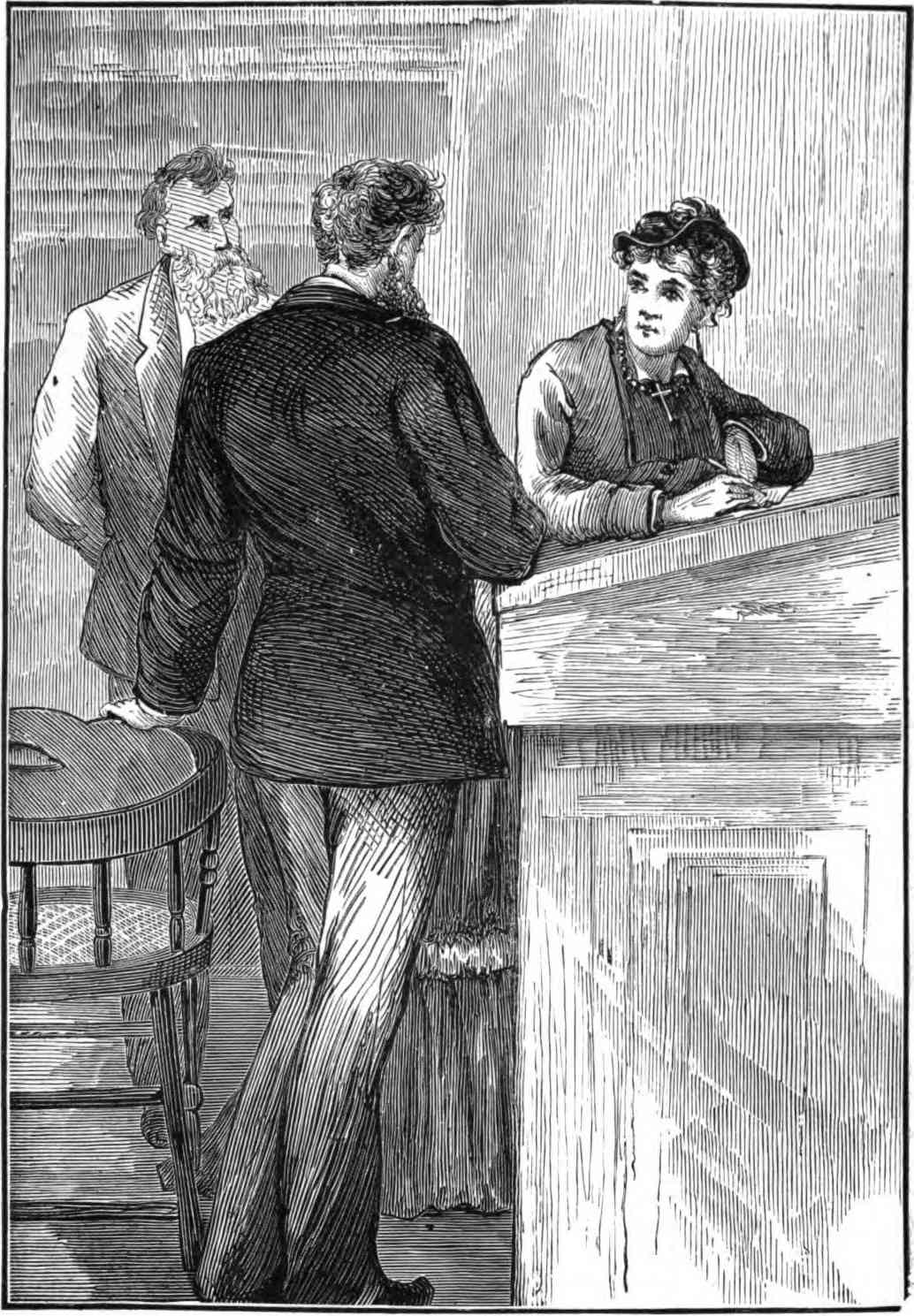
Getting an Endorser.
Page 20.
Frank looked at her a moment, to ascertain what mischief was lurking in her mind. She smiled, apparently without the power to prevent it.
The lover, impelled by curiosity as much as any other motive, wrote the note and signed it.
“Now how do you indorse it?” asked she.
“By writing the name across the back.”
The lady approached the desk, and turning the note, wrote, with two dashes of the pen, “Isabel Allen,” across it.
“It is indorsed,” said she, with a smile, which told Frank all she meant.
“But, Isabel——”
“Good morning, Frank,” interrupted she, and hastened out of the store.
“Bravo, Frank!” exclaimed I.
He smiled doubtfully. His pride was a little touched.
“Would you use it?” said he, after a long pause.
“Use it? to be sure!” and he did use it.
In the afternoon Mr. Allen called, satisfied in his own mind that he should witness the complete humiliation of the young man, who had had the audacity to fall in love with an heiress. Knowing at what hour he would call, I was careful to be present.
“Well, Mr. Howard, how have you succeeded? I have really been in hopes you will be able to secure the paper,” said the merchant; and I could plainly discern the malicious chuckle on his face as he spoke.
“I have succeeded, Mr. Allen; and I am infinitely obliged to you for your good will.”
The merchant was completely staggered at the reply. It was wholly unexpected, and wholly unwelcome also.
“I trust you have procured a good one,” said he, painfully.
“A wealthy one, but a name unknown on State Street.”
“Can’t take it, then,” answered the merchant, promptly, and with renewed hope.
“But a name well known to you!” and Frank handed him the note.
Mr. Allen started back in surprise and anger, as he read the name of the fair indorser.
“Very well, sir; when a man of any delicacy can resort to such a trick as this, I have nothing more to do with him.” And the crestfallen merchant, after throwing the old note on the counter, hastened indignantly from the store.
The keeper was withdrawn, and Frank heard no more from Mr. Allen. A week after, Smith paid the money, and Frank took up his note.
Before another of the notes came due, Isabel Allen had become Mrs. Frank Howard. The stock and stand were sold out, the debts paid, and my handsome friend is as happy as a beautiful wife, with a heart full of love, can make him.