Chapter I
Reading edition
When I was a boy, the schoolmaster succeeded in impressing upon my mind the truth of that common saying—“If a man thinks nothing of himself, no one will think any thing of him.” The pedagogue believed it himself, and his daily deportment was based upon it. Whether I learned any thing else of him I cannot now say; but I am sure I learned to set a high value upon myself.
Confessions of a Conceited Man.
At the age of eighteen, I found myself in the service of an eminent merchant of Boston, in the capacity of assistant bookkeeper, on the paltry salary of four hundred dollars a year. I was worth more—I was sure of it. But perhaps my employer had not yet come to a knowledge of the treasure he possessed in me, and I wisely determined to wait till I had a better opportunity to distinguish myself.
Certainly I took a great deal of pride in discharging the duties of my position. I labored assiduously to please both the merchant and the head bookkeeper, and they seemed to regard me with satisfaction; but I resolved to make myself so necessary that the business could not be carried on without me.
Whether my imagination was more lively than my reason, or not, I do not know; but certainly, at the end of six months I made up my mind that Mr. Bancroft could not possibly continue in business a single month without me. As to my superior, he would be perfectly powerless if I should leave. In fact, I “conceited” that I was in reality the bookkeeper of the concern, though he received the salary and did all the dictating.
I was an ambitious young man. I built a great many very pretty castles in the air; among them the idea of marrying my employer’s beautiful daughter was not the least attractive. She was a splendid girl—people called her the belle of Boston—and what to me was just as insinuating, she was an only child, and consequently the heiress of all Mr. Bancroft’s reputed wealth.
I never was one of that sort who wistfully dream over fine things, without making an attempt to attain them. That stale old maxim to the effect that “faint heart ne’er won fair lady,” was uppermost in my mind. I had come to the conclusion that Rosabel Bancroft should have the supreme felicity of becoming my household deity.
But the way was full of difficulties. I had never seen the peerless maiden, save on occasions when I had called at the house in the capacity of an errand boy—for the key of the safe, to get Mr. Bancroft to sign a check, or something of that sort. She was a proud beauty, and had never even taken the pains to look at me. “Ah, my fine lady,” thought I, “when we are married, I will teach you what is what!”
Certainly I would! And as for marrying her, why, that was a settled fact in my mind—I had resolved to do the deed.
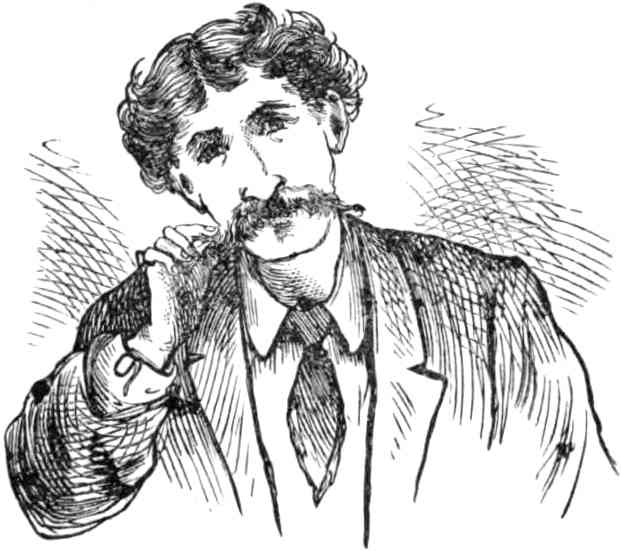
I flattered myself that I was a decidedly good-looking fellow, and a great many young men cherish this idea in these progressive times. My looking glass had told me I was handsome, and there was no going behind its impressive declaration. But I was aware that my beauty needed a little cultivation, and accordingly I applied to Bogle for some of the “compounds,” and in a few weeks, I had the satisfaction of contemplating the addition of a downy mustache upon my well-turned upper lip. I took a great deal of pains with this beautifier of my physiognomy, and felt perfectly sure that the charming Rosabel would be unable to resist my killing attractions.
There was to be a grand ball at Union Hall, and I heard that my divinity was to form one of the revellers. I will not trouble the reader with a relation of the difficulties that beset me in procuring a ticket—for the affair was intended solely for the “upper ten;” but I got one, though it cost me in the neighborhood of twenty-five dollars, to say nothing of twenty-five more expended in a fancy vest, cravat, and other little amiabilities.
When I was dressed for the occasion, the effect was perfectly stunning. Rosabel was certainly a goner!
My entrée into the drawing room seemed to create a profound sensation. All the gentlemen stared at me, and I felt assured of being the lion of the evening. It was plain that my “personal” had created a furor among the aristocratic dandies; but I tried to treat them all with respect and politeness. It is true I saw some of them turn up their noses at me; and all evinced a disposition to avoid me. But I attributed all these unmannerly symptoms to the envy which my superior personal attractions had roused in their narrow minds. I did not resent their ill nature—I could afford to be magnanimous.
I walked like a king through the sumptuous apartments; indeed I always prided myself on my gait. More than once, when I have been leisurely promenading Washington Street, I have felt sure that all the ladies had singled me out for especial admiration.
There was something magnificent about my style of walking, and I did not blame the dear creatures for sighing when I passed them. It was a great pity that, in the illiberality of our laws, only one lady could ever have the satisfaction of calling me her husband. I am naturally of an sympathetic temperament, and I assure the reader that it deeply grieved me to think of the number of fair, promising ladies who would be disappointed in winning my affections. I could not love them all, and from the bottom of my heart I pitied those who were doomed to be disappointed.
Rosabel Bancroft was destined to be my wife. I had deliberately made up my mind, and though I thought, in consideration of my condescension in choosing her from the thousands who would have rejoiced to win me, she ought to meet me half way. But I was not over nice, and in deference to the fashions of the times, I mentally consented to do all the courting myself.
I succeeded in getting an introduction to her, and she consented to dance with me. I was not much elated; I regarded my progress as a matter of course. During the quadrille, I did the agreeable to my own satisfaction, and though the impression was not as marked and decided as I had expected, I was assured that everything was going on well.
“Procrastination is the thief of time,” said somebody. I don’t remember whether it was Plato or Diogenes. When the dance was ended, and I had conducted her to the drawing room, I made bold to express my admiration of her beauty and grace. She blushed, smiled, and looked confused. Poor thing! how could she help it?
Just then a dandy spoke a word to her, and then retreated. I was not to be balked, and with all the eloquence I possessed—and I would just hint that Demosthenes, Cicero, or Daniel Webster couldn’t hold a candle to me in making a speech—I popped the question.
It was handsomely done, and Rosabel was taken all aback. I expected all this—I knew all about making love—Ovid couldn’t tell me any thing about it. Girls at this momentous crisis, do not always mean half they say; and I was prepared to hear her declare it was rather sudden, that she must ask papa about it, and all that sort of thing.
But my ardent confession seemed to throw her into a perspiration—if I may so unpoetically express the confusion which my declaration produced.
“You impudent puppy!” exclaimed she, her pretty cheeks red with anger; “so you are one of my father’s clerks, and have the presumption to ask me to dance with you, and then to offer me such an indignity! Leave my presence, sir, this instant, or I will ask my friends to kick you away!”
Whew! I did feel sheepish for a moment; but then, poor thing, she did not know her own mind. Some of those envious noodles had been exciting her prejudices against me. That dandy had told her I was her father’s clerk, before I had had an opportunity to weave my spell upon her.
Comforting myself with the assurance that there were thousands of heiresses who were more discriminating than she, I whistled an air, and ambled away from her. If there is any person on the face of the earth whom I pity more than another, it is he or she who wilfully throws away a good opportunity.
Poor Rosabel! I pitied her! I believe I was unselfish enough to deplore her misfortune more acutely than I did my own. I had lost nothing that might not be regained; she had cast away one of the most brilliant opportunities that ever dawned upon the destiny of a maiden.
I have the credit, among those who know me best, of possessing firmness in a very remarkable degree; and it was melancholy to think she had cast me off forever, for, I am sure, if she had fallen upon her knees, and begged and pleaded, I should have been as firm as a rock. Those insulting, unlady-like words, had “fixed her flint”—to use a rather homely phrase, which I believe did not originate either with Addison or Macaulay.
I did not dance any more that evening. I found that I had fallen among fools, who could not appreciate me. And strange as it may seem to the unphilosophical reader, the fact did not in the least disturb my natural equanimity. Why should it? Did not Socrates experience the same coldness at the hands of the fickle Athenians, who put him to death by mixing poison with his “sherry cobbler?” Why should I expect a better fate than others whose misfortune it is to be superior to the masses around them?
I left the hall regretting only that the eighth part of my year’s salary had been wasted in the adventure.
When I went to the counting room next morning, Mr. Bancroft summoned me to his private office.
“You are a fool, young man!” said he, and his face was flushed with anger.
O the ingratitude of the world! This was a pretty return for the distinguished honor I had intended for his daughter, and which only her own wilfulness had prevented her from receiving at my hands.
“If you ever presume to speak to my daughter again, under any circumstances, I will immediately discharge you from my service,” continued he, with the utmost coolness.
“Nonsense!” thought I—and I beg the reader will not suppose I uttered this unseemly expression—“you won’t do any thing of the kind. You know your own interest too well.”
Discharge me! I should have liked to see him do it. I believe I should actually have gone, if he had said the word, and left him to take care of his business as best he might! If he had got me mad, I should just as lief seem him fail as not—it is my temperament. To a friend, I am a friend; to a foe, a foe of the most determined sort.
But he knew better than to provoke me too far. Bancroft was a shrewd man. He knew just how far I would have permitted him to go, in deference to the dignity of his position, and he did not exceed that limit. It was a lucky thing for him that he did not. Disaster, mercantile ruin, would have been the inevitable consequence of such an imprudent act!
I regret that my space does not permit me to give the reader the details of my exploits in the arena of Cupid for the succeeding six months. They were rich and varied; but I am happy to console my friends and admirers with the assurance that I am at present engaged in writing out the history of the whole period, which in due time will appear, complete in seven volumes, with portraits and illustrations.
From the events of this campaign, I deduce the melancholy conclusion that the fair sex are sadly wanting in good taste and nice discrimination. The fact that I am still a bachelor is a sad commentary on this truth. The ladies “are not what they are cracked up to be”—to use a rather inelegant expression, which I think was original with Hogg, the poet.
But disappointed of my matrimonial hopes, I determined to make commerce the study of my life. I had about made up my mind to offer my time and talents to Bancroft—in short, to offer to become his partner in business. I never was much in favor of these complications of mercantile affairs, and to become a partner of his might involve me in some future sacrifices, which it might not be pleasant to make.
I thought it best, on the whole, to retain my present situation. But the salary was too small. I must wait upon Bancroft, and consent to remain in his service, if he would add a hundred dollars to my pay. Of course he could not be so imprudent as to run the risk of failure and utter ruin for so trifling a matter as this.
“I beg your pardon, Mr. Bancroft,” said I, in my blandest tones,—for even a highway robber is polite nowadays when he blows a man’s brains out—“but I have taken the liberty to wait upon you for the purpose of asking you to advance my salary from four to five hundred dollars.”
“Go to the devil!” said he, rudely.
It is astonishing how some folks will even kick an angel out of their presence. Poor Bancroft! he “stood in his own light,”—to borrow from Carlyle or Mephistopheles, I forget which.
“You are dear help at two hundred a year; I don’t want you any longer at any price,” continued Bancroft.
“There’s stupidity for you!” thought I.
My blood was up, and I determined to leave him, let the consequences be what they might.
I did leave him, assured that the mercantile world would be startled to its centre by a crash, in a very short time. The concern has not broke down yet, but there is a moral certainty that it must soon “go by the board,”—to quote from Captain Cook, or Sir John Franklin, it is not very material which.
I had not been out of business a week before I discovered that literature was the proper sphere for me. I intend to bring about a revolution in the world of letters, by introducing an entirely new style of composition, adapted both to prose and poetry. I have several works under way, including a complete History of the Musquito Kingdom, Annals of Hull, and a poem in two hundred and seventy-six cantos, on the Want of Appreciation and Correct Taste in the Female Sex,—all of which will appear as soon as written and published.