Chapter I
Reading edition
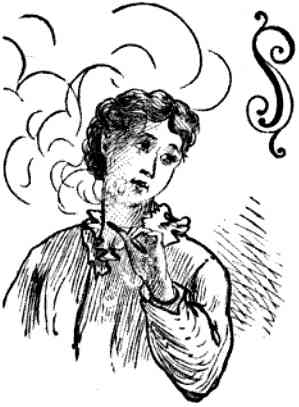
“Smokes, does he? The abominable wretch!” exclaimed Mrs. Volant to her friend, Mrs. Washburn, a young wife who had just gone to housekeeping.
“He smokes, but he is not an abominable wretch—I am sure he is not,” replied Mrs. Washburn, a little startled by the hard name applied to her husband, whom she both loved and esteemed.
“Not a wretch?”
“No, I’m sure he is not!”
“Yes, he is; any husband, especially one who has been married only a year, and won’t leave off smoking when his wife desires it, must be a wretch.”
“No, you overstate the case. He is every thing a husband ought to be—so kind, so devoted, so indulgent. But then, I do wish he would not smoke.”
“You must break him of it—the cruel monster.”
“Nay, do not call him such hard names; I love him with all my heart, though he does smoke.”
“Well, I suppose you do; young wives are apt to be foolish.”
“Foolish!”
“Yes; he sees, I dare say, that you love him, and so he takes the advantage of you.”
“Why, Mrs. Volant, don’t you love your husband?”
“Well, suppose I do; there is no need of telling him of it. I make him think I don’t care any thing about him. Why, I can manage him as easily as I could a kitten.”
“I don’t like that; I think there ought to be love and confidence between man and wife.”
“Pooh!”
“You cannot be happy with him.”
“I should not be if I became his slave.”
“Not his slave!”
“Don’t you believe it! When you have been married as long as I have, you will get rid of some of these sentimental notions, which answer very well for the first year or so, but become very inconvenient after that.”
“For my part, I always mean to love my husband as much as I do now, even if it is sentimental.”
“See if you do! Husbands must be carefully managed, or they become tyrants. Now, my husband smoked the first year after marriage; but then he was a little careful about bringing his cigar into the house, for I told him, up and down, I wouldn’t have it.”
“I should suppose he would have rebelled.”
“He did, but not at first. One night, nearly a year after we were married, he brought home a whole bundle of cigars, and put them on the mantel-piece. Taking one, he very coolly lighted it, and proceeded to read the evening paper.”
“That’s just the way my husband does.”
“I was downright mad at his impudence; but I did not say a word. The next day I bought a monstrous great snuff box, and filled it full of rappee. In the evening he lighted his cigar as before; but no sooner had he done so, than I seated myself opposite to him, and drawing out my snuff box, I took a generous pinch, snuffing the filthy stuff into my nostrils, at the risk of sneezing my head off.”
“How funny!”
“My husband did not think so. He looked at me with astonishment. ‘You take snuff?’ said he. ‘I do; at least, I mean to learn,’ I replied. ‘It is a filthy habit,’ says he. ‘No worse than smoking,’ says I. We debated the matter for a long time, and at last he gave up the point, and promised to throw away his cigars if I would throw away my snuff. My point was gained, and of course I gave up my snuff.”
“And he never smoked any more?” asked Mrs. Washburn, laughing.
“Yes, he began once after; but I took to the snuff again, and he gave it up.”
“Are you sure he don’t smoke now?”
“If he does, he never lets me see him. My sitting room is not all smoked up as yours is.”
“It was a glorious trick!”
“That it was, and I advise you to try it upon Mr. Washburn.”
“I! I couldn’t take a pinch of snuff any more than I could swallow an elephant.”
“Smoke, then. There are some nice little cigars sold at the apothecaries, made on purpose for ladies. They are so mild that they wouldn’t make you sick; though, even if they did, you wouldn’t mind, so they cure your husband of smoking.”
“It seems too bad to play such a trick upon him—he is always so kind, and permits me to do just as I please,” said the tender-hearted Mrs. Washburn.
“What else could he do?”
“It looks kind of mean to me.”
“Not a bit.”
“I don’t know as it would succeed.”
“Nonsense! I am sure it would. He never would let you smoke, for these husbands have an awful horror of any impropriety in their wives.”
“Then, he says he has always smoked, and can’t leave it off.”
“Pshaw! The old story!”
“I am almost tempted to try it.”
“I would.”
“It seems so unkind, though, that I have hardly the heart to do it.”
“You are notional, my dear Mrs. Washburn. When you have been married—”
The remark was broken off by the abrupt entrance of the “abominable wretch” himself. Mrs. Washburn rose as he entered, and in spite of the abominable odor that his breath must have exhaled, printed a kiss upon his tobacco-stained lips.
The lady “who had been married several years” was disgusted, and after a few words concerning the weather, took her leave.