Chapter I
Reading edition
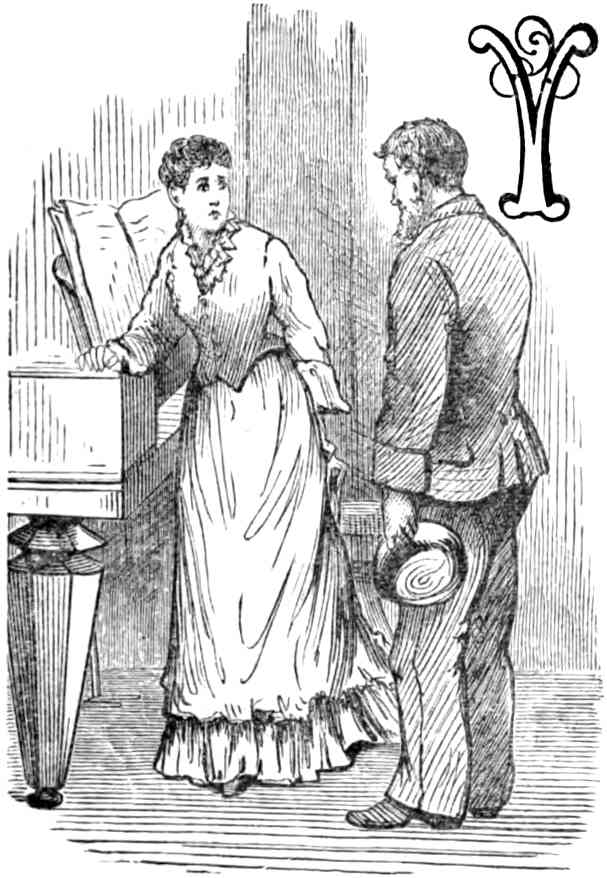
“You are of course aware of the object of my repeated visits at your house, Mr. Miller?” stammered George Harrison to the father of his intended.
“O, yes, of course,” replied the father, carelessly.
“And you must be favorably disposed towards the matter, or you would not have permitted it to continue as long as it has.”
“Well, Mr. Harrison, those are affairs that I don’t like to meddle with, though my opinion is, a great deal of judgment ought to be used in relation to them.”
“Certainly, sir; they affect the parties for life,” replied George, seriously.
“You do not intend to be married at present, do you?”
“Yes, sir; we have been thinking of it; that is, not under a month.”
“A month! Pray, Mr. Harrison, what have you got to support a wife with?” asked the careful father, gazing with considerable astonishment into the face of the candidate for matrimony.
“Well, sir, I have not got much now, it is true; but I think I shall be able to pay my way.”
“You think so, but you may be laboring under a mistake. Young men are apt to be rash.”
“I am going into business, as you are aware, next week. I have hired a store, and have no doubt I shall do well.”
“I suppose not. Have you the capital wherewith to stock your store?”
“My capital is small, but I have friends.”
“Every body has friends. Who are they?”
“There is Mr. Redman, who offers to let me have half my stock on six months.”
“And the other half?”
“I can obtain it on the same terms from other parties.”
“And you propose to lay in all your stock on six months’ credit?”
“Yes, sir.”
“Rather a dangerous scheme, young man.”
“I think not. I have no doubt that I shall be able to sell goods enough to pay most of the notes; if not, I can easily get them renewed.”
“You are confident.”
“Perhaps I am vain; but I trust a great deal to my ability as a salesman. Why, Smith, Jones, & Co. offered me a thousand dollars for the next year if I would stay with them.”
“You had better accept the offer, young man.”
“I think not; if I am worth a thousand dollars to them, I am worth it to myself. No, sir; I mean to have the benefit of my own talents.”
“Bah!” exclaimed the prudent Mr. Miller.
“Perhaps I am vain.”
“You are, Mr. Harrison. You will find that your ability in a concern like that of Smith, Jones, & Co. is much more available than it would be in your own hands.”
“We differ in that matter,” replied George Harrison, with some display of wounded dignity. “If you please, we will turn to the subject to which my present visit relates.”
“To be sure, young man, if you wish. I have no desire to force my advice upon you, though I cannot help thinking you had better heed the counsel of those who are older and more experienced than you are.”
“I am very willing to hear any advice.”
“More willing to hear it than to follow it.”
“I wish to be reasonable. If a young man never attempts to better his condition, it is plain that he never will get ahead in the world.”
“Very true; but let him labor as hard as he may, without proper discretion, he never will succeed.”
“You question my judgment, do you, sir?” asked George, rather sharply.
“Excuse me, Mr. Harrison, but I do. The relation in which you stand to my family prompts me to speak very plain. No man in his senses would stock his store on six months’ credit, and expect to succeed. How can you pay your notes, coming all together as they do?”
“With your leave, I will take care of that matter,” replied George, with dignity.
“Very well,” replied Mr. Miller, smiling at the young man’s warmth. “You propose to be married in about a month?”
“We do.”
“Have you got a house?”
“I have looked at one.”
“Have you the means of furnishing it?”
“Rowe & Co. have offered to sell it to me on six months.”
“Then in six months, Mr. Harrison, I will talk with you about marriage. In the mean time, I must decline all negotiation.”