Chapter II
Reading edition
When Mrs. Butler was married, she was a bright, cheerful, and happy maiden. For more than a year she and her devoted husband had not known the meaning of matrimonial strife. It was a new state of existence to her, and while the novelty of the thing lasted, she was as happy as the day was long.
But in the course of events, she was deprived of the pleasure of going abroad much, and the pretty home in which she had spent a year of joy, began to rust on her imagination. Not that her husband was less devoted; though he might not have been quite so dreamy and sentimental as he was in the days of their courtship, yet he was all that a reasonable wife could expect. He was indulgent, kind, and sympathized deeply with her in all those matters wherein a young wife needs tenderness and care.
Little Bobby was born; but the little stranger made such a heap of work for the fond mother, that she declared she should die under the infliction. She would not listen to her husband’s suggestion to keep a girl. She had a kind of vanity in her composition, which led her to endure rather than subject her husband’s purse to such an expenditure. She feared folks would say she was not as “smart” as she wished to be considered, or that Thomas’s relations would deem her extravagant and lazy.
She continued to do her work, though each day was a day of misery. Before she got breakfast, dinner, or tea, she sat and moped over it, thinking what a terrible hard job it was for her to perform. She dreaded washing day from about Friday morning; and over the washtub she was as miserable as soapsuds and a rubbing-board could possibly make her.
The reader may imagine that she was lazy; but I do not think so. She lived in a “world of trouble;” she looked upon the dark side of every thing. Of course, there were many hardships she was called upon to endure—as who is not? She was obliged to keep occupied most of the time in the duties of the household and the care of the baby. Her position was undoubtedly one of trial and vexation, as those who are experienced in these matters will readily understand.
But the principal difficulty was to be found in Mrs. Butler’s unhappy disposition. She was not cheerful and contented with her lot. Her morbid imagination magnified the little trials of every-day life into monstrous woes, and she suffered intolerably in her mind, which was communicated to the body. She was the most miserable of women—the most unreasonably miserable.
Of course, her husband, who was of a directly opposite temperament, was rendered miserable, also. Mrs. Butler seemed so wedded to her woe, that every effort on his part to alleviate it was promptly repulsed. He had grown disgusted. His wife was always complaining. He never came into the house without being assailed by a relation of her woes. He cursed his stars—blamed himself for ever becoming a husband.
But, then, poor fellow, what could he do? Mary was as gentle and pleasant a maiden before her marriage as one often finds. She had never been placed in a position to try her character. He might have heard her fret over a new dress that did not fit, or something of that sort; but he never dreamed that a tempest could ever blow out of such a little cloud. It was only when she felt the cold touch of life’s realities, that she showed out exactly what she was.
It was too late now; the mischief had been done. She was his wife; she was the mother of little Bobby. He loved her still, though his affections had been terribly shocked by her thoughtless grumbling.
Mary had promised to do better; but, alas for the vanity of human promises, they were words written in sand. The habit had become deep, rooted. Thomas was in despair. He had tried by threats and by persuasions to make her reasonable, but all in vain. His house was a hell to him. If she had scolded him, been negligent of her household duties, a gadder in the street, a gossip—anything but a grumbler, he felt that he could have endured it, loved her, and continued to be happy.
But it was an ever present leaf of woe her countenance presented to him, and when home had ceased to be a pleasant place, he gradually absented himself, and the still loving but incorrigible wife smelt the rum in his breath when he returned from his evening amusements.
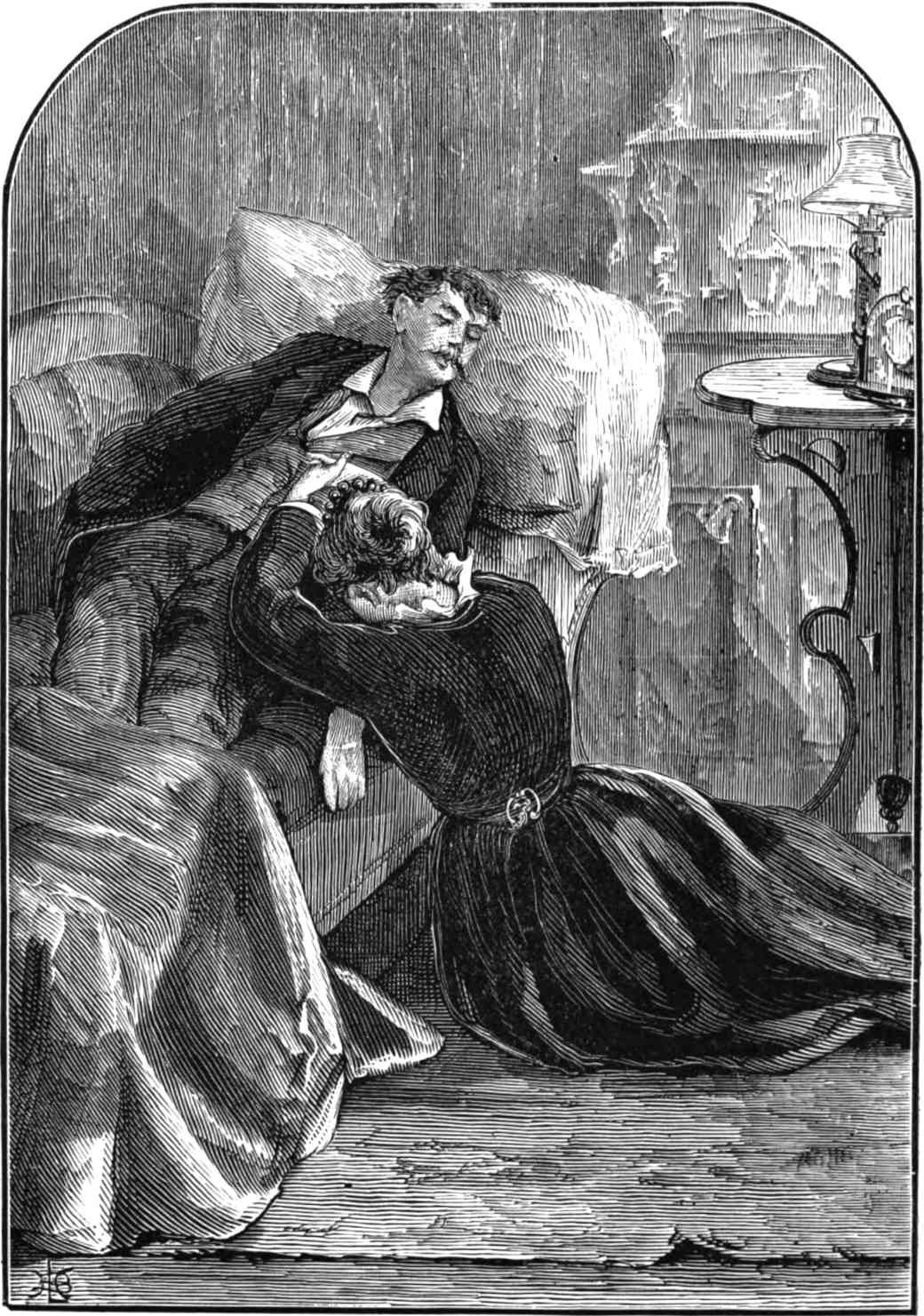
A World of Trouble.
Page 234.
One night, about two months after the conversation we have narrated, as the clock was striking the midnight hour, he was brought home, helplessly drunk, in the arms of two watchmen, who had picked him up in the street.
What a sight for a young and loving wife, to behold the father of her child drunk! They placed him in bed, and she spent a sleepless night in weeping over his senseless, imbruted form. O, the agony of that bitter time! Her husband a drunkard! she a drunkard’s wife! Earth has its miseries, but none like those of the inebriate’s wife.
Want, shame, the poorhouse, the court, and the prison rose before her with terrible vividness. A train of woes—real woes,—so long she could not see the end of it, marched in solemn procession before her. There was her child in rags, her husband a homeless, idle, degraded sot. There was the gaunt form of Hunger, the glaring eyes of the demons of crime—there was every thing there, from which the heart of woman would instinctively shrink.
Thomas rose next morning and ate his breakfast in silence—the silence which shame seemed to impose upon him. He was about to leave his house for his workshop, when Mary spoke.
“Thomas,” said she, in the subdued tones of anguish, while a flood of tears rained down her wan cheek.
He looked at her, as though he had already divined what she meant to say.
“Thomas, you can’t think how unhappy I was last night, when you were—when you came home.”
“Well, what’s the matter now?” answered Thomas, sullenly.
“O, Thomas, last night!”
“Well, what of it?”
Mary was amazed that no appearance of contrition mitigated his flagrant error.
“You don’t come home in the evening now.”
“No.”
“But you will come to-night, Thomas?”
“Perhaps I will.”
“Nay, you will?”
“What for?”
“Come for my sake, Thomas.”
“Your sake! Well, that is a good one,” replied he, coarsely.
Mary was shocked.
“Last night, you were—were——” she could say no more.
“Yes, I was.”
“You were——”
“Drunk! Out with it.”
“O, Thomas!”
“Well?”
“What misery is in store for us!”
“Can’t help it.”
“Nay, Thomas, promise that you will not——”
“Get drunk,” laughed Thomas.
“Do not again.”
“Can’t promise.”
“O God! has it come to this!”
“Fact!”
Mary threw herself into a chair, and wept as though her heart would break. The sight seemed to move the husband, who was not yet lost in transgression. A tear stole into his eye and he bent over her and took her hand.
“Mary, I have sinned.”
“You will not again?” said she, eagerly.
“But, Mary, is there no fault on your part?”
“My part?”
“My home is hateful to me. Even the presence of that sleeping, innocent child removes not the curse which seems to hang over it.”
“Why, Thomas, what do you mean?”
“You know what I mean. Have I not often reasoned with you?”
“O God!” exclaimed Mary, burying her face between her hands, conscious that the misery which menaced her was of her own seeking.
“I never will complain of anything again as long as I live!” she continued.
“Ah, Mary, I have often heard you say so before.”
“Trust me, this time, Thomas.”
“I will, Mary.”
“Come home to-night; you shall find me all that you could wish.”
“Bless you, Mary. I trust for your sake as well as my own, and for the sake of our own dear boy, that you may be true to your resolution.”
“I will, Thomas,” replied she, with a gathering smile, as her husband kissed her.
“And I promise never again to taste the fatal cup. You shall be the guardian of this my solemn pledge; for in no way can you more effectually secure the keeping of my promise, than by observing your own—in short, by making home happy.”
Again the husband kissed her, and then went to his work.