Chapter I
Reading edition
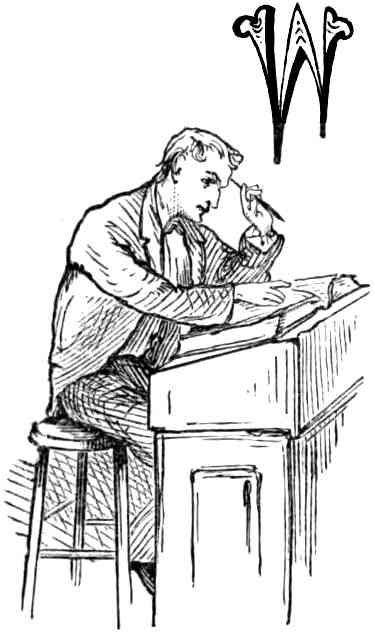
“Well, Dixon, what is it?” asked Mr. Phogie of his assistant bookkeeper, who had been patiently waiting for half an hour in the private counting room of the merchant for an opportunity to speak with his employer.
“My second year in your service will begin to-morrow, sir; and I have taken the liberty to request your attention to a matter which, though of little consequence to you, perhaps, is of considerable moment to me.”
The young man paused as if to note the effect of his words upon his employer.
“Indeed!” ejaculated the merchant, not half liking the cool and dignified way the young gentleman had of introducing himself.
To his mind there was a lack of that cringing, subservient tone and manner which his old-fashioned notions had taught him to believe was a dangerous deficiency in a clerk.
“I refer to my salary, sir.”
“Well?”
There was a gathering frown upon the brow of the merchant.
“I have endeavored to serve you faithfully,” continued the clerk, rather discouraged by the coldness with which he was received.
There was an awkward pause. Mr. Phogie’s philosophy did not permit him to speak; and the young man was too much embarrassed to proceed with his application.
“My salary for the past year has been five hundred dollars,” stammered Dixon, when he found his employer was bent on holding his peace.
“Well?” said Mr. Phogie, who still provokingly refused to take a hint.
“The object of my present visit is respectfully to request you to raise it to six hundred,” continued Dixon, more boldly, as he began to appreciate the humor of his employer.
Mr. Phogie stared, aghast with astonishment and horror, at the supplicant. Cruikshank or Johnston would have accounted the scene quite equal to that in the workhouse, where Oliver Twist, in a less important matter, had the unheard-of presumption and impudence to “ask for more.”
Dixon lost all hope.
“I trust, sir, I am not unreasonable,” said he, excusing his boldness.
“Forty years ago, Dixon, when I was of your age,” began Mr. Phogie, with solemn deliberateness, “I should have been glad to have received one half of your present salary.”
The merchant looked complacently at the clerk, to note the effect of this astounding declaration.
Dixon ventured to suggest that the times had changed.
Mr. Phogie admitted it, but was quite sure the change had been for the worse.
“That is a matter of opinion, sir.”
“Humph!”
“It costs much more to live now than it did then.”
“Young men didn’t drive fast horses then, nor go to the opera, nor board at fashionable hotels,” sneered Mr. Phogie.
“I am guilty of none of these follies, sir,” replied Dixon, a little indignant at the coarseness of the implication.
“Perhaps not; but five hundred dollars a year is a good salary for a prudent, careful young man.”
“For one who can do no better, it is very well.”
“Clerks are vain nowadays, and over-estimate themselves,” said Mr. Phogie, rebuking the complacence of his servant.
“I do not ask an increase of salary, sir, because I cannot live on five hundred dollars, but because I wish to advance myself, and, if you will pardon my vanity, because I think my services are worth more.”
“Very well, sir; when young men get above their business, there is no knowing where they will stop. I cannot accede to your demand;” and Mr. Phogie, to show his indifference, busied himself in arranging some papers on the desk before him.
“Then, sir, I shall be obliged to give you notice of my intention to leave your service,” returned Dixon, evidently relieved by the fact that the interview was concluded, even in this unsatisfactory manner.
Mr. Phogie paused in his occupation and looked with surprise upon the clerk. It was doubtful whether Dixon meant so.
“Got another situation?” asked he.
“No, sir.”
“Nothing in view?”
“Nothing, sir. Of course I could not make an arrangement till I had consulted you.”
Mr. Phogie was not pleased with the result of the interview. Dixon was an honest, faithful, and devoted clerk, and the idea of parting with him was not agreeable. But to retract what he had hastily said, would be an indication of weakness; besides, he knew that any quantity of clerks could be obtained for four, or even three hundred dollars a year; and he reasoned with himself that he should be a fool to pay Dixon six when he could get one for three.
Accordingly Dixon gave formal notice of his intention to “quit;” but, having already earned a reputation for integrity and fidelity, he could easily obtain a situation at the salary he had demanded of Mr. Phogie.