Chapter I
Reading edition
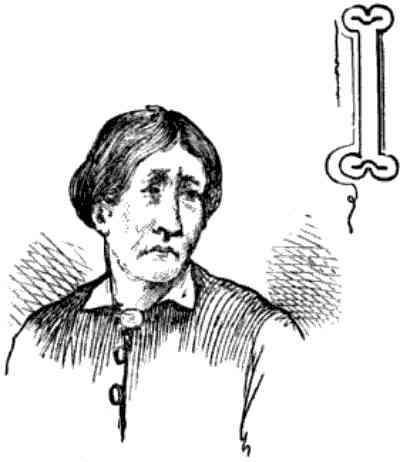
“I am so glad you have come, Thomas!” exclaimed Mrs. Butler, a pale, care-worn young wife, as her husband entered the room in which she had prepared the evening meal.
“Why, what is the matter now?” returned the husband, laying a wicked emphasis upon the word “now,” as though he meant to imply that there always was something the matter.
“Nothing; only I wanted you to bring in a pail of water, for I am so tired, that I declare I can hardly keep upon my feet.”
“Is that all? I did not know but what the baby had had a fit, or got scalded, or something of that sort.”
“Nothing of the kind; I have trouble enough to get along with, without sickness in the family. I feel just as though I should die every night when I get my work done;” and Mrs. Butler sighed, as she placed the smoking tea upon the table, and threw herself into a chair, apparently so exhausted that she could not have stood another moment.
“You must have a girl, Mary; you know I don’t want you to work so hard. I have often told you so before,” said Mr. Butler.
“A girl, indeed! Can you afford to keep a girl, Thomas?”
“Certainly, I can. I am earning twelve dollars a week now, and I am sure our expenses are not above eight. A dollar and a half a week added to this sum would leave me a handsome surplus.”
“Just like you, Thomas; that is one of your calculations.”
“Certainly, that is one of my calculations,” replied Mr. Butler, a little tartly.
“I suppose you wouldn’t reckon any thing for a girl’s board,” sneered the wife.
“A mere trifle.”
“Every thing is a mere trifle with you.”
Thomas stuffed half a hot biscuit into his mouth to help him keep his temper.
“And then she would waste double her wages,” continued the lady.
“Pshaw! that is an old woman’s bugbear,” replied Butler, impatiently.
“Yes; that’s just the way you always talk.”
“It is correct talk, though.”
“Girls don’t waste, I suppose?”
“I presume they do, many of them; but you abominably exaggerate the amount.”
“No, I don’t; I say they waste double their wages.”
“No such thing.”
“Ask any one who has kept them.”
“What articles do they waste to such an enormous extent?”
“Every thing—provisions, groceries; and they burn up twice as much fuel as there is any kind of need of.”
“Twice as much?”
“Yes; twice as much.”
“Let me see;” and Thomas pulled out a bit of paper and a pencil, and went to figuring with all his might. “We use three tons of coal in six months. Twice as much would be six tons, which would come to forty-two dollars, or twenty-one dollars waste. That is eighty cents a week.”
“Clear waste!” exclaimed Mrs. Butler, with palpable horror depicted on her countenance.
“Now, allow that she wastes one-half the provisions and one-half the groceries, which is absurd, and she would just double my bills. They were fifty-two dollars for the last six months, which makes a waste of two dollars per week. Why, Mary, we have only made the waste to be two dollars and eighty cents even with these figures. Double her wages would be three dollars.”
“She would waste enough, as you would find out to your sorrow, if you kept one,” added Mrs. Butler, not pleased with the state of her side of the argument.
“You don’t believe she could waste half the fuel and stores?”
Mrs. Butler did not believe it, but she did not like to say so.
“Probably, my dear, under your excellent supervision, she could not possibly waste more than fifty cents a week.”
“Well, that is twenty-six dollars a year.”
“But I can afford to lose that, rather than that you should make a slave of yourself.”
“I don’t want a girl; it would be more work to look after her than it would be to do the work myself.”
“As you please, my dear.”
“I don’t want your friends to think, you have got an extravagant wife.”
“Fudge on my friends!”
“Yes, it is easy enough for you to say so.”
“And for you, too, if you choose.”
“I don’t want to spend all we get.”
“Nor I, my dear; but, to be very plain with you, I had much rather do it, than hear you everlastingly complain how hard you have to work.”
“Don’t I work hard?”
“I don’t know but you do.”
“Just think what I have to do.”
“Well, I have to work hard, too; but I am sure it does not make one feel any better to be continually grumbling about it.”
“Who’s grumbling? Can’t a body speak without being accused of grumbling?” said Mrs. Butler, rather pettishly.
“I only mean to say, that you work twice as hard with your imagination as you do with your hands; your thoughts make the work hard.”
“Yes, it is easy for you to say so,” said the wife, wiping away the tears from her wan cheeks.
“When have I come into the house, Mary, for the last six months, and you have not told me a heap of troubles as big as a mountain? I can’t stand it.”
“I never thought you could be so harsh to me. You did not use to speak to me in that way,” sobbed Mary, feeling that she was the most cruelly used wife in the world.
“You irritate me with your troubles.”
“I can’t help my troubles; I do the best I can to keep your house in order, and take good care of the baby.”
“I never found any fault with your management. I am abundantly pleased with all you do, save and except your croaking and grumbling.”
“What can I do?”
“Go about your work cheerfully, and with a disposition to make the best of every thing. By a cheerful and contented disposition, you will make even the hardest day of toil a day of satisfaction. You look darkly upon your lot, and that makes it black.”
“I can’t help my feelings.”
“Yes, you can, Mary. At any rate, you ought not to imbitter my existence with your incessant complainings.”
“I have tried to make you happy.”
“If you have, you have signally failed; for it has come to that, I almost hate to come into the house, so much do I dread to hear your tale of woe.”
“I will try to do better.”
“Do, Mary; home will become a curse to me instead of the brightest spot upon earth, as it ought to be, if you do not.”
The baby cried at this point of the conversation, and Mrs. Butler wiped away her tears, and took the little cherub from the cradle where he had been sleeping, all unconscious of the matrimonial squall which had been blowing around him.