Chapter I
Reading edition
“What are you reading, sis?”
“Hard Times.”
“A novel!”
“Yes; why not? Dickens’s last new novel, and a capital thing it is, too.”
The two ladies, between whom this conversation passed, were sisters, and nieces of one of the better class of New England farmers, with whom they resided. ’Squire Fairbank, without being a very brilliant man, had acquired considerable distinction in the village where he lived, probably because, besides being “worth money,” he was a straightforward, conservative, reliable man, and had frequently served the town in an acceptable manner, both in the legislature, and as moderator in town meeting. He was the most notable man in the village, and won the title of ’Squire, which was universally accorded to him, simply by being a very respectable person and a man of influence.
Susan and Mary Fairbank were orphans, inheriting from their father the very pretty little sum of five thousand dollars each. Both had attained their majority, and consequently were in full possession of their portions, untrammelled even by the authority of as indulgent a guardian as ’Squire Fairbank had proved to be.
They had been well educated at a celebrated female seminary in the vicinity of Boston, and as a matter of course, had brought home to the quiet village of Poppleton many strange notions and remarkable peculiarities. But they were sensible girls in the main, and though their habits and education elevated them above the reigning ton of the place, it was generally conceded that they knew “what was what,” and were not “a mite more stuck up” than would naturally have been expected.
Mary and Susan were essentially different in temperament and disposition. The former was exceedingly open and free-hearted, while the latter was rather disposed to truckle to the formality of the world, or to the circumstances in which she happened to be placed. Mary never asked what the world would say or think, and while her notions of duty were very clearly defined, she chose to be independent and straightforward. People said she “took after” her father.
Susan, on the contrary, was nicely sensitive to the good opinion of others. She had not the energy to do any thing in opposition to popular sentiment. Indeed, she was very much like some of the distinguished public servants at Washington, who do every thing with an eye to a reëlection or to government patronage.
A short time before our story opens, a young minister had been settled in Poppleton, and being a single man, ’Squire Fairbank had consented, as a special favor, to receive him into his house. The Rev. Mr. Carlisle was universally allowed to be a very promising young man. He was talented, had a graceful elocution, and, what pleased the young ladies better still, was decidedly a handsome person. Those who were not much influenced by talent, elocution, and personal beauty, thought he was rather bigoted for one so young, and hoped that time would wear off the rough corners of his repulsive theology.
Susan Fairbank was deeply interested in the young clergyman, and as a natural consequence to one of her vacillating temperament, became deeply interested in spiritual things. We do not believe she had any intention of playing the hypocrite; but her devotion to the young minister involuntarily led her to assume an interest, which, if Mr. Carlisle had been old, ugly, or married, she would not have felt.
“A novel, sis! only think of it!” exclaimed Susan, holding up both hands with pious horror.
“Pray, Susan, how long is it since you have possessed this holy repugnance to novels? It was only last winter that I saw you reading The Children of the Abbey,” returned Mary, laughing heartily.
“I have not read one since, and I never mean to again.”
“Fudge!”
“What do you think Mr. Carlisle would say if he should see you reading a novel?”
“I shouldn’t care what he said.”
“Why, Mary!”
“I shouldn’t; if he does not like it, he may whistle for all me.”
“Don’t talk so, Mary.”
“Why will you make a fool of yourself, Susan? Mr. Carlisle cares no more for you than he does for the fifth wheel of a coach; I would not stand in such fear of him for the world.”
“Fear of him! I do not fear him; I only respect him as a very good man.”
“You have set your cap for him; but let me tell you to be more independent, or you never will catch him,” said Mary, laughing.
“How absurd you talk!”
“Do I?”
Susan fell to biting her finger nail—a very vulgar habit, by the way—and to think of something which her sister had no difficulty in discerning.
“Do you really love him, Susan?” asked Mary.
“Love him! No; I never thought of such a thing.”
Perhaps she never did.
“What makes you go to all the prayer meetings, and mope round the house like a sick owl, then?”
“I think I am under conviction,” replied Susan, demurely.
“Conviction of what?”
“Conviction of sin.”
“Conviction that Mr. Carlisle is a very handsome fellow, more like.”
“How absurd you are!”
“And I have heard a report round town, that you were going to join the church.”
“I have spoken to Mr. Carlisle about it.”
Mary looked serious for a moment.
“If you really feel so, I commend your conduct; but I advise you not to be too hasty. Examine your heart attentively, and do not bring scandal upon the church by having side motives. But here comes Mr. Carlisle,” said Mary, as she again turned her attention to the fascinating pages of Hard Times.
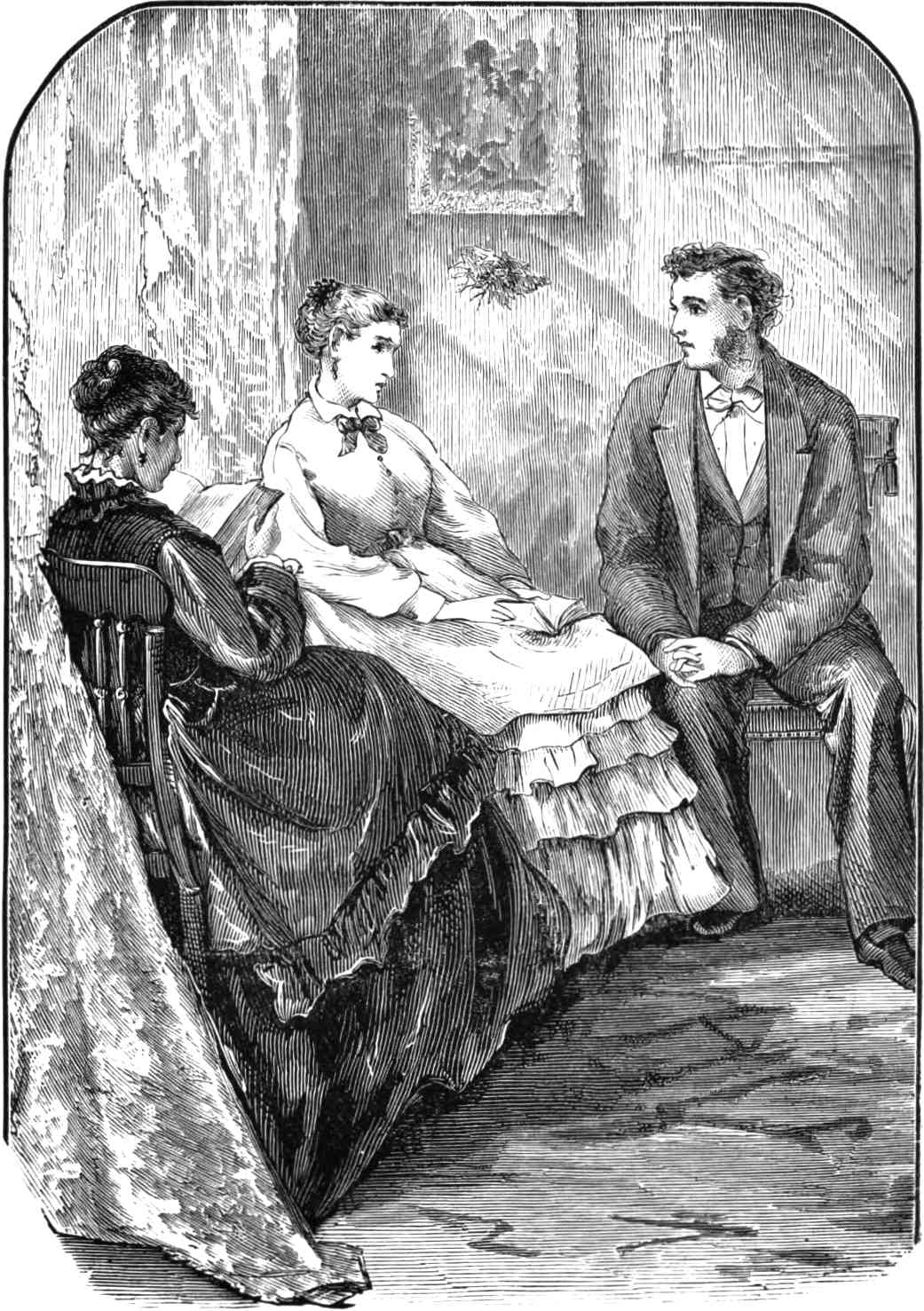
Extremes Meet.
Page 267.