Chapter II
Reading edition
Louise Percy, without being very beautiful or very bewitching, was a very sensible, earnest, straightforward girl. With a warm heart and generous disposition, she was free, open, and sincere in her intercourse with the world.
Just the opposite was her friend and confidant, Susan Maylie, though, as the world goes, she passed for a good-hearted person. She lacked that transparency of motive which was so eminently the characteristic of Louise’s temperament. Where no strong prejudice actuated her, she was generally prompt in her choice of the good from the evil, though sometimes the most intimate friend was involuntarily led to suspect her motive.
Six months before we introduce them to the reader, the village in which they resided was thrown into commotion by the arrival of the new minister, who had been called to officiate in the parish church.
He was young, handsome, and, more than all, unmarried. Straightway, one half of the eligible maidens in town became interested in “serious things.” The prayer meetings and the conference meetings were all at once found to be seasons of special interest. All the charitable societies connected with the church suddenly become prosperous. The missionary society, which was composed of ladies, who met once a month at the sewing circle, received a new impetus from the arrival of Mr. Rogers.
The young clergyman made it a point to attend these meetings, for he was particularly interested in the enterprise of sending the gospel to the heathen. He had preached several sermons on his favorite topic, and his exertions were rewarded by the creation of a strong and unusual feeling on the subject.
Susan, all at once, found her mind intently engaged in the engrossing subject. It is true she had learned from her father to ridicule and despise the missions; but then her heart was hard, and the ministrations of the handsome young clergyman had turned her mind from the vanities and vexations of life, to the lofty and substantial realities of “serious things.”
Louise could not help noticing the sudden and remarkable change; but then Susan so constantly spoke of the minister’s handsome face; so often sneered at the thought of sundry village belles, whom she was malicious enough to accuse of attempting to “catch” him, that she readily fathomed the occasion of the singular transformation.
Louise got out of patience with her friend’s duplicity, but suspecting that it might be involuntary, or the consequence of a want of consideration, she had plainly pointed out the inconsistency. Susan could hardly deny the fact, and feeling that Louise was a true friend, one who would not proclaim her infirmity to the world, she suffered the charge to pass unrefuted.
“I am going to set up an opposition to the missionary society,” said Louise, after Mr. Rogers had gone.
“Pray, what mad scheme have you got in your brain now?” asked Susan.
“I am going to do something for the relief of Mrs. Weston.”
“How foolish you are!”
“Am I?”
“You are, very foolish. It is the town’s business to look out for paupers.”
“It is my business, too, and yours, Susan.”
“I am sure I shall not meddle with it.”
“We have each of us reserved five dollars for charitable purposes, you know.”
“Well?”
“I shall give mine to Mrs. Weston.”
“And I shall give mine to the missions. I thought you were going to do the same.”
“I have altered my mind. I cannot send my money across the ocean, when there is an abundance of heathen growing up in ignorance around us. Now, if you will put your five dollars with mine, it will just make up the amount the poor woman asked the deacon to abate her rent.”
“I shall do no such thing, I assure you. I am too much interested in the missions to throw my money away upon the town’s paupers.”
“Very well; I will not urge you.”
“What do you suppose Mr. Rogers would say, if I should give nothing to the missions?”
“Are you beholden to him to render an account of your stewardship? For my part, I shouldn’t care what he thought. Do your duty, Susan, let folks think as they may. If I had money enough, I would contribute handsomely towards having the gospel preached to such heathen as Deacon Hapgood, Farmer Jones, and some others who support missions, while they starve their own souls and those of their families.”
Susan, knowing how obstinate Louise was when excited, refrained from opposing the purpose she had announced, and Louise retired to her room.
“Five dollars,” said she, musingly; “it is more than a week’s pay; but she shall have it; yes, and more too. Since Susan has refused to join me in this work of charity, I will give another five dollars; and then how happy the poor creature will be!”
The face of the gentle-hearted girl lighted up with an involuntary smile, as she opened her drawer and took therefrom the ten dollars. It was a large sum for her; but she cheerfully resigned the pleasures it would purchase, and looked forward to the joy she was about to carry to the cottage of the drunkard’s wife.
With a light heart she tripped down the road to execute her charitable mission. As she entered the hovel, she shrank back at the scene of wretchedness presented to her view. The poor woman, pale and haggard with care, apparently with one foot in the grave, was surrounded by half a dozen ragged children, whom her utmost exertions could hardly feed with the coarsest fare, and clothe even with the miserable garments that only half covered their nakedness.
Stating the object of her visit, Louise handed to her the ten dollars.
Mrs. Weston started back in amazement. Such unheard of liberality overwhelmed her with confusion. If Deacon Hapgood could not afford to take off ten dollars from her rent, how could a poor girl afford to give her that sum outright? Before she could recover her self-possession sufficiently to express her gratitude, the young minister entered the house.
Mr. Rogers was almost as much astonished at the generosity of Louise as Mrs. Weston had been; and when he took his leave, he gladdened the poor creature’s heart by adding another ten dollars to the gift.
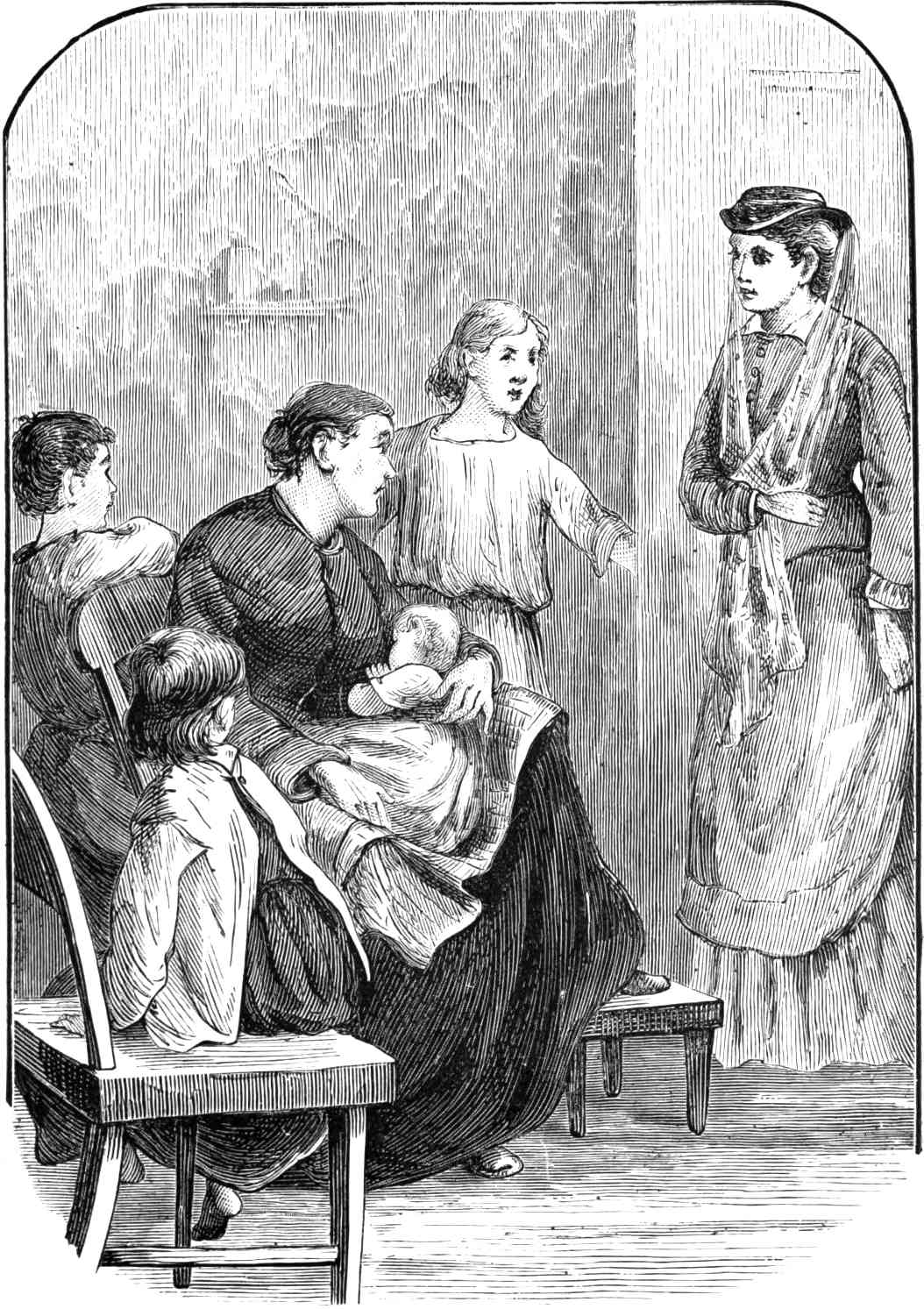
The New Minister.
Page 58.