Chapter I
Reading edition
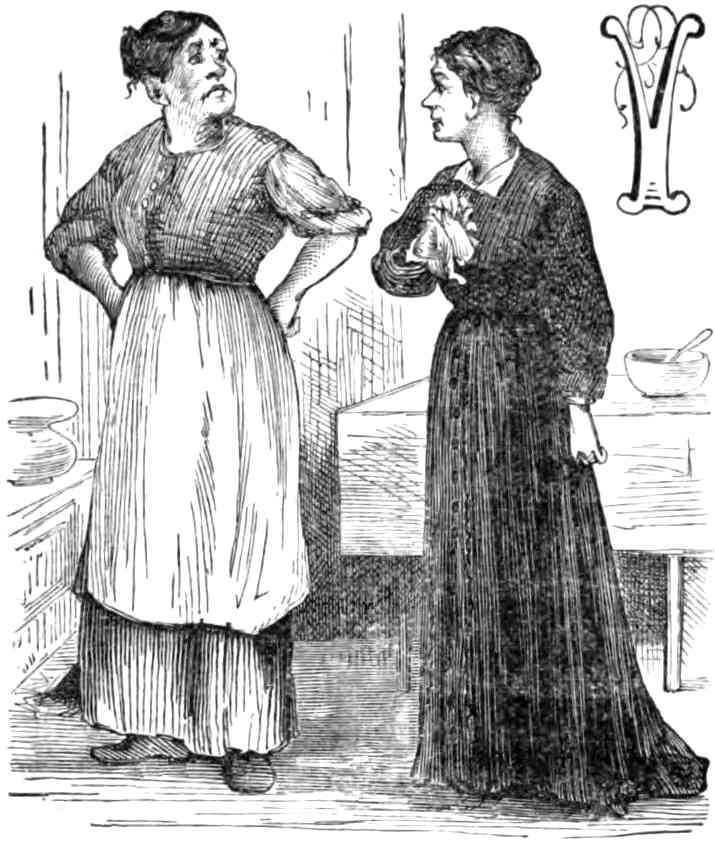
“Your girl is a prize, Mrs. Bagley,” said Mrs. Veazie, a lady whose physiognomy was rather indicative of a sour temper.
“Bridget is a good girl,” responded the lady addressed; “and she has been with me over a year now.”
“Indeed! Over a year! Well, I am astonished! For my part, if I get a good girl, I can’t keep her.”
“I have been very fortunate in that respect.”
“You have indeed. O dear! it is really terrible to think how much one is dependent upon these Irish servant girls. They are such lazy, impudent, good-for-nothing creatures, that it is enough to weary out one’s life.”
“Some of them are. If I had been so unfortunate as to get such a one as you describe, I should instantly discharge her. But very few are of that description.”
“Very few! Let me tell you that your girl is one in a thousand, Mrs. Bagley. Where you find one who is honest, faithful, and respectful, you will find nine hundred and ninety-nine who are just the reverse.”
“I can hardly believe it,” replied the good-natured Mrs. Bagley, with a smile of incredulity upon her pleasant features.
“It is as true as the gospel! Why, I have had no less than ten different girls within a year.”
“Ten! Is it possible?”
“And my family is no larger and the work is no harder than yours. Isn’t it singular?”
Politeness compelled Mrs. Bagley to answer that it was singular; but, at the same time, she knew that it was not so very singular, after all. If she had felt at liberty to do so, she could have given her friend a solution of the mystery.
“And the girl I have now I shall be compelled to discharge. She is discontented, impudent, and overbearing.”
“I am sorry for you.”
“She is a capital girl in every other respect, and I am sorry to part with her. She is a good cook, and—what you don’t find in many girls—understands pastry, cake, and puddings.”
“Too bad to lose her, isn’t it?” said Mrs. Bagley, with a greater appearance of sympathy in her speech than found a place in her heart.
“It is; but one cannot put up with impudence, you know. I would send off the best girl in the world, before I would submit to it.”
“Certainly; impudence cannot be tolerated. Can’t you teach her better?”
“No; she won’t hear to any thing. It was only the other day, when I saw her washing the potatoes in the wash-hands basin, that I merely called her a nasty, good-for-nothing hussy; and, don’t you think, the impudent jade told me to mind my own business, and not to be sticking my nose into her affairs! Did any one ever hear the like?”
Mrs. Bagley only smiled. If she had lived in a less civilized era, perhaps she would have been blunt enough to say that the fault was partly with the mistress, and not wholly with the servant.
“And then she is so ugly,” continued Mrs. Veazie, “that I dare not trust my children with her.”
“I leave the baby with Bridget for half a day sometimes, and feel perfectly safe.”
“My girl don’t like children; I know she hates them. Why, only yesterday I told her she might leave the washing for an hour or so, and take Charley out in the little wagon; and, don’t you think, she had the impudence to tell me that, if I wanted Charley taken out, I might take him out myself! I never was so provoked in my life.”
Mrs. Bagley’s good nature was all exhausted; and, at the risk of being deemed uncivil, she had the hardihood to say she never took Bridget away from her washing, unless in a case of absolute necessity.
“Wasn’t this a case of absolute necessity?” asked Mrs. Veazie, with a rather uncompromising look upon her sharp features.
Poor Mrs. Bagley! She was in for it, and must needs defend the policy at which she had incautiously hinted.
“I should say not,” replied she, not a little fearful that she was about to “stir up strife.”
“What would you do? Charley ought to have the fresh air every day.”
“I should have taken him out myself; for it is very annoying for a girl to be called away from the wash tub. She has to change her dress, which is a great deal of trouble, and leave her clothes in the water or on the fire.”
“Yes, girls are desperate ’fraid of a little trouble.”
“If they feel any pride about their work, they like to have it done up in good season, you know.”
“And she insists upon being absent every fourth Sunday.”
“I let Bridget go every third Sunday.”
“You do?”
“I think it very reasonable.”
“Who gets your dinner Sundays?”
“What little we get I attend to myself. But we always have baked beans Sunday, so that I don’t have to stay at home from meeting.”
“And you wash the dishes yourself!” exclaimed Mrs. Veazie, in utter astonishment.
“Certainly. The fact is, these Irish girls are human beings, after all, and need a little recreation as well as the rest of us.”
“But they take advantage.”
“If you give them no advantages, they will take them. I have found out that, the better you use good girls, the more faithfully they will serve you. I make it a point to treat my girl well; and, having secured her good will, I feel a reasonable assurance that she will do the best she can for me.”
“You don’t mean to say that I don’t treat my girl well?” said Mrs. Veazie, her features coloring under the insinuation she believed was aimed at her.
“Certainly not. My remark was intended to be very general.”
Mrs. Veazie went home; and, though she was a little angry with her neighbor, she “set to thinking” upon what she had heard.