Part 1 — XVIII. MILLARD FILLMORE, PRESIDENT.
Reading edition
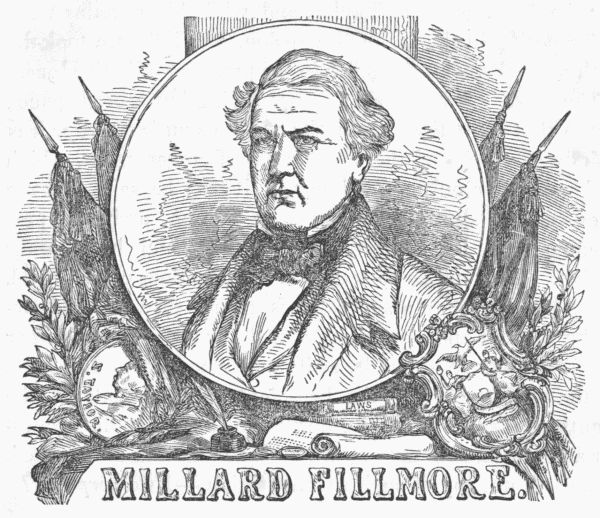
ASSUMED THE GOVERNMENT JULY 10, 1850.
[Immediately upon the death of President Taylor, the members of his Cabinet tendered their resignation to President Fillmore, but at his request, and for the safety of the public service, they retained their offices for a few days. On the 15th, the new Cabinet was formed.]
Daniel Webster, Massachusetts, July 15, Secretary of State.
Thomas Corwin, Ohio, July 15, Secretary of Treasury.
Alexander H. H. Stuart, Secretary of the Interior.[90]
Charles M. Conrad,[91] Secretary of War.
William A. Graham, North Carolina, July 15, Secretary of the Navy.
John J. Crittenden, Kentucky, July 15, Attorney General.
Nathan K. Hall, New York, July 15, Postmaster General.
It is a most admirable feature of the Constitution of the United States, that it provides, in case of the death of a President, for the ready and quiet transfer of all his powers to the Vice President, as his constitutional successor. And a most interesting hour was that when, on the day following the death of Gen. Taylor, and while his remains were still reposing in the national mansion, Mr. Fillmore took the oath of the Presidential office in the presence of both Houses of Congress. It was a service occupying but a brief space; but in that short time a transfer of all executive power was quietly effected, and the machinery of government, which had paused for only a few hours, if it may be said to have been suspended at all, was again in motion, and was proceeding with its accustomed regularity and harmonious action. How unlike to scenes in other nations of the world, when the demise of a sovereign is nearly sure to be followed by turmoil and confusion, and the transfer of his power is effected only, perhaps, by strife and bloodshed. But here, at the bidding of God, the President one hour puts off the mantle of his power and authority, and the next his successor assumes it, and not one wave of commotion is observed. Who will not say of such a Constitution,—Esto perpetua?
The Compromise Bill.—The death of Gen. Taylor, and the funeral obsequies consequent thereupon, suspended for a brief time all other Congressional proceedings of the National Council. When, at length, action was resumed, it was natural to expect that an event so providential and so monitory would have its due influence in mitigating the acerbity of party spirit, and of infusing into the minds of legislators a deeper sense of the importance of harmony and mutual kindness. But it proved otherwise. Scarcely had the grave closed upon the remains of the great and good man, ere the same heated contest was renewed, and the same sectional jealousies indulged.
It would impart no pleasure to enter into the details of the Senate's action, day after day, upon the Compromise bill, the one great measure which had absorbed its dissensions nearly the whole of the session. Suffice it to say, that in consequence of various amendments, the bill, at length, contained nothing but the sections relating to the territory of Utah, and in that shape it was passed by a vote of 32 to 18. Thus a series of measures, which had been under discussion for months, which the powerful eloquence of Clay, Cass, and others had advocated, and which by them and others was deemed almost essential to the peace and integrity of the Union, was lost, and for the time any adequate substitute seemed hopeless. Clouds of deeper intensity than ever seemed to be gathering, and anarchy and discord were ready to extend their baleful influence to the nation at large.
Happily, however, a conservative spirit at length prevailed. Men perceived the necessity of doing something to save the nation and the Union, and under this conviction, a movement was made to revive, in another form and in distinct bills, the measures which had been previously combined into one, and been lost. We shall attempt to state little more than results.
First, the bill for the admission of California was taken up, and after a warm discussion, during which amendment after amendment was offered and rejected, it was passed by the Senate, 34 to 18. To this bill a formal and spirited protest was presented by several southern Senators, but its registration on the journal was refused.
Next, followed a bill making proposals to Texas for the settlement of her western boundary, and proposing to pay her ten millions of dollars, provided she should relinquish all claim to the United States for territory beyond the boundaries prescribed. The bill was debated for several days, and on the 9th of September, received its final passage. Yeas 30, nays 20.
On the 14th, the bill providing for a territorial government for New Mexico, was taken up and finally passed.
The above several bills were sent of course to the House of Representatives, and by that body were passed with amendments with regard to some of them, but only after as warm and even heated debate, as was ever, perhaps, known on the floor of Congress.
Two other important bills received also the sanction of a majority of both houses; the first was a bill to facilitate the recovery of fugitive slaves; and the second, a bill abolishing the slave trade in the District of Columbia.
Congress adjourned on the 30th of September; the session having been protracted to the long period of ten months, and having proved more stormy than any other session since the adoption of the Federal Constitution. The effects of the above measures time only can determine. While to the South, the abolition of the slave trade in the District of Columbia, is most obnoxious, being, as is affirmed, a precursor of further action by the general government in relation to the abolition of slavery, the fugitive slave bill has received the loud and decided condemnation of individuals and assemblies at the North. The opinion, however, of the Attorney General, that this latter bill does not suspend the writ of Habeas Corpus, has served in a measure to allay the wide-spread hostility to it, as such suspension was supposed to be contemplated by it, and was condemned as unconstitutional and unjust.