Part 1 — II. BATTLE OF BUNKER'S HILL.
Reading edition
American Patriotism—American and British Forces—Fortification of Bunker's hill—Attacked by British Ships—Asa Pollard, the first Martyr—Preparations of the British—Warren—Prescott's Injunction to his Troops—British repulsed with terrible slaughter—Second Attack—Charlestown set on fire at the same time—Second Repulse—Putnam and Major Small—Death of Colonel Gardiner—Thrilling Incident—Third Advance of the British—Death of Major Pitcairn—Americans in want of Ammunition—Retreat—Death of Warren—Respective Losses—Results of the Battle.
Boston, which for a considerable time had been the point of greatest interest in the American colonies, was not less so immediately following the battle of Lexington. That engagement served to quicken the already excited pulse of thousands. The fires of patriotism burned brighter. Sires and sons, mothers and daughters, rejoiced that the crisis had come, and were ready to make every needful sacrifice for their country's good. In a few weeks, the metropolis of the province of Massachusetts was environed by an American army, fifteen thousand strong—ten thousand of which was furnished by Massachusetts, and three thousand by Connecticut; the rest were supplied by the other New England colonies. Of these troops, General Ward was commander-in-chief. His head-quarters were at Cambridge. The right-wing was stationed at Roxbury, the left at Medford and Chelsea.
Towards the end of May, a considerable rëinforcement arrived at Boston from England, which, with the garrison, formed an army of from ten to twelve thousand men—all veteran troops. At the head of this rëinforcement were three distinguished and practical generals—Howe, Clinton, and Burgoyne.
The difference in numbers was on the side of the Americans—not so, however, their military science, arms, or ammunition. They had, in all, but sixteen field-pieces, six of which, at the very utmost, were in a condition for service. Their brass pieces, which were few, were of the smallest caliber. They had, however, some heavy iron cannon, with three or four mortars and howitzers, and some scanty provision of balls and bombs. But of powder, they were almost totally destitute.
The situation of the English was now daily becoming more perplexing and critical, and the necessity was increasingly apparent, if they intended to retain their position, of fortifying certain points in the neighborhood. The two regarded of greatest importance were the heights of Dorchester and Charlestown. The former presenting superior inducements, it was determined to occupy and fortify that first, and, afterwards, the latter.
The Americans having learned the intentions of the British general, it became a serious question what course was most prudent for them to adopt. For a time, a difference of opinion prevailed among the American patriots; but, at length, the committee of safety recommended to the council of war to occupy and fortify Bunker's hill at once, and Dorchester heights (now South Boston), as early after as practicable.
In conformity with this suggestion, on the following day (16th June), General Ward issued orders to Colonel Prescott to proceed to Charlestown, and occupy and fortify Bunker's hill.
The troops detached for this service, amounted to about one thousand men. They were ordered to take provisions but for a single day. In the early part of the evening of the 16th, they were mustered on Cambridge common, near the colleges. They were commended to the protection and guidance of Almighty God, in a prayer by President Langdon; after which, led by the valiant Prescott, attired in a calico frock, and himself preceded by two sergeants with dark lanterns, and accompanied by Colonel Gridley and Judge Winthrop of Cambridge, they took their destined path.
Having reached the ground, a question arose which of the two hills was intended as Bunker's hill. The northern eminence was more generally spoken of under that name, while the southern, commonly called Breed's hill, was evidently the one best fitted for the purpose. After long deliberation, it was decided to construct the principal work on Breed's hill, and to erect an additional and subsidiary one on Bunker's hill. Accordingly, Captain Gridley proceeded to lay out the principal work. Midnight arrived, however, before a spade entered the ground; there remained therefore less than four hours before day-light, when the operations would, of course, be seen by the British. The men, however, now began, and they worked.
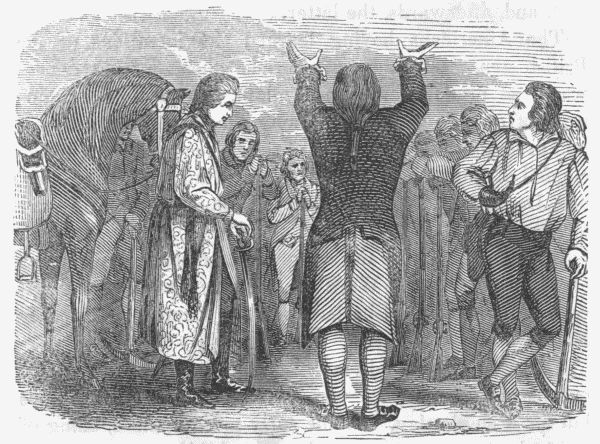
President Langdon at Prayer.
Meanwhile, a strong guard, under Captain Manners, was stationed on the Charlestown shore, to watch the enemy. The day had been fair, and it was a clear, star-light night. Colonel Prescott, accompanied by Major Brooks, went down twice to the shore to reconnoitre, and distinctly heard the British sentries relieving guard, and uttering, as they walked their rounds, the customary, but, in this instance deceptive, cry, "All's well!"[32]
The night, on the part of the patriot band, was one of sleepless vigilance and incessant toil. Shovels, pickaxes, and spades, were in incessant motion; and, by four o'clock in the morning, they had thrown up a redoubt, eight rods square and four feet high. At this time, the captain of a British ship, called the Lively, discovered the work, and opened a fire upon it. The alarm was given to the British in Boston, and to the men-of-war in the river, and a heavy cannonade was commenced. The fire from a battery of six guns, on Copp's hill, proved most annoying; but the Americans, regardless of bombs and balls, continued their labors with unshaken constancy. The first martyr who had the honor of shedding his blood, on that ever-memorable hill, was a private soldier by the name of Asa Pollard, of Billerica, and the shot which killed him was the only one which took fatal effect during the forenoon.
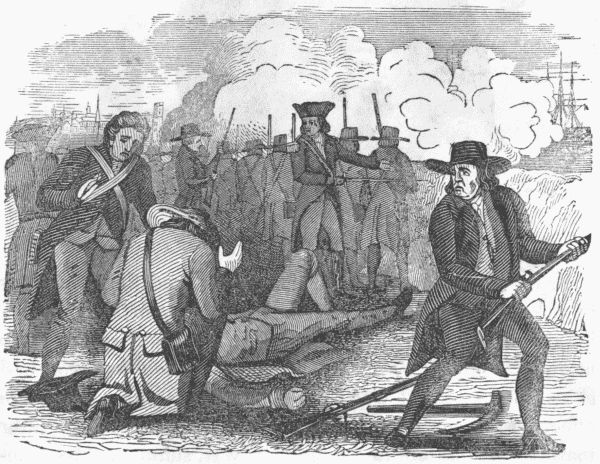
Death of Pollard.
While various movements were in progress, the Americans in the neighborhood of the redoubt were by no means idle. About two hundred yards in the rear of the breastwork was a stone fence surmounted with rails. In front of this, another fence was constructed, and the space between the two filled with hay, which happened to be on the field. A subsidiary work was also hastily thrown up on Bunker's hill, properly so called, by General Putnam.
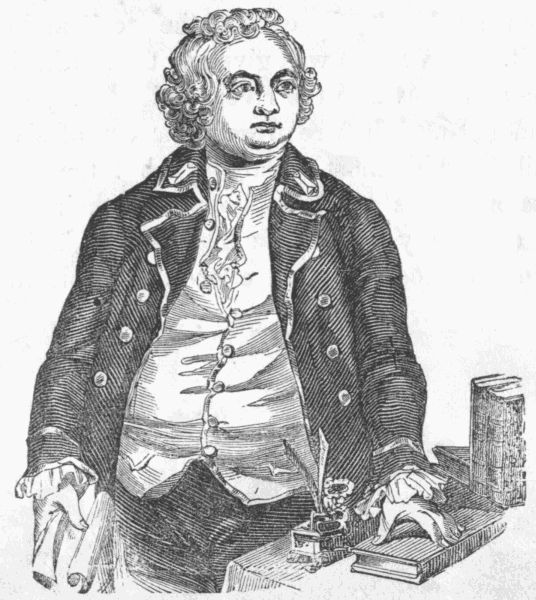
General Putnam.
From the moment the British discovered the operations of the Americans, they well knew the importance of dislodging them from their position. They had expected to attain this object by a cannonade from their batteries and ships of war; but it was soon apparent that other and more effective measures would be necessary. Accordingly, after mature consultation in a council of war, summoned by General Gage, it was resolved to transport a competent force across the river, and attack the works in front.
It was "a day without clouds," and intensely hot. Between mid-day and one o'clock, twenty-eight barges were seen moving from the end of Long wharf towards Morton's point. On board of these were four battalions of infantry and ten of grenadiers. They had six pieces of artillery, one of which was placed in each of the six leading boats.
About two o'clock, a second detachment left Winnisimmett ferry, and joined the first at Morton's point. These were soon after followed by rëinforcements, which landed at Madlin's ship-yard, now the navy-yard near the east end of Breed's hill. These several detachments, amounting to about four thousand men, were under command of General Howe, subordinate to whom were General Pigot, and Colonels Nesbit, Abercrombie, and Clark.
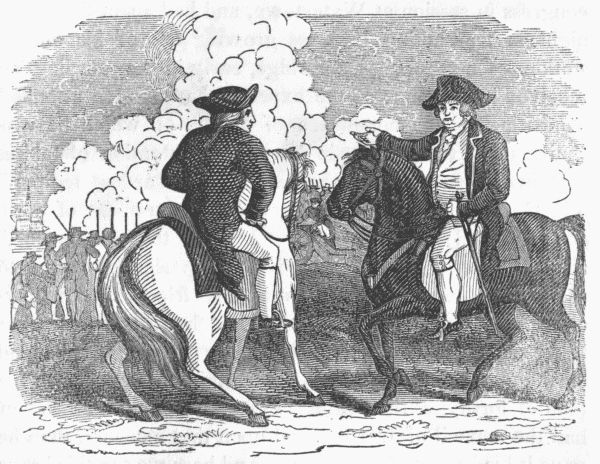
Interview between Putnam and Warren.
A short time before the action commenced, a horseman was perceived advancing rapidly from Charlestown, towards the American redoubt. It proved to be General Warren, the president of the provincial congress. "Ah!" said Putnam, as the former came up, "is it you, General? I am glad to see you, and yet I regret your presence. Your life is too precious to be thus exposed; but since you are here, let me receive your orders." "No," replied the gallant soldier; "I give no orders! I come as a volunteer; and now say where I can be the most useful." "Go, then," said Putnam, "to the redoubt; you will there be less exposed." "Tell me," rejoined Warren, "where will be the point of greatest danger." "The redoubt will be the enemy's first and principal object," said Putnam; "if we can defend that, the day is ours." Warren passed on, and, as he passed, the troops recognised him, and loud and long were their acclamations. Every bosom felt the impulse of his presence. At the redoubt, Prescott received him, and begged him to receive the command. "Give me a musket," said Warren; "to-day I take a lesson from the veteran soldier in the art of war." Warren could not content himself away from the dangers which were thickening around the patriotic cause. The day previous, he had presided in the congress in session at Watertown, and had spent the entire night in transacting business growing out of his official station. On reaching Cambridge, early in the morning, he received intelligence of the expected battle. He attended a meeting of the committee of safety, of which he was chairman. Here he made known his intention of taking part in the approaching contest. "Your ardent temper," said Gerry, "will carry you forward in the midst of peril, and you will probably fall." "I know that I may fall," replied Warren, "but I should die with shame, were I to remain at home in safety, while my friends and fellow-citizens are shedding their blood, and hazarding their lives in the cause." The honor of Warren is greatly enhanced by the consideration that he was originally opposed to the plan of fortifying the heights of Charlestown, but no sooner had the council of war decided upon that measure, than he gave it his hearty cöoperation. And here we see this brave and patriotic man in the field of battle, and in the midst of danger, having adopted the beautiful sentiment of the Roman poet,
"Dulce et decorum est pro patria mori."
The action opened at about three o'clock in the afternoon, at which time a general discharge of artillery was ordered along the whole British line. At the same time, the troops advanced in two divisions. General Howe led the right towards the rail-fence; General Pigot with the left end towards the redoubt.
The march of the British troops was slow, but steady. They wore the aspect of strong confidence and strong determination. Meanwhile, the American drums beat to arms. Quitting his intrenchment, where he was still at work on Bunker's hill, Putnam led his equally determined, but far less disciplined, troops into action. Said this veteran general, in his usual pointed and laconic style, "Fellow-soldiers! powder is scarce, and must not be wasted. Reserve your fire till you see the whites of their eyes. Then take aim at the officers."
This injunction, however, having been disobeyed by a few of the more restless and impetuous, Prescott, proceeding along the lines, said, in a tone of thunder: "The next man that fires before the order is given, shall be instantly shot." It was apparently cruel thus to require troops, whose bosoms were now glowing with burning zeal, to withhold their fire, while the enemy was pouring in his at every step of his progress. It was, however, a wise delay. At length, the British had advanced within eight rods of the redoubt. "Now, men," said Prescott, "now is your time! Make ready! Take aim! Fire!"
And such a deadly fire, perhaps, was never before made; and, when the smoke rolled off, such a sight was perhaps never before seen. The hill-side was covered with the slain. The ranks of the British were broken, and confusion appeared on every side. The British officers attempted to rally their troops. In this, they succeeded so far as to induce them to fire; but, evidently appalled at the fearful and unexpected carnage, they turned, and fled down the hill.
"Following this repulse, there was an ominous pause," says a writer, "like the lull that sometimes interrupts the wildest tempest, only broken by the occasional discharge of artillery from the ships and batteries." It was not, however, of long duration. A second attack was decided upon, and orders issued again to advance. Meanwhile, a deep silence brooded over the American lines, all being intent upon the devastation which had been made, and watching for the future movements of the enemy which had been so signally repulsed. Their success had greatly exceeded their own expectations, and served to inspire them with still more confidence in a second rencontre which they might now momently expect. In the first attack, they had been directed to reserve their fire until the enemy had approached within eight rods; now they must wait until the enemy should approach within six rods.
While the British troops were advancing, suddenly a new spectacle burst upon the eyes of the tens of thousands who were looking on from every neighboring eminence, which greatly added to the sublimity of the scene.
Annoyed in his first attack upon the American redoubt, by the fire of a detachment stationed at Charlestown, General Howe had given directions to fire that town, both by way of revenging the injury he had sustained, and, also, the more to distract the Americans during his second attack, to which he was now advancing. In furtherance of this object, a large quantity of combustibles had been conveyed from Boston, and a detachment of marines, from the Somerset, been landed to set them on fire. The work of conflagration was now commenced. Dense and dark clouds of smoke rose over the town, and at length enveloped the whole peninsula; through this smoke, columns of flame shot up, and flashed in every direction. The fire spread with fearful rapidity from house to house, and from street to street. At length, the flames reached the church, and, climbing its lofty steeple, converted it into a blazing pyramid. The beams, supporting the bell, were burned in sunder, upon which it fell, and while falling, its pealing sounds were distinctly heard by hundreds, uniting with crackling flames and crashing edifices in enhancing the dreadful magnificence of the day.
It was in the midst of a scene of desolation like this—by which property to the amount of one hundred and twenty thousand pounds sterling was destroyed, six hundred buildings consumed, and two thousand people rendered houseless—the two opposing forces were preparing for another sanguinary rencontre. The British general was leading on his troops, as cool and undisturbed as if they had met with no repulse. They opened their fire by platoons, and apparently at random, yet not entirely without effect. Colonels Nixon and Brewer were borne wounded from the works. A ball through his shoulder rendered Colonel Backminster a cripple for life. Major Moore received a shot through the thigh; soon after which, a second ball pierced his body, which subsequently proved mortal.
The Americans had been charged to reserve their fire till the enemy were within six rods. The success which had attended their former delay, now enabled them the more cheerfully to yield obedience to orders, a compliance with which had, in the first instance, seemed nearly impossible. At length, the enemy reached the prescribed distance, when the anticipated words, "Make ready! Take aim! Fire!" were heard in a voice like thunder—and, in an instant, hundreds of men, including a surprising number of principal officers, were seen prostrated in the dust. The fire proved even more destructive than in the first attack. General Howe was left nearly alone, almost every officer of his staff being either killed or wounded. So sweeping had been the destruction, that the ranks were fatally broken, and a second time orders were issued for the British army to make good their retreat.
An interesting incident is related, as having occurred immediately following the fire of the Americans. Among the British officers who escaped the terrible destruction, was Major Small; but, so fatal had been the fire, that scarcely was there a man left near him. Consequently, his superior dress rendered him a more conspicuous object. Several riflemen had marked him—had indeed raised their guns, and were in the act of levelling them, when Putnam recognised Major Small, and perceived the imminent danger he was in. A moment longer, and his early friend, with whom he had served in the French war, and for whom he cherished an unfeigned regard, would be in the agonies of death. He sprang upon the parapet, and rushed immediately before the levelled rifles, exclaiming: "My gallant comrades! spare, spare that officer! we are friends; we are brothers. Do you not remember how we rushed into each others' arms, at the meeting for the exchange of prisoners?" The appeal, it needs scarcely be added, was successful. Every rifle was instantly lowered; every bosom glowed with the generous emotions which filled that of the high-souled Putnam; nor was one feeling of regret indulged, as the gallant British officer retired unharmed.
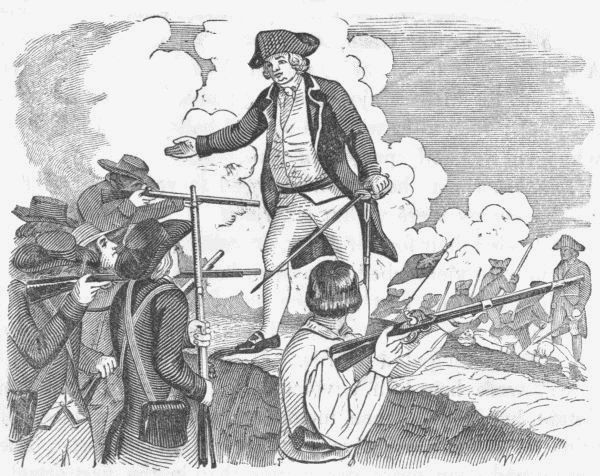
Putnam saves the life of Major Small.
Although repulsed in a second attack, and with losses as signal as unexpected, Howe immediately decided upon renewing the contest. Upon the issue of that day, and the results of this single conflict, he well knew, might hang the fortunes of the British cause in America. If successful, the patriots would become disheartened; if defeated, they would take courage, and continue the controversy with greater animation. With more wisdom, he decided to concentrate his whole force upon the redoubt—and, that his troops might act with greater energy, he directed them to lay aside their cumbersome knapsacks, and, in imitation of the Americans, to reserve their fire, or, if circumstances allowed, to rely upon the bayonet.
Meanwhile, the situation of the Americans had become critical and alarming. They had, indeed, lost comparatively few of their number; but it was discovered, we might almost say to their dismay, that their ammunition was nearly exhausted. They had little prospect of any further supply; they had few, if any bayonets, and, as to rëinforcements, though extremely desirable, and now necessary, they could indulge only slight hopes. They were, however, cheered by the prospect of a rëinforcement of three hundred men at this critical juncture. The regiment of Colonel Gardiner, stationed at Charlestown, although they had received no orders to that effect, that gallant officer volunteered to bring to their assistance. Most unfortunately, however, just as he was descending to the lines, a musket-ball struck him, which soon after proved mortal. In consequence of this untoward event, his regiment became disordered, and but a single company that marched from Charlestown, under command of Captain Harris, participated in the action. It was, however, and well does it attest their patriotic courage, the very last to leave the field.
The history of the American war furnishes many an incident of thrilling interest, and many an instance of heroic bravery and devotion to the cause of liberty: the last moments of Colonel Gardiner may be ranked among the number. On receiving his wound, he was borne from the field by some of his men; when his son, a youth of only nineteen, and a second lieutenant in Trevett's artillery company, rushed forward to his father's aid. On beholding him, said the father: "Think not of me, my son. I am well. Go to your duty!" And the son obeyed, and hastened to his post, while the father was borne from the field to die. Is it a matter of marvel that people should succeed in a struggle where such lofty patriotism fired their bosoms, and, in pursuing which, some of the tenderest and strongest ties of our nature were sacrificed for their country's good?
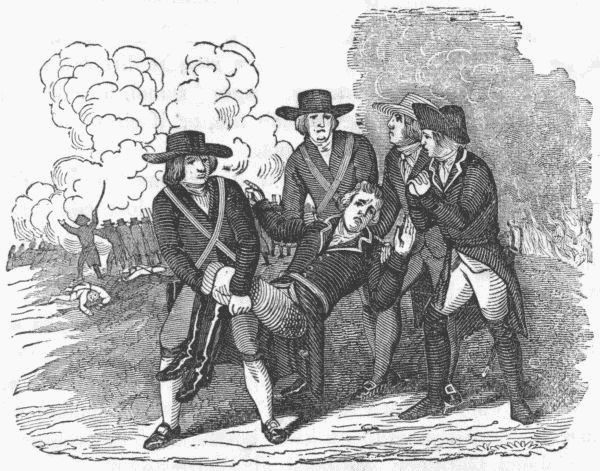
Death of Colonel Gardiner.
The British troops, as we said, were again advancing. Without bayonets, with a few charges of powder remaining, the Americans waited in silence to receive them as they were able. Stones and the stocks of their muskets supplied the place of powder and ball. Richardson, a private in the Royal Irish regiment, was the first to mount the parapet; but he fell the next moment. Nearly at the same time, Major Pitcairn, whose insolence and inhumanity at Lexington will not soon be forgotten, appeared upon the parapet, and, as if actuated by a similar spirit now as then, he exultingly exclaimed: "The day is ours!" But here he met a deserved fate; for, while the words still lingered on his lies, a bullet from a musket, fired by a colored man named Salem, pierced his body, and he fell and expired.
While these events were occurring in one quarter, the enemy were more successful in another, the south-east corner of the redoubt. Here a tree had been left standing, and by means of this, General Pigot succeeded in mounting the works; his men followed him; and here, for a brief space, the contest was spirited and sanguinary. Several American officers suffered severely. Colonel Bridge was twice wounded by a broad-sword. Major Gridley received a ball through the leg, and was borne from the field. Lieutenant Prescott, nephew to the colonel, had his arm so broken, as to hang useless by his side; but, nothing deterred by his wound, he continued to load his musket, and was in the act of pointing his gun through the sally-port at the enemy, when he was cut in sunder by a cannon-ball. But now, the sacrifice of life which was being offered upon the shrine of liberty, was accomplishing no good. The Americans could no longer contend with hope, as their ammunition was fairly expended. Prescott was reluctant to yield; but it was wise—it was best. An honorable retreat was still practicable, and he chose this alternative. The Americans retired in order from the hill.
A retreat bore more heavily upon one patriotic spirit than, if possible, upon all others—that one was Warren's. He lingered to the very latest moment—beyond the moment of safety. Nor had he quitted the works, or proceeded but a few rods, when the British were in full possession. Major Small, the British officer whose life Putnam had saved only a few hours before, saw him—surmised his reluctance—perceived his danger—and would have saved him. Addressing him by name, he besought him to surrender, as the only means of security; at the same time ordering his men to suspend their firing. Warren, it is supposed, heard the voice of Small; but whether he would have taken advantage of the proffered safety, cannot be known. He turned his head towards the sound, and at that instant a ball sunk deep in his forehead, and produced instant death.
The day following, the body of this patriot, statesman, and hero, was discovered and identified by Isaac Winslow, (then a youth, afterwards general,) and by several others, who were familiar with his person. The bullet which terminated his life was extracted by Mr. Savage, an officer in the custom-house. Subsequently, he carried it to England; but, years afterwards, it was presented at London to Rev. Mr. Montague, of Dedham, Mass., in whose family it still remains. The remains of Warren were buried on the spot where he fell; but the following year they were temporarily removed to a tomb in the Tremont cemetery. They now repose in the family vault, under St. Paul's church, Boston.
The loss of Warren was among the saddest and bitterest incidents of the day. Few had such aspirations after liberty—few so well understood the true interests of the country, or were better able to suggest measures calculated to secure the triumph of her cause. To the British, the intelligence of his fall was as grateful (considering him in the light of an enemy) as it was unexpected. It is recorded that when on the following morning the news of the event was brought to General Howe, who remained on the field during the night, he would scarcely credit it; and when, at length, it was verified, he declared that "his death was a full offset for the loss of five hundred men."
The battle of Bunker's hill, which we have thus described as minutely as our limits will allow, was of about two hours' continuance, having commenced at three o'clock. The Americans engaged were estimated at about three thousand five hundred. The number killed and missing was one hundred and fifteen; three hundred and five were wounded, and thirty taken prisoners. Of the several regiments, Prescott's suffered the most severely, losing forty-two killed and twenty-eight wounded. Several officers were killed—Colonel Gardiner, Lieutenant-Colonel Parker, Major Moore, and Major Maclary.
The British force engaged in this battle was four thousand. Their loss General Gage, in his official account, acknowledged to be one thousand and fifty-four—two hundred and twenty-six killed; eight hundred and twenty-eight wounded, including nineteen officers killed and twenty-eight wounded. Their loss, according to the official account of the action by the Massachusetts congress, was fifteen hundred.
Charlestown was entirely destroyed. On the retreat of the Americans, the British took possession of Bunker's hill, from which they kept up a fire of artillery during the night. The Americans occupied Prospect and Winter hills.
It was a bold attempt on the part of General Howe to carry the American redoubt by an attack in front; in consequence of this, his troops were exposed to the direct and galling fire of men who were each able to take deliberate aim. A censure was indeed cast upon him for so doing; but a too vain confidence in the bravery and discipline of his soldiers, and an equally mistaken estimate of American valor, led him to reject a plan proposed by General Clinton, and the adoption of one which, had it succeeded, would have secured more honor, but which obviously was so hazardous and doubtful in its issue, as might well have gained for the other the preference.
The night of the 17th of June was one of more sadness to the British than to the Americans, notwithstanding that the latter had been driven from their position, and the colors of the former were waving over Bunker's hill. To the British belonged the field—to the Americans, in effect, the victory. What the former had gained, was of no use to them, as their forces were not sufficiently numerous to hold possession of so extended a line. Their loss in numbers was grievous; but this was small in comparison to the mortification experienced in view of their repeated repulses. Nor was that mortification lessened when it became known that the retreat of the Americans was caused by a want of ammunition. Had the materiel of battle not failed, who can say that the Americans would not have maintained their position?[33]
Such an issue, however, might have drawn after it consequences which, in the sequel, would have been disastrous to the patriotic cause. A vain confidence might have been engendered, leading to the neglect of needful, and even essential preparation, to cope with a foe more formidable at that era, than any other on the globe. It was well doubtless, and Providence in kindness so ordered, it, that ammunition should fail. God gave to the Americans just that success which was calculated to animate and encourage them: and permitted them to suffer just in that way, and to that extent, as to teach them humility, and to trust in Him. Theirs was a just and glorious cause. It was the cause of liberty and of God. It was right that they should succeed; but it was equally befitting that they should feel and acknowledge that their success was from the God of their fathers.