Part 1 — III. WASHINGTON, COMMANDER-IN-CHIEF.
Reading edition
Effects of the Battle of Bunker hill—Meeting of Congress—Appointment of a Commander-in-Chief proposed—Difficulties in regard to a Selection—Claims of Individuals—Interview between John and Samuel Adams—Speech of the former—Washington Nominated—Unanimously Confirmed—Manifesto of Congress—Public Fast.
If, previous to the battle of Bunker's hill, doubts existed in the minds of any, whether the contest between Great Britain and America would be settled without a struggle, the sanguinary scene on that hill must have dispelled them. Both parties had received a wound not likely soon to be healed. If the British had won the field, they had gained but little, if any, honor—and in the repulse, which the Americans had met with, while they had lost no honor, they had acquired self-confidence, and added to their already high-wrought valor and determination.
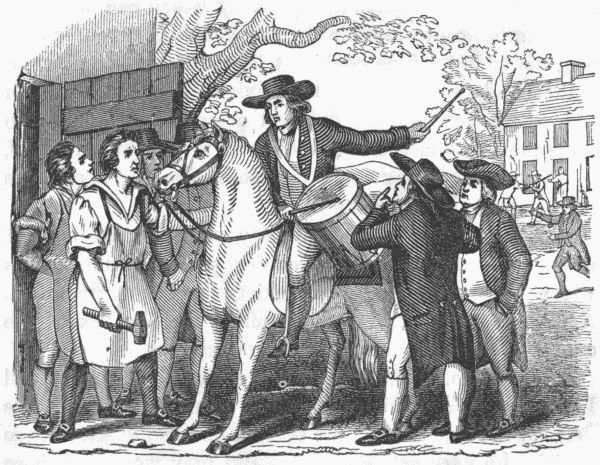
Messengers spreading news of the Battle of Bunker's hill.
"The battle was fought on Saturday afternoon. Before Sunday night, the intelligence was spread more than a hundred miles distant from the scene of action. All were roused to the highest pitch of resentment, and set about preparing themselves for a long and bloody struggle. Companies were raised and equipped with the utmost dispatch; all hopes of reconciliation were lost. Squads of armed men flocked to head-quarters, some of them having traveled eighty miles in twenty-four hours."
While events of so much importance were occurring in and around Boston, the more immediate theatre of the war, the second general congress were in session in Philadelphia, in deep consultation as to measures which the cause and exigencies of the country required.
Their session had commenced on the 10th day of May preceding. Various matters of interest engaged their attention, and required all their wisdom and firmness. As the war had commenced, it was essential to keep up the zeal of the people—to prevent revolt to the royal standard—to introduce discipline into an army which had been collected in haste—to provide for the growing expenses of a war, the end of which could not be predicted—to prevent, in the conduct of the war, the revival of jealousies which had existed between the different colonies—and, finally, to place the army in the hands of some commander-in-chief, in whom the country could confide, and whose commands the army would cheerfully obey.
The importance of this last duty magnified, the more it was contemplated—and difficulties presented themselves which occasioned no small anxiety and embarrassment. A mistake here might prove fatal to the liberties of the country, for an indefinite period to come.
Upon whom, then, should their choice fall? Gates and Lee were held in high estimation as military men. The first, for his experience; the second, because to experience he joined a very active genius. But they were both born in England, and, in case of misfortune, it would be difficult, however upright and faithful they might have been, to persuade the people that they had not been guilty of treason, or at least of negligence in the accomplishment of their duties. Besides, Lee had an impetuosity of temper, which, in some hour of excitement, might spur him to the adoption of measures inconsistent with the safety of the army, and prejudicial to the interests of the patriot cause. There were also Ward and Putnam, who were already in the field, and who had demonstrated the most signal valor and ability in all the actions which had taken place in the vicinity of Boston. Putnam had seen much service, and, for energy and promptitude, had few equals; but he had declared himself too openly in favor of independence; this, congress devoutly wished to procure, but withal in a propitious time. As to General Ward, New England, it was well known, entertained an exalted opinion of him, and many were strongly wishing and anticipating that the lot would fall on him. He had served in the French war, in which he had acquired an honorable distinction. In addition, he was both a scholar and a gentleman, and the army itself was uncommonly prepossessed in his favor. But besides that he also had openly expressed himself in favor of independence, it was well known that the provinces of the middle, and more so of the south, were in a measure jealous of New England, in which the physical force of the country confessedly predominated, and they would naturally be reluctant to have the cause of America confided to the hands of an individual who might allow himself to be influenced by certain local prepossessions, at a time in which all desires and all interests ought to be common. Nor was it a small desideratum with some of the sages of that era, that the commander-in-chief should himself possess an estate of such value as to offer a guaranty of his fidelity, and elevate him above the sordid and selfish motives of personal gain.
Surrounded by such difficulties, and embarrassed by such opposite considerations, what was to be done? One point was clear,—union must be preserved, at any sacrifice. Union was strength. If in harmonious concert the colonies could not proceed, their doom was sealed. The country, and the whole country, must come in. The pulsation must beat through all hearts. The cause was one, and how many soever bore a part in sustaining and defending it, they must act as impelled but by one motive—and using but a single arm.
To the final question, it had been foreseen for some time, the congress must come. Out of doors, the subject had been considered and debated, but, as yet, no settled opinion had been formed, and no decisive action had been had.
In this anxious and inquiring period, the Father of mercies—that Almighty Being by whose care the colonies had been planted, and hitherto sustained—whose blessing was daily sought by thousands of families, morning and evening—whose guidance the public councils, whether provincial or continental, were never ashamed to implore—that good and gracious Benefactor was not slow in pointing to the man who should lead the armies of his American Israel!
One morning, the elder President Adams was walking in Congress hall, apparently absorbed in thought, when Samuel Adams, a kinsman and a member of congress, approaching him, inquired the subject of his deep cogitation. "The army," he replied; "I am determined what to do about the army at Cambridge." "What is that?" asked his kinsman. "I am determined to enter on a full detail of the state of the colonies, before the house this morning. My object will be to induce congress to name a day for adopting the army, as the legal army of the United Colonies of North America; and, having done this, I shall offer a few hints on my election of a commander-in-chief." "I like your plan, Cousin John," said Samuel Adams; "but on whom have you fixed as this commander?" "George Washington, of Virginia, a member of this house." "That will never do, never, never." "It must do," said John Adams, "and for these reasons: the southern and middle states are loath to enter heartily into the cause, and their arguments are potent; they see that New England holds the physical power in her hands, and they fear the result. A New England army, a New England commander, with New England perseverance, all united, appal them. For this cause, they hang back. The only way to allay their fears, and silence their complaints, is by appointing a southern chief over the army. This policy will blend us in one mass, and that mass will be resistless."
Mr. Adams now went in, and, taking the floor, put forth his strength in the delineations he had prepared, all aiming at the adoption of the army. He was ready to own the army, appoint a commander, and vote supplies. His speech was patriotic, eloquent, and thrilling; but some doubted, some objected, some feared. To all these doubts and hesitations, he replied: "Gentlemen, if this congress do not adopt this army, before ten moons have set, New England will have a congress of her own, which will adopt it, and she will undertake the struggle alone—with a strong arm and a clear conscience." This had the desired effect, and they agreed to appoint a day.
The day was fixed, and came, and the army was adopted. And now followed the question as to a commander. Mr. Adams again rose. He proceeded to a minute delineation of the character of General Ward, according to him merits and honors, which then belonged to no one else; but, at the end of this eulogy, he said: "This is not the man I have chosen." The peculiar situation of the colonies required another and a different man—and one from a different quarter. These qualifications were now set forth in strong, bold, and eloquent terms; and, in the sequel, he said: "Gentlemen, I know these qualifications are high, but we all know they are needful at this crisis, in this chief. Does any one say that they are not to be obtained in the country? I reply, they are; they reside in one of our own body, and he is the person whom I now nominate: George Washington, of Virginia."
At the moment, Washington was intently gazing, as were others, upon Mr. Adams, wrought up by an eager curiosity for the annunciation of the name. Without a suspicion that it would be his own, as it transpired from the lips of the speaker, he sprang from his seat, and rushed from the hall.
Samuel Adams, already in the secret, immediately moved an adjournment of the house, in order that the members might have time to deliberate on a nomination so unexpected and so surprising.
On the 15th of June, two days only before the battle of Bunker's hill, congress convened in the hall to decide the important question. As individuals, they had given to the subject a deep and solemn deliberation, commensurate with its vital importance to the country. Until the annunciation of Washington's name by John Adams, probably no one had even thought of him—but now, but one sentiment prevailed. He was the man, and their ballots unanimously confirmed the choice. The delegates of Massachusetts had other predilections; but, nobly relinquishing sectional claims, and even partialities, they united with the others, and rendered the choice unanimous. That was a happy day—that a fortunate selection for America. And who can doubt that the God by whose providence nations rise and fall, guided that choice, with the same benign influence which was exerted upon the prophet in a prior age of the world, when from among his brethren he selected David as the successor of Saul?
In a few days, following the appointment of Washington, congress published a manifesto, setting forth to the world the causes which had led them to take up arms. After enumerating these causes, in a tone of manly assurance, and yet of humble dependence upon Almighty God, they said:
"Our cause is just—our union is perfect—our internal resources are great—and, if necessary, foreign assistance is undoubtedly attainable. We gratefully acknowledge, as signal instances of Divine favor towards us, that His providence would not permit us to be called into this severe controversy, until we were grown to our present strength, had been previously exercised in warlike operations, and possessed of the means of defending ourselves. With hearts, fortified with these animating reflections, we must most solemnly, before God and the world, declare, that, exerting the utmost energy of those powers, which the beneficent Creator hath graciously bestowed upon us, the arms we have been compelled by our enemies to assume, we will, in defiance of every hazard, with unabating firmness and perseverance, employ for the preservation of our liberties; being, with one mind, resolved to die freemen, rather than to live slaves." Finally, they added: "With an humble confidence in the mercies of the supreme and impartial Judge and Ruler of the universe, we most devoutly implore His divine goodness, to protect us happily through this great conflict, to dispose our adversaries to reconciliation on reasonable terms, and thereby relieve the empire from the calamities of civil war."
The above manifesto was sent into every part of the country, and read from the pulpits by the ministers of religion, with suitable exhortations. In the camps of Boston, it was read with particular solemnity. Major-General Putnam assembled his division, upon the heights of Prospect hill, to hear it. It was followed by a prayer, analogous to the occasion; the general having given the signal, all the troops cried, three times, amen! and, at the same instant, the artillery of the fort fired a general salute; the colors, recently sent to General Putnam, were seen waving with the usual motto "An appeal to Heaven;" and this other, "Qui transulit sustinet." The same ceremony was observed in the other divisions. The joy and enthusiasm were universal.
It may be added, in this connexion, as an evidence of the piety of our fathers—of the belief of a superintending providence, which characterized that generation, that congress recommended a public fast to be observed in all the colonies, on the 20th of July. The soldiers, they recommended to be "humane and merciful;" and all classes of citizens, "to humble themselves, to fast, to pray, and to implore the Divine assistance, in this day of trouble and of peril."
Congress, in a body, attended divine services on that day, in one of the churches of Philadelphia. Just as they were about to enter the temple, important intelligence was received from Georgia. It was, that that province, which had hitherto held itself aloof from the common cause, had joined the confederation, and had appointed five delegates for its representation in Congress. While humbling themselves, God was blessing and exalting them. No news scarcely could have occasioned more joy; and this was heightened, in consideration of the moment at which the government and people were apprised of it.