Part 1 — VI. ATTACK ON SULLIVAN'S ISLAND.
Reading edition
Invasion of Southern Colonies proposed—Expedition dispatched—Charleston its first Object—Proceedings of its Citizens—Sullivan's island Fortified—Arrival of General Lee—His opinion of Fort Moultrie—British Fleet arrives—Preliminary movements—Fort Moultrie attacked—Remarkable Defence of it—Action described—Heroic conduct of Sergeant Jasper—British repulsed—Respective losses—Liberal conduct of Governor Rutledge—Mrs. Elliot—Death of Jasper.
The successful defence of Fort Moultrie, on Sullivan's island, is justly considered one of the noblest achievements recorded in the annals of the Revolution.
The reduction of the southern colonies to obedience, was deemed a measure of prime importance by the British government, nor was it considered a project of difficult achievement. Hitherto the principal theatre of the war had been in the north; and, hence, it was calculated that preparations for the defence of the southern colonies had been so much neglected, that little more than a demonstration in that quarter would be necessary to bring the people to terms.
Early in 1776, an expedition having the above object in view was devised, the command of which was entrusted to Sir Peter Parker and Earl Cornwallis. Accordingly, on the 3d of May, Admiral Parker, with twenty sail, arrived at Cape Fear, with Generals Cornwallis, Vaughan, and several others.
General Clinton was expected from New York, with another considerable corps, to cöoperate in the attack. With his troops he had arrived at the point of destination, even anterior to the naval armament; and, being the senior general, on the junction of the forces, assumed the command. The immediate object was the reduction and possession of Charleston, the capital of South Carolina; on the fall of which, the subjugation of that and the other southern provinces would be an easy achievement.
The meditated invasion was not unknown to the Carolinians, who, being a high-minded and chivalrous people, determined that if their capital fell, it should be at an expense of a treasure of British blood.
With great activity and energy, therefore, they betook themselves to the fortification of every assailable point. With patriotic disinterestedness, the citizens demolished their valuable store-houses on the wharves to supply materials for defence. Streets were barricaded, and intrenchments erected along the shore. Even windows were stripped of their weights, to supply the demand for bullets. The inhabitants generally came to the work of defence, and scarcely a man on the ground could be discovered without a spade, a pickaxe, or other implement of work. Even the blacks from the city, and for miles in the country, were employed, and seemed animated with the enthusiasm and zeal of their masters. The commanding general was Major-general Lee, who, having been appointed by congress to the command of the southern forces, and possessing the entire confidence of the troops and of the people, was enabled to carry to completion the various works of defence, which his knowledge and skill had decided to be important. Governor Rutledge, also a man of great influence in the province, cöoperated with General Lee, in all his measures of defence, and by his example and exhortations essentially contributed to the happy results which followed.
At the distance of six miles from the point of land formed by the confluence of the two rivers, Ashley and Cooper, and on which Charleston is built, lies Sullivan's island. It commands the channel which leads to the port. The due fortification of this point was a matter of great moment. The outline of a fort had already been marked out, to complete which, Colonel William Moultrie, a singularly brave and accomplished officer, was dispatched early in March. Palmetto trees, which from their soft and spongy texture, were admirably calculated to deprive a ball of its impetus without causing splinters, had been cut in the forest, and the logs in huge rafts lay moored to the beach. "Ignorant of gunnery, but confident in their own resources, and nerved with resolute courage, Moultrie and his coadjutors, hardy sons of the soil, heaved those huge logs from the water, and began the work. A square pen was built, with bastions from each angle, capable of covering a thousand men. The logs were laid in two parallel rows, and sixteen feet apart; bound together with cross-timbers dove-tailed and bolted into logs, and the wide space filled with sand. When completed, it presented the appearance of a solid wall, sixteen feet wide; but its strength was yet to be tested. Behind this, Moultrie placed four hundred and thirty-five men, and thirty-one cannon, some of them twenty-sixes, some eighteens, and the rest of smaller caliber—throwing in all five hundred and thirteen pounds.
"It was at this juncture that Lee arrived from the north, and took command of the troops. When his eye, accustomed to the scientific structures of Europe, fell on this rudely-built affair, he smiled in derision, calling it a 'slaughter-pen,' and requested Governor Rutledge to have it immediately evacuated. But that noble patriot was made of sterner stuff, and replied, 'that while a soldier remained alive, he would never give his sanction to such an order.'"
The naval force of the British, consisted of the Bristol and Experiment, of fifty guns; four frigates, the Active, the Acteon, the Solebay, and the Syren, of twenty-eight; the Sphynx, of twenty, the Friendship, of twenty-two, two smaller vessels of eight, and the Thunder, a bomb-ketch. On reaching the bar, at the entrance of the channels of Charleston, it was found that the fifty-gun ships could not pass without being lightened. The removal and rëplacement of their guns was attended with incredible labor; and although thus lightened, they struck, and for a time were in danger of bilging.
Meanwhile, General Clinton issued his proclamation, which he dispatched to the city with a flag, demanding the citizens to lay down their arms, and to return to their allegiance, on pain of an immediate attack, and an utter overthrow. To this demand, not even the civility of a reply was accorded, and the threatened attack, on the morning of the 28th of June, was commenced.
To the citizens of Charleston those were anxious hours. There was hope, but more of fear. They filled the wharves, the roofs, and the steeples—in short, every eminence was black with spectators, gazing on the exciting scene and the approaching conflict.
It was a calm, bright, beautiful day. The wind being fair, the British fleet came steadily, proudly, towards the "slaughter-pen," and one after another took the positions assigned them. The Americans watched them with intense interest—"Moultrie's eye flashed with delight." Every gun was loaded—every one was manned—and all were now anxiously waiting the order to fire. At length, a portion of the fleet had reached point-blank-shot distance, when Moultrie, who, like Prescott at the battle of Bunker's hill, had restrained his anxiously-waiting men, now gave the word of command "Fire!"—And they did fire—and "the shores shook with the tremendous explosion."
The fleet continued to advance, a little abreast of the fort, when letting go their anchors, and clewing up their sails, they opened upon the fort. More than a hundred cannon!—their blaze, their smoke, their roar—all in the same instant—it was a terrible commencement—the stoutest heart palpitated! every one unconsciously held his breath!
"The battle had now fairly commenced, and the guns were worked with fearful rapidity. It was one constant peal of thunder, and to the spectators in Charleston, that low spot, across the bay, looked like a volcano breaking forth from the sea. Lee stood on Haddrell's point, watching the effect of the first fire. When the smoke lifted, like the folds of a vast curtain, he expected to see that 'slaughter-pen' in fragments; but there still floated the flag of freedom, and beneath it beat brave hearts, to whom that awful cannonade was but 'a symphony to the grand march of independence.' When the fight had fairly begun, they thought no more of those heavy guns than they did of their rifles. Their coats were hastily flung one side, and their hats with them—and in their shirt-sleeves, with handkerchiefs about their heads, they toiled away under the sweltering sun with the coolness and courage of old soldiers. The fire from those nine vessels, with their cannon all trained upon that pile of logs, was terrific, and it trembled like a frightened thing under the shock; but the good palmettoes closed silently over the balls, as they buried themselves in the timber and sand, and the work went bravely on. Thus, hour after hour, did it blaze, and flame, and thunder there on the sea, while the shots of the Americans told with murderous effect. At every discharge, those vessels shook as if smitten by a rock—the planks were ripped up, the splinters hurled through the air, and the decks strewed with mangled forms. Amid the smoke, bombs were seen traversing the air, and dropping, in an incessant shower, within the fort—but a morass in the middle swallowed them up as fast as they fell. At length, riddled through and through, her beds of mortar broken up, the bomb-vessel ceased firing. Leaving the smaller vessels, as unworthy of his attention, Moultrie trained his guns upon the larger ones, and 'Look to the Commodore! look to the fifty-gun ship!' passed along the lines, and they did look to the Commodore in good earnest, sweeping her decks at every discharge with such fatal fire, that at one time there was scarcely a man left upon the quarter-deck. The Experiment, too, came in for her share of consideration—her decks were slippery with blood, and nearly a hundred of her men were borne below, either killed or wounded. Nor were the enemy idle, but rained back a perfect tempest of balls; but that brave garrison had got used to the music of cannon, and the men, begrimed with powder and smoke, shot with the precision and steadiness they would have done in firing at a target. As a heavy ball, in full sweep, touched the top of the works, it took one of the coats, lying upon the logs, and lodged it in a tree. 'See that coat! see that coat!' burst in a laugh on every side, as if it had been a mere plaything that had whistled past their heads. Moultrie, after a while, took out his pipe, and lighting it, leaned against the logs, and smoked away with his officers, as if they were out there sunning themselves, instead of standing within the blaze, and smoke, and uproar of nearly two hundred cannon. Now and then he would take the pipe from his mouth to shout 'fire!' or give some order, and then commence puffing and talking—thus presenting a strange mixture of the droll and heroic. The hearts of the spectators in the distance, many of whom had husbands and brothers in the fight, were far more agitated than they against whom that fearful iron storm was hailing.
"After the fight had continued for several hours, Lee, seeing that the 'slaughter pen' held out so well, passed over to it in a boat, and remained for a short time. Accustomed as he was to battle, and to the disciplined valor of European troops, he still was struck with astonishment at the scene that presented itself as he approached. There stood Moultrie, quietly smoking his pipe, while the heavy and rapid explosions kept up a deafening roar; and there, stooping over their pieces, were those raw gunners firing with the deadly precision of practised artillerists. Amazed to find an English fleet, carrying two hundred and sixty guns, kept at bay by thirty cannon and four hundred men, he left the fort to its brave commander, and returned to his old station."[38]
Among the Americans, who were that day in the "slaughter-pen," and who were dealing death and destruction without stint, was a Sergeant Jasper, whose name has since been given to one of the counties in Georgia, for this and other heroic deeds. In the warmest of the contest, the flag-staff of the fort was shot away by a cannon-ball, and fell to the outside of the ramparts on the beach. The spectators at Charleston saw it fall, and supposing that the fort had yielded, were filled with consternation and dismay. In the surrender of the fort, they read the destiny of themselves and city. But what was their joy to perceive that columns of smoke, from the fort, still continued to roll up—the blaze and thunder of its cannon continued to be seen and heard; and presently the folds of the flag again fluttered in the breeze. Sergeant Jasper was the hero of the occasion. He had witnessed the fall of the flag—and he saw it "stretched in dishonor on the sand." It was a perilous attempt, but he did not hesitate. Leaping the ramparts, he proceeded, amidst a shower of balls, the entire length of the fort, and, picking up the flag, tied it to a post, and rëplaced it on a parapet, and there, too, he himself supported it till another flag-staff could be procured. Here, once more, it proudly waved—amid the shouts and congratulations of the now still more courageous in the fort, and to the joy of still more distant and equally anxious spectators of the scene.
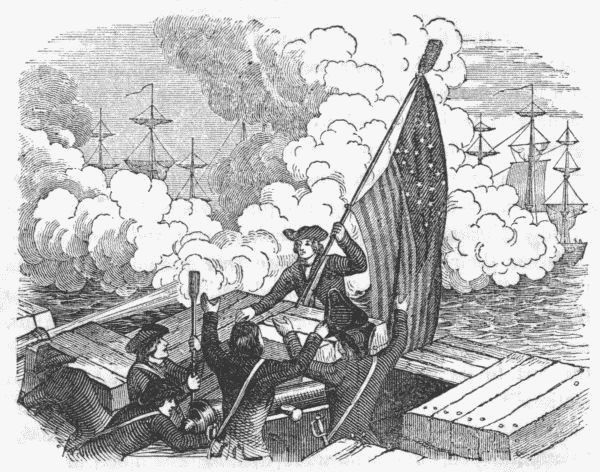
Sergeant Jasper replanting the Flag at Fort Moultrie.
About this time, another circumstance sent a momentary panic through the stern hearts of the defenders of the fort. The ammunition was failing, and a large force, which had effected a landing, was in rapid march to storm the works. Moultrie instantly dispatched Marion to a sloop-of-war for a supply, and another message to Governor Rutledge at Charleston. Both were successful—both in season. Said the governor, in a note accompanying five hundred pounds of powder, "Do not make too free with your cannon—cool, and do mischief."
With this fresh supply of ammunition, the fire, which had been relaxed, was redoubled. The British were astounded. They had congratulated themselves, upon the partial suspension of firing, that the fort was about to yield. But the new fury of the firing, on the part of the Americans, soon served to convince them of their error. They also redoubled their efforts, and, for a time, the contest was more terrible than ever. "Once," it is said, "the broadsides of four vessels exploded together, and when the balls struck the fort, it trembled in every timber and throughout its entire extent, and shook as if about to fall in pieces."
The day was now wearing away, and still the contest was undecided. The British, reluctant to relinquish an object which in the morning they imagined so easily won, still continued the heavy cannonade; while the Americans, gathering strength and courage by what they had already accomplished, stood firm and undaunted. At length, the sun went down behind the distant shore, and darkness threw its ample folds on every object of nature. But now, through the darkness, flames shot forth and thunders rolled, presenting a scene of solemn and indescribable grandeur. The inhabitants of Charleston still lingered on their watchtowers, gazing out through the gloom towards the spot where the battle was still raging in its fiercest intensity.
But they were not destined to hope and pray in vain. At about half-past nine, the fire from the English fleet suddenly ceased. They had fought long—fought with all the ardor and enthusiasm of friends to their king and his cause. But they had fought in vain. Victory decided for Moultrie and his patriot band, and it only remained for the English to withdraw, as well as they were able, their ships, which had been nearly disabled, and their crews, which had been dreadfully reduced.
"The loss of the Americans, in this gallant action," says the writer whom we have already quoted, "was slight, amounting to only thirty-six, both killed and wounded, while that of the British, according to their own accounts, was a hundred and sixty. Double the number would probably be nearer the truth. The commander had his arm carried away. One is surprised that so few of the garrison were killed, when it is remembered that nearly ten thousand shots and shells were fired by the enemy that day. The Acteon, during the action, went aground, and the next morning a few shots were fired at her, when a party was sent to take possession of her. The crew, however, setting fire to her, pushed off. When the Americans got on board, they turned two or three of the guns on the fugitives, but, finding the flames approaching the magazine, abandoned the vessel. For a short time, she stood a noble spectacle, with her tall masts wreathed in flame, and black hull crackling and blazing below. But when the fire reached the powder, there suddenly shot up a huge column of smoke, spreading like a tree at the top, under the pressure of the atmosphere—and then the ill-fated vessel lifted heavily from the water, and fell back in fragments, with an explosion that was heard for miles around."
A few days following the battle, the fort was visited by Governor Rutledge and many of the distinguished ladies and gentlemen of Charleston. They came to see the old "slaughter-pen," which had so nobly withstood the attack under such long-practiced and accomplished officers as Parker, Clinton, and Cornwallis. Ample praises were bestowed upon the "rough-and-ready" soldiers, while mutual congratulations were exchanged with Moultrie and his brave associates in command. Nor was the gallant Jasper forgotten. Taking from his side his sword, Governor Rutledge buckled it on the daring soldier, as a reward for his noble exploit. Following this, the accomplished Mrs. Elliot presented a pair of elegant colors to the regiment under Moultrie and Motte, with the following brief, but beautiful address: "The gallant behavior in defence of liberty and your country, entitle you to the highest honor; accept, then, two standards, as a reward justly due to your regiment; and I make not the least doubt, under Heaven's protection, you will stand by them as long as they can wave in the air of liberty."
The colors thus presented to Colonel Moultrie were, at a subsequent date, carried by him to Savannah, and were displayed during the assault against that place. Two officers were killed, while attempting to place them upon the enemy's parapet at the Spring-hill redoubt. Just before the retreat, Jasper, while endeavoring to rëplace them upon the works, received a mortal wound. When a retreat was ordered, he recollected the honorable condition upon which the donor presented them to his regiment, and among the last acts of his life, he succeeded in bringing them off.
To Major Horry, who called to see him a little while before his death, he said: "Major, I have got my furlough. That sword was presented to me by Governor Rutledge, for my services in defence of Fort Moultrie; give it to my father, and tell him I have worn it with honor. If he should weep, tell him his son died in hope of a better life. Tell Mrs. Elliot that I lost my life supporting the colors which she presented to our regiment."
Such was the affair at Fort Moultrie—such the patriotic and chivalrous conduct of men fighting for their altars, their homes, their wives, their children. Was it strange that, in a good cause, Heaven should smile on such high and heroic conduct? Was it strange that a people, so intent on the enjoyment of their just rights, should accomplish their object?
This repulse of the British, it may be added, was unexpected to them; and the more so, as they well knew that no systematic measure of defence had been adopted at the South. The contest had hitherto been in a different quarter, and no intimations had transpired of a contemplated change. In addition to this, the British were profoundly ignorant of the true southern character. They had learned some lessons in regard to the "Yankees;" and, especially, that if they were made of "stuff," it was "stern stuff;" but they had yet to learn, that the same kind of ore abounded south of the Potomac. The old "slaughter-pen" on Sullivan's Island, enlightened them, and impressed them as to the fact so fully, that the influence of the lesson lasted for two years and a half—that being the respite of the Southern states from the calamities of war, consequent upon the repulse of the British at Fort Moultrie.