Part 1 — VIII. WAR OF WILLIAM III.
Reading edition
Combination of French and Indians against the Americans—Burning of Schenectady—Cause of it—Horrors attending it—Attack upon Salmon Falls—Upon Casco—Results of Expeditions fitted out by New York and New England—Reduction of Port Royal—Atrocities which marked the war—Attack on Haverhill, Mass.—Heroic Conduct of Mrs. Dustan—Peace.
During the three wars of King William, Queen Anne, and George II., the sufferings of the northern colonies were severe and protracted, or were intermitted only at short intervals. The hostility of the Indians was kept alive, and often kindled into a fresh flame, through the agency of European settlers on their northern border. These took up the quarrel of France and England, and sought occasions to molest the subjects of the English sovereign in America.
In King William's War, the French combined with the Indians in bringing fire and sword upon the inhabitants of New England and New York. A connected account need not be given of the disastrous occurrences that took place, during this sanguinary war; but only particular instances of hostilities, and their effects, will be narrated in this portion of the present work.
We commence with the attack on Schenectady. This was made in pursuance of a plan adopted by Count Frontenac, then the governor of Canada, in revenging on the English colonies the treatment which King James had received from the English government, and which had inflamed the resentment of Frontenac's master, Louis XIV. The governor fitted out three expeditions against the American colonies in the midst of winter, of which one was against New York. The attack on Schenectady was the fruit of this expedition. It was made by a party, consisting of about two hundred French and, perhaps, fifty Caughnewaga Indians, under the command of two French officers, Maulet and St. Helene, in 1689-90.
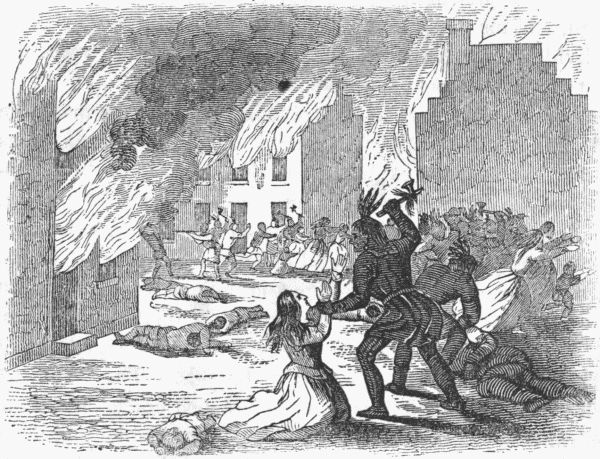
Burning of Schenectady.
Schenectady was then in the form of an oblong square, having a gate at each extremity. But as one of the gates only could be found, they all entered at that one. The gate was not only open, but was also unguarded. Although the town was impaled, and might have been protected, no one deemed it necessary to close the gate at night, presuming that the severity of the season was a sufficient security. The enemy divided themselves into several parties, and waylaid every portal, and then raised the war-whoop. It was between eleven and twelve o'clock on Saturday night, the 8th of February, when the fearful tragedy commenced. Maulet attacked a garrison, where the only resistance of any account was made. He soon forced the gate, and all the English were slaughtered, and the garrison burned. One of the French officers was wounded, in forcing a house, and thereby wholly disabled; but St. Helene having come to his assistance, the house was taken and all who had shut themselves in it were put to the sword. Nothing was now to be seen but massacre and pillage on every side. The most shocking barbarities were committed on the inhabitants. "Sixty-three houses and the church were immediately in a blaze. Enciente women, in their expiring agonies, saw their infants cast into the flames, being first delivered by the knife of the midnight assassin. Sixty-three persons were murdered and twenty-seven were carried into captivity."
A few persons were enabled to escape, but being without sufficient clothing, they lost their limbs from the severity of the cold, as they traveled towards Albany.
About noon, the next day, the enemy left the desolated place, taking such plunder as they could carry with them, and destroying the remainder. It was designed, it seems, to spare the minister of the place, as Maulet wanted him as his own prisoner; but he was found among the mangled dead, and his papers burned. The houses of two or three individuals were spared, for particular reasons, while the rest were consigned to the flames.
Owing to the state of the traveling, news of the massacre did not reach the great Mohawk castle, seventeen miles distant, until at the expiration of two days. On the reception of the news, a party commenced a pursuit of the foe. After a tedious route, they fell upon their rear, killed and took twenty-five of them, and effected some other damage.
The second party of French and Indians was sent against the delightful settlement at Salmon Falls, on the Piscataqua. At Three Rivers, Frontenac had fitted out an expedition of fifty-two men and twenty-five Indians. They had an officer at their head in whom the greatest confidence could be reposed—Sieur Hertel. In his small band he had three sons and two nephews. After a long and rugged march, Hertel reached the place on the 27th of March, 1690. His spies having reconnoitered it, he divided his men into three companies, the largest portion of which he led himself. The attack was made at the break of day. The English made a stout resistance, but were unable to withstand the well-directed fire of the assailants. Thirty of the bravest of the inhabitants were cut to pieces; the remainder, amounting to fifty-four, were made prisoners. The English had twenty-seven houses reduced to ashes, and two thousand domestic animals perished in the barns that had been burned.
The third party, which was fitted out from Quebec by the directions of Frontenac, made an attack upon Casco, in Maine. This was commanded by M. de Portneuf. Hertel, on his return to Canada, met with this expedition, and, joining it with the force under his command, came back to the scene of warfare in which he had been so unhappily successful. As the hostile company marched through the country of the Abenakis, numbers of them joined it. Portneuf, with his forces thus augmented, came into the neighborhood of Casco, according to the French account, on the 25th of May, 1690. On the following night, having prepared an ambush, he succeeded in taking and killing an Englishman who fell into it. Upon this occurrence, the Indians raised the war-whoop, and about fifty English soldiers, leaving the garrison to learn the occasion of it, had nearly reached the ambush, when they were fired upon. Before they could make resistance, they were fallen upon by the French and Indians, who, with their swords and tomahawks, made such a slaughter, that but four of them escaped, and those with severe wounds. "The English, seeing now that they must stand a siege, abandoned four garrisons, and all retired into one which was provided with cannon. Before these were abandoned, an attack was made upon one of them, in which the French were repulsed with the loss of one Indian killed, and one Frenchman wounded. Portneuf began now to doubt of his ability to take Casco, fearing the issue; for his commission only ordered him to lay waste the English settlements, and not to attempt fortified places. But, in this dilemma, Hertel and Hopehood (a celebrated chief of the tribe of the Kennebecks), arrived. It was now determined to press the siege. In the deserted forts they found all the necessary tools for carrying on the work, and they began a mine within fifty feet of the fort, under a steep bank, which entirely protected them from its guns. The English became discouraged, and, on the 28th of May, surrendered themselves prisoners of war. There were seventy men, and probably a much greater number of women and children; all of whom, except Captain Davis, who commanded the garrison, and three or four others, were given up to the Indians, who murdered most of them in their most cruel manner; and, if the accounts be true, Hopehood excelled all other savages in acts of cruelty."
These barbarous transactions, producing alike terror and indignation, aroused New England and New York to attempt a formidable demonstration against the enemy. The general court of Massachusetts sent letters of request to the several executives of the provinces, pursuant to which they convened at New York, May 1st, 1691. Two important measures were adopted, as the result of the deliberations, on this occasion—Connecticut sent General Winthrop, with troops, to march through Albany, there to receive supplies, and to be joined by a body of men from New York. The expedition was to proceed up Lake Champlain, and was destined for the destruction of Montreal. There was a failure, however, of the supplies, and thus the project was defeated. Massachusetts sent forth a fleet of thirty-four sail, under Sir William Phipps. He proceeded to Port Royal, took it, reduced Acadia, and thence sailed up the St. Lawrence, with the design of capturing Quebec. The troops landed, with some difficulty, and the place was boldly summoned to surrender. A proud defiance was returned by Frontenac. The position of the latter happened to be strengthened, just at this time, by a rëinforcement from Montreal. Phipps, learning this, and finding also that the party of Winthrop, which he expected from Montreal, had failed, gave up the attempt, and returned to Boston, with the loss of several vessels and a considerable number of troops. A part of his fleet had been wrecked by a storm.
During the progress of King William's War, the atrocities committed upon the colonists, by the French and Indians, were equal to any recorded in the annals of the most barbarous age. Connected with these, were instances of heroic valor on the part of the sufferers, which are not surpassed by any on the historic page. A specimen will here be related: On the 15th of March, 1697, the last year of King William's War, an attack was suddenly made on Haverhill, in Massachusetts, by a party of about twenty Indians. It was a rapid, but fatal onset, and a fitting finale of so dreadful a ten years' war. Eight houses were destroyed, twenty-seven persons killed, and thirteen carried away prisoners. One of these houses belonged to a Mr. Dustan, in the skirts of the town. Mr. Dustan was engaged in work at some distance from home, but, by some means, he learned what was passing at the place.
Before the Indians had reached his house, he had arrived there, and been able to make some arrangements for the removal of his wife and children. The latter he bid to run. His wife, who had but only a few days before become the mother of an infant, was in no condition to leave her bed. He undertook, however, to remove her, but it was too late. The Indians were rushing on. No time could be lost; and Mr. Dustan turned with despair from the mother of his children, to the children themselves. It became necessary at once to hasten their flight—they were seven in number, besides the infant left with its mother, the eldest being seventeen years, and the youngest two years old. The Indians were upon them, and what could the agonized father do? With his gun he mounted his horse, and riding in the direction of his children, overtook them only about forty rods from the house. His first intention was to take up the child that he could least spare, and escape with that. But, alas! that point he was unable to decide—they were all equally dear to him. He, therefore, determined to resist the enemy, who was on a pursuit, and, if possible, save all. Facing the savages, he fired, and they returned the fire. The Indians, however, did not choose to follow up the pursuit, either from fear of the resolute father, who continued to fire as he retreated, or from an apprehension of arousing the neighboring English, before they could finish their depredations in the town, and hence this part of the family soon effected their escape.
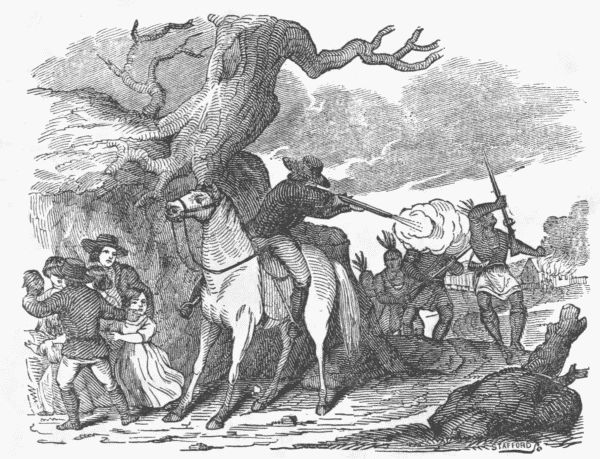
Mr. Dustan saving his children.
We now return to the house. There was living in it a nurse, Mrs. Neff, who heroically shared the fate of her mistress, when escape was in her power. The Indians entered the house, and, having ordered the sick woman to rise and sit quietly in the corner of the fire-place, they commenced the pillage of the dwelling, and concluded by setting it on fire. At the approach of night, Mrs. Dustan was forced to march into the wilderness, and seek repose upon the hard, cold ground. Mrs. Neff, in attempting to elude the Indians with the infant, was intercepted. The babe was taken from her, and its brains beat out against a neighboring tree. The captives, when collected, amounted to thirteen in number. That same day they were marched twelve miles before encamping, although it was nearly night before they set out. Succeeding this, for several days, they were obliged to keep up with their savage comrades, over an extent of country of not less than one hundred and forty or fifty miles. Mrs. Dustan, feeble as she had been, wonderfully supported the fatigue incident to her situation.
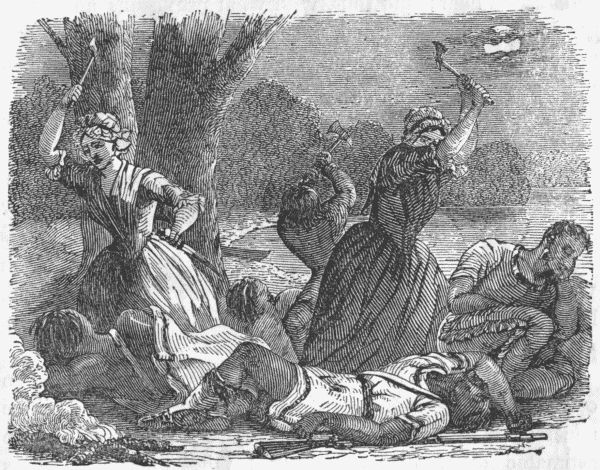
Escape of Mrs. Dustan.
After this, the Indians, according to their custom, divided their prisoners. Mrs. Dustan, Mrs. Neff, and a captive lad from Worcester, fell to the share of an Indian family consisting of twelve persons. These now took charge of the captives, and appear to have treated them with no unkindness, save that of forcing them to extend their journey still farther towards an Indian settlement. They, however, gave the prisoners to understand that there was one ceremony to which they must submit, after they had arrived at their place of destination, and that was to run the gauntlet between two files of Indians. This announcement filled Mrs. Dustan and her two companions with so much dread, that they mutually decided to attempt an escape. Accordingly, after obtaining information from the Indians themselves, as to the way of killing and scalping their enemies, who gave the information without suspecting their object, they laid their plans for taking the lives of the savages. One night, "when the Indians were in the most sound sleep, these three captives arose, and, softly arming themselves with the tomahawks of their masters, allotted the number each should kill; and so truly did they direct their blows, that but two, a boy and a woman, made their escape, the latter having been seriously wounded. Having finished their fearful work, they hastily left the place. As the scene of the exploit was a small island, in the mouth of a stream that falls into the Merrimack, they made use of a boat of the Indians to effect their escape; the others being scuttled to prevent the use of them in pursuit, should the Indians be near; and thus, with what provisions and arms the Indian camp afforded, they embarked, and slowly took the course of the river for their homes, which they reached without accident."
The whole country was startled at the relation of the heroic deed, the truth of which was never questioned. The palpable proofs of their feat they brought with them, and the general court of Massachusetts gave them fifty pounds as a reward, and they received from individuals likewise substantial tokens, expressing the admiration in which the exploit was held. The governor of Maryland, hearing of the transaction, sent them also a generous present.
This is a case where individuals may, perhaps, differ in opinion as to the strict moral propriety of the deed. The necessity of such an act, for relief from suffering, may be estimated differently, according to the different theories which men have adopted. Yet it seems to have been generally, if not universally approved by those who lived contemporaneously with the transaction; and who, from the stern integrity of their character, and from their acquaintance with the circumstances of the country, were peculiarly well fitted to judge.
Such were some of the striking events during the period of King William's War; a war which continued nearly ten years, and brought incalculable distress upon the colonies. The peace of Ryswick, in 1697, put an end to it; but this peace proved to be of short duration.