ILLUSTRATIONS.
Reading edition
page
Time stopping in his Course, &c. 13
Tailpiece—Discovery of Newfoundland, 18
Columbus and Cabot, 19
Northmen leaving Iceland, 21
Discovery of Labrador, 22
Incident in the Camp of the Northmen, 24
Columbus, 26
Columbus before Ferdinand and Isabella, 30
Columbus sets sail, 32
First Sight of Land, 36
Columbus and Natives of Cuba, 38
Columbus casting a Barrel into the Sea, 39
Tailpiece—Prairie Scene, 44
Tailpiece—Columbus at Hispaniola, 47
Early Settlements, 48
Early Settlers trading with the Natives, 50
Captain Smith saved from death, 55
Landing of the Pilgrims, 66
Visit of Samoset to the English, 67
Interview with Massasoit, 68
Boston founded, 73
Settlers emigrating to Connecticut, 76
Hooker addressing the Soldiers, 79
Gallup finds Oldham murdered, 80
Portsmouth founded, 84
Tailpiece—Indian Council, 95
Surrendering of New Amsterdam, 97
Charles II. signing for Penn, 101
Tailpiece—The Maple, 103
Indian Wars, 104
Tailpiece—Indian War Dance, 108
Tailpiece—Savage Barbarities, 112
Smith selling Blue Beads to Powhatan, 115
Pocahontas disclosing a Plot, 118
Opecancanough borne to a Massacre, 121
Tailpiece—Ship before the wind, 124
New England Indian Wars, 125
Governor Winslow's Visit to Massasoit, 134
Governor Bradford and the Snake-skin, 143
Captain Atherton threatens Ninigret, 149
Captain Mason attacking the Pequod Fort, 156
Tailpiece—Camanche Wigwam, 160
Philip's War, 161
Flight of Philip from Mount Hope, 163
Captain Church and his Men hemmed in, 164
Attack on Brookfield, 166
Battle of Muddy Brook, 168
Swamp Fight, 172
Indian Stratagem, 176
Fight near Sudbury, 177
Indians attacked at Connecticut-river Falls, 180
Defence of Hadley, 182
Philip's Escape, 184
Death of Philip, 185
Capture of Anawon, 188
Burning of Schenectady, 191
Mrs. Dustan saving her Children, 196
Escape of Mrs. Dustan, 197
Tailpiece—Round Tower at Rhode Island, 199
Capture of Mr. Williams, 202
Reduction of Louisburg, 211
Tailpiece—Boston Harbor discovered, 213
Braddock's Defeat, 219
Battle of Lake George, 222
Destruction of Kittaning, 224
Destruction of the village of St. Francis, 230
View of Quebec, 231
Death of Wolfe, 235
Tailpiece—Peruvian Canoe, &c. 237
The Revolution, 238
Otis in the Council-chamber, 246
Procession at Boston, 249
Attack on the Governor's House, 250
Burning of the Effigy of Governor Colden, 251
Arrival of the First Man-of-war at Boston, 253
Boston Massacre, 255
Burning of the Gaspee, 257
Destruction of Tea, 259
Patrick Henry, 262
Tailpiece—Falls of St. Anthony, 265
Events of the Revolution, 266
Battle of Lexington, 268
Captain Wheeler and the British Officer, 269
Retreat of the British from Concord, 271
Tailpiece—Source of the Passaic, 273
President Langdon at Prayer, 276
Death of Pollard, 277
General Putnam, 278
Interview between Warren and Putnam, 279
Putnam saves the life of Major Small, 284
Death of Colonel Gardiner, 286
Tailpiece—View of Boston, 290
Messengers spreading news, &c. 291
Tailpiece—Penn laying out Philadelphia, 298
Evacuation of Boston, 299
House at Cambridge occupied by Washington, 300
Fortifying Dorchester Heights, 305
Putnam reading Declaration of Independence, 310
John Hancock, 317
Sergeant Jasper re-planting the Flag, 328
Tailpiece—The Cotton-plant, 332
Battle of Trenton, 347
Tailpiece—Cortez landing at St. Juan d'Ulloa, 352
General Wayne, 355
Marquis Lafayette, 356
Tailpiece—Franklin in Council, 359
Destruction of Gallies, 363
Burgoyne's Advance, 366
Burgoyne's Retreat, 372
Tailpiece—View on the Hudson, 377
American Commissioners and Louis XVI. 379
Tailpiece—The Genius of Liberty, &c. 390
The Sloop-of-war Vulture, 391
Arnold's Expedition through the Wilderness, 393
General Lincoln, 394
Death of General Wooster, 396
Arnold and the British Soldier, 397
General Arnold, 398
Major Andre, 401
Interview of Arnold and Wife, 409
Tailpiece—Capture of Major Andre, 414
Jasper on the Ramparts, 419
Death of De Kalb, 425
Charge of Colonel Washington, 428
Battle of Yorktown, 440
Washington taking leave of the Army, 444
Washington embarking at Whitehall, 446
Tailpiece—American Flag, 449
Naval Operations, 450
First Naval Engagement of the Revolution, 452
Silas Deane, 454
Randolph and Yarmouth, 463
Raleigh and Druid, 465
Jones setting fire to Ships at Whitehaven, 470
Paul Jones, 472
Le Bon Homme Richard and Serapis, 473
Sinking of the Bon Homme Richard, 479
Tailpiece—Ship on her Beam-ends, 487
Sir Henry Clinton, 494
Colonel Barre, 495
Lord Chatham, 500
Charles James Fox, 503
George Grenville, 506
Sir Guy Carlton, 511
Edmund Burke, 513
Tailpiece—Lugger near Shore, 519
Governments, 520
Franklin, 534
Tailpiece—Natural Bridge, 541
George Washington, 542
Inauguration of Washington, 547
John Adams, 571
Tailpiece—New York, from the East river, 589
Thomas Jefferson, 590
Tailpiece—Basket of Flowers, 610
James Madison, 611
Tippecanoe, 615
Constitution and Java, 629
Perry's Victory, 638
Battle of the Thames, 639
Creek Chiefs surrendering to Gen. Jackson, 641
Battle of New Orleans, 652
James Monroe, 656
Reception of Monroe, 658
Attack on Lieutenant Scott's Boats, 663
Taking the Fort at Pensacola, 665
Landing of Lafayette at New York, 668
Lafayette laying Corner-stone, &c. 669
Lafayette at Washington's Tomb, 670
John Q. Adams, 673
Removal of the Creek Indians, 676
Tailpiece—Agricultural Emblem, 682
Andrew Jackson, 683
Martin Van Buren, 701
Burning of the Caroline, 709
William Henry Harrison, 713
John Tyler, 715
James K. Polk, 725
Surprise of Captain Thornton and his Party, 732
Charge of Captain May, 736
American Army in Vera Cruz, 744
Colonel Harney at Cerro Gordo, 746
Battle of Churubusco, 748
Army crossing the National Bridge, 751
Zachary Taylor, 755
British America, 757
Tailpiece—Indians Hunting in Skins, 758
Champlain's Interview with the Algonquins, 760
Extermination of the Hurons, 764
Death of Wolfe, 771
Tailpiece—Tampico, 780
Nova Scotia, 781
Destruction of the Acadians, 785
Newfoundland, 793
Tailpiece—Vessels in the Offing, 796
Tailpiece—Icebergs, 799
Tailpiece—Winter in Lapland, 801
Mexico, 802
Marina acting as Interpreter, 805
Cortez burning his Ships, 806
Meeting of Cortez and Montezuma, 807
Montezuma on his Throne, 808
Death of Montezuma, 809
Noche Triste, 811
Texans flying to Arms, 827
Guatemala, 830
Alvarado marching on Guatemala, 832
New Grenada, 833
Venezuela, 837
Equator, 841
Tailpiece—Peruvian Peasants, 844
Peru, 845
Hualpa discovers the Mine of Potosi, 846
Manco Capac and his Wife, 847
Valverde addressing Atahualpa, 848
Pizarro in Cusco, 850
Bolivia, 855
Tailpiece—Mexican Women making Bread, 857
Chili, 858
Almagro marching against Chili, 859
Tailpiece—Araucanian Men and Women, 862
Buenos Ayres, 863
Uruguay, 868
Brazil, 870
Alvarez Cabral discovers Brazil, 872
Paraguay, 875
West Indies, 879
Millard Fillmore, 911
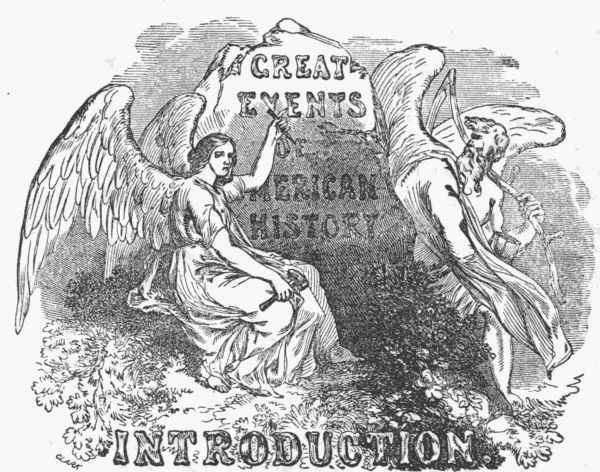
Time stopping in his course to read the Inscription carved by the Muse of History.
If it be remarkable that the Western Continent should have remained unknown for so many centuries to civilized man, it is, perhaps, still more remarkable that since its discovery and settlement, it should have become the theatre of so many signal transactions, and have advanced so rapidly to its present civil, religious, and political importance. The history of every portion of it is interesting and instructive; but more especially that portion occupied by the people of the United States. A great work is in progress throughout the entire continent; but the importance of the American Republic, with which our fortunes are more immediately connected, is becoming apparent with each revolving year. While, therefore, we propose to make an historical survey of the several countries both of North and South America, we shall dwell with greater particularity upon the events which have signalized our own republican America. If not from her present population, which, though increasing by a wonderful progression, is still, in point of numbers, inferior to many other nations; yet, from her wealth, her enterprise, her commercial and political relations, she is entitled to rank among the most powerful and influential nations on the globe. The eyes of the civilized world are upon her; and with wonder, if not with jealousy, do they mark her rapid and surprising advancement.
The history of such a people must be full of interest. By what means has her national elevation been maintained? But a little more than two centuries have elapsed, since the first settlers planted themselves at Jamestown, in Virginia, and the Pilgrim Fathers landed on Plymouth Rock. They were then a feeble band. Before them lay a howling wilderness. An inhospitable and intractable race rose up to oppose and harass them. The means of living were stinted and uncertain. Famine pressed upon them, and weakened them. The winters were cold and piercing. Their habitations were rude and unprotective. Disease added its sufferings and sorrows, and death hurried many of the few to an untimely grave. Yet, amidst accumulated calamity, they gathered strength and courage. Accessions from the mother-country were made to their numbers. Other and distant stations were occupied. The forest fell before them. Towns and villages rose in the wilderness, and solitary places became glad. Savage tribes—after years of terror, massacre, and bloodshed—retired, leaving the colonists to the peaceful occupancy of the land, in all its length and breadth.
But they were still a dependant people—subject to the laws, exactions, and oppressions of a proud and arbitrary foreign government. That government, jealous of their growing importance, adopted measures to check their aspirations, and to extend and perpetuate the prerogatives of the crown. But it was impossible that a people, sprung from the loins of fathers whose courage and enterprise had been matured by years of conflict, should be either crushed, or long thwarted in their plans. Oppressions served rather to strengthen them; threats prompted to resolution, and served to inspire confidence. And, at length, they arose to the assertion and maintenance of their rights. They entered the field; and for years, with all the fortunes of war apparently against them, they grappled successfully with the colossal power of the British empire—thwarted her counsels—conquered her armies—established their independence.
But a little more than seventy years has America been free from the British yoke; yet, in that brief period, her advancement has outstripped all the predictions of the most sanguine statesmen. With but three millions of people, she entered the Revolutionary contest; she now numbers more than twenty millions. Instead of thirteen colonies, she embraces thirty free and independent states. Meanwhile, she has continued to gather national strength and national importance. Her wealth is rolling up, while her moral power is becoming the admiration of the world.
These attainments, too, she has made amid convulsions and revolutions, which have shaken the proudest empires, and spread desolation over some of the fairest portions of the globe. On every side are the evidences of her advancement. Genius and industry are creating and rolling forward with amazing power and rapidity the means of national wealth and aggrandizement. An enterprising, ardent, restless population are spreading over our western wilds, and our cities are now the creations almost of a day.
But by what means has this national elevation and prosperity been attained? Shall we ascribe them to the wise, sagacious, and patriotic men, who guided our councils and led our armies? Shall we offer our homage and gratitude to Washington, Franklin, Adams, Otis, Henry, Jefferson, and a multitude of others, who periled fortune, liberty, life itself, to achieve our independence, and lay the foundation of our country's glory?
Let us do them honor; and a nation's honor and gratitude will be accorded to them, so long as the recorded history of their noble achievements shall last.
Theirs is no vulgar sepulchre: green sods Are all their monument; and, yet, it tells A nobler history than pillar'd pile, Or the eternal pyramid. They need No statue, nor inscription, to reveal Their greatness.
But, while merited honor is paid to the sages and heroes of the Revolution, and to the Pilgrim Fathers of an earlier age, let not the hand of Providence be overlooked or disregarded.
On this point, the Puritans have left a noble example to their posterity. The supplication of the smiles and blessings of a superintending Providence preceded and accompanied all their plans and all their enterprises. "God was their king; and they regarded him as truly and literally so, as if he had dwelt in a visible palace in the midst of their state. They were his devoted, resolute, humble subjects; they undertook nothing which they did not beg of him to prosper; they accomplished nothing without rendering to him the praise; they suffered nothing without carrying up their sorrows to his throne; they ate nothing which they did not implore him to bless." Nor were the actors in the Revolutionary struggle insensible to the necessity of the Divine blessing upon their counsels and efforts. Washington, as well at the head of his army as in the retirement of his closet, or amid some secluded spot in the field, looked up for the blessing of the God of battles. That also was a beautiful recognition of a superintending Providence, which Franklin made in the Convention, which, subsequent to the Revolution, framed the Constitution. "I have lived, sir, a long time," said he; "and the longer I live, the more convincing proof I see of this truth, that God governs in the affairs of men. And if a sparrow cannot fall to the ground without his notice, is it probable that an empire can rise without his aid?"
Let it be remembered by the American people—by men who fill her councils—by historians who write her history—by the young, who are coming up to the possession of the rich inheritance, that whatever human agencies were employed in the discovery, settlement, independence, and prosperity of these states, the "good hand of God has been over and around us," and has given to us this goodly land, with its religious institutions—its free government—its unwonted prosperity.
Let not the historian, who writes—especially if he writes for the young—be thought to travel out of his appropriate sphere, in an effort to imbue the rising generation with somewhat of the religious spirit of the fathers—to lead them to recognise the Divine government, in respect to nations as well as individuals—to impress upon them that sentiment of the "Father of his country," as just as impressive, viz: "Of all the dispositions and habits which lead to political prosperity, religion and morality are indispensable supports."
"When the children of the Pilgrims forget that Being who was the Pilgrims guide and deliverer"—should they ever be so faulty and unfortunate—when the descendants of the Puritans cease to acknowledge, and obey, and love that Being, for whose service the Puritans forsook all that men chiefly love, enduring scorn and reproach, exile and poverty, and finding at last a superabundant reward; when the sons of a religious and holy ancestry fall away from its high communion, and join themselves to the assemblies of the profane, they have forfeited the dear blessings of their inheritance; and they deserve to be cast out from this fair land, without even a wilderness for their refuge. No! let us still keep the ark of God in the midst of us; let us adopt the prayer of the wise monarch of Israel: "The Lord our God be with us, as he was with our fathers; let him not leave us nor forsake us; that he may incline our hearts unto him, to walk in all his ways, and to keep his commandments and his statutes and his judgments, which he commanded our fathers."
Such a regard for God—his laws—his institutions, and his service, is obligatory upon the present generation, aside from those blessings which may be justly anticipated as the reward of such reverence and obedience. It is due to the memory of the Pilgrim Fathers. Never can we so worthily and appropriately honor them, as to cherish the pious sentiments which they cherished, and perpetuate the civil and religious institutions which they founded.—It is due to the generation of our Revolutionary era, which, impressed with a sense of the value of the inheritance transmitted to them, periled life and fortune that they might transmit that inheritance in all its fullness and in all its richness to their posterity. We are the children of patriot heroes, who prayed and then fought, and fought and then prayed.—It is due to ourselves, as we would secure the admiration and gratitude of the generations which are to follow us.—It is due to those generations which, by the blessing of God, are to spread over and occupy the vast territory which now constitutes the American republic.
Those generations! I see them rising and spreading abroad, as future years roll on! What shall be their character—their regard for civil and religious liberty—their peace, order, happiness, and prosperity, may depend upon the example which we set, and the principles which we inculcate. We are living and acting not only for the present, but for the future. We are making impressions for all time to come. If, then, our history for the future shall be as our history past—filled up with divine blessings, and signal providential interpositions—if the noble work begun, centuries since, is to go on—if the "fullest liberty and the purest religion" are to prevail as time rolls on—if this vast continent is to be inhabited by enlightened and happy millions—we, who are now on the stage of action, must imitate the example of that pilgrim band, which first landed on Plymouth Rock.
Under the influence of such an example transmitted from generation to generation, we may hope that our beloved country will ultimately become, if she is not already,
"The queen of the world, and the child of the skies."
Impressed with the importance of such sentiments himself, the author will make no apology for offering them as, in his own view, an appropriate introduction to a work chiefly designed for the benefit of the rising generation.