Part 1 — VII. PHILIP'S WAR.
Reading edition
Causes of Philip's War—Character of Philip—General spirit of hostility among the Indians—Outbreak at Swansey—Expedition under General Savage—Expedition under Captain Church—Perilous situation of this latter party—Timely arrival of Captain Hutchinson—Second expedition of Captain Church—Critical situation of Philip—Effects his escape—Annoys the back settlements of Massachusetts—Treachery of the Nipmucks—Attack on Brookfield—Bloody affair at Muddy Brook—Attack on Springfield—Attack on Hatfield—Outrages at Northampton—Large force raised by Massachusetts, Plymouth, and Connecticut, against the Narragansets—Philip's fortress at Kingston, Rhode Island—Destruction of it—Lancaster destroyed—Other towns burned—Fatal affair at Pawtuxet river, Rhode Island—Stratagem of Cape Cod Indians—Attacks on Rehoboth, Chelmsford, Sudbury, &c.—Expedition of Connecticut troops—Conanchet captured—Long Meadow attacked—Hadley—Fortunes of Philip on the wane—Successful expedition against the Indians at Connecticut river falls—Attack on Hatfield—On Hadley—Remarkable interposition of a stranger at Hadley, supposed to be Goffe—Decline of Philip's power—Pursued by Captain Church—Death of Philip—Disastrous effects of the war—Philip's warriors—Annawon—Reflections.
To communities and nations, crises arrive, in which, through danger and sufferings, they are either overcome and extirpated, or spring forward to an improved condition after the first hurtful effect of the trial is passed away. The war with Philip constituted such a crisis to the New England colonies. Their danger was imminent—their sufferings were fearful, and the immediate consequences were lamentation, and weakness, and indebtedness. But their recuperative energies soon rëappeared, and a wide door thus became open to extended settlement and population.
The causes of the war lay partly in the condition of the colonies, and partly in the character of Philip. The English settlements were extending far into the wilderness, the home of the Indian, and were rapidly increasing in strength. The natives viewed them as intruders, and considered the probability that, at no distant day, they would be dispossessed of the heritage of their fathers. They were jealous of the designs of the English, and impatient under the encroachments already made. They viewed themselves as the proper lords of the forest, and they now saw that their hunting grounds were abridged, and the wild animals on which they depended for subsistence, were disappearing, as the white man felled the trees, and cultivated the soil, and reared his dwellings.
In view of this progress of the whites, nothing seemed to remain to the native savage but to be forced from his loved haunts, and to lose his cherished possessions, or to arouse, and by a desperate effort of strength and valor to regain all that he once owned.
The individual among the Indians whose foresight most clearly discerned the state of things, and whose spirit was equal to the emergency of attempting to resist it, was Pometacom. He was styled Philip by the English, a nickname given him on account of his ambitious and haughty temper, and by this name he is chiefly known in history. He was the sachem of the Wampanoags, residing at Mount Hope, a younger son of the famous Massasoit, the friend of the whites.
Philip had not spared any pains for a long time to effect a conspiracy, and to unite the Indians in a general war against the colonists; but it happened that before his plan was matured, his intentions, and those of the Indians generally, were revealed to the English. The Indian who betrayed him was Sausaman, one of Eliot's converts. For this he was murdered by Philip's men; three of whom were seized, tried, and executed. This was the signal for blood. The first attack of the Indians was upon Swansey, several of whose inhabitants were killed.
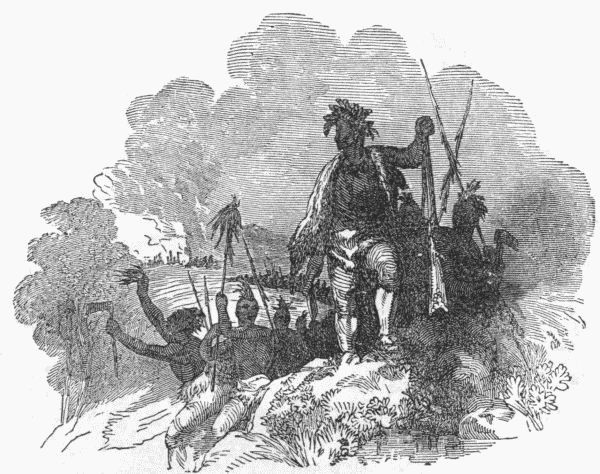
Flight of Philip from Mount Hope.
Philip soon after suddenly left his place of residence and his territory to the English. The occasion of his precipitate retreat, was the following: Additional assistance being needed, the authorities of Boston sent out Major General Savage from that place, with sixty horse and as many foot. They scoured the country on the march to Mount Hope, where Philip and his wife were supposed to be at that time. They came into his neighborhood unawares, so that he was forced to rise from dinner, and he and all with him fled farther up into the country. They pursued him as far as they could go for swamps; and killed fifteen or sixteen in that expedition.
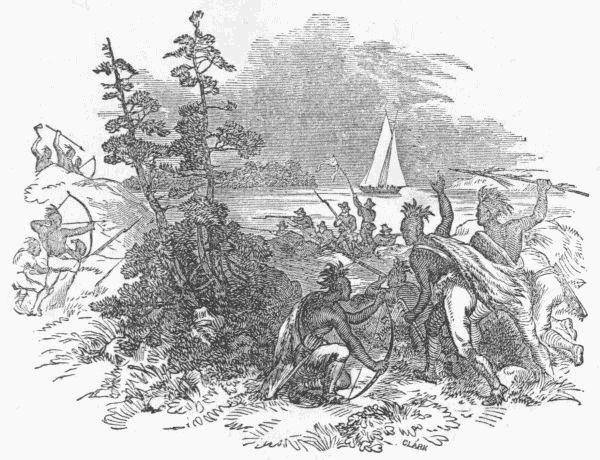
Captain Church and his men hemmed in by Indians.
At the solicitation of Benjamin Church, a company of thirty-six men were put under him and Captain Fuller, who on the 8th of July marched down into Pocasset Neck. This force, small as it was, afterwards divided—Church taking nineteen men, and Fuller the remaining seventeen. The party under Church proceeded into a point of land called Punkateeset, now the southerly extremity of Tiverton, where they were attacked by a body of three hundred Indians. After a few moments' fight, the English retreated to the sea-shore, and thus saved themselves from destruction; for Church perceived that it was the intention of the Indians to surround them. They could expect little more than to perish, but they knew they were in a situation to sell their lives at the dearest rate. Thus hemmed in, Church had a double duty to perform—that of preserving the spirit of his followers, several of whom viewed their situation as desperate, and erecting piles of stone to defend them.
As boats had been appointed to attend upon the English in this expedition, the heroic party looked for relief from this quarter; but though the boats appeared, they were kept off by the fire of the Indians, and Church, in a moment of vexation, bid them be gone. The Indians, now encouraged, fired thicker and faster than before. The situation of the English was now most forlorn, although as yet, providentially, not one of them had been wounded. Night was coming on, their ammunition nearly spent, and the Indians had possessed themselves of a stone house that overlooked them; but, just in season to save them, a sloop was discovered bearing down towards the shore. It was commanded by a resolute man, Captain Golding, who effected the embarkation of the company, taking only two at a time in a canoe. During all this time, the Indians plied their fire-arms; and Church, who was the last to embark, narrowly escaped the balls of the enemy, one grazing the hair of his head, and another lodging in a stake, which happened to stand just before the centre of his breast. The band under Captain Fuller met with a similar fortune, but escaped by getting possession of an old house, close upon the water's edge, and were early taken off by boats. He had two of his party wounded.
Church soon after joined a body of English forces, and again penetrated Pocasset, and renewed his skirmishes with the enemy. The main body of the English, not long after, arrived at the place; on which, Philip retired into the recesses of a large swamp. Here his situation, for a time, was exceedingly critical; but at length he contrived to elude his besiegers; and, effecting his escape, fled to the Nipmucks, by whom he was readily received.
Soon after the war began, an effort had been made by the governor of Massachusetts to dissuade the Nipmucks from espousing the cause of Philip. But at the time, not agreeing among themselves, they would only consent to meet the English commissioners at a place three miles from Brookfield on a specified day. The English authorities deputed Captains Hutchinson and Wheeler to proceed to the appointed place. They took with them twenty mounted men, and three Christian Indians as guides and interpreters. On reaching the place agreed upon, no Indians were to be seen; upon this, the party proceeded still further; when, on reaching a narrow defile, they were suddenly attacked. Eight men were killed outright, and three mortally wounded; among the latter, was Captain Hutchinson. With the above loss, a retreat was effected; and, under the guidance of the three Christian Indians, the remnant made their way to Brookfield.
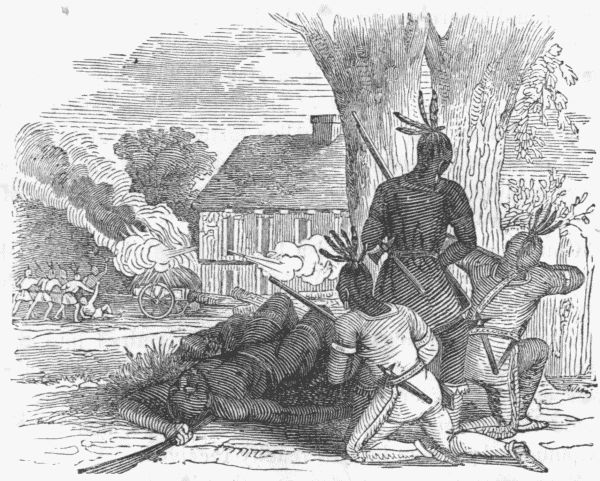
Attack on Brookfield.
They were, however, immediately followed by the Indian foe. Luckily, there was barely time to alarm the inhabitants, who, to the number of seventy or eighty, flocked into a garrison-house. It was slightly fortified about the exterior side, by a few logs hastily thrown up, and in the interior by a few feather beds suspended to deaden the force of the bullets. The house was soon surrounded by the enemy, and shot poured upon it in all directions. But the fire of the besieged kept the Indians from a very near approach. By persevering exertions, the English were enabled to maintain themselves, until a force under Major Willard came to their relief. He was in the vicinity of Lancaster with forty-eight dragoons, when he learned the critical condition of Brookfield. With a forced march of thirty miles, he reached the place the following night.
At the very time Major Willard arrived at Brookfield, the Indians were contriving some machinery to set the garrison on fire. They first endeavored to effect their purpose by fire-arrows, and rags dipped in brimstone tied to long poles spliced together. But this method was without effect, while it exposed them to the deadly fire of those within the building. They next filled a cart with hemp, flax, and other combustible materials; and this, after they set it on fire, they thrust backward with their long poles. But no sooner had the flame began to take effect, than it was extinguished by an unexpected shower of rain.
Major Willard soon left the region of Brookfield, and marched the principal part of his forces to Hadley, for the protection of the settlements in that quarter. When he had completed his business, he returned to Boston, leaving Lathrop and Beers at Hadley. A considerable number of christianized Indians, belonging to the neighborhood of Hadley, occupied a small fort about a mile above Hatfield. On the occurrence of the difficulties in that region, these, as all other Indians, were watched and suspected of conniving with Philip. To put their fidelity to a test, Captains Lathrop and Beers, with a force of one hundred and eighty men, ordered these Indians to surrender their arms. They hesitated to do so then, but promised a speedy compliance. Yet, on the following night, August 25th, they left their fort, and fled up the river towards Deerfield to join Philip. The English captains commenced a pursuit early the next morning, and came up with them at a swamp, opposite to the present town of Sunderland, where a warm contest ensued. The Indians fought bravely, but were finally routed, with a loss of twenty-six of their number. The whites lost ten men. The Indians, who escaped, joined Philip's forces, and Lathrop and Beers returned to their station in Hadley.
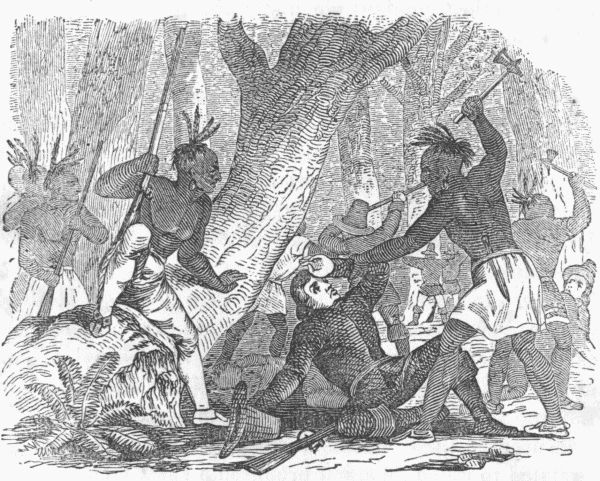
Battle of Muddy Brook.
Near the middle of September, Captain Lathrop was sent from Hadley, with eighty-eight men, to bring away some corn, grain, and other valuable articles from Deerfield. It was at that very time that the company under Captain Mosely, then quartered at Deerfield, intended to pursue the enemy. But upon the 10th of the month, "that most fatal day, the saddest that ever befel New England," Lathrop's company was attacked by the Indians, who had selected a place very advantageous to their purpose, knowing that the English with their teams would pass the road at the spot. The place was at the village now called Muddy Brook, in the southerly part of Deerfield, where the road crossed a small stream (as it now does), bordered by a narrow morass. Here the Indians, in great force, had planted themselves in ambuscade; and no sooner had Lathrop arrived at the spot, than the Indians poured a heavy and destructive fire upon the columns, and then rushed furiously to close engagement. The English ranks were broken, and the scattered troops were every where attacked. Those who survived, after the first onset, met the foe individually, and endeavored to sell their lives as dearly as possible. Seeking the covert of a tree, each one selected an object of attack, and the awful conflict now became a trial of skill in sharp shooting, on the issues of which life or death was suspended. But the overwhelming superiority of the Indians, as to numbers, left no room for hope on the part of the English. They were cut down every instant from behind their retreats, until nearly the whole number were destroyed. The dead, the dying, the wounded, strewed the ground in every direction. Out of nearly one hundred, including the teamsters, only seven or eight escaped from the bloody spot. The wounded were indiscriminately massacred. This company consisted of choice young men, "the very flower of Essex county, none of whom were ashamed to speak with the enemy in the gate." Eighteen of the men belonged to Deerfield.
Captain Mosely, being only four or five miles distant, heard the sound of musketry, and reasonably concluded what was the cause of the report. By a rapid march for the relief of Lathrop, he arrived at the close of the struggle, when he found the Indians stripping and mangling the dead. At once he rushed on in compact order, and broke through the enemy, charging back and forth, and cutting down all within range of his shot. After several hours of gallant fighting, he compelled the Indians to flee into the more distant parts of the forest. His loss amounted to two killed and eleven wounded.
Until this period, the Indians near Springfield remained friendly, and refused the appeals of Philip, to cöoperate with him against the white population. But now that he held the northern towns, they were closely watched by the English, who supposed that the Indians might take sides with him, as his cause seemed likely to prevail. The suspicions entertained concerning them were confirmed. On the night of the 4th of October, they admitted about three hundred of Philip's men into their fort, which was situated at a place called Longhill, about a mile below the village of Springfield, and a plan was concerted for the destruction of the place. The plot, however, was revealed by an Indian at Windsor, and the inhabitants of Springfield had time barely to escape into their garrisons. Here they resisted the attacks of the Indians until they received relief from abroad. The unfortified houses, thirty-two in number, together with twenty-five barns, were burned by the savages. The people were reduced to great distress, and had very inadequate means of support through the ensuing winter.
The confidence of Philip and his Indians was now greatly increased by their successes. The next blow which they aimed, was at the head-quarters of the whites, hoping to destroy Hatfield, Hadley, and Northampton, as they had Springfield. But by the providence of God, and the good conduct of the whites, they were effectually foiled. At this time, Captain Appleton, with one company, lay at Hadley, and Captains Mosely and Poole, with two companies, at Hatfield, and Major Treat was just returned to Northampton for the security of that settlement. Against such commanders, it was in vain for the untutored Indian to contend in regular battle. Philip's men, however, made a bold attempt, and seven or eight hundred strong fell upon Hatfield, on the 19th of October, attacking it on all sides at once. They had previously cut off several parties, which were scouring the woods in the vicinity. While Poole bravely defended one extremity, Mosely, with no less vigor, protected the centre, and Appleton, coming on with his troops, maintained the other extremity. After a severe struggle, the Indians were repulsed at every point.
After leaving the western frontier of Massachusetts, Philip was known next to be in the country of his allies, the Narragansets. They had not heartily engaged in the war; but their inclination to do so was not doubted, and it was the design of Philip to incite them to activity. An army of fifteen hundred English was therefore raised by the three colonies of Massachusetts, Plymouth, and Connecticut, for the purpose of breaking down the power of Philip among the Narragansets. It was believed that the next spring, that nation would come with all their power upon the whites. Conanchet, their sachem, in violation of the treaty, had not only received Philip's warriors, but aided their operations against the English. These were the grounds of the great expedition against the Narragansets, in the winter of 1675.
Philip had strongly fortified himself in South Kingston, Rhode Island, on an elevated portion of an immense swamp. Here his men had erected about five hundred wigwams, of a superior construction, in which was deposited an abundant store of provisions. Baskets and tubs of corn (hollow trees cut off about the length of a barrel), were piled one upon another, about the inside of the dwellings, which rendered them bullet-proof. Here about three thousand persons, as is supposed, had taken up their residence for the winter, among whom were Philip's best warriors.
THE SWAMP FIGHT.
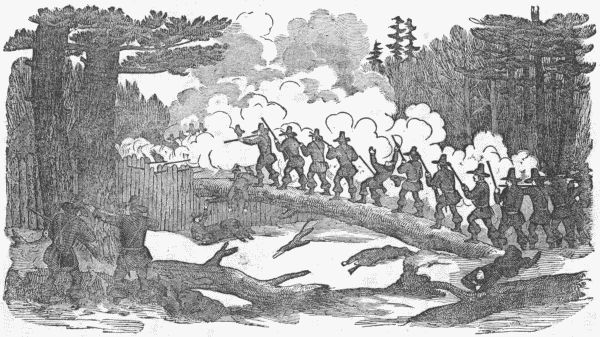
The forces destined to the attack of this great rendezvous of Philip and his men, were under command of Governor Winslow, of Plymouth. By reasons of a great body of snow, and the prevalence of intense cold, much time was consumed in reaching the fort. On the 19th of December, they arrived before it; and, by reason of a want of provisions, found an immediate attack indispensable. No Englishman, however, was acquainted with its situation, and, but for an Indian, who betrayed his countrymen, there is little probability that the assailants could have effected any thing against it. The hour of their arrival was one o'clock on that short day of the year. There was but one point where the place could be assailed with the least probability of success, and this was fortified by a kind of blockhouse, directly in front of the entrance, and had also flankers to cover a cross-fire. The place was protected by high palisades, and an immense hedge of fallen trees surrounding it on all sides. Between the fort and the main land was a body of water, which could be crossed only on a large tree lying over it. Such was the formidable aspect of the place—such the difficulty of gaining access to the interior of it.
On coming to the spot, the English soldiers, attempting to pass upon the tree in single file, the only possible mode, were instantly swept off by the fire of the enemy. Still, others, led by their captains, supplied the places of the slain. These also met the same fearful fire, with the same fatal effect. The attempts were repeated, until six captains and a large number of men had fallen. And now was a partial, but momentary, recoil from the face of death.
At length, however, Captain Mosely got within the fort, with a small band of men. Then commenced a terrible struggle, at fearful odds. While these were contending hand to hand with the Indians, the cry was heard, "They run! they run!" and immediately a considerable body of their fellow-soldiers rushed in. The slaughter of the foe became immense, as the assailants were insufficient in strength to drive them from the main breast-work. Captain Church, who was acting as aid to Winslow, at the head of a volunteer party, about this time dashed through the fort, and reached the swamp in the rear, where he poured a destructive fire on the rear of a party of the enemy. Thus attacked in different directions, the warriors were at length compelled to relinquish their ground, and flee into the wilderness.
The Indian cabins, (contrary to the advice of some of the officers, who thought it best that the wearied and wounded soldiers should rest there for a time,) "were now set on fire; in a few moments every thing in the interior of the fort was involved in a blaze; and a scene of horror was now exhibited. Several hundred of the Indians strewed the ground on all sides: about three hundred miserable women and children with lamentable shrieks were running in every direction to escape the flames, in which many of the wounded, as well as the helpless old men, were seen broiling and roasting, and adding to the terrors of the scene by their agonizing yells. The most callous heart must have been melted to pity at so awful a spectacle. By information afterwards obtained from a Narraganset chief, it was ascertained that they lost about seven hundred warriors at the fort, and three hundred who died of their wounds. After the destruction of the place, Winslow, about sunset, commenced his march for Pettyquamscott, in a snow storm, carrying most of his dead and wounded, where he arrived a little after midnight. Several wounded, probably not mortally, were overcome with cold, and died on their march; and the next day thirty-four were buried in one grave. Many were severely frozen, and about four hundred so disabled that they were unfit for duty. The whole number killed and wounded, was about two hundred." The sufferings of the English, after the fight, were well pronounced to be almost without a parallel in history.
The spirit of Philip animated the Indians even where he was not present, for he was now by some supposed to be beyond the frontier. On the 19th of February, they surprised Lancaster with complete success, falling upon it with a force of several hundred warriors. It contained at that time fifty families, of whom forty-two persons were killed and captured. Most of the buildings were set on fire. Among the captives were Mrs. Rowlandson and her children, the family of the minister of that place, who were afterwards happily redeemed. The town was saved from entire ruin by the arrival of Captain Wadsworth with forty men from Marlborough.
Not far from this time a fatal affair occurred at Pawtuxet river, in Rhode Island. Captain Pierce, of Scituate, with fifty men, and twenty Cape Cod Indians, having passed the river, unexpectedly met with a large body of Indians. Perceiving that their numbers rendered an attack upon them hopeless, he fell back, and took a position so as to be sheltered by the bank. In this situation, the company was not long secure. Part of the Indians crossed the river, and attacked them from the opposite bank, while the remainder encircled them on the side of the river, where they had sought protection, and poured in upon them a most destructive fire. Hemmed in so effectually, there was no possibility of escape, and nothing was left them but to sell their lives as dearly as possible. This was accordingly done, and before the unfortunate men were nearly all cut off, more than a hundred of the enemy are said to have fallen by the desperate valor of the English.
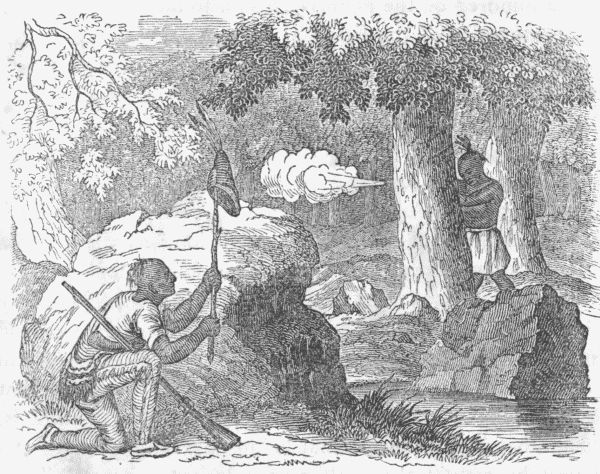
The Christian Cape Cod Indians showed their faithfulness and courage in this melancholy affair, as also their dexterity and foresight. Four of them effected their escape, and one of these aided the escape of the only Englishman that survived the encounter. One of them, whose name was Amos, after Captain Pierce was disabled by a wound, would not leave him, so long as there was a prospect of rendering him service, but loaded and fired his piece several times. At length, to save himself, he adroitly adopted the plan of painting his face black, as he perceived the enemy had done to their faces. In this disguise he ran among them, and pretended to join them in the fight; but watching his opportunity, he soon escaped into the woods. Of another it is reported, that being pursued by one of the enemy, he sought the shelter of a large rock. While in that situation, he perceived that his foe lay ready with his gun on the opposite side, to fire upon him as soon as he stirred. A stratagem only saved his life. Raising carefully his hat upon a pole, he seemed to the person lying in wait, to have exposed himself to a shot. A ball was instantly sent through the hat, but one was returned in earnest against the head of the enemy. Thus the Christian Indian, through his address, found the means of escape from his singular peril. A similar subtle device was used by another of these Indians, who was pursued as he attempted to cross the river. Hiding himself behind a mass of earth turned up with the roots of a tree, he was watched by the enemy, in the expectation that he would soon be obliged to change his position. But, instead of doing this, the Cape Cod Indian, perforating his breastwork, made a convenient loophole, and shot his enemy before he had time to notice the artifice. The fourth Cape Cod Indian who escaped, effected his object by affecting to be in pursuit of an Englishman with his upraised hatchet. This ingenious feint, of course, was the means of saving the white man at the same time.
Indian Stratagem.
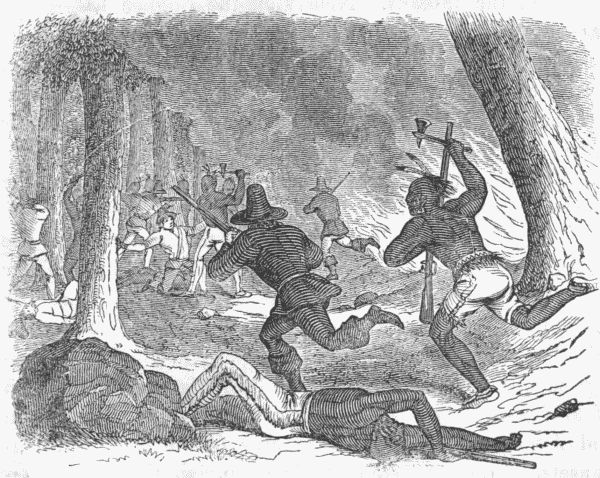
The work of destruction continued among the towns of New England at this period. To a greater or less extent Rehoboth and Providence suffered—also, Plymouth, Chelmsford, and Andover—either men were killed, or dwelling-houses and barns were burned. But the most signal disaster, at this time, fell upon the English in the vicinity of Sudbury. On the morning of the 20th of April, the largest body of Indians which had at any time appeared, attacked the place, and, before a force could be brought against them, set fire to several buildings, which were consumed. The inhabitants rallied, and bravely defended their homes; and, being soon joined by some soldiers from Watertown, they forced the Indians to retreat without effecting further mischief against the town that day. On hearing the news of the attack on Sudbury, some of the people of Concord flew for its protection. As they approached a garrison-house, a few Indians were discovered, and a pursuit was given them. The flight of the latter proved to be only a decoy, and the Concord people, eleven in number, found themselves ambushed on every side. Fighting with the utmost desperation, they were all cut off except one. The Indians, who remained in the adjoining woods for further depredations, found another opportunity to glut their vengeance against the whites. Captain Wadsworth, hearing of the transactions at Sudbury, marched with several men, joined by Captain Brocklebank and ten others, towards the place. At a mile and a half from the town, five hundred Indians lay in ambush behind the hills. When Wadsworth arrived at the spot, the Indians sent out a few of their party, who crossed the track of the English, and, being discovered by the latter, affected to fly through fear. Wadsworth, with great want of caution, immediately commenced a pursuit, and was consequently drawn into the ambush. The Indians began the attack with great boldness. For some time, the English maintained good order, and retreated with small loss to an adjacent hill. After fighting four hours, and losing many men, the Indians became doubly enraged, and resolved to try the effect of another stratagem. In this they completely succeeded. They immediately set the woods on fire to the windward of the English, which, owing to the wind, and the dryness of grass and other combustibles, spread with great and fatal rapidity. The English were driven, by the fury of the flames, from their favorable position, and were thus exposed to the tomahawks of the Indians. Nearly all the English fell—some accounts say that they sold their lives, to the last man.
Fight near Sudbury.
Several towns in the colony of Plymouth, as Scituate, Bridgewater, Middleborough, and Plymouth, were in turn attacked and injured, though not many of their inhabitants were destroyed. They probably betook themselves to the fortified houses, which now became common in the exposed villages.
Connecticut, not being exposed to the incursions of the natives, sent out several volunteer companies in aid of her sister colonies, in addition to the troops required as her quota in the present war. These volunteer forces were raised principally from New London, Norwich, and Stonington, joined by a body of friendly Indians. On the 27th of March, a body of these troops, under Captains Dennison and Avery, penetrated the country of the hostile Narragansets. In the course of their excursion, they struck the trail of a large body of Indians, and commenced pursuit. The latter, upon the approach of the English, scattered in all directions. It proved to be a force commanded by Conanchet. He took a route by himself and, being swift of foot, hoped to outstrip his pursuers. In crossing a river, however, he accidentally plunged under water, and wet his gun. On this occurrence, he was soon overtaken by a fast-running Pequod, to whom he surrendered himself at once. A young Englishman, coming up, began to put various questions to the chief, who, little liking to be catechised in that manner, replied to him, with a look of contempt: "You much child—no understand matters of war; let your captain come: him I will answer." Conanchet was conveyed to Stonington, and, after a sort of trial, was condemned to be shot by the Mohegan and Pequod sachems. The alternative of life was, however, presented to him, if he would make peace with the English. The chieftain indignantly refused it, and gave utterance to the feelings of his untamed spirit, when his sentence was pronounced, in the sentiment, that "he liked it well that he should die before his heart was soft, or he had said any thing unworthy of himself." Conanchet was the son of the famous Miantonimoh, who was put to death by Uncas, as related in another portion of this work.[22]
When success no longer attended Philip in Massachusetts, those of his allies whom he had seduced into this war began to accuse him as the author of all their calamities. Many of the tribes, therefore, scattered themselves in different directions. The Deerfield Indians were among the first who abandoned his cause, and many of the Nipmucks and Narragansets soon followed their example. Still, Philip, though he had not been much seen during the winter—and it is doubtful, even, where he had spent the most of it—had no intention of abating his efforts against the English. In the month of May, 1676, he was found at the head of a powerful force, in the northern part of Massachusetts, extending many miles on its frontier from east to west. Considerable numbers of his people were also still in and about Narraganset, ravaging and annoying the adjacent English settlements.
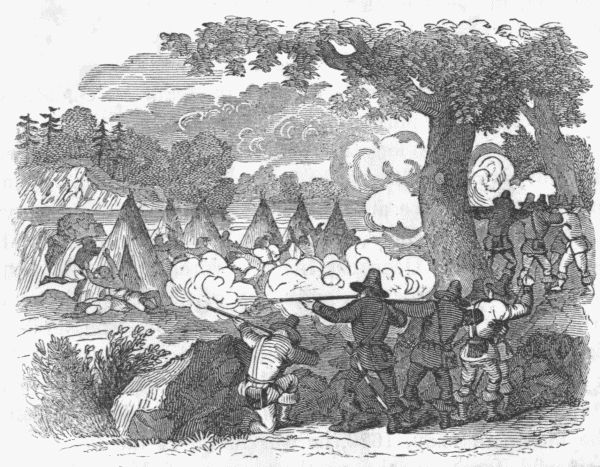
Large bodies of the Indians, about this time, anxious to secure the advantages of fishing in Connecticut river, took up positions at the falls, between the present towns of Gill and Montague. This was in the vicinity of the line of country occupied by Philip's forces. They felt the more secure here, as the English forces at Hadley and the adjacent towns were not at this time at all numerous. Two captive lads, who had escaped from the Indians, informed the English of their situation, and the little pains they had taken to guard themselves. The intelligence thus brought induced the people of Hatfield, Hadley, and Northampton, to raise a force, for the purpose of attacking the enemy at so favorable a point. About one hundred and sixty troops were raised, and placed under the command of Captain Turner. They marched silently in the dead of the night, and came upon the Indians a little before the dawn of day, whom they found almost in a dead sleep, and without any scouts abroad, or watching around their wigwams at home.
Indians attacked at Connecticut River Falls.
When the Indians were first awakened by the thunder of their guns, they cried out, "Mohawks! Mohawks!" as if their own native enemies had been upon them; but the dawning of the light soon rectified their error, though it could not prevent their danger. The loss of the Indians was great: one hundred men were left dead on the ground, and one hundred and forty were seen to pass down the cataract, but one of whom escaped drowning.
The march of the English forces back was, however, attended with no small disaster. The Indians, learning the inconsiderable numbers that had attacked them, rallied in their turn, and hung upon the rear of the English. Their captain, just then enfeebled by sickness, was unable to arrange or conduct his forces as they should have been; and the consequence was a degree of confusion, and their separation into small parties. In this manner, they suffered the loss of thirty-eight men, though the Indians paid dearly for it by the loss of more than a hundred of their warriors on the way. Captain Turner perished in the expedition.
By the destruction at the falls, Philip's forces were seriously diminished; yet his spirit continued unsubdued and undaunted, and he was resolved to retort upon the English the injuries he had sustained. Accordingly, on the 30th of May, six hundred of his warriors appeared at Hatfield, and rushed suddenly into the town. They immediately set fire to twelve unfortified buildings, and attacked several palisaded dwelling-houses. These were bravely defended by the people. In the midst of the fight, as the inhabitants were attacked, whether in their dwellings or at their labors, a party of twenty-five resolute young men crossed the river from Hadley, and came with such animation upon the Indians, and with so deadly a fire, that the latter were driven back. Eventually, the whole body of the enemy was obliged to return, without effecting, as was intended, the complete destruction of the place. They, however, drove off a large number of sheep and cattle.
Massachusetts and Connecticut now increased their forces in this quarter, as it appeared that the foe was determined on devastating the settlements upon the river. Hadley became next the object of attack, in which about seven hundred Indians were engaged. The assault was made on the 12th of June, the Indians having laid an ambuscade at the southern extremity, and advanced the main body towards the other the preceding night. Though the Indians exhibited their usual fierceness, they were met and repulsed at the palisades. Renewing their attacks upon other points, they seemed resolved to carry the place. Still, they were held in check until assistance arrived from Northampton, when the foe was driven into the woods.
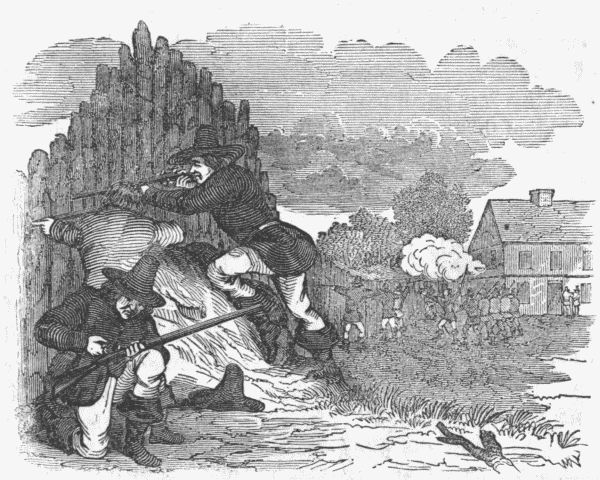
Defence of Hadley.
It was during this attack, as is supposed, that the assistance was afforded to the whites which has generally been ascribed to Goffe, one of the fugitive judges from England, which at the time was believed to have been rendered by the guardian angel of the place. In the midst of the confusion and distress of the battle, a gray-headed, venerable-looking man, whose costume differed from that of the inhabitants, appeared, and assumed the direction of the defence. He arrayed the people in the best manner, showing that he well understood military tactics, led in the battle, and, by his exhortations and efforts, rendered essential aid on the occasion. After the departure of the Indians, he was not observed, and nothing was heard of him afterwards. As it is known that, at that time, Goffe and Whalley were concealed in the house of Mr. Russel in Hadley, it is inferred that one of these men, Goffe (for Whalley was superanuated) left his concealment, in the danger which existed, and put forth the effort here recorded, in order to save the town.
Philip was now secure in no place, but his haughty spirit was untamed by adversity. Although meeting with constant losses, and among them some of his most experienced warriors, he, nevertheless, seemed as hostile and determined as ever. In August, the intrepid Church made a descent upon his head-quarters, at Matapoiset, where he killed and took prisoners about one hundred and thirty of his men. Even Philip escaped with difficulty. So great was his precipitation, that he was obliged to leave his wampum behind, which, with his wife and son, fell into the hands of the victors. That son, it was afterwards ascertained, was sold into slavery, as it was also the mournful fact, with a number of Philip's captured followers. Philip, as stated above, escaped with difficulty. The particulars, as related by Church, are as follow: Church's guide had brought him to a place where a large tree, which the enemy had fallen across a river, lay. Church had come to the top end of the tree when he happened to spy an Indian upon the stump of it, on the other side of the stream. He immediately leveled his gun against the Indian, and had doubtless despatched him, had not one of his own Indians called hastily to him not to fire, for he believed it was one of his own men. Hearing this, in all probability the Indian upon the stump looked about, and Church's Indian, then seeing his face, perceived his mistake, for he knew him to be Philip. Church's Indian then fired himself, but it was too late. Philip immediately threw himself off the stump, leaped down a bank on the other side of the river, and was out of sight. Church at once gave chase for him, but was unable to discover his course, and only took some of his friends and followers, as has been related.
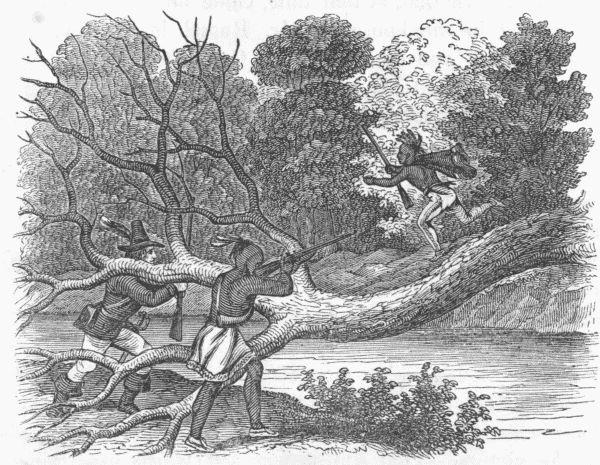
Philip's Escape.
But from this time, Philip was too closely watched and hotly pursued to escape destruction. His end was rapidly drawing near, his followers mostly deserted him, and he was driven from place to place, until he found himself in his ancient seat near Pokanoket. The immediate occasion of his death is thus narrated: He having put to death one of his own men, for advising him to make peace, this man's brother, whose name was Alderman, fearing the same fate, deserted him, and gave Captain Church an account of his situation, and offered to lead him to his camp. Early on Saturday morning, 12th August, Church came to the swamp where Philip was encamped, and, before he was discovered, had placed a guard about it so as to encompass it, except at a small place. He then ordered Captain Golding to rush into the swamp, and fall upon Philip in his camp, which he immediately did, but was discovered as he approached, and, as usual, Philip was the first to fly. Having but just awaked from sleep, and having put on part of his clothes, he fled with all his might. Coming directly upon an Englishman and Indian, who composed a part of the ambush at the edge of the swamp, the Englishman's gun missed fire, but Alderman, the Indian, whose gun was loaded with two balls, sent one through his heart and another not above two inches from it. "He fell upon his face in the mud and water, with his gun under him."
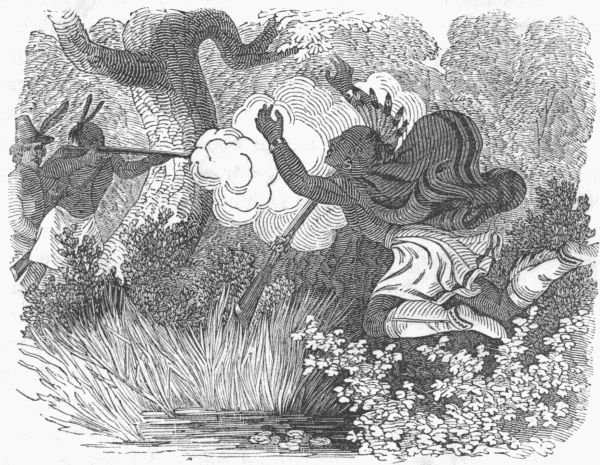
Death of Philip.
This important news was immediately communicated to Captain Church, by the man who performed the exploit; but the captain suffered nothing to be said concerning it, as he wished to dislodge the enemy from his retreat. Philip's great captain, Annawon, had, however, led out about sixty of his followers from their dangerous situation, and, when the English scoured the swamp, they found not many Indians left. These were killed and captured. After the affair was over, Church communicated to his troops the gratifying intelligence of Philip's death, upon which the whole army gave three loud huzzas. Philip's body was drawn from the spot where he fell, the head taken off, and the body left unburied, to be devoured by wild beasts. With the great chief fell five of his most trusty followers; one of whom was his chief captain's son, and the Indian who fired the first gun in this bloody war. Thus fell this chieftain, who, though an untutored savage, was doubtless a great man—considered in reference to his intellectual resources and the influence he wielded among his compatriots. Had his lot fallen among a civilized race, and fighting as he did for his native country, he had been as illustrious as any hero of any age or clime.
Philip's war proved a most serious concern to the infant colonies. It cost them half a million of dollars, and the lives of above six hundred inhabitants, who were either killed in battle, or otherwise destroyed by the enemy. Thirteen towns and six hundred houses were burned, and there was scarcely a family in the United Colonies that had not occasion to mourn the death of a relative. Dr. Trumbull thinks the loss exceeds the common estimate. He concludes that about one fencible man in eleven was killed, and every eleventh family burned out. But the war was still more disastrous to the Indians. Great numbers of them fell in battle; their lodges were destroyed, and, indeed, their country conquered. Scarcely a hundred warriors remained of the great leading tribe of the Narragansets.[23]
Of Philip's warriors, several were remarkable men.—Among these were Nanunteno, or Cononchet; Annawon, Quinnapin, Tuspaquin, and Tatoson. We can briefly notice but one—the mighty Annawon. We have seen that at the time of Philip's death, he escaped with a number of his men. The place of his retreat was not long after disclosed by an Indian and his daughter, who had been captured. It was in a swamp in the south-east part of Rehoboth. Captain Church, upon this information, adopted a most daring stratagem to secure Annawon. At the head of a small party, conducted by his informers, Church cautiously approached in the evening the edge of a rocky precipice, under which the chief was encamped, and critically examined the position. The Indians, their arms, their employments, (for they were preparing for a meal,) and other defences, were all noticed by Captain Church; and particularly the fact, that Annawon and his son were reposing near the arms. As he learned from his guide that no one was allowed to go out or come into the camp, except by the precipice, he determined to seek his object in that direction. The Indian and his daughter, according to a concerted plan, with baskets upon their backs, as if bringing in provisions, preceded Church and his men, by their shadows concealing the latter, and descended the rock. In this way, although with great difficulty, they all reached the bottom without alarming the Indians. It happened, singularly enough, that their descent was accomplished without discovery, on account of the noise made by the pounding of a mortar; a squaw being engaged in that work in preparing green dried corn for their supper. Under favor of the noise thus made, the rustling sound proceeding from their leaps from crag to crag was not noticed. Church, with his hatchet in his hand, stepped over the young man's head to the arms. The young Annawon threw his blanket suddenly over his head, and shrunk up in a heap. The old chief started upon end, and cried out Howah! meaning Welcome! Finding that there was no escape, he resigned himself to his fate, and fell back on his couch; while his captors secured the rest of the company. English and Indian amicably ate their supper together, and Church afterwards laid down to rest, as he had not slept during the thirty-six previous hours; but his mind was too full of cares to admit of repose, and after lying a short time, he got up. On one occasion, during the night, he felt suspicious of Annawon's intentions, as the latter, after attempting in vain to sleep, arose, and left the spot a short time. Returning with something in his hands, (Church having in the mean time prepared himself for the worst,) he placed it on the ground, and, falling on his knees before his captor, said: "Great Captain, you have killed Philip and conquered his country, for I believe that I and my company are the last that war against the English. I suppose the war is ended by your means." His pack consisted of presents, being principally several belts of wampum, curiously wrought, and a red cloth blanket, the royal dress of Philip. These he gave to Church, expressing his gratification in having an opportunity of delivering them to him.
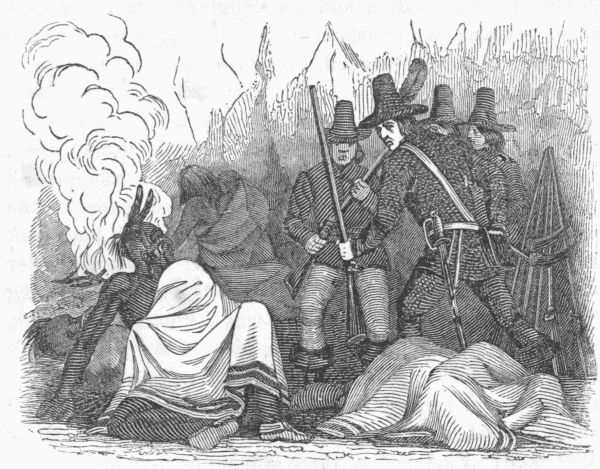
Capture of Annawon.
The remainder of the night they spent in discourse, in which Annawon gave an account of his success and exploits in former wars with the Indians when he served Asuhmequin, Philip's father. Annawon, it is said, had confessed that he had put to death several of the captive English, and could not deny but that some of them had been tortured. Under these circumstances, and considering the exasperation which the English naturally felt, it was hardly to be expected that mercy should be shown him. Church, however, did not intend that he should be put to death, and had earnestly entreated for him; but in his absence from Plymouth, not long after, the old chief was executed.
It is not uncommon with historians and others, to denounce and execrate the conduct of Philip and his warriors, as wanton and savage. They were doubtless cruel—they were savage. The writer would not become their panegyrist. But let it be remembered, that if they cannot be exculpated, there are mitigating circumstances which should always be mentioned in connection with their most inhuman barbarities. The influences of Christianity never bore upon them. They inflicted no greater tortures upon the English than they often inflicted upon other prisoners of their own complexion. But in addition, they were fighting for their own country. They were patriots—and they saw in the progress and prosperity of the English, the downfall of Indian power—the annihilation of Indian title. They were fathers, husbands, and full well did they know that soon their family relations would be broken up—and the inheritance of their children for ever fail. Who can blame them for wishing to perpetuate their hold on their native hunting grounds—or leaving to their posterity an inheritance dear to them as ours is to us?—We cannot justify their treachery—their indiscriminate and wholesale butcheries—but surely we may admire their bravery—their endurance—their patriotism.