Part 1 — II. NOVA SCOTIA.
Reading edition
Limits—Conquest by the English—Settlement—Annexation to the British Crown—Policy of England in relation to the Country—Situation of the English Settlers—English Treatment of the Acadians—State of the Province during the Wars of the United States—Results of the War of 1812.
Limits.—Nova Scotia is a large peninsula on the south-eastern part of British America, united to the continent by a narrow isthmus, between Chignecto bay and the Gulf of St. Lawrence. It is three hundred and eighty-eight miles in length from north-east to south-west, and contains an area of sixteen thousand square miles. It is a rough, mountainous country, barren on the sea-board, but very fertile in some of the interior parts.
Settlement.—De Monts, a French gentleman, sailing from France with a view to settlement in this part of America, touched, in the first instance, at Nova Scotia, on the 16th May, 1604; but no settlement was effected until the year after, and that was at Port Royal (now Annapolis). The whole country, including New Brunswick, was then known by the name of Acadia. The settlement above spoken of was soon after, in 1614, broken up by Argall, an English captain, engaged in the Virginia settlement. The whole region was viewed with indifference on the part of the English, because it did not contain gold and silver. They, however, made an attempt, under Sir William Alexander, to occupy it, some years after Argall's success against Port Royal; but were obliged to desist, from finding it in possession of the French. In 1628 and 1629, the English succeeded in taking Nova Scotia and Canada; but by the terms of a treaty in 1632, the whole country was restored to France.
Conquest by the English.—A period of several years was passed in the infelicities of a deadly feud between the rival chiefs who held possession of the country. But amidst their contentions, an expedition was sent against Nova Scotia in 1654 by Cromwell, who had then declared war against France; and the result was the reduction of the warring parties, and the submission of the whole country to the English authority. This was but a temporary acquisition. By the peace of 1667, Nova Scotia was again ceded to the French.
In the course of a few subsequent years, Nova Scotia was twice invaded and taken by the English from the colony of Massachusetts; the first time under Sir William Phipps, and the second time by a body of five hundred men from Boston. Acadia was now held by the British until the treaty of Ryswick in 1697, when it again reverted to France.
Permanent Annexation to the British Crown.—There was a speedy return of the war between France and England, and the reduction of Nova Scotia was again left to New England. The first expedition, under Colonel Church, and a subsequent one, three years after, effected little for the object in view. The determination of the New Englanders, however, could not be shaken. After two years spent in preparing, they assembled a large force of five regiments; and under the command of General Nicholson, they arrived at Port Royal on the 24th of September, 1716, which in its weakness capitulated without resistance. The month following, when the deed of surrender was made, forms the era of the permanent annexation of Nova Scotia to the British crown.[85] The Indians of the country, who were strongly attached to the French, were not satisfied with the transfer, and for many years became extremely troublesome to the English, frequently surprising them, and carrying off their property. It was in the course of these disturbances, that the Massachusetts troops in 1728 defeated the tribe of the Noridgewocks; among the results of which invasion, was the death of the celebrated Father Rolle, their missionary.
Policy of England in relation to the Country.—After the treaty of Aix-la-Chapelle 1748, which had been preceded by disasters to the French possessions in America, particularly by the taking of Louisburg, Great Britain began to pay more attention to Nova Scotia. Hitherto, it had been quite a French country, peopled and cultivated throughout by that hostile nation. It was suggested, that of the large number of soldiers and sailors discharged in consequence of the peace, a part might with great advantage be located as agriculturists, and thereby provide the colony with an English population. This project was embraced with ardor by the Earl of Halifax.
Fifty acres were allowed to every private, with ten additional for each member of his family. A higher allowance was granted to officers, in proportion to their rank. By this arrangement, three thousand seven hundred and sixty adventurers with their families were induced to embark in May, 1749. They were landed, not at Annapolis, but Chebucto, named henceforth Halifax, after the patron of the expedition.
Situation of the English Settlers.—As munificent provision was made for them from time to time, a town, with spacious and regular streets, was soon reared; where they were as comfortably situated as they could be with a hostile population in their vicinity, and the difficulties arising from the French claims. The boundaries of the country were in dispute between the two nations—the encroachments of the English, as the French settlers deemed them, alarmed the fears of the latter; and the Indians, excited by French emissaries, committed upon the English numerous outrages. At length, the French arose in rebellion against the British rule; but it was not until after many attempts to subdue them, on the part of the English, that the object was effected. The success of the last expedition, under Colonel Monckton, in 1755, from New England, secured the tranquillity of all French Acadia, then claimed by the English under the name of Nova Scotia.
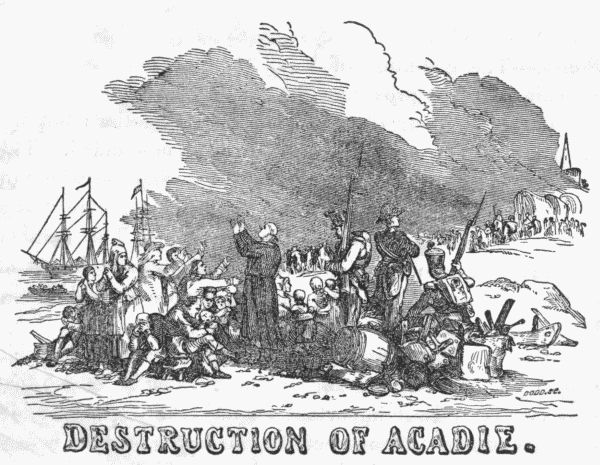
English Treatment of the French Acadians.—The English, in consequence of the war which now raged between France and Britain, did not feel at ease. They had reason to believe that, in the event of an invasion of Nova Scotia by the French, they would find not only the Indians, but the Acadians, friendly to the invaders. A cruel expedient, hardly justified by the circumstances, was adopted to prevent the danger and evil. It was determined to break up the homes of the latter, and disperse them throughout the British colonies, so that they might be unable to unite in offensive measures. They were comfortably situated, and attached to their homes; were a quiet people, only a few of them ever having been openly engaged in arms against the British; and, consequently, they could not but keenly feel the greatness of their wrongs. They submitted to them, but with moans and pathetic appeals, though occasional forcible resistance was offered.
"Notwithstanding the barbarous diligence with which this mandate was executed, it is not supposed that the number actually deported exceeded seven thousand. The rest fled into the depth of the forest, or to the nearest French settlements, enduring incredible hardships. To prevent the return of the hapless fugitives, the government reduced to ashes their habitations and property, laying waste their own lands with a fury exceeding that of their most savage enemy. In one district, two hundred and sixty-three houses were at once in a blaze. The Acadians, from the heart of the woods, beheld all they possessed consigned to destruction; yet they made no movement till the devastators wantonly set their chapel on fire. They then rushed forward in desperation, killed about thirty of the incendiaries, and then hastened back to their hiding-place."—Such is the account given by an eloquent historian of this barbarous proceeding.
Condition of the Acadians.—By the peace which was concluded at Paris, in 1763, France was compelled to transfer to her victorious rival all her possessions on the North American continent. After the peace, the case of the Acadians was necessarily taken into consideration. The severe treatment to which they had been subjected brought no advantage to the country, as it had not become the theatre of war, and there no longer remained any pretext for continuing the persecution. Though transportation was advised by the governor, yet the administration at home, with a more equitable spirit, allowed them to return to their original places of abode, receiving lands on taking the customary oaths. Yet the justice rendered was imperfect, inasmuch as no compensation was allowed them for their plundered property.
It, however, pleased a number to return, though in 1772 the whole body was found to be only two thousand one hundred; an eighth-part, perhaps, of what had constituted once a flourishing colony. They have since, by their industry, brought themselves into a thriving state.
State of the Province during the War of the United States.—The condition of Nova Scotia, as indeed of the adjoining British provinces on the North, was highly critical during the war of the American Revolution; but the fears indulged from this source proved unfounded. The province remained loyal to the crown during the whole of that long and arduous contest. At its close, there was a large influx of refugees into the province. The number that arrived, prior to September, 1783, was reckoned at eighteen thousand, and two thousand more landed in the following month.
"Many of these new citizens possessed considerable property, as well as regular and industrious habits, so that they formed a most important acquisition. Several additional townships were erected; Shelburne, before nearly deserted, rapidly acquired upwards of ten thousand inhabitants; emigrants from Nantucket established a whale-fishery at Dartmouth; while saw and grist mills were established in various parts of the province. A considerable proportion of these emigrants directed their course to the region beyond the peninsula; which thereby acquiring a great increase of importance, was, in 1784, erected into a distinct government, under the title of New Brunswick." Cape Breton, from the above date, after having been separated from Nova Scotia until 1820, was rëannexed to the latter.
Results of the War of 1812.—The war between the United States and Great Britain, which broke out in 1812, materially advanced the prosperity of Nova Scotia, and showed the importance of Halifax as a naval station. Into this port numerous prizes were carried, by the sale of which large fortunes were realized. The evils of war were almost unknown, for a neutrality was observed by the government of Maine and the British authorities on the New Brunswick frontier; so that although the militia were kept in readiness for service, they were not called into it. A long succession of able governors since, has been the means of giving to the province a desirable increase of wealth and prosperity. The importance of Halifax has, within a few years, been greatly increased, by becoming a touching place for the royal English steamers (Cunard line) in their transit across the Atlantic.