Part 1 — V. NEWFOUNDLAND.
Reading edition
Location and Importance—Discovery and Settlement—French Hostilities—Renewal of War—Change of Administration—Present Condition.
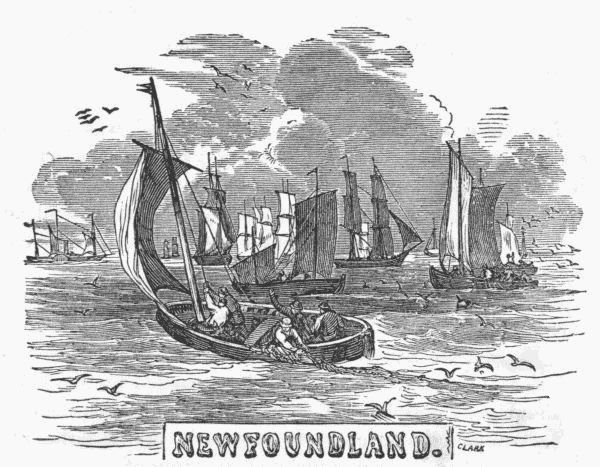
Location and Importance.—Newfoundland is an island on the eastern coast of North America, extending farther out into the Atlantic than any other point of the Western hemisphere. It is an important and large island, being about one thousand miles in circuit. Its consequence arises not from its internal resources, but from its position and its connection with the cod-fisheries in its vicinity. In this, its commercial aspect, it is the most valuable of all the English northern possessions.
The celebrated bank, which constitutes the fishing-ground, is estimated to extend six hundred miles in length and two hundred in breadth, composed almost throughout of masses of solid rock. The abundance of fish is literally inexhaustible, no diminution of fruitfulness being observed, although Europe and America have drawn upon this treasure, to any extent, for several centuries. The vast masses of ice, which float down from the northern seas into the neighborhood of this island, bring also with them a valuable article of commerce, viz: herds of seal, which the seamen contrive to take, and which furnish a rich store of oil for export.
Discovery and Settlement.—Newfoundland was discovered, in 1497, by Cabot, and has always been claimed by Britain. Attention was drawn to its fisheries before 1517; since, as early as that time, it was stated by the crew of an English ship, that they had left forty vessels, of different European nations, engaged in the fishery.
Several partial attempts were made at settling the country, from 1536 to 1612; but it was only at the latter date that we find the first attempt made on a large scale to colonize the territory. It was chiefly promoted by Mr. Guy, an intelligent merchant of Bristol, who induced a number of influential men at court to engage in the undertaking. In 1610, he having been appointed governor of the intended colony, conveyed thither thirty-nine persons, who constructed a dwelling and store-house, and formed there the first permanent settlement.
For several years, however, the spirit of settlement languished. It was not until 1621 that it began to revive under the auspices of Sir George Calvert, afterwards Lord Baltimore, who obtained a grant of a considerable tract on a part of the island. He had in view the establishment of a Catholic colony, who might enjoy there the free exercise of their religion. About twenty years after his first plantation, there were estimated to be about three hundred and fifty families on different parts of the coast. The fishery, at the same time, grew rapidly into importance.
In 1660, the French, who had previously become active rivals of the British in the fishery, formed a settlement in the Bay of Placentia, which they occupied for a long period.
Through some jealousy, excited by those who favored the deep-sea or whale-fishery, in opposition to the boat-fishery at Newfoundland, serious attempts were made at one time, by the government at home, to break up all the settlements on the island, and reduce the land to a desert. This cruel and suicidal policy could, however, be effected but in part, and some years afterwards more just views began to be entertained on the subject, and some emigrations even were made again!
French Hostilities.—During the war with France, which broke out in consequence of the revolution of 1688, the settlements in Newfoundland endured great vicissitudes. The latter had, by favor or oversight, been allowed full freedom of fishing, and even formed several settlements. They evidently showed an intention of gaining possession of the whole island. With a view to effect their object, the works at Placentia were attacked in 1692, and partly destroyed; but, in 1696, the French, rëinforced by a squadron from Europe, attacked St. John, yet without success. The place, however, suffered severely, and another armament, before the end of the year, gaining possession of it, set it on fire. Upon this, Ibberville, with a body of troops, destroyed all the English stations, except Bonavista and Carbonier. An English fleet, sent out to retrieve these disasters, failed through the misconduct of the commander. The difficulties were terminated in 1698, by the peace of Ryswick, which placed every thing on the same footing as before the contest.
Renewal of War.—The war of the succession exposed the colony again to the attacks of the French, who were favored by local situation in their proceedings at Newfoundland. The English, at first, took some of the smaller settlements; but in 1705, the troops in Placentia, rëinforced by five hundred men from Canada, successfully attacked the British colonists. Three years afterwards, St. John was completely destroyed, and the French became masters of every English station, except Carbonier. A subsequent attempt of the British to recover their possessions, was not without effect; but their splendid successes in Europe enabled them at the treaty of Utrecht, in 1713, to do more than redeem all their losses in America. Louis XIV. was compelled to yield up all his possessions on the coast of Newfoundland; but he retained, for his subjects, the right to erect huts and stages for fishing on particular portions of the coast.
Changes of Administration.—The nominal dependence of Newfoundland on Nova Scotia, was withdrawn in 1779. From this period until 1827, the government of the island was administered by naval commanders, appointed to cruise on the fishing station, but who returned to England during the winter. Since the last-named period, the government has been administered by resident governors, and, in 1832, it was determined to grant the boon of a representative assembly. This was placed on an extremely liberal footing, the assembly being elected by a suffrage nearly universal.
Present Condition.—The chief British settlements are on the large peninsula named Avalon, constituting the south-eastern part of the island, St. John, the capital, is very convenient for ships coming either from Europe or America, and particularly for the deep-sea and seal-fisheries. After all its improvements, it still bears the aspect of a fishing station, consisting of one long and narrow street, extending entirely along the sea.