Part 1 — XII. TREACHERY OF ARNOLD.
Reading edition
The Vulture in the Hudson—Midnight Adventure—Benedict Arnold—Repairs to Cambridge—Expedition to Canada—Created a Brigadier-general—Grounds of Complaint—Honorable Conduct in Connecticut—Appointed to the command at Philadelphia—Charges preferred against him—Reprimanded by Washington—Plots against his Country—Correspondence with Sir H. Clinton—Appointed to the command of West Point—Interview with Andre—Capture of Andre—Arrival of Washington—Escape of Arnold—Developments of Arnold's traitorous intentions—Trial and Condemnation of Andre—Subsequent incidents in the life of Arnold.
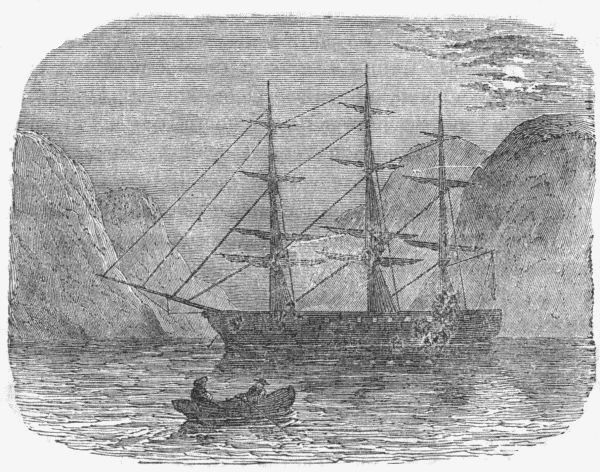
The Vulture.
On the night of the 21st of September, 1780, there was lying at anchor on the Hudson, a few miles below West Point, a British sloop-of-war, called the Vulture. A little before midnight, a boat, with muffled oars, and rowed by two men, put off from the American shore, and proceeded with great caution towards the sloop. In the stern of the boat sat a third man, of more consequence than the oarsmen, and the leader of the secret expedition. It was a tranquil night; the stars peered out with unwonted lustre, and the waters moved slowly down the channel. What object was proposed by this cautious midnight adventure? Was intelligence sought from the enemy, or was it to be imparted to them? Was it a patriotic or a traitorous expedition?—The sequel will tell.
Among the brave and chivalrous men who early engaged in the defence of American rights, was Benedict Arnold. On the occurrence of the battle of Lexington, he was residing at New Haven, and was commandant of a company of militia, called the Governor's Guards.
On the arrival of the news of the above battle at New Haven, citizens and soldiers, as if moved by a common impulse, assembled on the green. Fired with indignation, as were others, Arnold proposed to head such as would volunteer under him, and lead them to the more immediate scene of action.
Such was the dispatch of preparation, that the following day, at the head of sixty volunteers, he was ready to march.
After reaching Cambridge, for a time Arnold was employed in an expedition against Ticonderoga. About the time of his return, congress was contemplating a still more important and hazardous movement against Canada, under General Schuyler. Believing that essential aid might be rendered by the way of the Kennebec river, a detachment of troops was made at Cambridge, the command of which was tendered to Arnold.
The troops detached for this service amounted to eleven hundred men—ten companies of musket-men from New England, and three companies of rifle-men from Virginia and Pennsylvania. The field officers were Colonel Arnold, Lieutenant-colonels Greene and Enos, and Majors Bigelow and Meigs. The afterwards-celebrated Daniel Morgan commanded the riflemen. On the 18th of September, the troops sailed from Newburyport, and rendezvoused at Fort Western, on the Kennebec, opposite the present town of Augusta.
From this point they started, and their hardships and trials began. No body of troops during the Revolutionary war, if indeed in the annals of warfare, encountered greater obstacles, or endured more suffering, than this. The distance traversed was about two hundred miles, and nearly the whole of it was a howling wilderness.
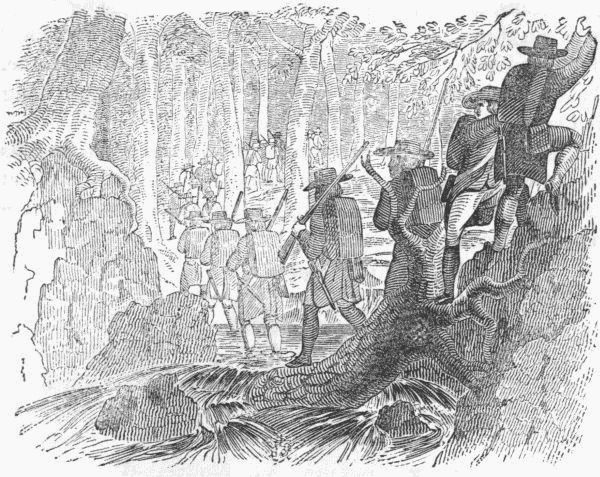
Arnold's Expedition through the Wilderness.
On the night of the 14th, Arnold with his men crossed the St. Lawrence; and, ascending the same abrupt precipice which Wolfe had climbed before him, formed his small corps on the heights, near the memorable Plains of Abraham. But he soon discovered that neither the number nor condition of his men would justify him in hazarding an action. Having spent a few days on the heights, and summoned the town to surrender, without even a response, he retired twenty miles above Quebec, to wait the arrival of the troops which were to proceed by the western route, which were now led by General Montgomery, who had succeeded General Schuyler, in consequence of the illness of the latter.
On the 1st of December, Montgomery joined Arnold; and on the morning of the 31st occurred the memorable assault upon Quebec, in which the gallant and lamented Montgomery fell. Arnold, not less bold and intrepid, had his leg-bone severely fractured, and was obliged to be carried from the ground. The issue was disastrous to the Americans, as is well known; about sixty being killed, and between three and four hundred taken prisoners. Notwithstanding his wound and the serious diminution of his force, Arnold maintained a blockade of the city during a long and severe Canadian winter.
As a reward for his persevering efforts in conducting his troops through the wilderness, and for his gallant conduct in the assault of Quebec, congress promoted Arnold to the rank of brigadier-general.
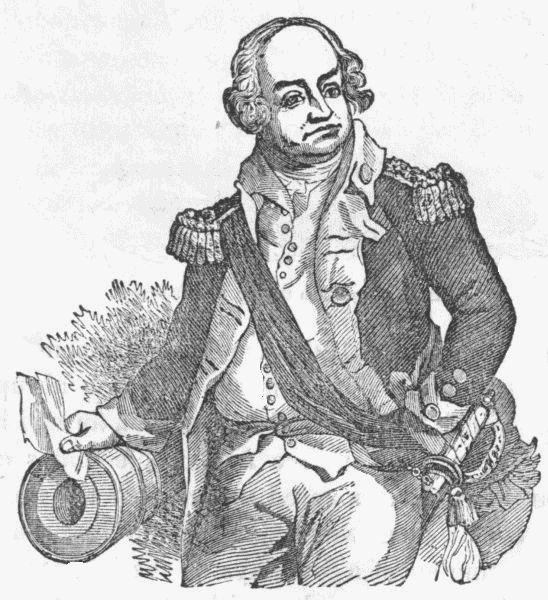
General Lincoln.
In February, 1777, congress appointed five additional major-generals. According to the usual practice in reference to promotions, Arnold would have been entitled to this honor; but those thus promoted were all his juniors, and one of them, General Lincoln, was taken from the militia. To a man like Arnold, ambitious of military glory, such a neglect could not be otherwise than deeply wounding. In anticipation of his mortified feelings, Washington addressed a kind and soothing letter to him, virtually expressing his disapproval of the course of procedure, and advising Arnold to demean himself with the magnanimity of a soldier, in the hope that justice would still be done him, and others, who were similarly neglected.
Meanwhile, Washington addressed to friends in congress a letter of inquiry on the subject. To this it was replied, that as each state claimed a number of general officers, proportioned to the troops it furnished, and as Connecticut already had two, there existed no vacancy for another. There was at least plausibility in the reason, but it seems not to have satisfied Washington; much less could it be expected to satisfy so sensitive and ambitious a man as Arnold. This disappointment was probably among the causes which soured the mind of the latter, and laid the foundation of those corrodings of the heart, which in after-times led to the utter ruin of his reputation, and came near effecting the ruin of his country.
But this was by no means the only ground of Arnold's complaint. Construing the neglect of congress as an implied censure of his military conduct in past times—and perhaps the inference was not entirely without foundation—Arnold resolved to demand of congress an examination into his conduct. With this object in view, he proceeded to head-quarters, to solicit of Washington permission to proceed to Philadelphia.
Just at the time he was passing through Connecticut, a British force, consisting of two thousand troops, under the infamous General Tryon, had landed at Compo, between Fairfield and Norwalk, for the purpose of penetrating to Danbury, to destroy some public stores, which the Americans had lodged there.
Arnold heard of this invasion; and, for the time, honorably foregoing the object of his journey, and roused by that high military spirit which in no small degree characterized him, he immediately turned his course northward, for the purpose of aiding in repelling the foe.
A militia force of five hundred had been hastily collected by Generals Wooster and Silliman. These, together with about one hundred continental troops, Arnold overtook near Reading, on their march towards Danbury. At Bethel, information was obtained that the town had been fired, and the public stores destroyed. The next morning, the generals divided their forces—General Wooster, with two hundred men, falling in the rear of the enemy, while Arnold and Silliman, with five hundred (their original force having been augmented), by a rapid movement, took post in their front at Ridgefield.
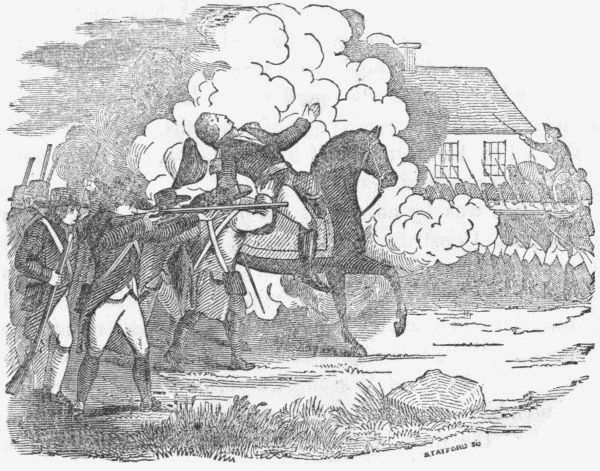
Death of General Wooster.
About eleven o'clock, General Wooster overtook the enemy, and attacked them with great gallantry. Riding to the front of his troops, with a design of inspiring them with appropriate courage, he cried: "Come on, my boys! never mind such random shot." But scarcely had he uttered the words, when a fatal ball pierced his side, and this gallant general fell.
Meanwhile, Arnold having reached the north part of the long street at Ridgefield, barricaded the road with carts, logs, hay, and earth, presenting a formidable obstruction to the approaching enemy, and no mean protection to the resisting force.
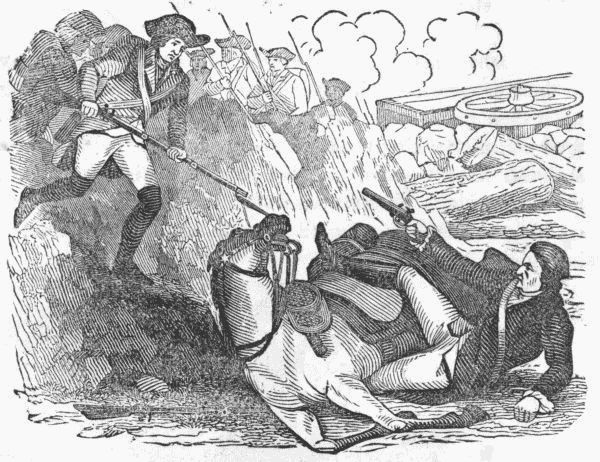
Arnold and the British Soldier.
"At three o'clock the enemy appeared, marching in a solid column, and they commenced a heavy fire as they advanced towards the breastwork: it was briskly returned. For nearly a quarter of an hour, the action was warm, and the Americans maintained their ground, by the aid of their barricade, against four times their number, until the British column began to extend itself, and to stretch around their flanks. This was a signal for retreat. Arnold was the last man that remained behind. While alone in this situation, a platoon of British troops, who had clambered up the rocks on the left flank, discharged their muskets at him. His horse dropped lifeless; and when it was perceived that the rider did not fall, one of the soldiers rushed forward with a fixed bayonet, intending to run him through. Arnold sat unmoved on his struggling horse, watched the soldier's approach till he was near enough to make sure his aim, then drew a pistol from his holsters, and shot him dead. Seizing this critical opportunity, he sprang upon his feet, and escaped unharmed. So remarkable an exhibition of cool and steady courage, in a moment of extreme danger, has rarely been witnessed.
"He rallied his men, and continued to annoy the enemy in their progress. Being rëinforced the next day, he hung upon their flanks and rear throughout the whole march to their ships, attacking them at every assailable point. In a skirmish near Compo, just before the British embarked, the horse which he rode was shot through the neck, and on all occasions he exposed himself with his accustomed intrepidity."
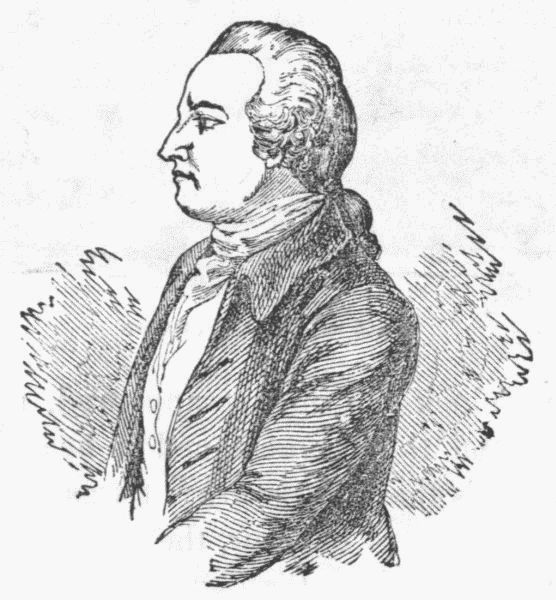
General Arnold.
The heroic conduct of Arnold—periling life as a volunteer, and while smarting under a sense of wrong—was duly appreciated wherever the exploit was told. Congress, sensible of the merit of the achievement, immediately promoted him to the rank of major-general; but instead of ante-dating his commission, that he might take rank with those who had been raised above him, they left him still subordinate to them. This was unfortunate, and even inconsistent. Arnold felt the neglect with still deeper sensibility, and saw in it, as he imagined, an undeniable proof that the charge of ingratitude which he had brought against his country was well founded.
At length, his complaints were referred to the Board of War, and the charges of his accusers were examined. The board reported that they were satisfied with the character and conduct of General Arnold. This report congress confirmed. Indeed, they went further, and presented him with a horse properly caparisoned, in token of their approbation of his gallant conduct in resisting the troops under General Tryon. Had they added to this an equality of rank with the generals who had been raised over him, Arnold would have been satisfied; but neglecting this—and the cause was doubtless to be ascribed to the personal influence of bitter enemies, who could not forget his arrogance and presumption—he was chagrined, rather than flattered, by the tokens of approbation he had received—and soured rather than pacified.
Added to this, Arnold was mortified and exasperated that his accounts were not fully and promptly allowed by a committee appointed to audit them. This they could not justly do without much qualification. They were numerous and large, many debts incurred were without authority, and vouchers were wanting. The consequence was a general suspicion that Arnold intended to enrich himself, or meet his private extravagant expenditures at the public expense.
Passing over several intervening events, especially the signal success of General Gates in resisting the progress of General Burgoyne, during which Arnold acted a part so heroic, as to be honored by Washington with one of the three sets of epaulettes and sword-knots which had been presented to him by a gentleman of France, we reach a signal event in the life of this remarkable man—his appointment by Washington, in consideration of his disabled condition, to the command of Philadelphia, following the evacuation of that city by the British. The station was honorable, and the duties, though delicate, were not severe.
Several circumstances, about this time, served to weaken his affections for the patriotic cause. One was the report of specific charges against him by a committee of congress, for acts oppressive and unworthy his rank and station, on which he was tried, and ordered to be reprimanded by the commander-in-chief.
In performing this duty, Washington exhibited as much mildness as the case permitted. "Our profession," said he, "is the chastest of all. The shadow of a fault tarnishes our most brilliant actions. The least inadvertence may cause us to lose that public favor, which is so hard to be gained. I reprimand you for having forgotten that, in proportion as you had rendered your name formidable to our enemies, you should have shown moderation towards our citizens. Exhibit again those splendid qualities which have placed you in the rank of our most distinguished generals. As far as it shall be in my power, I will myself furnish you with opportunities for regaining the esteem which you have formerly enjoyed."
The decision of the court, and the reprimand of Washington, mild and delicate as it was, fell heavy on the excitable spirit of Arnold. A burning revenge rankled in his bosom, and from this time—if his traitorous purposes had not before been formed—he sought opportunities to gratify his malice, and at the same time the sordid passion of avarice, which had long held sway in his bosom.
Another circumstance, besides contributing to his expenses, operated to separate his affections from the patriotic cause. He had married a beautiful and accomplished lady, during his residence in Philadelphia, a daughter of Mr. Edward Shippen, a family of distinguished rank; and which, like others of a similar stamp in that city, was intimate with Sir William Howe, Major Andre, and other British officers, during their occupation of Philadelphia. This alliance brought Arnold, as a matter of course, into associations with persons who were attached to the royal cause, and who were ready to foster his prejudices, and justify his complaints of ingratitude and persecution.
At length, he matured a plan—confined for a time to his own bosom—dark, base, and traitorous—as it were the offspring of the nether world.
To the accomplishment of this plan, it was necessary that he should be appointed to the command of West Point, a fortress on the Hudson. With consummate art, he accomplished his purpose; and, at the hands of Washington, to whom he had been indebted more than to any other, for standing by him as a shelter during his stormy life, he received the appointment; soon after which, he repaired to the Highlands, and established his head-quarters at Robinson's house, two or three miles below West Point, on the opposite, or eastern bank of the river.
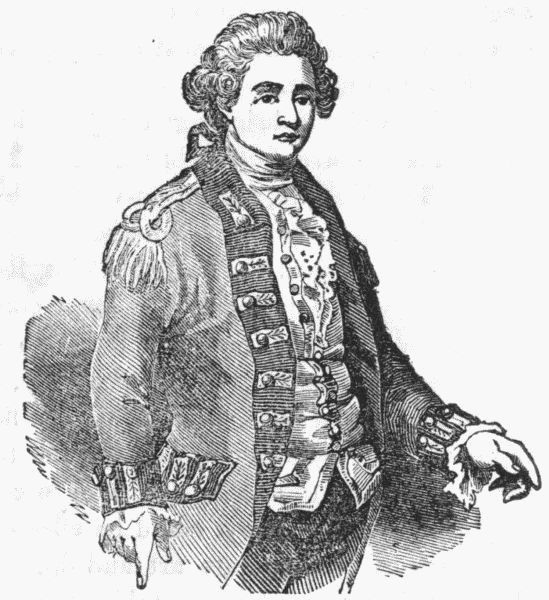
Major Andre.
Previous to her marriage, Mrs. Arnold had been acquainted with Major Andre, and had corresponded with him after that event, and after his removal with the British forces to New York. Acquainted with this correspondence, Arnold took the opportunity presented by it to address, unknown to his wife, letters to Sir Henry Clinton, through Andre, under the signature of Gustavus, and Andre replied under the assumed name of John Anderson. This correspondence had been carried on for months before Arnold's appointment to West Point. For a time, Clinton was at a loss to imagine the real character behind the curtain; but, at length, he became convinced that it could be no other than Arnold himself. Hitherto, that general had treated Gustavus with cautious indifference, but no sooner was Arnold promoted to the command of West Point, than Clinton was ready to enter into negotiation with him to surrender that fortress into the hands of the British, and almost at any price which Arnold might choose to name.
The first plan devised for bringing about an interview between Arnold and Andre failed, but a second proved more successful. The Vulture, a sloop-of-war, with Colonel Robinson on board, came up the river about the 16th of September. On their arrival at Teller's Point, Robinson, who was a tory, and whose property had been confiscated by the state of New York, addressed a letter to General Putnam, relating to the recovery of his property, and forwarded it under cover of a letter to Arnold by a flag-boat. Putnam was known not to be in that quarter, but the letter to him served as a pretext to enable Robinson to communicate a plan, by which an interview could be effected.
Arnold, by means of consummate art and duplicity, had engaged a Mr. Smith, a man of respectable standing, to go on board the Vulture, and convey a gentleman there to the American shore, who would impart intelligence to him of the greatest importance to the American cause. Smith had been employed in procuring intelligence from time to time from New York for Arnold's predecessor at West Point, and at length consented to perform the service solicited by Arnold; and, that his family might not be privy to the transaction, they were removed to Fishkill, under pretence of a visit to some friends.
Thus matters were arranged; and on the night of the 21st, Smith, with two oarsmen, bribed to secresy by the promise of fifty pounds each, left the American shore, and proceeded, as related in the commencement of this account, to the Vulture.
Andre was expecting Arnold himself. Not finding him on board, but receiving a letter putting him on his guard, and inviting him to return in the boat, for a time he hesitated. Robinson was still firmer in the opinion that he should not go. But, at length, the adventurous spirit of Andre decided the point; and having cautiously concealed his uniform in a great-coat, he stepped on board the boat, which immediately proceeded towards the American shore. They landed at the foot of a mountain, called Long Clove, about six miles below Stony Point.
Arnold was in the bushes, ready to receive the stranger. Smith had expected to be present at the interview, and was not only disappointed, but exasperated, in being refused. What a spot! what a conference! what a deep and traitorous planning in midnight darkness!
The interview was long, and the patience of Smith was exhausted, but more his fears were roused. The night was far spent, and the dawning of the day was at hand. He now made known his apprehensions to the midnight traitors; but as they had not perfected their business, Smith and his oarsmen were allowed to retire.
No sooner were they gone, than Arnold proposed that Andre should proceed with him to Smith's house, and leave the manner of his return to future deliberation. This plan was replete with hazard; but no alternative presenting itself, Andre reluctantly followed. Judge his surprise, when, on approaching the American lines, a sentinel hailed them, and demanded the countersign. Andre shuddered. Arnold gave the sign, and they passed on. Andre was now, contrary to all his determinations, within the American lines, on dangerous ground, where his life and fortunes hung, as it were, upon the cast of a die.
Arnold and Andre reached Smith's about the dawn of day. Soon after, the latter made his appearance. An incident now occurred, which added to the anxiety of Andre. The sound of cannon broke upon them, which, on proceeding to a window overlooking the river, was ascertained to be from the American shore; and from the movements of the Vulture soon after down the stream, it was inferred that the fire was against her. So it proved. Believing her to lie in the river for no good purpose, Colonel Livingston had directed a fire to be opened upon her, which caused the movement observed. Andre now felt the delicacy of his situation still more, and the difficulty of his return to the sloop to be still greater.
But the duties of his mission required attention, and to its completion the plotters betook themselves. It was finally settled. The British, on a given day, were to dispatch a fleet up the river with the requisite troops: and Arnold, in order to render the seizure of the fortress easy, was previously to withdraw the garrison, and station them at different points in the neighborhood, in small detachments. In consideration of the surrender, the traitor was to receive a large amount of "British gold."
Having completed these nefarious negotiations, the manner in which Andre should return, next engrossed their deliberations. This was a question of difficult solution. Andre insisted on being put on board the Vulture; Smith was unwilling to run the hazard. Before the question was decided, Arnold left for West Point, giving to Andre passports accommodated to the manner in which it might finally be decided that he should return.
Andre spent the day in an upper room at Smith's—a long and anxious day. Towards its close, he urged Smith to take him on board the Vulture; but to his surprise and distress, the former peremptorily refused, but offered to accompany him on horseback to some point of safety. No other alternative presenting itself, Andre consented; and, having changed his military coat for a citizen's dress, over which throwing his great-coat, they departed.
Between eight and nine o'clock, they were startled by the hail of a sentinel, who ordered them to stop. "Who commands here?" inquired Smith, dismounting, and approaching the sentinel. The commander, Captain Boyd, being himself within hearing distance, approached, and demanded who the stranger was, and whither bound. Smith, ignorant of the real character of Andre, answered as Arnold had dictated; and, moreover, added that he had a pass from the general. Boyd required a sight of the pass, on perusing which, his curiosity was still more excited, and he now in private questioned Smith with still greater particularity. Smith explained the matter as well as he was able; and, by several adroit fabrications, finally induced Boyd to consent to their continuing their journey; not, however, until morning, for fear, as he pretended, they might be waylaid by the Cow-boys.[50] Andre would have purchased a release from tarrying in the neighborhood that night at any price, had he had the means; but such an overture would have been fraught with danger, and therefore, bending to necessity, they repaired to one Miller's, where they passed the night—a night of dread and fearful anticipation.
At early dawn, in order to escape the further scrutiny of Boyd, they were on their journey. At the distance of about a couple of miles from Pine's bridge, they halted, took breakfast, and separated—Smith setting out on his return, and Andre continuing his journey. Andre had now nearly thirty miles to traverse ere he was on safe ground. He had been recommended to proceed by the way of White Plains; but, on crossing the above bridge, deeming the Tarrytown road more safe, he took that, and for a time passed on without molestation.
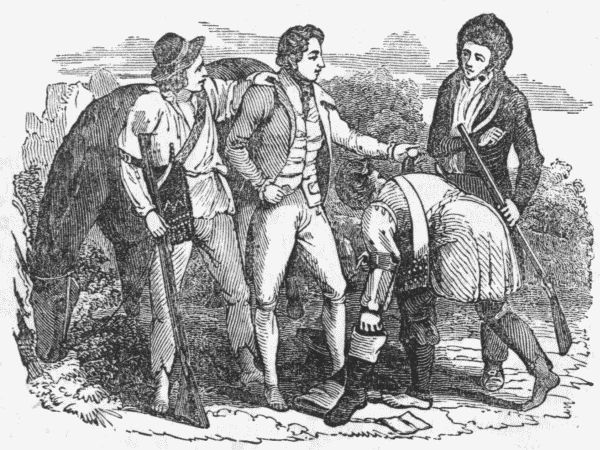
Two plundering parties were abroad that morning from the "neutral ground;" one of which, consisting of John Paulding, Daniel Williams, and Isaac Van Wart, had concealed themselves in some bushes near the road which Andre was passing, watching there for some valuable prey.
Andre approached the spot; upon which, Paulding rose, and presenting his firelock to his breast, bid him stand. "Gentlemen," said Andre, "I hope you belong to our party." "I asked him"—we follow the testimony of Paulding on the trial of Smith—"what party? He said, 'The lower party.' Upon that I told him I did. Then he said, 'I am a British officer out of the country on particular business, and I hope you will not detain me a minute;' and to show that he was a British officer, he pulled out his watch. Upon which, I told him to dismount. He then said, 'My God! I must do any thing to get along;' and seemed to make a kind of laugh of it, and pulled out General Arnold's pass, which was to John Anderson, to pass all guards to White Plains and below. Upon that, he dismounted. Said he, 'Gentlemen, you had better let me go, or you will bring yourselves into trouble, for your stopping me will detain the general's business;' and said he was going to Dobb's ferry, to meet a person there, and get intelligence for General Arnold. Upon that, I told him I hoped he would not be offended, that we did not mean to take any thing from him; and I told him there were many bad people who were going along the road, and I did not know but perhaps he might be one."
Williams testified as follows: "We took him into the bushes, and ordered him to pull off his clothes, which he did; but on searching him narrowly, we could not find any sort of writings. We told him to pull off his boots, which he seemed to be indifferent about; but we got one boot off, and searched in that boot, and could find nothing. But we found there were some papers in the bottom of his stocking next to his foot; on which we made him pull his stocking off, and found three papers wrapped up. Mr. Paulding looked at the contents, and said he was a spy. We then made him pull off his other boot, and there we found three more papers at the bottom of his foot within his stocking."
After consultation, it was decided to take the prisoner to North Castle, where Lieutenant-colonel Jameson commanded a detachment of dragoons. Having surrendered him to Jameson, the latter for a time hesitated what disposition to make of him. The papers found upon Andre were important—in the hand-writing of Arnold, and endorsed by him.
Most men would have suspected treason—nor would Arnold himself have escaped suspicion. Yet Jameson, at length, decided to forward the papers to Washington by express, and the prisoner to Arnold. These measures had been taken, when Major Talmadge, next in command to Jameson, returned from an excursion to White Plains. On learning the incidents of the day, he expressed his surprise, and begged Jameson to dispatch a counter-order, if possible, to bring back the prisoner and the papers.
To the foregoing, Jameson finally consented, but the papers were left to be conveyed to Washington. Andre was overtaken and brought back. Talmadge, being a sagacious observer, marked Andre—his walk—his military air—his dignified bearing—and decided that the prisoner was no ordinary man. Shortly after, under escort of Talmadge, Andre was removed to Lower Salem, to await the developments of time and the orders of Washington.
The morning after their arrival at Salem, Andre requested paper and ink, and soon presented to Talmadge an open letter addressed to Washington, with a request that he would himself read and forward it.
This letter, couched in most respectful language, communicated to Washington his name, and rank in the British army, and his object in coming within the American lines.
It so happened—a wonderful interposition of Divine Providence, who can doubt?—it so happened, that on the very day that Andre wrote his letter, Washington, on his return from Hartford, arrived at Fishkill, eighteen miles from Arnold's head-quarters. Contrary to his previous intentions, he was induced to remain there during the night. In the morning, an express was dispatched early to give notice to General Arnold, that the party would reach his quarters to breakfast.
Washington and his suite followed soon after, and on coming to the road which led off to Robinson's house—Arnold's residence—Washington was proceeding towards the river. Being informed of his mistake, he observed that as he must inspect the redoubts on this side the river, he himself would forego Mrs. Arnold's breakfast, but his suite might pass on, and enjoy it. They would not, however, leave their general; and all, excepting his aids, who were sent forward to make his excuse, proceeded towards the river.
On learning that General Washington would not be there to breakfast, General Arnold and family, with the aids, proceeded to the breakfast-table.
That was the last peaceful meal Arnold was to enjoy in this world—and even the peace of that was invaded, before they were ready to leave the table. A messenger entered with a letter from Jameson—the letter which first announced the capture of Andre.
It fell as a thunderbolt upon the traitor. Yet he so far concealed his agitation before the aids, as to prevent serious suspicion that any thing uncommon had occurred. A sudden emergency called him to West Point, he said, and he begged to be excused. Having ordered a horse, he requested Mrs. Arnold's presence in her chamber, and here in few words informed her of the necessity of his fleeing for his life. He left her fainting on the floor; and, mounting, put spurs to his horse, directing his course to the river, on reaching which, he entered a boat, and fabricating a story to his purpose, ordered the men to proceed to the Vulture. The promise of reward gave impulse to their energies, and Arnold was soon safely on board of the royal sloop.
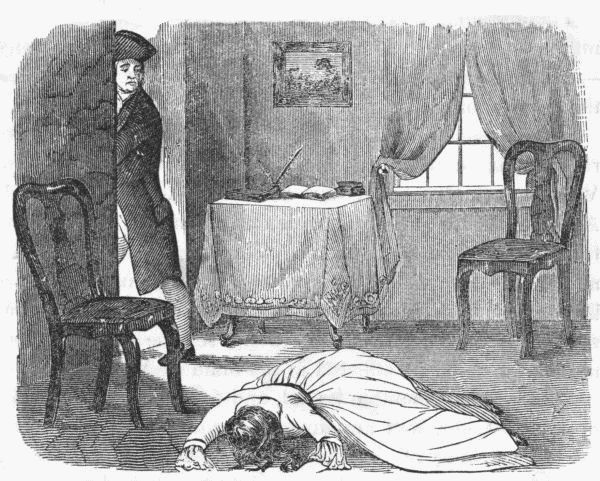
Interview of Arnold and his Wife.
Washington having completed his inspection of the redoubts, reached Arnold's soon after his departure. Understanding that he had gone to West Point, after a hasty breakfast, Washington and suite followed. But what was his surprise to learn that Arnold had not been there. After a cursory view of the fortress, the party returned to Arnold's. Meanwhile, the messenger from Colonel Jameson, with Andre's papers, had arrived.
Light was now shed upon the mystery. Arnold was a traitor, and had fled to the enemy. Measures were immediately taken to secure the fortress. An express was dispatched to Salem, with orders to have Andre conveyed to Arnold's house.
Let us hasten to the conclusion. On the 29th of September, Washington ordered a Board of Inquiry, consisting of six major and eight brigadier generals. After a full hearing of the facts, the Board reported that Major Andre ought to be considered as a spy, and, according to the laws and usages of nations, to suffer death.
The decision, though just, was painful—painful to Washington—to the Board—to the officers of the American army—but more painful, if possible, to Sir Henry Clinton and the companions of Andre in arms.
Efforts, and such as did honor to Clinton, were made to reverse the doom of Andre. Intimations were given from Washington, that upon one condition—the surrender of Arnold—Andre might be released; but to this, Clinton thought he could not in honor yield—while in the scale of affection, Andre would have outweighed a thousand traitors like Arnold. A deputation from Clinton repaired to Robinson's house under a flag, to urge the release of Andre, but no change could be effected in the mind of Washington.
Sentence of execution issued, and five o'clock, of the 1st day of October, was appointed for carrying it into effect. On the morning of that day, Andre addressed a letter to Washington, requesting that he might be allowed a soldier's death.
"Tappan, 1st October, 1780.
"Sir: Buoyed above the terror of death, by the consciousness of a life devoted to honorable pursuits, and stained with no action that can give me remorse, I trust that the request I make to your excellency, at this serious period, and which is to soften my last moments, will not be rejected.
"Sympathy towards a soldier will surely induce your excellency, and a military tribunal, to adapt the mode of my death to the feelings of a man of honor.
"Let me hope, sir, that if aught in my character impresses you with esteem towards me—if aught in my misfortune marks me as the victim of policy, and not of resentment—I shall experience the operations of those feelings in your breast, by being informed that I am not to die on a gibbet.
"I have the honor to be your excellency's most obedient and most humble servant,
"John Andre."
To this request, Washington could not consistently accede, but to avoid needless pain, he omitted to make a reply.
The execution finally took place October 2d, at twelve o'clock—a delay having been occasioned by pending negotiations, which could not be terminated in season the previous day.
Dr. Thatcher, in his 'Military Journal,' has given the closing particulars of this tragic scene. It follows:
"The principal guard-officer, who was constantly in the room with the prisoner, relates, that when the hour of his execution was announced to him in the morning, he received it without emotion; and while all present were affected with silent gloom, he retained a firm countenance, with calmness and composure of mind. Observing his servant enter the room in tears, he exclaimed, 'Leave me till you can show yourself more manly.' His breakfast being sent to him from the table of General Washington, which had been done every day of his confinement, he partook of it as usual; and having shaved and dressed himself, he placed his hat on the table, and cheerfully said to the guard-officers, 'I am ready at any moment, gentlemen, to wait on you.' The fatal hour having arrived, a large detachment of troops was paraded, and an immense concourse of people assembled; almost all our general and field officers, excepting his excellency and his staff, were present on horseback; melancholy and gloom pervaded all ranks; the scene was affecting and awful.
"I was so near during the solemn march to the fatal spot, as to observe every movement, and participate in every emotion which the melancholy scene was calculated to produce. Major Andre walked from the stone house, in which he had been confined, between two of our subaltern officers, arm in arm; the eyes of the immense multitude were fixed on him, who, rising superior to the fear of death, appeared as if conscious of the dignified deportment which he displayed. He betrayed no want of fortitude, but retained a complacent smile on his countenance, and politely bowed to several gentlemen whom he knew, which was respectfully returned. It was his earnest desire to be shot, as being the mode of death most conformable to the feelings of a military man, and he had indulged the hope that his request would be granted. At the moment, therefore, when suddenly he came in view of the gallows, he involuntarily started backward, and made a pause. 'Why this emotion, sir?' said an officer by his side. Instantly recovering his composure, he said, 'I am reconciled to my death, but I detest the mode.'
"While waiting, and standing near the gallows, I observed some degree of trepidation; placing his foot on a stone, and rolling it over, and choking in his throat, as if attempting to swallow. So soon, however, as he perceived that things were in readiness, he stepped quickly into the wagon, and at this moment he appeared to shrink; but instantly elevating his head with firmness, he said, 'It will be but a momentary pang;' and taking from his pocket two white handkerchiefs, the provost-marshal with one loosely pinioned his arms, and with the other, the victim, after taking off his hat and stock, bandaged his own eyes with perfect firmness, which melted the hearts, and moistened the cheeks, not only of his servant, but of the throng of spectators. The rope being appended to the gallows, he slipped the noose over his head, and adjusted it to his neck, without the assistance of the executioner. Colonel Scammell now informed him that he had opportunity to speak, if he desired it. He raised the handkerchief from his eyes, and said: 'I pray you to bear me witness, that I meet my fate like a brave man.' The wagon being now removed from under him, he was suspended, and instantly expired."
Thus was cut off in the morning of life a man full of promise and expectation—one to whose personal attractions were added accomplishments, rich, varied, and brilliant—destined, but for an untimely sacrifice of himself, under the impulse of a forbidden ambition, to have reached the goal of his wishes—honor and renown. His death at the hands of the Americans, according to the usage of war, was just; but to Arnold, the pioneer in the base transaction, the news of his execution must, it would seem, have been as the bitterness of death.
But no:—Arnold had no such feelings. Conscience was seared; the generous sympathies of our nature were extinct; even the honor of a soldier, dearer to him than life itself, had expired. The long-cherished, deep-rooted, sordid passion of his soul—avarice—alone lived; and now, while Andre, who might almost be said to be the victim of that nether spirit, was mouldering in an untimely and dishonored grave, he demanded his pay. What must Clinton—the friend and patron of the high-souled and magnanimous Andre—have felt when he told out to Arnold six thousand three hundred and fifteen pounds, as the reward of his treachery!
In addition to this pecuniary reward, Arnold received the commission of brigadier-general in the British army. But, after his infamous attack on New London, and his inhuman conduct to the brave Ledyard and his garrison in Fort Trumbull, finding himself neglected by the British officers, he obtained permission to retire to England, for which he sailed in 1781 with his family.
The life of Arnold was prolonged twenty years beyond this date. But although the king and a few others in office felt compelled to notice him for a time, yet they, at length, were willing to forget him, while others despised and shunned him. Colonel Gardiner says, that when a petition for a bill authorizing a negotiation of peace was presented to the king, Arnold was standing near the throne. Lauderdale is reported to have declared, on his return to the House of Commons, that, however gracious the language he had heard from the throne, his indignation could not but be highly excited at beholding, as he had done, his majesty supported by a traitor. And on another occasion, Lord Surrey, rising to speak in the House of Commons, and perceiving Arnold in the gallery, immediately sat down, exclaiming: "I will not speak while that man (pointing to him) is in the house."
Not long after the war, Arnold removed to St. John's, in New Brunswick, where he engaged for a time in the West India trade. Subsequently, he returned to England, where he resided to the time of his death, which occurred in London, June 14th, 1804.