Part 1 — IV. PERU.
Reading edition
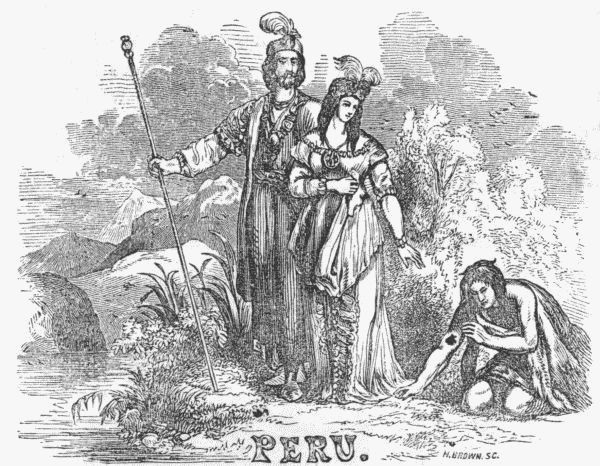
Manco Capac and his Wife appearing on the borders of Lake Titiaca.
Locality, Extent, and Physical Character—Condition at the time of its Invasion by the Spaniards—Conquest by Pizarro—Condition of the Country after the Conquest—Insurrection—Revolutionary Movement—Declaration of Independence—Condition of the Country after the Expulsion of the Spaniards.
Locality, Extent, &c.—Peru lies south of Equator along the western shore of the continent, nearly central between the isthmus and the Straits of Magellan, having an area of five hundred thousand square miles, and a population of one million eight hundred thousand. The country is traversed by several chains of the Andes, from north to south, the principal chain lying nearly parallel to the coast. There exists a great variety as to the surface, soil, and climate of Peru, portions of the country being sterile, with no rains, and only dews; and others very fertile, abounding in impenetrable forests of gigantic trees, and producing the rich fruits and vegetables of tropical regions. The traveler, according to his elevation, meets here with eternal snows or perpetual summer, or the most excessive and deadly heat. The gold and silver wealth of Peru has a world-wide celebrity. The silver mines of Potosi are perhaps the richest known, unless the recent golden treasures of California shall be found to exceed them. Like the latter, the former were first made known by accident. An Indian, by the name of Hualpa, one day following some wild animals up the mountain, laid hold of a shrub or tree to aid his ascent; which, giving way, revealed a mass of silver ore, which lay so near the surface as to cling to the roots. For some time Hualpa kept his discovery a secret, but his rapid increase of wealth attracting the notice of a countryman, he revealed it to him. The friends, however, soon quarreled; upon which, the secret was divulged.
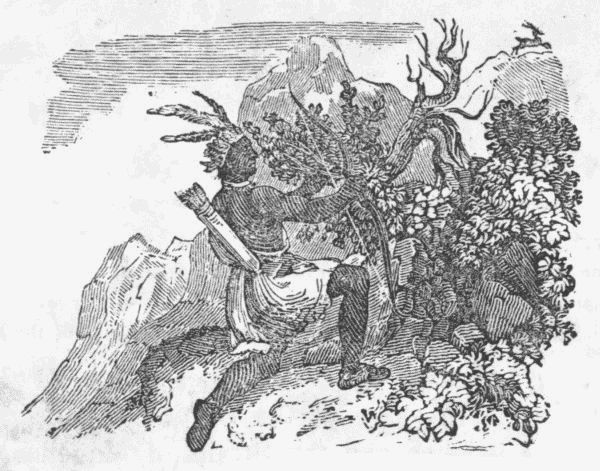
Hualpa discovers the Mine of Potosi.
Condition at the time of its Invasion by the Spaniards.—"Peru was one of the two monarchies of America which, at the invasion of the Spaniards, had attained to a degree of refinement far above that savage state in which most of the American Indians lived. It was also remarkable from the contrast of the character of its civilization to that of the Mexicans. Instead of the fierce and lofty spirit, the bloody wars, the uncouth deities, and ferocious rites of the latter, the Peruvians were united in tranquil subjection to a mild superstition, which represented their Inca as the child of the sun, to whom unreserved submission was due. However fable may have been mixed with the truth in the tale of Manco Capac and his wife Mama Ocollo—who, according to the traditions of the country, founded the empire, first appearing among the people about the year 1100, claiming to be children of the sun—the story of the greatness of the Peruvian empire has nothing fabulous. It comprehended not only the vast region now called Peru, but the territory of Quito or Ecuador, which is covered with the monuments of the Incas. Order was established in this vast region; the land was carefully cultivated; the rivers were carefully employed in irrigating the soil; mountains were formed into terraces to receive the canals constructed for this purpose, and walls were built to prevent the water from escaping; so that large tracts, which have now relapsed into deserts, were rendered productive."
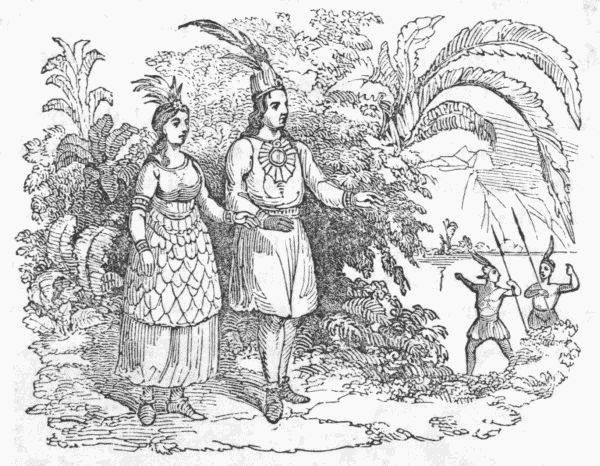
Manco Capac and his Wife first appearing to the Peruvians.
Conquest by Pizarro.—Francisco Pizarro, an uneducated Spaniard, is entitled to the renown, or the infamy, of bringing this rich country under the dominion of Spain, in the former part of the sixteenth century. The details are too numerous to be here given; but suffice it to say, that with two associates and about two hundred soldiers, he overran this splendid empire, and filled it with rapine and blood. The gentle and unsuspicious character of the natives rendered them an easy prey to the artifice, cupidity, and cruelty of these Spanish cut-throats. Pizarro's associates were Diego de Almagro, a soldier of fortune, and Fernando de Luques, a mercenary priest.
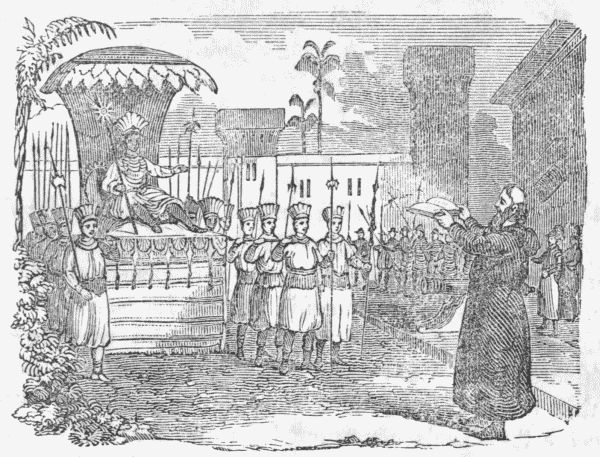
Valverde addressing Atahualpa.
Atahualpa, the Peruvian emperor, treated the strangers with great courtesy, and sent them several valuable presents—fruits, corn, emeralds, and vases of gold and silver. The sight of the gold and silver served to render the Spaniards more fierce, and prepare them for the cruel butcheries that followed. The following morning, Atahualpa, attended by fifteen thousand men, met Pizarro at a place previously appointed. He was borne on a throne of gold. As the procession approached Pizarro, a Dominican friar, by the name of Valverde, made a long address to the emperor, in which he endeavored to expound the Christian religion; following which, he proposed to him a submission to the king of Spain, on the ground that the pope had made a present to him of Peru.
To this, Atahualpa replied, that he was willing to be the friend of the king of Spain, but not his vassal. The pope he considered a very extraordinary personage to make a present of that which did not belong to him; and as to those whom the friar denominated Christians—"If," said he, "they worship a God who died upon a cross, I worship the Sun, who never dies." After further efforts at persuasion, Valverde became indignant, and called upon the Spaniards to vindicate their holy religion, and to wreak their just vengeance upon dogs who could thus trample upon the gospel. Upon this, a signal was given, and the work of butchery commenced in the emperor's own palace. Pizarro himself advanced towards Atahualpa, and took him prisoner, while all around the princes of the race of the Incas, the flower of the nobility, and other great men of the court, were indiscriminately put to the sword.
The cruelties that were inflicted, from this time forward, upon this unoffending people, and the riches amassed by these rapacious adventurers, so abhorred of God and men, are scarcely capable of enumeration, were it the object of this succinct account to speak of particulars. While their prince, being a prisoner, was condemned on some frivolous pretext, and strangled at the stake, they were made to expiate, by their death, the crime of owning a rich and beautiful country. Their great city of Cuzco was entered by Pizarro, in 1534, and plundered of its immense wealth. Indeed, the thirst of blood and plunder was every where exhibited in the progress of the Spaniards through the country. Had the latter shown any degree of moderation and humanity, they would probably have made themselves masters of the empire without further bloodshed than this commencement of the fearful tragedy. A people, by constitution and training so mild and submissive, would have yielded to the yoke without much reluctance. But the infinite variety of their calamities stirred up the people to revenge, and they found agents to give it, for a time, a degree of effect. But the Spaniards persevered in their efforts to overthrow the country; large numbers poured into it from abroad, and all resistance finally ceased. Those of the natives who were most attached to their liberty, to their government, and to their religion, took refuge at a distance among inaccessible mountains. The greater part of them, however, submitted to their conquerors.
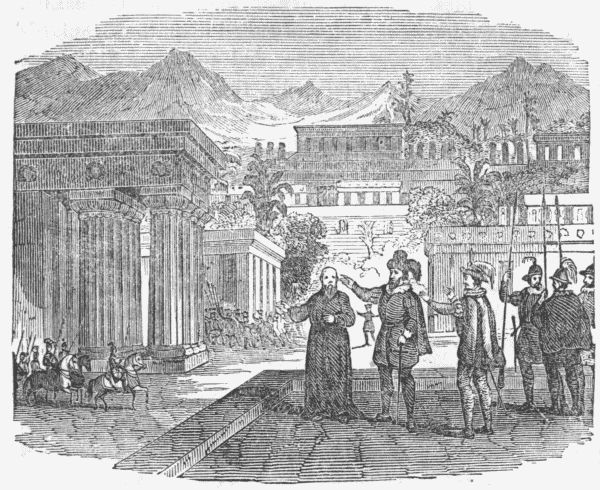
Pizarro in Cuzco.
The fate of these robbers was, at length, as deplorable as that of the subjects of their rapacity and cruelty. By various causes irritated and enraged against each other, the leaders fought among themselves, and the most revolting scenes of revenge and hatred were exhibited in the result. The original leaders of the enterprise were soon no more, and others followed in the same path of robbery, blood, and mutual jealousy and contention. These civil wars continued through a series of years. Fortunately for this part of the new world, the most seditious of the conquerors, and of those who followed in their steps, had perished in these wars. With their departure was connected a degree of tranquillity, and then only the Catholic kings might with truth style themselves the sovereigns of the Spaniards settled in Peru.
Condition of the Country after the Conquest.—The native Peruvians, after their subjugation, quietly submitted to the Spanish yoke for more than two centuries. They felt keenly, in many instances, the wrongs inflicted on them, but they had no power of resistance against a disciplined European force. They were loaded with insupportable burdens, yet it was useless to complain. The exactions of their conquerors were most unreasonable and cruel, and they passed their days in sorrow, groaning under the severest bondage. It would seem that all memory of their ancient independence, and the glories of the empire of Manco Capac, was lost from among them. Under their oppressions, their spirit and resolution appeared wholly to depart; but events proved that they were capable of being aroused—if by nothing better, at least by despair.
Insurrection in the latter part of the Eighteenth Century.—The sufferings of the natives became so extreme, that they wanted nothing but a leader to induce them to rise upon their oppressors, and attempt the overthrow of the Spanish power. Such a leader was found in Tupac Amaru, a descendant, on the mother's side, from an Inca of that name. He was well fitted, in many respects, to head an insurrection, having a commanding figure and intrepidity of spirit. He animated his countrymen to many heroic deeds, and, in the course of the rebellion, several successful battles were fought, and many Spaniards killed in the encounters, and many massacred in the progress of the Indian arms; but these were, on the whole, unsuccessful; their irregularities were, perhaps, more than retaliated by the Spaniards. Amaru was captured in the course of the war, and drawn into pieces by wild horses, as the punishment of his attempt to free his countrymen from oppression. Several other leaders were likewise taken, and shared the same cruel fate.
The principal leaders of the insurrection being no more, the great body of the Indian population quietly returned to vassalage, and bowed again under the galling yoke. Such was the issue of an attempt for freedom, which filled Peru with bloodshed and misery for the space of two years, and of a war, in which, it is asserted, one-third of the population of Peru perished by the hand of violence. It produced no permanent or important change in the condition of the Indians. They were rigidly prohibited the use of arms. The tribute pressed more heavily afterwards, and was more strictly levied, and that unfortunate people were treated more contemptuously, in revenge of their unsuccessful rebellion.
Revolutionary Movements in the early part of the Present Century.—Previously to the French invasion of Spain, and the confusion into which the mother-country was thrown by that event, and the consequent facilities and inducements which were furnished to the colonies in respect to their independence, an attempt had been made in Peru, having that object in view, as early as the year 1805. It was undertaken by Ubalde, an eminent jurist of Cuzco; but it proved to be a failure, and its author paid his life as the forfeiture of his rashness.
In 1809, a popular movement took place, and provisional juntas were established at Quito and La Paz. This revolutionary design, however, was at once defeated by the viceroys of Peru, Buenos Ayres, and New Grenada, whose armies dissolved the juntas. After this second abortive attempt, Peru remained tranquil for ten years, while the neighboring provinces were engaged in the war of their independence. At length, the people of Chili having defeated the Spanish army in the decisive battle of Maypu, in 1818, conceived the project of securing their independence by expelling the Spaniards from Peru. A naval armament and a land army both were fitted out for this object; the one in 1819, and the other in 1820. The naval force was commanded by Lord Cochrane, an English adventurer, and the land force was commanded by General San Martin.
Some obstacles were interposed to the immediate success of the undertaking; partly from negotiation, and partly from the insufficiency of the invading forces—the liberating army of San Martin being only about five thousand strong, and Cochrane being able only to blockade the Peruvian ports. The city of Lima appeared to be too powerful for an attack by the army of the general; but having, at length, resolved on the enterprise of advancing upon this city, the pusillanimity of the viceroy made way for a success which force might not have achieved. The viceroy fled, to secure his personal safety, while a deputation of citizens invited San Martin to enter the city as a liberator.
Declaration of Independence.—It was on the 12th of July, 1821, that San Martin made his entry into Lima, where he was received with acclamations, and, on the 28th, the independence of Peru was formally declared. San Martin took the title of Protector of Peru, with supreme power, both civil and military. A provisional government was organized, and measures were adopted to establish the affairs of the country on a permanent basis. But the new state of things was fluctuating. It was not until the 20th of September, 1822, that the first Peruvian congress convened. At this congress, an executive junta was appointed, of three persons, to administer the government. San Martin declined the office of commander-in-chief of the Peruvian armies, and returned to Chili.
From this period, there was little promise of stability for the new republic. Discontent and dissensions followed among the people, and every thing was thrown into confusion. It was not until the great liberator, Bolivar, had come among them, by invitation of a portion of the people, and after three sanguinary battles had with the royalist forces, that the Spanish power was prostrated in Peru. On the 10th of December, 1824, the Peruvian congress was again installed. Bolivar was then declared the political and military head of the republic, as he had been once before, and a gift of a million of dollars was tendered him for his services, which he saw fit to refuse. Lower Peru was thus liberated, and, as early as January, 1826, Upper Peru experienced the same deliverance, through the arms of the patriot General Sucre.
Condition of the Country after the Expulsion of the Spaniards.—Bolivar's influence was great, and a constitution of government was adopted, which harmonized with his views; but the people were still dissatisfied, and they seized an occasion, when Bolivar was absent in Columbia, of rising in insurrection, and effected a complete revolution in the beginning of the year 1827. A new form of government was adopted, combining the properties of a federal and a central system, with a president, chosen for four years, a national congress, and a separate provisional government.
The republic, however, did not become settled by this latter change; for the constitution of 1827, like that which preceded it, has proved to be too little congenial to the taste and capacities of the people. As late as 1835, four chiefs, in arms, were striving for the supremacy; and one year later, a spurious president, General Salaverry, having been defeated in battle, was condemned to death by a court martial, and shot, with his adherents, in the month of February, 1836. In 1837, Peru was placed under the protection of Santa Cruz, president of Bolivia. Both Chili and Buenos Ayres were at war with Peru, a few years since.