Part 1 — IX. OCCUPATION OF PHILADELPHIA.
Reading edition
Position of the Armies—British remove to New York—Sail for the Chesapeake—Advance towards Philadelphia—American Army also move towards the same place—Meet at Brandywine—Battle—Americans repulsed—British enter Philadelphia—Congress retire to Lancaster—Battle of Germantown—Americans retreat—Ineffectual attempts to force the British to evacuate Philadelphia.
During the winter of 1776-7, the American army encamped, as already noticed, at Morristown. The royal army occupied Brunswick. Towards the close of May, the former, which had been augmented by recruits to almost ten thousand men, removed from Morristown to a fortified position at Middlebrook. The British soon after left their encampment, General Howe endeavoring, by various movements, to induce Washington to quit his stronghold and meet him on equal ground. But the latter, too prudent and sagacious to risk an engagement with a force so decidedly superior, determined to remain in his present secure position, until the designs of the British were more fully developed.
At length, the British commander, wearied with an unprofitable contest with an enemy which had the decided advantage as to position, and satisfied that his adversary would, on no consideration, hazard a general engagement, resolved to abandon New Jersey, and direct his attention to the occupation of Philadelphia.
In pursuance of this plan, the British forces fell back upon Amboy, and soon after passed over to Staten Island. Leaving Sir Henry Clinton in command at New York, General Howe, on the 26th of July, put out to sea with sixteen thousand troops. His destination was carefully concealed. Unfavorable winds delayed his voyage beyond his wishes; but, on the 20th of August, he entered Chesapeake bay, and thus rendered it certain that an attack upon Philadelphia was intended. On the 25th, the troops were landed at Elk ferry, in Maryland, fifty miles south of the city.
Washington, penetrating the designs of his adversary, and yielding to the wishes of a great portion of the people in that section of the country, that a general engagement should be hazarded for the defence of Philadelphia, moved with his army across the Delaware, and hastening his march, passed through and took a position on the eastern bank of Brandywine creek, with the hope of giving a check to the advancing foe. The force of Washington, including irregulars, was now about eleven thousand men.
Meanwhile, the British army was advancing towards Philadelphia. "At day-break, on the morning of the 11th, (Washington having crossed the Brandywine, and taken position on a height behind that river,) it was ascertained, that Sir William Howe in person had crossed the Brandywine at the forks, and was rapidly marching down the north side of the river to attack the American army. The commander-in-chief now ordered General Sullivan to form the right wing to oppose the column of Sir William. General Wayne was directed to remain at Chadd's ford with the left wing, to dispute the passage of the river with Knyphausen. General Green, with his division, was posted as a reserve in the center, between Sullivan and Wayne, to rëinforce either, as circumstances might require. General Sullivan marched up the river, until he found favorable ground on which to form his men; his left was near the Brandywine, and both flanks were covered with thick wood. At half-past four o'clock, when his line was scarcely formed, the British, under Lord Cornwallis, commenced a spirited attack. The action was for some time severe; but the American right, which was not properly in order when the assault began, at length gave way, and exposed the flank of the troops, that maintained their ground, to a destructive fire, and, continuing to break from the right, the whole line finally gave way. As soon as the firing began, General Washington, with General Greene's division, hastened towards the scene of action, but, before his arrival, Sullivan was routed, and the commander-in-chief could only check the pursuit of the enemy, and cover the retreat of the beaten troops. During these transactions, General Knyphausen assaulted the works erected for the defence of Chadd's ford, and soon carried them. General Wayne, by this time learning the fate of the other divisions, drew off his troops. General Washington retreated with his whole force that night to Chester. The American loss in this battle was about three hundred killed and six hundred wounded. Four hundred were made prisoners, but these chiefly of the wounded." Among the latter were two general officers; the Marquis de la Fayette and General Woodford. Count Pulaski, a Polish nobleman, fought also with the Americans in this battle.
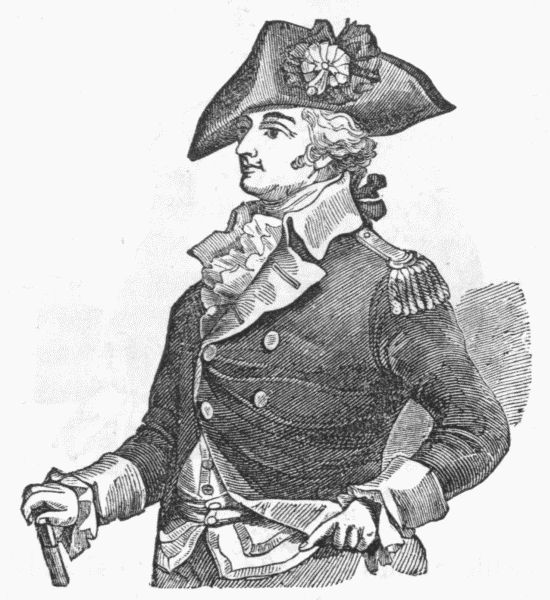
General Wayne.
"Perceiving that the enemy were moving into the Lancaster road towards the city, General Washington took possession of ground near the Warren tavern, on the left of the British, and twenty-three miles from Philadelphia. The protection of his stores at Reading was one object of this movement. The next morning, he was informed of the approach of the British army. He immediately put his troops in motion to engage the enemy. The advance of the two hostile armies met, and began to skirmish, when a violent storm came on, which prevented a general engagement, and rendered the retreat of the Americans absolutely necessary. The inferiority of the muskets in the hands of the American soldiery, which had been verified in every action, was strikingly illustrated in this retreat. The gun-locks being badly made, and the cartridge-boxes imperfectly constructed, this storm rendered most of the arms unfit for use, and all the ammunition was damaged. The army was, in consequence, extremely exposed, and their danger became the greater, as many of the soldiers were destitute of bayonets. Fortunately the tempest, which produced such serious mischief to the Americans, prevented the pursuit of the British. Washington still continued to make every effort to save the capitol; but Sir William Howe, having secured the command of the Schuylkill, on the 23d of September, crossed it with his whole army; on the 26th, he advanced to Germantown, and, on the succeeding day, Lord Cornwallis, at the head of a strong detachment, entered Philadelphia in triumph." Congress removed from the city, and immediately rëassembled at Lancaster. Fortunately, through the precautions of Washington, the military stores and deposits at Philadelphia, had been removed up the Delaware, and were thus prevented from falling into the hands of the enemy.
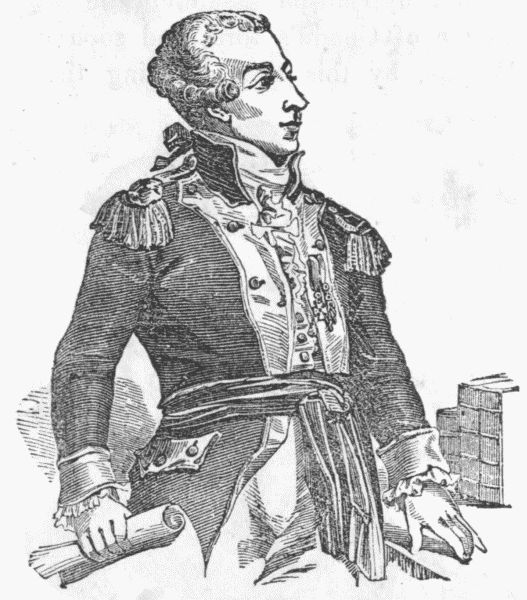
Marquis de la Fayette.
Passing over some unimportant events, we arrive at the 4th of October, on the morning of which day, the American army made a spirited attack upon a strong body of British forces encamped at Germantown, a village of a single street, beginning about five miles from Philadelphia, and extending along the road about two miles more. Lord Cornwallis occupied the city with another division, and a numerous detachment had marched to Chester, as an escort for a convoy of provisions. A fair opportunity for assailing the enemy in detail was thus offered to the enterprise of the American commander, and he was not slow in perceiving its advantages. He accordingly chose, for his point of assault, the advanced camp at Germantown, and made masterly arrangements for surrounding and destroying that exposed division of the enemy, before rëinforcements could arrive from Philadelphia.
Never was an attack more auspiciously begun, or the prospect of a decisive victory, for a time, more flattering. But the British army, at length, recovering from its first surprise, rallied the fugitives, and prepared vigorously to assume the offensive. The fortunes of the day, in consequence, changed, and Washington became convinced of the necessity of withdrawing his troops from the contest. The disputed town was therefore evacuated by the Americans. According to the official returns of the English general, his loss in the battle of Germantown scarcely exceeded five hundred men. On the side of the Americans, two hundred were killed, more than five hundred wounded, and four hundred made prisoners. Congress passed a resolution highly commending the plan of the battle, and thanking the commander and the army for their courage and conduct.
The main object of the American commander was now to compel the evacuation of Philadelphia, by cutting off the supplies of the British army. The fleet was effectually prevented from cöoperation by the obstructions fixed in the channel of the Delaware, and by two small forts—one called Fort Mifflin, on Mud Island, near the confluence of the Delaware and Schuylkill, and the other at Red Bank, on the opposite Jersey shore. Strong parties of militia scoured the whole country in the neighborhood of the city, for the purpose of enforcing the resolution of congress, which subjected to martial law all persons supplying provisions to the enemy.
Sir William Howe soon felt the increasing difficulties of his situation, and began to prepare his plans for their forcible removal. Works were erected against Fort Mifflin, which produced severe conflicts with Colonel Samuel Smith, who commanded the station. Lord Howe came up the river, with his ships of war and transports, and anchored from New Castle to Reedy Island; some frigates being detached, in advance, to remove the chevaux de frise that encumbered the channel. Considerable difficulties were encountered in effecting this object, so that the obstructions below Mud Island were not cleared until the middle of October, while those, covered by the American guns, were yet untouched. The capture of the forts was, therefore, the next object, and it was accordingly attempted by a combined attack on land and water.
The importance to the British of effecting the reduction of these forts, brought into requisition every possible means. On the other hand, the most determined resistance was made for their defence; but, at length, the Americans were obliged to yield them up to superior force; in consequence of which, Sir William Howe was fully secured in his conquest of Philadelphia, and in the possession of an uninterrupted communication between his army and fleet.
The occupation of Philadelphia by the British, was to them an important movement. Washington deeply regretted the success of the enterprise by which it fell into their hands; but he had no occasion to reproach himself in view of the event. He had taken every precaution, and made every effort to prevent the loss of so important a place. But the benefits anticipated by the British, were scarcely realized. The prospects of the Americans were, after all, growing brighter, and events were hastening on, which were to make those prospects brighter still.