Part 1 — I:—BATTLE OF LEXINGTON
Reading edition
Cause or Occasion of the Battle—British Detachment proceeds towards Concord—Reaches Lexington—First Blood shed—Hancock and Adams—Captain Wheeler and the British Officer—Stores destroyed—The British harassed by the Americans—Retreat from Concord—Effect of this affair upon the Country—Proceedings of the Massachusetts Provincial Congress.
The immediate cause of the battle, or, more properly, rencontre at Lexington, was an attempt of a detachment of British troops to execute an order of General Gage to destroy certain military stores, which the provincials had collected at Concord, a town situated some eighteen miles from Boston. In anticipation of an approaching contest, the provincial assembly of Massachusetts had passed a resolution for the purchase of all the gunpowder that could be found, and of every sort of arms and ammunition requisite for an army of fifteen thousand men. As these objects abounded principally in Boston, the inhabitants employed all their address to procure and transport them to places of safety in the country. Cannon-balls and other instruments of war were therefore collected and transported in carts, apparently loaded with manure; powder in the baskets and panniers of those who came from Boston market, and cartridges were concealed even in candle-boxes. By these means, and through other channels, a considerable quantity of arms and ammunition had been collected at Concord.
Excited by the loyalists, General Gage resolved to send a few companies to Concord, for the purpose already stated. It was said, also, that he had it in view, by this sudden expedition, to get possession of John Hancock and Samuel Adams, two of the most ardent patriot chiefs, and the principal directors of the provincial congress, then assembled in the town of Concord.
In pursuance of the above purpose, on the evening of the 18th of April, several British officers dispersed themselves here and there upon the road and passages, to intercept the couriers that might have been dispatched to give notice of the movements of the troops. The governor gave orders that no person should be allowed to leave the city; nevertheless, Dr. Warren, one of the most active patriots, had timely intimation of the scheme, and immediately dispatched confidential messengers; some of whom found the roads interdicted by the officers who guarded them; but others made their way unperceived to Lexington, a town upon the road leading to Concord. The intelligence was soon divulged; the people flocked together; the bells in all parts were rung to give the alarm; and the continual firing of cannon spread the agitation through all the neighboring country. In the midst of this tumultuous scene, at eleven in the evening, a strong detachment of grenadiers and of light infantry was embarked at Boston, to land at a place called Phipps' Farm, whence they marched to Concord.
The British troops were under the command of Lieutenant-Colonel Smith and Major Pitcairn, who led the van-guard. The militia of Lexington, as the intelligence of the movement of this detachment was uncertain, had separated in the course of the night. Finally, at five in the morning of the 19th, advice was received of the near approach of the royal troops. The provincials that happened to be near, assembled—to the number, however, of only seventy. The English appeared; and Major Pitcairn, galloping up to them, in a loud voice cried, "Disperse, rebels! lay down your arms, and disperse!"
The provincials did not obey; upon which, advancing nearer, he discharged a pistol, and, brandishing his sword, ordered his soldiers to fire. Eight Americans were killed, three or four of them by the first fire of the British; the others, after they had left the parade. Several were also wounded. A handsome monument has been erected to the memory of the killed, on the green where the first of them fell.
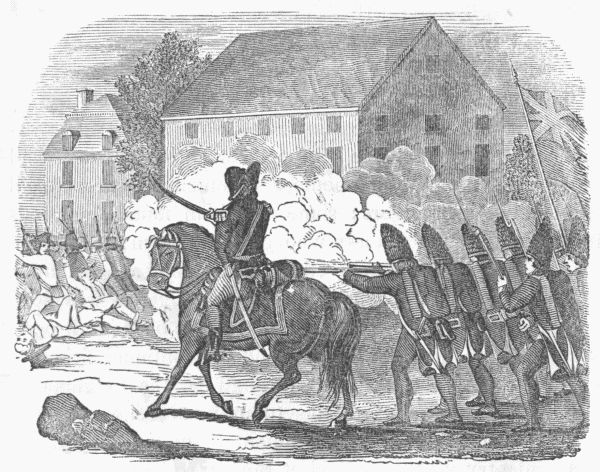
Battle of Lexington.
Meanwhile, Hancock and Adams retired from danger; and it is related that, while on the march, the latter, enraptured with joy, exclaimed, "Oh, what an ever-glorious morning is this!"—considering this first effusion of blood as the prelude of events which must secure the happiness of his country. The soldiers advanced towards Concord, where the inhabitants assembled; but seeing the numbers of the enemy, they fell back, and posted themselves on a bridge, north of the town. The light infantry assailed them with fury, routed them, and occupied the bridge, while the others entered Concord, and proceeded to the execution of their orders. They disabled two twenty-four pounders, threw five hundred pounds of ball into the river and wells, and broke in pieces about sixty barrels of flour.
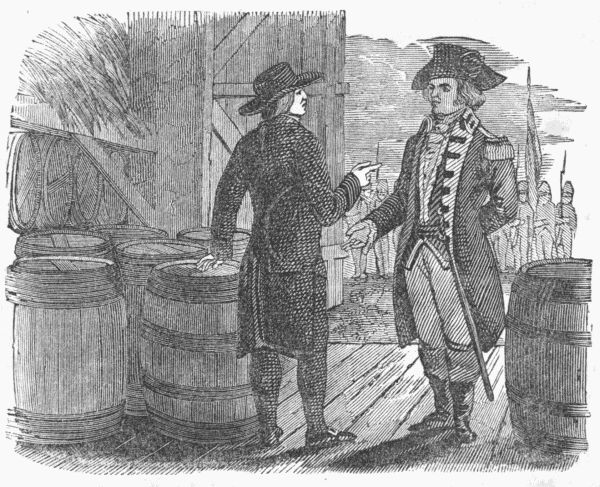
Captain Wheeler and the British Officer.
During the search of the British for military stores, a British officer demanded entrance into the barn of Captain Wheeler. This was readily granted. In it was stored a large quantity of provincial flour. The officer expressed his pleasure at the discovery. But Captain Wheeler, with much affected simplicity, said to him, putting his hand on a barrel, "This is my flour. I am a miller, sir; yonder stands my mill; I get my living by it. In the winter, I grind a great deal of grain, and get it ready for market in the spring. This," (pointing to one barrel,) "is the flour of wheat; this," (pointing to another,) "is the flour of corn; this is the flour of rye; this," (putting his hand on his own cask,) "is my flour; this is my wheat; this is my rye; this is mine." "Well," said the officer, "we do not injure private property," and withdrew, leaving this important depository untouched.
The militia being rëinforced, Major Buttrick, of Concord, who had gallantly offered to command them, advanced towards the bridge; but, not knowing of the transaction at Lexington, ordered the men not to give the first fire, that the provincials might not be the aggressors. As he advanced, the light infantry retired to the Concord side of the river, and began to pull up the bridge; and on his nearer approach, they fired, and killed a captain and one of the privates. The provincials returned the fire; a skirmish ensued, and the regulars were forced to retreat, with some loss. They were soon joined by the main body, which now retreated with precipitancy. Meanwhile, the people of the adjacent country flocked in, and attacked them in every direction. Some fired from behind stone walls and other coverts; while others pressed on their rear during their retreat to Lexington.
General Gage, apprehensive for the fate of the English, had dispatched nine hundred men and two field-pieces, under command of Lord Percy. This corps arrived very opportunely at Lexington, at the moment when the royal troops entered the town from the other side, pursued with fury by the provincial militia.
It appears highly probable that, without this rëinforcement, they would have all been cut to pieces or made prisoners; their strength was exhausted, as well as their ammunition. After making a considerable halt at Lexington, they renewed their march towards Boston, the number of the provincials increasing, although the rear-guard of the English was less molested, on account of the two field-pieces, which repressed the impetuosity of the Americans. But the flanks of the columns remained exposed to a destructive fire, from every point adapted to serve as coverts. The royalists were also annoyed by the heat, which was excessive, and by a violent wind, which blew a thick dust in their eyes. Finally, after a march of incredible fatigue, and considerable loss of men, the English, overwhelmed with lassitude, arrived at sunset in Charlestown. Independently of the combat they had sustained, the distance they had that day traveled was above five-and-thirty miles. The day following, they crossed over to Boston.[31]
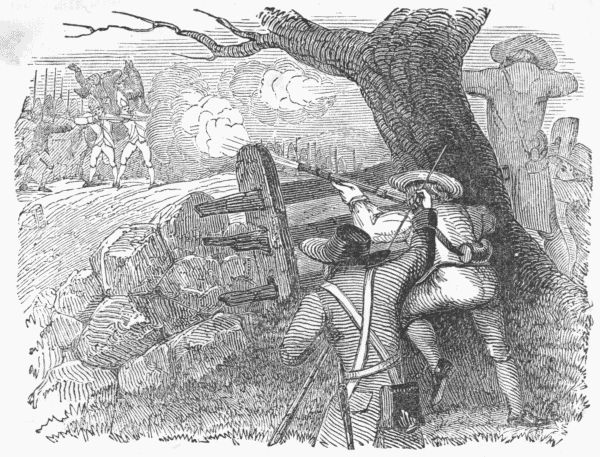
Retreat of the British from Concord.
The rencontre at Lexington was, in itself, an inconsiderable affair. But, in its relation and influence, its importance can scarcely be estimated. It was the first outbreak of indignant feeling, which, for months and years, had been acquiring strength, but which, until now, had been suppressed. It was a solution of the problem, whether the wrongs of America could be redressed without a resort to arms. It developed the spirit and determination, as well of the king and parliament, as of the Americans themselves. It shut the door for further negotiation; it cut off hope for the colonies, but through an appeal to arms. In fact, it was a signal for war—it was war itself.
The affair had two results. The first was to demonstrate how false and ridiculous were the vaunts of those Gascons who, within parliament as well as without, had spoken in such unworthy terms of American courage; from this moment, the English nation, and especially its soldiers, persuaded themselves that the struggle would be far more severe and sanguinary than had been at first believed. The second effect of the combat was, greatly to increase the confidence of the colonists, and their resolution to defend their rights. It should be added, also, that the reports of the cruelties of the British troops produced an incredible excitement in the minds of the inhabitants, which was still further increased by the public honors which were paid to those who had fallen in the opening contest. Their eulogies were pronounced, and they were styled martyrs of liberty, while their families were the objects of unusual veneration. They were cited as the models to be imitated in the approaching conflict.
The provincial congress of Massachusetts was in session at Watertown, ten miles distant from Boston. On receiving intelligence of the battle, it took immediate measures to raise thirteen thousand and six hundred men, and chose for their general Colonel Ward, an officer of much reputation. This militia was designed to form the contingent of Massachusetts; the provinces of New Hampshire, Connecticut, and Rhode Island were invited to furnish theirs, in order to complete an army of thirty thousand men, to be commanded by General John Thomas, an officer of great experience. Connecticut dispatched, immediately, a considerable corps, under the command of Colonel Putnam, an old officer, who, in the two late wars, had often given proof of courage and intelligence. The other provinces were not slow in causing their standards to move; and, in a short time, an army of thirty thousand men was found assembled under the walls of Boston. So great and so universal was the ardor produced among the inhabitants by the battle of Lexington, that the American generals were obliged to send back to their homes many thousand volunteers. Putnam took his station at Cambridge, and Thomas at Roxbury, upon the right wing of the army, to cut off entirely the communication of the garrison, by the isthmus, with the adjacent country. Thus, in a few days after the affair of Lexington, the capital of the province of Massachusetts was closely besieged; thus a multitude assembled in haste, of men, declared rebels and mean-spirited cowards, held in strict confinement, not daring to sally forth even to procure food, many thousands of veteran troops, commanded by an able general, and combating under the royal standard.