Part 1 — VIII. RETURNING PROSPERITY.
Reading edition
BATTLES OF TRENTON AND PRINCETON.
Reliance of the patriots for success upon God—Public Fast recommended by Congress—Offensive Operations decided upon—Battle of Trenton—Washington victorious—Battle of Princeton—British repulsed—American Army at Morristown—British at Brunswick—Prospects brightening.
Irrespective of the special blessing of Heaven, the colonies of America entered upon the revolutionary war with fearful chances against them. That they well knew, and hence that blessing was more universally sought than by any other people, in similar circumstances, since the founding of empires. The cause was remembered by those who offered the incense of prayer morning and evening on the family altar. Scarcely a Sabbath occurred, on which the embassadors of God did not make public mention, in their addresses to a Throne of grace, of the American cause; and fervent supplications for Divine aid in supporting that cause, and, carrying it to a prosperous issue, were to be heard in every church. Nor were colonial assemblies—nor, after its organization, the continental congress—backward in recognising the necessity of propitiating the Divine favor. Not a single instance, it is believed, is on record, and probably never occurred, in which a legislator in a provincial assembly attached to the patriotic cause, or a member of congress, opposed the adoption of any resolution which had for its object the humiliation of the people in the season of national adversity, or the rendering of due thanks to God in the day of prosperity. There were men concerned in conducting the military operations of the Revolution, and in guiding the counsels of the nation, who were far from being personally religious; but such was the pervading influence of piety in the land, that they would have manifested no open opposition, had they felt it; nor is it to be credited, in the absence of positive evidence, that such feelings ever existed.
The reverses sustained by the Americans, detailed in the preceding pages, were most sensibly felt in every portion of the land. Notwithstanding the knowledge of the superiority of the British, in regard to numerical force, but much more in respect to munitions of war, and the disciplined character of their soldiery, the Americans had cherished the expectation of success. Their confidence at the commencement of the struggle had been raised, and strengthened by the issue of the affairs at Lexington, and Bunker's hill, and the evacuation of Boston. Success thus early was positively essential to success in the sequel. Had they early met with reverses, such as were experienced from the discomfiture at Brooklyn to the battle of Trenton, it is doubtful whether that resolution would not have failed, and with the failure of that, the contest have been relinquished.
Those reverses, though painful and mortifying, were perhaps even salutary. A firmer reliance upon Providence was felt to be needful, and a holier tide of supplication ascended to the Arbiter of the fate of nations.
The connexion between an acknowledgment of God in his providence, and his blessing on the common cause, was recognised by no body with more readiness than by the continental congress. Although in May, 1776, that body had recommended a public fast, in view of the gloomy reverses which had attended the American arms, on the 11th of December, in a resolution, which for the tone of its piety cannot be too much admired, and which might serve as a model to future ages, they recommended the observance of a day of fasting and humiliation: "Whereas the war in which the United States are engaged with Great Britain, has not only been prolonged, but is likely to be carried to the greatest extremity; and whereas it becomes all public bodies, as well as private persons, to reverence the providence of God, and look up to him as the Supreme Disposer of all events, and the Arbiter of the fate of nations; therefore Resolved, that it be recommended to all the United States, as soon as possible, to appoint a day of solemn fasting and humiliation; to implore of Almighty God the forgiveness of the many sins prevailing among all ranks, and to beg the countenance and assistance of his providence in the prosecution of the present just and necessary war. The congress do also, in the most solemn manner, recommend to all the members of the United States, and particularly the officers, civil and military, under them, the exercise of repentance and reformation; and, further, require of them the strict observation of the articles of war, and particularly that part of the said articles which forbids profane swearing and all immorality, of which all such officers are desired to take notice."[46]
We left Washington on the Pennsylvania side of the Delaware—his army greatly reduced by the return of numbers to their homes, and depressed by a long and disheartening retreat before an exulting foe. Nor would the Americans have now been permitted to pause in safety, had the British commander succeeded in procuring the means necessary to make the passage of the river. Finding his efforts for this purpose, however, fruitless, he began his preparations for retiring into winter-quarters. The main body of the army was therefore cantoned between the Delaware and the Hackensack: about four thousand men occupied positions between Trenton and Mount Holly, and strong detachments lay at Princeton, Brunswick, and Elizabethtown. The object of this dispersion over so wide an extent of country, was to intimidate the people, and thus prevent the possibility of recruiting for the continental service; while in the spring these forces could be immediately concentrated, and it was then proposed to put an easy conclusion to all rebellious contumacy.
The desperate condition of his country's fortunes now pressed with saddening weight upon the mind of Washington, and he resolved, if possible, to retrieve misfortune by some daring enterprise. To such an enterprise he was the more inclined, since, with the exception of about fifteen hundred effectives, his whole force would be entitled in a few days to its discharge. Having formed his plan—an attack upon the British posts on the Delaware—he proceeded to put it in execution.
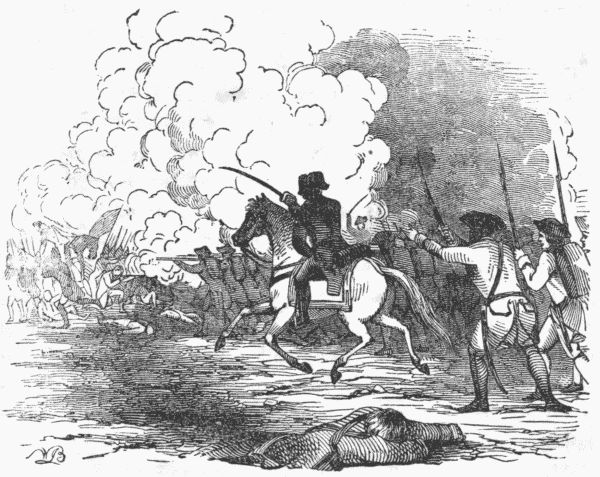
Battle of Trenton.
Early in the morning of the 26th of December, 1776, the main body of the American army, twenty-four hundred strong, and headed by Washington in person, crossed the river at M'Konkey's ferry, about nine miles above Trenton. The night was tempestuous with rain and sleet, and the river encumbered with quantities of floating ice, so that the passage, although begun soon after midnight, was not fully effected until three o'clock, and one hour more elapsed before the march could be commenced. The Americans moved in two divisions along the roads leading to the town, and their operations were so well combined, and executed with such precision, that the two attacks on the British outposts were made within three minutes of each other. The pickets attempted resistance, but were almost immediately driven in upon the main body, which was forming hurriedly in line. Colonel Rawle, their commander, soon after fell, mortally wounded; the confusion of the soldiery became irremediable; and, after a loss of about twenty killed, one thousand men laid down their arms, and surrendered their munitions and artillery. On the American side, the loss in battle amounted to only two killed and four wounded; among the latter, James Monroe, afterwards president of the United States.
The other parts of this brilliant enterprise were not, however, executed with the same success. General Irvine had been instructed to cross at Trenton ferry, and, by securing a bridge below the town, to cut off the enemy's march along the Bordentown road. Notwithstanding all his exertions, it was found that the ice had rendered the passage impracticable; and five hundred fugitives from the disastrous field of Trenton were thus enabled to escape by a speedy and well-timed retreat. General Cadwallader was to have crossed at Drink's ferry, and carried the post at Mount Holly; but the same impediment prevented this movement also, and he was compelled to return with a part of his infantry which had effected the passage. Deprived of this important and expected cöoperation, Washington had, nevertheless, achieved a most critical and important triumph; he returned to his former position, charged with the spoils and trophies of his foes; and from that moment, though reverses frequently dimmed the brilliancy of the prospect, hope never again deserted the cause of American independence.
Having secured the Hessian prisoners on the Pennsylvania side of the Delaware, Washington rëcrossed the river two days after the action, and took possession of Trenton. Generals Mifflin and Cadwallader, who lay at Bordentown and Crosswix with three thousand six hundred militia, were ordered to march up in the night of the 1st of January, to join the commander-in-chief, whose whole effective force, including this accession, did not exceed five thousand men. The detachments of the British army, which had been distributed over New Jersey, now assembled at Princeton, and were joined by the army from Brunswick, under Lord Cornwallis. From this position, the enemy advanced towards Trenton in great force, on the morning of the 2d of January; and, after some slight skirmishing with troops detached to harass and delay their march, the van of their army reached Trenton about four in the afternoon. On their approach, General Washington retired across the Assumpinck, a rivulet that runs through the town; and by some field-pieces, posted on its opposite banks, compelled them, after attempting to cross in several places, to fall back out of the reach of his guns. The two armies, kindling their fires, retained their positions on opposite sides of the rivulet, and kept up a cannonade till night.
The situation of the American general at this moment was extremely critical. Nothing but a stream, fordable in many places, separated his army from an enemy, in every respect his superior. If he remained in his present position, he was certain of being attacked the next morning, at the hazard of the entire destruction of his little army. If he should retreat over the Delaware, the ice in that river not being firm enough to admit a passage upon it, there was danger of great loss—perhaps of a total defeat: the Jerseys would be in full possession of the enemy; the public mind would be depressed; recruiting would be discouraged; and Philadelphia would be within the reach of General Howe. In this extremity, he boldly determined to abandon the Delaware; and, by a circuitous march along the left flank of the enemy, fall into their rear at Princeton, which was known to be occupied by three British regiments.[47]
About sunrise, at a short distance from the town, they encountered two of these regiments, marching forward in order to cöoperate in the expected battle, and a warm engagement immediately commenced. The American general was well aware that the existence of his country hung suspended in the scale of victory; and he exerted himself as one who knew the importance of the object, and felt that success depended on his efforts. Wherever the fire was hottest, or the press of battle most fearful, Washington was sure to be found, guiding the thunders of war, and animating all by his language and example. At length, the British line was broken, and the two regiments separated. Colonel Mawhood, with the division in the van, pushed rapidly forward for the main army; while the fifty-fifth, cut off from this point of support, fled in confusion across the fields to Brunswick. The Americans now pressed the remaining regiment, which at first attempted a defence in the college; but this was soon abandoned, and those who were not captured, escaped only by precipitate flight. The British loss amounted to one hundred killed and three hundred prisoners; the conquerors had to lament the death of General Mercer, an experienced officer, much respected by the commander-in-chief.
"The battles of Trenton and Princeton, though similar in their outlines, were very different in point of conception and execution. The attack upon Trenton was a blow struck against an enemy in position, which admitted, therefore, of every advantage of preparation on the part of the assailants. The battle of Princeton belonged to a higher and more elaborate order of tactics. The American forces were already engaged with a superior army, commanded by an officer of eminent reputation; and the change of plan was wholly contrived and executed with the enemy in front. It was entirely due to the prompt genius, and fertile resources of Washington, that his army was extricated from so perilous an exposure, and enabled to attack the enemy's rear with such advantage, as to leave it no choice but surrender or flight. A military critic, contemplating these inspirations with a soldier's eye, can easily appreciate the feelings of the great Frederick, when he sent a sword to the American commander, 'as a gift from the world's oldest general to its best.'"
As a natural result of these unexpected manœuvres, the British officers were thrown into a state of uncertainty, which gave to their subsequent operations an unusual character of timidity. The distant roll of the American artillery at Princeton, first announced to Lord Cornwallis the danger of his rear, and the escape of his active adversary. Alarmed for the safety of his magazines, the British commander instantly broke up from the Assumpinck, and commenced a forced march upon New Brunswick; moving with such celerity as nearly to overtake the American rear at Princeton. On the other hand, Sir William Howe drew in all his forces, by concentration in the neighborhood of Amboy and Brunswick, and abandoned all hope of preventing the recruiting service by overawing the whole extent of the country. Washington, finding the surprise of the stores impossible, moved northward into the highlands of Jersey, in order to afford some relief to the fatigues of his troops; for long and severe exposure to the inclemencies of the winter, without the usual protections, had produced sickness, and even complaint. It was finally considered necessary to abandon offensive operations, and to put the army under cover at Morristown. Among other prudent precautions adopted, during this temporary respite, the commander-in-chief caused the whole army to be innoculated; an operation then very uncommon in America, but which enabled him thereafter to defy a disease, which had proved more fatal than the sword of the enemy.
The situation of American affairs—though far from brilliant—was much improved by the late successes. The people of Jersey rose with fresh spirit, and in a number of small skirmishes inflicted loss upon the enemy, both in men and stores: new hope was made to animate the public mind; while congress fanned the flame by judicious and well-timed incitements to vigorous action. Washington was authorized to raise sixteen regiments, and in further testimony of the public confidence, he was invested for six months with almost dictatorial powers in the conduct of the war. It was, however, found to be impossible to collect a sufficient force for active operations upon any considerable scale during the winter. All the hopes of the commander-in-chief were therefore turned to the next campaign; and in the mean time an active warfare was carried on with small posts and foraging parties, which greatly annoyed the British army; while the frequent reports of fresh successes excited the spirit of the American people. The most earnest applications were made to the several states, for rëinforcements enlisted upon longer terms; for, as Washington strongly observed, "to the short engagements of our troops may be fairly and justly ascribed almost every misfortune that we have experienced." These representations produced at last their due impression; and the hope was abandoned of defending the country by hasty assemblages of militia, and of carrying on a protracted warfare upon the impulse and mere foundation of disinterested patriotism.