Part 1 — VI. CHILI.
Reading edition
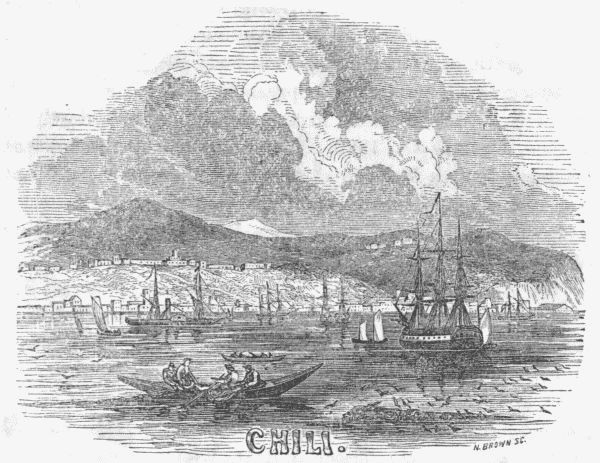
View of Valparaiso.
Extent, Physical Features, Climate—Conquest by Almagro—Revolution in the beginning of the Present Century—Final Establishment of Independence—Subsequent Condition.
Extent, Physical Features, Climate, &c.—Chili, lying on the shore of the Pacific, from the twenty-fourth to the forty-fifth degrees of south latitude, its length being one thousand two hundred and sixty miles, and its breadth three hundred miles, possesses many natural advantages and attractions. The immense chain of the Andes traverses the country from north to south. In the vicinity of these mountains, earthquakes are common, and these seem to be the only drawbacks to the paradise which nature has formed in this part of the South American continent. Chili, it is believed, is blessed with the most salubrious and delightful climate on the globe.
Though there are some sterile tracts, the soil, in general, is remarkably fertile, and the products are rich and varied. Medicinal, dyeing, and aromatic plants abound, and there are several plants peculiar to the country. All kinds of metal abound in Chili. Gold, however, is the most copious, and in some districts there is scarcely a hill which does not contain it. Chili is supposed to be the only American state, formerly subject to Spain, whose commerce has been increased since the separation from the mother-country.
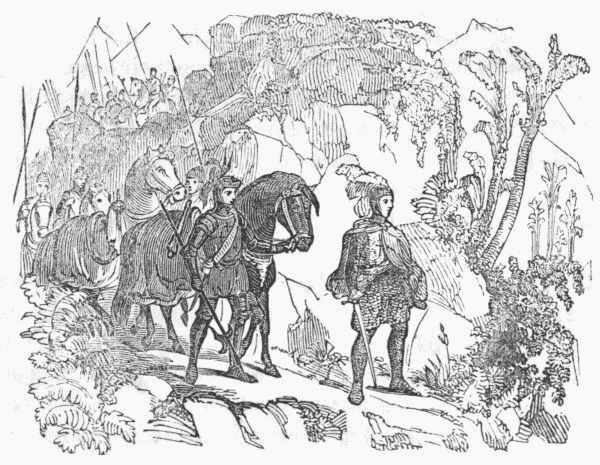
Almagro marching against Chili.
Conquest by Almagro.—After the principal provinces of Peru were brought into subjection, the Spanish conquerors turned their attention to the conquest of Chili. In the early part of 1535, Almagro set out for Cuzco, in the prosecution of this enterprise, with a considerable force. From the nature of the route, he met with great difficulties, and lost many of his men; but he at length accomplished his design, and was received with tokens of submission on the part of the inhabitants. The natives, however, at length, recovering from their astonishment at the sight of so superior a race of men as the Spaniards, began to think of regaining their liberty. Hence, a war arose, which lasted ten years, in which, though the natives were sometimes successful, they were generally and in the end defeated. For a long course of years, the possession of the country by the Spaniards continued to be disputed, and fatal hostilities occurred from time to time, as they attempted to extend their empire in Chili. Their object, however, was effected by degrees, as in all the other American colonies.
Revolution in the beginning of the Present Century.—The occasion of the revolution in Chili, and its subsequent independence, was the same as in the other Spanish states in America, viz: the disturbances in Spain in consequence of the French invasion in 1809. The captain-general of the province was compelled to resign, and by the popular voice the Count de la Conquista was elevated to his place. The count immediately took measures for instituting a new government. A general congress was determined on, and at length chosen, after some attempts made by the royalists at a counter-revolution. The congress, upon their organization, passed a decree, permitting all persons who were dissatisfied with the changes in the government, to leave the country with their effects, within six months. The children of slaves, born in future, were declared free, and many other acts were passed, with a view to reform the abuses of the ancient government.
Discontent, however, with the new order of things, soon arose, and there was the usual amount of plots and counter-plots, menace and fighting, between the friends and the enemies of the changes in the government, which has constituted a principal feature of Spanish American history in modern times. After various military movements and internal struggles, the revolutionary power was overthrown, and, in 1814, the Spanish authority was completely rëestablished in Chili.
Final Establishment of Independence.—This state of things continued for more than two years. But it was destined to pass away, after some severe fighting. The government of Buenos Ayres dispatched an army, under San Martin, for the purpose of liberating Chili. After incredible exertions and fatigue, he crossed the lofty chain of the Andes, and arrived in Chili with very little loss. At Chacabuco, the royal troops were defeated, and put to the rout, on the 12th of February, 1817. At Santiago, the liberator was received with acclamations by the inhabitants, and made supreme director. He, however, declined the office, and bestowed it upon O'Higgins, who had commanded a division of his army. Chili was delivered by means of San Martin's successes, ending in the great victory of Maypu, April 5th, 1818, in which the whole Spanish army was destroyed, with the exception of their commander, Osorio, and a few horsemen. This victory set the seal on the independence of Chili, and the patriots were soon enabled to carry the war into the enemy's country by the invasion of Peru, as narrated in the history of the latter.
Condition subsequently to the Establishment of Independence.—The fact of securing her independence has given little repose to Chili. The outward forms of a republic have been preserved in her government, while parties have struggled for the ascendancy, and filled the country with turbulence. For several years, the southern frontiers were disturbed by the depredations of an outlaw, named Benavides, a Spaniard, who put himself at the head of the Araucanian Indians, and desolated the country with fire and sword, and the commission of bloody atrocities unsurpassed in the history of savage warfare. His success, and the authority he had acquired over the Indians, induced him to think himself a powerful monarch, and he attempted to establish a navy. He captured several American and English vessels, which touched on the coasts of Chili for refreshments, and made himself master of a large amount of property, arms, and military stores. The Spaniards encouraged him in his piracies and murders, and furnished him with troops and artillery. But his bloody career was cut short by the Chilians, who dispatched an expedition against him in October, 1821. Arauco, his capital, was taken, his forces defeated, and Benavides compelled to flee. He was taken prisoner in February, 1822, tried and executed.
In January, 1823, O'Higgins was compelled to resign, and was succeeded by Ramon Freire, as supreme director. In July, 1826, Freire resigned his office, and Admiral Manuel Blanco was appointed in his place; but before the expiration of two months, he retired from office. In 1827, the form of the government was changed; but the public tranquillity has not been secured by the change. Of the two vice-presidents, who were chosen from 1827 to 1831, one was expelled and the other assassinated. Chili, for many years, has been agitated by the dissensions of two parties; the one desiring to establish a central government, and the other, a government like that of the United States.
Chili, in connection with Buenos Ayres, within a few years, has been at war both with Peru and Bolivia. According to the latest accounts, some difficulty now exists between this country and Buenos Ayres; the hope is expressed that it may not issue in war. The too great readiness of the infant republics of South America to engage in contentions with one another, and to indulge in internal feuds, must be acknowledged to be a bad omen in respect to their preparation for the blessings of liberty and independence.