Part 1 — II. VENEZUELA.
Reading edition
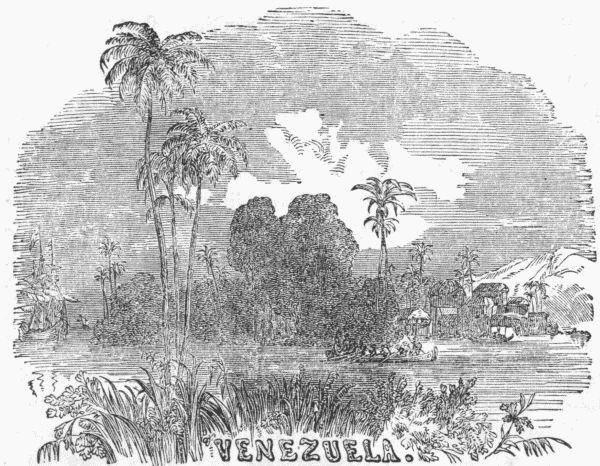
First Discovery by the Spaniards—They approach the Village built upon poles.
Name, Physical Features, &c.—Discovery—State of the Country under the Spanish Dominion—Termination of the Spanish Dominion—Condition since.
Name, Physical Features, &c.—This republic formerly known by the name of the Captain-generalship of Caraccas, as has been seen, once formed a part of the republic of Columbia. When it was first brought to the knowledge of the Spaniards, they called the place where they landed Venezuela, from the common propensity to find a resemblance between the objects they saw in America, and those that were familiar to them at home. An Indian village, built upon piles, was the object which suggested the name.
Venezuela includes a portion of the great chain of the Andes and a vast plain, which constitutes the greater part of the surface. It is watered by the Orinoco, one of the largest rivers of the world, which empties into the Atlantic by about fifty mouths. The area of Venezuela measures four hundred and fifty thousand square miles. In respect to its soil, it has all the richness of the equatorial regions of the globe.
Discovery.—The Spaniards, under Ojeda, first visited this country, in 1499. They made some attempts to settle at the Indian village before adverted to, which they observed built upon piles, in order to raise the huts above the stagnant waters around. But their labors were, for the most part, abortive. The reduction of the country was brought about by soldiers of fortune, abounding in Germany in the sixteenth century, who, through an arrangement of the Emperor Charles V., were introduced into these wilds. These adventurers, neglecting the purpose for which they were placed there, which was to cultivate and improve the country, became impatient to amass riches, and wandered from district to district in search of mines. In this pursuit, they cruelly plundered the natives, and imposed on them intolerable tasks. In a few years, the desolated province hardly afforded them subsistence; and when they were removed by their employers, the Spaniards again took possession of the country, and soon renewed the horrors which it had already experienced. In consequence of these, and other ravages at a later period, the whole region lay waste for a long season. When new settlements were at length commenced, they advanced so slowly, that this part of the Spanish possessions remained comparatively unproductive, while the other American colonies were in a thriving state.
State of the Country under the Spanish Dominion.—As in the other provinces held by Spain on this continent, the Spanish dominion continued in this until the early part of the nineteenth century. Venezuela was, however, agitated by the question of freedom and independence, perhaps, earlier than was the fact elsewhere in Spanish America. As early as in 1797, an attempt to raise the standard of independence was made in Venezuela, so keenly did the country feel the rapacity and oppression of the Spanish government. Two natives of Caraccas were leaders in this revolt, which comprised a large number of people distinguished for their talents, virtues, and wealth. The insurrection, which had for its object the securing of the heads of government, as hostages, till a treaty could be made with the court of Spain for a redress of grievances was fixed for the 14th of July, 1797; but was divulged by one of the conspirators on the evening previous. The consequence was, that most of the conspirators were arrested, and eventually put to death, but the leaders effected their escape.
The discontents of the people continued, and General Miranda, in consequence of earnest entreaties expressed in letters from Venezuela, to put himself at the head of an expedition for revolutionizing the country, acceded to the proposal. Proceeding to the United States, he collected there a body of a few hundred adventurers. With this force he sailed from New York in 1806; but after arriving on the coast, he was repulsed by the Spanish gun-boats; and it was only after recruiting his forces at Trinidad, and aided under the convoy of a British sloop, that he again proceeded to the place of destination. He, however, effected nothing, as he found the people now luke-warm in the cause of revolt, and abandoned the project, with the loss of numbers of his men, who were taken and hanged.
Termination of the Spanish Dominion.—The Spanish authority, however, over the province, was drawing to an end. The great revolution broke out in 1810. On the 19th of April, the captain-general of Caraccas was deposed, and delegates were chosen by the people to meet in a congress, for the purpose of forming a government for Venezuela. The congress published a declaration of independence on the 5th of July, 1811, and this example was followed by the other provinces, which were afterwards united, as has already been mentioned, in the republic of Columbia.
In so succinct an account as the present, the details of the revolution cannot be given, nor would they be specially interesting or useful, from their want of general and permanent results. It needs only to be stated, that the patriots were generally successful till 1812, when they experienced the terrible calamity of the loss of their city, Caraccas, by an earthquake; a circumstance which wrought upon the superstitious fears of the populace against the cause, and that Miranda, who had returned to this country, in despair capitulated, was taken a prisoner, and finally sent to Spain, where he died in a dungeon.
From this period, through a series of years, the contest maintained a doubtful character; Bolivar defeating the royalists in several battles, and they in their turn defeating him. The struggle between the parties continued, until after the junction of New Grenada and Venezuela, in 1819. The battle of Carabobo in 1820, as already related in the history of the former state, put the finishing stroke to the war in Venezuela. By the end of the year, the Spaniards were driven from every part of the two provinces, except Puerto Cabello and Quito.
Condition since the Overthrow of the Spanish Power.—The promise of better times soon after the union of New Grenada and Venezuela, was realized but in part. The country continued disturbed for years. In the mean time, the republic of Columbia was formed, but, as already shown, it was not destined to continue: its remembrance, however, will always be connected with the heroic efforts of Bolivar.
The government of the country was administered from 1831 to 1835, by General José Antonio Paez, the president, and 1835 to 1839, by Dr. Vargas, also the president. Since the last-named period, the government has been in the hands again of General Paez. From recent accounts, however, it would seem that the country is in a disturbed state, a war being carried on between Paez and Monagas—Paez representing the constitutional party. Very lately, the latter obtained a decided victory over Monagas.