LIST OF ABBREVIATIONS USED IN THIS DICTIONARY. (continued 9)
Reading edition
Hability, ha-bil′i-ti, n. an obsolete form of ability.
Habit, hab′it, n. ordinary course of conduct: tendency to perform certain actions: general condition or tendency, as of the body: practice: custom: outward appearance: dress, esp. any official or customary costume: a garment, esp. a tight-fitting dress, with a skirt, worn by ladies on horseback.—v.t. to dress:—pr.p. hab′iting; pa.p. hab′ited.—adj. Hab′ited, clothed, dressed.—ns. Hab′it-mak′er, one who makes women's riding-habits; Hab′it-shirt, a thin muslin or lace under-garment worn by women on the neck and shoulders, under the dress.—adj. Habit′ūal, formed or acquired by frequent use: customary.—adv. Habit′ūally.—v.t. Habit′ūāte, to cause to acquire a habit: to accustom.—ns. Habitūā′tion; Hab′itūde, tendency from acquiring a habit: usual manner; Habitué (hab-it′ū-ā), a habitual frequenter of any place of entertainment, &c.—Habit and repute, a phrase in Scotch law to denote something so notorious that it affords strong and generally conclusive evidence of the facts to which it refers; Habit of body, the general condition of the body as outwardly apparent: any constitutional tendency or weakness. [Fr.,—L. habitus, state, dress—habēre, to have.]
Habitable, hab′it-a-bl, adj. that may be dwelt in.—ns. Habitabil′ity, Hab′itableness.—adv. Hab′itably.—ns. Hab′itant, an inhabitant; Hab′itat, the natural abode or locality of an animal or plant: place of abode generally; Habitā′tion, act of inhabiting: a dwelling or residence: a group, lodge, company, as of the so-called 'Primrose League.' [Fr.,—L. habitabilis—habitāre, -ātum, to inhabit, freq. of habēre, to have.]
Hable, hā′bl, adj. (Spens.). Same as Habile.
Hachel, hach′el, n. (Scot.) a sloven.
Hachure, hash′ūr, n. Same as Hatching.
Hacienda, as-i-en′da, n. an estate or establishment. [Sp.,—L. facienda, things to be done, facĕre, to do.]
Hack, hak, v.t. to cut: to chop or mangle: to notch: to kick (another) at football.—n. a cut made by hacking: a kick on the shin.—n. Hack′ing, the operation of picking a worn grindstone, &c., with a hack-hammer.—adj. short and interrupted, as a broken, troublesome cough.—n. Hack′-log, a chopping-block. [A.S. haccian, in composition tó-haccian; cf. Dut. hakken, Ger. hacken.]
Hack, hak, n. a horse kept for hire, esp. a poor one: any person overworked on hire: a literary drudge.—adj. hired, mercenary: used up.—v.t. to offer for hire: to use roughly.—n. Hack′-work, literary drudgery for which a person is hired by a publisher, as making dictionaries, &c. [Contr. of hackney.]
Hack, hak, n. a grated frame, as a rack for feeding cattle, a place for drying bricks, &c. [Hatch.]
Hackberry, hak′ber-i, n. an American tree, allied to the elm. [See Hagberry.]
Hackbut, hak′but, n. an arquebuse—also Hag′but.—n. Hackbuteer′. [O. Fr. haquebute, from Dut. haakbus. See Arquebuse.]
Hackee, hak′ē, n. the United States chipmuck or ground-squirrel. [Imit.]
Hackery, hak′er-i, n. a native bullock-cart. [Hind. chhakrā, a cart.]
Hackle, hak′l, n. an instrument with iron teeth for sorting hemp or flax: any flimsy substance unspun: a feather in a cock's neck: part of the dressing of a fly-hook used by anglers.—v.t. to dress with a hackle, as flax: to tear rudely asunder.—n. Hack′ler, a flax-dresser, heckler.—adj. Hack′ly, rough and broken, as if hacked or chopped: (min.) covered with sharp points. [Cf. Dut. hekel, Ger. hechel.]
Hacklet, hak′let, n. a kind of sea-bird, prob. the shear-water—also Hag′let.—The Hagden is the Greater Shear-water (Puffinus major).
Hackney, hak′ni, n. a horse for general use, esp. for hire: (obs.) a person hired for any mean work.—v.t. to carry in a hackney-coach: to use much: to make commonplace.—adjs. Hack′ney, Hack′neyed, let out for hire: devoted to common use: much used.—ns. Hack′ney-coach, a coach let out for hire; Hack′ney-coach′man; Hack′neyman, one who keeps hackney horses. [O. Fr. haquenee, an ambling nag; further history unknown.]
Hacqueton (Spens.). A form of acton.
Had, pa.t. and pa.p. of have: (B.) held.—ns. Had′ding, Had′din (Scot.), a holding, residence.
Haddock, had′uk, n. a sea-fish of the cod family—(Scot.) Hadd′ie. [M. E. haddoke; ety. unknown.]
Hade, hād, n. (min.) the dip or underlie of a lode or fault.—v.i. to underlay or incline from the vertical.
Hades, hā′dēz, n. the unseen world: the abode of the dead indefinitely, hell. [Gr. haidēs, hadēs, dubiously derived from a, neg., and idein, to see.]
Hadith, had′ith, n. the body of traditions about Mohammed, supplementary to the Koran. [Ar.]
Hadj, Hajj, haj, n. a Mohammedan pilgrimage to Mecca or Medina.—ns. Hadji, Hajji (haj′i), one who has performed a Hadj. [Ar., 'a pilgrimage.']
Hadrosaurus, had-rō-sä′rus, n. a very large Dinosaurian of the Cretaceous epoch—abundant in New Jersey. [Gr. hadros, thick, sauros, a lizard.]
Hae, hā, a Scotch form of have.
Hæcceity, hek-sē′i-ti, hēk-, n. Duns Scotus's word for that element of existence on which individuality depends, hereness-and-nowness. [Lit. 'thisness,' L. hæc.]
Hæmacyte, Hem-, hē′ma-sīt, n. a blood-corpuscle.—n. Hæmacytom′eter, an instrument for determining the number of such in a given quantity of blood.
Hæmadynamics, Hem-, hē-ma-di-nam′iks, n. the dynamics or theory of the circulation of the blood.
Hæmal, Hemal, hē′mal, adj. relating to the blood or blood-vessels: ventral, the opposite of Neural.—n. Hæ′machrome, the colouring matter of the blood.—adj. Hæ′matoid, resembling blood.—Hæmal arch, the position of a vertebra enclosing and protecting the heart and other viscera; Hæmal cavity, the thoracic-abdominal cavity, containing the heart, &c. [Gr. haima, blood.]
Hæmanthus, hē-man′thus, n. a genus of bulbous plants native to Africa, including the Cape tulip. [Gr. haima, blood, anthos, a flower.]
Hæmastatic, Hem-, -al, hē-ma-stat′ik, -al, adj. serving to stop the flow of blood.—n.pl. Hæmastat′ics, the statics of the blood and blood-vessels. [Gr. haima, blood, statikos, static.]
Hæmatein, Hem-, hē-ma-tē′in, n. an organic principle derived from the colouring matter of logwood.
Hæmatemesis, hē-ma-tem′e-sis, n. a vomiting of blood from the stomach. [Gr. haima, haimat-os, blood, emein, to vomit.]
Hæmatin, Hem-, hē′ma-tin, hem′a-tin, n. a brown substance associated with hemoglobin in the blood.—adjs. Hæmat′ic, Hæ′mic—n.pl. Hæmat′ics, that branch of medical science concerned with the blood.
Hæmatite, Hem-, hem′a-tīt, hē′ma-tīt, n. (min.) a valuable ore of iron, consisting chiefly of peroxide of iron—its two chief varieties, Red Hæmatite and Brown Hæmatite.—adj. Hæmatit′ic.
Hæmatoblast, hē′ma-to-blast, hem′-, n. one of the minute colourless discs, smaller than either the red or white corpuscles, found in the blood. [Gr. haima, haimat-os, blood, blastos, a germ.]
Hæmatocele, Hem-, hē′ma-to-sēl, n. a tumour containing blood. [Gr. haima, blood, kēlē, a tumour.]
Hæmatology, hē-ma-tol′o-ji, n. the branch of biology which relates to the blood.
Hæmatosis, hē-ma-tō′sis, n. the formation of blood, the conversion of venous into arterial blood.—n. Hæmatō′sin, hæmatin.
Hæmatoxylin, Hem-, hē-ma-tok′si-lin, n. a dye obtained from the logwood-tree. [Gr. haima, blood, xylon, wood.]
Hæmatozoa, hē-ma-to-zō′a, n. parasites occurring in the blood. [Gr. haima, haimat-os, blood, zōon, an animal.]
Hæmaturia, hē-ma-tū′ri-a, n. the discharge of blood with the urine, usually from disease of the kidneys or bladder. [Gr. haima, blood, ouron, urine.]
Hæmoglobin, Hem-, hē-mo-glō′bin, n. the red substance in the red blood-corpuscles. [Gr. haima, blood, L. globus, a ball.]
Hæmony, hē′mo-ni, n. a plant with sovereign properties against magic, &c., in Milton's Comus. [Prob. formed from Gr. haimōnios, blood-red.]
Hæmophilia, hē-mo-fil′i-a, hem-o-, n. a constitutional tendency to excessive bleeding when any blood-vessel is even slightly injured.
Hæmophthalmia, hē-mof-thal′mi-a, n. effusion of blood into the eye. [Gr. haima, blood, ophthalmos, the eye.]
Hæmoptysis, hē-mop′ti-sis, n. expectoration of blood. [Gr. haima, blood, ptysis, a spitting.]
Hæmorrhage, Hem-, hem′or-āj, n. a discharge of blood from the blood-vessels.—adj. Hæmorrhag′ic. [Gr. haimorrhagia—haima, blood, rhēgnynai, to burst.]
Hæmorrhoids, Hem-, hem′or-oidz, n.pl. dilated veins liable to discharge blood, esp. piles.—adj. Hæmorrhoid′al. [Gr. haimorrhoides—haima, blood, rhein, to flow.]
Hæmostasia, hē-mo-stā′si-a, n. stagnation of blood in any part: any operation for arresting the flow of blood, as the ligation of an artery.—adj. Hæmostat′ic, stopping or preventing hæmorrhage, styptic. [Gr. haima, blood, stasis, a standing.]
Haet, Hait, hāt, n. (Scot.) a whit.
Haffet, haf′et, n. (Scot.) the side of the head, the temples. [Prob. half-head—A.S. healf-héafod.]
Hafflin, haf′lin, adj. (Scot.) half-grown.—n. a fool.
Haft, haft, n. a handle.—v.t. to set in a haft: to establish firmly. [A.S. hæft; Ger. heft.]
Hag, hag, n. an ugly old woman, originally a witch: one of the Round Mouths, allied to the lamprey.—adj. Hag′gish, hag-like.—adv. Hag′gishly.—adj. Hag′-rid′den, ridden by witches, as a horse: troubled by nightmare.—ns. Hag′-seed, a witch's offspring; Hag′ship, the personality of a hag; Hag′weed, the common broom, a broomstick being usually bestridden by a witch in her flight through the air. [A.S. hægtesse, a witch; Ger. hexe.]
Hag, hag, n. (Scot.) any broken ground in a moss or bog: brushwood to be cut down.
Hagberry, hag′ber-i, n. the bird-cherry—sometimes Hack′berry. [Prob. Scand.; Ice. heggr.]
Hagbut. See Hackbut.
Hagden. See Hacklet.
Haggada, ha-gä′da, n. a free Rabbinical homiletical commentary on the whole Old Testament, forming, together with the Halacha, the Midrash, but from its especial popularity often itself styled the Midrash—also Haggä′dah, Agä′dah.—adjs. Haggad′ic, Haggadist′ic, pertaining to the Haggada, said of free interpretation, opposed to Halachic or legal.—n. Hagg′adist. [Heb.]
Haggard, hag′ard, adj. lean: hollow-eyed: wild, applied to an untrained hawk—(arch.) Hagg′ed.—n. Hagg′ard, a hawk.—adv. Hagg′ardly. [O. Fr. hagard, prob. related to haie, hedge.]
Haggard, hag′ard, n. a stackyard. [Hay-yard.]
Haggis, hag′is, n. a Scotch dish made of the heart, lungs, and liver of a sheep, calf, &c., chopped up with suet, onions, oatmeal, &c., seasoned and boiled in a sheep's stomach-bag. [Ety. unknown; not Fr. hachis, hash, assimilated with hag, hack.]
Haggle, hag′l, v.t. to cut unskilfully: to mangle.—v.i. to be slow and hard in making a bargain: to stick at trifles, to cavil.—n. Hagg′ler. [A variant of hackle, itself a freq. of hack, to cut.]
Hagiarchy, hā′ji-ar-ki, n. government by priests.—Also Hagioc′racy. [Gr. hagios, sacred, archē, rule.]
Hagiographa, hag-i-og′ra-fa, n.pl. the last of the three Jewish divisions of the Old Testament, comprehending the books of Psalms, Proverbs, Job, Daniel, Ezra, Nehemiah, Ruth, Esther, Chronicles, Canticles, Lamentations, Ecclesiastes.—adj. Hagiog′raphal.—n. Hagiog′rapher, one of the writers of the Hagiographa: a sacred writer.—adjs. Hagiograph′ic, -al, pertaining to the Hagiographa. [Gr. hagiographa (biblia)—hagios, holy, graphein, to write.]
Hagiology, hag-i-ol′o-ji, n. history of saints.—n. Hagiog′rapher, a writer of saints' lives.—adjs. Hagiograph′ic, -al, pertaining to the writing of saints' lives.—ns. Hagiog′raphy, the lives of saints as a branch of literature; Hagiol′ater, one who worships saints; Hagiol′atry, the worship of saints.—adjs. Hagiolog′ic, -al.—n. Hagiol′ogist, one versed in the legends of saints. [Gr. hagios, holy, logia, discourse.]
Hagioscope, hag′-, or hā′ji-o-skōp, n. an oblique opening in the screen or chancel wall of a church to afford a view of the chief altar to those in a side chapel or aisle, a squint.—adj. Hagioscop′ic. [Gr. hagios, holy, skopein, to look.]
Hah, hä, interj. Same as Ha.
Ha-ha, imitation of the sound of laughter.
Ha-ha, Hawhaw, haw-haw′, n. a sunk fence, or a ditch not seen till close upon it.
Hahnemannian, hä-ne-man′i-an, adj. of or relating to C. F. S. Hahnemann (1755-1843), founder of the homeopathic method of treatment.
Haiduk, hī′duk, n. one of those, from the forests of eastern Hungary, who in the 16th century maintained a guerilla warfare against the Turks. [Hung. hajduk, pl. of hajdu, a cowherd.]
Haik, haik, n. an oblong piece of cloth which Arabs wrap round the head and body.—Also Haick, Haique, Hyke.
Haikh, haih, n. a branch of the Iranic group of Aryan languages, including Armenian and Ossetian: the native name of Armenia.—adj. Armenian.
Hail, hāl, v.t. to greet: to call to, at a distance: to address one passing.—n. a call: greeting.—interj. or imper. (lit.) may you be in health.—n. Hail′-fell′ow, a familiar friend.—adj. on hearty and intimate terms—'Hail, fellow! well met,' often used as a kind of descriptive adjective.—Hail from, to come from. [Ice. heill, health.]
Hail, hāl, n. frozen rain or particles of ice falling from the clouds.—v.i. to rain hail.—v.t. to pour down in rapid succession.—ns. Hail′shot, small shot which scatters like hail; Hail′stone, a single stone or ball of hail; Hail′-storm, a storm accompanied with hail.—adj. Hail′y. [A.S. hagol; Ger. hagel.]
Hain, hān, v.t. (Scot.) to save, preserve: to spare.—adj. Hained, saved, kept carefully.—n. Hain′ing, an enclosure. [Ice. hegna, to protect; cf. Sw. hägna; Dan. hegne.]
Hain't, Haint=have not, has not.
Hair, hār, n. a filament growing from the skin of an animal: the whole mass of hairs which forms a covering for the head or the whole body: (bot.) minute hair-like processes on the cuticle of plants: anything very small and fine: particular course, quality, or character: (mech.) a locking spring or other safety contrivance in the lock of a rifle, &c., capable of being released by a slight pressure on a hair-trigger.—ns. Hair′breadth, Hair's′-breadth, the breadth of a hair (Hairbreadth 'scape, a very narrow escape): a very small distance; Hair′-brush, a brush for the hair; Hair′cloth, cloth made partly or entirely of hair; Hair′dresser, one who dresses or cuts hair: a barber.—adj. Haired, having hair—as black-haired, fair-haired, &c.—ns. Hair′-grass, a kind of grass found generally on poor soil, the bracts of whose florets are generally awned near the base; Hair′iness.—adj. Hair′less, without hair.—ns. Hair′-line, a line made of hair, used in fishing: a slender line made in writing or drawing: (print.) a very thin line on a type; Hair′-oil, perfumed oil used in dressing the hair; Hair′-pen′cil, an artist's brush made of a few fine hairs; Hair′-pin, a pin used in hairdressing; Hair′-pow′der, a white powder for dusting the hair; Hair′-shirt, a penitent's shirt of haircloth; Hair′-space, the thinnest metal space used by compositors; Hair′-split′ter, one who makes too nice distinctions; Hair′-split′ting, the art of making minute and over-nice distinctions; Hair′spring, a very fine hair-like spring coiled up within the balance-wheel of a watch; Hair′-stroke, in writing, a fine stroke with the pen: a hair-line; Hair′-trigg′er, a trigger which discharges a gun or pistol by a hair-like spring; Hair′-work, work done or something made with hair, esp. human; Hair′worm, a worm, like a horse-hair, which lives in the bodies of certain insects.—adj. Hair′y, of or resembling hair: covered with hair.—Against the hair, against the grain: contrary to what is natural; A hair of the dog that bit him, a smaller dose of that which caused the trouble, esp. used of the morning glass after a night's debauch—a homeopathic dose; Comb a person's hair the wrong way, to irritate or provoke him; Keep one's hair on (slang) to keep cool; Make the hair stand on end, to give the greatest astonishment or fright to another; Not to turn a hair, not to be ruffled or disturbed; Put up the hair, to dress the hair up on the head instead of wearing it hanging; Split hairs, to make superfine distinctions; To a hair, To the turn of a hair, exactly, with perfect nicety. [A.S. hǽr, Ger., Dut., and Dan. haar, &c.]
Hairst, hārst, a Scotch form of harvest.
Haith, hāth, interj. (Scot.) by my faith!
Hajj. See Hadj.
Hake, hāk, n. a gadoid fish resembling the cod—varieties are the Silver Hake, the Merluccio, the Squirrel-hake, &c.—ns. Hā′ked, Hac′ot (prov.), the pike (A.S. hacod; Ger. hecht). [Prob. Scand.; cf. Norw. hake-fisk, lit. 'hook-fish.']
Hake, hāk, n. (prov.) a hook, esp. a pot-hook: a pike. [Prob. Ice. haki; cf. Dut. haak.]
Hake, hāk, v.i. to idle or loiter about. [Cf. Dut. haken, to hanker.]
Hakeem, Hakim, ha-kēm′, n. a physician. [Ar.]
Hakim, hā′kim, n. a judge or governor in Mohammedan India.
Halachah, Halakah, Halacha, ha-lak′ä, n. an amplification of points not explicitly set forth in the Mosaic law, deduced from it by analogy, and arranged in the collection of legal precepts designated Halachoth.—adj. Halach′ic, pertaining to halachoth, legal as opposed to homiletic or haggadic. [Heb.,—hālak, to walk.]
Halation, ha-lā′shun, n. a halo-like appearance in a photograph, caused by reflection of light.
Halberd, hal′bėrd, n. a weapon consisting of a wooden shaft some six feet long, surmounted by an axe-like instrument balanced on the opposite side by a hook or pick.—n. Halberdier′, one armed with a halberd. [O. Fr. halebard—Mid. High Ger. helmbarde (Ger. hellebarde)—halm, handle, or helm, helmet; Old High Ger. barta (Ger. barte), an axe.]
Halcyon, hal′si-un, n. the kingfisher, once believed to make a floating nest on the sea, which remained calm while it was hatching.—adj. calm: peaceful: happy—hence Halcyon-days, a time of peace and happiness. [L.,—Gr., alkyōn; as if hals, the sea, kyein, to conceive.]
Hald, a Scotch form of hold.
Hale, hāl, adj. healthy: robust: sound of body.—n. (Spens.) welfare.—n. Hale′ness. [Northern A.S. hál; the S. forms hôl, hool, produce whole. There is a parallel N. form from Norse heill.]
Hale, hāl, v.t. to drag. [A variant of haul.]
Half, häf, n. one of two equal parts: a contraction of half-year, as in a school session:—pl. Halves (hävz).—adj. having or consisting of one of two equal parts: being in part: incomplete, as measures.—adv. in an equal part or degree: in part: imperfectly.—v.i. to divide into two equal parts.—ns. Half′-and-half, a mixture of beer or porter and ale; Half′-back, in football, a position on the right or left side of the field, between the quarter-back and full-back, or directly behind the forwards: a player occupying this position.—adj. Half′-baked, underdone: incomplete: half-witted.—v.t. Half′-baptise′, to baptise privately and hastily.—ns. Half′-bind′ing, a style of bookbinding in which the backs and corners are of leather, and the sides of paper or cloth; Half′-blood, relation between those who are of the same father or mother, but not of both.—adj. Half′-blood′ed.—ns. Half′-board (naut.), a manœuvre by which a sailing-ship gains distance to windward by luffing up into the wind; Half′-boot, a boot reaching half-way to the knee.—adj. Half′-bound, bound only partly in leather, as a book.—n. Half′-breed, one that is half-blooded.—adj. Half′-bred, half or not well bred or trained: wanting in refinement.—ns. Half′-broth′er, Half′-sis′ter, a brother or sister by one parent only; Half′-cap (Shak.), a cap only partly taken off: a slight salute; Half′-caste, a person one of whose parents belongs to a Hindu caste, and the other is a European: any half-breed; Half′-cheek (Shak.), a face in profile; Half′-cock, the position of the cock of a gun when retained by the first notch (see Cock); Half′-crown, a silver coin in England, of the value of two shillings and sixpence.—adj. Half′-dead, almost dead, nearly exhausted.—n. Half′-doll′ar, a silver coin of the United States, worth 50 cents.—adj. Half′-done, not fully cooked, roasted, &c.—n. Half′-doz′en, six.—adjs. Half′-ed′ucated, imperfectly educated; Half′en (Spens.), half.—adv. Half′endeal (Spens.), half.—adjs. Half′-faced (Shak.), showing only part of the face: wretched-looking; Half′-heart′ed, cold, ungenerous: lukewarm: indifferent.—adv. Half′-heart′edly.—ns. Half′-heart′edness; Half′-holiday, half of a working day for recreation; Half′-kir′tle, a kind of jacket worn by women in the 16th and 17th centuries; Half′-length, a portrait or photograph showing the upper part of the body.—adj. of half-length.—ns. Half′ling, a half-grown person, between a boy and a man; Half′-mast, the position of a flag lowered half-way down, in respect for the dead or in signal of distress; Half′-meas′ure, any means inadequate for the end proposed; Half′-moon, the moon at the quarters when but half of it is illuminated: anything semicircular; Half′-mourn′ing, a mourning costume less than deep or full mournings.—adj. Half′-nā′ked, as nearly naked as clothed.—ns. Half′-note (mus.), a minim, being one-half of a semibreve or whole note; Half′-one (golf), a handicap of one stroke every second hole; Half′-pay, reduced pay, as of naval or military officers when not in active service.—adj. receiving half-pay.—ns. Halfpenny (hā′pen-i), a copper coin worth half a penny: the value of half a penny: (Shak.) anything very small:—pl. Halfpence (hā′pens); Half′pennyworth, the worth or value of a halfpenny; Half′-pike, a pike with a shaft only half the length of the ordinary; Half′-price, a reduced charge of admission, &c.—adj. at half the usual prices.—adj. Half′-round (Milt.), semicircular.—ns. Half′-roy′al, a special kind of millboard or pasteboard; Half′-shell, one-half of a bivalve, as in oysters 'on the half-shell.'—adj. Half′-sight′ed, short-sighted.—n. Half′-sov′ereign, an English gold coin, worth ten shillings.—adj. Half′-starved, having insufficient food.—ns. Half′-suit, the body armour of the 17th century; Half′-sword (Shak.), fight within half a sword's length: close fight; Half′-tide, the tide half-way between flood and ebb.—adj. left dry at half-tide.—ns. Half′-tim′er, one who works only half the usual time, esp. a pupil in an elementary school allowed to be absent half the school-day at some employment; Half′-tint, an intermediate tint; Half′-tī′tle, a short title of a book at the head of the first page of the text, or a title of any subdivision of a book when printed in a full page; Half′-truth, a statement conveying only part of the truth.—adv. Half′-way, at half the way or distance: imperfectly.—adj. equally distant from two points.—adjs. Half′-wit′ted, weak in intellect; Half′-year′ly, occurring at every half-year or twice in a year.—adv. twice in a year.—n. Bett′er-half, a wife.—Half-seas-over, half-drunk.—Not half, to a very slight extent: (slang) not at all.—Cry halves, to claim a half-share; Go halves, to share equally with a person. [A.S. healf (Ger. halb, Dan. halv); original meaning 'side.']
Halibut, hal′i-but, n. the largest kind of flat-fishes, in form more elongated than the flounder or the turbot.—Also Hol′ibut. [M. E. hali, holy, and butte, a flounder, plaice, the fish being much eaten on fast or holy days; cf. Dut. heilbot, Ger. heilbutt.]
Halicore, hal-ik′o-ri, n. a dugong.
Halidom, hal′i-dom, n. (Spens.) holiness—used chiefly as an oath. [A.S. hálig, holy, and affix -dom.]
Halieutics, hal-i-ū′tiks, n. a treatise on fishes or fishing. [L.,—Gr.,—hals, the sea.]
Haliotis, hal-i-ō′tis, n. a genus of univalve shells, the ear-shells, supplying mother-of-pearl.—adj. Hal′iotoid. [Gr. hals, sea, ous, ōtis, ear.]
Halitus, hal′i-tus, n. a vapour.—adj. Halit′uous. [L.]
Hall, hawl, n. a large room or passage at the entrance of a house: a large chamber for public business—for meetings, or for the sale of particular goods: an edifice in which courts of justice are held: a manor-house: the main building of a college, and in some cases, as at Oxford and Cambridge, the specific name of a college itself: an unendowed college: a licensed residence for students: the great room in which the students dine together—hence also the dinner itself: a place for special professional education, or for conferring professional degrees or licenses, as a Divinity Hall, Apothecaries' Hall.—ns. Hall′age, toll paid for goods sold in a hall; Hall′-door, the front door of a house.—A hall! a hall! a cry at a mask or the like for room for the dance, &c.; Bachelor's hall, a place free from the restraining presence of a wife; Liberty hall, a place where every one can do as he pleases. [A.S. heall; Dut. hal, Ice. holl, &c.]
Hallan, hal′an, n. (Scot.) a partition to keep out the cold between the door of a cottage and the fireplace.—n. Hallanshāk′er, a sturdy beggar.
Hallelujah, Halleluiah, hal-e-lōō′ya, n. the exclamation 'Praise (ye) the Lord' (Jah or Jehovah), which occurs in many songs and anthems: a song of praise to God, a musical composition based on the word, as the Hallelujah (chorus) in Handel's Messiah.—n. Hallel (hal-el′, hal′el), the hymn of praise chanted during the Passover supper, consisting of Psalms cxiii.-cxviii. inclusive. [Heb., 'Praise ye Jehovah,' halelu, praise ye, and Jāh, Jehovah.]
Halliard. See Halyard.
Hallion, hal′yon, n. a lazy rascal.—Also Hall′ian, Hall′yon.
Hall-mark, hawl′-märk, n. the authorised impression of certain symbols made on articles of gold and silver at the various assay offices in the United Kingdom to indicate their true value and the fineness of the metal: any mark of genuineness or good quality.—v.t. to assay and mark authoritatively.
Halloo, hal-lōō′, n. a hunting cry: a cry to draw attention.—v.i. to cry after dogs: to raise an outcry.—v.t. to encourage or chase with shouts.—interjs. Hallo′! Halloa′! used to call attention.—Halloo before one is out of the wood, to count on safety before one is out of danger. [Imit., A.S. éalá.]
Hallow, hal′ō, v.t. to make holy: to set apart for religious use: to reverence.—n. a saint.—ns. Hall′owe'en, the evening before All-Hallows or All-Saints' Day; Hall′owmas, the Feast of All-Saints, 1st November. [A.S. hálgian—hálig, holy.]
Hallucination, hal-lū-sin-ā′shun, n. error: delusion: the perception of things that do not externally exist.—v.i. Hallū′cinate, to suffer illusion.—adjs. Hallū′cinative, Hallū′cinatory, partaking of or tending to produce hallucination. [L. hallucinationem—alucināri, -ātus, to wander in mind.]
Hallux, hal′uks, n. the first or innermost digit of the foot, the great toe. [L. allex.]
Halm, Haulm, hawm, n. the stalk of any kind of grain. [A.S. healm; Ger. halm.]
Halma, hal′ma, n. a game played on a checkered board of 256 squares, by two or four persons, with thirteen to nineteen men each—also Hoppity: in the Greek pentathlon the long jump with weights in the hands. [Gr.,—hallesthai, to leap.]
Halmaturus, hal-ma-tū′rus, n. a genus of kangaroos.
Halo, hā′lō, n. a luminous circle round the sun or moon, due to the presence of ice-crystals in the air: (paint.) the bright ring round the heads of saints, hence any ideal or sentimental glory attaching to a thing:—pl. Halos (hā′lōz).—v.t. to surround with a halo.—n. Hal′oscope, an instrument exhibiting the phenomena connected with halos, parhelia, &c. [L. halos—Gr. halōs, threshing-floor.]
Halogen, hal′o-jen, n. a substance which by combination with a metal forms a saline compound.—adjs. Halog′enous; Ha′loid, like sea-salt.—ns. Hal′omancy, divination by means of salt; Hal′ophyte, the salt-wort, found in salt-marshes, &c. [Gr. hals, salt, genēs, producing.]
Halse, hawls, v.t. (Spens.) to clasp round the neck, to embrace.—n. (obs.) the neck, throat—(Scot.) Hawse. [A.S. heals, neck; Ger. hals.]
Halser, hawz′ėr, n. See Hawser.
Halt, hawlt, v.i. to stop from going on: (mil.) to stop in a march.—v.t. to stop.—n. (mil.) a stop in marching. [Orig. a Ger. military term, halt, stoppage.]
Halt, hawlt, n. a halting or limping.—adj. lame, crippled, limping.—v.i. to be lame, to limp: to walk unsteadily: to vacillate: to proceed lamely or imperfectly, to be at fault, as in logic, rhythm, &c.—ns. Halt′ing; Halt′ing-place. [A.S. halt, healt; Dan. and Sw. halt.]
Halter, hawlt′ėr, n. a head-rope for holding and leading a horse: a rope for hanging criminals: a strong strap or cord.—v.t. to catch or bind with a rope. [A.S. hælftre; Ger. halfter.]
Halve, häv, v.t. to divide into halves or two equal parts: to join two pieces of timber by notching or lapping.—adj. Halved, divided into halves: (bot.) appearing as if one side were cut away.—n.pl. Halves (see Half).
Halyard, Halliard, hal′yard, n. (naut.) a rope or purchase for hoisting or lowering a sail, yard, or flag, named from their use or position, as 'peak-halyards,' 'signal-halyards,' &c. [Skeat explains it as hale and yard; more prob. merely hale-ier.]
Ham, ham, n. the back of the thigh: the thigh of an animal, esp. of a hog salted and dried. [A.S. hamm; cf. dial. Ger. hamme.]
Hamadryad, ham′a-drī-ad, n. (myth.) a wood-nymph who lived and died with the tree in which she dwelt:—pl. Ham′adryads, Hamadry′ades (-ēz). [Gr. hamadryas—hama, together, drys, a tree.]
Hamarthritis, ham-ar-thrī′tis, n. gout in all the joints. [Gr. hama, together, arthritis, gout.]
Hamartialogy, ham-ar-ti-al′o-ji, n. that section of theology which treats of the nature and effects of sin. [Gr. hamartia, sin, logia, discourse.]
Hamate, hā′māt, adj. hooked, uncinate.—adj. Ham′iform, hamate.
Hamble, ham′bl, v.t. to mutilate, to cut out the balls of a dog's feet, making him useless for hunting.—v.i. to walk lame, to limp. [A.S. hamelian.]
Hamburg, ham′burg, n. a black variety of grape—often Black Hamburg: a small-sized variety of the domestic fowl, with blue legs, including the Black, Gold- and Silver-pencilled, and Gold- and Silver-spangled Hamburgs.
Hame, hām, n. one of the two curved bars to which the traces are attached in the harness of a draught-horse. [Cf. Dut. haam, Low Ger. ham.]
Hamesucken, hām′suk-n, n. (Scots law) the assaulting of a man in his own house. [A.S. hám-sócn, lit. 'home seeking,' an attack upon a house, also the fine exacted for such; cf. Ger. heimsuchung.]
Hamiltonian, ham-il-tō′ni-an, adj. pertaining to James Hamilton (1769-1831), or his method of teaching languages without grammar, by a literal interlinear word-for-word translation: pertaining to the philosophy of Sir W. Hamilton (1788-1856).
Hamitic, ham-it′ik, adj. pertaining to Ham, a son of Noah, or the races that used to be called his descendants, or their languages.—n.pl. Ham′ites, a physical and linguistic group, stretching across the north of Africa—the African branch of the Caucasic family—comprising Berbers, the Fellahin, &c.
Hamlet, ham′let, n. a cluster of houses in the country: a small village.—adj. Ham′leted, located in a hamlet. [O. Fr. hamel (Fr. hameau), and dim. affix -et—from Teut., Old Fris. ham, a home, Ger. heim, A.S. hám, a dwelling.]
Hammal, ham′al, n. a Turkish porter.
Hammam, ham′am, n. an Oriental bathing establishment, a Turkish bath.—Also Hum′maum, Hum′mum. [Ar.]
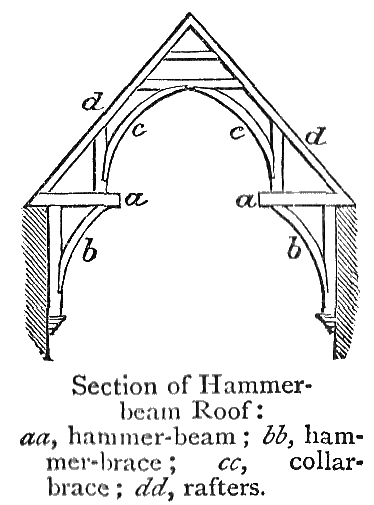
Hammer, ham′ėr, n. a tool for beating metal or driving nails: a striking-piece in the mechanism of a clock or piano: that part of the lock of a firearm which falls with a sharp blow and causes the discharge of the piece: the baton of an auctioneer, a knock from which signifies that an article is sold: a small bone of the ear, the malleus.—v.t. to drive, shape, or fashion with a hammer: to contrive by intellectual labour, to excogitate (with out): to declare (a person) a defaulter on the Stock Exchange: to beat down the price of (a stock), to depress (a market).—ns. Hamm′er-beam, a horizontal piece of timber in place of a tie-beam at or near the feet of a pair of rafters; Hamm′erhead, Hamm′er-fish, a rapacious fish of the shark family—from the shape of its head.—adj. Hamm′erheaded, with a head shaped like a hammer: dull in intellect, stupid.—n. Hamm′ering, a dented, appearance on silverware effected by successive blows of a hammer.—adj. Hamm′erless, without a hammer—of a gun.—n. Hamm′erman, a man who hammers, as a blacksmith, goldsmith, &c.—Hammer-and-tongs, with great noise and vigour, violently.—Bring to the hammer, to sell, or cause to sell, by auction; Up to the hammer, first-rate. [A.S. hamor; Ger. hammer, Ice. hamarr.]
Hammercloth, ham′ėr-kloth, n. the cloth which covers a coach-box. [Skeat thinks it an adaptation of Dut. hemal, heaven, a covering, with the addition of cloth, by way of giving a sort of sense.]
Hammochrysos, ham-o-krī′sos, n. a sparkling stone of the ancients, perhaps yellow micaceous schist. [Gr., hammos, sand, chrysos, gold.]
Hammock, ham′uk, n. a piece of strong cloth or netting suspended by the corners, and used as a bed by sailors. [Sp. hamaca, of Carib origin.]
Hamose, hā′mos, adj. hooked—also Hā′mous.—adjs. Ham′ular, like a small hook; Ham′ulate, having a small hook at the tip.—n. Ham′ulus, a small hook or hook-like process. [L. hamus, hook.]
Hamper, ham′pėr, v.t. to impede or perplex: to shackle.—n. a chain or fetter.—p.adj. Ham′pered, fettered, impeded.—adv. Ham′peredly.—n. Ham′peredness. [First about 1350, in Northern writers, prob. rel. to Ice. hemja (pt.t. hamdi), to restrain; Ger. hemmen.]
Hamper, ham′pėr, n. a large basket for conveying goods.—v.t. to put in a hamper.—ns. Han′ap, a large drinking-cup; Han′aper, an old name for a receptacle for treasure, paper, &c., long the name of an office in the Court of Chancery. [For hanaper—O. Fr. hanapier—hanap, a drinking-cup—Old High Ger. hnapf; A.S. hnæp, a bowl.]
Hamshackle, ham′shak-l, v.t. to shackle a cow or horse by a rope joined to the head and fore-leg: to fetter, restrain. [Hamper and shackle.]
Hamster, ham′stėr, n. a genus of rodent mammals of the family Muridæ, having cheek-pouches reaching back almost to the shoulders. [Ger.]
Hamstring, ham′string, n. the great tendon at the back of the knee or hock of the hind-leg of a quadruped.—v.t. to lame by cutting the hamstring.
Han, han (Spens.), pl. of have.
Hanaper. See Hamper, n.
Hanaster, Hanster. See under Hanse.
Hance, hans, n. (naut.) a curved rise from a lower to a higher part—sometimes Hanch, Haunch: (archit.) the arc of smaller radius at the springing of an elliptical or many-centred arch—also Haunch. [O. Fr. hauce, haulce, rise.]
Hanch, hansh, v.i. and v.t. to snap at with the jaws.
Hand, hand, n. the extremity of the arm below the wrist: that which does the duty of a hand by pointing, as the hand of a clock: the fore-foot of a horse: a measure of four inches: an agent or workman: (pl.) work-people in a factory: performance, agency, co-operation: power or manner of performing: skill: possession: style of handwriting, sign-manual: side: direction: the set of cards held by a single player at whist, &c.: a single round at a game.—v.t. to give with the hand: to lead or conduct: (naut.) to furl, as sails.—ns. Hand′-bag, a bag for small articles, carried in the hand; Hand′-ball, the sport of throwing and catching a ball; Hand′-barr′ow, a barrow without a wheel, carried by men: Hand′-bas′ket, a small portable basket; Hand′-bell, a small bell held by the hand when rung, a table-bell; Hand′bill, a pruning-hook used in the hand: a bill or loose sheet with some announcement; Hand′book, a manual or book of reference: a guide-book for travellers; Hand′breadth, the breadth of a hand: a palm; Hand′-cart, a small cart drawn by hand.—adj. Hand′ed (Milt.), with hands joined: (Shak.) having a hand of a certain sort.—ns. Hand′er; Hand′fast, a firm grip, handle: a contract, esp. a betrothal.—adj. bound, espoused: tight-fisted.—adj. Hand′fasted, betrothed.—n. Hand′fasting, betrothal: a private or even probationary form of marriage.—adj. Hand′-foot′ed, having feet like hands, chiropod.—ns. Hand′ful, as much as fills the hand: a small number or quantity:—pl. Hand′fuls; Hand′-gall′op, an easy gallop, in which the speed of the horse is restrained by the bridle-hand; Hand′-glass, a glass or small glazed frame used to protect plants: a small mirror; Hand′-grenade′, a grenade to be thrown by the hand; Hand′grip, grasp, grip, close struggle; Hand′icuffs, Hand′ycuffs, fighting hand to hand.—adj. Hand′less, awkward.—ns. Hand-line, a fishing-line worked by hand without a rod; Hand′-list, a list for easy reference; Hand′-loom, a weaver's loom worked by hand, as distinguished from a power-loom.—adj. Hand′-made, manufactured by hand, not by a machine.—ns. Hand′maid, Hand′maiden, a female servant; Hand′-mill, a mill worked by hand for coffee, pepper, &c., a quern; Hand′-or′gan, a portable organ, played by means of a crank turned by the hand; Hand′-pā′per, a particular make of paper, early in use at the Record Office, with the water-mark of a hand pointing; Hand′-post, a finger-post, guide; Hand′-prom′ise, a form of betrothal amongst the Irish peasantry; Hand′rail, a rail supported by balusters, as in staircases, to hold by.—adv. phrase, Hand′-run′ning, straight on, continuously.—ns. Hand′-saw, a saw manageable by the hand—also the same as Hern′shaw, in the proverb, 'not to know a hawk from a handsaw;' Hand′-screen, a small screen used to protect the face from the heat of the fire or sun; Hand′-screw, an appliance for raising heavy weights, a jack; Hand′spike, a bar used with the hand as a lever.—n.pl. Hand′staves (B.), probably javelins.—ns. Hands′-turn, a helping hand, aid; Hand′work, work done by hand, as distinguished from machinery; Hand′writing, the style of writing peculiar to each person: writing.—adj. Hand′-wrought, made with the hands, not by machinery.—Hand and [in] glove (with), on very intimate terms; Hand down, to transmit in succession; Hand in hand, in union, conjointly; Hand of God, a term used for unforeseen unpreventable accidents, as lightning, tempest, &c.; Hand over hand, by passing the hands alternately one before or above the other; Hand over head, rashly; Hands down, with ease; Hands off! keep off! refrain from blows! Hands up, a bushranger's call to surrender; Hand to hand, at close quarters; Hand to mouth, without thought for the future, precariously.—A bird in the hand, any advantage at present held; A cool hand, a person not easily abashed; At any hand, In any hand (Shak.), at any rate, in any case; At first hand, from the producer or seller, or from the first source direct; At hand, near in place or time; At second hand, from an intermediate purchaser or source; Bear a hand, make haste to help; Bear in hand (Shak.), to keep in expectation; Be hand and glove, to be very intimate and familiar; Believed on all hands, generally believed; Bloody, or Red, hand, granted to baronets of Great Britain and Ireland in 1611; By the strong hand, by force; Cap in hand, humbly; Change hands, to pass from one owner to another; Come to one's hand, to be easy to do; Dead man's hand, Hand-of-glory, a charm to discover hidden treasure, &c., made from a mandrake root, or the hand of a man who has been executed, holding a candle; For one's own hand, on one's own account; From good hands, from a reliable source; Gain the upper hand, to obtain the mastery; Get one's hand in, to become familiar with.—Handwriting on the wall, any sign foreshadowing disaster (from Dan. v. 5).—Have a hand in, to be concerned in; Have clean hands, to be honest and incorruptible; Have full hands, to be fully occupied; Hold hand (Shak.), to compete successfully; Hold in hand, to restrain; In hand, as present payment: in preparation: under control; Kiss the hand, in token of submission; Lay hands on, to seize; Laying on of hands, the laying on of the hands of a bishop or presbyters in ordination; Lend a hand, to give assistance; Off-hand, Out of hand, at once, immediately, without premeditation; Off one's hands, no longer under one's responsible charge; Old hand, one experienced, as opposed to Young hand; On all hands, on all sides; On hand, ready, available: in one's possession; On one's hands, under one's care or responsibility; Poor hand, an unskilful one; Second-hand, inferior, not new; Set the hand to, to engage in, undertake; Show one's hand, to expose one's purpose to any one; Stand one's hand (slang), to pay for a drink to another; Strike hands, to make a contract; Take in hand, to undertake; Take off one's hands, to relieve of something troublesome; To one's hand, in readiness; Under one's hand, with one's proper signature attached; Wash one's hands (of), to disclaim the responsibility for anything (Matt. xxvii. 24); With a heavy hand, oppressively; With a high hand, without taking other people into consideration, audaciously. [A.S. hand; in all Teut. tongues, perh. rel. to Goth. hinthan, to seize.]
Handcuff, hand′kuf, n. esp. in pl. Hand′cuffs, shackles for the hand locked upon the wrists of a prisoner.—v.t. to put handcuffs on:—pr.p. hand′cuffing; pa.p. hand′cuffed (-kuft). [Hand and cuff.]
Handicap, hand′i-kap, v.t. to impose special disadvantages or impediments upon in order to offset advantages, and make a better contest—in a horse-race the superior horse carries a heavier weight, while foot-runners are placed at different distances, or start at different times: (fig.) to place at a disadvantage by some burden or disability.—n. any contest so adjusted, or the condition imposed.—n. Hand′icapper, one who handicaps. [Hand in the cap, from the usage in an ancient kind of sport and method of settling a bargain by arbitration.]
Handicraft, hand′i-kraft, n. a manual craft or trade.—n. Hand′icraftsman, a man skilled in a manual art:—fem. Hand′icraftswoman.
Handiwork, Handywork, hand′i-wurk, n. work done by the hands, performance generally: work of skill or wisdom: creation.
Handjar, Hanjar, hand′jar, n. a Persian dagger.
Handkerchief, hang′kėr-chif, n. a piece of linen, silk, or cotton cloth for wiping the nose, &c.: a neckerchief.—Throw the handkerchief, to call upon next—from the usage in a common game.
Handle, hand′l, v.t. to touch, hold, or use with the hand: to make familiar by frequent touching: to manage: to discuss: to practise: to trade or do business in.—v.i. to use the hands.—n. that part of anything held in the hand: (fig.) that of which use is made: a tool: occasion, opportunity, pretext.—ns. Hand′ler, a person skilful in any special kind of manipulation; Hand′ling, the touching or managing with the hand: action: manner of touch.--A handle to the name, an adjunct of honour, as 'Dr,' 'Col.,' &c.; Give a handle, to furnish an occasion to. [A.S. handlian—hand, a hand.]
Handsel, Hansel, hand′sel, han′sel, n. the first sale or using of anything: earnest-money or part-payment by way of binding a bargain: (Scot.) a gift made on the first Monday of the year to a child or servant: a New-year's gift.—v.t. to give a handsel: to use or do anything the first time. [A.S. handselen, a giving into the hands of another; or Ice. handsal.]
Handsome, han′sum, adj. good-looking, well-proportioned, graceful: with dignity: liberal or noble: generous: ample.—adv. Hand′somely.—n. Hand′someness. [Hand and -some; cf. Dut. handzaam.]
Handy, han′di, adj. dexterous: ready to the hand: convenient: near.—adv. Hand′ily.—ns. Handi′ness; Hand′y-man, a man for doing odd jobs.
Handy-dandy, hand′i-dand′i, n. (Shak.) an old game among children, in which something is rapidly changed from one hand into the other, while another guesses in which hand it is. [A jingle on hand.]
Hang, hang, v.t. to hook or fix to some high point: to suspend: to decorate with pictures, &c., as a wall: to put to death by suspending and choking.—v.i. to be hanging, so as to allow of free motion: to lean, or rest for support: to drag: to hover or impend: to be in suspense: to linger:—pr.p. hang′ing; pa.t. and pa.p. hanged or hung.—n. action of hanging, bending down, &c.: a declivity: mode in which anything hangs: a slackening of motion: a hanging mass (Not a hang, not a bit, not in the least).—n. Hangabil′ity.—adj. Hang′able, liable to be hanged: punishable by hanging.—n. Hang′-dog, a low fellow.—adj. like such a fellow, esp. in his sneaking look.—ns. Hang′er, that on which anything is hung: a short sword, curved near the point; Hang′er-on, one who hangs on or sticks to a person or place: an importunate acquaintance: a dependent.—adj. Hang′ing, deserving death by hanging.—n. death by the halter: that which is hung, as drapery, &c.:—used chiefly in pl.—ns. Hang′ing-butt′ress, a buttress not standing solid on a foundation, but hanging or supported on a corbel; Hang′man, a public executioner; Hang′nail (see Agnail).—n.pl. Hang′-nests, a family of finch-like perching birds peculiar to America—often called American orioles, many weaving curious purse-like nests.—Hang back, to hesitate; Hang by a thread, to be in a very precarious position—from the sword of Damocles; Hang, draw, and quarter, to execute by hanging, cutting down while still alive, disembowelling, and cutting the body in pieces for exposure at different places; Hang fire, to be long in exploding or discharging, as a gun: to hesitate; Hang in doubt, to remain in a state of uncertainty; Hang in the balance, to be in doubt or suspense; Hang off, to let go, to hold off; Hang on, to cling to, to regard with admiration: to depend upon: to weigh down or oppress: to be importunate; Hang out (slang), to lodge or reside; Hang over, to project over; Hang together, to keep united; Hang up one's hat, to make one's self completely at home in a house. [A.S. hangian, causal form of hón, pa.t. heng, pa.p. hangen; Dut. and Ger. hangen, Goth. hahan.]
Hangar, hang′ar, n. a covered shed for carriages.
Hank, hangk, n. two or more skeins of thread tied together: a string, clasp, or other means of fastening. [Ice. hanki, a hasp.]
Hanker, hangk′ėr, v.i. to long for with eagerness: to linger about (with after, for).—n. Hank′ering, a lingering craving for something. [A freq. of hang, in sense to hang on; cf. Dut. hunkeren.]
Hanky-panky, hangk′i-pangk′i, n. jugglery, trickery. [A meaningless jingle, like hocus-pocus, &c.]
Hanoverian, han-o-vē′ri-an, adj. pertaining to Hanover, as of the brown rat, and the dynasty that came to the throne of England in 1714.—n. a supporter of the house of Hanover, as opposed to a Jacobite.
Hansard, han′sard, n. a name applied to the printed reports of the debates in parliament, from Luke Hansard (1752-1828), whose descendants continued to print these down to the beginning of 1889.—v.t. Han′sardise, to confront a member with his former opinions as recorded in his speeches in Hansard.
Hanse, hans, n. a league.—adjs. Hanse, Hanseat′ic, applied to certain commercial cities in Germany whose famous league for mutual defence and commercial association began in a compact between Hamburg and Lübeck in 1241.—ns. Han′aster, Han′ster, the ancient Oxford name for persons paying the entrance-fee of the guild-merchant, and admitted as freemen of the city. [O. Fr. hanse—Old High Ger. hansa, a band of men (Ger. hanse).]
Hansom-cab, han′sum-kab, n. a light two-wheeled cab or hackney-carriage with the driver's seat raised behind. [From the name of the inventor, Joseph Aloysius Hansom, 1803-82.]
Ha'n't, hānt, a coll. contr. for have not or has not.
Hantle, han′tl, n. (Scot.) a considerable number. [Cf. Dan. antal, Dut. aantal, Ger. anzahl. Some explain as hand and tale, number.]
Hap, hap, n. chance: fortune: accident.—v.i. to befall.—n. Hap-haz′ard, that which happens by hazard: chance, accident.—adj. chance, accidental.—adv. at random.—adv. Hap-haz′ardly.—n. Hap-haz′ardness.—adj. Hap′less, unlucky: unhappy.—adv. Hap′lessly.—n. Hap′lessness.—adv. Hap′ly, by hap, chance, or accident: perhaps: it may be.—v.i. Happ′en, to fall out: to take place: to chance to be.—n. Happ′ening. [Ice. happ, good luck.]
Hap, hap, v.t. (Scot.) to wrap up from the cold or rain.—n. a cloak or other covering.
Haplodon, hap′lō-don, n. a peculiar terrestrial rodent regarded as a connecting-link between beavers and squirrels, its single species (H. rufus) popularly known as the Sewellel, Boomer, and Mountain Beaver. [Gr. haploos, single, odous, odontos, tooth.]
Haplography, hap-log′raf-i, n. the inadvertent writing of a letter or word, or series of letters or words, once, when it should be written twice. [Gr. haploos, single, graphia, graphein, to write.]
Hap′orth, hā′pėrth, for halfpennyworth.
Happy, hap′i, adj. lucky, successful: possessing or enjoying pleasure or good: secure of good: furnishing enjoyment: dexterous, apt, felicitous.—v.t. (Shak.) to make happy.—v.t. Happ′ify, to make happy.—adv. Happ′ily.—n. Happ′iness.—adj. Happ′y-go-luck′y, easy-going: taking things as they come.—adv. in any way one pleases.—Happy despatch, a euphemism for the Hara-kiri (q.v.). [Hap.]
Haqueton, hak′ton, n. a stuffed jacket worn under the mail—same as Acton (q.v.).
Hara-kiri, har′a-kir′e, n. involuntary suicide by disembowelment, formerly practised in Japan by daimios and members of the military class, unable to outlive disgrace, or in order to anticipate execution. [Japanese hara, belly, kiri, cut.]
Harangue, ha-rang′, n. a loud speech addressed to a multitude: a popular, pompous address.—v.i. to deliver a harangue.—v.t. to address by a harangue:—pr.p. haranguing (-rang′ing); pa.p. harangued (-rangd′).—n. Harang′uer. [O. Fr. arenge, harangue, from Old High Ger. hring (Ger. ring), a ring of auditors.]
Harass, har′as, v.t. to fatigue: to annoy or torment.—p.adj. Har′assed.—adv. Har′assedly.—n. Har′asser.—p.adj. Har′assing.—adv. Har′assingly.—n. Har′assment. [O. Fr. harasser; prob. from harer, to incite a dog.]
Harbinger, här′bin-jėr, n. a forerunner, pioneer, originally one who goes forward to provide lodging.—v.t. to precede, as a harbinger. [M. E. herbergeour. See Harbour.]
Harbour, här′bur, n. any refuge or shelter: a port for ships—obs. form Har′borough.—v.t. to lodge or entertain: to protect: to possess or indulge, as thoughts.—v.i. to take shelter.—n. Har′bourage, place of shelter: entertainment.—n.pl. Har′bour-dues, charges for the use of a harbour.—n. Har′bourer, one who harbours or entertains.—adj. Har′bourless.—n. Har′bour-mas′ter, the public officer who has charge of a harbour.—Harbour of refuge, a harbour constructed to give shelter to ships on some exposed coast: any protection for one in distress. [M. E. herberwe—an assumed A.S. herebeorg—here, army, beorg, protection; cf. Ger. herberge, Ice. herbergi.]
Hard, härd, adj. not easily penetrated, firm, solid: difficult to understand or accomplish: violent, vehement: rigorous: close, earnest, industrious: coarse, scanty: stingy, niggardly: difficult to bear, painful: unjust: difficult to please: unfeeling: severe: stiff: constrained: intractable, resistant in some use, as water, &c.: strong, spirituous: (of silk) without having the natural gum boiled off: surd or breathed, as opposed to sonant or voiced.—n. a firm beach or foreshore: hard labour.—adv. with urgency, vigour, &c.: earnestly, forcibly: with difficulty: close, near, as in Hard by.—adv. Hard-a-lee, close to the lee-side, &c.—adj. Hard′-and-fast′, rigidly laid down and adhered to.—adv. Hard aport! a command instructing the helmsman to turn the tiller to the left or port side of the ship, thus causing the ship to swerve to the right or starboard.—ns. Hard′-bake, a sweetmeat made of boiled sugar and almonds; Hard′beam, the hornbeam.—adjs. Hard′-billed, having a hard bill or beak—of birds; Hard′-bitt′en, given to hard biting, tough in fight; Hard′-cured, cured thoroughly, as fish, by drying in the sun.—n. Hard′-drink′er, a constant drunkard.—adj. Hard′-earned, earned with toil or difficulty.—v.t. Hard′en, to make hard or harder: to make firm: to strengthen: to confirm in wickedness: to make insensible.—v.i. to become hard or harder, either lit. or fig.—adj. Hard′ened, made hard, unfeeling.—n. Hard′ener.—adj. Hard′-fav′oured, having coarse features.—n. Hard′-fav′ouredness.—adj. Hard′-feat′ured, of hard, coarse, or forbidding features.—n. Hard′-feat′uredness.—adjs. Hard′-fist′ed, having hard or strong fists or hands: close-fisted: niggardly; Hard′-fought, sorely contested; Hard′-gott′en, obtained with difficulty; Hard′-grained, having a close firm grain: uninviting.—n. Hard′-hack, the steeple-bush, an erect shrub of the rose family, with rose-coloured or white flowers.—adjs. Hard′-hand′ed, having hard hands: rough: severe; Hard′-head′ed, shrewd, intelligent; Hard′-heart′ed, having a hard or unfeeling heart: cruel.—adv. Hard′-heart′edly.—n. Hard′-heart′edness.—adj. Hard′ish, somewhat hard.—n. Hard′-lā′bour, labour imposed on certain classes of criminals during their imprisonment.—adv. Hard′ly, with difficulty: scarcely, not quite: severely, harshly.—adj. Hard′-mouthed, having a mouth hard or insensible to the bit: not easily managed.—n. Hard′-pan, the hard detritus often underlying the superficial soil: the lowest level.—adjs. Hard′-ruled (Shak.), ruled with difficulty; Hard′-run, greatly pressed; Hard′-set, beset by difficulty: rigid; Hard′-shell, having a hard shell: rigidly orthodox.—ns. Hard′ship, a hard state, or that which is hard to bear, as toil, injury, &c.; Hard′-tack, ship-biscuit.—adj. Hard′-vis′aged, of a hard, coarse, or forbidding visage.—ns. Hard′ware, trade name for all sorts of articles made of the baser metals, such as iron or copper; Hard′wareman.—adj. Hard′-won, won with toil and difficulty.—n.pl. Hard′wood-trees, forest trees of comparatively slow growth, producing compact hard timber, as oak, ash, elm, walnut, beech, birch, &c.—Hard hit, seriously hurt, as by a loss of money: deeply smitten with love; Hard lines, a hard lot; Hard metal, an alloy of two parts of copper with one of tin for gun metal; Hard money, money emphatically, prop. coin; Hard of hearing, pretty deaf; Hard swearing, swearing (as a witness) persistently to what is false, perjury; Hard up, short of money.—Be hard put to it, to be in great straits or difficulty; Die hard, to die only after a desperate struggle for life. [A.S. heard; Dut. hard, Ger. hart, Goth. hardus; allied to Gr. kratys, strong.]
Hardock. See Harlock.
Hards, härdz, n.pl. also Hurds, coarse or refuse flax or hemp from which is made the coarse fabric Hard′en, Herd′en, Hurd′en.
Hardy, härd′i, adj. daring, brave, resolute: confident: impudent: able to bear cold, exposure, or fatigue.—ns. Hard′ihood, Hard′iness, Hard′iment (arch.).—adv. Hard′ily. [O. Fr. hardi—Old High Ger. hartjan, to make hard.]
Hare, hār, n. a common and very timid animal, with a divided upper lip and long hind-legs, which runs swiftly by leaps.—ns. Hare-and-hounds, a boys' game in which some set off on a long run across country, dropping pieces of paper (the scent) as they go, and others try to overtake, following their trail; Hare′bell, a plant with blue bell-shaped flowers.—adjs. Hare′-brained, giddy: heedless; Hare′-foot, swift of foot like a hare; Har′ish, somewhat like a hare.—n. Hare′-lip, a fissure in the upper human lip like that of a hare.—adj. Hare′-lipped.—n. Hare's′-ear, a genus of umbelliferous plants having yellow flowers.—First catch your hare, make sure you have a thing first before you think what to do with it—from a direction in Mrs Glasse's cookery-book, where catch, however, was a misprint for 'case'=skin; Hold with the hare and run with the hounds, to play a double and deceitful game, to be with both sides at once; Jugged hare, hare cut into pieces and stewed with wine and other seasoning; Mad as a March hare, from the gambols of the hare during the breeding season. [A.S. hara; Dut. haas, Dan. hare, Ger. hase.]
Hareld, har′eld, n. a genus of northern sea-ducks. [Norw. havella—hav, sea.]
Harem, hā′rem, n. the portion of a Mohammedan house allotted to females: the collection of wives and concubines belonging to one Mussulman. [Ar. haram, anything forbidden—harama, to forbid.]
Haricot, har′i-ko, -kot, n. a kind of ragout or stew of mutton and beans or other vegetables: the kidney-bean or French bean. [Fr. haricot.]
Hari-kari, an incorrect form of hara-kiri.
Hark, härk, interj. or imper. listen.—n. a whisper.—n. Hark′-back, a backward move.—Hark back, to revert to the original point. [Hearken.]
Harl, härl, n. the skin of flax: any filamentous substance.
Harl, härl, v.t. (Scot.) to drag along the ground: to rough-cast a wall with lime.—v.i. to drag one's self: to troll for fish.—n. act of dragging: a small quantity, a scraping of anything.
Harleian, har-lē′an, här′li-an, adj. pertaining to Robert Harley, Earl of Oxford (1661-1724), and his son, Edward Harley, esp. in reference to the library of books and MSS. collected by them—the latter in the British Museum since 1753.
Harlequin, här′le-kwin, or -kin, n. the leading character in a pantomime, the lover of Columbine, in a tight spangled dress, with a wand, by means of which he is supposed to be invisible and to play tricks: a buffoon.—v.i. to play the harlequin.—n. Harlequināde′, the portion of a pantomime in which the harlequin plays a chief part.—Harlequin duck, a species of northern sea-duck, so called from its variegated markings. [Fr. harlequin, arlequin (It. arlecchino), prob. the same as O. Fr. Hellequin, a devil in medieval legend, perh. of Teut. origin.]
Harlock, här′lok, n. (Shak.) a flower not identified, not charlock=wild mustard, or hardock=burdock.
Harlot, här′lot, n. a woman who prostitutes her body for hire, a whore.—adj. wanton: lewd.—n. Har′lotry, prostitution, unchastity: (obs.) a woman given to such: meretriciousness. [O. Fr. herlot, arlot, a base fellow; origin dub., perh. from Old High Ger. karl (A.S. ceorl).]
Harm, härm, n. injury: moral wrong.—v.t. to injure.—adj. Harm′ful, hurtful.—adv. Harm′fully.—n. Harm′fulness.—adj. Harm′less, not injurious, innocent: unharmed.—adv. Harm′lessly.—n. Harm′lessness. [A.S. hearm; Ger. harm.]
Harmala, här′ma-la, n. wild rue—also Har′mel.—ns. Har′maline, a white crystalline alkaloid obtained from the seeds of wild rue; Har′malol, Har′mine, other alkaloids from the same source. [Gr., from Semitic; cf. Ar. harmil.]
Harman, här′man, n. (slang) a policeman—also Har′man-beck: (pl.) the stocks.
Harmattan, har-mat′an, n. a hot, dry, noxious wind which blows periodically from the interior of Africa to the Atlantic along the Guinea coast during December, January, and February. [Fanti.]
Harmonic, -al, har-mon′ik, -al, adj. pertaining to harmony: musical: concordant: recurring periodically.—n. a secondary tone, overtone; a note on a stringed instrument produced by lightly stopping a string: (math.) one of a class of functions that enter into the development of the potential of a nearly spherical mass due to its attraction.—adv. Harmon′ically.—n.pl. Harmon′ics, used as sing. the science of harmony or of musical sounds—as pl. consonances, the component sounds included in what appears to the ear to be a single sound.—adj. Harmō′nious, having harmony: symmetrical, congruous: concordant.—adv. Harmō′niously.—ns. Harmō′niousness; Harmonisā′tion.—v.i. Har′monīse, to be in harmony: to agree.—v.t. to make in harmony: to cause to agree: (mus.) to provide parts to.—ns. Harmonīs′er; Har′monist, one skilled in harmony: a musical composer.—Harmonic engine, an invention of Edison's, in which the energy of an electric current is used, by means of two small electro-magnets, to keep up the vibrations of a large and heavily-weighted tuning-fork whose arms are connected with two pistons working a miniature pump; Harmonic progression, a series of numbers the reciprocals of which are in arithmetical progression; Harmonic proportion, the relation of three quantities in harmonic progression—the 2d a harmonic mean between the 1st and 3d, as in the three numbers 2, 3, and 6; Harmonic triad, the common chord.
Harmonium, har-mō′ni-um, n. a reed-organ, esp. one in which the air is compressed in the bellows and driven thence through the reeds.—ns. Harmon′ica, the musical glasses—an instrument invented by Franklin, the sounds of which were produced from bell-shaped glasses placed on a framework that revolved on its centre, while the rims were touched by the moistened finger: a musical instrument consisting of a series of glass or metal plates played by striking with a small mallet: a mouth-organ or harmonicon; Harmon′icon, a mouth-organ: an acoustic apparatus by which a musical note is evolved when a long dry tube, open at both ends, is held over a jet of burning hydrogen; Harmon′iphone, a musical instrument played with a keyboard, in which the sounds are produced by reeds set in a tube, and vibrating under pressure from the breath; Harmō′niumist, one who plays the harmonium; Harmon′ograph, an instrument for tracing curves representing sonorous vibrations; Harmonom′eter, one for measuring the harmonic relations of sounds.
Harmony, här′mo-ni, n. a fitting together of parts so as to form a connected whole, agreement in relation: in art, a normal state of completeness and order in the relations of things to each other: (mus.) a simultaneous combination of accordant sounds: the whole chordal structure of a piece, as distinguished from its melody or its rhythm: concord, music in general: a collation of parallel passages regarding the same event arranged to demonstrate the substantial unity—as of the Gospels.—Harmony, or Music, of the spheres, a harmony formed by the regular movements of the heavenly bodies throughout space, determined by the relation to each other of the intervals of separation; Pre-established harmony, the designation of Leibnitz for his theory of the divinely established relation between body and mind—the movements of monads and the succession of ideas, as it were a constant agreement between two clocks. [Fr.,—L.,—Gr. harmonia—harmos, a fitting—arein, to fit.]
Harmost, här′most, n. a Spartan governor of a subject city or province.—n. Har′mosty; the office of such.
Harmotome, här′mō-tōm, n. a hydrous silicate of aluminium and barium.—Also Cross-stone.
Harness, här′nes, n. the equipments of a horse: formerly, the armour of a man or horse: equipment for any kind of labour.—v.t. to equip with armour: to put the harness on a horse.—n. Har′ness-cask, a tub, a cask with rimmed cover on a ship's deck holding the salt meat for daily use.—Die in harness, to die at one's work. [O. Fr. harneis, armour; dubiously referred to Celt., as in Bret. harnez, old iron, also armour.]
Harns, härnz, n.pl. (Scot.) the brains. [A.S. hærnes, most prob. Norse hjarne; cf. Ger. hirn.]
Haro, hä′ro, n. an old term for a form of appeal in the Channel Islands, a demand for protection against harm, or for assistance to arrest an adversary.—Also Ha′row, Har′row (Spens.), a mere exclamation of distress. [O. Fr. haro, harou, of unknown origin; not ha Rou! an appeal to Rolf, Rollo, or Rou, the first Duke of Normandy.]
Harp, härp, n. a musical stringed instrument much esteemed by the ancients.—v.i. to play on the harp: to dwell tediously upon anything.—v.t. to give voice to.—ns. Harp′er, Harp′ist, a player on the harp.—n.pl. Harp′ings (naut.), the fore-parts of the wales surrounding the bow extensions of the rib-bands.—n. Harp′-shell, a genus of gasteropodous molluscs with inflated shell.—Harp on one string, to dwell constantly on one topic. [A.S. hearpe; Ger. harfe.]
Harpoon, här-pōōn′, n. a dart for striking and killing whales.—v.t. to strike with the harpoon.—ns. Harpoon′er, Harpooneer′, one who uses a harpoon; Harpoon′-gun, a gun from which a harpoon or toggle-iron may be discharged. [Fr. harpon—harpe, a clamp—L. harpa, Gr. harpē, sickle.]
Harpsichord, härp′si-kord, n. an old-fashioned keyed musical instrument, where the sound is produced by the twitching of the strings by a piece of crow-quill or hard leather. [O. Fr. harpechorde.]
Harpy, här′pi, n. (myth.) a rapacious and filthy monster, with the body of a woman and the wings, feet, and claws of a bird of prey, considered as a minister of the vengeance of the gods: (her.) a vulture with the head and breast of a woman: a South American eagle, larger than the golden eagle, and of great strength and rapacity: a rapacious person. [L. harpyia—Gr., pl. harpyiai, 'snatchers,' symbols of the storm-wind—harpazein, to seize.]
Harquebus, Harquebuse, Harquebuss, här′kwi-bus, n. Same as Arquebuse.
Harridan, har′i-dan, n. a vixenish old woman. [Prob. O. Fr. haridelle, a lean horse, a jade.]
Harrier, har′i-ėr, n. a small kind of dog with a keen smell, for hunting hares: (pl.) a name taken by some clubs of cross-country runners (see Hare-and-hounds). [Formed from hare, like graz-i-er.]
Harrovian, har-ō′vi-an, adj. pertaining to Harrow.—n. one educated at the public school there.
Harrow, har′ō, n. a frame of wood or iron toothed with spikes for smoothing and pulverising ploughed land, and for covering seeds sown.—v.t. to draw a harrow over: to harass: to tear.—adj. Harr′owing, acutely distressing to the mind.—adv. Harr′owingly.—n. Chain′-harr′ow, a harrow composed of rings for breaking clods of earth.—Under the harrow, in distress or anxiety. [A.S. hearge; cf. Ice. herfi, Dan. harv.]
Harrow. See Haro.
Harry, har′i, v.t. to plunder: to ravage: to destroy: to harass:—pr.p. harr′ying; pa.p. harr′ied.—n. Harr′ier, one who, or that which, harries: a kind of hawk so named from its harrying or destroying small animals.—Harrying, or Harrowing, of hell, the spoiling of hell, the delivery by Christ, upon His descent into hell after the crucifixion, of the souls of patriarchs and prophets there held in bondage by Satan (1 Pet. iii. 19)—a favourite subject of Christian art, and of our own medieval writers of Mysteries. [A.S. hergian, from A.S. here, gen. herg-es, an army; Ger. heer.]
Harsh, härsh, adj. rough: bitter: jarring: abusive: severe: unkind.—v.t. Harsh′en, to render harsh.—adv. Harsh′ly.—n. Harsh′ness. [M. E. harsk, a northern word; cf. Sw. härsk and Dan. harsk, rancid, Ger. harsch, hard.]
Hart, härt, n. the stag or male deer from the age of six years, when the crown or sur-royal antler begins to appear:—fem. Hind.—ns. Hart′ebeest, Hart′beest, a South African antelope; Harts′horn, the antlers of the red deer: a solution of ammonia, orig. a decoction of the shavings of a hart's horn; Harts′tongue, a genus of widely distributed ferns, one species native to Britain, common in moist woods.—Hart of grease, a hart of the season when fat. [A.S. heort; Dut. hert, Ger. hirsch.]
Harum-scarum, hā′rum-skā′rum, adj. flighty: rash.—n. a giddy, rash person. [Prob. compounded of hare, from the sense of haste and fright, and scare.]
Haruspex, ha-rus′peks, n. (pl. Harus′pices) a soothsayer or diviner among the Etruscans, and from them adopted by the Romans, who foretold future events from the inspection of the entrails of animals offered in sacrifice—also Harus′pice.—ns. Haruspicā′tion, Harus′picy, divination as by a haruspex. [L., from an assumed haru, cog. with Sans. hirâ, entrails, and L. specĕre, to view.]
Harvest, här′vest, n. the time of gathering in the ripened crops: the crops gathered in: fruits: the product of any labour: consequences.—v.t. to reap and gather in.—ns. Har′vest-bug, -louse, -tick, a mite or tick of minute size, abundant late in summer, and very troublesome to people with delicate skins; Har′vester, a reaper in harvests; Har′vest-feast, the feast made at the ingathering of harvest; Har′vest-field, a field where a harvest is or has been; Har′vest-fly, in U.S. the popular name for a species of cicada; Har′vest-home, the bringing home of the harvest: the feast held at the bringing home of the harvest; Har′vest-lord, the head-reaper at the harvest; Har′vest-man (B.), a labourer in harvest; Har′vest-moon, the full moon nearest the autumnal equinox, rising nearly at the same hour for several days; Har′vest-mouse, a very small species of mouse, building its nest in the stalks of growing corn; Har′vest-queen, an image of Ceres, the queen or goddess of fruits, in ancient times carried about on the last day of harvest. [A.S. hærfest; Ger. herbst, Dut. herfst.]
Has, haz, 3d pers. sing. pres. ind. of have.
Hash, hash, v.t. to hack: to mince: to chop small.—n. that which is hashed: a mixed dish of meat and vegetables in small pieces: a mixture and preparation of old matter: (Scot.) a stupid fellow.—adj. Hash′y.—Make a hash of, to spoil or ruin completely; Settle a person's hash (slang), to silence him: to make an end of him. [O. Fr.,—Fr. hacher—hache, hatchet.]
Hashish, hash′ish, -ēsh, n. name given to the leaves of the Indian hemp, from which an intoxicating preparation is made. See Bhang and Assassin. [Ar.]
Hask, hask, n. (Spens.) a fish-basket made of rushes. [Prob. from root of hassock.]
Haslet, has′let, n. the edible entrails of an animal, esp. the hog.—Also Hars′let. [O. Fr. hastelet, haste, a spit—L. hasta, a spear.]
Hasp, hasp, n. a clasp: the clasp of a padlock: a spindle: a skein of yarn.—v.t. to fasten with a hasp. [A.S. hæpse; Dan. and Ger. haspe.]
Hassock, has′uk, n. a thick cushion used as a footstool or for kneeling on in church: Kentish rag-stone. [A.S. hassuc; prob. W. hesg, sedge.]
Hast, hast, 2d pers. sing. pres. ind. of have.
Hastate, -d, hast′āt, -ed, adj. (bot.) spear-shaped.—Also Hast′iform. [L. hastātus—hasta, spear.]
Haste, hāst, n. speed, quickness, a hurry: rashness: vehemence.—vs.t. Haste, Hasten (hās′n), to put to speed: to hurry on: to drive forward.—vs.i. to move with speed: to be in a hurry:—pr.p. hāst′ing, hastening (hās′ning); pa.p. hāst′ed, hastened (hās′nd).—n. Hast′ener.—adv. Hast′ily.—n. Hast′iness, hurry: rashness: irritability.—adj. Hast′y, speedy: quick: rash: eager: passionate.—n. Hast′y-pudd′ing, flour, milk, or oatmeal and water porridge.—adj. Hast′y-wit′ted, rash.—Make haste, to hasten. [O. Fr. haste (Fr. hâte), from Teut.; cf. A.S. hǽst, Dut. haast, Ger. hast.]
Hat, hat, n. a covering for the head, generally with crown and brim: the dignity of a cardinal, so named from his red hat.—v.t. to provide with, or cover with, a hat.—ns. Hat′band, the ribbon round a hat, often a mourning-band; Hat′-box, a box in which a hat is carried; Hat′-peg, -rack, -rail, -stand, &c., a contrivance on which hats are hung.—adj. Hat′ted, covered with a hat.—ns. Hat′ter, one who makes or sells hats: a miner who works by himself; Hat′ting, giving a hat; Hat′-trick, any conjurer's trick with a hat: a House of Commons mode of securing a seat by placing one's hat on it: in cricket, the feat of a bowler who takes three wickets by three successive balls—deserving a new hat.—Chimney-pot, Cocked, and Crushed hat (see Chimney, Cock, Crush).—Hang up one's hat (see Hang); Mad as a hatter, completely insane: very angry; Pass round the hat, to beg for contributions, to take up a collection. [A.S. hæt, Dan. hat.]
Hatch, hach, n. a door with an opening over it, a wicket or door made of cross-bars; the covering of a hatchway.—v.t. to close as with a hatch.—ns. Hatch′-boat, a kind of half-decked fishing-boat; Hatch′way, the opening in a ship's deck into the hold, or from one deck to another.—Under hatches, below deck, off duty, under arrest. [A.S. hæc, a gate; Dut. hek, a gate.]
Hatch, hach, v.t. to produce, especially from eggs, by incubation: to originate: to plot.—v.i. to produce young: to be advancing towards maturity.—n. act of hatching: brood hatched.—ns. Hatch′er, one who, or that which, hatches; Hatch′ery, a place for hatching eggs, esp. those of fish, by artificial means.—Count the chickens before they are hatched, to depend too securely on some future and uncertain event. [Early M. E. hacchen, from an assumed A.S. hæccean; cf. Mid. High Ger. hecken, Sw. häcka.]
Hatch, hach, v.t. to shade by minute lines crossing each other in drawing and engraving.—n. Hatch′ing, the mode of so shading. [O. Fr. hacher, to chop.]
Hatchel, hach′el, n. and v. Same as Hackle.
Hatchet, hach′et, n. a small axe used by one hand.—adjs. Hatch′et-faced, having a thin, sharp-featured face; Hatch′ety, like a hatchet.—Bury the hatchet, to put an end to war, from the habit of the North American Indians. [Fr. hachette, hacher, to chop.]
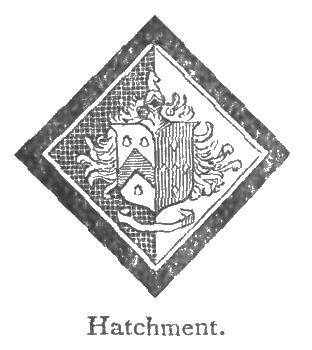
Hatchment, hach′ment, n. the arms of a deceased person within a black lozenge-shaped frame, meant to be placed on the front of his house. [Corrupted from achievement.]
Hate, hāt, v.t. to dislike intensely: to dislike: to despise relatively to something else.—n. extreme dislike: hatred.—adjs. Hate′able, deserving to be hated; Hate′ful, exciting hate: odious: detestable: feeling or manifesting hate.—adv. Hate′fully.—ns. Hate′fulness; Hat′er; Hat′red, extreme dislike: enmity: malignity. [A.S. hete, hate, hatian, to hate; Ger. hasz.]
Hate, Haet, hāt, n. (Scot.) a whit.
Hathor, hath′or, n. name of an Egyptian goddess, ranked among the second class of deities, who was the daughter of Ra, the sun.
Hatter, hat′ėr, v.t. to trouble, annoy: to batter.
Hatti, hat′i, n. a Turkish decree of the highest authority, differing from a firman in being signed by the Sultan himself—in full, Hatti-sherif (sher-ēf′).
Hauberk, haw′bėrk, n. a tunic, worn by the Norman soldiers, covered with rings or mascles, reaching to the knees, slit at the sides or in the front and back for convenience in riding, though sometimes ending in short trousers, originally a piece of armour for the neck. [O. Fr. hauberc—Old High Ger. halsberg—hals, neck, bergan, to protect.]
Haugh, häh, n. (Scot.) a level plain, generally near a river. [A.S. healh, halh, a corner.]
Haughty, haw′ti, adj. proud: arrogant: contemptuous: (arch.) bold: (Spens.) high—Shakespeare has Haught.—adv. Haught′ily.—n. Haught′iness. [O. Fr. halt, haut, high—L. altus, high.]
Haul, hawl, v.t. to drag: to pull with violence.—v.i. to tug, to try to draw something: to alter a ship's course, to sail generally.—n. a pulling: a draught, as of fishes: a source of interest or profit.—ns. Haul′age, act of hauling: charge for hauling or pulling a ship or boat; Haul′er, Haul′ier.—Haul over the coals (see Coal); Haul off, or round, to turn a ship's course away from an object; Haul up, to come or bring to rest after hauling. [Hale.]
Hauld, häld, a Scotch form of hold, as in the prov. phrase, 'out of house and hauld'=homeless and completely destitute.
Haulm. See Halm.
Hault, hawlt, adj. (Spens.). Haughty.
Haunch, hawnsh, n. the fleshy part of the hip and buttock: (Shak.) the hip, the hind-part, the rear: (archit.) the middle part between the vertex or crown and the springing of an arch.—adjs. Haunch′less; Haunch′y. [O. Fr. hanche; prob. Ger., Old High Ger. anchâ, leg.]
Haunch, hawnsh, v.t. (prov.) to throw with an underhand movement.—n. a jerked underhand throw.
Haunt, hawnt, v.t. to frequent: to follow importunately: to intrude upon continually: to inhabit or visit as a ghost.—v.i. to be much about: to appear or visit frequently.—n. a place much resorted to: (Shak.) habit of frequenting.—p.adj Haunt′ed, frequented, infested, esp. by ghosts or apparitions.—n. Haunt′er.—adv. Haunt′ingly. [O. Fr. hanter; acc. to Littré, a corr. of L. habitāre.]
Haustellum, haws-tel′um, n. the sucking organ or proboscis of an insect or a crustacean:—pl. Haustella.—adj. Haus′tellate, provided with such.
Haussmannize, hows′man-īz, v.t. to open out, widen, and straighten streets, and generally rebuild, as Baron Haussmann did to Paris when prefect of the Seine (1853-70).—n. Haussmannizā′tion.
Haustorium, haws-tō′ri-um, n. a small sucker of a parasitic plant, penetrating the tissues of the host:—pl. Haustō′ria.
Hautboy, hō′boi, n. an older form of Oboe (q.v.): a large kind of strawberry. [Fr. hautbois—haut, high, bois, wood.]
Hauteur, hō-tār′, n. haughtiness: arrogance.—adj. Haut (Milt.), haughty.—ns. Haut-goût, flavour, spice, a taint: a highly seasoned dish; Haut-pas, a dais; Haut′-relief′, high relief.—Haut ton, high fashion, people of high fashion. [Fr.]
Haüyne, hä′win, n. a rock-forming mineral, a silicate of alumina and soda or lime, with sodium and calcium sulphate. [Named from René Just Haüy, a French mineralogist (1743-1822).]
Havana, ha-van′a, n. a fine quality of cigar, named from Havana, the capital of Cuba, fondly supposed to be made there.—Also Havann′a(h).
Have, hav, v.t. to own or possess: to hold, contain: to hold control of: to grasp the meaning of: to allow to be done, to cause: to regard, hold in opinion, esteem: to obtain: to enjoy: to bear or beget: to effect: to be affected by: to get the better of, outwit, to have hold upon:—pr.p. hav′ing; pa.t. and pa.p. had.—ns. Hav′er, one who has or possesses, a holder: (Scots law) a term to denote the person in whose custody a document is; Hav′ing, act of possessing: possession, estate: behaviour: (Scot. esp. in pl.) good manners.—adj. greedy.—Have as good, lief, to be as willing; Have at, attack, thrust; Have done (with), to come to the end of one's dealings; Have it out, to have something finally settled; Have on, to wear; Have rather, to prefer; Have up, to call to account before a court of justice, &c. [A.S. habban, pa.t. hæfde, pa.p. gehæfd; Ger. haben, Dan. have.]
Havelock, hav′lok, n. a white cover for a military cap, with a long rear flap as a protection from the sun. [From Gen. Henry Havelock, 1795-1857.]
Haven, hā′vn, an inlet of the sea, or mouth of a river, where ships can get good and safe anchorage: any place of safety: an asylum.—v.t. to shelter.—p.adj. Hā′vened, sheltered, as in a haven. [A.S. hæfen; Dut. haven, Ger. hafen.]
Haver, hāv′ėr, v.i. (Scot.) to talk nonsense, or foolishly.—n. Hav′erel, a foolish person.—n.pl. Hav′ers, foolish talk.
Haversack, hav′ėr-sak, n. a bag of strong linen for a soldier carrying his rations in.—n. Hav′er (prov.), oats. [Fr. havresac—Ger. habersack, oat-sack—haber, hafer, oats.]
Haversian, hav-er′si-an, adj. pertaining to or named after Clopton Havers, a 17th-cent. English anatomist who investigated the blood-vascular system of bone.
Havildar, hav′il-dar, n. the highest rank of non-commissioned officer among native troops in India and Ceylon. [Pers.]
Haviour, hāv′ūr, n. (obs.) behaviour.
Havoc, hav′ok, n. general waste or destruction: devastation.—v.t. to lay waste.—interj. an ancient hunting or war cry. [O. Fr. havot, plunder, of Teut. origin.]
Haw, haw, n. a hedge or enclosure: a field: the berry of the hawthorn.—ns. Haw′-buck, a clown; Haw′finch, the common grosbeak; Haw′thorn, a shrub or small tree, much planted both for hedges and for ornament: the white flower of the hawthorn. [A.S. haga, a yard or enclosure; Dut. haag, a hedge, Ger. hag, a hedge, Ice. hagi, a field.]
Haw, haw, v.i. to speak with hesitation or a drawling manner, real or affected—hence adj. Haw-haw, in an affected tone of voice.—n. a hesitation in speech: loud vulgar laughter.—v.i. to guffaw, to laugh boisterously. [Imit.]
Haw, haw, n. the nictitating membrane or third eyelid, as of a horse; also a disease of this membrane.
Hawk, hawk, n. the name of several birds of prey allied to the falcons: a rapacious person.—v.i. to hunt birds with hawks trained for the purpose: to attack on the wing.—ns. Hawk′-bell, a small bell attached to a hawk's leg; Hawk′bit, a genus of plants of order Compositæ, closely related to the dandelion; Hawk′er.—adj. Hawk′-eyed.—n. Hawk′ing.—adj. Hawk′ish.—n. Hawk′-moth, a very large kind of moth, so called from its hovering motion.—adj. Hawk′-nosed, having a nose like a hawk's beak.—ns. Hawks′beard, a genus of annual and biennial plants of order Compositæ, closely related to hawkweed; Hawk′weed, a genus of perennial plants of order Compositæ.—Know a hawk from a handsaw (prob. for hernshaw), to be able to judge between things pretty well. [A.S. hafoc; Dut. havik, Ger. habicht, Ice. haukr.]
Hawk, hawk, v.i. to force up matter from the throat.—n. the effort to do this. [Imit.]
Hawk, hawk, n. a plasterer's tool.
Hawked, hawkt, adj. (Scot.) spotted, streaked.—ns. Haw′key, Haw′kie, a dark cow with white-striped face.
Hawker, hawk′ėr, n. one who carries about goods for sale on his back, a pedlar.—v.t. Hawk, to carry about for sale: to cry for sale. [Cf. Low Ger. and Ger. höker, Dut. heuker.]
Hawm, hawm, v.i. (prov.) to lounge about.
Hawse, hawz, n. the part of a vessel's bow in which the hawse-holes are cut.—n.pl. Hawse′-holes, the holes in a ship's bow through which the cables pass.—ns. Hawse′-pipe, an iron pipe fitted into a hawse-hole, to save the wood; Hawse′-tim′ber, one of the upright timbers in the bow in which the hawse-holes are cut. [Ice. háls, the neck.]
Hawser, häz′ėr, n. a small cable, a large rope used in warping.—adj. Haws′er-laid, made of three small ropes laid up into one. [O. Fr. haucier, haulser, to raise—Low L. altiare—L. altus, high.]
Hawthorn. See Haw.
Hay, hā, n. grass cut down and dried for fodder.—ns. Hay′cock, a conical pile of hay in the field; Hay′-fē′ver, an ailment mostly met with in early summer, marked by excessive irritation of the nose, throat, &c., and accompanied with violent sneezing and intense headache—also called Hay′-asth′ma; Hay′field, a field where hay is made; Hay′-fork, a long-handled fork used in turning over hay to dry, or in lifting it; Hay′-knife, a broad knife, with a handle set cross-wise at one end, used for cutting hay from a stack; Hay′-loft, a loft in which hay is kept; Hay′-mak′er, one employed in cutting and drying grass for hay: (pl.) a kind of country-dance; Hay′-mak′ing; Hay′-mow, a rick of hay: a mass of hay stored in a barn; Hay′-rick, a pile of hay; Hay′-stack, a stack of hay; Hay′-ted′der, a machine for scattering hay and exposing it to the sun and air.—Look for a needle in a hay-stack, to look for something where it is barely possible to be found; Make hay, to throw things into confusion; Make hay while the sun shines, to seize a favourable opportunity. [A.S. híeg, híg, hég; Ger. heu, Dut. hooï, Ice. hey.]
Hay, hā, n. a hedge, fence.—n. Hay′-ward, one who herded the common cattle of a town. [A.S. hege—haga, a hedge.]
Hay, hā, n. (Shak.) a home-thrust in fencing. [It. hai, avere—L. habēre, to have.]
Hay, hā, n. a country-dance with winding movement.
Hazard, haz′ard, n. a game played with a dice-box and two dice by any number of players: chance: accident: risk: (billiards) the pocketing of the object ball (winning hazard), of the player's own ball after contact (losing hazard): (tennis) the side of the court into which the ball is served: (golf) a general term for all difficulties on a golf-links—bunkers, long grass, roads, water, whins, &c.—v.t. to expose to chance: to risk: to venture.—v.i. to run a risk.—adj. Haz′ardable.—n. Haz′ardise (Spens.), hazard.—adj. Haz′ardous, dangerous: perilous: uncertain.—adv. Haz′ardously.—ns. Haz′ardousness; Haz′ardry (Spens.), playing at games of hazard or chance: rashness; Chick′en-haz′ard, a game of chance with very small stakes. [O. Fr. hasard; prob. through the Sp. from Arab. al zār, the die; but Littré favours William of Tyre's derivation from Hasart, a castle in Syria, where the game was discovered during the Crusades.]
Haze, hāz, n. vapour which renders the air thick: obscurity.—v.i. to form a haze.—adv. Haz′ily.—n. Haz′iness.—adj. Haz′y, thick with haze: obscure: confused (of the mind). [App. not the A.S. hasu, haswe, gray; prob. Ice. höss, gray.]
Haze, hāz, v.t. to vex with needless tasks: to play tricks upon, to bully.—ns. Haz′er, a player of boorish pranks and practical jokes; Haz′ing, brutal horse-play. [O. Fr. haser, to annoy.]
Hazel, hā′zl, n. a bush or small tree of genus Corylus, of the oak family (Cupuliferæ), yielding an ovoid bony nut enclosed in a leafy involucre.—adj. pertaining to the hazel: of a light-brown colour, like a hazel-nut.—n. Hā′zeline, an alcoholic distillate from the Witch Hazel.—adj. Hā′zelly, light brown like the hazel-nut.—n. Hā′zel-nut, the nut of the hazel-tree. [A.S. hæsel; Ger. hasel, Ice. hasl, L. corulus.]
He, hē, pron. of the third person: the male person named before: a male person or animal.—adj. male. [A.S. hé; Dut. hij, Ice. hann.]
Head, hed, n. the uppermost or foremost part of an animal's body: the brain: the understanding: a chief or leader: the place of honour or command: the front or top of anything: an individual animal or person: a topic or chief point of a discourse: a title, heading: the source or spring: height of the source of water: highest point of anything: culmination: a cape: strength: a froth on beer, porter, &c., when poured into a glass.—v.t. to act as a head to, to lead or govern: to go in front of: to commence: to check: (naut.) to be contrary: (obs.) to behead.—v.i. to grow to a head: to originate: to go head foremost.—n. Head′ache, an internal pain in the head.—adj. Head′achy, afflicted with headaches.—ns. Head′band, a band or fillet for the head: the band at each end of a book: a thin slip of iron on the tympan of a printing-press; Head′-block, in a sawmill carriage, a cross-block on which the head of the log rests: a piece of wood in a carriage, connected with the spring and the perches, and joining the fore-gear and the hind-gear; Head′-board, a board placed at the head of anything, esp. a bedstead; Head′-boom, a jib-boom or a flying jib-boom; Head′bor′ough, an old term for the head of a borough, the chief of a frank pledge, tithing, or decennary; Head′-boy, the senior boy in a public school; Head′chair, a high-backed chair with a rest for the head; Head′-cheese, pork-cheese, brawn; Head′-chute, a canvas tube used to convey refuse matter from a ship's bows down to the water; Head′-cloth, a piece of cloth covering the head, wound round a turban, &c.; Head′-dress, an ornamental dress or covering for the head, worn by women.—p.adj. Head′ed, having a head: (Shak.) come to a head.—ns. Head′er, one who puts a head on something: a dive, head foremost, into water: a brick laid lengthwise along the thickness of a wall, serving as a bond: a heavy stone extending through the thickness of a wall; Head′-fast, a rope at the bows of a ship used to fasten it to a wharf, &c.; Head′-frame, the structure over a mine-shaft supporting the head-gear or winding machinery; Head′-gear, gear, covering, or ornament of the head; Head′-hunt′ing, the practice among the Dyaks of Borneo, &c., of making raids to procure human heads for trophies, &c.—adv. Head′ily.—ns. Head′iness; Head′ing, the act of furnishing with a head; that which stands at the head: material forming a head; Head′land, a point of land running out into the sea: a cape.—adj. Head′less, without a head.—ns. Head′-light, a light carried in front of a vessel, locomotive, or vehicle, as a signal, or for light; Head′-line, the line at the head or top of a page containing the folio or number of the page: (pl.) the sails and ropes next the yards (naut.).—adv. Head′long, with the head foremost or first: without thought, rashly: precipitately.—adj. rash: precipitous, steep.—adj. Head′-lugged (Shak.), lugged or dragged along by the head.—ns. Head′-man, a chief, a leader; Head′mark, a characteristic peculiar to a certain class; Head′-mas′ter, the principal master of a school; Head′-mold, the skull proper: (archit.) a moulding round or over the head of a door, &c.; Head′-money, a tax counted per head: a reward by the head for persons captured at sea, &c.: a reward for a proscribed outlaw's head.—adj. Head′most, most advanced, or forward.—ns. Head′-note, a note placed at the head of a chapter or page, esp. a condensed statement of points of law involved introductory to the report of a legal decision; Head′piece, a helmet: a hat: head, intelligence: (print.) a decorative engraving placed at the top of the first page of a volume, and at the beginning of books, chapters, &c.; Head′-pump, a small pump at a ship's bows to pump up sea-water for washing decks.—n.pl. Head′quarters, the quarters or residence of a commander-in-chief or general.—ns. Head′-race, the race which brings the water to a water-wheel; Head′-reach, the distance to windward made by a vessel while tacking.—v.i. to shoot ahead, in tacking.—ns. Head′-rest, a support for the head, esp. the adjustable apparatus of the barber's chair, and that used by the photographer to steady the sitter's head; Head′-ring, a palm-leaf ornament worn by Kaffir men in their hair after marriage; Head′-shake, a significant shake or motion of the head; Head′-ship, the office of a head or chief authority: dignity; Heads′man, a man who cuts off heads: an executioner; Head′stall, the part of a bridle round the head; Head′-stā′tion, the dwelling-house, &c., on an Australian sheep or cattle station; Head′-stick (print.), a straight piece of furniture placed at the head of a form, between the chase and the type; Head′stone, the principal stone of a building: the corner-stone: the stone at the head of a grave; Head′-stream, the highest of the streams which combine to form a river.—adj. Head′strong, self-willed: obstinate.—ns. Head′-tire, a head-dress; Head′-wa′ter, the highest part of a stream, before receiving affluents; Head′way, motion ahead, esp. of a ship; Head′-wind, a wind blowing right against a ship's head; Head′-word, a title word or heading usually in distinctive type; Head′-work, intellectual labour.—adj. Head′y, affecting the head or the brain: intoxicating: inflamed: rash: violent.—Head and ears, with the whole person: completely; Head and shoulders, very much, as if taller by a head and shoulders: violently; Head foremost, with the head first, esp. of falling from a height; Head or tail, the side of a coin with the sovereign's head, or the reverse: a phrase used in tossing up a coin to decide a point ('to make neither head nor tail of anything'—to be unable to understand it); Head over heels, in a somersault.—Come to a head, to reach a climax; Eat one's head off, to be consumed with mortification; Go by the head, to sink head foremost; Have a head on one's shoulders, to have brains or ability; Head off, to prevent by some counteraction; Lose one's head, to become very much excited: to lose presence of mind; Make head against, to resist successfully: to advance; Off one's head, demented, crazy; Out of one's own head, spontaneously; Over head and ears, deeply engrossed; Turn a person's head (see Turn). [A.S. héafod, Dut. hoofd, Ger. haupt.]
Heal, hēl, v.t. to make whole and healthy: to cure: to remove or subdue what is evil: to restore to soundness, to remedy, repair.—v.i. to grow sound:—pr.p. heal′ing; pa.p. healed.—adj. Heal′able.—ns. Heal′er; Heal′ing, the act or process by which anything is healed or cured: the power to heal.—adj. tending to cure, mild.—adv. Heal′ingly.—adj. Heal′some (Scot.), wholesome. [A.S. hǽlan, hál, whole; cf. Ger. heil, Dut. heel, Ice. heill; also Eng. hail, hale, whole.]
Heald, hēld, n. the same as Heddle (q.v.).
Health, helth, n. wholeness or soundness of body: general state of the body, as in 'ill health,' 'good health,' soundness and vigour of mind: a toast, as 'to drink one's health'—to drink to the health of: (B.) salvation, or divine favour.—adj. Health′ful, full of or enjoying health: indicating health: wholesome: salutary.—adv. Health′fully.—n. Health′fulness.—adv. Health′ily.—n. Health′iness.—adj. Health′less, sickly, ailing.—ns. Health′lessness; Health′-resort′, a place to which people go for the good of their health.—adjs. Health′some (Shak.), healthy, wholesome; Health′y, in a state of good health: conducive to health: sound in body or mind: vigorous. [A.S. hælth—hál, whole.]
Heap, hēp, n. a pile or mass heaved or thrown together: a great number of things, a great deal, a collection: (B.) a ruin.—v.t. to throw in a heap or pile: to amass: to pile above the top:—pr.p. heap′ing; pa.p. heaped.—adj. Heap′y, full of heaps.—A heap, a good many; Knock all of a heap, to confound utterly. [A.S. héap: Ice. hópr, Ger. haufe, Dut. hoop.]
Hear, hēr, v.t. to perceive by the ear: to comprehend: to listen to: to grant or obey: to answer favourably: to attend to: to try judicially: to be a hearer of: (Milt.) to be called.—v.i. to have the sense of hearing: to listen: to be told:—pr.p. hear′ing; pa.t. and pa.p. heard (hėrd).—ns. Hear′er; Hear′ing, act of perceiving by the ear: the sense of perceiving sound: opportunity to be heard: audience: judicial investigation and hearing of arguments, esp. of trial without a jury: reach of the ear: (coll.) a scolding; Hear′say, common talk: rumour: report.—adj. of or pertaining to a report given by others.—v.i. to repeat rumours.—Hear, hear! an exclamation of approval, uttered by the hearers of a speech; Hearsay evidence, evidence at second hand; Hear tell of, to hear some one speak of; I will not hear of, I will not listen to the notion or proposal. [A.S. hýran; Dut. hooren, Ice. heyra, Ger. hören, Goth. hausjan.]
Hearken, härk′n, v.i. to hear attentively: to listen. [A.S. hýrcnian, from hýran, to hear; Ger. horchen.]
Hearsal, hėr′sal, n. (Spens.). Same as Rehearsal.
Hearse, hėrs, n. a carriage in which the dead are conveyed to the grave: (orig.) a triangular framework for holding candles at a church service, and esp. at a funeral service.—v.t. to put on or in a hearse.—n. Hearse′-cloth, a pall for a corpse laid on a bier.—adj. Hearse′-like, suitable to a funeral, mournful. [O. Fr. herse (It. erpice)—L. hirpicem, accus. of hirpex, a harrow.]
Heart, härt, n. the organ in animal systems that circulates the blood: the vital, inner, or chief part of anything: the seat of the affections, &c., esp. love: the affections: courage: vigour: secret meaning or design: that which resembles a heart: a person, esp. as implying courage or affectionateness—a term of endearment or encouragement: anything heart-shaped, esp. that one of the four suits in a pack of cards bearing a heart in red.—v.t. to encourage, hearten.—v.i. to form a compact head, as a plant.—ns. Heart′ache, sorrow: anguish; Heart′-beat, a pulsation of the heart: a throb of emotion, a thought; Heart′-blood, blood of the heart: life, essence; Heart′-bond, in masonry, a bond in which one header overlaps two others; Heart′-break, a sorrow or grief.—v.t. to break the heart of.—n. Heart′-break′er, a flirt: a curl, love-lock.—adjs. Heart′-break′ing, crushing with grief or sorrow; Heart′-brok′en, intensely afflicted or grieved.—ns. Heart′burn, a burning, acrid feeling, said to be due to the irritation of the upper end of the stomach by the fumes of its acrid contents: cardialgia: Heart′burning, discontent: secret enmity.—adj. Heart′-dear (Shak.), dear to the heart, sincerely beloved.—n. Heart′-disease′, any morbid condition of the heart, whether of the various tissues composing it, or of the nervous arrangements governing it.—adjs. Heart′-eas′ing, giving peace to the mind; Heart′ed, having a heart of a specified kind (hard-hearted, &c.): seated or fixed in the heart, laid up in the heart.—v.t. Heart′en, to encourage, stimulate: to add strength to.—adjs. Heart′-felt, felt deeply: sincere; Heart′free, having the affections free or disengaged.—ns. Heart′-grief, grief or affliction of the heart; Heart′-heav′iness, depression of spirits.—adv. Heart′ily, in a hearty manner: cordially: eagerly.—n. Heart′iness, the state or quality of being hearty.—adj. Heart′less, without heart, courage, or feeling.—adv. Heart′lessly.—ns. Heart′lessness; Heart′let, a little heart.—interj. Heart′ling (Shak.), little heart, used in a minced oath.—n. Heart′-quake, trembling, fear.—adjs. Heart′-rend′ing, deeply afflictive: agonising; Heart′-rob′bing (Spens.), stealing the affections: blissful.—ns. Heart′-rot, a disease producing decay in the hearts of trees, caused by the mycelia of various fungi; Heart's′-ease, a common name for the pansy, a species of violet, an infusion of which was once thought to ease the love-sick heart; Heart′-seed, a general name of plants of genus Cardiospermum, esp. the U.S. balloon-vine; Heart′-serv′ice, sincere devotion, as opposed to Eye-service.—adjs. Heart′-shaped, shaped like the human heart; Heart′-sick, pained in mind: depressed.—n. Heart′-sick′ness.—adjs. Heart′some, exhilarating: merry; Heart′-sore, caused by pain at the heart.—n. (Spens.) grief.—n. Heart′-spoon, the depression in the breastbone: the breastbone.—adj. Heart′-stir′ring, arousing the heart, exhilarating.—n. Heart′-string, a nerve or tendon supposed to brace and sustain the heart: (pl.) affections.—adjs. Heart′-struck (Shak.), driven to the heart, deeply fixed in the mind: (Milt.) shocked, dismayed; Heart′-swell′ing (Spens.), rankling in the heart or mind.—ns. Heart′-wheel, Heart′-cam, a form of cam-wheel used for converting uniform rotary motion into uniform reciprocating motion.—adj. Heart′-whole, whole at heart: unmoved in the affections or spirits.—n. Heart′-wood, the hard inner wood of a tree—also called Duramen.—adjs. Heart′y, full of, or proceeding from, the heart: warm: genuine: strong: healthy; Heart′y-hale (Spens.), wholesome or good for the heart.—Heart-and-hand, Heart-and-soul, with complete heartiness, with complete devotion to a cause; Heart of hearts, the inmost heart: deepest affections; Heart of oak, a brave, resolute heart.—After my own heart, to my own liking; At heart, in real character: substantially; Break the heart, to die of grief or disappointment: to cause deep grief to any one; By heart, by rote: in the memory; Eat one's heart (see Eat); Find in one's heart, to be willing or ready to do something; For one's heart, for one's life; Get, Have, by heart, to commit to memory, or to hold in one's memory; Have at heart, to wish earnestly for: to hold in dear esteem; Have one's heart in one's boots, mouth, to be in a state of terror; Lay, Take, to heart, to set one's mind strongly upon: to be deeply moved by something; Out of heart, in low spirits; Set the heart at rest, to become easy in mind; Set the heart upon, to desire earnestly; Speak to the heart (B.), to comfort, encourage; Take heart, to be encouraged; Take heart of grace (see Grace); Take to heart, to be deeply pained at anything; Wear the heart upon the sleeve, to show the feelings, &c., openly; With all my heart, most willingly. [A.S. heorte; Dut. hart, Ger. herz; cog. with L. cor, cordis, Gr. kardia.]
Hearth, härth, n. the part of the floor on which the fire is made: the fireside: the house itself: the home-circle: the lowest part of a blast-furnace: a brazier, chafing-dish, or fire-box.—ns. Hearth′-mon′ey, Hearth′-penn′y, Hearth′-tax, a tax in England, formerly laid upon hearths; Hearth′-rug, a rug used for covering the hearth-stone; Hearth′-stone, a stone forming a hearth, the fireside: a soft stone used for whitening hearths, doorsteps, &c. [A.S. heorð; Dut. haard, Ger. herd.]
Heast, hēst, n. (Spens.) command—same as Hest (q.v.).
Heat, hēt, n. that which excites the sensation of warmth: sensation of warmth: a heating: exposure to intense heat: a warm temperature: the warmest period, as the heat of the day: indication of warmth, flush, redness: vehemence, passion; sexual excitement, or its period, esp. of the female, corresponding to rut in the male: a single course in a race: animation.—v.t. to make hot: to agitate.—v.i. to become hot:—pr.p. heat′ing; pa.p. heat′ed.—n. Heat′-ap′oplexy, sunstroke.—p.adj. Heat′ed.—ns. Heat′-en′gine, an engine which transforms heat into mechanical work; Heat′er, one who, or that which, heats: a piece of cast-iron heated and then placed in a hollow flat-iron, &c.—adjs. Heat′er-shaped, triangular, like the common heater; Heat′ing, causing or imparting heat.—ns. Heat′-spot, a spot on the surface of the body where a sensation of heat is felt; Heat′-ū′nit, amount of heat required to raise a pound of water one degree.—Latent heat, the quantity of heat absorbed when bodies pass from the solid into the liquid, or from the liquid into the gaseous, state; Mechanical equivalent of heat, the relation between heat and work—viz. the amount of molecular energy required to produce one heat-unit; Specific heat, the number of heat-units necessary to raise the unit of mass of a given substance one degree in temperature. [A.S. hǽto, heat, hát, hot; Ger. hitze.]
Heath, hēth, n. a barren open country: any shrub of genus Erica, or its congener Calluna, of the heath family (Ericaceæ), a hardy evergreen under-shrub.—ns. Heath′-bell, same as Heather-bell; Heath′-cock, a large bird which frequents heaths: the black grouse:—fem. Heath′-hen; Heath′-poult, the heath-bird, esp. the female or young.—adj. Heath′y, abounding with heath. [A.S. hǽð; Ger. heide, Goth. haithi, a waste.]
Heathen, hē′thn, n. an inhabitant of an unchristian country, one neither Christian, Jewish, nor Mohammedan: (B.) the Gentiles: a pagan: an irreligious person.—adj. pagan, irreligious.—n. Hea′thendom, the condition of a heathen: those regions of the world where heathenism prevails.—v.t. Hea′thenise, to make heathen or heathenish.—adj. Hea′thenish, relating to the heathen: rude: uncivilised: cruel.—adv. Hea′thenishly.—ns. Hea′thenishness; Hea′thenism, the religious system of the heathens: paganism: barbarism; Hea′thenry, heathenism: heathendom. [A.S. hǽðen, a heathen; Dut. heiden.]
Heather, heth′ėr, n. the Scotch name for the native species of the Linnæan genus Erica, called in the north of England Ling, esp. Erica (now Calluna) vulgaris, Common Heather, and Erica cinerea, Fine-leaved Heath or Lesser Bell-heather.—adj. of the colour of heather.—ns. Heath′er-ale, a famous liquor traditionally brewed in Scotland from the bells of heather; Heath′er-bell, a name given to Erica tetralix (or specially to its blossom), and sometimes also to Erica cinerea.—adj. Heath′ery, of or pertaining to heather.—Set the heather on fire, to create a disturbance; Take to the heather, to become an outlaw. [Usually derived from heath.]
Heaume, hōm, n. (arch.) a massive helmet.
Heave, hēv, v.t. to lift up: to throw upward: to draw in any direction, as by a windlass: to cause to swell: to force from the breast: (geol.) to move away or displace (a vein or stratum).—v.i. to be raised: to rise and fall: to try to vomit:—pr.p. heav′ing; pa.t. and pa.p. heaved or (naut.) hōve.—n. an effort upward: a throw: a swelling: an effort to vomit: broken wind in horses.—ns. Heave′-off′ering, a voluntary Jewish offering lifted up before the Lord by the priest; Heav′er, one who, or that which, heaves; Heaves, a disease in horses; Heave′-shoul′der, the shoulder of an animal elevated in sacrifice; Heav′ing, a rising: swell: (Shak.) panting.—Heave ho! an exclamation used by sailors in putting forth exertion, as in heaving the anchor; Heave in sight, to come into view; Heave to, to bring a vessel to a stand-still, to make her lie to. [A.S. hebban, pa.t. hóf, pa.p. hafen; Ger. heben.]
Heaven, hev′n, n. the arch of sky overhanging the earth: the air: a zone or region: a very great and indefinite height: the dwelling-place of the Deity and the blessed: the Deity as inhabiting heaven: supreme happiness.—adjs. Heav′en-born, descended from heaven; Heav′en-bred (Shak.), bred or produced in heaven; Heav′en-direct′ed, pointing to the sky: divinely guided; Heav′en-fall′en (Milt.), fallen from heaven, having rebelled against God; Heav′en-gift′ed, granted by heaven; Heav′en-kiss′ing (Shak.), kissing or touching, as it were, the sky.—n. Heav′enliness.—adj. Heav′enly, of or inhabiting heaven: celestial: pure: supremely blessed: very excellent.—adv. in a manner like that of heaven: by the influence of heaven.—adj. Heav′enly-mind′ed, having the mind placed upon heavenly things: pure.—n. Heav′enly-mind′edness.—advs. Heav′enward, Heav′enwards, toward or in the direction of heaven.—Heaven of heavens (B.), the highest of the heavens, the abode and seat of God; In the seventh heaven, in a state of the most exalted happiness—from the system of the Cabbalists, who divided the heavens into seven in an ascending scale of happiness up to the abode of God. [A.S. heofon; not to be conn. with heave.]