LIST OF ABBREVIATIONS USED IN THIS DICTIONARY. (continued 17)
Reading edition
Light, līt, v.i. (with on, upon) to stoop from flight: to settle: to rest: to come by chance: (with down, from) to descend, to alight:—pr.p. light′ing; pa.t. and pa.p. light′ed or lit.—v.i. Light′en upon′ (Pr. Bk.), to alight or descend upon. [A.S. líhtan, to dismount, lit. 'make light,' relieve of a burden.]
Lighten, līt′n, v.t. to make light or clear: (fig.) to illuminate with knowledge.—v.i. to shine like lightning: to flash: to become less dark.—ns. Light′ning, the electric flash usually followed by thunder: (Shak.) a becoming bright; Light′ning-arrest′er, an apparatus used for protecting telegraph or telephone lines, &c., from lightning-discharges; Light′ning-bug, a sort of phosphorescent beetle or firefly; Light′ning-conduc′tor, Light′ning-rod, a metallic rod for protecting buildings from lightning.
Lignage, līn′āj, n. (Spens.) lineage.
Lign-aloes, līn-al′ōz, Lignaloes, lig-nal′ōz, n. (B.) aloes-wood. [L. lignum, wood, and aloes, aloes.]
Lignum, lig′num, n. wood as contrasted with soft tissues or with bark.—adjs. Lig′neous, wooden: woody: made of wood; Lignif′erous. producing wood.—n. Lignificā′tion.—adj. Lig′niform, resembling wood.—v.t. Lig′nify, to turn into wood.—v.i. to become wood or woody:—pr.p. lig′nifying; pa.p. lig′nifīed.—n. Lig′nīne, pure woody fibre.—adj. Ligniper′dous, destructive of wood.—n. Lig′nīte, brown coal, coal retaining the texture of wood.—adj. Lignit′ic.—ns. Lig′num-cru′cis, wood of the cross: a relic asserted to be a piece of the true cross; Lig′num-vī′tæ, popular name of a South American tree with very hard wood. [L. lignum, wood.]
Ligule, lig′ūl, n. (bot.) the flat part of the leaf of a grass: a strap-shaped petal in certain flowers.—n. Lig′ula, a tongue-like part or organ: in entomology, a fleshy membranaceous or horny anterior part of the labium.—adjs. Lig′ular, pertaining to a ligula; Lig′ulate (bot.), like a bandage or strap: composed of ligules. [L. ligula, dim. of lingua, a tongue.]
Ligure, lī′gūr, or lig′ūr, n. (B.) a precious stone.—n. Lig′urite, a variety of sphene or titanite. [Gr.]
Like, līk, adj. equal in quantity, quality, or degree: similar: likely, probable.—n. the like thing or person: an exact resemblance: a liking.—adv. in the same manner: probably.—conj. as, as if.—v.t. (Shak.) to compare, liken.—ns. Like′liness, Like′lihood.—adj. Like′ly, like the thing required: credible: probable: having reason to expect.—adv. probably.—adj. Like′-mind′ed, having a similar disposition or purpose.—v.t. Lik′en, to represent as like or similar: to compare.—n. Like′ness, resemblance: one who resembles another: that which resembles: a portrait or picture: effigy.—adv. Like′wise, in like wise or manner: also: moreover: too.—Feel like, to be disposed to do anything; Had like, was likely, came near to do something; Look like, to show a likelihood of: to appear similar to; Such like, of that kind. [A.S. líc, seen in ge-líc; Ice. líkr, Dut. ge-lijk, Ger. gleich (=ge-leich).]
Like, līk, v.t. to be pleased with: to approve: to enjoy: (obs.) to please.—n. a liking, chiefly in phrase 'likes and dislikes.'—adjs. Like′able, lovable: amiable; Like′ly, that may be liked: pleasing.—n. Lik′ing, state of being pleased with: inclination: satisfaction in: (B.) condition, plight.—adj. (B.) as in Good′-lik′ing, Well′-lik′ing, in good condition.—On liking, on approval. [Orig. the verb meant 'to be pleasing,' and was used impersonally, as it 'likes me'—i.e. it pleases me, A.S. lícian—líc, like.]
Lilac, lī′lak, n. a pretty flowering shrub, with a flower of a light-purple colour.—adj. having the colour of the lilac flower. [Sp.,—the Pers. lilaj.]
Lill, lil, v.t. (Spens.) to loll.
Lillibullero, lil-i-bu-lē′rō, n. the famous ballad in mockery of the Irish Catholics, which 'sung James II. out of three kingdoms.'—Also Lilliburlē′ro. [From the refrain.]
Lilliputian, lil-i-pū′shi-an, n. an inhabitant of the island of Lilliput, described by Swift in his Gulliver's Travels: a person of small size, a dwarf.—adj. of small size: dwarfish.
Lilt, lilt, v.i. to do anything cleverly or quickly, as to hop about: to sing, dance, or play merrily.—v.t. to sing a song easily or gaily.—n. a cheerful song or air. [M. E. lilten, lulten; ety. dub.]
Lily, lil′i, n. a bulbous plant, with showy and fragrant flowers.—adj. resembling a lily: pure.—adjs. Liliā′ceous, pertaining to lilies; Lil′ied, adorned with lilies: resembling lilies.—n. Lil′y-en′crinite, same as Stone-lily (see Encrinite).—adj. Lil′y-hand′ed, having hands white as the lily.—n. Lil′y-hy′acinth, a bulbous perennial plant with blue flowers.—adjs. Lil′y-liv′ered, white-livered: cowardly; Lil′y-white, white as the lily.—Lily of the valley, a very beautiful flower of the lily genus. [A.S. lilie—L. lilium—Gr. leirion, lily.]
Limaceous, lī-mā′shi-us, adj. like a slug.—adjs. Lim′acoid (also n.); Limac′iform.—n. Lī′max, a slug.
Limation, lī-mā′shun, n. the act of filing or polishing.—n. Lī′mature, act of filing: filings.
Limb, lim, n. a jointed part in animals, the leg: a projecting part: a branch of a tree: a part of something else, as 'a limb of the law:' an imp, scapegrace, as 'a limb of Satan.'—v.t. to supply with limbs: to tear off the limbs of.—adjs. Limbed, having limbs: formed in regard to limbs; Limb′meal (Shak.), limb from limb. [A.S. lim; Ice. limr, Sw. lem.]
Limb, lim, n. an edge or border, as of the sun, &c.: the edge of a sextant, &c.—adj. Lim′bate (bot.), bordered. [Fr. limbe—L. limbus.]
Limbec, lim′bek, n. (Spens.) an alembic.
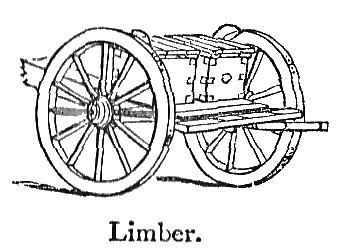
Limber, lim′bėr, n. the part of a gun-carriage consisting of two wheels and a shaft to which the horses are attached.—v.t. to attach to the limber, as a gun. [Prov. Eng. limbers, shafts—Ice. limar, boughs; cf. limb, a branch.]
Limber, lim′bėr, adj. pliant, flexible.—n. Lim′berness, flexibleness, pliancy. [See limp (adj.).]
Limbo, lim′bō, n. an indefinite region in the intermediate state, the abode of those who have had no opportunity to accept Christ, of the souls of the pious who died before the time of Christ, and of the souls of unbaptised infants: a place of confinement, or where things are thrown aside.—Also Lim′bus. [L. limbus, border.]
Lime, līm, n. any slimy or gluey material: bird-lime: the white caustic earth from limestone, and used for cement.—v.t. to cover with lime: to cement: to manure with lime: to ensnare.—ns. Lime′-burn′er, one who burns limestone to form lime; Lime′kiln, a kiln or furnace in which limestone is burned to lime; Lime′-light, or Calcium-light, light produced by a blowpipe-flame directed against a block of pure, compressed quicklime; Lime′stone, stone from which lime is procured by burning; Lime′twig, a twig smeared with bird-lime: a snare; Lime′wash, a coating given with a solution of lime; Lime′wa′ter, a saturated aqueous solution of lime.—adjs. Lim′ous, gluey: slimy: muddy; Lim′y, glutinous: sticky: containing, resembling, or having the qualities of lime. [A.S. lím; Ger. leim, glue, L. limus, slime.]
Lime, līm, n. a kind of citron or lemon tree and its fruit.—n. Lime′-juice, the acid juice of the lime, used at sea as a specific against scurvy. [Fr.]
Lime-hound, līm′-hownd, n. (Spens.) a boar-hound.
Lime-tree, līm′-trē, n. the linden-tree. [Lime is a corr. of line, for lind=linden-tree.]
Limit, lim′it, n. boundary: utmost extent: restriction: (Shak.) a limb, as the limit of the body.—v.t. to confine within bounds: to restrain: to fix within limits.—adjs. Lim′itable, that may be limited, bounded, or restrained; Limitā′rian, tending to limit.—n. one who limits.—adjs. Lim′itary, placed at the boundary as a guard, &c.: confined within limits; Lim′itate (bot.), bounded by a distinct line.—n. Limitā′tion, the act of limiting, bounding, or restraining: the state of being limited, bounded, or restrained: restriction.—adjs. Limitā′tive, Lim′ited, within limits: narrow: restricted.—adv. Lim′itedly.—ns. Lim′itedness; Lim′iter, the person or thing that limits or confines: a friar who had a license to beg within certain bounds.—adj. Lim′itless, having no limits: boundless: immense: infinite.—Limited liability (see Liability); Limited monarchy, a monarchy in which the supreme power is shared with a body of nobles, a representative body, or both. [Fr.,—L. limes, limitis, a boundary.]
Limma, lim′a, n. in prosody, a monosemic empty time or pause: in Pythagorean music, the smaller half-step or semi-tone. [Gr. leimma, a remnant.]
Limmer, lim′ėr, n. a mongrel-hound: a base person, esp. a jade. [O. Fr. liemier—liem, a leash.]
Limn, lim, v.t. to draw or paint, esp. in water-colours: (orig.) to illuminate with ornamental letters, &c.—n. Lim′ner, one who limns or paints on paper or parchment: a portrait-painter. [Contr. of O. Fr. enluminer—L. illumināre.]
Limonite, lī′mō-nīt, n. an iron ore—also Brown hematite and Brown iron ore.—adj. Limonit′ic. [Gr. leimōn, a meadow.]
Limosis, lī-mō′sis, n. a morbidly ravenous appetite. [Gr. limos, hunger.]
Limp, limp, adj. wanting stiffness, flexible: weak, flaccid. [According to Skeat, a nasalised form of lip, a weakened form of lap, as seen in Eng. lap, a flap; cf. prov. Ger. lampen, to hang loosely down.]
Limp, limp, v.i. to halt: to walk lamely—fig. as 'limping verses.'—n. act of limping: a halt.—p.adj. Limp′ing, having the imperfect movement of one who limps.—adv. Limp′ingly. [Prob. conn. with preceding. There is an A.S. adj. lemp-healt, halting.]
Limpet, lim′pet, n. a small shellfish which clings to intertidal rocks. [A.S. lempedu, lamprede, lamprey.]
Limpid, lim′pid, adj. clear: shining: transparent: pure.—ns. Limpid′ity, Lim′pidness.—adv. Lim′pidly. [Fr.,—L. limpidus, liquidus, liquid.]
Lin, lin, v.i. (Spens.) to cease, to give over.—v.t. to cease from. [A.S. linnan, to cease.]
Linament, lin′a-ment, n. lint: a tent for a wound. [L.]
Linch, linsh, n. a ridge of land, a boundary, a cliff.—n. Linch′et, a terrace seen on the slopes of the chalk, oolitic, and liassic escarpments in Bedfordshire, Somerset, &c. [A.S. hlinc, a ridge of land.]
Linchpin, linsh′pin, n. a pin used to keep the wheel of a carriage on the axle-tree. [Properly linspin, 'axle-pin'—obs. linse, axle, and pin.]
Lincoln-green, lingk′un-grēn, n. the colour of cloth made formerly at Lincoln: the cloth itself.
Lincture, lingk′tūr, n. medicine to be sucked up.—Also Linc′tus. [L. lingĕre, linctum, to lick.]
Linden, lin′den, n. the lime-tree. [A.S. linden—lind; cf. Ice. lind, Ger. linde.]
Line, līn, v.t. to cover on the inside: to pad: to impregnate: (Shak.) to aid.—n. Lin′ing. [M. E. linen, to cover, perh. orig. with linen—obs. line, linen—A.S. lín—L. linum.]
Line, līn, n. a thread of linen or flax: a slender cord: (math.) that which has length without breadth or thickness: an extended stroke: a straight row: a cord extended to direct any operations: outline: a series or succession, as of progeny: a series of steamers, &c., plying continuously between places: a railroad: a telegraph wire between stations: an order given to an agent for goods, such goods received, the stock on hand of any particular goods: a mark or lineament, hence a characteristic: a rank: a verse: a short letter or note: a trench: limit: method: the equator: lineage: direction: occupation: the regular infantry of an army: the twelfth part of an inch: (pl.) marriage-lines, a marriage certificate: a certificate of church membership: military works of defence.—v.t. to mark out with lines: to cover with lines: to place along by the side of for guarding: to give out for public singing, as a hymn, line by line: (rare) to delineate, paint: to measure.—n. Lin′eāge, descendants in a line from a common progenitor: race: family.—adj. Lin′eal, of or belonging to a line: composed of lines: in the direction of a line: descended in a direct line from an ancestor.—n. Lineal′ity.—adv. Lin′eally.—n. Lin′eament, feature: distinguishing mark in the form, esp. of the face.—adj. Lin′ear, of or belonging to a line: consisting of, or having the form of, lines: straight.—adv. Lin′early.—adjs. Lin′eāte, -d, marked longitudinally with depressed lines.—ns. Line′ātion (same as Delineation); Line′-engrav′ing, the process of engraving in lines, steel or copperplate engraving.—n.pl. Line′-fish, those taken with the line, as cod, halibut, &c.—adj. Lin′eolate, marked with fine or obscure lines.—ns. Lin′er, a vessel belonging to a regular line or series of packets; Lines′man (mil.), a private in the line; Line′-storm, an equinoctial storm.—Linear perspective, that part of perspective which regards only the positions, magnitudes, and forms of the objects delineated.—Equinoctial line, the celestial equator: the terrestrial equator; Fraunhofer's lines, the dark lines observed crossing the sun's spectrum at right angles to its length—from the Bavarian optician, Joseph von Fraunhofer (1787-1826); Give line, from angling, to allow a person apparent freedom, so as to gain him at last; Ship of the line (see Ship). [A.S. líne—L. linea—linum, flax.]
Linen, lin′en, n. cloth made of lint or flax: underclothing, particularly that made of linen: articles of linen, or of linen and cotton—table-linen, bed-linen, body-linen.—adj. made of flax: resembling linen cloth.—n. Lin′en-drap′er, a merchant who deals in linens. [Properly an adj. with suffix -en—A.S. lín—L. linum, flax; Gr. linon.]
Ling, ling, n. a fish resembling the cod, so called from its lengthened form. [A.S. lang, long.]
Ling, ling, n. heather.—adj. Ling′y. [Ice. lyng.]
Lingam, ling′gam, n. the phallus in Hindu mythology, representative of Siva and the generative power of nature, its female counterpart the Yoni.—Also Ling′a. [Sans.]
Lingel, ling′l, n. a shoemaker's thread rubbed with beeswax. [M. E. lingel, through O. Fr.,—L. lineola, dim. of linea, a line.]
Linger, ling′gėr, v.i. to remain long in any state: to loiter.—v.t. (Shak.) to prolong, protract: (with out) to pass in a tedious manner.—n. Ling′erer.—adj. Ling′ering, protracted.—n. a remaining long.—advs. Ling′eringly; Ling′erly (rare). [A.S. lengan, to protract—lang, long.]
Lingerie, lang-zhe-rē′, n. linen goods, esp. women's underclothing. [Fr.,—linge, flax—L. linum.]
Linget, Lingot, n. Same as Ingot.
Lingism, ling′izm, n. the Swedish movement-cure, kinesitherapy. [From Peter Henrik Ling, 1776-1839.]
Lingo, ling′gō, n. language, speech: esp. applied to dialects. [Corrupted from L. lingua, language.]
Lingua franca, ling′gwa frank′a, n. a mixed jargon used by Frenchmen and other Western people in intercourse with Arabs, Moors, and other Eastern peoples: an international dialect.
Lingual, ling′gwal, adj. pertaining to the tongue or utterance.—n. a letter pronounced mainly by the tongue, as t, d (also called Dental).—adj. Linguaden′tal—Dentilingual.—adv. Ling′ually.—adj. Ling′uiform, tongue-shaped.—ns. Ling′uist, one skilled in tongues or languages; Ling′uister, a dabbler in philology.—adjs. Linguist′ic, -al, pertaining to languages and the affinities of languages.—adv. Linguist′ically.—n.pl. Linguist′ics, the general or comparative science, or study, of languages.—n. Ling′ula, a tongue-like part or process.—adjs. Ling′ular, Ling′ulate, tongue-shaped. [L. lingua (old form dingua), the tongue.]
Linhay, lin′hā, n. a donkey-stable.—Also Lin′ny.
Liniment, lin′i-ment, n. a kind of thin ointment. [L. linimentum—linĕre, to besmear.]
Lining, lī′ning, n. the cover of the inner surface of anything, contents.
Link, lingk, n. a ring of a chain: anything connecting: a single part of a series: the 1⁄100th part of the chain, a measure used in surveying, &c. (see Chain).—v.t. to connect as by a link: to join in confederacy.—v.i. to be connected.—n. Link′-mō′tion, a system of pieces pivoted together, describing definite curves in the same plane or in parallel planes.—Missing link, any point or fact needed to complete a series or a chain of argument: (zool.) a conjectural form of animal life, supposed necessary to complete the chain of evolution from some simian to the human animal: (coll.) an ape, monkey, or apish-looking man. [A.S. hlence; Ice. hlekkr, Ger. gelenk, a joint.]
Link, lingk, n. a light or torch of pitch and tow.—ns. Link′boy, Link′man, a boy or man who carries such to light travellers. [Prob. corr. from Dut. lont, a match; cf. Scot. lunt, Dan. lunte.]
Link, lingk, n. a crook or winding of a river.—n.pl. Links, a stretch of flat or gently undulating ground along a sea-shore, on which the game of golf is played. [A.S. hlinc, a ridge of land, a bank.]
Link, lingk, v.i. (Scot.) to go quickly.
Linn, Lin, lin, n. a waterfall: a precipice.
Linnæan, Linnean, lin-nē′an, adj. pertaining to Linnæus, the Latinised form of the name of Linné, the celebrated Swedish botanist (1707-78), or to his artificial system of classification.
Linnet, lin′et, n. a small singing-bird—from feeding on flax-seed. [Fr. linot—lin, flax—L. linum.]
Linoleum, lin-ō′le-um, n. a preparation used as a floor-cloth, linseed-oil being greatly used in the making of it. [L. linum, flax, oleum, oil.]
Linotype, lin′ō-tīp, n. a machine for producing stereotyped lines or bars of words, &c., as a substitute for type-setting: a line of printing-type cast in one piece. [L. linea, a line, and type.]
Linseed, lin′sēd, n. lint or flax seed—also Lint′seed.—ns. Lin′seed-cake, the cake remaining when the oil is pressed out of lint or flax seed, used as a food for sheep and cattle; Lin′seed-meal, the meal of linseed, used for poultices and as a cattle-food; Lin′seed-oil, oil from flax-seed.
Linsey, lin′si, n. cloth made of linen and wool: a peculiar kind of clayey rock.—adj. Lin′sey-wool′sey, made of linen and wool mixed: mean: of unsuitable parts.—n. a thin coarse stuff of linen and wool mixed: inferior stuffs of doubtful composition: (Shak.) a mixture of nonsense, gibberish. [Obs. linsel, and wool.]
Linstock, lin′stok, n. a staff to hold a lighted match for firing cannon.—Also Lint′stock. [Dut. lontstok—lont, a match, stok, a stick.]
Lint, lint, n. linen scraped into a soft woolly substance for dressing wounds: raw cotton ready for baling. [L. linteus—linum, linen.]
Lintel, lin′tel, n. the piece of timber or stone over a doorway: the headpiece of a door or casement. [O. Fr. lintel (Fr. linteau)—Low L. lintellus for limitellus, dim. of L. limes, border.]
Lintie, lin′ti, Lintwhite, lint′hwīt=Linnet.
Lion, lī′un, n. a fierce quadruped of immense strength, the largest of all carnivorous animals, tawny-coloured, the male with a shaggy mane, springing on his prey with a terrific roar: a man of unusual courage: (astron.) Leo, a sign of the zodiac: any object of interest, esp. a famous or conspicuous person much sought after: an old Scotch coin, with a lion on the obverse, worth 74 shillings Scotch (James VI.): (her.) representation of a lion used as a bearing:—fem. Lī′oness.—ns. Lī′oncel, Lī′oncelle (her.), a small lion used as a bearing; Lī′onel, Lī′onet, a young lion; Lī′on-heart, one with great courage.—adj. Līon-heart′ed.—n. Lī′on-hunt′er, a hunter of lions: one who runs after celebrities with foolish adulation, or to get reflected glory from their company.—v.t. Lī′onise, to treat as a lion or object of interest.—n. Lī′onism.—adj. Lī′on-like.—Lion's provider, a popular name for the jackal, supposed to attend upon the lion: any humble friend or follower; Lion's share, the largest share.—A lion in the way, a danger to be met and overcome; British lion, the lion as the British national emblem; Put one's head into the lion's mouth, to get into a position of great danger. [O. Fr. lion—L. leon-em—Gr. leōn; Ger. löwe.]
Lip, lip, n. the muscular border in front of the teeth by which things are taken into the mouth; the edge of anything: (slang) impudent talk, insolence: (pl.) speech as passing through the lips.—v.t. to touch with the lips: to utter with the lips.—v.i. to apply the lips to the mouthpiece of an instrument.—adj. Lip′born, from the lips only: not genuine.—ns. Lip′-devō′tion, prayer of the lips without devotion in the heart; Lip′-hom′age, insincere homage; Lip′-lā′bour, empty speech; Lip′-lang′uage, oral or articulate language, communicated by motions of the lips, as opposed to the fingers, in teaching or conversing with the deaf and dumb; Lip′let, a little lip; Lip′-or′nament, an object inserted as an ornament in the lip, common among savage tribes.—adj. Lipped, having lips, or edges like lips, labiate.—ns. Lip′-read′ing, reading what a person says from the movement of the lips, in the instruction of the deaf and dumb; Lip′-serv′ice, service with the lips only: insincere devotion or worship; Lip′-wis′dom, wisdom in words only, not in deeds.—Bite the lip, to press the lips between the teeth to keep one's self from betraying vexation, anger, &c.; Curl of the lip, the causing the lip to curl as an indication of scorn; Hang the lip, to be sullen or sulky; Make a lip (Shak.), to pout in sullenness or contempt. [A.S. lippa; Dut. lip, Ger. lippe, L. labium, not conn. with L. lambĕre, Eng. lap.]
Lipæmia, li-pē′mi-a, n. excessive fat in the blood.
Liphæmia, li-fē′mi-a, n. deficiency or poverty of blood.
Lipogram, lī′pō-gram, n. the name given to a writing, esp. a poem from which all words are omitted which contain a particular letter.—adj. Lipogrammat′ic.—ns. Lipogram′matism; Lipogram′matist. [Gr. leipein, to leave, gramma, a letter.]
Lipoma, li-pō′ma, n. a tumour formed of fatty tissue—also Lip′arocele.—n. Lipomatō′sis, the excessive growth of fatty tissue.—adj. Lipom′atous.
Lippen, lip′n, v.i. (Scot.) to trust, rely, depend (with to, on).—adj. Lippe′ning, occasional, accidental.
Lippitude, lip′i-tūd, n. soreness of the eyes. [L.,—lippus, blear-eyed.]
Lippy, Lippie, lip′i, n. an old Scottish dry measure, the fourth of a peck. [Dim. from. A.S. leáp, a basket; Ice. laupr.]
Liquate, lik′wāt, v.t. to melt: to separate one metal from another which is less fusible, by applying sufficient heat.—adj. Liq′uable.—n. Liquā′tion. [L. liquāre, -ātum—liquēre, to be fluid.]
Liquefy, lik′we-fī, v.t. to make liquid: to dissolve.—v.i. to become liquid:—pa.t. and pa.p. liq′uefīed.—adj. Liquefā′cient.—n. Liquefac′tion, the act or process of making liquid: the state of being melted.—adj. Liq′uefiable.—ns. Liq′uefier; Liquesc′ency.—adj. Liquesc′ent, melting. [L. liquefacĕre—liquēre, to be fluid or liquid, facĕre, to make.]
Liqueur, li-kėr′, n. the name given to the many alcoholic preparations which are flavoured or perfumed and sweetened to be more agreeable to the taste—chartreuse, cherry brandy, curaçao, benedictine, kümmel, maraschino, &c.—ns. Liqueur′-glass, a very small drinking-glass intended for liqueurs or cordials; Liqueur′ing, the process of qualifying wine by means of liqueur. [Fr.]
Liquid, lik′wid, adj. flowing: fluid: soft: smooth: clear.—n. a flowing substance: a letter of a smooth flowing sound, coalescing easily with a preceding mute, l, m, n, r.—adj. Liq′uidable.—v.t. Liq′uidate, to make clear, esp. to clear or settle an account: to arrange or wind up the affairs of a bankrupt estate.—ns. Liquidā′tion, the clearing up of the money affairs, esp. the adjustment of the affairs of a bankrupt estate; Liquidāt′or, one engaged in a liquidation.—v.t. Liq′uidise, to render liquid.—n. Liquid′ity.—adv. Liq′uidly.—n. Liq′uidness. [Fr.,—L. liquidus, fluid—liquēre, to be fluid.]
Liquidambar, lik′wid-am-bar, n. a genus of balsamiferous trees of the witch-hazel family (Hamamelidaceæ), native to Mexico and the United States. [L. liquidus, liquid, Low L. ambar, amber.]
Liquor, lik′ur, n. anything liquid: strong drink: a strong solution of a particular substance: any prepared solution.—v.t. to apply liquor or a solution to: (Shak.) to rub with oil or grease.—v.i. (slang) to drink (esp. with up).—n. Liq′uor-gauge, a rod used by excisemen for measuring the depth of liquid in a cask.—Liquor laws, restrictive legislation with regard to the sale of intoxicating drink.—In liquor, drunk; Malt liquors, liquors brewed from malt. [O. Fr. liqeur—L. liquor-em—liquēre.]
Liquorice, lik′ur-is, n. a plant with a sweet root which is used for medicinal purposes. [Through an O. Fr. form, from Low L. liquiritia, a corr. of Gr. glykyrrhiza—glykys, sweet, rhiza, root.]
Liquorish, lik′ur-ish, adj. obsolete spelling of lickerish.
Lira, lē′ra, n. an Italian coin, worth a franc, and divisible into 100 centesimi:—pl. Lire (lē′rā). [It.]
Liriodendron, lir-i-ō-den′dron, n. a North American tree, sometimes above 100 feet in height, having close bark, large four-lobed leaves, and greenish-yellow flowers, something like a tulip.—Also Tulip-tree. [Gr. leirion, a lily, dendron, a tree.]
Liripoop, lir′i-poop, n. (obs.) a graduate's hood: smartness: a silly person.—Also Liripip′ium.
Lirk, lirk, n. (Scot.) a fold.—v.i. to hang in creases.
Lis, lis, n. a controversy, litigation. [L.]
Lis, lēs, n. (her.) same as Fleur-de-lis:—pl. Lisses.
Lisbon, liz′bon, n. a light-coloured wine from Estremadura in Portugal.
Lisle thread. See Thread.
Lisp, lisp, v.i. to speak with the tongue against the upper teeth or gums, as in pronouncing th for s or z: to articulate as a child: to utter imperfectly.—v.t. to pronounce with a lisp.—n. the act or habit of lisping.—n. Lisp′er.—adj. Lisp′ing, pronouncing with a lisp.—n. the act of speaking with a lisp.—adv. Lisp′ingly. [A.S. wlispian (a conjectural form)—wlisp, stammering; Dut. lispen, Ger. lispeln; from the sound.]
Lisse, lēs, n. in tapestry, the threads of the warp taken together. [Fr., also lice—L. licium.]
Lissencephalous, lis-en-sef′a-lus, adj. having a brain smooth or slightly convoluted.
Lissome, Lissom, lis′um, adj. lithesome, nimble, flexible.—n. Liss′omeness.
Lissotrichous, li-sot′ri-kus, adj. smooth-haired.
List, list, n. the selvage on woven textile fabrics: a stripe of any kind: (Shak.) a border.—adj. made of strips of woollen selvage. [A.S. líst; Ger. leiste.]
List, list, n. a catalogue, roll, or enumeration: a book, &c., containing a series of names of persons or things.—v.t. to place in a list or catalogue: to engage for the public service, as soldiers.—v.i. to enter the public service by enrolling one's name, to enlist.—Active list, the roll of soldiers on active service; Civil list (see Civil); Free list (see Free). [O. Fr. liste—Mid. High Ger. liste (Ger. leiste), border; A.S. líst, orig. same word as above.]
List, list, n. a line enclosing a piece of ground, esp. for combat: (pl.) the ground enclosed for a contest.—v.t. to enclose for a tournament.—Enter the lists, to engage in contest. [O. Fr. lisse (Fr. lice, It. lizza)—Low L. liciæ, barrier, perh. from L. licium, a thrum.]
List, list, v.i. to have pleasure in: to desire: to like or please: to choose: (naut.) to incline or heel over to one side.—v.t. to cause to careen or heel over.—n. such an inclination. [A.S. lystan, impers., please—lust, pleasure.]
List, list, v.t. and v.i. original form of listen: now poetical.—v.t. Listen (lis′n), to hear or attend to.—v.i. to give ear or hearken: to follow advice.—n. List′ener, one who listens or hearkens.—adjs. List′ful, attentive; List′less, having no desire or wish: careless: uninterested: weary: indolent.—adv. List′lessly.—n. List′lessness. [A.S. hlystan—hlyst, hearing; Ice. hlusta.]
Listel, lis′tel, n. (archit.) a narrow fillet.
Lister, lis′tėr, n. a form of plough for throwing up ridges.—n. List′ing.
Listerism, lis′tėr-izm, n. an antiseptic method of operating introduced by the English surgeon, Lord Lister, born 1827.—v.t. Lis′terise, to treat by Listerism.
Lit, pa.t. and pa.p. of light, lighten, light, to alight.
Litany, lit′a-ni, n. a prayer of supplication, esp. in processions: an appointed form of responsive prayer in public worship in which the same thing is repeated several times at no long intervals.—ns. Lit′any-desk, -stool, in the English Church, a movable desk at which a minister kneels, facing the altar, while he recites the litany.—Lesser litany, the common formula, 'Kyrie eleison, Christe eleison, Kyrie eleison.' [O. Fr.,—Low L. litania—Gr. litaneia—litesthai, to pray.]
Literal, lit′ėr-al, adj. according to the letter: plain: not figurative or metaphorical: following the letter or exact meaning, word for word.—v.t. Lit′eralise.—ns. Lit′eraliser; Lit′eralism, strict adherence to the letter: interpretation that is merely verbal: (art) exact and unimaginative rendering of objects; Lit′eralist; Literal′ity.—adv. Lit′erally.—n. Lit′eralness. [Fr.,—L. literalis—litera, a letter.]
Literary, lit′ėr-ar-i, adj. belonging to letters or learning: skilled in learning.—n. Lit′eracy, state of being literate:—opp. to Illiteracy.—adj. Lit′erāte, acquainted with letters of learning: learned.—n. one educated, but not having taken a university degree, esp. a candidate for holy orders who has not been at a university.—n.pl. Literā′tī, men of letters, the learned (sing. forms, Literā′tus, Literä′to).—adv. Literā′tim, letter for letter: without the change of a letter.—n. Literā′tor, a dabbler in learning: a man of letters, a literary man—sometimes in the French form Littérateur.—adj. Lit′erose, distinctively literary.—n. Literos′ity. [L. literarius.]
Literature, lit′ėr-a-tūr, n. the science of letters or what is written: the whole body of literary compositions in any language, or on a given subject: all literary productions except those relating to positive science and art, usually confined, however, to the belles-lettres.—adj. Lit′eratured (Shak.), learned, having literary knowledge.—Light literature, books which can be read and understood without mental exertion: fiction; Polite literature, belles-lettres. [Fr.,—L. literatura—litera, a letter.]
Lith, lith, n. (prov.) a joint, segment, or portion of anything. [A.S. lið, a member; Ger. glied.]
Lithagogue, lith′a-gog, adj. expelling stone from the bladder or kidneys.—n. a medicine with this quality.
Lithanthrax, li-than′thraks, n. stone-coal, mineral coal.
Litharge, lith′ärj, n. the semi-vitrified oxide of lead separated from silver in refining. [Fr.,—Gr. lithargyros—lithos, a stone, argyros, silver.]
Lithe, līth, adj. easily bent, flexible, active.—adv. Lithe′ly.—n. Lithe′ness.—adj. Lithe′some.—n. Lithe′someness. [A.S. líðe; Ger. lind and gelinde.]
Lithe, līth, v.i. (obs.) to listen. [Ice. hlydha, to listen—hljódh, hearing.]
Lithemia, Lithæmia, li-thē′mi-a, n. an excess of uric acid in the blood.—adj. Lithē′mic.
Lither, līth′ėr, adj. (Shak.) soft, yielding: (obs.) bad, lazy.—adj. Lith′erly, mischievous.—adv. slowly: lazily. [A.S. lýthre, bad.]
Lithia, lith′i-a, n. an alkali, the oxide of lithium, discovered in 1817 by Arfvedson: a mineral water good against the stone. [Low L.,—Gr. lithos, stone.]
Lithiasis, li-thī′a-sis, n. a bodily condition in which uric acid is deposited as stone or gravel in the urinary canals. [Gr. lithos, a stone.]
Lithic, lith′ik, adj. pertaining to, or obtained from, stone, specially from urinary calculi.—ns. Lith′ate, a salt of lithic acid; Lithificā′tion, a hardening into stone. [Gr. lithikos—lithos, a stone.]
Lithium, lith′i-um, n. one of the alkaline metals, of a silvery appearance, found in several minerals combined with silica.—adj. Lith′ic. [Gr. lithos, a stone.]
Lithocarp, lith′o-karp, n. a fossil fruit.
Lithochromatic, lith-o-krō-mat′ik, adj. pertaining to painting in oils on stone.—n.pl. Lithochromat′ics, this art. [Gr. lithos, stone, chrōma, colour.]
Lithoclast, lith′o-klast, n. an instrument for crushing bladder-stones. [Gr. lithos, stone, klān, to crush.]
Lithodome, lith′ō-dōm, n. a shellfish living in a hole in a rock.—adj. Lithod′omous.
Lithofracteur, lith-ō-frak′tėr, n. a blasting explosive.
Lithogenous, li-thoj′e-nus, adj. stone-producing.—n. Lithogen′esy, the science of the origin of minerals.
Lithoglyph, lith′o-glif, n. any engraving on stone, esp. a precious stone.—adj. Lithoglyph′ic.—ns. Lith′oglyphics, Lithoglypt′ics, the art of engraving on precious stones; Lithog′lyphite, a fossil as if engraved by art. [Gr. lithos, stone, glyphein, to carve.]
Lithograph, lith′o-graf, v.t. to write or engrave on stone and transfer to paper by printing.—n. a print from stone.—n. Lithog′rapher.—adjs. Lithograph′ic, -al, belonging to lithography.—adv. Lithograph′ically.—n. Lithog′raphy, the art of writing or engraving on stone and printing therefrom.—Lithographic stone, slate, a yellowish, compact, fine-grained, slaty limestone used in lithography. [Gr. lithos, a stone, graphein, to write.]
Lithoid, -al, lith′oid, -al, adj. resembling a stone.
Litholabe, lith′ō-lāb, n. an instrument for grasping a calculus and holding it while being crushed.
Litholatry, li-thol′a-tri, n. the worship of stones.—adj. Lithol′atrous.
Lithology, lith-ol′o-ji, n. the science that treats of rocks as mineral masses: that part of medical science concerned with the calculi found in the human body.—adjs. Litholog′ic, -al.—n. Lithol′ogist, one skilled in lithology. [Gr. lithos, a stone, logos, discourse.]
Litholopaxy, lith′ol-o-pak-si, n. the operation of crushing stone in the bladder, and of at once removing the fragments by suction. [Gr. lithos, stone, hapax, once only.]
Lithomancy, lith′o-man-si, n. divination by stones. [Gr. lithos, a stone, manteia, divination.]
Lithomarge, lith′o-märj, n. a clay-like mineral substance, sometimes called Mountain marrow, soft, greasy to the touch, white, yellow, or red. [Gr. lithos, stone, L. marga, marl.]
Lithophagous, lith-of′a-gus, adj. eating stones: perforating stones, as certain molluscs. [Gr. lithos, stone, phagein, to eat.]
Lithophane, lith′o-fān, n. ornamental porcelain with pictures which show through the transparency. [Gr. lithos, stone, phainesthai, to appear.]
Lithophotography, lith-o-fo-tog′ra-fi, n. the art of printing from lithographic stones photographic pictures developed upon them.
Lithophyl, lith′ō-fīl, n. a fossil leaf.
Lithophyte, lith′o-fīt, n. any one of the polyps whose substance is stony or hard, as corals. [Gr. lithos, stone, phyton, plant.]
Lithotint, lith′o-tint, n. the process of producing coloured pictures from lithographic stones: a picture so produced. [Gr. lithos, stone, and tint.]
Lithotomy, lith-ot′o-mi, n. cutting for stone in the bladder.—n. Lith′otome, a mineral resembling a cut gem: a cystotome.—adjs. Lithotom′ic, -al, pertaining to, or performed by, lithotomy.—n. Lithot′omist, one who practises lithotomy. [Gr. lithos, a stone, tomē, a cutting—temnein, to cut.]
Lithotrity, lith′ō-trī-ti, n. the operation of crushing a stone in the bladder, so that its fragments may be removed through the urethra—also Lith′otripsy.—ns. Lithothryp′tist, Lith′othryptor, Lithotrip′tist, Lith′otriptor, Lith′otritist, one who practises lithotrity; Lith′othrypty; Lith′otrite, Lith′otritor, an apparatus for crushing a stone in the bladder.—adjs. Lithotrit′ic, Lithotrip′tic—also Lithothryp′tic. [Gr. lithos, stone, tribein, to rub.]
Lithotypy, lith′ō-tī-pi, n. the process of making a kind of stereotype plates by filling a mould with a composition which, when cooled, becomes hard.—n. Lith′otype, a stereotype plate, produced by lithotypy.—v.t. to prepare for printing by lithotypy. [Gr. lithos, stone, typos, type.]
Litigate, lit′i-gāt, v.t. to contest in law.—v.i. to carry on a lawsuit.—adjs. Lit′igable, that may be contested in law; Lit′igant, contending at law: engaged in a lawsuit.—n. a person engaged in a lawsuit.—ns. Litigā′tion; Lit′igātor, one who litigates; Litigios′ity, Litig′iousness.—adj. Litig′ious, inclined to engage in lawsuits: subject to contention.—adv. Litig′iously. [L. litigāre, -ātum—lis, litis, a strife, agĕre, to do.]
Litmus, lit′mus, n. a dye obtained from certain lichens, originally red, but becoming blue on the addition of alkalies or of lime.—Litmus paper, paper used in chemical testing, tinged blue by litmus, reddened by an acid, made blue again by an alkali. [For lakmose—Dut. lakmoes—lak, lac, moes, pulp.]
Litotes, lit′ō-tēz, n. (rhet.) an affirmation made indirectly by the negation of its contrary, as 'a citizen of no mean city'='of an illustrious city.' [Gr. litotēs, simplicity—litos, plain.]
Litrameter, lit-ram′e-tėr, n. an instrument for measuring the specific gravity of liquids by the height to which they rise in vertical tubes under a definite air-pressure. [Gr. litra, a pound, metron, measure.]
Litre, lē′tėr, n. (her.) a hatchment consisting of a black belt, charged with the arms of the deceased. [Fr.; prob. orig. listre=liste, border.]
Litre, lē′tr, n. the unit of the French measures of capacity, both dry and liquid. It is the volume of a cubic decimètre, and contains a kilogramme of water at 4° C. in a vacuum, equal to .2200967 British imperial gallon, therefore less than a quart—4½ litres being roughly equal to a gallon.
Litter, lit′ėr, n. a heap of straw, &c., for animals to lie upon: materials for a bed: any scattered collection of objects, esp. of little value: a vehicle containing a bed for carrying about, a hospital stretcher: a brood of small quadrupeds.—v.t. to cover or supply with litter: to scatter carelessly about: to give birth to (said of small animals).—v.i. to produce a litter or brood.—p.adj. Litt′ered. [O. Fr. litiere—Low L. lectaria—L. lectus, a bed.]
Littérateur, lit-ėr-a-tėr′, n. a literary man. [Fr.]
Little, lit′l, adj. (comp. Less; superl. Least) small in quantity or extent: weak, poor: brief.—n. that which is small in quantity or extent: a small space.—adv. in a small quantity or degree: not much.—ns. Litt′le-ease, discomfort, misery: a form of punishment, as the stocks; Litt′le-end′ian, one of the Lilliputian party who opposed the Big-endians, maintaining that boiled eggs should be cracked at the little end; Litt′le-go (see Go); Litt′leness; Litt′le-off′ice, a short service of psalms, hymns, collects, &c.—adj. Litt′leworth, worthless.—By little and little, by degrees; In little, on a small scale; Not a little, considerably. [A.S. lýtel.]
Littoral, lit′or-al, adj. belonging to the sea-shore.—n. the strip of land along it.—Littoral zone, the interval on a sea-coast between high and low water mark. [L.,—litus, litŏris, shore.]
Liturate, lit′ū-rāt, adj. (bot.) having spots formed by the abrasion of the surface: in entomology, marked with spots (Lituræ) growing paler at one end.
Liturgy, lit′ur-ji, n. the form of service or regular ritual of a church—strictly, that used in the celebration of the Eucharist: in ancient Greece, a form of personal service to the state.—n. Liturge′, a leader in public worship.—adjs. Litur′gic, -al.—adv. Litur′gically.—ns. Litur′gics, the doctrine of liturgies; Liturgiol′ogist, a student of liturgies; Liturgiol′ogy, the study of liturgical forms; Lit′urgist, a leader in public worship: one who adheres to, or who studies, liturgies. [Fr.,—Gr. leitourgia—laos, the people, ergon, work.]
Lituus, li-tū′us, n. an augur's staff with recurved top: a spiral of similar form.—adjs. Lit′uāte, forked with the points turned outward; Lit′uiform. [L.]
Live, liv, v.i. to have, or continue in, life, temporal or spiritual: to last, subsist: to enjoy life: to direct one's course of life: to be nourished or supported: to dwell.—v.t. to spend: to act in conformity to:—pr.p. liv′ing; pa.t. and pa.p. lived.—adj. Liv′able, capable of being lived: habitable.—n. Liv′er.—Live down, live so as to cause a slander, a grief, &c. to be forgotten by one's self or others; Live out, to continue alive until the end of anything: (U.S.) to be from home in domestic service; Live under, to be tenant to; Live up to, to rule one's life according to some standard. [A.S. lifian; Ger. leben.]
Live, līv, adj. having life: alive, not dead: active: containing fire: burning: vivid.—Lived (līvd), used in compounds, as long-lived.—ns. Live′-axle, driving-axle; Live′-bait, a living worm or minnow used in fishing: Live′-cir′cuit, a circuit through which an electric current is flowing.—n.pl. Live′-feath′ers, those plucked from the living fowl.—n. Live′-lē′ver, that one of a pair of brake-levers to which the power is first applied:—opp. to Dead-lever.—adj. Live′-long, that lives or lasts long.—ns. Live′-oak, an American oak, with durable wood; Live′-shell, a shell loaded and fused for firing, or fired and not yet exploded; Live′-stock, domestic animals, esp. horses, cattle, sheep, and pigs; Live′-well, the well in a fishing-boat where fish are kept alive.
Livelihood, līv′li-hood, n. means of living: support—(obs.) Live′lihed. [A.S. líf. life, lád, a way.]
Lively, līv′li, adj. showing life: vigorous, active: sprightly: spirited: vivid.—adv. vivaciously, vigorously.—adv. Līve′lily.—n. Līve′liness.
Liver, liv′ėr, n. the largest gland in the body, which secretes the bile.—adjs. Liv′er-col′our, of the colour of the liver: dark-red; Liv′ered, in compounds, as white-livered, lily-livered=cowardly.—n. Liver-fluke, a trematoid worm (Distoma hepatica).—adj. Liv′er-grown, having a swelled liver.—n. Liverwort, any plant of the cryptogamic family Hepaticæ, allied to mosses.—adj. Liv′ery, resembling the liver. [A.S. lifer; Ger. leber, Ice. lifr.]
Livery, liv′ėr-i, n. the dress or uniform worn by servants, esp. men-servants: a dress peculiar to certain persons or things, as in the trade-guilds of London: any characteristic dress: the being kept and fed at a certain rate, as horses at livery: the whole body of liverymen in London: (orig.) the distinctive dress worn by the household of a king or nobleman, so called because delivered or given at regular periods.—adj. Liv′eried, clothed in livery.—ns. Liv′ery-com′pany, a guild of the city of London; Liv′eryman, a man who wears a livery: a freeman of the city of London entitled to wear the livery and enjoy other privileges of his company; Liv′ery-ser′vant, a servant who wears a livery; Liv′ery-stā′ble, a stable where horses and vehicles are kept for hire.—Sue one's livery (Shak.), to ask for the writ delivering a freehold into the possession of its heir. [Fr. livrée—livrer—L. liberāre, to free.]
Lives, līvz, n. plural of life.
Livid, liv′id, adj. black and blue: of a lead colour: discoloured.—ns. Livid′ity, Liv′idness. [Fr.,—L. lividus—livēre, to be of a lead colour.]
Living, liv′ing, adj. having life: active, lively: producing action or vigour: running or flowing, as opposed to stagnant.—n. means of subsistence: manner of life: a property: the benefice of a clergyman.—Living rock, rock in its native state or location; Living room, a sitting-room for general family use; Living wage, a wage on which it is possible for a workman and his family to live fairly.—The living, those alive.
Livraison, lē-vrā-zon′, n. a number of a book published in parts. [Fr.]
Livre, lē′vr, n. an old French coin, about the value of a franc, by which it was superseded in 1795: the ancient French unit of weight, equal to about 1 lb. avoirdupois. [Fr.,—L. libra, a pound.]
Lixiviation, liks-iv-i-ā′shun, n. the process of washing or steeping certain substances in a fluid, for the purpose of dissolving a portion of their ingredients, and so separating them from the insoluble residue.—adjs. Lixiv′ial, Lixiv′ious.—v.t. Lixiv′iate.—n. Lixiv′ium, lye. [L. lixivium, lye.]
Lizard, liz′ard, n. a family of four-footed scaly reptiles, a saurian or lacertilian.—n. Liz′ard-stone, a Cornish serpentine. [Fr. lézard—L. lacerta.]
Llama, lä′ma, or lā′ma, n. a South American ruminant of the camel family, used for transport in the Andes.
Llano, lä′nō, or lyä′nō, n. one of the vast steppes or plains in the northern part of South America:—pl. Lla′nos.—n. Llanero (lya-nā′rō), an inhabitant of the llanos. [Sp.,—L. planus, plain.]
Lloyd's, loidz, n. a part of the London Royal Exchange frequented by ship-owners, underwriters, &c. to obtain shipping intelligence and transact marine insurance.—Lloyd's Register, a list of sea-going vessels classified according to seaworthiness (as A1, &c.), annually prepared by an association of members of Lloyd's. [From their originally meeting in the coffee-house in Tower Street kept by Edward Lloyd in the 17th century.]
Lo, lō, interj. look! see! behold! [A.S. lá; imit.]
Loach, Loche, lōch, n. a small river-fish.—Also Beardie. [Fr. loche, Sp. loja.]
Load, lōd, v.t. to lade or burden: to put on as much as can be carried: to heap on: to put on overmuch: to confer or give in great abundance: to weigh down, to oppress: to weight by something specially added: to charge, as a gun: to make heavy, as a thin wine: to mix with white: to lay on colour in masses.—v.i. to put or take on a load: to charge a gun: to become loaded or burdened.—n. a lading or burden: as much as can be carried at once: freight or cargo: a measure: any large quantity borne: a quantity sustained with difficulty: that which burdens or grieves: a weight or encumbrance.—Load′en, old pa.p. of load.—ns. Load′er, one who, or that which, loads; Load′ing, the act of lading: a charge, cargo, or lading; Load′ing-machine′, a contrivance for loading cartridge-shells; Load′ing-tray, an iron frame on which a shot or shell is placed and brought forward into the opening in the breech of a gun; Load′-line, a line along the ship's side to mark the depth to which her proper cargo causes her to sink—also Plimsoll's mark.—Load a cane, whip, to weight it with lead, &c.; Load dice, to make one side heavier than the other, for purposes of cheating; Load wine, to falsify by mixing it with distilled liquor, sugar, &c. [A.S. hladan, pa.t. hlód, to load.]
Loadstar. Same as Lodestar.
Loadstone. Same as Lodestone.
Loaf, lōf, n. a regularly shaped mass of bread: a mass of sugar: any lump:—pl. Loaves (lōvz).—n. Loaf′-sug′ar, refined sugar in the form of a cone.—Loaves and fishes, temporal benefits, the main chance for one's self—from John, vi. 26. [A.S. hláf.]
Loaf, lōf, v.i. to loiter, pass time idly.—n. Loaf′er.—adj. Loaf′erish. [Prob. directly Ger. läufer, a runner, laufen, to run about.]
Loam, lōm, n. a muddy soil, of clay, sand, and animal and vegetable matter.—v.t. to cover with loam.—adj. Loam′y. [A.S. lám; Ger. lehm; cf. lime.]
Loan, lōn, n. a lane: an open space for passage left between fields of corn: a place for milking cows.—Also Loan′ing. [Lane.]
Loan, lōn, n. anything lent: the act of lending: permission to use: money lent for interest.—v.t. to lend.—adj. Loan′able.—ns. Loan′-off′ice, a public office at which loans are negotiated, a pawnbroker's shop; Loan′-socī′ety, a society organised to lend money to be repaid with interest by instalments; Loan′-word, one taken into one language from another—like Loafer above. [A.S. lǽn; Ice. lán, Dan. laan, cf. Ger. lehen, a fief.]
Loath, Loth, lōth, adj. disliking: reluctant, unwilling.—adv. Loath′ly.—n. Loath′ness. [A.S. láð, hateful—líðan, to travel; Ger. leiden, suffer.]
Loathe, lōth, v.t. to dislike greatly, to feel disgust at.—adj. Loath′ful, full of loathing, hate, or abhorrence: exciting loathing or disgust.—n. Loath′ing, extreme hate or disgust: abhorrence.—adj. hating.—adv. Loath′ingly.—adjs. Loath′ly, Loath′y (obs.), loathsome; Loath′some, exciting loathing or abhorrence: detestable.—adv. Loath′somely.—n. Loath′someness. [A.S. láðian—láð; cf. loath.]
Lob, lob, n. a clumsy person, the last in a race: a lobworm: the coal-fish: at cricket, a long slow ball: something thick and heavy.—v.t. to throw gently, slowly, or with underhand delivery: at lawn-tennis, to strike the ball high over an opponent's head into the end of the court: to hang wearily down.—n. Lobs′pound, a prison.—Lob lie by the fire, Milton's lubber-fiend, a brownie who works by night for his bowl of cream. [W. llob; cf. Lubber.]
Lobby, lob′i, n. a small hall or waiting-room: a passage serving as a common entrance to several apartments: the ante-chamber of a legislative hall, frequented by outsiders for the purpose of influencing votes.—ns. Lobb′ying, frequenting the lobby to collect political intelligence, &c.; Lobb′yist, Lobb′y-mem′ber, a journalist, &c., who frequents a lobby in the interest of some cause or of a newspaper. [Low L. lobia—Middle High Ger. loube (Ger. laube), a portico, arbour—laub, a leaf.]
Lobe, lōb, n. the lower part of the ear: (anat.) a division of the lungs, brain, &c.: (bot.) a division of a leaf.—adjs. Lob′ar, Lob′āte, Lobed, Lob′ose; Lobe′-foot′ed, Lō′biped, having lobate feet, as a coot, grebe, or phalarope.—ns. Lobe′let, Lob′ule, a small lobe.—adjs. Lob′ular, Lob′ulāted.—ns. Lob′ulus, any small lobe or lobe-like structure:—pl. Lob′ulī; Lō′bus, a lobe:—pl. Lō′bī.—Lobar pneumonia, inflammation of a whole lobe of the lungs, as distinguished from Lobular pneumonia, which attacks the lungs in patches. [Fr., prob. through Low L. from Gr. lobos, lobe; cf. lap, to fold.]
Lobelia, lob-ē′li-a, n. an ornamental flower, its roots medicinal. [Lobel, a Flemish botanist.]
Loblolly, lob′lol-i, n. a loutish person: medicine.—n. Lob′lolly-boy, a ship-surgeon's attendant.
Lobscouse, lob′skows, n. a stew or hash with vegetables, a dish used at sea. [Origin dub.]
Lobster, lob′stėr, n. a shellfish with large claws, used for food: (slang) a British soldier. [A.S. loppestre, lopust—L. locusta, a lobster.]
Lobworm, lob′wurm, n. a large worm used as bait. [Perh. lob—W. llob, a dull fellow, and worm.]
Local, lō′kal, adj. of or belonging to a place: confined to a spot or district.—ns. Locale (lō-käl′), a locality: the scene of some event; Localisā′tion.—v.t. Lō′calise, to assign to a place: to refer a sensation in perception to some part of the body.—ns. Lō′calism, the state of being local: affection for a place: provincialism; Local′ity, existence in a place: position: district.—adv. Lō′cally.—v.t. Locāte′, to place: to set in a particular position: to designate the place of.—n. Locā′tion, act of locating or placing: situation: (law) a leasing on rent.—adj. Lō′cātive (gram.), indicating place.—Local Government Acts, a series of enactments instituting local self-government of the various counties of Great Britain and of a large number of boroughs; Local Option, a phrase first used by Mr Gladstone in a letter in 1868 for the determination by vote of the people of a town or district as to whether licenses to sell intoxicating liquors shall be granted or not. [Fr.,—Low L. localis—locus, a place.]
Loch, loh, n. a lake or arm of the sea.—ns. Lochaber axe (loh-ä′bėr aks), a battle-axe used by the Scottish Highlanders, having a narrow blade, but very long towards the shaft, and generally with a hook at the end of the staff; Loch′an (Scot.), a pond. [Gael. loch; cf. Lake.]
Loche, n. See Loach.
Lochia, lō′ki-a, n.pl. the evacuations from the womb after childbirth.—adj. Lō′chial. [Gr.]
Lock, lok, n. a device to fasten doors, &c.: an enclosure in a canal for raising or lowering boats: the part of a firearm by which it is discharged: a grapple in wrestling: a state of being immovable: any narrow, confined place.—v.t. to fasten with a lock: to fasten so as to impede motion: to shut up: to close fast: to embrace closely: to furnish with locks.—v.i. to become fast: to unite closely.—ns. Lock′age, the locks of a canal: the difference in their levels, the materials used for them, and the tolls paid for passing through them; Lock′-chain, a chain for fastening the wheels of a vehicle by tying the rims to some part which does not rotate; Lock′er, any closed place that may be locked; Lock′et, a little ornamental case of gold or silver, usually containing a miniature.—adj. Lock′fast, firmly fastened by locks.—ns. Lock′gate, a gate for opening or closing a lock in a canal or river; Lock′-hos′pital (see Hospital); Lock′house, the lock-keeper's house; Lock′-jaw, Locked′-jaw, a contraction of the muscles of the jaw by which its motion is suspended; Lock′-keep′er, one who keeps or attends the locks of a canal; Lock′out, the act of locking out, esp. used of the locking out of a teacher by the pupils or vice versâ, or of the refusal of an employer to admit his workmen within the works as a means of coercion; Locks′man, a turnkey; Lock′smith, a smith who makes and mends locks; Lock′stitch, a stitch formed by the locking of two threads together; Lock′up, a place for locking up or confining persons for a short time.—Not a shot in the locker (naut.), not a penny in the pocket. [A.S. loca, a lock; Ice. loka, a bolt, Ger. loch, a dungeon.]
Lock, lok, n. a tuft or ringlet of hair: a small quantity, as of hay: (Scots law) a quantity of meal, the perquisite of a mill-servant: (Shak.) a love-lock—n. Lock′man, an officer in the Isle of Man who acts as a kind of under-sheriff to the governor. [A.S. locc; Ice. lokkr, Ger. locke, a lock.]
Lockian, lok′i-an, adj. pertaining to the philosophy of John Locke (1632-1704).—ns. Lock′ian, Lock′ist.
Lockram, lok′ram, n. a kind of coarse linen—from Locrenan, in Brittany, where made.
Locofoco, lō-kō-fō′kō, n. (U.S.) a friction match: the extreme section of the Democratic party of 1835, known as the Equal Rights Party, or any adherent of it. [L. locus, a place, focus, a hearth.]
Locomotive, lō-ko-mō′tiv, adj. moving from place to place: capable of, or assisting in, locomotion.—n. a locomotive machine: a railway engine.—ns. Locomō′tion; Locomotiv′ity; Locomō′tor.—adj. Locomō′tory.—Locomotor ataxy (see Ataxia). [L. locus, a place, movēre, motum, to move.]
Locorestive, lō-kō-res′tiv, adj. staying in one place.
Loculus, lok′ū-lus, n. (bot., anat., zool.) a small compartment or cell: in ancient catacombs, a small recess for holding an urn:—pl. Loc′ulī.—n. Loc′ulament (bot.), loculus.—adjs. Loc′ular, Loc′ulāte, Loc′ulose, Loc′ulous. [Dim. of L. locus, a place.]
Locum-tenens, lō′kum-tēn′enz, n. a deputy or substitute.—n. Lō′cum-tēn′ency, the holding by a temporary substitute of a post. [L. locus, a place, tenēre, to hold.]
Locus, lō′kus, n. (math.) the curve described by a point, or the surface generated by a line, moving in a given manner: a passage in a writing:—pl. Loci (lō′sī), a collection of passages, esp. from sacred and ancient writings, arranged with special reference to some particular theme.—Locus classicus (pl. Loci classici), a standard passage, esp. in an ancient author: that passage which is the accepted authority for some particular subject or for the use of some special or disputed word; Locus standi (law), right of place in court: recognised place or position. [L.]
Locust, lō′kust, n. a migratory winged insect, in shape like the grasshopper, highly destructive to vegetation.—v.i. (rare) to lay waste like locusts. [L. locusta.]
Locust, lō′kust, n. a tree with thorny branches and dense clusters of white, heavily-scented flowers, found in the U.S.: the carob-tree.—ns. Locus′ta, the spikelet of grasses:—pl. Locus′tæ; Lō′cust-bean, the sweet pod of the carob-tree.
Locution, lō-kū′shun, n. the act of speaking: form of speaking, phraseology, a phrase.—n. Loc′utory, a room for conversation, esp. in monastic establishments. [L. locution-em—loqui, locutus, to speak.]
Lode, lōd, n. a vein containing metallic ore: a reach of water: an open ditch.—ns. Lodes′man, a pilot; Lode′star, the star that guides, the pole-star—often used figuratively; Lode′stone, a stone or ore of iron that attracts other pieces of iron. [A.S. lád, a course—líðan, to travel.]
Lodge, loj, n. a small house in a park: a hut: the cottage of a gatekeeper: a retreat: a secret association, also the place of meeting.—v.t. to furnish with a temporary dwelling: place, deposit: to infix, to settle: to drive to covert: to lay flat, as grain.—v.i. to reside: to rest: to dwell for a time: to pass the night: to lie flat, as grain.—ns. Lodg′er, one who lodges or lives at board or in a hired room; Lodg′ing, temporary habitation: a room or rooms hired in the house of another (often in pl.): harbour; Lodg′ing-house, a house where lodgings are let, a house other than a hotel where travellers lodge; Lodg′ment, act of lodging, or state of being lodged: accumulation of something that remains at rest: (mil.) the occupation of a position by a besieging party, and the works thrown up to maintain it.—Lodger franchise, a right to vote conferred on persons occupying lodgings.—Grand Lodge, the principal lodge of Freemasons, presided over by the Grand-master. [O. Fr. loge—Old High Ger. loubā, an arbour.]
Loess, lės, or lō′es, n. a loamy deposit of Pleistocene age, in the valleys of the Rhine, Danube, and Rhone.—Also Löss. [Ger. löss.]
Loft, loft, n. the room or space immediately under a roof: a gallery in a hall or church: an upper room.—v.t. to furnish with a loft: (golf) to strike the ball up by means of a club called the Loft′er.—adv. Loft′ily.—n. Loft′iness.—adj. Loft′y, high in position, character, sentiment, or diction: stately: haughty.—Lofted house (Scot.), a house of more than one story.—Cock of the loft, the head or chief of a set. [Ice. lopt (loft), the sky, an upper room; A.S. lyft, Ger. luft, the air.]
Log, log, n. a Hebrew liquid measure, believed to be very nearly an English pint. [Heb. lōgh.]
Log, log, n. a bulky piece of wood: a heavy, stupid, or sluggish person.—adj. consisting of logs.—ns. Log′-cab′in, -house, -hut, a cabin or hut built of hewn or unhewn logs, common in new American settlements; Log′gat, a small log or piece of wood: an old game somewhat like nine-pins; Log′gerhead, a blockhead: a dunce: (naut.) a round piece of timber, in a whale-boat, over which the line is passed: a species of sea-turtle: a round mass of iron with a long handle, heated for various purposes.—adj. Log′gerheaded.—ns. Log′-head, a blockhead; Log′-man (Shak.), a man who carries logs: (U.S.) one whose occupation is to cut and remove logs—also Log′ger.—v.t. Log′-roll, to engage in log-rolling.—ns. Log′-roll′er; Log′-roll′ing, a combination for facilitating the collection of logs after the clearing of a piece of land, or for rolling logs into a stream: mutual aid given by politicians for carrying out individual schemes: a system of literary criticism conducted on the lines of mutual admiration or adulation; Log′wood, the dark-red heart-wood of Hæmatoxylon campechianum, a native of Mexico and Central America, whence it is exported in logs.—At loggerheads, at issue, quarrelling about differences of opinion, &c. [Ice. lág, a felled tree, liggja, to lie. Cf. Lie and Log.]
Log, log, n. a piece of wood with a line for measuring the speed of a ship: the record of a ship's progress.—v.t. to exhibit by the indication of the log: to enter in the logbook.—ns. Log′board; Log′book, the official record of the proceedings on board ship: a book kept by the head-master of a board-school for recording attendances and other matters connected with the school; Log′-chip, the board, in the form of a quadrant, attached to a logline; Log′-glass, a 14- or 28-second sand-glass, used with the logline to ascertain the speed of a ship; Log′line, the line fastened to the log, and marked for finding the speed of a vessel; Log′-reel, a reel on which the logline is wound; Log′-slate, a double slate, marked and ruled in the inside, for recording the log.—Heave the log, to learn the speed of a ship by logline and glass. [Sw. logg, a ship's log, a piece of wood that lies in the water.]
Logan, log′an, n. a rocking-stone.—Also Log′ging-rock. [Prob. cog. with Dan. logre, to wag the tail.]
Logaœdic, log-a-ē′dik, adj. (ancient prosody) pertaining to a variety of trochaic or iambic verse, where dactyls are combined with trochees or anapæsts with iambi. [Gr. logos, prose, aoidē, song.]
Logarithm, log′a-rithm, n. (of a number) the power to which another given number must be raised in order that it may equal the former number: one of a series of numbers having a certain relation to the series of natural numbers by means of which many arithmetical operations are simplified.—adjs. Logarith′mic, -al, pertaining to, or consisting of, logarithms.—adv. Logarith′mically. [Gr. logos, ratio, arithmos, number.]
Loggia, loj′a, n. an open arcade enclosing a passage or open apartment, common in Italy:—pl. Logg′ie (-e). [It.; cf. Lodge.]
Logia, log′i-a, n.pl. oracles, sayings, a supposed primitive collection of the sayings and discourses of Jesus, largely drawn upon by the writers of the first and third gospels for much of what they have in common with each other apart from Mark. [Gr.]
Logic, loj′ik, n. the science and art of reasoning correctly: the science of the necessary laws of thought.—adj. Log′ical, according to the rules of logic: skilled in logic: discriminating.—ns. Logical′ity, Log′icalness.—adv. Log′ically.—n. Logic′ian, one skilled in logic.—v.i. Log′icise, to argue.—Chop logic (see Chop); Deductive logic, logic independent of probability or quantitative considerations; Formal logic, logic regarded as a distinct science, independent of matters of fact; Inductive logic, the logic of scientific reasoning; Material logic, logic which takes into account natural fact or phenomena, as distinct from formal logic; Natural logic, the natural faculty of distinguishing the true from the false: the logical doctrine applicable to natural things as opposed to the logic of faith; Pure logic, the general laws of thought. [Gr. logikē, from logos, speech.]
Logistic, -al, loj-is′tik, -al, adj. skilled in calculating: proportional.—n. Logis′tic, the art of calculation, sexagesimal arithmetic: (pl.) that branch of military science relating to the movement and supplying of armies. [Gr. logistēs, a calculator—logizesthai, to compute.]
Logodædaly, log-o-dē′da-li, n. verbal legerdemain.
Logogram, log′o-gram, n. a sign which represents a word: a puzzle in which from an original word, by combinations of all or some of its letters, other words are formed, which again are concealed under synonymous expressions in a series of verses. [Gr. logos, word, gramma, letter.]
Logographer, lo-gog′ra-fėr, n. in Greek literature, one of the earliest annalists, esp. those before Herodotus.—adjs. Logograph′ic, -al.—adv. Logograph′ically.—ns. Logog′raphy, a method of printing with whole words cast in a single type; Log′otype, a type containing two or more letters. [Gr.,—logos, word, graphein, to write.]
Logogriph, log′ō-grif, n. a riddle. [Gr. logos, word, griphos, a riddle.]
Logomachy, lo-gom′a-ki, n. contention about words or in words merely.—n. Logom′achist. [Gr. logomachia—logos, word, machē, fight.]
Logomania, log-o-mā′ni-a, n. disease of the faculty of language. [Gr. logos, speech, and mania.]
Logometer, lō-gom′e-tėr, n. a logarithmic scale: a scale for measuring chemical equivalents.
Logos, log′os, n. in the Stoic philosophy, the active principle living in and determining the world: (theol.) the Word of God incarnate. [Gr.]
Loimic, loi′mik, adj. relating to the plague.—ns. Loimog′raphy; Loimol′ogy.
Loin, loin, n. the back of a beast cut for food: (pl.) the reins, or the lower part of the back.—n. Loin′-cloth, a piece of cloth for wearing round the loins.—Gird up the loins, to prepare for energetic action—the clothes tucked up before running, &c. [O. Fr. logne—L. lumbus, loin.]
Loiter, loi′tėr, v.i. to delay: to be slow in moving: to linger.—n. Loi′terer.—adv. Loi′teringly. [Dut. leuteren, to trifle; Ger. prov. lottern, to waver.]
Loki, lō′ki, n. an evil giant-god in Norse mythology.
Loligo, lō-lī′go, n. the typical genus of Loliginidæ, embracing the common European squid. [L.]
Lolium, lō′li-um, n. a genus of grasses of the tribe Hordeeæ. [L., darnel, 'tares.']
Loll, lol, v.i. to lie lazily about, to lounge: to hang out from the mouth.—v.t. to thrust out (the tongue).—n. Loll′er.—adv. Loll′ingly.—v.i. Loll′op, to lounge, idle: (coll.) to be moved heavily about. [Old Dut. lollen, to sit over the fire; cf. Lull.]
Lollards, lol′ards, n.pl. the followers of Wycliffe in England: a society founded in Antwerp (1300 A.D.) for the burial of the dead and the care of the sick.—ns. Loll′ardy, Loll′ardism, the doctrines of the Lollards. [Old Dut. Lollaerd, from their peculiar hum in singing—lollen, to sing softly; but confused with M. E. loller, an idler; cf. Loll.]
Lolly, lol′i, n. a lump.—n. Loll′ypop, a sweetmeat made with sugar and treacle: (pl.) sweets.
Loma, lō′ma, n. a lobe, flap, or fringe bordering the toe of a bird.
Lombard, lom′bard, n. an inhabitant of Lombardy in Italy: one of the Lombards or Langobardi, a Germanic tribe, which founded a kingdom in Lombardy (568), overthrown by Charlemagne (774): (obs.) a banker or money-lender, so called from the number of Lombard bankers in London.—adjs. Lom′bard, Lombar′dic.—Lombard architecture, the style used by the Lombards, derived from the base Roman style they found in the country, superseded by the Pointed Style imported from France (13th century); Lombard Street, the chief centre of the banking interest in London. [O. Fr.,—L. Langobardus, from Old Teut. lang, long, bart, beard.]
Loment, lō′ment, n. (bot.) an indehiscent legume, with constrictions or transverse articulations between the seeds—also Lomen′tum.—adj. Lomentā′ceous.
Londoner, lun′dun-ėr, n. a native or citizen of London.—adj. Londonese′, pertaining to London: cockney.—n. English as spoken in London: cockney speech.—v.t. and v.i. Lon′donise.—n. Lon′donism, a mode of speech, &c., peculiar to London.—London clay, a geological formation in south-eastern England, belonging to the lower division of the Eocene Tertiary; London pride, a hardy perennial cultivated in cottage-gardens—also None-so-pretty and St Patrick's cabbage.
Lone, lōn, Lonely, lōn′li, adj. alone: solitary: retired: standing by itself.—ns. Lone′liness, Lone′ness.—adj. Lone′some, solitary: dismal.—adv. Lone′somely.—n. Lone′someness. [Alone.]
Long, long, conj. by means (of), owing (to). [Along.]
Long, long, v.i. (Spens.) to belong.
Long, long, adj. (comp. Long′er; superl. Long′est) extended: not short: extended in time: slow in coming: tedious: far-reaching.—n. (prosody) a long time or syllable: (coll.) the long summer vacation at the English universities, termed 'the Long.'—adv. to a great extent in space or time: through the whole: all along.—v.i. to desire earnestly.—adv. Long′-agō′, in the far past.—n. the far past.—n. Longanim′ity, long-suffering, endurance.—adj. Longan′imous.—ns. Long′boat, the largest and strongest boat of a ship; Long′-bow, a bow bent by the hand in shooting, called long as distinguished from the cross-bow.—adj. Long′-breathed, able to continue violent exercise of the lungs for a long time.—n.pl. Long′-coats, long clothes, worn by infants.—adj. Long′-descend′ed, of ancient lineage.—n. Long′-doz′en, thirteen.—adjs. Long′-drawn, prolonged; Longeval, Longevous (-jē′-), of long or great age.—ns. Longevity (-jev′-); Long′-field (cricket), a fielder placed near the boundary on the bowler's side; Long′-firm, the name given to a company of swindlers who obtain goods on pretence of being established in business, and then decamp without payment to do the like elsewhere; Long′hand, writing of the ordinary kind.—adj. Long′-head′ed, having good intellectual powers: sagacious.—ns. Long′-head′edness; Long′-hun′dred, a hundred and twenty.—adjs. Lon′gicorn (-ji-), having long antennæ; Longimanous (-jim′-), long-handed; Longimet′ric.—ns. Longimetry (-jim′-), the art of measuring distances; Long′ing, an eager desire, craving, esp. of the whimsical desires sometimes felt in pregnancy.—adv. Long′ingly.—n. Longinquity (-jinq′-), greatness of distance.—adj. Longipen′nate (-ji-), long-winged, as gulls.—n. Longiros′ter (-ji-), one of a family of birds having a long, slender bill, as the snipe.—adjs. Longiros′tral, Longiros′trate (-ji-), having a long bill or beak; Long′ish.—n. Lon′gitude (-ji-), distance of a place east or west of a given meridian: distance in degrees from the vernal equinox, on the ecliptic—adj. Longitud′inal, pertaining to longitude or length: extending lengthwise.—adv. Longitud′inally.—n. Long′-leg (cricket), see Leg.—adj. Long′-legged, having long legs.—n. Long′legs, an insect with long legs, as the common crane-fly.—adj. Long′-lived, having a long life.—adv. Long′ly (Shak.), longingly.—ns. Long′-meas′ure, lineal measure; Long′-off, Long′-on (cricket), the fielders in the long-field to the left and right of the bowler respectively; Long′-prim′er, a size of type intermediate between small pica and bourgeois; Long′-pur′ples, the manorchis.—adj. Long′-range, able to reach or hit from a considerable distance.—n.pl. Longs′-and-shorts′, verses.—adj. Long′shore, existing or employed along the shore.—n. Long′shoreman, a stevedore: one who makes a living along shores by oyster-fishing, &c.—adj. Long′-sight′ed, able to see far but not close at hand: sagacious.—ns. Long′-sight′edness; Long′-slip (cricket), a fielder some distance behind on the right of the batsman.—adjs. Long′some, long and tedious; Long′-spun, long-drawn, tedious; Long′-stā′ple, having a long fibre.—n. Long′-stop (cricket), one who stands behind the wicket-keeper and stops balls missed by him.—v.i. to field at long-stop.—adj. Long′-suff′ering, enduring long.—n. long endurance or patience.—n. Long′-tail, an animal, esp. a dog, with uncut tail—also adj.—adjs. Long′-tongued, talkative, babbling; Long′-vis′aged, having a long face, of rueful countenance; Long′-waist′ed, having a long waist, long from the armpits to the hips; Long′-wind′ed, long-breathed: tedious.—n. Long′-wind′edness.—adv. Long′wise, lengthwise.—Long home, the grave; Long Tom (see Tom).—A long figure (slang), a high price or rate; Before long, Ere long, soon; Draw the long-bow, to exaggerate, to tell incredible stories; For long, for a considerable period of time; In the long-run (see Run); Make a long arm (prov.), to help one's self liberally at table; The long and the short, the sum of the matter in a few words. [A.S. lang; Ger. lang, Ice. langr.]
Loo, lōō, n. a game at cards.—v.t. to beat in the game of loo:—pr.p. lōō′ing; pa.p. lōōed.—n. Loo′-tā′ble, a table for loo. [Formerly lanterloo—Dut. lanterlu. Cf. Dut. lanterfant, an idler.]
Looby, lōōb′i, n. a clumsy, clownish fellow.—adv. Loob′ily. [From root of lob.]
Loof, lōōf, n. the after-part of a ship's bow where the planks begin to curve in towards the cut-water. [Dut. loef, the weather-gauge, luff, orig. a paddle for steering; perh. conn. with loof, palm.]
Loof, lōōf, n. (Scot) the palm of the hand. [Ice. lófi.]
Loofa. See Luffa.
Look, lōōk, v.i. to turn the eye toward so as to see; to direct the attention to: to watch: to seem: to face, as a house: (B.) to expect.—v.t. to express by a look: to influence by look.—n. the act of looking or seeing: sight: air of the face: appearance.—imp. or interj. see: behold.—ns. Look′er, one who looks; Look′er-on, one that looks on, a mere spectator; Look′ing, seeing: search or searching; Look′ing-for (B.), expectation; Look′ing-glass, a glass which reflects the image of the person looking into it, a mirror; Look′out, a careful watching for: an elevated place from which to observe: one engaged in watching.—Look about, to be on the watch; Look after, to attend to or take care of: (B.) to expect; Look alive (coll.), to bestir one's self; Look down on, to treat with indifference, to despise; Look for, to search for, to expect; Look into, to inspect closely; Look on, to regard, view, think; Look out, to watch: to select; Look over, to examine cursorily: to overlook or pass over anything; Look through, to penetrate with the eye or the understanding; Look to, to take care of: to depend on; Look up, to search for: (coll.) to call upon, visit.—Have a look in (slang), to have a chance. [A.S. lócian, to look.]
Loom, lōōm, n. a machine in which yarn or thread is woven into a fabric, by the crossing of threads called chain or warp, running lengthwise, with others called weft, woof, or filling; the handle of an oar, or the part within the rowlock.—n. Jac′quard-loom, a famous apparatus devised by Joseph Marie Jacquard (1752-1834), invaluable in weaving the finer kinds of figured silk fabrics. [A.S. gelóma, a tool.]
Loom, lōōm, v.i. to appear above the horizon, or larger than the real size: to show large in darkness, &c.: to stand out prominently in the future.—n. Loom′ing, a mirage. [O. Fr. lumer—L. lumināre.]
Loon, lōōn, n. a low fellow: a rascal: (Scot.) a lad. [Old Dut. loen, a stupid fellow, lome, slow.]
Loon, lōōn, n. a genus of web-footed aquatic birds, the Divers, with short wings, and legs placed very far back—also Loom.—n. Loon′ing, the cry of a loon, like the howl of a wolf, ominous of evil. [Ice. lómr, prob. influenced by loon, as above, from their awkward walk on land.]
Loop, lōōp, n. a doubling of a cord, chain, &c., through which another may pass: an ornamental doubling in fringes.—v.t. to fasten or ornament with loops.—n.pl. Loop′ers, the caterpillars of certain moths, which move by drawing up the hindpart of their body to the head.—n. Loop′-line, a branch from a main line of railway, returning to it after making a detour. [Prob. Celt.; Gael. lub, a bend.]
Loop, lōōp, Loophole, lōōp′hōl, n. a small hole in a wall, &c., through which small-arms may be fired: a means of escape.—adjs. Looped (Shak.), full of small openings; Loop′holed.—n. Loop′-light, a small narrow window. [O. Fr. loup.]
Loord, lōōrd, n. (Spens.) a lout. [Fr. lourd, heavy.]
Loos, lōōs, n. (Spens.) praise. [L. laus, praise.]
Loose, lōōs, adj. slack, free: unbound: not confined: not compact: indefinite: vague: not strict: unrestrained: lax in principle: licentious: inattentive.—adj. Loose′-bod′ied, flowing.—n. Loose′-kir′tle, a wanton.—adv. Loose′ly.—ns. Loos′ener, a laxative; Loose′ness, the state of being loose: diarrhœa.—Loose box, a part of a stable where horses are kept untied.—Break loose, to escape from confinement; Give a loose to, to give free vent to; Let loose, to set at liberty. [A.S. leás, loose; from the same root as loose (v.t.) and lose, seen also in Goth. laus, Ger. los; more prob. due to Ice. lauss.]
Loose, lōōs, v.t. to free from any fastening: to release: to relax: (Spens.) to solve.—v.i. (B.) to set sail.—v.t. Loos′en, to make loose: to relax anything tied or rigid: to make less dense; to open, as the bowels.—v.i. to become loose: to become less tight. [A.S. lósian; Ger. lösen, Goth. lausjan, to loose.]
Loosestrife, lōōs′strīf, n. the popular name for a plant of the natural order Lythraceæ (q.v.).
Loot, lōōt, n. act of plundering, esp. in a conquered city: plunder.—v.t. or v.i. to plunder, ransack. [Hindi lūt—Sans. lotra, loptra, stolen goods.]
Lop, lop, v.i. to hang down loosely.—adjs. Lop′-eared, having ears which hang downwards; Lop′sided, heavier on one side than the other, as a ship.
Lop, lop, v.t. to cut off the top or ends of, esp. of a tree: to curtail by cutting away superfluous parts:—pr.p. lop′ping; pa.t. and pa.p. lopped.—n. twigs of trees cut off—ns. Lop′per; Lop′ping, a cutting off: that which is cut off. [Cf. Dut. lubben, to cut; perh. conn. with leaf.]
Lope, lōp, v.i. to leap: to run with a long stride.
Lophobranch, lō′fō-brangk, adj. having tufted gills.—Also Lophobran′chiate. [Gr. lophos, a crest, brachia, gills.]
Loquacious, lo-kwā′shus, adj. talkative.—adv. Loquā′ciously.—ns. Loquā′ciousness, Loquac′ity, talkativeness. [L. loquax, -acis—loqui, to speak.]
Loquat, lō′kwat, n. an esteemed Chinese and Japanese fruit, yellowish, flavouring tarts. [Chinese.]
Lorate, lōr′āt, adj. (bot.) resembling a thong or strap. [L. loratus—lorum, a thong.]
Lorcha, lor′cha, n. a light vessel of European build, but rigged like a Chinese junk.
Lord, lawrd, n. a master: a superior: a husband: a ruler: the proprietor of a manor: a baron: a peer of the realm: the son of a duke or marquis, or the eldest son of an earl: a bishop, esp. if a member of parliament: (B.) the Supreme Being, Jehovah (when printed in capitals): a name also applied to Christ.—v.t. to raise to the peerage.—v.i. to act the lord: to tyrannise.—ns. Lord′liness; Lord′ling, a little lord: a would-be lord—also Lord′ing, Lord′kin.—adj. Lord′ly, like, becoming, or pertaining to a lord: dignified: haughty: tyrannical—also adv.—ns. Lordol′atry, excessive worship of nobility; Lords′-and-lā′dies, a popular name for the common arum (q.v.); Lord's′-day, the first day of the week; Lord′ship, state or condition of being a lord: the territory belonging to a lord: dominion: authority; Lord's′-sup′per, the sacrament of the communion, instituted at our Lord's last supper.—Lord-lieutenant of a county (see Lieutenant); Lord-lieutenant Of Ireland, a viceroy or deputy of the sovereign to whom the government of Ireland is nominally committed; Lord of misrule (see Misrule); Lords of Session, the judges of the Scotch Court of Session; Lords Ordinary, the five judges forming the outer house of the Court of Session; Lords spiritual, the archbishops and bishops in the House of Lords—opp. to Lords temporal, the peers proper.—House of Lords, the upper house in the two branches of the British parliament, consisting of the lords spiritual and temporal. [M. E. loverd, laverd—A.S. hláford—hláf, a loaf, bread, weard, warder.]
Lordosis, lor-dō′sis, n. abnormal curvature of the spinal column, the convexity towards the front.
Lore, lōr, n. that which is learned: doctrine: learning.—n. Lor′ing (Spens.), learning. [A.S. lár.]
Lore, lōr, n. (Spens.) something like a thong: (ornith.) the side of the head between the eye and the base of the upper mandible.
Lorel, lor′el, n. (Spens.) an idle fellow. [Losel.]
Lorette, lō-ret′, n. a showy strumpet. [Fr.]
Lorgnette, lōr-nyet′, n. an opera-glass.—n. Lor′gnon, an eye-glass with a handle. [Fr.]
Lorica, lo-rī′ka, n. in ancient Rome, a cuirass made of thongs—also Lor′ic (Browning).—v.t. Lor′icāte, to furnish with a coat-of-mail: to plate or coat over.—adj. covered with defensive armour: imbricated.—n. Loricā′tion, a coating or crusting over, as with plates of mail. [L.,—lorum, a thong.]
Lorikeet, lor-i-kēt′, n. a small parrot, a kind of lory.
Lorimer, lor′i-mėr, n. a maker of horse-furniture.—Also Lor′iner. [Fr. lormier—L. lorum, a thong.]
Loriot, lō′ri-ut, n. the oriole. [Fr. le, the, oriol—L. aureolus, dim. of aureus, golden—aurum, gold.]
Loris, lō′ris, n. the slender lemur of Ceylon.
Lorn, lorn, adj. (Spens.) lost, forsaken. [A.S. loren, pa.p. of leósan, to lose.]
Lorry, lor′i, n. a four-wheeled wagon without sides. [Perh. from prov. Eng. lurry, to pull.]
Lory, lō′ri, n. a common name for the members of a family of Australian parrots. [Malay.]
Lose, lōōz, v.t. to be deprived of: to cease to have: to mislay: to waste, as time: to miss: to bewilder: to cause to perish: to ruin.—v.i. to fail, to be unsuccessful: to suffer waste:—pr.p. los′ing; pa.t. and pa.p. lost.—adj. Los′able.—n. Los′er.—adj. Los′ing, causing loss.—adv. Los′ingly.—n. Loss, the act of losing: injury: destruction: defeat: that which is lost: waste.—adj. Lost, parted with: no longer possessed: missing: thrown away: squandered: ruined.—Lose one's self, to lose one's way, to become bewildered; Lost to, insensible to; Lost tribes, the tribes of Israel which never returned from captivity.—At a loss, in uncertainty. [A.S. losian—leósan; cog. with Ger. ver-lieren, to lose.]
Losel, lō′zel, n. a sorry, worthless fellow: a scamp.—adj. slothful: wasteful—n. Lō′selism, worthlessness, worthless fellows collectively. [Prob. lose.]
Löss. See Loess.
Lot, lot, n. one's fate in the future: destiny: that which falls to any one as his fortune: that which decides by chance: a separate portion.—v.t. to allot: to separate into lots: to catalogue:—pr.p. lot′ting; pa.p. lot′ted.—Cast, or Draw, lots, to determine an event by some arrangement of chances. [A.S. hlot, hlýt, a lot—hleótan, to cast lots.]
Lotah, lō′ta, n. a Hindu small brass or copper pot.
Lote. See Lotus.
Loth, lōth, adj. Same as Loathful, Loathly.
Lothario, lō-thā′ri-ō, n. a libertine, rake. [From Lothario, in Rowe's play, The Fair Penitent.]
Lotion, lō′shun, n. a liquid preparation for healing or cleansing any diseased or bruised part. [Fr.,—L.,—lavāre lotum, to wash.]
Lottery, lot′ėr-i, n. a distribution of prizes by lot or chance: a game of chance.
Lotto, lot′ō, n. a game played with numbered discs and cards.—Also Lot′o. [It.]
Lotus, lō′tus, n. the water-lily of Egypt: a tree in North Africa, whose fruit made strangers forget their home: a genus of leguminous plants—also Lote, Lō′tos.—ns.pl. Lotō′phagi, Lō′tus-eat′ers, a people who ate the fruit of the lotus, among whom Ulysses lived for a time.—ns. Lō′tus-eat′er, an eater of the lotus: one given up to sloth; Lō′tus-land, the country of the lotus-eaters. [Gr.]
Loud, lowd, adj. making a great sound: noisy: showy.—advs. Loud, Loud′ly.—adj. Loud′-lunged, vociferous.—n. Loud′ness.—adj. Loud′-voiced, stentorian. [A.S, hlúd; Ger. laut, sound; L. inclytus, renowned, Gr. klytos, heard.]
Lough, loh, n. the Irish form of loch.
Louis, lōō′i, n. a French gold coin superseded in 1795 by the 20-franc piece—also Lou′is-d'or.—adjs. Lou′is-Quatorze′, characteristic of the reign of Louis XIV. (1643-1715), in architecture and decoration; Lou′is-Quinze, of that of Louis XV. (1715-74); Lou′is-Seize, of that of Louis XVI. (1774-92); Lou′is-Treize, of that of Louis XIII. (1610-43).
Lounder, lown′dėr, v.t. (Scot.) to beat.—n. a heavy blow.—n. Loun′dering, a beating.
Lounge, lownj, v.i. to recline at one's ease: to move about listlessly.—n. the act or state of lounging: an idle stroll: a place for lounging: a kind of sofa.—n. Loung′er. [Fr. longis, one that is long in doing anything, formed (but with a pun on L. longus, long) from L. Longius or Longinus, the legendary name of the centurion who pierced the body of Christ.]
Loup, lōōp, n. (Spens.) loop.
Loup, lowp, v.i. (Scot.) to leap.—ns. Loup′ing-ill, a disease causing sheep to spring up in walking; Loup′ing-on′-stane, a stone from which to mount a horse; Loup′-the-dyke′, runaway.
Lour, lowr, v.i. Same as lower, to frown.
Louse, lows, n. a common wingless parasitic insect, with a flat body, and short legs furnished with claws:—pl. Lice (līs).—v.t. (obs.) to remove lice from.—n. Lous′iness.—adj. Lous′y, swarming with lice. [A.S. lús, pl. lýs; Ger. laus; from the root of Goth. liusan, to destroy.]
Lout, lowt, n. a clown, awkward fellow.—v.t. to treat as a lout.—v.i. to bend.—adj. Lout′ish, clownish: awkward and clumsy.—adv. Lout′ishly.—n. Lout′ishness. [A.S. lútan, to stoop.]
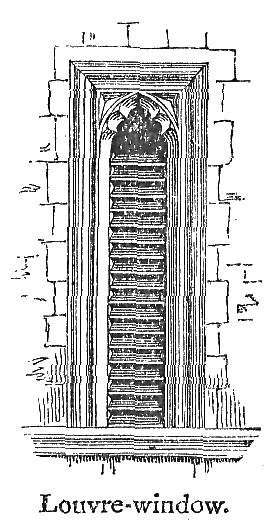
Louvre, Louver, lōō′vėr, n. an opening of a turret shape on roofs, to allow the smoke or foul air to escape from halls, kitchens, &c.—n. Lou′vre-win′dow, an open window in a church tower, crossed by a series of sloping boards. [O. Fr. louvert for l'ouvert, the open space.]
Lovage, luv′āj, n. a genus of plants of the natural order Umbelliferæ, allied to Angelica, used as a salad plant: a liquor made from the above. [O. Fr. luvesche—L. ligusticum, belonging to Liguria.]
Love, luv, n. fondness: an affection of the mind caused by that which delights: pre-eminent kindness: benevolence: reverential regard: devoted attachment to one of the opposite sex: the object of affection: the god of love, Cupid: (Shak.) a kindness, a favour done: nothing, in billiards, tennis, and some other games.—v.t. to be fond of: to regard with affection: to delight in with exclusive affection: to regard with benevolence.—v.i. to have the feeling of love.—adj. Lov′able, worthy of love: amiable.—ns. Love′-app′le, the fruit of the tomato; Love′bird, a genus of small birds of the parrot tribe, so called from their attachment to each other; Love′-brok′er (Shak.), a third person who carries messages and makes assignations between lovers; Love′-charm, a philtre; Love′-child, a bastard; Love′-day (Shak.), a day for settling disputes; Love′-fā′vour, something given to be worn in token of love; Love′-feast, a religious feast held periodically by certain sects of Christians in imitation of the love-feasts celebrated by the early Christians in connection with the Lord's-supper; Love′-feat, the gallant act of a lover; Love′-in-ī′dleness, the heart's-ease; Love′-juice, a concoction used to excite love; Love′-knot, an intricate knot, used as a token of love.—adj. Love′less, without love, tenderness, or kindness.—ns. Love′-lett′er, a letter of courtship; Love′-lies-bleed′ing, a species of the plant Amaranthus; Love′liness; Love′lock, a lock of hair hanging at the ear, worn by men of fashion in the reigns of Elizabeth and James I.—adj. Love′lorn, forsaken by one's love.—n. Love′lornness.—adj. Love′ly, exciting love or admiration: amiable: pleasing: delightful.—adv. beautifully, delightfully.—ns. Love′-match, a marriage for love, not money; Love′-mong′ėr, one who deals in affairs of love; Love′-pō′tion, a philtre; Lov′er, one who loves, esp. one in love with person of the opposite sex, in the singular almost exclusively of the man: one who is fond of anything: (B.) a friend.—adjs. Lov′ered (Shak.), having a lover; Lov′erly, like a lover.—n. Love′-shaft, a dart of love from Cupid's bow.—adjs. Love′-sick, languishing with amorous desire; Love′some, lovely.—ns. Love′-suit (Shak.), courtship; Love′-tō′ken, a gift in evidence of love.—adj. Lov′ing, having love or kindness: affectionate: fond: expressing love.—ns. Lov′ing-cup (see under Cup); Lov′ing-kind′ness, kindness full of love: tender regard: mercy: favour.—adv. Lov′ingly.—n. Lov′ingness.—For love or money, in some way or another; In love, enamoured; Make love to, to try to gain the affections of; Play for love, to play without stakes; There's no love lost between them, they have no regard for each other. [A.S. lufu, love; Ger. liebe; cf. L. libet, lubet.]
Lovelace, luv′lās, n. a well-mannered libertine. [From Lovelace, the hero of Clarissa Harlowe.]
Lover, an obsolete form of louvre.
Low, lō, v.i. to make the loud noise of oxen: to bellow.—n. the bellow of oxen.—n. Low′ing, the bellowing of cattle. [A.S. hlówan; Dut. loeijen; imit.]
Low, lō, adj. (comp. Low′er; superl. Low′est) lying in an inferior place or position: not high: deep: shallow: small: moderate: cheap: dejected: mean: plain: in poor circumstances: humble.—adv. not aloft: cheaply: meanly: in subjection, poverty, or disgrace: in times near our own: not loudly: (astron.) near the equator.—adj. Low′-born, of mean birth.—ns. Low′-church, a party within the Church of England minimising sacerdotal claims, ecclesiastical constitutions, ordinances, and forms, holding evangelical views of theology:—opp. to High-church; Low′-church′ism; Low′-church′man.—v.t. Low′er, to bring low: to depress: to degrade: to diminish.—v.i. to fall: to sink: to grow less.—adjs. Low′er-case (print.), kept in a lower case, denoting small letters as distinguished from capitals; Low′er-class, pertaining to persons of the humbler ranks.—n. Low′ering, the act of bringing low or reducing.—adj. letting down: sinking: degrading.—adj. Low′ermost, lowest.—ns. Low′land, land low with respect to higher land; Low′lander, a native of lowlands; Low′-life, humble life; Low′lihead, Low′lihood, a lowly or humble state; Low′liness.—adjs. Low′-lived, vulgar: shabby; Low′ly, of a low or humble mind: not high: meek: modest; Low′-mind′ed, moved by base or gross motives: vulgar; Low′-necked, cut low in the neck and away from the shoulders, décolleté.—n. Low′ness.—adjs. Low′-press′ure, employing or exerting a low degree of pressure (viz. less than 50 lb. to the sq. inch), said of steam and steam-engines; Low′-spir′ited, having the spirits low or cast down: not lively: sad.—n. Low′-spir′itedness.—adj. Low′-thought′ed, having the thoughts directed to low pursuits.—n. Low′-wa′ter, the lowest point of the tide at ebb.—Low Latin, a term often applied loosely to the Latin spoken and written after the fall of the Roman Empire, as well as during the Middle Ages; Low Sunday, the first Sunday after Easter, so called in contrast to the great festival whose octave it ends; Low wines, the weak spirit produced from the first distillation of substances containing alcohol.—Lie low, to keep quiet or hidden. [Ice. lágr, Dut. laag, low; allied to A.S. licgan, to lie.]
Low, low, n. (Scot.) a flame.—v.i. to blaze.—n. Low′-bell, a bell used in fowling by night, in connection with a light, to frighten birds into a net. [Ice. logi; cf. Dan. lue, Ger. lohe.]
Lower, low′ėr, v.i. to appear gloomy, as the clouds: to threaten a storm: to frown.—adjs. Lou′ry, Low′ery, cloudy; Low′ering, looking sullen: appearing dark and threatening.—adv. Low′eringly. [M. E. louren, from M. E. lure, lere, the cheek, allied to A.S. hleór, and thus a variant of leer.]
Lown, lown, n. a variant of loon.
Lown, lown, adj. (Scot.) sheltered, tranquil.
Loxia, lok′si-a, n. wryneck. [Gr.]
Loxodromic, lok-so-drom′ik, adj. pertaining to certain lines on the surface of a sphere which cut all meridians at the same angle, and indicate the course held by ships in rhumb sailing.—Loxodromic curve, line, or spiral, the course of a ship oblique to the equator and cutting all the meridians at the same angle, sailing constantly toward the same point of the compass.—Loxodromics, the art of such oblique sailing. [Gr. loxos, oblique, dromos, a course.]
Loyal, loi′al, adj. faithful to one's sovereign: obedient: true to a lover.—n. Loy′alist, a loyal adherent of his sovereign, esp. in English history, a partisan of the Stuarts: in the American war, one that sided with the British troops.—adv. Loy′ally.—n. Loy′alty. [Fr.,—L. legalis—lex, legis, law.]
Lozenge, loz′enj, n. an oblique-angled parallelogram or a rhombus: a small cake of flavoured sugar, originally lozenge or diamond shaped: (her.) the rhomb-shaped figure in which the arms of maids, widows, and deceased persons are borne.—adjs. Loz′enged, formed in the shape of a lozenge; Loz′enge-shaped, shaped like a lozenge or rhomb; Loz′engy (her.), divided into lozenge-shaped compartments. [O. Fr. losange, flattery, whence its use for an epitaph, square slab, window-pane.]
Lubber, lub′ėr, Lubbard, lub′ard, n. an awkward, clumsy fellow: a lazy, sturdy fellow.—adj. Lubb′ard, lubberly.—adj. and adv. Lubb′erly.—n. Lubb′er's-hole (naut.), a hole between the head of the lower mast and the edge of the top through which 'lubbers' may climb, instead of going round the futtock shroud. [W. llob, a dolt, llabbi, a stripling.]
Lubricate, lū′bri-kāt, v.t. to make smooth or slippery: to supply with oil to overcome friction.—adjs. Lū′bric, -al, Lū′bricous, slippery: lewd.—ns. Lū′bricant; Lubricā′tion.—adj. Lū′bricative.—ns. Lū′bricator; Lubricity (lū-bris′i-ti), slipperiness: smoothness: instability: lewdness; Lubrifac′tion. [L. lubricāre, -ātum—lubricus, slippery.]
Lucarne, lū′kärn, n. a dormer-window, esp. in a church spire. [Fr.,—L. lucerna, a lamp.]
Luce, lūs, n. a fresh-water fish, the pike. [O. Fr. lus—Low L. lucius.]
Lucent, lū′sent, adj. shining: bright.—n. Lū′cency, brightness.—adj. Lucer′nal, pertaining to a lamp. [L. lucens—lucēre, to shine—lux, lucis, light.]
Lucerne, lū′sėrn, n. a species of Medick, a valuable forage-plant. [Fr. luzerne.]
Lucid, lū′sid, adj. shining: transparent: easily understood: intellectually bright: not darkened with madness.—ns. Lucid′ity, Lū′cidness.—adv. Lū′cidly.—ns. Luc′ifer, the planet Venus when it appears as the morning-star: Satan: a match of wood tipped with a combustible substance ignited by friction.—adjs. Lucifē′rian, Lucif′erous, of or pertaining to Lucifer: bearing light: affording means of discovery; Lucif′ugal, Lucif′ugous, shunning light.—n. Lucim′eter, an instrument for measuring the intensity and duration of sunshine in promoting evaporation. [L.,—lux, lucis, light.]
Lucigen, lū′si-jen, n. one of the most powerful artificial lamps, and specially adapted for lighting large spaces, whether open or covered. [L. lux, lucis, light, and root of gignĕre, to beget.]
Lucina, lū′sī-na, n. a name applied both to Diana and to Juno—to the latter as the especial divinity that presides over childbirth. [L.,—lux, light.]
Luck, luk, n. fortune, good or bad: chance: lot: good fortune.—adv. Luck′ily.—n. Luck′iness.—adj. Luck′less, without good luck: unhappy.—adv. Luck′lessly.—ns. Luck′lessness; Luck′-penn′y, a trifle returned for luck by a seller to a buyer: a coin carried for luck.—adj. Luck′y, having good luck: auspicious.—n. Luck′y-bag, a receptacle for lost property on board a man-of-war.—Be down on one's luck, to be unfortunate. [From a Low Ger. root, seen in Dut. luk; cf. Ger. glück, prosperity.]
Lucky, Luckie, luk′i, n. (Scot.) an elderly woman.
Lucky, luk′i, n. (slang) departure.—Cut one's lucky, to bolt.
Lucre, lū′kėr, n. gain (esp. sordid gain): profit: advantage.—adj. Lū′crative, bringing lucre or gain: profitable.—adv. Lū′cratively. [Fr.,—L. lucrum, gain.]
Luctation, luk-tā′shun, n. struggle. [L.,—luctāri.]
Lucubrate, lū′kū-brāt, v.i. to study by lamplight or at night.—n. Lucubrā′tion, a product of close study or thought, any composition produced in retirement.—adj. Lū′cubrātory, composed by candle-light. [L. lucubrāre, -ātum—lux.]
Luculent, lū′kū-lent, adj. lucid: clear: transparent: evident.—adv. Lū′culently. [L. luculentus—lux.]
Lucumo, lū′kū-mō, n. an appellation of the Etruscan princes and priests. [L.]
Lud, n. a minced form of lord.
Ludicrous, lū′di-krus, adj. that serves for sport: adapted to excite laughter: laughable: comic.—adv. Lū′dicrously.—n. Lū′dicrousness. [L. ludicrus—ludĕre, to play.]
Lue, lū, v.t. to sift.
Lues, lū′ēz, n. a plague.—adj. Luet′ic. [L.]
Luff, luf, n. the windward side of a ship: the act of sailing a ship close to the wind: the loof.—v.t. to turn a ship towards the wind. [M. E. lof, a paddle; cf. Scot. loof, Dut. loef.]
Luffa, luf′a, n. a genus of climbing herbs of the gourd family, whose seeds are contained in a fibrous network removed entire by soaking, &c., and used as a flesh-brush.—Also Loof′a, &c. [Ar.]
Lug, lug, v.t. to pull along: to drag: to pull with difficulty:—pr.p. lug′ging; pa.t. and pa.p. lugged.—ns. Lug′gage, the trunks and other baggage of a traveller; Lug′gage-van, a wagon for baggage; Lug′ger, a small vessel with two or three masts, a running bowsprit, and long or lug sails; Lug′sail, Lug, a square sail bent upon a yard that hangs obliquely to the mast.—Lug in, to introduce without any apparent connection. [Scand., Sw. lugga, to pull by the hair—lugg, the forelock; from a base luk, to pull, present in Scot. lug, the ear.]
Lug, lug, n. (Spens.) a perch or rod of land.
Lug, lug, n. (Scot.) the ear.—adj. Lugged, having ears.—n. Lug′gie, a small vessel with ears.
Lugubrious, lū-gū′bri-us, adj. mournful: dismal.—adv. Lugū′briously. [L. lugubris—lugēre, to mourn.]
Lugworm, lug′wurm, n. a sluggish worm found in the sand on the sea-shore, much used for bait by fishermen.—Also Lobworm.
Lukewarm, lūk′wawrm, adj. partially or moderately warm: indifferent—also Luke.—adv. Luke′warmly.—ns. Luke′warmness, Luke′warmth. [M. E. leuk, luke, an extension of lew, cog. with the A.S. hleó, the source of lee; prob. confused with A.S. wlæc, wlacu, tepid; cf. Dut. leuk, Ger. lau.]
Lull, lul, v.t. to soothe: to compose: to quiet.—v.i. to become calm: to subside.—n. a season of calm.—n. Lull′aby, a song to lull children to sleep, a cradle-song.—v.t. to lull to sleep. [Scand., as in Sw. lulla; imit. like Ger. lallen, Gr. lalein.]
Lum, lum, n. (Scot.) a chimney. [W. llumon.]
Lumbago, lum-bā′gō, n. a rheumatic affection of the muscles or fibrous tissues in the lumbar region.—adjs. Lumbag′inous; Lum′bar, Lum′bal, pertaining to, or near, the loins. [L.,—lumbus, loin.]
Lumber, lum′bėr, n. anything cumbersome or useless: timber sawed or split for use.—v.t. to fill with lumber: to heap together in confusion.—n. Lum′berer, one employed in felling timber and bringing it from the forest.—adj. Lum′bering, filling with lumber: putting in confusion.—n. Lum′ber-room, a room for holding things not in use. [Fr. Lombard—Ger. Langbart; the lumber-room being orig. the Lombard-room or place where the Lombards, the medieval bankers and pawnbrokers, stored their pledges.]
Lumber, lum′bėr, v.i. to move heavily. [Scand.; prov. Sw. lomra, to resound, Ice. hljómr, a sound.]
Lumbrical, lum′brik-al, adj. (anat.) worm-like.—adj. Lumbric′iform. [L. lumbricus, a worm.]
Luminary, lū′min-ar-i, n. any body which gives light, esp. one of the heavenly bodies: one who illustrates any subject or instructs mankind.—adj. Lū′minant, emitting light.—n. an illuminating agent.—n. Luminā′tion, a lighting up.—v.t. Lū′mine (Spens.), to illumine.—adjs. Luminif′erous, transmitting light; Lū′minous, giving light: shining: illuminated: clear: lucid.—adv. Lū′minously.—ns. Lū′minousness, Luminos′ity.—Luminous paint, a phosphorescent powder, such as sulphide or oxysulphide of calcium, ground up with a colourless varnish or other medium, and used as a paint. [L. lumen, luminis, light—lucēre, to shine.]
Lummy, lum′i, adj. (slang) knowing, cute.
Lump, lump, n. a small shapeless mass: a protuberance: swelling: the whole together: the gross.—v.t. to throw into a confused mass: to take in the gross.—ns. Lump′er, a labourer employed in the lading or unlading of ships: (prov.) a militiaman; Lump′fish, a clumsy sea-fish with a short, deep, and thick body and head, and a ridge on its back, also called Lump′sucker, from the power of its sucker.—adjs. Lump′ing, in a lump: heavy: bulky; Lump′ish, like a lump: heavy: gross: dull.—adv. Lump′ishly.—ns. Lump′ishness; Lump′-sug′ar, loaf-sugar in small pieces.—adj. Lump′y, full of lumps.—In the lump, in gross. [Scand., Norw. lump, a block; Dut. lomp.]
Lunar, lū′nar, adj. belonging to the moon: measured by the revolutions of the moon: caused by the moon: like the moon—also Lū′nary.—ns. Lū′nacy, a kind of madness formerly supposed to be affected by the moon: insanity; Lunā′rian, Lū′narist, a student of lunar phenomena; Lū′nary, the moonwort fern.—adjs. Lū′nāte, -d, formed like a half-moon: crescent-shaped; Lū′natic, affected with lunacy.—n. a person so affected: a madman (De lunatico inquirendo, the title of the writ or commission for inquiry into the mental state of an alleged lunatic).—n. Lunā′tion, the time between two revolutions of the moon: a lunar month.—adjs. Lū′niform, moon-shaped; Lū′nisolar, resulting from the united action of the sun and moon: compounded of the revolution of the sun and the moon.—n. Lū′nula, a crescent-like appearance, esp. the whitish area at the base of the nails.—adjs. Lū′nulate, -d (bot.), shaped like a small crescent.—ns. Lū′nule, Lū′nulet, anything in form like a small crescent; Lū′nulite, a small circular fossil coral.—Lunar caustic, fused crystals of nitrate of silver, applied to ulcers, &c.; Lunar cycle=Metonic cycle (q.v.); Lunar month (see Month); Lunar observation, an observation of the moon's distance from a star for the purpose of finding the longitude; Lunar rainbow (see Rainbow, under Rain); Lunar theory, a term employed to denote the a priori deduction of the moon's motions from the principles of gravitation; Lunar year (see Year). [L. lunaris—luna, the moon—lucēre, to shine.]
Lunch, lunsh, n. a slight repast between breakfast and dinner—also Lunch′eon.—v.i. to take lunch.—n. Lunch′eon-bar, a counter at a restaurant where luncheons are served. [Lunch, a contr. of luncheon, itself extended from lunch, a lump.]
Lune, lūn, n. anything in the shape of a half-moon: (Shak.) a fit of lunacy.—n. Lunette′, a little moon: (fort.) a detached bastion: a hole in a concave ceiling to admit light: a watch-glass flattened more than usual in the centre: in the R.C. Church, a moon-shaped case of crystal used for receiving the consecrated host. [Fr. lune—L. luna.]
Lung, lung, n. one of the organs of breathing—from its spongy texture.—adjs. Lunged; Lung′-grown, having an adhesion of the lung to the pleura.—n. Lung′wort, an herb with purple flowers and spotted leaves: a lichen on tree-trunks, used as a remedy for pulmonary diseases. [A.S. lunge, pl. lungan, the lungs; cog. with light (adj.).]
Lunge, lunj, n. a sudden thrust in fencing.—v.i. to give such.—v.t. to cause to plunge. [Fr. allonger, to lengthen—L. ad, to, longus, long.]
Luniform, Lunisolar, Lunulate. See Lunar.
Lunt, lunt, n. a light, blaze.—v.i. (Scot.) to burn, to smoke. [Dut. lont, a match; cf. Ger. lunte.]
Lupine, lū′pīn, adj. like a wolf: wolfish.—n. a genus of leguminous plants.—adj. Lupanā′rian, bawdy.—n. Lupercā′lia, a festival among the ancient Romans, held on the 15th of February, in honour of Lupercus (Pan), god of fertility and patron of shepherds—(Shak.) Lū′percal. [L. lupinus—lupus, a wolf, lupa, a whore.]
Luppa, lup′a, n. cloth having so much gold and silver thread as to look as if made entirely of metal.
Lupulus, lū′pu-lus, n. the common hop.—n. Lū′pulin, the peculiar bitter aromatic principle of the hop.
Lupus, lū′pus, n. a chronic tuberculosis of the skin, often affecting the nose. [L. lupus, a wolf.]
Lurch, lurch, n. an ancient card-game: in cribbage, the position of the party who has gained every point before the other makes one.—v.t. to overreach: (arch.) to steal.—Leave in the lurch, to leave in a difficult situation without help. [O. Fr. lourche.]
Lurch, lurch, v.i. to evade by stooping, to lurk: to roll or pitch suddenly to one side (as a ship).—n. a sudden roll of a ship.—n. Lurch′er, a name applied to any dog with a distinct cross of greyhound: one who lies in wait: a glutton. [Lurk.]
Lurdan, lur′dan, adj. (arch.) stupid.—n. a stupid person.—Also Lur′dane, Lur′den. [O. Fr. lourdein, dull—lourd, heavy.]
Lure, lūr, n. any enticement: bait: decoy: (Shak.) a stuffed bird used in falconry for training the hawk.—v.t. to entice: decoy. [O. Fr. loerre (Fr. leurre)—Mid. High Ger. luoder (Ger. luder), bait.]
Lure, lūr, n. a trumpet with long curved tube, used for calling cattle, &c. [Ice. lúdhr.]
Lurid, lū′rid, adj. ghastly pale, wan: ghastly and sensational: gloomy.—adv. Lū′ridly. [L. luridus.]
Lurk, lurk, v.i. to lie in wait: to be concealed.—n. a swindle.—n. Lurk′er.—adj. Lurk′ing, lying hid: keeping out of sight.—n. Lurk′ing-place, a hiding-place. [Scand., Sw. prov. luska.]
Lurry, lur′i, n. (Milt.) confusion.
Luscious, lush′us, adj. sweet in a great degree: delightful: fulsome, as flattery.—adv. Lusc′iously.—n. Lusc′iousness. [Old form lushious, from lusty.]
Lush, lush, adj. rich and juicy, of grass. [A contr. of lushious, old form of luscious.]
Lush, lush, v.t. to swill.—n. plentiful liquor.—adj. Lush′y, tipsy.
Lusiad, lū′si-ad, n. a Portuguese epic by Camoens, celebrating the chief events in the history of Portugal.—adj. Lusitā′nian, Portuguese. [Port. Os Lusiadas, the Lusitanians.]
Lusk, lusk, adj. (obs.) lazy.—v.i. to lie about lazily.—adj. Lusk′ish (obs.).—n. Lusk′ishness (Spens.).
Lust, lust, n. longing desire: eagerness to possess: carnal appetite: (B.) any violent or depraved desire.—v.i. to desire eagerly (with after, for): to have carnal desire: to have depraved desires.—adjs. Lust′-breathed (Shak.), animated by lust; Lust′-dī′eted (Shak.), pampered by lust.—n. Lust′er.—adj. Lust′ful, having lust: inciting to lust: sensual.—adv. Lust′fully.—n. Lust′fulness.—adj. Lust′ic (Shak.), lusty, healthy, vigorous.—ns. Lust′ihead, Lust′ihood, Lust′iness.—adv. Lust′ily.—adj. Lust′less (Spens.), listless, feeble.—n. Lust′wort, the sundew.—adj. Lust′y, vigorous: healthful: stout: bulky: (Milt.) lustful. [A.S. lust, pleasure.]
Lustre, lus′tėr, n. brightness, gloss, splendour: (fig.) renown: a candlestick ornamented with pendants of cut-glass: the characteristic appearance of a bright metallic surface, or of air within glass under water as seen under certain angles of total reflection: a dress material having a highly finished surface: a glaze applied to porcelain.—adjs. Lus′treless, destitute of lustre; Lus′trous, bright: shining: luminous.—adv. Lus′trously. [Fr.,—Low L. lustrum, a window—L. lucēre, to shine.]
Lustre, lus′tėr, Lustrum, lus′trum, n. a period of five years: (orig.) the solemn offering for the purification of the Roman people made by one of the censors at the conclusion of the census, taken every five years.—adj. Lus′tral, relating to or used in lustration: of or pertaining to a lustre.—n. Lustrā′tion, a purification by sacrifice: act of purifying.—adj. Lus′trical, pertaining to purification by lustration. [L. lustrum—luĕre, to wash, to purify.]
Lustring, lus′tring, n. a glossy silk cloth.—Also Lus′trine, Lute′string. [Fr. lustrine—It. lustrino.]
Lusty. See Lust.
Lute, lūt, n. a medieval stringed instrument of music like the guitar.—v.i. to play on the lute.—ns. Lut′anist, Lut′er, Lut′ist, a player on a lute; Lute′string, the string of a lute. [O. Fr. lut (Fr. luth); like Ger. laute, from Ar. al, the, ‛úd, wood, the lute.]
Lute, lūt, n. a composition used to exclude air, as round pipe-joints: a brickmaker's straight-edge scraper: a rubber packing-ring for a jar.—v.t. to close or coat with lute.—adjs. Lutā′rious, Lū′teous, of or like mud.—n. Lutā′tion.—adj. Lū′tose, miry. [L. lutum, from luĕre, to wash.]
Luteolin, lū′tē-ō-lin, n. the yellow colouring matter of weld or dyer's weed.—adjs. Lutē′olous, yellowish; Lū′teous, golden-yellowish. [L. lutum, weld.]
Lutetian, lū-tē′shan, adj. Parisian. [L.]
Lutheran, lū′thėr-an, adj. pertaining to Luther, the great German Protestant reformer (1483-1546), or to his doctrines: a follower of Luther.—ns. Lu′theranism, Lū′therism; Lū′therist.
Luxate, luks′āt, v.t. to put out of joint: to displace.—n. Luxā′tion, a dislocation. [L. luxāre, -ātum—luxus—Gr. loxos, slanting.]
Luxury, luk′sū-ri, n. free indulgence in rich diet or costly dress or equipage: anything delightful: a dainty: (Shak.) wantonness.—ns. Luxū′riance, Luxū′riancy, Luxurī′ety.—adj. Luxū′riant, exuberant in growth: overabundant.—adv. Luxū′riantly.—v.i. Luxū′riate, to be luxuriant: to grow exuberantly: to live luxuriously: to expatiate with delight.—n. Luxuriā′tion, the act of luxuriating.—adj. Luxū′rious, given to luxury: administering to luxury: furnished with luxuries: softening by pleasure: (Milt.) luxuriant: (Shak.) lustful.—adv. Luxū′riously.—ns. Luxū′riousness; Lux′urist, one given to luxury. [O. Fr. luxurie—L. luxuria, luxury—luxus, excess.]
Luz, luz, n. a bone supposed by Rabbinical writers to be indestructible, probably the sacrum.
Luzula, lū′zū-lä, n. a genus of plants of the rush family, having plain leaves, covered with thinly scattered, longish hairs. [Old It. luzziola, a firefly.]
Lyam, lī′am, n. a leash.—Also Lime.
Lyart. See Liard.
Lycanthropy, lī-kan′thro-pi, n. the power possessed by a person of changing himself into a wolf: a kind of madness, in which the patient fancies himself to be a wolf.—ns. Lycan′thrope, Lycan′thropist, a wolf-man or were-wolf, one affected with lycanthropy.—adjs. Lycanthrop′ic, Lycan′thropous. [Gr. lykos, a wolf, anthrōpos, a man.]