LIST OF ABBREVIATIONS USED IN THIS DICTIONARY. (continued 3)
Reading edition
Evert, e-vert′, v.t. to turn inside out.—n. Ever′sion. [L. evertĕre—e, out, vertĕre, versum, to turn.]
Every, ev′ėr-i, adj. each one of a number: all taken separately.—pron. Ev′erybody, every person.—adj. Ev′eryday, of or belonging to every day, daily: common, usual: pertaining to week-days, in opposition to Sunday.—pron. Ev′erything, all things: all.—advs. Ev′eryway, in every way or respect; Ev′erywhen, at all times; Ev′erywhere, in every place.—Every bit, the whole; Every now and then, or again, at intervals; Every other, every second—e.g. every other day, every alternate day. [A.S. ǽfre, ever, and ǽlc, each.]
Evict, e-vikt′, v.t. to dispossess by law: to expel from.—ns. Evic′tion, the act of evicting from house or lands: the dispossession of one person by another having a better title of property in land; Evic′tor. [L. evictus, pa.p. of evincĕre, to overcome.]
Evident, ev′i-dent, adj. that is visible or can be seen: clear to the mind: obvious.—n. Ev′idence, that which makes evident: means of proving an unknown or disputed fact: information in a law case, as 'to give evidence:' a witness.—v.t. to render evident: (obs.) to attest, prove.—adjs. Eviden′tial, Eviden′tiary, furnishing evidence: tending to prove.—advs. Eviden′tially; Ev′idently (N.T.), visibly.—In evidence, received by the court as competent evidence: plainly visible, conspicuous—a penny-a-liner's phrase adopted from the Fr. en evidence; Turn King's (Queen's) evidence (of an accomplice in a crime), to give evidence against his partners. [L. evidens, -entis—e, out, vidēre, to see.]
Evil, ē′vl, adj. wicked: mischievous: disagreeable: unfortunate.—adv. in an evil manner: badly.—n. that which produces unhappiness or calamity: harm: wickedness: depravity: sin.—ns. E′vil-do′er, one who does evil; E′vil-eye, a supposed power to cause evil or harm by the look of the eye.—adj. E′vil-fā′voured, having a repulsive appearance: ugly.—n. E′vil-fā′vouredness (B.), ugliness: deformity.—adv. E′villy, in an evil manner: not well.—adj. E′vil-mind′ed, inclined to evil: malicious: wicked.—ns. E′vilness, state of being evil: wickedness; E′vil-speak′ing, the speaking of evil: slander.—adj. E′vil-starred (Tenn.), born under the influence of an unpropitious star, unfortunate.—n. E′vil-work′er, one who works or does evil.—The Evil One, the devil.—Speak evil of, to slander. [A.S. yfel; Dut. euvel; Ger. übel. Ill is a doublet.]
Evince, e-vins′, v.t. to prove beyond doubt: to show clearly: to make evident.—n. Evince′ment.—adj. Evinc′ible, that may be evinced or made evident.—adv. Evinc′ibly.—adj. Evinc′ive, tending to evince, prove, or demonstrate. [L. evincĕre—e, inten., vincĕre, to overcome.]
Evirate, ē′vir-āt, v.t. to castrate: to render weak or unmanly. [L. evirāre—e, out, vir, a man.]
Eviscerate, e-vis′ėr-āt, v.t. to tear out the viscera or bowels: to gut.—n. Eviscerā′tion. [L. e, out, viscera, the bowels.]
Evite, e-vīt′, v.i. to avoid.—v.t. Ev′itate (Shak.) to avoid.—n. Evitā′tion, the act of shunning. [L. evitāre, -ātum—e, out, vitāre, to shun.]
Eviternal, ev-i-tėr′nal, adj. eternal.—adv. Eviter′nally.—n. Eviter′nity.
Evoke, e-vōk′, v.t. to call out: to draw out or bring forth.—v.t. Ev′ocate, to call up (spirits) from the dead.—n. Evocā′tion. [L. evocāre—e, out, and vocāre, to call.]
Evolution, ev-ol-ū′shun, n. the act of unrolling or unfolding: gradual working out or development: a series of things unfolded: the doctrine according to which higher forms of life have gradually arisen out of lower: (arith., alg.) the extraction of roots: (pl.) the orderly movements of a body of troops or of ships of war.—adjs. Evolū′tional, Evolū′tionary, of or pertaining to evolution.—ns. Evolū′tionism, the theory of evolution; Evolū′tionist, one skilled in evolutions or military movements: one who believes in evolution as a principle in science.—adj. Ev′olūtive. [L. evolutionem—evolvĕre.]
Evolve, e-volv′, v.t. to unroll: to disclose: to develop: to unravel.—v.i. to disclose itself: to result.—n. Ev′olūte (math.), an original curve from which another curve (the involute) is described by the end of a thread gradually unwound from the former.—adj. Evolv′able, that can be drawn out.—n. Evolve′ment.—adj. Evolv′ent. [L. evolvĕre—e, out, volvĕre, volūtum, to roll.]
Evulgate, e-vul′gāt, v.t. to divulge: to publish. [L. evulgāre, ātum—e, out, vulgus, the people.]
Evulsion, e-vul′shun, n. a plucking out by force. [L. e, out, vellĕre, vulsum, to pluck.]
Ewe, ū, n. a female sheep.—ns. Ewe′-cheese, cheese made from the milk of ewes; Ewe′-lamb, a female lamb: a poor man's one possession—used in reference to 2 Sam. xii.; Ewe′-neck, of horses, a thin hollow neck.—adj. Ewe′-necked. [A.S. eowu; cf. L. ovis, Gr. oïs, Sans, avi, a sheep.]
Ewer, ū′ėr, n. a large jug with a wide spout, placed on a washstand to hold water. [Through Fr. from L. aquarium—aqua, water, whence also Fr. eau.]
Ewest, ū′est, adj. (Scot.) near.
Ewft, eft, n. (Spens.). Same as Eft (1).
Ewhow, ā′hwow, interj. (Scot.) an exclamation of sorrow.
Ewigkeit, ā′vih-kīt, n. eternity. [Ger.]
Ex, eks, used adjectively in words like ex-emperor, to signify late. See Prefixes in Appendix.
Exacerbate, egz-as′ėr-bāt, or eks-, v.t. to embitter: to provoke: to render more violent or severe, as a disease.—ns. Exacerbā′tion, Exacerbes′cence, increase of irritation or violence, esp. the increase of a fever or disease: embitterment. [L. exacerbāre, -ātum—ex, and acerbāre, from acerbus, bitter.]
Exact, egz-akt′, v.t. to force from: to compel full payment of: to make great demands, or to demand urgently: to extort: to inflict.—v.i. to practice extortion.—adj. precise: careful: punctual: true: certain or demonstrable.—p.adj. Exact′ing, compelling full payment of: unreasonable in making demands.—ns. Exac′tion, act of exacting or demanding strictly: an oppressive demand: that which is exacted, as excessive work or tribute; Exact′itude, exactness: correctness.—adv. Exact′ly.—ns. Exact′ment; Exact′ness, quality of being exact: accuracy; Exact′or, -er, one who exacts: an extortioner: one who claims rights, often too strictly:—fem. Exact′ress.—Exact sciences, the mathematical sciences, of which the results are demonstrable. [L. exigĕre, exactum—ex, out, agĕre, to drive.]
Exaggerate, egz-aj′ėr-āt, v.t. to magnify unduly: to represent too strongly: to intensify.—n. Exaggerā′tion, extravagant representation: a statement in excess of the truth.—adjs. Exagg′erative, Exagg′eratory, containing exaggeration or tending to exaggerate.—n. Exagg′erator. [L. exaggerāre, -ātum—ex, aggerāre, to heap up—agger, a heap.]
Exalbuminous, eks-al-bū′min-us, adj. (bot.) without albumen.—Also Exalbū′minose.
Exalgin, eks-al′jin, n. an anodyne obtained from coal-tar products. [Gr.,—ex, out, algos, pain.]
Exalt, egz-awlt′, v.t. to elevate to a higher position: to elate or fill with the joy of success: to extol: (chem.) to refine or subtilise.—n. Exaltā′tion, elevation in rank or dignity: high estate: elation: (astrol.) the position of a planet in the zodiac where it was supposed to wield the greatest influence.—p.adj. Exalt′ed, elevated: lofty: dignified.—n. Exalt′edness. [L. exaltāre—ex, altus, high.]
Examine, egz-am′in, v.t. to test: to inquire into: to question.—n. Exā′men, examination.—adj. Exam′inable.—ns. Exam′inant, an examiner; Exam′inate, one who is examined; Examinā′tion, careful search or inquiry: trial: testing of capacity of pupils, also contracted to Exam.; Examinēē′, one under examination; Exam′iner, Exam′inātor, one who examines.—p.adj. Exam′ining, that examines, or is appointed to examine. [Fr.,—L. examināre—examen (=exagmen), the tongue of a balance.]
Example, egz-am′pl, n. that which is taken as a specimen of the rest, or as an illustration of the rule, &c.: the person or thing to be imitated or avoided: a pattern: a warning: a former instance.—v.t. to exemplify: to instance.—n. Exam′plar, a pattern, model.—adj. Exam′plary, serving for an example. [O. Fr.,—L. exemplum—eximĕre, to take out—ex, out of, emĕre, emptum, to take.]
Exanimate, egz-an′i-māt, adj. lifeless: spiritless: depressed.—n. Exanimā′tion.—adj. Exan′imous [L. exanimātus—ex, neg., animus, spirit, life.]
Exanthema, eks-an-thē′ma, n. one of a class of febrile diseases with distinctive eruptions on the skin, appearing at a definite period and running a recognisable course:—pl. Exanthē′mata.—adjs. Exanthemat′ic, Exanthem′atous.—ns. Exanthematol′ogy; Exanthē′sis, the appearing of an exanthema. [Gr.,—ex, out, antheein, to blossom.]
Exarch, eks′ärk, n. name formerly given to the vicegerent of the Byzantine empire in Italy: a bishop: (Gr. Church) an ecclesiastical inspector.—n. Exarch′ate, the office of an exarch. [Gr. exarchos—ex, and archein, to lead.]
Exasperate, egz-as′pėr-āt, v.t. to make very angry: to irritate in a high degree.—p.adj. irritated.—adjs. Exas′perating, Exas′perative, provoking.—ns. Exasperā′tion, act of irritating; state of being exasperated: provocation: rage: aggravation; Exas′perator. [L. ex, inten., asperāre, to make rough—asper, rough.]
Excalibur, eks-kal′ib-ėr, n. the name of King Arthur's sword. [O. Fr. escalibor—caliburn; cf. Ir. caladbolg, a famous sword.]
Excambion, eks-kam′bi-on, n. legal term for the exchange of lands—also Excam′bium.—v.t. Excamb′, to exchange. [Low L. excambiāre.]
Excavate, eks′ka-vāt, v.t. to hollow or scoop out: to dig out.—ns. Excavā′tion, act of excavating: a hollow or cavity made by excavating; Ex′cavator, one who excavates: a machine used for excavating. [L. excavāre—ex, out, cavus, hollow.]
Exceed, ek-sēd′, v.t. to go beyond the limit or measure of: to surpass or excel.—v.i. to go beyond a given or proper limit.—p.adj. Exceed′ing, surpassing, excessive.—adv. Exceed′ingly, very much: greatly. [L. ex, beyond, cedĕre, cessum, to go.]
Excel, ek-sel′, v.t. to be superior to: to exceed: to surpass.—v.i. to have good qualities in a high degree: to perform very meritorious actions: to be superior:—pr.p. excel′ling; pa.p. excelled′.—ns. Ex′cellence, Ex′cellency, great merit: any excellent quality: worth: greatness: a title of honour given to persons high in rank or office.—adj. Ex′cellent, surpassing others in some good quality: of great virtue, worth, &c.: superior: valuable.—adv. Ex′cellently.—adj. Excel′sior (L. comp.), higher still. [L. excellĕre—ex, out, up, and a word from the root of celsus, high.]
Except, ek-sept′, v.t. to take or leave out: to exclude.—v.i. to object.—prep. leaving out: excluding: but.—adj. and n. Except′ant.—prep. Except′ing, with the exception of, except.—n. Excep′tion, the act of excepting: that which is excepted: exclusion: objection: offence.—adj. Excep′tionable, objectionable.—adv. Excep′tionably.—adj. Excep′tional, peculiar.—adv. Excep′tionally.—adjs. Excep′tious, disposed to take exception; Except′ive, including, making, or being an exception; Except′less (Shak.), making an exception, usual.—n. Except′or. [L. excipĕre, exceptum—ex, out, capĕre, to take.]
Excerpt, ek′sėrpt, or ek-sėrpt′, n. a passage selected from a book, an extract.—v.t. Excerpt′, to select: to extract.—ns. Excerpt′ing, Excerp′tion; Excerp′tor. [L. excerptum, pa.p. of excerpĕre—ex, out, carpĕre, to pick.]
Excess, ek-ses′, n. a going beyond what is usual or proper: intemperance: that which exceeds: the degree by which one thing exceeds another.—adj. Exces′sive, beyond what is right and proper: immoderate: violent.—adv. Exces′sively.—n. Exces′siveness.—Carry to excess, to do too much. [L. excessus—excedĕre, excessum, to go beyond.]
Exchange, eks-chānj′, v.t. to give or leave one place or thing for another: to give and take mutually: to barter.—n. the giving and taking one thing for another: barter: the thing exchanged: process by which accounts between distant parties are settled by bills instead of money: the difference between the value of money in different places: the building where merchants, &c., meet for business.—n. Exchangeabil′ity.—adj. Exchange′able, that may be exchanged.—n. Exchan′ger, one who exchanges or practises exchange: (B.) a money-changer, a banker. [O. Fr. eschangier (Fr. échanger)—Low L. excambiāre—L. ex, out, cambīre, to barter.]
Excheat, eks-chēt′, n. (Spens.). Same as Escheat.
Exchequer, eks-chek′ėr, n. a superior court which had formerly to do only with the revenue, but now also with common law, so named from the chequered cloth which formerly covered the table, and on which the accounts were reckoned.—v.t. to proceed against a person in the Court of Exchequer.—Exchequer bill, bill issued at the Exchequer, under the authority of acts of parliament, as security for money advanced to the government.—Chancellor of the Exchequer (see Chancellor); Court of Exchequer, originally a revenue court, became a division of the High Court of Justice in 1875, and is now merged in the Queen's Bench Division. [From root of check, checker.]
Excide, ek-sid′, v.t. to cut off. [L. excidĕre—ex, out, cædĕre, to cut.]
Excipient, ek-sip′i-ent, n. a substance mixed with a medicine to give it consistence, or used as a vehicle for its administration.
Excise, ek-sīz′, n. a tax on certain home commodities and on licenses for certain trades; the department in the civil administration which is concerned with this tax.—v.t. to subject to excise duty.—adj. Excis′able, liable to excise duty.—n. Excise′man, an officer charged with collecting the excise. [Old Dut. excijs—O. Fr. acceis, tax—Low L. accensāre, to tax—ad, to, census, tax.]
Excise, ek-sīz′, v.t. to cut off or out.—n. Exci′sion, a cutting out or off of any kind: extirpation. [L. excidĕre, to cut out—ex, out, cædĕre, to cut.]
Excite, ek-sīt′, v.t. to call into activity: to stir up: to rouse: to irritate.—ns. Excītabil′ity, Excīt′ableness.—adj. Excīt′able, capable of being excited, easily excited.—ns. Excitant (ek′sit-ant, or ek-sīt′ant), that which excites or rouses the vital activity of the body: a stimulant; Excitā′tion, act of exciting: means of excitement: state of excitement.—adjs. Excīt′ātive, Excīt′ātory, tending to excite.—p.adj. Excīt′ed, agitated.—ns. Excite′ment, agitation: that which excites; Excīt′er.—p.adj. Excīt′ing, tending to excite.—adj. Excī′to-mō′tor, exhibiting muscular contraction. [Fr.,—L. excitāre, -ātum—exciēre—ex, out, ciēre, to set in motion.]
Exclaim, eks-klām′, v.i. to cry out: to utter or speak vehemently.—n. an exclamation, outcry.—n. Exclamā′tion, vehement utterance: outcry: an uttered expression of surprise, and the like: the mark expressing this (!): an interjection.—adjs. Exclam′ative, Exclam′atory, containing or expressing exclamation. [Fr. exclamer—L. exclamāre, -ātum—ex, out, clamāre, to shout.]
Exclave, eks′klāv, n. a part of a country, province, &c. disjoined from the main part—opp. to Enclave.
Exclude, eks-klōōd′, v.t. to close or shut out: to thrust out: to hinder from entrance: to hinder from participation: to except.—ns. Exclu′sion, a shutting or putting out: ejection: exception; Exclu′sionism; Exclu′sionist, one who excludes, or would exclude, another from a privilege.—adj. Exclu′sive, able or tending to exclude: debarring from participation: sole: not taking into account.—n. one of a number who exclude others from their society.—adv. Exclu′sively.—ns. Exclu′siveness; Exclu′sivism.—adj. Exclu′sory, exclusive.—Exclusive dealing, the act of abstaining deliberately from any business or other transactions with persons of opposite political or other convictions to one's own—a euphemism for boycotting (q.v.). [L. excludĕre—ex, out, claudĕre, to shut.]
Excogitate, eks-koj′i-tāt, v.t. to discover by thinking: to think earnestly or laboriously.—n. Excogitā′tion, laborious thinking: invention: contrivance. [L. excogitāre, -ātum—ex, out, cogitāre, to think.]
Excommunicate, eks-kom-ūn′i-kāt, v.t. to put out of or expel from the communion of the church: to deprive of church privileges.—adj. Excommun′icable.—ns. Excommunicā′tion, act of expelling from the communion of a church—(Milt.) Excommun′ion.—adj. Excommun′icatory, of or pertaining to excommunication. [From Late L. excommunicāre—L. ex, out, communis, common.]
Excoriate, eks-kō′ri-āt, v.t. to strip the skin from.—n. Excoriā′tion, the act of excoriating: the state of being excoriated. [L. excoriāre, -ātum—ex, from, corium, the skin.]
Excorticate, eks-kor′ti-kāt, v.t. to strip the bark off.—n. Excorticā′tion.
Excrement, eks′kre-ment, n. useless matter discharged from the animal system: dung.—adjs. Excrement′al, Excrementi′tial, Excrementi′tious, pertaining to or containing excrement. [L. excrementum—excernĕre—ex, out, cernĕre, to sift.]
Excrescence, eks-kres′ens, n. that which grows out unnaturally from anything else: an outbreak: a wart or tumour: a superfluous part.—ns. Ex′crement, an outgrowth; Excres′cency, state of being excrescent: excrescence.—adjs. Excres′cent, growing out: superfluous; Excrescen′tial. [Fr.,—L.,—excrescĕre—ex, out, crescĕre, to grow.]
Excrete, eks-krēt′, v.t. to separate from: to eject.—ns.pl. Excrē′ta, Excrētes′, matters discharged from the animal body.—n. Excrē′tion, act of excreting matter from the animal system: that which is excreted.—adjs. Excrē′tive, able to excrete; Excrē′tory, having the quality of excreting.—n. a duct that helps to receive and excrete matter. [L. ex, from, cernĕre, cretum, to separate.]
Excruciate, eks-krōō′shi-āt, v.t. to torture: to rack: to pain, grieve.—p.adj. Excru′ciāting, extremely painful: racking: torturing: agonising.—adv. Excru′ciatingly.—n. Excruciā′tion, torture: vexation. [L. ex, out, cruciāre, -ātum, to crucify—crux, crucis, a cross.]
Exculpate, eks-kul′pāt, v.t. to clear from the charge of a fault or crime: to absolve: to vindicate.—n. Exculpā′tion.—adj. Excul′patory, tending to free from the charge of fault or crime. [L. ex, from, culpa, a fault.]
Excursion, eks-kur′shun, n. a going forth: an expedition: a trip for pleasure or health: a wandering from the main subject: a digression.—adj. Excur′rent (bot.), projecting beyond the edge or point.—vs.i. Excurse′, to digress; Excur′sionise, to go on an excursion.—n. Excur′sionist, one who goes on a pleasure-trip.—adj. Excur′sive, rambling: deviating.—adv. Excur′sively.—ns. Excur′siveness; Excur′sus, a dissertation on some particular point appended to a book or chapter.—Excursion train, a special train, usually with reduced fares, for persons making an excursion. [L. excursio—ex, out, currĕre, cursum, to run.]
Excuse, eks-kūz′, v.t. to free from blame or guilt: to forgive: to free from an obligation: to release, dispense with: to make an apology or ask pardon for.—n. (eks-kūs′) a plea offered in extenuation of a fault: indulgence.—adj. Excus′able, admitting of justification.—n. Excus′ableness.—adv. Excus′ably.—adj. Excus′atory, making or containing excuse: apologetic.—Excuse me, an expression used as an apology for any slight impropriety, or for controverting a statement that has been made. [L. excusāre—ex, from, causa, a cause, accusation.]
Exeat, eks′ē-at, n. formal leave, as for a student to be out of college for more than one night. [L., 'let him go out.']
Execrate, eks′e-krāt, v.t. to curse: to denounce evil against: to detest utterly.—adj. Ex′ecrable, deserving execration: detestable: accursed.—adv. Ex′ecrably.—n. Execrā′tion, act of execrating: a curse pronounced: that which is execrated.—adj. Ex′ecrātive, of or belonging to execration.—adv. Ex′ecrātively.—adj. Ex′ecrātory. [L. exsecrāri, -ātus, to curse—ex, from, sacer, sacred.]
Execute, eks′e-kūt, v.t. to perform: to give effect to: to carry into effect the sentence of the law: to put to death by law.—adj. Exec′utable, that can be executed.—ns. Exec′utant, one who executes or performs; Ex′ecuter; Execū′tion, act of executing or performing: accomplishment: completion: carrying into effect the sentence of a court of law: the warrant for so doing: the infliction of capital punishment; Execū′tioner, one who executes, esp. one who inflicts capital punishment.—adj. Exec′utive, designed or fitted to execute: active: qualifying for or pertaining to the execution of the law.—n. the power or authority in government that carries the laws into effect: the persons who administer the government.—adv. Exec′utively.—n. Exec′utor, one who executes or performs: the person appointed to see a will carried into effect:—fem. Exec′utress, Exec′utrix.—adj. Executō′rial.—n. Exec′utorship.—adj. Exec′utory, executing official duties: designed to be carried into effect. [Fr. exécuter—L. exsequi, exsecutus—ex, out, sequi, to follow.]
Exedra, eks′e-dra, n. a raised platform with steps, in the open air: an apse, recess, niche—also Ex′hedra:—pl. Ex′edræ. [L.]
Exegesis, eks-e-jē′sis, n. the science of interpretation, esp. of the Scriptures.—ns. Ex′egete, Exeget′ist, one who interprets the Scriptures.—adjs. Exeget′ic, -al, pertaining to exegesis: explanatory.—adv. Exeget′ically.—n.pl. Exeget′ics, the science of exegesis. [Gr. exēgesis—exēgeesthai, to explain—ex, out, hēgeesthai, to guide.]
Exeme, eks-ēm′, v.t. (Scot.) to release, exempt. [L. eximĕre—ex, out, emĕre, to take.]
Exemplar, egz-em′plar, n. a person or thing to be imitated: the ideal model of an artist: a type: an example.—adv. Ex′emplarily.—ns. Exem′plariness, the state or quality of being exemplary; Exemplar′ity, exemplariness: exemplary conduct.—adj. Exemplary (egz-em′plar-i, or egz′em-plar-i), worthy of imitation or notice. [O. Fr. exemplaire—Low L. exemplarium—exemplum, example.]
Exemplify, egz-em′pli-fī, v.t. to illustrate by example: to make an attested copy of: to prove by an attested copy:—pr.p. exem′plifying; pa.p. exem′plified.—adj. Exem′plifīable.—n. Exemplificā′tion, act of exemplifying: that which exemplifies: a copy or transcript. [L. exemplum, example, facĕre, to make.]
Exempt, egz-emt′, v.t. to free, or grant immunity (with from).—adj. taken out: not liable to: released: unaffected by.—n. Exemp′tion, act of exempting: state of being exempt: freedom from any service, duty, &c.: immunity. [Fr.,—L. eximĕre, exemptum—ex, out, emĕre, to buy.]
Exenterate, eks-en′tėr-āt, v.t. to disembowel.—p.adj. disembowelled.—n. Exenterā′tion. [L. exenterāre—Gr. ex, out, enteron, intestine.]
Exequatur, eks-e-kwā′tur, n. an official recognition of a consul or commercial agent given by the government of the country in which he is to be. [L. exequatur='let him execute'—the opening word.]
Exequy, eks′e-kwi (only in pl. Exequies, eks′e-kwiz), n. a funeral procession: funeral rites.—adj. Exē′quial. [L. exequiæ—ex, out, sequi, to follow.]
Exercise, eks′ėr-sīz, n. a putting in practice: exertion of the body for health or amusement: discipline: a lesson, task, academical disputation, &c.: (Shak.) skill: (pl.) military drill: an act of worship or devotion: a discourse, the discussion of a passage of Scripture, giving the coherence of text and context, &c.—the addition, giving the doctrinal propositions, &c.: the Presbytery itself.—v.t. to train by use: to improve by practice: to afflict: to put in practice: to use: to wield.—adj. Ex′ercisable. [O. Fr. exercice—L. exercitium—L. exercēre, -citum—ex, out, arcēre, to shut up.]
Exercitation, egz-er-sit-ā′shun, n. the putting into practice: employment: exercise: a discourse. [L. exercitāre—exercēre, to exercise.]
Exergue, eks′erg, or egz-erg′, n. the part on the reverse of a coin, below the main device, often filled up by the date, &c.—adj. Exer′gual. [Fr.,—Gr. ex, out, ergon, work.]
Exert, egz-ėrt′, v.t. to bring into active operation: to do or perform.—n. Exer′tion, a bringing into active operation: effort: attempt.—adj. Exert′ive, having the power or tendency to exert: using exertion. [L. exserĕre, exsertum—ex, out, serĕre, to put together.]
Exeunt, eks′ē-unt. See Exit.
Exfoliate, eks-fō′li-āt, v.i. and v.t. to come off, or send off, in scales.—n. Exfoliā′tion.—adj. Exfō′liative. [L. exfoliāre, -ātum—ex, off, folium, a leaf.]
Exhale, egz-hāl′, v.t. to emit or send out as vapour: to evaporate.—v.i. to rise or be given off as vapour.—adjs. Exhal′able, that can be exhaled; Exhal′ant, having the quality of exhaling.—n. Exhalā′tion, act or process of exhaling: evaporation: that which is exhaled: vapour: steam. [Fr. exhaler—L. exhalāre—ex, out, halāre, -ātum, to breathe.]
Exhale, egz-hāl′, v.t. to draw out: (Shak.) to cause to flow. [Pfx. ex-, and hale, to draw.]
Exhaust, egz-awst′, v.t. to draw out the whole of: to use the whole strength of: to wear or tire out: to treat of or develop completely.—n. the exit of steam from the cylinder when it has done its work in propelling the piston—escaping by the exhaust-pipe and regulated by the exhaust-valve.—p.adj. Exhaust′ed, drawn out: emptied: consumed: tired out.—n. Exhaust′er, he who or that which exhausts.—adj. Exhaust′ible, that may be exhausted.—n. Exhaust′ion, act of exhausting or consuming: state of being exhausted: extreme fatigue.—adjs. Exhaust′ive, tending to exhaust; Exhaust′less, that cannot be exhausted. [L. exhaurīre, exhaustum—ex, out, haurīre, to draw.]
Exheredate, eks-her′i-dāt, v.t. (rare) to disinherit.—n. Exheredā′tion. [L. exheredāre—ex, out, heres, -edis, heir.]
Exhibit, egz-ib′it, v.t. to hold forth or present to view: to present formally or publicly.—n. (law) a document produced in court to be used as evidence: something exhibited: an article at an exhibition.—ns. Exhib′iter, Exhib′itor; Exhibi′tion, presentation to view: display: a public show, esp. of works of art, manufactures, &c.: that which is exhibited: an allowance or bounty to scholars in a university; Exhibi′tioner, one who enjoys an exhibition at a university; Exhibi′tionist.—adjs. Exhib′itive, serving for exhibition: representative; Exhib′itory, exhibiting.—Make an exhibition of one's self, to behave foolishly, exciting ridicule. [L. exhibēre, -itum—ex, out, habēre, -itum, to have.]
Exhilarate, egz-il′a-rāt, v.t. to make hilarious or merry: to enliven: to cheer.—adj. Exhil′arant, exhilarating: exciting joy, mirth, or pleasure.—n. an exhilarating medicine.—p.adj. Exhil′arāting, cheering: gladdening.—adv. Exhil′arātingly.—n. Exhilarā′tion, state of being exhilarated: joyousness.—adjs. Exhil′arātive, Exhil′arātory. [L. exhilarāre, -ātum—ex, inten., hilaris, cheerful.]
Exhort, egz-hort′, or egz-ōrt′, v.t. to urge strongly to good deeds, esp. by words or advice: to animate: to advise or warn.—n. Exhortā′tion, act of exhorting: language intended to exhort: counsel: a religious discourse.—adjs. Exhort′ative, Exhort′atory, tending to exhort or advise. [L. exhortāri, -ātus—ex, inten., hortāri, to urge.]
Exhume, eks-hūm′, v.t. to take out of the ground or place of burial: to disinter: to bring to light—also Ex′humate.—ns. Exhumā′tion, act of exhuming: disinterment; Exhum′er, one who exhumes. [L. ex, out of, humus, the ground.]
Exies, ek′siz, n.pl. (Scot.) ecstasy: hysterics. [Perh. from access, an attack, a fit.]
Exigent, eks′i-jent, adj. pressing: demanding immediate attention or action.—n. end, extremity: (Browning) a needed amount.—adj. Exigeant′, exacting.—n.fem. Exigeante′.—ns. Ex′igence, Ex′igency, pressing necessity: emergency: distress.—adj. Ex′igible, capable of being exacted.—ns. Exigū′ity, Exig′uousness.—adj. Exig′uous, small: slender. [L. exigens, -entis—exigĕre—ex, out, agĕre, to drive.]
Exile, eks′īl, or egz′īl, n. state of being sent out of one's native country: expulsion from home: banishment: one away from his native country.—v.t. to expel from one's native country, to banish.—n. Ex′īlement, banishment.—adj. Exil′ic, pertaining to exile, esp. that of the Jews in Babylon. [O. Fr. exil—L. exsilium, banishment—ex, out of, and root of salīre, to leap.]
Exility, eks-il′i-ti, n. slenderness, smallness: refinement. [L. exilis, slender, contraction for exigilis.]
Eximious, eg-zim′i-us, adj. excellent, distinguished. [L. eximius—eximĕre—ex, out, emĕre, to take.]
Exist, egz-ist′, v.i. to have an actual being: to live: to continue to be.—n. Exist′ence, state of existing or being: continued being: life: anything that exists: a being.—adjs. Exist′ent, having being: at present existing; Existen′tial. [L. existĕre, exsistĕre—ex, out, sistĕre, to make to stand.]
Exit, eks′it, n. a direction in playbooks to an actor to go off the stage: the departure of a player from the stage: any departure: a way of departure: a passage out: a quitting of the world's stage, or life: death:—pl. Ex′eunt.—v.i. to make an exit. [L. exit, he goes out, exeunt, they go out—exīre, to go out—ex, out, and īre, itum, to go.]
Ex libris, eks lī′bris, n. a book-plate—lit. 'from the books of.' [L.]
Exode, ek′sōd, n. the concluding part of a Greek drama: a farce or afterpiece. [Gr.]
Exodus, eks′o-dus, n. a going out or departure, esp. that of the Israelites from Egypt (1491 B.C., Usher): the second book of the Old Testament.—adj. Exod′ic.—n. Ex′odist, one who goes out: an emigrant. [L.,—Gr. exodos—ex, out, hodos, a way.]
Exogamy, eks-og′a-mi, n. the practice of marrying only outside of one's own tribe.—adj. Exog′amous. [Gr. exo, out, gamos, marriage.]
Exogen, eks′o-jen, n. a plant belonging to the great class that increases by layers growing on the outside of the wood.—adj. Exog′enous (-oj′), growing by successive additions to the outside. [L. exō, outside, and gen, root of gignesthai, to be produced.]
Exomis, eks-ō′mis, n. a sleeveless vest, worn by workmen and slaves—(Browning) Exō′mion. [Gr. exōmis—ex, out, ōmos, shoulder.]
Exon, eks′on, n. one of the four officers of the yeomen of the Royal Guard. [App. intended to express the pronunciation of Fr. exempt (Dr Murray).]
Exonerate, egz-on′ėr-āt, v.t. to free from the burden of blame or obligation: to acquit.—n. Exonerā′tion, act of exonerating or freeing from a charge or blame.—adj. Exon′erative, freeing from a burden or obligation. [L. exonerāre, -ātum—ex, from, onus, oneris, burden.]
Exophagy, eks-of′a-ji, n. the custom among cannibals of eating only the flesh of persons not of their own tribe.—adj. Exoph′agous. [Formed from Gr. exō, outside, phagein, to eat.]
Exorable, ek′sō-ra-bl, adj. capable of being moved by entreaty.—n. Exorā′tion, entreaty.
Exorbitant, egz-or′bi-tant, adj. going beyond the usual limits: excessive.—ns. Exor′bitance, Exor′bitancy, extravagance: enormity.—adv. Exor′bitantly.—v.i. Exor′bitāte, to stray. [L. exorbitans, -antis, pr.p. of exorbitāre—ex, out of, orbita, a track—orbis, a circle.]
Exorcise, eks′or-sīz, or eks-or′-, v.t. to adjure by some holy name: to call forth or drive away, as a spirit: to deliver from the influence of an evil spirit.—ns. Ex′orcism, act of exorcising or expelling evil spirits by certain ceremonies: a formula for exorcising; Ex′orcist, one who exorcises or pretends to expel evil spirits by adjurations: (R.C. Church) the third of the minor orders. [Through Late L., from Gr. exorkizein—ex, out, horkos, an oath.]
Exordium, egz-or′di-um, n. the introductory part of a discourse or composition.—adj. Exor′dial, pertaining to the exordium: introductory. [L. exordīri—ex, out, ordīri, to begin.]
Exoskeleton, ek-sō-skel′e-tun, n. any structure produced by the hardening of the integument, as the scales of fish, but esp. when bony, as the carapace of the turtle, &c.—adj. Exoskel′etal. [Gr. exō, outside, skeleton.]
Exosmose, eks′os-mōz, n. the passage outward of fluids, gases, &c. through porous media, esp. living animal membranes—also Exosmō′sis.—adj. Exosmot′ic. [L.,—Gr. ex, out, ōsmos, pushing.]
Exostome, eks′os-tōm, n. the small opening in the outer coating of the ovule of a plant. [Gr. exō, without, stoma, a mouth.]
Exostosis, eks-os-tō′sis, n. (anat.) morbid enlargement of a bone. [Gr. ex, out, osteon, a bone.]
Exoteric, -al, eks-o-ter′ik, -al, adj. external: fit to be communicated to the public or multitude—opp. to Esoteric.—n. Exoter′icism. [Gr. exōterikos—comp. formed from exō, outside.]
Exotic, egz-ot′ik, adj. introduced from a foreign country—the opposite of indigenous.—n. anything of foreign origin: something not native to a country, as a plant, a word, a custom.—ns. Exot′icism, Ex′otism. [L.,—Gr. exōtikos—exō, outside.]
Expand, eks-pand′, v.t. to spread out: to lay open: to enlarge in bulk or surface: to develop, or bring out in fuller detail.—v.i. to become opened: to enlarge.—ns. Expanse′, a wide extent of space: the firmament; Expansibil′ity.—adj. Expans′ible, capable of being expanded.—adv. Expans′ibly.—adj. Expans′ile, capable of expansion.—n. Expan′sion, act of expanding: state of being expanded: enlargement: that which is expanded: immensity: extension.—adj. Expans′ive, widely extended: diffusive.—adv. Expans′ively.—ns. Expans′iveness; Expansiv′ity. [L. expandĕre—ex, out, pandĕre, pansum, to spread.]
Ex parte, eks pär′ti, adj. on one side only: partial: prejudiced. [L. ex, out, pars, partis, part.]
Expatiate, eks-pā′shi-āt, v.i. to range at large: to enlarge in discourse, argument, or writing.—n. Expatiā′tion, act of expatiating or enlarging in discourse.—adjs. Expā′tiative, Expā′tiatory, expansive.—n. Expā′tiator. [L. exspatiāri, -ātus—ex, out of, spatiāri, to roam—spatium, space.]
Expatriate, eks-pā′tri-āt, v.t. to send out of one's native country: to banish, or exile.—n. Expatriā′tion, act of expatriating: exile, voluntary or compulsory. [Low L. expatriāre, -ātum—ex, out of, patria, fatherland.]
Expect, eks-pekt′, v.t. to wait for: to look forward to as something about to happen: to anticipate: to hope.—n. (Shak.) expectation.—ns. Expect′ance, Expect′ancy, act or state of expecting: that which is expected: hope.—adj. Expect′ant, looking or waiting for.—n. one who expects: one who is looking or waiting for some benefit or office.—adv. Expect′antly.—ns. Expectā′tion, act or state of expecting: prospect of future good: that which is expected: the ground or qualities for anticipating future benefits or excellence: promise: the value of something expected: (pl.) prospect of fortune or profit by a will; Expectā′tion-week, the period between Ascension Day and Whitsunday—during this time the Apostles continued praying in expectation of the Comforter.—adj. Expect′ative, giving rise to expectation: reversionary.—n. an expectancy.—n. Expect′er (Shak.), one who waits for a person or thing.—adv. Expect′ingly, in a state of expectation. [L. exspectāre, -ātum—ex, out, spectāre, to look, freq. of specĕre, to see.]
Expectorate, eks-pek′to-rāt, v.t. to expel from the breast or lungs by coughing, &c.: to spit forth.—v.i. to discharge or eject phlegm from the throat.—adj. Expec′torant, tending to promote expectoration.—n. a medicine which promotes expectoration.—n. Expectorā′tion, act of expectorating: that which is expectorated: spittle.—adj. Expec′torātive, having the quality of promoting expectoration. [L. expectorāre, -ātum—ex, out of, from, pectus, pectoris, the breast.]
Expedient, eks-pē′di-ent, adj. suitable: advisable: (Shak.) hasty.—n. that which serves to promote: means suitable to an end: contrivance.—ns. Expē′dience (Shak.), haste, despatch: expediency; Expē′diency, fitness: desirableness: self-interest.—adj. Expedien′tial.—adv. Expē′diently. [L. expediens, -entis, pr.p. of expedīre.]
Expedite, eks′pe-dīt, v.t. to free from impediments: to hasten: to send forth: to despatch.—adj. free from impediment: unencumbered: quick: prompt.—adv. Ex′peditely.—n. Expedi′tion, speed: promptness: any undertaking by a number of persons: a hostile march or voyage: those who form an expedition.—adjs. Expedi′tionary; Expedi′tious, characterised by expedition or rapidity: speedy: prompt.—adv. Expedi′tiously.—n. Expedi′tiousness, quickness.—adj. Exped′itive. [L. expedīre, -itum—ex, out, pes, pedis, a foot.]
Expel, eks-pel′, v.t. to drive out: eject: to discharge: to banish: (Shak.) to keep off:—pr.p. expel′ling; pa.p. expelled′. [L. expellĕre, expulsum—ex, out, pellĕre, to drive.]
Expend, eks-pend′, v.t. to lay out: to employ or consume in any way: to spend.—ns. Expend′iture, act of expending or laying out: that which is expended: the process of using up: money spent; Expense′ (Shak.), expenditure: outlay: cost: (pl.) the cost of a lawsuit (Scots law).—adj. Expens′ive, causing or requiring much expense: extravagant.—adv. Expens′ively.—n. Expens′iveness.—Be at the expense of, to pay the cost of. [L. expendĕre—ex, out, pendĕre, pensum, to weigh.]
Experience, eks-pē′ri-ens, n. thorough trial of: practical acquaintance with any matter gained by trial: repeated trial: long and varied observation, personal or general: wisdom derived from the changes and trials of life.—v.t. to make trial of, or practical acquaintance with: to prove or know by use: to suffer, undergo.—p.adj. Expē′rienced, taught by experience: skilful: wise.—adjs. Expē′rienceless, having no experience; Experien′tial, pertaining to or derived from experience.—ns. Experien′tialism; Experien′tialist.—Experience meeting, a religious meeting, where those present relate their religious experiences. [Fr.,—L. experientia, from experīri—ex, inten., and old verb perīri, to try.]
Experiment, eks-per′i-ment, n. a trial: something done to prove some theory, or to discover something unknown.—v.i. to make an experiment or trial: to search by trial.—adj. Experiment′al, founded or known by experiment: taught by experience: tentative.—v.i. Experiment′alise.—ns. Experiment′alist, Exper′imentist, one who makes experiments.—adv. Experiment′ally.—n. Experimentā′tion.—adj. Experiment′ative. [L. experimentum, from experīri, to try thoroughly.]
Expert, eks-pėrt′, adj. taught by practice: having a familiar knowledge: having a facility of performance: skilful, adroit.—n. Ex′pert, one who is expert or skilled in any art or science: a specialist: a scientific or professional witness.—adv. Expert′ly.—n. Expert′ness. [Fr.,—L. expertus—experīri, to try thoroughly.]
Expiate, eks′pi-āt, v.t. to make complete atonement for: to make satisfaction or reparation for.—p.adj. (Shak.) expired.—adj. Ex′piable, capable of being expiated, atoned for, or done away.—ns. Expiā′tion, act of expiating or atoning for: the means by which atonement is made: atonement; Ex′piātor, one who expiates.—adj. Ex′piātory, having the power to make expiation or atonement. [L. expiāre, -ātum—ex, inten., piāre, to appease, atone for.]
Expire, eks-pīr′, v.t. to breathe out: to emit or throw out from the lungs: to emit in minute particles.—v.i. to breathe out the breath of life: to die out (of fire): to die: to come to an end.—adj. Expī′rable, that may expire or come to an end.—ns. Expī′rant, one expiring; Expirā′tion, the act of breathing out: (obs.) death: end: that which is expired.—adj. Expī′ratory, pertaining to expiration, or the emission of the breath.—p.adj. Expī′ring, dying: pertaining to or uttered at the time of dying.—n. Expī′ry, the end or termination: expiration. [Fr. expirer—L. ex, out, spirāre, -ātum, to breathe.]
Expiscate, eks-pis′kāt, v.t. to find out by skilful means or by strict examination.—n. Expiscā′tion.—adj. Expis′catory. [L. expiscāri, expiscātus—ex, out, piscāri, to fish—piscis, a fish.]
Explain, eks-plān′, v.t. to make plain or intelligible: to unfold and illustrate the meaning of: to expound: to account for.—adj. Explain′able, that may be explained or cleared up.—ns. Explain′er, one who explains; Explanā′tion, act of explaining or clearing from obscurity: that which explains or clears up: the meaning or sense given to anything: a mutual clearing up of matters.—adv. Explan′atorily.—adj. Explan′atory, serving to explain or clear up: containing explanations.—Explain away, to modify the force of by explanation, generally in a bad sense. [O. Fr. explaner—L. explanāre—ex, out, planāre—planus, plain.]
Expletive, eks′ple-tiv, adj. filling out: added for ornament or merely to fill up.—n. a word or syllable inserted for ornament or to fill up a vacancy: an oath.—adj. Ex′pletory, serving to fill up: expletive. [L. expletivus—ex, out, plēre, to fill.]
Explicate, eks′pli-kāt, v.t. to unfold, develop: to lay open or explain the meaning of.—adj. Ex′plicable, capable of being explicated or explained.—n. Explicā′tion, act of explicating or explaining: explanation.—adjs. Ex′plicātive, Ex′plicātory, serving to explicate or explain. [L. explicāre, explicātum or explicitum—ex, out, plicāre, to fold.]
Explicit, eks-plis′it, adj. not implied merely, but distinctly stated: plain in language: outspoken: clear: unreserved.—adv. Explic′itly.—n. Explic′itness. [L. explicitus, from explicāre.]
Explicit, eks′plis-it, n. a term formerly put at the end of a book, indicating that it is finished. [Contr. from L. explicitus est liber, the book is unrolled.]
Explode, eks-plōd′, v.t. to cry down, as an actor: to bring into disrepute, and reject: to cause to blow up.—v.i. to burst with a loud report: to burst into laughter.—p.adj. Explō′ded, rejected, discarded.—n. Explō′sion, act of exploding: a sudden violent burst with a loud report: a breaking out of feelings, &c.—adj. Explō′sive, liable to or causing explosion: bursting out with violence and noise.—n. something that will explode.—adv. Explō′sively.—n. Explō′siveness. [L. explodĕre, explosum—ex, out, plaudĕre, to clap the hands.]
Exploit, eks-ploit′, n. a deed or achievement, esp. an heroic one: a feat.—v.t. to work up: to utilise for one's own ends.—adj. Exploit′able.—ns. Exploit′age, Exploitā′tion, the act of successfully applying industry to any object, as the working of mines, &c.: the act of using for selfish purposes. [O. Fr. exploit—L. explicitum, ended.]
Explore, eks-plōr′, v.t. to search for the purpose of discovery: to examine thoroughly.—n. Explorā′tion, act of searching thoroughly.—adjs. Explor′ative, Explor′atory, serving to explore: searching out.—n. Explor′er, one who explores.—p.adj. Explor′ing, employed in or intended for exploration. [Fr.,—L. explorāre, -ātum, to search out—prob. from ex, out, plorāre, to make to flow.]
Exponent, eks-pō′nent, n. he who, or that which, points out, or represents: (alg.) a figure which shows how often a quantity is to be multiplied by itself, as a3: an index: an example, illustration.—adj. Exponen′tial (alg.), pertaining to or involving exponents.—n. an exponential function.—Exponential curve, a curve expressed by an exponential equation; Exponential equation, one in which the x or y occurs in the exponent of one or more terms, as 5x = 800; Exponential function, a quantity with a variable exponent; Exponential series, a series in which exponential quantities are developed; Exponential theorem gives a value of any number in terms of its natural logarithm, and from it can at once be derived a series determining the logarithm. [L. exponens—ex, out, ponĕre, to place.]
Exponible, eks-pō′ni-bl, adj. able to be, or requiring to be, explained.
Export, eks-pōrt′, v.t. to carry or send out of a country, as goods in commerce.—n. Ex′port, act of exporting: that which is exported: a commodity which is or may be sent from one country to another, in traffic.—adj. Export′able, that may be exported.—ns. Exportā′tion, act of exporting, or of conveying goods from one country to another; Export′er, the person who exports, or who ships goods to a foreign or distant country for sale—opp. to Importer. [L. exportāre, -ātum—ex, out of, portāre, to carry.]
Expose, eks-pōz′, v.t. to lay forth to view: to deprive of cover, protection, or shelter: to make bare: to abandon (an infant): to explain: to make liable to: to disclose: to show up.—ns. Exposé (eks-pō-zā′), an exposing: a shameful showing up: a formal recital or exposition; Expos′edness, the act of exposing: the state of being exposed; Expos′er; Exposi′tion, act of exposing: a setting out to public view: the abandonment of a child: a public exhibition: act of expounding, or laying open of the meaning of an author: explanation: commentary.—adj. Expos′itive, serving to expose or explain: explanatory: exegetical.—n. Expos′itor, one who, or that which, expounds: an interpreter:—fem. Expos′itress.—adj. Expos′itory, serving to explain: explanatory.—n. Expō′sure (Shak., Expos′ture), act of laying open or bare: act of showing up an evil: state of being laid bare: openness to danger: position with regard to the sun, influence of climate, &c. [Fr. exposer—L. exponĕre, to expose.]
Expostulate, eks-post′ū-lāt, v.i. to reason earnestly with a person on some impropriety of his conduct: to remonstrate: (Shak.) to discuss: (Milt.) to claim.—n. Expostulā′tion, act of expostulating, or reasoning earnestly with a person against his conduct: remonstrance.—adjs. Expost′ulative, Expost′ulatory, containing expostulation.—n. Expost′ulator. [L. expostulāre, -ātum—ex, inten., postulāre, to demand.]
Expound, eks-pownd′, v.t. to expose, or lay open the meaning of: to explain: to interpret: to explain in a certain way.—n. Expound′er, one who expounds: an interpreter. [O. Fr. espondre—L. exponĕre—ex, out, ponĕre, to place.]
Express, eks-pres′, v.t. to press or force out: to emit: to represent or make known by a likeness or by words: to declare, reveal: to out into words: to state plainly: to designate.—adj. pressed or clearly brought out: exactly representing: directly stated: explicit: clear: intended or sent for a particular purpose.—adv. with haste: specially: with an express train.—n. a messenger or conveyance sent on a special errand: a regular and quick conveyance: (U.S.) a system organised for the speedy and safe transmission of parcels or merchandise.—n. Express′age, the system of carrying by express.—adj. Express′ible.—ns. Expres′sion, act of expressing or forcing out by pressure: act of representing or giving utterance to: faithful and vivid representation by language, art, the features, &c.: that which is expressed: look: feature: the manner in which anything is expressed: tone of voice or sound in music.—adjs. Expres′sional, of or pertaining to expression; Expres′sionless.—n. Expres′sion-stop, a stop in a harmonium, by which the performer can regulate the air to produce expression.—adj. Expres′sive, serving to express or indicate: full of expression: vividly representing: emphatic: significant.—adv. Expres′sively.—n. Expres′siveness.—adv. Express′ly.—ns. Express′-rī′fle, a modern sporting rifle for large game at short range, with heavy charge of powder and light bullet; Express′-train, a railway-train at high speed and with few stops; Expres′sure, the act of expressing: (Shak.) expression. [O. Fr. expresser—L. ex, out, pressāre, freq. of premĕre, pressum, to press.]
Expromission, eks-prō-mish′un, n. the intervention of a new debtor, substituted for the former one, who is consequently discharged by the creditor.—n. Expromis′sor.
Expropriate, eks-prō′pri-āt, v.t. to dispossess.—n. Expropriā′tion. [L. expropriāre, -ātum—ex, out, proprium, property.]
Expugnable, eks-pug′na-bl, or eks-pū′-, adj. (rare) capable of being stormed.—v.t. Expūgn′, to overcome.—n. Expugnā′tion. [Fr.,—L. expugnāre.]
Expulsion, eks-pul′shun, n. the act of expelling: banishment.—v.t. Expulse′ (obs.), to expel forcibly, eject.—adj. Expul′sive, able or serving to expel. [L. expulsio. See Expel.]
Expunge, eks-punj′, v.t. to wipe out: to efface.—n. Expunc′tion. [L. expungĕre, to prick out, erase—ex, out, pungĕre, to prick.]
Expurgate, eks′pur-gāt, or eks-pur′-, v.t. to purge out or render pure: to purify from anything noxious or erroneous.—ns. Expurgā′tion, act of expurgating or purifying: the removal of anything hurtful or evil: exculpation; Expurgator (eks′pur-gā-tor, or eks-pur′ga-tor), one who expurgates or purifies.—adjs. Expurgatō′rial, Expur′gatory, tending to expurgate or purify.—v.t. Expurge′, to purify, expurgate. [L. expurgāre, -ātum—ex, out, purgāre, to purge.]
Exquisite, eks′kwi-zit, adj. of superior quality: excellent: of delicate perception or close discrimination: not easily satisfied: fastidious: exceeding, extreme, as pain or pleasure.—n. one exquisitely nice or refined in dress: a fop.—adv. Ex′quisitely.—n. Ex′quisiteness. [L. exquisitus—ex, out, quærĕre, quæsitum, to seek.]
Exsanguinous, eks-sang′gwin-us, adj. without blood: anæmic—also Exsang′uine, -d, Exsanguin′eous.—n. Exsanguin′ity. [L. ex, neg., sanguis, blood.]
Exscind, ek-sind′, v.t. to cut off. [L. ex, off, scindĕre, to cut.]
Exsect, ek-sekt′, v.t. to cut out.—n. Exsec′tion. [L. ex, out, secāre, to cut.]
Exsert, eks-sert′, v.t. to protrude.—p.adj. Exsert′ed, projecting.—adj. Exser′tile.—n. Exser′tion.
Exsiccate, ek′si-kāt, or ek-sik′-, v.t. to dry up.—adj. Exsicc′ant.—n. Exsiccā′tion.—adj. Exsicc′ative.—n. Ex′siccātor. [L. exsiccāre—ex-, siccus, dry.]
Exsputory, ek-spū′tō-ri, adj. that is spit out or rejected. [L. expuĕre, exsputum, to spit out.]
Exstipulate, ek-stip′ū-lāt, adj. (bot.) without stipules.
Exsuccous, eks-suk′us, adj. destitute of sap.
Exsufflicate, eks-suf′fli-kāt, adj. (Shak.) puffed out, contemptible, abominable.—v.t. Exsuf′flāte, to exorcise. [Prob. from L. ex, out, and sufflāre, to blow out—sub, under, flāre, to blow.]
Extant, eks′tant, adj. standing out, or above the rest: still standing or existing. [L. extans, antis—ex, out, stāre, to stand.]
Extasy, Extatic. Same as Ecstasy, Ecstatic.
Extempore, eks-tem′po-re, adv. on the spur of the moment: without preparation: suddenly.—adj. sudden: rising at the moment: of a speech delivered without help of manuscript.—adjs. Extem′poral, Extemporā′neous, Extem′porary, done on the spur of the moment: hastily prepared: speaking extempore: done without preparation: off-hand.—advs. Extemporā′neously; Extem′porarily.—ns. Extem′poriness; Extemporisā′tion, the act of speaking extempore.—v.i. Extem′porise, to speak extempore or without previous preparation: to discourse without notes: to speak off-hand. [L. ex, out of, tempus, temporis, time.]
Extend, eks-tend′, v.t. to stretch out: to prolong in any direction: to enlarge, expand: to widen: to hold out: to bestow or impart: (law) to seize: to make a valuation of property by the oath of a jury.—v.i. to stretch: to be continued in length or breadth.—adj. Extend′ant (her.), displayed.—adv. Extend′edly.—adjs. Extend′ible; Extense′ (obs.), extensive.—n. Extensibil′ity.—adjs. Extens′ible, Extens′ile, that may be extended.—Exten′sion, a stretching out, prolongation, or enlargement: that property of a body by which it occupies a portion of space: (logic) a term, opposed to Intension, referring to the extent of the application of a term or the number of objects included under it (University extension, the enlargement of the aim of a university, in providing instruction for those unable to become regular students).—adj. Exten′sional.—ns. Exten′sionist; Exten′sity, sensation from which perception of extension is derived.—adj. Extens′ive, large: comprehensive.—adv. Extens′ively.—ns. Extens′iveness; Exten′sor, a muscle which extends or straightens any part of the body; Extent′, the space or degree to which a thing is extended: bulk: compass: scope: the valuation of property: (law) a writ directing the sheriff to seize the property of a debtor, for the recovery of debts of record due to the Crown: (Shak.) seizure, attack: (Shak.) maintenance: (Shak.) behaviour.—adj. stretched out. [L. extendĕre, extentum, or extensum—ex, out, tendĕre, to stretch.]
Extenuate, eks-ten′ū-āt, v.t. to lessen: to underrate: to weaken the force of: to palliate.—p.adj. Exten′uating, palliating.—adv. Exten′uatingly.—n. Extenuā′tion, act of representing anything as less wrong or criminal than it is: palliation: mitigation.—adjs. Exten′uative, Exten′uatory, tending to extenuate: palliative.—n. Exten′uator. [L. extenuāre, -ātum—ex, inten., tenuis, thin.]
Exterior, eks-tē′ri-or, adj. outer: outward, external: on or from the outside: foreign.—n. outward part or surface: outward form or deportment: appearance.—n. Exterior′ity.—adv. Extē′riorly, outwardly. [L. exterior, comp. of exter, outward—ex, out.]
Exterminate, eks-tėr′mi-nāt, v.t. to destroy utterly: to put an end to: to root out.—adj. Exter′minable, that can be exterminated: used in the sense of 'illimitable' by Shelley.—n. Exterminā′tion, complete destruction or extirpation.—adjs. Exter′minātive, Exter′minātory, serving or tending to exterminate.—n. Exter′minātor.—v.t. Exter′mine (Shak.), to exterminate. [L. extermināre, -ātum—ex, out of, terminus.]
External, eks-tėr′nal, adj. exterior: lying outside: outward: belonging to the world of outward things: that may be seen: not innate or intrinsic: accidental: foreign.—n. exterior: (pl.) the outward parts: outward or non-essential forms and ceremonies.—n. Extē′rior, an exterior thing, the outside.—adj. Extern′, external, outward.—n. a day-scholar.—n. Externalisā′tion.—v.t. Exter′nalise, to give form to.—ns. Exter′nalism, undue regard to mere externals or non-essential outward forms, esp. of religion; External′ity, external character: superficiality: undue regard to externals.—adv. Exter′nally.—n. Exter′nat, a day-school. [L. externus—exter.]
Exterraneous, eks-ter-rā′ne-us, adj. belonging to or coming from abroad, foreign.—adjs. Exterritō′rial, Extraterritō′rial, exempt from territorial jurisdiction. [L. exterraneus—ex, out of, terra, the earth.]
Extersion, eks-ter′shun, n. the act of rubbing out.
Extinct, eks-tingkt′, adj. put out: extinguished: no longer existing: dead.—adj. Extinct′ed, extinguished.—ns. Extincteur (eks-tang′tür, eks-tingk′tür—see Extinguisher); Extinc′tion, a quenching or destroying: destruction: suppression.—adj. Extinct′ive, tending to extinguish.—n. Extinct′ure (Shak.), extinction.
Extine, eks′tin, n. (bot.) the outer coat of the pollen-grain or of a spore.
Extinguish, eks-ting′gwish, v.t. to quench: to destroy, annihilate: to obscure by superior splendour.—v.i. to die out.—adj. Exting′uishable.—ns. Exting′uisher, one who, or that which, extinguishes: a small hollow conical instrument for putting out a candle—also in Fr. form Extincteur; Exting′uishment, the act of extinguishing: (law) putting an end to a right by consolidation or union. [L. extinguĕre, extinctum—ex, out, stinguĕre, to quench.]
Extirpate, eks′tėr-pāt, v.t. to root out: to destroy totally: to exterminate—(obs.) Extirp′.—adj. Extirp′able.—ns. Extirpā′tion, extermination: total destruction; Extirp′ator.—adj. Extirp′atory. [L. exstirpāre, -ātum—ex, out, and stirps, a root.]
Extol, eks-tol′, v.t. to magnify: to praise:—pr.p. extolling; pa.p. extolled′.—n. Extol′ment, the act of extolling: the state of being extolled. [L. extollĕre—ex, up, tollĕre, to lift or raise.]
Extort, eks-tort′, v.t. to gain or draw from by compulsion or violence.—p.adj. wrongfully obtained.—adj. Extors′ive, serving or tending to extort.—adv. Extors′ively.—n. Extor′tion, illegal or oppressive exaction: that which is extorted.—adjs. Extor′tionary, pertaining to or implying extortion; Extor′tionāte, oppressive.—ns. Extor′tioner, one who practises extortion; Extor′tionist.—adj. Extor′tionous. [L. extorquēre, extortum—ex, out, torquēre, to twist.]
Extra, eks′tra, adj. beyond or more than the usual or the necessary: extraordinary: additional.—adv. unusually.—n. what is extra or additional, as an item above and beyond the ordinary school curriculum: something over and above the usual course or charge in a bill, &c.: a special edition of a newspaper containing later news, &c.—adjs. Ex′tra-condensed′ (print.), extremely narrow in proportion to the height; Ex′tra-con′stellary, outside of the constellations; Extradō′tal, not forming part of the dowry; Ex′tra-foliā′ceous (bot.), situated outside of or away from the leaves; Ex′tra-forā′neous, outdoor; Ex′tra-judi′cial, out of the proper court, or beyond the usual course of legal proceeding.—adv. Ex′tra-judi′cially.—adjs. Ex′tra-lim′ital, not found within a given faunal area: lying outside a prescribed area—also Extralim′itary; Ex′tra-mun′dane, beyond the material world; Ex′tra-mū′ral, without or beyond the walls; Ex′tra-offi′cial, not being within official rights, &c.; Ex′tra-parō′chial, beyond the limits of a parish; Ex′tra-phys′ical, not subject to physical laws; Ex′tra-profes′sional, outside the usual limits of professional duty; Extr′a-pro′vincial, outside the limits of a particular province; Ex′tra-reg′ular, unlimited by rules; Ex′tra-sō′lar, beyond the solar system; Ex′tra-trop′ical, situated outside the tropics; Ex′tra-ū′terine, situated outside the uterus; Extravas′cular, situated outside of the vascular system. [Perh. a contraction for extraordinary.]
Extract, eks-trakt′, v.t. to draw out by force or otherwise: to choose out or select: to find out: to distil.—n. Ex′tract, anything drawn from a substance by heat, distillation, &c., as an essence: a passage taken from a book or writing.—adjs. Extract′able, Extract′ible; Extract′iform.—n. Extrac′tion, act of extracting: derivation from a stock or family: birth: lineage: that which is extracted.—adj. Extract′ive, tending or serving to extract.—n. an extract.—n. Extract′or, he who, or that which, extracts.—Extract the root of a quantity, to find its root by a mathematical process; Extractive matter, the soluble portions of any drug. [L. extrahĕre, extractum—ex, out, trahĕre, to draw.]
Extradition, eks-tra-dish′un, n. a delivering up by one government to another of fugitives from justice.—adj. Extradī′table.—v.t. Ex′tradite, to hand over to justice. [L. ex, from, traditio—tradĕre, traditum, to deliver up.]
Extrados, eks-trā′dos, n. the convex surface of an arch or vault. [Fr.]
Extraneous, eks-trān′yus, adj. external: foreign: not belonging to or dependent on a thing: not essential.—n. Extranē′ity.—adv. Extran′eously. [L. extraneus, external, ex, from, extra, outside.]
Extraordinary, eks-tror′di-nar-i, or eks-trä-or′-, adj. beyond ordinary: not usual or regular: wonderful: special or supernumerary, as 'physician extraordinary' in a royal household, and 'extraordinary professor' in a German university, both being inferior to the ordinary official.—n.pl. Extraor′dinaries, things that exceed the usual order, kind, or method.—adv. Extraor′dinarily.—n. Extraor′dinariness. [L. extra, outside, ordo—inis, order.]
Extraught, eks-trawt′ (Shak.), pa.p. of Extract.
Extravagant, eks-trav′a-gant, adj. wandering beyond bounds: irregular: unrestrained: excessive: profuse in expenses: wasteful.—ns. Extrav′agance, excess: lavish expenditure: (Milt.) digression; Extrav′agancy (Shak.), vagrancy: extravagance.—adv. Extrav′agantly.—v.i. Extrav′agāte, to wander: to exceed proper bounds. [L. extra, beyond, vagans, -antis, pr.p. of vagāri, to wander.]
Extravaganza, eks-trav-a-gan′za, n. an extravagant or eccentric piece of music or literary production: extravagant conduct or speech. [It.]
Extravasate, eks-trav′a-sāt, v.t. to let out of the proper vessels.—adj. let out of its proper vessel: extravasated.—n. Extravasā′tion, act of extravasating: the escape of any of the fluids of the living body from their proper vessels through a rupture in their walls. [L. extra, out of, vas, a vessel.]
Extreat, eks-trēt′, n. (Spens.) extraction.
Extreme, eks-trēm′, adj. outermost: most remote: last: highest in degree: greatest: excessive: most violent: most urgent: stringent.—n. the utmost point or verge: end: utmost or highest limit or degree: great necessity.—adv. Extrēme′ly.—ns. Extrē′mism; Extrē′mist.—adj. Extrem′ital.—n. Extrem′ity, the utmost limit: the highest degree: greatest necessity or distress: (pl.) the hands and feet.—Extreme unction (see Unction).—Go to extremes, to go too far: to use extreme measures.—In extremis (L.), at the point of death; In the extreme, in the last, highest degree: extremely; The last extremity, the utmost pitch of misfortune: death. [O. Fr. extreme—L. extremus, superl. of exter, on the outside.]
Extricate, eks′tri-kāt, v.t. to free from hinderances or perplexities: to disentangle: to set free.—adj. Ex′tricable.—n. Extricā′tion, disentanglement: act of setting free. [L. extricāre, -ātum—ex, out, tricæ, hinderances.]
Extrinsic, -al, eks-trin′sik, -al, adj. external: not contained in or belonging to a body: foreign: not essential—opp. to Intrinsic.—n. Extrinsical′ity.—adv. Extrin′sically. [Fr.,—L. extrinsecus—exter, outside, secus, beside.]
Extrorse, eks-trors′, adj. turned outward.—Also Extror′sal. [L. extra, outside, versus, turned.]
Extrude, eks-trōōd′, v.t. to force or urge out: to expel: to drive off.—n. Extru′sion, act of extruding, thrusting, or throwing out: expulsion.—adjs. Extru′sive, Extru′sory. [L. extrudĕre, extrusum—ex, out, trudĕre, to thrust.]
Exuberant, eks-ū′bėr-ant, adj. plenteous: overflowing: happy: lavish.—ns. Exū′berance, Exū′berancy, quality of being exuberant: an overflowing quantity: superfluousness: outburst.—adv. Exū′berantly.—v.i. Exū′berāte, to be exuberant. [L. exuberans, pr.p. of exuberāre—ex, inten., uber, rich.]
Exude, eks-ūd′, v.t. to discharge by sweating: to discharge through pores or incisions, as sweat, moisture, &c.—v.i. to flow out of a body through the pores.—n. Exudā′tion, act of exuding or discharging through pores: that which is exuded. [L. exudāre—ex, out, sudāre, to sweat.]
Exul, eks′ul, n. (Spens.) an exile.
Exulcerate, egz-ul′ser-āt, v.t. to exasperate, afflict.—n. Exulcerā′tion, ulceration: exasperation. [L. exculcerāre, -ātum—ex, out, ulcerāre.]
Exult, egz-ult′, v.i. to rejoice exceedingly: to triumph.—ns. Exult′ance, Exult′ancy, exultation: triumph.—adj. Exult′ant, exulting: triumphant.—n. Exultā′tion, rapturous delight: transport.—adv. Exult′ingly. [L. exsultāre, -ātum, from exsilīre—ex, out or up, salīre, to leap.]
Exuviæ, eks-ū′vi-ē, n.pl. cast-off skins, shells, or other coverings of animals: (geol.) fossil shells and other remains of animals.—adj. Exū′vial.—v.i. Exū′viāte, to lay aside an old covering or condition for a new one.—n. Exuviā′tion, the act of exuviating. [L., from exuĕre, to draw off.]
Eyalet, ī′a-let, n. a division of the Turkish Empire—vilayet. [Turk.,—Ar. iyālahāl, to govern.]
Eyas, ī′as, n. an unfledged hawk.—adj. (Spens.) unfledged.—n. Ey′as-mus′ket, an unfledged male hawk: (Shak.) a child. [Eyas, a corr. of nyas—Fr. niais—L. nidus, nest.]
Eye, ī, n. (obs.) a brood. [For nye, neye; a neye=an eye. See Eyas.]
Eye, ī, n. the organ of sight or vision, more correctly the globe or movable part of it: the power of seeing: sight: regard: aim: keenness of perception: anything resembling an eye, as the hole of a needle, loop or ring for a hook, &c.: the seed-bud of a potato: (pl.) the foremost part of a ship's bows, the hawse-holes.—v.t. to look on: to observe narrowly.—v.i. (Shak.) to appear:—pr.p. ey′ing or eye′ing; pa.p. eyed (īd).—ns. Eye′-ball, the ball, globe, or apple of the eye; Eye′-beam, a glance of the eye; Eye′bright, a beautiful little plant of the genus Euphrasia, formerly used as a remedy for diseases of the eye (see Euphrasy); Eye′brow, the hairy arch above the eye.—v.t. to provide with artificial eyebrows.—adj. Eye′browless, without eyebrows.—p.adj. Eyed, having eyes: spotted as if with eyes.—ns. Eye′-drop (Shak.), a tear; Eye′-flap, a blinder on a horse's bridle; Eye′-glance, a quick look; Eye′glass, a glass to assist the sight, esp. such as stick on the nose by means of a spring: the eye-piece of a telescope and like instrument: (Shak.) the lens of the eye; Eye′lash, the line of hairs that edges the eyelid.—adj. Eye′less, without eyes or sight: deprived of eyes: blind.—ns. Eye′let, Eye′let-hole, a small eye or hole to receive a lace or cord, as in garments, sails, &c.: a small hole for seeing through: a little eye.—v.i. to make eyelets.—ns. Eye′liad, obsolete form of œillade; Eye′lid, the lid or cover of the eye: the portion of movable skin by means of which the eye is opened or closed at pleasure; Eye′-ō′pener, something that opens the eyes literally or figuratively, a startling story: a drink, esp. in the morning; Eye′-piece, the lens or combination of lenses at the eye-end of a telescope; Eye′-pit, the socket of the eye; Eye′-salve, salve or ointment for the eyes; Eye′-serv′ant, a servant who does his duty only when under the eye of his master; Eye′-serv′ice, service performed only under the eye or inspection of an employer: formal worship; Eye′-shot, the reach or range of sight of the eye: a glance; Eye′sight, power of seeing: view: observation; Eye′sore, anything that is offensive to the eye or otherwise; Eye′-splice, a kind of eye or loop formed by splicing the end of a rope into itself; Eye′-spot, a spot like an eye.—adj. Eye′-spot′ted (Spens.), marked with spots like eyes.—ns. Eye′-stone, a small calcareous body used for removing substances from under the eyelid; Eye′-string, the muscle which raises the eyelid; Eye′-tooth, one of the two canine teeth of the upper jaw, between the incisors and premolars; Eye′-wa′ter, water flowing from the eye: a lotion for the eyes; Eye′-wink (Shak.), a rapid lowering and raising of the eyelid: a glance: the time of a wink; Eye′-wit′ness, one who sees a thing done.—Eye for eye, lex talionis (Ex. xxi. 24); Eye of day, the sun.—All my eye (slang) unreal; Be all eyes, to give all attention; Be a sheet in the wind's eye, to be intoxicated; Clap, Lay, Set, eyes on (coll.), to see; Cry one's eyes out, to weep bitterly; Cut one's eye-tooth, to cease to be a child: to be shrewd; Give an eye to, to attend to; Green eye, jealousy; Have an eye to, to contemplate: to have regard to; In eye, in sight; In one's mind's eye, in contemplation; In the eyes of, in the estimation, opinion, of; In the wind's eye, against the wind; Keep one's eye on, to observe closely: to watch; Make a person open his eyes, to cause him astonishment; Make eyes at, to look at in an amorous way: to ogle; Mind your eye (slang), take care; My eye! a mild asseveration; Naked eye (see Naked); Open a person's eyes, to make him see: to show him something of which he is ignorant; Pipe, or Put the finger in, the eye, to weep; See eye to eye, from Is. lii. 8, but used in the sense of 'to think alike;' See with half an eye, to see without difficulty; Under the eye of, under the observation of; Up to the eyes, deeply engaged. [A.S. éage; cf. Goth. augo, Ger. auge, Dut. oog, Ice. auga.]
Eyne, īn, n.pl. (arch.) eyes.
Eyot, ī′ot, n. a little island. [A variant of ait.]
Eyre, ār, n. a journey or circuit: a court of itinerant justices.—Justices in eyre, itinerant judges who went on circuit. [O. Fr. eire, journey, from L. iter, a way, a journey—īre, itum, to go.]
Eyry, Eyrie, old spellings of aerie.
the sixth letter in the English and Latin alphabets—its sound called a labio-dental fricative, and formed by bringing the lower lip into contact with the upper teeth: (mus.) the fourth note of the natural diatonic scale of C: as a medieval Roman numeral=40; F=40,000.—The three F's, fair rent, fixity of tenure, and free sale.
Fa′, fä, v. and n. a Scotch form of fall.
Fa′ard, färd, adj. a Scotch form of favoured.
Fabaceous, fā-bā′shi-us, adj. bean-like. [L. faba, a bean.]
Fabian, fā′bi-an, adj. delaying, avoiding battle, cautious, practising the policy of delay.—n. a member of a small group of Socialists in England, called by this name. [From Q. Fabius Maximus, surnamed Cunctator ('delayer'), from the masterly tactics with which he wore out the strength of Hannibal, whom he dared not meet in battle.]
Fable, fā′bl, n. a narrative in which things irrational, and sometimes inanimate, are, for the purpose of moral instruction, feigned to act and speak with human interests and passions: any tale in literary form, not necessarily probable in its incidents, intended to instruct or amuse: the plot or series of events in an epic or dramatic poem: a fiction or myth: a ridiculous story, as in 'old wives' fables,' a falsehood: subject of common talk.—v.i. to tell fictitious tales: (obs.) to tell falsehoods.—v.t. to feign: to invent.—p.adj. Fā′bled, mythical.—n. Fā′bler, a writer or narrator of fictions.—adj. Fab′ular.—v.i. Fab′ulīse, to write fables, or to speak in fables.—ns. Fab′ulist, one who invents fables; Fabulos′ity, Fab′ulousness.—adj. Fab′ulous, feigned, false: related in fable: immense, amazing.—adv. Fab′ulously. [Fr. fable—L. fabula, fāri, to speak.]
Fabliau, fab-li-ō′, n. one of a group of over a hundred metrical tales, usually satirical in quality, produced in France from about the middle of the 12th to the end of the 13th century:—pl. Fab′liaux. [Fr.]
Fabric, fab′rik, or fā′brik, n. workmanship: texture: anything framed by art and labour: building, esp. the construction and maintenance of a church, &c.: manufactured cloth: any system of connected parts.—v.t. (Milt.) to construct.—n. Fab′ricant, a manufacturer. [Fr. fabrique—L. fabrica—faber, a worker in hard materials.]
Fabricate, fab′ri-kāt, v.t. to put together by art and labour: to manufacture: to produce: to devise falsely.—n. Fabricā′tion, construction: manufacture: that which is fabricated or invented: a story: a falsehood.—adj. Fab′ricative.—n. Fab′ricator. [L. fabricāri, -ātus—fabrica, fabric.]
Façade, fa-sād′, n. the exterior front or face of a building. [Fr.,—face, after It. facciata, the front of a building—faccia, the face.]
Face, fās, n. the front part of the head, including forehead, eyes, nose, mouth, cheeks, and chin: the outside make or appearance: front or surface of anything: the edge of a cutting-tool, &c.: the part of a coal-seam actually being mined: cast of features, any special appearance or expression of the countenance: look, configuration: boldness, effrontery; presence: (B.) anger or favour.—v.t. to meet in the face or in front: to stand opposite to: to resist: to put an additional face or surface on; to cover in front.—v.i. to turn the face, as in military tactics—'right face,' &c.—ns. Face′-ache, neuralgia in the nerves of the face; Face′-card, a playing-card bearing a face (king, queen, or knave); Face′-cloth, a cloth laid over the face of a corpse.—adj. Faced, having the outer surface dressed, with the front, as of a dress, covered ornamentally with another material.—n. Face′-guard, a kind of mask to guard or protect the face.—adj. Face′less, without a face.—ns. Fac′er, one who puts on a false show: a bold-faced person: (slang) a severe blow on the face, anything that staggers one; Fac′ing, a covering in front for ornament or protection.—Face down, to abash by stern looks; Face out, to carry off by bold looks; Face the music (U.S. slang), to accept the situation at its worst; Face-to-face, in front of, in actual presence of.—Accept one's face, to show him favour or grant his request; Fly in the face of, to set one's self directly against; Have two faces, or Be two-faced, to be disingenuous; On the face of it, on its own showing: palpably plain; Pull a long face, to look dismal and unhappy; Put a good face on, to assume a bold or contented bearing as regards; Right face! Left face! Right about face! words of command, on which the soldiers individually turn to the side specified; Run one's face (U.S. slang), to obtain things on credit by sheer impudence; Set one's face against, to oppose strenuously; Show one's face, to appear, to come in view; Shut the door in his face, to shut the door before him, refusing him admittance; To his face, in his presence, openly. [Fr. face—L. ''facies'', form, face; perh. from facĕre, to make.]
Facet, fas′et, n. a small surface, as of a crystal.—v.t. to cut a facet upon, or cover with facets.—adj. Fac′eted, having or formed into facets. [Fr. facette, dim. of face.]
Facetious, fa-sē′shus, adj. witty, humorous, jocose: bawdy—(obs. or arch.) Facete′.—n.pl. Facetiæ (fa-sē′shi-ē), witty or humorous sayings or writings: a bookseller's term for improper books—of all degrees of indecency.—adv. Facē′tiously.—n. Facē′tiousness. [Fr., from L. facētia—facetus, merry, witty.]
Facial, fā′shal, adj. of or relating to the face.—adv. Fā′cially.—Facial angle, in craniometry, the angle formed by lines drawn to show to what extent the jaws are protruding and the forehead receding.
Facies, fā′shi-ēz, n. general aspect of anything: the face, features. [L.]
Facile, fas′il, adj. easily persuaded: affable: yielding: easy of access or accomplishment: courteous: easy.—n. Fac′ileness.—v.t. Facil′itāte, to make easy: to lessen difficulty.—ns. Facilitā′tion; Facil′ity, quality of being facile; dexterity: easiness to be persuaded: pliancy: easiness of access: affability: (Scots law) a condition of mental weakness short of idiocy, but such as makes a person easily persuaded to do deeds to his own prejudice:—pl. Facil′ities, means that render anything easily done. [Fr.,—L. facilis, easy—facĕre, to do.]
Facinorous, fa-sin′o-rus, adj. atrociously wicked.—n. Facin′orousness. [L. facinorosus—facinus, a crime—facĕre, to do.]
Fac-simile, fak-sim′i-lē, n. an exact copy, as of handwriting, a coin, &c.—adj. exactly corresponding.—v.t. to make a fac-simile of, to reproduce.—n. Fac-sim′ilist. [L. fac, imper. of facĕre, to make, simile, neut. of similis, like.]
Fact, fakt, n. a deed or anything done: anything that comes to pass: reality, or a real state of things, as distinguished from a mere statement or belief, a datum of experience: truth: the assertion of a thing done: an evil deed, a sense now surviving only in 'to confess the fact,' 'after' or 'before the fact.'—adj. Fact′ual, pertaining to facts: actual.—ns. Factual′ity; Fact′um, a thing done, a deed.—As a matter of fact, in reality.—The fact of the matter, the plain truth about the subject in question. [L. factum—facĕre, to make.]
Faction, fak′shun, n. a company of persons associated or acting together, mostly used in a bad sense: a contentious party in a state or society: dissension.—adj. Fac′tional.—ns. Fac′tionary, a member of a faction; Fac′tionist.—adj. Fac′tious, turbulent: disloyal.—adv. Fac′tiously.—n. Fac′tiousness. [L. factionem—facĕre, to do.]
Factitious, fak-tish′us, adj. made by art, in opposition to what is natural or spontaneous: conventional.—adv. Facti′tiously.—n. Facti′tiousness.—adjs. Fac′titive, causative; Fac′tive (obs.), making. [L. factitius—facĕre, to make.]
Factor, fak′tor, n. a doer or transactor of business for another: one who buys and sells goods for others, on commission: (Scot.) an agent managing heritable estates for another: (math.) one of two or more parts, which, when multiplied together, result in a given number—e.g. 6 and 4 are factors of 24: an element in the composition of anything, or in bringing about a certain result.—ns. Fac′torage, the fees or commission of a factor.—adj. Factō′rial, of or pertaining to a factor.—v.t. Fac′torise (U.S.), to warn not to pay or give up goods: to attach the effects of a debtor in the hands of a third person.—ns. Fac′torship; Fac′tory, a manufactory: a trading settlement in a distant country.—Judicial factor, a person appointed by the Court to manage the estate of a person under some incapacity. [L.,—facĕre.]
Factotum, fak-tō′tum, n. a person employed to do all kinds of work for another. [Low L.,—L. fac, imper. of facĕre, to do, totum, all.]
Facture, fak′tūr, n. the act or the result of making, workmanship.
Facula, fak′ū-la, n. a spot brighter than the rest of the surface, sometimes seen on the sun's disc:—pl. Fac′ulæ. [L., 'a torch,' dim. of fax, torch.]
Faculty, fak′ul-ti, n. facility or power to act: any particular ability or aptitude: an original power of the mind: any physical capability or function: personal quality or endowment: right, authority, or privilege to act: license: a department of learning at a university, or the professors constituting it: the members of a profession: executive ability.—adj. Fac′ultātive, optional: of or pertaining to a faculty.—Court of Faculties, a court established by Henry VIII., whereby authority is given to the Archbishop of Canterbury to grant dispensations and faculties. [Fr.,—L. facultatem—facilis, easy.]
Facundity, fa-kun′di-ti, n. (obs.) eloquence.
Fad, fad, n. a weak or transient hobby, crotchet, or craze: any unimportant belief or practice intemperately urged.—adjs. Fad′dish, given to fads—also Fad′dy.—ns. Fad′disnness; Fad′dism; Fad′dist, one who is a slave to some fad. [Ety. dub.]
Fadaise, fa-dāz′, n. a trifling thought or expression. [Fr.]
Faddle, fad′l, v.i. (prov.) to trifle.—n. nonsense, trifling—usually in fiddle-faddle.
Fade, fād, v.i. to lose strength, freshness, or colour gradually: to vanish.—adj. insipid: weak.—adv. Fā′dedly.—adj. Fade′less.—adv. Fade′lessly.—n. Fā′ding (Shak.), the burden of a song.—adj. Fā′dy, wearing away. [O. Fr. fader—fade—L. vapidum, acc. to Gaston Paris.]
Fadge, faj, v.i. to agree: to succeed, turn out well. [Ety. dub.; not conn. with A.S. fégan, to join.]
Fæces, Feces, fē′sēz, n.pl. sediment after infusion or distillation: dregs: the solid excrements.—adj. Fæ′cal, of or pertaining to fæces. [L., pl. of fæx, fæcis, grounds.]
Faerie, Faery, fā′ėr-i, n. (arch.) the world of fairies, fairyland: (obs.) a fairy. [A variant of fairy.]
Fag, fag, v.i. to become weary or tired out: to work hard: to be a fag.—v.t. to weary: to use as a fag:—pr.p. fag′ging; pa.p. fagged.—n. at Eton, Winchester, &c., a schoolboy forced to do menial offices for one older, who in turn protects him: a tiresome piece of work: drudgery.—ns. Fag′gery, drudgery: fagging; Fag′ging, laborious drudgery: a usage in virtue of which senior boys are authorised to exact a variety of services from the junior boys.—To fag out, to field, as a fag, in cricket. [Ety. dub.; perh. a corr. of flag, to droop, which see.]
Fag-end, fag′-end, n. the end of a web of cloth that hangs loose: the untwisted end of a rope: the refuse or meaner part of a thing.
Faggot, Fagot, fag′ut, n. a bundle of sticks for fuel, fascines, &c.: a stick: anything like a faggot: a bundle of pieces of iron or steel cut off into suitable lengths for welding: a soldier numbered on the muster-roll, but not really existing: a voter who has obtained his vote expressly for party purposes, on a spurious or sham qualification.—adj. got up for a purpose, as in 'Faggot vote.'—v.t. to tie together.—ns. Fagg′oting, Fag′oting, a kind of embroidery in which some of the cross-threads are drawn together in the middle. [Fr. fagot, a bundle of sticks, perh. from L. fax, a torch.]
Fagotto, fag-ot′o, n. a bassoon.—n. Fagott′ist, one who plays on the bassoon. [It.]
Fahlerz, fäl′erts, n. gray copper, or gray copper ore. [Ger.]
Fahrenheit, fä′ren-hīt, or far′en-īt, n. the name applied to a thermometer, the freezing-point of which is marked at 32, and the boiling-point at 212 degrees (see Thermometer for the relations between the two scales). [Named from the inventor, Gabriel D. Fahrenheit (1686-1736).]
Faience, fā′yäns, n. a fine kind of pottery, glazed and painted. [Fr.; prob. from Faenza in Italy.]
Faik, fāk, v.i. and v.t. (Scot.) to abate: to excuse.
Fail, fāl, n. a turf, sod.—n. Fail′-dike (Scot.), a turf-wall. [Perh. from Gael. fàl, a sod.]
Fail, fāl, v.i. to fall short or be wanting (with in): to fall away: to decay: to die: to prove deficient under trial, examination, pressure, &c.: to miss: to be disappointed or baffled: to be unable to pay one's debts.—v.t. to be wanting to: not to be sufficient for: to leave undone, omit: to disappoint or desert any one:—pr.p. fail′ing; pa.p. failed.—n. (Shak.) failure.—p.adj. Failed, decayed, worn out: bankrupt.—n. Fail′ing, a fault, weakness: a foible.—prep. in default of.—n. Fail′ure, a falling short, or cessation: omission: decay: bankruptcy.—Fail of, to come short of accomplishing any purpose; Without fail, infallibly. [O. Fr. faillir—L. fallĕre, to deceive; cf. Dut. feilen, Ger. fehlen, Ice. feila.]
Fain, fān, adj. glad or joyful: inclined (with to): content to accept, for want of better: compelled: (Spens.) wont.—v.i. (Spens.) to delight.—adv. gladly.—adv. Fain′ly, gladly.—n. Fain′ness, eagerness. [A.S. fægen, joyful: cf. Ice. feginn, glad.]
Fain, fān, v.i. (Spens.). Same as Feign.
Fainéant, fā-nyang′, adj. and n. do-nothing, applied esp. to the later Merovingian kings of France, mere puppets, under whom the mayors of the Palace really governed the country.—ns. Fai′neance (Kingsley), Fai′neancy, Faineant′ise. [Fr., faire, to do, néant, nothing.]
Faint, fānt, adj. wanting in strength: fading: lacking distinctness: not bright or forcible: weak in spirit: lacking courage: depressed: done in a feeble way.—v.i. to become feeble or weak: to lose strength, colour, &c.: to swoon: to fade or decay: to vanish: to lose courage or spirit: to become depressed.—v.t. (rare) to render faint.—n. a swoon.—p.adj. Faint′ed (Milt.), exhausted.—adjs. Faint′-heart, Faint′-heart′ed, cowardly: timorous.—adv. Faint′-heart′edly.—ns. Faint′-heart′edness; Faint′ing.—adj. Faint′ish, slightly faint.—n. Faint′ishness.—adv. Faint′ly.—n. Faint′ness, want of strength: feebleness of colour, light, &c.: dejection.—adj. Faint′y, faintish. [O. Fr. feint (Fr. feindre), feigned—L. fingĕre, to feign.]
Fair, fār, adj. bright: clear: free from blemish: pure: pleasing to the eye: beautiful: free from a dark hue: of a light shade: free from clouds or rain: favourable: unobstructed: open: prosperous: frank: impartial: just: pleasing: plausible: hopeful: moderate: pretty good.—n. that which is fair: (arch.) a woman.—v.t. to make fair.—v.i. to clear up, as the weather from rain.—adv. kindly, honestly, clearly: straight: (Shak.) favourably.—adjs. Fair′-and-square, honest—also used adverbially; Fair′-bod′ing (Shak.), auspicious.—n. Fair′-cop′y, the state of a document copied after final correction.—adjs. Fair′-faced, with a light complexion: beautiful: specious; Fair′-haired, having fair or light-coloured hair; Fair′-hand, having a fair appearance; Fair′ish, somewhat fair: pretty well, pretty drunk.—adv. Fair′ly.—adj. Fair′-mind′ed, judging fairly.—ns. Fair′ness; Fair′-play, honest dealing: justice.—adjs. Fair′-seem′ing, appearing fair; Fair′-spok′en, bland and civil in language and address.—ns. Fair′-trade, free-trade: a euphemism for smuggling: a mild form of the protective system, in which the basis of economic policy is supposed to be reciprocity or free-trade only with such nations as grant similar privileges—also used adverbially; Fair′-way, the part of a river, roadstead, &c. by which vessels enter or leave.—adj. Fair′-weath′er, suitable only for fair weather or favourable circumstances.—Be in a fair way to, to be likely to succeed in; Keep fair with, to keep on amiable terms with; Stand fair with, to be in the good graces of.—The fair, The fair sex, the female sex. [A.S. fæger.]
Fair, fār, n. a great periodical market for one kind of merchandise, or for the general sales and purchases of a district: a collection of miscellaneous goods for sale on behoof of charity at a bazaar, &c.—n. Fair′ing, a present given at a fair, any complimentary gift.—A day after the fair, too late; Get one's fairing (Scot.), to get one's deserts. [O. Fr. feire—L. feria, holiday.]
Fairy, fār′i, n. an imaginary being, generally of diminutive and graceful human form, capable of kindly or unkindly acts towards man: fairy-folk collectively: an enchantress, or creature of overpowering charm.—adj. like a fairy, fanciful, whimsical, delicate.—adv. Fair′ily.—n.pl. Fair′y-beads, the separate joints of the stems of fossil crinoids found in carboniferous limestone.—ns. Fair′y-butt′er, a name applied in northern England to certain gelatinous fungi; Fair′ydom; Fair′yhood, Fair′yism; Fair′yland, the country of the fairies.—adj. Fair′y-like, like or acting like fairies.—n. Fair′y-mon′ey, money given by fairies, which quickly changes into withered leaves, &c.: money found.—ns.pl. Fair′y-rings, -cir′cles, spots or circles in pastures, either barer than the rest of the field, or greener—due to the outwardly spreading growth of various fungi.—ns. Fair′y-stone, a fossil echinite found abundantly in chalk-pits; Fair′y-tale, a story about fairies: an incredible tale. [O. Fr. faerie, enchantment—fae (mod. fée). See Fay.]
Faith, fāth, n. trust or confidence in any person: belief in the statement of another: belief in the truth of revealed religion: confidence and trust in God: the living reception by the heart of the truth as it is in Christ: that which is believed: any system of religious belief, esp. the religion one considers true—'the faith;' fidelity to promises: honesty: word or honour pledged.—adjs. Faithed (Shak.), credited; Faith′ful, full of faith, believing: firm in adherence to promises, duty, allegiance, &c.: loyal: conformable to truth: worthy of belief: true.—adv. Faith′fully, sincerely, truthfully, exactly.—ns. Faith′fulness; Faith′-heal′ing, a system of belief based on James, v. 14, that sickness may be treated without any medical advice or appliances, if the prayer of Christians be accompanied in the sufferer by true faith.—adj. Faith′less, without faith or belief: not believing, esp. in God or Christianity: not adhering to promises, allegiance, or duty: delusive.—adv. Faith′lessly.—ns. Faith′lessness; Faith′worthiness, trustworthiness.—adj. Faith′worthy, worthy of faith or belief.—Bad faith, treachery.—Father of the faithful, Abraham: the caliph.—In good faith, with sincerity.—The Faithful, believers. [M. E. feith, feyth—O. Fr. feid—L. fides—fidĕre, to trust.]
Faitor, fā′tor, n. an impostor: an evil-doer, a scoundrel.—Often Fai′tour. [O. Fr. faitor—L. factor.]
Fake, fāk, v.t. to fold, coil.—n. a coil of rope, &c.
Fake, fāk, v.t. to steal: to make up an article so as to hide its defects.—n. Fake′ment, any swindling device. [Prof. Skeat thinks it merely the Mid. Dut. facken, to catch; Mr Bradley suggests the earlier feak, feague, Ger. fegen, to furbish up.]
Fakir, fa-kēr′, or fā′kėr, n. a member of a religious order of mendicants or penitents in India, &c.—n. Fakir′ism, religious mendicancy. [Ar. faqîr, a poor man, fakr, faqr, poverty.]
Fa-la, fä-lä, n. an old kind of madrigal.
Falbala, fal′ba-la, n. a trimming for women's petticoats: a furbelow. [Ety. dub.; cf. furbelow.]
Falcade, fal′kād′, n. the motion of a horse when he throws himself on his haunches in a very quick curvet. [Fr.,—L. fulcatus, bent.]
Falcate, -d, fal′kāt, -ed, adj. (astron., bot.) bent like a sickle, as the crescent moon, and certain leaves.—ns. Falcā′tion; Fal′cula, a falcate or falciform claw.—adj. Fal′culate. [L. falx, a sickle.]
Falchion, fawl′shun, n. a short, broad sword, bent somewhat like a sickle.—adj. Fal′ciform, sickle-shaped. [O. Fr. fauchon, through Low L., from L. falx, a sickle.]
Falcon, fol′kon, or faw′kn, n. a bird of prey formerly trained to the pursuit of game: a kind of cannon.—ns. Fal′coner, one who sports with, or who breeds and trains, falcons or hawks for taking wild-fowl; Fal′conet, a small field-gun in use till the 16th century.—adj. Fal′con-eyed, keen-eyed.—ns. Fal′con-gen′til, -gen′tle, the female and young of the goshawk.—adj. Fal′conine.—n. Fal′conry, the art of training or hunting with falcons. [O. Fr. faucon—Low L. falcōn-em—L. falx, a hook or sickle.]
Faldage, fal′dāj, n. the right, often reserved by the lord of a manor, of folding his tenant's sheep in his own fields for the sake of the manure: a fee paid for exemption from the foregoing.
Falderal, fäl′der-al, n. a meaningless refrain in songs: any kind of flimsy trifle—also Fol′derol and Fal de rol.—Falderal it, to sing unmeaning sounds.
Faldetta, fal-det′a, n. a Maltese woman's combined hood and cape. [It.]
Faldstool, fawld′stōōl, n. a folding or camp stool: a kind of stool for the king at his coronation: a bishop's armless seat: a small desk in churches in England, at which the litany should be sung or said.—n. Fald′istory, a bishop's seat within the chancel. [Low L. faldistolium—Old High Ger. faldan (Ger. falten), to fold, stuol (Ger. stuhl), stool.]
Falernian, fa-ler′ni-an, adj. pertaining to a district (Falernus ager) in Campania, famous of old for its wine.—n. Faler′ne, a modern sweet white wine, produced near Naples.
Fall, fawl, v.i. to drop down: to descend by the force of gravity: to become prostrate: (of a river) to discharge itself: to slope down: to sink as if dead: to vanish: to die away: to lose strength, subside: to decline in power, wealth, value, or reputation: to be overthrown: to be compelled to yield: to become downcast: to sink into sin, to yield to temptation: to depart from the faith: to become dejected: to pass gently into any state, as 'to fall in love,' 'to fall asleep:' to befall: to issue, occur: to enter upon with haste or vehemence: to rush: to be dropped in birth: to be required or necessary: to fall away:—pr.p. fall′ing; pa.t. fell; pa.p. fallen (faw′ln).—n. the act of falling, in any of its senses: descent by gravity, a dropping down: that which falls—a trap-door, &c.: as much as comes down at one time, as 'a fall of snow,' &c.: overthrow: death: descent from a better to a worse position: slope or declivity: descent of water: a cascade: length of a fall: outlet of a river: decrease in value: a sinking of the voice: the time when the leaves fall, autumn: a bout at wrestling: the yielding of a city or stronghold to the enemy: that which falls: a lapse into sin, esp. that of Adam and Eve, called 'the Fall:' a kind of collar worn in the 17th century.—adj. Fall′en, in a degraded state, ruined.—ns. Fall′ing, that which falls; Fall′ing-band (see Band); Fall′ing-sick′ness, epilepsy; Fall′ing-star, a meteor; Fall′ing-stone, a portion of an exploded meteor; Fall′trank, a medicine compounded of certain aromatic and astringent Swiss plants, of repute for accidents; Fall′-trap, a trap which operates by falling.—Fall-a, to begin; Fall across, to meet by chance; Fall among, to come into the midst of; Fall away, to decline gradually, to languish: to grow lean: to revolt or apostatise; Fall back, to retreat, give way; Fall back, fall edge, no matter what may happen; Fall back upon, to have recourse to some expedient or resource in reserve; Fall behind, to slacken, to be outstripped; Fall flat, to fail completely, as a shopman in attracting attention or purchasers, a new book, &c.; Fall foul, to come in collision: to quarrel (with of); Fall in (with), to concur or agree: to comply: to place themselves in order, as soldiers; Fall off, to separate or be broken: to die away, to perish: to revolt or apostatise; Fall on, to begin eagerly: to make an attack: to meet; Fall on one's feet, to come well out of a difficulty, to gain any unexpected good fortune; Fall out, to quarrel: to happen or befall; Fall over (Shak.), to go over to the enemy; Fall short, to be deficient (with of); Fall through, to fail, come to nothing; Fall to, to begin hastily and eagerly: to apply one's self to; Fall upon, to attack: to attempt: to rush against.—Try a fall, to take a bout at wrestling. [A.S. feallan; Ger. fallen; prob. conn. with L. fallĕre, to deceive.]
Fall, fawl, n. the cry given when a whale is sighted, or harpooned: the chase of a whale.—Loose fall, the losing of a whale. [Prob. from the north-eastern Scotch pronunciation of whale.]
Fallacy, fal′a-si, n. something fallacious: deceptive appearance: an apparently genuine but really illogical argument: (obs.) deception.—adj. Fallā′cious, calculated to deceive or mislead: not well founded: causing disappointment: delusive.—adv. Fallā′ciously.—n. Fallā′ciousness. [O. Fr. fallace, deceit—L. fallacia, from fallax, deceptive—fallĕre, to deceive.]
Fallal, fal′lal′, or fal-lal′, n. a piece of ribbon worn as a streamer, any trifling ornament.—adj. foppish, trifling.—n. Fallal′ery.—adv. Fallal′ishly.
Fallible, fal′i-bl, adj. liable to error or mistake.—n. Fallibil′ity, liability to err.—adv. Fall′ibly. [Fr.,—Low L. fallibilis, from fallĕre, to deceive.]
Fallopian, fal-lō′pi-an, adj. denoting two tubes or ducts through which the ova pass from the ovary to the uterus in the human subject. [So called because supposed to have been discovered by the Italian anatomist Fallopius (1523-62).]
Fallow, fal′ō, adj. left untilled or unsowed for a time.—n. land that has lain a year or more untilled or unsown after having been ploughed.—v.t. to plough land without seeding it.—ns. Fall′owness, state of being fallow or untilled; Green fall′ow, fallow where land is cleaned by a green crop, as turnips. [Ety. dub.; prob. an assumed A.S. fealgian, that may be confounded with the following word, from the reddish colour of unsown land.]
Fallow, fal′ō, adj. of a brownish-yellow colour.—ns. Fall′ow-chat, Fall′ow-finch, the wheatear or stonechat; Fall′ow-deer, a yellowish-brown deer smaller than the red-deer, with broad flat antlers. [A.S. falu; cf. Ger. fahl, Ice. folr.]
False, fawls, adj. deceptive or deceiving: untruthful: unfaithful to obligations: untrue: not genuine or real, counterfeit: hypocritical: not well founded, or not according to rule: artificial, as opposed to natural, of teeth, &c.—adv. incorrectly: faithlessly.—n. (Shak.) falsehood: untruth.—v.t. (Shak.) to betray.—ns. False conception, a uterine growth consisting of some degenerate mass instead of a fœtus; False′face, a mask.—adjs. False′-faced (Shak.), hypocritical; False′-heart′ed, treacherous, deceitful.—n. False′hood, state or quality of being false: want of truth: want of honesty: deceitfulness: false appearance: an untrue statement: a lie.—adv. False′ly.—ns. False′ness; Fals′er (Spens.), a deceiver, a liar.—adjs. Falsid′ical, deceptive; Fals′ish, somewhat false.—ns. Fals′ism, a self-evident falsity; Fals′ity, quality of being false: a false assertion.—Play one false, to act falsely or treacherously to a person; Put in a false position, to bring any one into a position in which he must be misunderstood. [O. Fr. fals (mod. faux)—L. falsus, pa.p. of fallĕre, to deceive.]
Falsetto, fawl-set′o, n. a forced voice of a range or register above the natural, the head voice. [It. falsetto, dim. of falso, false.]
Falsify, fawls′i-fī, v.t. to forge or counterfeit: to prove untrustworthy: to break by falsehood:—pr.p. fals′ifying; pa.p. fals′ified.—adj. Fals′ifīable, capable of being falsified.—ns. Falsificā′tion, the act of making false: the giving to a thing the appearance of something which it is not; Fals′ifier, one who falsifies. [Fr.,—Low L. falsificăre—L. falsus, false, facĕre, to make.]
Falstaffian, fal′staf-i-an, adj. like Shakespeare's Falstaff—corpulent, jovial, humorous, and dissolute.
Falter, fawl′tėr, v.i. to stumble: to fail or stammer in speech: to tremble or totter: to be feeble or irresolute.—n. any unsteadiness.—n. Fal′tering, feebleness, deficiency.—adv. Fal′teringly, in a faltering or hesitating manner. [Prob. a freq. of falden, fold. The conn. with fault, in which the l is late, is untenable.]
Falx, falks, n. a sickle-shaped part or process, as of the dura mater of the skull: a chelicera: a poison-fang of a snake: a rotula of a sea-urchin:—pl. Falces (fal′sēz). [L., a sickle.]
Famble, fam′bl, n. (slang) the hand—also Fam.—v.t. to feel or handle. [Der. obscure; perh. from the obs. verb famble, in its probable original sense, 'to grope, fumble.']
Fame, fām, n. public report or rumour: renown or celebrity, chiefly in good sense.—v.t. to report: to make famous.—n. Fā′ma, report, rumour, fame.—adjs. Famed, renowned; Fame′less, without renown.—Fama clamosa (Scot.), any notorious rumour ascribing immoral conduct to a minister or office-bearer in a church.—House of ill fame, a brothel. [Fr.,—L. fama, from fāri, to speak; cog. with Gr. phēmē, from phanai, to say.]
Familiar, fa-mil′yar, adj. well acquainted or intimate: showing the manner of an intimate: free: unceremonious: having a thorough knowledge of: well known or understood: private, domestic: common, plain.—n. one well or long acquainted: a spirit or demon supposed to attend an individual at call: a member of a pope's or bishop's household: the officer of the Inquisition who arrested the suspected.—v.t. Famil′iarise, to make thoroughly acquainted: to accustom: to make easy by practice or study.—n. Familiar′ity, intimate acquaintanceship: freedom from constraint: any unusual or unwarrantable freedom in act or speech toward another, acts of license—usually in pl.—adv. Famil′iarly. [O. Fr. familier—L. familiaris, from familia, a family.]
Family, fam′i-li, n. the household, or all those who live in one house under one head, including parents, children, servants: the children of a person: the descendants of one common progenitor: race: honourable or noble descent: a group of animals, plants, languages, &c. more comprehensive than a genus.—ns. Fam′ilism, the family feeling; Fam′ilist, one of the 16th-cent. mystical sect known as the Family of Love, which based religion upon love independently of faith.—Family Bible, a large Bible for family worship, with a page for recording family events; Family coach, a large carriage able to carry a whole family; Family man, a man with a family: a domesticated man.—Be in the family way, to be pregnant; In a family way, in a domestic manner. [L. familia—famulus, a servant.]
Famine, fam′in, n. general scarcity of food: extreme scarcity of anything, as in 'famine prices,' &c.: hunger: starvation. [Fr., through an unrecorded Low L. famina, from L. fames, hunger.]
Famish, fam′ish, v.t. to starve.—v.i. to die or suffer extreme hunger or thirst.—n. Fam′ishment, starvation. [Obs. fame, to starve—L. fames, hunger.]
Famous, fā′mus, adj. renowned: noted.—v.t. to make famous.—adv. Fā′mously.—n. Fā′mousness. [O. Fr.,—L. famosus—fama.]
Famulus, fam′ū-lus, n. a private secretary or factotum: an attendant, esp. on a magician or scholar.—n. Fam′ulist, a collegian of inferior position (Dr Murray doubts the word). [L. famulus, a servant.]
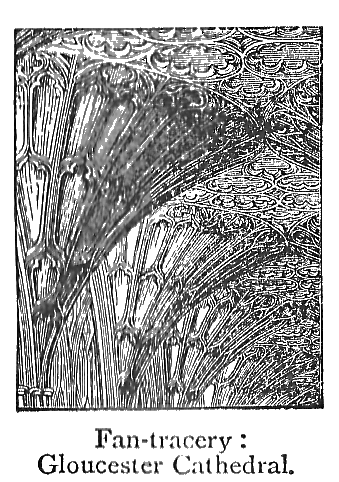
Fan, fan, n. an instrument for winnowing grain: a broad, flat instrument used by ladies to cool themselves: a wing: a small sail to keep a windmill to the wind: the agitation of the air caused by a fan.—v.t. to cool with a fan: to winnow: to ventilate: to remove by waving a fan:—pr.p. fan′ning; pa.p. fanned.—ns. Fan′-blast, in ironworks the blast produced by a fan, as distinguished from that produced by a blowing-engine; Fan′-crick′et, the mole-cricket, fen-cricket, or churr-worm.—adj. Fan′-nerved, in entomology, having a fan-like arrangement of the nervures or veins of the wings.—ns. Fan′light, a window resembling in form an open fan; Fan′ner, a machine with revolving fans, used for winnowing grain, &c.; Fan′-palm, a species of palm 60 or 70 feet high, with fan-shaped leaves, used for umbrellas, tents, &c.; Fan′-tail, an artificial fan-tailed variety of the domestic pigeon; Fan′-trāc′ery (archit.), tracery rising from a capital or a corbel, and diverging like the folds of a fan over the surface of a vault; Fan′-wheel, a wheel with fans on its rim for producing a current of air. [A.S. fann, from L. vannus, a fan; cf. Fr. van.]
Fanal, fā′nal, n. (arch.) a lighthouse, a beacon. [Fr.,—Gr. phanos, a lantern, phainein, to show.]
Fanatic, fa-nat′ik, adj. extravagantly or unreasonably zealous, esp. in religion: excessively enthusiastic.—n. a person frantically or excessively enthusiastic, esp. on religious subjects.—adj. Fanat′ical, fanatic, (Shak.) extravagant.—adv. Fanat′ically.—v.t. Fanat′icise, to make fanatical.—v.i. to act as a fanatic.—n. Fanat′icism, wild and excessive religious enthusiasm. [Fr.,—L. fanaticus, belonging to a temple, inspired by a god, fanum, a temple.]
Fancy, fan′si, n. that faculty of the mind by which it recalls, represents, or makes to appear past images or impressions: an image or representation thus formed in the mind: an unreasonable or capricious opinion: a whim: capricious inclination or liking: taste: (Shak.) love.—adj. pleasing to, or guided by, fancy or caprice: elegant or ornamental.—v.t. to portray in the mind: to imagine: to have a fancy or liking for: to be pleased with: to breed animals:—pr.p. fan′cying; pa.p. fan′cied.—p.adj. Fan′cied, formed or conceived by the fancy: imagined.—n. Fan′cier, one who has a special liking for anything, or who keeps a special article for sale: one who is governed by fancy.—adj. Fan′ciful, guided or created by fancy: imaginative: whimsical: wild.—adv. Fan′cifully.—n. Fan′cifulness.—adj. Fan′ciless, destitute of fancy.—ns. Fan′cy-ball, a ball at which fancy-dresses in various characters are worn; Fan′cy-dress, dress arranged according to the wearer's fancy, to represent some character in history or fiction; Fan′cy-fair, a special sale of fancy articles for some charitable purpose.—adj. Fan′cy-free (Shak.), free from the power of love.—n.pl. Fan′cy-goods, fabrics of variegated rather than simple pattern, applied generally to articles of show and ornament.—n. Fan′cy-mong′er (Shak.), one who deals in tricks of imagination.—adj. Fan′cy-sick (Shak.), of distempered mind, love-sick.—ns. Fan′cy-stitch, a more intricate and decorative stitch than plain-stitch; Fan′cy-stroke (billiards), an unusual stroke, or one made to show off one's skill; Fan′cy-work, ornamental needlework.—The fancy, sporting characters generally, esp. pugilists: pugilism. [Contracted from fantasy.]
Fand, fand (Spens.), pa.t. of Find.
Fand, fand, Fond, fond, v.i. (Spens.) to try, attempt. [A.S. fandian.]
Fandango, fan-dan′go, n. an old Spanish dance for two, in ¾ time, with castanets, proceeding gradually from a slow and uniform to the liveliest motion: a gathering for dancing, a ball. [Sp.]
Fane, fān, n. (obs.) a flag: weathercock. [Vane.]
Fane, fān, n. a temple. [L. fanum.]
Fanfare, fan-fār′, n. a flourish of trumpets or bugles—also Fanfarade′.—ns. Fan′faron, one who uses bravado: a blusterer, braggart; Fan′faronade, vain boasting: bluster: ostentation.—v.i. to bluster. [Fr. fanfare, perh. from the sound.]
Fang, fang, n. the tooth of a ravenous beast: a claw or talon: the venom-tooth of a serpent: (Shak.) a grip, catch.—v.t. (obs.) to seize upon, catch.—adjs. Fanged, having fangs, clutches, or anything resembling them; Fang′less, having no fangs or tusks: toothless.—Lose the fang (of a pump), to be dry, to have no water (Scot.). [A.S. fang, from fón, to seize; Ger. fangen, to catch, Dut. vangen.]
Fangle, fang′gl, n. (Milt.) fancy.—adj. Fang′led (obs. save in newfangled, q.v.), newly made, new-fashioned: showy, gaudy.—n. Fang′leness.
Fanion, fan′yun, n. a small marking-flag used at a station in surveying. [O. Fr.,—Low L. fano.]
Fannel, fan′el, n. a vexillum or banner.
Fanon, fan′on, n. a cloth for handling the holy vessels or the offertory bread: a maniple or napkin used by the celebrant at mass: an orale: a fannel: one of the lappets of a mitre: (surg.) a fold of linen laid under a splint. [O. Fr.]
Fantasia, fan-tä′zi-a, n. a musical composition, not governed by the ordinary musical rules. [It., from Gr. phantasia. See Fancy.]
Fantasy, Phantasy, fan′ta-si, n. fancy: imagination: mental image: love: whim, caprice.—v.t. to fancy, conceive mentally.—adj. Fan′tasied, filled with fancies.—n. Fan′tasm (same as Phantasm).—adj. Fan′tasque, fantastic.—ns. Fan′tast, a person of fantastic ideas; Fantas′tic, one who is fantastical.—adjs. Fantas′tic, -al, fanciful: not real: capricious: whimsical: wild.—adv. Fantas′tically.—n. Fantas′ticalness.—v.t. and v.i. Fantas′ticate.—ns. Fantas′ticism; Fantas′tico (Shak.), a fantastic. [O. Fr.,—Low L. phantasticus—Gr. phantastikos, phantazein, to make visible. Fancy is a doublet.]
Fantoccini, fan-to-chē′nē, n.pl. puppets worked by machinery: dramatic performances by puppets. [It., pl. of fantoccino, dim. of fantoccio, a puppet—fante, a boy.]
Fantom, fan′tom, n. Same as Phantom.
Fap, fap, adj. (Shak.) fuddled, drunk.
Faquir, fak-ēr′, n. Same as Fakir.
Far, fär, adj. remote: more distant of two: remote from or contrary to purpose or design.—adv. to a great distance in time, space, or proportion: remotely: considerably or in great part: very much: to a great height: to a certain point, degree, or distance.—v.t. (prov.) to remove to a distance.—adjs. Far′-away′, distant: abstracted, absent-minded; Far′-fetched, fetched or brought from a remote place: forced, unnatural—(obs.) Far′fet.—advs. Far′-forth (Spens.), very far; Far′most, most distant or remote.—n. Far′ness, the state of being far: remoteness, distance.—adj. and adv. Far′-off, distant.—adjs. Far′-reach′ing, exerting influence to a great distance and for a long time; Far′-sight′ed, seeing to a great distance: having defective eyesight for near objects; Far′-sought, sought for at a distance; Far′-spent, far advanced.—Far and away, by a great deal; By far, in a very great degree; I'll see you far (or farther) first, I will not do it by any means; In so far as, to the extent that. [A.S. feor; Dut. ver; Ice. fiarre; Ger. fern.]
Far, fär, n. (prov.) a litter of pigs.
Farad, far′ad, n. the name of the practical unit of electrical capacity—the capacity of a conductor which when raised to a potential of one volt has a charge of one coulomb.—adj. Farad′ic.—n. Faradisā′tion.—v.t. Far′adise.—ns. Far′adism; Microfar′ad, the millionth part of a farad. [From Michael Faraday (1791-1867).]
Farand, Farrand, far′and, adj. (Scot.) having a certain favour or appearance, esp. in such compound forms as auld-farand, old-fashioned; ill-faured, ill-favoured, &c. [M. E. farand, comely. Origin obscure; most prob. the verb fare (q.v.).]
Farce, färs, n. a style of comedy marked by low humour and extravagant wit: ridiculous or empty show.—n. Far′ceur, a joker.—adj. Far′cical.—n. Farcical′ity, farcical quality.—adv. Far′cically.—v.t. Far′cify, to turn into a farce. [Fr. farce, stuffing, from L. farcīre, to stuff, applied, acc. to H. Bradley, to words put between Kyrie and Eleison in religious services, then to the interpolated gag in a religious play, next a buffoon performance.]
Farce, färs, v.t. to cram: to stuff, fill with stuffing: (Shak.) to swell out.—n. Far′cing, stuffing. [O. Fr. farsir—L. farcīre, to cram.]
Farcy, fär′si, n. a disease of horses like glanders—(obs.) Far′cin.—adj. Far′cied.—n. Far′cy-bud, a swollen lymphatic gland, as in farcy. [Fr. farcin—Low L. farciminum.]
Fard, färd, n. white paint for the face.—v.t. to paint with such, to embellish. [Fr., of Teut. origin, Old High Ger. farwjan, to colour.]
Fardage, fär′dāj, n. (naut.) loose wood or other material stowed among the cargo to keep it from shifting, or put under it to keep it above the bilge. [Fr.]
Fardel, fär′del, n. a pack: anything cumbersome or irksome.—adj. Far′del-bound, constipated, esp. of cattle and sheep, by the retention of food in the third stomach. [O. Fr. fardel (Fr. fardeau), dim. of farde, a burden—Ar. fardah, a package (Devic).]
Farding-bag, fär′ding-bag, n. the first stomach of a cow or other ruminant.
Fare, fār, v.i. to get on or succeed: to happen well or ill to: to be in any particular state, to be, to go on: to feed.—n. the price of passage—(orig.) a course or passage: those conveyed in a carriage: food or provisions for the table.—interj. Farewell′, may you fare well! a wish for safety or success.—n. well-wishing at parting: the act of departure.—adj. parting: final. [A.S. faran; Ger. fahren.]
Farina, fa-rī′na, or fa-rē′na, n. ground corn: meal: starch: pollen of plants.—adjs. Farinā′ceous, mealy; Farinose′, yielding farina. [L.,—far.]
Farl, färl, n. (Scot.) the quarter of a round cake of flour or oatmeal. [Fardel, a fourth part.]
Farm, färm, n. land let or rented for cultivation or pasturage, with the necessary buildings: (Spens.) habitation: (Shak.) a lease.—v.t. to let out as lands to a tenant: to take on lease: to grant certain rights in return for a portion of what they yield, as to farm the taxes: to cultivate, as land.—adj. Farm′able.—ns. Farm′-bai′liff; Farm′er, one who farms or cultivates land: the tenant of a farm: one who collects taxes, &c., for a certain rate per cent.:—fem. Farm′eress; Farm′ering, the business of a farmer.—n.pl. Farm′ers-gen′eral, the name given before the French Revolution to the members of a privileged association in France, who leased the public revenues of the nation.—ns. Farm′ery, the buildings of a farm; Farm′-house, a house attached to a farm in which the farmer lives; Farm′ing, the business of cultivating land; Farm′-lā′bourer.—n.pl. Farm′-off′ices, the offices or outbuildings on a farm.—ns. Farm′stead, a farm with the buildings belonging to it; Farm′-yard, the yard or enclosure surrounded by the farm buildings. [A.S. feorm, goods, entertainment, from Low L. firma—L. firmus, firm. The Low L. firma meant a fixed payment, also a signature (whence our 'firm' in business); from 'rent' farm passed to 'lease,' then to 'a tract of land held on lease.' Farm is therefore a doublet of firm.]
Faro, fār′o, n. a game of chance played by betting on the order in which certain cards will appear when taken singly from the top of the pack. [Perh. from King Pharaoh on one of the cards.]
Farrago, far-rā′gō, n. a confused mass.—adj. Farrā′ginous, miscellaneous, jumbled. [L., far, grain.]
Farrier, far′i-ėr, n. one who shoes horses: one who cures the diseases of horses.—n. Farr′iery, the art of curing the diseases of cattle. [O. Fr. ferrier, through Low L. ferrarius, from L. ferrum, iron.]
Farrow, far′ō, n. a litter of pigs.—v.i. or v.t. to bring forth pigs. [A.S. fearh, a pig; Ger. ferkel.]
Farrow, far′rō, adj. not producing young in a particular season, said of cows. [Ety. dub.; with farrow cow cf. Flem. verwekoe, varwekoe.]
Farse, färs, n. an explanation of the Latin epistle in the vernacular.—v.t. to extend by interpolation.
Fart, fart, v.i. to break wind.—n. a noisy expulsion of wind. [A.S. feortan; Ger. farzen.]
Farther, fär′thėr, adj. (comp. of Far) more far or distant: tending to a greater distance: longer: additional.—adv. at or to a greater distance; more remotely: beyond: moreover.—adjs. and advs. Far′thermore, furthermore; Far′thermost, furthermost.—adj. Farthest (superl. of Far), most far, distant, or remote.—adv. at or to the greatest distance. [A rather recent form, comp. of far, the euphonic th being inserted from the analogy of further.]
Farthing, fär′thing, n. the fourth of a penny: anything very small: (B.) the rendering for two names of coins, one the fourth part of the other—assarion, used as the Gr. equivalent of the L. as, and kodrantes (L. quadrans), a coin equivalent to two lepta.—n. Far′thingful. [A.S. féorthing, a fourth part—féortha, fourth, and dim. -ing, or -ling.]
Farthingale, fär′thing-gāl, n. a kind of crinoline of whalebone for distending women's dress. [O. Fr. verdugale—Sp. verdugado, hooped, verdugo, rod.]
Fasces, fas′ēz, n.pl. a bundle of rods with an axe in the middle, borne before the ancient Roman principal magistrates. [L. fascis, a bundle.]
Fascia, fash′i-a, n. (archit.) a flat space or band between mouldings: (anat.) a layer of condensed connective tissue between some muscle and any other tissue.—adjs. Fas′cial; Fas′ciated.—n. Fasciā′tion (bot.), a form of monstrosity by the flattening of a single stem, or the lateral union of several stems. [L.]