LIST OF ABBREVIATIONS USED IN THIS DICTIONARY. (continued 19)
Reading edition
Mastic, Mastich, mas′tik, n. a species of gum-resin from the lentisk-tree: a cement from mastic: the tree producing mastic. [Fr.,—L. mastiche—Gr. mastichē—mas-tizein, to chew.]
Masticate, mas′ti-kāt, v.t. to chew: to grind with the teeth.—adj. Mas′ticable, that may be chewed.—ns. Masticā′tion, act or process of chewing; Masticā′tor, a machine for cutting up meat for people unable to chew: a machine used in purifying india-rubber.—adj. Mas′ticatory, chewing: adapted for chewing.—n. a substance chewed to increase the saliva. [L. masticāre, -ātum—mastiche, mastic.]
Masticot. Same as Massicot.
Mastiff, mas′tif, n. a thick-set and powerful variety of dog much used as a watch-dog. [Skeat follows Scheler and Diez in explaining mastiff as 'house-dog,' from an assumed O. Fr. mastif, prob. a variant of O. Fr. mastin (Fr. mâtin)—Low L. masnata, a family—L. mansion-em, a house. Others explain as O. Fr. mestif (Fr. métif), of mixed breed, mongrel, or O. Fr. mestis (métis), mongrel, or even as the above O. Fr. mastin (Fr. mâtin), all, through Low L. forms, from L. mixtus, mistus, miscēre, to mix.]
Mastitis, mas-tī′tis, n. inflammation of the mammary gland.—n. Mastodyn′ia, pain in the breast.—adj. Mas′toid, like a nipple or teat: denoting a part or process of the temporal bone.—n. Mastol′ogy, mammology. [Gr. mastos, a nipple.]
Mastodon, mas′to-don, n. a genus of extinct elephants, so named from the mamillary cusps or teat-like prominences on the molar teeth. [Gr. mastos, the breast, odous, odontos, a tooth.]
Masturbation, mas-tur-bā′shun, n. self-defilement, onanism.—v.i. Mas′turbate, to commit self-abuse.—n. Mas′turbator, one guilty of this. [L. masturbāri.]
Mat, mat, n. a texture of sedge, rushes, straw, &c. for cleaning the feet on: a web of rope-yarn: an ornamental border for a picture: a piece of cloth, &c. put below dishes on a table: anything like a mat in appearance, thick and closely set: any interwoven structure used as a revetment on river-banks, &c.: a sack of matting used to cover tea and coffee chests, such a sack containing a certain quantity of coffee: the closely-worked portion of lace: any annular pad to protect the head in bearing burdens.—v.t. to cover with mats: to interweave: to entangle:—pr.p. mat′ting; pa.t. and pa.p. mat′ted. [A.S. meatta—L. matta, a mat.]
Mat, mat, adj. and n. having a dull or dead surface, without lustre: an instrument by means of which such is produced.—v.t. to produce such a surface on metal. [Ger. matt, dull.]
Matador, Matadore, mat-a-dōr′, n. the man who kills the bull in bull-fights: one of the three chief cards at ombre and quadrille. [Sp. matador—matar, to kill—L. mactāre, to kill, to honour by sacrifice—mactus, honoured.]
Matafunda, mat-a-fun′da, n. an old military engine which slung stones. [Low L., prob. Sp. matar, to kill, L. funda, a sling.]
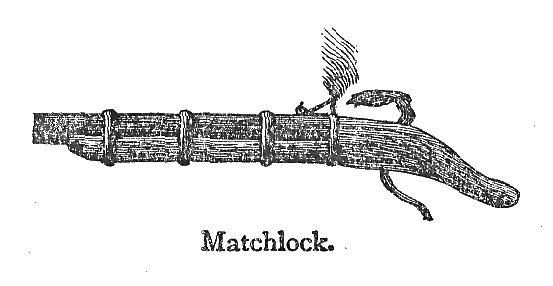
Match, mach, n. a piece of inflammable material which easily takes or carries fire: a prepared rope for firing a gun, &c.: a lucifer.—ns. Match′-box, a box for holding matches; Match′lock, the lock of a musket containing a match for firing it: a musket so fired; Match′wood, wood cut down to a size suitable for making matches: wood broken into small pieces; Quick′-match, a match made of threads of cotton, and steeped in various inflammable substances so as to burn a yard in thirteen seconds; Safe′ty-match, a match which will only light when rubbed on a specially prepared surface; Slow′-match, a match made to burn at the rate of from four to five inches in an hour, for blasting, &c. [O. Fr. mesche (Fr. mèche)—Low L. myxus—Gr. myxa, the snuff or wick of a lamp.]
Match, mach, n. anything which agrees with or suits another thing: an equal: one able to cope with another: a contest or game: a pairing, a marriage: one to be gained in marriage.—v.i. to be of the same make, size, &c., to correspond: to form a union with.—v.t. to be equal to, to set a counterpart to anything: to be able to compete with: to find an equal to: to set against as equal: to suit: to give in marriage.—adj. Match′able.—ns. Match′board, a board with a tongue cut along one edge and a groove in the opposite edge, their joining being called a Match′-joint; Match′er.—adj. Match′less, having no match or equal: superior to all: peerless: unpaired.—adv. Match′lessly.—ns. Match′lessness; Match′-mak′er, one who makes matches: one who plans to bring about marriages. [A.S. gemæca, gemaca, a mate, a wife.]
Mate, māt, n. a companion: an equal: one of a pair, the male or female of animals that go in pairs: in a merchant-ship the first-mate is the second in command—in the navy the term is now confined to petty-officers, such as boatswain's mate, gunner's mate, &c.: an assistant, deputy.—v.t. to be equal to: to become a companion to: to marry.—adj. Mate′less, without a mate or companion. [A.S. ge-maca; Ice. maki, an equal, from the same root as make. Cf. match. Prob. mate in its naut. sense is Dutch—Old Dut. maet, mod. maat.]
Mate, māt, n. and v.t. in chess=Checkmate.
Mate, Maté, mä′tā, n. a South American species of holly, the leaves and green shoots of which, dried and roughly ground, furnish the yerba de mate of Paraguay and Brazil. [Sp. mate, orig. the vessel in which it was infused for drinking.]
Mate, māt, v.t. (Bacon) to weaken, to confound, to crush. [O. Fr. mater; cf. Sp. matar, to weaken.]
Matelasse, mat-las′ā, adj. and n. having a raised pattern on the surface as if quilted, of silks. [Fr. matelas, a mattress.]
Matelote, mat′e-lōt, n. fish stewed with wine-sauce, onions, &c. [Fr. matelot, a sailor.]
Mateology, mat-ē-ol′o-ji, n. a foolish inquiry. [Gr. mataios, vain, matē, folly, logia, discourse.]
Mater, mā′tėr, n. a mother: one of the two membranes of the brain, outer and inner, separated by the arachnoid—the dura mater, or dura, and pia mater, or pia.—Mā′ter dolorō′sa, the Virgin Mary represented as the sorrowing mother; Māterfamil′ias, the mother of a family. [L.,—Gr. mētēr.]
Material, ma-tē′ri-al, adj. consisting of matter: corporeal, not spiritual: substantial: essential: important, esp. of legal importance: (phil.) pertaining to matter and not to form, relating to the object as it exists.—n., esp. in pl., that out of which anything is to be made.—n. Materialisā′tion.—v.t. Matē′rialīse, to render material: to reduce to or regard as matter: to occupy with material interests.—ns. Matē′rialism, the doctrine that denies the independent existence of spirit, and maintains that there is but one substance—viz. matter—thus professing to find in matter (monistic or philosophical materialism), or in material entities (atomistic materialism), or in material qualities and forces (scientific or physical materialism), a complete explanation of all life and existence whatsoever; Matē′rialist, one who holds the doctrine of materialism: one absorbed in material interests, who takes a low view of life and its responsibilities.—adjs. Materialist′ic, -al, pertaining to materialism.—adv. Matē′rially.—ns. Matē′rialness, Material′ity.—Material being, existence in the form of matter; Material cause, that which gives being to the thing; Material distinction, a distinction between individuals of the same species; Material evidence, evidence tending to prove or to disprove the matter under judgment; Material fallacy, a fallacy in the matter or thought, rather than in the logical form; Material form, a form depending on matter; Material issue (see Issue).—Raw material, stuff as yet unworked into anything useful. [Fr.,—L. materialis—materia.]
Materia medica, ma-tē′ri-a med′i-ka, n. the various substances used in making up medicines: the science of the nature and use of substances used as medicines. [L. materia, material, medicus, medical.]
Matériel, ma-tā-re-el′, n. the totality of materials or instruments employed (as in an army), as distinguished from the personnel or men—applied esp. to military stores, arms, baggage, horses, &c. [Fr.]
Maternal, ma-tėr′nal, adj. belonging to a mother: motherly.—adv. Mater′nally.—n. Mater′nity, the state, character, or relation of a mother: motherhood: a lying-in hospital. [Fr. maternel (It. maternale)—L. maternus—mater, mother.]
Math, math, n. a mowing.
Mathematic, -al, math-e-mat′ik, -al, adj. pertaining to, or done by, mathematics: very accurate.—adv. Mathemat′ically.—ns. Mathematic′ian, one versed in mathematics; Mathemat′ics, the science of magnitude and number, and of all their relations—usually divided into Pure, and Mixed or Applied, the first including all deductions from the abstract, self-evident relations of magnitude and number—the second, the results arrived at by applying the principles so established to certain relations found by observation to exist among the phenomena of nature.—Higher mathematics, a term applied generally to all the scientifically treated branches of mathematics. [Fr. mathématique—L. mathematica—Gr. mathēmatikē (epistēmē, skill, knowledge), relating to learning—mathēma—manthanein, to learn.]
Mathesis, ma-thē′sis, n. mental discipline. [Gr.]
Matico, ma-tē′ko, n. a Peruvian shrub, used in medicine as a styptic and astringent.
Matin, mat′in, adj. morning: used in the morning.—n. in pl. the daily morning service of the Church of England: one of the seven canonical hours, usually sung between midnight and daybreak.—adj. Mat′inal.—n. Matinée (mat-i-nā′), a musical entertainment or reception held in the day-time, usually in the afternoon: a woman's dress for wear in the forenoon or before dinner. [Fr.,—L. matutinus, belonging to the morning—Matuta, goddess of morning, prob. akin to maturus, early.]
Matrass, mat′ras, n. a chemical vessel with a tapering neck, a cucurbit.
Matriarchy, mā′tri-är-ki, n. government by a mother or by mothers, esp. a primitive order of society existing in many Indian tribes, in which the mother takes precedence of the father in tracing line of descent and in inheritance: descent in the female line.—ns. Mā′triarch, a woman in whom matriarchy rests: a patriarch's wife.—adj. Matriar′chal.—ns. Matriar′chalism, the character of possessing matriarchal customs; Matriar′chate, the position of a matriarch. [Gr. mētēr, mother, archos, a ruler.]
Matrice, mā′tris, n. Same as Matrix.
Matricide, mat′ri-sīd, n. a murderer of one's own mother: the murder of one's own mother.—adj. Mat′ricidal [Fr.,—L. matricida, matricidium—mater, mother, cædĕre, to kill.]
Matriculate, ma-trik′ū-lāt, v.t. to admit to membership by entering one's name in a register, esp. in a college.—v.i. to become a member of a college, university, &c., by being enrolled.—n. one admitted to membership in a society.—n. Matriculā′tion, act of matriculating: state of being matriculated. [Late L. matricula, a register, dim. of matrix.]
Matrimony, mat′ri-mun-i, n. union of husband and wife, marriage: state of marriage.—adj. Matrimō′nial, relating to, derived from, marriage.—adj. Matrimō′nially. [O. Fr.,—L. matrimonium—mater.]
Matrix, mā′triks, or mat′riks, n. (anat.) the cavity in which an animal is formed before its birth, the womb: the cavity in which anything is formed, a mould: (mining) earthy or stony substances in which minerals are found embedded: (dyeing) the five simple colours (black, white, blue, red, and yellow) from which all the others are formed: (math.) a rectangular array of quantities, usually square—a multiple quantity having as many dimensions as it has spaces:—pl. Matrices (mā′tri-sez or mat′ri-sez). [L. matrix, -icis—mater, mother.]
Matron, mā′trun, n. an elderly married woman: an elderly lady of staid and sober habits: a head-nurse in a hospital, or a female superintendent in a school.—ns. Mā′tronage, Mā′tronhood, state of being a matron: a body of matrons.—adj. Mā′tronal, pertaining or suitable to a matron: motherly: grave.—v.t. Mā′tronise, to render matronly: to attend a lady to public places, as protector: to chaperon.—adjs. Mā′tron-like, Mā′tronly, like, becoming, or belonging to a matron: elderly: sedate.—n. Matronym′ic, a name derived from a mother or maternal ancestor—also adj. [Fr.,—L. matrona, a married lady—mater, mother.]
Matross, ma-tros′, n. formerly a soldier set to help the gunners in an artillery train. [Dut. matroos—Fr. matelot, a sailor.]
Matte, mat, n. a product of the smelting of sulphuretted ores.—Also Regulus and Coarse metal. [Fr.,—Ger.]
Matter, mat′ėr, n. that which occupies space, and with which we become acquainted by our bodily senses: that out of which anything is made: that which receiving a form becomes a substance: the subject or thing treated of: anything engaging the attention: that with which one has to do: cause of a thing: thing of consequence: something requiring remedy or explanation: any special allegation in law: importance: a measure, &c., of indefinite amount: (print.) material for work, type set up: mere dead substance, that which is thrown off by a living body, esp. pus, or the fluid in boils, tumours, and festering sores.—v.i. to be of importance: to signify: to form or discharge matter in a sore:—pr.p. matt′ering; pa.p. matt′ered.—adjs. Matt′erful, full of matter, pithy; Matt′erless; Matt′er-of-fact, adhering to the matter of fact: not fanciful: dry; Matt′ery, significant: purulent.—Matter of course, occurring in natural time and order, as a thing to be expected; Matter of fact, really happening and not fanciful or supposed: not wandering beyond realities. [O. Fr. matiere—L. materia, matter.]
Matting, mat′ing, n. a covering with mats: a texture like a mat, but larger: material for mats.
Mattins. Same as Matins, pl. of Matin.
Mattock, mat′uk, n. a kind of pickaxe for loosening the soil, having the iron ends broad instead of pointed. [A.S. mattuc—W. matog.]
Mattress, mat′res, n. a bed made of a bag stuffed with wool, horse-hair, &c.: a mass of brushwood, &c., used to form a foundation for roads, &c., or for the walls of embankments, &c.—Spring mattress, a mattress in which springs of twisted wire are used to support the stuffed part; Wire mattress, one whose elasticity is produced by a sheet of tightly-stretched wire. [O. Fr. materas (Fr. matelas)—Ar. matrah, a place where anything is thrown.]
Maturate, mat′ū-rāt, v.t. to make mature: (med.) to promote the suppuration of.—v.i. (med.) to suppurate perfectly.—ns. Mat′urant, a maturative; Maturā′tion, a bringing or a coming to maturity: the process of suppurating fully.—adj. Matū′rative, maturing or ripening: (med.) promoting suppuration.—n. a medicine promoting suppuration. [L. maturāre—maturus, ripe.]
Mature, ma-tūr′, adj. grown to its full size: perfected: ripe: (med.) come to suppuration: fully digested, as a plan.—v.t. to ripen: to bring to perfection: to prepare for use.—v.i. to become ripe: to become payable, as a bill.—adj. Matur′able, capable of being matured.—adv. Mature′ly.—ns. Mature′ness, state or quality of being ripe or ready for use; Matur′ity, ripeness: a state of completeness or readiness for use. [L. maturus, ripe.]
Maturescent, mat-ū-res′ent, adj. becoming ripe: approaching maturity. [L. maturescĕre, to become ripe—maturus.]
Matutinal, mat-ū-tī′nal, adj. pertaining to the morning: happening early in the day.—Also Mat′utine. [L. matutinalis, matutinus. See Matin.]
Maud, mawd, n. a Scotch shepherd's woollen plaid.
Maudlin, mawd′lin, adj. silly: sickly-sentimental: fuddled, half-drunk: (obs.) tearful.—n. Maud′linism, the tearful stage of drink. [Contr. from M. E. Maudelein, which comes through O. Fr. and L. from Gr. Magdalēnē, the orig. sense being 'tearful from penitence,' hence 'with eyes red and swollen with weeping,' like Mary Magdalene, erroneously identified with the penitent woman of Luke vii. 37.]
Maugre, maw′gėr, prep. in spite of.—n. (obs.) ill-will: spite. [O. Fr. malgré—L. male gratum—male, badly, gratum, agreeable.]
Maul, mawl, v.t. to beat with a mall or a heavy stick: to injure greatly by beating.—n. a heavy wooden hammer: a struggle for the ball in football, when it has been carried across the goal-line, but has not yet been touched down. [Mall.]
Maulstick. See Mahl-stick.
Maumet, Mammet. Same as Mawmet.
Maund, mawnd, n. (Shak.) a basket. [A.S. mand.]
Maund, mawnd, n. a measure of weight in India, its value varying in different places from about 25 to about 85 pounds avoirdupois. [Hind. mān.]
Maunder, mawn′dėr, v.i. to beg: to whine like a beggar, to grumble: to mutter, to talk foolishly, to drivel.—ns. Maun′derer; Maun′dering, drivelling talk. [O. Fr. mendier, to beg—L. mendicāre.]
Maundril, mawn′dril, n. a pick with two prongs.
Maundy, mawn′di, n. the religious ceremony of washing the feet of others, esp. of inferiors, in commemoration of Christ's washing His disciples' feet at the Last Supper—still practised in Austria by the emperor.—Maundy money, the money given away on Maundy Thursday, the Thursday in Passion week, by the royal almoner, usually a penny for each year of the sovereign's reign—the small silver coins specially coined since 1662. [O. Fr. mande (Fr. mandé)—L. mandātum, command, i.e. the 'new Commandment' of John, xiii. 34.]
Maurist, maw′rist, n. a member of the reformed Benedictine Congregation of St Maur, settled from 1618 at the abbey of St Maur-sur-Loire, near Saumur, notable for its great services to learning.
Mauser, mow′zėr, n. a German magazine rifle, invented by Wilhelm Mauser (1834-82).
Mausoleum, maw-so-lē′um, n. a magnificent tomb or monument.—adj. Mausolē′an, pertaining to a mausoleum: monumental. [L.,—Gr., Mausōleion, from Mausolus, king of Caria, to whom his widow, Artemisia, erected a splendid tomb about 350 B.C.]
Mauther, mä′thėr, n. an Eng. prov. form of mother.
Mauve, mawv, n. a beautiful purple dye extracted from coal-tar, so called from its likeness in colour to the flowers of the common mallow.—adj. of the colour of mauve. [Fr.,—L. malva, the mallow.]
Maverick, mav′ėr-ik, n. (U.S.) an animal found straying without an owner's brand, esp. a strayed calf: anything dishonestly obtained.—v.t. to seize without legal claim. [From Samuel Maverick, a Texas cattle-raiser.]
Mavis, mā′vis, n. the song-thrush. [Fr. mauvis; prob. from Bret. milfid, a mavis.]
Mavourneen, ma-vōōr′nēn, n. and interj. a term of endearment=my dear one. [Ir.]
Maw, maw, n. the stomach, esp. in the lower animals: the craw, in birds.—ns. Maw′-seed, poppy-seed, so called when used as food for cage birds; Maw′-worm, the thread-worm infesting the stomach. [A.S. maga; Ger. magen.]
Mawkin. Same as Malkin (q.v.).
Mawkish, mawk′ish, adj. loathsome, disgusting, as anything beginning to breed mawks or maggots.—n. Mawk, a maggot.—adv. Mawk′ishly.—n. Mawk′ishness. [Explained by Skeat as formed, with suffix -ish, from M. E. mawk, mauk, a contr. form of M. E. maðek, a maggot—Ice. maðkr, a maggot.]
Mawmet, maw′met, n. a puppet: an idol—Mohammed.
Max, maks, n. a kind of gin. [L. maximus, greatest.]
Maxillary, maks′il-ar-i, adj. pertaining to the jawbone or jaw.—n. a maxillary bone, or maxilla.—n. Maxill′a, a jawbone.—adjs. Maxillif′erous; Maxill′iform.—n. Maxill′ipede, in crustacea, one of those limbs serving both for mastication and locomotion. [L. maxilla, jawbone.]
Maxim, maks′im, n. a general principle, serving as a rule or guide: a pithy saying: a proverb.—adjs. Max′imal; Max′imed, reduced to a maxim.—ns. Max′imist, Max′im-mong′er. [Fr.,—L. maxima (sententia, an opinion), superl. of magnus, great.]
Maxim, maks′im, n. often put for Max′im-gun, an automatic machine-gun capable of firing as many as 620 rounds per minute, and of accurate shooting up to 3000 yards. [From Hiram Maxim, the inventor.]
Maximum, maks′i-mum, adj. the greatest.—n. the greatest number, quantity, or degree: the highest point reached: (math.) the value of a variable when it ceases to increase and begins to decrease:—pl. Max′ima:—opp. to Minimum.—adj. Max′imal, of the highest or maximum value.—adv. Max′imally.—v.t. Max′imise, to raise to the highest degree. [L., superl. of magnus, great.]
May, mā, v.i. to be able: to be allowed: to be free to act: to be possible: to be by chance: to be competent:—pa.t. might (mīt).—adv. May′be, perhaps, possibly.—n. a possibility.—adv. May′hap, perhaps. [A.S. mæg, pr.t. of mugan, to be able, pa.t. mihte; cog. with Goth. magan, Ger. mögen.]
May, mā, n. the fifth month of the year: the early or gay part of life.—v.i. to gather May (prov. Eng. the blossom of the hawthorn, which blooms in May):—pr.p. May′ing.—ns. May′-bee′tle, May′-bug, the cockchafer; May′-bloom, the hawthorn flower; May′day, the first day of May; May′-dew, the dew of May, esp. that of the morning of the first day of May, which is said to whiten linen, and to enable a face washed with it to keep its beauty; May′-duke, a variety of sour cherry; May′-flow′er, the hawthorn, which blooms in May; May′fly, a short-lived fly which appears in May; May′-game, sport such as is usual on 1st May, frolic generally; May′ing, the observance of Mayday sports and games; May′-lā′dy, the queen of the May; May′-lil′y, the lily of the valley, so called because it blooms in May; May′-morn (Shak.), freshness, like that of a morning in May, vigour; May′pole, a pole erected for dancing round on Mayday; May′-queen, a young woman crowned with flowers as queen on Mayday; May′time, May, the season of May. [O. Fr. Mai—L. Maius (mensis, a month), sacred to Maia, the mother of Mercury.]
May, mā, n. a maid. [A.S. mǽg, a kinswoman.]
Maya, mä′ya, n. an illusive appearance, esp. of a celestial maiden personifying the active will of the creator of the universe. [Hind.]
Mayhem, mā′hem, n. the offence of depriving a person by violence of any limb, member, or organ, or causing any mutilation of the body. [Maim.]
Mayonnaise, mā-on-āz′, n. a sauce composed of the yoke of eggs, salad-oil, and vinegar or lemon-juice, seasoned: any cold dish of which the foregoing is an ingredient, as lobster. [Fr.]
Mayor, mā′ur, n. the chief magistrate of a city or borough:—fem. May′oress.—adj. May′oral.—ns. May′oralty, May′orship, the office of a mayor. [Fr. maire—L. major, comp. of magnus, great.]
Mazard, Mazzard, maz′ard, n. (Shak.) a head or skull: a wild European cherry. [Prob. from mazer, from the likeness of the skull to a goblet.]
Mazarinade, maz-a-rin-ād′, n. a pamphlet or satire against the French minister, Cardinal Mazarin (1602-61).—n. Mazarine′, a rich blue colour: a blue gown.—Mazarin Bible, the first printed Bible, printed by Gutenberg and Fust about 1450, so called because Cardinal Mazarin possessed twenty-five copies.
Mazda, maz′da, n. or Ahura Mazdâh, the supreme deity and creator of the Zend-Avesta.—adj. Maz′dēan.—n. Maz′dēism, the religious system of the Zend-Avesta, the ancient sacred writings of the Parsees, Zoroastrianism. [Zend ahu=the living, life, or spirit, root ah=to be; Mazdâh, the great Creator, maz+dâ=Sans. mahâ+dhâ.]
Maze, māz, n. a place full of intricate windings: confusion of thought: perplexity.—v.t. to bewilder: to confuse.—adjs. Maze′ful (Spens.), Maz′y, full of mazes or windings: intricate.—adv. Maz′ily.—n. Maz′iness, state or quality of being mazy. [Scand., as in Ice. masa, to jabber.]
Mazer, maz′ėr, n. (Spens.) a kind of hard wood, probably maple: a cup or goblet made of maple, and usually highly ornamented. [Skeat explains as Ice. mösurr, a maple-tree, lit. 'spot-wood.']
Mazourka, Mazurka, ma-zōōr′ka, n. a lively Polish round dance for four or eight couples: the music such as is played to it.
Me, mē, personal pron. the objective case of I, including both the old English accusative and dative of the first personal pronoun. [A.S. mé.]
Meacock, mē′kok, adj. (Shak.) timorous, effeminate, cowardly. [Perh. dim. of meek.]
Mead, mēd, n. honey and water fermented and flavoured. [A.S. medu; Ger. meth, W. medd.]
Meadow, med′ō, n. a level tract producing grass to be mown down: a rich pasture-ground—(poet.) Mead.—ns. Mead′ow-fox′tail (see Foxtail); Mead′ow-grass, the larger and more useful kinds of grass, grown in meadows for hay and pasture; Mead′ow-hay, a coarse grass or sedge growing in moist places, used as fodder or bedding; Mead′ow-lark, the American field-lark; Mead′ow-saff′ron, the colchicum—also Autumn-crocus, or Naked lady; Mead′ow-sweet, Mead′ow-wort, an ornamental shrub or plant with white flowers, called also Queen of the meadow.—adj. Mead′owy. [A.S. mǽd—máwan, to mow; Ger. mahd, a mowing, Swiss matt, a meadow, as in Zermatt, &c.]
Meagre, mē′gėr, adj. having little flesh: lean: poor: without richness or fertility: barren: scanty: without strength.—adv. Mea′grely.—n. Mea′greness, state or quality of being meagre. [Fr. maigre—L. macer, lean; cf. Ger. mager.]
Meal, mēl, n. the food taken at one time: the act or the time of taking food: a breakfast, dinner, or supper.—ns. Meal′er, one who takes his meals at a boarding-house, lodging elsewhere; Meal′-time, the time for meals.—Square meal, a full meal. [A.S. mǽl, time, portion of time; Dut. maal, Ger. mahl.]
Meal, mēl, n. grain ground to powder.—v.i. to yield or be plentiful in meal.—ns. Meal′-ark (Scot.), a large chest for holding meal; Meal′iness; Meal′-man, or Meal′-mong′er, one who deals in meal; Meal′-pock, or -poke, a beggar's meal-bag; Meal′worm, the larva of an insect abounding in granaries and flour-stores.—adj. Meal′y, resembling meal: covered with meal or with something like meal: whitish.—n. Meal′y-bug, a small species of cochineal insect covered with a while powdery substance resembling meal or flour.—adj. Meal′y-mouthed, smooth-tongued.—n. Meal′y-mouthedness. [A.S. melu, melo; Ger. mehl, Dut. meel, meal.]
Mealie, mēl′i, n. an ear of maize or Indian corn, esp. in pl., maize.
Mean, mēn, adj. low in rank or birth: base: sordid: low in worth or estimation: of little value or importance: poor, humble: despicable.—adj. Mean′-born, of humble origin.—adv. Mean′ly.—n. Mean′ness, state or quality of being mean: want of nobility or excellence: a low action.—adj. Mean′-spir′ited, having a mean spirit, base.—n. Mean′-spir′itedness. [A.S. mǽne, wicked, from mán, wickedness; perh. conn. with A.S. gemǽne, Ger. gemein, common.]
Mean, mēn, adj. middle: coming between two others in size, degree, quantity, time, &c.: average: moderate.—n. the middle point, quantity, value, or degree: (math.) a term interpolated between two terms of a series, and consequently intermediate in magnitude: (mus.) a middle voice or voice-part, as the tenor or alto, the second or third string in a viol: instrument or medium: (pl.) that by which anything is caused or brought to pass: income: estate: instrument.—n. Mean′-time, the interval between two given times.—advs. Mean′time, Mean′while, in the intervening time.—Means of grace, divine ordinances, by which divine grace reaches the hearts of men—word and sacraments.—Arithmetical mean, the average obtained by adding several quantities together and dividing the sum by their number; Harmonic mean, the reciprocal of the arithmetical mean of the reciprocals of the quantities concerned; Geometric mean, the mean obtained by multiplying two quantities together and extracting the square root of the product; Golden mean, the middle course between two extremes: a wise moderation; Quadratic mean, the square root of the arithmetical mean of the squares of the given quantities.—By all means, certainly; By any means, in any way; By no means, certainly not.—In the mean (Spens.), in the meantime. [O. Fr. meien (Fr. moyen)—L. medianus, enlarged form of medius.]
Mean, mēn, v.t. to have in the mind or thoughts: to intend, to purpose: to signify.—v.i. to have in the mind: to have meaning or disposition:—pr.p. mean′ing; pa.t. and pa.p. meant (ment).—n. Mean′ing, that which is in the mind or thoughts: signification: the sense intended: purpose.—adj. significant.—adj. Mean′ingless, without meaning.—adv. Mean′ingly. [A.S. mǽnan; Ger. meinen, to think.]
Mean, mēn, v.i. (Shak.) to lament, to moan.
Meander, mē-an′dėr, n. a winding course: a maze: an intricate variety of fretwork: perplexity.—v.i. to flow, run, or proceed in a winding course: to be intricate.—v.t. to wind or flow round.—adjs. Mean′dered, formed into mazy passages or patterns; Mean′dering, winding in a course; Mean′drian, Mean′drous, winding.—n. a winding course. [L.,—Gr. Maiandros, a winding river in Asia Minor.]
Meant, pa.t. and pa.p. of mean (v.t.).
Mear, mēr, n. (Spens.) a boundary. [See Mere.]
Mease, mēs, or mēz, n. a tale of 500 herrings.
Measles, mē′zlz, n.sing. a contagious fever accompanied with eruptions of small red spots upon the skin: a disease of swine and cattle, caused by larval tapeworms: a disease of trees, the leaves being covered with spots.—adjs. Mea′sled, Mea′sly, infected with measles: good for nothing, miserable.—n. Meas′liness.—German measles, a name somewhat loosely used of a disease, resembling measles, but mostly less prolonged and severe. [Dut. maselen, measles, from Old Dut. masche, a spot, cog. with Old High Ger. māsā, a spot; Ger. masern, measles.]
Measure, mezh′ūr, n. that by which extent is ascertained or expressed: the size of anything: a rule or standard by which anything is adjusted (Apothecaries', Cubic, Decimal, Dry, Liquid, &c.): (politics) a proposal or plan by which some end can be brought about: proportion: a stated quantity: degree: extent: moderation: means to an end: metre: (mus.) that division of time, containing a specified number of beats, by which the air and motion of music are regulated: rate of movement, time, rhythm, metre, arrangement of syllables in poetry: a slow and stately dance, as the minuet: (print.) the width of a page or column, usually in ems: (pl., geol.) a series of beds or strata.—v.t. to ascertain the dimensions of: to adjust by a rule or standard: to mark out: to allot: to show a certain measurement.—v.i. to be of a certain size: to be equal or uniform.—adj. Meas′urable, that may be measured or computed: moderate: in small quantity or extent.—n. Meas′urableness, the quality of being measurable.—adv. Meas′urably.—adjs. Meas′ured, of a certain measure: equal: uniform: steady: restricted; Meas′ureless, boundless: immense.—ns. Meas′urement, the act of measuring: quantity found by measuring—(Measurement goods, light goods carried for charges according to bulk, not weight); Meas′urer, one who, or that which, measures.—adj. Meas′uring, that measures, or fitted for measuring.—Measure one's length, to fall or be thrown down at full length; Measure strength, to engage in a contest; Measure swords, to fight with swords: to try one's skill against.—Above, or Beyond, measure, to an exceedingly great degree; In a measure, to some degree.—Take measures, to adopt means (to gain an end); Take one's measure, to find out what one is, and what he can or cannot do; Tread a measure, to dance; Use hard measures, to apply harsh treatment to; Within measure, moderately; Without measure, immoderately. [O. Fr. mesure—L. mensura, a measure—metīri, to measure.]
Meat, mēt, n. anything eaten as food, the edible part of anything: act of taking meat: (obs.) meal, flour: the flesh of animals used as food—sometimes beef, mutton, pork, veal, &c., as opposed to poultry, fish, &c.—ns. Meat′-bis′cuit, a preparation of meat, made with meal into a biscuit; Meat′iness, quality of being meaty; Meat′-off′ering, a Jewish sacrificial offering of fine flour or first-fruits with oil and frankincense; Meat′-pie, a pie mainly made up of meat; Meat′-safe, a receptacle for storing meat, walled with perforated zinc or gauze; Meat′-sales′man, one who sells meat, esp. to the retail butchers; Meat′-tea, a high tea, at which meat is served; Meat′-tub, a pickling-tub.—adj. Meat′y, full of meat: fleshy: pithy.—Hang meat, to hang up meat before cooking; Sit at meat, to sit at table. [A.S. mete; Dut. met.]
Meath, Meathe, mēth, n. a form of mead, liquor.
Meatus, mē-ā′tus, n. a passage or canal, as the urethral meatus.—adj. Meā′tal.—n. Meat′oscope, an instrument for examining the urethral or other meatus. [L. meātus—meāre, to go.]
Meazel, mē′zl, n. (Shak.) a leper. [Measles.]
Mechanic, -al, me-kan′ik, -al, adj. pertaining to machines or mechanics: constructed according to the laws of mechanics: possessing mechanical talent: acting by physical power: done by a machine: pertaining to artisans: done simply by force of habit, slavish, artificial: vulgar.—n. Mechan′ic, one engaged in a mechanical trade: an artisan—(Shak.) Mechan′ical.—adv. Mechan′ically.—ns. Mechanic′ian, Mech′anist, a machine-maker: one skilled in mechanics; Mechan′ics, the science which treats of machines: the science which treats of the nature of forces and of their action on bodies, either directly or by the agency of machinery.—v.t. Mech′anise, to make mechanical: to work out the details of a machine.—ns. Mech′anism, the construction of a machine: the arrangement and action of its parts, by which it produces a given result; Mech′anograph, a copy, esp. of a work of art produced by a mechanical process on a machine.—adj. Mech′anographic.—ns. Mechanog′raphist; Mechanog′raphy, the art of multiplying copies of a writing or work of art by means of a machine; Mechanol′ogy, a treatise on mechanics: the knowledge of such.—Mechanical effect, work produced by the use of mechanical power; Mechanical philosophy, the principles of mechanics applied to solve questions or phenomena involving force; Mechanical powers, the elementary forms or parts of machines—three primary, the lever, inclined plane, and pulley; and three secondary, the wheel-and-axle, the wedge, and the screw.—Mechanics' institute, an institution for mechanics, with lectures, library, museum, &c. [O. Fr.,—L. mechanicus; Gr. mēchanikos—mēchane, a contrivance.]
Mechlin, meh′lin, adj. and n. produced at Mechlin or Malines: lace made at Mechlin.
Meconic, me-kon′ik, adj. denoting an acid obtained from poppies.—ns. Mec′onate, a salt of meconic acid; Mec′onine, a white, fusible, neutral substance existing in opium; Mecō′nium, the first fæces of a new-born child: opium. [Gr. mēkōn, the poppy.]
Medal, med′al, n. a piece of metal in the form of a coin bearing some device or inscription, struck or cast: a reward of merit.—v.t. to decorate with a medal.—n. Med′alet, a small medal, esp. the representation of saints, worn by Roman Catholics.—adj. Medall′ic, pertaining to medals.—ns. Medall′ion, a large medal: a bas-relief of a round (sometimes a square) form: a round ornament enclosing a portrait or lock of hair; Med′allist, Med′alist, one skilled in medals: an engraver of medals: one who has gained a medal; Med′allurgy, the art of producing medals and coins. [O. Fr. medaille—It. medaglia; through a Low L. form medalla or medalia, a small coin, from L. metallum, a metal.]
Meddle, med′l, v.i. to interfere unnecessarily (with or in): to take part in a matter with which one has nothing to do: to have to do (with).—n. Medd′ler, one who interferes with matters in which he has no concern.—adj. Medd′lesome, given to meddling.—n. Medd′lesomeness.—adj. Medd′ling, interfering in the concerns of others: officious—also n. [O. Fr. medler, a corr. of mesler (Fr. mêler)—Low L. misculare—L. miscēre, to mix.]
Media. See Medium.
Mediæval, Mediævalist. See Medieval.
Medial, mē′di-al, adj. lying between two extremes, median: of or pertaining to a mean or average.—n. one of the sonant-mute group, g, d, b, intermediate between the surd or smooth group (c, t, p) and the rough or aspirate group (gh, dh, bh, kh, th, ph). [Low L. medialis—L. medius, middle.]
Median, mē′di-an, adj. being in the middle, running through the middle: situated in the median plane, that dividing the body longitudinally into symmetrical halves.—adv. Med′ianly.—n. Med′iant (mus.), the third tone of a diatonic scale. [L. medianus—medius, middle.]
Median, mē′di-an, adj. pertaining to Media or the Medes, an ancient Aryan race which became fused with the Persians under the victorious Cyrus about 550 B.C.—n. Mede, a member of this race.
Mediastinum, mē-di-as-tī′num, n. a membranous septum or cavity between two principal portions of an organ, esp. the folds of the pleura and the space between the right and left lungs.—adj. Mediastī′nal. [L., medius.]
Mediate, mē′di-āt, adj. middle: between two extremes: acting by or as a means: not direct and independent: dependent on some intervening thing.—v.i. to interpose between parties as a friend of each: to intercede: to hold a mediate position: to act as a spiritualistic medium.—v.t. to bring about by mediation: to effect a relation between two things.—n. Mē′diacy.—adv. Mē′diately.—ns. Mē′diateness, state of being mediate; Mediā′tion, the act of mediating or coming between: entreaty for another; Mediatisā′tion.—v.t. Mē′diatīse, to cause to act in a subordinate position or through an agent: to annex, or to subordinate, as a smaller state to a larger neighbouring one.—adj. Mē′diative.—n. Mē′diator, one who mediates between parties at strife:—fem. Mediat′ress, Mē′diatrix.—adj. Mediatō′rial, belonging to a mediator or intercessor.—adv. Mediatō′rially.—n. Mediat′orship, the office of a mediator.—adj. Mē′diatory. [Low L. mediāre, -ātum—L. medius.]
Medic, med′ik, n. one of several plants of the genus Medicago, esp. the purple medic or lucerne—leguminous plants, with leaves like those of clover.—Also Med′ick. [L. medica—Gr. mēdikē (poa), 'median' (grass).]
Medical, med′i-kal, adj. relating to the art of healing diseases: containing that which heals: intended to promote the study of medicine.—adv. Med′ically.—Medical jurisprudence (see Jurisprudence). [Fr.,—Low L. medicalis—L. medicus, pertaining to healing, a physician—medēri, to heal.]
Medicate, med′i-kāt, v.t. to treat with medicine: to impregnate with anything medicinal.—adj. Med′icable, that may be healed.—n. Med′icament, anything used for healing: a medicine: healing power.—adj. Medicamen′tal.—n. Med′icaster, an ignorant physician.—adj. Med′icated, mixed with medicine: made medicinal: treated with medicine.—n. Medicā′tion, the act or process of medicating or of mixing with medicinal substances: the use of medicine.—adj. Med′icative, having the power of healing: tending to heal.—n. Medicā′tor, any medical appliance. [L. medicāre, to heal—medicus.]
Medicean, med-i-sē′an, adj. relating to the Medici, a distinguished Florentine family which attained to sovereign power in the 15th century, and became extinct in 1737.
Medicine, med′i-sin, or med′sin, n. anything applied for the cure or lessening of disease or pain, whether simple or compound (made up of more than one ingredient): the science which treats of the prevention or cure of disease: a charm.—v.t. to treat or cure by medicine.—adj. Medic′inal, relating to medicine: fitted to cure or to lessen disease or pain.—adv. Medic′inally.—ns. Med′icine-bag, a Red Indian's receptacle for charms; Med′icine-chest, a chest for keeping medicines in a ship, &c.; Med′icine-man, among savages, a witch-doctor or exorciser.—adjs. Med′ico-chirur′gical, relating to both medicine and surgery; Med′ico-lē′gal, relating to the application of medicine to questions of law. [Fr.,—L. medicina—medicus.]
Medieval, Mediæval, mē-di-ē′val, adj. relating to the Middle Ages.—ns. Mediē′valism, the spirit of the Middle Ages, devotion to medieval ideals; Mediē′valist, Mediæ′valist, one versed in the history of the Middle Ages.—Medieval architecture, Medieval art, the style of architecture and art used in public buildings in Europe from the 4th to the 16th century. [L. medius, middle, ævum, age.]
Medio-, Medi-, middle, in compounds like mediocarpal, mediodorsal, mediotarsal, medioventral. [L. medius, middle.]
Mediocre, mē′di-ō-kėr, adj. of middling extent or quality: moderate.—n. Medioc′rity, a middle state or condition: a moderate degree: a person of little power or importance. [Fr.,—L. mediocris—medius, middle.]
Medism, mēd′izm, n. the adoption of Persian interests—to a Greek, a treachery to his country.
Meditate, med′i-tāt, v.i. to consider thoughtfully: to purpose (with on, upon).—v.t. to think on: to revolve in the mind: to intend.—adj. Med′itated, thought of: planned.—n. Meditā′tion, the act of meditating: deep thought: serious contemplation: the direction of the thoughts of others, in a discourse, &c.: a literary or musical theme treated in a meditative manner.—adj. Med′itative, given to meditation: expressing design.—adv. Med′itatively.—n. Med′itativeness. [L. meditāri, prob. cog. with L. medēri, to heal.]
Mediterranean, med-i-tėr-rā′ne-an, adj. situated in the middle of earth or land: inland—also Mediterrā′neous.—Mediterranean Sea, so called from being, as it were, in the middle of the land of the Old World. [L., medius, middle, terra, earth.]
Medium, mē′di-um, n. the middle: the middle place or degree: any intervening means, instrument, or agency: the substance in which bodies exist, or through which they move: in spiritualism, the person through whom spirits are said to make themselves seen or heard:—pl. Mē′diums, or Mē′dia.—adjs. Mē′dium, mediocre; Mediumis′tic, of or pertaining to spiritualistic mediums.—Circulating medium, money passing from hand to hand, as coin, bank-notes, &c. [L.]
Medius, mē′di-us, n. the middle finger of the hand.
Medjidie, me-jid′i-e, n. a Turkish order of knighthood instituted in 1852, having five classes. [Turk. mejīd, glorious.]
Medlar, med′lar, n. a small tree of the rose family, or its fruit. [O. Fr. meslier, a medlar-tree—L. mespilum—Gr. mespilon.]
Medley, med′li, n. a mingled and confused mass: a miscellany: a song or piece of music made up of bits from various sources continuously: a cloth woven from yarn of different colours: (obs.) a mêlée, fight. [O. Fr. medler, mesler, to mix.]
Médoc, me-dok′, n. a French wine produced in the district of Médoc, department of Gironde.
Medorrhea, mē-dor-ē′a, n. mucous discharge from the genitals. [Gr. mēdos, bladder, rhoia, a flowing.]
Medulla, me-dul′a, n. the inner portion of an organ or part, as the pith of a hair, spinal cord, or its continuation within the cranium, (medulla oblongata): the pith of a plant, the thallus in lichens, &c.—adjs. Medull′ar, -y, consisting of, or resembling, marrow or pith; Med′ullated, provided with a medullary sheath.—n. Medull′in, the cellulose in the medulla of plants like the lilac.—adj. Med′ullose, like pith.—Medullary rays, the bands of cells in various trees extending across the wood from the pith to the bark; Medullary sheath (bot.), a thin layer surrounding the pith. [L. medulla, marrow.]
Medusa, me-dū′sa, n. one of the three Gorgons, whose head, cut off by Perseus, and placed in the ægis of Minerva, had the power of turning those who looked on it into stone: the name given to the common kinds of jelly-fishes, prob. from the likeness of their tentacles to the snakes on Medusa's head:—pl. Medū′sæ, a division of hydrozoans.—adjs. Medū′siform, Medū′soid—also ns. [Gr., 'ruler,' fem.]
Meed, mēd, n. wages: reward: what is bestowed for merit. [A.S. méd, meord; Ger. miethe.]
Meek, mēk, adj. mild and gentle of temper: submissive.—adv. Meek′ly.—n. Meek′ness, state or quality of being meek. [Ice. mjúkr; Dut. muik.]
Meer, mēr, n. a form of mere.
Meerschaum, mēr′shawm, n. a fine light whitish clay making excellent tobacco-pipes—once supposed to be a petrified sea-scum: a pipe made of this material. [Ger. meer, sea, schaum, foam.]
Meet, mēt, adj. fitting: qualified.—adv. Meet′ly.—n. Meet′ness. [A.S. ge-met—metan, to measure.]
Meet, mēt, v.t. to come face to face: to encounter in conflict: to find or experience; to refute: be suitable to: satisfy, as by payment: to receive as a welcome.—v.i. to come together from different points: to assemble: to have an encounter: to balance or come out correct:—pa.t. and pa.p. met.—n. a meeting, as of huntsmen.—ns. Meet′ing, a coming face to face for friendly or hostile ends: an interview: an assembly: a crossing of two roads: a junction of two rivers; Meet′ing-house, a house or building where people, esp. Dissenters, meet for public worship; Race′-meet′ing, a stated occasion for horse-racing.—Meet half-way, to make mutual concessions; Meet the ear, or eye, to be told, or shown, anything distinctly: to be readily apparent; Meet with, to come to or upon, esp. unexpectedly: (Bacon) to obviate (as an objection).—Well met, an old complimentary greeting. [A.S. métan, to meet—mót, ge-mót, a meeting.]
Megacephalous, meg-a-sef′a-lus, adj. large-headed.
Megafarad, meg′a-far-ad, n. in electrometry, a unit equal to a million farads.
Megalichthys, meg-a-lik′this, n. a genus of extinct ganoid fishes. [Gr. megas, megalē, great, ichthys, a fish.]
Megalith, meg′a-lith, n. a huge stone.—adj. Megalith′ic. [Gr. megas, great, lithos, a stone.]
Megalomania, meg-a-lō-mā′ni-a, n. the delusion that one is great or powerful. [Gr. megas, great, mania.]
Megalosaurus, meg-a-lō-saw′rus, n. a gigantic extinct reptile of carnivorous habits.—adj. Megalosau′rian. [Gr. megas, megalē, great, sauros, a lizard.]
Megaphone, meg′a-fōn, n. an appliance for making words audible—a form of speaking-trumpet.
Megapodidæ, meg-a-pod′i-dē, n. mound-birds (q.v.).
Megascope, meg′a-skōp, n. a form of solar microscope for throwing enlarged images on a screen: (phot.) an enlarging camera.
Megatherium, meg-a-thē′ri-um, n. a gigantic extinct quadruped of the order Edentata, found in the pampas of South America. [Gr. megas, great, thērion, wild beast.]
Megilp, me-gilp′. See Magilp.
Megohm, meg′ōm, n. a unit of electrical resistance, equal to one million ohms. [Gr. megas, great, and ohm.]
Megrim, mē′grim, n. a pain affecting only one half of the head or face: lowness of spirits: a sudden sickness of a horse at work. [Fr. migraine—Gr. hēmicrania—hēmi, half, kranion, skull.]
Meiny, mē′ni, n. (Shak.) a retinue or company of servants attending upon a person of high rank. [O. Fr. mesnie, a company, through Low L. forms, from L. mansio, a dwelling.]
Meiocene. Same as Miocene.
Meiosis, mī-ō′sis, n. (rhet.) a figure of speech representing a thing as less than it is. [Gr.]
Meistersinger, mīs′tėr-sing′ėr, n. one of the burgher poets and musicians of Germany in the 14th-16th centuries, the successors of the Minnesingers. [Ger.]
Melampode, mel-am′pōd, n. (Spens.) the black hellebore. [Gr.]
Melanæmia, mel-a-nē′mi-a, n. a morbid condition of the blood in which the vessels contain an unusual quantity of dark colouring matter.
Melancholy, mel′an-kol-i, n. continued depression of spirits: dejection: a gloomy state of mind causing groundless fears: (Milt.) pensiveness.—adj. gloomy: producing grief.—n. Melanchō′lia, a form of insanity, in which there is continued depression or pain of mind.—adjs. Melanchol′ic, Melanchō′lious, affected with, or caused by, melancholy: dejected: mournful. [Through Fr.,—L.,—Gr. melancholia—melan, black, cholē, bile.]
Melange, mā-longzh′, n. a mixture: a medley. [Fr.]
Melanic, me-lan′ik, adj. black.—n. Mel′anism, an undue development of colouring matter in the skin and its appendages.—adj. Melanis′tic.—n. Mel′anite, a deep-black variety of garnet.—adjs. Melanochrō′ic, Melanoch′rōous, dark-coloured; Mel′anoid, dark-looking.—n. Melanō′sis, an abnormal deposition of pigmentary matter in such organs as the spleen, liver, &c.: the condition of the system associated with such, black degeneration.—adjs. Melanot′ic; Mel′anous, dark-complexioned.—n. Melanū′ria, the presence of a dark pigment in the urine.—adj. Melanū′ric.—ns. Mel′aphyre, a pre-Tertiary basalt, usually altered; Melas′ma, a skin disease showing dark discolouration in spots.
Mêlée, mā-lā′, n. a fight in which the combatants are mingled together: a confused conflict: an affray. [Fr.,—mêler, to mix.]
Melibean, Melibœan, mel-i-bē′an, adj. in poetry, alternately responsive—from the name of a shepherd in Virgil's first eclogue.
Melic, mel′ik, adj. pertaining to song.
Melilot, mel′i-lot, n. a genus of clover-like plants with white or yellow flowers and a peculiar sweet odour. [Gr. melilōtos—meli, honey, lōtos, lotus.]
Melinite, mā′lin-īt, n. an explosive of great force obtained from picric acid. [Fr.]
Meliorate, mē′lyo-rāt, v.t. to make better.—v.i. to grow better.—ns. Meliorā′tion, the act of making or becoming better; Meliorā′tor, an improver; Mē′liorism, the doctrine that the world is capable of improvement, as opposed to Optimism and Pessimism; Mē′liorist, one who holds this doctrine; Melior′ity, the state of being better: betterness. [L. meliorāre, -ātum, to make better.]
Meliphagous, mel-if′a-gus, adj. feeding upon honey. [Gr. meli, honey, phagein, to eat.]
Mell, mel, v.i. (Spens.) to mingle: to be concerned with: to meddle. [Meddle.]
Mellay, mel′ā, n. another form of mêlée.
Melliferous, mel-if′ėr-us, adj. honey-producing.—adj. Mellif′ic, honey-making.—ns. Mellificā′tion, the production of honey; Mellif′luence, a flow of sweetness: a smooth sweet flow.—adjs. Mellif′luent, Mellif′luous, flowing with honey or sweetness: smooth.—advs. Mellif′luently, Mellif′luously.—adj. Mellig′enous, producing honey.—n. Mell′ite, honey stone.—adjs. Mellit′ic; Melliv′orous, eating honey. [L. mellifer—mel, honey, ferre, to bear.]
Mellow, mel′ō, adj. soft and ripe: well matured: soft to the touch, palate, ear, &c.: genial: half-tipsy.—v.t. to soften by ripeness or age: to mature.—v.i. to become soft: to be matured.—adv. Mell′owly.—n. Mell′owness, softness: maturity.—adj. Mell′owy, soft: friable. [A.S. mearu, soft; Dut. murw, mollig, L. mollis, Gr. malakos.]
Melocoton, mel′ō-kot-on, n. (Bacon) a quince: a large kind of peach.—Also Mel′ocotoon. [Late L. melum cotoneum (a corr. of Cydonium), a quince, lit. apple of Cydonia, in Crete.]
Melodrama, mel-o-dram′a, n. a kind of romantic and sensational drama, formerly largely intermixed with songs—also Mel′odrame.—adj. Melodramat′ic, of the nature of melodrama: overstrained: sensational.—n. Melodram′atist, a writer of melodramas. [Gr. melos, a song, drama, a play.]
Melody, mel′o-di, n. an air or tune: music: an agreeable succession of single musical sounds, as distinguished from harmony or the concord of a succession of simultaneous sounds.—n. Melō′deon, a small reed organ: an improved variety of the accordeon.—adj. Melod′ic—n.pl. Melod′ics, the branch of music concerned with melody.—adj. Melō′dious, full of melody: agreeable to the ear.—adv. Melō′diously.—n. Melō′diousness.—v.t. Mel′odise, to make melodious: to reduce to the form of a melody.—v.i. to compose or sing melodies.—n. Mel′odist. [Fr.,—Late L.—Gr. melōdia—melos, a song, ōdē, a lay.]
Melon, mel′un, n. a kind of cucumber and its fruit, which in shape resembles an apple. [Fr.,—L. melo, -onis—Gr. mēlon, an apple.]
Melpomene, mel-pom′e-ne, n. the Muse of tragedy. [Gr. melpomĕnē, songstress.]
Melrose, mel′rōz, n. honey of roses.
Melt, melt, v.t. to make liquid, to dissolve: to soften: to waste away.—v.i. to become liquid: to dissolve: to become tender or mild: to lose distinct form: to be discouraged:—pa.p. melted, or molten.—n. Melt′ing, the act of making liquid or of dissolving: the act of softening or rendering tender.—adv. Melt′ingly.—n. Melt′ing-pot, a crucible. [A.S. meltan; Ice. melta, Gr. meldein.]
Melton, mel′ton, n. a strong cloth for men's wear, the surface without nap, neither pressed nor finished.
Member, mem′bėr, n. an integral part of a whole, esp. a limb of an animal: a clause: one of a society: a representative in a legislative body.—adj. Mem′bered, having limbs.—n. Mem′bership, the state of being a member or one of a society: the members of a body regarded as a whole.—adj. Mem′bral, pertaining to the limbs rather than the trunk. Member of Parliament, a member of the House of Commons, M.P. [Fr. membre—L. membrum.]
Membrane, mem′brān, n. (anat.) one of the thin textures which cover the organs or line the cavities or canals of the body: the film containing the seeds of a plant.—adjs. Membran′eous, Mem′branous, Membranā′ceous, relating to, consisting of, or like a membrane; Membranif′erous; Mem′braniform.—Mucous membrane, the membrane lining the various channels of the body which communicate with the outside. [Fr.,—L. membrana—membrum.]
Memento, me-men′tō, n. something to awaken memory: a reminder of what is past or of what is yet to come:—pl. Memen′tos.—Memento mori, remember death: an ornament by its form reminding one of death. [L., imper. of meminisse, to remember.]
Memnon, mem′non, n. a hero who fought for Troy against the Greeks: a statue at Thebes in Egypt which gave out a musical sound at sunrise. [Gr.]
Memoir, mem′wor, or me-moir′, n. a sketch or description of something as remembered by the writer: a short biographical sketch of some one now dead: a record of facts personally found out on any subject: the transactions of a society.—ns. Mem′oirism, the act or art of writing memoirs; Mem′oirist, a writer of memoirs. [Fr. mémoire—L. memoria, memory—memor, mindful.]
Memory, mem′o-ri, n. the power of retaining and reproducing mental or sensory impressions: a having or keeping in the mind: time within which past things can be remembered: that which is remembered: commemoration: remembrance.—n.pl. Memorabil′ia, things worth remembering: noteworthy points.—adj. Mem′orable, deserving to be remembered: remarkable.—adv. Mem′orably.—n. Memoran′dum, something to be remembered: a note to assist the memory: (law) a brief note of some transaction: (diplomacy) a summary of the state of a question:—pl. Memoran′dums, Memoran′da.—adjs. Mem′orātive, pertaining to memory: aiding the memory; Memō′rial, bringing to memory: contained in memory.—n. that which serves to keep in remembrance: a monument: a note to help the memory: a written statement forming the ground of a petition, laid before a legislative or other body: (B.) memory.—v.t. Memō′rialise, to present a memorial to: to petition by a memorial.—n. Memō′rialist, one who writes, signs, or presents a memorial.—v.t. Mem′orise, to commit to memory: (Shak.) to cause to be remembered.—adv. Memor′iter, from memory: by heart.
Memphian, mem′fi-an, adj. relating to Memphis, an ancient capital of Egypt.—Also Mem′phite, Memphit′ic.
Men, plural of man.
Menace, men′ās, v.t. to threaten.—v.i. to act in a threatening manner.—n. a threat or threatening: a show of an intention to do harm.—adj. Men′acing, overhanging: threatening.—adv. Men′acingly. [Fr.,—L. minaciæ, threats—minæ, the overhanging points of a wall.]
Menage, obsolete form of manage.
Menage, me-nazh′, n. a household: the management of a house: a club of working-men. [Fr. through Late L.,—L. mansio, -onis, a dwelling.]
Menagerie, men-aj′ėr-i, n. a place for keeping wild animals for exhibition: a collection of such animals.—Also Menag′ery. [Fr., from ménage.]
Menagogue, men′a-gog, n. a medicine that promotes the menstrual flux.
Mend, mend, v.t. to remove a fault: to repair, as something broken or worn: to make better: to correct, improve.—v.i. to grow better.—ns. Mend′er, one who mends; Mend′ing, the act of repairing: things requiring to be mended. [Short for amend.]
Mendacious, men-dā′shus, adj. given to lying: speaking falsely: of the nature of a lie.—adv. Mendā′ciously.—n. Mendac′ity, a tendency to lying: a habit of lying: falsehood. [L. mendax, -acis, conn. with mentīri, to lie.]
Mendicant, men′di-kant, adj. in the condition of a beggar: practising beggary.—n. one who is in extreme want: a beggar: a member of one of the R.C. orders who live by begging: a begging friar.—ns. Men′dicancy, Mendic′ity, the state of being a mendicant or beggar: the life of a beggar.—Mendicant orders, religious bodies who depended on begging for their support. [L. mendicans, -antis, pr.p. of mendicāre, to beg—mendicus, a beggar.]
Mends, mendz, for amends.
Menhaden, men-hā′dn, n. a species of herring or shad, found off the east coast of the United States.
Menhir, men′hēr, n. a tall, often massive, stone, set up on end as a monument in ancient times, either singly or in groups, circles, &c. [W. maen, a stone, hir, long.]
Menial, mē′ni-al, adj. of or pertaining to a train of servants: doing servile work: low.—n. a domestic servant: one performing servile work: a person of servile disposition. [O. Fr., mesnee, a household. See Mansion.]
Meninx, mē′ningks, n. one of three membranes that envelop the brain:—pl. Meniniges (men-in′jēz).—adj. Mening′eal.—ns. Meningitis (-jī′-), inflammation of the membranes investing the brain or spinal cord; Mening′ocele, hernia of those membranes. [Gr. meninx, meningos, a membrane.]
Meniscus, mē-nis′kus, n. a crescent or a new moon: a lens hollow on one side and bulging on the other.—adjs. Menis′cal; Menis′cate; Menis′ciform; Menis′coid. [Gr. mēnē, the moon, -iskos, small.]
Mennonite, men′on-īt, n. one of a Protestant sect, combining some of the distinctive characteristics of the Baptists and Friends. [From Menno Simons (died 1559), their chief founder.]
Menology, mē-nol′o-ji, n. a register of months: a list or calendar of martyrs, with festivals celebrated, &c.
Menopome, men′o-pōm, n. a large North American amphibian—from its persistent gill-aperture. [Gr. menein, to remain, pōma, lid.]
Mensal, men′sal, adj. occurring once in a month: monthly.—Also Men′sual.
Mensal, men′sal, adj. belonging to the table. [L.]
Mense, mens, n. (Scot.) propriety: ornament: credit.—v.t. to grace or set off something.—adjs. Mense′ful, decorous: respectable; Mense′less, graceless, uncivil. [M. E. mensk—A.S. mennisc, mannish.]
Menses, men′sēz, n.pl. the monthly discharge from the uterus.—ns. Men′opause, the final cessation of the menses; Menorrhā′gia (phys.), the ordinary flow of the menses: (path.) an immoderate menstrual discharge.—adj. Menorrhag′ic.—n. Menos′tasis, the retention of the menses.—n.pl. Men′strua, the menses.—adjs. Men′strual, monthly; Men′struant, subject to menses.—v.i. Men′struāte, to discharge the menses.—n. Menstruā′tion.—adj. Men′struous, having or belonging to menses. [Pl. of L. mensis, a month.]
Menstruum, men′strōō-um, n. any fluid substance which dissolves a solid body.
Mensurable, mens′ū-ra-bl, adj. that can be measured: measurable.—n. Mensurabil′ity, quality of being mensurable.—adj. Mens′ural, pertaining to measure.—n. Mensurā′tion, the act or art of finding by measurement and calculation the length, area, volume, &c. of bodies.—adj. Mensurā′tive. [L. mensurāre, to measure.]
Ment, ment (obs.), pa.t. and pa.p. of ming, to mix.
Mental, men′tal, adj. pertaining to the mind: done in the mind.—ns. Mental′ity, Mentā′tion.—adv. Men′tally.—adjs. Menticul′tural, improving the mind; Mentif′erous, conveying thought, telepathic.—Mental alienation, insanity; Mental arithmetic, arithmetic performed without the help of written figures. [Fr.,—L. mens, mentis, the mind.]
Menthol, men′thol, n. a camphor obtained from oil of peppermint by cooling, which gives relief in neuralgia, &c. [L. mentha, mint.]
Mention, men′shun, n. a brief notice: a hint.—v.t. to notice briefly: to remark: to name.—adj. Men′tionable, fit to be mentioned. [L. mentio, -onis.]
Mentonnière, men-ton-nyār′, n. a piece of armour attached to the helmet, worn to protect the chin and throat. [Fr., menton, the chin—L. mentum.]
Mentor, men′tor, n. a wise counsellor.—adj. Mentor′ial. [Gr. Mentōr, the tutor of Telemachus.]
Mentum, men′tum, n. the chin: the central part of the labium in insects: (bot.) a projection in front of the flower in some orchids.—n. Mentag′ra, an eruption about the chin forming a crust.—adj. Men′tal (anat.), pertaining to the chin. [L., the chin.]
Menu, men′ü, n. a bill of fare. [Fr.,—L. minutus, small.]
Mephistopheles, mef-is-tof′e-lēz, n. the name of the devil in Marlowe's Doctor Faustus and Goethe's Faust.—adj. Mephistophē′lean, cynical, scoffing, malicious. [Ety. unknown; prob. formed from Gr. mē, not, phōs (phot-), light, philos, loving.]
Mephitis, me-fī′tis, n. a poisonous exhalation from the ground or from decaying substances—also Mephī′tism.—adjs. Mephit′ic, -al. [L. mephitis.]
Mercantile, mėr′kan-tīl, adj. pertaining to merchants: having to do with trade: commercial.—ns. Mer′cantilism; Mer′cantilist.—Mercantile agency, a means of getting information about the circumstances of merchants all over the country, for the use of those who sell to them; Mercantile law, the points of law referring to the dealings of merchants with each other; Mercantile marine, the ships and their crews which in any country are employed in commerce; Mercantile system (polit. econ.), the system of encouraging exportation and restricting importation, so that more may be received than is paid away. [Fr.,—Low L.—L. mercans, -antis, pr.p. of mercāri, to trade—merx, mercis, merchandise—merēre, to gain.]
Mercator's projection. See under Project.
Mercenary, mėr′se-nar-i, adj. hired for money: actuated by the hope of reward: greedy of gain: sold or done for money.—n. one who is hired: a soldier hired into foreign service.—adv. Mer′cenarily. [Fr.,—L., mercenarius—merces, hire.]
Mercer, mėr′sėr, n. a merchant in silks and woollen cloths, or in small wares.—n. Mer′cery, the trade of a mercer: the goods of a mercer. [Fr. mercier.]
Merchant, mėr′chant, n. one who carries on trade, esp. on a large scale: one who buys and sells goods: a trader: (obs.) a supercargo: a merchant-vessel.—adj. pertaining to trade or merchandise.—v.i. Merch′and (Bacon), to trade or traffic.—n. Mer′chandīse, goods bought and sold for gain: (B. and Shak.) trade: dealing.—adjs. Mer′chantable, suitable for sale: inferior to the very best, but suitable for ordinary purposes; Mer′chant-like (Shak.), like a merchant.—ns. Mer′chantman, a trading-ship: (B.) a merchant:—pl. Mer′chantmen; Mer′chantry, the business of a merchant; merchants collectively.—Merchant prince, one who has made a great fortune as a merchant; Merchant service, the ships, &c., engaged in commerce: the commerce which is carried on by sea; Merchant ship or vessel, a ship used for carrying goods; Merchant tailor, a tailor who supplies the cloth for the clothes which he makes. [Fr. marchand.]
Mercury, mėr′kū-ri, n. the god of merchandise and eloquence, and the messenger of the gods: the planet nearest the sun: a white, liquid metal, also called quicksilver: the column of mercury in a thermometer or barometer: a messenger: a newspaper.—adj. Mercū′rial, having the qualities said to belong to the god Mercury: active: sprightly: often changing: of or pertaining to trade: containing, or consisting of, mercury—also Mercū′ric.—v.t. Mercū′rialise (med.), to affect with mercury: to expose to the vapour of mercury.—n. Mercū′rialist.—adv. Mercū′rially.—n. Mercurificā′tion.—v.t. Mercū′rify.—adj. Mer′cūrous. [Fr.,—L. Mercurius—merx, mercis, merchandise.]
Mercy, mėr′si, n. tenderness and forbearance shown in sparing an offender in one's power: a forgiving disposition: clemency: an act of mercy: an undeserved blessing: compassion or benevolence.—adjs. Mer′ciable (Spens.), merciful; Mer′ciful, full of, or exercising, mercy.—adv. Mer′cifully.—n. Mer′cifulness.—v.t. Mer′cify (Spens.), to deal mercifully with, to pity.—adj. Mer′ciless, without mercy: unfeeling: cruel.—adv. Mer′cilessly.—ns. Mer′cilessness, want of mercy; Mer′cy-seat, the seat or place of mercy; the covering of the Jewish Ark of the Covenant: the throne of God.—At the mercy of (another), wholly in the power of; For mercy! or For mercy's sake! an exclamatory appeal to pity; Great mercy=Gramercy; Sisters of mercy, members of female religious communities who tend the sick, &c. [Fr. merci, grace—L. merces, mercedis, pay, in later L. also 'favour.']
Mere, mēr, n. a pool or lake.—Also Meer. [A.S. mere; Ger. and Dut. meer, L. mare, the sea.]
Mere, mēr, adj. unmixed: pure: only this and nothing else: alone: absolute.—adj. Mered (Shak.), only, entire.—adv. Mere′ly, purely, simply: only: thus and no other way: solely. [L. merus, unmixed (of wine).]
Mere, mēr, n. a boundary.—v.t. to limit or bound.—ns. Mere′stead, the land within the boundaries of a farm: Mere′stone, a stone which marks a boundary. [A.S. ge-mǽre.]
Meretricious, mer-e-trish′us, adj. of or pertaining to harlots: alluring by false show: gaudy and deceitful: false.—adv. Meretric′iously.—ns. Meretric′iousness; Mer′etrix, a harlot. [L. meretricius—meretrix, a harlot, merēre, to earn.]
Merganser, mėr-gan′sėr, n. a diving bird, sea-duck. [L. mergus, a diving bird, anser, a goose.]
Merge, mėrj, v.t. to dip or plunge in: to sink: to cause to be swallowed up.—v.i. to be swallowed up, or lost.—n. Mer′ger (law), a sinking of an estate or a security in one of larger extent or of higher value. [L. mergĕre, mersum.]
Mericarp, mer′i-karp, n. one carpel or part of the fruit of an umbelliferous plant. [Gr. meros, a part, karpos, fruit.]
Meridian, me-rid′i-an, adj. pertaining to midday: being on the meridian or at midday: raised to the highest point.—n. midday: a midday dram: the highest point, as of success: an imaginary circle on the earth's surface passing through the poles and any given place: (astron.) an imaginary circle, passing through the poles of the heavens, and the zenith of the spectator, which the sun crosses at midday.—adj. Merid′ional, pertaining to the meridian: southern: having a southern aspect.—n. Meridional′ity.—adv. Merid′ionally.—Meridian splendour, fullest point of brightness; Meridian sun, the sun at its full height, as at midday.—First meridian, the meridian passing through Greenwich, from which longitudes are measured east or west; Magnetic meridian (see Magnetic). [Fr.,—L. meridianus, from meridies (orig. medidies), midday—medius, middle, dies, day.]
Meringue, me-rang′, n. a mixture of sugar and white of eggs slightly browned for garnishing other confections: a pudding or tart covered with this.—Meringue glacé, ice-cream with a casing of meringue. [Fr., prob. from Mehringen.]
Merino, me-rē′no, n. a variety of sheep having very fine wool, originally from Spain: a fine French all-wool dress fabric for women, originally of merino wool.—adj. belonging to the merino sheep or their wool. [Sp.,—merino, inspector of sheep-walks—Low L. majorinus, a head-man—L. major, greater.]
Meristem, mer′is-tem, n. the formative tissue of plants, distinguished from the permanent tissues by the power its cells have of dividing and forming new cells.—adj. Meristemat′ic. [Gr. meristos, verbal adj. of merizein, to divide—meros, a part.]
Merit, mer′it, n. excellence that deserves honour or reward: worth: value: that which one has earned.—v.t. to earn: to have a right to claim as a reward: to deserve: (pl., in law) the right or wrong of a case, apart from questions of procedure.—adj. Meritō′rious, possessing merit or desert: deserving of reward, honour, or praise.—adv. Meritō′riously.—n. Meritō′riousness.—Order for merit, a Prussian order, the military class founded by Frederick the Great in 1740—the civil class, by Frederick William IV. in 1842 for eminence in science and art; Order of merit, place in a class or list in which the best is placed first, the next best second, and so on. [Fr.,—L. meritum—merēre, -ĭtum, to obtain as a lot, to deserve.]
Merk, mėrk, n. an old Scotch silver coin, worth 13s. 4d. Scots, or 13⅓d. sterling. [Mark.]
Merle, mėrl, n. the blackbird. [Fr.,—L. merula.]
Merlin, mėr′lin, n. a species of small hawk. [Fr. émerillon, prob. from L. merula.]
Merling, mer′ling, n. a small gadoid fish, the whiting.
Merlon, mėr′lon, n. (fort.) the part of a wall with battlements which lies between two openings. [Fr., prob. through Low L. forms from L. murus, a wall.]
Mermaid, mėr′mād, n. a sea-woman, having the head and body of a lovely woman to the waist, ending in the tail of a fish.—ns. Mer′maiden (Tenn.):—masc. Mer′man; Mer′maid's-glove, the largest kind of British sponge. [A.S. mere, a lake (influenced by Fr. mer, the sea), mægden, maid.]
Meroblast, mer′ō-blast, n. a meroblastic ovum.—adj. Meroblast′ic, undergoing segmentation only in the germinal disc, as the eggs of birds.
Merognostic, mer-og-nos′tik, n. one who claims to know in part.—n. Merognos′ticism.
Meropidan, me-rop′i-dan, n. a bird of the family of bee-eaters. [L. merops, the bee-eater—Gr.]
Merosome, mer′ō-sōm, n. one of the serial segments of which a body is composed, as the ring of a worm, a metamere, a somite.
Merovingian, mer-o-vin′ji-an, adj. pertaining to the first dynasty of Frankish kings in Gaul, named from Merwig, king of the western or Salian Franks (448-457), grandfather of Clovis.
Merry, mer′i, adj. sportive: cheerful: noisily gay: causing laughter: lively.—adv. Merr′ily.—ns. Merr′imake, Merr′y-make (Spens.), a meeting for making merry, a festival, mirth.—v.i. to make merry, to feast.—ns. Merr′iment, Merr′iness, gaiety with laughter and noise: mirth: hilarity; Merr′y-an′drew, one who makes sport for others: a buffoon: one who goes round with a mountebank or a quack doctor—also Merr′yman; Merr′y-go-round, a revolving ring of hobby-horses, &c., on which children ride round at fairs, &c.; Merr′y-mak′ing, a merry entertainment, a festival; Merr′y-thought, the forked bone of a fowl's breast, which two persons pull at in play, the one who breaks off the longer part being thought likely to be first married. [A.S. merg, from the Celtic, as in Gael. and Ir. mear, merry, Gael. mir, to sport.]
Merry, mer′i, n. an English wild-cherry. [Fr. merise.]
Mersion, mėr′shun, n. Same as Immersion.
Merulidan, me-rōō′li-dan, n. a bird of the thrush family (Turdidæ), the typical genus of which is the Mer′ula. [Merle.]
Merycism, mer′i-sizm, n. rumination in the human species. [Gr., mērykizein, to chew the cud.]
Mesail, mes′āl, n. the vizor of a helmet, esp. when made in two parts.
Mesal, mes′al, adj. See Mesial.
Mésalliance, mā-zal-lē-an(g)s′, n. a marriage with a person of lower rank or social condition. [Fr.]
Mesaraic, mes-a-rā′ik, adj. mesenteric. [Gr. mesos, middle, araia, the belly.]
Meseems, me-sēmz′, v.impers. it seems to me (used only in poetry). [Me, the dative of I, and seems used impersonally.]
Mesembryanthemum, me-zem-bri-an′the-mum, n. a genus of succulent plants, mostly belonging to South Africa. [Gr. mesēmbria, midday—mesos, middle, hēmera, day, anthemon, a flower.]
Mesencephalon, mes-en-sef′a-lon, n. the mid-brain.—adj. Mesencephal′ic.
Mesentery, mes′en-tėr-i, or mez′-, n. a membrane in the cavity of the abdomen, attached to the backbone, and serving to keep the intestines in their place.—adj. Mesenter′ic.—n. Mesenterī′tis, inflammation of the mesentery. [L.,—Gr. mesenterion—mesos, middle, enteron, intestines.]
Mesfaith, mes′fāth, n. (Tenn.) wrong faith, error of belief. [Fr. mes—L. mis, wrong, and faith.]
Mesh, mesh, n. the opening between the threads of a net: the threads and knots which bound the opening: network.—v.t. to catch in a net: to engage or interlock, as gear-teeth.—v.i. to become engaged thus.—n. Mesh′-work, a network, web.—adj. Mesh′y, formed like network. [A.S. max, a net; Ger. masche.]
Mesial, mē′zi-al, adj. pertaining to the middle: median—also Mes′al, Mes′ian.—advs. Mes′ally, Mes′ially. [Gr. mesos, middle.]
Mesmerise, mez′mėr-īz, v.t. to induce an extraordinary state of the nervous system, in which the operator is supposed to control the actions and thoughts of the subject.—n. Mesmeree′, one mesmerised.—adjs. Mesmer′ic, -al, of or relating to mesmerism.—ns. Mesmerisā′tion; Mes′meriser, Mes′merist, one who mesmerises: Mes′merism, act of mesmerising. [From Friedrich Anton or Franz Mesmer, a German physician (1733-1815), who first published his discovery in 1775.]
Mesne, mēn, adj. intermediate: applied to a writ issued between the beginning and end of a suit.—Mesne lord, one who held land of a superior, but had granted part of it to another person. [Norm. Fr. mesne, middle.]
Mesoblast, mes′o-blast, n. the middle one of the three germinal layers of any metazoic embryo between the epiblast and the hypoblast: the mesoderm.—adj. Mesoblas′tic.
Mesocarp, mes′o-kärp, n. (bot.) the middle one of the three layers of a seed-vessel.
Mesocephalic, mes-ō-sē-fal′ik, adj. of medium breadth or capacity—of the skull—also Mesoceph′alous.—ns. Mesoceph′alism, Mesoceph′aly.
Mesoderm, mes′o-derm, n. Same as Mesoblast.
Mesodic, me-sod′ik, adj. (pros.) pertaining to a system of different form intervening between a strophe and its antistrophe.
Mesogastric, mes-o-gas′trik, adj. of or belonging to the middle of the stomach: denoting the membrane which sustains the stomach.
Mesophlœum, mes-ō-flē′um, n. (bot.) the middle or green layer of bark.
Mesothorax, mes-o-thō′raks, n. the middle one of the three segments of an insect's thorax.—adj. Mesothorac′ic.
Mesozoic, mes-o-zō′ik, adj. of the Secondary geological period, including the Triassic, Jurassic, and Cretaceous systems. [Gr. mesos, middle, zōē, life.]
Mesprise, mes-prīz′, n. (Spens.) contempt, scorn. [O. Fr. mespriser, to despise—L. minus, less, pretiāre, to prize.]
Mesquite, mes′kēt, mes-kēt′, n. a leguminous tree or shrub of America, with nutritious pods. [Sp.]
Mess, mes, n. a mixture disagreeable to the sight or taste: a medley: disorder: confusion.—v.t. to make a mess of: to muddle.—adj. Mess′y, confused, untidy. [A form of mash.]
Mess, mes, n. a dish or quantity of food served up at one time: a number of persons who take their meals together at the same table, esp. in the army and navy: the take of fish at one time.—v.t. to supply with a mess.—v.i. to eat of a mess: to eat at a common table. [O. Fr. mes (Fr. mets), a dish—L. mittĕre, missum, to send, in Low L. to place.]
Mess, mes, n.=mass.—Mess John, a domestic chaplain.
Message, mes′āj, n. any communication sent from one person to another: an errand: an official communication, of advice, &c., as a President's Message in the United States.—n. Mess′enger, the bearer of a message: a forerunner: a light scudding cloud preceding a storm: a piece of paper, &c., blown up the string to the kite: the secretary-bird: a rope or chain by which cables were formerly connected to the capstan when heaving up the anchor: (Scots law) an officer who executes the summonses of the Court of Session, called a Mess′enger-at-arms.—Queen's, or King's, messenger, an officer who carries official despatches whether at home or abroad. [Fr.,—Low L. missaticum—L. mittĕre, missum, to send.]
Messiah, mes-sī′a, n. the anointed One, the Christ—also Messī′as.—n. Messī′ahship, the character and work of Christ as the Saviour of the world.—adj. Messian′ic, relating to the Messiah. [Heb. māshīach, anointed—māshach, to anoint.]
Messidor, mes-si-dōr′, n. the tenth month of the French revolutionary calendar, June 19th-July 18th. [Fr.,—L. messis, harvest, Gr. dōron, a gift.]
Messieurs, plural of Monsieur (q.v.).
Messin, mes′in, n. (Scot.) a mongrel dog, a cur.—adj. mongrel. [Cf. Mastiff.]
Messmate, mes′māt, n. one who eats at the same table. [Mess and mate.]
Messuage, mes′wāj, n. (law) a dwelling and offices with the adjoining lands appropriated to the household: a mansion-house and grounds. [O. Fr.,—Low L. messuagium—L. mansa, pa.p. of manēre, to remain.]
Mestee, mes-tē′, n. the offspring of a white person and a quadroon. [Cf. Fr. métis, mongrel.]
Mestizo, mes-tē′zō, n. the offspring of a person of mixed Spanish and American Indian parentage, &c. [Sp.,—L. mixtus—miscēre, to mix.]
Met, pa.t. and pa.p. of meet.
Metabasis, me-tab′a-sis, n. a change, as in treatment or remedies: a transition.—adj. Metabat′ic. [Gr., meta, beyond, bainein, to go.]
Metabolism, me-tab′o-lizm, n. a general term for the chemical changes of living matter: retrograde metamorphosis, catabolism: complete metamorphosis, as in Diptera, &c.—adj. Metabol′ic, undergoing complete metamorphosis: polymorphic: exhibiting metabolism.—v.t. Metab′olise. [Gr. metabolē, change.]
Metacarpal, met-a-kär′pal, adj. pertaining to the part of the hand between the wrist and the fingers, the Metacar′pus: denoting the foreleg of a horse between knee and fetlock joint.
Metacentre, met-a-sen′tėr, n. that point in a floating body slightly displaced from equilibrium through which the resultant upward pressure of the fluid always passes.
Metachronism, me-tak′ron-izm, n. an error made by placing an event after its real time. [Fr.,—Gr. metachronos—meta, beyond, chronos, time.]
Metachrosis, met-a-krō′sis, n. colour-change, as of a chameleon.
Metacism. See Mytacism.
Metage, mēt′āj, n. measurement of coal: price of measurement. [Mete.]
Metagenesis, met-a-jen′e-sis, n. (biol.) a kind of alteration of generations in which a series of generations of unlike forms come between the egg and the parent type.—adj. Metagenet′ic.
Metagnostic, met-ag-nos′tik, adj. transcending present knowledge.—n. one who holds that there is a supreme being, but that he transcends knowledge.—n. Metagnos′ticism.
Metairie, mē-tā′rē, n. a piece of land cultivated for a share of the produce. [Fr. See Metayer.]
Metal, met′al, n. an opaque substance, possessing a peculiar lustre, fusibility, conductivity for heat and electricity, &c., such as gold, &c.: courage or spirit (now spelt mettle): intrinsic quality: the number and power of guns carried by a ship-of-war: broken stones used for macadamised roads: (pl.) the rails of a railroad.—v.t. to put metal on, as a road.—n. Metalic′ity.—adjs. Met′alled, covered with metal, as a road; Metal′lic, pertaining to, or like, a metal: consisting of metal.—adv. Metal′lically.—adjs. Metallif′erous, producing or yielding metals; Metal′liform, having the form of metals: like metal; Met′alline, pertaining to a metal: consisting of, or mixed with, metal.—ns. Met′alling, road-metal, broken stones; Metallisā′tion.—v.t. Met′allise, to form into metal: to give to a substance its metallic properties.—ns. Met′allist, a worker in metals: one who is skilled in metals: an advocate of the use of metal as currency; Metal′lograph, a print produced by metallographic process.—adj. Metallograph′ic—ns. Metallog′raphist; Metallog′raphy, an account or description of metals: a process for utilising metal plates in a manner similar to lithographic stones: a process of imitating the grain of wood on metals; Met′alloid, one of the metallic bases of the fixed alkalies and alkaline earths: any of the elements which are non-metallic in the chemical sense of being able to replace hydrogen in an acid, and thus forming a salt: one of the inflammable non-metallic elements (sulphur, phosphorus, &c.).—adjs. Met′alloid, Metalloid′al, pertaining to, or of the nature of, the metalloids.—ns. Metal′lophone, a kind of piano, having graduated metal bars in place of strings: a musical instrument, differing from the xylophone in having metal instead of wooden bars; Met′allotherapy, the treatment of disease by the external application of metals.—Metallic oxide, a compound of metal and oxygen; Metallic salts, salts having a metal or metallic oxide for base.—Base metals, lead, zinc, copper, iron; Fusible metal, a metallic alloy that fuses at a very low temperature—usually of lead, tin, and bismuth; Light metals, those whose specific gravity is less than 5; Noble, or Perfect, metals, gold, silver, platinum, so called because they keep their lustre when exposed to the air. [Fr.,—L. metallum—Gr. metallon, a mine, a metal.]
Metalepsis, met-a-lep′sis, n. (rhet.) a compound figure that consists in uniting two or more different tropes in the same word, or in so using a word as to suggest two or three different figures by it.—adjs. Metalep′tic, -al. [Gr.]
Metallurgy, met′al-ur-ji, n. the art of working metals: the art of separating metals from their ores.—adj. Metallur′gic, pertaining to metallurgy.—n. Met′allurgist, one who works metals: one skilled in metallurgy. [Gr. metallon, a metal, ergon, work.]
Metamerism, met′a-me-rizm, n. (chem.) a particular form of isomerism, seen in substances having the same molecular formula, but in which all the atoms in the molecule are not directly united: (zool.) segmentation of the body of an animal along the primary axis, producing a series of homologous parts.—adjs. Met′amēral, Metamer′ic.—n. Met′amere. [Gr. meta, after, meros, a part.]
Metamorphic, met-a-mor′fik, adj. subject to change of form: (geol.) applied to the alteration undergone by rocks under heat, pressure, &c., so that they assume a crystalline or semi-crystalline structure.—ns. Metamor′phism, state or quality of being metamorphic; Metamor′phist, one who believes that the body of Christ merged into the Deity when He ascended.—v.t. Metamor′phose, to transform.—n. Metamor′phosis, change of shape, transformation: the frequent transformation of human beings to beasts, stones, trees, &c.—an essential part of folklore everywhere: the marked change which some living beings undergo in the course of their growth, as caterpillar to insect, tadpole to frog, &c.:—pl. Metamor′phoses. [Gr. metamorphōsis—meta, expressing change, morphē, form.]
Metaphery, me-taf′e-ri, n. (bot.) the transposition of various floral organs. [Gr.: see Metaphor.]
Metaphor, met′a-fur, n. a transference of meaning, the putting of one thing for another which it only resembles, as when words are said to be bitter: an implicit simile.—adjs. Metaphor′ic, -al, pertaining to, or containing, metaphor: figurative.—adv. Metaphor′ically.—ns. Metaphor′icalness; Met′aphorist.—Mixed metaphor, an expression in which two or more metaphors are confused, where one only is capable of being intelligibly evolved or conceived objectively, as Cromwell's 'God has kindled a seed in this nation.' [Fr.,—Gr. metaphora—metapherein—meta, over, pherein, to carry.]
Metaphrase, met′a-frāz, n. a translation from one language into another word for word—opp. to Paraphrase: a repartee—also Metaph′rasis.—n. Met′aphrast, one who translates word for word.—adj. Metaphras′tic, literal in translation. [Gr. metaphrasis—meta, over, phrasis, a speaking.]
Metaphysics, met-a-fiz′iks, n.sing. the science which investigates the first principles of nature and thought: ontology or the science of being.—adj. Metaphys′ical, pertaining to metaphysics; abstract.—adv. Metaphys′ically.—n. Metaphysic′ian, one versed in metaphysics. [From certain works of Aristotle to be studied after his physics—Gr. meta, after, physika, physics—physis, nature.]
Metaphyta, met-a-fī′ta, n.pl. many-celled plants, in contrast to the single-celled Protophytes.
Metaplasia, met-a-plā′si-a, n. the direct conversion of one form of an adult tissue into another—also Metap′lasis.—n. Met′aplasm, a grammatical change in a word by adding or dropping a letter. [Gr. meta, over, plasis—plassein, to form.]
Metapophysis, met-a-pof′i-sis, n. (anat.) a dorsolateral apophysis on the anterior articular process of a vertebra. [Gr. meta, after, apophysis, a process.]
Metastasis, me-tas′ta-zis, n. a change in nature, form, or quality; a change from one part to another, as a disease: (bot.) metabolism.—adj. Metastat′ic. [Gr.,—methistēmi, I change place.]
Metatarsal, met-a-tär′sal, adj. belonging to the front part of the foot, behind the toes, nearly the same as the instep in man.—n. Metatar′sus. [Gr. meta, beyond, tarsos, the flat of the foot.]
Metathesis, me-tath′es-is, n. (gram.) a change of place of the letters or syllables of a word.—adjs. Metathet′ic, -al. [Gr.,—metatithenai, to transpose—meta, over, tithenai, to place.]
Metathorax, met-a-thō′raks, n. the third segment of an insect's thorax.—adj. Metathorac′ic.
Metatome, met′a-tōm, n. (archit.) the space between two dentils.
Metayer, me-tā′yėr, n. a farmer who pays, instead of money rent, a fixed proportion of the crops.—n. Metā′yage, this system. [Fr.,—Low L. medietarius—L. medietas, the half—medius, middle.]
Metazoa, met-a-zō′a, n.pl. many-celled animals possessing cellular differentiation:—opp. to single-celled Protozoa.—adjs. Metazō′an, Metazō′ic.—n.sing. Met′azōon. [Gr. meta, after, zōon, animal.]
Mete, mēt, v.t. to measure.—ns. Mete′wand, a measuring-stick; Mete′yard (B.), a yard or rod for meting or measuring. [A.S. metan; Ger. messen.]
Metempiric, -al, met-em-pir′ik, -al, adj. beyond or outside of experience:—opp. to Empirical or Experiential.—ns. Metempir′icism; Metempir′icist.
Metempsychosis, me-temp-si-kō′sis, n. the passing of the soul after death into some other body, whether that of a human being or of an animal:—pl. Metempsychō′ses. [Gr.,—meta, expressing change, empsychōsis, an animating—en, in, psychē, soul.]
Metensomatosis, met-en-sō-ma-tō′sis, n. transference of the elements of one body into another.
Meteor, mē′te-or, n. one of numberless small bodies travelling through space, continually being encountered by the earth on its orbital path, and then revealed to our observation as aerolites, fire-balls, or shooting-stars: formerly used of any appearance in the atmosphere, as clouds, rain: (fig.) anything that for a time dazzles or strikes with wonder.—adj. Meteor′ic, pertaining to, or consisting of, meteors: proceeding from a meteor: flashing like a meteor: influenced by the weather.—ns. Mē′teorograph, an instrument by which several meteorological elements are recorded in combination; Meteor′olite, Mē′teorite, a meteoric stone.—adjs. Meteorolog′ic, -al.—ns. Meteorol′ogist; one skilled in meteorology; Meteorol′ogy, that department of physics which treats of the phenomena of the atmosphere as regards weather and climate.—adj. Mē′tēorous (Milt.), having the nature of a meteor.—Meteoric iron, iron as found in meteoric stones; Meteoric showers, showers of meteors or shooting-stars; Meteoric Stones, aerolites. [Gr. meteōron—meta, beyond, eōra, anything suspended—aeirein, to lift.]
Meter, a form of metre.
Meter, mē′tėr, n. one who, or that which, measures, esp. an apparatus for recording automatically the quantity of a fluid passing through it, as in gas-meter, water-meter, &c.—v.t. to measure by a meter.—n. Mē′terage.—Dry meter, a gas-meter with bellows-like apparatus and no liquid. [Metre.]
Methane, meth′ān, n. marsh-gas, the simplest hydrocarbon, found wherever the decomposition of vegetable matter is taking place under water, also in coal-mines, forming when mixed with air the deadly fire-damp.—n. Methanom′eter.
Metheglin, meth-eg′lin, n. mead, a fermented liquor made from honey.—n. Mether (-th′-) a vessel for mead. [W. meddyglyn—medd, mead, llyn, liquor.]
Methinks, me-thingks′, (B.) Methink′eth, v.impers. it seems to me: I think:—pa.t. methought (me-thawt′). [A.S. mé thyncth, it seems to me. Þyncan, to seem, is often confused with Þencan, to think. Cf. Ger. dünken, to seem, denken, to think.]
Method, meth′ud, n. the mode or rule of accomplishing an end: orderly procedure: manner: orderly arrangement: system, rule, classification: manner of performance: an instruction-book systematically arranged.—adjs. Method′ic, -al, arranged with method: disposed in a just and natural manner: formal.—adv. Method′ically.—v.t. Meth′odise, to reduce to method: to dispose in due order.—ns. Meth′odism, the principles and practice of the Methodists; Meth′odist, one who observes method: one of a sect of Christians founded by John Wesley (1703-91), noted for the strictness of its discipline: one who is very strict in religion.—adjs. Methodist′ic, -al, resembling the Methodists: strict in religious matters.—adv. Methodist′ically.—n. Methodol′ogy, the science of method in scientific procedure. [Fr.,—L. methodus—Gr. methodos—meta, after, hodos, a way.]
Methomania, meth-o-mā′ni-a, n. morbid craving for alcohol. [Gr. methy, drink, mania, madness.]
Methought. See Methinks.
Methuselah, me-thū′ze-la, n. a patriarch said to have lived 969 years (Gen. v. 27): any very aged person.
Methyl, meth′il, n. (chem.) the name given to the hypothetical radical of methylic alcohol or wood spirit.—n. Meth′ylene, a highly inflammable and volatile liquid, obtained by the destructive distillation of wood.—adj. Methyl′ic, denoting alcohol obtained by the destructive distillation of wood.—Methylated spirit, a mixture of nine parts of alcohol with one of pyroxylic or wood spirit (to prevent people drinking it), used for spirit-lamps, varnishes, &c. [Gr. meta, after, with, hylē, wood.]
Methysis, meth′i-sis, n. (path.) drunkenness.—adj. Methys′tic, intoxicating. [Gr.]
Metic, met′ik, n. an immigrant, a resident alien. [Gr. meta, over, oikos, a house.]
Meticulous, mē-tik′ū-lus, adj. (arch.) timid, over careful.—adv. Metic′ulously. [L. metus, fear.]
Métier, met′yār, n. one's calling or business. [Fr.]
Metif, mē′tif, n. the offspring of a white and a quadroon.—n. Mē′tis, a half-breed of French and Indian parentage in Canada. [Cf. Mastiff.]
Metis, mē′tis, n. a Greek personification of prudence.
Metonic, me-ton′ik, adj. pertaining to the lunar cycle of nineteen years, after which the new and full moon happen again on the same day of the year as at its beginning. [From Meton, c. 430.]
Metonymy, me-ton′i-mi, n. (rhet.) a trope in which the name of one thing is put for that of another related to it, the effect for the cause, &c., as 'the heart' for 'the affections,' 'the bottle' for 'drink,' &c.—adjs. Metonym′ic, -al, used by way of metonymy.—adv. Metonym′ically. [L.,—Gr. metōnymia—meta, expressing change, onoma, a name.]
Metope, met′o-pē, n. (archit.) the space between the triglyphs in the frieze of the Doric order, generally ornamented with carved work: the face, forehead, frontal surface generally.—adj. Metop′ic.—ns. Met′opism, the condition of having a persistent metopic or frontal suture. [Gr.,—meta, between, and opē, the hole in the frieze receiving one of the beam-ends.]
Metoposcopy, met-ō-pos′kō-pi, n. the study of character from the physiognomy.—adjs. Metoposcop′ic, -al.—n. Metopos′copist.
Metra, met′ra, n. a pocket-instrument, combining the uses of thermometer, level, plummet, and lens. [Gr., pl. of metron, measure.]
Metre, mē′tėr, n. that regulated succession of certain groups of syllables in which poetry is usually written—these groups of long and short (classical) or accented (English) syllables being called feet: rhythm: verse, or poetry generally: a plan of versification, the character of a stanza as consisting of a given number of lines composed of feet of a given number, construction, and accent: musical time.—adjs. Met′ric, -al, pertaining to metre or to metrology: consisting of verses.—adv. Met′rically.—ns. Metric′ian, Met′ricist, one skilled in metres, one who writes in metre; Met′rics, the art or science of versification; Metrificā′tion. (Tenn.), the act of making verses; Met′rifier, a versifier; Met′rist, one skilled in metres, a skilful versifier; Metromā′nia, a mania for writing verses.—Common metre, the stanza forming a quatrain in eights and sixes, of four and of three iambic feet alternately—also Service metre, from its use in the metrical psalms, &c., and Ballad metre, from its use in old romances and ballads; Long metre, an octosyllabic quatrain, the four lines with four feet each; Short metre, the quatrain in sixes, with the third line octosyllabic. [Fr.,—L. metrum—Gr. metron.]
Mètre, mā′tr, n. the fundamental unit of length in the metric system—one ten-millionth of a quadrant of the Meridian—39.3707904 English inches.—adj. Met′ric.—Metric system, the French system of weights and measures, founded on the French mètre—dividing or multiplying by ten, and therefore a decimal system.
Metre. Same as Meter.
Metric, met′rik, adj. quantitative.—adj. Met′rical, pertaining to measurement.—n.pl. Met′rics, the theory of measurement.—ns. Met′rograph, an apparatus for registering the speed of a railway-train and the places and duration of stops; Metrol′ogy, the science of weights and measures; Met′ronome, an instrument like an inverted pendulum which measures musical time.—adj. Metronom′ic.—n. Metron′omy, measurement of time by a metronome.
Metronymic, met-ro-nim′ik, adj. derived from the name of one's mother, or other female ancestor.—n. an appellation so derived; cf. Patronymic. [Gr. mētēr, a mother, onoma, name.]
Metropolis, me-trop′o-lis, n. the capital of a country; the chief cathedral city, as Canterbury of England: the mother-city of an ancient Greek colony: a generic focus in the distribution of plants or animals:—pl. Metrop′olises.—adj. Metropol′itan, belonging to a metropolis: pertaining to the mother-church.—n. the bishop of a metropolis, presiding over the other bishops of a province: an archbishop.—n. Metropol′itanate.—adjs. Metropol′itic, -al. [L.,—Gr. mētēr, mother, polis, a city.]
Mettle, met′l, n. ardent temperament: spirit: sprightliness: courage.—adjs. Mett′led, Mett′lesome, high-spirited: ardent.—n. Mett′lesomeness, quality or state of being mettlesome.—Put one on his mettle, to rouse a person up to putting forth his best efforts. [From the metal of a blade.]
Meum, mā′um, n. mine—in the phrase Meum and tuum, mine and thine. [L.]
Meute, mūt, n. a mew, a place where hawks are mewed or confined. [Mew, a cage for hawks.]
Mew, mū, n. a sea-fowl: a gull. [A.S. mǽw; Dut. meeuw, Ice. mâr, Ger. möwe; all imit.]
Mew, mū, v.i. to cry as a cat.—n. the cry of a cat.
Mew, mū, v.t. to change, as the covering or dress: to shed or cast: to confine, as in a cage.—v.i. to change: to cast the feathers: to moult.—n. a place for confining: a cage for hawks while mewing: generally in pl. a stable, because the royal stables were built where the king's falcons were kept. [O. Fr. mue, a changing, esp. of the coat or skin—muer, to mew—L. mutāre, to change.]
Mewl, mūl, v.i. (Shak.) to cry as an infant. [Imit.]
Mexican, meks′i-kan, n. a native or inhabitant of Mexico.—adj. pertaining to Mexico or Mexicans.
Mezereon, me-zē′re-on, n. a deciduous shrub with pink flowers, and having an extremely acrid bark used in medicine. [Fr.,—Pers.]
Mezzanine, mez′a-nīn, n. (archit.) a low story introduced between two higher ones: a small window used to light such apartments. [Fr.,—It. mezzanino—mezzo—L. medius, middle.]
Mezzo-rilievo, med′zo-rē-lyā′vō, n. a degree of relief in figures, half-way between high and low relief. [It.]
Mezzo-soprano, med′zo-so-prä′nō, n. a quality of voice between soprano and alto: low soprano.
Mezzotint, mez′ō-tint, or med′zō-tint, n. a method of copperplate engraving, producing an even gradation of tones, resembling those of a photograph: an impression from a plate so produced.—Also Mezzotint′o. [It.,—mezzo, middle, half, tinto, tint—L. tingĕre, tinctum, to dye.]
Mi, mē, n. the third note in the diatonic scale.
Miasma, mī-az′ma, n. unwholesome exhalations arising from putrescent matter—also Mī′asm:—pl. Mī′asms, Mias′mata.—adjs. Mias′mal, Miasmat′ic, Mias′matous, pertaining to, or containing, miasma.—ns. Mias′matist; Miasmol′ogy.—adj. Mias′mous. [Gr. miasma—miainein, to stain.]
Miaul, mi-awl′, v.i. to cry as a cat.
Mica, mī′ka, n. a group of rock-forming minerals, with perfect cleavage in one direction, the laminæ flexible and elastic, and generally transparent.—adj. Micā′ceous.—ns. Mī′ca-schist, Mī′ca-slate, a metamorphic rock consisting of alternate layers of mica and quartz. [L. mica, a crumb.]
Mice, mīs, plural of mouse.
Michaelmas, mik′el-mas, n. the festival of St Michael, celebrated Sept. 29: a quarterly rent-day in England.
Miche, mich, v.i. (obs.) to lie hid, to skulk, to act by stealth: to pilfer meanly—also Mich.—ns. Mich′er; Mich′ing—also adj.
Mickle, mik′l, adj. (arch.) much. [A.S. micel, mycel; Scot. muckle.]
Micky, mik′i, n. an Irish boy: a wild young bull.
Microbe, mī′krōb, mik′rōb, n. a microscopic organism, esp. a bacterium, found wherever organic matter is in process of decomposition.—adjs. Micrō′bial, Micrō′bian, Micrō′bic.—n. Microbiol′ogy, the science of micro-organisms. [Fr.,—Gr. mikros, small, bios, life.]
Microcephalous, mī-krō-sef′a-lus, adj. having a small or imperfectly formed head.—Also Microcephal′ic. [Gr. mikros, small, kephalē, the head.]
Microchronometer, mī-krō-krō-nom′e-tėr, n. an instrument for registering very small periods of time.
Micrococcus, mī-krō-kok′us, n. a microscopic organism of a round form.
Microcosm, mī′krō-kozm, n. a little universe or world: (often applied to) man, who was regarded by ancient philosophers as a model or epitome of the universe.—adjs. Microcos′mic, -al, pertaining to the microcosm.—n. Microcosmog′raphy. [Fr.,—L.,—Gr.—mikros, little, kosmos, world.]
Microcoustic, mī-krō-kōōs′tik, adj. serving to augment weak sounds.—n. an instrument for such purpose.
Microcrith, mī′krō-krith, n. (chem.) the unit of molecular weight, that of the half-molecule of hydrogen.
Microcyte, mī′krō-sīt, n. a small cell or corpuscle: a small blood corpuscle found in anæmia.—ns. Microcythē′mia, Microcytō′sis, a condition of the blood with many very small corpuscles.
Microdentism, mī-krō-den′tizm, n. smallness of the teeth.
Microdont, mī′krō-dont, adj. having short or small teeth.
Microfarad, mī-krō-far′ad, n. one-millionth of a farad, the practical unit of electrical capacity.
Microgeology, mī-krō-jē-ol′o-ji, n. the department of geology concerned with the study of microscopic structures.
Micrograph, mī′krō-graf, n. a pantograph instrument for minute writing or drawing: a microscopic picture.—n. Microg′rapher.—adj. Micrograph′ic.—n. Microg′raphy, the description of microscopic objects. [Gr. mikros, little, graphein, write.]
Microhm, mik′rōm, n. an electric unit equal to the millionth part of an ohm.
Microlite, mī′krō-līt, n. a mineral related to pyrochlore.—n. Mī′crolith, a name suggested by Vogelsang in 1867 for the microscopic acicular components of rocks.—adj. Microlith′ic. [Gr. mikros, small, lithos, a stone.]
Micrology, mī-krol′o-ji, n. the branch of science which treats of microscopic objects.—adjs. Microlog′ic, -al.—adv. Microlog′ically.
Micrometer, mī-krom′e-tėr, n. an instrument for measuring minute distances or angles.—adjs. Micromet′ric, -al.—ns. Microm′etry, measuring with a micrometer; Mī′cron, the millionth part of a metre, or 1⁄25400 of an inch; Mī′cro-or′ganism, a microscopic organism. [Gr. mikros, little, metron, measure.]
Microphone, mī′krō-fōn, n. an instrument which renders the faintest sounds distinctly audible.—adjs. Microphon′ic, Microph′onous.—n. Mī′crophony. [Gr. mikros, little, phōnē, sound.]
Microphotography, mī-krō-fō-tog′ra-fi, n. the photographing of objects on a microscopic scale.
Microphyllous, mī-krof′il-us, adj. (bot.) having small leaves. [Gr. mikros, little, phyllon, leaf.]
Microphyte, mī′krō-fīt, n. a microscopic plant, esp. one parasitic.—adjs. Mī′crophytal, Microphyt′ic.
Micropoda, mī-krop′o-da, n.pl. in some systems a division of monomyarian bivalves, with rudimentary feet, including oysters, &c. [Gr. mikros, small, pous, podos, foot.]
Micropsia, mī-krop′si-a, n. an affection of the eye in which objects appear in less than actual size.
Micropterous, mī-krop′te-rus, adj. having short wings or fins.
Micropyle, mī′krō-pīl, n. (bot.) the orifice in the coats of the ovule leading to the apex of the nucleus, through which the pollen-tube penetrates: (zool.) the hilum of an ovum at the point of attachment to the ovary: any opening in the coverings of an ovum by which spermatozoa may find entrance. [Gr. mikros, small, pylē, a gate.]
Microscope, mī′krō-skōp, n. an instrument which magnifies to the eye objects so minute as to be almost or quite undiscernible without its aid.—adjs. Microscop′ic, -al, pertaining to a microscope: made by, or as if by, a microscope: visible only by the aid of a microscope: working with, or as if with, a microscope.—adv. Microscop′ically.—ns. Mī′croscopist, one skilled in the use of the microscope; Mī′croscopy.—Binocular microscope, a microscope with two eye-pieces, for viewing an object with both eyes at once; Compound microscope, a microscope with two sets of lenses so arranged that the image formed by the lower or object glass is again magnified by the upper or eye-piece. [Gr. mikros, little, skopein, to look at.]
Microseism, mī′krō-sizm, n. a slight earthquake tremor.—adjs. Microseis′mic, -al.—ns. Microseis′mograph; Microseismom′etry.
Microsoma, mī-krō-sō′ma, n. one of the minute granules embedded in the hyaline plasm of the protoplasm of vegetable cells:—pl. Microsō′mata. [Gr. mikros, small, sōma, body.]
Microspectroscope, mī-krō-spek′trō-skōp, n. a combination of the spectroscope with the microscope.
Microspore, mī′krō-spōr, n. (bot.) a small asexually produced spore: (zool.) one of the numerous very small spore-like elements produced through the encystment and subdivision of many monads.—n. Microsporan′gium.—adj. Mī′crosporous. [Gr. mikros, small, sporos, a seed.]
Microtome, mī′krō-tōm, n. an instrument for cutting thin sections of objects for microscopic examination.—adj. Microtom′ic.—ns. Microt′omist; Microt′omy. [Gr. mikros, little, temnein, to cut.]
Microzoa, mī-krō-zō′ä, n.pl. microscopic animals.—n. and adj. Microzō′an.—n. Microzoā′ria, a name sometimes used for infusorians, &c.—adj. Microzoā′rian.—n. and adj. Microzō′öid, a very minute free-swimming zoöid, which buries itself in the body of a sedentary animalcule.—ns. Microzō′ön, any micro-organism of animal nature; Microzō′öspore, a zoöspore of abnormally small size; Mī′crozyme, a member of a class of extremely minute living organisms floating in the atmosphere, supposed to be the means of communicating certain epidemic and other zymotic diseases. [Gr. mikros, small, zōon, an animal, sporos, seed, zymē, leaven.]
Micturition, mik-tū-rish′un, n. the act of passing, or the frequent desire to pass, urine.—n. Mic′tion, voiding urine.—v.i. Mic′turate. [L. micturīre, -ītum, to pass urine.]
Mid, mid, adj. middle: situated between extremes.—prep. amid.—n. (Shak.) middle.—ns. Mid′-age (Shak.), the middle time of life, a person in middle-life; Mid′-air, Mid′-heav′en, the middle of the sky; Mid′day, the middle of the day: noon.—adj. of or pertaining to noon.—adj. Mid′dest (Spens.), most nearly in the middle: middlemost.—n. the midst, middle.—n. Mid′-hour, the middle part of the day.—adj. Mid′land, in the middle of, or surrounded by, land: distant from the coast: inland.—n. the interior of a country: (pl.) esp. the central parts of England.—n. Mid′-Lent, the middle or fourth Sunday in Lent.—adj. Mid′most, middlemost.—n. Mid′night, the middle of the night: twelve o'clock at night.—adj. being at midnight: dark as midnight.—ns. Mid′noon, noon; Mid′-sea, the open sea.—adj. Mid′ship, being in the middle of a ship.—n. Mid′shipman, in the British navy, an officer whose rank is next above that of a naval cadet: in the U.S. navy, the lowest grade of officers in the line of promotion, now called Naval cadet.—adv. Mid′ships.—ns. Mid′summer, the middle of summer: the summer solstice, about the 21st of June; Mid′summer-day, the 24th of June; Mid′way, the middle of the way or distance.—adj. being in the middle of the way or distance.—adv. half-way.—n. Mid′winter, the middle of winter: the winter solstice (21st or 22d December), or the time shortly before or after it. [A.S. (mid-), middgen; Ger. mitte and mittel, L. medius, Gr. mesos.]
Midas, mī′das, n. a fabulously rich man, from the king of Phrygia who got the power of turning everything he touched into gold, till he was like to be starved. His ears were changed by Apollo to those of an ass for deciding a musical contest in favour of Pan.
Midden, mid′en, n. a heap of ashes or dung (see also Kitchen-midden).—n. Midd′enstead, a place where dung is heaped up. [Scand., as Dan. mödding—mög, dung; cf. Muck.]
Middle, mid′l, adj. equally distant from the extremes: intermediate: intervening: (gram.) intermediate between active and passive, reflexive.—n. the middle point or part: midst: central portion, waist.—adjs. Midd′le-aged, of or about the middle period of life (from about 35 to 50); Midd′le-class, pertaining to, or included in, the middle class.—ns. Midd′le-earth (Shak.), the earth, considered as placed between the upper and lower regions; Midd′leman, one who stands in the middle between two persons: an agent who does business between two parties: in Ireland, one who rents land in large tracts, and lets it in small portions to the peasantry.—adjs. Midd′lemost, Mid′most (B.), nearest the middle; Midd′le-sized, of middle or average size.—ns. Midd′le-watch, the period between midnight and 4 A.M.; Midd′le-weight, a boxer or jockey of intermediate weight, between light and heavy weight.—adj. Midd′ling, of middle rate, state, size, or quality: about equally distant from the extremes: moderate: (Scot.) not in very good health: fairly well or prosperous.—adv. moderately.—n. Midd′lingness, mediocrity.—n.pl. Midd′lings, the coarser part of ground wheat.—Middle Ages, the time between the downfall of the western Roman empire, about 476 A.D., and the Reformation in the first quarter of the 16th century, or even earlier—in the later half of the preceding century, when printing was invented, America discovered, and the revival of learning took place; Middle class, that part of the people which comes between the nobility and the working-class; Middle distance (same as Middle ground); Middle English, English as spoken and written from 1350 to 1500 or 1550; Middle ground, the central portion of a picture—that is, between the foreground and background; Middle Kingdom, China; Middle passage, the voyage across the Atlantic from Africa to the West Indies, which was a time of horror on board a slave-ship; Middle States, New York, New Jersey, Pennsylvania, Delaware; Middle term (logic), that term of a syllogism which appears both in the major premise and the minor, but not in the conclusion.—Middle-class schools, schools for the higher education of the middle class, intermediate between the primary schools and the large public schools or the universities. [A.S. middel—mid; Dut. middel, Ger. mittel.]
Middy, mid′i, n. for midshipman.
Midgard, mid′gārd, n. (Scand. myth.) the abode of men, midway between heaven and hell. [Ice. midhgardhr=mid-yard.]
Midge, mij, n. the common name of several species of small two-winged insects, like gnats, but with a shorter proboscis.—n. Midg′et, a little midge: something very small of its kind: a very small person. [A.S. micge; Ger. mücke, a gnat.]
Midrash, mid′rash, n. the Hebrew exposition of the Old Testament—its two divisions, Haggada and Halakha:—pl. Midrashim (mid-rä′shēm), commentaries to individual books or sections of the Old Testament. [Heb., 'exposition.']
Midrib, mid′rib, n. (bot.) the continuation of the leaf-stalk to the point of a leaf.
Midriff, mid′rif, n. the diaphragm. [A.S. mid, middle, hrif, the belly.]
Midst, midst, n. the middle.—adv. in the middle.—prep. amidst. [From the M. E. phrase in middle-s, in the midst, with excrescent t (cf. whil-s-t).]
Midwife, mid′wīf, n. a woman who assists others in childbirth:—pl. Midwives (mid′wīvz).—n. Mid′wifery, art or practice of a midwife or accoucheuse: assistance at childbirth. [A.S. mid, together with (Ger. mit, Gr. met-a), wíf, woman.]
Mien, mēn, n. the look or appearance of a person: the expression of the face: manner: bearing. [Fr. mine—It. mina, deportment—Low L. mināre, to conduct—L. mināri, to threaten.]
Miff, mif, n. (coll.) a slight feeling of resentment. [Akin to Ger. muffen, to sulk.]
Might, mīt, pa.t. of may.
Might, mīt, n. power: ability: strength: energy or intensity of purpose or feeling.—adj. Might′ful (Shak.), mighty: powerful.—adv. Might′ily.—n. Might′iness, state of being mighty: power: greatness: great amount: a title of dignity: excellency.—adj. Might′y, having greater power: strong: valiant: very great: important: exhibiting might: wonderful.—Might and main, utmost strength. [A.S. meaht, miht; Ger. macht; cf. May.]
Mignonette, min-yo-net′, n. an annual with sweet-scented flowers. [Fr.,—mignon, darling.]
Migraine, mi-grān′, n. Same as Megrim.
Migrate, mī′grāt, v.i. to pass from one place to another: to remove for residence from one country, college, &c. to another.—adjs. Mī′grant, Mī′grātory, migrating or accustomed to migrate: wandering.—ns. Migrā′tion, a change of abode: a removal from one country or climate to another: a number removing together; Migrā′tionist, Migrā′tor.—Migratory animals, animals that remove from one region to another as the seasons change. [L. migrāre, -ātum; cf. meāre, to go.]
Mikado, mi-kä′dō, n. a title of the Emperor of Japan. [Jap., 'exalted gate.']
Mil, mil, n. a unit of length in measuring the diameter of wire. [L. mille, a thousand.]
Miladi, mi-lā′di, n. my lady. [It.]
Milch, milch, adj. giving milk: yielding liquid, tender. [Milk.]
Mild, mīld, adj. gentle in temper and disposition: not sharp or bitter: acting gently: gently and pleasantly affecting the senses: soft: calm.—v.t. Mild′en, to render mild.—v.i. to become mild.—adv. Mild′ly.—n. Mild′ness.—adj. Mild′-spok′en, having a mild manner of speech.—Mild ale, ale newly brewed, which has not got the taste that comes from keeping. [A.S. milde, mild; cf. Ger. mild, Ice. mildr, gracious, &c.]