LIST OF ABBREVIATIONS USED IN THIS DICTIONARY. (continued 11)
Reading edition
Holophrastic, hol-o-fras′tik, adj. bearing the force of a whole phrase, expressive of a sentence or an idea.—n. Holophrā′sis. [Gr. holos, whole, phrastikos, phrazein, to indicate.]
Holorhinal, hol-o-rī′nal, adj. having the nasal bones slightly cleft or not at all. [Gr. holos, whole, hris, hrinos, the nose.]
Holothurian, hol-o-thōō′ri-an, n. a sea-cucumber or similar echinoderm. [L.,—Gr. holothourion, from holos, whole, and perh. thouros, impetuous.]
Holp, hōlp, Holpen, hōlp′n, old pa.t. and pa.p. of help.
Holster, hōl′stėr, n. the leathern case carried by a horseman at the forepart of the saddle for covering a pistol.—adj. Hol′stered. [Acc. to Skeat, from Dut. holster, a pistol-case—hullen, to cover, which is cog. with A.S. helan, to cover.]
Holt, hōlt, n. a wood or woody hill: an orchard. [A.S. holt, a wood; Ice. holt, a copse, Ger. holz.]
Holus-bolus, hōl′us-bōl′us, adv. all at a gulp: altogether.—n. the whole. [A vulgarism, formed from whole, most likely on the analogy of hocus-pocus; hardly conn. with bolus, a pill.]
Holy, hō′li, adj. perfect in a moral sense: pure in heart: religious: set apart to a sacred use.—adv. Hō′lily, in a holy manner: piously.—n. Hō′liness, state of being holy: religious goodness: sanctity: a title of the pope.—adj. Hō′ly-cru′el (Shak.), cruel through excess of holiness.—ns. Hō′ly-day, a formal spelling of holiday (q.v.); Hō′ly-off′ice, the Inquisition; Hō′ly-rood, the holy cross in R.C. churches over the entrance to the chancel; Hō′lystone, a sandstone used by seamen for cleansing the decks, said to be named from cleaning the decks for Sunday.—v.t. to scrub with a holystone.—ns. Hō′ly-Thurs′day, the day on which the ascension of our Saviour is commemorated, ten days before Whitsuntide; Hō′ly-wa′ter, water blessed by the priest or bishop for certain religious uses; Hō′ly-week, the week before Easter, kept holy to commemorate our Lord's passion; Hō′ly-writ, the holy writings: the Scriptures.—Holy Alliance, a league formed after the fall of Napoleon (1815) by the sovereigns of Austria Russia, and Prussia, professedly to regulate all national and international relations in accordance with the principles of Christian charity; Holy city, Jerusalem: also specially applied to Rome, Mecca, Benares, Allahabad, &c.; Holy coat, the seamless coat of Jesus, claimed to be kept at Trèves; Holy communion (see Communion); Holy Family, the infant Saviour with Joseph, Mary, &c.; Holy Ghost, Spirit, the third person of the Trinity, proceeding from the Father and the Son; Holy grail (see Grail); Holy grass, a sweet-smelling grass about a foot high, with a brownish glossy lax panicle—sometimes strewed on the floors of churches on festival days, whence its name; Holy land, Palestine; Holy of holies, The most holy place, the inner chamber of the Jewish tabernacle, which the high-priest alone might enter, and but once a year; Holy One, God: Christ: the one who is holy, by way of emphasis: one separated to the service of God; Holy orders, ordination to the rank of minister in holy things: the Christian ministry; Holy places, scenes of the Saviour's life, the sepulchre, &c.; Holy quest, the search for the Holy grail; Holy Roman Empire, the official denomination of the German Empire from 962 down to 1806, when Francis II. of Hapsburg resigned the imperial title; Holy war, a name impiously given to a war for the extirpation of heresy, as that against the Albigenses, &c.: one of the Crusades. [A.S. hálig, lit. whole, perfect, healthy—hál, sound, whole; conn. with hail, heal, whole.]
Holywell, hol′i-wel, in phrase, 'Holywell Street literature,' i.e. such books as used to be much sold in Holywell Street, London—viz. filthy books.
Homage, hom′āj, n. the service due from a knight or vassal to his lord in feudal times, the vassal preferring to become his lord's man: the act of fealty: respect paid by external action: reverence directed to the Supreme Being: devout affection.—n. Hom′ager, one who does homage. [O. Fr. homage—Low L. homaticum—L. homo, a man.]
Home, hōm, n. one's house or country: place of constant residence: the residence of a family: the seat, as of war: a charitable institution where domestic comforts are given to the destitute.—adj. pertaining to one's dwelling or country: domestic: close: severe.—adv. pertaining to one's habitation or country: close: closely: to the point: effectively.—adjs. Home′-born, native, not foreign; Home′bound, homeward-bound; Home′-bred, bred at home: native: domestic: plain: unpolished; Home′-brewed, brewed at home or for home use.—n. Home′-farm, the farm near the home or mansion of a gentleman.—adjs. Home′felt, felt in one's own breast: inward: private; Home′-grown, produced in one's own country, not imported; Home′-keep′ing, staying at home; Home′less, without a home.—n. Home′lessness,—adv. Home′lily.—n. Home′liness.—adjs. Home′ly, pertaining to home: familiar: plain; Home′-made, made at home: made in one's own country: plain.—n. Hom′er, a pigeon trained to fly home from a distance.—adj. Home′sick, sick or grieved at separation from home.—n. Home′sickness.—adj. Home′spun, spun or wrought at home: not made in foreign countries: plain: inelegant.—n. cloth made at home.—ns. Home′stall, Home′stead, the place of a mansion-house: the enclosures immediately connected with it: original station.—advs. Home′ward, Home′wards, towards home: towards one's habitation or country.—adj. in the direction of home.—adj. Home′ward-bound, bound homeward or to one's native land.—adjs. Hom′ing, having a tendency to return home; Hom′y, home-like.—Home circuit, the south-eastern circuit of Assize, including the home counties (except Middlesex), also Cambridgeshire, Norfolk, and Suffolk; Home counties, the counties over and into which London has extended—Middlesex, Hertfordshire, Essex, Kent, Surrey; Home Department, that part of government which is concerned with the maintenance of the internal peace of the United Kingdom—its headquarters the Home Office, its official head the Home Secretary; Home rule, a form of self-government claimed by Ireland, with a separate parliament for the management of internal affairs.—At home, in one's own house: at ease: familiar: a phrase signifying that a family will be at home at a fixed date, and ready to receive visitors—as a n.—a reception; Bring home to, to prove to, in such a way that there is no way of escaping the conclusion: to impress upon; Eat out of house and home, to live at the expense of another so as to ruin him; Long home, the grave; Make one's self at home, to be as free and unrestrained as when in one's own house; Pay home, to strike to the quick: to retaliate. [A.S. hám; Dut. and Ger. heim, Goth. haims.]
Homelyn, hom′el-in, n. a species of ray, found on the south coast of England.
Homeopathy, hō-me-op′a-thi, n. the system of curing diseases by small quantities of those drugs which excite symptoms similar to those of the disease.—ns. Hō′meopath, Homeop′athist, one who believes in or practises homeopathy.—adj. Homeopath′ic, of or pertaining to homeopathy.—adv. Homeopath′ically. [Gr. homoiopatheia—homoios, like, pathos, feeling.]
Homeoplasy, hō-mē-ō-plās′i, n. the taking on by one tissue of the form of another under plastic conditions, as in skin-grafting.—adj. Homeoplast′ic [Gr. homoios, like, plastos—plassein, to form.]
Homer, hō′mėr, n. a Hebrew measure of capacity, amounting to about 10 bushels and 3 gallons. [Heb. khōmer, a heap—khāmar, to swell up.]
Homeric, hō-mer′ik, adj. pertaining to Homer, the great poet of Greece (c. 850 B.C.): pertaining to or resembling the poetry of Homer.—Homeric verse, hexameter verse, the metre of the Iliad and Odyssey.
Homicide, hom′i-sīd, n. manslaughter: one who kills another.—adj. Hom′icidal, pertaining to homicide: murderous: bloody. [Fr.,—L. homicidium—homo, a man, cædĕre, to kill.]
Homily, hom′i-li, n. a plain expository sermon, interpreting a passage of Scripture rather than working out a doctrine in detail: a hortatory discourse, essentially simple, practical, and scriptural.—adjs. Homilet′ic, -al.—n. Homilet′ics, the science which treats of homilies, and the best mode of preparing and delivering them.—n. Hom′ilist, one who exhorts a congregation, or who composes homilies. [Gr. homilia, an assembly, a sermon—homos, the same, ilē, a crowd.]
Hominy, hom′i-ni, n. maize hulled, or hulled and crushed, boiled with water: a kind of Indian-corn porridge. [American Indian auhuminea.]
Hommock, hom′uk, n. a hillock or small conical eminence.—Also Humm′ock. [A dim. of hump, like hillock from hill.]
Homo, hō′mō, n. generic man. [L.]
Homobaric, hō-mō-bar′ik, adj. of uniform weight. [Gr. homos, the same, baros, weight.]
Homoblastic, hō-mō-blas′tik, adj. of the same germinal origin:—opp. of Heteroblastic. [Gr. homos, the same, blastos, a germ.]
Homocentric, hō-mō-sen′trik, adj. having the same centre. [Fr. homocentrique—Gr. homokentros—homos, the same, kentron, centre.]
Homocercal, hō-mō-sėr′kal, adj. having the upper fork of the tail similar to the lower one, as the herring:—opposed to Heterocercal. [Gr. homos, the same, kerkos, tail.]
Homodermic, hō-mō-derm′ik, adj. homological in respect of derivation from one of the three primary blastoderms (endoderm, mesoderm, and ectoderm). [Gr. homos, the same, derma, skin.]
Homodont, hō-mō-dont, adj. having teeth all alike:—opp. of Heterodont.
Homodromous, hō-mod′rō-mus, adj. (bot.) following the same direction, as the leaf-spirals on certain branches: (obs.) having the power and the weight on the same side of the fulcrum, of a lever. [Gr. homos, the same, dromos, a course.]
Homœomorphous, hō-mē-ō-mor′fus, adj. having a like crystalline form, but not necessarily analogous composition.—n. Homœomor′phism. [Gr. homoios, like, morphē, form.]
Homœopathy, &c. See Homeopathy.
Homœozoic, hō-mē-ō-zō′ik, adj. containing similar forms of life. [Gr. homos, the same, zōē, life.]
Homogamous, ho-mog′a-mus, adj. (bot.) having all the florets hermaphrodite.—n. Homog′amy. [Gr. homos, the same, gamos, marriage.]
Homogeneal, hō-mō-jē′ni-al, Homogeneous, hō-mōjē′ni-us, adj. of the same kind or nature: having the constituent elements all similar.—ns. Homoge′neousness, Homogenē′ity, Homō′geny, sameness of nature or kind. [Gr. homogenēs—homos, one, same, genos, kind.]
Homogenesis, hō-mō-jen′e-sis, n. (biol.) a mode of reproduction in which the offspring is like the parent, and passes through the same cycle of existence.—adj. Homogenet′ic. [Gr. homos, the same, genesis, birth.]
Homograph, hom′ō-graf, n. a word of the same form as another, but different meaning and origin.—Also Homonym.
Homoiousian, hō-moi-ōō′si-an, adj. similar in essence (as distinct from the Nicene homo-ousion and the strictly Arian hetero-ousion), the semi-Arian position in the great Christological controversy of the 4th century (see Arian). [Gr. homoios, like, ousia, being—einai, to be.]
Homologate, hō-mol′o-gāt, v.t. to say the same: to agree: to approve: to allow.—n. Homologā′tion. [Low L. homologāre, -ātum—Gr. homologein—homos, the same, legein, to say.]
Homologous, hō-mol′o-gus, adj. agreeing: corresponding in relative position, proportion, value, or structure.—adj. Homolog′ical.—v.t. and v.i. Homol′ogise.—ns. Hom′ologue, that which is homologous to something else, as the same organ in different animals under its various forms and functions; Homol′ogy, the quality of being homologous: affinity of structure, and not of form or use. [Gr. homologos—homos, the same, legein, to say.]
Homologumena, hō-mō-lō-gōō′me-na, n.pl. the books of the New Testament, whose authenticity was universally acknowledged in the early Church—opp. of Antilegumena. [Gr.,—homologein, to agree.]
Homomorphous, hō-mō-mor′fus, adj. analogous, not homologous, superficially alike—also Homomor′phic.—n. Homomor′phism. [Gr. homos, the same, morphē, form.]
Homonym, hom′o-nim, n. a word having the same sound as another, but a different meaning.—adj. Homon′ymous, having the same name: having different significations: ambiguous: equivocal.—adv. Homon′ymously.—n. Homon′ymy, sameness of name, with difference of meaning: ambiguity: equivocation. [Fr. homonyme—Gr. homōnymos—homos, the same, onoma, name.]
Homoousian, hō-mō-ōō′si-an, adj. of or belonging to identity or sameness of substance—the co-equality of the Son with the Father—the orthodox position which triumphed in the great Christological controversy of the 4th century (see Arian). [Gr. homos, same, ousia, being—einai, to be.]
Homophone, hom′o-fōn, n. a letter or character having the same sound as another.—adj. Homoph′onous, having the same sound.—n. Homoph′ony. [Gr. homos, the same, phōnē, sound.]
Homoplastic, hō-mō-plas′tik, adj. analogical or adaptive, and not homological in structure.—ns. Hom′ōplasmy, Hom′ōplasy. [Gr. homos, the same, plastos, plassein, to form.]
Homoptera, hom-op′tėr-a, n. an order of insects having two pair of wings uniform throughout.—adj. Homop′terous. [Gr. homos, the same, pteron, a wing.]
Homotaxis, hom′o-tak′sis; n. (geol.) similarity of order in organic succession, a term suggested by Huxley as a substitute for contemporaneity (q.v.).—adjs. Homotax′ial, Homotax′ic.—adv. Homotax′ically. [Gr. homos, the same, taxis, arrangement.]
Homotonous, hō-mot′ō-nus, adj. of the same tenor or tone.—n. Homot′ony.
Homotropous, hō-mot′rō-pus, adj. turned or directed in the same way as something else: (bot.) curved or turned in one direction.—Also Homot′ropal. [Gr. homos, the same, tropos, a turn.]
Homotype, hom′o-tīp, n. that which has the same fundamental type of structure with something else.—n. Hom′otypy. [Gr. homos, the same, typos, type.]
Homunculus, hō-mung′kū-lus, n. a tiny man capable of being produced artificially, according to Paracelsus, endowed with magical insight and power: a dwarf, mannikin. [L., dim. of homo.]
Hone, hōn, n. a stone of a fine grit for sharpening instruments.—v.t. to sharpen as on a hone. [A.S. hán; Ice. hein; allied to Gr. kōnos, a cone.]
Hone, hōn, v.i. to pine, moan, grieve. [Perh. Fr. hogner, to grumble.]
Honest, on′est, adj. full of honour: just: the opposite of thievish, free from fraud: frank, fair-seeming, openly shown: chaste: (B.) honourable.—adv. Hon′estly.—n. Hon′esty, the state of being honest: integrity: candour: a small flowering plant, so called from its transparent seed-pouch: (B.) becoming deportment: (Shak.) chastity.—Make an honest woman of, to marry, where the woman has been dishonoured first. [Fr.,—L. honestus—honor.]
Honey, hun′i, n. a sweet, thick fluid collected by bees from the flowers of plants: anything sweet like honey.—v.t. to sweeten: to make agreeable:—pr.p. hon′eying; pa.p. hon′eyed (-′id).—adj. (Shak.) sweet.—ns. Hon′ey-bag, an enlargement of the alimentary canal of the bee in which it carries its load of honey; Hon′eybear, a South American carnivorous mammal about the size of a cat, with a long protrusive tongue, which it uses to rob the nests of wild bees; Hon′ey-bee, the hive-bee; Hon′ey-buzz′ard, a genus of buzzards or falcons, so called from their feeding on bees, wasps, &c.; Hon′eycomb, a comb or mass of waxy cells formed by bees, in which they store their honey: anything like a honeycomb.—v.t. to fill with cells: to perforate.—adj. Hon′eycombed (-kōmd), formed like a honeycomb.—ns. Hon′ey-crock (Spens.), a crock or pot of honey; Hon′eydew, a sugary secretion from the leaves of plants in hot weather: a fine sort of tobacco moistened with molasses.—adjs. Hon′eyed, Hon′ied, covered with honey: sweet: flattering; Hon′eyless, destitute of honey.—ns. Hon′ey-guide, -indicator, a genus of African birds supposed to guide men to honey by hopping from tree to tree with a peculiar cry; Hon′ey-lō′cust, an ornamental North American tree; Hon′eymoon, Hon′eymonth, the first month after marriage, commonly spent in travelling, before settling down to the business of life.—v.i. to keep one's honeymoon.—adj. Hon′ey-mouthed, having a honeyed mouth or speech: soft or smooth in speech.—ns. Hon′ey-stalk, prob. the flower of the clover; Hon′ey-suck′er, a large family of Australian birds; Hon′eysuckle, a climbing shrub with beautiful cream-coloured flowers, so named because honey is readily sucked from the flower.—adjs. Hon′ey-sweet, sweet as honey; Hon′ey-tongued, having a honeyed tongue or speech: soft or pleasing in speech.—Virgin honey, honey that flows of itself from the comb; Wild honey, honey made by wild bees. [A.S. hunig; Ger. honig, Ice. hunang.]
Hong, hong, n. a Chinese warehouse: a foreign mercantile establishment in China. [Chin.]
Honiton lace. See Lace.
Honk, hongk, n. the cry of the wild goose.—v.t. to give the cry of the wild goose. [Imit.]
Honorarium, hon′or-ā′ri-um, n. a voluntary fee paid, esp. to a professional man for his services. [L. honorarium (donum), honorary (gift).]
Honorary, on′or-ar-i, adj. conferring honour: holding a title or office without performing services or receiving a reward.—n. a fee. [L. honorarius—honor.]
Honour, on′or, n. the esteem due or paid to worth: respect: high estimation: veneration, said of God: that which rightfully attracts esteem: exalted rank: distinction: excellence of character: nobleness of mind: any special virtue much esteemed: any mark of esteem: a title of respect: (pl.) privileges of rank or birth: civilities paid: at whist, one of the four highest trump cards (if one pair of partners hold four honours they score four points; if three, two points; if only two, none—'Honours easy'): (golf) the right to play first from the tee: academic prizes or distinctions.—v.t. to hold in high esteem: to respect: to adore: to exalt: to accept and pay when due.—adj. Hon′ourable, worthy of honour: illustrious: actuated by principles of honour: conferring honour: becoming men of exalted station: a title of distinction.—n. Hon′ourableness, eminence: conformity to the principles of honour: fairness.—adv. Hon′ourably.—adjs. Hon′oured; Hon′ourless.—n. Hon′our-point (her.), the point just above the fesse-point.—Honour bright! a kind of interjectional minor oath or appeal to honour; Honours of war, the privileges granted to a capitulating force to march out with their arms, flags, &c.—Affair of honour, a duel; Debt of honour (see Debt); Last honours, funeral rites: obsequies; Laws of honour, the conventional rules of honourable conduct, esp. in the causes and conduct of duels; Maid of honour, a lady in the service of a queen or princess; Point of honour, any scruple caused by a sense of duty: the obligation to demand and to receive satisfaction for an insult, esp. in the duel; Upon my honour, an appeal to one's honour or reputation in support of a certain statement; Word of honour, a verbal promise which cannot be broken without disgrace. [Fr.,—L. honor.]
Hood, hood, n. a covering for the head: anything resembling such: a folding roof for a carriage: an ornamental fold at the back of an academic gown, and worn over it.—v.t. to cover with a hood: to blind.—adj. Hood′ed.—n. Hood′ie-crow, the hooded crow (Corvus cornix).—adj. Hood′less, having no hood.—ns. Hood′man, the person blindfolded in blindman's buff; Hood′man-blind (Shak.), blindman's buff. [A.S. hód; Dut. hoed, Ger. hut.]
Hoodlum, hōōd′lum, n. (U.S.) a rowdy, street bully.
Hoodock, hood′ok, adj. (Scot.) miserly.
Hoodwink, hood′wingk, v.t. to blindfold: (Shak.) to cover: to deceive, impose on. [Hood, wink.]
Hoof, hōōf, n. the horny substance on the feet of certain animals, as horses, &c.: a hoofed animal:—pl. Hoofs, Hooves.—v.i. (of a hoofed animal) to walk.—adjs. Hoof′-bound, having a contraction of the hoof causing lameness; Hoofed; Hoof′less, without hoofs,—n. Hoof-mark, the mark of an animal's hoof on the ground, &c.—adj. Hoof′-shaped.—Cloven hoof (see Cloven). [A.S. hóf; Ger. huf, Ice. hófr.]
Hook, hook, n. a piece of metal bent into a curve, so as to catch or hold anything: a snare: an advantageous hold: a curved instrument for cutting grain: a spit of land projecting into the sea, ending in a hook-shaped form.—v.t. to catch or hold with a hook: to draw as with a hook: to ensnare: (golf) to drive a ball widely to the left—also Draw.—v.i. to bend: to be curved.—adj. Hooked.—ns. Hook′edness, the state of being bent like a hook; Hook′er, he who, or that which, hooks.—adj. Hook′-nosed, having a hooked or curved nose.—n. Hook′-pin, an iron pin with hooked head used for pinning the frame of a floor or roof together.—adj. Hook′y, full of, or pertaining to, hooks.—Hook and eye, a contrivance for fastening dresses by means of a hook made to fasten on a ring or eye on another part of the dress; Hook it (slang), to decamp, make off.—By hook or by crook, one way or the other; Off the hooks, out of gear: superseded: dead; On one's own hook, on one's own responsibility. [A.S. hóc; Dut. haak, Ger. haken.]
Hookah, Hooka, hōō′ka, n. the water tobacco-pipe of Arabs, Turks, &c. [Ar. huqqa.]
Hooker, hook′ėr, n. a two-masted Dutch vessel, a small fishing-smack. [Dut. hoeker.]
Hooligan, hoo′li-gan, n. one of a gang of street roughs, addicted to crimes of violence—Hoo′liganism. [From the name of a leader of such a gang.]
Hooly, hōōl′i, adv. (Scot.) softly, carefully—also adj.
Hoop, hōōp, n. a pliant strip of wood or metal formed into a ring or band, for holding together the staves of casks, &c.: something resembling such: a large ring of wood or metal for a child to trundle: a ring: (pl.) elastic materials used to expand the skirt of a lady's dress.—v.t. to bind with hoops: to encircle.—ns. Hoop′-ash, a kind of ash much used for making hoops (same as Nettle-tree); Hooped′-pot, a drinking-pot with hoops to mark the amount each man should drink; Hoop′er, one who hoops casks: a cooper. [A.S. hóp; Dut. hoep.]
Hoop, hōōp, v.i. to call out.—n. Hoop′er, the wild swan. [Whoop.]
Hooping-cough. See under Whoop.
Hoopoe, hōōp′ō, Hoopoo, hōōp′ōō, n. a genus of crested birds allied to the hornbills. [L. upupa; Gr. epops.]
Hoot, hōōt, v.i. to shout in contempt: to cry like an owl.—v.t. to drive with cries of contempt.—n. a scornful cry: the owl's cry. [Imit.; cf. Sw. hut, begone; W. hwt.]
Hoove, hōōv, n. a disease of cattle and sheep, marked by distention of the abdomen by gas—also Wind-dropsy, Drum-belly.—adjs. Hoov′en, Hō′ven.
Hop, hop, v.i. to leap on one leg: to spring: to walk lame: to limp:—pr.p. hop′ping; pa.t. and pa.p. hopped.—n. a leap on one leg: a jump: a spring: a dance, dancing-party.—ns. Hop′-o'-my-thumb, the diminutive hero of one of Madame D'Aulnoy's famous nursery tales—'le petit pouce,' not to be confounded with the English Tom Thumb; Hop′per, one who hops: a shaking or conveying receiver, funnel, or trough in which something is placed to be passed or fed, as to a mill: a boat having a movable part in its bottom for emptying a dredging-machine: a vessel in which seed-corn is carried for sowing; Hop′ping, the act of one who hops or leaps on one leg; Hop′-scotch, a game in which children hop over lines scotched or traced on the ground.—Hop, skip, and jump, a leap on one leg, a skip, and a jump with both legs; Hop the twig (slang), to escape one's creditors: to die. [A.S. hoppian, to dance; Ger. hüpfen.]
Hop, hop, n. a plant with a long twining stalk, the bitter cones of which are much used in brewing and in medicine.—v.t. to mix with hops.—v.i. to gather hops:—pr.p. hop′ping; pa.t. and pa.p. hopped.—ns. Hop′bind (corrupted into Hopbine), the stalk of the hop; Hop′-flea, a small coleopterous insect, very destructive to hop plantations in spring; Hop′-fly, a species of Aphis, or plant-louse, injurious to hop plantations; Hop′-oast, a kiln for drying hops.—adj. Hopped, impregnated with hops.—ns. Hop′per, Hop′-pick′er, one who picks hops; a mechanical contrivance for stripping hops from the vines; Hop′ping, the act of gathering hops: the time of the hop harvest; Hop′-pock′et, a coarse sack for hops—as a measure, about 1½ cwt. of hops; Hop′-pole, a slender pole supporting a hop-vine.—adj. Hop′py, tasting of hops.—ns. Hop′-tree, an American shrub, with bitter fruit, a poor substitute for hops; Hop′-vine, the stock or stem of the hop; Hop′-yard, a field where hops are grown. [Dut. hop; Ger. hopfen.]
Hope, hōp, v.i. to cherish a desire of good with expectation of obtaining it: to have confidence.—v.t. to desire with expectation or with belief in the prospect of obtaining.—n. a desire of some good, with expectation of obtaining it: confidence: anticipation: he who, or that which, furnishes ground of expectation: that which is hoped for.—adj. Hope′ful, full of hope: having qualities which excite hope: promising good or success.—adv. Hope′fully.—n. Hope′fulness.—adj. Hope′less, without hope: giving no ground to expect good or success: desperate.—adv. Hope′lessly.—n. Hope′lessness.—adv. Hōp′ingly.—Hope against hope, to continue to hope when there is no sufficient reason. [A.S. hopian—hopa, hope; Dut. hopen, Ger. hoffen.]
Hope, hōp, n. a hollow, a mound: the upper end of a narrow mountain-valley: a comb—common in north country place-names.
Hoplite, hop′līt, n. a heavy-armed Greek foot-soldier. [Gr. hoplitēs.]
Hopple, hop′l, v.t. to tie the feet close together to prevent hopping or running.—n. (chiefly in pl.) a fetter for horses, &c., when left to graze. [A parallel form to hobble, a freq. of hop.]
Horal, hōr′al, adj. relating to an hour.—adj. Hor′ary, pertaining to an hour: noting the hours: hourly: continuing an hour. [L. hora, an hour.]
Horatian, hō-rā′shan, adj. pertaining to Horace, the Latin poet (65-8 B.C.), or to his style.
Horde, hōrd, n. a migratory or wandering tribe or clan.—v.i. to live together as a horde.—Golden horde (see Golden). [Fr.,—Turk. ordū, camp—Pers. ōrdū, court, camp, horde of Tatars.]
Hordeum, hor′dē-um, n. a genus of plants of order Gramineæ, with twelve species.—adj. Hordeā′ceous, barley-like.—n. Hordē′olum, a sty on the edge of the eyelid. [L., barley.]
Horehound. See Hoarhound.
Horizon, ho-rī′zun, n. the circular line formed by the apparent meeting of the earth and sky—in astronomical phrase, the sensible, apparent, or visible horizon, as opposed to the astronomical, true, or rational horizon, the circle formed by a plane passing through the centre of the earth, parallel to the sensible horizon, and produced to meet the heavens: (geol.) a stratum marked by the presence of a particular fossil not found in the overlying or underlying beds: any level line or surface: the limit of one's experience or apprehension.—adj. Horizon′tal, pertaining to the horizon: parallel to the horizon: level: near the horizon: measured in a plane of the horizon.—n. Horizontal′ity.—adv. Horizon′tally.—Artificial horizon, a small trough containing quicksilver, the surface of which affords a reflection of the celestial bodies. [Fr.,—L.,—Gr. horizōn (kyklos), bounding (circle), horizein, to bound—horos, a limit.]
Horn, horn, n. the hard substance projecting from the heads of certain animals, as oxen, &c.: something made of or like a horn, as a powder-horn, a drinking-horn: a symbol of strength: (mus.) a hunting-horn: an orchestral wind-instrument of the trumpet class, with a slender twisted brass tube and bell mouth—also distinctively French horn.—v.t. to furnish with horns.—adj. Horned.—ns. Horn′beak, the garfish; Horn′beam, a tree of Europe and America, the hard white wood of which is used by joiners, &c.; Horn′bill, a bird about the size of the turkey, having a horny excrescence on its bill; Horn′book, a first book for children, which formerly consisted of a single leaf set in a frame, with a thin plate of transparent horn in front to preserve it; Horn′-bug, a common North American beetle; Horned′-horse, the gnu; Horned′-owl, Horn′owl, a species of owl, so called from two tufts of feathers on its head, like horns; Horn′er, one who works or deals in horns: a trumpeter.—adj. Horn′-foot′ed, having a hoof or horn on the foot.—ns. Horn′-gate, one of the two gates of Dreams, through which pass those visions that come true, while out of the ivory-gate pass the unreal; Horn′ie, the devil, usually represented with horns; Horn′ing, appearance of the moon when in its crescent form: (U.S.) a mock serenade with tin horns and any discordant instruments by way of showing public disapproval.—adjs. Horn′ish, like horn: hard; Horn′less, without horns.—n. Horn′let, a little horn.—adj. Horn′-mad, mad with rage, as the cuckold at the moment of discovery.—ns. Hornmad′ness (Browning); Horn′-mak′er (Shak.), a cuckold-maker; Horn′-mer′cury, mercurous chloride or calomel; Horn′-sil′ver, silver chloride; Horn′stone, a stone much like flint, but more brittle [horn and stone]; Horn′work (fort.), an outwork having angular points or horns, and composed of two demi-bastions joined by a curtain; Horn′wrack, the sea-mat or lemon-weed.—adjs. Horn′y, like horn: hard: callous; Horn′y-hand′ed, with hands hardened by toil.—Horn of plenty, the symbol of plenty, carried by Ceres in her left arm, filled to overflowing with fruits and flowers (see Cornucopia); Horns of a dilemma (see Dilemma); Horns of the altar, the projections at the four corners of the Hebrew altar, to which the victim was bound when about to be sacrificed.—Letters of horning (Scots law), letters running in the sovereign's name, and passing the signet, instructing messengers-at-arms to charge the debtor to pay, on his failure a caption or warrant for his apprehension being granted; Pull, or Draw, in one's horns, to restrain one's ardour or one's pretensions; Put to the horn (old Scots law), to outlaw by three blasts of the horn at the Cross of Edinburgh; Wear horns, to be a cuckold. [A.S. horn; Scand. and Ger. horn, Gael. and W. corn, L. cornu, Gr. keras.]
Hornblende, horn′blend, n. a mineral of various colours, found in granite and other igneous rocks that contain quartz. [Ger. horn, horn, and -blende—blenden, to dazzle.]
Hornet, horn′et, n. a species of wasp, so called from its antennæ or horns: a person who pesters with petty but ceaseless attacks.—Bring a hornet's nest about one's ears, to stir up enemies and enmities against one's self. [A.S. hyrnet, dim. of horn.]
Hornito, hor-nē′tō, n. a low oven-shaped fumarole, common in South American volcanic regions. [Sp., dim. of horno, an oven.]
Hornpipe, horn′pīp, n. an old Welsh musical instrument resembling the clarinet: a lively air: a lively English dance, usually by one person, popular amongst sailors.
Horography, hor-og′ra-fi, n. the art of constructing dials or instruments for indicating the hours.—n. Horog′rapher. [Gr. hōra, an hour, graphein, to describe.]
Horologe, hor′o-lōj, n. any instrument for telling the hours.—ns. Horol′oger, Horologiog′rapher, Horol′ogist, a maker of clocks, &c.—adjs. Horolog′ic, -al.—ns. Horologiog′raphy, the art of constructing timepieces; Horol′ogy, the science which treats of the construction of machines for telling the hours: the office-book of the Greek Church for the canonical hours. [O. Fr. horologe (Fr. horloge)—L. horologium—Gr. hōrologion—hōra, an hour, legein, to tell.]
Horometry, hor-om′et-ri, n. the art or practice of measuring time.—adj. Horomet′rical. [Gr. hōra, an hour, metron, a measure.]
Horoscope, hor′o-skōp, n. an observation of the heavens at the hour of a person's birth, by which the astrologer predicted the events of his life: a representation of the heavens for this purpose.—adj. Horoscop′ic.—ns. Horos′copist, an astrologer; Horos′copy, the art of predicting the events of a person's life from his horoscope: aspect of the stars at the time of birth. [Fr.,—L.,—Gr. hōroskopos—hōra, an hour, skopein, to observe.]
Horrent, hor′ent, adj. standing on end, as bristles. [L. horrens, -entis, pr.p. of horrēre, to bristle.]
Horrible, hor′i-bl, adj. causing or tending to cause horror: dreadful: awful: terrific.—n. Horr′ibleness.—adv. Horr′ibly. [L. horribilis—horrēre.]
Horrid, hor′id, adj. fitted to produce horror: shocking: offensive.—adv. Horr′idly.—n. Horr′idness. [L. horridus—horrēre, to bristle.]
Horrify, hor′-i-fī, v.t. to strike with horror:—pa.p. horr′ified.—adj. Horrif′ic, exciting horror: frightful. [L. horrificus—horror, horror, facĕre, to make.]
Horripilation, hor-i-pi-lā′shun, n. a contraction of the cutaneous muscles causing the erection of the hairs and the condition known as goose-flesh.—v.t. Horrip′ilate.
Horrisonous, hor-is′ō-nus, adj. sounding dreadfully.—Also Horris′onant.
Horror, hor′ur, n. a shuddering: excessive fear: that which excites horror.—adjs. Horr′or-strick′en, -struck, struck with horror.—The horrors, extreme depression: delirium tremens. [L.—horrēre, to bristle.]
Hors-d'œuvre, or-düvr′, a preliminary snack that does not form part of the regular menu.
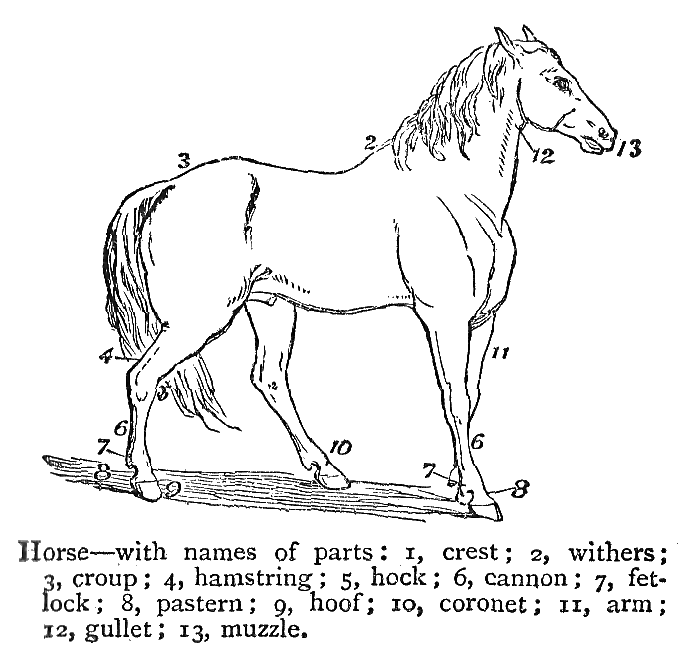
Horse, hors, n. a well-known quadruped: (collectively) cavalry: that by which something is supported, as 'clothes-horse,' &c.: a wooden frame on which soldiers were formerly made to ride as a punishment—also Timber-mare: a boy's crib, a translation.—v.t. to mount on a horse: to provide with a horse: to sit astride: to carry on the back: to urge at work tyrannically: to construe by means of a crib.—v.i. to get on horseback: to charge for work before it is done.—ns. Horse′-artill′ery, field artillery with comparatively light guns and the gunners mounted; Horse′back, the back of a horse; Horse′-bean, a large bean given to horses; Horse′-block, a block or stage by which to mount or dismount from a horse; Horse′-boat, a boat for carrying horses, or one towed by a horse; Horse′-box, a railway car for transporting horses in, or a stall on shipboard; Horse′-boy, a stable-boy; Horse′-break′er, Horse′-tam′er, one whose business is to break or tame horses, or to teach them to draw or carry (Pretty horse-breaker, a woman with little virtue to lose); Horse′-car, a car drawn by horses; Horse′-chest′nut, a large variety of chestnut, prob. so called from its coarseness contrasted with the edible chestnut: the tree that produces it (see Chestnut); Horse′-cloth, a cloth for covering a horse; Horse′-coup′er (Scot.), a horse-dealer; Horse′-deal′er, one who deals in horses; Horse′-doc′tor, a veterinary surgeon; Horse′-drench, a dose of physic for a horse.—adj. Horse′-faced, having a long face.—ns. Horse′-flesh, the flesh of a horse: horses collectively: a Bahama mahogany.—adj. of reddish-bronze colour.—ns. Horse′-fly, a large fly that stings horses; Horse′-foot, the colt's foot; Horse′-god′mother, a fat clumsy woman.—n.pl. Horse′-guards, horse-soldiers employed as guards: the 3d heavy cavalry regiment of the British army, forming part of the household troops: the War Office, or public office in Whitehall, London, appropriated to the departments of the commander-in-chief of the British army.—ns. Horse′-hair, the hair of horses: haircloth; Horse′-hoe, a hoe drawn by horses; Horse′-knack′er, one who buys worn-out horses for slaughtering; Horse′-lat′itudes, a part of the North Atlantic Ocean noted for long calms, so called from the frequent necessity of throwing part of a cargo of horses overboard from want of water when becalmed; Horse′-laugh, a harsh, boisterous laugh; Horse′-leech, a large species of leech, so named from its fastening on horses when wading in the water: a bloodsucker (Prov. xxx. 15); Horse′-litt′er, a litter or bed borne between two horses; Horse′-mack′erel, one of various fishes—the scad (q.v.), &c.; Horse′man, a rider on horseback: a mounted soldier; Horse′manship, the art of riding, and of training and managing horses; Horse′-ma′rine, a person quite out of his element: an imaginary being for whom wild flights of imagination had best be reserved ('Tell it to the horse-marines'); Horse-mill, a mill turned by horses; Horse′-mill′iner, one who provides the trappings for horses; Horse′-mint, a common European wild-mint: the American Monarda punctata—Sweet horse-mint, the common dittany; Horse′-nail, a nail for fastening a horse-shoe to the hoof; Horse′-pis′tol, a large pistol carried in a holster; Horse′-play, rough, boisterous play; Horse′-pond, a pond for watering horses at; Horse′-pow′er, the power a horse can exert, or its equivalent=that required to raise 33,000 lb. avoirdupois one foot per minute: a standard for estimating the power of steam-engines; Horse′-race, a race by horses; Horse′-rac′ing, the practice of racing or running horses in matches; Horse′-rad′ish, a plant with a pungent root, used in medicine and as a condiment; Horse′-rake, a rake drawn by horses; Horse′-rid′ing, a circus; Horse′-sense, plain robust sense; Horse′-shoe, a shoe for horses, consisting of a curved piece of iron.—adj. shaped like a horse-shoe.—ns. Horse′-sol′dier, a cavalry soldier; Horse′-tail, a genus of leafless plants with hollow rush-like stems, so called from their likeness to a horse's tail; Horse′-train′er, one who trains horses for racing, &c.; Horse′-way, a road by which a horse may pass; Horse′-whip, a whip for driving horses.—v.t. to strike with a horse-whip: to lash.—ns. Horse′woman, a woman who rides on horseback; Hors′iness; Hors′ing, birching a schoolboy mounted on another's back.—adj. Hors′y, of or pertaining to horses: devoted to horse racing or breeding.—A dark horse (see Dark); Flog a dead horse, to try to work up excitement about a threadbare subject; Get on, Mount, the high horse, to assume consequential airs; Put the cart before the horse (see Cart); Ride the wooden horse (see above); Take horse, to mount on horseback. [A.S. hors; Ice. horss, Old High Ger. hros (Ger. ross).]
Hortative, hort′a-tiv, adj. inciting: encouraging: giving advice—also Hort′atory.—n. Hortā′tion. [L. hortāri, -ātus, to incite.]
Horticulture, hor′ti-kul-tūr, n. the art of cultivating gardens.—adj. Horticul′tural, pertaining to the culture of gardens.—n. Horticul′turist, one versed in the art of cultivating gardens.—Hortus siccus, a collection of dried plants arranged in a book. [L. hortus, a garden, cultura—colĕre, to cultivate.]
Hosannna, hō-zan′a, n. an exclamation of praise to God, or a prayer for blessings. [Gr. hōsanna—Heb. hōshī‛āh nnā, hōshīā‛, save, nā, I pray.]
Hose, hōz, n. a covering for the legs or feet: stockings: socks: a flexible pipe for conveying water, so called from its shape:—pl. Hose; (B.) Hos′en.—ns. Hose′man, one who directs the stream of water from the hose of a fire-engine; Hose′pipe; Hose′-reel, a large revolving drum or reel for carrying hose for fire-engines, &c.; Hō′sier, one who deals in hose, or stockings and socks, &c.; Hō′siery, hose in general. [A.S. hosa, pl. hosan; Dut. hoos, Ger. hose.]
Hospice, hos′pēs, n. a house of entertainment for strangers, esp. such kept by monks on some Alpine passes for travelers.—Also Hospit′ium. [Fr.,—L. hospitium—hospes, a stranger treated as a guest.]
Hospitable, hos′pit-a-bl, adj. entertaining strangers and guests kindly and without reward: showing kindness: generous: bountiful.—n. Hos′pitableness.—adv. Hos′pitably.—n. Hospital′ity, the practice of one who is hospitable; friendly welcome and entertainment of guests—(Spens.) Hos′pitāge.
Hospital, hos-′pit-al, n. a building for the reception and treatment of the old, the sick, and hurt, &c., or for the support and education of the young.—n. Hos′pitaller, one of a charitable brotherhood for the care of the sick in hospitals: one of an order of knights, commonly called Knights of St John (otherwise called Knights of Rhodes, and afterwards of Malta), who about 1048 built a hospital for the care and cure of pilgrims at Jerusalem.—Hospital Saturday, or Sunday, days set apart for the collection of funds on behalf of hospitals.—Convalescent hospital, one intermediate between the ordinary hospital and the patient's own home; Cottage hospital, a small establishment where hospital treatment is carried on at little expense and with simple arrangements; Lock hospital, one for the treatment of venereal diseases; Magdalen hospital, an institution for the reclamation of fallen women; Marine, or Naval, hospital, a special hospital for sick sailors, or for men in the naval service; Maternity hospital, one for women in labour. [O. Fr. hospital—Low L. hospitale—hospes, a guest.]
Hospodar, hos′po-där, n. formerly the title of the princes of Moldavia and Wallachia. [Slav.]
Hoss, a vulgarism for horse.
Host, hōst, n. one who entertains a stranger or guest at his house without reward: an innkeeper: an organism on which another lives as a parasite:—fem. Host′ess.—n. Host′ess-ship (Shak.), the character or office of a hostess.—adj. Host′less (Spens.), destitute of a host, inhospitable.—Reckon, or Count, without one's host, to misjudge, the original idea being that of totting up one's bill without reference to the landlord. [O. Fr. hoste—L. hospes, hospitis.]
Host, hōst, n. an army, a large multitude.—n. Host′ing, (Milt.) an encounter of hosts, a battle: (Spens.) an assemblage of hosts, a muster.—A host in himself, one of great strength, skill, or resources, within himself; Heavenly host, the angels and archangels; Lord of hosts, a favourite Hebrew term for Jehovah, considered as head of the hosts of angels, the hosts of stars, &c. [O. Fr. host—L. hostis, an enemy.]
Host, hōst, n. in the R.C. Church, the consecrated bread of the Eucharist—a thin circular wafer of unleavened bread. [L. hostia, a victim.]
Hostage, hos′tāj, n. one remaining with the enemy as a pledge for the fulfilment of the conditions of a treaty.—Hostages to fortune, a man's wife, children, &c. [O. Fr. hostage (Fr. ôtage)—Low L. obsidaticus—L. obses, obsidis, a hostage.]
Hostel, hos′tel, Hostelry, hos′tel-ri, n. an inn: in some universities an extra-collegiate hall for students.—ns. Hos′teler, Hos′teller, one living in a hostel. [O. Fr. hostel, hostellerie.]
Hostile, hos′til, adj. belonging to an enemy: showing enmity: warlike: adverse.—adv. Hos′tilely.—n. Hostil′ity, enmity:—pl. Hostil′ities, acts of warfare. [L. hostilis—hostis.]
Hostler, Ostler, hos′lėr, or os′-, n. he who has the care of horses at an inn. [Hostler=hosteleer.]
Hot, hot, adj. having heat: very warm: fiery: pungent: animated: ardent in temper: fervent: vehement: violent: passionate: lustful.—adj. Hot′-and-hot′, of food cooked and served up at once in hot dishes.—ns. Hot′bed, a glass-covered bed heated for bringing forward plants rapidly: any place favourable to rapid growth or development, as 'a hotbed of vice,' &c.; Hot′blast, a blast of heated air blown into a furnace to raise the heat.—adjs. Hot′-blood′ed, having hot blood: high-spirited: irritable; Hot′-brained, hot-headed, rash and violent.—n. Hot′-cock′les, an old game in which a person is blindfolded, and being struck, guesses who strikes him; Hot′-flue, a drying-room.—adj. Hot′-head′ed, hot in the head: having warm passions: violent: impetuous.—n. Hot′-house, a house kept hot for the rearing of tender plants: any heated chamber or drying-room, esp. that where pottery is placed before going into the kiln: (Shak.) a brothel.—adv. Hot′ly.—adj. Hot′-mouthed, headstrong.—n. Hot′ness; Hot′-pot, a dish of chopped mutton seasoned and stewed with sliced potatoes.—v.t. Hot′press, to press paper, &c., between hot plates to produce a glossy surface.—adjs. Hot′-short, brittle when heated; Hot′-spir′ited, having a fiery spirit.—n., one pressing his steed with spurs as in hot haste: a violent, rash man.—adj. Hot′-tem′pered, having a quick temper.—ns. Hot′-trod, the hot pursuit in old Border forays; Hot′-wall, a wall enclosing passages for hot air, affording warmth to fruit-trees trained against it, when needed; Hot′-well, in a condensing engine, a reservoir for the warm water drawn off from the condenser.—Hot coppers (see Copper); Hot cross-buns (see Cross); Hot foot, with speed, fast; In hot water, in a state of trouble or anxiety; Make a place too hot to hold a person, to make it impossible for him to stay there. [A.S. hát; Ger. heiss, Sw. het.]
Hot, hot, Hote, hōt (Spens.) named, called. [Pa.t. and pa.p. of hight.]
Hotchpotch, hoch′poch, Hotchpot, hoch′pot, Hodgepodge, hoj′poj, n. a confused mass of ingredients shaken or mixed together in the same pot: a kind of mutton-broth in which green peas take the place of barley or rice.—Hotchpot, a commixture of property in order to secure an equable division amongst children. [Fr. hochepot—hocher, to shake, and pot, a pot—Old Dut. hutsen, to shake, Dut. pot, a pot.]
Hotel, hō-tel′, n. a superior house for the accommodation of strangers: an inn: in France, also a public office, a private town-house, a palace.—ns. Hôtel′-de-ville (Fr.), a town-hall; Hôtel′-dieu, a hospital. [M. E. hostel—O. Fr. hostel (Fr. hôtel)—L. hospitalia, guest-chambers—hospes.]
Hottentot, hot′n-tot, n. a native of the Cape of Good Hope: a brutish individual. [Dut., because the language of the South Africans seemed to the first Dutch settlers to sound like a repetition of the syllables hot and tot; Dut. en—and.]
Hottering, hot′er-ing, adj. (prov.) raging.
Houdah. See Howdah.
Houdan, hōō′dang, n. a valued breed of domestic fowls, orig. from Houdan in Seine-et-Oise.
Hough, hok, Hock, hok, n. the joint on the hind-leg of a quadruped, between the knee and fetlock, corresponding to the ankle-joint in man: in man, the back part of the knee-joint: the ham.—v.t. to hamstring:—pr.p. hough′ing; pa.p. houghed (hokt). [A.S. hóh, the heel.]
Hound, hownd, n. a dog used in hunting: a cur: a caitiff.—v.t. to set on in chase: to hunt: to urge, pursue, harass (with on).—ns. Hound′fish, same as Dogfish; Hounds′-berr′y, the common dogwood; Hound's′-tongue, a plant, so called from the shape of its leaves.—Gabriel hounds, a popular name for the noise made by distant curlews, ascribed to damned souls whipped on by the angel Gabriel; Master of hounds, the master of a pack of hounds. [A.S. hund; Gr. kyōn, kynos, L. canis, Sans. çvan.]
Hour, owr, n. 60 min., or the 24th part of a day: the time indicated by a clock, &c.: an hour's journey, or three miles: a time or occasion; (pl., myth.) the goddesses of the seasons and the hours: set times of prayer, the canonical hours, the offices or services prescribed for these, or a book containing them.—ns. Hour′-cir′cle, a circle passing through the celestial poles and fixed relatively to the earth: the circle of an equatorial which shows the hour-angle of the point to which the telescope is directed; Hour′-glass, an instrument for measuring the hours by the running of sand from one glass vessel into another; Hour′-hand, the hand which shows the hour on a clock, &c.—adj. Hour′ly, happening or done every hour: frequent.—adv. every hour: frequently.—n. Hour′plate, the plate of a timepiece on which the hours are marked: the dial.—At the eleventh hour, at the last moment possible (Matt. xx. 6, 9); In a good, or evil, hour, acting under a fortunate, or an unfortunate, impulse—from the old belief in astrological influences; Keep good hours, to go to bed and to rise early: to lead a quiet and regular life; The hour is come, the destined day of fate has come (John, xiii. 1); The small hours, the early hours of the morning; Three hours service, a service held continuously on Good Friday, from noon to 3 P.M., in commemoration of the time of Christ's agony on the cross. [O. Fr. hore (Fr. heure)—L. hora—Gr. hōra.]
Houri, how′ri, hōō′ri, n. a nymph of the Mohammedan paradise. [Pers. huri—Ar. hūriya, a black-eyed girl.]
House, hows, n. a building for dwelling in: a dwelling-place: an inn: household affairs: a family: kindred: a trading establishment: one of the twelve divisions of the heavens in astrology: one of the estates of the legislature (House of Lords or Upper House, House of Commons or Lower House; also Upper and Lower Houses of Convocation, House of Representatives, &c.): at Oxford, 'The House,' Christ Church College: the audience at a place of entertainment, a theatre, &c. (a full house, a thin house): (coll.) the workhouse:—pl. Houses (howz′ez).—v.t. House (howz), to protect by covering: to shelter: to store: to provide houses for.—v.i. to take shelter: to reside.—ns. House′-ā′gent, one who has the letting of houses; House′-boat, a barge with a deck-cabin that may serve as a dwelling-place; House′-bote, wood that a tenant may take to repair his house, or for fuel; House′-break′er, one who breaks open and enters a house by day for the purpose of stealing; House′-break′ing; House′-carl, a member of a king or noble's bodyguard, in Danish and early English history; House′-dū′ty, -tax, a tax laid on inhabited houses; House′-fac′tor (Scot.), a house-agent; House′-fa′ther, the male head of a household or community; House′-flag, the distinguishing flag of a shipowner or company of such; House′-fly, the common fly universally distributed; House′hold, those who are held together in the same house, and compose a family.—adj. pertaining to the house and family.—ns. House′holder, the holder or tenant of a house; House′keeper, a female servant who keeps or has the chief care of the house: one who stays much at home; House′keeping, the keeping or management of a house or of domestic affairs: hospitality.—adj. domestic.—n. House′-leek, a plant with red star-like flowers and succulent leaves that grows on the roofs of houses.—adj. House′less, without a house or home: having no shelter.—ns. House′-line (naut.), a small line of three strands, for seizings, &c.; House′maid, a maid employed to keep a house clean, &c.; House′-mate, one sharing a house with another; House′-moth′er, the mother of a family, the female head of a family; House′-room, room or place in a house; House′-stew′ard, a steward who manages the household affairs of a great family; House′-sur′geon, the surgeon or medical officer in a hospital who resides in the house—so also House′-physi′cian; House′-warm′ing, an entertainment given when a family enters a new house, as if to warm it; Housewife (hows′wīf, huz′wif, or huz′if), the mistress of a house: a female domestic manager: a small case for articles of female work.—adj. House′wifely.—n. House′wifery—(Scot.) House′wifeskep.—House of call, a house where the journeymen of a particular trade call when out of work; House of correction, a jail; House of God, prayer, or worship, a place of worship; House of ill fame, a bawdy-house.—A household word, a familiar saying; Bring down the house, to evoke very loud applause in a place of entertainment; Cry from the house-top, to announce in the most public manner possible; Household gods, one's favourite domestic things—a playful use of the Roman penates (q.v.); Household suffrage, or franchise, the right of householders to vote for members of parliament; Household troops, six regiments whose peculiar duty is to attend the sovereign and defend the metropolis; Housemaid's knee, an inflammation of the sac between the knee-pan and the skin, to which housemaids are specially liable through kneeling on damp floors.—Inner House, the higher branch of the Scotch Court of Session, its jurisdiction chiefly appellate; Outer House, the lower branch of the Court of Session.—Keep a good house, to keep up a plentifully supplied table; Keep house, to maintain or manage an establishment; Keep open house, to give entertainments to all comers; Keep the house, to be confined to the house; Like a house afire, with astonishing rapidity; The Household, the royal domestic establishment. [A.S. hús; Goth. hus, Ger. haus.]
Housel, howz′el, n. the Eucharist: the act of taking the same.—n. Hous′eling-cloth, a linen cloth held or stretched beneath the communicants.—adj. Hous′ling (Spens.), sacramental. [A.S. húsel, sacrifice.]
Housing, howz′ing, n. an ornamental covering for a horse: a saddle-cloth: (pl.) the trappings of a horse. [O. Fr. housse, a mantle, of Teut. origin.]
Housty, hows′ti, n. (prov.) a sore throat.
Hout-tout, hoot-toot, interj. Same as Hoot.
Houyhnhnm, whin′im, n. one of the noble rational horse race in Gulliver's Travels. [From whinny.]
Hova, hō′va, n. one of the dominant race in Madagascar:—pl. Hō′vas.
Hove, hōv, v.t. (Scot.) to heave, to raise.
Hove, hōv, v.i. (Spens.) to hover, to loiter.
Hove, pa.t. and pa.p. of heave.
Hovel, hov′el, n. a small or mean dwelling: a shed.—v.t. to put in a hovel: to shelter: to construct a chimney so as to prevent smoking, by making two of the more exposed walls higher than the others, or making an opening on one side near the top:—pr.p. hov′elling; pa.p. hov′elled.—n. Hov′eller, a boatman acting as a non-certificated pilot or doing any kind of occasional work on the coast: a small coasting-vessel. [Dim. of A.S. hof, a dwelling.]
Hover, hov′ėr, v.i. to remain aloft flapping the wings: to wait in suspense: to move about near.—adv. Hov′eringly, in a hovering manner. [Formed from A.S. hof, house.]
How, how, adv. in what manner: to what extent: for what reason: by what means: from what cause: in what condition: (N.T.) sometimes=that.—The how and the why, the manner and the cause. [A.S. hú is prob. a form of hwí, in what way, why, the instrumental case of hwá, who.]
How, Howe, how, n. (Scot.) a hollow, glen, dell, or narrow plain. [Prob. related to hole.]
How, how, n. (prov.) a low hill. [Akin to high, A.S. heáh.]
Howbeit, how-bē′it, conj. be it how it may: notwithstanding: yet: however—(Spens.) How′be.
Howdah, Houdah, how′da, n. a seat fixed on an elephant's back. [Ar. hawdaj.]
Howdie, Howdy, how′di, n. (Scot.) a midwife. [Webster ingeniously at least suggests a derivation in 'How d'ye?' the midwife's first question.]
Howdy, how′di, interj. a colloquial form of the common greeting, 'How do you [do]?'—n. How′dy-do, a troublesome state of matters.
However, how-ev′ėr, adv. and conj. in whatever manner or degree: nevertheless: at all events.
Howff, Houff, howf, n. (Scot.) a haunt, resort.—v.i. to resort to a place. [A.S. hof, a house.]
Howitzer, how′its-ėr, n. a short, light cannon, used for throwing shells. [Ger. haubitze, orig. hauffnitz—Bohem. haufnice, a sling.]
Howk, howk, v.t. and v.i. (Scot.) to dig, burrow.
Howker, how′kėr, n. Same as Hooker.
Howl, howl, v.i. to yell or cry, as a wolf or dog: to utter a long, loud, whining sound: to wail: to roar.—v.t. to utter with outcry:—pr.p. howl′ing; pa.p. howled.—n. a loud, prolonged cry of distress: a mournful cry.—n. Howl′er, a South American monkey, with prodigious power of voice: (slang) a glaring or very stupid error.—adj. Howl′ing, filled with howlings, as of the wind, or of wild beasts: (slang) tremendous.—n. a howl. [O. Fr. huller—L. ululāre, to shriek or howl—ulula, an owl; cf. Ger. heulen, Eng. owl.]
Howlet, how′let. Same as Owlet.
Howso, how′so, adv. howsoever.
Howsoever, how-so-ev′ėr, adv. in what way soever: although: however.—Provincial forms are Howsomev′er and Howsomdev′er.
Hox, hoks, v.t. (Shak.) to hough or hamstring.
Hoy, hoi, n. a large one-decked boat, commonly rigged as a sloop. [Dut. heu, Flem. hui.]
Hoy, hoi, interj. ho! stop!—v.t. to incite, drive on. [Imit.]
Hoyden, Hoiden, hoi′den, n. a tomboy, a romp. [Old Dut. heyden, a heathen, a gipsy, heyde, heath.]
Hub, hub, n. the projecting nave of a wheel; a projection on a wheel for the insertion of a pin: the hilt of a weapon: a mark at which quoits, &c., are cast.—Hub (i.e. centre) of the universe, Boston, U.S. [A form of hob.]
Hubble, hub′l, n. (Scot.) an uproar: a heap, as of work: (U.S.) a lump.—adj. Hub′bly.
Hubble-bubble, hub′l-bub′l, n. an East Indian tobacco-pipe, in which the smoke is drawn through water with a bubbling sound. [Reduplic. from bubble.]
Hubbub, hub′ub, n. a confused sound of many voices: riot: uproar. [Prob. a repetition of hoop, whoop.]
Hubby, hub′bi, n. (coll.) a diminutive of husband.
Huckaback, huk′a-bak, n. a coarse variety of linen for towels, &c., having raised figures on it. [Skeat suggests as the original meaning 'pedlar's ware,' Low Ger. hukkebak; cf. hawker.]
Huckle, huk′l, n. a hunch: the hip—also Huck.—adjs. Huck′le-backed, -shoul′dered, having the back or shoulders round.—n. Huck′le-bone, the hip-bone, or ankle-bone. [Dim. of huck, a prov. form of hook.]
Huckleberry, huk′l-ber′ri, n. a North American shrub (Gaylussacia) with blue berries. [Prob. a corr. of hurtleberry.]
Huckster, huk′stėr, n. a retailer of smallwares, a hawker or pedlar: a mean, trickish fellow:—fem. Huck′stress.—v.i. to deal in small articles, to higgle meanly.—n. Huck′sterage, business of a huckster. [With fem. suff. -ster, from Dut. heuker, a retailer, Old Dut. hucken, to stoop or bow; cf. Ice. húka, to sit on one's hams, and Eng. hawker.]
Huddle, hud′l, v.i. to put up things confusedly: to hurry in disorder: to crowd.—v.t. to throw or crowd together in confusion: to put on hastily.—n. a crowd: tumult: confusion. [M. E. hodren; prob. a freq. of M. E. huden, to hide.]
Huddup, hud-up′, interj. get up! (to a horse).
Hudibrastic, hū-di-bras′tik, adj. similar in style to Hudibras, a metrical burlesque on the Puritans by Samuel Butler (1612-80): doggerel.
Hue, hū, n. appearance: colour: tint: dye.—-adjs. Hued, having a hue; Hue′less. [A.S. hiw, heow; Sw. hy, complexion.]
Hue, hū, n. a shouting.—Hue and cry, a loud clamour about something: name of a police gazette, established in 1710. [Fr. huer, imit.]
Huff, huf, n. sudden anger or arrogance: a fit of disappointment or anger: a boaster.—v.t. to swell: to bully: to remove a 'man' from the board for not capturing pieces open to him, as in draughts.—v.i. to swell: to bluster.—adjs. Huff′ish, Huff′y, given to huff: insolent: arrogant.—adv. Huff′ishly.—ns. Huff′ishness, Huff′iness. [Imit., like puff; cf. Ger. hauchen, to breathe.]
Hug, hug, v.t. to embrace closely and fondly: to cherish: to congratulate (one's self): (naut.) to keep close to.—v.i. to crowd together:—pr.p. hug′ging; pa.p. hugged.—n. a close and fond embrace: a particular grip in wrestling.—Hug one's self, to congratulate one's self. [Scand., Ice. húka, to sit on one's hams. See Huckster.]
Huge, hūj, adj. having great dimensions, especially height: enormous: monstrous: (B.) large in number.—adv. Huge′ly.—n. Huge′ness. [M. E. huge; formed by dropping a from O. Fr. ahuge, of Teut. origin, cog. with Ger. hoch.]
Hugger-mugger, hug′ėr-mug′ėr, n. secrecy: confusion. [Perh. a rhyming extension of hug.]
Huguenot, hū′ge-not, or -nō, n. the name formerly given in France to an adherent of the Reformation. [Prob. a dim. of the personal name Hugo, Hugon, Hugues, Hugh, name of some French Calvinist, later a general nickname. Not the Swiss eidguenot, Ger. eidgenossen, confederates.]
Huia-bird, hwē′ä-bėrd, n. a New Zealand starling.
Hulk, hulk, n. the body of a ship: an old ship unfit for service: a big lubberly fellow: anything unwieldy—often confounded in meaning with hull, the body of a ship:—pl. The hulks, old ships formerly used as prisons.—adjs. Hulk′ing, Hulk′y, clumsy. [Low L. hulka—Gr. holkas—helkein, to draw.]
Hull, hul, n. the husk or outer covering of anything.—v.t. to strip off the hull: to husk. [A.S. hulu, a husk, as of corn—helan, to cover; Ger. hülle, a covering, hehlen, to cover.]
Hull, hul, n. the frame or body of a ship.—v.t. to pierce the hull (as with a cannon-ball).—v.i. to float or drive on the water, as a mere hull. [Same word as above, perh. modified in meaning by confusion with Dut. hol, a ship's hold, or with hulk.]
Hullabaloo, hul′la-ba-loo′, n. an uproar.
Hullo, hul-lō′, v., n., and interj. Same as Halloo.
Hully, hul′i, adj. having husks or pods.
Hulsean, hul′sē-an, adj. of or pertaining to John Hulse (1708-89), founder of the Hulsean divinity lectures at Cambridge.
Hum, hum, v.i. to make a buzzing sound like bees: to utter a low, droning sound: to supply an interval in speaking by an audible sound.—v.t. to sing in a low tone: to applaud anything by humming:—pr.p. hum′ming; pa.p. hummed.—n. the noise of bees and some other insects: any low, dull noise.—interj. a sound with a pause implying doubt.—n. Hum′mer, something that hums.—Hum and haw, to hesitate in giving a direct answer; Humming ale, ale that froths up well, or that makes the head hum; Make things hum, to set things agoing briskly. [Imit.; cf. Ger. hummen, humsen.]
Hum, hum, v.t. to impose on.—n. an imposition. [Contr. of humbug.]
Human, hū′man, adj. belonging or pertaining to man or mankind: having the qualities of a man.—n. (coll.) a human being.—n. Hū′mankind, the human species.—adv. Hū′manly. [Fr.,—L. humanus—homo, a human being.]
Humane, hū-mān′, adj. having the feelings proper to man: kind: tender: merciful.—adv. Humane′ly.—n. Humane′ness, kindness: tenderness.
Humanise, hū′man-īz, v.t. to render human or humane: to soften.—v.i. to become humane or civilised.—n. Humanisā′tion.
Humanist, hū′man-ist, n. a student of polite literature: at the Renaissance, a student of Greek and Roman literature: a student of human nature.—n. Hū′manism, polite learning, literary culture: any system which puts human interests paramount.—adj. Humanist′ic.
Humanitarian, hū-man′i-tā′ri-an, n. one who denies Christ's divinity, and holds Him to be a mere man: a philanthropist.—adj. of or belonging to humanity, benevolent.—n. Humanitā′rianism.
Humanity, hū-man′it-i, n. the nature peculiar to a human being: the kind feelings of man: benevolence: tenderness: mankind collectively:—pl. Human′ities, in Scotland, grammar, rhetoric, Latin, Greek, and poetry, so called from their humanising effects.—Professor of Humanity, in Scotch universities, the professor of Latin. [Fr.,—L. humanitas—humanus—homo, a man.]
Humble, hum′bl, or um′bl, adj. low: meek: modest.—v.t. to bring down to the ground: to lower: to abase: to mortify: to degrade.—adj. Hum′ble-mouthed, humble in speech.—n. Hum′bleness—(Spens.) Hum′bless.—adj. Hum′bling, making humble.—n. a humiliation.—advs. Hum′blingly, in a humiliating manner; Hum′bly. [Fr.,—L. humilis, low—humus, the ground.]
Humble, hum′bl, adj. having no horns.
Humble-bee, hum′bl-bē, n. the humming-bee: a genus of social bees which construct their hives under ground. [Humble is a freq. of hum.]
Humble-pie, hum′bl-pī, n. a pie made of the umbles or numbles (liver, heart, &c.) of a deer.—Eat humble-pie, to humiliate one's self, eat one's own words.
Humbug, hum′bug, n. an imposition under fair pretences: hollowness, pretence: one who so imposes: a kind of candy.—v.t. to deceive: to hoax:—pr.p. hum′bugging; pa.p. hum′bugged.—adj. Humbug′able, capable of being humbugged.—ns. Hum′bugger, one who humbugs; Hum′buggery, the practice of humbugging. [Orig. 'a false alarm,' 'a bugbear,' from hum and bug, a frightful object.]
Humbuzz, the same as the Bull-roarer (q.v.).
Humdrum, hum′drum, adj. dull: droning: monotonous: commonplace.—n. a stupid fellow: monotony, tedious talk. [Hum and drum.]
Humdudgeon, hum′duj-on, n. (Scot.) an unnecessary outcry.
Humectant, hū-mek′tant, adj. pertaining to remedies supposed to increase the fluidity of the blood.—vs.t. Humect′, Humec′tate, to moisten.—n. Humectā′tion.—adj. Humec′tive, having the power to moisten.—v.t. Hū′mefy, to make moist. [L. humectans—humēre, to be moist.]
Humeral, hū′mėr-al, adj. belonging to the shoulder.—n. an oblong scarf worn round the priest's shoulders at certain parts of the Mass and of Benediction.—n. Hū′merus, the arm from the shoulder to the elbow: the bone of the upper arm:—pl. Hū′meri (-rī).—adjs. Hū′mero-cū′bital; Hū′mero-dig′ital; Hū′mero-dor′sal; Hū′mero-metacar′pal; Hū′mero-rā′dial. [Fr.,—L. humerus, the shoulder.]
Humet, Humette, hū-met′, n. (her.) a fesse or bar cut off short at each end.—adj. Humeté.
Humgruffin, hum′gruf-in, n. a terrible person.
Humian, hūm′i-an, adj. of or pertaining to David Hume (1711-76), or his philosophy.
Humhum, hum′hum, n. a kind of plain, coarse cotton cloth used in the East Indies.
Humic, hū′mik, adj. denoting an acid formed by the action of alkalies on humus or mould.
Humid, hū′mid, adj. moist: damp: rather wet.—adv. Hū′midly.—ns. Hū′midness, Humid′ity, moisture: a moderate degree of wetness. [L. humidus—humēre, to be moist.]
Humiliate, hū-mil′i-āt, v.t. to make humble: to depress: to lower in condition.—adjs. Humil′iant, humiliating; Humil′iāting, humbling, mortifying.—n. Humiliā′tion, the act of humiliating: abasement: mortification. [L. humiliāre, -ātum.]
Humility, hū-mil′i-ti, n. the state or quality of being humble: lowliness of mind: modesty. [O. Fr. humilite—L. humilitat-em—humilis, low.]
Humine, hūm′in, n. Same as Humus.
Hummel, hum′el, adj.—hornless.—n. Humm′eller, a machine for separating awns of barley from seed.
Humming, hum′ing, n. a low, murmuring sound, like that made by bees.—ns. Humm′ing-bird, a tropical bird, of brilliant plumage and rapid flight, from the humming sound of its wings; Humm′ing-top, a top which when spun gives a humming sound. [Hum.]
Hummock, hum′uk, n. a hillock: pile or ridge (of ice): (Scot.) a fistful.—n. Humm′ie, a small protuberance.—adjs. Humm′ocked, Humm′ocky. [Dim. of hump.]
Hummum, the same as Hammam (q.v.).
Humour, hū′mur, or ū′mur, n. the moisture or fluids of animal bodies: an animal fluid in an unhealthy state: state of mind (because once thought to depend on the humours of the body), as 'good' and 'ill humour:' disposition: caprice: a mental quality which delights in ludicrous and mirthful ideas: playful fancy.—v.t. to go in with the humour of: to gratify by compliance.—adj. Hū′moral, pertaining to or proceeding from the humours.—ns. Hū′moralism, the state of being humoral: the doctrine that diseases have their seat in the humours; Hū′moralist, one who favours the doctrine of humoralism; Humoresque′, a musical caprice; Hū′morist, one whose conduct and conversation are regulated by humour or caprice: one who studies or portrays the humours of people: one possessed of humour: a writer of comic stories.—adjs. Humoris′tic, humorous; Hū′morless, without humour; Hū′morous, governed by humour: capricious: irregular: full of humour: exciting laughter.—adv. Hū′morously.—n. Hū′morousness.—adj. Hū′moursome, capricious, petulant.—n. Hū′moursomeness.—Out of humour, out of temper, displeased; The new humour, a so-called modern literary product in which there is even less humour than novelty. [O. Fr. humor (Fr. humeur)—L. humor—humēre, to be moist.]
Hump, hump, n. a lump or hunch upon the back.—v.t. to bend in a hump: (U.S. slang) to prepare for a great exertion: (slang) to vex or annoy.—v.i. to put forth effort.—n. Hump′back, a back with a hump or hunch: a person with a humpback.—adjs. Hump′backed, having a humpback; Humped, having a hump on the back; Hump′y, full of humps or protuberances. [Prob. a nasalised form of heap.]
Humph, humf, interj. an exclamation expressive of dissatisfaction or incredulity.
Humphrey, To dine with. See Dine.
Humpty-dumpty, hum′ti-dum′ti, n. a short, squat, egg-like being of nursery folklore: a gipsy drink, ale boiled with brandy.—adj. short and broad.
Humstrum, hum′strum, n. a hurdy-gurdy.
Humus, hūm′us, Humine, hūm′in, n. a brown or black powder in rich soils, formed by the action of air on animal or vegetable matter.—adj. Hū′mous. [L., 'the ground,' akin to Gr. chamai, on the ground.]
Hun, hun, n. one of a powerful, squat, swarthy, and savage nomad race of Asia, probably of Mongolian or Tartar stock, who began to move westwards in Europe about 372 A.D., pushing the Goths before them across the Danube, and under Attila (433-453) overrunning Europe: a shortened form of Hungarian.—adjs. Hun′nic, Hun′nish.
Hunch, hunsh, n. a hump, esp. on the back: a lump.—n. Hunch′back, one with a hunch or lump on his back.—adj. Hunch′backed, having a humpback. [The nasalised form of hook; cog. with Ger. hucke, the bent back; cf. Scot. to hunker down, to sit on one's heels with the knees bent up towards the chin.]
Hundred, hun′dred, n. the number of ten times ten: a division of a county in England, orig. supposed to contain a hundred families.—adjs. Hun′dredfold, folded a hundred times, multiplied by a hundred; Hun′dredth, coming last or forming one of a hundred.—n. one of a hundred.—n. Hun′dredweight, a weight the twentieth part of a ton, or 112 lb. avoirdupois; orig. a hundred lb., abbreviated cwt. (c. standing for L. centum, wt. for weight).—Hundred days, the period between Napoleon's return from Elba and his final downfall after Waterloo (the reign lasted exactly 95 days, March 20-June 22, 1815); Hundred years' war, the struggle between England and France, from 1337 down to 1453; Chiltern Hundreds, a district of Bucks, whose stewardship is a nominal office under the Crown, the temporary acceptance of which by a member of parliament enables him technically to vacate his seat; Great, or Long, hundred, six score; Not a hundred miles off, an indirect phrase for 'here,' 'in this very place;' Old Hundred, or Hundredth, a well-known long-metre setting of the hundredth psalm, 'All people that on earth do dwell.' [A.S. hundred—old form hund, a hundred, with the superfluous addition of réd or rǽd (Eng. rate), a reckoning.]
Hung, pa.t. and pa.p. of hang.—n. Hung′-beef, beef cured and dried.
Hungarian, hung-gā′ri-an, adj. pertaining to Hungary or its inhabitants.—n. a native of Hungary: the Magyar or Hungarian language.
Hunger, hung′gėr, n. desire for food: strong desire for anything.—v.i. to crave food: to long for.—adjs. Hung′er-bit′ten, bitten, pained, or weakened by hunger; Hung′erful, hungry; Hung′erly (Shak.), hungry.—adv. (Shak.) hungrily.—adv. Hung′rily.—adj. Hung′ry, having eager desire: greedy: lean: poor. [A.S. hungor (n.), hyngran (v.); cf. Ger. hunger, Dut. honger, &c.]
Hunk, the same as Hunch.
Hunk, hungk, n. (U.S.) goal or base in boys' games.—n. Hunk′er, a conservative.—adj. Hunk′y, in good position. [Dut. honk.]
Hunker, hungk′er, v.i. (Scot.) to squat down.—n.pl. Hunk′ers, the hams. [See Hunch.]
Hunks, hungks, n.sing. a covetous man: a miser.
Hunt, hunt, v.t. to chase wild animals for prey or sport: to chase such over a country: to search for: to pursue.—v.i. to go out in pursuit of game: to search.—n. a chase of wild animals: search: a pack of hunting hounds: an association of huntsmen.—ns. Hunt′-count′er, a dog that runs back or counter on the scent, a worthless dog—hence (Shak.), a blunderer, and v.t. to retrace one's steps; Hunt′er (fem. Hunt′ress), one who hunts: a horse used in the chase: a watch whose face is protected, like the reverse, with a metal case; Half′-hunt′er, such a watch where that metal case has a small circle of glass let in, so that one can see the time without opening it; Hunt′ing, the pursuit of wild game, the chase; Hunt′ing-box, Hunt′ing-lodge, Hunt′ing-seat, a temporary residence for hunting; Hunt′ing-cap, a form of cap much worn in the hunting-field; Hunt′ing-cog, an extra cog in one of two geared wheels, by means of which the order of contact of cogs is changed at every revolution; Hunt′ing-crop, -whip, a short whip with a crooked handle and a loop of leather at the end, used in the hunting-field; Hunt′ing-ground, a place or region for hunting; Hunting-horn, a horn used in hunting, a bugle; Hunt′ing-knife, -sword, a knife or short sword used to despatch the game when caught, or to skin and cut it up; Hunt′ing-song, a song about hunting; Hunt′ing-tide, the season of hunting; Hunts′man, one who hunts: a servant who manages the hounds during the chase; Hunts′manship, the qualifications of a huntsman; Hunt's-up (Shak.), a tune or song intended to arouse huntsmen in the morning—hence, anything calculated to arouse.—Hunt down, to destroy by persecution or violence; Hunt out, up, after, to search for, seek; Hunt-the-gowk, to make an April fool (see April); Hunt-the-slipper, an old-fashioned game in which one in the middle of a ring tries to catch a shoe which those forming the ring upon the ground shove about under their hams from one to another.—Happy hunting-grounds, the paradise of the Red Indian; Mrs Leo Hunter, of 'The Den, Eatanswill,' a social lion-hunter in the Pickwick Papers whose husband hunts up all the newest celebrities to grace her breakfast parties. [A.S. huntian; A.S. hentan, to seize.]
Hunterian, hun-tē′ri-an, adj. of or pertaining to the great surgeon John Hunter (1728-93), to his collection of anatomical specimens and preparations, the nucleus of the great Hunterian Museum in London, or to the Hunterian Oration delivered at the Royal College of Surgeons on the anniversary of his birth, 14th February: of or pertaining to his elder brother, William Hunter (1718-83), or his museum at Glasgow.
Huntingdonian, hun-ting-dō′ni-an, n. a member of the Countess of Huntingdon's Connection, a denomination of Calvinistic Methodists founded by Whitefield in conjunction with Selina, Countess of Huntingdon (1707-91).
Huon-pine, hū′on-pīn′, n. a Tasmanian yew, with light-yellow wood, used in boat-building.
Hurdies, hur′diz, n.pl. (Scot.) the buttocks.
Hurdle, hur′dl, n. a frame of twigs or sticks interlaced: (agri.) a movable frame of timber or iron for gates, &c.: a rude sledge on which criminals were drawn to the gallows.—v.t. to enclose with hurdles.—n. Hur′dle-race, a race where the runners, whether men or horses, have to clear a succession of hurdles. [A.S. hyrdel; Ger. hürde.]
Hurds. Same as Hards.
Hurdy-gurdy, hur′di-gur′di, n. a musical stringed instrument, like a rude violin, whose strings are sounded by the turning of a wheel: a hand-organ: an impact-wheel. [Imit.]
Hurl, hurl, v.i. to make a noise by throwing: to move rapidly: to dash with force: to whirl: (Scot.) to convey in a wheeled vehicle.—v.t. to throw with violence: to utter with vehemence.—n. act of hurling, tumult, confusion: (Scot.) conveyance in a wheeled vehicle.—ns. Hurl′er; Hurl′ey, the game of hockey, or the stick used in playing it; Hurl′ing, a game in which a ball is forced through the opponent's goal, hockey; Hurl′y (Scot.), a wheelbarrow; Hurl′y-hack′et, an ill-hung carriage. [Hurtle.]
Hurly-burly, hur′li-bur′li, n. tumult: confusion.—n. Hur′ly (Shak.). [Hurly is from O. Fr. hurler, to yell, orig. huller, whence Eng. howl. Burly is simply a rhyming addition.]
Hurrah, Hurra, hoor-rä′, interj. an exclamation of excitement or joy.—Also n. and v.i. [Ger. hurra; Dan. and Sw. hurra.]
Hurricane, hur′ri-kān, n. a storm with extreme violence and sudden changes of the wind: a social party, a rout—(Shak.) Hur′ricano.—Hurricane deck, a cross-deck about amidships, a bridge-deck or bridge: the upper light deck of a passenger-steamer. [Sp. huracan, from Caribbean.]
Hurry, hur′i, v.t. to urge forward: to hasten.—v.i to move or act with haste:—pa.p. hurr′ied.—n. a driving forward: haste: tumult: a tremolando passage for violins, &c., in connection with an exciting situation.—adj. Hurr′ied.—adv. Hurr′iedly.—n. Hurr′iedness.—adv. Hurr′yingly.—n. Hurr′y-skurr′y, confusion and bustle.—adv. confusedly. [Imit. Cf. Old Sw. hurra, to whirl round.]
Hurst, hurst, n. a wood, a grove. [A.S. hyrst.]
Hurt, hurt, v.t. to cause bodily pain to: to damage: to wound, as the feelings.—v.i. to give pain, &c.:—pa.t. and pa.p. hurt.—n. a wound: injury.—n. Hurt′er, that which hurts: a beam at the lower end of a gun-platform to save the parapet: a piece of iron or wood fixed to the top-rails of a gun-carriage to check its motion: the shoulder of an axle against which the hub strikes.—adj. Hurt′ful, causing hurt or loss: mischievous.—adv. Hurt′fully.—n. Hurt′fulness.—adj. Hurt′less, without hurt or injury, harmless.—adv. Hurt′lessly.—n. Hurt′lessness. [O. Fr. hurter (Fr. heurter), to knock, to run against; prob. from the Celtic, as in W. hwrdd, a thrust, the butt of a ram, Corn. hordh, a ram.]
Hurtle, hurt′l, v.t. to dash against: to move violently: to clash: to rattle.—v.i. to move rapidly with a whirring sound. [Freq. of hurt in its original sense.]
Hurtleberry, a form of whortleberry.
Husband, huz′band, n. a married man: (B.) a man to whom a woman is betrothed: one who manages affairs with prudence: (naut.) the owner of a ship who manages its concerns in person.—v.t. to supply with a husband: to manage with economy.—n. Hus′bandage, allowance or commission of a ship's husband.—adjs. Hus′bandless (Shak.), without a husband; Hus′bandly, frugal, thrifty.—ns. Hus′bandman, a working farmer: one who labours in tillage; Hus′bandry, the business of a farmer: tillage: economical management: thrift. [M. E. husbonde—A.S. húsbonda, Ice. húsbóndi—hús, a house, búandi, inhabiting, pr.p. of Ice. búa, to dwell. Cf. Ger. bauen, to till.]
Hush, hush, interj. or imper. silence! be still!—adj. silent: quiet.—v.t. to make quiet: (min.) to clear off soil, &c., overlying the bed-rock.—ns. Hush′aby, a lullaby used to soothe babies to sleep; Hush′-mon′ey, money given as a bribe to hush or make one keep silent.—Hush up, to stifle, suppress: to be silent. [Imit. Cf. hist and whist.]
Husk, husk, n. the dry, thin covering of certain fruits and seeds: (pl.) refuse, waste.—v.t. to remove the husk or outer integument from.—adj. Husked, covered with a husk: stripped of husks.—ns. Husk′er, one who husks Indian corn, esp. at a husking-bee; Husk′ing, the stripping of husks: a festive gathering to assist in husking Indian corn (maize)—also Husk′ing-bee. [M. E. huske, orig. with l, as in cog. Ger. hülse, Dut. hulse, &c.]
Husky, husk′i, adj. hoarse, as the voice: rough in sound.—adv. Husk′ily.—n. Husk′iness. [A corr. of husty, from M. E. host (Scot. hoast, host, a cough)—A.S. hwósta, a cough; cf. Ger. husten.]
Huso, hū′so, n. the great sturgeon.
Hussar, hooz-zär′, n. a light-armed cavalry soldier: (orig.) a soldier of the national cavalry of Hungary. [Not Hung. huszar—husz, twenty, because at one time in Hungary one cavalry soldier used to be levied from every twenty families; but Slav. hussar, gooseherd, the sobriquet of the raiding horse of Matthias Corvinus (1443-90).]
Hussif. See Housewife. [Contr. of housewife.]
Hussite, hus′sīt, n. a follower of the Bohemian reformer, John Hus, martyred in 1415.
Hussy, huz′i, n. a pert girl: a worthless wench.
Hustings, hus′tingz, n.sing. the principal court of the city of London: formerly the booths where the votes were taken at an election of an M.P., or the platform from which the candidates gave their addresses. [A.S. hústing, a council, but a Scand. word, and used in speaking of the Danes—Ice. hústhing—hús, a house, thing, an assembly.]
Hustle, hus′l, v.t. to shake or push together: to crowd with violence.—n. Hus′tler, an energetic fellow. [Old Dut. hutsen, hutselen, to shake to and fro; cf. hotchpotch.]
Huswife. See Housewife.
Hut, hut, n. a small or mean house: (mil.) a small temporary dwelling.—v.t. (mil.) to place in huts, as quarters:—pr.p. hut′ting; pa.p. hut′ted. [Fr. hutte—Old High Ger. hutta (Ger. hütte).]
Hutch, huch, n. a box, a chest: a coop for rabbits: a baker's kneading-trough: a trough used with some ore-dressing machines: a low wagon in which coal is drawn up out of the pit.—v.i. (Milt.) to hoard up. [Fr. huche, a chest—Low L. hutica, a box; prob. Teut.]
Hutchinsonian, huch-in-sōn′i-an, n. a follower of John Hutchinson (1674-1737), who held that the Hebrew Scriptures contain typically the elements of all rational philosophy, natural history, and true religion.
Huttonian, hut-ō′ni-an, adj. relating to the views of James Hutton (1726-97), who emphasised natural agencies in the formation of the earth's crust.
Huzza, hooz-zä′, interj. and n. hurrah! a shout of joy or approbation.—v.t. to attend with shouts of joy.—v.i. to utter shouts of joy or acclamation:—pr.p. huzza′ing; pa.p. huzzaed (-zäd′). [Ger. hussa; the same as hurrah.]
Hyacine, hī′a-sin, n. (Spens.) the hyacinth.
Hyacinth, hī′a-sinth, n. a bulbous-rooted flower of a great variety of colours: (myth.) a flower which sprang from the blood of Hyacinthus, a youth killed by Apollo with a quoit: a precious stone, the jacinth.—adj. Hyacin′thine, consisting of or resembling hyacinth: very beautiful, like Hyacinthus: curling like the hyacinth. [Doublet of jacinth.]
Hyades, hī′a-dēz, Hyads, hī′adz, n. a cluster of five stars in the constellation of the Bull, supposed by the ancients to bring rain when they rose with the sun. [Gr. hyades, explained by the ancients as from hyein, to rain; more prob.=little pigs, hys, a pig.]
Hyæna, Hyena, hī-ē′na, n. a bristly-maned quadruped of the dog kind, so named from its likeness to the sow.—Laughing hyæna, the tiger-wolf or spotted hyæna of South Africa, emitting at times a sound somewhat like hysterical laughter. [L.,—Gr. hyaina—hys, a sow.]
Hyaline, hī′a-lin, adj. glassy: consisting of or like glass.—n. a glassy transparent surface.—n. Hyales′cence, the process of becoming glassy.—adj. Hyales′cent.—ns. Hy′alite, a variety of opal like colourless gum; Hyalīt′is, inflammation of the vitreous humour; Hyalog′raphy, the art of engraving on glass.—adj. Hy′aloid, hyaline, transparent. [Gr. hyalinos—hyalos, glass, prob. Egyptian.]
Hybernate, &c. See Hibernate, &c.
Hyblæan, hi-blē′an, adj. pertaining to ancient Hybla in Sicily, noted for its honey.
Hybrid, hī′brid, or hib′-, n. an animal or plant produced from two different species: a mongrel: a mule: a word formed of elements from different languages.—adjs. Hy′brid, Hyb′ridous, produced from different species: mongrel.—adj. Hy′bridisable.—n. Hybridisā′tion.—v.t. and v.i. Hy′bridise, to cause to interbreed, and to interbreed.—-ns. Hybridis′er; Hy′bridism, Hybrid′ity, state of being hybrid. [Fr.,—L. hibrida, a mongrel.]
Hydatid, hī′dā-tid, n. a watery cyst or vesicle sometimes found in animal bodies.—n. Hy′datism, the sound caused by the fluctuation of pus in an abscess.—adj. Hyd′atoid, watery, aqueous. [Gr. hydatis, a watery vesicle—hydōr, hydatos, water.]
Hydra, hī′dra, n. (myth.) a water-serpent with many heads, which when cut off were succeeded by others: any manifold evil: a genus of fresh-water polyps remarkable for their power of multiplication by being cut or divided.—adjs. Hy′dra-head′ed, difficulty to root out, springing up vigorously again and again; Hy′droid, like the hydra. [L.,—Gr. hydra—hydōr, water, akin to Sans. udras, an otter.]
Hydragogue, hī′dra-gōg, n. a very active purgative, such as jalap. [Gr. hydōr, water, agōgos, leading, agein, to lead.]
Hydrangea, hī-dran′je-a, n. a genus of shrubby plants with large heads of showy flowers, natives of China and Japan. [Gr. hydōr, water, anggeion, vessel.]
Hydrant, hī′drant, n. a machine for discharging water: a water-plug. [Gr. hydōr, water.]
Hydrate, hī′drāt, n. a compound formed by the union of water with an oxide.—n. Hydrā′tion. [Gr. hydōr, water.]
Hydraulic, -al, hī-drawl′ik, -al, adj. relating to hydraulics: conveying water: worked by water.—adv. Hydraul′ically.—n.pl. Hydraul′ics, used as sing., the science of hydrodynamics in its practical application to water-pipes, &c.—Hydraulic belt, an arrangement for lifting water, consisting of an endless belt fitted with buckets which discharge as they turn over an upper wheel; Hydraulic cement, lime, a cement that sets or hardens under water; Hydraulic jack, a jack or lifting apparatus, by means of oil, &c., pressed by a force-pump against a piston or plunger; Hydraulic mining, a method of mining by which the auriferous detritus is washed down by a powerful jet of water into a sluice where the gold is easily separated; Hydraulic press, a press operated by the differential pressure of water on pistons of different dimensions; Hydraulic ram, an automatic pump worked by the pressure of a column of water in a pipe, and the force acquired by intermittent motion of the column. [From Gr. hydōr, water, aulos, a pipe.]
Hydria, hī′dri-a, n. a large Greek water-vase.—n. Hy′driad, a water-nymph.
Hydrid, hī′drid, n. (chem.) a substance consisting of hydrogen combined with an element or some compound radical.—n. Hy′driodate, a salt of hydriodic acid.—adj. Hydriod′ic, produced by the combination of hydrogen and iodine.
Hydrobarometer, hī-dro-ba-rom′e-ter, n. an instrument for determining the depth of the sea by the pressure of the superincumbent water.
Hydrobromic, hī-dro-brō′mik, adj. compounded of bromine and hydrogen.—n. Hydrobrō′mate, a salt of hydrobromic acid—same as bromide; also Bromhydrate.
Hydrocarbon, hī-dro-kär′bon, n. a compound of hydrogen and carbon.—Hydrocarbon furnace, a furnace in which liquid fuel, as petroleum, is used.
Hydrocele, hī′dro-sēl, n. (med.) a swelling consisting of a collection of serous fluid in the scrotum or in some of the coverings of the testicle or spermatic cord. [Gr. hydōr, water, kēlē, a swelling.]
Hydrocephalus, hī-dro-sef′a-lus, n. an accumulation of serous fluid within the cranial cavity, either in the sub-dural space or the ventricles: water in the head: dropsy of the brain.—adjs. Hydrocephal′ic, Hydroceph′aloid, Hydroceph′alous. [Gr. hydōr, water, kephalē, the head.]
Hydrochloric, hī-dro-klō′rik, adj. compounded of hydrogen and chlorine.—n. Hydrochlō′rate, a salt of hydrochloric acid.
Hydrocyanic, hī-dro-sī-an′ik, adj. noting an acid formed by the combination of hydrogen and cyanogen—also Prussic acid.—ns. Hydrocy′anide, Hydrocy′anite.
Hydrodynamics, hī-dro-di-nam′iks, n.pl. used as sing., the science that treats of the motions and equilibrium of a material system partly or wholly fluid, called Hydrostatics when the system is in equilibrium, Hydrokinetics when it is not.—adjs. Hydrodynam′ic, -al.—n. Hydrodynamom′eter, an instrument for measuring the velocity of fluid in motion by its pressure.—adj. Hydroelec′tric, pertaining to electricity generated by the escape of steam under high pressure.—n. Hy′dro-extract′or, an apparatus for removing moisture from yarns, cloths, &c., in process of manufacture. [Gr. hydōr, water, and dynamics.]
Hydrofluoric, hī-dro-flōō-or′ik, adj. consisting of fluorine and hydrogen.
Hydrogen, hī′dro-jen, n. a gas which in combination with oxygen produces water, an elementary gaseous substance, the lightest of all known substances, and very inflammable.—adjs. Hy′dric, containing hydrogen; Hydrog′enous, containing hydrogen: produced by the action of water, as applied to rocks in opposition to those that are pyrogenous, formed by the action of fire. [A word coined by Cavendish (1766) from Gr. hydōr, water, and genēs, producing.]
Hydrography, hī-drog′ra-fi, n. the art of measuring and describing the size and position of waters or seas: the art of making sea-charts.—n. Hydrog′rapher, a maker of sea-charts.—adjs. Hydrograph′ic, -al.—adv. Hydrograph′ically. [Gr. hydōr, water, graphein, to write.]
Hydrokinetics, hī-dro-ki-net′iks, n.pl. used as sing., a branch of Hydrodynamics (q.v.).
Hydrology, hī-drol′o-ji, n. the science which treats of water.—adjs. Hydrolog′ic, -al.—n. Hydrol′ogist. [Gr. hydōr, water, logia, a discourse.]
Hydrolysis, hī-drol′i-sis, n. a kind of chemical decomposition by which a compound is resolved into other compounds by taking up the elements of water.—adj. Hydrolyt′ic. [Gr. hydōr, water, lysis—lyein, to loose.]
Hydromancy, hī′dro-man-si, n. divination by water.—adj. Hydromant′ic. [Gr. hydōr, water, manteia, divination.]
Hydromania, hī-dro-mā′ni-a, n. an insatiable craving for water, as in diabetes: a morbid propensity to suicide by drowning.
Hydromechanics, hī-dro-me-kan′iks, n. the mechanics of fluids.
Hydromel, hī′dro-mel, n. a beverage made of honey and water. [Gr. hydōr, water, meli, honey.]
Hydrometamorphism, hī-dro-met-a-mor′fizm, n. a kind of metamorphism of igneous rocks brought about by water, in opposition to Pyrometamorphism, that brought about by means of heat.
Hydrometeorology, hī-dro-mē-te-or-ol′o-ji, n. the branch of meteorology which treats of water in the atmosphere, as rain, clouds, snow, &c.—n. Hydromē′teor, any one of the aqueous phenomena of the atmosphere. [Gr. hydōr, water, meteōron, a meteor.]
Hydrometer, hī-drom′et-ėr, n. an instrument for measuring the density or specific gravity of solids and liquids by flotation, consisting of a weighted glass bulb or hollow metal cylinder with a long stem: a current-gauge.—adjs. Hydromet′ric, -al.—n. Hydrom′etry. [Gr. hydōr, water, metron, a measure.]
Hydromotor, hī-dro-mō′tor, n. a form of motor for propelling vessels by means of jets of water ejected from the sides or stern.
Hydromys, hī′dro-mis, n. an Australasian genus of rodents, known as water-rats and beaver-rats. [Gr. hydōr, water, mys, mouse.]
Hydronette, hī′dro-net, n. a syringe: a garden force-pump.
Hydropathy, hī-drop′a-thi, n. the treatment of disease by cold water.—adjs. Hydropath′ic, -al.—adv. Hydropath′ically.—n. Hydrop′athist, one who practises hydropathy.—Hydropathic establishment or (coll.) simply Hydropath′ic, a temperance hotel where the guests can have hydropathic treatment if desired. [Gr. hydōr, water, pathos, suffering, pathein, to suffer.]
Hydrophane, hī′dro-fān, n. a partly translucent variety of opal which becomes transparent when wetted.—adj. Hydroph′anous. [Gr. hydōr, water, phainein, to shine.]
Hydrophidæ, hī-drof′i-dē, n.pl. a family of venomous sea-snakes. [Gr. hydōr, water, ophis, snake.]
Hydrophobia, hī-dro-fō′bi-a, n. an unnatural dread of water, a symptom of a disease known as Rabies, usually resulting from the bite of a mad dog—hence the disease itself.—adj. Hydrophob′ic. [Gr. hydōr, water, phobos, fear.]
Hydrophone, hī′dro-fōn, n. a marine electric apparatus for detecting the approach of a torpedo-boat, &c.
Hydrophore, hī′dro-fōr, n. an apparatus for obtaining specimens of water from any required depth.
Hydrophthalmia, hī-drof-thal′mi-a, n. an increase in quantity of the aqueous or the vitreous humour.
Hydrophyte, hī′dro-fīt, n. a plant living in water.—n. Hydrophytog′raphy, the branch of botany which describes such—also Hydrophytol′ogy. [Gr. hydōr, water, phyton, a plant, logia, discourse.]
Hydropsy, hī′drop-si, n. dropsy.—adjs. Hydrop′ic, Hydrop′tic, dropsical: thirsty.
Hydropult, hī′dro-pult, n. a hand force-pump.
Hydrosaurus, hī-dro-saw′rus, n. a genus of monitor-lizards, of aquatic habit, found in the Malay Peninsula, &c. [Gr. hydōr, water, sauros, a lizard.]
Hydroscope, hī′dro-skōp, n. a kind of water-clock, consisting of a cylindrical graduated tube, from which the water escaped through a hole in the bottom. [Gr. hydōr, water, skopein, to view.]
Hydrosoma, hī-dro-sō′ma, n. the entire organism of any hydrozoon:—pl. Hydrosō′mata.—adjs. Hydrosō′mal, Hydrosō′matous.
Hydrostatics, hī-dro-stat′iks, n.pl. used as sing., a branch of Hydrodynamics (which see).—n. Hy′drostat, an electrical contrivance for detecting a leakage or overflow of water: an apparatus devised to guard against the explosion of steam boilers.—adjs. Hydrostat′ic, -al.—adv. Hydrostat′ically.—Hydrostatic balance, a balance for weighing bodies in water to determine their specific gravity; Hydrostatic bellows, a device for illustrating the law that fluid pressure is proportional to area; Hydrostatic paradox, the principle that (disregarding molecular forces) any quantity of fluid, however small, may balance any weight, however great, as in the hydrostatic bellows; Hydrostatic press, the same as Hydraulic Press.
Hydrosulphuric, hī-dro-sul-fū′rik, adj. formed by a combination of hydrogen and sulphur.
Hydrotelluric, hī-dro-tel-lū′rik, adj. pertaining to hydrogen and tellurium.
Hydro-therapeutics, hī-dro-ther-a-pū′tiks, n.pl. remedial treatment of disease by water in various modes and forms—also Hydrother′apy.—adj. Hydrotherapeu′tic.
Hydrothermal, hī-dro-ther′mal, adj. pertaining to, or produced by, action of heated or super-heated water, esp. in dissolving, transporting, and redepositing mineral matter.
Hydrothorax, hī-dro-thō′raks, n. a term applied to dropsical collections in the pleura. [Gr. hydōr, water, thōrax, chest.]
Hydrotropism, hī-dro-trop′izm, n. the habit induced in a growing organ by the influence of moisture, of turning toward, or away from, the moisture.—adj. Hydrotrop′ic. [Gr. hydōr, water, tropos, a turn.]
Hydrous, hī′drus, adj. watery, containing hydrogen.
Hydroxide, hī-droks′īd, n. a metallic or basic radical combined with one or more hydroxyl groups.—n. Hydrox′yl, a compound radical not yet isolated, but found in many chemical compounds.
Hydrozoa, hī-dro-zō′a, n.pl. (sing. Hydrozō′on) one of the main divisions of the sub-kingdom Cœlenterata, the other two being Ctenophora and Anthozoa or Actinozoa; they are chiefly marine organisms, soft and gelatinous, free or fixed, existing everywhere, endlessly varied in form and complexity of structure, including such great groups as hydroids, acalephs, medusans, jelly-fish, sea-blubbers, &c.—adjs. Hydrozō′an, Hydrozō′ic. [Gr. hydōr, water, zōon, an animal.]
Hydruret. Same as Hydrid.
Hyena, hī-ē′na, Hyen, hī′en, n. (Shak.) a hyæna.
Hyetal, hī′e-tal, adj. rainy.—n. Hy′etograph, a chart showing the average rainfall of the earth or any of its divisions.—adjs. Hyetograph′ic, -al.—ns. Hyetog′raphy; Hyetol′ogy; Hyetom′eter; Hyetomet′rograph. [Gr. hyetos, rain.]
Hygeian, hī-jē′an, adj. relating to health and its preservation.—ns. Hygeia (hī-jē′a), goddess of health, daughter of Æsculapius; Hy′giēne, Hygien′ics, Hy′gienism, the science which treats of the preservation of health.—adj. Hygien′ic.—adv. Hygien′ically.—n. Hy′gienist, one skilled in hygiene; Hygiol′ogy, art of the preservation of health. [Gr. hygieia—hygiēs, healthy.]
Hygrodeik, hī′gro-dīk, n. a form of hygrometer in which the atmospheric humidity is indicated by an index controlled by the heights of a wet-bulb and a dry-bulb thermometer, supported on each side of a frame on which is described a scale. [Gr. hygros, wet, deik-nynai, to show.]
Hygrometer, hī-grom′et-ėr, n. an instrument for measuring the moisture in the atmosphere, or its relative humidity.—n. Hygrom′etry, the art of measuring the moisture in the atmosphere, and of bodies generally.—adjs. Hygromet′ric, -al. [Gr. hygros, wet, metron, a measure.]
Hygroscope, hī′gro-skōp, n. an instrument for indicating the humidity of the atmosphere.—adjs. Hygroscop′ic, -al.—ns. Hygroscopic′ity; Hygrostat′ics, the art of measuring degrees of moisture. [Gr. hygros, wet, skopein, to view.]
Hyksos, hik′sos, n. the shepherd kings, apparently a Tartar race who overthrew the reigning dynasty of Lower Egypt about 2000 B.C., and reigned until overturned by the Egyptian rulers of Upper Egypt about 1700 B.C.
Hyleg, hī′leg, n. the planet which rules at the hour of one's birth, in that sign of the zodiac immediately above the eastern horizon. [Ar.]
Hylism, hī′lizm, n. materialism—also Hy′licism.—ns. Hy′licist; Hylogen′esis, the origin of matter; Hy′lotheism, the doctrine that there is no God but matter and the universe.—adjs. Hylozō′ical, Hylozois′tic.—ns. Hylozō′ism, the doctrine that all matter is endowed with life; Hylozō′ist.
Hylopathism, hī-lop′a-thizm, n. the doctrine that matter is sentient.—n. Hylop′athist, one who maintains this. [Gr. hylē, matter, pathos, suffering.]
Hymen, hī′men, n. (myth.) the god of marriage: marriage: a thin membrane partially closing the virginal vagina.—adjs. Hymenē′al, Hymenē′an.—n. Hymē′nium, the fructifying surface in fungi. [L.,—Gr. hymēn; cf. Gr. hymnos, a festive song.]
Hymenopteral, hī-men-op′tėr-al, adj. pertaining to the Hymenop′tera, an order of insects having four membranous wings.—Also Hymenop′terous. [Gr. hymēn, a membrane, pteron, a wing.]
Hymenotomy, hī-men-ot′o-mi, n. the cutting or dissection of membranes.
Hymn, him, n. a song of praise, a metrical formula of public worship.—v.t. to celebrate in song: to worship by hymns.—v.i. to sing in adoration.—ns. Hym′nal, Hym′nary, a hymn-book.—adj. Hym′nic, relating to hymns.—ns. Hym′nody, hymns collectively: hymnology; Hymnog′rapher; Hymnog′raphy, the art of writing hymns; Hymnol′ogist; Hymnol′ogy, the study or composition of hymns. [Gr. hymnos.]
Hyoid, hī′oid, adj. having the form of the Greek letter upsilon (υ), applied to a bone at the base of the tongue. [Gr. hyoeidēs—the letter υ, and eidos, form.]
Hyoscyamine, hī-ō-skī′a-mīn, n. a very poisonous alkaloid found in the seeds of Hyoscyamus niger, or henbane. [Gr. hyoskyamos, henbane.]
Hyp. See Hip (3).
Hypæthral, hip-ē′thral, adj. roofless, open to the sky.—n. Hypæ′thron, an open court. [Gr. hypo, beneath, aithēr, air.]
Hypalgesia, hip-al-jē′si-a, n. diminished susceptibility to painful impressions—also Hyperal′gia.—adj. Hyperalgē′sic. [Gr. hypo, under, algos, pain.]
Hypallage, hi-pal′a-jē, n. (rhet.) a figure in which the relations of things in a sentence are mutually interchanged, but without obscuring the sense. [Fr.,—L.,—Gr. hypallassein, to interchange—hypo, under, alassein, to change.]
Hyperacute, hī-per-a-kūt′, adj. excessively acute.—n. Hyperacute′ness.
Hyperæsthesia, hī-per-es-thē′si-a, n. (path.) excessive sensibility.—adj. Hyperæsthet′ic.
Hyperbaton, hī-per′ba-ton, n. (rhet.) a figure by which words are transposed from their natural order.—adj. Hyperbat′ic.—adv. Hyperbat′ically. [Gr.,—hyperbainein—hyper, beyond, bainein, to go.]
Hyperbola, hī-per′bo-la, n. (geom.) one of the conic sections or curves formed when the intersecting plane makes a greater angle with the base than the side of the cone makes.—adjs. Hyperbol′ic, -al.—adv. Hyperbol′ically.—adjs. Hyperbol′iform; Hyper′boloid. [L.,—Gr. hyperbolē, from hyperballein—hyper, beyond, ballein, to throw.]
Hyperbole, hī-per′bo-le, n. a rhetorical figure which produces a vivid impression by representing things as much greater or less than they really are—not expecting to be taken literally: an obvious exaggeration.—adjs. Hyperbol′ic, -al.—adv. Hyperbol′ically.—v.t. Hyper′bolise, to represent hyperbolically.—v.i. to speak hyperbolically or with exaggeration.—n. Hyper′bolism. [A doublet of the above.]
Hyperborean, hī-per-bō′rē-an, adj. belonging to the extreme north.—n. an inhabitant of the extreme north. [Gr. hyperboreos—hyper, beyond, Boreas, the north wind.]
Hypercatalectic, hī-per-kat-a-lek′tik, adj. (pros.) having an additional syllable or half-foot after the last complete dipody.—n. Hypercatalex′is.
Hypercritic, hī-per-krit′ik, n. one who is over-critical.—adjs. Hypercrit′ic, -al, over-critical.—adv. Hypercrit′ically.—v.t. Hypercrit′icise, to criticise with too much nicety.—n. Hypercrit′icism.
Hyperdulia, hī-per-dū-lī′a, n. the special kind of worship paid by Roman Catholics to the Virgin Mary, being higher than that paid to other saints (dulia), and distinct from that paid to God alone (latria). [Gr. hyper, beyond, douleia, service.]
Hyperemesis, hī-per-em′e-sis, n. excessive vomiting.—adj. Hyperemet′ic. [Gr. hyper, over, emesis, vomiting.]
Hyperemia, Hyperæmia, hī-per-ē′mi-a, n. an excessive accumulation of blood in any part of the body.—adjs. Hyperem′ic, Hyperæ′mic. [Gr. hyper, over, haima, blood.]
Hyperesthetic, hī-per-es-thet′ik, adj. morbidly sensitive.—Also Hyperesthē′sic.
Hypericum, hī-per′i-kum, n. a large genus of plants, of which St John's wort is a typical species. [Gr. hypo, under, ereikē, heath.]
Hyperinosis, hī-per-i-nō′sis, n. excess of fibrin in the blood:—opp. to Hypinosis.—adj. Hyperinot′ic.
Hyperion, hī-pēr′i-on, n. a Titan, son of Uranus and Ge, and father of Helios, Selene, and Eos: Helios himself, the incarnation of light and beauty.
Hypermetrical, hī-per-met′rik-al, adj. beyond or exceeding the ordinary metre of a line: having a syllable too much.—n. Hyper′meter.
Hypermetropia, hī-per-me-trō′pi-a, n. long-sightedness, the opposite of Myopia—-also Hyperop′ia.—adj. Hypermetrop′ic. [Gr. hyper, beyond, metron, measure, ōps, eye.]
Hyperorthodox, hī-per-or′thō-doks, adj. extremely orthodox—n. Hyperor′thodoxy.
Hyperphasia, hī-per-fā′zi-a, n. (path.) lack of control of the organs of speech.—adj. Hyperphā′sic.
Hyperphysical, hī-per-fiz′ik-al, adj. beyond physical laws: supernatural.
Hyperplasia, hī-per-plā′si-a, n. (path.) overgrowth of a part due to excessive multiplication of its cells.—adjs. Hyperplas′ic, Hyperplas′tic. [Gr. hyper, over, plasis, a forming—plassein, to form.]
Hypersarcosis, hī-per-sar-kō′sis, n. (path.) proud or fungous flesh.—Also Hypersarcō′ma.
Hypersensitive, hī-per-sen′si-tiv, adj. excessively sensitive.—n. Hypersen′sitiveness.
Hypersthene, hī-per-sthēn′, n. a rock-forming mineral which crystallises in orthorhombic forms, an anhydrous magnesian silicate, generally dark green or raven-black in colour.—adj. Hypersthē′nic.—n. Hypersthē′nite, a more or less coarsely crystalline igneous rock, allied to gabbro—an aggregate of labradorite (feldspar) and hypersthene, of plutonic origin. [Gr. hyper; above, sthenos, strength.]
Hypersthenia, hī-per-sthē′ni-a, n. (path.) a morbid condition marked by excessive excitement of all the vital phenomena.—adj. Hypersthē′nic. [Gr. hyper, above, sthenos, strength.]
Hyperthesis, hī-per′the-sis, n. a transfer of a letter from its own to the syllable immediately before or after.—adj. Hyperthet′ic. [Gr. hyper, over, thesis—tithenai, to put.]
Hypertrophy, hī-per′tro-fi, n. over-nourishment: the state of an organ or part of the body when it grows too large from over-nourishment.—adjs. Hypertroph′ic, -al, Hyper′trophied, Hyper′trophous. [Gr. hyper, above, trophē, nourishment.]
Hyphen, hī′fen, n. a short stroke (-) joining two syllables or words.—adj. Hyphen′ic. [Gr. hypo, under, hen, one.]
Hypnotism, hip′no-tizm, n. a sleep-like condition induced by artificial means: a nervous sleep like the condition under mesmerism.—n. Hypnogen′esis, production of hypnotism—also Hypnog′eny.—adj. Hypnogenet′ic.—adv. Hypnogenet′ically.—adjs. Hypnogen′ic, Hypnot′ic, having the property of producing sleep; Hypnog′enous.—ns. Hypnol′ogy, the sum of knowledge about sleep; Hypnō′sis, the production of sleep: the hypnotic state; Hypnot′ic, a medicine that induces sleep; Hypnotisabil′ity.—adj. Hyp′notisable.—n. Hypnotisā′tion.—v.t. Hyp′notīse, to subject to hypnotism, to produce hypnotic sleep in any one.—n. Hyp′notīser.—adjs. Hypnotis′tic; Hyp′notoid, like hypnotism. [Coined in 1843 from Gr. hypnos, sleep.]
Hypnum, hip′num, n. the largest genus of mosses, order Bryineæ, having archegonia and capsules borne on special lateral branches.
Hypobole, hip-pob′o-lē, n. (rhet.) the mention in argument of things apparently damaging to one's side, with the successive refutation of each. [Gr.]
Hypocaust, hip′o-kawst, n. among the ancients, a vaulted chamber from which the heat of stoves was distributed to baths or rooms above: now applied to the fireplace of a stove or hothouse. [Gr. hypokauston—hypo, under, kaiein, to burn.]
Hypochondria, hip-o-kon′dri-a, n. a nervous malady, often arising from indigestion, and tormenting the patient with imaginary fears—more correctly, Hypochondrī′asis—also Hypochonrī′acism, Hypochondrī′asis, Hypochon′driasm.—n. Hypochon′driac, one suffering from hypochondria—also Hypochon′driast.—adjs. Hypochon′driac, -al, relating to or affected with hypochondria: melancholy.—n. Hypochon′drium (anat.), that region of the abdomen situated on either side, under the costal cartilages and short ribs. [L.,—Gr., from hypo, under, chrondos, a cartilage.]
Hypocist, hī′po-sist, n. an inspissated juice from a parasitic plant of the cytinus family.
Hypocrisy, hi-pok′ri-si, n. a feigning to be what one is not: concealment of true character. [Gr. hypokrisis—hypokrinesthai, to play on the stage, from hypo, under, krinein, to decide.]
Hypocrite, hip′o-krit, n. one who practises hypocrisy.—adj. Hypocrit′ical, practising hypocrisy.—adv. Hypocrit′ically. [Fr.,—L.,—Gr. hypokritēs.]
Hypocycloid, hī-po-sī′kloid, n. a curve generated by a point on the circumference of a circle which rolls on the inside of another circle.—adj. Hypocyoloid′al.
Hypodermic, hī-po-der′mik, adj. relating to the parts under the skin, subcutaneous, esp. of a method of injecting a drug in solution under the skin by means of a fine hollow needle to which a small syringe is attached—also Hypoder′mal.—n. Hypoder′ma, the layer of colourless cells immediately beneath the epidermis of a leaf. [Gr. hypo, under, derma, the skin.]
Hypogastric, hip-o-gas′trik, adj. belonging to the lower part of the abdomen.—ns. Hypogas′trium, the lower part of the belly; Hypogas′trocele, a hernia through the walls of the lower belly. [Gr. hypo, under, gastēr, the belly.]
Hypogene, hī′po-jēn, adj. (geol.) of or pertaining to rocks which have assumed their present structure under the surface, plutonic:—opp. to Epigene.—adj. Hypog′enous (bot.), produced below the surface, of fungi growing on the under side of leaves:—opp. to Epigenous and Epiphyllous. [Gr. hypo, under, genēs, produced.]
Hypogeum, hī-po-jē′um, n. the part of a building below the ground, any underground chamber.—adjs. Hypogē′al, Hypogæ′an, Hypogē′an, subterranean. [Gr. hypo, under, gē, the ground.]
Hypoglossal, hī-po-glos′al, adj. situated under the tongue. [Gr. hypo, under, glōssa, the tongue.]
Hypognathous, hī-pog′nā-thus, adj. (ornith.) having the under mandible longer than the upper, as the black skimmer.—n. Hypog′nathism.
Hypogynous, hī-poj′i-nus, adj. (bot.) growing from beneath the ovary, said of certain parts of plants. [Gr. hypo, under, gynē, a woman.]
Hyponasty, hī′po-nas-ti, n. (bot.) increased growth along the lower surface of an organ or part of a plant, causing the part to bend upward:—opp. to Epinasty.
Hypophosphite, hī-po-fos′fīt, n. (chem.) a salt obtained by the union of hypophosphorous acid with a salifiable base—also Hypophos′phate.—adjs. Hypophosphor′ic, Hypophos′phorous, containing less oxygen than phosphorous acid contains.
Hypophysis, hī-pof′i-sis, n. the pituitary body of the brain: (bot.) an inflated part of the pedicel under the capsule, in mosses; in flowering plants, a cell of the embryo producing the primary root and root-cap. [Gr. hypo, under, phyein, to grow.]
Hypostasis, hī-pos′ta-sis, n. a substance: the essence or real personal subsistence or substance of each of the three divisions of the Godhead.—adjs. Hypostat′ic, -al.—adv. Hypostat′ically.—v.t. Hypos′tatīse. [L.,—Gr. hypostasis—hyphistēmi—hypo, under, histēmi, I make to stand.]
Hypostrophe, hī-pos′tro-fe, n. return of a disease, relapse: (rhet.) use of insertion or parenthesis.
Hypostyle, hī′po-stīl, adj. (archit.) having the roof supported by pillars. [Gr. hypo, under, stylos, a pillar.]
Hyposulphurous, hī-po-sul′fer-us, adj. next in a series below sulphurous.—Also Hyposulphū′ric.
Hypotaxis, hī-po-tak′sis, n. (gram.) dependent construction—opp. to Parataxis.—adj. Hypotac′tic.
Hypotenuse, hī-pot′en-ūs, or hip-, Hypothenuse, hī-poth′en-ūs, n. the side of a right-angled triangle opposite to the right angle. [Fr.,—Gr. hypoteinousa (grammē), lit. (a line) 'which stretches under'—hypo, under, teinein, to stretch.]
Hypothec, hī-poth′ek, n. in Scotch law, a lien or security over goods in respect of a debt due by the owner of the goods.—adj. Hypoth′ecary, pertaining to hypothecation or mortgage.—v.t. Hypoth′ecāte, to place or assign anything as security under an arrangement: to mortgage.—ns. Hypothecā′tion; Hypoth′ecator. [Fr.,—L. hypotheca—Gr. hypothēkē, a pledge.]
Hypothesis, hī-poth′e-sis, n. a supposition: a proposition assumed for the sake of argument: a theory to be proved or disproved by reference to facts: a provisional explanation of anything.—v.i. Hypoth′esize, to form hypotheses.—adjs. Hypothet′ic, -al, belonging to a hypothesis: conditional.—adv. Hypothet′ically. [Gr., hypo, under, tithenai, to place.]
Hypotyposis, hī-po-ti-pō′sis, n. (rhet.) vivid description of a scene.
Hypozoic, hī-po-zō′ik, adj. (geol.) below the limit of life: belonging to the Hypozō′a.—adj. and n. Hypozō′an.
Hypsometry, hip-som′e-tri, n. the art of measuring the heights of places on the earth's surface by means of the Hypsom′eter.—adj. Hypsomet′ric. [Gr. hypsi, on high, metron, a measure.]
Hypural, hī-pū′ral, adj. situated beneath the tail.
Hyrax, hī′raks, n. a genus of mammals of obscure affinities, like rabbits in size and marmots in appearance, living among rocks in Africa and Syria—the Cape Daman, Klippdass, or Rock-badger; the Shaphan (Hyrax syriacus) mistranslated 'cony' of Scripture; and the Abyssinian Ashtok.