LIST OF ABBREVIATIONS USED IN THIS DICTIONARY. (continued 5)
Reading edition
Flaw, flaw, n. a gust of wind: a sudden rush, uproar. [Cf. Dut. vlaag, Sw. flaga.]
Flaw, flaw, n. a break, a crack: a defect.—v.t. to crack or break.—adjs. Flaw′less; Flaw′y. [Ice. flaga, a slab.]
Flawn, flawn, n. a custard, pancake. [O. Fr. flaon—Low L. fladon-em—Old High Ger. flado.]
Flax, flax, n. the fibres of the plant Linum, which are woven into linen cloth: the flax-plant.—ns. Flax′-comb, a toothed instrument or heckle for cleaning the fibres of flax; Flax′-dress′er, one who prepares flax for the spinner by the successive processes of rippling, retting, grassing, breaking, and scutching.—adj. Flax′en, made of or resembling flax: fair, long, and flowing.—ns. Flax′-mill, a mill for working flax into linen; Flax′-seed, linseed; Flax′-wench, a female who spins flax.—adj. Flax′y, like flax: of a light colour.—New Zealand flax, a valuable fibre, quite different from common flax, obtained from the leaf of Phormium tenax, the flax lily or flax bush. [A.S. fleax; Ger. flachs.]
Flay, flā, v.t. to strip off the skin:—pr.p. flay′ing; pa.p. flayed.—ns. Flay′er; Flay′-flint, a skinflint. [A.S fléan; Ice. flá, to skin.]
Flea, flē, n. a well-known wingless insect of great agility, ectoparasitic on warm-blooded animals.—ns. Flea′-bane, a genus of plants which emit a strong smell said to have the power of driving away fleas; Flea′-bite, the bite of a flea: a small mark caused by the bite: (fig.) a trifle.—adj. Flea′-bit′ten, bitten by fleas: (fig.) mean: having small reddish spots on a lighter ground, of horses.—A flea in one's ear, a caution, rebuff, anything specially irritating. [A.S. fléah; cf. Ger. floh, Dut. vloo.]
Fleam, flēm, n. an instrument for bleeding cattle. [Fr. flamme—Gr. phlebotomon, a lancet—phleps, phlebos, a vein, and tem-nein, to cut.]
Flèche, flāsh, n. a spire generally: the slender spire rising from the intersection of the nave and transepts in some large churches: (fort.) a parapet with two faces forming a salient angle at the foot of a glacis. [Fr., 'an arrow.']
Fleck, flek, n. a spot or speckle: a little bit of a thing.—vs.t. Fleck, Fleck′er, to spot: to streak.—adjs. Flecked, spotted, dappled; Fleck′less, without spot. [Ice. flekkr, a spot; Ger. fleck, Dut. vlek.]
Flection. Same as Flexion.
Fled, fled, pa.t. and pa.p. of Flee.
Fledge, flej, v.t. to furnish with feathers or wings.—v.i. to acquire feathers for flying.—n. Fledg′ling, a little bird just fledged.—adj. Fledg′y (Keats), feathery. [M. E. fligge, flegge—A.S. flycge, fledged (cf. Ger. flügge)—fléogan, to fly (Ger. fliegen).]
Flee, flē, v.i. to run away, as from danger: to disappear.—v.t. to keep at a distance from:—pr.p. flee′ing; pa.t. and pa.p. fled.—n. Flē′er. [A.S. fléon, akin to fléogan, to fly; Ger. fliehen, akin to fliegen, to fly.]
Fleece, flēs, n. the coat of wool shorn from a sheep at one time: anything like a fleece.—v.t. to clip wool from: to plunder: to cover, as with wool.—adjs. Fleeced, having a fleece; Fleece′less.—ns. Flee′cer, one who strips or plunders; Fleece′-wool, that shorn from the living animal.—adj. Fleec′y, woolly. [A.S. fléos; Dut. vlies, Ger. fliess.]
Fleech, flēch, v.t. (Scot.) to flatter, coax, beg.—ns. Fleech′ing, Fleech′ment.
Fleer, flēr, v.t. or v.i. to make wry faces in contempt, to mock.—n. mockery.—n. Fleer′ing.—adv. Fleer′ingly. [Cf. Norw. flira, Sw. flissa, to titter.]
Fleet, flēt, n. a number of ships in company, esp. ships of war: a division of the navy, commanded by an admiral. [A.S. fléot, a ship—fléotan, to float; conn. with Dut. vloot, Ger. flotte.]
Fleet, flēt, adj. swift: nimble: transient: (prov.) shallow.—adjs. Fleet′-foot (Shak.), fleet or swift of foot; Fleet′ing, passing quickly: temporary.—advs. Fleet′ingly; Fleet′ly.—n. Fleet′ness. [Prob. Ice. fliótr, swift; but ult. cog. with succeeding word.]
Fleet, flēt, v.i. to flit, pass swiftly.—v.t. (Shak.) to make to pass quickly:—pr.p. fleet′ing; pa.p. fleet′ed. [A.S. fléotan, to float.]
Fleet, flēt, n. a shallow creek or bay, as in Northfleet, Fleet-ditch, &c.—The Fleet, or Fleet Prison, a London gaol down to 1842, long a place of confinement for debtors—clandestine marriages were solemnised here down to 1754 by broken-down clergymen confined for debt. [A.S. fléot, an inlet.]
Flemish, flem′ish, adj. of or belonging to the Flemings or people of Flanders, or their language.—n. Flem′ing, a native of Flanders.—Flemish school, a school of painting formed by the brothers Van Eyck, reaching its height in Rubens, Vandyck, and Teniers; Flemish stitch, a stitch used in making certain kinds of point-lace. [Dut. Vlaamsch.]
Flench, flensh, v.t. to cut up the blubber of, as a whale.—Also Flense, Flinch. [Dan. flense.]
Flesh, flesh, n. the soft substance which covers the bones of animals: animal food: the bodies of beasts and birds, not fish: the body, not the soul: animals or animal nature: mankind: kindred: bodily appetites: the present life: the soft substance of fruit: the part of a fruit fit to be eaten: (B.) man's visible nature (as opposed to Pneuma or Spirit), his human or bodily nature, the seat of sin, but not originally or necessarily evil.—v.t. to train to an appetite for flesh, as dogs for hunting: to accustom: to glut: to use upon flesh, as a sword, esp. for the first time.—ns. Flesh′-broth, broth made by boiling flesh; Flesh′-brush, a brush used for rubbing the skin to excite circulation; Flesh′-col′our, pale red, like the normal colour of the cheek of a child.—adj. Fleshed (flesht), having flesh: fat.—ns. Flesh′er (Scot.), a butcher; Flesh′-fly, a fly that deposits its eggs in and feeds on flesh; Flesh′hood (Mrs Browning), the state of being in the flesh; Flesh′-hook, a hook for drawing flesh from a pot; Flesh′iness.—n.pl. Flesh′ings, thin flesh-coloured dress worn by dancers, actors, &c.—adj. Flesh′less, without flesh: lean.—ns. Flesh′liness; Flesh′ling (Spens.), one wholly devoted to sensuality.—adj. Flesh′ly, corporeal: carnal: not spiritual—also adv. Flesh′ly-mind′ed, given to sensual pleasures: carnally-minded.—ns. Flesh′-meat, flesh of animals used for food; Flesh′ment (Shak.), act of fleshing or initiating, excitement arising from success; Flesh′monger, one who deals in flesh: (Shak.) a procurer, a pimp; Flesh′-pot, a pot or vessel in which flesh is cooked: (fig.) abundance of flesh, high living; Flesh′-pottery, sumptuous living; Flesh′-tint, the tint or colour that best represents the human body; Flesh′-worm, a worm that feeds on flesh; Flesh′-wound, a wound not reaching beyond the flesh.—adj. Flesh′y, fat: pulpy: plump.—An arm of flesh, human strength or help; In the flesh, in life, alive: (B.) under control of the lower nature. [A.S. flǽsc; cog. forms in all Teut. languages; Ger. fleisch, &c.]
Fletch, flech, v.i. to feather.—n. Fletch′er, one who makes arrows. [Fr. flèche, an arrow.]
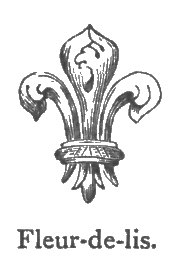
Fleur-de-lis, flōōr′-de-lē′, n. the flower of the lily: (her.) a bearing explained as representing three flowers of the white lily joined together, or the white iris—commonly called Flower-de-luce:—pl. Fleurs′-de-lis′—the arms of the Bourbons and of France.—ns. Fleur′et, an ornament like a small flower: a fencing-foil; Fleur′y (her.), decorated with a fleur-de-lis, or with the upper part only. [Fr., lis being for L. lilium, a lily.]
Flew, flōō, pa.t. of Fly.
Flewed, flōōd, adj. (Shak.) having large chops (of dogs). [Ety. unknown.]
Flexible, fleks′i-bl, Flexile, fleks′il, adj. easily bent: pliant: docile.—v.t. Flex, to bend or make a flexure of.—adjs. Flexan′imous, influencing the mind; Flexed, bent.—ns. Flex′ibleness, Flexibil′ity, pliancy: easiness to be persuaded.—adv. Flex′ibly.—ns. Flex′ion, Flec′tion, a bend: a fold: the action of a flexor muscle; Flex′or, a muscle which bends a joint, as opposed to Extensor.—adjs. Flex′ūous, Flex′ūose, of windings and turnings: variable.—n. Flex′ūre, a bend or turning: (math.) the curving of a line or surface: the bending of loaded beams: (Shak.) obsequious bowing. [L. flexibilis, flexilis—flectĕre, flexum, to bend.]
Fley, Flay, flā, v.t. to cause to fly: to frighten.—v.i. to be frightened. [M. E. flayen—A.S. flégan, fléogan, to fly; Ice. fleyja, Goth. flaugjan.]
Flibbertigibbet, flib′er-ti-jib′et, n. a flighty person: an imp. [Most prob. jargon.]
Flick, flik, v.t. to strike lightly.—n. a flip.
Flicker, flik′ėr, v.i. to flutter and move the wings, as a bird: to burn unsteadily, as a flame.—n. an act of flickering, a flickering movement.—v.i. Flicht′er, (Scot.), to flutter, quiver.—adv. Flick′eringly. [A.S. flicorian; imit.]
Flier, Flyer, flī′ėr, n. one who flies or flees: a part of a machine with rapid motion.
Flight, flīt, n. a passing through the air: a soaring: excursion: a sally: a series of steps: a flock of birds flying together: the birds produced in the same season: a volley or shower: act of fleeing: hasty removal.—adj. Flight′ed (Milt.), flying.—adv. Flight′ily.—n. Flight′iness.—adj. Flight′y, fanciful: changeable: giddy. [A.S. flyht—fléogan.]
Flim-flam, flim′-flam, n. a trick. [Formed like skimble-skamble, whim-wham, &c.]
Flimp, flimp, v.t. (slang) to snatch a watch while a confederate prods the victim in the back.
Flimsy, flim′zi, adj. thin: without solidity, strength, or reason: weak.—n. transfer-paper: (slang) a bank-note: reporters' copy written on thin paper.—adv. Flim′sily, in a flimsy manner.—n. Flim′siness. [First in 18th century. Prob. an onomatopœic formation suggested by film.]
Flinch, flinsh, v.i. to shrink back: to fail.—ns. Flinch′er; Flinch′ing, the act of flinching or shrinking.—adv. Flinch′ingly. [M. E. flecchen—O. Fr. fléchir, prob. from L. flectĕre, to bend.]
Flinder, flin′der, n. a splinter or small fragment—usually in pl. [Norw. flindra, a splinter.]
Flindersia, flin-der′si-a, n. a genus of Australian and African trees, yielding African and Madeira mahogany, or Calcedra wood. [From the Australian explorer, Captain Matthew Flinders, 1774-1814.]
Fling, fling, v.t. to strike or throw from the hand: to dart: to send forth: to scatter: to throw (of a horse).—v.i. to act in a violent and irregular manner: to kick out with the legs: to upbraid: to sneer:—pr.p. fling′ing; pa.t. and pa.p. flung.—n. a cast or throw: a taunt: complete freedom, full enjoyment of pleasure: a lively Scotch country-dance.—Fling out, to speak or act recklessly.—Full fling, at the utmost speed, recklessly. [Ice. flengja; Sw. flänga.]
Flint, flint, n. a hard mineral, a variety of quartz, from which fire is readily struck with steel: anything proverbially hard.—adj. made of flint, hard.—n. Flint′-glass, a very fine and pure kind of glass, so called because originally made of calcined flints.—adjs. Flint′-heart, -ed (Shak.), having a hard heart.—v.t. Flint′ify, to turn to flint.—ns. Flint′iness; Flint′-lock, a gun-lock having a flint fixed in the hammer for striking fire and igniting the priming.—adj. Flint′y, consisting of or like flint: hard: cruel.—Flint implements, arrow, axe, and spear heads, &c. made by man before the use of metals, commonly found in prehistoric graves, &c. [A.S. flint; Dan. flint; Gr. plinthos, a brick.]
Flip, flip, n. a hot drink of beer and spirits sweetened.
Flip, flip, v.t. to fillip, to touch lightly: to toss up with a motion of the thumb.—v.i. to flap.—n. a fillip, a snap.—adv. Flip′-flap, with a repeated flapping movement.—n. a coster's dance: a form of somersault: a cracker.—ns. Flip′-flop, the sound of a regular footfall; Flip′per, a fin: (slang) hand.—adj. Flip′perty-flop′perty, that goes flip-flap, loose, dangling. [Attenuated from flap.]
Flipe, flīp, v.t. to fold back, as a sleeve. [Prob. Scand.; cf. Dan. flip, a flap.]
Flippant, flip′ant, adj. quick and pert of speech: thoughtless.—ns. Flipp′ancy, Flipp′antness, pert fluency of speech: pertness.—adv. Flipp′antly. [Skeat explains as for flipp -and (Old Northumbrian pr.p. ending)—Ice. fleipa, to prattle.]
Flirt, flėrt, v.t. to move about quickly like a fan, to flick, rap.—v.i. to trifle with love: to play at courtship: to move briskly about.—n. a pert, giddy girl: one who coquets for amusement, usually of a woman.—n. Flirtā′tion the act of flirting.—adj. Flirtā′tious (coll.), giving to flirting.—ns. Flirt′-gill (Shak.), a pert or wanton woman; Flirt′ing.—adv. Flirt′ingly, in a flirting manner.—adj. Flirt′ish, betokening a flirt. [Onomatopœic, like flick, flip, flirk (a jerk), spurt, squirt.]
Flisk, flisk, v.i. (Scot.) to skip or caper about: to fret at the yoke.—n. a whim: a large-tooth comb.—adj. Flisk′y. [Onomatopœic.]
Flit, flit, v.i. to flutter on the wing: to fly quickly: to be unsteady or easily moved: (Scot.) to remove from place to place:—pr.p. flit′ting; pa.p. flit′ted.—n. Flit′ting, a removal from one house to another: a wandering. [Ice. flytja; Sw. flytta.]
Flitch, flich, n. the side of a hog salted and cured. [A.S. flicce; Ice. flikki.]
Flitter, flit′ėr, v.i. to flutter.—n. Flitt′er-mouse, a bat.
Flittern, flit′ern, n. (prov.) a young oak.
Flitters, flit′ers, n.pl. fragments, tatters.
Flix, fliks, n. fur, beaver-down.
Float, flōt, v.i. to swim on a liquid: to be buoyed up: to move lightly and irregularly: to circulate, as a rumour: to drift about aimlessly.—v.t. to cause to swim: to cover with water: to set agoing.—n. anything swimming on water: a raft: the cork or quill on a fishing-line: a plasterer's trowel.—adj. Float′able.—ns. Float′age, Flot′age, the floating capacity of a thing: anything that floats; Float′-board, a board on the rim of an undershot water-wheel on which the water acts and moves the wheel; Float′er.—adj. Float′ing, swimming: not fixed: circulating.—n. action of the verb float: the spreading of plaster on the surface of walls.—ns. Float′ing-batt′ery, a vessel or hulk heavily armed, used in the defence of harbours or in attacks on marine fortresses; Float′ing-bridge, a bridge of rafts or beams of timber lying on the surface of the water; Float′ing-dock (see Dock); Float′ing-is′land, an aggregation of driftwood, roots, &c., capable of bearing soil, floated out from a river delta or the like; Float′ing-light, a ship, bearing a light, moored on sunken rocks, to warn seamen of danger.—adv. Float′ingly.—n. Float′-stone, a porous, sponge-like variety of quartz, so light as to float for a while on water.—adj. Float′y. [A.S. flotian, to float; Ice. flota.]
Flock, flok, n. a company of animals, as sheep, birds, &c.: a company generally: a Christian congregation.—v.i. to gather in flocks or in crowds.—n. Flock′-mas′ter, an owner or overseer of a flock. [A.S. flocc, a flock, a company; Ice. flokkr.]
Flock, flok, n. a lock of wool.—n. Floccillā′tion, a delirious picking of the bed-clothes by a patient.—adjs. Floc′cose, woolly; Floc′cūlar; Floc′cūlate.—n. Floc′cūlence.—adj. Floc′cūlent, woolly, flaky.—ns. Floc′cūlus, a small flock or tuft: a small lobe of the inferior surface of the cerebellum; Floc′cus, a flock or tuft of wool or wool-like hairs: the downy plumage of unfledged birds:—pl. Flocci (flok′si); Flock′-bed, a bed stuffed with flock or refuse wool; Flock′-pā′per, wall-paper covered with a rough surface formed of flock.—adj. Flock′y. [O. Fr. floc—L. floccus, a lock of wool.]
Floe, flō, n. a field of floating ice. [Prob. Norse flo, layer. The usual Danish word is flage.]
Flog, flog, v.t. to beat or strike: to lash: to chastise with blows:—pr.p. flog′ging; pa.p. flogged.—n. Flog′ging. [Late; prob. an abbrev. of flagellate.]
Flood, flud, n. a great flow of water: (B.) a river: an inundation: a deluge: the rise or flow of the tide: any great quantity.—v.t. to overflow: to inundate: to bleed profusely, as after parturition:—pr.p. flood′ing; pa.p. flood′ed.—ns. Flood′-gate, a gate for letting water flow through, or to prevent it: an opening or passage: an obstruction; Flood′ing, an extraordinary flow of blood from the uterus; Flood′mark, the mark or line to which the tide rises; Flood′-tide, the rising or inflowing tide.—The Flood, the deluge in the days of Noah. [A.S. flód; Dut. vloed, Ger. fluth. Cog. with flow.]
Floor, flōr, n. the part of a room on which we stand: a platform: the rooms in a house on the same level, a story: any levelled area.—v.t. to furnish with a floor: (coll.) to vanquish, stump.—ns. Floor′cloth, a covering for floors made of canvas oil-painted on both sides; Floor′er, a knock-down blow; a decisive retort, &c.: an examination question one cannot answer; Floor′ing, material for floors: a platform.—n.pl. Floor′-tim′bers, the timbers placed immediately across a ship's keel, on which her bottom is framed.—ns. First′-floor, the floor in a house above the ground-floor—in United States mostly identical with Ground-floor, the floor of a house on a level with the ground. [A.S. flór; Dut. vloer, a flat surface, Ger. flur, flat land; W. llawr.]
Flop, flop, v.t. to cause to hang down.—v.i. to plump down suddenly: to break down.—n. a fall plump on the ground.—adv. Flop′pily.—n. Flop′piness.—adj. Flop′py. [A form of flap.]
Flora, flō′ra, n. the collective plants or vegetable species of a region, country, or district: a work containing a descriptive enumeration of these.—adj. Flō′ral, pertaining to Flora or to flowers: (bot.) containing the flower.—adv. Flō′rally.—n. Floréal (flō-rā-al′), the 8th month of the French revolutionary calendar, April 20-May 20.—adj. Flō′reāted, decorated with floral ornament.—n. Flores′cence, a bursting into flower: (bot.) the time when plants flower.—adj. Flores′cent, bursting into flowers.—n. Flō′ret (bot.), the flowers of any small and closely crowded inflorescence which resembles at first sight a single flower—e.g. composites, teasels, grasses, &c.—adj. Flōricul′tural.—ns. Flō′riculture, the culture of flowers or plants; Flōricul′turist, a florist.—adj. Flor′id, bright in colour: flushed with red: containing flowers of rhetoric or lively figures: richly ornamental.—adv. Flor′idly.—n. Flor′idness.—adjs. Flōrif′erous, bearing or producing flowers; Flō′riform, flower-shaped.—ns. Flōrilē′gium, an anthology or collection of choice extracts; Flor′ist, a cultivator of flowers: one who writes an account of plants. [L. Flora, the goddess of flowers.]
Florentine, flor′en-tin, adj. pertaining to Florence in Tuscany.—n. a native or inhabitant thereof: a durable silk textile fabric—also Flor′ence: a pie with no crust beneath the meat.
Florin, flor′in, n. an English silver coin worth 2s., first minted in 1849: in Austria the unit of account, otherwise called gulden, with a value about 2s.: in Holland sometimes called guilder, and worth about 1s. 8d.: (orig.) a Florentine gold coin with a lily stamped on one side, first struck in the 11th century. [Fr., from It. fiorino—fiore, a lily—L. flos.]
Floruit, flō′rū-it, n. the period during which a person flourished. [L., 3d pers. sing. perf. of florēre, to flourish.]
Floscule, flos′kūl, n. a floret.—adjs. Flos′cular, Flos′culous, composed of many floscules or tubular florets. [L. flosculus, dim. of flos, a flower.]
Floss, flos, n. the loose downy or silky substance in the husks of certain plants, as the bean—also Flosh.—n. Floss′-silk, very fine silk fibre extremely soft and downy and with a high lustre, used chiefly for embroidery.—adj. Floss′y. [Prob. O. Fr. flosche, down: or from some Teut. word cog. with fleece—cf. Ice. flos, nap.]
Flota, flō′ta, n. a commercial fleet: formerly the fleet which annually conveyed the produce of America to Spain. [Sp., 'a fleet.']
Flotage. See Floatage.
Flotant, flōt′ant, adj. (her.) floating in air or in water.
Flotation, flo-tā′shun, n. the act of floating: the science of floating bodies: act of floating a company or commercial enterprise.—Plane, or Line, of flotation, the plane or line in which the horizontal surface of a fluid cuts a body floating in it.
Flotilla, flo-til′a, n. a fleet of small ships. [Sp., dim. of flota, a fleet.]
Flotsam, flot′sam, n. goods lost by shipwreck, and found floating on the sea (see Jetsam). [Anglo-Fr. floteson (Fr. flottaison)—O. Fr. floter, to float.]
Flounce, flowns, v.i. to move abruptly or impatiently—n. an impatient gesture. [Prob. cog. with Norw. flunsa, to hurry, Sw. prov. flunsa, to souse.]
Flounce, flowns, n. a plaited strip sewed to the skirt of a dress.—v.t. to furnish with flounces.—n. Floun′cing, material for flounces. [Earlier form frounce—O. Fr. fronce, fronche, prob. from L. frons, forehead; or Old High Ger. runza, a wrinkle, Ger. runze.]
Flounder, flown′dėr, v.i. to struggle with violent and awkward motion: to stumble helplessly in thinking or speaking. [Prob. an onomatopœic blending of the sound and sense of earlier words like founder, blunder. Skeat compares Dut. flodderen, to splash.]
Flounder, flown′dėr, n. a small flat-fish, generally found in the sea near the mouth of rivers. [Anglo-Fr., floundre, O. Fr. flondre, most prob. of Scand. origin; cf. Ice. flyðra, Sw. flundra.]
Flour, flowr, n. the finely-ground meal of wheat or other grain: the fine soft powder of any substance.—v.t. to reduce into or sprinkle with flour.—v.i. to break up into fine globules of mercury in the amalgamation process.—ns. Flour′-bolt, a machine for bolting flour; Flour′-mill, a mill for making flour.—adj. Flour′y, covered with flour. [Fr. fleur (de farine, of meal), fine flour—L. flos, floris, a flower.]
Flourish, flur′ish, v.i. to thrive luxuriantly: to be prosperous: to use copious and flowery language: to move in fantastic figures: to display ostentatiously: (mus.) to play ostentatious passages, or ostentatiously: to play a trumpet-call: to make ornamental strokes with the pen: to boast or brag.—v.t. to adorn with flourishes or ornaments: to swing about by way of show or triumph: (Shak.) to gloss over.—n. decoration: showy splendour: a figure made by a bold stroke of the pen: the waving of a weapon or other thing: a parade of words: a musical prelude: a trumpet-call.—adjs. Flour′ished, decorated with flourishes; Flour′ishing, thriving: prosperous: making a show.—adv. Flour′ishingly.—adj. Flour′ishy, abounding in flourishes.—Flourish of trumpets, a trumpet-call sounded on the approach of great persons; any ostentatious introduction. [O. Fr. florir, L. flos, flower.]
Flouse, flows, v.t. and v.i. (prov.) to splash.—Also Floush.
Flout, flowt, v.t. and v.i. to jeer, mock, or insult: to treat with contempt.—n. a mock: an insult.—adv. Flout′ingly, with flouting: insultingly.—n. Flout′ing-stock (Shak.), an object for flouting. [Prob. a specialised use of floute, M. E. form of flute, to play on the flute. So with Dut. fluiten.]
Flow, flō, v.i. to run, as water: to rise, as the tide: to move in a stream, as air: to glide smoothly: to circulate, as the blood: to abound: to hang loose and waving: (B.) to melt.—v.t. to cover with water.—n. a stream or current: the setting in of the tide: abundance: copiousness: free expression.—n. Flow′age, act of flowing: state of being flooded.—adj. Flow′ing, moving, as a fluid: fluent or smooth: falling in folds or in waves.—adv. Flow′ingly.—n. Flow′ingness. [A.S. flówan; Ger. fliessen.]
Flow, flow, n. a morass: (Scot.) a flat, moist tract of land. [Ice. floi, a marsh—flóa, to flood.]
Flower, flow′ėr, n. a growth comprising the reproductive organs of plants: the blossom of a plant: the best of anything: the prime of life: the person or thing most distinguished: a figure of speech: ornament of style: (pl.) menstrual discharge (B.).—v.t. to adorn with figures of flowers.—v.i. to blossom: to flourish.—ns. Flow′erage, a gathering of flowers; Flow′er-bell, a blossom shaped like a bell; Flow′er-bud, a bud with the unopened flower; Flow′er-clock, a collection of flowers so arranged that the time of day is indicated by their times of opening and closing; Flow′er-de-luce, the old name for the common species of iris (q.v.), or for the heraldic emblem conventionalised therefrom (see Fleur-de-lis); Flow′eret, a little flower: a floret; Flow′er-head, a compound flower in which all the florets are sessile on the receptacle; Flow′eriness; Flow′ering-rush, a monocotyledonous plant usually reckoned under the order Alismaceæ, with large linear three-edged leaves and an umbel of rose-coloured flowers.—adjs. Flow′er-kir′tled, Flow′ery-kir′tled (Milt.), dressed in robes or garlands of flowers; Flow′erless (bot.) having no flowers.—ns. Flow′er-pot, a utensil in culture whereby plants are rendered portable;, Flow′er-serv′ice, a church service where offerings of flowers are made, to be afterwards sent to hospitals; Flow′er-show, an exhibition of flowers; Flow′er-stalk, the stem that supports the flower.—adj. Flow′ery, full of, or adorned with, flowers: highly embellished, florid.—Flower of Jove, a caryophyllaceous plant, with heads of purple or scarlet flowers, and leaves silky-white with hairs. [O. Fr. flour (Fr. fleur)—L. flos, floris, a flower.]
Flown, flōn, pa.p. of fly.
Flown, flōn, adj. inflated, flushed: (Milt.) overflown.
Fluate, flōō′āt, n. Same as Fluoride.
Fluctuate, fluk′tū-āt, v.i. to float backward and forward: to roll hither and thither: to be irresolute.—v.t. to cause to move hither and thither.—adjs. Fluc′tuant; Fluc′tuāting.—ns. Fluctuā′tion, a rising and falling like a wave: motion hither and thither: agitation: unsteadiness; Fluctuos′ity.—adj. Fluc′tuous. [L. fluctuāre, -ātum—fluctus, a wave—fluĕre, to flow.]
Flue, flōō, n. a smoke-pipe or small chimney. [Prob. related to flue, to expand, splay out.]
Flue, flōō, n. light down: soft down or fur.—adj. Flu′ey. [Ety. unknown; conn. with fluff.]
Flue, flōō, adj. (prov.) shallow, flat.—Also Flew.
Fluent, flōō′ent, adj. ready in the use of words: voluble: marked by copiousness.—n. the variable quantity in fluxions.—ns. Flu′ence (Milt.), Flu′ency, Flu′entness, readiness or rapidity of utterance: volubility.—adv. Flu′ently. [L. fluens, fluentis, pr.p. of fluĕre, to flow.]
Fluff, fluf, n. a soft down from cotton, &c.: anything downy.—n. Fluff′iness.—adj. Fluff′y. [Perh. conn. with flue, light down.]
Flugelman, flōō′gl-man′, n. Same as Fugleman.—n. Flü′gel-horn, a hunting-horn, a kind of keyed bugle.
Fluid, flōō′id, adj. that flows, as water: liquid or gaseous.—n. a substance in which the particles can move about with greater or less freedom from one part of the body to another.—adjs. Flu′idal; Fluid′ic; Fluid′iform.—vs.t. Fluid′ify, Flu′idise, to make fluid.—ns. Flu′idism; Fluid′ity, Flu′idness, a liquid or gaseous state.—adv. Flu′idly. [Fr.,—L. fluidus, fluid—fluĕre, to flow.]
Fluke, flōōk, n. a flounder: a parasitic trematoid worm which causes the liver-rot in sheep, so called because like a miniature flounder: a variety of kidney potato. [A.S. flóc, a plaice; cf. Ice. flóke.]
Fluke, flōōk, n. the part of an anchor which fastens in the ground.—adj. Fluk′y. [Prob. a transferred use of the foregoing.]
Fluke, flōōk, n. a successful shot made by chance, as at billiards: any unexpected advantage.
Flume, flōōm, n. an artificial channel for water to be applied to some industrial purpose: (U.S.) a narrow defile with upright walls, the bottom occupied by a torrent.—Be, or Go, up the flume, to come to grief, to be done for. [O. Fr. flum—L. flumen, a river—fluĕre, to flow.]
Flummery, flum′ėr-i, n. an acid jelly made from the husks of oats: the Scotch sowens: anything insipid: empty compliment. [W. llymru—llymrig, harsh, raw—llym, sharp, severe.]
Flummox, flum′oks, v.t. (slang) to perplex: defeat.
Flump, flump, v.t. (coll.) to throw down violently.—v.i. to throw one's self down heavily.—n. the dull sound so produced. [Imit.]
Flung, flung, pa.t. and pa.p. of fling.
Flunkey, flung′ki, n. a livery servant: a footman: a mean, cringing fellow.—n. Flun′keydom.—adj. Flun′keyish.—n. Flun′keyism. [Perh. orig. flanker, one who runs along by the side of.]
Fluor, flōō′or, n. a mineral often described as chemically fluate of lime, but really calcium fluoride, found abundantly in Derbyshire—also Flu′or-spar, Flu′orite.—ns. Fluores′cein, a coal-tar product, little used in dyeing, the colour not being fast; Fluores′cence, a peculiar blue appearance exhibited by certain substances exposed to sunlight, and especially observable in a dilute solution of sulphate of quinine.—adjs. Fluores′cent, having the property of fluorescence; Fluor′ic.—ns. Flu′oride, a binary compound of fluorine with another element; Flu′orine, an elementary substance allied to chlorine, obtained chiefly from fluor; Flu′orotype, a photographic process in which salts of fluoric acid were employed for the purpose of producing images in the camera; Fluosil′icate, a compound of fluosilicic acid with some base.—adj. Fluosilic′ic, composed of silicon and fluorine. [A name given by the alchemists to all mineral acids because of their fluidity, from L. fluĕre, to flow.]
Flurry, flur′i, n. a sudden blast or gust: agitation: bustle: the death-agony of the whale: a fluttering assemblage of things, as snowflakes.—v.t. to agitate, to confuse:—pr.p. flurr′ying; pa.p. flurr′ied.—v.t. Flurr, to scatter.—v.i. to fly up. [Prob. onomatopœic, suggested by flaw, hurry, &c.]
Flush, flush, n. a flow of blood to the face causing redness: sudden impulse: bloom, freshness, vigour: abundance.—v.i. to become red in the face: to flow swiftly.—v.t. to make red in the face: to cleanse by a copious flow of water: to elate, excite the spirits of: mostly in the pa.p. flushed (with victory).—adj. (of weather) hot and heavy: abounding: well supplied, as with money: (Shak.) in full bloom.—n. Flush′-box, a rectangular tank supplied with water for flushing the bowls of water-closets.—adj. Flushed, suffused with ruddy colour: excited.—ns. Flush′er, one who flushes sewers; Flush′ing, action of the verb flush: sudden reddening; Flush′ness, quality of being flush.—adj. Flush′y, reddish. [Prob. orig. identical with succeeding word, but meaning influenced by phonetic association with flash, the senses relating to colour by blush.]
Flush, flush, v.i. to start up like an alarmed bird.—v.t. to rouse and cause to start off.—n. the act of starting: (Spens.) a bird, or a flock of birds so started. [Prob. onomatopœic; suggested by fly, flutter, and rush.]
Flush, flush, v.t. to make even: to fill up to the level of a surface (often with up).—adj. having the surface level with the adjacent surface. [Prob. related to flush above.]
Flush, flush, n. in card-playing, a hand in which all the cards or a specified number are of the same suit.—adj. in poker, consisting of cards all of the same suit.—Straight, or Royal, flush, in poker, a sequence of five cards of the same suit. [Prob. Fr. flux—L. fluxus, flow.]
Fluster, flus′tėr, n. hurrying: confusion: heat.—v.t. to make hot and confused: to fuddle.—v.i. to bustle: to be agitated or fuddled.—v.t. Flus′terāte, to fluster.—n. Flusterā′tion.—adj. Flus′tered, fuddled: flurried.—n. Flus′terment.—adj. Flus′tery, confused. [Ice. flaustr, hurry.]
Flustra, flus′tra, n. one of the commonest genera of marine Polyzoa.
Flute, flōōt, n. a musical pipe with finger-holes and keys sounded by blowing: in organ-building, a stop with stopped wooden pipes, having a flute-like tone: one of a series of curved furrows, as on a pillar, called also Fluting: a tall and narrow wine-glass: a shuttle in tapestry-weaving, &c.—v.i. to play the flute.—v.t. to play or sing in soft flute-like tones: to form flutes or grooves in.—adj. Flut′ed, ornamented with flutes, channels, or grooves.—ns. Flut′er; Fluti′na (tē′-), a kind of accordion; Flut′ing-machine′, a machine for corrugating sheet-metal, also a wood-turning machine for forming twisted, spiral, and fluted balusters; Flut′ist.—adj. Flut′y, in tone like a flute. [O. Fr. fleüte; ety. dub.]
Flutter, flut′ėr, v.i. to move about with bustle: to vibrate: to be in agitation or in uncertainty: (obs.) to be frivolous.—v.t. to throw into disorder: to move in quick motions.—n. quick, irregular motion: agitation: confusion: a hasty game at cards, &c. [A.S. flotorian, to float about, from flot, the sea, stem of fléotan, to float.]
Fluvial, flōō′vi-al, adj. of or belonging to rivers.—n. Flu′vialist.—adjs. Fluviat′ic, Flu′viatile, belonging to or formed by rivers. [L. fluvialis—fluvius, a river, fluĕre, to flow.]
Flux, fluks, n. act of flowing: a flow of matter: quick succession: a discharge generally from a mucous membrane: matter discharged: excrement: the term given to the substances employed in the arts to assist the reduction of a metallic ore and the fusion of a metal.—v.t. to melt.—v.i. to flow.—ns. Flux′ātion, the act of flowing or passing away; Fluxibil′ity, Flux′ibleness.—adjs. Flux′ible, Flux′ide, that may be melted.—ns. Fluxil′ity; Flux′ion, a flowing or discharge: a difference or variation: (math.) the rate of change of a continuously varying quantity: (pl.) the name given after Newton to that branch of mathematics which with a different notation is known after Leibnitz as the differential and integral calculus.—adjs. Flux′ional, Flux′ionary, variable: inconstant.—n. Flux′ionist, one skilled in fluxions.—adj. Flux′ive (Shak.), flowing with tears. [O. Fr.,—L. fluxus—fluĕre, to flow.]
Fly, flī, v.i. to move through the air on wings: to move swiftly: to pass away: to flee: to burst quickly or suddenly: to flutter.—v.t. to avoid, flee from: to cause to fly, as a kite:—pr.p. fly′ing; pa.t. flew (flōō); pa.p. flown (flōn).—n. a popular name best restricted in its simplicity to the insects forming the order Diptera, but often so widely used with a prefix—e.g. butterfly, dragon-fly, May-fly—as to be virtually equivalent to insect: a fish-hook dressed with silk, &c., in imitation of a fly: a light double-seated carriage, a hackney-coach: (mech.) a flywheel: (pl.) the large space above the proscenium in a theatre, from which the scenes, &c., are controlled.—adj. wide-awake: (slang) knowing.—adjs. Fly′away, flighty; Fly′-bit′ten, marked by the bite of flies.—n. Fly′blow, the egg of a fly.—adj. Fly′blown, tainted with the eggs which produce maggots.—ns. Fly′boat, a long, narrow, swift boat used on canals; Fly′book, a case like a book for holding fishing-flies; Fly′-catch′er, a small bird, so called from its catching flies while on the wing; Fly′-fish′er, one who fishes with artificial flies as bait; Fly′-fish′ing, the art of so fishing; Fly′-flap′per, one who drives away flies with a fly-flap; Fly′ing-bridge, a kind of ferry-boat which is moved across a river by the action of the combined forces of the stream and the resistance of a long rope or chain made fast to a fixed buoy in the middle of the river; Fly′ing-butt′ress, an arch-formed prop which connects the walls of the upper and central portions of an aisled structure with the vertical buttresses of the outer walls; Fly′ing-camp, a body of troops for rapid motion from one place to another; Fly′ing-Dutch′man, a Dutch black spectral ship, whose captain is condemned for his impieties to sweep the seas around the Cape of Storms unceasingly, without ever being able to reach a haven; Fly′ing-fish, a fish which can leap from the water and sustain itself in the air for a short time, by its long pectoral fins, as if flying; Fly′ing-fox, a large frugivorous bat; Fly′ing-lē′mur, a galeopithecoid insectivore whose fore and hind limbs are connected by a fold of skin, enabling it to make flying leaps from tree to tree; Fly′ing-par′ty, a small body of soldiers, equipped for rapid movements, used to harass an enemy; Fly′ing-phalan′ger, a general popular name for the petaurists; Fly′ing-shot, a shot fired at something in motion; Fly′ing-squid, a squid having broad lateral fins by means of which it can spring high out of the water; Fly′ing-squirr′el, a name given to two genera of squirrels, which have a fold of skin between the fore and hind legs, by means of which they can take great leaps in the air; Fly′leaf, a blank leaf at the beginning and end of a book; Fly′-line, a line for angling with an artificial fly; Fly′-mak′er, one who ties artificial flies for angling; Fly′man, one who works the ropes in the flies of a theatre; Fly′pāper, a porous paper impregnated with poison for destroying flies; Fly′-pow′der, a poisonous powder used for killing flies; Fly′-rail, that part of a table which turns out to support the leaf.—adj. (Shak.) moving slow as a fly on its feet.—ns. Fly′-rod, a light flexible rod used in fly-fishing, usually in three pieces—butt, second-joint, and tip; Fly′-trap, a trap to catch flies: (bot.) the spreading dog-bane, also the Venus's fly-trap; Fly′wheel, a large wheel with a heavy rim applied to machinery to equalise the effect of the driving effort.—Fly at, to attack suddenly; Fly in the face of, to insult: to oppose; Fly open, to open suddenly or violently; Fly out, to break out in a rage; Fly the kite, to obtain money as by accommodation bills, the endorser himself having no money; Fly upon, to seize: to attack.—A fly in the ointment, some slight flaw which corrupts a thing of value (Eccles. x. i.); Break a fly on the wheel, to subject to a punishment out of all proportion to the gravity of the offence; Let fly, to attack: to throw or send off; Make the feathers fly (see Feathers). [A.S. fléogan, pa.t. fleáh; Ger. fliegen.]
Flyte, Flite, flīt, v.i. (Scot.) to scold, to brawl.—n. Flyte, Flyt′ing, a scolding, or heated dispute. [A.S. flítan, to strive; Ger. be-fleissen.]
Foal, fōl, n. the young of a mare or of a she-ass.—v.i. and v.t. to bring forth a foal.—ns. Foal′foot, colts-foot; Foal′ing, bringing forth of a foal or young. [A.S. fola; Ger. fohlen, Gr. pōlos; L. pullus.]
Foam, fōm, n. froth: the bubbles which rise on the surface of liquors: fury.—v.i. to gather foam: to be in a rage.—v.t. (B.) to throw out with rage or violence (with out).—adv. Foam′ingly.—adjs. Foam′less, without foam; Foam′y, frothy. [A.S. fám; Ger. feim, prob. akin to L. spuma.]
Fob, fob, n. a trick.—v.t. to cheat. [Prob. a corr. of O. Fr. forbe, a rogue; or Ger. foppen, to jeer.]
Fob, fob, n. a small pocket in the waistband of trousers for a watch: a chain with seals, &c., hanging from the fob. [If orig. a secret pocket, perh. connected with the above.]
Focus, fō′kus, n. (opt.) a point in which several rays meet and are collected after being reflected or refracted, while a virtual focus is a point from which rays tend after reflection or refraction—the principal focus is the focus of parallel rays after reflection or refraction: any central point:—pl. Fō′cuses, Foci (fō′sī).—v.t. to bring to a focus: to concentrate:—pa.p. fō′cussed.—adj. Fō′cal, of or belonging to a focus.—v.t. Fō′calise, to bring to a focus: to concentrate.—n. Focimeter (fō-sim′e-tėr), an instrument for assisting in focussing an object in or before a photographic camera—usually a lens of small magnifying power.—Focussing cloth, a cloth thrown over a photographic camera and the operator's head and shoulders to exclude all light save that coming through the lens.—Conjugate foci, two points so situated that if a light be placed at one, its rays will be reflected to the other; In focus, placed or adjusted so as to secure distinct vision, or a sharp, definite image. [L. focus, a hearth.]
Fodder, fod′ėr, n. food for cattle, as hay and straw.—v.t. to supply with fodder.—ns. Fodd′erer; Fodd′ering. [A.S. fódor; Ger. futter.]
Fodient, fō′di-ent, adj. and n. digging.
Foe, fō, n. an enemy: one who, or that which, injures or hinders anything: an ill-wisher.—ns. Foe′man, an enemy in war:—pl. Foe′men; Fō′en (Spens.), pl. of foe. [M. E. foo—A.S. fáh, fá (adj.), allied to the compound n. gefá; cf. féogan, to hate.]
Fœtus, Fetus, fē′tus, n. the young of animals in the egg or in the womb, after its parts are distinctly formed, until its birth.—adjs. Fœ′tal, Fē′tal, pertaining to a fœtus; Fœ′ticidal.—ns. Fœ′ticide, Fē′ticide, destruction of the fœtus. [L., from obs. feuēre, to bring forth, whence femina, fecundus, &c.]
Fog, fog, n. a thick mist: watery vapour rising from either land or water.—v.t. to shroud in fog.—v.i. to become coated with a uniform coating.—ns. Fog′-bank, a dense mass of fog sometimes seen at sea appearing like a bank of land; Fog′-bell, a bell rung by the motion of the waves or wind to warn sailors from rocks, shoals, &c. in foggy weather.—adj. Fog′-bound, impeded by fog.—ns. Fog′-bow, a whitish arch like a rainbow, seen in fogs.—adv. Fog′gily.—n. Fog′giness.—adj. Fog′gy, misty: damp: clouded in mind: stupid.—n. Fog′-horn, a horn used as a warning signal by ships in foggy weather: a sounding instrument for warning ships off the shore during a fog: a siren.—adj. Fog′less, without fog, clear.—ns. Fog′-ring, a bank of fog in the form of a ring; Fog′-sig′nal, an audible signal used on board ship, &c., during a fog, when visible signals cease to be of use; Fog′-smoke, fog. [The origin of the word is hopelessly misty; Mr Bradley connects with succeeding word; Prof. Skeat connects with Dan. fog, as in snee-fog, thick falling snow; cf. Ice. fok, a snowdrift.]
Fog, fog, Foggage, fog′āj, n. grass which grows in autumn after the hay is cut: (Scot.) moss.—v.i. to become covered with fog. [Origin unknown; W. ffwg, dry grass, is borrowed.]
Fogy, Fogey, fō′gi, n. a dull old fellow; a person with antiquated notions.—adjs. Fō′gram, antiquated.—n. a fogy.—ns. Fō′gramite; Fogram′ity; Fōgydom.—adj. Fō′gyish.—n. Fō′gyism. [Prob. a substantive use of foggy in sense of 'fat,' 'bloated,' 'moss-grown.']
Foh, fō, interj. an exclamation of abhorrence or contempt.
Foible, foi′bl, n. a weak point in one's character: a failing. [O. Fr. foible, weak.]
Foil, foil, v.t. to defeat: to puzzle: to disappoint: (Spens.) to beat down or trample with the feet:—pr.p. foil′ing; pa.p. foiled.—n. failure after success seemed certain: defeat: a blunt sword used in fencing, having a button on the point.—Put to the foil, to blemish. [O. Fr. fuler, to stamp or crush—Low L. fullare—fullo, a fuller of cloth.]
Foil, foil, n. a leaf or thin plate of metal, as tin-foil: a thin leaf of metal put under precious stones to increase their lustre or change their colour: anything that serves to set off something else: a small arc in the tracery of a window, &c. (trefoiled, cinquefoiled, multifoiled, &c.).—adj. Foiled.—n. Foil′ing. [O. Fr. foil (Fr. feuille)—L. folium, a leaf.]
Foin, foin, v.i. to thrust with a sword or spear.—n. a thrust with a sword or spear.—adv. Foin′ingly. [O. Fr. foine—L. fuscina, a trident.]
Foison, foi′zn, n. plenty: autumn.—adj. Foi′sonless, weak, feeble—(Scot.) Fizz′enless. [O. Fr.,—L. fusion-em—fundĕre, fusum, to pour forth.]
Foist, foist, v.t. to bring in by stealth: to insert wrongfully: to pass off as genuine (with in or into before the thing affected, and upon before the person).—n. Foist′er. [Prob. Dut. prov. vuisten, to take in the hand; vuist, fist.]
Fold, fōld, n. the doubling of any flexible substance: a part laid over on another: (pl.) complex arrangements, intricacy.—v.t. to lay one part over another: to enclose in a fold or folds, to wrap up: to embrace.—Fold, in composition with numerals=times, as in Ten′fold.—n. Fold′er, the person or thing that folds: a flat knife-like instrument used in folding paper.—adj. Fold′ing, that folds, or that can be folded, as folding-bed, -chair, -joint, -net, -table, &c.—ns. Fold′ing, a fold or plait; Fold′ing-door, a door consisting of two parts hung on opposite jambs, so that their edges come into contact when the door is closed; Fold′ing-machine′, a mechanism that automatically folds printed sheets. [A.S. fealdan, to fold; pa.t. feóld; Ger. falten.]
Fold, fōld, n. an enclosure for protecting domestic animals, esp. sheep: a flock of sheep: (fig.) a church: the Christian Church.—v.t. to confine in a fold.—n. Fold′ing. [A.S. fald, a fold, stall.]
Folderol, fol′de-rol, n. mere nonsense: silly trifle: (pl.) trivial ornaments. [Formed from meaningless syllables, the refrain of old songs.]
Foliaceous, fō-li-ā′shus, adj. pertaining to or consisting of leaves or laminæ. [L. foliaceus—folium, a leaf.]
Foliage, fō′lī-āj, n. leaves: a cluster of leaves: (archit.) a representation of leaves, flowers, and branches used for ornamentation.—adjs. Fō′liaged, worked like foliage; Fō′liar, pertaining to leaves: resembling leaves.—v.t. Fō′liāte (orig.), to beat into a leaf: to cover with leaf-metal.—adj. Fō′liāted, beaten into a thin leaf: decorated with leaf ornaments: (mus.) having notes added above or below, as in a plain-song melody.—ns. Fō′liātion, the leafing, esp. of plants: the act of beating a metal into a thin plate, or of spreading foil over a piece of glass to form a mirror: (geol.) the alternating and more or less parallel layers or folia of different mineralogical nature, of which the crystalline schists are composed: (archit.) decoration with cusps, lobes, or foliated tracery; Fō′liature, foliation. [O. Fr. fueillage—L. folium, a leaf.]
Folio, fō′li-ō, n. a sheet of paper once folded: a book of such sheets: the size of such a book: one of several sizes of paper adapted for folding once into well-proportioned leaves: (book-k.) a page in an account-book, or two opposite pages numbered as one: (law) a certain number of words taken as a basis for computing the length of a document: a wrapper for loose papers.—adj. pertaining to or containing paper only once folded.—v.t. to number the pages of: to mark off the end of every folio in law copying.—In folio, in sheets folded but once: in the form of a folio. [Abl. of L. folium, the leaf of a tree, a leaf or sheet of paper.]
Foliole, fō′li-ōl, n. (bot.) a single leaflet of a compound leaf.—adj. Fō′liolate, of or pertaining to leaflets. [Fr., dim. of L. folium, a leaf.]
Folk, fōk, n. people, collectively or distributively: a nation or race (rarely in pl.): (arch.) the people, commons: (pl.) those of one's own family, relations (coll.):—generally used in pl. Folk or Folks (fōks).—ns. Folke′thing, the lower house of the Danish parliament or Rigsdag; Folk′land, among the Anglo-Saxons, public land as distinguished from boc-land (bookland)—i.e. land granted to private persons by a written charter; Folk′lore, a department of the study of antiquities or archæology, embracing everything relating to ancient observances and customs, to the notions, beliefs, traditions, superstitions, and prejudices of the common people—the science which treats of the survivals of archaic beliefs and customs in modern ages (the name Folklore was first suggested by W. J. Thoms—'Ambrose Merton'—in the Athenæum, August 22, 1846); Folk′lorist, one who studies folklore; Folk′mote, an assembly of the people among the Anglo-Saxons; Folk′-right, the common law or right of the people; Folk′-song, any song or ballad originating among the people and traditionally handed down by them: a song written in imitation of such; Folk′-speech, the dialect of the common people of a country, in which ancient idioms are embedded; Folk′-tale, a popular story handed down by oral tradition from a more or less remote antiquity. [A.S. folc; Ice. fólk; Ger. volk.]
Follicle, fol′i-kl, n. (anat.) a gland: (bot.) a seed-vessel.—adjs. Follic′ular, pertaining to or consisting of follicles; Follic′ulated; Follic′ulous. [Fr.,—L. folliculus, dim. of follis, a wind-bag.]
Follow, fol′ō, v.t. to go after or behind: to come after, succeed: to pursue: to attend: to imitate: to obey: to adopt, as an opinion: to keep the eye or mind fixed on: to pursue, as an object of desire: to result from, as an effect from a cause: (B.) to strive to obtain.—v.i. to come after another: to result.—n. (billiards) a stroke which causes the ball to follow the one which it has struck.—ns. Foll′ow-board, in moulding, the board on which the pattern is laid; Foll′ower, one who comes after: a copier: a disciple: a servant-girl's sweetheart; Foll′owing, the whole body of supporters.—adj. coming next after.—Follow home, to follow closely: to follow to the end; Follow on (B.), to continue endeavours; Follow suit, in card-playing, to play a card of the same suit as the one which was led: to do anything on the same lines as another; Follow up, to pursue an advantage closely. [A.S. folgian, fylgian, app. a compound, but obscure; Ger. folgen.]
Folly, fol′i, n. silliness or weakness of mind: a foolish act: criminal weakness: (B.) sin: a monument of folly, as a great structure left unfinished, having been begun without a reckoning of the cost.—v.i. to act with folly. [O. Fr. folie—fol, foolish.]
Foment, fo-ment′, v.t. to bathe with warm water: to encourage: to instigate (usually to evil).—ns. Fomentā′tion, a bathing or lotion with warm water: encouragement; Foment′er. [Fr.,—L. fomentāre—fomentum for fovimentum—fovēre, to warm.]
Fomes, fō′miz, n. any porous substance capable of absorbing and retaining contagious effluvia:—pl. Fomī′tes. [L., touchwood.]
Fon, fon, n. (Spens.) a fool, an idiot.—v.i. to be foolish, play the fool.—adv. Fon′ly, foolishly.
Fond, fond, adj. foolishly tender and loving: weakly indulgent: prizing highly (with of): very affectionate: kindly disposed: (obs.) foolish.—v.i. to dote.—v.t. Fond′le, to treat with fondness: to caress.—ns. Fond′ler; Fond′ling, the person or thing fondled.—adv. Fond′ly, in a fond manner, foolishly.—n. Fond′ness. [For fonned, pa.p. of M. E. fonnen, to act foolishly, fon, a fool; fondly conn. by some with Sw. fåne, fool, Ice. fáni, swaggerer.]
Fond. See Fand (2).
Fone, fōn, n. (Spens.) pl. of foe.
Font, font, n. the vessels used in churches as the repository of the baptismal water, usually a basin or cup hollowed out of a solid block of marble, &c.—adj. Font′al, pertaining to a font or origin.—ns. Font′let, a little font; Font′-stone, a baptismal font of stone. [L. font-em, fons, a fountain.]
Font, font, Fount, fownt, n. a complete assortment of types of one sort, with all that is necessary for printing in that kind of letter. [Fr. fonte—fondre—L. fundĕre, to cast.]
Fontanelle, fon-ta-nel′, n. a gap between the bones of the skull of a young animal: an opening for the discharge of pus.—Also Fontanel′. [Fr.]
Fontange, fong-tanzh′, n. a tall head-dress worn in the 17th and 18th centuries. [Fr., from Fontanges, the territorial title of one of Louis XIV.'s drabs.]
Fontarabian, fon-ta-rā′bi-an, adj. pertaining to Fontarabia or Fuenterrabia on the Pyrenees, where Roland was overpowered and slain by the Saracens.
Fonticulus, fon-tik′ū-lus, n. a small ulcer produced by caustics, &c.: the depression just over the top of the breast-bone. [L., dim. of fons.]
Fontinalis, fon-tin-ā′lis, n. a genus of aquatic mosses allied to Hypnum, almost without stalk. [Formed from L. fons.]
Food, fōōd, n. what one feeds on: that which, being digested, nourishes the body: whatever sustains or promotes growth.—adjs. Food′ful, able to supply food abundantly; Food′less, without food. [A.S. fóda; Goth. fódeins, Sw. föda.]
Food, fōōd, n. (Spens.). Same as Feud.
Fool, fōōl, n. one who acts stupidly: a person of weak mind: a jester: a tool or victim, as of untoward circumstances: (B.) a wicked person.—v.t. to deceive: to treat with contempt.—v.i. to play the fool: to trifle.—adjs. Fool′-begged (Shak.), taken for a fool, idiotical, absurd; Fool′-born (Shak.), foolish from one's birth, arising from folly.—n. Fool′ery, an act of folly: habitual folly.—adj. Fool′-happ′y, happy or lucky without contrivance or judgment.—n. Fool′-hard′iness—(Spens.) Fool′-hard′ise.—adjs. Fool′-hard′y, foolishly bold: rash or incautious; Fool′ish, weak in intellect: wanting discretion: ridiculous: marked with folly: deserving ridicule: (B.) sinful, disregarding God's laws.—adv. Fool′ishly.—ns. Fool′ishness, Fool′ing, foolery.—adj. Fool′ish-wit′ty (Shak.), wise in folly and foolish in wisdom.—ns. Fool's′-err′and, a silly or fruitless enterprise: search for what cannot be found; Fool's′-pars′ley, an umbelliferous plant in Britain, not to be mistaken for parsley, being poisonous.—Fool away, to spend to no purpose or profit; Fool's cap, a kind of head-dress worn by professional fools or jesters, usually having a cockscomb hood with bells; Fool's paradise, a state of happiness based on fictitious hopes or expectations; Fool with, to meddle with officiously; Make a fool of, to bring a person into ridicule: to disappoint; Play the fool, to behave as a fool: to sport. [O. Fr. fol (Fr. fou), It. folle—L. follis, a wind-bag.]
Fool, fōōl, n. crushed fruit scalded or stewed, mixed with cream and sugar, as 'gooseberry fool.' [Prob. a use of preceding suggested by trifle.]
Foolscap, fōōlz′kap, n. a long folio writing or printing paper, varying in size (17×13½ in., 16¾×13½ in., &c.), so called from having originally borne the water-mark of a fool's cap and bells.
Foot, foot, n. that part of its body on which an animal stands or walks (having in man 26 bones): the lower part or base: a measure=12 in., (orig.) the length of a man's foot: foot-soldiers: a division of a line of poetry:—pl. Feet.—v.i. to dance: to walk:—pr.p. foot′ing; pa.p. foot′ed.—ns. Foot′ball, a large ball for kicking about in sport: play with this ball; Foot′-bath, act of bathing the feet: a vessel for this purpose; Foot′-board, a support for the foot in a carriage or elsewhere: the foot-plate of a locomotive engine; Foot′boy, an attendant in livery; Foot′breadth, the breadth of a foot, an area of this size; Foot′bridge, a narrow bridge for foot-passengers; Foot′cloth (Shak.), a sumpter-cloth which reached to the feet of the horse.—p.adj. Foot′ed, provided with a foot or feet: (Shak.) having gained a foothold, established.—ns. Foot′fall, a setting the foot on the ground: a footstep; Foot′gear, shoes and stockings.—n.pl. Foot′guards, guards that serve on foot, the élite of the British infantry.—ns. Foot′hill, a minor elevation distinct from the higher part of a mountain and separating it from the valley (usually in pl.); Foot′hold, space on which to plant the feet: that which sustains the feet; Foot′ing, place for the foot to rest on: firm foundation: position: settlement: tread: dance: plain cotton lace.—adj. Foot′less, having no feet.—ns. Foot′-lick′er (Shak.), a fawning, slavish flatterer; Foot′light, one of a row of lights in front of and on a level with the stage in a theatre, &c.; Foot′man, a servant or attendant in livery: (B.) a soldier who serves on foot: a runner:—pl. Foot′men; Foot′mark, Foot′print, the mark or print of a foot: a track; Foot′note, a note of reference at the foot of a page; Foot′pad, a highwayman or robber on foot, who frequents public paths or roads; Foot′-pass′enger, one who travels on foot; Foot′path, a narrow way which will not admit carriages; Foot′-plate, the platform on which the driver and stoker of a locomotive engine stand; Foot′-post, a post or messenger that travels on foot; Foot′-pound, the force needed to raise one pound weight the height of one foot—the usual unit in measuring mechanical force; Foot′-race, a race on foot; Foot′-rope, a rope stretching along under a ship's yard for the men standing on when furling the sails: the rope to which the lower edge of a sail is attached; Foot′rot, a name applied to certain inflammatory affections about the feet of sheep; Foot′rule, a rule or measure a foot in length; Foot′-sol′dier, a soldier that serves on foot.—adj. Foot′-sore, having sore or tender feet, as by much walking.—ns. Foot′-stalk (bot.), the stalk or petiole of a leaf; Foot′-stall, a woman's stirrup; Foot′step, the step or impression of the foot: a track: trace of a course pursued.—n.pl. Foot′steps, course, example.—ns. Foot′stool, a stool for placing one's feet on when sitting: anything trodden upon; Foot′-warm′er, a contrivance for keeping the feet warm; Foot′way, a path for passengers on foot.—p.adj. Foot′worn, worn by many feet, as a stone: foot-sore.—Foot-and-mouth disease (see Murrain).—Foot it, to walk: to dance.—Cover the feet (B.), a euphemism for, to ease nature.—Put one's best foot foremost, to appear at greatest advantage; Put one's foot in it, to spoil anything by some indiscretion; Set on foot, to originate. [A.S. fót, pl. fét; Ger. fuss, L. pes, pedis, Gr. pous, podos, Sans. pād.]
Footy, foot′i, adj. (prov.) mean.—Also Fought′y. [Prob. an A.S. fúhtig; cog. with Dut. vochtig.]
Foozle, fōōz′l, n. (coll.) a tedious fellow: a bungled stroke at golf, &c.—v.i. to fool away one's time.—n. Fooz′ler.—p.adj. Fooz′ling. [Cf. Ger. prov. fuseln, to work slowly.]
Fop, fop, n. an affected dandy.—ns. Fop′ling, a vain affected person; Fop′pery, vanity in dress or manners: affectation: folly.—adj. Fop′pish, vain and showy in dress: affectedly refined in manners.—adv. Fop′pishly.—n. Fop′pishness. [Cf. Ger. foppen, to hoax.]
For, for, prep. in the place of: for the sake of: on account of: in the direction of: with respect to, by reason of: appropriate or adapted to, or in reference to: beneficial to: in quest of: notwithstanding, in spite of: in recompense of: during.—For all (N.T.), notwithstanding; For it, to be done for the case, usually preceded by a negative; For to (B.), in order to.—As for, as far as concerns. [A.S. for; Ger. für, vor, akin to L. and Gr. pro, Sans. pra, before in place or time.]
For, for, conj. the word by which a reason is introduced: because: on the account that.—For because and For that=because; For why=why.
Forage, for′aj, n. fodder, or food for horses and cattle: provisions: the act of foraging.—v.i. to go about and forcibly carry off food for horses and cattle, as soldiers.—v.t. to plunder.—ns. For′age-cap, the undress cap worn by infantry soldiers; For′ager. [Fr. fourrage, O. Fr. feurre, fodder, of Teut. origin.]
Foramen, fo-rā′men, n. a small opening:—pl. Foram′ina.—adjs. Foram′inated, Foram′inous, pierced with small holes: porous.—n.pl. Foraminif′era, an order of Rhizopoda, furnished with a shell or test, usually perforated by pores (foramina).—n. Foramin′ifer, one of such.—adjs. Foraminif′eral, Foraminif′erous.—Forāmen magnum, the great hole in the occipital bone for the passage of the medulla oblongata and its membranes. [L.,—forāre, to pierce.]
Forasmuch, for′az-much, conj. because that.
Foray, for′ā, n. a sudden incursion into an enemy's country.—v.t. to ravage.—n. For′ayer. [Ety. obscure, but ult. identical with forage (q.v.).]
Forbade, for-bad′, pa.t. of forbid.
Forbear, for-bār′, v.i. to keep one's self in check: to abstain.—v.t. to abstain from: to avoid voluntarily: to spare, to withhold.—n. Forbear′ance, exercise of patience: command of temper: clemency.—adjs. Forbear′ant, Forbear′ing, long-suffering: patient.—adv. Forbear′ingly. [A.S. forberan, pa.t. forbær, pa.p. forboren. See pfx. for- and bear.]
Forbid, for-bid′, v.t. to prohibit: to command not to do: (Shak.) to restrain.—n. Forbid′dance, prohibition: command or edict against a thing.—adj. Forbid′den, prohibited: unlawful.—adv. Forbid′denly (Shak.), in a forbidden or unlawful manner.—adj. Forbid′ding, repulsive: raising dislike: unpleasant.—adv. Forbid′dingly.—n. Forbid′dingness.—Forbidden, or Prohibited, degrees, degrees of consanguinity within which marriage is not allowed; Forbidden fruit, or Adam's apple, a name fancifully given to the fruit of various species of Citrus, esp. to one having tooth-marks on its rind. [A.S. forbéodan, pa.t. forbéad, pa.p. forboden. See pfx. for-, and bid; cf. Ger. verbieten.]
Forbore, for-bōr′, pa.t. of forbear.—pa.p. Forborne′.
Forby, for-bī′, prep. (Spens.) near, past: (Scot.) besides.
Forçat, for-sä′, n. in France, a convict condemned to hard labour. [Fr.]
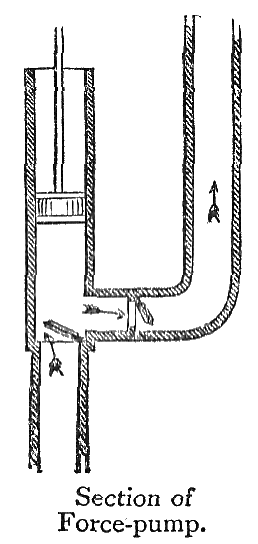
Force, fōrs, n. strength, power, energy: efficacy: validity: influence: vehemence: violence: coercion or compulsion: military or naval strength (often in pl.): an armament: (mech.) any cause which changes the direction or speed of the motion of a portion of matter.—v.t. to draw or push by main strength: to compel: to constrain: to compel by strength of evidence: to take by violence: to ravish: (hort.) to cause to grow or ripen rapidly: to compel one's partner at whist to trump a trick by leading a card of a suit of which he has none: to make a player play so as to reveal the strength of his hand.—v.i. to strive: to hesitate.—p. and adj. Forced, accomplished by great effort, as a forced march: strained, excessive, unnatural.—n. Forc′edness, the state of being forced: distortion.—adj. Force′ful, full of force or might: driven or acting with power: impetuous.—adv. Force′fully.—adj. Force′less, weak.—ns. Force′-pump, Forc′ing-pump, a pump which delivers the water under pressure through a side-pipe; Forc′er, the person or thing that forces, esp. the piston of a force-pump.—adj. Forc′ible, active: impetuous: done by force: efficacious: impressive.—adj. and n. Forc′ible-fee′ble, striving to look strong while really weak.—n. Forc′ibleness.—adv. Forc′ibly.—ns. Forc′ing (hort.), the art of hastening the growth of plants; Forc′ing-house, a hothouse for forcing plants; Forc′ing-pit, a frame sunk in the ground over a hotbed for forcing plants.—Force and fear (Scot.), that amount of constraint or compulsion which is enough to annul an engagement or obligation entered into under its influence; Force the pace, to keep the speed up to a high pitch by emulation with one not competing for a place: to hasten unduly, or by any expedient; Forcible detainer, and entry, detaining property or forcing an entry into it by violence or intimidation. [Fr.,—Low L., fortia—L. fortis, strong.]
Force, fōrs, Foss, fos, n. a waterfall. [Ice. foss, fors.]
Force, fōrs, v.t. (cook.) to stuff, as a fowl.—n. Force′meat, meat chopped fine and highly seasoned, used as a stuffing or alone. [A corr. of farce.]
Forceps, for′seps, n. a pair of tongs, pincers, or pliers for holding anything difficult to be held with the hand.—adj. For′cipāted, formed and opening like a forceps.—n. Forcipā′tion, torture by pinching with forceps. [L., from formus, hot, and capĕre, to hold.]
Ford, fōrd, n. a place where water may be crossed on foot: a stream where it may be crossed.—v.t. to cross water on foot.—adj. Ford′able. [A.S. ford—faran, to go; Ger. furt—fahren, to go on foot; akin to Gr. poros, and to Eng. fare, ferry, and far.]
Fordo, for-dōō′, v.t. (arch.) to ruin: to overcome, to exhaust:—pr.p. fordo′ing; pa.t. fordid′; pa.p. fordone′. [A.S. fōrdón; Ger. verthun, to consume.]
Fore, fōr, adj. in front of: advanced in position: coming first.—adv. at the front: in the first part: previously: (golf) a warning cry to any person in the way of the ball to be played.—Fore and aft, lengthwise of a ship.—At the fore, displayed on the foremast (of a flag); To the fore, forthcoming: (Scot.) in being, alive. [A.S. fore, radically the same as for, prep.—to be distinguished from pfx. for- (Ger. ver- in vergessen, L. per).]
Fore-admonish, fōr-ad-mon′ish, v.t. to admonish beforehand.
Fore-advise, fōr-ad-vīz′, v.t. to advise beforehand.
Foreanent, fōr-a-nent′, prep. (Scot.), opposite to.
Forearm, fōr′ärm, n. the part of the arm between the elbow and the wrist.
Forearm, fōr-ärm′, v.t. to arm or prepare beforehand.
Forebear, fōr-bār′, n. (Scot.) an ancestor, esp. in pl.
Forebode, fōr-bōd′, v.t. to feel a secret sense of something future, esp. of evil.—ns. Forebode′ment, feeling of coming evil; Forebod′er; Forebod′ing, a boding or perception beforehand; apprehension of coming evil.—adv. Forebod′ingly.
Fore-body, fōr′-bod′i, n. the part of a ship in front of the mainmast.
Fore-brace, fōr′-brās, n. a rope attached to the fore yard-arm, for changing the position of the foresail.
Fore-by, fōr-bī′ (Spens.). Same as Forby.
Forecabin, fōr-kab′in, n. a cabin in the forepart of the vessel.
Forecast, fōr-kast′, v.t. to contrive or reckon beforehand: to foresee: to predict.—v.i. to form schemes beforehand.—ns. Fore′cast, a previous contrivance: foresight: a prediction; Forecast′er.
Forecastle, fōr′kas-l, Fo'c'sle, fōk′sl, n. a short raised deck at the fore-end of a vessel: the forepart of the ship under the maindeck, the quarters of the crew.
Forechosen, fōr-chōz′n, p.adj. chosen beforehand.
Fore-cited, fōr-sīt′ed, p.adj. quoted before or above.
Foreclose, fōr-klōz′, v.t. to preclude: to prevent: to stop.—n. Foreclos′ure, a foreclosing: (law) the process by which a mortgager, failing to repay the money lent on the security of an estate, is compelled to forfeit his right to redeem the estate. [O. Fr. forclos, pa.p. of forclore, to exclude—L. foris, outside, and claudĕre, clausum, to shut.]
Foredamned, fōr-damd′, p.adj. (Spens.) utterly damned.
Foredate, fōr-dāt′, v.t. to date before the true time.
Foreday, fōr′dā, n. (Scot.) forenoon.
Foredeck, fōr′dek, n. the forepart of a deck or ship.
Foredoom, fōr-dōōm′, v.t. to doom beforehand.
Fore-end, fōr′-end, n. the early or fore part of anything.
Forefather, fōr′fä-thėr, n. an ancestor.
Forefeel, fōr-fēl′, v.t. to feel beforehand.—adv. Forefeel′ingly.—adj. Forefelt′.
Forefinger, fōr′fing-gėr, n. the finger next the thumb.
Forefoot, fōr′foot, n. one of the anterior feet of a quadruped.
Forefront, fōr′frunt, n. the front or foremost part.
Foregleam, fōr′glēm, n. a glimpse into the future.
Forego, fōr-gō′, v.t. to go before, precede: chiefly used in its pr.p. foregō′ing and pa.p. foregone′.—ns. Foregō′er; Foregō′ing.—p.adj. Foregone′.—n. Foregone′ness.—Foregone conclusion, a conclusion come to before examination of the evidence.
Forego, fōr-gō′, v.t. to give up: to forbear the use of.—Better Forgō′.
Foreground, fōr′grownd, n. the part of a picture nearest the observer's eye, as opposed to the background or distance.
Forehammer, fōr′häm-ėr, n. a sledge-hammer.
Forehand, fōr′hand, n. the part of a horse which is in front of its rider.—adj. done beforehand.—adj. Fore′handed, forehand, as of payment for goods before delivery, or for services before rendered: seasonable: (U.S.) well off: formed in the foreparts.
Forehead, fōr′hed, n. the forepart of the head above the eyes, the brow: confidence, audacity.
Fore-horse, fōr′-hors, n. the foremost horse of a team.
Foreign, for′in, adj. belonging to another country: from abroad: alien: not belonging to, unconnected: not appropriate.—adj. For′eign-built, built in a foreign country.—ns. For′eigner, a native of another country; For′eignness, the quality of being foreign: want of relation to something: remoteness. [O. Fr. forain—Low L. foraneus—L. foras, out of doors.]
Forejudge, fōr-juj′, v.t. to judge before hearing the facts and proof.—n. Forejudg′ment.
Foreking, fōr′king, n. (Tenn.) a preceding king.
Foreknow, fōr-nō′, v.t. to know beforehand: to foresee.—adj. Foreknow′ing.—adv. Foreknow′ingly.—n. Foreknowl′edge, knowledge of a thing before it happens.—adj. Foreknown′.
Forel, for′el, n. a kind of parchment for covering books. [O. Fr. forrel, a sheath, forre, fuerre.]
Foreland, fōr′land, n. a point of land running forward into the sea, a headland.
Forelay, fōr-lā′, v.t. to contrive antecedently: to lay wait for in ambush.
Foreleg, fōr′leg, n. one of the front legs of a quadruped, chair, &c.
Forelie, fōr-lī, v.t. (Spens.) to lie before.
Forelift, fōr-lift′, v.t. (Spens.) to raise any anterior part.
Forelock, fōr′lok, n. the lock of hair on the forehead.—Take time by the forelock, to seize the occasion promptly, so as to anticipate opposition.
Foreman, fōr′man, n. the first or chief man, one appointed to preside over, or act as spokesman for, others: an overseer:—pl. Fore′men.
Foremast, fōr′mast, n. the mast that is forward, or next the bow of a ship.—n. Fore′mastman, any sailor below the rank of petty officer.
Foremean, fōr-mēn′, v.t. to intend beforehand.—pa.p. Fore′meant.
Fore-mentioned, fōr-men′shund, adj. mentioned before in a writing or discourse.
Foremost, fōr′mōst, adj. first in place: most advanced: first in rank or dignity. [A.S. forma, first, superl. of fore, and superl. suffix -st. It is therefore a double superl.; the old and correct form was formest, which was wrongly divided for-mest instead of form-est, and the final -mest was mistaken for -most.]
Forename, fōr′nām, n. the first or Christian name.
Fore-named, fōr′-nāmd, adj. mentioned before.
Forenenst, fōr-nenst′, prep. (Scot.) opposite.
Forenight, fōr′nīt, n. (Scot.) the early part of the night before bedtime, the evening.
Forenoon, fōr′nōōn, n. the part of the day before noon or midday.—adj. pertaining to this part of the day.
Forenotice, fōr-nō′tis, n. notice of anything before it happens.
Forensic, fo-ren′sik, adj. belonging to courts of law, held by the Romans in the forum: used in law pleading: appropriate to, or adapted to, argument.—Forensic medicine, medical jurisprudence, the application of medical knowledge to the elucidation of doubtful questions in a court of justice. [L. forensis—forum, market-place, akin to fores.]
Fore-ordain, fōr-or-dān′, v.t. to arrange beforehand: to predestinate.—n. Fore-ordinā′tion.
Forepart, fōr′pärt, n. the part before the rest: the front: the beginning: (B.) the bow of a ship.
Forepast, fōr′past, p.adj. (Shak.) former.
Forepayment, fōr′pā-ment, n. payment beforehand.
Forepeak, fōr′pēk, n. the contracted part of a ship's hold, close to the bow.
Foreplan, fōr′plan, v.t. to plan beforehand.
Forepoint, fōr′point, v.t. to foreshadow.
Fore-quoted, fōr-kwōt′ed, p.adj. quoted or cited before in the same writing.
Foreran, fōr-ran′, pa.t. of forerun.
Fore-rank, fōr′-rangk, n. the rank which is before all the others: the front.
Forereach, fōr′rēch, v.i. (naut.) to glide ahead, esp. when going in stays (with on).—v.t. to sail beyond.
Fore-read, fōr′-rēd, v.t. (Spens.) to signify by tokens: to foretell:—pa.p. fore-read′.—n. Fore′-read′ing.
Fore-recited, fōr′-re-sīt′ed, p.adj. (Shak.) recited or named before.
Fore-rent, fōr′-rent, n. (Scot.) rent due before the first crop is reaped.
Forerun, fōr-run′, v.t. to run or come before: to precede.—n. Forerun′ner, a runner or messenger sent before: a sign that something is to follow.
Foresaid, fōr′sed, adj. described or spoken of before.
Foresail, fōr′sāl, n. a sail attached to the foreyard on the foremast. See Ship.
Fore-say, fōr-sā′, v.t. to predict or foretell: (Shak.) to prognosticate.
Foresee, fōr-sē′, v.t. or v.i. to see or know beforehand.—p.adj. Foresee′ing.—adv. Foresee′ingly.
Foreshadow, fōr-shad′ō, v.t. to shadow or typify beforehand.—n. Foreshad′owing.
Foreship, fōr′ship, n. (B.) the forepart of a ship.
Foreshore, fōr′shōr, n. the part immediately before the shore: the sloping part of a shore included between the high and low water marks.
Foreshortening, fōr-short′n-ing, n. a term in drawing signifying that a figure or portion of a figure projecting towards the spectator is so represented as to truly give the idea of such projection.—v.t. Foreshort′en.
Foreshow, fōr-shō′, v.t. to show or represent beforehand: to predict.—Also Foreshew′.
Foreside, fōr′sīd, n. the front side.
Foresight, fōr′sīt, n. act of foreseeing: wise forethought, prudence: the sight on the muzzle of a gun: a forward reading of a levelling staff.—adjs. Fore′sighted, Fore′sightful; Fore′sightless.
Foresignify, fōr-sig′ni-fī, v.t. to betoken beforehand: to foreshow: to typify.
Foreskin, fōr′skin, n. the skin that covers the glans penis: the prepuce.
Foreskirt, fōr′skėrt, n. (Shak.) the loose part of a coat before.
Foreslack. See Forslack.
Foreslow, fōr-slō′, v.i. (Shak.) to delay.—v.t. (Spens.) to hinder.—Better Forslow′.
Forespeak, fōr-spēk′, v.t. to predict: (Shak.) to gainsay: (Scot.) to engage beforehand.
Forespend. Same as Forspend.
Forespurrer, fōr-spur′ėr, n. (Shak.) one who rides before.
Forest, for′est, n. a large uncultivated tract of land covered with trees and underwood: woody ground and rude pasture: a preserve for large game, as a deer forest: a royal preserve for hunting, governed by a special code called the Forest Law.—adj. pertaining to a forest: silvan: rustic.—v.t. to cover with trees.—n. For′estage, an ancient service paid by foresters to the king: the right of foresters.—adjs. For′estal; For′est-born (Shak.), born in a wild.—ns. For′ester, one who has charge of a forest: an inhabitant of a forest; For′est-fly, a dipterous insect sometimes called Horse-fly, from the annoyance it causes horses.—adj. For′estine.—ns. For′est-mar′ble, a fissile limestone belonging to the middle division of the Jurassic System, so called because the typical beds are found in Wychwood Forest, Oxfordshire; For′est-oak, the timber of the Australian beefwood trees; For′estry, the art of cultivating forests; For′est-tree, a timber-tree. [O. Fr. forest (Fr. forêt)—Low L. forestis (silva), the outside wood, as opposed to the parcus (park) or walled-in wood—L. foris, out of doors.]
Forestall, fōr-stawl′, v.t. to buy up the whole stock of goods before they are brought to market, so as to sell again at higher prices: to anticipate.—ns. Forestall′er, one who forestalls; Forestall′ing, the act of buying provisions before they come to the market, in order to raise the price: anticipation: prevention.
Forestay, fōr′stā, n. a rope reaching from the foremast-head to the bowsprit end to support the mast.
Foretaste, fōr-tāst′, v.t. to taste before possession: to anticipate: to taste before another.—n. Fore′taste, a taste beforehand: anticipation.
Foreteach, fōr-tēch′, v.t. to teach beforehand.
Foretell, fōr-tel′, v.t. to tell before: to prophesy.—v.i. to utter prophecy.—n. Foretell′er.
Forethink, fōr-thingk′, v.t. to anticipate in the mind: to have prescience of.—n. Fore′thought, thought or care for the future: provident care.
Foretoken, fōr′tō-kn, n. a token or sign beforehand.—v.t. Foretō′ken, to signify beforehand.
Foretooth, fōr′tōōth, n. a tooth in the forepart of the mouth:—pl. Fore′teeth.
Foretop, fōr′top, n. (naut.) the platform at the head of the foremast: a lock of natural hair or in a wig, lying on the forehead, or brushed up straight.—n. Foretop′mast, in a ship, the mast erected at the head of the foremast, at the top of which is the Fore′top-gall′ant-mast.
Forever, for-ev′ėr, adv. for ever, for all time to come: to eternity.—adv. Forev′ermore, for ever hereafter.
Forevouched, fōr-vowcht′, p.adj. (Shak.) affirmed or told before.
Foreward, fōr′wawrd, n. advance-guard: (Shak.) the front.
Forewarn, fōr-wawrn′, v.t. to warn beforehand: to give previous notice.—n. Forewarn′ing, warning beforehand.
Foreweigh, fōr-wā′, v.t. to estimate beforehand.
Forewind, fōr′wind, n. (Shak.) a favourable wind.
Forewoman, fōr′woom-an, n. a woman who oversees the employees in any shop or factory, a head-woman:—pl. Fore′women.
Foreword, fōr′wurd, n. a preface.
Forfairn, fōr-fārn′, adj. (Scot.) worn out: exhausted.
Forfeit, for′fit, v.t. to lose the right to by some fault or crime:—pr.p. for′feiting; pa.p. for′feited.—n. that which is forfeited: a penalty for a crime, or breach of some condition: a fine: something deposited and redeemable by a sportive fine or penalty, esp. in pl., a game of this kind.—adj. forfeited.—adj. For′feitable.—ns. For′feiter (Shak.), one who incurs punishment by forfeiting his bond; For′feiture, act of forfeiting: state of being forfeited: the thing forfeited. [O. Fr. forfait—Low L. forisfactum—L. forisfacĕre, to transgress.]
Forfend, for-fend′, v.t. (arch.) to ward off, avert.
Forfex, fōr′feks, n. a pair of scissors.
Forfoughten, for′fäh-ten, adj. (Scot.) exhausted, as by fighting.
Forgat, for-gat′, old pa.t. of forget.
Forgather, for-gath′er, v.i. (Scot.) to meet, to take up company with.
Forgave, for-gāv′, pa.t. of forgive.
Forge, fōrj, n. the workshop of a workman in iron, &c.: a furnace, esp. one in which iron is heated: a smithy: a place where anything is shaped or made.—v.t. to form by heating and hammering: to form: to make falsely: to fabricate: to counterfeit or imitate for purposes of fraud.—v.i. to commit forgery.—ns. Forge′man; Forg′er, one who forges or makes one guilty of forgery; Forg′ery, fraudulently making or altering any writing: that which is forged or counterfeited.—adj. Forg′etive (Shak.), that may forge or produce.—n. Forg′ing, a piece of metal shaped by hammering: act of one who forges: a form of overreaching in which the horse strikes the fore shoe with the toe of the hind one, clicking. [O. Fr. forge—L. fabrica—faber, a workman.]
Forge, fōrj, v.t. to move steadily on (with ahead).
Forget, for-get′, v.t. to lose or put away from the memory: to neglect:—pr.p. forget′ting; pa.t. forgot′; pa.p. forgot′, forgot′ten.—adjs. Forget′able, Forget′table; Forget′ful, apt to forget: inattentive.—adv. Forget′fully.—ns. Forget′fulness; Forget′-me-not, a small herb (Myosotis palustris) with beautiful blue flowers, regarded as the emblem of friendship: a keepsake [a word adapted by Coleridge from the German Vergissmeinnicht]; Forget′ter, one who fails to bear in mind: a heedless person.—adv. Forget′tingly.—Forget one's self, to lose one's self-control or dignity, to descend to words and deeds unworthy of one's self. [A.S. forgietan—pfx. for-, away, gitan, to get.]
Forgive, for-giv′, v.t. to pardon: to overlook an offence or debt: (Spens.) to give up.—v.i. to be merciful or forgiving.—adj. Forgiv′able, capable of being forgiven.—n. Forgive′ness, pardon: remission: disposition to pardon.—adj. Forgiv′ing, ready to pardon: merciful: compassionate. [A.S. forgiefan—pfx. for-, away, giefan, to give; cf. Ger. ver-geben.]
Forgo. See Forego.
Forgot, Forgotten. See Forget.
Forhail, for-hāl′, v.t. (Spens.) to overtake.
Forhent, for-hent′, v.t. (Spens.) to overtake.
Forhow, for-how′, v.t. (Scot.) to desert or abandon. [A.S. forhogian, pfx. for-, away, hogian, to care.]
Forisfamiliate, fō-ris-fa-mil′i-āt, v.t. to put a son in possession of land which he accepts as his whole portion of his father's property, said of a father.—v.i. to renounce one's title to a further share of the paternal estate, said of a son:—pr.p. fōrisfamil′iāting; pa.p. fōrisfamil′iāted.—n. Fōrisfamiliā′tion. [Low L. forisfamiliāre, -ātum—L. foris, out of doors, familia, a family.]
Forjeskit, for-jes′kit, adj. (Scot.) tired out.
Fork, fork, n. an instrument with two or more prongs at the end: one of the points or divisions of anything fork-like: the bottom of a sump into which the water of a mine drains—also Forcque: (pl.) the branches into which a road or river divides, also the point of separation.—v.i. to divide into two branches: to shoot into blades, as corn.—v.t. to form as a fork: to pitch with a fork: to bale a shaft dry.—n. Fork′-chuck, a forked lathe-centre used in wood-turning.—adjs. Forked, Fork′y, shaped like a fork.—adv. Fork′edly.—ns. Fork′edness, Fork′iness; Fork′er; Fork′head, the forked end of a rod in a knuckle-joint or the like; Fork′-tail, a fish with forked tail: the kite.—Fork out, over (slang), to hand or pay over. [A.S. forca—L. furca.]
Forlorn, for-lorn′, adj. quite lost: forsaken; wretched.—v.t. Forlore′ (Spens.).—adv. Forlorn′ly.—n. Forlorn′ness. [A.S. forloren, pa.p. of forléòsan, to lose—pfx. for-, away, and léòsan, to lose; Ger. verloren, pa.p. of verlieren, to lose.]
Forlorn-hope, for-lorn′-hōp, n. a body of soldiers selected for some service of uncommon danger. [From the Dut. verloren hoop, the lost troop.]
Form, form, n. shape of a body: the boundary-line of an object: a model: a mould: mode of being: mode of arrangement: order: regularity: system, as of government: beauty or elegance: established practice: ceremony: fitness or efficiency for any undertaking: a blank schedule to be filled in with details: a specimen document to be copied or imitated: (phil.) the inherent nature of an object, that which the mind itself contributes as the condition of knowing, that in which the essence of a thing consists: (print.) the type from which an impression is to be taken arranged and secured in a chase—often Forme:—(in the fol. senses pron. fōrm), a long seat, a bench: the pupils on a form, a class: the bed of a hare, which takes its shape from the animal's body.—v.t. to give form or shape to: to make: to contrive: to settle, as an opinion: to combine: to go to make up: to establish: (gram.) to make by derivation.—v.i. to assume a form.—adj. Form′al, according to form or established mode: ceremonious, punctilious, methodical: having the form only: (Shak.) embodied in a form: having the power of making a thing what it is: essential: proper.—v.t. and v.i. Form′alise.—ns. Form′alism, excessive observance of form or conventional usage, esp. in religion: stiffness of manner; Form′alist, one having exaggerated regard to rules or established usages; Formal′ity, the precise observance of forms or ceremonies: established order: sacrifice of substance to form.—adv. Form′ally.—n. Formā′tion, a making or producing: structure: (geol.) a group of strata of one period.—adj. Form′ative, giving form, determining, moulding: (gram.) inflectional, serving to form, not radical.—n. a derivative.—p.adj. Formed, trained, mature.—n. Form′er.—adj. Form′less, shapeless.—Formal logic (see Logic).—Good, or Bad, form, according to good social usage, or the opposite; Take form, to assume a definite appearance. [O. Fr. forme—L. forma, shape.]
Formalin, for′ma-lin, n. a formic aldehyde used as an antiseptic, germicide, or preservative in foods.
Format, for′ma, n. of books, &c., the size, form, shape in which they are issued. [Fr.]
Formate, form′āt, n. a salt composed of formic acid and a base.—Also For′miate.
Former, form′ėr, adj. (comp. of fore) before in time or order: past: first mentioned.—adv. Form′erly, in former times: heretofore. [Formed late on analogy of M. E. formest by adding comp. suff. -er to base of A.S. forma, first, itself a superlative form.]
Formic, for′mik, adj. pertaining to ants, as formic acid, originally obtained from ants.—adj. For′micant, crawling like an ant: very small and unequal, of a pulse.—n. For′micary, an ant-hill.—adj. For′micate, resembling an ant.—n. Formicā′tion, a sensation like that of ants creeping on the skin. [L. formicāre, -ātum, to creep like an ant—formica.]
Formidable, for′mi-da-bl, adj. causing fear: adapted to excite fear.—ns. Formidabil′ity; For′midableness.—adv. For′midably. [Fr.,—L. formidabilis—formido, fear.]
Formula, form′ū-la, n. a prescribed form: a formal statement of doctrines: (math.) a general expression for solving problems: (chem.) a set of symbols expressing the components of a body:—pl. Formulæ (form′ū-lē), Form′ulas.—adjs. Form′ular, Formularis′tic.—ns. Formularisā′tion, Formulā′tion; Form′ulary, a formula: a book of formulæ or precedents.—adj. prescribed: ritual.—vs.t. Form′ulāte, Form′ulise, to reduce to or express in a formula: to state or express in a clear or definite form. [L., dim. of forma.]
Fornent, for-nent′, adv. and prep. (Scot.) right opposite to.
Fornicate, for′ni-kāt, adj. arched: (bot.) arching over.—n. Fornicā′tion. [L. fornicatus—fornix, an arch.]
Fornicate, for′ni-kāt, v.i. to commit lewdness: to have unlawful sexual intercourse.—ns. Fornicā′tion, sexual intercourse between two unmarried persons, or an unmarried and married person: (B.) adultery, and applied frequently by a figure to idolatry; For′nicator, an unmarried person guilty of lewdness:—fem. For′nicatress. [L. fornix, an arch, brothel.]
Fornix, for′niks, n. something resembling an arch: an arched formation of the brain. [L.]
Forpine, for-pīn′, v.i. (Spens.) to waste away.
Forpit, for′pit, n. (Scot.) the fourth part of some other measure, now of a peck.—Also For′pet.
Forrit, for′it, adv. (Scot.) forward.
Forsake, for-sāk′, v.t. to desert: to abandon:—pr.p. forsāk′ing; pa.t. forsook′; pa.p. forsāk′en.—adj. Forsāk′en.—adv. Forsāk′enly.—ns. Forsāk′enness; Forsāk′ing, abandonment. [A.S. forsacan—for-, away, sacan, to strive.]
Forsay, for-sā′, v.t. (Spens.) to forbid, to renounce. [A.S. forsecgan—for, against, secgan, to say.]
Forslack, for-slak′, v.t. (Spens.) to relax, delay.
Forslow, for-slō′, v.t. See Foreslow.
Forsooth, for-sōōth′, adv. in truth: certainly.
Forspeak, for-spēk′, v.t. (Shak.) to forbid, to prohibit: (Scot.) to bewitch.
Forspend, for-spend′, v.t. to spend completely:—pa.t. and pa.p. forspent′.
Forstall, for-stawl′, v.t. Same as Forestall.
Forswat, for-swat′, adj. (Spens.) exhausted with heat. [Pfx. for-, inten., and swat, old pa.t. of sweat.]
Forswear, for-swār′, v.t. to deny upon oath:—pa.t. forswore′; pa.p. forsworn′.—n. Forsworn′ness.—Forswear one's self, to swear falsely.
Forswink, for-swingk′, v.t. to exhaust by labour.—p.adj. Forswonk′ (Spens.), over-laboured. [Pfx. for-, inten., and obs. swink, labour.]
Fort, fōrt, n. a small fortress: an outlying trading-station, as in British North America.—adj. Fort′ed (Shak.), guarded by forts. [Fr.,—L. fortis, strong.]
Fortalice, fort′al-is, n. a small outwork of a fortification. [Low L. fortalitia—L. fortis.]
Forte, fōrt, n. that in which one excels.
Forte, fōr′te, adj. (mus.) strongly, loud:—superl. Fortis′simo.—n. a loud passage in music. [It.]
Forth, fōrth, adv. before or forward in place or order: in advance: onward in time: (Shak.) completely, outright: abroad: (B.) out.—prep. (Shak.) out of, forth from.—v.i. Forth′come, to come forth.—adj. Forth′coming, just coming forth: about to appear.—ns. Forth′going, a going forth: a proceeding out; Forth′-iss′uing, coming forth; Forth′-put′ting, action of putting forth: (U.S.) forwardness.—adj. forward.—adv. Forth′right, straightforward.—n. (Shak.) a straight path.—adj. straightforward: honest.—adv. Forthwith′, immediately.—And so forth, and so on, and more besides. [A.S. forth—fore, before; Dut. voort, Ger. fort.]
Forthink, for-thingk′, v.t. (Spens.) to be sorry for.
Forthy, for′thi, adv. (Spens.) therefore. [A.S. forthý—for, and thý, instrumental case of thaet, that.]
Fortieth. See Forty.
Fortify, for′ti-fī, v.t. to strengthen against attack with forts, &c.: to invigorate: to confirm:—pa.p. for′tifīed.—adj. Fortifī′able.—ns. Fortificā′tion, the art of strengthening a military position by means of defensive works: the work so constructed: that which fortifies; For′tifier. [Fr. fortifier—Low L. fortificāre—fortis, strong, facĕre, to make.]
Fortilage, fōr′ti-lāj, n. (Spens.) a fort. [Fortalice.]
Fortissimo. See Forte.
Fortition, for-tish′un, n. principle of trusting to chance. [L. fors, chance.]
Fortitude, for′ti-tūd, n. mental power of endurance: firmness in meeting danger: (obs.) strength, power of resistance or attack.—adj. Fortitū′dinous. [L. fortitudo—fortis.]
Fortlet, fōrt′let, n. a little fort.
Fortnight, fort′nīt, n. two weeks or fourteen days.—adj. and adv. Fort′nightly, once a fortnight. [Contr. of A.S. féowertýne niht, fourteen nights.]
Fortress, for′tres, n. a fortified place: a defence.—v.t. (Shak.) to guard. [O. Fr. forteresse, another form of fortelesce (q.v. under Fortalice).]
Fortuitous, for-tū′i-tus, adj. happening by chance.—ns. Fortū′itism; Fortū′itist.—adv. Fortū′itously.—ns. Fortū′itousness, Fortū′ity. [L. fortuitus.]
Fortune, for′tūn, n. whatever comes by lot or chance: luck: the arbitrary ordering of events: the lot that falls to one in life: success: wealth.—v.i. to befall.—v.t. to determine.—adj. For′tunāte, happening by good fortune: lucky: auspicious: felicitous.—adv. For′tunātely.—ns. For′tunāteness; For′tune-book, a book helpful in telling fortunes.—adj. For′tuned, supplied by fortune.—n. For′tune-hunt′er, a man who hunts for marriage with a woman of fortune.—adj. For′tuneless, without a fortune: luckless.—v.i. For′tune-tell, to reveal futurity: to tell one his fortune.—ns. For′tune-tell′er, one who pretends to foretell one's fortune; For′tune-tell′ing.—v.t. For′tunīse (Spens.), to make fortunate or happy. [Fr.,—L. fortuna.]
Forty, for′ti, adj. and n. four times ten.—adj. For′tieth.—n. a fortieth part.—Forty winks, a short nap, esp. after dinner.—The Forty, the French Academy. [A.S. féowertig—feower, four, tig, ten.]
Forum, fō′rum, n. a market-place, esp. the market-place in Rome, where public business was transacted and justice dispensed: the courts of law as opposed to the Parliament. [L., akin to foras, out of doors.]
Forwander, for-won′dėr, v.i. and v.t. (Spens.) to wander till wearied, to weary with wandering.
Forward, for′ward, adj. near or at the forepart: in advance of something else: ready: too ready: presumptuous: officious: earnest: early ripe.—v.t. to help on, to quicken: to send on.—advs. For′ward, For′wards, towards what is before or in front: onward: progressively.—ns. For′warder; For′warding, the act of sending forward merchandise, &c., for others.—adv. For′wardly.—n. For′wardness. [A.S. foreweard—fore, and -weard, sig. direction. Forwards—M. E. forwardes—was orig. the gen. form (cf. Ger. vorwärts).]
Forwaste, for-wāst′, v.t. (Spens.) to lay waste utterly.
Forweary, for-wē′ri, v.t. (Spens.) to weary out.
Forwent, for-went′ (Spens.), pa.t of forego.
Forworn, for-wōrn′, adj. (Spens.) much worn.
Forzando. Same as Sforzando (q.v.).
Foss, Fosse, fos, n. (fort.) a ditch or moat, either with or without water, the excavation of which has contributed material for the walls of the fort it protects: an abyss.—adj. Fossed.—n. Foss′way, an ancient Roman road having a ditch on either side. [Fr. fosse—L. fossa—fodĕre, fossum, to dig.]
Fossa, fos′a, n. (anat.) a pit or depression in a body, esp. that in an animal integument forming a point of attachment for an organ.—n. Fossette′, a dimple or small depression. [L., a ditch.]
Fosset-seller, fos′et-sel′ėr, n. (Shak.) one who sells faucets. [Fosset, obs. form of faucet.]
Fossick, fos′ik, v.i. to be troublesome: to undermine another's diggings, or work over waste-heaps for gold: to search about for any kind of profit.—ns. Foss′icker, a mining gleaner who works over old diggings, and scratches about in the beds of creeks; Foss′icking. [Ety. dub.]
Fossil, fos′il, n. the petrified remains of an animal or vegetable found embedded in the strata of the earth's crust: anything antiquated.—adj. dug out of the earth: in the condition of a fossil: antiquated.—adj. Fossilif′erous, bearing or containing fossils.—n. Fossilificā′tion, the act of becoming fossil.—vs.t. Fossil′ify, Foss′ilīse, to convert into a fossil.—v.i. to be changed into a stony or fossil state.—ns. Fossilisā′tion, a changing into a fossil; Foss′ilism, the science of fossils; Foss′ilist, one skilled in fossils; Fossilol′ogy, Fossil′ogy, paleontology. [Fr. fossile—L. fossilis—fodĕre, to dig.]
Fossorial, fo-sō′ri-al, adj. digging, burrowing.—n. Foss′or, a grave-digger. [L. fossor—fodĕre, to dig.]
Fossulate, fos′ū-lāt, adj. (anat.) having one or more long narrow grooves or depressions.
Foster, fos′tėr, v.t. to bring up or nurse: to encourage.—ns. Fos′terāge, the act of fostering or nursing; Fos′ter-broth′er, a male child, fostered or brought up with another of different parents; Fos′ter-child, a child nursed or brought up by one who is not its parent; Fos′ter-daugh′ter; Fos′terer; Fos′ter-fa′ther, one who brings up a child in place of its father; Fos′terling, a foster-child; Fos′ter-moth′er, one who suckles a child not her own; Fos′ter-nurse (Shak.), a nurse; Fos′ter-par′ent, one who rears a child in the place of its parent; Fos′ter-sis′ter, one brought up as a sister by the same parents, but not a sister by birth; Fos′ter-son, one brought up as a son, though not a son by birth. [A.S. fóstrian, to nourish, fóstor, food.]
Foster, fos′tėr, n. (Spens.) a forester.
Fother, foth′ėr, v.t. to stop or lessen a leak in a ship's bottom whilst afloat by means of a heavy sail closely thrummed with yarn and oakum. [Perh. from Dut. voederen (mod. voeren) or Low Ger. fodern, to line.]
Fother, foth′ėr, n. a load, quantity: a definite weight—of lead, 19½ cwt. [A.S. fóðer; Ger. fuder.]
Fou, fōō, adj. (Scot.) full: drunk.
Fou, fōō, n. (Scot.) a bushel.
Foud, fowd, n. a bailiff or magistrate in Orkney and Shetland.—n. Foud′rie, his jurisdiction. [Ice. fógeti; Ger. vogt; from L. vocatus—vocāre, to call.]
Foudroyant, fōō-droi′ant, adj. quick like lightning. [Fr. foudroyer—foudre, lightning.]
Fouet, fōō′et, n. (Scot.) the house-leek.—Also Fou′at.
Fougade, foo-gäd′, n. (mil.) a small mine from six to twelve feet under ground, charged either with powder or loaded shells, and sometimes loaded with stones.—Also Fougasse′. [Fr.]
Fought, fawt, pa.t. and pa.p.—Foughten (fawt′n), old pa.p. of fight.
Foul, fowl, adj. filthy: loathsome: obscene: impure: stormy: unfair: running against: distressing, pernicious: choked up, entangled: (Shak.) homely, ugly.—v.t. to make foul: to soil: to effect a collision.—v.i. to come into collision:—pr.p. foul′ing; pa.p. fouled.—n. act of fouling: any breach of the rules in games or contests.—adj. Foul′-faced (Shak.), having a hatefully ugly face.—n. Foul′-fish, fish during the spawning season.—adv. Foul′ly.—adjs. Foul′-mouthed, Foul′-spok′en, addicted to the use of foul or profane language.—ns. Foul-mouthed′ness; Foul′ness; Foul′-play, unfair action in any game or contest, dishonest dealing generally.—Claim a foul, to assert that the recognised rules have been broken, and that a victory is therefore invalid; Fall foul of, to come against: to assault; Make foul water, used of a ship, to come into such shallow water that the keel raises the mud. [A.S. fúl; Ger. faul, Goth. fûls.]
Foulard, fōōl′ard, n. a soft untwilled silk fabric: a silk handkerchief. [Fr.]
Foulder, fowl′dėr, v.i. (Spens.) to flame, to gleam. [O. Fr. fouldre—L. fulgur, lightning.]
Foulé, fōō-lā′, n. a light woollen dress material with a glossy surface. [Fr.]
Foumart, fōō′märt, n. an old name for the polecat, from its offensive smell. [M. E. fulmard—A.S. fúl, foul, mearð, a marten.]
Found, pa.t. and pa.p. of find.—n. Found′ling, a little child found deserted.—Foundling hospital, an institution where such are brought up.
Found, fownd, v.t. to lay the bottom or foundation of: to establish on a basis: to originate: to endow.—v.i. to rely.—ns. Foundā′tion, the act of founding: the base of a building: the groundwork or basis: a permanent fund for a benevolent purpose or for some special object; Foundā′tioner, one supported from the funds or foundation of an institution; Foundā′tion-mus′lin, -net, gummed fabrics used for stiffening dresses and bonnets; Foundātion-stone, one of the stones forming the foundation of a building, esp. a stone laid with public ceremony; Found′er, one who founds, establishes, or originates: an endower:—fem. Found′ress. [Fr. fonder—L. fundāre, -ātum, to found—fundus, the bottom.]
Found, fownd, v.t. to form by melting and pouring into a mould: to cast.—ns. Found′er, one who melts and casts metal, as a brassfounder; Found′ing, metal-casting; Found′ry, Found′ery, the art of founding or casting: the house where founding is carried on. [Fr. fondre—L. fundĕre, fusum, to pour.]
Founder, fownd′ėr, v.i. to go to the bottom: to fill with water and sink.—v.t. to cause to sink: to disable by injuring the feet (of a horse).—adj. Found′erous, causing to founder. [O. Fr. fondrer, to fall in, fond, bottom—L. fundus, bottom.]
Fount. See Font (2).
Fountain, fownt′ān, n. a spring of water, natural or artificial: the structure for a jet of water: the source of anything: a reservoir for holding oil, &c., in a lamp.—ns. Fount, a spring of water: a source; Fount′ain-head, the head or source of a fountain: the beginning.—adj. Fount′ainless, wanting fountains or springs of water.—n. Fount′ain-pen, a pen having a reservoir for holding ink.—adj. Fount′ful, full of springs. [Fr. fontaine—Low L. fontāna—L. fons, fontis, a spring—-fundĕre, to pour.]
Four, fōr, adj. and n. two and two, a cardinal number.—adjs. Four′fold, folded four times: multiplied four times; Four′-foot′ed, having four feet; Four′-hand′ed, having four hands: of a game, played by four people; Four′-inched (Shak.), four inches broad.—ns. Four′-in-hand, a vehicle drawn by four horses, driven by one person: a team of four horses drawing a carriage—also adj.; Four′penny, a small silver coin worth fourpence formerly coined in England.—adj. worth fourpence.—n. Four′-post′er, a large bed with four posts on which to hang curtains.—adjs. Four′score, four times a score—80; Four′some, by fours: anything in which four act together—also n.; Four′square, having four equal sides and angles: square.—adjs. and ns. Four′teen, four and ten; Four′teenth, four or the fourth after the tenth.—adj. Fourth, next after the third.—n. one of four equal parts.—adv. Fourth′ly.—adj. Fourth′-rate, of the fourth class or order.—n. Four′-wheel′er, a carriage or cab with four wheels.—Go on all fours, to go on hands and knees. [A.S. féower; Ger. vier, L. quatuor, Gr. tessares.]
Fourchette, fōōr-shet′, n. a small forked instrument used for supporting the tongue in the operation of cutting the frenum: a forked piece between glove fingers, uniting the front and back parts. [Fr.]
Fourcroya, fōōr-krō′ya, n. a neotropical genus of Amaryllidaceæ, nearly allied to Agave (q.v.), and yielding a similar fibre. [Named from A. F. de Fourcroy, a French chemist (1755-1809).]
Fourgon, fōōr-gong′, n. a baggage-wagon. [Fr.]
Fourierism, fōō′ri-ėr-izm, n. the socialistic system of F. M. Charles Fourier (1772-1837), based on the harmony educed by the free-play of his twelve radical passions.
Foutre, fōō′tėr, n. (Shak.) a gross term of contempt, used interjectionally.—Also Fou′ter. [O. Fr. foutre—L. futuere, to lecher.]
Fouth, footh, n. (Scot.) abundance.—Also Fowth.
Fovea, fō′vē-a, n. (anat.) a depression or pit.—adjs. Fō′veal; Fō′veate, pitted.—n. Fovē′ola, a small depression—also Fovē′ole. [L.]
Fovilla, fō-vil′a, n. (bot.) the contents of a pollen-grain.
Fowl, fowl, n. a bird: a bird of the barn-door or poultry kind, a cock or hen: the flesh of fowl:—pl. Fowls, Fowl.—v.i. to kill fowls by shooting or snaring.—ns. Fowl′er, a sportsman who takes wild-fowl; Fowl′ing; Fowl′ing-net, a net for catching birds; Fowl′ing-piece, a light gun for small-shot, used in fowling. [A.S. fugol; Ger. vogel.]
Fox, foks, n. an animal of the family Canidæ, genus Vulpes, of proverbial cunning:—fem. Vix′en: any one notorious for cunning.—ns. Fox′-bat, a flying-fox, a fruit-bat; Fox′-brush, the tail of a fox; Fox′-earth, a fox's burrow.—adj. Foxed, discoloured, spotted.—ns. Fox′-ē′vil, alopecia; Fox′glove, a plant with glove-like flowers, whose leaves are used as a soothing medicine; Fox′hound, a hound used for chasing foxes; Fox′-hunt; Fox′-hunt′er; Fox′-hunt′ing; Fox′iness, decay: having a harsh, sour taste: state of being spotted, as books; Fox′-shark, a large shark of over 12 feet, occasionally seen off British coasts; Fox′ship (Shak.), the character of a fox, craftiness; Fox′-tail, a genus of grasses, generally characterised by a bushy head; Fox′-terr′ier, a kind of terrier trained to unearth foxes; Fox′-trap, a trap for catching foxes; Fox′-trot, a pace with short steps, as in changing from trotting to walking.—adj. Fox′y, of foxes: cunning, suspicious, causing suspicion: (paint.) having too much of the reddish-brown or fox-colour.—Fox and geese, a game played with pieces on a board, where the object is for certain pieces called the geese to surround or corner one called the fox. [A.S. fox; Ger. fuchs.]
Foy, foi, n. (Spens.) allegiance. [Fr. foi, faith.]
Foy, foi, n. (prov.) a parting entertainment.
Foyer, fwo-yā′, n. in theatres, a public room opening on the lobby. [Fr.,—L. focus, hearth.]
Fozy, fōz′i, adj. (Scot.) spongy.—n. Foz′iness, softness, want of spirit. [Cf. Dut. voos, spongy.]
Frab, frab, v.t. to worry.—adj. Frab′bit, peevish.
Fracas, fra-kä′, n. uproar: a noisy quarrel. [Fr.,—It. fracasso—fracassare, to make an uproar.]
Fraction, frak′shun, n. a fragment or very small piece: (arith.) any part of a unit: a technical term to indicate the breaking of the bread in the sacrifice of the Eucharist.—v.t. Fract (Shak.), to break, to violate.—adjs. Fract′ed (her.), having a part displaced, as if broken; Frac′tional, belonging to or containing a fraction or fractions; Frac′tionary, fractional: unimportant.—v.t. Frac′tionate, to separate the elements of a mixture by distillation or otherwise.—n. Fractionā′tion.—v.t. Frac′tionise, to break up into fractions.—n. Frac′tionlet, a small fraction.—adj. Frac′tious, ready to quarrel: cross.—adv. Frac′tiously.—ns. Frac′tiousness; Frac′ture, the breaking of any hard body: the breach or part broken: the breaking of a bone.—v.t. to break through.—Compound, Comminuted, Complicated fracture (see the respective adjectives); Greenstick fracture, a fracture where the bone is partly broken, partly bent, occurring in the limbs of children; Simple fracture, a fracture when the bone only is divided. [O. Fr. fraccion—L. fraction-em—frangĕre, fractum, to break.]
Fragaria, frā-gā′ri-a, n. a genus of perennial plants with creeping stolons, the fruit the strawberry. [L. fragum, the strawberry.]
Fragile, fraj′il, adj. easily broken: frail: delicate.—n. Fragil′ity, the state of being fragile. [Fr.,—L. fragilis, frangĕre, to break.]
Fragment, frag′ment, n. a piece broken off: an unfinished portion.—adj. Frag′mental (also -ment′).—adv. Frag′mentarily.—n. Frag′mentariness.—adjs. Frag′mentary, Frag′mented, consisting of fragments or pieces: broken. [Fr.,—L. fragmentum, frangĕre, to break.]
Fragor, frā′gor, n. a crash. [L.]
Fragrant, frā′grant, adj. sweet-scented.—ns. Frā′grance, Frā′grancy, pleasantness of smell or perfume: sweet or grateful influence.—adv. Frā′grantly.—n. Frā′grantness. [Fr.,—L. fragrans, -antis, pr.p. of fragrāre, to smell.]
Frail, frāl, adj. wanting in strength or firmness: weak: unchaste.—adj. Frail′ish, somewhat frail.—adv. Frail′ly.—ns. Frail′ness, Frail′ty, weakness: infirmity. [O. Fr. fraile—L. fragilis, fragile.]
Frail, frāl, n. a rush: a basket made of rushes. [O. Fr. frayel; of dubious origin.]
Fraise, frāz, n. (fort.) a palisade of pointed stakes planted in the rampart horizontally or in an inclined position: a tool used for enlarging a drill-hole: a 16th-cent. ruff.—v.t. to fence with a fraise. [Fr.]
Fraise, frāz, n. (prov.) commotion.
Frambœsia, fram-bē′zi-a, n. the yaws (q.v.). [Fr. framboise, a raspberry.]
Frame, frām, v.t. to form: to shape: to construct by fitting the parts to each other: to plan, adjust, or adapt to an end: to contrive or devise: to constitute: to put a frame or border round, as a picture: to put into a frame: (Spens.) to support.—v.i. (dial.) to move: (B.) to contrive.—n. the form: a putting together of parts: a case made to enclose or support anything: the skeleton of anything: state of mind: in gardening, a movable structure used for the cultivation or the sheltering of plants, as a 'forcing-frame,' 'cucumber-frame,' &c.: (Shak.) the act of devising.—ns. Frame′-bridge, a bridge constructed of pieces of timber framed together; Frame′-house, a house consisting of a skeleton of timber, with boards or shingles laid on; Frame′-mak′er, a maker of frames for pictures; Fram′er, he who forms or constructs: one who makes frames for pictures, &c.; Frame′-saw, a thin saw stretched in a frame for greater rigidity; Frame′work, the work that forms the frame: the skeleton or outline of anything; Fram′ing, the act of constructing: a frame or setting. [A.S. framian, to be helpful, fram, forward.]
Frampold, fram′pōld, adj. (Shak.) peevish, cross-grained: quarrelsome.—Also Fram′pel. [Prob. fram, from, poll, head.]
Franc, frangk, n. a French silver coin, forming since 1795 the unit of the French monetary system, and now also used in Belgium, Switzerland, equal to fully 9½d. sterling, the equivalent of the Italian lira, the Greek drachma. [O. Fr. franc, from the legend Francorum rex on the first coins.]
Franchise, fran′chiz, or -chīz, n. liberty: a privilege or exemption belonging to a subject by prescription or conferred by grant: the right of voting for a member of Parliament.—v.t. to enfranchise: to give one the franchise.—ns. Fran′chisement (Spens.), freedom, release; Fran′chiser, one who has the franchise. [O. Fr., from franc, free.]
Franciscan, fran-sis′kan, adj. belonging to the order of mendicant friars in the R.C. Church founded by St Francis of Assisi (1182-1226).—n. a monk of this order. [L. Franciscus, Francis.]
Franco-, frangk′ō, French, in combinations as Franco-German, Franco-Russian, &c.
Francolin, frang′kō-lin, n. a genus of birds of the grouse family, closely allied to partridges. [Fr.]
Franc-tireur, frang-tē-rėr′, n. a French sharp-shooter, one of an armed band of French peasants and others prominent in the later stages of the Franco-Prussian war. [Fr. franc, free, tireur, a shooter.]
Frangible, fran′ji-bl, adj. easily broken.—n. Frangibil′ity. [See Fraction.]
Frangipane, fran′ji-pān, n. a kind of pastry-cake, filled with cream, almonds, and sugar: a perfume from the flower of the red jasmine, or in imitation of it.—Also Fran′gipani. [Fr., from a personal name.]
Franion, fran′yun, n. (Spens.) a paramour: a boon-companion. [Origin uncertain.]
Frank, frangk, adj. free, open: (obs.) liberal: open or candid in expression: (Spens.) unrestrained.—v.t. to send free of expense, as a letter.—n. the signature of a person who had the right to frank a letter.—n. Frank′-fee, a species of tenure in fee-simple, the opposite of copyhold.—adv. Frank′ly, candidly: (obs.) gratuitously.—ns. Frank′ness; Frank′-pledge, a system of mutual suretyship by which the members of a tithing were made responsible for one another; Frank′-ten′ement, freehold. [O. Fr. franc—Low L. francus—Old High Ger. Franko, one of the tribe called Franks, a free man.]
Frank, frangk, n. one of the German tribes from Franconia who conquered Gaul in the 5th century, and founded France: the name given in the East to a native of Western Europe.—adj. Frank′ish.
Frank, frangk, n. (Shak.) a pig-sty.—v.t. (Shak.) to shut up in a sty, to cram, to fatten. [O. Fr. franc.]
Frankalmoign, frangk′al-moin, n. (Eng. law) a form of land-tenure in which no obligations were enforced except religious ones, as praying, &c. [O. Fr. franc, free, almoigne, alms.]
Frankenstein, frangk′en-stīn, n. any creation which brings anxiety or disaster to its author—from the Frankenstein in Mrs Shelley's romance so named, who by his skill forms an animate creature like a man, only to his own torment.