LIST OF ABBREVIATIONS USED IN THIS DICTIONARY. (continued 12)
Reading edition
Hyson, hī′son, n. a very fine sort of green tea.—n. Hy′son-skin, the refuse of hyson tea. [Chinese.]
Hyssop, his′up, n. an aromatic plant. [Fr.,—L. hyssopum—Gr. hyssōpos—Heb. ēzōph.]
Hysteranthous, his-ter-an′thus, adj. (bot.) having the leaves appearing after the flowers.
Hysteresis, his-te-rē′sis, n. magnetic friction in dynamos, by which every reversal of magnetism in the iron causes dissipation of energy. [Gr. hysterēsis, a deficiency—hysteros, later.]
Hysteric, -al, his-ter′ik, -al, adj. pertaining to, of the nature of, or affected with hysterics or hysteria: like hysterics, fitfully and violently emotional.—adv. Hyster′ically.—ns. Hyster′ics, Hystēr′ia, a nervous affection occurring typically in paroxysms of laughing and crying alternately, with a choking sensation in the throat, but often as a counterfeit of some organic disease.—adjs. Hys′teroid, -al, like hysteria.—ns. Hysteromān′ia, hysterical mania, often marked by erotic delusions and an excessive desire to attract attention; Hysterot′omy, the operation of cutting into the uterus. [L. hystericus—Gr. hysterikos—hystera, the womb.]
Hysteron-proteron, his′ter-on-prot′er-on, n. a figure of speech in which what should follow comes first: an inversion. [Gr., lit. 'the last first.']
Hythe, hīth, n. Same as Hithe.
the ninth letter in the alphabet of western Europe, called iota by the Greeks, from its Semitic name yod, in most European languages the sound that of the Latin long i, which we have in the words machine and marine. The normal sound of i in English is that heard in bit, dip, sit, which is the short Latin i.
I, ī, pron. the nominative case singular of the first personal pronoun: the word used by a speaker or writer in mentioning himself: the object of self-consciousness, the ego. [M. E. ich—A.S. ic; Ger. ich, Ice. ek, L. ego, Gr. egō, Sans. aham.]
I, ī, adv. same as Ay.—I', a form of in.
Iambus, ī-am′bus, n. a metrical foot of two syllables, the first short and the second long, as in L. fĭdēs; or the first unaccented and the second accented, as in deduce—also Iamb′.—adj. Iam′bic, consisting of iambics.—n. iambus.—adv. Iam′bically, in the manner of an iambic.—v.i. Iam′bise, to satirise in iambic verse.—n. Iambog′rapher, a writer of iambics. [L.,—Gr. iambos, from iaptein, to assail, this metre being first used by writers of satire.]
Ianthina, ī-an-thī′na, n. a genus of gregarious, pelagic gasteropods, having a snail-like shell, but delicate, translucent, and blue in colour. [Gr. ianthinos—ion, a violet, anthos, a flower.]
Iatric, -al, ī-at′rik, -al, adj. relating to medicine or physicians.—adj. Iatrochem′ical, pertaining to Iatrochem′istry, a system of applying chemistry to medicine introduced by Francis de la Boë of Leyden (1614-72).—n. Iatrol′ogy, a treatise on medicine.
Iberian, ī-bē′ri-an, adj. Spanish.—n. one of the primitive inhabitants of Spain, of whom some think the Basques a remnant. [L. Iberia, Spain.]
Ibex, ī′beks, n. a genus of goats, inhabiting the Alps and other mountainous regions. [L.]
Ibidem, ib-ī′dem, adv. in the same place. [L.]
Ibis, ī′bis, n. a genus of wading birds related to the stork, one species of which was worshipped by the ancient Egyptians. [L.,—Gr.; an Egyptian word.]
Icarian, ī-kā′ri-an, adj. belonging to, or like, Icarus. [L. Icarius—Gr. Ikarios—Ikaros, who fell into the sea on his flight from Crete, his waxen wings being melted by the sun.]
Ice, īs, n. water congealed by freezing: concreted sugar, a frozen confection of sweetened cream or the juice of various fruits.—v.t. to cover with ice: to freeze: to cover with concreted sugar:—pr.p. ic′ing; pa.p. iced.—ns. Ice′-age (geol.), the glacial epoch, its records included in the Pleistocene system, the chief relics morainic materials, boulder-clay or till, believed to have been formed under glacial ice; Ice′-an′chor, an anchor with one arm for securing a vessel to an ice-floe; Ice′-bird, the little auk or sea-dove; Ice′blink, the peculiar appearance in the air reflected from distant masses of ice; Ice′boat, a boat used for forcing a passage through or being dragged over ice.—adj. Ice′-bound, bound, surrounded, or fixed in with ice.—ns. Ice′-brook, a frozen brook; Ice′-cream, Iced′-cream, cream sweetened or flavoured, and artificially frozen.—adj. Iced, covered with ice: encrusted with sugar.—n. Ice′-fall, a glacier.—n.pl. Ice′-feath′ers, peculiar feather-like forms assumed by ice at the summits of mountains.—ns. Ice′-fern, the fern-like encrustation which is found on windows during frost; Ice′field, a large field or sheet of ice; Ice′float, Ice′floe, a large mass of floating ice; Ice′foot, a belt of ice forming round the shores in Arctic regions—also Ice′-belt, Ice′-ledge, Ice′-wall; Ice′house, a house for preserving ice; Ice′-ī′sland, an island of floating ice; Ice′man, a man skilled in travelling upon ice: a dealer in ice: a man in attendance at any frozen pond where skating, &c., are going on; Ice′pack, drifting ice packed together; Ice′-pail, a pail filled with ice for cooling bottles of wine; Ice′-plant, a plant whose leaves glisten in the sun as if covered with ice; Ice′-plough, an instrument for cutting grooves in ice to facilitate its removal; Ice′-saw, a large saw for cutting through ice to free ships, &c.; Ice′-spar, a variety of feldspar remarkable for its transparent ice-like crystals; Ice′-wa′ter, water from melted ice: iced water.—adv. Ic′ily.—ns. Ic′iness; Ic′ing, a covering of ice or concreted sugar.—adjs. Ic′y, composed of, abounding in, or like ice: frosty: cold: chilling: without warmth of affection; Ic′y-pearled (Milt.), studded with pearls or spangles of ice.—Break the ice (see Break). [A.S. is; Ger. eis, Ice., Dan. is.]
Iceberg, īs′bėrg, n. a mountain or huge mass of floating ice. [From Scand., Norw., and Sw. isberg. See ice and berg=mountain.]
Icelander, īs′land-ėr, n. a native of Iceland.—n. Ice′land-dog, a shaggy white dog, sharp-eared, imported from Iceland.—adj. Iceland′ic, relating to Iceland.—n. the language of the Icelanders.—ns. Ice′land-moss, a lichen found in Iceland, Norway, &c., valuable as a medicine and for food; Ice′land-spar, a transparent variety of calcite or calcium carbonate.
Ichneumon, ik-nū′mun, n. a small carnivorous animal in Egypt, destroying crocodiles' eggs: an insect which lays its eggs on the larva of other insects. [L.,—Gr., ichneuein, to hunt after—ichnos, a track.]
Ichnite, ik′nīt, n. a fossil footprint. [Gr. ichnos.]
Ichnography, ik-nog′raf-i, n. a tracing out: (archit.) a ground-plan of a work or building.—adjs. Ichnograph′ic, -al.—adv. Ichnograph′ically. [Gr. ichnographia—ichnos, a track, graphein, to grave.]
Ichnolite, ik′no-līt, n. a stone retaining the impression of an extinct animal's footprint. [Gr. ichnos, a footprint, lithos, a stone.]
Ichnology, ik-nol′o-ji, n. footprint lore: the science of fossil footprints.—Also Ichnolithol′ogy. [Gr. ichnos, a track, a footprint, logia, discourse.]
Ichor, ī′kor, n. (myth.) the ethereal juice in the veins of the gods: a watery humour: colourless matter from an ulcer.—adj. I′chorous. [Gr. ichōr.]
Ichthine, ik′thin, n. an albuminous substance found in fishes' eggs. [Gr. ichthys, a fish.]
Ichthyodorulite, ik′thi-ō-dor′ōō-līt, n. the name given to fossil fish-spines in stratified rocks. [Gr. ichthys, a fish, doru, a spear, lithos, a stone.]
Ichthyography, ik-thi-og′ra-fi, n. a description of fishes. [Gr. ickthys, a fish, graphein, to write.]
Ichthyoid, -al, ik′thi-oid, -al, adj. having the form or characteristics of a fish—also Ich′thyic.—n. Ichthyocol′la, fish-glue, isinglass. [Gr. ichthys, a fish, eidos, form.]
Ichthyolatry, ik-thi-ol′a-tri, n. fish-worship.—adj. Ichthyol′atrous.
Ichthyolite, ik′thi-ō-līt, n. a fossil fish. [Gr. ichthys, a fish, lithos, a stone.]
Ichthyology, ik-thi-ol′o-ji, n. the branch of natural history that treats of fishes.—adj. Ichthyolog′ical.—n. Ichthyol′ogist, one skilled in ichthyology. [Gr. ichthys, a fish, logia, discourse.]
Ichthyophagy, ik-thi-of′a-ji, n. the practice of eating fish.—n. Ichthyoph′agist.—adj. Ichthyoph′agous. [Gr. ichthys, a fish, phagein, to eat.]
Ichthyopsida, ik-thi-op′si-da, n.pl. one of three primary groups of vertebrates in Huxley's classification (the other two, Sauropsida and Mammalia), comprising the amphibians or batrachians and the fish and fish-like vertebrates. [Gr. ichthys, fish, opsis, appearance.]
Ichthyornis, ik-thi-or′nis, n. a fossil bird with vertebræ like those of fishes, and with teeth set in sockets. [Gr. ichthys, a fish, ornis, a bird.]
Ichthyosauria, ik-thi-o-sawr′i-a, n. an order of gigantic extinct marine reptiles, uniting some of the characteristics of the Saurians with those of fishes.—adj. Ichthyosaur′ian.—n. Ich′thyosaurus. [Gr. ichthys, a fish, sauros, a lizard.]
Ichthyosis, ik-thi-ō′sis, n. a disease in which the skin becomes hardened, thickened, rough, and almost horny in severe cases.—adj. Ichthyot′ic. [Gr. ichthys, a fish.]
Icthyotomy, ik-thi-ot′o-mi, n. the anatomy of fishes.—n. Ichthyot′omist.
Ichthys, ik′this, n. an emblem or motto (ΙΧΘΥΣ) supposed to have a mystical connection with Jesus Christ, being the first letters of the Greek words meaning 'Jesus Christ, Son of God, Saviour.'
Icicle, īs′i-kl, n. a hanging point of ice formed by the freezing of dropping water. [A.S. ísgicel, for isesgicel; ises being the gen. of ís, ice, and gicel, an icicle; cf. Ice. jökull.]
Icon, ī′kon, n. a figure, esp. in the Greek Church, representing Christ, or a saint, in painting, mosaic, &c.—adj. Icon′ic.—n. Iconog′raphy, the art of illustration.—adj. Iconomat′ic, expressing ideas by means of pictured objects.—ns. Iconomat′icism; Iconoph′ilism, a taste for pictures, &c.; Iconoph′ilist, a connoisseur of pictures, &c.; Iconos′tasis, a wooden wall which in Byzantine churches separates the choir from the nave—the icons are placed on it. [L.,—Gr. eikōn, an image.]
Iconoclasm, ī-kon′o-klazm, n. act of breaking images.—n. Icon′oclast, a breaker of images, one opposed to idol-worship, esp. those at the commencement in the Eastern Church, who from the 8th century downwards opposed the use of sacred images, or at least the paying of religious honour to such: any hot antagonist of the beliefs of others.—adj. Iconoclast′ic, pertaining to iconoclasm. [Gr. eikōn, an image, klastēs, a breaker—klan, to break.]
Iconology, ī-kon-ol′o-ji, n. the doctrine of images, especially with reference to worship.—ns. Iconol′ater, an image-worshipper; Iconol′atry, the worship of images; Iconol′ogist; Iconom′achist, one opposed to the cultus of icons; Iconom′achy, opposition to the same. [Gr. eikōn, an image, logia, discourse.]
Icosahedron, ī-kos-a-hē′dron, n. (geom.) a solid having twenty equal sides or faces.—adj. Icosahē′dral. [Gr. eikosi, twenty, hedra, base.]
Icosandria, ī-ko-san′dri-a, n. a class of plants having not less than twenty stamens in the calyx.—adjs. Icosan′drian, Icosan′drous. [Gr. eikosi, twenty, anēr, andros, a male.]
Icterus, ik′te-rus, n. the jaundice: a yellowish appearance in plants.—adjs. Icter′ic, -al, affected with jaundice; Ic′terine, yellow, or marked with yellow, as a bird; Icterit′ious, yellow. [Gr. ikteros, jaundice.]
Ictus, ik′tus, n. a stroke: rhythmical or metrical stress.—adj. Ic′tic, abrupt. [L., 'a blow.']
I'd, īd, contracted from I would, or I had.
Idalian, ī-dā′li-an, adj. pertaining to Idalia, in Cyprus, or to Venus, to whom it was sacred.
Idea, ī-dē′a, n. an image of an external object formed by the mind: a notion, thought, any product of intellectual action—of memory and imagination: an archetype of the manifold varieties of existence in the universe, belonging to the supersensible world, where reality is found and where God is (Platonic); one of the three products of the reason (the Soul, the Universe, and God) transcending the conceptions of the understanding—transcendental ideas, in the functions of mind concerned with the unification of existence (Kantian); the ideal realised, the absolute truth of which everything that exists is the expression (Hegelian).—adjs. Idē′aed, Idē′a'd, provided with an idea or ideas; Idē′al, existing in idea: mental: existing in imagination only: the highest and best conceivable, the perfect, as opposed to the real, the imperfect.—n. the highest conception of anything.—adj. Idē′aless.—n. Idealisā′tion, act of forming an idea, or of raising to the highest conception.—v.t. Idē′alise, to form an idea: to raise to the highest conception.—v.i. to form ideas.—ns. Idē′alīser; Idē′alism, the doctrine that in external perceptions the objects immediately known are ideas, that all reality is in its nature psychical: any system that considers thought or the idea as the ground either of knowledge or existence: tendency towards the highest conceivable perfection, love for or search after the best and highest: the imaginative treatment of subjects; Idē′alist, one who holds the doctrine of idealism, one who strives after the ideal: an unpractical person.—adj. Idealist′ic, pertaining to idealists or to idealism.—n. Ideal′ity, ideal state: ability and disposition to form ideals of beauty and perfection.—adv. Idē′ally, in an ideal manner: mentally.—n. Idē′alogue, one given to ideas: a theorist.—v.i. Idē′ate, to form ideas.—adj. produced by an idea.—n. the correlative or object of an idea.—n. Ideā′tion, the power of the mind for forming ideas: the exercise of such power.—adjs. Ideā′tional, Idē′ative. [L.,—Gr. idea—idein, to see.]
Identify, ī-den′ti-fī, v.t. to make to be the same: to ascertain or prove to be the same:—pa.p. iden′tified.—adj. Iden′tifiable.—n. Identificā′tion.—Identify one's self with, to take an active part in the promotion of. [Fr. identifier—L., as if identicus—idem, the same, facĕre, to make.]
Identity, ī-den′ti-ti, n. state of being the same: sameness.—adj. Iden′tical, the very same: not different.—adv. Iden′tically.—n. Iden′ticalness, identity. [Fr.,—Low L. identitat-em—L. idem, the same.]
Ideography, ī-de-og′ra-fi, n. the representation of things by pictures, and not by sound-symbols or letters.—ns. I′deograph, such a character or symbol as represents an idea without expressing its name—also I′deogram.—adjs. Ideograph′ic, -al, representing ideas by pictures, or directly instead of words.—adv. Ideograph′ically, in an ideographic manner. [Gr. idea, idea, graphein, to write.]
Ideology, ī-de-ol′o-ji, n. the science of ideas, metaphysics.—adjs. Ideolog′ic, -al.—n. Ideol′ogist, one occupied with ideas having no significance: a mere theorist—also Idē′ologue. [Gr. idea, idea, logia, discourse.]
Ideopraxist, ī-de-ō-prak′sist, n. one who is impelled to carry out an idea. [Gr. idea, idea, praxis, doing.]
Ides, īdz, n.sing. in ancient Rome, the 15th day of March, May, July, October, and the 13th of the other months. [Fr.,—L. idus, prob. Etruscan.]
Idiocrasy, id-i-ok′ra-si, n. same as Idiosyncrasy.—adj. Idiocrat′ic.
Idiocy. See Idiot.
Idioelectric, id-i-o-e-lek′trik, adj. electric by virtue of its own peculiar properties.
Idiograph, id′i-o-graf, n. a private mark or trademark.—adj. Idiograph′ic.
Idiom, id′i-um, n. a mode of expression peculiar to a language, a peculiar variation of any language, a dialect.—n. Id′iasm, a peculiarity.—adjs. Idiomat′ic, -al, conformed or pertaining to the idioms of a language.—adv. Idiomat′ically.—n. Idiot′icon, a vocabulary of a particular dialect or district. [Fr.,—L.,—Gr. idiōma, peculiarity—idios, one's own.]
Idiomorphic, id-i-o-mor′fik, adj. having a peculiar or distinctive form.
Idiopathy, id-i-op′a-thi, n. a peculiar affection or state: (med.) a primary disease, one not occasioned by another.—adj. Idiopath′ic (med.), primary, not depending on or preceded by another disease.—adv. Idiopath′ically. [Gr. idios, peculiar, pathos, suffering—pathein to suffer.]
Idiosyncrasy, id-i-o-sin′kra-si, n. peculiarity of temperament or constitution; crotchet or peculiar view, any characteristic of a person.—adj. Idiosyncrat′ic. [Gr. idios, one's own, syncrasis, a mixing together—syn, together, krasis, a mixing.]
Idiot, id′i-ut, n. one deficient in intellect: a foolish or unwise person.—adj. afflicted with idiocy: idiotic.—v.t. to make idiotic—ns. Id′iocy, Id′iotcy, state of being an idiot: imbecility: folly.—adjs. Idiot′ic, -al, pertaining to or like an idiot: foolish.—adv. Idiot′ically.—adj. Idiot′ish, idiotic.—n. Id′iotism, the state of being an idiot. [Fr.,—L. idiota—idiōtēs, orig. a 'private man,' then a rude person—idios, one's own.]
Idle, ī′dl, adj. vain: trifling: unemployed: averse to labour: not occupied: useless: unimportant: unedifying.—v.t. to spend in idleness.—v.i. to be idle or unoccupied.—adj. I′dle-head′ed, foolish.—ns. I′dlehood, I′dleness; I′dler; Id′lesse, idleness; I′dle-wheel, a wheel placed between two others simply for transferring the motion from one to the other without changing the direction.—n.pl. I′dle-worms, once jocularly supposed to be bred in the fingers of lazy maid-servants.—adv. I′dly. [A.S. idel; Dut. ijdel, Ger. eitel.]
Idocrase, id′o-krāz, n. the mineral vesuvianite. [Gr. eidos, form, krasis, mixture.]
Idol, ī′dul, n. a figure: an image of some object of worship: a person or thing too much loved or honoured: any phantom of the brain, or any false appearance by which men are led into error or prejudice which prevents impartial observation, a fallacy—also Idō′lon, Idō′lum:—pl. Idō′la—Bacon (Novum Organum, i. § 38) makes these four in number—Idols of the nation or tribe; Idols of the den or cave (fallacies due to personal causes); Idols of the forum (those due to the influence of words or phrases); Idols of the theatre (those due to misconceptions of philosophic system or demonstration).—v.t. I′dolīse, to make an idol of, for worship: to love to excess.—ns. Idolīs′er; I′dolism (Milt.), idolatrous worship; I′dolist (Milt.), an idolater; Idol′oclast, a breaker of images.—adj. Idolograph′ical, treating of idols. [O. Fr. idole—L. idolum—Gr. eidōlon—eidos, what is seen—idein, to see.]
Idolater, ī-dol′a-tėr, n. a worshipper of idols: a great admirer:—fem. Idol′atress.—v.t. Idol′atrīse, to worship as an idol: to adore.—adj. Idol′atrous, pertaining to idolatry.—adv. Idol′atrously.—n. Idol′atry, the worship of an image held to be the abode of a superhuman personality: excessive love. [Fr. idolâtre, corr. of L.,—Gr. eidōlolatrēs—eidōlon, idol, latreuein, to worship.]
Idolon, ī-dō′lon, n. same as Idol, an image: a mistaken notion. [Gr. eidōlon, an image.]
Idris, ī′dris, n. a mythical figure in Welsh tradition, giant, prince, and astronomer.
Idyl, Idyll, ī′dil, n. a short pictorial poem, chiefly on pastoral subjects: a narrative poem.—n. Idyl′ist, a writer of idyls.—adj. Idyll′ic, of or belonging to idyls: pastoral. [L. idyllium—Gr. idyllion, dim. of eidos, image.]
If, if, conj. an expression of doubt; whether: in case that: supposing that.—As if, as it would be if. [A.S. gif; Dut. of, Ice. ef, if, efa, to doubt.]
Ignaro, ig-nā′rō, n. (Spens.) an ignorant person. [It.,—L. ignarus. See Ignore.]
Ignatian, ig-nā′shan, adj. of or pertaining to St Ignatius, Bishop of Antioch, martyred at Rome under Trajan about 110 A.D.—The famous Ignatian Epistles exist in 3 different forms or recensions—the Short (3 only, in Syriac); the Middle (7, the Greek text first published in 1646—considered by Zahn and Lightfoot to be the original form); the Long (these 7, together with 6 others).
Igneous, ig′ne-us, adj. pertaining to, consisting of, or like fire: (geol.) produced by the action of fire.—adjs. Ignesc′ent, emitting sparks of fire; Ignif′erous, bearing fire; Ignig′enous, engendered in fire.—Igneous rocks, those which have been erupted from the heated interior of the earth—hence also termed Eruptive rocks. [L. igneus—ignis, fire.]
Ignipotent, ig-nip′o-tent, adj. (Pope) presiding over fire. [L. ignis, fire, potens, -entis, powerful.]
Ignis-fatuus, ig′nis-fat′ū-us, n. a light which misleads travellers, often seen over marshy places, also called 'Will-o'-the-Wisp:'—pl. Ignes-fatui (ig′nēz-fat′ū-ī). [L. ignis, fire, fatuus, foolish.]
Ignite, ig-nīt′, v.t. to set on fire, to kindle: to render luminous with heat.—v.i. to take fire: to burn.—n. Ignitibil′ity.—adj. Ignīt′ible, that may be ignited.—n. Igni′tion, act of setting on fire: state of being kindled, and esp. of being made red hot. [L. ignīre, ignītum, to set on fire—ignis, fire.]
Ignoble, ig-nō′bl, adj. of low birth: mean or worthless: dishonourable.—v.i. to degrade.—ns. Ignobil′ity, Ignō′bleness.—adv. Ignō′bly. [Fr.,—L. ignobilis—in, not, gnobilis, nobilis, noble.]
Ignominy, ig′nō-min-i, n. the loss of one's good name: public disgrace: infamy—formerly also Ig′nomy.—adj. Ignomin′ious, dishonourable: marked with ignominy: contemptible: mean.—adv. Ignomin′iously.—n. Ignomin′iousness. [Fr.,—L. ignominia—in, not, gnomen, nomen, name.]
Ignoramus, ig-nō-rā′mus, n. the word formerly written by a grand-jury on the back of an indictment, meaning that they rejected it: an ignorant person, esp. one making a pretence to knowledge:—pl. Ignorā′muses. [L., 'We are ignorant,' 1st pers. pl. pres. indic. of ignorāre.]
Ignorant, ig′nō-rant, adj. without knowledge: uninstructed: unacquainted with: resulting from want of knowledge: (Shak.) unconscious: (Shak.) undiscovered.—n. Ig′norance, state of being ignorant: want of knowledge—in R.C. theol. vincible or wilful ignorance is such as one might be fairly expected to overcome, hence it can never be an excuse for sin, whether of omission or of commission; while invincible ignorance, which a man could not help or abate, altogether excuses from guilt: (pl.) in Litany, sins committed through ignorance.—adv. Ig′norantly.—n. Ignorā′tion. [Fr.,—L. ignorans, -antis, pr.p. of ignorāre. See Ignore.]
Ignorantines, ig-nō-ran′tīnz, n.pl. (R.C.) name of a religious congregation of men devoted to the instruction of poor children—now better known as the Brothers of Christian Schools.
Ignore, ig-nōr′, v.t. wilfully to disregard: to set aside. [Fr.,—L. ignorāre, not to know—in, not, and gno-, root of (g)noscĕre, to know.]
Iguana, i-gwä′na, n. a genus of thick-tongued arboreal lizards in tropical America. [Sp., prob. Haytian.]
Iguanodon, i-gwä′no-don, n. a large extinct herbivorous reptile, with teeth like those of the iguana. [Iguana, and Gr. odous, odontos, a tooth.]
Ileac, il′e-ak, adj., Ileum, il′e-um, n. See Iliac.
Ilex, ī′leks, n. the scientific name for Holly (which see): the evergreen or holm oak. [L.]
Iliac, il′i-ak, adj. pertaining to the lower intestines.—ns. Il′eum, the lower part of the smaller intestine in man; Il′ium, the upper part of the hip-bone:—pl. Il′ia.—Ileus, Ileac, or Iliac passion, a severe colic with vomiting, &c. [Fr., through a Low L. iliacus—ilia, the flanks, the groin.]
Iliad, il′i-ad, n. an epic poem by Homer, giving an account of the destruction of Ilium or ancient Troy. [L. Ilias, Iliadis—Gr. Ilias, Iliados, a poem relating to Ilium, the city of Ilos, its founder.]
Ilk, ilk, adj. the same.—Of that ilk, of that same, used in connection with a man whose name is the same as that of his ancestral estate—often used erroneously for 'of that kind.' [A.S. ilc, ylc, from y- or i- (base of he), and líc=like.]
Ilka, il′ka, adj. (Scot.) each. [A.S. ǽlc, each.]
Ill, il, adj. (comp. worse; superl. worst) evil, bad: contrary to good: wicked: producing evil: unfortunate: unfavourable: sick: diseased: improper: incorrect: cross, as temper.—adv. not well: not rightly: with difficulty—(rare) Ill′y.—n. evil: wickedness: misfortune.—Ill, when compounded with other words, expresses badness of quality or condition, as 'ill-advised,' 'ill-affected,' 'ill-disposed,' &c.—adj. Ill′-beseem′ing (Shak.), unbecoming.—n. Ill′-blood, ill-feeling: resentment.—adjs. Ill′-bod′ing, inauspicious; Ill′-bred, badly bred or educated: uncivil.—n. Ill′-breed′ing.—adjs. Ill′-condit′ioned, in bad condition: churlish; Ill′-fat′ed, bringing ill-fortune; Ill′-faurd (Scot.), Ill′-fā′voured, ill-looking: deformed: ugly.—n. Ill′-fā′vouredness, state of being ill-favoured: deformity.—adjs. Ill′-got, -ten, procured by bad means; Ill′-haired (Scot.) cross-grained; Ill′-judged, not well judged; Ill′-look′ing, having a bad look; Ill′-manned′, insufficiently provided with men; Ill′-nā′tured, of an ill nature or temper: cross: peevish.—adv. Ill′-nā′turedly.—ns. Ill′-nā′turedness, the quality of being ill-natured; Ill′ness, sickness: disease.—adjs. Ill′-off, in bad circumstances; Ill′-ō′mened, having bad omens: unfortunate; Ill′-starred, born under the influence of an unlucky star: unlucky; Ill′-tem′pered, having a bad temper: morose: fretful: (Shak.) disordered; Ill′-timed, said or done at an unsuitable time.—v.t. Ill′-treat, to treat ill: to abuse.—n. Ill′-turn, an act of unkindness or enmity.—adj. Ill′-used, badly used or treated.—ns. Ill′-will, unkind feeling: enmity; Ill′-wish′er, one who wishes harm to another.—adj. Ill′-wrest′ing, misinterpreting to disadvantage.—Go ill with, to result in danger or misfortune; Take it ill, to be offended. [From Ice. illr, a contraction of the word which appears in A.S. yfel, evil.]
Illapse, il-laps′, n. a sliding in: the entrance of one thing into another.—v.i. to glide. [L. illapsus—illabi—in, into, labi, to slip, to slide.]
Illaqueate, i-lak′wē-āt, v.t. to ensnare.—adj. Illaq′ueable.—n. Illaqueā′tion.
Illation, il-lā′shun, n. act of inferring from premises or reasons: inference: conclusion.—adj. Il′lative, denoting an inference: that may be inferred.—adv. Il′latively. [Fr.,—L. illation-em—inferre, illātum—in, in, into, ferre, to bear.]
Illaudable, il-law′da-bl, adj. not laudable or praiseworthy.—adv. Illau′dably.
Illegal, il-lē′gal, adj. contrary to law.—v.t. Illē′galīse, to render unlawful.—n. Illegal′ity, the quality or condition of being illegal.—adv. Illē′gally.
Illegible, il-lej′i-bl, adj. that cannot be read: indistinct.—ns. Illeg′ibleness, Illegibil′ity.—adv. Illeg′ibly.
Illegitimate, il-le-jit′i-māt, adj. not according to law: not born in wedlock: not properly inferred or reasoned: not genuine.—n. Illegit′imacy.—adv. Illegit′imātely.—n. Illegitimā′tion, the act of rendering, or state of being, illegitimate.
Illiberal, il-lib′ėr-al, adj. niggardly: mean, narrow in opinion.—v.t. Illib′eralise.—n. Illiberal′ity.—adv. Illib′erally.
Illicit, il-lis′it, adj. not allowable: unlawful: unlicensed.—adv. Illic′itly.—n. Illic′itness. [L. illicitus—in, not, licitus, pa.p. of licēre, to be allowable.]
Illimitable, il-lim′it-a-bl, adj. that cannot be bounded: infinite.—n. Illim′itableness.—adv. Illim′itably.—n. Illimitā′tion.—adj. Illim′ited.
Illiquation, il-li-kwā′shun, n. the melting of one thing into another. [L. in, into, liquāre, -ātum, to melt.]
Illision, il-lizh′un, n. the act of striking against. [L. illision-em—illidĕre—in, in, lædĕre, to strike.]
Illiteral, il-lit′ėr-al, adj. not literal.
Illiterate, il-lit′ėr-āt, adj. not learned: uninstructed: ignorant.—n.pl. a term used to designate those persons who are unable to read or write or both.—adv. Illit′erately.—ns. Illit′erateness, Illit′eracy, state of being illiterate: want of learning.
Illogical, il-loj′i-kal, adj. contrary to the rules of logic.—adv. Illog′ically.—n. Illog′icalness.
Illude, il-lūd′, v.t. to play upon by artifice: to deceive. [O. Fr.,—L. illudĕre—in, upon, ludĕre, to play.]
Illume. See Illumine.
Illuminate, il-lū′min-āt, v.t. to light up: to enlighten: to illustrate: to adorn with ornamental lettering or illustrations.—adj. enlightened.—adj. Illū′minable, that may be illuminated.—adj. and n. Illū′minant.—n.pl. Illuminā′tī, the enlightened, a name given to various sects, and especially to a society of German Freethinkers at the end of the 18th century.—n. Illuminā′tion, act of giving light: that which gives light: splendour: brightness: a display of lights: adorning of books with coloured lettering or illustrations: (B.) enlightening influence, inspiration.—adj. Illū′minative, tending to give light: illustrative or explanatory.—n. Illū′minator, one who illuminates, esp. one who is employed in adorning books with coloured letters and illustrations.—vs.t. Illū′mine, Illū′me, to make luminous or bright: to enlighten: to adorn.—ns. Illū′miner, an illuminator; Illū′minism.—adj. Illum′inous, bright. [L. illumināre, -ātum—in, in, upon, lumināre, to cast light—lumen (=lucimen)—lucēre, to shine, light.]
Illusion, il-lū′zhun, n. a playing upon: a mocking: deceptive appearance: false show: error.—n. Illū′sionist, one who is subject to illusions: one who produces illusions, as sleight-of-hand tricks, for entertainment.—adjs. Illū′sive, Illū′sory, deceiving by false appearances: false.—adv. Illū′sively.—n. Illū′siveness. [See Illude.]
Illustrate, il-lus′trāt, or il′us-trāt, v.t. to make distinguished: to make clear to the mind: to explain: to explain and adorn by pictures.—adj. (Shak.) renowned.—n. Illustrā′tion, act of making lustrous or clear: act of explaining: that which illustrates: a picture or diagram.—adjs. Illus′trative, Illus′tratory, having the quality of making clear or explaining.—adv. Illus′tratively.—n. Illus′trator.—adj. Illus′trious, morally bright, distinguished: noble: conspicuous: conferring honour.—adv. Illus′triously.—n. Illus′triousness. [L. illustrāre, -ātum, to light up—illustris, prob. in, in, lux, lucis, light.]
I′m, īm, a contraction of I am.
Image, im′āj, n. likeness: a statue: an idol: a representation in the mind, an idea: a picture in the imagination: (optics) the figure of any object formed by rays of light.—v.t. to form an image of: to form a likeness of in the mind.—adj. Im′ageless, having no image.—ns. Imagery (im′āj-ri, or im′āj-er-i), the work of the imagination: mental pictures: figures of speech: (orig.) images in general; Im′age-wor′ship, honour paid in worship to graven or painted representations of sacred persons or things. [O. Fr.,—L. imago, image; cf. imitāri, to imitate.]
Imagine, im-aj′in, v.t. to form an image of in the mind: to conceive: to think: (B.) to contrive or devise.—v.i. to form mental images: to conceive.—adj. Imag′inable, that may be imagined.—n. Imag′inableness.—adv. Imag′inably.—adj. Imag′inary, existing only in the imagination: not real: (alg.) impossible.—n. Imaginā′tion, act of imagining: the faculty of forming images in the mind: that which is imagined: contrivance.—adj. Imag′inātive, full of imagination: proceeding from the imagination.—ns. Imag′inātiveness; Imag′iner; Imag′ining, that which is imagined. [O. Fr. imaginer—L. imagināri—imago, an image.]
Imago, i-mā′gō, n. the last or perfect state of insect life: an image or optical counterpart of a thing. [L.]
Imâm, i-mam′, Imaum, i-mawm′, n. the officer who in Mohammedan mosques recites the prayers and leads the devotions of the faithful—in Turkey also superintending circumcisions, marriages, and funerals. [Ar. imām, chief.]
Imbank, im-bangk′. Same as Embank.
Imbar, im-bär′, v.t. to exclude.
Imbark, im-bärk′, v.i. Same as Embark.
Imbathe, im-bāth′, v.t. (Milt.) to bathe.
Imbecile, im′be-sēl, adj. without strength either of body or mind: feeble: fatuous.—n. one destitute of strength, either of mind or body.—n. Imbecil′ity, state of being imbecile: weakness of body or mind. [O. Fr. imbecile—L. imbecillis; origin unknown.]
Imbed, im-bed′, v.t. See Embed.
Imbellishing, n. (Milt.). Same as Embellishment.
Imbibe, im-bīb′, v.t. to drink in: to absorb: to receive into the mind.—v.i. to drink, absorb.—ns. Imbib′er; Imbibi′tion. [L. imbibĕre—in, in, into, bibĕre, to drink.]
Imbitter, im-bit′ėr, v.t. See Embitter.
Imblaze, im-blāz′, v.t. obsolete form of emblaze.
Imbody, im-bod′i. See Embody.
Imboil, im-boil′, v.i. Same as Emboil.
Imborder, im-bor′dėr, v.t. Same as Emborder.
Imbosom, im-bōōz′um. See Embosom.
Imbound, im-bownd′, v.t. Same as Embound.
Imbow, im-bō′, v.t. Same as Embow.
Imbrangle. See Embrangle.
Imbricate, im′bri-kāt, v.t. to lay one over another, as tiles on a roof.—adj. bent like a gutter-tile: (bot.) overlapping each other.—n. Imbricā′tion, a concave indenture, as of a tile: an overlapping of the edges: ornamental masonry. [L. imbricāre, -ātum—imbrex, a gutter-tile—imber; a shower.]
Imbrocata, im-bro-kä′tä, n. in fencing, a thrust in tierce. [It.]
Imbroglio, im-brōl′yō, n. an intricate plot in a romance or drama: a perplexing state of matters: a complicated misunderstanding. [It., 'confusion'—imbrogliare, to confuse, embroil.]
Imbrown. See Embrown.
Imbrue, im-brōō′, v.t. to wet or moisten: to soak: to drench.—n. Imbrue′ment. [O. Fr. embruer—bevre (Fr. boire)—L. bibĕre, to drink.]
Imbrute, im-brōōt′, v.t. and v.i. to reduce, or sink, to the state of a brute:—pr.p. imbrut′ing; pa.p. imbrut′ed.
Imbue, im-bū′, v.t. to moisten: to tinge deeply: to cause to imbibe, as the mind. [O. Fr. imbuer—L. imbuĕre—in, and root of bibĕre, to drink.]
Imitate, im′i-tāt, v.t. to copy, to strive to be the same as: to produce a likeness of.—n. Imitabil′ity.—adj. Im′itable, that may be imitated or copied: worthy of imitation.—n. Im′itancy, the tendency to imitate.—adj. Im′itant.—n. Imitā′tion, act of imitating: that which is produced as a copy, a likeness: (mus.) the repeating of the same passage, or the following of a passage with a similar one in one or more of the other parts or voices.—adj. Im′itātive, inclined to imitate: formed after a model.—adv. Im′itātively.—ns. Im′itātiveness, the quality of being imitative; Im′itātor, one who imitates or copies. [L. imitāri, imitātus, ety. unknown.]
Immaculate, im-mak′ū-lāt, adj. spotless: unstained: pure.—adv. Immac′ulately.—n. Immac′ulateness.—Immaculate Conception, the R.C. dogma that the Virgin Mary was conceived without original sin—first proclaimed in 1854. [L. immaculātus—in, not, maculāre, to stain—macula, a spot.]
Immalleable, im-mal′le-a-bl, adj. not malleable.
Immanacle, im-man′a-kl, v.t. (Milt.) to put in manacles, to fetter or confine.
Immanation, im-ā-nā′shun, n. an easy flow.—v.t. Imm′anate, to flow or issue in. [L. in, in, manāre, -ātum, to flow.]
Immane, i-mān′, adj. huge: cruel, savage.—adv. Immane′ly.—n. Imman′ity (Shak.), inhumanity, cruelty. [L. immanis, huge.]
Immanent, im′ā-nent, adj. remaining within: inherent.—ns. Imm′ānence, Imm′ānency, the notion that the intelligent and creative principle of the universe pervades the universe itself, a fundamental conception of Pantheism. [L. immanens, -entis, pr.p. of immanēre—in, in, manēre, to remain.]
Immantle, im-man′tl, v.t. to envelop in a mantle.
Immanuel, Emmanuel, i-man′ū-el, e-, n. a name given to Jesus (Matt. i. 23) as the son of a virgin (Is. vii. 14). [Heb., lit. 'God-with-us.']
Immarginate, im-ar-jin′āt, adj. having no margin.
Immask, im-mask′, v.t. (Shak.) to mask, disguise.
Immaterial, im-a-tē′ri-al, adj. not consisting of matter: incorporeal: unimportant.—v.t. Immatē′rialise, to separate from matter.—ns. Immate′rialism, the doctrine that there is no material substance; Immatē′rialist, one who believes in this; Immaterial′ity, the quality of being immaterial or of not consisting of matter.—adv. Immatē′rially.
Immature, im-a-tūr′, Immatured, im-a-tūrd′, adj. not ripe: not perfect: come before the natural time.—adv. Immature′ly.—ns. Immature′ness, Immatur′ity.
Immeasurable, im-mezh′ūr-a-bl, adj. that cannot be measured: very great.—n. Immeas′urableness.—adv. Immeas′urably.—adj. Immeas′ured (Spens.), beyond the common measure, immeasurable.
Immediate, im-mē′di-āt, adj. with nothing between two objects: not acting by second causes: direct: present: without delay.—n. Immē′diacy (Shak.), immediate or independent power.—adv. Immē′diātely.—ns. Immē′diāteness; Immē′diatism.
Immedicable, im-med′i-ka-bl, adj. incurable.
Immemorial, im-me-mōr′i-al, adj. beyond the reach of memory.—adj. Immem′orable.—adv. Immemō′rially.
Immense, im-mens′, adj. that cannot be measured: vast in extent: very large.—adv. Immense′ly.—ns. Immense′ness; Immens′ity, an extent not to be measured: infinity: greatness. [Fr.,—L. immensus—in, not, mensus, pa.p,. of metīri, to measure.]
Immensurable, im-mens′ūr-a-bl, adj. that cannot be measured.—n. Immensurabil′ity.
Immerge, im-mėrj′, v.t. to plunge into. [L. in, into, mergĕre, mersum, to plunge.]
Immeritous, im-mer′it-us, adj. (Milt.) undeserving. [L. immeritus—in, not, meritus, deserving.]
Immerse, im-mėrs′, v.t. to plunge into: to dip: to baptise by dipping the whole body: to engage deeply: to overwhelm.—adjs. Immers′able, Immers′ible.—ns. Immer′sion, act of immersing or plunging into: state of being dipped into: state of being deeply engaged; Immer′sionist. [See Immerge.]
Immesh. See Enmesh.
Immethodical, im-me-thod′ik-al, adj. without method or order: irregular.—adv. Immethod′ically.
Immigrate, im′i-grāt, v.i. to migrate or remove into a country.—ns. Imm′igrant, one who immigrates; Immigrā′tion, act of immigrating. [L. immigrāre—in, into, migrare, -ātum, to remove.]
Imminent, im′i-nent, adj. near at hand: threatening: impending.—n. Imm′inence.—adv. Imm′inently. [L. imminens, -entis—in, upon, minēre, to project.]
Immingle, im-ming′gl, v.t. to mingle together, to mix.
Immiscible, im-is′i-bl, adj. not capable of being mixed.
Immit, im-mit′, v.t. to send into: to inject:—pr.p. immit′ting; pa.p. immit′ted.—n. Immiss′ion, act of immitting: injection. [L. immitĕre—in, into, mittĕre, missum, to send.]
Immitigable, im-it′i-ga-bl, adj. incapable of being mitigated.—adv. Immit′igably.
Immix, im-miks′, v.t. (Milt.) to mix.—adj. Immix′able, incapable of being mixed.
Immobility, im-mo-bil′i-ti, n. the character of being immovable.—adj. Immob′ile.
Immoderate, im-mod′ėr-āt, adj. exceeding proper bounds: extravagant.—ns. Immod′eracy, Immod′erateness, the quality of being immoderate: extravagance.—adv. Immod′erately.—n. Immoderā′tion, want of moderation: excess.
Immodest, im-mod′est, adj. wanting restraint: impudent: forward: wanting shame or delicacy.—adv. Immod′estly.—n. Immod′esty, want of modesty.
Immolate, im′ō-lāt, v.t. to offer in sacrifice.—ns. Immolā′tion, act of immolating: a sacrifice; Imm′olator, one who immolates or offers sacrifice. [L. immolāre, -ātum, to sprinkle meal on a victim, hence to sacrifice—in, upon, mola, meal.]
Immoment, im-mō′ment, adj. (Shak.) of no value.
Immoral, im-mor′al, adj. inconsistent with what is right: wicked: licentious.—n. Immoral′ity, quality of being immoral: an immoral act or practice.—adv. Immor′ally.
Immortal, im-mor′tal, adj. exempt from death: imperishable: never to be forgotten (as a name, poem, &c.).—n. one who will never cease to exist: one of the forty members of the French Academy.—n. Immortalisā′tion.—v.t. Immor′talise, to make immortal.—n. Immortal′ity, condition or quality of being immortal: exemption from death or oblivion.—adv. Immor′tally.
Immortelle, im-mor-tel′, n. any one of the flowers commonly called everlasting. [Fr. (fleur) immortelle, immortal (flower).]
Immovable, im-mōōv′a-bl, adj. steadfast: unalterable: that cannot be impressed or made to fall: (pl.) fixtures, &c., not movable by a tenant.—ns. Immov′ableness, Immovabil′ity.—adv. Immov′ably.
Immune, im-mūn′, adj. free from obligation: not liable to infection.—n. Immun′ity, state of being immune: exemption: privilege. [Fr.,—L. in, not, munis, serving, obliging.]
Immure, im-mūr′, v.t. to wall in: to shut up: to imprison.—n. (Shak.) a wall.—n. Immure′ment, imprisonment. [Fr.,—L. in, in, murus, a wall.]
Immutable, im-mūt′a-bl, adj. unchangeable.—ns. Immutabil′ity, Immūt′ableness, unchangeableness.—adv. Immūt′ably.
Imp, imp, n. a little devil or wicked spirit: a son, offspring, a pert child.—v.t. (falconry) to mend a broken or defective wing by inserting a feather: to qualify for flight.—adj. Imp′ish, like an imp: fiendish. [A.S. impe—Low L. impotus, a graft—Gr. emphytos, engrafted.]
Impacable, im-pāk′a-bl, adj. (Spens.) not to be quieted or appeased. [L. in, not, pacāre, to quiet.]
Impact, im-pakt′, v.t. to press firmly together: to drive close.—n. Im′pact, a striking against: collision: the blow of a body in motion impinging on another body: the impulse resulting from collision.—Impacted fracture (surg.), when one part of the bone is forcibly driven into the other. [O. Fr. impacter—L. impactus, pa.p. of impingēre. See Impinge.]
Impaint, im-pānt′, v.t. (Shak.) to paint.
Impair, im-pār′, v.t. to diminish in quantity, value, or strength: to injure: to weaken.—v.i. (obs.) to become worse.—n. Impair′ment. [O. Fr. empeirer (Fr. empirer), from L. im (=in), inten., and L. pejorāre, to make worse—L. pejor, worse.]
Impair, im-pār′, adj. (Shak.) unsuitable. [Fr.,—L. impar—in, not, par, equal.]
Impale, im-pāl′, v.t. to fence in with stakes: to shut in: to put to death by spitting on a stake.—n. Impale′ment, an enclosed space: (her.) the marshalling side by side of two escutcheons combined in one. [Fr. empaler—L. in, in, palus, a stake.]
Impalpable, im-pal′pa-bl, adj. not perceivable by touch: not coarse: not easily understood.—n. Impalpabil′ity.—adv. Impal′pably.
Impanation, im-pā-nā′shun, n. a term used to express the local union of the body of Christ with the consecrated bread in the Eucharist; but later specially used of Luther's doctrine of Consubstantiation (q.v.).—adj. Impā′nate, embodied in bread. [From Low L. impanāre, -ātum—in, in, panis, bread.]
Impanel. See Empanel.
Imparadise, im-par′a-dīs, v.t. (Milt.) to put in a paradise or state of extreme felicity, to make perfectly happy:—pr.p. impar′adīsing; pa.p. impar′adīsed.
Imparity, im-par′i-ti, n. want of parity or equality: indivisibility into equal parts.—adjs. Imparidig′itate, having an uneven number of digits; Imparipin′nate, unequally pinnate; Imparisyllab′ic, not consisting of an equal number of syllables. [L. impar—in, not, par, equal.]
Impark, im-pärk′, v.t. to enclose in a park.
Imparlance, im-pärl′ans, n. (Spens.) parley.—v.i. Imparl′, to hold a consultation. [O. Fr. emparlance—emparler, to talk.]
Impart, im-pärt′, v.t. to bestow a part of: to give: to communicate: to make known.—v.i. to give a part.—ns. Impartā′tion, the act of imparting; Impart′ment (Shak.), the act of imparting: that which is imparted, disclosure. [O. Fr. empartir—L. impartīre—in, on, pars, partis, a part.]
Impartial, im-pär′shal, adj. not favouring one more than another: just: (Shak.) partial.—ns. Impartial′ity, Impar′tialness, quality of being impartial: freedom from bias.—adv. Impar′tially.
Impartible, im-pärt′i-bl, adj. capable of being imparted.—n. Impartibil′ity.
Impartible, im-pärt′i-bl, adj. not partible: indivisible.—n. Impartibil′ity.
Impassable, im-pas′a-bl, adj. not capable of being passed.—ns. Impassabil′ity, Impass′ableness.—adv. Impass′ably.
Impassible, im-pas′i-bl, adj. incapable of passion or feeling.—ns. Impassibil′ity, Impass′ibleness, quality of being impassible. [Fr.,—L. impassibilis,—in, not, pati, passus, to suffer.]
Impassion, im-pash′un, v.t. to move with passion.—adjs. Impass′ionable, Impass′ionāte, Impass′ioned, moved by strong passion or feeling: animated: excited; Impass′ive, not susceptible of pain or feeling.—adv. Impass′ively.—ns. Impass′iveness, Impassiv′ity. [Through Low L.—L. in, in, passion-em, passion.]
Impaste, im-pāst′, v.t. (Shak.) to knead into a paste: to lay colours on thick.—ns. Impastā′tion, act of impasting: that which is made into paste; Impas′to, in painting, the thick laying on of pigments. [Low L. impastāre—in, into, pasta, paste.]
Impatient, im-pā′shent, adj. not able to endure or to wait: fretful: restless.—n. Impā′tience, want of patience.—adv. Impā′tiently.
Impave, im-pāv′, v.t. (Wordsworth) to pave.
Impavid, im-pav′id, adj. fearless.—adv. Impav′idly, fearlessly: dauntlessly. [L. impavidus—in, not, pavidus, fearing.]
Impawn, im-pawn′, v.t. to pawn or deposit as security.
Impeach, im-pēch′, v.t to charge with a crime: to cite before a court for official misconduct: to call in question: (Spens.) to impede.—adj. Impeach′able, liable to impeachment: chargeable with a crime.—ns. Impeach′er, one who impeaches; Impeach′ment, an exceptional form of process whereby the House of Commons may obtain redress for any high crimes and misdemeanours committed by peers and ministers of the Crown: (Shak.) hinderance, obstruction. [O. Fr. empescher, to hinder (Fr. empêcher, It. impacciare); either from L. impingĕre, to strike against, or impedicāre, to fetter—thus cognate either with impinge or impede.]
Impearl, im-pėrl′, v.t. to adorn with or as with pearls: to make like pearls.
Impeccable, im-pek′a-bl, adj. not liable to error or to sin.—ns. Impeccabil′ity, Impecc′ancy.—adj. Impecc′ant, doing no sin.
Impecunious, im-pe-kūni-us, adj. having no money: poor.—n. Impecunios′ity.
Impede, im-pēd′, v.t. to hinder or obstruct.—n. Impē′dance, hinderance, esp. in electricity an apparent increase of resistance due to induction in a circuit.—adj. Imped′ible, capable of being impeded.—n. Imped′iment, that which impedes: hinderance: a defect preventing fluent speech.—n.pl. Impediment′a, military baggage, baggage generally.—adjs. Impedimen′tal, Imped′itive, causing hinderance. [L. impedīre—in, in, pes, pedis, a foot.]
Impel, im-pel′, v.t. to urge forward: to excite to action: to instigate:—pr.p. impel′ling; pa.p. impelled′.—adj. Impel′lent, impelling or driving on.—n. a power that impels.—n. Impel′ler. [L. impellĕre, impulsum—in, on, pellĕre, to drive.]
Impend, im-pend′, v.i. to threaten: to be about to happen.—ns. Impend′ence, Impend′ency, the state of impending: near approach.—adj. Impend′ent, imminent: ready to act or happen. [L. impendēre—in, on, pendēre, to hang.]
Impenetrable, im-pen′e-tra-bl, adj. incapable of being pierced: preventing another body from occupying the same space at the same time: not to be impressed in mind or heart.—n. Impenetrabil′ity, one of the essential properties of matter, implying that no two bodies can at the same time occupy the same space.—adv. Impen′etrably.
Impenitent, im-pen′i-tent, adj. not repenting of sin.—n. one who does not repent: a hardened sinner.—n. Impen′itence.—adv. Impen′itently.
Impennate, im-pen′āt, Impennous, im-pen′us, adj. wingless: having very short wings useless for flight. [L. in, not, penna, a wing.]
Imperative, im-per′a-tiv, adj. expressive of command: authoritative: peremptory: obligatory.—adv. Imper′atively.—Imperative mood, the form of a verb expressing command or advice; Categorical imperative (see under Category). [L. imperativus—imperāre, to command—in, in, parāre, to prepare.]
Imperator, im′pē-rā-tor, n. a commander: a ruler: an emperor.—adj. Imperatō′rial. [L.,—imperāre, to command.]
Imperceptible, im-pėr-sep′ti-bl, adj. not discernible: insensible: minute.—ns. Impercep′tibleness, Imperceptibil′ity.—adv. Impercep′tibly.—adjs. Impercep′tive, not perceiving; Impercip′ient, having no power to perceive.
Imperfect, im-pėr′fekt, adj. incomplete: defective: not fulfilling its design: liable to err.—adv. Imper′fectly.—ns. Imper′fectness, Imperfec′tion.
Imperforate, -d, im-pėr′fo-rāt, -ed, adj. not pierced through: having no opening.—adj. Imper′forable, that cannot be perforated or bored through.—n. Imperforā′tion.
Imperial, im-pē′ri-al, adj. pertaining to an empire or to an emperor: sovereign, supreme: commanding, of superior size or excellence.—n. a tuft of hair on the lower lip (from its use by Napoleon III.): a kind of dome, as in Moorish buildings: an outside seat on a diligence: a size of writing-paper, 22 × 30 in.; also of printing-paper, 22 × 32 in.—v.t. Impē′rialise, to make imperial.—ns. Impē′rialism, the power or authority of an emperor: the spirit of empire; Impē′rialist, one who belongs to an emperor: a soldier or partisan of an emperor; Imperial′ity, imperial power, right, or privilege.—adv. Impē′rially.—n. Impē′rium, a military chief command: empire.—Imperial city, Rome: one of those cities in the German Empire which owed allegiance to none but the emperor, which exercised suzerain rights within their own territories, and had the right of sitting and voting in the imperial diet; Imperial Institute of the United Kingdom, the Colonies, and India, an institution designed to commemorate the Jubilee of Queen Victoria (1887). [Fr.,—L. imperialis—imperium, sovereignty.]
Imperil, im-per′il, v.t. to put in peril: to endanger.—n. Imper′ilment.
Imperious, im-pē′ri-us, adj. assuming command: haughty: tyrannical: authoritative: (obs.) imperial.—adv. Impē′riously.—n. Impē′riousness. [L. imperiosus.]
Imperishable, im-per′ish-a-bl, adj. indestructible: everlasting.—ns. Imper′ishableness, Imperishabil′ity.—adv. Imper′ishably.
Impermanence, im-per′man-ens, n. want of permanence.—adj. Imper′manent.
Impermeable, im-pėr′mē-a-bl, adj. not permitting passage: impenetrable.—ns. Impermeabil′ity, Imper′meableness.—adv. Imper′meably.—n. Imper′meātor, a device in a steam-engine for forcing lubricating oil uniformly into the cylinder.
Imperseverant, im-per-sev′ėr-ant, adj. (Shak.) strongly persevering.
Impersonal, im-pėr′sun-al, adj. not having personality: (gram.) not varied according to the persons.—n. Impersonal′ity.—adv. Imper′sonally.—v.t. Imper′sonāte, to invest with personality or the bodily substance of a person: to ascribe the qualities of a person to: to personify: to assume the person or character of, esp. on the stage.—adj. personified.—ns. Impersonā′tion; Imper′sonātor.
Impertinent, im-pėr′ti-nent, adj. not pertaining to the matter in hand: trifling: intrusive: saucy: impudent.—n. Imper′tinence, that which is impertinent: intrusion: impudence, over-forwardness: (law) matter introduced into an affidavit, &c., not pertinent to the matter.—adv. Imper′tinently.
Imperturbable, im-pėr-tur′ba-bl, adj. that cannot be disturbed or agitated: permanently quiet.—n. Imperturbabil′ity.—adv. Impertur′bably.—n. Imperturbā′tion. [L. imperturbabilis—in, not, perturbare, to disturb.]
Imperviable, im-pėr′vi-a-bl, Impervious, im-pėr′vi-us, adj. not to be penetrated.—ns. Imper′viableness, Imperviabil′ity, Imper′viousness.—adv. Imper′viously.
Impeticos, im-pet′i-kos, (Shak.) a word coined by the fool in Twelfth Night, perhaps meaning impocket.
Impetigo, im-pe-tī′go, n. a skin disease characterised by thickly-set clusters of pustules.—adj. Impetig′inous. [L.—impetĕre, to rush upon, attack.]
Impetrate, im′pē-trāt, v.t. to obtain by entreaty or petition.—n. Impetrā′tion.—adjs. Im′petrative, Im′petrātory.
Impetuous, im-pet′ū-us, adj. rushing upon with impetus or violence: vehement in feeling: passionate.—adv. Impet′uously.—ns. Impet′uousness, Impetuos′ity.
Impetus, im′pe-tus, n. an attack: force or quantity of motion: violent tendency to any point. [L.,—in, in, petĕre, to fall upon.]
Impi, im′pi, n. a body of Kaffir warriors. [S. Afr.]
Impictured, im-pik′tūrd, adj. (Spens.) painted.
Impierceable, im-pērs′a-bl, adj. (Spens.) incapable of being pierced.
Impignorate, im-pig′nō-rāt, v.t. to pledge or pawn.—n. Impignorā′tion.
Impinge, im-pinj′, v.i (with on, upon, against) to strike or fall against: to touch upon.—n. Impinge′ment.—adj. Imping′ent, striking against. [L. impingĕre—in, against, pingĕre, to strike.]
Impious, im′pi-us, adj. irreverent; wanting in veneration for God: profane.—adv. Im′piously.—ns. Im′piousness, Impī′ety.
Implacable, im-plāk′a-bl, adj. not to be appeased: inexorable: irreconcilable.—ns. Implac′ableness, Implacabil′ity.—adv. Implac′ably.
Implacental, im-pla-sen′tal, adj. having no placenta, as certain marsupial animals.
Implant, im-plant′, v.t. to fix into: to insert: to infuse.—n. Implantā′tion, the act of infixing.
Implate, im-plāt′, v.t. to put a plate or covering upon: to sheathe.
Implausible, im-plawz′i-bl, adj. not plausible, incredible.—n. Implausibil′ity.
Impleach, im-plēch′, v.t. (Shak.) to intertwine.
Implead, im-plēd′, v.t. to prosecute a suit at law.—n. Implead′er.
Impledge, im-plej′, v.t. to pledge.
Implement, im′ple-ment, n. a tool or instrument of labour.—v.t. to give effect to: to fulfil or perform.—adj. Implemen′tal, acting as an implement.—n. Implē′tion, a filling: the state of being full. [Low L. implementum—L. im-plēre, to fill.]
Implex, im′pleks, adj. not simple: complicated.—n. Implex′ion.—adj. Implex′uous. [L. implexus—in, into, plectĕre, to twine.]
Implicate, im′pli-kāt, v.t. (with by, in, with) to enfold: to involve: to entangle.—ns. Im′plicate, the thing implied; Implicā′tion, the act of implicating: entanglement: that which is implied.—adj. Im′plicative, tending to implicate.—adv. Im′plicatively.—adj. Implic′it, implied: relying entirely, unquestioning: (rare) entangled, involved.—adv. Implic′itly.—n. Implic′itness. [L. implicāre, -ātum—in, in, plicāre, to fold.]
Implore, im-plōr′, v.t. to ask earnestly: to beg.—ns. Implorā′tion; Implor′ātor (Shak.), one who implores or entreats.—adj. Implor′atory.—n. Implor′er (Spens.), one who implores.—adv. Implor′ingly, in an imploring manner. [Fr.,—L. implorāre—in, in, plorāre, to weep aloud.]
Impluvium, im-plōō′vi-um, n. in ancient Roman houses, the square basin in the atrium or hall into which the rain-water was received. [L.,—impluĕre—in, in, pluĕre, to rain.]
Imply, im-plī′, v.t. (Spens.) to enfold: to include in reality, to express indirectly: to mean: to signify:—pr.p. imply′ing; pa.p. implied′.—adv. Implī′edly. [O. Fr. empleier—L. implicāre.]
Impocket, im-pok′et, v.t. to put in the pocket.
Impolite, im-po-līt′, adj. of unpolished manners: uncivil.—adv. Impolite′ly.—n. Impolite′ness.
Impolitic, im-pol′i-tik, adj. imprudent: unwise: inexpedient.—n. Impol′icy.—adv. Impol′iticly.
Imponderable, im-pon′dėr-a-bl, adj. not able to be weighed: without sensible weight.—ns. Impon′derableness, Imponderabil′ity.—n.pl. Impon′derables, fluids without sensible weight, as heat, light, electricity, and magnetism, considered as material—still used of ether.
Impone, im-pōn′, v.t. (Shak.) to place or put on, to stake, as a wager.—adj. Impon′ent, competent to impose an obligation.—n. one who imposes. [L. imponĕre—in, on, ponĕre, to place.]
Import, im-pōrt′, v.t. to carry into: to bring from abroad: to convey, as a word: to signify: to be of consequence to: to interest.—n. Im′port, that which is brought from abroad: meaning: importance: tendency.—adj. Import′able, that may be imported or brought into a country.—ns. Import′ance; Import′ancy (Shak.).—adj. Import′ant, of great import or consequence: momentous: pompous.—adv. Import′antly.—ns. Importā′tion, the act of importing: the commodities imported; Import′er, one who brings in goods from abroad.—adj. Import′less (Shak.), without consequence. [Fr.,—L. importāre, -ātum—in, in, portāre, to carry.]
Importune, im-pōr-tūn′, v.t. to urge with troublesome application: to press urgently: (Spens.) to import, signify (a false use): to molest, as a beggar, prostitute, &c.—ns. Impor′tunacy, Import′unāteness.—adj. Import′unāte, troublesomely urgent.—adv. Import′unātely.—adj. Import′une, untimely: importunate.—adv. Importune′ly.—ns. Importun′er; Importun′ity. [Fr.,—L. importunus—in, not, portus, a harbour.]
Impose, im-pōz′, v.t. to place upon: to lay on: to enjoin or command: to put over by authority or force: to obtrude unfairly: to pass off: (print.) to arrange or place in a chase, as pages of type.—v.i. (with upon) to mislead or deceive: act with constraining effect.—n. (Shak.) command, injunction.—adjs. Impos′able, capable of being imposed or laid on; Impos′ing, commanding: adapted to impress forcibly.—adv. Impos′ingly.—ns. Impos′ingness; Imposi′tion, a laying on: laying on of hands in ordination: a tax, a burden: a deception. [Fr. imposer—L. in, on, ponĕre, to place.]
Impossible, im-pos′i-bl, adj. that which cannot be done: that cannot exist: absurd, or excessively odd.—n. Impossibil′ity.
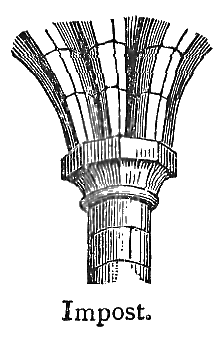
Impost, im′pōst, n. a tax, esp. on imports: (archit.) that part of a pillar in vaults and arches on which the weight of the building is laid. [O. Fr. impost (Fr. impôt)—L. imponĕre, to lay on.]
Imposthume, impos′tūm, n. an abscess.—v.i. Impos′thumāte, to form an imposthume or abscess.—v.t. to affect with an imposthume.—adj. affected with such.—n. one swelled or bloated.—n. Imposthumā′tion, the act of forming an abscess: an abscess. [A corr. of apostume, itself a corr. of aposteme—Gr. apostēma, a separation of corrupt matter—apo, away, and the root of histēmi, I set up.]
Impostor, im-pos′tur, n. one who practises imposition or fraud.—n. Impos′tūre.—adj. Impos′tūrous.
Impotent, im′po-tent, adj. powerless: without sexual power: wanting the power of self-restraint.—ns. Im′potence, Im′potency.—adv. Im′potently.
Impound, im-pownd′, v.t. to confine, as in a pound: to restrain within limits: to take possession of.—n. Impound′age, the act of impounding cattle.
Impoverish, im-pov′ėr-ish, v.t. to make poor: to exhaust the resources (as of a nation), or fertility (as of the soil).—n. Impov′erishment. [From O. Fr. empovrir (Fr. appauvrir)—L. in, in, pauper, poor.]
Impracticable, im-prak′tik-a-bl, adj. not able to be done: unmanageable: stubborn.—ns. Imprac′ticability, Imprac′ticableness.—adv. Imprac′ticably.
Imprecate, im′pre-kāt, v.t. to pray for good or evil upon: to curse.—n. Imprecā′tion, the act of imprecating: a curse.—adj. Im′precatory. [L. imprecāri—in, upon, precāri, -ātus, to pray.]
Impregn, im-prēn′, v.t. (Milt.) to impregnate.
Impregnable, im-preg′na-bl, adj. that cannot be seized: that cannot be moved.—n. Impregnabil′ity.—adv. Impreg′nably. [Fr. imprenable—L. in, not, prendĕre, prehendĕre, to take.]
Impregnate, im-preg′nāt, v.t. to make pregnant: to impart the particles or qualities of one thing to another: saturate.—n. Impregnā′tion, the act of impregnating: that with which anything is impregnated. [Low L. imprægnāre, -ātum—in, in, prægnans, pregnant.]
Impresario, im-pre-sä′ri-ō, n. a manager or conductor of a troupe of concert or operatic singers. [It.,—impresa, enterprise.]
Imprescriptible, im-pre-skrip′ti-bl, adj. not founded on external authority.—n. Imprescriptibil′ity.
Imprese, im-prēs′, Impress, im-pres′, n. (Milt.) a device worn by a noble or his retainers. [O. Fr.]
Impress, im-pres′, v.t. to press upon: to mark by pressure: to produce by pressure: to stamp: to fix deeply in the mind.—ns. Im′press, that which is made by pressure: stamp: likeness; Impressibil′ity.—adj. Impress′ible, susceptible.—n. Impress′ibleness.—adv. Impress′ibly.—ns. Impress′ion, the act or result of impressing: a single edition of a book: the effect of any object on the mind: idea: slight remembrance; Impressionabil′ity.—adj. Impress′ionable, able to receive an impression.—ns. Impress′ionism, a modern movement in art and literature, originating in France, its aim being to cast off the trammels of artistic tradition, and to look at nature in a fresh and original manner—it employs general effects, vigorous touches, and deals in masses of form and colour; Impress′ionist.—adv. Impressionis′tic.—adj. Impress′ive, capable of making an impression on the mind: solemn.—adv. Impress′ively—ns. Impress′iveness; Impress′ure (Shak.), impression.
Impress, im-pres′, v.t. to force into service, esp. the public service.—n. Im′press. [An altered spelling of imprest.]
Impressment, im-pres′ment, n. the act of impressing or seizing for service, esp. in the navy. [A word coined from press, in pressgang.]
Imprest, im′prest, n. earnest-money: money advanced.—v.t. Imprest′, to advance on loan.
Imprimatur, im-pri-mā′tur, n. a license to print a book, &c. [Lit. 'let it be printed;' from L. imprimĕre—in, on, premĕre, to press.]
Imprimis, im-prī′mis, adv. in the first place. [L., in, in, primus, first.]
Imprint, im-print′, v.t. to print: to stamp: to impress: to fix in the mind.—n. Im′print, that which is imprinted: the name of the publisher, time and place of publication of a book, &c., printed on the title-page: also the printer's name on the back of the title-page and at the end of the book.
Imprison, im-priz′n, v.t. to put in prison: to shut up: to confine or restrain.—n. Impris′onment, the act of imprisoning or state of being imprisoned: confinement or restraint.
Improbable, im-prob′a-bl, adj. unlikely.—n. Improbabil′ity.—adv. Improb′ably.
Improbation, im-pro-bā′shun, n. in Scots law, an action for the purpose of declaring some instrument false or forged.—adj. Improb′ative, disapproving—also Improb′atory.
Improbity, im-prob′i-ti, n. want of probity.
Impromptu, im-promp′tū, adj. prompt, ready: off-hand.—adv. readily.—n. a short witty saying expressed at the moment: any composition produced at the moment. [L., 'in readiness'—in, in, promptus, readiness.]
Improper, im-prop′ėr, adj. not suitable: unfit: unbecoming: incorrect: wrong.—adv. Improp′erly.—n. Improprī′ety.
Impropriate, im-prō′pri-āt, v.t. to appropriate to private use: to place ecclesiastical property in the hands of a layman.—adj. Imprō′priate, devolved into the hands of a layman.—ns. Impropriā′tion, act of appropriating: property impropriated; Imprō′priator, a layman who holds possession of the lands of the Church or an ecclesiastical living. [Low L. impropriātus—L. in, in, proprius, one's own.]
Improve, im-prōōv′, v.t. to make better: to advance in value or excellence: to correct: to employ to good purpose.—v.i. to grow better: to make progress: to increase: to rise (as prices).—ns. Improvabil′ity, Improv′ableness.—adj. Improv′able, able to be improved.—adv. Improv′ably.—ns. Improve′ment, the act of improving: advancement or progress: increase, addition; Improv′er, one who improves: a pad worn by women to make the dress hang properly.—pr.p. and adj. Improv′ing, tending to cause improvement.—adv. Improv′ingly.—Improve on, or upon, to bring to a better state by addition or amendment; Improve the occasion, to point out a moral from some event that has just occurred. [A variant of approve.]
Improvident, im-prov′i-dent, adj. not provident or prudent: wanting foresight: thoughtless.—adj. Improvide′ (Spens.), not provided against.—n. Improv′idence.—adv. Improv′idently.
Improvisate, im-prov′i-sāt, Improvise, im-pro-vīz′, v.t. to compose and recite, esp. in verse, without preparation: to bring about on a sudden: to do anything off-hand.—ns. Improvisā′tion, act of improvising: that which is improvised; Improvisā′tor, Improvisatō′re (-rā), sometimes fem. Improvisā′trix, Improvisatri′ce, one who improvises: one who composes and recites verses without preparation:—pl. Improvisatō′ri (-rē).—adjs. Improvisatō′rial, Improvis′atory.—n. Improvīs′er.—adj. Improvī′so, not studied beforehand. [Fr. improviser—L. in, not, provisus, foreseen.]
Imprudent, im-prōō′dent, adj. wanting foresight or discretion: incautious: inconsiderate.—n. Impru′dence.—adv. Impru′dently.
Impudent, im′pū-dent, adj. wanting shame or modesty: brazen-faced: bold: rude: insolent.—n. Im′pudence.—adv. Im′pudently.—n. Impudic′ity. [L. in, not, pudens, -entis—pudēre, to be ashamed.]
Impugn, im-pūn′, v.t. to oppose: to attack by words or arguments: to call in question.—adj. Impugn′able.—ns. Impugn′er; Impugn′ment. [L. impugnāre—in, against, pugnāre, to fight.]
Impuissant, im-pū′i-sant, adj. powerless.—n. Impū′issance.
Impulse, im′puls, n. the act of impelling: effect of an impelling force: force suddenly communicated: influence on the mind.—n. Impul′sion, impelling force: instigation.—adj. Impuls′ive, having the power of impelling: actuated by mental impulse: (mech.) acting by impulse: not continuous.—adv. Impuls′ively.—n. Impuls′iveness. [L. impulsus, pressure—impellĕre.]
Impunity, im-pūn′i-ti, n. freedom or safety from punishment: exemption from injury or loss. [Fr.,—L. impunitat-em—in, not, pœna, punishment.]
Impure, im-pūr′, adj. mixed with other substances: defiled by sin: unholy: unchaste: unclean.—adv. Impure′ly.—ns. Impur′ity, Impure′ness, quality of being impure.
Impurple, im-pur′pl. Same as Empurple.
Impute, im-pūt′, v.t. to reckon as belonging to (in a bad sense): to charge: (theol.) to attribute vicariously: (rare) to take account of.—adj. Imput′able, capable of being imputed or charged: attributable.—ns. Imput′ableness, Imputabil′ity.—adv. Imput′ably.—n. Imputā′tion, act of imputing or charging: censure: reproach: the reckoning as belonging to.—adjs. Imput′ative, imputed; Imput′atively.—n. Imput′er. [Fr. imputer—L. imputāre, -ātum—in, in, putāre, to reckon.]
In, in, prep. denotes presence or situation in place, time, or circumstances—within, during: consisting of: because of: by or through.—adv. within: not out: in addition to, thrown in.—n. in politics, a member of the party in office: a corner.—adj. In′-and-in′, from animals of the same parentage: with constant and close interaction.—n. a game with four dice.—In as far as, to the extent that; In as much as, Inasmuch as, considering that; In itself, intrinsically, apart from relations; In that, for the reason that.—Ins and outs, nooks and corners: the whole details of any matter.—Be in for a thing, to be destined to receive a thing; Be in it (slang), to be getting on successfully, esp. in a game; Be in with, to have intimacy or familiarity with. [A.S. in; Dut., Ger. in, Ice. í; W. yn, L. in, Gr. en. A.S. also had innan, within; cf. Old High Ger. innana, Sw. innan. In A.S. the prep. in was often interchangeable with the related on.]
Inability, in-a-bil′i-ti, n. want of sufficient power: incapacity.
Inabstinence, in-ab′sti-nens, n. want of abstinence.
Inaccessible, in-ak-ses′i-bl, adj. not to be reached, obtained, or approached.—ns. Inaccess′ibility, Inaccess′ibleness.—adv. Inaccess′ibly.
Inaccurate, in-ak′kūr-āt, adj. not exact or correct: erroneous.—n. Inac′curacy, want of exactness: mistake.—adv. Inac′curately.
Inactive, in-akt′iv, adj. having no power to move: idle: lazy: (chem.) not showing any action.—n. Inac′tion, idleness: rest.—adv. Inact′ively.—n. Inactiv′ity, idleness.
Inadaptable, in-a-dap′ta-bl, adj. that cannot be adapted.—n. Inadaptā′tion.—adj. Inadap′tive.
Inadequate, in-ad′e-kwāt, adj. insufficient.—ns. Inad′equacy, Inad′equateness, insufficiency.—adv. Inad′equately.
Inadmissible, in-ad-mis′i-bl, adj. not allowable.—n. Inadmissibil′ity.—adv. Inadmiss′ibly.
Inadvertent, in-ad-vėrt′ent, adj. inattentive.—ns. Inadvert′ence, Inadvert′ency, negligence: oversight.—adv. Inadvert′ently.
Inaidable, in-ād′a-bl, adj. (Shak.) that cannot be aided.
Inalienable, in-āl′yen-a-bl, adj. not capable of being transferred.—ns. Inalienabil′ity, Inal′ienableness.—adv. Inal′ienably.
Inalterable, in-awl′ter-a-bl, adj. unalterable.—n. Inalterabil′ity.
Inamorata, in-am-o-rä′ta, n.fem. a woman with whom one is in love:—masc. Inamora′to. [It. innamorata—Low L. inamorāre, to cause to love—L. in, in, amor, love.]
Inane, in-ān′, adj. empty, void: void of intelligence: useless.—ns. Inani′tion, exhaustion from want of food; Inan′ity, senselessness: worthlessness: any kind of vain frivolity. [L. inanis.]
Inanimate, -d, in-an′im-āt, -ed, adj. without animation or life: dead: spiritless: dull.—ns. Inan′imateness, Inanimā′tion.
Inappeasable, in-ap-pēz′a-bl, adj. that cannot be appeased.
Inapplicable, in-ap′plik-a-bl, adj. not applicable or suitable.—ns. Inapplicabil′ity, Inap′plicableness.
Inapposite, in-ap′poz-it, adj. not apposite, suitable, or pertinent.—adv. Inap′positely.
Inappreciable, in-ap-prē′shi-a-bl, adj. not appreciable or able to be valued.—adj. Inapprē′ciātive, not valuing justly or at all.
Inapprehensible, in-ap-pre-hen′si-bl, adj. not apprehensible or intelligible.—n. Inapprehen′sion.—adj. Inapprehen′sive.
Inapproachable, in-ap-prōch′a-bl, adj. inaccessible.—adv. Inapproach′ably.
Inappropriate, in-ap-prō′pri-āt, adj. not suitable.—adv. Inapprō′priately.—n. Inapprō′priateness.
Inapt, in-apt′, adj. not apt: unfit, or unqualified.—ns. Inapt′itude, Inapt′ness, unfitness, awkwardness.—adv. Inapt′ly.
Inarable, in-ar′a-bl, adj. not arable.
Inarching, in-ärch′ing, n. a method of grafting by uniting, without separating from the original stem.—Also Enarch′ing.
Inarm, in-ärm′, v.t. to encircle.
Inarticulate, in-är-tik′ūl-āt, adj. not distinct, incapable of speaking distinctly: (zool.) not jointed.—adv. Inartic′ulately.—ns. Inartic′ulateness, Inarticulā′tion, indistinctness of sounds in speaking.
Inartificial, in-ärt-i-fish′yal, adj. not done by art: simple.—adv. Inartific′ially.
Inartistic, -al, in-ar-tis′tik, -al, adj. not artistic: deficient in appreciation of works of art.—adv. Inartis′tically.
Inasmuch, in-az-much′. See In.
Inattentive, in-at-tent′iv, adj. careless, not fixing the mind to attention.—ns. Inatten′tion, Inattent′iveness.—adv. Inattent′ively.
Inaudible, in-awd′i-bl, adj. not able to be heard.—ns. Inaudibil′ity, Inaud′ibleness.—adv. Inaud′ibly.
Inaugurate, in-aw′gūr-āt, v.t. to induct formally into an office: to cause to begin: to make a public exhibition of for the first time.—adjs. Inau′gural, Inau′gurātory, pertaining to, or done at, an inauguration.—ns. Inaugurā′tion, act of inaugurating; Inau′gurātor, one who inaugurates.—adj. Inau′guratory. [L. inaugurāre, -ātum.]
Inaurate, in-aw′rāt, adj. having a golden lustre: covered with gold.
Inauspicious, in-aw-spish′us, adj. not auspicious: ill-omened: unlucky.—adv. Inauspic′iously.—n. Inauspic′iousness.
Inbeing, in′bē-ing, n. inherent existence.
Inboard, in′bōrd, adv. within the hull or interior of a ship: toward or nearer to the centre.
Inbond, in′bond, adj. laid with its length across the thickness of a wall:—opp. to Outbond, where the brick or stone is laid with its length parallel to the face of the wall.
Inborn, in′bawrn, adj. born in or with: implanted by nature.
Inbreak, in′brāk, n. a violent rush in: irruption:—opp. to Outbreak.
Inbreathe, in′brēth, v.t. to breathe into.
Inbreed, in-brēd′, v.t. to breed or generate within: to breed in-and-in.—pa.p. In′bred, bred within, inherent, intrinsic.
Inburning, in′burn-ing, adj. (Spens.) burning within.
Inburst, in′burst, n. an irruption:—opp. to Outburst.
Inby, Inbye, in-bī′, adv. (Scot.) toward the interior, as of a house from the door, or a mine from the shaft. [In and by.]
Inca, ing′ka, n. the name of the ancient kings and princes of Peru:—pl. Incas (ing′kaz). [Sp. inca—Peruvian inca.]
Incage, in-kāj′. Same as Encage.
Incalculable, in-kal′kū-la-bl, adj. not calculable or able to be reckoned.—ns. Incalculabil′ity, Incal′culableness.—adv. Incal′culably.
Incalescent, in-kal-es′ent, adj. growing warm.—n. Incalesc′ence. [L. incalescens, -entis, pr.p. of incalescĕre—in, in, calescĕre, inceptive of calēre, to be warm.]
Incameration, in-kam-ėr-ā′shun, n. the act of making over to a government a fund as a source of revenue, esp. an annexation to the papal exchequer. [L. in, in, camera, a chamber.]
Incandescent, in-kan-des′ent, adj. white or glowing with heat: rendered luminous by heat.—v.i. and v.t. to glow with heat, to cause to glow.—n. Incandesc′ence, a white heat.—Incandescent light, a brilliant white light produced by a resisting conductor under an electric current, or by coal-gas burnt under a mantle or hood of the oxide of didymium and others of the alkaline earths. [L.,—in, in, candescĕre—candēre, to glow.]
Incantation, in-kan-tā′shun, n. a formula of words said or sung in connection with certain ceremonies for purposes of enchantment.—n. In′cantātor.—adj. Incan′tatory. [L. incantation-em—incantāre, to sing a magical formula over.]
Incapable, in-kāp′a-bl, adj. not capable: insufficient, unable: lacking mental capacity: unconscious of: helplessly drunk: disqualified.—n. one lacking capacity.—n. Incapabil′ity.—adv. Incap′ably.
Incapacious, in-kap-ā′shus, adj. not large, narrow.—n. Incapā′ciousness.
Incapacitate, in-kap-as′i-tāt, v.t. to deprive of capacity: to make incapable: to disqualify.—ns. Incapacitā′tion, the act of disqualifying; Incapac′ity, want of capacity or power of mind: inability: legal disqualification.
Incarcerate, in-kär′sėr-āt, v.t. to imprison: to confine.—n. Incarcerā′tion, imprisonment: (surg.) obstinate constriction or strangulation. [L. in, in, carcer, a prison.]
Incardinate, in-kar′di-nāt, v.t. to attach as a cardinal part, as a priest to his church.—adj. a perversion of incarnate.
Incarnadine, in-kär′na-din, v.t. to dye of a red colour.—adj. carnation-coloured.
Incarnate, in-kär′nāt, v.t. to embody in flesh.—v.i. to form flesh, heal.—adj. invested with flesh.—n. Incarnā′tion, act of embodying in flesh: (theol.) the union of the divine nature with the human in the divine person of Christ: an incarnate form: manifestation, visible embodiment: (surg.) the process of healing, or forming new flesh. [Low. L. incarnāre, -ātum—L. in, in, caro, carnis, flesh.]
Incase, Incasement. See Encase, Encasement.
Incast, in′käst, n. something thrown in in addition by way of giving good measure.
Incatenation, in-ka-te-nā′shun, n. the act of chaining and linking together.
Incautious, in-kaw′shus, adj. not cautious or careful.—ns. Incau′tion, Incau′tiousness, want of caution.—adv. Incau′tiously.
Incavo, in-kä′vō, n. the incised part in an intaglio. [It.,—L. in, in, cavus, hollow.]
Incedingly, in-sēd′ing-li, adv. (rare) triumphantly. [L. incedĕre, to march along.]
Incelebrity, in-sel-eb′ri-ti, n. lack of celebrity.
Incendiary, in-sen′di-ar-i, n. one that sets fire to a building, &c., maliciously: one who promotes quarrels:—pl. Incen′diaries.—adj. wilfully setting fire to: relating to incendiarism: tending to excite quarrels.—n. Incen′diarism.—adj. Incend′ious (obs.), promoting faction. [L. incendiarius—incendium—incendĕre, incensum, to kindle.]
Incense, in-sens′, v.t. to inflame with anger: to incite, urge: to perfume with incense.—n. In′cense, odour of spices burned in religious rites: the materials so burned: pleasing perfume: (fig.) homage, adulation.—adj. In′cense-breath′ing, exhaling incense or fragrance.—ns. Incense′ment (Shak.), state of being inflamed with anger; Incens′or (obs.), a censer.
Incentive, in-sent′iv, adj. inciting, encouraging: (Milt.) igniting.—n. that which incites to action or moves the mind: motive. [L. incentivus, striking up a tune—incinĕre—in, in, canĕre, to sing.]
Inception, in-sep′shun, n. a beginning.—v.i. Incept′, to commence, esp. the period of candidature for the degree of master of arts, or a period of licensed teaching.—adj. Incep′tive, beginning or marking the beginning.—adv. Incep′tively, in a manner denoting beginning.—n. Incep′tor. [L. inceptionem—incipĕre, inceptum, to begin—in, on, capĕre, to take.]
Incertain, in-ser′tān, adj. uncertain.—ns. Incer′tainty, Incer′titude, want of certainty.
Incessant, in-ses′ant, adj. uninterrupted: continual.—adv. Incess′antly, unceasingly: (obs.) immediately. [L. incessans, -antis—in, not, cessāre, to cease.]
Incest, in′sest, n. sexual intercourse within the prohibited degrees of kindred.—adj. Incest′ūous, guilty of incest.—adv. Incest′uously.—n. Incest′uousness. [Fr.,—L. incestus—in, not, castus, chaste.]
Inch, insh, n. the twelfth part of a foot: proverbially, a small distance or degree: (Shak.) a critical moment.—v.i. to move by slow degrees.—adj. Inched, containing inches: marked with inches.—adv. Inch′meal, by inches or small degrees: gradually.—Inch by inch, By inches, by small degrees; Every inch, entirely, thoroughly. [A.S. ynce, an inch—L. uncia, the twelfth part of anything, an inch, also an ounce (twelfth of a pound).]
Inch, insh, n. an island. [Gael, innis, an island.]
Inchase, in-chās′. See Enchase.
Inchoate, in′kō-āt, adj. only begun: unfinished, rudimentary: not established.—v.t. (Browning) to begin.—adv. In′choately.—n. Inchoā′tion, beginning: rudimentary state.—adj. Inchō′ative, incipient. [L. inchoāre, -ātum, to begin.]
Incident, in′si-dent, adj. falling upon: liable to occur: naturally belonging to anything, or following therefrom.—n. that which happens: an event: a subordinate action: an episode.—n. In′cidence, the manner of falling: bearing or onus, as of a tax that falls unequally: the falling of a ray of heat, light, &c. on a body: (geom.) the falling of a point on a line, or a line on a plane.—adj. Incident′al, occurring as a result, concomitant: occasional, casual.—adv. Incident′ally.—n. Incident′alness.—Angle of incidence, the angle at which a ray of light or radiant heat falls upon a surface. [Fr.,—L. incĭdens—in, on, cadĕre, to fall.]
Incineration, in-sin-ėr-ā′shun, n. the act of reducing to ashes by combustion.—v.t. Incin′erate, to burn to ashes.—n. Incin′erator, a furnace for consuming anything. [L. incinerāre, -ātum—in, in, cinis, cineris, ashes.]
Incipient, in-sip′i-ent, adj. beginning.—ns. Incip′ience, Incip′iency.—adv. Incip′iently. [Pr.p. of L. incipĕre.]
Incise, in-siz′, v.t. to cut into: to cut or gash: to engrave.—adj. Incis′iform, shaped like an incisor-tooth.—n. Incis′ion, the act of cutting into a substance: a cut: a gash.—adj. Incī′sive, having the quality of cutting into: trenchant: acute: sarcastic.—adv. Incī′sively.—ns. Incī′siveness; Incī′sor, a cutting or fore tooth.—adjs. Incisō′rial, Incī′sory.—n. Incis′ure, a cut, incision. [Fr. inciser—L. incīdĕre, incisum—in, into, cædĕre, to cut.]
Incite, in-sīt′, v.t. to rouse: to move the mind to action: to encourage: to goad.—ns. Incit′ant, that which incites: a stimulant; Incitā′tion, the act of inciting or rousing: an incentive.—adj. and n. Incit′ative.—ns. Incite′ment; Incit′er.—adv. Incit′ingly. [Fr.,—L. incitāre—in, in, citāre, to rouse—ciēre, to put in motion.]
Incivil, in-siv′il, adj. (Shak.) uncivil.—n. Incivil′ity, want of civility or courtesy: impoliteness: an act of discourtesy (in this sense has a pl., Incivil′ities).
Incivism, in′si-vizm, n. neglect of one's duty as a citizen, conduct unbecoming a good citizen. [Fr.]
Inclasp, in-klasp′, v.t. to clasp to: to enclasp.
Inclave, in-klāv′, adj. (her.) shaped, or cut at the edge, like a series of dovetails, as the border of an ordinary.—adj. Inclavāt′ed, made fast, nailed. [L. in, in, clavus, a nail.]
Inclearing, in′klēr-ing, n. the total amount in cheques and bills of exchange chargeable to a bank by the Clearing-house:—opp. to Outclearing.
Inclement, in-klem′ent, adj. unmerciful: stormy: very cold: harsh: unpropitious.—n. Inclem′ency.—adv. Inclem′ently.
Incline, in-klīn′, v.i. to lean towards: to deviate from a line towards an object: to be disposed: to have some desire.—v.t. to cause to bend towards: to give a leaning to: to dispose: to bend.—n. an inclined plane: a regular ascent or descent.—adj. Inclin′able, leaning: tending: somewhat disposed.—ns. Inclin′ableness; Inclinā′tion, the act of bending towards: tendency, disposition of mind: natural aptness: favourable disposition, preference, affection: act of bowing: angle between two lines or planes: the angle a line or plane makes with the horizon.—p.adj. Inclined′, bent.—pr.p. and n. Inclin′ing, inclination: (Shak.) side, party.—n. Inclinom′eter, an instrument for measuring the vertical element of the magnetic force.—Inclined plane, one of the so-called mechanical powers, a slope or plane up which may be rolled a weight one could not lift. [Fr.,—L. inclināre—in, towards, clināre, to lean.]
Inclip, in-klip′, v.t. (Shak.) to embrace, surround.
Inclose, Inclosure. See Enclose.
Incloud. See Encloud.
Include, in-klōōd′, v.t. to close or shut in: to embrace within limits: to contain: to comprise: (Shak.) to conclude.—adj. Includ′ible.—n. Inclū′sion, act of including: that which is included: restriction, limitation.—adj. Inclu′sive, shutting in: enclosing: (with of) comprehending the stated limit or extremes.—adv. Inclu′sively. [L. includĕre, inclusum—in, in, claudĕre, to shut.]
Incoercible, in-ko-ėrs′i-bl, adj. that cannot be liquefied by pressure, said of certain gases.
Incog, in-kog′, adv. an abbreviation of incognito.
Incogitable, in-koj′i-ta-bl, adj. unthinkable.—ns. Incogitabil′ity, Incog′itancy.—adjs. Incog′itant, Incog′itātive. [L. in, not, cogitāre, to think.]
Incognisable, Incognizable, in-kog′niz-a-bl, or in-kon′iz-a-bl, adj. that cannot be known or distinguished.—adjs. Incog′nisant, Incog′nizant, not cognisant.—n. Incog′nizance, failure to recognise.—n. Incognoscibil′ity.—adj. Incognos′cible.
Incognito, in-kog′ni-tō, adj. unknown: disguised: under an assumed title.—n. a man unknown (fem. Incog′nita): concealment. [It.,—L. incognitus—in, not, cognitus, known—cognoscĕre, to know.]
Incoherent, in-kō-hēr′ent, adj. not connected: loose: incongruous.—n. Incoher′ence, want of coherence or connection: incongruity.—adv. Incoher′ently.—n. Incohē′sion.
Incombustible, in-kom-bust′i-bl, adj. incapable of being consumed by fire.—ns. Incombustibil′ity, Incombust′ibleness.—adv. Incombust′ibly.
Income, in′kum, n. the gain, profit, or interest resulting from anything: revenue: (Shak.) arrival: (Scot.) a disease coming without known cause.—n.pl. In′come-bonds, a term applied to a bastard kind of security which has no mortgage rights, and is really only a sort of preference share.—ns. In′comer, one who comes in: one who takes possession of a farm, house, &c., or who comes to live in a place, not having been born there; In′come-tax, a tax directly levied on all persons having incomes above a certain amount.—adj. In′coming, coming in, as an occupant: accruing: (Scot.) ensuing, next to follow.—n. the act of coming in: revenue. [Eng. in and come.]
Incommensurable, in-kom-en′sū-ra-bl, adj. having no common measure.—ns. Incommensurabil′ity, Incommen′surableness.—adv. Incommen′surably.—adj. Incommen′surāte, not admitting of a common measure: not adequate: unequal.—adv. Incommen′surātely.—n. Incommen′surāteness, the state of being incommensurate.
Incommiscible, in-kom-is′i-bl, adj. that cannot be mixed together. [L. in, not, commiscēre, to mix.]
Incommode, in-kom-ōd′, v.t. to cause trouble or inconvenience to: to annoy: to molest.—adj. Incommō′dious, inconvenient: annoying.—adv. Incommō′diously.—ns. Incommō′diousness, the quality of being incommodious; Incommod′ity, anything which causes inconvenience. [Fr.,—L. incommodāre—incommodus, inconvenient—in, not, commodus, commodious.]
Incommunicable, in-kom-ūn′i-ka-bl, adj. that cannot be communicated or imparted to others.—ns. Incommunicabil′ity, Incommun′icableness.—adv. Incommun′icably.—adj. Incommun′icative, not disposed to hold communion with, or to give information: unsocial.—adv. Incommun′icatively.—n. Incommun′icativeness.
Incommutable, in-kom-ūt′a-bl, adj. that cannot be commuted or exchanged.—ns. Incommutabil′ity, Incommut′ableness.—adv. Incommut′ably.
Incomparable, in-kom′par-a-bl, adj. matchless.—ns. Incomparabil′ity, Incom′parableness.—adv. Incom′parably.—adj. Incompared′ (Spens.), peerless.
Incompatible, in-kom-pat′i-bl, adj. not consistent: contradictory: incapable of existing together in harmony: (pl.) things which cannot coexist.—ns. Incompatibil′ity, Incompat′ibleness.—adv. Incompat′ibly.
Incompetent, in-kom′pe-tent, adj. wanting adequate powers: wanting the proper legal qualifications: insufficient.—ns. Incom′petence, Incom′petency.—adv. Incom′petently.
Incomplete, in-kom-plēt′, adj. imperfect.—adv. Incomplete′ly.—ns. Incomplete′ness, Incomplē′tion.
Incompliance, in-kom-plī′ans, n. refusal to comply: an unaccommodating disposition.—adj. Incomplī′ant.
Incomposed, in-kom-pōzd′, adj. (Milt.) discomposed.
Incomposite, in-kom′poz-it, adj. simple.—Incomposite numbers, same as prime numbers (see Prime).
Incompossible, in-kom-pos′i-bl, adj. incapable of coexisting.—n. Incompossibil′ity.
Incomprehensible, in-kom-pre-hen′si-bl, adj. not capable of being understood: not to be contained within limits.—ns. Incomprehensibil′ity, Incomprehen′sibleness, Incomprehen′sion.—adv. Incomprehen′sibly.—adj. Incomprehen′sive, limited.—n. Incomprehen′siveness.
Incompressible, in-kom-pres′i-bl, adj. not to be compressed into smaller bulk.—ns. Incompressibil′ity, Incompress′ibleness.
Incomputable, in-kom-pūt′a-bl, adj. that cannot be computed or reckoned.
Inconceivable, in-kon-sēv′a-bl, adj. that cannot be conceived by the mind: incomprehensible: involving a contradiction in terms: physically impossible.—ns. Inconceivabil′ity, Inconceiv′ableness.—adv. Inconceiv′ably.
Inconcinnity, in-kon-sin′i-ti, n. want of congruousness or proportion.—adj. Inconcinn′ous. [L.]
Inconclusive, in-kon-klōōs′iv, adj. not settling a point in debate, indeterminate, indecisive.—adv. Inconclus′ively.—ns. Inconclus′iveness, Inconclu′sion.
Incondensable, in-kon-den′sa-bl, adj. not condensable.
Incondite, in-kon′dīt, adj. not well put together, irregular, unfinished. [L. inconditus—in, not, condĕre, conditum, to build.]
Incongruous, in-kong′grōō-us, adj. inconsistent: not fitting well together, disjointed: unsuitable—also Incon′gruent.—ns. Incongru′ity, Incon′gruousness.—adv. Incon′gruously.
Inconscient, in-kon′shi-ent, adj. unconscious.—adj. Incon′scious, unconscious.
Inconsecutive, in-kon-sek′ū-tiv, adj. not succeeding in regular order.—n. Inconsec′utiveness.
Inconsequent, in-kon′se-kwent, adj. not following from the premises: illogical: irrelevant: unreasonable, inconsistent.—n. Incon′sequence.—adj. Inconsequen′tial, not following from the premises: of no consequence or value.—advs. Inconsequen′tially, Incon′sequently.
Inconsiderable, in-kon-sid′ėr-a-bl, adj. not worthy of notice: unimportant.—n. Inconsid′erableness.—adv. Inconsid′erably.
Inconsiderate, in-kon-sid′ėr-āt, adj. not considerate: thoughtless: inattentive.—adv. Inconsid′erately.—ns. Inconsid′erateness, Inconsiderā′tion.
Inconsistent, in-kon-sist′ent, adj. not consistent: not suitable or agreeing with: intrinsically incompatible: self-contradictory: changeable, fickle.—ns. Inconsist′ence, Inconsist′ency.—adv. Inconsist′ently.
Inconsolable, in-kon-sōl′a-bl, adj. not to be comforted.—n. Inconsol′ableness.—adv. Inconsol′ably.
Inconsonant, in-kon′sō-nant, adj. not consonant.—n. Incon′sonance.—adv. Incon′sonantly.
Inconspicuous, in-kon-spik′ū-us, adj. not conspicuous: scarcely discernible.—adv. Inconspic′uously.—n. Inconspic′uousness.
Inconstant, in-kon′stant, adj. subject to change: fickle.—n. Incon′stancy.—adv. Incon′stantly.
Inconsumable, in-kon-sūm′a-bl, adj. that cannot be consumed or wasted.—adv. Inconsum′ably.
Incontestable, in-kon-test′a-bl, adj. too clear to be called in question: undeniable.—n. Incontestabil′ity.—adv. Incontest′ably.
Incontiguous, in-kon-tig′ū-us, adj. not adjoining or touching.—adv. Incontig′uously.—n. Incontig′uousness.
Incontinent, in-kon′ti-nent, adj. not restraining the passions or appetites: unchaste: (med.) unable to restrain natural discharges or evacuations: (coll.) immediate, off-hand.—adv. without delay: at once.—ns. Incon′tinence, Incon′tinency.—adv. Incon′tinently, without restraint: forthwith, immediately.
Incontrollable, in-kon-trō′la-bl, adj. uncontrollable.—adv. Incontrol′lably.
Incontrovertible, in-kon-tro-vėrt′i-bl, adj. too clear to be called in question.—n. Incontrovertibil′ity.—adv. Incontrovert′ibly.
Inconvenient, in-kon-vēn′yent, adj. unsuitable: causing trouble or uneasiness: increasing difficulty: incommodious.—v.t. Inconven′ience, to trouble or incommode.—ns. Inconven′ience, Inconven′iency.—adv. Inconven′iently.
Inconversable, in-kon-vers′a-bl, adj. indisposed to conversation, unsocial.
Inconversant, in-kon′ver-sant, adj. not versed in.
Inconvertible, in-kon-vėrt′i-bl, adj. that cannot be changed or exchanged.—n. Inconvertibil′ity.—adv. Inconvert′ibly.
Inconvincible, in-kon-vin′si-bl, adj. not capable of being convinced.
Incony, in′kon-i, adj. (Shak.) fine, delicate, pretty. [Prob. from Fr. inconnu, unknown—L. incognitus (see Incog). Cf. unco, in the sense of strange, rare, fine, abbreviated from uncouth.]
Inco-ordinate, in-ko-or′di-nāt, adj. not in co-ordinate relation.—n. Inco-ordinā′tion.
Incoronate, -d, in-kor′o-nāt, -ed, adj. crowned.
Incorporate, in-kor′po-rāt, v.t. to form into a body: to combine into one mass, or embody: to unite: to form into a corporation.—v.i. to unite into one mass: to become part of another body.—adj. united in one body: (rare) not having a material body.—n. Incorporā′tion, act of incorporating: state of being incorporated: formation of a legal or political body: an association: (gram.) polysynthesis.—adjs. Incor′porative, characterised by grammatical incorporation—also Polysynthetic; Incorpō′real, Incor′poral (Shak.), not having a body: spiritual: intangible.—ns. Incorpō′realism, Incorporē′ity, Incorporeal′ity.—adv. Incorpō′really.
Incorpse, in-korps′, v.t. (Shak.) to incorporate.
Incorrect, in-kor-ekt, adj. containing faults: not accurate: not correct in manner or character: (Shak.) not regulated.—adv. Incorrect′ly.—n. Incorrect′ness.
Incorrigible, in-kor′i-ji-bl, adj. and n. bad beyond correction or reform.—ns. Incorr′igibleness, Incorrigibil′ity.—adv. Incorr′igibly.
Incorrodible, in-ko-rō′di-bl, adj. incapable of being corroded.
Incorrupt, in-kor-upt′, adj. sound: pure: not depraved: not to be tempted by bribes.—adj. Incorrupt′ible, not capable of decay: that cannot be bribed: inflexibly just.—ns. Incorrupt′ibleness, Incorruptibil′ity.—adv. Incorrupt′ibly.—ns. Incorrup′tion, Incorrupt′ness.—adj. Incorrupt′ive.—adv. Incorrupt′ly.
Incrassate, in-kras′āt, v.t. to make thick.—v.i. (med.) to become thicker.—adj. made thick or fat: (bot.) becoming thick by degrees.—n. Incrassā′tion.—adj. Incrass′ative. [Low L. incrassāre, -ātum—L. in, in, crassāre, to make thick.]
Increase, in-krēs′, v.i. to grow in size: to become greater: to advance.—v.t. to make greater: to advance: to extend: to aggravate.—adj. Increas′able.—ns. Increas′ableness; In′crease, growth: addition to the original stock: profit: produce: progeny.—adj. Increase′ful (Shak.), abundant of produce.—adv. Increas′ingly, in the way of increase. [M. E. incresen—en (L. in), and O. Fr. creisser, croistre—L. crescĕre, to grow.]
Increate, in′kre-āt, adj. (arch.) uncreated.
Incredible, in-kred′i-bl, adj. surpassing belief.—ns. Incredibil′ity, quality of being incredible, an incredible thing; Incred′ibleness, incredibility.—adv. Incred′ibly.
Incredulous, in-kred′ū-lus, adj. hard of belief.—ns. Incredū′lity, Incred′ulousness.—adv. Incred′ulously.
Incremation, in-kre-mā′shun, n. the act of burning a dead body.—v.t. Incrē′mate, to burn. [L. in, in, cremāre, -ātum, to burn.]
Increment, in′kre-ment, n. act of increasing or becoming greater: growth: that by which anything is increased: (math.) the finite increase of a variable quantity: (rhet.) an adding of particulars without climax (see 2 Peter, i. 5-7): (gram.) a syllable in excess of the number of the nominative singular or the second pers. sing. present indicative.—adj. Increment′al.—Unearned increment, any exceptional increase in the value of land, houses, &c., not due to the owner's labour or outlay. [L. incrementum—increscĕre, to increase.]
Increscent, in-kres′ent, adj. increasing, growing (of the moon).
Incriminate, in-krim′in-āt, v.t. to charge with a crime or fault, to criminate: to characterise as criminal or as accessory to crime.—adj. Incrim′inātory.
Incrust. See Encrust.
Incubate, in′kū-bāt, v.i. to sit on eggs to hatch them.—v.t. to produce by hatching: (fig.) to turn over in the mind, ponder over.—n. Incubā′tion, the act of sitting on eggs to hatch them: (fig.) meditation on schemes: (med.) the period between the implanting of a disease and its development.—adjs. In′cubātive, Incubā′tory.—n. In′cubātor, a machine for hatching eggs by artificial heat. [L. incubāre, -ātum—in, upon, cubāre, to lie.]
Incubus, in′kū-bus, n. the nightmare: a male demon formerly supposed to consort with women in their sleep: any oppressive or stupefying influence:—pl. In′cubuses, Incubi (in′kū-bī). [L. incubāre—in, upon, cubāre, to lie.]
Inculcate, in-kul′kāt, v.t. to enforce by frequent admonitions or repetitions.—ns. Inculcā′tion; Incul′cātor. [L. inculcāre, -ātum—in, into, calcāre, to tread—calx, the heel.]
Inculpable, in-kul′pa-bl, adj. blameless.—adv. Incul′pably.—v.t. Incul′pate, to bring into blame: to censure.—n. Inculpā′tion.—adj. Incul′patory. [Low L. inculpāre, -ātum—L. in, in, culpa, a fault.]
Incult, in-kult′, adj. (rare) uncultivated.
Incumbent, in-kum′bent, adj. lying or resting on: lying on as a duty.—n. one who holds an ecclesiastical benefice.—n. Incum′bency, a lying or resting on: the holding of an office: an ecclesiastical benefice.—adv. Incum′bently. [L. incumbens, -entis, pr.p. of incumbĕre, to lie upon.]
Incunabula, in-kū-nab′ū-la, n.pl. books printed in the early period of the art, before the year 1500: the cradle, birthplace, origin of a thing. [L. in, in, cunabula, a cradle, dim. of cunæ, a cradle.]
Incur, in-kur′, v.t. to become liable to: to bring on:—pr.p. incur′ring; pa.p. incurred′. [L. incurrĕre, incursum—in, into, currĕre, to run.]
Incurable, in-kūr′a-bl, adj. not admitting of cure or correction.—n. one beyond cure.—ns. Incur′ableness, Incurabil′ity.—adv. Incur′ably.
Incurious, in-kū′ri-us, adj. not curious or inquisitive: inattentive: deficient in interest.—adv. Incū′riously.—ns. Incū′riousness, Incurios′ity.
Incursion, in-kur′shun, n. a hostile inroad.—adj. Incur′sive, making an incursion or inroad. [Fr.,—L. incursion-em—incurrĕre.]
Incurve, in-kurv′, v.t. to cause to curve inward.—v.i. to curve inward.—v.t. Incur′vāte, to turn from a straight course.—adj. curved inward or upward.—ns. Incurvā′tion, act of bending, bowing, kneeling, &c.: the growing inward of the nails; Incur′vature, any curving.—adj. Incurved′ (bot.), curving toward the axis of growth.—n. Incur′vity, the state of being bent inward.
Incus, in′kus, n. one of the bones in the tympanum or middle ear, so called from its fancied resemblance to an anvil:—pl. In′cūdes. [L., an anvil.]
Incuse, in-kūz′, v.t. to impress by stamping, as a coin.—adj. hammered.—n. an impression, a stamp. [L. incusus, pa.p. of incudĕre—in, on, cudĕre, to strike.]
Incut, in′kut, adj. set in by, or as if by, cutting, esp. in printing, inserted in spaces left in the text.
Indagate, in′da-gāt, v.t. to search out.—n. Indagā′tion.—adj. In′dagātive.—n. In′dagātor.—adj. In′dagātory. [L. indagāre, -ātum, to trace.]
Indart, in-därt′, v.t. (Shak.) to dart or strike in.
Indebted, in-det′ed, adj. being in debt: obliged by something received.—ns. Indebt′edness, Indebt′ment.
Indecent, in-dē′sent, adj. offensive to common modesty: unbecoming: gross, obscene.—n. Indē′cency, quality of being indecent: anything violating modesty or seemliness.—adv. Indē′cently.
Indeciduous, in-de-sid′ū-us, adj. not deciduous, as leaves.—Also Indecid′uate.
Indecipherable, in-de-sī′fer-a-bl, adj. incapable of being deciphered.
Indecision, in-de-sizh′un, n. want of decision or resolution: hesitation.—adj. Indecī′sive, unsettled: inconclusive.—adv. Indecī′sively.—n. Indecī′siveness.
Indeclinable, in-de-klīn′a-bl, adj. (gram.) not varied by inflection.—adv. Indeclin′ably.
Indecomposable, in-de-kom-pōz′a-bl, adj. that cannot be decomposed.
Indecorous, in-de-kō′rus (sometimes in-dek′ō-rus), adj. not becoming; violating good manners.—adv. Indecō′rously.—ns. Indecō′rousness, Indecō′rum, want of propriety of conduct: a breach of decorum.
Indeed, in-dēd′, adv. in fact: in truth: in reality. It emphasises an affirmation, marks a qualifying word or clause, a concession or admission, or, used as an interj., it expresses surprise or interrogation.
Indefatigable, in-de-fat′i-ga-bl, adj. that cannot be fatigued or wearied out: unremitting in effort.—n. Indefat′igableness.—adv. Indefat′igably. [Fr.,—L. indefatigabilis—in, not, de, fatigāre, to tire.]
Indefeasible, in-de-fēz′i-bl, adj. not to be defeated or made void.—n. Indefeasibil′ity.—adv. Indefeas′ibly.
Indefectible, in-de-fekt′i-bl, adj. incapable of defect: unfailing.
Indefensible, in-de-fens′i-bl, adj. untenable, that cannot be maintained or justified.—adv. Indefens′ibly.
Indefinable, in-de-fīn′a-bl, adj. that cannot be defined.—adv. Indefin′ably.
Indefinite, in-def′i-nit, adj. not limited: not precise or certain: (logic) indeterminate in logical quantity.—adv. Indef′initely.—n. Indef′initeness.
Indelible, in-del′i-bl, adj. that cannot be blotted out or effaced.—ns. Indelibil′ity, Indel′ibleness.—adv. Indel′ibly. [Fr.,—L. in, not, delebilis—delēre, to destroy.]
Indelicate, in-del′i-kāt, adj. offensive to good manners or purity of mind: coarse.--n. Indel′icacy.—adv. Indel′icately.
Indemnify, in-dem′ni-fī, v.t. (with against) to secure against loss: to make good for damage done: to give security against:—pa.p. indem′nified.—ns. Indemnificā′tion, act of indemnifying: that which indemnifies; Indem′nitor, one who indemnifies; Indem′nity, security from damage, loss, or punishment: compensation for loss or injury.—Act of Indemnity, an act or decree for the protection of public officers from any technical or legal penalties or liabilities they may have been compelled to incur. [Fr.,—L. indemnis, unharmed—in, not, damnum, loss, facĕre, to make.]
Indemonstrable, in-de-mon′stra-bl, adj. that cannot be demonstrated or proved.—n. Indemonstrabil′ity.
Indent, in-dent′, v.t. to cut into points like teeth: to notch: to indenture, apprentice: (print.) to begin farther in from the margin than the rest of a paragraph.—v.i. (Shak.) to move in a zigzag course: to bargain: to make a compact.—n. a cut or notch in the margin: a recess like a notch.—n. Indentā′tion, a hollow or depression: act of indenting or notching: notch: recess.—pa.p. and adj. Indent′ed, having indentations: serrated: zigzag.—ns. Inden′tion (print.), any space left before the beginning of lines, as in poetry; Indent′ure, the act of indenting, indentation: (law) a deed under seal, with mutual covenants, where the edge is indented for future identification: a written agreement between two or more parties: a contract.—v.t. to bind by indentures: to indent. [Low L. indentāre—L. in, in, dens, dentis, a tooth.]
Independent, in-de-pend′ent, adj. (with of) not dependent or relying on others: not subordinate: not subject to bias: affording a comfortable livelihood: belonging to the Independents: (gram.) of some parts of speech (noun, pronoun, verb), capable of forming sentences without the others.—n. one who in ecclesiastical affairs holds that every congregation should be independent of every other and subject to no superior authority—a Congregationalist: (math.) not depending on another for its value, said of a quantity or function.—ns. Independ′ence, Independ′ency.—adv. Independ′ently.—Declaration of Independence, the document embodying the reasons for the secession of the thirteen colonies of America from England, reported to the Continental Congress, July 4, 1776—observed in the United States as a legal holiday—Independence Day.
Indescribable, in-de-skrīb′a-bl, adj. that cannot be described: (pl.) applied facetiously to trousers.—adv. Indescrib′ably.
Indesignate, in-des′ig-nāt, adj. (logic) without any indication of quantity.
Indestructible, in-de-struk′ti-bl, adj. that cannot be destroyed.—ns. Indestructibil′ity, Indestruc′tibleness.—adv. Indestruc′tibly.
Indeterminable, in-de-tėr′min-a-bl, adj. not to be ascertained or fixed: (nat. hist.) not to be classified or fixed.—n. Indeter′minableness.—adv. Indeter′minably.—adj. Indeter′mināte, not determinate or fixed: uncertain: having no defined or fixed value.—adv. Indeter′minātely.—ns. Indeter′mināteness, Indeterminā′tion, want of determination: want of fixed direction.—adj. Indeter′mined, not determined: unsettled.
Index, in′deks, n. anything that indicates or points out: a hand that directs to anything, as the hour of the day, &c.: the forefinger: alphabetical list of subjects treated of in a book: (math.) the exponent of a power:—pl. Indexes (in′deks-ez), and in math., Indices (in′di-sēz).—v.t. to provide with or place in an index.—ns. In′dex-dig′it, In′dex-fing′er, the forefinger, or in other animals that digit representing the human index.—adjs. Index′ical; In′dexless, without an index.—Index Expurgatorius, in the R.C. Church, an authoritative list of books only to be read in expurgated editions; Index Librorum Expurgandorum, or Index Librorum Prohibitorum, an official list of books which the faithful are absolutely forbidden to read at all under pain of instant excommunication; Index rerum, an index of subjects; Index verborum, an index of words. [L. index, indicis—indicāre, to show.]
Indexterity, in-deks-ter′i-ti, n. want of dexterity.
Indian, in′di-an, adj. belonging to the Indies, East or West, or to the aborigines of America.—n. a native of the Indies: a European who lives or has lived in India: an aboriginal of America.—ns. In′diaman, a large ship employed in trade, with India; In′dia-rub′ber, an elastic gummy substance, the inspissated juice of various tropical plants, extensively used in the arts: caoutchouc.—adj. In′dic, originating or existing in India, a term comprehensively applied to all the Aryan languages of India.—Indian berry, a climbing Indian shrub, its fruit Cocculus Indicus; Indian club, a bottle-shaped block of wood, swung in various motions by the arms with the view of developing the muscles of these and of the chest, &c.; Indian corn, maize, so called because brought from the West Indies; Indian cress, an ornamental garden shrub from Peru, with orange flowers; Indian file (see File); Indian fire, a pyrotechnic composition, used as a signal-light, consisting of sulphur, realgar, and nitre; Indian red (see Red); Indian summer, in America, a period of warm, dry, calm weather in late autumn, with hazy atmosphere.—India Docks, extensive docks in London for the accommodation of vessels engaged in the West and East India trade; India ink (see Ink); India Office, a government office in London, where are managed the affairs of the Indian government; India paper, a thin yellowish printing-paper made in China and Japan from vegetable fibre, and used in taking the finest proofs from engraved plates—hence called India proofs; India shawl, a Cashmere shawl.—East India Company, a great chartered company formed for trading with India and the East Indies, more especially applied to the English Company, incorporated in 1600 and abolished in 1858; East Indian, an inhabitant or a native of the East Indies; Red Indian, one of the aborigines of America, so called from the colour of the skin—(coll.) in U.S. Injen, Injun; West Indian, a native or an inhabitant of the West Indies. [L. India—Indus (Gr. Indos), the Indus (Pers. Hind. Hind; Zend Hindu)—Sans. sindhu, a river.]
Indicate, in′di-kāt, v.t. to point out: to show: to give as a ground for inferring.—adj. In′dicant, indicating.—n. that which indicates.—n. Indicā′tion, act of indicating: mark: token: symptom.—adj. Indic′ative, pointing out: giving intimation of: (gram.) applied to the mood of the verb which affirms or denies.—adv. Indic′atively.—n. In′dicātor, one who indicates: an instrument on a steam-engine to show the pressure.—adj. In′dicātory, showing. [L. indicāre, -ātum—in, in, dicāre, to proclaim.]
Indict, in-dīt′, v.t. to charge with a crime formally or in writing, esp. by a grand-jury.—adj. Indict′able.—ns. Indictee′, one who is indicted; Indict′ment, formal accusation: the written accusation against one who is to be tried by jury: (Scots law) the form under which a criminal is put to trial at the instance of the Lord Advocate.—Find an indictment, said of the grand-jury when they are satisfied of the truth of the accusation, and endorse the bill, A true bill. [L. indictāre, freq. of indicĕre, indictum, to declare—in, in, dicĕre, to say.]
Indiction, in-dik′shun, n. a proclamation: a cycle of fifteen years, instituted by Constantine the Great for fiscal purposes, and adopted by the popes as part of their chronological system: a year bearing a number showing its place in a fifteen years' cycle, dating from 313 A.D.
Indifferent, in-dif′ėr-ent, adj. without importance: uninteresting: of a middle quality: neutral: unconcerned.—n. one who is indifferent or apathetic: that which is indifferent.—ns. Indiff′erence, Indiff′erency, Indiff′erentism, indifference: (theol.) the doctrine that religious differences are of no moment: (metaph.) the doctrine of absolute identity—i.e. that to be in thought and to exist are one and the same thing; Indiff′erentist.—adv. Indiff′erently, in an indifferent manner: tolerably: passably: without distinction, impartially.
Indigenous, in-dij′en-us, adj. native born or originating in: produced naturally in a country.—adj. and n. In′digene.—adv. Indig′enously. [L. indigena, a native—indu, or in, and gen-, root of gignĕre, to produce.]
Indigent, in′di-jent, adj. in need of anything: destitute of means of subsistence: poor.—n. In′digence.—adv. In′digently. [Fr.,—L. indigens, -entis, pr.p. of indigĕre—indu, or in, in, egēre, to need.]
Indigest, in-di-jest′, adj. not digested, shapeless.—n. a crude mass, disordered state of affairs.—adj. Indigest′ed, not digested: unarranged: not methodised.—ns. Indigestibil′ity, Indigest′ion, want of digestion: painful digestion.—adj. Indigest′ible, not digestible: not easily digested: not to be received or patiently endured.—adv. Indigest′ibly.—adj. Indigest′ive, dyspeptic. [L. indigestus, unarranged—in, not, digerĕre, to arrange, digest.]
Indign, in-dīn′, adj. not worthy: disgraceful. [L. in, not, dignus, worthy.]
Indignant, in-dig′nant, adj. affected with anger and disdain.—n. Indig′nance (Spens.).—adv. Indig′nantly.—n. Indignā′tion, the feeling caused by what is unworthy or base: anger mixed with contempt: effect of indignant feeling.—v.t. Indig′nify (Spens.), to treat indignantly or disdainfully.—n. Indig′nity, unmerited contemptuous treatment: incivility with contempt or insult: (Spens.) unworthiness, base conduct. [L. indignans, -antis, pr.p. of indignāri, to consider as unworthy—in, not, dignus, worthy.]
Indigo, in′di-go, n. a blue dye obtained from the stalks of the indigo plant.—Indigo blue, the blue colouring matter of indigo, a crystalline solid, colourless and tasteless; Indigo plant, a plant of the genus Indigofera, from which indigo is obtained. [Sp. indico—L. indicum, from Indicus, Indian.]
Indirect, in-di-rekt′, adj. not direct or straight: not lineal or in direct succession: not related in the natural way, oblique: not straightforward or honest.—adv. Indirect′ly.—ns. Indirect′ness, Indirec′tion (Shak.), indirect course or means, dishonest practice.—Indirect evidence, or testimony, circumstantial or inferential evidence; Indirect object (gram.), a substantive word dependent on a verb less immediately than an accusative governed by it; Indirect syllogism (logic), a syllogism which can be made more cogent and useful by the process called reduction.
Indiscernible, in-diz-ėrn′i-bl, adj. not discernible.—adv. Indiscern′ibly.
Indiscipline, in-dis′i-plin, n. want of discipline, disorder.—adj. Indis′ciplinable.
Indiscoverable, in-dis-kuv′ėr-a-bl, adj. not discoverable.
Indiscreet, in-dis-krēt′, adj. not discreet: imprudent: injudicious.—adv. Indiscreet′ly.—ns. Indiscreet′ness, Indiscretion (-kresh′-), want of discretion: rashness: an indiscreet act.
Indiscriminate, in-dis-krim′i-nāt, adj. not distinguishing: promiscuous.—adv. Indiscrim′inately.—adjs. Indiscrim′inating, Indiscrim′inative, not discriminative.—n. Indiscriminā′tion.
Indispensable, in-dis-pens′a-bl, adj. that cannot be dispensed with: absolutely necessary.—ns. Indispensabil′ity, Indispens′ableness.—adv. Indispens′ably.
Indispose, in-dis-pōz′, v.t. to render indisposed, averse, or unfit.—pa.p. and adj. Indisposed′, averse: slightly disordered in health.—ns. Indispos′edness, Indisposi′tion, state of being indisposed: disinclination: slight illness.
Indisputable, in-dis′pū-ta-bl, adj. certainly true: certain.—n. Indis′putableness.—adv. Indis′putably.
Indissociable, in-dis-ō′shi-a-bl, adj. incapable of being separated.
Indissoluble, in-dis′ol-ū-bl, adj. that cannot be broken or violated: inseparable: binding for ever.—ns. Indiss′olubleness, Indissolubil′ity.—adv. Indiss′olubly.
Indissolvable, in-dis-ol′va-bl, adj. that cannot be dissolved.
Indistinct, in-dis-tingkt′, adj. not plainly marked: confused: not clear to the mind: dim, imperfect, as of the senses.—adj. Indistinct′ive, not capable of making distinctions.—n. Indistinct′iveness.—adv. Indistinct′ly.—ns. Indistinct′ness, Indistinc′tion, confusion: absence of distinction, sameness.
Indistinguishable, in-dis-ting′gwish-a-bl, adj. that cannot be distinguished.—n. Indistin′guishableness.—adv. Indistin′guishably.
Indite, in-dīt′, v.t. to compose or write: (B.) to arrange for utterance or writing: (Shak.) to invite.—v.i. to compose.—ns. Indite′ment; Indit′er. [O. Fr. enditer, a doublet of indict.]
Indium, in′di-um, n. a soft malleable silver-white metallic element.
Indivertible, in-di-vert′i-bl, adj. not capable of being turned aside out of a course.
Individable, in-di-vīd′a-bl, adj. (Shak.) that cannot be divided.
Individual, in-di-vid′ū-al, adj. not divisible without loss of identity: subsisting as one: pertaining to one only, of a group where each constituent is different from the others: (Milt.) inseparable.—n. a single person, animal, plant, or thing.—n. Individualisā′tion.—v.t. Individ′ualīse, to stamp with individual character: to particularise.—ns. Individ′ualism, individual character: independent action as opposed to co-operation: that theory which opposes interference of the State in the affairs of individuals, opposed to Socialism or Collectivism: (logic) the doctrine that individual things alone are real: the doctrine that nothing exists but the individual self; Individ′ualist.—adj. Individualist′ic.—n. Individual′ity, separate and distinct existence: oneness: distinctive character.—adv. Individ′ually.—v.t. Individ′uāte, to individualise: to make single.—n. Individuā′tion, the question as to what it is that distinguishes one organised or living being, or one thinking being, from all others. [L. individuus—in, not, dividuus, divisible—dividĕre, to divide.]
Indivisible, in-di-viz′i-bl, adj. not divisible.—n. (math.) an indefinitely small quantity.—ns. Indivisibil′ity, Indivis′ibleness.—adv. Indivis′ibly.
Indo-Chinese, in′dō-chī-nēz′, adj. of or pertaining to Indo-China, the south-eastern peninsula of Asia.
Indocile, in-dō′sīl, or in-dos′il, adj. not docile: not disposed to be instructed—also Indō′cible.—n. Indocil′ity.
Indoctrinate, in-dok′trin-āt, v.t. to instruct in any doctrine: to imbue with any opinion.—ns. Indoctrinā′tion; Indoc′trinator.
Indo-European, in′dō-ū-rō-pē′an, adj. a term applied to the family of languages variously called Aryan, Japhetic, Sanscritic, Indo-Germanic, generally classified into seven great branches—viz. Indic, Iranian or Persic, Celtic, Greek, Italic, Slavo-Lettic, Teutonic.
Indolent, in′dō-lent, adj. indisposed to activity.—ns. In′dolence, In′dolency.—adv. In′dolently. [L. in, not, dolens, -entis, pr.p. of dolēre, to suffer pain.]
Indomitable, in-dom′it-a-bl, adj. that cannot be tamed: not to be subdued.—adv. Indom′itably.
Indoor, in′dōr, adj. performed indoors.—adv. In′doors, within doors.—Indoor relief, support given to paupers in public buildings, as opposed to Outdoor relief, or help given them at their own homes.
Indorse. See Endorse.
Indra, in′dra, n. the god of the firmament and of rain. [Sans.]
Indraught, in′dräft, n. a drawing of something, as air, into a place.
Indrawn, in′drawn, adj. drawn in: manifesting mental abstraction.
Indrench, in-drensh′, v.t. (Shak.) to overwhelm with water.
Indubious, in-dū′bi-us, adj. not dubious: certain.
Indubitable, in-dū′bit-a-bl, adj. that cannot be doubted: certain.—n. Indū′bitableness.—adv. Indū′bitably.
Induce, in-dūs′, v.t. to prevail on: to cause or produce in any way: (obs.) to place upon: (physics) to cause, as an electric state, by mere proximity of surfaces.—ns. Induce′ment, that which induces or causes: incentive, motive: (law) a statement of facts introducing other important facts; Induc′er.—adj. Indū′cible.—Induced current (elect.), a current set in action by the influence of the surrounding magnetic field, or by the variation of an adjacent current. [L. inducĕre, inductum—in, into, ducĕre, to lead.]
Induct, in-dukt′, v.t. to introduce: to put in possession, as of a benefice.—adj. Induc′tile, that cannot be drawn out into wire or threads.—ns. Inductil′ity; Induc′tion, introduction to an office, especially of a clergyman: an introduction, a prelude independent of the main work, but giving some notion of its aim and meaning: the act or process of reasoning from particular cases to general conclusions: (physics) the production by one body of an opposite electric state in another by proximity.—adjs. Induc′tional, Induc′tive.—n. Induc′tion-coil, an electrical machine consisting of two coils of wire, in which every variation of the primary or inner current induces a current in the outer or secondary circuit.—adv. Induc′tively.—n. Induc′tor.—Induction by simple enumeration, logical induction by enumeration of all the cases singly; Inductive philosophy, Bacon's name for science founded on induction or observation; Inductive reasoning, opp. to Deductive reasoning (see Deductive); Inductive science, any special branch of science founded on positive and observable fact. [See Induce.]
Indue. See Endue.
Indulge, in-dulj′, v.t. to yield to the wishes of: not to restrain, as the will, &c.—v.i. (with in) to gratify one's appetites freely.—ns. Indul′gence, gratification: forbearance of present payment: in the R.C. Church, a remission, to a repentant sinner, of the temporal punishment which remains due after the sin and its eternal punishment have been remitted (Plenary indulgences, such as remit all; Partial, a portion of the temporal punishment due to sin; Temporal, those granted only for a time; Perpetual or Indefinite, those which last till revoked; Personal, those granted to a particular person or confraternity; Local, those gained only in a particular place): exemption of an individual from an ecclesiastical law.—adjs. Indul′gent, yielding to the wishes of others: compliant: not severe; Indulgen′tial.—adv. Indul′gently.—ns. Indul′ger; Indult′, a license granted by the Pope, authorising something to be done which the common law of the Church does not sanction.—Declaration of Indulgence, a proclamation of James II. in 1687, by which he promised to suspend all laws tending to force the conscience of his subjects. [L. indulgēre, to be kind to—in, in, and prob. L. dulcis, sweet.]
Induline, in′dū-lin, n. a name of various coal-tar colours used in dyeing cotton wool and silk dark-blue colours resembling indigo.
Indumentum, in-dū-men′tum, n. (bot.) any hairy covering: plumage, of birds. [L.]
Induplicate, in-dū′pli-kāt, adj. having the margins doubled inwards, said of the calyx or corolla in æstivation.—n. Induplicā′tion.
Indurate, in′dū-rāt, v.t. to harden, as the feelings.—v.i. to grow hard: to harden.—n. Indurā′tion.—adj. In′durative. [L. indurāre, -ātum—in, in, durāre, to harden.]
Indusium, in-dū′zi-um, n. (bot.) a sort of hairy cup enclosing the stigma of a flower: the scale covering the fruit-spot of ferns.—adj. Indū′sial (geol.), composed of Indū′sia, or the petrified larva-cases of insects. [L.,—induĕre, to put on.]
Industry, in′dus-tri, n. quality of being diligent: assiduity: steady application to labour: habitual diligence: manufacture: trade.—adj. Indus′trial, relating to or consisting in industry.—n. Indus′trialism, devotion to labour or industrial pursuits: that system or condition of society in which industrial labour is the chief and most characteristic feature, opposed to feudalism and the military spirit.—adv. Indus′trially.—adj. Indus′trious, diligent or active in one's labour: laborious: diligent in a particular pursuit.—adv. Indus′triously.—Industrial exhibition, museum, an exhibition, museum, of industrial products or manufactures; Industrial school, a school in which agricultural or some other industrial art is taught: a school where neglected children are taught mechanical arts. [Fr.,—L.; perh. from indo, old form of in, within, and struĕre, to build up.]
Induviæ, in-dū′vi-ē, n.pl. (bot.) the withered leaves which remain persistent on the stems of some plants.—adjs. Indū′vial; Indū′viate. [L.]
Indwell, in′dwel, v.i. to dwell or abide in.—n. In′dweller, an inhabitant.—adj. In′dwelling, dwelling within, abiding permanently in the mind or soul.—n. residence within, or in the heart or soul.
Inearth, in-ėrth′, v.t. to inter.
Inebriate, in-ē′bri-āt, v.t. to make drunk, to intoxicate: to exhilarate greatly.—adj. drunk: intoxicated.—n. a habitual drunkard.—adj. Inē′briant, intoxicating—also n.—ns. Inebriā′tion, Inebrī′ety, drunkenness: intoxication.—adj. Inē′brious, drunk: causing intoxication. [L. inebriāre, -ātum—in, inten., ebriāre, to make drunk—ebrius, drunk.]
Inedible, in-ed′i-bl, adj. unfit to be eaten.
Inedited, in-ed′it-ed, adj. not edited: unpublished.
Ineffable, in-ef′a-bl, adj. that cannot be described, inexpressible.—n. Ineff′ableness.—adv. Ineff′ably. [Fr.,—L. ineffabilis—in, not, effabilis, effable.]
Ineffaceable, in-ef-fās′a-bl, adj. that cannot be rubbed out.—adv. Inefface′ably.
Ineffective, in-ef-fek′tiv, adj. not effective: useless.—adv. Ineffec′tively.—adj. Ineffec′tual, fruitless.—ns. Ineffectual′ity, Ineffec′tualness.—adv. Ineffec′tually.—adj. Inefficā′cious, not having power to produce an effect.—adv. Inefficā′ciously.—n. Inef′ficacy, want of efficacy.—n. Ineffic′iency.—adj. Ineffic′ient, effecting, or capable of effecting, nothing.—adv. Ineffic′iently.
Inelastic, in-ē-las′tik, adj. not elastic: incompressible.—n. Inelastic′ity.
Inelegance, in-el′e-gans, n. want of elegance: want of beauty or polish—also Inel′egancy.—adj. Inel′egant, wanting in beauty, refinement, or ornament.—adv. Inel′egantly.
Ineligible, in-el′i-ji-bl, adj. not capable, or worthy, of being chosen: unsuitable.—n. Ineligibil′ity.—adv. Inel′igibly.
Ineloquent, in-el′o-kwent, adj. not fluent or persuasive.—n. Inel′oquence.
Ineluctable, in-e-luk′ta-bl, adj. not to be overcome or escaped from.
Inenarrable, in-e-nar′a-bl, adj. incapable of being narrated or told.
Inept, in-ept′, adj. not apt or fit: unsuitable: foolish: inexpert.—ns. Inept′itūde, Inept′ness.—adv. Inept′ly. [Fr.,—L. ineptus—in, not, aptus, apt.]
Inequable, in-ē′kwa-bl, adj. not equable, changeable.
Inequality, in-e-kwol′i-ti, n. want of equality: difference: inadequacy: incompetency: unevenness: dissimilarity.
Inequitable, in-ek′wi-ta-bl, adj. unfair, unjust.—adv. Ineq′uitably.—n. Ineq′uity, lack of equity: an unjust action.
Ineradicable, in-e-rad′i-ka-bl, adj. not able to be eradicated or rooted out.—adv. Inerad′icably.
Inerrable, in-er′a-bl, adj. incapable of erring.—adv. Inerr′ably.—n. Inerr′ancy, freedom from error.—adj. Inerr′ant, unerring.
Inert, in-ėrt′, adj. dull: senseless: inactive: slow: without the power of moving itself, or of active resistance to motion: powerless.—n. Iner′tia, inertness: the inherent property of matter by which it tends to remain for ever at rest when still, and in motion when moving.—adv. Inert′ly.—n. Inert′ness. [Fr.,—L. iners—in, not, ars, art.]
Inerudite, in-er′ū-dīt, adj. not erudite: unlearned.
Inescapable, in-es-kā′pa-bl, adj. not to be escaped: inevitable.
Inescutcheon, in-es-kuch′un, n. (her.) a single shield borne as a charge.
Inessential, in-es-sen′shal, adj. not essential or necessary: immaterial.
Inestimable, in-es′tim-a-bl, adj. not able to be estimated or valued: priceless.—adv. Ines′timably.
Ineunt, in′ē-unt, n. (math.) a point of a curve. [Iniens, ineunt-is, pr.p. of inīre, to go in.]
Inevitable, in-ev′it-a-bl, adj. not able to be evaded or avoided: that cannot be escaped: irresistible.—n. Inev′itableness.—adv. Inev′itably.—The inevitable, that which is sure to happen. [Fr.,—L. inevitabilis—in, not, evitabilis, avoidable—evitāre, to avoid—e, out of, vitāre, to avoid.]
Inexact, in-egz-akt′, adj. not precisely correct or true.—ns. Inexact′itude, Inexact′ness.
Inexcusable, in-eks-kūz′a-bl, adj. not justifiable: unpardonable.—ns. Inexcusabil′ity, Inexcus′ableness.—adv. Inexcus′ably.
Inexecrable, in-ek′se-krä-bl, adj. prob. for inexorable in Shak., Merchant of Venice, IV. i. 128.
Inexecutable, in-ek-se-kūt′a-bl, adj. incapable of being executed.—n. Inexecū′tion.
Inexhausted, in-egz-hawst′ed, adj. not exhausted or spent.—n. Inexhaustibil′ity.—adj. Inexhaust′ible, not able to be exhausted or spent: unfailing.—adv. Inexhaust′ibly.—adj. Inexhaust′ive, not to be exhausted: unfailing: not exhaustive.
Inexistence, in-eg-zist′ens, n. non-existence.—adj. Inexist′ent.
Inexorable, in-egz′or-a-bl, adj. not to be moved by entreaty: unrelenting: unalterable.—ns. Inex′orableness, Inexorabil′ity.—adv. Inex′orably.—Inexorable logic of facts, Mazzini's phrase for the inexorable force of circumstances, whose conclusions are beyond the reach of argument. [L.,—in, not, exorabilis—exorāre—ex, out of, orāre, to entreat.]
Inexpansible, in-eks-pan′si-bl, adj. incapable of being expanded.
Inexpectant, in-eks-pek′tant, adj. not expecting.
Inexpedient, in-eks-pē′di-ent, adj. not tending to promote any end: unfit: inconvenient.—ns. Inexpē′dience, Inexpē′diency.—adv. Inexpē′diently.
Inexpensive, in-eks-pens′iv, adj. of slight expense.
Inexperience, in-eks-pē′ri-ens, n. want of experience.—adj. Inexpē′rienced, not having experience: unskilled or unpractised.
Inexpert, in-eks-pėrt′, adj. unskilled.—n. Inexpert′ness.
Inexpiable, in-eks′pi-a-bl, adj. not able to be expiated or atoned for, implacable.—n. Inex′piableness.—adv. Inex′piably.
Inexplicable, in-eks′pli-ka-bl, adj. that cannot be explained: unintelligible.—ns. Inexplicabil′ity, Inex′plicableness.—adv. Inex′plicably.
Inexplicit, in-eks-plis′it, adj. not clear.
Inexplorable, in-eks-plōr′a-bl, adj. that cannot be explored or discovered.
Inexplosive, in-eks-plō′siv, adj. not explosive.
Inexpressible, in-eks-pres′i-bl, adj. that cannot be expressed: unutterable: indescribable.—n.pl. (coll. and supposed to be humorous) trousers.—adv. Inexpress′ibly.—adj. Inexpress′ive, not expressive or significant.—n. Inexpress′iveness.
Inexpugnable, in-eks-pug′na-bl (or -pū′-), adj. not to be overcome by force.—adv. Inexpug′nably.
Inextended, in-eks-tend′ed, adj. not extended, without extension.—n. Inextensibil′ity.—adj. Inexten′sible.—n. Inexten′sion.
Inextinguishable, in-eks-ting′gwish-a-bl, adj. that cannot be extinguished, quenched, or destroyed.—adv. Inextin′guishably.