LIST OF ABBREVIATIONS USED IN THIS DICTIONARY. (continued 16)
Reading edition
Last, last, v.i. to continue, endure: to escape failure: remain fresh, unimpaired.—adj. Last′ing, permanent, durable.—n. endurance.—adv. Last′ingly.—n. Last′ingness. [A.S. lǽstan, to keep a track. See foregoing word.]
Last, last, n. a load, cargo, a weight generally estimated at 4000 lb., but varying in different articles.—n. Last′age, the lading of a ship: room for stowing goods in a ship: a duty formerly paid for the right of carrying goods, &c. [A.S. hlæst—hladan, to load; Ger. last, Ice. hlass.]
Last, last, adj. latest: coming after all the others: final: next before the present: utmost: meanest: most improbable or unlikely—also adv.—n. Last′-court, a court held by the jurats in the marshes of Kent to fix rates chargeable for the preservation of these—also Last.—adv. Last′ly.—Last day (Scot.), yesterday; Last heir (Eng. law), he to whom lands come by escheat for want of lawful heirs.—At last, in conclusion (this from A.S. on lást, therefore not from late at all, but from last (1), which is the A.S. lást, a trace); Breathe one's last, to die; Die in the last ditch, to fight to the bitter end; First and last, altogether; On one's last legs, on the verge of utter failure or exhaustion; Put the last hand to, to finish, put the finishing touch to; The last cast (see Cast); The last day, the Day of Judgment; The last days, times (B.), the period when the end of the world draws near; To the last, to the end: till death. [A contr. of latest.]
Lastery, last′ėr-i, n. (Spens.) a red colour.
Lat, lät, n. in Indian architecture, an isolated pillar.
Latakia, lat-a-kē′a, n. a fine kind of tobacco produced at Latakia (Laodicea ad Mare) in Syria.
Latch, lach, v.t. (Shak.) to moisten. [Leach.]
Latch, lach, n. a small piece of wood or iron to fasten a door.—v.t. to fasten with a latch: to hold, retain: (obs.) to seize.—ns. Latch′et, a strap or buckle for fastening a shoe; Latch′key, a key to raise the latch of a door.—On the latch, not locked, but opened by a latch. [A.S. læccan, to catch.]
Late, lāt, adj. (comp. Lat′er; superl. Lat′est) slow, tardy; behindhand: coming after the expected time: long delayed: far advanced towards the close: last in any place or character: deceased: departed: out of office: not long past—also adv.—adj. Lat′ed (Shak.), belated, being too late.—adv. Late′ly.—n. Late′ness, state of being late.—adv. Lat′er.—adj. Lat′ish, somewhat late. [A.S. læt, slow; Dut. laat, Ice. latr, Ger. lass, weary; L. lassus, tired.]
Latebra, lat′eb-ra, n. the cavity in the food-yolk of a meroblastic ovum.—adj. Lat′ebrous. [L.—latēre.]
Lateen, la-tēn′, adj. applied to a triangular sail, common in the Mediterranean, the Lake of Geneva, &c. [Fr.,—L. Latinus, Latin.]
Latent, lā′tent, adj. hid: concealed: not visible or apparent: dormant, undeveloped.—ns. Lā′tence, Lā′tency.—adv. Lā′tently.—Latent heat (see Heat); Latent life, a phrase describing the physiological condition of organisms in which the functions are for a time suspended without losing the power of future activity; Latent period of a disease, the time that elapses before symptoms show the presence of the disease. [L. latens, pr.p. of latēre, to lie hid; Gr. lanthanein, to be hidden.]
Lateral, lat′ėr-al, adj. belonging to the side: proceeding from or in the direction of the side: (anat. and zool.) situated on one of the sides of the median vertical longitudinal plane of the body: (physics) at right angles to a line of motion or strain.—n. Lateral′ity.—adv. Lat′erally.—adj. Laterifō′lious (bot.), growing by the side of a leaf at its base.—Lateral fin, one of the paired side fins of a fish:—opp. to Vertical fin. [L. lateralis—latus, latĕris, a side.]
Lateran, lat′ėr-an, adj. pertaining to the Church of St John Lateran at Rome, the Pope's cathedral church, on the site of the splendid palace or basilica of Plautius Lateranus (executed 66 A.D.).—Lateran Councils, five general councils of the Western Church, held in the Lateran basilica (1123, 1139, 1179, 1215, and 1512-17), regarded by Roman Catholics as œcumenical: also an important synod against the Monothelites in 649.
Latericeous, lat-ėr-ish′us, adj. of brick, or brick-coloured.—Also Laterit′ious. [L. latericius—later, lateris, a brick.]
Laterite, lat′ėr-īt, n. an argillaceous sandstone of a reddish or brick colour found in India, esp. in Ceylon. [L. later, lateris, a brick.]
Latescent, lā-tes′ent, adj. becoming hidden.—n. Latesc′ence. [L. latescĕre—latēre, to lie hid.]
Latest, lāt′est, adj. superl. of late.
Latex, lā′teks, n. (bot.) the sap of plants after it has been elaborated in the leaves.—adj. Laticif′erous, containing or conveying latex. [L.]
Lath, läth, n. a thin cleft slip of wood used in slating, plastering, &c.:—pl. Laths (läthz).—v.t. to cover with laths.—adj. Lath′en.—ns. Lath′ing, the act or process of covering with laths: a covering of laths; Lath′-split′ter, one who splits wood into laths.—adj. Lath′y, like a lath.—Dagger of lath, any insufficient means of attack or defence. [A.S. lættu; Dut. lat, Ger. latte, a lath.]
Lathe, lāth, n. a machine for turning and shaping articles of wood, metal, &c.: the movable swing-frame of a loom carrying the reed for separating the warp threads and beating up the weft. [Ice. löð.]
Lathe, läth, n. a part or division of a county, now existing only in Kent, and consisting of four or five hundreds. [A.S. lǽth, a district.]
Lather, lath′ėr, n. a foam or froth made with water and soap: froth from sweat.—v.t. to spread over with lather.—v.i. to form a lather: to become frothy. [A.S. leáðor, lather; Ice. lauðr, foam.]
Latibulum, lā-tib′ū-lum, n. a hiding-place, burrow:—pl. Latib′ula.—v.i. Latib′ulise, to hibernate. [L.]
Laticlave, lat′i-klāv, n. a broad vertical purple stripe running down the front of a Roman senator's tunic. [L. latus, broad, clavus, a stripe.]
Laticostate, lat-i-kos′tāt, adj. broad-ribbed.
Latidentate, lat-i-den′tāt, adj. broad-toothed.
Latifoliate, lat-i-fō′li-āt, adj. broad-leafed.—Also Latifō′lious.
Latin, lat′in, adj. pertaining to ancient Latium (esp. Rome) or its inhabitants, also to all races claiming affinity with the Latins by language, race, or civilisation: written or spoken in Latin.—n. an inhabitant of ancient Latium: a member of a modern race ethnically or linguistically related to the ancient Romans or Italians: the language of ancient Rome—the foundation of the modern Romance tongues: a member of the Latin or Roman Catholic Church.—adj. Lā′tian.—n. Lat′iner, one who knows Latin: (obs.) an interpreter.—v.t. Lat′inīse, to give Latin forms to: to render into Latin.—ns. Lat′inism, a Latin idiom; Lat′inist, one skilled in Latin; Latin′ity, the Latin tongue, style, or idiom.—Latin Church, the Western Church as distinguished from the Greek or Oriental Church, so named as having employed Latin as its official language: the Roman Catholic Church; Latin Empire, that portion of the Byzantine Empire seized in 1204 by the Crusaders, and overthrown by the Greeks in 1261; Latin kingdom, the Christian kingdom of Jerusalem ruled by French or Latin kings, and lasting from 1099 to 1187.—Classical Latin, the Latin of the writers who flourished from about 75 B.C. to 200 A.D.; Dog Latin, barbarous Latin; Late Latin, the Latin written by authors between 200 and (circ.) 600 A.D.; Middle, Medieval, or Low Latin, the Latin of the middle age between 600 and 1500 A.D.; New, Modern, Latin, Latin as written between 1500 and the present time, mostly used as a scientific medium; Thieves' Latin, thieves' cant. [L. Latinus, belonging to Latium, the district round Rome.]
Latipennate, lat-i-pen′āt, adj. broad-winged.
Latirostral, lat-i-ros′tral, adj. broad-billed.—Also Latiros′trate.
Latissimus, lā-tis′i-mus, n. the broadest muscle which lies upon the back.
Latitude, lat′i-tūd, n. the distance of a place north or south from the equator, measured in degrees of the meridian: a place as indicated by latitude: the angular distance of a celestial body above the plane of the ecliptic (apparent when the point of view is on the earth's surface, geocentric when at the earth's centre, heliocentric when at the centre of the sun): (fig.) extent of signification: freedom from restraint: scope: (obs.) width.—adjs. Latitud′inal, pertaining to latitude: in the direction of latitude; Latitudinā′rian, broad or liberal, esp. in religious belief: lax.—n. a name applied by contemporaries to a member of a school of liberal and philosophical theologians within the English Church in the later half of the 17th century: one who affects to regard specific creeds, methods of church government, &c. with indifference.—n. Latitudinā′rianism.—adj. Latitud′inous, having latitude or large extent.—Latitude by account, in navigation, the latitude calculated from the course and distance sailed since last observation; Latitude by observation, the latitude determined from an observation of a heavenly body; Middle latitude, the latitude of the parallel midway between two places situated in the same hemisphere. [Fr.,—L. latitudo, -inis—latus, broad.]
Latria, lā-trī′a, n. the kind of supreme worship lawfully offered to God alone—opposed to Dulia, that given to saints and angels, and to Hyperdulia, that given to the Virgin. [Gr. latreuein, to serve.]
Latrine, lat′rin, n. a privy or water-closet in barracks, factories, hospitals, &c. [Fr.,—L. lavatrina, latrina—lavāre, to wash.]
Latrobe, la-trōb′, n. a form of stove set into a fireplace, heating the room by radiation, and the rooms above by hot air—from I. Latrobe of Baltimore.
Latrocinium, lat-rō-sin′i-um, n. the Robber-Council, that held at Ephesus in 449, in which the doctrines of the heretic Eutyches were upheld by means of intimidation—its acts revoked at the œcumenical council of Chalcedon in 451: larceny: right of adjudging and executing thieves. [L., robbery.]
Latten, lat′en, n. brass or bronze used for crosses: sheet tin, tinned iron-plate. [O. Fr. laton (Fr. laiton)—Ger. latte, a lath, thin plate.]
Latter, lat′ėr, adj. later: coming or existing after: mentioned the last of two: modern: recent: (Shak.) last.—adjs. Latt′er-born (Shak.), younger; Latt′er-day, belonging to recent times.—adv. Latt′erly, in latter time: of late.—Latter-day saints (see Mormon); Latter end (see End); Latter-mint, a late kind of mint.—The former and the latter rain (see Rain). [A variant of later.]
Lattice, lat′is, n. a network of crossed laths or bars, called also Latt′ice-work: anything of lattice-work, as a window: (her.) a bearing of vertical and horizontal bars crossing each other.—v.t. to form into open work: to furnish with a lattice.—ns. Latt′ice-bridge, a bridge with its sides consisting of cross-framing like lattice-work; Latt′ice-gird′er, a girder of which the web consists of diagonal pieces arranged like lattice-work; Latt′ice-leaf, an aquatic plant, native to Madagascar, so called from the singular resemblance of the leaves to open lattice-work—otherwise Lattice-plant, Lace-leaf, Water-yam, or Ouvirandrano.—Red lattice (Shak.), a frame of lattice-work painted red, formerly used to fill the windows of an ale-house. [Fr. lattis—latte, a lath.]
Laud, lawd, v.t. to praise in words or with singing: to celebrate.—n. commendation: praise in divine worship: (pl.) in the R.C. Church, the prayers immediately following matins, constituting with the latter the first of the seven canonical hours.—adj. Laud′able, worthy of being praised.—n. Laud′ableness.—adv. Laud′ably.—ns. Laudā′tion, praise: honour paid; Laud′ative, a panegyric, a eulogium.—adj. Laud′atory, containing praise: expressing praise.—n. that which contains praise.—n. Laud′er. [L. laudāre—laus, laudis, praise.]
Laudanum, lawd′a-num, n. a preparation of opium: tincture of opium. [Same word as ladanum, transferred to a different drug.]
Laugh, läf, v.i. to express mirth or joy by an explosive inarticulate sound of the voice and peculiar facial distortion: to be gay or lively: make merry (with at), to flout.—v.t. to express with a laugh: to affect in some way by laughter.—n. the sound caused by merriment.—adj. Laugh′able, ludicrous.—n. Laugh′ableness.—adv. Laugh′ably.—ns. Laugh′er; Laugh′ing-gas, a gas which excites laughter, called nitrous oxide, used as an anæsthetic in minor surgical operations, as in dentistry; Laugh′ing-jack′ass, the great kingfisher of Australia.—adv. Laugh′ingly, in a laughing manner.—ns. Laugh′ing-stock, an object of ridicule, like something stuck up to be laughed at; Laugh′ter, act or noise of laughing.—Laugh a thing off, to treat as if worthy only of a laugh; Laugh in one's sleeve, to laugh inwardly; Laugh one out of, to make a person abandon a habit, &c., by laughing at him for it; Laugh on the wrong side of the mouth, to be made feel disappointment or sorrow, esp. after boasting, &c.; Laugh to scorn, to deride or jeer at.—Have the laugh on one's side, to be able to laugh at another through getting the better of him by superior dexterity, &c. [A.S. hlihan; Ger. lachen, Goth. hlahjan; prob. imit.]
Launce, läns, n. Same as Lance.
Launce, läns, n. (Spens.) a balance. [L. lanx, lancis, a plate, a scale of a balance.]
Launch, Lanch, länsh, v.t. to throw as a lance or spear: (Shak.) to pierce or cut with a lance: to send forth: to cause to slide into the water.—v.i. to go forth, as a ship into the water: to come into new relations, make a transition.—n. act of launching or moving a newly-built ship from the stocks into the water: the largest boat carried by a man-of-war: (Spens.) a lancing.—n.pl. Launch′ing-ways, the timbers on which a ship is launched.—n. Steam′-launch, a large passenger-boat propelled by steam-power, and used largely on rivers. [O. Fr. lanchier, lancier (Fr. lancer). See Lance.]
Laund, lawnd, n. (Shak.) a park. [O. Fr. lande; prob. Celt. See Lawn.]
Laundress, lawn′dres, n. a woman who washes and irons clothes.—n. Laun′der, a washerwoman or washerman: a trough for conveying water.—v.t. to wash and iron, as clothes: (Shak.) to wet, wash.—ns. Laun′dry, a place where clothes are washed and dressed; Laun′dry-man, -maid, a male, female, worker in a laundry. [M. E. lavander—O. Fr. lavandier—L., gerundive of lavāre to wash.]
Laura, law′ra, n. an early kind of monastic community, its cells separate structures, the inmates living in solitude, meeting only for common services in the chapel—found only in Egypt, Syria, and Palestine. [Most prob. Gr. laura, an alley, lane.]
Laureate, law′re-āt, adj. crowned with laurel.—n. one crowned with laurel: a poet-laureate.—v.t. to crown with laurel, in token of literary merit: to confer a degree upon.—ns. Lau′reateship, office of a laureate; Laureā′tion, act of laureating or conferring a degree; Pō′et-lau′reate, formerly one who received a degree in grammar (i.e. poetry and rhetoric) at the English universities: a poet bearing that honorary title, a salaried officer in the royal household, appointed to compose annually an ode for the king's birthday and other suitable occasions.
Laurel, law′rel, n. the bay-tree, used by the ancients for making honorary wreaths: a crown of laurel, honours gained (freq. in pl.): any species of the genus Laurus.—adjs. Lau′rel; Lau′relled, crowned with laurel.—n. Lau′rel-wa′ter, a sedative and narcotic water distilled from the leaves of the cherry-laurel.—adjs. Laurif′erous, producing laurel; Lau′riger, laurel-wearing.—n Laurustī′nus, an evergreen shrub. [Fr. laurier—L. laurus.]
Laurentian, law-ren′shi-an, adj. pertaining to Lorenzo or Laurentius dei Medici, or to the Laurentian library founded by him at Florence: of or pertaining to the river St Lawrence: applied to a series of rocks covering a large area in the region of the Upper Lakes of North America.
Lauwine, law′vin, n. (Byron) an avalanche. [Ger., from Low L. lavina, prob. L. labi, to fall.]
Lav, lav, n. word—in lavengro, word-master. [Gypsy.]
Lava, lä′va, n. the melted matter discharged from a burning mountain, that flows down its sides. [It. lava, a stream—L. lavāre, to wash.]
Lave, lāv, v.t. and v.i. to wash: to bathe.—ns. Lā′vabo, the ritual act of washing the celebrant's fingers after the offertory, before proceeding with the eucharistic service—from Lavabo manus meas in innocentia (Ps. xxvi. 6): a stone basin in monasteries for washing in before meals or religious exercises: a modern convenience or lavatory of similar kind; Lā′vage, a washing out; Lavā′tion, a washing or cleansing; Lav′atory, a place for washing: a medieval stone table in monasteries, &c., on which bodies were washed before burial: (med.) a lotion for a diseased part; Lā′ver, a large vessel for laving or washing. [Fr. laver—L. lavāre, -ātum; Gr. louein, to wash.]
Lave, lāv, n. (Scot.) what is left, the remainder. [A.S. láf; Ice. leif. See Leave.]
Lave, lāv, v.t. to lade or throw out (as water from a boat). [A.S. lafian, pour out water; Ger. laben, refresh. Conn. with L. lavāre, to wash, dub.]
Lavender, lav′en-dėr, n. an odoriferous plant, probably so called from its being laid with newly washed clothes: a pale-lilac colour, the colour of lavender blossoms.—v.t. to sprinkle with lavender.—n. Lav′ender-wa′ter, a perfume composed of spirits of wine, essential oil of lavender, and ambergris.—Lay in lavender, to lay by carefully, as clothes, with sprigs of lavender in them; Oil of lavender, an aromatic oil distilled from lavender flowers and stems, used as a stimulant and tonic. [M. E. lavendre—Fr. lavande—L. lavāre, to wash.]
Laver. See Lave (1).
Laver, lāv′ėr, n. the fronds of certain marine plants, sometimes used as food. [L. laver.]
Laverock, lav′ėr-ock, n. (prov.) a lark. [Cf. Lark.]
Lavish, lav′ish, v.t. to expend profusely: to waste.—adj. bestowing profusely: prodigal: extravagant: unrestrained.—adv. Lav′ishly.—ns. Lav′ishment, Lav′ishness. [From Lave (3).]
Lavolt, la-volt′, Lavolta, la-vol′ta, n. (Shak.) an old dance in which there were much turning and high leaping. [It. la volta, the turn.]
Law, law, n. a rule of action established by authority: statute: the rules of a community or state: a rule or principle of science or art: the whole jurisprudence or the science of law: established usage: that which is lawful: the whole body of persons connected professionally with the law: litigation: a theoretical principle educed from practice or observation: a statement or formula expressing the constant order of certain phenomena: (theol.) the Mosaic code or the books containing it.—v.t. (coll.) to give law to, determine.—v.i. (obs.) to go to law.—adj. Law′-abid′ing, obedient to the law.—ns. Law-bind′ing; Law′-book, a book treating of law or law cases; Law′-break′er, one who violates a law; Law′-burr′ows (Scots law), a writ requiring a person to give security against doing violence to another; Law′-calf, a book-binding in smooth, pale-brown calf; Law′-day, a day of open court.—adj. Law′ful, allowed by law: rightful.—adv. Law′fully.—ns. Law′fulness; Law′giver, one who enacts laws: a legislator.—adj. Law′giving, legislating.—n. Law′ing, going to law: litigation: (obs.) the practice of cutting off the claws and balls of a dog's forefeet to hinder it from hunting: (Scot.) a reckoning at a public-house, a tavern bill.—adj. Law′less.—adv. Law′lessly.—ns. Law′lessness; Law′-list, an annual publication containing all information regarding the administration of law and the legal profession; Law′-lord, a peer in parliament who holds or has held high legal office: in Scotland, a judge of the Court of Session; Law′-mak′er, a lawgiver; Law′-man, one of a select body with magisterial powers in some of the Danish towns of early England; Law′-mer′chant, a term applied to the customs which have grown up among merchants in reference to mercantile documents and business; Law′-mong′er, a low pettifogging lawyer; Law′-stā′tioner, a stationer who sells parchment and other articles needed by lawyers; Law′suit, a suit or process in law; Law′-writ′er, a writer on law: a copier or engrosser of legal papers; Law′yer, a practitioner in the law: (N.T.) an interpreter of the Mosaic Law: the stem of a brier.—Law Latin, Latin as used in law and legal documents, being a mixture of Latin with Old French and Latinised English words; Law of nations, now international law, originally applied to those ethical principles regarded as obligatory on all communities; Law of nature (see Nature); Law of the land, the established law of a country; Laws of association (see Association); Laws of motion (see Motion); Lawful day, one on which business may be legally done—not a Sunday or a public holiday.—Boyle's (erroneously called Mariotte's) law (physics), in gases, the law that, for a given quantity at a given temperature, the pressure varies inversely as the volume—discovered by Robert Boyle in 1662, and treated in a book by Mariotte in 1679; Brehon law (see Brehon); Canon law (see Canon); Case law, law established by judicial decision in particular cases, in contradistinction to statute law; Common law (see Common); Criminal law, the law which relates to crimes and their punishment; Crown law, that part of the common law of England which is applicable to criminal matters; Customary law (see Consuetudinary); Empirical law, a law induced from observation or experiment, and though valid for the particular instances observed, not to be relied on beyond the conditions on which it rests; Federal law, law prescribed by the supreme power of the United States, as opposed to state law; Forest law, the code of law which was drawn up to preserve the forests, &c., forming the special property of the English kings; Gresham's law (polit. econ.), the law that of two forms of currency the inferior or more depreciated tends to drive the other from circulation, owing to the hoarding and exportation of the better form; Grimm's law (philol.), the law formulating certain changes or differences which the mute consonants exhibit in corresponding words in the Teutonic branches of the Aryan family of languages—stated by Jacob Grimm (1785-1863); International law (see International); Judiciary law, that part of the law which has its source in the decisions and adjudications of the courts; Kepler's laws, three laws of planetary motion discovered by Johann Kepler (1571-1630)—viz. (1) the orbits of the planets are ellipses with the sun at one focus; (2) the areas described by their radii vectores in equal times are equal; (3) the squares of their periodic times vary as the cubes of their mean distances from the sun; Lynch law (see Lynch); Maine law, a prohibitory liquor law passed by the legislature of Maine State, U.S.A., in 1851; Maritime, Martial, Mercantile, Military law (see the adjs.); May laws, several Prussian enactments (1873-74) directed to control the action of the Church, and limit its interference in civil matters, largely modified in 1887—often called Falk laws, from the introducer; Moral law, that portion of the Old Testament which relates to moral principles, especially the ten commandments; Mosaic, Municipal, Natural law (see the adjs.); Ohm's law, the basis of electrical measurements, established in 1827 by Ohm (1787-1854), that the resistance of a conductor is measured by the ratio of the electromotive force between its two ends to the current flowing through it; Poor-law, -laws, laws providing for the support of paupers at the public expense; Positive law, law owing its force to human sanction as opposed to divine law; Private law (see Private); Roman law, the system of law developed by the ancient Romans, and often termed the civil law (q.v.); Salic law (see Salian); Statute law (see Statute); Sumptuary law (see Sumptuary); Verner's law (philol.), a law stated by Karl Verner in 1875, showing the effect of the position of accent in the shifting of the original Aryan mute consonants, and s, into Low German, and explaining the most important anomalies in the application of Grimm's law; Written law, statute law as distinguished from the common law.—Have the law of (coll.), to enforce the law against; Lay down the law, to state authoritatively or dictatorially. [M. E. lawe—A.S. lagu, from licgan, to lie; Ice. lōg.]
Lawk, lawk, interj. implying surprise. [For Lord!]
Lawn, lawn, n. a sort of fine linen or cambric.—adj. made of lawn.—adj. Lawn′y.—Lawn sleeves, wide sleeves of lawn worn by Anglican bishops. [Prob. from Fr. Laon, a town near Rheims.]
Lawn, lawn, n. an open space between woods: a space of ground covered with grass, generally in front of or around a house or mansion.—ns. Lawn′-mow′er, a machine for cutting the grass on a lawn; Lawn′-sprink′ler, a machine for watering a lawn by sprinkling from a hose with perforated swivel-collar; Lawn′-tenn′is, a game played with a ball and rackets on an open lawn or other smooth surface by two, three, or four persons.—adj. Lawn′y. [A corr. of laund, lawnd.]
Lax, laks, adj. slack: loose: soft, flabby: not strict in discipline or morals: loose in the bowels.—adj. Lax′ative, having the power of loosening the bowels.—n. a purgative or aperient medicine.—ns. Lax′ativeness, Lax′ity, Lax′ness, state or quality of being lax; Laxā′tor, a muscle that relaxes an organ or part; Lax′ist, one holding loose notions of moral laws, or of their application.—adv. Lax′ly. [L. laxus, loose.]
Lay, pa.t. of lie, to lay one's self down.
Lay, lā, v.t. to cause to lie down: to place or set down: to beat down: to spread on a surface: to conjoin: to spread the proper thing on: to calm: to appease: to wager: to bring forth: to impose: to charge: to present.—v.i. to produce eggs: to wager, bet:—pr.p. lay′ing; pa.t. and pa.p. laid.—n. situation: (Shak.) a bet: a share of profit, esp. in whaling enterprises: (slang) a field or method of operations, esp. of thieves: a measure in thread manufacture, about 800 yards.—ns. Lay′er, that which lays—e.g. a hen, a bricklayer: a bed or stratum: a shoot laid for propagation; Lay′ering, the propagation of plants by layers; Lay′ing, the first coat of plaster: the act or time of laying eggs: the eggs laid; Lay′-out, that which is laid out, a spread, for dining, gaming, &c.; Lay′-stall, a place for laying dung, rubbish, &c.—Lay about one, to deal blows vigorously or on all sides; Lay aside, away, to discard: to put apart for future use; Lay at, to endeavour to strike; Lay bare, to make bare, disclose; Lay before, to submit to, as of plans; Lay by, to keep for future use, to dismiss, to put off; Lay by the heels (see Heel); Lay down, to give up: to deposit, as a pledge: to apply, as embroidery: to delineate, describe: to affirm, assert: (rare) to store for future use; Lay heads together, to consult together, to deliberate; Lay hold of, or on, to seize, apprehend; Lay in, to get in a supply of; Lay into, to chastise thoroughly; Lay it on, to charge exorbitantly, to do anything with profuseness; Lay off, to cast aside: to mark off; Lay on, to apply with force, to strike, to act with vigour; Lay one's self out to, to put forth one's best efforts for anything; Lay on load (Spens.), to belabour; Lay on the table (see Table); Lay open, to make bare, to show, expose; Lay out, to expand, to display: to expend, to plan, to exert: to dress in grave-clothes: to take measures, seek; Lay siege to, to besiege: to importune; Lay the land, to cause the land to disappear below the horizon by sailing away from it; Lay to, to apply with vigour: to bring a ship to rest; Lay to heart (see Heart); Lay under, to subject to; Lay up, to store up, preserve: to confine to one's bed or room for a time: to put a ship in dock after dismantling; Lay upon, to wager upon; Lay wait, to lie in wait, or in ambush; Lay waste, to devastate, to destroy.—Laying on of hands (see Hand).—Laid embroidery, gimped or raised embroidery.—On a lay, on shares, as when a crew is shipped 'on a lay' instead of receiving wages. [Lay is the causal to lie, from A.S. lecgan; Ice. leggja, Ger. legen.]
Lay, lā, n. a song: a lyric or narrative poem. [O. Fr. lai, from Celt.; cf. Gael. laoidh, a hymn.]
Lay, lā, Laic, -al, lā′ik, -al, adjs. pertaining to the people: not clerical: unprofessional: (cards) not trumps.—v.t. Lā′icise, to deprive of a clerical character.—ns. Lā′ity, the people as distinguished from any particular profession, esp. the clerical; Lay′-bap′tism, baptism administered by a layman; Lay′-broth′er, a layman: a man under vows of celibacy and obedience, who serves a monastery, but is exempt from the studies and religious services required of the monks; Lay′-commun′ion, the state of being in the communion of the church as a layman; Lay′-imprō′priator, an impropriator who is a layman (see Impropriator); Lay′-lord, a civil lord of the Admiralty; Lay′man, one of the laity: a non-professional man; Lay′-read′er, in the Anglican Church, a layman who receives authority to read the lessons or a part of the service, and who may in certain cases preach or read the sermons of others. [O. Fr. lai—L. laicus—Gr. laikos—laos, the people.]
Lay-day, lā′-dā, n. one of a number of days allowed a charter-party for shipping or unshipping cargo.
Layer, lā′ėr, n. a stratum—better Lair (q.v.). See Lay.
Layette, lā-yet′, n. a baby's complete outfit: a tray for carrying powder in powder-mills. [Fr.]
Lay-figure, lā′-fig′ūr, n. a jointed figure used by painters in imitation of the human body, as a model for drapery: a living person or a fictitious character wanting in individuality.—Also Lay′-man.
Lazar, lā′zar, n. one afflicted with a loathsome and pestilential disease like Lazarus, the beggar.—ns. Lā′zar-house, a lazaretto; Laz′arist, a member of a R.C. order, the Congregation of the Priests of the Mission, founded by St Vincent de Paul in 1624.—adj. Lā′zar-like, like a lazar: full of sores: leprous. [Fr. lazare—L.,—Gr. Lazaros, in the parable in Luke xvi.—Heb. El‛āzār, 'he whom God helps.']
Lazaretto, laz-a-ret′ō, n. a public hospital for diseased persons, esp. for such as have infectious disorders: a prison hospital: a place where persons are kept during quarantine.—Also Laz′aret. [It. lazzeretto.]
Lazaroni, laz-a-rō′ni, n. Same as Lazzaroni.
Lazuli, laz′ū-lī. See Lapis-lazuli, under Lapidary.
Lazulite, laz′ū-līt, n. a mineral of a light, indigo-blue colour, occurring in quartz and in clay-slate.
Lazy, lā′zi, adj. disinclined to exertion: averse to labour: sluggish: tedious.—v.i. Laze, to be lazy.—adv. Lā′zily.—ns. Lā′ziness, state or quality of being lazy; Lā′zy-bed, a bed for growing potatoes, the seed being laid on the surface and covered with earth dug out of trenches along both sides; Lā′zybones (coll.), a lazy person, an idler; Lā′zy-jack, a jack constructed of compound levers pivoted together; Lā′zy-pin′ion (see Idle-wheel).—n.pl. Lā′zy-tongs, tongs consisting of a series of diagonal levers pivoted together at the middle and ends, capable of being extended by a movement of the scissors-like handles so as to pick up objects at a distance. [M. E. lasche—O. Fr. lasche (Fr. lâche), slack, weak, base—L. laxus, loose.]
Lazzaroni, laz-a-rō′ni, n. name given to the lowest classes in Naples, idle beggars, with no fixed habitation or regular occupation:—sing. Lazzarone. [It.]
Lea, lē, n. a meadow: grass-land, pasturage.—Older forms, Lay, Lee, Ley. [A.S. leáh; cf. prov. Ger. lohe, loh, found also in place-names, as Waterloo.]
Leach, lēch, v.t. to wash or drain away by percolation of water, esp. to make lye by leaching ashes—also Letch.—ns. Leach′-trough, -tub, a trough or tub in which ashes are leached.—adj. Leach′y, liable to be leached, letting water percolate through. [A.S. leccan, to moisten.]
Leach, lēch, n. Same as Leech.
Lead, lēd, v.t. to show the way by going first: to guide by the hand: to direct: to precede: to transport or carry: to allure.—v.i. to go before and show the way: to have a tendency: to exercise dominion:—pr.p. lead′ing; pa.t. and pa.p. led.—n. first place: precedence: direction: (naut.) the course of a running rope from end to end: the right of playing the first card in a round or trick: a main conductor in electrical distribution.—ns. Lead′er, one who leads or goes first: a chief: the leading editorial article in a newspaper (also Leading article): principal wheel in any machinery; Leaderette′, a brief newspaper leader; Lead′ership, state or condition of a leader or conductor; Lead′ing-bus′iness, the acting of the principal parts or rôles in plays; Lead′ing-mō′tive (Ger. leit-motif), in dramatic music, a principal theme: a theme, usually of but few tones, by which any personage or particular emotion is indicated by suggestion as often as it occurs; Lead′ing-ques′tion, a legal term for a question so put to a witness as to suggest the answer that is wished or expected.—n.pl. Lead′ing-strings, strings used to lead children when beginning to walk: vexatious care or custody.—Lead apes in hell (see Ape); Lead astray, to draw into a wrong course, to seduce from right conduct; Lead by the nose, to make one follow submissively; Lead in prayer, to offer up prayer in an assembly, uniting the prayers of others; Lead off, to begin or take the start in anything; Lead on, to persuade to go on, to draw on; Lead one a dance (see Dance); Lead up to, to bring about by degrees, to prepare for anything by steps or stages. [A.S. lǽdan, to lead, lád, a way; Ger. leiten, to lead.]
Lead, led, n. a well-known metal of a bluish-white colour: the plummet for sounding at sea: a thin plate of lead separating lines of type: (pl.) sheets of lead for covering roofs, a flat roof so covered.—v.t. to cover or fit with lead: (print.) to separate lines with leads.—n. Lead′-arm′ing, tallow, &c., placed in the hollow of a sounding-lead, to ascertain the nature of the bottom.—adjs. Lead′ed, fitted with or set in lead: (print.) separated by leads, as the lines of a book, &c.; Lead′en, made of lead: heavy: dull; Lead′en-heart′ed, having an unfeeling heart; Lead′en-step′ping (Milt.), moving slowly.—ns. Lead′-glance, lead ore, galena; Lead′-mill, a mill for grinding white-lead: a leaden disc charged with emery for grinding gems; Lead′-pen′cil, a pencil or instrument for drawing, &c., made of blacklead; Lead′-poi′soning, or Plumbism, poisoning by the absorption and diffusion of lead in the system, its commonest form, Lead or Painter's Colic; Leads′man, a seaman who heaves the lead.—adj. Lead′y, like lead. [A.S. leád; Ger. loth.]
Leaf, lēf, n. one of the lateral organs developed from the stem or axis of the plant below its growing-point: anything beaten thin like a leaf: two pages of a book: one side of a window-shutter, &c.:—pl. Leaves (lēvz).—v.i. to shoot out or produce leaves:—pr.p. leaf′ing; pa.p. leafed.—ns. Leaf′age, leaves collectively: abundance of leaves: season of leaves or leafing; Leaf′-bridge, a form of drawbridge in which the rising leaf or leaves swing vertically on hinges; Leaf′-bud, a bud producing a stem with leaves only; Leaf′iness; Leaf′-in′sect, an orthopterous insect of family Phasmidæ, the wing-covers like leaves.—adj. Leaf′less, destitute of leaves.—ns. Leaf′let, a little leaf, a tract; Leaf′-met′al, metal, especially alloys imitating gold and silver, in very thin leaves, for decoration; Leaf′-mould, earth formed from decayed leaves, used as a soil for plants; Leaf′-stalk, the petiole supporting the leaf.—adj. Leaf′y, full of leaves.—Take a leaf out of one's book (see Book); Turn over a new leaf, to take up a new and better course of conduct. [A.S. leáf; Ger. laub, Dut. loof, a leaf.]
League, lēg, n. a nautical measure, 1⁄20th of a degree, 3 geographical miles, 3.456 statute miles: an old measure of length, varying from the Roman league, 1.376 mod. Eng. miles, to the French, 2.764 miles, and the Spanish, 4.214 miles. [O. Fr. legue (Fr. lieue)—L. leuca, a Gallic mile of 1500 Roman paces; from the Celt., as in Bret. leó.]
League, lēg, n. a bond or alliance: union for mutual advantage.—v.i. to form a league: to unite for mutual interest:—pr.p. leag′uing; pa.t. and pa.p. leagued.—n. Leag′uer, one connected with a league. [Fr. ligue—Low L. liga—L. ligāre, to bind.]
Leaguer, lēg′ėr, n. a camp, esp. of a besieging army: siege or besiegement. [Dut. leger, a lair.]
Leak, lēk, n. a crack or hole in a vessel through which liquid may pass: the oozing of any fluid through an opening.—v.i. to let any fluid into or out of a vessel through a leak.—ns. Leak′age, a leaking: that which enters or escapes by leaking: an allowance for leaking; Leak′iness.—adj. Leak′y, having leaks: letting any liquid in or out.—Leak out, to find vent, to get to the public ears; Spring a leak, to begin to let in water. [Ice. leka; Dut. lekken, to drip.]
Leal, lēl, adj. true-hearted, faithful.—Land o' the Leal, the home of the blessed after death—Paradise, not Scotland. [Norm. Fr. leal, same as loyal.]
Leam, lēm, n. (obs.) a gleam of light, a glow.—v.i. to shine. [A.S. leóma.]
Lean, lēn, v.i. to incline or bend: to turn from a straight line: to rest against: to incline towards:—pr.p. lean′ing; pa.t. and pa.p. leaned or leant (lent).—n. Lean′-to, a shed or penthouse whose supports lean upon another building or wall. [A.S. hlinian, and causal form hlǽnan; Dut. leunen.]
Lean, lēn, adj. thin, wanting flesh: not fat: unprofitable, taking extra time—a printer's phrase.—n. flesh without fat.—adj. Lean′-faced, having a thin face: (print.) slender and narrow, as letters.—adv. Lean′ly.—n. Lean′ness.—adj. Lean′-wit′ted, of little sense. [A.S. hlǽne; Low Ger. leen; according to Skeat, from hlǽnan, to lean (above).]
Leap, lēp, v.i. to move with bounds: to spring upward or forward: to jump: to rush with vehemence.—v.t. to bound over: to cause to take a leap: to cover or copulate (of some beasts):—pr.p. leap′ing; pa.t. leaped or leapt (lept); pa.p. leaped, rarely leapt.—n. act of leaping: bound: space passed by leaping: sudden transition.—ns. Leap′-frog, a play in which one boy places his hands on the back of another stooping in front of him, and vaults over his head; Leap′ing-house (Shak.), a brothel; Leap′ing-time (Shak.), youth; Leap′-year, every fourth year—of 366 days, adding one day in February.—Leap in the dark, an act of which we cannot foresee the consequences. [A.S. hleápan, pa.t. hleóp; Ger. laufen, to run.]
Leap, lēp, n. a basket: a wicker net. [A.S. leáp.]
Lear, lēr, v.t. (Spens.) to learn.—n. that which is learned, a lesson: (Scot.) learning.
Learn, lėrn, v.t. to acquire knowledge of, to get to know: to gain power of performing: (prov.) to teach.—v.i. to gain knowledge: to improve by example.—adjs. Learn′able, that may be learned; Learn′ed, having learning: versed in literature, &c.: skilful.—adv. Learn′edly.—ns. Learn′edness; Learn′er, one who learns: one who is yet in the rudiments of any subject; Learn′ing, what is learned: knowledge: scholarship: skill in languages or science.—New learning, the awakening to classical learning in England in the 16th century, led by Colet, Erasmus, Warham, More, &c. [A.S. leornian; Ger. lernen; cf. A.S. lǽran (Ger. lehren), to teach.]
Lease, lēs, n. a contract letting a house, farm, &c. for a term of years: the duration or term of tenure: any tenure.—v.t. to let for a term of years:—pr.p. leas′ing; pa.t. and pa.p. leased.—adjs. Leas′able; Lease′hold, held by lease or contract.—n. a tenure held by lease.—ns. Lease′holder; Leas′er, one who leases. [Fr. laisser, to leave—L. laxāre, to loose, laxus, loose.]
Lease, lēz, v.i. (prov.) to glean.—n. Leas′ing, gleaning. [A.S. lesan, to gather.]
Lease, lēs, n. in weaving, the plane in which the warp-threads cross: this system of crossing.
Leash, lēsh, n. a lash or line by which a hawk or hound is held: a brace and a half, three.—v.t. to hold by a leash: to bind. [O. Fr. lesse (Fr. laisse), a thong to hold a dog by—L. laxus, loose.]
Leasing, lēz′ing, n. falsehood, lies: lying. [A.S. lásung—leás, false, loose; Goth. laus, Ice. los.]
Leasowe, lē′sō, n. a pasture.—v.t. to feed or pasture. [A.S. lǽs, a meadow.]
Least, lēst, adj. (serves as superl. of Little) little beyond all others: smallest.—adv. in the smallest or lowest degree.—advs. Least′ways, Least′wise, at least: however.—At least, or At the least, at the lowest estimate: at any rate. [A.S. læst, contr. from læsast, from læssa (adj.), less, læs (adv.).]
Least, lēst, conj. (Spens.). Same as Lest.
Leat, Leet, lēt, n. (prov.) a trench for bringing water to a mill-wheel.
Leather, leth′ėr, n. the prepared skin of an animal, tanned, tawed, or otherwise dressed.—adj. consisting of leather.—ns. Leath′er-cloth, a textile fabric coated on one face with certain mixtures of a flexible nature when dry, so as to resemble leather—called also American leather-cloth, or simply American cloth; Leath′er-coat (Shak.), an apple with a rough coat or rind, the golden russet; Leatherette′, cloth or paper made to look like leather; Leath′er-head, a blockhead: an Australian bird with a bare head—called also Monk and Friar: Leath′ering, a thrashing; Leath′er-jack′et, one of various fishes; Leath′er-knife, a knife of curved form for cutting leather.—adj. Leath′ern, made or consisting of leather.—p.adj. Leath′er-winged (Spens.), having wings like leather.—adj. Leath′ery, resembling leather: tough.—Fair leather, leather not artificially coloured; Morocco leather (see Morocco); Patent leather, leather with a finely varnished surface—also Japanned or Lacquered leather; Russia leather, a fine brownish-red leather with a characteristic odour; Split leather, leather split by a machine, for trunk-covers, &c.; White leather, tawed leather, having its natural colour. [A.S. leðer, leather; Dut. and Ger. leder.]
Leave, lēv, n. permission: liberty granted: formal parting of friends: farewell. [A.S. leáf, permission, cog. with leóf, dear. See Lief.]
Leave, lēv, v.t. to allow to remain: to abandon, resign: to quit or depart from: to have remaining at death: to bequeath: to refer for decision.—v.i. to desist: to cease: to depart:—pr.p. leav′ing; pa.t. and pa.p. left.—Leave alone, to let remain undisturbed; Leave in the dark, to conceal information from; Leave off, to desist, to terminate: to give up using; Leave out, to omit.—Get left (coll.), to be beaten or left behind; Take French leave (see French); Take leave, to assume permission: to part, say farewell. [A.S. lǽfan, to leave a heritage (láf), lifian, to be remaining.]
Leave, lēv, v.t. (Spens.) to levy, to raise.
Leave, lēv, v.i. to put out leaves.—adj. Leaved, furnished with leaves: made with folds.
Leaven, lev′n, n. the ferment which makes dough rise in a spongy form: anything that makes a general change, whether good or bad.—v.t. to raise with leaven: to taint.—n. Leav′ening.—adj. Leav′enous, containing leaven. [Fr. levain—L. levamen—levāre, to raise—levis, light.]
Leaves, lēvz, pl. of leaf.
Leavings, lēv′ingz, n.pl. things left: relics: refuse.—n. Leav′ing-shop, an unlicensed pawnshop.
Leavy, lēv′i, adj. (Shak.). Same as Leafy.
Lecher, lech′ėr, n. a man addicted to lewdness.—v.i. to practise lewdness.—adj. Lech′erous, lustful: provoking lust.—adv. Lech′erously.—ns. Lech′erousness, Lech′ery. [O. Fr. lecheor—lecher, to lick; from Old High Ger. lechón, Ger. lecken, Eng. lick.]
Lectern, lek′tėrn, n. a reading-desk in churches from which the Scripture lessons are read.—ns. (obs.) Lec′turn, Let′tern. [Low L. lectrinum—Low L. lectrum, a pulpit—Gr. lektron, a couch.]
Lection, lek′shun, n. a reading: a variety in a manuscript or book: a portion of Scripture read in divine service.—ns. Lec′tionary, a book for use in worship, containing lessons for particular days; Lec′tor, a reader: a reader of Scripture in the ancient churches; Lec′tress, a female reader. [L. lection-em—legĕre, lectum, to read.]
Lectual, lek′tū-al, adj. confining to the bed.
Lecture, lek′tūr, n. a discourse on any subject, esp. a professional or tutorial discourse: an expository and discursive religious discourse, usually based on an extended passage of Scripture rather than a single text: an endowed lectureship, as the Bampton, Hulsean, &c.: a formal reproof.—v.t. to instruct by discourses: to instruct authoritatively: to reprove.—v.i. to give a lecture or lectures.—ns. Lec′turer, one who lectures: one of a class of preachers in the Church of England, chosen by the vestry and supported by voluntary contributions; Lec′tureship, the office of a lecturer. [See Lection.]
Led, led, pa.t. and pa.p. of lead, to show the way.—adj. under leading or control, esp. of a farm or place managed by a deputy instead of the owner or tenant in person.—Led captain, an obsequious attendant, a henchman; Led horse, a spare horse led by a servant, a sumpter-horse or pack-horse.
Leden, led′n, n. (Spens.) language, dialect, speech. [A.S. lǽden, Latin speech—L. Latinum, Latin.]
Ledge, lej, n. a shelf on which articles may be laid: that which resembles such a shelf: a ridge or shelf of rocks: a layer: a small moulding: a lode in mining.—adj. Ledg′y, abounding in ledges. [Skeat explains as Scand., allied to Sw. lagg, Ice. lögg, Norw. logg (pl. legger); cf. also Norw. lega, a couch; all from Ice. liggja; Sw. ligga, Dan. ligge, to lie.]
Ledger, lej′ėr, n. the principal book of accounts among merchants, in which the entries in all the other books are entered: (Shak.) a resident, esp. an ambassador: a bar, stone, &c., made to lie flat, a piece of timber used in making a scaffolding, a horizontal slab, as over a tomb.—adj. lying in a certain place, stationary. [Skeat explains ledger-book as one that lies always ready, from Dut. legger, one that lies down, leggen, to lie, a common corr. of liggen, to lie (like lay for lie in English).]
Ledum, lē′dum, n. a genus of ericaceous plants. [Gr. lēdon, ladanum.]
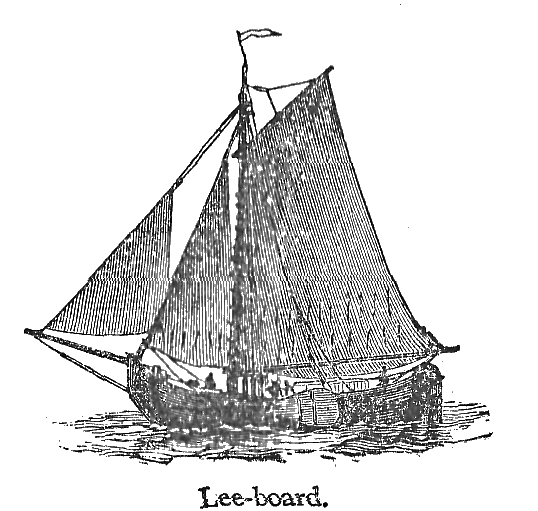
Lee, lē, n. the quarter toward which the wind blows.—adj. as in Lee′-side, the sheltered side of a ship.—ns. Lee′-board, a board lowered on the lee-side of a vessel, and acting like a keel or centre-board to prevent her from drifting to leeward; Lee′-gage, the sheltered or safe side:—opp. to Weather-gage; Lee′-shore, the shore opposite to the lee-side of a ship; Lee′-tide, a tide running in the same direction as the wind is blowing.—adj. Lee′ward, pertaining to, or in, the direction toward which the wind blows.—adv. toward the lee.—n. Lee′way, the distance a ship is driven to leeward of her true course: a falling behind.—Make up leeway, to make up for time lost; Under the lee, on the side sheltered from the wind, under shelter from the wind. [A.S. hleów, shelter; Ice. hlé, Low Ger. lee; prov. Eng. lew.]
Lee, lē, n. (Spens.) a river: also the same as Lea.
Leech, lēch, n. the edge of a sail at the sides. [Ice. lík, a leech-line; Dan. lig; Sw. lik, a bolt-rope.]
Leech, lēch, n. a blood-sucking worm: a physician.—v.t. to apply leeches to.—ns. Leech′craft, Leech′dom. [A.S. lǽce, one who heals; cf. Goth. leikeis.]
Leef, lēf, adj. an obsolete form of lief.
Leefang, lē′fang, n. a rope through the clew of a jib, holding it amidships while lacing on the bonnet.
Leek, lēk, n. a well-known biennial species of the onion family, esteemed for cooking—national emblem of Wales.—Eat the leek, to be compelled to take back one's words or put up with insulting treatment—from the scene between Fluellen and Pistol in Henry V. [A.S. leác, a leek, a plant, present also in Char-lock, Gar-lic, Hem-lock.]
Leer, lēr, n. a sly, sidelong look: (Shak.) complexion, colour.—v.i. to look askance: to look archly or obliquely.—adv. Leer′ingly, with a leering look. [A.S. hleór, face, cheek; Ice. hlýr.]
Lees, lēz, n.pl. sediment or dregs that settle at the bottom of liquor. [Fr. lie—Low L. lia.]
Leese, lēz, v.t. (Spens.) to lose. [A.S. leósan, to lose.]
Leet, lēt, n. (Scot.) a selected list of candidates for an office.—Short leet, a small list of selected candidates—for the final choice. [Ice. leiti, a share; cf. A.S. hlét, hlýt, forms of hlot, lot.]
Leet, lēt, n. an ancient English court, esp. the assembly of the men of a township: the district subject to such: the right to hold such a court.—n. Court′-leet (see Court). [A.S. lǽth.]
Leetle, lē′tl, a vulgarism for little.
Leeze, lēz (Scot.), in phrase Leeze me, it is pleasing to me. [Prob. a corr. of Lief is me.]
Left, left, pa.p. (Spens.) lifted.
Left, left, pa.t. and pa.p. of leave.—adj. Left′-off, laid aside.
Left, left, adj. being on the left side—also Left′-hand.—n. the side opposite to the right: the part of an assembly sitting on the president's left hand, generally the more liberal or democratic section.—adv. toward the left.—adj. Left′-hand′ed, having the left hand stronger and readier than the right: awkward: unlucky.—ns. Left′-hand′edness; Left′-hand′er, a blow with the left hand, a sudden and unexpected attack; Left′-hand′iness, awkwardness.—adv. Left′ward, towards the left: on the left side. [M. E. lift, left—A.S. left for lyft, weak; prob. allied to lop.]
Leg, leg, n. one of the limbs by which animals walk: a long, slender support of anything, as of a table: (fig.) something that supports: in cricket, that part of the field, or that fielder, to the left of and behind the batsman as he faces the bowler.—v.i. to pass on briskly, often with indef. it.—ns. Leg′-bail (see Bail); Leg′-bus′iness, ballet-dancing; Leg′-bye, in cricket, a run made when the ball touches any part of the batsman's person except his hand.—adj. Legged, having legs.—ns. Leg′ging, an outer and extra gaiter-like covering for the legs; Leg′gism, character of a blackleg.—adj. Leg′gy, having disproportionately long and lank legs.—n. Leg′-ī′ron, a fetter for the leg.—adj. Leg′less, without legs.—Change the leg (of a horse), to change the gait; Feel one's legs (of an infant), to begin to support one's self on the legs; Find one's legs, to become habituated to, to attain ease in; Give a leg to, to assist by supporting the leg; In high leg, in great excitement; Make a leg (Shak.), to make a bow; On one's last legs (see Last); On one's legs, standing, esp. to speak; Upon its legs, in an independent position. [Ice. leggr, a leg; Dan. læg, Sw. lägg.]
Legacy, leg′a-si, n. that which is left to one by will: a bequest of personal property.—ns. Leg′acy-hunt′er, one who hunts after legacies by courting those likely to leave them; Leg′atary, a legatee; Legatee′, one to whom a legacy is bequeathed.—Legacy duty, a duty levied on legacies, varying according to degree of relationship, and reaching its maximum where the legatee is not related to the testator.—Cumulative, or Substitutional, legacy, a second legacy given to the same person, either in addition to or in place of the first; Demonstrative legacy, a general legacy, but with a particular fund named from which it is to be satisfied; General legacy, a sum of money payable out of the assets generally; Residuary legatee, the person to whom the remainder of the property is left after all claims are discharged; Specific legacy, a legacy of a definite thing, as jewels, pictures, a sum of stock in the Funds, &c. [L. legatum—legāre, to leave by will.]
Legal, lē′gal, adj. pertaining to, or according to, law: lawful: created by law: (theol.) according to the Mosaic law or dispensation.—n. Lē′galisātion.—v.t. Lē′galise, to make legal or lawful: to authorise: to sanction.—ns. Lē′galism, strict adherence to law: (theol.) the doctrine that salvation depends on strict adherence to the law, as distinguished from the doctrine of salvation by grace: the tendency to observe the letter rather than the spirit of religious law; Lē′galist; Legal′ity.—adv. Lē′gally.—Legal tender, that which can be lawfully used in paying a debt. [Fr.,—L. legalis—lex, legis, law.]
Legate, leg′āt, n. an ambassador, esp. from the Pope: a delegate, deputy, esp. a foreign envoy chosen by the senate of ancient Rome, or a general or consul's lieutenant.—n. Leg′ateship.—adj. Leg′atīne, of or relating to a legate.—n. Legā′tion, the person or persons sent as legates or ambassadors: the official abode of a legation. [Fr. légat, It. legato—L. legatus—legāre, to send with a commission.]
Legatee. See Legacy.
Legato, lā-gä′to, adj. (mus.) in a smooth manner, the notes being played as if bound together.—n. a smooth manner of performance, or a tune so played.—adv. (sup.) Legatiss′imo. [It.,—L. ligāre, to tie.]
Legend, lej′end, or lē′-, n. a marvellous story from early times: the motto on a coat of arms, medal, or coin: an inscription of any kind: a musical composition set to a poetical story.—n. Leg′endary, a book of legends: one who relates legends: (pl.) a chronicle of the lives of saints.—adj. consisting of legends: romantic: fabulous.—n. Leg′endist, a writer of legends.—Golden legend (see Golden). [Fr.,—Low L. legenda, a book of chronicles of the saints read at matins—L. legendus—legĕre, to read.]
Leger, lej′ėr, adj. light: small.—ns. Leger′ity (Shak.), lightness; Leg′er′-line (mus.), one of the short lines added above or below the staff to extend its compass. [O. Fr.,—L. lĕvis, light.]
Legerdemain, lej-ėr-dē-mān′, n. sleight-of-hand: jugglery. [Fr. léger de main—L. as if leviarius—levis, light, Fr. de, of, main—L. manus, hand.]
Leghorn, leg′horn, n. fine plait for bonnets and hats made in Tuscany: a bonnet of this material: a small breed of the common domestic fowl. [Leghorn (It. Livorno), a seaport of Tuscany, Italy.]
Legible, lej′i-bl, adj. that may be read: that may be understood.—ns. Leg′ibleness, Legibil′ity.—adv. Leg′ibly. [L. legibilis—legĕre, to read.]
Legion, lē′jun, n. in ancient Rome, a body of soldiers of from three to six thousand: a military force: a great number: in French history, the name of several military bodies, more esp. one which distinguished itself in Algeria and in the Crimea.—v.t. to form into legions.—adj. Lē′gionary, relating to, or consisting of, a legion or legions: containing a great number.—n. a soldier of a legion.—Legion of Honour, an order of merit instituted in France in 1802 by Napoleon I.; Thundering Legion, the name in Christian tradition for a body of soldiers under Marcus Aurelius, whose prayers for rain once brought down a thunderstorm and destroyed the enemy. [Fr.,—L. legion-em—legĕre, to levy.]
Legislate, lej′is-lāt, v.i. to bring forward, propose, or make laws.—n. Legislā′tion.—adj. Leg′islative, giving or enacting laws: pertaining to legislation, or a legislature.—n. a body of persons, or a single person, with powers to enact laws.—adv. Leg′islatively.—n. Leg′islator, one who makes laws: a lawgiver:—fem. Leg′islatress.—adj. Legislatō′rial, of or pertaining to a legislature.—ns. Leg′islatorship; Leg′islature, the body of men in a state who have the power of making laws.—Legislative assembly (see Assembly); Legislative power, the power to make laws.—Class legislation, legislation affecting the interests of a particular class. [L. lex, legis, law, ferre, latum, to bear.]
Legist, lē′jist, n. one skilled in the laws. [Fr.]
Legitim, lej′i-tim, n. (Scots law) the legal provision which a child is entitled to out of the movable or personal estate of the deceased father.—Also Bairn's Part. [Fr.,—L. legitimus—lex, law.]
Legitimate, le-jit′i-māt, adj. lawful: lawfully begotten, born in wedlock: fairly deduced: following by natural sequence: authorised by usage.—v.t. to make lawful: to give the rights of a legitimate child to an illegitimate one.—n. Legit′imacy, state of being legitimate: lawfulness of birth: regular deduction: directness of descent as affecting the royal succession.—adv. Legit′imately.—ns. Legit′imateness, lawfulness; Legitimā′tion, act of rendering legitimate, esp. of conferring the privileges of lawful birth.—v.t. Legit′imise (same as Legitimate).—n. Legit′imist, one who supports legitimate authority: in France, a follower of the elder Bourbon line (descendants of Louis XIV.), as opposed to the Orleanists or supporters of the descendants of the Duke of Orleans, Louis XIV.'s brother.—Legitimate drama, a designation frequently applied to the representation of Shakespeare's plays—often employed as vaguely indicating approval of the drama of some former time. [Low L. legitimāre. -ātum—L. legitimus, lawful—lex, law.]
Legume, leg′ūm, n. a seed-vessel which splits into two valves, having the seeds attached to the ventral suture only: a pod, as of the pea, bean, &c.—also Legū′men:—pl. Legū′mens, Legū′mina.—adj. Legū′minar.—n. Legū′mine, a nitrogenous proteid substance in the seeds of most leguminous plants, corresponding with the casein of milk.—adj. Legū′minous, pertaining to pulse: bearing legumes. [Fr.,—L. legumen—legĕre, to gather.]
Leibnitzian, līb-nit′zi-an, adj. pertaining to the great German philosopher and mathematician, Gottfried Wilhelm Leibnitz (1646-1716).—n. Leibnit′zianism, the philosophy of Leibnitz—the doctrine of primordial monads, pre-established harmony, fundamental optimism on the principle of sufficient reason.
Leiger, lej′ėr, n. (Shak.) a resident ambassador.—Also Leidg′er. [See Ledger.]
Leiotrichous, lī-ot′ri-kus, adj. of the smooth-haired races. [Gr. leios, smooth, thrix, trichos, hair.]
Leipoa, lī-pō′a, n. a genus of Australian mound-birds.
Leister, lēs′tėr, n. (Scot.) a salmon-spear. [Cf. Ice. ljóstr; Dan. lyster, a salmon-spear.]
Leisure, lē′zhōōr, or lezh′-, n. time free from employment: freedom from occupation, convenient opportunity, ease.—adj. unoccupied.—adj. Lei′sured, not occupied with business.—adj. and adv. Lei′surely, not hasty or hastily.—At leisure, At one's leisure, free from occupation, at one's ease or convenience. [O. Fr. leisir—L. licēre, to be permitted.]
Leman, lē′man, or lem′-, n. a sweetheart; paramour. [A.S. leóf, loved, mann, man.]
Lemma, lem′a, n. (math.) a preliminary proposition demonstrated for the purpose of being used in a subsequent proposition: sometimes in logic a premise taken for granted: a theme:—pl. Lemm′as, Lemm′ata. [L.,—Gr. lēmma—lambanein, to take.]
Lemming, lem′ing, n. a genus of rodents, nearly allied to voles, migrating southward in great numbers. [Norw. lemende, lemming—lemja, to beat. Perh. Lapp, loumek, a lemming.]
Lemnian, lem′ni-an, adj. pertaining to Lemnos in the Ægean Sea.—Lemnian earth, cimolite; Lemnian ruddle, a red chalk found in Lemnos.
Lemniscate, lem-nis′kāt, n. a curve in general form like the figure 8—also adj.—n. Lemnis′cus, a woollen fillet attached to the back of crowns, diadems, &c. [Gr. lēmniskos.]
Lemon, lem′un, n. an oval fruit resembling the orange, with an acid pulp: the tree that bears lemons.—n. Lemonade′, a drink made of lemon-juice, water, and sugar.—adj. Lem′on-col′oured, having the colour of a ripe lemon.—ns. Lem′on-grass, a fragrant perennial grass, in India, Arabia, &c., yielding an essential oil used in perfumery; Lem′on-squash, unfervescent lemonade; Lem′on-squeez′er, a small hand-press for extracting the juice of lemons; Lem′on-yell′ow, a clear, pale yellow colour. [Fr. limon—Ar. līmūn.]
Lemur, lē′mur, n. a genus of mammals appearing to stand between the Insectivora and the monkeys, forest dwellers, mainly nocturnal in habits, common in Madagascar. [L. lemur, a ghost.]
Lemures, lem′ū-rēz, n.pl. (Milt.) spirits of the departed: spectres. [L.]
Lend, lend, v.t. to give for a short time something to be returned: to afford, grant, or furnish, in general: to let for hire.—v.i. to make a loan:—pr.p lend′ing; pa.t. and pa.p. lent.—ns. Lend′er; Lend′ing, the act of giving in loan: (Shak.) that which is lent or supplied. [A.S. lǽnan—lǽn, lán, a loan.]
Length, length, n. quality of being long: extent from end to end: the longest measure of anything: long continuance: detail: (prosody) time occupied in uttering a vowel or syllable: the quality of a vowel as long or short: any definite portion of a known extent.—v.t. Length′en, to increase in length: to draw out.—v.i. to grow longer.—adv. Length′ily.—n. Length′iness.—adv. Length′wise, in the direction of the length.—adj. Length′y, of great length: rather long—(obs.) Length′ful.—Length of days, prolonged life.—At length, in the full extent: at last; Go great lengths, Go to all lengths, to use extreme efforts; Go to the length of, to proceed as far as. [A.S.,—lang, long.]
Lenient, lē′ni-ent, adj. softening: mild: merciful.—n. (med.) that which softens: an emollient.—ns. Lē′nience, Lē′niency.—adv. Lē′niently.—v.t. Lē′nify (rare), to assuage.—adj. Len′itive, mitigating: laxative.—n. any palliative: (med.) an application for easing pain: a mild purgative.—n. Len′ity, mildness: clemency. [L. leniens, -entis, pr.p. of lenīre, to soften—lenis, soft.]
Leno, lē′nō, n. a thin linen like muslin.
Lenocinium, lē-nō-sin′i-um, n. (Scots law) a husband's connivance at his wife's adultery. [L.]
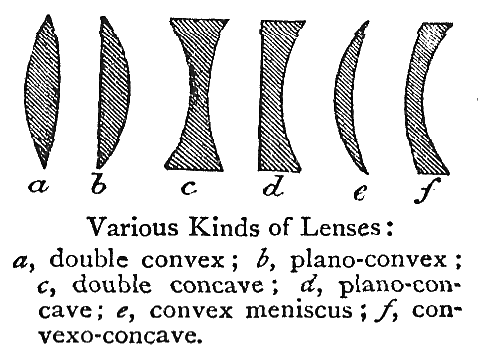
Lens, lenz, n. (optics) a piece of transparent substance with one or both sides convex or concave, the object to refract rays of light really or apparently radiating from a point, and make them deviate so as to pass, or travel on as if they had passed, through another point: the crystalline humour of the eye: a genus of leguminous plants:—pl. Lens′es. [L. lens, lentis, the lentil.]
Lent, lent, n. an annual fast of forty days in commemoration of the fast of our Saviour (Matt. iv. 2), from Ash-Wednesday to Easter.—adj. Lent′en, relating to, or used in, Lent: sparing.—n. Lent′-lil′y, the daffodil, as flowering in Lent. [A.S. lencten, the spring; Dut. lente, Ger. lenz.]
Lentamente, len-ta-men′te, adv. (mus.) slowly, in slow time.—advs. Lentan′do, becoming slower by degrees; Len′to, slow, slowly. [It.]
Lenticular, len-tik′ū-lar, adj. resembling a lens or lentil seed: double-convex—also Len′tiform.—n. Len′ticel (bot.), a loose, lens-shaped mass of cells belonging to the corky layer or periderm of plants.—adj. Lenticel′late.—n. Lentic′ula, a small lens: a lenticel: a freckle—also Len′ticule.—adv. Lentic′ularly.—adjs. Lentig′erous, having a crystalline lens; Len′toid, lens-shaped. [L. lenticularis—lenticula, dim. of lens, a lentil.]
Lentigo, len-tī′gō, n. a freckle.—adjs. Lentig′inose, Lentig′inous (bot.), covered with minute dots as if dusted. [L.]
Lentil, len′til, n. an annual plant, common near the Mediterranean, bearing pulse used for food. [O. Fr. lentille—L. lens, lentis, the lentil.]
Lentisk, len′tisk, n. the mastic-tree. [L. lentiscus.]
Lentor, len′tor, n. tenacity, viscidity.—adj. Len′tous. [L. lentus, slow.]
Lenvoy, len-voi′, n. a kind of postscript appended to a literary composition: an envoy. [O. Fr. l'envoi.]
Leo, lē′ō, n. the Lion, the 5th sign of the zodiac.
Leonine, lē′o-nīn, adj. of or like a lion.
Leonine, lē′o-nīn, adj. a kind of Latin verse, generally alternate hexameter and pentameter, rhyming at the middle and end. [From Leoninus, a 12th-cent. canon in Paris; or from Pope Leo II.]
Leopard, lep′ard, n. an animal of the cat kind, with a spotted skin, now generally supposed to be identical with the panther:—fem. Leop′ardess: (her.) a lion passant gardant. [O. Fr.,—L.,—Gr. leopardos—leōn, lion, pardos, pard.]
Leper, lep′ėr, n. one affected with leprosy.—adjs. Lep′erous (Shak.), Lep′rous. [Fr.,—L.,—Gr. lepra—lepros, scaly—lepos, a scale—lepein, to peel off.]
Lepid, lep′id, adj. pleasant, jocose. [L. lepidus.]
Lepidodendron, lep-i-do-den′dron, n. a common fossil plant of the Carboniferous strata, the stem covered with ovate leaf-scars arranged spirally. [Gr. lepis, -idos, a scale, dendron, a tree.]
Lepidoptera, lep-i-dop′tėr-a, n.pl. an order of insects, with four wings covered with fine scales—butterfly, moth, &c.—adjs. Lepidop′teral, Lepidop′terous. [Gr. lepis, -idos, a scale, pteron, a wing.]
Lepidosauria, lep-i-do-sawr′i-a, n. a sub-class or sub-order of Reptilia, with scales and plates—the ophidians and lacertilians, not crocodilians and chelonians. [Gr. lepis, a scale, sauros, a lizard.]
Lepidosiren, lep-i-do-sī′ren, n. one of the Amazon mud-fishes or Dipnoi. [Gr. lepis, a scale, Eng. siren.]
Lepidosteus, lep-i-dos′te-us, n. a genus of fishes with rhomboid scales hard like bone. [Gr. lepis, -idos, a scale, osteon, a bone.]
Leporine, lep′o-rīn, adj. pertaining to or resembling the hare. [L. leporinus—lepus, lepŏris, the hare.]
Lepped, lep′d, pa.t. (Spens.) leaped.
Leprechaun, Leprechawn, lep′rē-kawn, n. a small-sized brownie who helps Irish housewives, mends shoes, grinds meal, &c. [Ir. luchorpan, lu, small, corpan, corp, a body—L. corpus.]
Leprosy, lep′ro-si, n. a name applied to several different cutaneous diseases of contagious character, now confined to lepra cutanea, elephantiasis, Græcorum, or Leontiasis.—n. Lep′ra, leprosy: a scurfy, mealy substance on the surface of some plants.—adjs. Lep′rose, scale-like or scurf-like; Lep′rous, affected with leprosy.—adv. Lep′rously.—ns. Lep′rousness, Lepros′ity. [See Leper.]
Leptocardian, lep-to-kär′di-an, adj. pertaining to the Leptocardii, the lowest group of true vertebrates, the lancelets.—n. a lancelet, branchiostome, or amphioxus. [Gr. leptos, thin, kardia, heart.]
Leptocephalic, lep-to-se-fal′ik, adj. having a narrow skull, as in certain flat-fishes. [Gr. leptos, thin, kephalē, the head.]
Leptodactyl, lep-to-dak′til, adj. having small or slender toes. [Gr. leptos, thin, daktylos, a finger.]
Leptology, lep-tol′o-ji, n. minute description. [Gr. leptos, thin, logia—legein, to speak.]
Lepton, lep′ton, n. the smallest of modern Greek coins, 100 to the drachma. [Gr.,—leptos, small.]
Leptorrhine, lep′tō-rin, adj. with small nose or slender snout. [Gr. leptos, thin, hris, hrinos, nose.]
Leptospermum, lep-to-sper′mum, n. a genus of Australian trees and shrubs, evergreens, with leaves like those of myrtles—the tea-tree, &c. [Gr. leptos, thin, sperma, seed.]
Lere, lēr, n. (Spens.) learning a lesson.—v.t. to learn: to teach. [Learn.]
Lesbian, les′bi-an, adj. pertaining to the island of Lesbos in the Ægean Sea, and the adjoining part of the coast of Asia Minor, together forming Æolis, the home of a famous school of lyric poets, including Alcæus and Sappho: amatory, erotic.
Lese-majestie, lēz′-maj′es-ti, n. any crime committed against the sovereign power in a state, treason.—Also Leze′-maj′esty. [O. Fr.,—Low L. læsa majestas—L. læsa—lædĕre, to hurt, majestas, majesty.]
Lesion, lē′zhun, n. a hurt: (med.) an injury or wound. [Fr.,—L. læsion-em—lædĕre, læsum, to hurt.]
Less, les, adj. (serves as comp. of little) diminished: smaller.—adv. not so much: in a lower degree.—n. a smaller portion: (B.) the inferior or younger. [A.S. lǽssa, less, lǽs (adv.); comparative form from a root lasinn, feeble, found also in Goth. lasiws, weak, Ice. las, weakness, not conn. with little.]
Lessee, les-sē′, n. one to whom a lease is granted.
Lessen, les′n, v.t. to make less, in any sense: to weaken: to degrade.—v.i. to become less, shrink.
Lesser, les′ėr, adj. (B.) less: smaller: inferior. [A double comp. formed from less.]
Lesson, les′n, n. a portion of Scripture appointed to be read in divine service: that which a pupil learns at a time: a precept or doctrine inculcated: instruction derived from experience: severe lecture.—v.t. to give a lesson to. [Fr. leçon—L. lection-em—legĕre, to read.]
Lessor, les′or, n. one who grants a lease.
Lest, lest, conj. that not: for fear that. [From the A.S. phrase ðý læs ðe (for the reason less that=L. quominus), the first word being dropped, while the others coalesced into lest.]
Lest, lest, v.i. (Spens.) to listen.
Let, let, v.t. to slacken or loose restraint upon: to give leave or power to: to allow, permit, suffer: to grant to a tenant or hirer: to cause (with infin. without to):—pr.p. let′ting; pa.t. and pa.p. let.—n. a letting for hire.—ns. Let′ter; Let′ting.—Let alone, to leave out, not to mention.—adj. passive, inactive—also n. (Shak.) forbearance.—Let blood, to open a vein and let the blood run out; Let down, to allow to fall: to bring down; Let go, to cease holding: to pass by or disregard; Let in, to allow to enter: to take in or swindle; Let into, to admit to the knowledge of; Let off, to allow to go free without punishment, to excuse from payment, &c.; Let on, to allow a thing to be believed, to pretend; Let one's self loose, to let go restraint on words or actions, to indulge in extravagant talk or conduct; Let out, to allow to get free, to let some secret become known; Let slip, to allow to escape: to lose sight of; Let well alone, to let things remain as they are from fear of making them worse. [A.S. lǽtan, to permit, pt.t. lét, leót, pp. læten; Ger. lassen, Fr. laisser, to permit.]
Let, let, v.t. (B.) to prevent.—n. (law) hinderance, obstruction: delay.—n. Let′ter. [A.S. lettan, to hinder—læt, slow.]
Letch, lech, n. strong desire: a crotchet.
Lethal, lē′thal, adj. death-dealing: deadly: mortal.—n. Lethe (Shak.), death.—adj. Lethif′erous, carrying death. [L. lethalis—lethum, letum, death.]
Lethargy, leth′ar-ji, n. heavy unnatural slumber: dullness.—v.t. (Shak.) to make lethargic.—adjs. Lethar′gic, -al, pertaining to lethargy: unnaturally sleepy: dull.—adv. Lethar′gically.—n. Lethar′gicness, the state of being lethargic: morbid sleepiness.—v.t. Leth′argise. [Fr.,—L.,—Gr. lēthargia, drowsy forgetfulness—lēthē, forgetfulness.]
Lethe, lē′thē, n. one of the rivers of hell causing forgetfulness of the past to all who drank of it: oblivion.—adj. Lethē′an, of Lethe: oblivious. [Gr.,—lēthō, old form of lanthanein, to forget.]
Letter, let′ėr, n. a conventional mark to express a sound: a written or printed message: literal meaning: a printing-type: (pl.) learning, literary culture.—v.t. to stamp letters upon.—ns. Lett′er-bal′ance, a balance for testing the weight of a letter for post; Lett′er-board (print.), board on which matter in type is placed for keeping or convenience in handling; Lett′er-book, a book in which letters or copies of letters are kept; Lett′er-box, a box in a post-office, at the door of a house, &c., for receiving letters; Lett′er-carr′ier, a postman; Lett′er-case, a portable writing-desk.—adj. Lett′ered, marked with letters: educated: versed in literature: belonging to learning (Lettered proof and Proof before letters; see Proof).—ns. Lett′erer; Lett′er-found′er, one who founds or casts letters or types; Lett′ering, the act of impressing letters: the letters impressed.—adj. Lett′erless, illiterate.—ns. Lett′er-miss′ive, an official letter on matters of common interest, sent to members of a church: a letter from the sovereign addressed to a dean and chapter, naming the person they are to elect bishop—also Royal letter; Lett′ern (same as Lectern); Lett′er-of-cred′it, a letter authorising credit or cash to a certain sum to be paid to the bearer; Lett′er-of-marque (märk), a commission given to a private ship by a government to make reprisals on the vessels of another state.—adj. Lett′er-per′fect, kept in the memory exactly (of an actor's part, &c.).—ns. Lett′erpress, letters impressed or matter printed from type, as distinguished from engraving: a copying-press; Lett′ers-pā′tent, a writing conferring a patent or authorising a person to enjoy some privilege, so called because written on open sheets of parchment; Lett′er-stamp, a post-office implement for defacing a postage-stamp: a stamp for imprinting dates, &c., on letters or papers; Lett′er-wood, the heart-wood of a tree found in British Guiana, dark brown, with darker spots somewhat resembling hieroglyphics; Lett′er-writ′er, one who writes letters, esp. for hire: a book containing forms for imitation in writing letters.—Letter of indication (see Circular); Letters of administration, a document issued by court appointing an administrator of an intestate estate; Letters requisitory, or rogatory, an instrument by which a court of one country asks that of another to take certain evidence on its behalf; Lettre de cachet (see Cachet). [Fr. lettre—L. littera.]
Lettic, let′ik, adj. of or pertaining to the Letts or Lithuanians, or to their language.—Also Lett′ish.
Letting, let′ing, n. the act of granting to a tenant: the act of giving to a contractor.
Lettuce, let′is, n. a plant containing a milky juice, its leaves used as a salad. [O. Fr. laictuce (Fr. laitue)—L. lactuca—lac, milk.]
Leucæmia, lū-sē′mi-a, n. a disease in which the number of white corpuscles in the blood is greatly increased, with changes in the lymphatic tissues, enlargement of the spleen, &c.—Also Leucocythæ′mia. [Gr. leukos, white, haima, blood.]
Leucine, lū′sin, n. a product of the decomposition of albuminous materials occurring in many of the juices of the animal body. [Gr. leukos, white.]
Leuciscus, lū-sis′kus, n. a genus of fresh-water fishes of the Cyprinoid family, including the roach, dace, chub, minnow, &c. [Gr. leukos, white.]
Leucite, lū′sīt, n. a whitish mineral occurring only in volcanic rocks.—adj. Leucit′ic. [Gr. leukos, white.]
Leucocyte, lū′kō-sīt, n. a white corpuscle of the blood or lymph (see Phagocyte).—adj. Leucocyt′ic.—ns. Leucocytog′enesis, the production of leucocytes; Leucocytō′sis, the presence of an excessive number of white corpuscles in the blood.
Leucocythæmia. See Leucæmia.
Leucol, lū′kol, n. an organic base obtained by the distillation of coal-tar. [Gr. leukos, white.]
Leucoma, lū-kō′ma, n. a white opacity of the cornea, the result of acute inflammation. [Gr. leukos, white.]
Leucomaine, lū′kō-mān, n. an alkaloid found in living animal tissue:—opp. to Ptomaine (q.v.).
Leucorrhœa, lū-kō-rē′a, n. an abnormal mucous or muco-purulent discharge from the vagina, the whites. [Gr. leukos, white, hroia—hrein, to flow.]
Leucosis, lū-kō′sis, n. whiteness of skin, pallor.—ns. Leucism (lū′sizm), whiteness resulting from lack of colour, albinism; Leucop′athy, albinism.—adj. Leu′cous, white, albinotic. [Gr. leukos, white.]
Levant, le-vant′, n. the point where the sun rises: the East: the coasts of the Mediterranean east of Italy.—adj. Lev′ant, or Lē′vant, eastern.—n. Levant′er, a strong easterly wind in the Levant.—adj. Levant′ine, belonging to the Levant. [Fr. levant—L. levāre, to raise.]
Levant, le-vant′, v.i. to decamp.—n. Levant′er, one who runs away dishonourably, who dodges paying his bets, &c. [Sp. levantar, to move—L. levāre, to raise.]
Levator, le-vā′tor, n. that which raises (of a muscle):—opp. to Depressor. [L. levāre, to raise.]
Levee, lev′ā, lev′ē, le-vē′, n. a morning assembly of visitors: an assembly received by a sovereign or other great personage.—v.t. to attend the levee of. [Fr. lever, to rise.]
Levee, le-vē′, n. an artificial bank, as that of the Lower Mississippi: a quay. [Fr.]
Level, lev′el, n. a horizontal line or surface: a surface without inequalities: proper position: usual elevation: state of equality: the line of direction: an instrument for showing the horizontal.—adj. horizontal: even, smooth: even with anything else: uniform: well-balanced, sound of judgment: in the same line or plane: equal in position or dignity.—v.t. to make horizontal: to make flat or smooth: to make equal: to take aim:—pr.p. lev′elling; pa.t. and pa.p. lev′elled.—ns. Lev′el-cross′ing, or Grade′-cross′ing, a place at which a common road crosses a railway at the same level; Lev′eller, one who levels or makes equal, esp. one of an ultra-republican and revolutionary sect or party which grew up in the parliamentary army in 1647, crushed by Cromwell in 1649; Lev′elling, the act of making uneven surfaces level: the process of finding the differences in level between different points on the surface of the earth by means of a Levelling instrument, consisting of a telescope carrying a parallel and sensitive spirit-level, adjustable by means of screws; Lev′elling-rod, -staff, an instrument used in levelling, in conjunction with a levelling instrument, or with a spirit-level and a telescope.—adv. Lev′elly, evenly.—n. Lev′elness, state of being level, even, or equal.—Level down or up, to lower or raise to the same level or status; Do one's level best (coll.) to do one's utmost. [O. Fr. livel, liveau (Fr. niveau)—L. libella, a plummet, dim. of libra, a balance.]
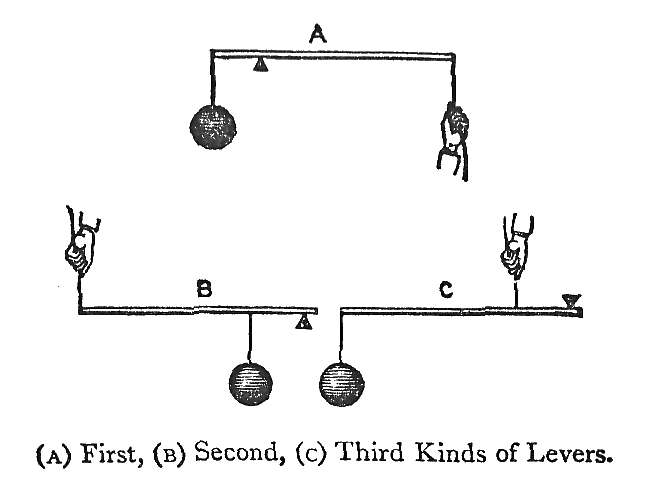
Lever, lē′vėr, n. a bar of metal or other substance turning on a support called the fulcrum or prop, for imparting pressure or motion from a source of power to a resistance—of three kinds, according to the relative positions of the power, weight, and fulcrum: (fig.) anything which exerts influence: any one of various tools on the principle defined above—in surgery, dentistry, &c.: a removable rod or bar inserted in a machine, to be operated by hand leverage.—ns. Lē′verage, the mechanical power gained by the use of the lever: advantage gained for any purpose; Lē′ver-watch, a watch having a vibrating lever in the mechanism of the escapement. [Fr. levier—lever—L. levāre, to raise.]
Lever, lē′vėr, adv. an obsolete comp. of lief.
Leveret, lev′ėr-et, n. a hare in its first year. [O. Fr. levret (Fr. lièvre)—L. lepus, lepŏris, a hare.]
Leviable, lev′i-a-bl, adj. able to be levied or assessed.
Leviathan, le-vī′a-than, n. (B.) a huge aquatic animal in Job xli., here a crocodile; in Isa. xxvii. 1, apparently the great python of Egyptian monuments: anything of huge size: any huge sea-monster, as in Ps. civ. 26. [Heb. livyāthān—lāvāh, to cleave.]
Levigate, lev′i-gāt, v.t. to make smooth: to grind to a fine, impalpable powder.—adj. made smooth, polished.—adj. Lev′igable, capable of being ground down to fine powder.—n. Levigā′tion. [L. lēvigāre, -ātum—lēvis, smooth; Gr. leios, akin to level.]
Levigate, lev′i-gāt, v.t. to lighten, belittle. [L. lĕvigāre, -ātum—lĕvis, light.]
Levin, lev′n, n. (Spens.) lightning.—Also Lev′en.
Levirate, lev′i-rāt, n. marriage between a man and a childless brother's widow—an obligation amongst the ancient Hebrews.—adj. Levirat′ical.—n. Levirā′tion. [L. levir, a brother-in-law.]
Levitation, lev-i-tā′shun, n. act of rendering light: the floating in the air of heavy bodies believed in by spiritualists.—v.t. Lev′itate, to cause to float.
Levite, lē′vīt, n. a descendant of Levi: an inferior priest of the ancient Jewish Church.—adjs. Levit′ic, -al.—adv. Levit′ically.—n. Levit′icus, the third book of the Old Testament.—Levitical degrees, the degrees of kindred within which marriage was forbidden in Lev. xviii. 6-18.
Levity, lev′it-i, n. lightness of weight: lightness of temper or conduct: thoughtlessness: disposition to trifle: vanity. [L. levitat-em—lĕvis, light.]
Levogyrate (Læv-), lē-vō-jī′rāt, adj. causing to turn toward the left hand.—n. Levogyrā′tion.—adj. Levogy′rous.
Levulose, lev′ū-lōs, n. a sugar isomeric with dextrose, but turning the plane of polarisation to the left. [L. lævus, left.]
Levy, lev′i, v.t. to raise: to collect by authority, as an army or a tax:—pr.p. lev′ying; pa.t. and pa.p. lev′ied.—n. the act of collecting by authority: the troops so collected. [L. levāre, to raise.]
Lew, lū, adj. tepid, lukewarm. [Cf. Ger. lau.]
Lewd, lūd, or lōōd, adj. lustful: unchaste: debauched: ignorant, vicious, or bad, so in B.—adv. Lewd′ly.—ns. Lewd′ness; Lewd′ster, one addicted to lewdness. [A.S. lǽwede, ignorant, belonging to the laity, the pa.p. of the verb lǽwan, to weaken.]
Lewis, lū′is, n. a contrivance for securing a hold on a block of stone to allow of its being raised by a derrick.—Also Lew′isson. [Ety. dub.]
Lexicon, leks′i-kon, n. a word-book or dictionary.—adj. Lex′ical, belonging to a lexicon.—adv. Lex′ically.—n. Lexicog′rapher, one skilled in lexicography.—adjs. Lexicograph′ic, -al.—ns. Lexicog′raphist, Lexicol′ogist, one skilled in lexicology; Lexicog′raphy, the art of compiling a dictionary; Lexicol′ogy, that branch of philology which treats of the proper signification and use of words.—adjs. Lexigraph′ic, -al, pertaining to lexigraphy.—n. Lexig′raphy, the art of defining words. [Gr.,—lexis, a word, legein, to speak.]
Ley, lē, n. Same as Lea.
Leyden jar, lī′den jär, n. a form of condenser for statical electricity, a glass jar coated inside and outside with tinfoil for two-thirds of its height, the inner coating connected with a metallic knob at the top of the jar, usually by means of a loose chain.
Lherzolite, ler′zō-līt, n. an igneous rock, consisting of a granular aggregate of olivine, pyroxene, enstatite, and picotite. [From Lake Lherz.]
Li, lē, n. a Chinese weight, equal to the one-thousandth of a liang or ounce, and nominally to the Japanese rin: a Chinese mile, equal to rather more than one-third of an English mile. [Chinese.]
Liable, lī′a-bl, adj. able to be bound or obliged: responsible: tending to: subject: (Shak.) exposed: suitable.—ns. Liabil′ity, state of being liable: that for which one is liable, an obligation, debt, &c.; Lī′ableness, state of being liable.—Employers' Liability Act, an enactment (1880) making employers answerable to their servants for the negligence of those to whom they have delegated their authority; Limited liability, a principle of modern statute law which attempts to limit the responsibilities of shareholders in a partnership, joint-stock company, &c., by the extent of their personal interest therein. [Fr. lier—L. ligāre, to bind.]
Liaison, lē-ā-zong′, n. union, or bond of union: connection, esp. if illicit between the sexes: in French, the linking in pronunciation of a final consonant to the succeeding word, when that begins with a vowel. [Fr.—L. ligation-em—ligāre, to bind.]
Liana, li-an′a, n. a general name for the woody, climbing, and twining plants in tropical forests. [Fr. liane—lier, to bind—L. ligāre, to bind.]
Liang, lyang, n. a Chinese ounce or tael, reckoned as one-third heavier than the ounce avoirdupois.
Liar, lī′ar, n. one who lies. [Lie.]
Liard, lī′ard, adj. gray, dapple-gray—(Scot.) Lī′art, Ly′art. [M. E. liard—O. Fr. liard, liart.]
Liard, liär, n. an old French coin, worth 3 deniers.
Lias, lī′as, n. (geol.) a formation of argillaceous limestone, &c., underlying the oolitic system.—adj. Lias′sic, pertaining to the lias formation. [Fr., perh. Bret. liach, a stone, Gael. leac, a stone.]
Lib, lib, v.t. (prov.) to geld, castrate.
Libation, lī-bā′shun, n. the pouring forth wine or other liquid in honour of a deity: the liquid poured.—adj. Lī′bant, sipping.—v.t. Lī′bate (rare), to make a libation to.—adj. Lī′batory, pertaining to libation. [L. libation-em—libāre, -ātum; Gr. leibein, to pour.]
Libbard, lib′bard, n. (Spens.) a leopard.
Libeccio, li-bech′ō, n. the south-west wind. [It.]
Libel, lī′bel, n. a written accusation: any malicious defamatory publication or statement: (law) the statement of a plaintiff's grounds of complaint against a defendant.—v.t. to defame by a libel: to satirise unfairly: (law) to proceed against by producing a written complaint:—pr.p. lī′belling; pa.t. and pa.p. lī′belled.—ns. Lī′bellant, one who brings a libel; Lī′beller; Lī′belling, defaming.—adj. Lī′bellous, containing a libel: defamatory.—adv. Lī′bellously. [L. libellus, dim. of liber, a book.]
Liber, lī′ber, n. the bast or inner bark of exogenous plants: a book. [L.]
Liberal, lib′ėr-al, adj. becoming a gentleman: generous: noble-minded: candid: free: free from restraint: general, extensive.—n. one who advocates greater freedom in political institutions.—n. Liberalisā′tion, the process of making liberal.—v.t. Lib′eralise, to make liberal, or enlightened: to enlarge.—ns. Lib′eralism, the principles of a Liberal in politics or religion; Liberal′ity, the quality of being liberal: generosity: largeness or nobleness of mind: candour: impartiality.—adv. Lib′erally.—v.t. Lib′erāte, to set free: to release from restraint, confinement, or bondage.—ns. Liberā′tion; Liberā′tionist, one who is in favour of church disestablishment; Lib′erātor, one who liberates or frees.—adj. Lib′erātory, tending to liberate.—Liberal Party, the name adopted by the Whigs (1830) to denote the body formed by their union with the Radicals; Liberal Unionist, one of that section of the Liberal Party which joined the Conservatives from inability to accede to Mr Gladstone's policy of giving Home Rule to Ireland (1886); German Liberals, a party in German politics, formed by the amalgamation of the Progressist party and the Liberal union, and advocating moderate liberalism in opposition to the policy of Prince Bismarck; National Liberals, a party in German politics which before 1871 advocated the completion of governmental unity in Germany, as well as supported progressive measures of reform. [Fr.,—L. liberalis, befitting a freeman—liber, free, akin to libet, lubet, it pleases.]
Liberty, lib′ėr-ti, n. freedom to do as one pleases: the unrestrained enjoyment of natural rights: power of free choice: privilege: exemption: relaxation of restraint: the bounds within which certain privileges are enjoyed: freedom of speech or action beyond ordinary civility.—ns. Libertā′rian, one who believes in free-will as opposed to necessity; Libertā′rianism, the doctrine of the freedom of the will, as opposed to necessitarianism; Liber′ticide, a destroyer of liberty; Liber′tinage, debauchery; Lib′ertine, formerly one who professed free opinions, esp. in religion: one who leads a licentious life, a rake or debauchee.—adj. belonging to a freedman: unrestrained: licentious.—n. Lib′ertinism, licentiousness of opinion or practice: lewdness or debauchery.—Liberty of indifference, freedom of the will—because before action the will is undetermined as to acting or not acting; Liberty of the press, liberty to print and publish without previous permission from government.—Cap of liberty (see Bonnet rouge, under Bonnet); Religious liberty, the right of thinking about religion or of worshipping as one likes. [Fr.,—L. libertas.]
Libidinous, li-bid′in-us, adj. lustful, lascivious, lewd.—ns. Libid′inist, a lewd person; Libidinos′ity, Libid′inousness.—adv. Libid′inously. [Fr.,—L. libidinosus—libido, desire—libet, lubet, it pleases.]
Libken, lib′ken, n. (slang) a place of abode.
Libra, lī′bra, n. the balance, the seventh sign of the zodiac. [L.]
Library, lī′brar-i, n. a building or room containing a collection of books: a collection of books.—ns. Librā′rian, the keeper of a library; Librā′rianship. [L. librarium—liber, a book.]
Librate, lī′brāt, v.t. to poise: to balance.—v.i. to move slightly: to be poised.—n. Librā′tion, balancing: a state of equipoise: a slight swinging motion.—adj. Lī′bratory.—Libration of the moon, an apparent irregularity in the moon's motion, whereby its globe seems to turn slightly round to each side alternately. [L. librāre, -ātum—libra, balance.]
Libretto, li-bret′ō, n. a book of the words of an opera or other musical composition: the text itself.—n. Librett′ist, a writer of librettos. [It., dim. of libro—L. liber, a book.]
Libyan, lib′yan, adj. of Libya, northern Africa from Egypt to the Atlantic.—n. a native thereof.
Lice, līs, pl. of louse.
License, Licence, lī′sens, n. a being allowed: leave: grant of permission, as for manufacturing a patented article or for the sale of intoxicants: the document by which authority is conferred: excess or abuse of freedom: a departure from rules or standards in art or literature.—v.t. Lī′cense, to grant license to: to authorise or permit.—adj. Lī′censable.—ns. Licensee′, one to whom license is granted; Lī′censer, one who grants license or permission: one authorised to license; Lī′censure, act of licensing; Licen′tiate, among Presbyterians, a person authorised by a Presbytery to preach: on the Continent, an academical dignity, forming the step from the baccalaureate to the doctorate.—adj. Licen′tious, indulging in excessive freedom: given to the indulgence of the animal passions: dissolute.—adv. Licen′tiously.—n. Licen′tiousness.—High license, a mode of regulating the traffic in alcoholic drinks by exacting a comparatively large sum for the privilege of selling such; Special license, license given by the Archbishop of Canterbury permitting the marriage of two specified persons without banns, and at a place and time other than those prescribed by law. [Fr.,—L. licentia—licet.]
Lichen, lī′ken, lich′en, n. one of an order of cellular flowerless plants: an eruption on the skin.—adjs. Lī′chened, covered with lichens; Lichen′ic, pertaining to lichens; Lī′cheniform.—ns. Lī′chenine, a starch-like substance, found in Iceland moss and other lichens; Lī′chenist, Lichenog′rapher, one versed in Lichenog′raphy, the description of lichens.—adjs. Lichenograph′ic, -al.—n. Lichenol′ogy, the department of botany relating to lichens.—adj. Lī′chenous, abounding in, or pertaining to, lichens. [L.,—Gr. leichēn—leichein, to lick.]
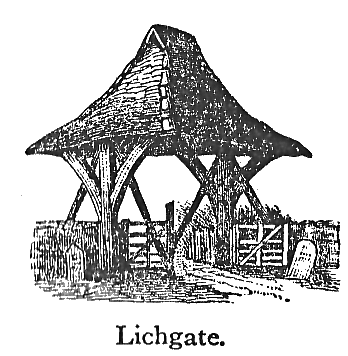
Lichgate, lich′gāt, n. a churchyard gate with a porch to rest the bier under.—ns. Lich′wake, the wake or watch held over a dead body—also Likewake, Lykewake, and even Latewake; Lich′way, the path by which the dead are carried to the grave. [M. E. lich—A.S. líc (Ger. leiche), geat, a gate.]
Licit, lis′it, adj. lawful, allowable.—adv. Lic′itly. [L.]
Lick, lik, v.t. to pass the tongue over: to take in by the tongue: to lap: to beat by repeated blows: (coll.) to triumph over, overcome.—n. a passing the tongue over: a slight smear: (Scot.) a tiny amount: a blow: (coll.) an attempt, trial: (pl., Scot.) a thrashing.—ns. Lick′er; Lick′ing, a thrashing; Lick′penny (Scot.), a miserly person; Lick′-plat′ter, Lick′-trench′er, Lick′spittle, a mean, servile dependent.—Lick into shape, to give form and method to—from the notion that the she-bear gives form to her shapeless young by licking them; Lick the dust, to be slain: to be abjectly servile. [A.S. liccian; Ger. lecken, L. lingĕre, Gr. leichein.]
Lickerish, lik′ėr-ish, adj. dainty: eager to taste or enjoy: tempting.—adv. Lick′erishly.—n. Lick′erishness. [Formerly also liquorish; a corr. of obsolete lickerous, lecherous.]
Licorice. Same as Liquorice.
Lictor, lik′tor, n. an officer who attended the Roman magistrates, bearing an axe and bundle of rods. [L.]
Lid, lid, n. a cover: that which shuts a vessel: the cover of the eye.—adjs. Lid′ded, having a lid or lids; Lid′less, without lid or lids. [A.S. hlid (Dut. lid)—hlídan, to cover.]
Lie, lī, n. anything meant to deceive: an intentional violation of truth: anything that misleads.—v.i. to utter falsehood with an intention to deceive: to make a false representation:—pr.p. ly′ing; pa.t. and pa.p. lied.—Lie in one's throat, to lie shamelessly; Lie out of whole cloth, to lie without any foundation whatever; Give the lie to, to charge with falsehood; White lie, a conventional phrase not strictly true: a well-meant falsehood. [A.S. leógan (lyge, a falsehood), prov. Eng. lig; Dut. liegen, Goth. liugan, Ger. lügen, to lie.]
Lie, lī, v.i. to rest in a reclining posture: to lean: to press upon: to be situated: to abide: to consist: (law) to be sustainable: (Shak.) to be imprisoned: to lodge, pass the night:—pr.p. ly′ing; pa.t. lay; pa.p. lain, (B.) lī′en.—n. manner of lying: relative position: an animal's lair: (golf) position of the ball for striking.—ns. Lī′er, Lie′-abed′, one who lies late—also adj.—Lie along, to be extended at full length; Lie at one's door, to be directly imputable to one; Lie at one's heart, to be an object of interest or affection to one; Lie by, to take rest from labour: (Shak.) to be under the charge of; Lie hard or heavy on, upon, (Shak.) to, to oppress, burden; Lie in, to be in childbed; Lie in one, to be in one's power; Lie in the way, to be ready, at hand: to be an obstacle; Lie in wait, to lie in ambush; Lie low, to conceal one's actions or intentions; Lie on, upon, to be incumbent on; Lie on the hands, to remain unused or unoccupied; Lie over, to be deferred to a future occasion; Lie to, to be checked in sailing; Lie under, to be subject to or oppressed by; Lie up, to abstain from work; Lie with, to lodge or sleep with: to have carnal knowledge of; Lying-in hospital, a hospital for those about to become mothers. [A.S. licgan; Ger. liegen; Goth. ligan.]
Liebig, lē′big, n. a nutritious extract of beef first prepared by the great German chemist, Baron von Liebig (1803-1873).
Lied, lēt, n. a German ballad, secular or sacred, fitted for singing and often set to music. [Ger.; cf. A.S. leóth, a song.]
Lief, lēf, adj. (arch.) loved, dear.—adv. willingly—now chiefly used in the phrases, 'I had as lief,' 'to have liefer.' [A.S. leóf; Ger. lieb, loved.]
Liege, lēj, adj. free, except as within the relations of vassal and feudal lord: under a feudal tenure.—n. one under a feudal tenure: a vassal: a lord or superior, or one who has lieges.—n. Liege′dom, allegiance.—adj. Liege′less, not subject to a superior.—n. Liege′man, a vassal: a subject. [O. Fr. lige, prob. from Old High Ger. ledic, free (Ger. ledig, free, unfettered), līdan, to depart.]
Lien, lī′en, or lē′en, n. (law) a right in one to retain the property of another to pay a claim. [Fr., tie, band—L. ligamen—ligāre, to bind.]
Lien, lī′en (B.), pa.p. of lie, to lie down.
Lientery, lī′en-ter-i, n. a form of diarrhœa, with frequent liquid evacuations in which the food is discharged undigested.—adj. Lienter′ic. [Gr. leios, smooth, enteron, an intestine.]
Lierne, li-ern′, n. (archit.) a cross-rib or branch-rib in vaulting. [Fr.]
Lieu, lū, n. place, stead, chiefly in the phrase 'in lieu of.' [Fr.,—L. locus, place.]
Lieutenant, lef-ten′ant, n. one representing or performing the work of another: an officer holding the place of another in his absence: a commissioned officer in the army next below a captain, or in the navy next below a commander and ranking with captain in the army: one holding a place next in rank to a superior, as in the compounds Lieuten′ant-col′onel, Lieuten′ant-gen′eral.—ns. Lieuten′ancy, Lieuten′antship, office or commission of a lieutenant: the body of lieutenants; Lieuten′ant-gov′ernor, in India, the name of the chief official in the provinces of Bengal, Behar, and Orissa, the North-western Provinces, and Oudh, Punjab, and Delhi; Lieuten′ant-gov′ernorship; Lieuten′antry (Shak.), lieutenancy; Lord′-lieuten′ant, the title of the viceroy of Ireland: in the British Isles, a permanent governor of a county appointed by the sovereign, usually a peer or other large land-owner, at the head of the magistracy and the chief executive authority; Sub′-lieuten′ant, formerly mate or passed midshipman, now the intermediate rank in the navy between midshipman and lieutenant.—Field-marshal lieutenant (see Field-marshal). [Fr.; cf. Lieu and Tenant.]
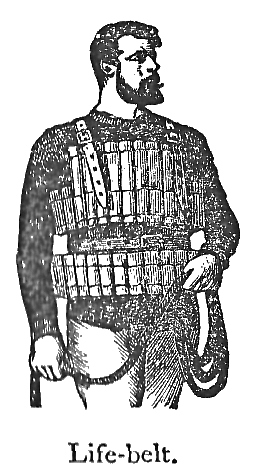
Life, līf, n. state of living: animate existence: union of soul and body: the period between birth and death: present state of existence: manner of living: moral conduct: animation: a living being: system of animal nature: social state: human affairs: narrative of a life: eternal happiness, also He who bestows it: a quickening principle in a moral sense: the living form and expression, living semblance: (cricket) an escape, as by a missed or dropped catch:—pl. Lives (līvz).—interj. used as an oath, abbreviated from God's life.—adj. Life′-and-death′, critical: desperate.—ns. Life′-annū′ity, a sum paid to a person yearly during life; Life′-assur′ance, Life′-insur′ance (see Insurance); Life′-belt, a belt either inflated with air, or with cork attached, for sustaining a person in the water; Life′-blood, the blood of an animal in the body: that which gives strength or life; Life′boat, a boat for saving shipwrecked persons, having air-chambers or the like, by which it is rendered specially buoyant and sometimes self-righting; Life′-buoy, a buoy intended to support a person in the water till he can be rescued; Life′-estate′, an estate held during the life of the possessor.—adjs. Life′ful (Spens.), full of vital energy; Life′-giv′ing, imparting life: invigorating.—ns. Life′-guard, a guard of the life or person: a guard of a prince or other dignitary; Life′-his′tory, Life′-cy′cle, the series of vital phenomena exhibited by an organism in its passage from the ovum to full development; Life′hold, land held by lease for life; Life′-in′terest, an interest lasting during one's life.—adj. Life′less, dead: without vigour: insipid: sluggish.—adv. Life′lessly.—n. Life′lessness.—adj. Life′-like, like a living person.—n. Life′-line, a rope stretched anywhere on board a vessel for support of the sailors in difficult operations or during wild weather: a line attached to a life-buoy or lifeboat for an immersed person to seize hold of.—adj. Life′long, during the length of a life.—ns. Life′-mor′tar, a mortar for throwing a shot of some kind to carry a rope from the shore to a ship in distress; Life′-peer, a peer whose title is not hereditary; Life′-peer′age; Life′-preserv′er, an invention, as a buoyant belt or jacket, for the preservation of life in cases of shipwreck: a cane with a loaded head; Life′-raft, a raft-like structure for use in case of shipwreck; Life′-rate, rate of payment on a policy of life-insurance.—adj. Life′-ren′dering (Shak.), yielding up life.—ns. Life′rent, a rent that continues for life; Life′renter, one who enjoys a liferent:—fem. Life′rentrix; Life′-rock′et, a rocket for carrying a line from the shore to a ship in distress.—adjs. Life′-sav′ing, designed to save life, esp. from drowning.—n. Life′-school, a school where artists work from living models.—adjs. Life′-size, similar in size to the object represented; Life′some, full of life: gay, lively.—ns. Life′-tā′ble, a table of statistics as to the probability of life at different ages; Life′-ten′ant, the owner of a life-estate: one who holds lands, &c., for the term of his own or another's life; Life′-time, continuation or duration of life.—adj. Life′-wea′ry (Shak.), weary of life: wretched.—n. Life′-work, the work to which one's life is or is to be devoted.—Life-saving apparatus, all materials, appliances, &c. available for preserving life in cases of shipwreck or fire.—Bring to life, to restore to life one apparently dead; Come to life, to be reanimated; For life, for the whole period of one's existence: so as to save life: very fast or strenuously; High life, the manner of living of those in high or fashionable society: the upper classes of society; Line of life (see Line); To the life, very closely resembling the original: exactly drawn. [A.S. líf; Ice. líf, Sw. lif, Dut. lijf, body, life; Ger. leben, to live.]
Lift, lift, n. (Scot.) the air, heavens, sky. [A.S. lyft; Ger. luft, Ice. lopt, Goth. luftus, the air.]
Lift, lift, v.t. to bring to a higher position: to elevate or keep elevated: to elate: to take and carry away: (obs.) to bear, support: (slang) to arrest: to steal.—v.i. to rise: to try to rise.—n. act of lifting: that which is to be raised: that which assists to lift: a hoisting-machine: advancement.—adj. Lift′able.—ns. Lift′er, one who, or that which, lifts: (Shak.) a thief; Lift′ing-bridge, a drawbridge raised so as to allow ships to pass; Lift′-pump, any pump which is not a force-pump.—Lift the hand, to raise it in hostility; Lift up the eyes, to look, direct one's eyes, or thoughts, to; Lift up the face, to look upward, as in supplication; Lift up the hand, to make oath, swear: to pray; Lift up the head, to rejoice, exult; Lift up the voice, to cry loudly.—Dead lift (see Dead). [Ice. lypta—lopt, the air.]
Lig, lig, v.i. (Spens.) to lie. [See Lie.]
Ligament, lig′a-ment, n. anything that binds: (anat.) the membrane connecting the movable bones: a bond of union.—adjs. Ligament′al, Ligament′ous, composing or resembling a ligament.—ns. Ligā′tion, act of binding: state of being bound; Lig′ature, anything that binds: a bandage: (mus.) a line connecting notes: (print.) a type of two letters: (med.) a cord for tying the blood-vessels, &c.: impotence produced by magic.—adj. Lig′atured, bound by a ligature. [Fr.,—L. ligamentum—ligāre, to bind.]
Ligan, lī′gan, n. goods sunk at sea, with a float attached for recovery. [L. ligamen, a band.]
Ligger, lig′ėr, n. the horizontal timber of a scaffolding: a nether millstone: a board-pathway over a ditch: a coverlet for a bed: a kelt or spent salmon: a night-line with float and bait for pike-fishing.
Light, līt, n. that which shines or is brilliant: the agent by which objects are rendered visible: the power of vision: day: dawn of day: that which gives light, as the sun, a candle: the illuminated part of a picture: means of communicating fire or light: a lighthouse: (fig.) mental or spiritual illumination: enlightenment: knowledge: public view: point of view: a conspicuous person: an aperture for admitting light: (B.) prosperity, favour.—adj. not dark: bright: whitish.—v.t. to give light to: to set fire to: to attend with a light.—v.i. to become light or bright:—pr.p. light′ing; pa.t. and pa.p. light′ed or lit.—adj. Light′able.—n. Light′-ball, a composition of saltpetre, sulphur, resin, and linseed-oil formed into a ball, and used by soldiers to give light during military operations.—n.pl. Light′-dues, tolls taken from ships in certain waters, for the maintenance of lighthouses.—ns. Light′er; Light′house, a tower-like construction exhibiting a light for indicating to vessels, when nearing a port or coasting along shore, the proximity of rocks, shoals, and other dangers; Light′house-man, Light′-keep′er, the keeper of a lighthouse.—adj. Light′less.—ns. Light′ness; Light′-room, in a man-of-war, a small room separated from the magazine by thick glass windows, and used to illuminate it: the room in a lighthouse containing the lighting apparatus; Light′-ship, a stationary ship carrying a light and serving the purpose of a lighthouse in very deep waters.—adj. Light′some, full of light.—n. Light′wave, a wave of the luminous ether.—Light of nature, intellectual perception or intuition: (theol.) man's capacity of discovering truth unaided by revelation.—Between the lights, in the twilight; Between two lights, under cover of darkness; Bring to light, to reveal; Children of light, Christians as under the illumination of the Divine light, that illumination which comes directly from God; Come to light, to be revealed; Fixed light, in lighthouses, a light which is maintained steadily without change, as opposed to a revolving light; Floating light, a light displayed at the mast-head of a lightship to show dangers to navigation; Foot, Ground, lights, a row of lights used on a stage to light up the base of a scene; Inner light, spiritual illumination, light divinely imparted; Northern lights, aurora borealis; See the light, to come into view; Stand in one's own light, to hinder one's own advantage. [A.S. leóht; Ger. licht.]
Light, līt, adj. not heavy: of short weight: easily suffered or performed: easily digested: not heavily armed: active: not heavily burdened: unimportant: not dense or copious or intense: gentle: gay, lively: amusing: unchaste: loose, sandy: giddy, delirious: idle, worthless.—vs.t. Light, Light′en, to make less heavy: to alleviate, cheer.—advs. Light, Light′ly (Shak.), commonly, usually.—adj. Light′-armed, armed in a manner suitable for active service.—ns. Light′er, a large open boat used in unloading and loading ships; Light′erage, price paid for unloading ships by lighters: the act of thus unloading; Light′erman.—adjs. Light′-fing′ered, light or active with one's fingers: thievish; Light′-foot, -ed, nimble, active; Light′ful (rare), cheery, happy; Light′-hand′ed, with light or dexterous touch: having little in the hand: empty-handed: insufficiently manned; Light′-head′ed, giddy in the head: delirious: thoughtless: unsteady.—n. Light′-head′edness.—adj. Light′-heart′ed, light or merry of heart: free from anxiety: cheerful.—adv. Light′-heart′edly.—n. Light′-heart′edness.—adj. Light′-heeled, swift of foot.—ns. Light′-horse, light-armed cavalry; Light′-horse′man; Light′-in′fantry, infantry lightly or not heavily armed.—adjs. Light′-legged, swift of foot; Light′-mind′ed, having a light or unsteady mind: not considerate.—ns. Light′-mind′edness; Light′ness (Shak.), light-headedness; Light′ning (Shak.), an exhilaration of the spirits; Light′-o'-love, a capricious and wanton woman: an old dance tune.—n.pl. Lights, the lungs.—adj. Light′some, light, gay, lively, cheering.—n. Light′someness.—adj. Light′-spir′ited, having a cheerful spirit.—n. Light′-weight, in sporting and especially boxing, a man or animal of a certain weight prescribed by the rules, intermediate between the middle-weight and the feather-weight: a person of little importance.—adj. Light′-winged, having light wings: volatile.—Make light of, to treat as of little consequence. [A.S. leóht; Ger. leicht, Ice. léttr; L. lĕvis.]