LIST OF ABBREVIATIONS USED IN THIS DICTIONARY. (continued 20)
Reading edition
Mildew, mil′dū, n. a disease on plants, caused by the growth of minute fungi.—v.t. to taint with mildew.—v.i. to become so tainted. [A.S. meledeáw, mele, honey, deáw, dew.]
Mile, mīl, n. 1760 yards.—ns. Mile′age, length in miles: (U.S.) compensation for expense of travel reckoned by the mile; Mil′er, something the length of a mile; Mile′stone, a stone set up to mark the distance of a mile. [A.S. mil; Fr. mille; both a contr. of L. mille passuum, a thousand paces.]
Milesian, mi-lē′zhan, adj. of or pertaining to Ireland or to the Irish race.—n. an Irishman. [Milesius, a fabulous king of Spain, whose sons seized Ireland.]
Milfoil, mil′foil, n. the herb yarrow, remarkable for the numerous divisions of its leaf. [L. millefolium—mille, thousand, folium, a leaf.]
Miliary, mil′yar-i, adj. like a millet-seed: having formations of the size of millet-seeds, as miliary glands. [L. milium, millet.]
Militant, mil′i-tant, adj. fighting: engaged in warfare.—n. Mil′itancy, the state of being militant.—adv. Mil′itantly.—ns. Mil′itarism, an excess of the military spirit; Mil′itarist (Shak.), a military man.—adj. Mil′itary, pertaining to soldiers or to warfare: warlike: becoming a soldier: engaged in the profession of arms: derived from service as a soldier—(obs.) Mil′itar.—n. soldiery: the army.—v.i. Mil′itate, to contend: to stand opposed: to have force for or against.—Church militant (see Church). [L. militans, -antis, pr.p. of militāre.]
Militia, mi-lish′a, n. a body of men enrolled and drilled as soldiers, but only liable to home service: (U.S.) the whole body of citizens capable of bearing arms.—n. Milit′iaman, a man or soldier in the militia force. [L. militia—miles, militis.]
Milk, milk, v.t. to squeeze or draw milk from: to supply with milk.—n. a white liquid secreted by female mammals for the nourishment of their young: a milk-like juice of certain plants.—adj. Milk′en, consisting of milk, or like milk.—ns. Milk′en-way (Bacon), the milky-way, the galaxy; Milk′er, one who milks: a machine for milking cows: a cow that gives milk; Milk′-fē′ver, a fever accompanying the secretion of milk shortly after childbirth.—adv. Milk′ily.—ns. Milk′iness; Milk′ing, the amount of milk drawn at one time; Milk′ing-stool, a stool on which the milker sits while milking; Milk′ing-time; Milk′ing-tube, a perforated tube inserted in a cow's teat to let the milk flow without pressing the udder; Milk′-kin′ship, the kinship arising from fostering.—adj. Milk′-liv′ered (Shak.), white-livered: cowardly.—ns. Milk′maid, a woman who milks: a dairymaid; Milk′man, a man who sells milk, esp. from door to door; Milk′-mō′lar, one of the grinders or back teeth in young animals, early shed and replaced by another; Milk′-porr′idge, porridge made with milk instead of water; Milk′-punch, an excellent but very heady drink made of milk, rum or whisky, sugar, and nutmeg; Milk′-sick′ness (U.S.), a kind of malignant fever affecting cattle, also men; Milk′sop, a piece of bread sopped or soaked in milk: an effeminate, silly fellow; Milk′-this′tle, the lady's thistle; Milk′-tooth, one of the first fore-teeth of a foal: one of the first teeth of a child; Milk′-tree, a tree yielding a milk-like, nourishing juice, as the cow-tree of South America; Milk′-vetch, a plant sometimes cultivated as food for cattle; Milk′-walk, a milkman's route.—adj. Milk′-warm, warm as new milk.—ns. Milk′-weed, a general name for plants of the genus Asclepias, from their milky juice; Milk′-wort, a genus of handsome flowering plants, containing a milk-like juice.—adj. Milk′y, made of, full of, like, or yielding milk: soft: gentle.—n. Milk′y-way (astron.), the galaxy, a broad, luminous zone in the sky, caused by the light of innumerable fixed stars. [A.S. meolc, milk; Ger. milch, milk.]
Mill, mil, n. a machine for grinding any substance, as grain, by crushing it between two hard, rough surfaces: a place where corn is ground, or manufacture of some kind is carried on: a contest at boxing.—v.t. to grind: to press or stamp in a mill: to stamp or turn up the edge of coin, and put ridges and furrows on the rim: to put furrows and ridges on any edge: to clean, as cloth: to beat severely with the fists.—ns. Mill′-board, stout pasteboard, used esp. in binding books; Mill′cog, a cog of a mill-wheel; Mill′dam, Mill′pond, a dam or pond to hold water for driving a mill.—adj. Milled, prepared by a grinding-mill or a coining-press: transversely grooved: treated by machinery, esp. smoothed by calendering rollers in a paper-mill.—ns. Mill′-horse, a horse that turns a mill; Mill′ing, the act of passing anything through a mill: the act of fulling cloth: the process of turning up the edge of coin and of putting the rows of ridges and furrows on it: indenting coin on the edge; Mill′race, the current of water that turns a mill-wheel, or the channel in which it runs; Mill-six′pence (Shak.), a milled sixpence; Mill′stone, one of the two stones used in a mill for grinding corn; Mill′stone-grit (geol.), a hard gritty variety of sandstone suitable for millstones; Mill′-tooth, a molar; Mill′-wheel, the water-wheel used for driving a mill; Mill′-work, the machinery of a mill: the planning and putting up of machinery in mills; Mill′wright, a wright or mechanic who builds and repairs mills.—Go through the mill, to undergo suffering or experience sufficient to fit one for certain duties or privileges; See through a millstone, to see far into or through difficult questions. [A.S. miln—L. mola, a mill—molāre, to grind.]
Mill, mil, n. (U.S.) the thousandth part of a dollar. [L. mille, a thousand.]
Millennium, mil-len′i-um, n. a thousand years: the thousand years during which, as some believe, Christ will personally reign on the earth.—adj. Millenā′rian, lasting a thousand years: pertaining to the millennium.—n. one believing in the millennium.—ns. Millenā′rianism, Mil′lenarism, the doctrine of millenarians.—adj. Mill′enary, consisting of a thousand.—n. a thousand years.—adj. Millenn′ial, pertaining to a thousand years, or to the millennium.—ns. Millenn′ialist, a believer in the millennium; Millenn′ianism, Millenn′iarism, belief in the millennium. [L. mille, 1000, annus, a year.]
Milleped. See Milliped.
Millepore, mil′e-pōr, n. a species of branching coral, having a smooth surface with numerous minute, distinct pores or cells.—n. Mill′eporite, a fossil millepore. [Fr.; L. mille, 1000, porus, a pore.]
Miller, mil′ėr, n. one who has, or who attends to, a corn-mill.—ns. Mill′er's-thumb, a small fresh-water fish with a large, broad, and rounded head like a miller's thumb, the river bull-head.
Millesimal, mil-les′im-al, adj. thousandth: consisting of thousandth parts.—adv. Milles′imally. [L. millesimus—mille, a thousand.]
Millet, mil′et, n. a grass yielding grain which is used for food. [Fr. millet—L. milium.]
Milliard, mil′yard, n. a thousand millions. [Fr.,—L. mille, a thousand.]
Milliare, mil′yar, n. the one-thousandth part of an are.
Milliary, mil′i-ā-ri, adj. pertaining to a Roman mile.—n. a Roman milestone.
Millier, mēl-yā′, n. a weight of 1000 kilogrammes.
Milligram, mil′i-gram, n. the 1⁄1000th part of a gramme.
Millilitre, mil′i-lē-tėr, n. the thousandth part of a litre.
Millimeter, Millimetre, mil′i-mē-tėr, n. the thousandth part of a metre.
Milliner, mil′in-ėr, n. one who makes head-dresses, bonnets, &c. for women.—n. Mill′inery, the articles made or sold by milliners: the industry of making these. [Prob. orig. Milaner, a trader in Milan wares, esp. silks and ribbons.]
Million, mil′yun, n. a thousand thousands (1,000,000): a very great number.—n. Mill′ionaire, a man worth a million of money or more.—adj. Mill′ionary, pertaining to, or consisting of, millions.—adj. and n. Mill′ionth, the ten hundred thousandth.—The million, the great body of the people generally. [Fr.,—Low L. millio—L. mille, 1000.]
Milliped, Milleped, mil′e-ped, n. a small worm-like animal, with a great number of legs.—Also Mill′ipede, Mill′epede. [L. millepeda—mille, a thousand, pes, pedis, a foot.]
Millocrat, mil′ō-krat, n. a wealthy mill-owner.—n. Mill′ocratism.
Milord, mi-lord′, n. my lord: a rich Englishman on the Continent.
Milreis, mil′rēs, n. a thousand reals: a Portuguese coin worth about 4s. 5d.
Milsey, mil′si, n. (prov.) a milk-strainer.
Milt, milt, n. the soft roe of male fishes: (anat.) the spleen.—v.t. to impregnate, as the spawn of the female fish.—n. Milt′er, a male fish. [A corr. of milk, as in Sw. mjölke, milt of fishes.]
Miltonic, mil-ton′ik, adj. relating to Milton (1608-74), or to his poetry.
Milvine, mil′vin, adj. pertaining to, or like, birds of the kite family. [L. milvinus—milvus, a kite.]
Mim, mim, adj. (prov.) demure, precise.
Mimbar, mim′bar, n. the pulpit in a mosque.
Mime, mīm, n. a farce in which scenes from actual life were represented by gesture: an actor in such a farce.—n. Mim′esis, a mimicking of the speech, gestures, &c. of a person or a people: (biol.) mimicry.—adjs. Mimet′ic, -al, apt to imitate.—v.t. Mim′ic, to imitate: simulate:—pr.p. mim′icking; pa.p. mim′icked.—n. one who mimics: a buffoon: a servile imitator.—adjs. Mim′ic, -al, imitative: mock: miniature.—ns. Mim′icker; Mim′icry, act of mimicking: an imitative resemblance in one animal to another or to some inanimate object. [Gr. mimos.]
Mimeograph, mim′ē-ō-graf, n. an apparatus in which a thin fibrous paper coated with paraffin is used as a stencil for reproducing copies of written or printed matter.—v.t. to reproduce such by this means. [Gr. mimeisthai, to imitate, graphein, to write.]
Mimography, mim-og′ra-fi, n. the art of writing gesture-languages by means of pictorial symbols constituting ideographs.—n. Mimog′rapher.
Mimosa, mī-mō′za, n. a genus of leguminous plants, including the sensitive plant. [Gr. mimos.]
Mimulus, mim′ū-lus, n. a genus of figworts.
Mina, mī′na, n. a weight in silver at Athens=100 drachmas: (B.) a weight of money valued at fifty shekels. [L. mina—Gr. mna.]
Mina, mī′na, n. one of several different sturnoid passerine birds of India.
Minaret, min′a-ret, n. a turret on a Mohammedan mosque, from which the people are summoned to prayers. [Sp. minarete—Ar. manarat, lighthouse—nar, fire.]
Minatory, min′a-tor-i, adj. threatening, menacing.—Also Minā′cious. [L. mināri, -ātus, to threaten.]
Minauderie, min-ō′de-rē, n. a display of affectation. [Fr.]
Mince, mins, v.t. to cut into small pieces: to chop fine: to diminish or suppress a part in speaking: to pronounce affectedly.—v.i. to walk with affected nicety: to speak affectedly:—pr.p. minc′ing; pa.p. minced (minst).—ns. Mince′-meat, meat chopped small—hence anything thoroughly broken or cut to pieces; Mince′-pie, a pie made with minced meat, &c.—adj. Minc′ing, not speaking fully out: speaking or walking with affected nicety.—adv. Minc′ingly.—Mince matters, to speak of things with affected delicacy, or to soften an account unduly.—Minced collops (see Collops). [A.S. minsian—min, small; prob. cog. with Fr. mince, thin, also Teut.]
Mind, mīnd, n. the faculty by which we think, &c.: the understanding: the whole spiritual nature: memory: choice: intention: thoughts or sentiments: belief: cast of thought and feeling: (B.) disposition.—v.t. to attend to: to obey: (orig.) to remind: (Scot.) to remember.—v.i. (B.) to intend.—adj. Mind′ed, having a mind: disposed: determined.—ns. Mind′edness, inclination toward anything; Mind′er, a care-taker: one taken care of, as a pauper child by a private person.—adj. Mind′ful, bearing in mind: taking thought or care: attentive: observant.—adv. Mind′fully.—n. Mind′fulness.—adj. Mind′less, without mind: stupid.—n. Mind′-trans′ference, thought-transference.—Mind one's p's and q's, to be accurate and precise; Mind your eye (slang), take care what you are about.—Absence of mind, inattention to what is going on at the time; Bear in mind, to remember; Be out of one's mind, to be forgotten: to be insane; Have a mind, to wish or to be inclined strongly; Have half a mind, to be somewhat inclined; Lose, or Be out of, one's mind, to become insane; Make up one's mind, to determine; Month's mind, continual prayer on a dead person's behalf for a month after death, with masses esp. on 3d, 7th, and 30th days (also A monthly mind): any very strong desire or inclination; Never mind, do not concern yourself; Of one mind, agreed; Of two minds, uncertain what to think or do; Presence of mind, a state of calmness in which all the powers of the mind are on the alert and ready for action; Put in mind, to warn or remind; Year's mind, a commemorative service of a similar kind to the month's mind, on the anniversary of a death. [A.S. ge-mynd—munan, to think; Ger. meinen, to think, L. mens, the mind.]
Mindererus spirit, min-der-ē′rus spir′it, n. acetate of ammonia, much used in cases of fever.
Mine, mīn, adj. pron. belonging to me: my. [A.S. mín; Ger. mein.]
Mine, mīn, v.i. and v.t. to dig for metals: to excavate: to dig under a wall or building in order to overturn it: to ruin or destroy by secret means.—n. a place from which metals are dug: an excavation dug under a fortification to blow it up with gunpowder: a rich source of wealth.—ns. Mine′-cap′tain, the overseer of a mine; Mī′ner, one who digs in a mine.—adj. Mī′ny, rich in mines: like a mine.—See also Submarine mine. [Low L. mināre, to lead, open a mine.]
Mineral, min′ėr-al, n. an inorganic substance found in the earth or at its surface: any substance containing a metal.—adj. relating to minerals: having the nature of minerals: impregnated with minerals, as water: denoting inorganic substances.—n. Mineralisā′tion.—v.t. Min′eralise, to make into a mineral: to give the properties of a mineral to: to impregnate with mineral matter.—v.i. to collect minerals.—ns. Min′eraliser, an element that combines with a metal to form an ore, as sulphur: a volatile or other substance, as water, which facilitates the recrystallisation of rocks; Min′eralist, one versed in or employed about minerals.—adj. Mineralog′ical, pertaining to mineralogy.—adv. Mineralog′ically.—v.i. Mineral′ogise, to collect or study minerals.—ns. Mineral′ogist, one versed in mineralogy; Mineral′ogy, the science which treats of minerals: the art of describing and classifying minerals.—Mineral acids, a name applied to sulphuric, nitric, and hydrochloric acids; Mineral black, an impure carbon used as a pigment; Mineral caoutchouc, a variety of bitumen—also Elaterite; Mineral kingdom, that department of nature which comprises substances that are neither animal nor vegetable; Mineral oil, oil which is forced up or pumped from the earth, as petroleum, naphtha, &c.; Mineral salt, a salt of a mineral acid; Mineral water, the water of certain springs having the taste of various kinds of minerals, and used as medicines. [Fr.,—miner, to mine—Low L. mināre; cf. Mine.]
Minerva, mi-nėr′va, n. the Roman goddess of wisdom, of the arts and sciences, and of war—identified with the Greek Athena.—Minerva Press, a printing-office in Leadenhall Street, London, whence were issued about the close of the 18th century a long series of highly sentimental novels. [L., prob. from root of mens, mentis, the mind.]
Minever, min′e-vėr, n. Same as Miniver.
Ming, ming, v.t. to mix:—old pa.t. and pa.p. meint, ment. [A.S. mengan; Ger. mengen.]
Mingle, ming′gl, v.t. to mix: to unite into one mass: to confuse: to join in mutual intercourse.—v.i. to become mixed or confused.—n. a medley.—n. Ming′le-mang′le, a medley, jumble.—v.t. to confuse, jumble together.—ns. Ming′lement; Ming′ler; Ming′ling, mixture: a mixing or blending together.—adv. Ming′lingly. [Freq. of ming.]
Miniature, min′i-a-tūr, or min′i-tūr, n. a painting on a very small scale, on ivory, vellum, or thick paper: a small or reduced copy of anything.—adj. on a small scale: minute.—v.t. to represent on a small scale.—n. Min′iaturist, one who paints miniatures. [It. miniatura—miniare, to write with red lead—L. minium, vermilion.]
Minibus, min′i-bus, n. a small four-wheeled carriage.
Minié rifle. See Rifle.
Minify, min′i-fī, v.t. to make little or less: to depreciate.
Minikin, min′i-kin, n. a little darling: a small sort of pin: the treble string of a lute.—adj. small. [Old Dut., dim. of minne, love, cog. with Old High Ger. minna, memory, love.]
Minim, min′im, n. (med.) the smallest liquid measure, a drop, 1⁄60 drachm: (mus.) a note (formerly the shortest) equal to two crotchets: (Milt.) a diminutive creature: one of an austere order of mendicant friars founded about the middle of the 15th century by St Francis of Paola in Calabria (1416-1507)—called Minims (L. minimi, the least) to humble them even below the Franciscans (Friars minor).—adj. Min′imal.—v.t. Min′imise, to reduce to the smallest possible proportions: to treat slightingly.—ns. Minim′itude, Minimisā′tion; Min′imum, the least quantity or degree possible—opp. of Maximum: a trifle:—pl. Min′ima; Min′imus (Shak.), a being of the smallest size.—Minimum and Maximum thermometer (see Thermometer). [Fr. minime—L. minimus, minima, the smallest.]
Miniment, min′i-ment, n. obsolete form of muniment.
Mining, mī′ning, n. the art of forming or of working mines: the work of a miner.—adj. of or pertaining to mines: of burrowing habits.
Minion, min′yun, n. a darling, a favourite, esp. of a prince: a flatterer: a fawning favourite: (print.) a small kind of type, about 10½ lines to the inch, between nonpareil and brevier. [Fr. mignon, a darling—Old High Ger. minna, minne, love.]
Minish, min′ish, v.t. (B.) to make little or less: to diminish. [Fr. menuiser, to cut small, said of a carpenter—L. minutia, smallness.]
Minister, min′is-tėr, n. a servant: one who serves at the altar: a clergyman: one transacting business for another: the responsible head of a department of state affairs: the representative of a government at a foreign court.—v.i. to act as a servant: to perform duties: to supply or do things needful.—v.t. to furnish:—pr.p. min′istering; pa.p. min′istered.—adj. Ministē′rial, pertaining to the work of a servant: acting under superior authority: pertaining to the office of a minister: clerical: executive.—n. Ministē′rialist, one who supports ministers or the government in office.—adv. Ministē′rially.—adj. Min′istering, attending and serving.—n. Ministē′rium, the body of the ordained ministers in a district.—adj. Min′istrant, administering: attendant.—n. Ministrā′tion, the act of ministering or performing service: office or service of a minister.—adj. Min′istrātive, serving to aid or assist: ministering.—ns. Min′istress, a female minister; Min′istry, act of ministering: service: office or duties of a minister: the clergy: the clerical profession: the body of ministers who manage the business of the country. [L.,—minor, less.]
Minium, min′i-um, n. red oxide of lead.—adj. Min′iate, minium coloured.—v.t. to paint with minium. [Fr.,—L., minium, red lead.]
Miniver, min′i-vėr, n. a mixed or variegated fur. [O. Fr. menu ver—menu, small—L. minutus, vair, fur—L. varius, changing, mottled.]
Mink, mingk, n. a small quadruped of the weasel kind, valued for its fur. [Perh. from Sw. mänk.]
Minnesinger, min′e-sing′ėr, n. one of a school of German amatory lyric poets in the 12th and 13th centuries, mostly of noble birth. [Ger. minne, love, singer, singer.]
Minnie, min′i, n. (Scot.) mother. [Dim. of min.]
Minnow, min′ō, n. a very small fresh-water fish of the same genus as the roach, chub, &c.: the young of larger fish. [A.S. myne, prob. min, less.]
Mino, mē′nō, n. a Japanese rain-coat of hemp, &c.
Minor, mī′nor, adj. smaller: less: inferior in importance, degree, bulk, &c.: inconsiderable: lower: (mus.) smaller by a semitone.—n. a person under age (21 years): (logic) the term of a syllogism which forms the subject of the conclusion.—n. Mī′norite, a Franciscan friar.—adj. belonging to the Franciscans.—n. Minor′ity, the state of being under age (also Mī′norship): the smaller of two parts of a number: a number less than half:—opp. to Majority.—Minor canon, a canon of inferior grade who assists in performing the daily choral service in a cathedral; Minor mode or scale, the mode or scale in music which has the third note only three semitones above the key; Minor premise, the premise which contains the minor term; Minor prophets, the name given to the twelve prophets from Hosea to Malachi inclusive. [L., neut. minus.]
Minotaur, min′o-tawr, n. the bull of Minos, a fabulous monster, half-man, half-bull. [L.,—Gr., prob. from Minos, king of Crete, taurus, a bull.]
Minster, min′stėr, n. the church of an abbey or priory, but often applied to a cathedral church without any monastic connection. [A.S. mynster—L. monasterium, a monastery.]
Minstrel, min′strel, n. one of an order of men who sang to the harp verses composed by themselves or others: a musician: one of a class of performers, with blackened faces, of negro songs.—n. Min′strelsy, the art or occupation of a minstrel: a company or body of minstrels: a collection of songs: (Chaucer) instrumental music. [O. Fr. menestrel—Low L. ministralis—L. minister.]
Mint, mint, n. the place where money is coined by government: a place where anything is invented or made: any source of abundant supply.—v.t. to coin: to invent.—ns. Mint′age, the money which is minted or coined: the duty paid for coining; Mint′er, one who mints or coins: an inventor; Mint′-man, one skilled in coining or coinage; Mint′-mark, a private mark put by the mint on coins for purposes of identification; Mint′-mas′ter, the master of a mint: one who invents. [A.S. mynet, money—L. monēta, a surname of Juno—monēre to remind.]
Mint, mint, n. an aromatic plant producing a highly odoriferous oil.—ns. Mint′-ju′lep, a spirituous drink flavoured with mint, and sucked through a straw or small tube; Mint′-sauce, chopped mint mixed with vinegar and sugar, used as a sauce for roast lamb. [A.S. minte—L. mentha—Gr. mintha.]
Mint, mint, v.i. (Scot.) to purpose, try: to hint. [A.S. myntan, to mean—munan, to think.]
Minuend, min′ū-end, n. the number from which another is to be subtracted. [L. minuendum—minuĕre, to lessen.]
Minuet, min′ū-et, n. a slow, graceful dance in triple measure, invented in Poitou about the middle of the 17th century: the music for such a dance. [Fr. menuet—menu, small—L. minutus, small.]
Minus, mī′nus, adj. less: less than nothing or less than zero: deficient in respect of, deprived of, without.—n. an amount less than nothing: the sign (-) before quantities requiring to be subtracted.—n. Minus′cūle, a semi-uncial cursive script, originated by the monks in the 7th-9th centuries: any small or lower-case letter as distinguished from a capital or Majuscule.—adj. small, of a letter: written in minuscule. [L., neuter of minor, less.]
Minute, min-ūt′, adj. very small or slender: of small consequence: slight: attentive to small things: particular, exact.—adv. Minute′ly.—n. Minute′ness. [L. minūtus, pa.p. of minuĕre, to lessen.]
Minute, min′it, n. the sixtieth part of an hour: the sixtieth part of a degree: an indefinitely small space of time: a brief jotting or note: (pl.) a brief summary of the proceedings of a meeting.—v.t. to make a brief jotting or note of anything.—adj. (Shak.) happening every minute.—ns. Min′ute-bell, a bell sounded at regular intervals of one minute, in morning; Min′ute-book, a book containing minutes or short notes; Min′ute-glass, a glass the sand of which measures a minute in running out; Min′ute-gun, a gun discharged every minute, as a signal of distress or mourning; Min′ute-hand, the hand that indicates the minutes on a clock or watch; Min′ute-jack (Shak.), a little figure that strikes the bell of the clock: a flighty, unstable person; Min′ute-man, a man ready to turn out at a minute's warning—the name taken by a body of militia in the American war of independence; Min′ute-watch, a watch that marks minutes; Min′ute-while (Shak.), a minute's time. [Same word as above.]
Minutiæ, mi-nū′shi-ē, n.pl. minute or small things: the smallest particulars or details.—adj. Minū′tiōse. [L., pl. of minutia, smallness.]
Minx, mingks, n. a pert young girl: a jade: a she-puppy. [Contr. of minikin, with added s.]
Miocene, mī′o-sēn, adj. (geol.) less recent, applied by Lyell to the middle division of the Tertiary strata. [Gr. meiōn, less, kainos, recent.]
Miosis, mī-ō′sis, n. diminution: litotes. [Gr.]
Mir, mēr, n. a Russian commune or local community holding land which is redistributed from time to time. [Russ. mirŭ, union.]
Mirable, mīr′a-bl, adj. (Shak.) wonderful.
Miracle, mir′a-kl, n. anything wonderful: a prodigy: anything beyond human power, and away from the common action of the laws of nature: a supernatural event.—ns. Mir′acle-mong′er, one who pretends to work miracles; Mir′acle-play, a medieval form of drama founded on Old or New Testament history, or the legends of the saints.—adj. Mirac′ulous, of the nature of a miracle: done by supernatural power: very wonderful: able to perform miracles.—adv. Mirac′ulously.—n. Mirac′ulousness. [Fr.,—L. miraculum—mirāri, -ātus, to wonder.]
Mirador, mir-a-dōr′, n. a belvedere or gallery. [Sp.]
Mirage, mi-räzh′, n. an optical illusion by which objects are seen double, or as if suspended in the air. [Fr.—mirer—L. mirāri.]
Mirbane, mėr′bān, n. nitro-benzol. [See Nitre.]
Mire, mīr, n. deep mud.—v.t. to plunge and fix in mire: to soil with mud.—v.i. to sink in mud.—n. Mī′riness.—adj. Mī′ry, consisting of mire: covered with mire. [Ice. mýri, marsh.]
Mirk, mėrk, adj. dark.—adj. Mirk′some, murky.
Mirror, mir′ur, n. a looking-glass: a reflecting surface, usually made of glass lined at the back with a brilliant metal: a pattern.—v.t. to reflect as in a mirror:—pr.p. mirr′oring; pa.p. mirr′ored.—n. Mag′ic-mirr′or, a mirror in which, by means of divination, a person sees scenes in his future life: a Japanese convex mirror, engraved on the back, by which bright light reflected from the polished surface on to a screen gives bright-lined images corresponding to the figures on the back. [O. Fr. mireor, miroir—L. mirāri, -ātus, to wonder at.]
Mirth, mėrth, n. merriness: pleasure: delight: noisy gaiety: jollity: laughter.—adj. Mirth′ful, full of mirth: causing mirth: merry: jovial.—adv. Mirth′fully.—n. Mirth′fulness.—adj. Mirth′less, joyless: cheerless.—n. Mirth′lessness, absence of mirth. [A.S. myrgð—merg, merry.]
Mirza, mir′za, n. a Persian title, equivalent to 'Prince' when following the surname—a common title of respect, like 'Mr,' when preceding it.
Misacceptation, mis-ak-sep-tā′shun, n. the act of accepting or understanding in a wrong sense.
Misadventure, mis-ad-vent′ūr, n. an unfortunate adventure: ill-luck: disaster.—adjs. Misadvent′ured (Shak.), unfortunate; Misadvent′urous.
Misadvertence, mis-ad-vert′ens, n. want of proper care or attention: inadvertence.
Misadvise, mis-ad-vīz′, v.t. to give bad advice to: to deceive.—adj. Misadvised′, ill-advised, ill-directed.—adv. Misadvī′sedly.—n. Misadvī′sedness.
Misaimed, mis-āmd′, adj. not rightly aimed.
Misallege, mis-al-lej′, v.t. to allege wrongly.
Misalliance, mis-al-lī′ans, n. a bad alliance, esp. marriage with one of a lower rank—the Fr. Mésalliance.—adj. Misallied′.
Misallotment, mis-al-lot′ment, n. a wrong allotment.
Misanthrope, mis′an-thrōp, n. a hater of mankind: one who distrusts every one else—also Misan′thropist.—adjs. Misanthrop′ic, -al, hating or distrusting mankind.—adv. Misanthrop′ically.—ns. Misan′thropos (Shak.), a misanthrope; Misan′thropy, hatred or distrust of mankind. [Fr.,—Gr. misanthrōpos—misein, to hate, anthrōpos, a man.]
Misapply, mis-ap-plī′, v.t. to apply wrongly: to use for a wrong purpose.—n. Misapplicā′tion.
Misappreciated, mis-ap-prē′shi-āt-ed, adj. not rightly or fully appreciated.—n. Misappreciā′tion.—adj. Misapprē′ciātive.
Misapprehend, mis-ap-pre-hend′, v.t. to apprehend wrongly: to take or understand in a wrong sense.—n. Misapprehen′sion.—adv. Misapprehen′sively, by or with misapprehension or mistake.
Misappropriate, mis-ap-prō′pri-āt, v.t. to put to a wrong use.—n. Misappropriā′tion.
Misarrange, mis-ar-rānj′, v.t. to arrange wrongly: to put in wrong order.—n. Misarrange′ment.
Misarray, mis-ar-rā′, n. want of proper order.
Misassign, mis-as-sīn′, v.t. to assign wrongly.
Misbecome, mis-be-kum′, v.t. not to suit or befit: to be unfitting.—adj. Misbecom′ing, unbecoming.—n. an impropriety.—n. Misbecom′ingness.
Misbegot, Misbegotten, mis-be-got′, -got′n, p.adj. (Shak.) unlawfully begotten: shapeless.
Misbehave, mis-be-hāv′, v.i. to behave ill or improperly.—adj. Misbehaved′ (Shak.), badly behaved: ill-bred.—n. Misbehav′iour.
Misbelieve, mis-be-lēv′, v.t. to believe wrongly or falsely.—ns. Misbelief′, belief in false doctrine; Misbeliev′er.—adj. Misbeliev′ing.
Misbeseem, mis-be-sēm′, v.t. to suit ill.
Misbestow, mis-be-stō′, v.t. to bestow improperly, or on the wrong person.—n. Misbestow′al.
Misborn, mis′bawrn, adj. (Spens.) born to evil or misfortune—n. Misbirth′, an abortion.
Miscalculate, mis-kal′kū-lāt, v.t. to calculate wrongly.—n. Miscalculā′tion.
Miscall, mis-kawl′, v.t. to call by a wrong name: to abuse or revile.
Miscarriage, mis-kar′ij, n. the act of miscarrying: failure: ill-conduct: the act of bringing forth young prematurely.—v.i. Miscarr′y, to be unsuccessful: to fail of the intended effect: to bring forth, as young, before the proper time.
Miscast, mis-kast′, v.t. and v.i. to cast erroneously.
Miscegenation, mis-sē-jen-ā′shun, n. a mixture of races. [L. miscēre, to mix, genus, race.]
Miscellaneous, mis-sel-lān′i-us, adj. mixed or mingled: consisting of several kinds.—adj. Miscellanā′rian.—n. a writer of miscellanies.—adv. Miscellan′eously.—ns. Miscellan′eousness; Mis′cellānist, a writer of miscellanies; Mis′cellany, a mixture of various kinds: a collection of writings on different subjects—also n.pl. Miscellā′nea. [L. miscellaneus—miscēre, to mix.]
Mischallenge, mis-chal′enj, n. a false challenge.
Mischance, mis-chans′, n. ill-luck: mishap, misfortune: calamity.—v.i. to chance wrongly, come to ill-luck.—adj. Mischan′cy (Scot.), unlucky.
Mischarge, mis-chärj′, v.t. to charge wrongly: to make an error in an account.—n. a mistake in charging, as in an account.
Mischief, mis′chif, n. an ill consequence: evil: injury: damage, hurt: (coll.) the devil, as in 'What the mischief,' &c.—n. Mis′chief-mak′er, one who incites to mischief.—adjs. Mis′chief-mak′ing, causing mischief; Mis′chievous, causing mischief: injurious: prone to mischief.—adv. Mis′chievously.—n. Mis′chievousness.—Play the mischief with, to disturb anything greatly. [O. Fr. meschef, from mes-, ill, chef—L. caput, the head.]
Miscible, mis′si-bl, adj. that may be mixed.—n. Miscibil′ity. [Fr.,—L. miscēre, to mix.]
Miscollocation, mis-kol-lo-kā′shun, n. wrong collocation.
Miscolour, mis-kul′ur, v.t. to misrepresent.
Miscomprehend, mis-kom-pre-hend′, v.t. to misunderstand.—n. Miscomprehen′sion.
Miscomputation, mis-kom-pū-tā′shun, n. wrong computation: false reckoning.
Misconceit, mis-kon-sēt′, n. (Spens.) misconception.—v.i. to form a wrong opinion about.
Misconceive, mis-kon-sēv′, v.t. to conceive wrongly: to mistake.—v.i. to have a wrong conception of anything.—n. Misconcep′tion.
Misconduct, mis-kon′dukt, n. bad conduct: wrong management.—v.t. Misconduct′, to conduct badly.
Misconjecture, mis-kon-jek′tūr, n. a wrong conjecture or guess.—v.t. or v.i. to guess or conjecture wrongly.
Misconstruct, mis-kon-strukt′, v.t. to construct wrongly: to construe or interpret erroneously.—n. Misconstruc′tion, a mistaking of the true meaning.
Misconstrue, mis-kon′strōō, v.t. to construe or to interpret wrongly.
Miscontent, mis-kon-tent′, adj. not content—also Miscontent′ed.—n. Miscontent′ment.
Miscopy, mis-kop′i, v.t. to copy wrongly or imperfectly.—n. an error in copying.
Miscounsel, mis-kown′sel, v.t. (Spens.) to counsel or advise wrongly.
Miscount, mis-kownt′, v.t. to count wrongly: to misjudge.—n. a wrong counting.
Miscreant, mis′krē-ant, n. a vile wretch, a detestable scoundrel: a misbeliever, an infidel.—adj. unbelieving.—n. Mis′creance (Spens.), unbelief, belief in a false religion. [O. Fr. mescreant—mes-, L. credens, -entis, pr.p. of credĕre, to believe.]
Miscreate, -d, mis-krē-āt′, -ed, adj. wrongly created: deformed: (Shak.) illegitimate.—n. Miscreā′tion.—adj. Miscreā′tive, inclining towards wrong creation.
Miscredit, mis-krēd′it, v.t. to disbelieve.
Miscreed, mis-krēd′, n. a false creed.
Miscue, mis-kū′, n. at billiards, a stroke spoiled by the slipping off of the cue.
Misdate, mis-dāt′, n. a wrong date.—v.t. to date wrongly or erroneously.
Misdeal, mis-dēl′, n. a wrong deal, as at cards.—v.t. to deal wrongly: to divide improperly.—v.i. to make a wrong distribution.
Misdecision, mis-de-sizh′un, n. act of deciding wrongly: a wrong decision.
Misdeed, mis-dēd′, n. a bad deed: fault: crime.
Misdeem, mis-dēm′, v.t. to deem or think wrongly: to make a mistake in judging.
Misdemean, mis-de-mēn′, v.t. to behave ill (with one's self).—v.i. to misbehave.—ns. Misdemean′ant, one who commits a misdemeanour or petty crime; Misdemean′our, bad conduct: a legal offence of less gravity than a felony.
Misdescribe, mis-des-krīb′, v.t. to describe falsely.—n. Misdescrip′tion.
Misdesert, mis-de-zėrt′, n. (Spens.) ill-desert.
Misdevotion, mis-de-vō′shun, n. ill-directed devotion.
Misdiet, mis-dī′et, n. (Spens.) improper diet or food.
Misdight, mis-dīt, adj. (Spens.) badly dressed.
Misdirect, mis-di-rekt′, v.t. to direct wrongly.—n. Misdirec′tion, act of directing wrongly, or state of being wrongly directed.
Misdistinguish, mis-dis-ting′gwish, v.t. to make wrong distinctions concerning.
Misdivide, mis-di-vīd′, v.t. to divide wrongly.—n. Misdivi′sion, wrong or unfair division.
Misdo, mis-dōō′, v.t. to do wrongly.—v.i. to act amiss, err—ns. Misdo′er; Misdo′ing.
Misdoubt, mis-dowt′, v.t. to have a doubt or suspicion regarding: to suspect.—n. suspicion: hesitation.—adj. Misdoubt′ful (Spens.), misgiving.
Misdraw, mis-draw′, v.t. to draw or draft badly.—v.i. to fall apart.—n. Misdraw′ing.
Misdread, mis-dred′, n. (Shak.) dread of evil to come.—v.t. to regard with dread.
Mise, mīz, n. expenditure, outlay: a gift of money to a superior, prince, &c.: in a writ of right, a traverse by which both parties put the cause directly upon the question as to which had the better right: the adjustment of a dispute by arbitration and compromise, as the 'Mise of Lewes' in 1264. [Fr.,—L. mittĕre, missum.]
Miseducation, mis-ed-ū-kā′shun, n. improper or imperfect education.
Misemploy, mis-em-ploi′, v.t. to employ wrongly or amiss: to misuse.—n. Misemploy′ment, ill-employment: improper application: misuse.
Misentry, mis-en′tri, n. a wrong entry, as in an account.—v.t. Misen′ter, to make such.
Miser, mī′zėr, n. a miserable person: an extremely covetous person: a niggard: one whose chief pleasure is in hoarding wealth.—adj. like a miser.—adj. Mī′serly, excessively covetous: sordid: niggardly. [L. miser, wretched.]
Miser, mīz′ėr, n. a tubular well boring-bit, with valved opening for the earth passing up.
Miserable, miz′ėr-a-bl, adj. wretched, exceedingly unhappy: causing misery: very poor or mean: worthless: despicable: barren.—n. Mis′erableness.—adv. Mis′erably. [Fr.,—L. miserabilis—miser.]
Misereatur, miz-ėr-ē-ā′tur, n. the first part of the absolution service in the R.C. liturgy, beginning 'Misereatur vestri omnipotens Deus.'
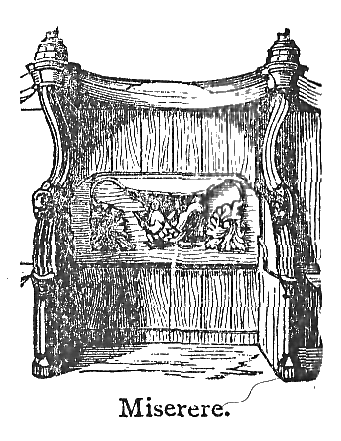
Miserere, miz-e-rē′re, n. the name by which in Catholic usage the penitential 50th Psalm of the Vulgate (51st in A.V.) is commonly known, from its commencement, 'Miserere mei, Domine:' a musical composition adapted to this psalm: a hinged folding-seat in a church stall, which, when turned up, shows a bracket on which a person who is standing can lean. [L., 2d pers. sing, imperf. of miserēri, to have mercy, to pity—miser, wretched.]
Misericorde, miz-e-ri-kord′, n. mercy, forgiveness, pity: a folding-seat: a narrow-bladed dagger for putting a wounded foe out of pain by the coup-de-grâce. [Fr.,—L.,—misericors, -dis, tender-hearted.]
Misery, miz′ėr-i, n. wretchedness: great unhappiness: extreme pain of body or of mind: a cause of pain or sorrow: (Shak.) avarice. [O. Fr.,—L. miseria.]
Misesteem, mis-es-tēm′, n. want of esteem: disregard: disrespect.—v.t. Mises′timāte, to estimate wrongly.
Misexpression, mis-eks-presh′un, n. a wrong expression.
Misfaith, mis′fāth, n. (Tenn.) distrust.
Misfall, mis′-fawl′, v.t. (obs.) to befall unluckily.
Misfare, mis-fār′, n. (Spens.) ill fare: misfortune.—v.i. to fare or succeed ill.
Misfeasance, mis-fēz′ans, n. (law) a wrong done, as distinguished from Nonfeasance, which means a mere omission: the doing of a lawful act in a wrongful manner, as distinguished from Malfeasance, which means the doing of an act which is positively unlawful.—ns. Misfeas′ant, Misfeas′or, one who commits a misfeasance. [O. Fr., mes-, wrong, faisance—faire—L. facĕre, to do.]
Misfeign, mis-fān′, v.i. to feign with bad design.
Misfit, mis-fit′, n. a bad fit, of clothes, &c.—v.t. to make of a wrong size: to supply with something that does not fit.
Misform, mis-form′, v.t. to form or shape badly or improperly.—n. Misformā′tion.
Misfortune, mis-for′tūn, n. ill-fortune: an evil accident: calamity: (coll.) a euphemism for a lapse from virtue resulting in the birth of a natural child.—adj. Misfor′tuned. (Milt.), unfortunate.
Misget, mis-get′, v.t. (Spens.) to procure unlawfully.—adj. Misgot′ten, wrongly obtained.
Misgive, mis-giv′, v.t. to fill with doubt: to destroy confidence.—v.i. to fail, as the heart: to give way to doubt.—n. Misgiv′ing, mistrust.
Misgo, mis-gō′, v.i. to go astray or amiss.
Misgovern, mis-guv′ėrn, v.t. to govern badly: to use power unjustly.—ns. Misgov′ernance (Spens.), ill government: irregularity; Misgov′ernment.
Misgraff, mis-graf′, Misgraft, mis-graft′, v.t. (Shak.) to graft wrongly or on a wrong stock.
Misgrowth, mis-grōth′, n. an irregular growth, an excrescence.
Misguide, mis-gīd′, v.t. to guide wrongly: to lead into error.—ns. Misguid′ance, Misguide′ (obs.).
Mishallowed, mis-hal′ōd, adj. devoted to evil ends.
Mishandle, mis-han′dl, v.t. to maltreat.
Mishanter, Mischanter, mi-shan′tėr, n. (Scot.) an unlucky chance, misfortune.
Mishap, mis-hap′, n. ill chance: accident: misfortune.—v.i. Mishap′pen (Spens.), to happen ill.
Mishear, mis-hēr′, v.t. to hear incorrectly.—v.i. to mistake in hearing.
Mishmash, mish′mash, n. a hotch-potch, medley.
Mishmee, mish′mē, n. the bitter tonic root of a Chinese species of gold-thread.
Mishnah, Mishna, mish′na, n. a great collection of halachoth, comprising the body of the 'Oral Law,' or the juridico-political, civil, and religious code of the Jews; it forms one of the divisions of the Talmud—the 'Gemara,' or commentary on the Mishna, being the other; and it was finally redacted at Tiberias in 220 A.D.:—pl. Mish′noth.—adjs. Mishnā′ic, Mish′nic. [Heb.,—shānāh, to repeat.]
Misimprove, mis-im-prōōv′, v.t. to apply to a bad purpose: to misuse.—n. Misimprove′ment.
Misincline, mis-in-klīn′, v.t. to cause to incline wrongly.
Misinfer, mis-in-fėr′, v.t. to infer wrongly.—v.i. to draw a wrong inference.
Misinform, mis-in-form′, v.t. to tell incorrectly.—ns. Misinform′ant; Misinformā′tion; Misinform′er.
Misinstruct, mis-in′strukt′, v.t. to instruct improperly.—n. Misinstruc′tion, wrong instruction.
Misintelligence, mis-in-tel′e-jens, n. wrong or false information.
Misintend, mis-in-tend′, v.t. to misdirect.
Misinterpret, mis-in-tėr′pret, v.t. to interpret wrongly: to explain wrongly.—ns. Misinterpretā′tion; Misinter′preter.
Misjoin, mis-join′, v.t. to join improperly or unfitly.—n. Misjoin′der (law), an incorrect union of parties or of causes of actions in a suit.
Misjudge, mis-juj′, v.t. and v.i. to judge wrongly.—n. Misjudg′ment.
Misken, mis-ken′, v.t. (Scot.) to be, or to appear, ignorant of.
Misknow, mis-nō′, v.t. to misapprehend.—n. Misknowl′edge.
Mislabel, mis-lā′bel, v.t. to mark with a wrong descriptive label, &c.
Mislay, mis-lā′, v.t. to lay in a wrong place or in one not remembered: to lose:—pa.p. mislaid′.
Misle, miz′l. See Mizzle.
Mislead, mis-lēd′, v.t. to guide into error: to cause to mistake:—pa.p. misled′.—n. Mislead′er.—adj. Mislead′ing, deceptive.—adv. Mislead′ingly.
Misleared, mis-lērd′, adj. (Scot.) mistaught: wrongly informed, imposed upon.
Misletoe. See Mistletoe.
Mislight, mis-līt′, v.t. to lead astray by a light.
Mislike, mis-līk′, v.t. to dislike: to disapprove of.—n. dislike: disapprobation.—n. Mislike′ness, a misleading resemblance.
Mislippen, mis-lip′n, v.t. (Scot.) to disappoint, deceive: to neglect to pay attention to anything.
Mislive, mis-liv′, v.i. to live a bad life.
Misluck, mis-luk′, v.i. to meet with bad luck, to fail.—n. ill-luck.
Mismanage, mis-man′āj, v.t. to conduct badly: to conduct carelessly.—n. Misman′agement.
Mismanners, mis-man′ėrz, n.pl. bad manners.
Mismatch, mis-mach′, v.t. to match unsuitably.—n. Mismatch′ment.
Mismated, mis-māt′ed, adj. (Tenn.) ill-matched.
Mismeasure, mis-mezh′ūr, v.t. to measure wrongly.—n. Mismeas′urement.
Misname, mis-nām′, v.t. to call by the wrong name.
Misnomer, misnō′mėr, n. a misnaming: a wrong name. [O. Fr., from Fr. mes- and nommer—L. nomināre, to name.]
Misobserve, mis-ob-zėrv′, v.t. and v.i. to observe incorrectly.
Misocapnic, mis-o-kap′nik, adj. hating smoke, esp. that of tobacco.
Misoclere, mis′o-klēr, adj. (Fuller) hating the clergy. [Gr. misein, to hate, klēros, clergy.]
Misogamist, mis-og′a-mist, n. a hater of marriage.—n. Misog′amy. [Gr. misein, to hate, gamos, marriage.]
Misogynist, mis-oj′i-nist, n. a woman-hater.—adjs. Misogynist′ical, Misog′ynous.—n. Misog′yny. [Gr. misein, to hate, gynē, a woman.]
Misology, mi-sol′o-ji, n. hatred of reason.—n. Misol′ogist. [Gr., misein, to hate, logos, reason.]
Misotheism, mis′o-thē-izm, n. hatred of God. [Gr. misein, to hate, theos, God.]
Mispaint, mis-pānt′, v.t. to paint in false colours.
Mispersuasion, mis-pėr-swā′zhun, n. a wrong persuasion or notion: a false opinion.
Misplace, mis-plās′, v.t. to put in a wrong place: to set on an improper object.—n. Misplace′ment.
Misplay, mis-plā′, n. a wrong play.
Misplead, mis-plēd′, v.i. to plead wrongly.—n. Misplead′ing, an error in pleading.
Misplease, mis-plēz′, v.t. to displease.
Mispoint, mis-point′, v.t. to punctuate wrongly.
Mispolicy, mis-pol′i-si, n. bad policy.
Mispractice, mis-prak′tis, n. misconduct.
Mispraise, mis-prāz′, v.t. to praise falsely.
Misprint, mis-print′, v.t. to print wrong.—n. a mistake in printing.
Misprise, mis-prīz′, v.t. to slight, undervalue. [O. Fr mespriser—pfx. mes-, amiss, Low L. pretiāre—L. pretium, price.]
Misprision, mis-prizh′un, n. mistake: (law) criminal oversight or neglect in respect to the crime of another: any serious offence, failure of duty—positive or negative, according as it is maladministration or mere neglect.—Misprision of heresy, treason, &c., knowledge of and failure to give information about heresy, treason, &c. [O. Fr., mes-, ill, Low L. prension-em—L. prehendĕre, to take.]
Misprize, mis-prīz′, v.t. (Shak.) to mistake.
Mispronounce, mis-pro-nowns′, v.t. to pronounce incorrectly.—n. Mispronunciā′tion, wrong or improper pronunciation.
Misproud, mis-prowd′, adj. unduly proud.
Mispunctuate, mis-pungk′tū-āt, v.t. and v.i. to punctuate wrongly.—n. Mispunctuā′tion.
Mispursuit, mis-pur-sūt′, n. a mistaken pursuit.
Misqualify, mis-kwol′i-fī, v.t. to characterise erroneously.
Misquote, mis-kwōt′, v.t. to quote wrongly.—n. Misquotā′tion, a wrong quotation.
Misread, mis-rēd′, v.t. to read wrongly: to misinterpret.—n. Misread′ing, an erroneous reading.
Misreckon, mis,-rek′n, v.t. to reckon or compute wrongly.—n. Misreck′oning.
Misregard, mis-re-gärd′, n. (Spens.) misconstruction.
Misrelate, mis-re-lāt′, v.t. to relate incorrectly.—n. Misrelā′tion.
Misremember, mis-re-mem′bėr, v.t. to mistake in remembering.—v.i. to fail to remember correctly.
Misreport, mis-re-pōrt′, v.t. to give an incorrect report or account of.—n. a false report.
Misrepresent, mis-rep-re-zent′, v.t. to represent incorrectly: to act unfaithfully on behalf of.—v.i. to give a false impression.—n. Misrepresentā′tion.
Misresemblance, mis-re-zem′blans, n. an imperfect resemblance.
Misrule, mis-rōōl′, n. wrong or unjust rule: disorder: tumult.—v.t. and v.i. to govern badly.—Abbot, or Lord, of Misrule, or Unreason, ancient titles for the leader of the Christmas revels.
Miss, mis, n. a title of address of an unmarried female: a young woman or girl: (obs.) a kept mistress:—pl. Miss′es—either the 'Miss Hepburns' or the 'Misses Hepburn' may be said, but the latter is preferable.—n. Miss′-Nan′cy, a very effeminate young man. [Contr. of mistress.]
Miss, mis, v.t. to fail to hit, reach, find, or keep: to omit: to fail to have: to discover the absence of: to feel the want of: to fail to observe: to leave out.—v.i. to fail to hit or obtain: to go wrong.—n. a failure to hit the mark: loss.—Miss fire, to fail to go off or explode from some cause; Miss one's tip (slang), to fail in one's plan or attempt; Miss stays (naut.), to fail in going about from one tack to another. [A.S. missan; Dut. missen, to miss.]
Missal, mis′al, n. the book which contains the complete service for mass throughout the year. [Low L. missale, from missa, mass.]
Missay, mis-sā′, v.i. to say or speak incorrectly or falsely.—v.t. to utter amiss: to slander.
Missee, mis-sē′, v.t. and v.i. to see falsely or erroneously, to take a distorted view.
Misseem, mis-sēm′, v.i. (Spens.) to seem or appear falsely, to misbecome.—p.adj. Misseem′ing, unbecoming.—n. false appearance.
Missel, mis′l, n. the largest of the European thrushes—supposed to be fond of the berries of the mistletoe.—Also Miss′el-bird, Miss′el-thrush.
Misseltoe. See Mistletoe.
Missel-tree, mis′l-trē, n. a tree of the Melastoma family in British Guiana.
Misset, mis-set′, v.t. to set or place wrongly or unfitly.—p.adj. (Scot.) out of humour.
Misshape, mis-shāp′, v.t. to shape ill: to deform.—n. deformity.—p.adj. Misshap′en, ill-shaped.—n. Misshap′enness.
Missheathed, mis-shēthd′, adj. (Shak.) wrongly sheathed.
Missile, mis′il, adj. that may be thrown from the hand or from any instrument.—n. a weapon thrown by the hand. [L. missilis—mittĕre, missum, to throw.]
Missing, mis′ing, adj. absent from the place where it was expected to be found: lost: wanting.—adv. Miss′ingly (Shak.), with a sense of loss.—Missing link (see Link). [See Miss (v.).]
Mission, mish′un, n. a sending of any agent, delegate, or messenger: the purpose for which one is sent: the sending out persons to spread a religion: a series of special religious services conducted by a missioner: any particular field of missionary enterprise: persons sent on a mission: an embassy: a station or association of missionaries: duty on which one is sent: purpose of life.—v.t. (rare) to commission.—n. Miss′ionary, one sent upon a mission to spread the knowledge of religion.—adj. pertaining to missions.—ns. Miss′ionary-bish′op, one having jurisdiction in a heathen country, or in districts not yet formed into dioceses; Miss′ioner, one who conducts a series of special mission services; Miss′ion-school, a school for religious, and sometimes also secular, instruction for the poor, kept up by charity: a school conducted by a missionary abroad. [Fr.,—L. mission-em—mittĕre, to send.]
Missis, mis′iz, n. a colloquial form of mistress: a wife.
Missish, mis′ish, adj. prim, affected.—n. Miss′ishness.—adj. Miss′y, namby-pamby, sentimental.—n. a diminutive of miss. [Miss.]
Missive, mis′iv, adj. that may be sent: intended to be thrown or hurled.—n. that which is sent, as a letter: (Shak.) messenger: (pl., Scots law) letters sent between two parties in which one makes an offer and the other accepts it. [Fr.,—L. missus.]
Misspeak, mis-spēk′, v.t. to utter wrongly.—v.i. to mistake or err in speaking.
Misspell, mis-spel′, v.t. to spell wrongly.—n. Misspell′ing, a wrong spelling.
Misspend, mis-spend′, v.t. to spend ill: to waste or squander:—pa.t. and pa.p. misspent′.
Misstate, mis-stāt′, v.t. to state wrongly or falsely.—n. Misstate′ment.
Misstep, mis-step′, v.i. to make a false step; to make a mistake.—n. a mistake in conduct, &c.
Missuit, mis-sūt′, v.t. to be unbecoming to.
Missummation, mis-su-mā′shun, n. wrong addition.
Missy. See Missish.
Mist, mist, n. watery vapour seen in the atmosphere: rain in very fine drops: anything that dims or darkens the sight or the judgment.—n. Mist′flow′er, a North American plant of the Aster family, with clusters of blue or violet flowers.—adj. Mist′ful, misty.—adv. Mist′ily.—n. Mist′iness.—adj. Mist′y, full of mist: dim: obscure, not perspicuous.—Scotch mist, a very wetting rain. [A.S. mist, darkness; Ice. mistr, mist, Dut. mist.]
Mistake, mis-tāk′, v.t. to understand wrongly: to take one thing or person for another.—v.i. to err in opinion or judgment.—n. a taking or understanding wrongly: an error.—adjs. Mistak′able; Mistak′en, understood wrongly: guilty of a mistake: erroneous: incorrect.—adv. Mistak′enly.—n. Mistak′ing (Shak.), a mistake.—And no mistake (coll.), without any manner of doubt: without fail; Be mistaken, to make or have made a mistake: to be misunderstood. [M. E. mistaken—Ice. mistaka, to take wrongly—mis-, wrongly, taka, to take.]
Misteach, mis-tēch′, v.t. to teach wrongly.
Mistell, mis-tel′, v.t. to tell wrongly.
Mistemper, mis-tem′pėr, v.t. to temper ill: to disorder.—adj. Mistem′pered (Shak.), angry.
Mister, mis′tėr, n. (Spens.) manner, kind: (Scot.) necessity.—v.i. (Spens.) to need, require: to be poor: to be necessary. [O. Fr. mestier (Fr. métier), trade—L. ministerium, service.]
Mister, mis′tėr, n. sir: a title of address to a man, written Mr. [A corr. of master, through the influence of mistress.]
Misterm, mis-tėrm′, v.t. to term or name wrongly.
Mistery, mis′tėr-i, n. (Shak.) an art or trade—often spelt mystery. [Mister, trade.]
Misthink, mis-thingk′, v.t. (Shak.) to think ill of.—v.i. to think wrongly.—n. Misthought′, a wrong notion.
Mistico, mis′ti-kō, n. a small Mediterranean coaster, between a xebec and a felucca. [Sp.,—Ar.]
Mistigris, mis′ti-gris, n. a variation of poker in which a joker is used, to which the player holding it gives what value he chooses—also the joker when so used.
Mistime, mis-tīm′, v.t. to time wrongly.—adj. Mistimed′, unseasonable.
Mistitle, mis-tī′tl, v.t. to call by a wrong title.
Mistle. Same as Mizzle.
Mistletoe, miz′l-tō, n. a parasitic evergreen plant, with white viscous berries, found in southern England and elsewhere growing on the apple, apricot, &c. (very rarely on the oak). [A.S. mistel-tán (Ice. mistel-teinn)—mistel, mistletoe, A.S. tán, twig; mistel is a dim. of mist.]
Mistradition, mis-tra-dish′un, n. a false tradition.
Mistrain, mis-trān′, v.t. to train amiss.
Mistral, mis′träl, n. a violent north-west wind which at certain seasons prevails on the south coast of France. [Fr. mistral, lit. a master (wind)—L. magister, master.]
Mistranslate, mis-trans-lāt′, v.t. to translate incorrectly.—n. Mistranslā′tion.
Mistreading, mis-tred′ing, n. (Shak.) a wrong treading or going, a false step.
Mistreat, mis-trēt′, v.t. to treat ill: to abuse.—n. Mistreat′ment, ill-treatment: abuse.
Mistress, mis′tres, n. (fem. of Master) a woman having power or ownership: the female head of a family, school, &c.: a woman well skilled in anything: a woman loved and courted: a concubine: (fem. of Mister) a form of address once applied to any woman or girl, now given to a married woman (usually written Mrs and pronounced mis′ez): (Shak.) the small ball at bowls, now called the Jack, at which the players aim.—v.t. to play the mistress. [O. Fr. maistresse (Fr. maîtresse).]
Mistrial, mis-trī′al, n. a trial void because of error, as by disqualification of a juror, &c.: a trial in which the jury fail to agree.
Mistrust, mis-trust′, n. want of trust or confidence.—v.t. to regard with suspicion: to doubt.—adj. Mistrust′ful, full of mistrust.—adv. Mistrust′fully.—n. Mistrust′fulness.—adv. Mistrust′ingly, with mistrust: without confidence.—adj. Mistrust′less, without mistrust or suspicion.
Mistryst, mis-trīst′, v.t. (Scot.) to disappoint by not keeping an engagement: to deceive.
Mistune, mis-tūn′, v.t. to tune wrongly or falsely: to put out of tune.
Misunderstand, mis-un-dėr-stand′, v.t. to take in a wrong sense.—n. Misunderstand′ing, a mistake as to meaning: a slight disagreement.
Misuse, mis-ūs′, n. improper use: application to a bad purpose.—v.t. Misuse (mis-ūz′), to use for a wrong purpose or in a wrong way: to treat ill: to abuse.—n. Misus′age, ill-usage: abuse.
Misventure, mis-ven′tūr, n. a misadventure.—adj. Misven′turous.
Misween, mis-wēn′, v.i. to judge wrongly.
Miswend, mis-wend′, v.i. to wander.
Misworship, mis-wur′ship, v.t. to worship wrongly.—n. worship of a wrong object.
Miswrite, mis-rīt′, v.t. to write incorrectly.
Miswrought, mis-rawt′, adj. badly wrought.
Mite, mīt, n. an acaridan arachnid, esp. one of the smaller forms, as the cheese-mite, &c. [A.S. míte.]
Mite, mīt, n. the minutest or smallest of coins, about one-fourth of a farthing: anything very small, even a person: a very little quantity. [Old Dut. mijt.]
Mithras, mith′ras, n. a Perso-Iranian divinity of light, worshipped with elaborate secret rites and mysteries, popular at Rome in the early Empire—representations of Mithras as a beautiful youth in Phrygian dress sacrificing a bull being common in Roman art—also Mith′ra.—n. Mithræ′um, a grotto sacred to Mithras.—adj. Mithrā′ic.—ns. Mithrā′icism, Mith′raism.—v.i. Mith′raise.—n. Mith′raist. [L.,—Gr.,—Old Pers. Mitra.]
Mithridate, mith′ri-dāt, n. an antidote to poison, Mithridates, king of Pontus (b.c. 120-63), having made himself proof against poisons.—adj. Mithridat′ic.
Mitigate, mit′i-gāt, v.t. to make more easily borne: to lessen the severity of: to temper: to reduce in amount (as evil).—adjs. Mit′igable, that can be mitigated; Mit′igant, mitigating.—n. Mitigā′tion, act of mitigating: alleviation: abatement.—adjs. Mit′igative, Mit′igatory, tending to mitigate: soothing.—n. Mit′igator, one who mitigates. [L. mitigāre, -atum—mitis, mild.]
Mitrailleuse, mē-tra-lyez′, n. a breech-loading machine-gun, discharging a stream of bullets with great rapidity—first brought into use by the French in 1870-71.—n. Mitraille (mē-traly′), grapeshot.—v.t. to fire mitraille at—n. Mitrailleur (mē-tra-lyėr′), a man in charge of a mitrailleuse. [Fr. mitrailler, to fire with grapeshot—mitraille, grapeshot.]
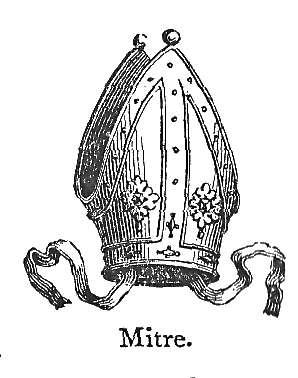
Mitre, mī′tėr, n. a head-dress worn by archbishops and bishops, and sometimes by abbots: (fig.) episcopal dignity: (archit.) a junction of two pieces, as of moulding, at an angle of 45°: a cap or cowl for a chimney or ventilator-pipe: a gusset in sewing, &c.—v.t. to adorn with a mitre: to unite at an angle of 45°.—adjs. Mī′tral, Mit′riform, having the form of a mitre: (bot.) conical, and somewhat dilated at the base.—ns. Mī′tre-joint, a joint between two pieces, each cut at an angle of 45°; Mī′tre-wheel, a bevel-wheel having its face inclined 45° to its axis. [Fr.,—L. mitra—Gr. mitra, belt, fillet.]
Mitt, mit, short for mitten.
Mitten., mit′n, n. a kind of glove for winter use, without a separate cover for each finger: a glove for the hand and wrist, but not the fingers.—v.t. to put mittens on.—Get the mitten, to be rejected as a lover. [O. Fr. mitaine, perh. from Middle High Ger. mittemo, 'half glove;' but perh. Celtic, cf. Gael. and Ir. mutan, a muff.]
Mittimus, mit′i-mus, n. (law) a warrant granted for sending to prison a person charged with a crime: a writ by which a record is transferred out of one court to another: a formal dismissal from a situation. [L., 'we send'—mittĕre, to send.]
Mity, mīt′i, adj. full of mites or insects.
Miurus, mī-ū′rus, n. a dactylic hexameter with short penultimate syllable. [Gr. meiouros, curtailed, meiōn, less, oura, a tail.]
Mix, miks, v.t. to unite two or more things into one mass: to mingle: to associate.—v.i. to become mixed: to be joined: to associate.—n. a jumble, a mess.—adjs. Mix′able, Mix′ible; Mixed, mingled: promiscuous: confused.—adv. Mix′edly.—n. Mix′er.—adjs. Mix′o-barbar′ic, not purely barbarous; Mix′tiform, of a mixed character; Mixtilī′neal, consisting of a mixture of lines, right, curved, &c.—ns. Mix′tion, a mixture of amber, mastic, and asphaltum used as a mordant for fixing gold-leaf to distemper pictures or to wood; Mix′tūre, act of mixing or state of being mixed: a mass or compound formed by mixing: (chem.) a composition in which the ingredients retain their properties—opp. to Combination: a compound-stop in organ-building: a preparation in which an insoluble compound is suspended in an aqueous solution: a cloth of variegated colouring.—adj. Mix′ty-max′ty (Scot.), mixed confusedly together.—Mix up, to confuse.—Mixed chalice, the chalice prepared for the eucharist, containing wine mixed with water; Mixed marriage, one in which the contracting persons are of different religions. [A.S. miscan; Ger. mischen.]
Mixen, miks′n, n. (Tenn.) a dunghill. [A.S. mixen—mix, meox, dung.]
Mizmaze, miz′māz, n. a labyrinth: bewilderment.
Mizzen, Mizen, miz′n, n. in a three-masted vessel, the hindmost of the fore-and-aft sails: the spanker or driver.—adj. belonging to the mizzen: nearest the stern.—n. Mizz′en-mast, the mast that bears the mizzen. [Fr. misaine—It. mezzana—Low L. medianus—L. medius, the middle.]
Mizzle, miz′l, v.i. to rain in small drops.—n. fine rain.—n. Mizz′ling, a thick mist.—adj. Mizz′ly, misty. [For mist-le, freq. from mist.]
Mizzle, miz′l, v.i. to yield: (slang) to decamp.—v.t. to muddle, confuse.
Mjolnir, myōl′nir, n. Thor's terrible hammer.
Mnemonic, -al, nē-mon′ik, -al, adj. assisting the memory.—ns. Mnemon′ics, the art of assisting the memory: a mode of recalling to the mind any fact or number, or a series of disconnected terms or figures; Mnemos′yne, goddess of memory, mother of the Muses.—adj. Mnemotech′nic, mnemonic.—n. Mnemotech′nics, mnemonics. [Gr. mnēmonikos—mnēmōn, mindful—mnasthai, to remember.]
Mo, mō, adj. and adv. (obs.) more.—Also Moe. [A.S. má, more, connected with mára.]
Moa, mō′a, n. an extinct large wingless ostrich-like bird of New Zealand.
Moabite, mō′a-bīt, n. one of the ancient people of Moab, living to the east of the lower part of Jordan and the Dead Sea.—adj. of or pertaining to Moab.—n. Mō′abite-stone, slab of black, basalt found in 1868 among the ruins of Dhibân (Dibon) in Moab, bearing an inscription of 34 lines in Hebrew-Phœnician letters, about the revolt of Mesha, king of Moab, against the king of Israel (2 Kings, iii.)
Moan, mōn, v.i. to make a low sound of grief or pain: to lament audibly.—v.t. to lament.—n. a low sound of grief or pain: audible expression of pain.—adj. Moan′ful, expressing sorrow: lamentable.—adv. Moan′fully, with lamentation. [A.S. mǽnan.]
Moat, mōt, n. a deep trench round a castle or fortified place, sometimes filled with water: (obs.) a hill or mound.—v.t. to surround with a moat.—adj. Moat′ed. [O. Fr, mote, a mound, trench.]
Mob, mob, n. the mobile or fickle common people: the vulgar: the rabble: a disorderly crowd, a riotous assembly: a large herd or flock.—v.t. to attack in a disorderly crowd:—pr.p. mob′bing; pa.p. mobbed.—adj. Mob′bish.—ns. Mob′-law, lynch-law; Moboc′racy, rule or ascendency exercised by the mob; Mob′ocrat, a demagogue.—adj. Mobocrat′ic.—n. Mobs′man, a well-dressed thief or swindler—usually Swell-mobsman. [Contr. for L. mobile (vulgus), the fickle (multitude); movēre to move.]
Mob, mob, or Mob′-cap, n. a cap with puffy crown, a broad band, and frills—v.t. to cover, as the face, by a cap or hood. [Old Dut. mop; mod. Dut. mopmuts, a woman's nightcap; cf. Scotch Mutch.]
Mobby, mob′i, n. the juice of apples or peaches from which brandy is to be distilled.
Mobile, mō′bil, or mob′il, adj. that can be moved or excited.—n. Mobilisā′tion.—v.t. Mō′bilise, to put in readiness for service in war: to call into active service, as troops.—n. Mobil′ity, quality of being mobile: (slang) the mob.—Crédit mobilier, the system in banking of advancing money to the owners of movable property—as opposed to Credit foncier, on the security of real or immovable property. [Fr. mobiliser—L. mobilis.]
Moble, mob′l, v.t. (Shak.) to muffle or cover the head, as in a mob or hood. [Freq. of mob, a cap.]
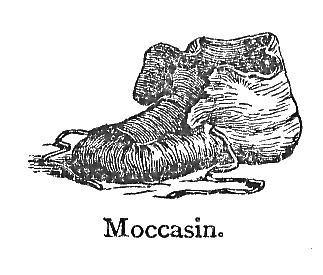
Moccasin, mok′a-sin, n. a shoe of deerskin or other soft leather, worn by the North American Indians: a venomous North American serpent.—Also Moc′assin. [Algonkin mawcahsun.]
Mocha, mō′ka, n. a very fine kind of coffee produced in Arabia, and brought from Mocha, the port of Yemen.
Moche, mōsh, n. an imported package of spun silk.
Mock, mok, v.t. to laugh at: to make sport of: to mimic in ridicule: to disappoint the hopes of: to deceive: to set at nought, defy.—n. ridicule, a sneer: a bringing into ridicule.—adj. imitating reality, but not real: false.—adj. Mock′able, exposed to, or deserving, derision.—ns. Mock′er; Mock′ery, Mock′ing, derision: ridicule: subject of laughter or sport: fruitless labour: vain imitation: false show.—adj. Mock′-herō′ic, mocking the heroic style, or the actions or characters of heroes.—n. Mock′ing-bird, a bird of North America, of the thrush family, which mocks or imitates the notes of birds and other sounds.—adv. Mock′ingly.—n. Mock′-or′ange, an ornamental shrub of the saxifrage family—also Syringa. Mock sun (see Parhelion); Mock turtle soup, a dish made of calf's head, veal, &c., seasoned in imitation of turtle soup. [O. Fr. moquer; from a Teut. root seen in Ger. mucken, to mutter; prob. imit.]
Mocuddum, mo-kud′um, n. a chief: a head-man. [Hind. from Ar., mukaddam, a head-man.]
Mod, mod, n. an assembly, meeting, of a similar nature to the Welsh Eisteddfod. [Gael.]
Mode, mōd, n. manner of acting, doing, or existing: rule: custom: form: that which exists only as a quality of substance: a form of the verb, same as mood: in lace-making, a small decorative piece inserted in a pattern: the openwork between the solid parts of a pattern: a woman's mantle with a hood: (mus.) the method of dividing the octave for melodic purposes according to the position of its steps and half-steps.—adj. Mō′dal, relating to mode or form without reference to substance: consisting of mode only: (logic) indicating some mode of expression.—ns. Mō′dalism, the doctrine first set forth by Sabellius that the Father, the Son, and the Holy Spirit are not three distinct personalities, but only three different modes of manifestation; Mō′dalist, one who holds this theory.—adj. Modalist′ic.—n. Modal′ity, mode in its logical sense: (law) the quality of being limited by a condition.—adv. Mō′dally.—Greek modes, consisting each of two tetra-chords and one whole step; Gregorian, Medieval, or Ecclesiastical modes, derived from the above by Ambrose, Gregory the Great, &c., each of the seven natural sounds of the diatonic scale forming the keynote or final of a mode, which embraced that note and the seven above it. To each of these seven modes is attached another, in which the melody, while having the same final or keynote, instead of ascending to the octave above, ranges from the fourth below it to the fifth above. The former are called the authentic modes, the latter plagal; Major mode, a modern mode, consisting of two steps, a half-step, three steps, and a half-step; Minor mode, a modern mode, consisting of a step, a half-step, two steps, a half-step, and two steps. [Fr.,—L. modus.]
Model, mod′el, n. something to show the mode or way: something to be copied: a pattern: a mould: an imitation of something on a smaller scale: a living person from whom an artist works: something worthy of imitation.—adj. serving as a model: fit for a model.—v.t. to form after a model: to shape: to make a model or copy of: to form in some soft material.—v.i. to practise modelling:—pr.p. mod′elling; pa.p. mod′elled.—ns. Mod′eller; Mod′elling, the act or art of making a model of something, a branch of sculpture. [Fr.,—L. modulus, dim. of modus, a measure.]
Modena, mod′e-na, n. a shade of crimson.
Moderate, mod′ėr-āt, v.t. to keep within measure or bounds: to regulate: to reduce in intensity: to make temperate or reasonable: to pacify: to decide as a moderator.—v.i. to become less violent or intense: to preside or act as a moderator.—adj. kept within measure or bounds: not excessive or extreme: temperate: of middle rate.—n. one of a party in Scottish Church history dominant in the 18th century, lax in doctrine and discipline, but intolerant of Evangelicanism and popular rights—it caused the secessions of 1733 and 1761, and its final resultant was the Disruption of 1843.—adv. Mod′erately.—ns. Mod′erateness; Moderā′tion, act of moderating: state of being moderated or moderate: freedom from excess: calmness of mind; Mod′eratism, moderate opinions in religion or politics.—adv. Moderä′to (mus.), with moderate quickness.—ns. Mod′erātor, one who, or that which, moderates or restrains: a president or chairman, esp. in Presbyterian Church courts: an officer at the universities of Oxford and Cambridge who superintends the examination for degrees: a kind of lamp in which the flow of the oil to the wick is regulated:—fem. Mod′eratrix; Mod′eratorship. [L. moderāri, -ātus—modus, a measure.]
Modern, mod′ėrn, adj. limited to the present or recent time: not ancient: (Shak.) commonplace.—n. one who lives in modern times: (pl.) the nations of the present day, distinguished from the Greeks and Romans—the ancients.—n. Modernisā′tion.—v.t. Mod′ernise, to adapt to the present time.—ns. Mod′erniser; Mod′ernism, modern practice or character: something of modern origin; Mod′ernist, an admirer of modern ideas or habits.—adv. Mod′ernly.—ns. Mod′ernness, Mod′ernity, state or quality of being modern. [Fr.,—L. modernus—modo; just now, orig. abl. of modus.]
Modest, mod′est, adj. restrained by a sense of propriety: not forward: decent: chaste: pure and delicate, as thoughts or language: not excessive or extreme: moderate.—adv. Mod′estly.—n. Mod′esty, humility: purity of thought and manners: becoming behaviour: chastity, purity: moderation. [Fr.,—L. modestus—modus; a measure.]
Modicum, mod′i-kum, n. a small quantity: something of a moderate size: anything very small. [L. neut. of modicus, moderate—modus.]
Modify, mod′i-fī, v.t. to set bounds to: to moderate: to change the form or quality of: to alter slightly: to vary.—adj. Modifī′able.—n. Modificā′tion, act of modifying or state of being modified: result of alteration or change: changed shape or condition.—adjs. Mod′ificātive, Mod′ificātory, tending to modify: causing change of form or condition.—n. Mod′ifīer. [Fr. modifier—L. modificāre, -ātum—modus, a measure, facĕre, to make.]
Modillion, mod-il′yun, n. (archit.) an ornamental bracket used in the cornices of the Corinthian and composite styles. [Fr.,—L. modulus—modus, a measure.]
Modiolus, mo-dī′o-lus, n. the central stem round which wind the passages of the cochlea of the internal ear.—adjs. Modī′olar, Modī′oliform.
Modish, mō′dish, adj. according to the fashion.—adv. Mō′dishly.—ns. Mō′dishness; Mō′dist, one who follows the fashion; Modiste (mō-dēst′), a fashionable dressmaker.
Modius, mō′di-us, n. a Roman dry measure=2 gal.: a cylindrical head-dress:—pl. Mō′dii (-ī). [L.]
Modulate, mod′ū-lāt, v.t. to measure, to regulate: to vary the tone of voice so as to give expression: (mus.) to change the key or mode.—v.i. to pass from one key into another.—adj. Mod′ular, of or pertaining to mode or modulation, or to a module.—ns. Modulā′tion, the act of modulating: state of being modulated: (mus.) the changing of the keynote and of the original scale by the introduction of a new sharp or flat; Mod′ulātor, one who, or that which, modulates: a chart in the Tonic Sol-fa musical notation on which the modulations or changes from one scale to another are shown by the relative position of the notes; Mod′ule, a small measure or quantity: (archit.) a measure such as the diameter of the shaft for regulating the proportions of the other parts of columns: (Shak.) a model, image; Mod′ulus (math.), a constant multiplier in a function of a variable, by which the function is adapted to a particular base:—pl. Moduli (mod′ū-lī). [L. modulāri, -ātus—modulus, dim. of modus, a measure.]
Modus, mō′dus, n. the way or style of expressing anything: a fixed payment instead of tithes: (law) a departure from, or a modification of, some general rule or form:—pl. Mō′dī. [L. modus, manner.]
Modwall, mod′wal, n. (prov.) the bee-eater.
Moe, mō, adj. and adv. (Shak.). See Mo.
Moe, mō, n. (Shak.) a wry mouth, grimace.—v.i. to make grimaces.—Better Mow (q.v.).
Moellon, mō′el-lon, n. rubble-stone with mortar, used as a filling in mason-work. [Fr.,—moelle, marrow—L. medulla, marrow—medius, middle.]
Moerology, mē-rol′o-ji, n. the practice of professional mourning. [Gr. moira, fate, legein, to speak.]
Moeso-Gothic, mē-sō-goth′ik, adj. relating to the Goths who settled in Moesia, or to their language.
Mofette, mō-fet′, n. a noxious gas escaping from the earth. [L. mephitis.]
Moff, mof, n. a thin silk fabric.
Moffle, mof′l, v.i. (prov.) to do anything clumsily.
Mofussil, mō-fus′il, n. the country districts and stations in India, as distinguished from the towns and official residencies: rural: provincial. [Hind. mufassal, the country—Ar. fasala, separate.]
Mog, mog, v.i. (prov.) to move away.
Mogul, mō-gul′, n. a Mongol or Mongolian, esp. one of the followers of Baber, the conqueror of India (1483-1530): a name applied to the best quality of playing-cards.—adj. pertaining to the Mogul Empire, architecture, &c.—adj., the title by which Europeans knew the Emperors of Delhi. [Pers., properly 'a Mongol.']
Mohair, mō′hār, n. the fine silken hair of the Angora goat of Asia Minor: cloth made of mohair. [O. Fr. mouaire (Fr. moire)—Ar. mukhayyar.]
Mohammedan, mo-ham′ed-an, adj. pertaining to Mohammed or to his religion.—n. a follower of Mohammed: one who professes Mohammedanism—also Mahom′etan, Mahom′edan.—v.t. Mohamm′edanise, to convert to, or made conformable to, Mohammedanism.—ns. Mohamm′edanism, Mohamm′edism, the religion of Mohammed, contained in the Koran. [Mohammed, the great prophet of Arabia (570-632); lit. 'praised.']
Moharram, mo-har′am, n. the first month of the Mohammedan year: the great fast held during the first ten days of this month.—Also Muharr′am.
Mohawk, mō′hawk, n. the name of a tribe of North American Indians of the Huron-Iroquois family—hence one of a set of London street-ruffians about the beginning of the 18th century.—Also Mō′hock.
Mohican, mō-hē′kan, adj. and n. relating to the Mohicans, a tribe of North American Indians of the Algonkin stock.
Mohr, mōr, n. a small African gazelle.
Mohur, mō′hur, n. in British India, a gold coin=from twelve to fifteen rupees, or 30s. [Pers.]
Moider, moi′dėr, v.t. to confuse: to spend.—v.i. to work hard.
Moidore, moi′dōr, n. a disused gold coin of Portugal worth 27s. [Port. moeda d'ouro—L. moneta de auro, money of gold.]
Moiety, moi′e-ti, n. half: one of two equal parts: a small share. [Fr.,—L.,—medius, middle.]
Moil, moil, v.t. to daub with dirt.—v.i. to toil or labour: to drudge.—n. a spot: a defilement. [O. Fr. moiler (Fr. mouiller), to wet—L. mollis, soft.]
Moineau, moi′nō, n. a small flat bastion to protect a fortification while being erected. [Fr.]
Moiræ, moi′rē, n.pl. the Fates, the Parcæ of the Romans—Clotho, the spinner of the thread of human life; Lachĕsis, who assigns to man his fate; and Atrŏpos, or the fate that cannot be avoided.
Moire, mwor, n. watered silk: a watered appearance on metals or textile fabrics.—Moire antique, silk watered so as to resemble the stuffs worn in ancient times. [Fr.; see Mohair.]
Moist, moist, adj. damp: humid: juicy: containing water or other liquid.—vs.t. Moist′en, Moist (obs.), to make moist: to wet slightly; Moist′ify, to make moist.—ns. Moist′ness; Moist′ure, moistness: that which makes slightly wet: a small quantity of any liquid. [O. Fr. moiste (Fr. moite)—L. musteus,—mustum, juice of grapes, new wine.]
Moke, mōk, n. (slang) a donkey: a stupid fellow: a variety performer on several instruments: a negro.
Molar, mō′lar, adj. grinding, as a mill: used for grinding.—n. a grinding tooth: a back tooth. [L. molaris—mola, a mill—molĕre, to grind.]
Molar, mō′lar, adj. of or pertaining to a mass: acting on or by means of whole masses. [L. moles, a mass.]
Molasses, mo-las′ez, n.sing. a kind of syrup that drains from sugar during the process of manufacture: treacle. [Port. melaço (Fr. mélasse)—L. mell-aceus, honey-like—mel, mellis, honey.]
Mold. See Mould.
Mole, mōl, n. a permanent dark-brown mark on the human skin, often hairy—a pigmentary Nævus (q.v.). [A.S. mál; Ger. maal, L. mac-ula.]
Mole, mōl, n. a small animal, with very small eyes and soft fur, which burrows in the ground and casts up little heaps of mould.—v.t. to burrow or form holes in.—ns. Mole′cast; Mole′-catch′er, one whose business it is to catch moles; Mole′-crick′et, a burrowing insect like a cricket, with forelegs like those of a mole.—adj. Mole′-eyed, having eyes like those of a mole: seeing imperfectly.—ns. Mole′hill, a little hill or heap of earth cast up by a mole; Mole′rat, a rat-like animal, which burrows like a mole; Mole′skin, the skin of a mole: a superior kind of fustian, double-twilled, cropped before dyeing; Mole′-spade, a small spade used by mole-catchers; Mole′-track, the track made by a mole burrowing.—Make a mountain of a molehill, to magnify a trifling matter. [For mold-warp—A.S. molde, mould, weorpan, to warp.]
Mole, mōl, n. a breakwater: any massive building: an ancient Roman mausoleum. [Fr.,—L. moles.]
Molecule, mol′e-kūl, n. one of the minute particles of which matter is composed: the smallest mass of any substance which retains the properties of that substance.—adj. Molec′ular, belonging to, or consisting of, molecules.—n. Molecular′ity.—Molecular attraction, attraction acting on the atoms or molecules of a body, as distinguished from attraction of gravitation. [Fr.,—L. moles, a mass.]
Molendinaceous, mō-len-di-nā′shi-us, adj. like a windmill.—adj. Molen′dinary, relating to a mill. [Low L. molendinum, a mill—L. molĕre, to grind.]
Molest, mō-lest′, v.t. to trouble.—ns. Molestā′tion, state of being molested: annoyance; Molest′er.—adj. Molest′ful. [Fr. molester—L. molestāre—molestus—moles, mass, difficulty.]
Molimen, mō-lī′men, n. great effort, esp. of any periodic effort to discharge a natural function.—adj. Molim′inous. [L.,—molīri, to toil—moles.]
Moline, mō′lin, n. and adj. the crossed iron in the upper millstone for receiving the spindle in the lower stone, a millstone rynd: (her.) a moline cross. [L. mola, a mill.]
Molinism, mō′li-nizm, n. the doctrine of the Spanish Jesuit Luis Molina (1535-1600), that predestination is consequent on God's fore-knowledge of the free determination of man's will, that God gives to all men sufficient grace whereby to live virtuously and merit happiness, its efficaciousness depending on the voluntary co-operation of the will with it.—n. Mō′linist, one who holds the foregoing views.
Molinist, mō′li-nist, n. a Quietist, or follower of Miguel de Molinos (1640-97). [See Quietism.]
Moll, mol, n. a familiar form of Mary: a concubine.
Mollah, Molla, mol′a, n. a Mohammedan title of respect for a learned or religious person: a judge of Moslem law. [Turk. and Pers., from Ar. maulā.]
Mollie, mol′i, n. a meeting and carousal on board one ship of the sailors belonging to several whaling-ships ice-bound in company—an abbreviation of Mallemaroking, [Mallemuck, the fulmar petrel.]
Mollify, mol′i-fī, v.t. to make soft or tender: to assuage: to calm or pacify:—pa.p. moll′ified.—adjs. Moll′ient, serving to soften: assuaging; Moll′ifiable.—ns. Mollificā′tion, act of mollifying: state of being mollified: mitigation; Moll′ifier; Moll′ine, a base for ointments used in skin diseases, a soft soap mixed with excess of fat and glycerine.—adj. Mollipī′lose, having soft plumage.—n. Mollipilos′ity, fleecines, fluffiness.—adj. Mollit′ious, luxurious.—n. Moll′itude. [Fr.,—L. mollificāre—mollis, soft, facĕre, to make.]
Mollusc, Mollusk, mol′usk, n. one of the Mollusca, a large division of invertebrate animals—bivalves or Lamellibranchs, snails or Gasteropods, and cuttlefish or Cephalopods:—pl. Moll′uscs, Moll′usks, or Mollus′ca.—n. Mollus′can, a mollusc.—adjs. Mollus′can, Mollus′coid, Mollus′cous. [Fr.,—L. molluscus, softish—mollis, soft.]
Molly, mol′i, n. dim. of Mary: the wagtail bird.—n. Moll′ycoddle, an effeminate fellow.—Molly Maguire, one of the Ribbonmen of Ireland (1843), who perpetrated outrages by night in women's dress: one of a secret society which terrorised the coal regions of Pennsylvania (1867-77).
Moloch, mō′lok, n. a Phœnician god to which human sacrifices were offered: an exceedingly spiny Australian lizard—also Mō′lech.—v.t. Mō′lochise, to sacrifice as to Moloch.
Molossus, mo-los′us, n. a metrical foot of three long syllables:—pl. Moloss′ī. [L.—Gr.]
Molten, mōlt′n, adj. melted: made of melted metal.—adv. Molt′enly. [Old pa.p. of melt.]
Molto, mol′to, adv. (mus.) very, much. [It.]
Moly, mō′li, n. (Milt.) a magic herb given by Hermes to Odysseus as a counter-charm against the spells of Circe.
Molybdenum, mol-ib-dē′num, n. a rare metal of a silvery-white colour—also Molybdē′na.—ns. Molyb′date, a compound of molybdic acid with a base; Molybdē′nite, sulphide of molybdenum.—adjs. Molybdē′nous, Molyb′dic.—n. Molybdō′sis, lead-poisoning. [L.,—Gr.,—molybdos, lead.]
Mome, mōm, n. (obs.) a buffoon: a stupid person. [O. Fr.,—L.,—Gr. Mōmos, god of mirth.]
Moment, mō′ment, n. moving cause or force: importance in effect: value, consequence: the smallest portion of time in which a movement can be made: an instant: the precise point of time, the right opportunity: (math.) an increment or decrement, an infinitesimal change in a varying quantity: (mech.) the moment of a force about a point is the product of the force and the perpendicular on its line of action from the point.—adj. Mō′mentany (Shak.), momentary.—adv. Mō′mentarily.—n. Mō′mentariness.—adj. Mō′mentary, lasting for a moment: done in a moment: short-lived.—adv. Mō′mently, for a moment: in a moment: every moment.—adj. Mōment′ous, of importance: of great consequence.—adv. Moment′ously.—ns. Moment′ousness; Moment′um, the quantity of motion in a body, measured by the product of the mass and the velocity of the moving body:—pl. Moment′a. [Fr.,—L. momentum, for movimentum—movēre, to move.]
Momus, mō′mus, n. the god of raillery, &c.—Son, or Disciple, of Momus, a wag. [See Mome.]
Monachism, mon′ak-izm, n. monastic life: state of religious seclusion under vows.—adj. Mon′achal, living alone: pertaining to monks or nuns, or to a monastic life.—n. Mon′achus, the monk-seal genus. [Fr.,—L. monachus, a monk.]
Monad, mon′ad, n. an ultimate atom or simple unextended point: a simple, primary element, assumed by Leibnitz and other philosophers: (zool.) one of the simplest of animalcules.—adj. of or pertaining to monads.—adjs. Monac′id, capable of saturating a single molecule of a monobasic acid; Monac′tinal, single-rayed.—n. Mon′adelph, a plant whose stamens are united by their filaments into one set, generally into a tube or ring.—adjs. Monadel′phian, Monadel′phous (bot.), having the stamens united into one body by the filaments; Monad′ic, -al, relating to monads: single; Monad′iform, like a monad.—ns. Mon′adism, Monadol′ogy, the theory of monads.—adj. Monan′thous (bot.), producing but one flower.—n. Mon′as, a monad: a monadiform infusorian.—adj. Monascid′ian, simple, not compound or composite—also n.—adj. Monatom′ic, consisting of a single atom, as a molecule: (chem.) having a valence of one, as hydrogen. [L. monas, -adis—Gr. monas, -ados, a unit—monos, alone.]
Monandria, mon-an′dri-a. n. the first class in Linnæus's system of plants, including all genera having only one stamen.—n. Monan′der.—adjs. Monan′drian, Monan′drous (bot.), having only one stamen. [Gr. monos, single, anēr, andros, a male.]
Monandry, mō-nan′dri, n. the practice of having only one husband.
Monarch, mon′ark, n. a sole or supreme ruler: sovereign: the chief of its kind.—adj. supreme: superior to others.—adjs. Monarch′al, pertaining to a monarch: regal; Monarch′ial, Monarch′ic, -al, relating to a monarch or to monarchy: vested in a single ruler.—ns. Monarch′ian, a Christian who denied the personal independent subsistence of Christ—dynamic, when regarding the divinity of Christ as only a power (dynamis) communicated to Him; modalistic, when regarding Christ as God Himself incarnate, the Father who had assumed flesh, a mere modus of the Godhead; Monarch′ianism, the doctrine of the Monarchians, in opposition to Subordinationalism.—adj. Monarchianis′tic.—v.t. Mon′archise, to rule over, as a monarch: to convert into a monarchy.—ns. Mon′archism, the principles of monarchy: love of monarchy; Mon′archist, an advocate of monarchy: a believer in monarchy; Monarch′o (Shak.), a fantastic Englishman who assumed Italian airs, any fantastic person; Mon′archy, a state or a people ruled over by one person: a kind of government of which the chief power is in the hands of a monarch: the territory of a monarch. [Fr. monarque, through L., from Gr. monarchēs—monos, alone, archein, to rule.]
Monastery, mon′as-tėr-i, n. a house for monks: an abbey: a convent.—adjs. Monastē′rial, Monas′tic, -al, pertaining to monasteries, monks, and nuns: recluse: solitary.—n. Monas′tic, a monk.—adv. Monas′tically.—ns. Monas′ticism, the corporate monastic life or system of living; Monas′ticon, a book about monasteries and monks.—Monastic vows, the vows which a person takes when entering a monastery—of poverty, chastity, obedience. [L. monasterium—Gr. monastērion—monastēs, a monk—monos, alone.]
Monday, mun′dā, n. the second day of the week.—adj. Mon′dayish, fagged—of preachers, after their Sunday exercitations.—Black Monday, Easter Monday, the 14th of April 1360: any Easter Monday; Handsel Monday, the first Monday of the year, when presents are given. [A.S. mónandæg, mónan, gen. of móna, moon, dæg, day.]
Mondayne, mun′dān, adj. an old form of mundane.
Monde, mond, n. the world (of fashion).—Beau monde, Demi-monde (see Beau and Demi). [Fr.]
Monera, mō-nē′ra, n.pl. a class of Protozoans of the simplest characters.—ns.sing. Mō′ner, Monē′ron.—adjs. Monē′ral, Monē′ran.
Monergism, mon′ėr-jizm, n. (theol.) the doctrine that regeneration is entirely the work of the Holy Spirit, the natural will being incapable of co-operation. [Gr. monos, alone, ergon, work.]
Monetary, mun′e-tar-i, adj. relating to money or moneyed affairs: consisting of money.—n. Monetisā′tion.—v.t. Mon′etise, to give the character of money to, to coin as money.—Monetary unit, the unit of currency—the pound sterling.
Money, mun′i, n. coin: pieces of stamped metal used in commerce: any currency used as the equivalent of money: wealth:—pl. Mon′eys.—ns. Mon′ey-bill, a bill introduced into parliament or congress for raising revenue or otherwise dealing with money; Mon′ey-brok′er, Mon′ey-chang′er, Mon′ey-scriv′ener, a broker who deals in money or exchanges.—adj. Mon′eyed, having money: rich in money: consisting in money.—ns. Mon′eyer, Mon′ier, one who coins money: a master of a mint.—adj. Mon′eyless, having no money.—ns. Mon′ey-mak′er, a coiner of counterfeit money; Mon′ey-mak′ing, act of gaining wealth.—adj. lucrative, profitable.—ns. Mon′ey-mar′ket, the market or field for the investment of money; Mon′ey-or′der, an order for money deposited at one post-office, and payable at another; Mon′ey-spī′der, or -spin′ner, a small spider of family Attidæ, supposed to bring luck; Mon′ey's-worth, something as good as money: full value; Mon′ey-tak′er, one who receives payments of money, esp. at an entrance-door.—Hard money, coin; Pot of money, a large amount of money; Ready money, money paid for a thing at the time at which it is bought: money ready for immediate payment. [O. Fr. moneie (Fr. monnaie)—L. moneta, a mint, Moneta being a surname of Juno, in whose temple at Rome money was coined.]
Monger, mung′gėr, n. a trader: a dealer, chiefly in composition, sometimes depreciatory.—v.t. to trade in. [A.S. mangere—mang, a mixture.]
Mongol, mong′gol, n. and adj. one of an Asiatic people belonging to the Ural-Altaic branch of the human family, mainly inhabiting Mongolia.—adjs. Mongō′lian, Mongol′ic.
Mongoose, mong′gōōs, n. a common ichneumon of India, often domesticated to destroy snakes.—Also Mung′oose. [Marathi mangus.]
Mongrel, mung′grel, adj. of a mixed breed, impure.—n. an animal, esp. a dog, of a mixed breed.—v.t. Mong′relise.—n. Mong′relism. [A double dim. from A.S. mang, mixture.]
Monied, mun′id, adj. moneyed.
Moniliform, mō-nil′i-form, adj. like a string of beads. [L. monile, a necklace, forma, form.]
Moniment, mon′i-ment, n. (Spens.) a monument, memorial: superscription, image. [L. monimentum, monumentum, monument.]
Moniplies, mon′i-plīz. See Maniplies.
Monism, mon′izm, n. a philosophical theory that all being may ultimately be referred to one category; thus Idealism, Pantheism, Materialism are monisms—as opposed to the Dualism of matter and spirit.—n. Mon′ist.—adjs. Mon′istic, -al. [Gr. monos, alone, and -ism.]
Monition, mon-ish′un, n. a reminding or admonishing: warning: notice: (law) a summons to appear and answer.—adj. Mon′itive, conveying admonition.—n. Mon′itor, one who admonishes: an adviser: an instructor: a senior pupil who assists a schoolmaster: an ironclad steamship armed with heavy guns in revolving turrets: a raised part of a roof, with openings for light and ventilation: a kind of lizard:—fem. Mon′itress, Mon′itrix.—adj. Monitō′rial, relating to a monitor: performed or taught by a monitor.—adv. Monitō′rially.—n. Mon′itorship.—adj. Mon′itory, giving admonition or warning. [L.,—monēre, -itum, to remind.]
Monk, mungk, n. formerly, one who retired alone to the desert to lead a religious life: one of a religious community living in a monastery: an inky blotch in print: a fuse for firing mines.—ns. Monk′ery, the life of monks: monasticism; Monk′-fish, the angel-fish; Monk′hood, the state or character of a monk.—adj. Monk′ish, pertaining to a monk: like a monk: monastic.—ns. Monk's′-hood, the aconite, a poisonous plant with a flower like a monk's hood; Monk's′-seam (naut.), a strong seam formed by laying the selvage-edges of two pieces of canvas over each other and stitching on each side and down the middle—also Middle-stitching. [A.S. munec—L. monachus—Gr. monachos—monos, alone.]
Monkey, mungk′i, n. a quadrumanous mammal of the order Primates—the term is loose, and may be conveniently restricted only to all the Primates exclusive of the Anthropoid Apes, thus including the Platyrrhini, or New-World monkeys, and the Catarrhiini, or Old-World monkeys: an ape: a name of contempt, esp. for a mischievous person, also of playful endearment: a heavy weight for driving piles: a large hammer for driving bolts: in betting slang, a sum of 500 pounds, or dollars in U.S.: a fluid consisting of chlor-hydric acid and zinc—generally called spirits of salt—used in the process of soldering:—pl. Monk′eys.—v.i. to meddle with anything.—v.t. to imitate as a monkey does.—ns. Monk′ey-bag, a small money-bag, hung round the sailor's neck; Monk′ey-block, a small swivel-block used in guiding running rigging; Monk′ey-board, the omnibus conductor's foot-board; Monk′ey-boat, a narrow, half-decked river-boat; Monk′ey-bread, the baobab-tree or its fruit; Monk′ey-en′gine, a kind of pile-driver having a ram or monkey working in a wooden frame; Monk′ey-flow′er, a flower of the mimulus kind; Monk′ey-gaff, a small gaff above the spanker-gaff for the flag; Monk′ey-grass, a coarse fibre yielded by the leaf-stalks of Attalea funifera, used for brooms, street sweeping-machine brushes, &c.; Monk′ey-hamm′er, a drop-press with a ram, which is raised and let drop freely; Monk′eyism, the qualities of the monkey; Monk′ey-jack′et, a close-fitting jacket, generally made of some stout, coarse material; Monk′ey-pot, the seed-vessel of several species of Lecythis, having a round lid; Monk′ey-pump, a straw let through a gimlet-hole into a cask for the purpose of sucking the liquor; Monk′ey-puzz′le, the Chili pine, Araucaria imbricata; Monk′ey-rail, a light rail above the quarter-rail; Monk′ey-shine (U.S.), a piece of tomfoolery; Monk′ey-tail, a short lever for training carronades: a piece of knotted rope by which to attach a hook, to save the hand from jamming; Monk′ey-wheel, a tackle-block over which runs a hoisting-rope; Monk′ey-wrench, a screw-key having a movable jaw.—Have, or Get, one's monkey up, to be angry; Suck the monkey, to drink liquor from a cask through an inserted tube: to drink from a coco-nut, filled surreptitiously with rum, &c. [Old It. monicchio, dim. of Old It. monna, nickname for an old woman, an ape, contr. of It. madonna, mistress.]
Monobasic, mon-ō-bā′sik, adj. having one base, of an acid combining with a univalent basic radical to form a neutral salt.
Monoblastic, mon-ō-blas′tik, adj. pertaining to that condition of the metazoic embryo in which a single germinal layer is alone represented.
Monoblepsis, mon-ō-blep′sis, n. a condition of vision more distinct when one eye only is used. [Gr. monos, single, blepsis, sight.]
Monocarbonate, mon-ō-kar′bō-nāt, n. a carbonate in which both hydrogen atoms of the acid are replaced by basic elements.
Monocardian, mon-ō-kär′di-an, adj. having a single heart, as fishes and reptiles. [Gr. monos, single, kardia, the heart.]
Monocarpous, mon-ō-kärp′us, adj. bearing fruit only once, as wheat, and all annual plants.—n. Mon′ocarp. [Gr. monos, single, karpos, fruit.]
Monocentric, mon-ō-sen′trik, adj. having a single centre only: unipolar.
Monocephalous, mon-ō-sef′al-us, adj. having but one head or capitulum.
Monoceros, mō-nos′ėr-os, n. a one-horned animal: the unicorn: (Spens.) perhaps the sword-fish.—adj. Monoc′erous. [Gr. monos, single, keras, a horn.]
Monochlamydeous, mon-ō-kla-mid′ē-us, adj. (bot.) having a single instead of a double perianth. [Gr. monos, single, chlamys, a cloak.]
Monochord, mon′ō-kord, n. a musical instrument of one chord or string.
Monochromatic, mon-ō-kro-mat′ik, adj. of one colour only—also Monochrō′ic.—ns. Mon′ochrome, a painting in one colour only; Mon′ochromy, this art.
Monochronic, mon-ō-kron′ik, adj. contemporaneous.—adj. Monoch′ronous, monosemic.
Monocle, mon′o-kl, n. a one-eyed animal: a single eyeglass.
Monoclinal, mon′ō-klī-nal, adj. (geol.) dipping in one direction.
Monoclinic, mon′ō-klin-ik, adj. (mineral) crystallising in three unequal axes, two intersecting each other at an oblique angle, and at right angles to the third.—Also Mon′oclīnate. [Gr. monos, single, klinein, to incline.]
Monoclinous, mon′ō-klī-nus, adj. (bot.) hermaphrodite.
Mono-compound, mon′ō-kom′pownd, n. (chem.) a compound containing one atom of any particular element.
Monocotyledon, mon-ō-kot-i-lē′don, n. a plant with only one cotyledon.—adj. Monocotylē′donous.
Monocracy, mon-ok′ra-si, n. rule or government by a single person.—n. Mon′ocrat. [Gr. monos, single, kratos, strength.]
Monocular, mon-ok′ū-lar, adj. with one eye only: fitted only for one eye at a time.—Also Monoc′ulous.
Monodactylous, mon-ō-dak′ti-lus, adj. having only one toe or finger.
Monodelphia, mon-ō-del′fi-a, n.pl. one of the three primary divisions of mammals, the placental mammals.—adj. Monodel′phian.
Monodon, mon′ō-don, n. a genus of delphinoid odontocete cetaceans, containing only the narwhal.
Monodrama, mon′ō-drä-ma, n. a dramatic piece for a single performer.—adj. Monodramat′ic.
Monody, mon′ō-di, n. a mournful ode or poem in which a single mourner bewails: a song for one voice: monotonous sound.—adjs. Monod′ic, -al.—n. Mon′odist, one who writes monodies.
Monœcious, mon-ē′shus, adj. having the stamens and pistils in separate flowers on the same individual plant.—n.pl. Monœ′cia, the 21st class of plants of Linnæus. [Gr. monos, single, oikos, a house.]
Monogamy, mon-og′a-mi, n. marriage to one wife only: the state of such marriage.—adjs. Monogam′ic, Monog′amous.—n. Monog′amist. [Gr. monos, one, gamos, marriage.]
Monogenesis, mon-ō-jen′e-sis, n. development of the ovum from a parent like itself.—adj. Monogenet′ic.—ns. Monog′enism, the descent of the whole human family from a single pair—also Monog′eny; Monog′enist, one who maintains this.—adjs. Monogenist′ic; Monog′enous, generating by fission, gemmation, &c.: pertaining to monogenism: (math.) having a single differential coefficient considered as a rule of generation.
Monogony, mō-nog′o-ni, n. a sexual reproduction.
Monogram, mon′ō-gram, n. a figure consisting of several letters interwoven or written into one.—adj. Monogrammat′ic. [Gr. monos, alone, gramma, a letter.]
Monograph, mon′ō-graf, n. a treatise written on one particular subject or any branch of it.—v.t. to write a monograph upon.—ns. Monog′rapher, Monog′raphist, a writer of monographs.—adjs. Monograph′ic, -al, pertaining to a monograph: drawn in lines without colours.—n. Monog′raphy, a representation by one means only, as lines: an outline drawing. [Gr. monos, alone, graphein, to write.]
Monogynia, mon-ō-jin′i-a, n. an order of plants which have only one pistil or female organ.—n. Mon′ogyn, a plant of this kind.—adjs. Monogyn′ian, Monog′ynous (bot.), having only one pistil or female organ.—n. Monog′yny, a mating with only one female. [Gr. monos, alone, gynē, a female.]
Monohydric, mon-ō-hī′drik, adj. containing one atom of hydrogen.
Monoid, mon′oid, adj. and n. (pros.) containing but one kind of foot.
Monolatry, mō-nol′a-tri, n. the actual worship of but one divinity, not necessarily a disbelief in others.
Monolith, mon′ō-lith, n. a pillar, or column, of a single stone.—adjs. Monolith′al, Monolith′ic. [Gr. monos, alone, lithos, a stone.]
Monologue, mon′ō-log, n. a speech uttered by one person: soliloquy: a poem, &c. for a single performer.—v.i. Monol′ogise, to indulge in this.—ns. Monol′ogist, one who talks in monologue; Monol′ogy, the habit of doing so. [Fr.,—Gr. monos, alone, logos, speech.]
Monomachy, mō-nom′a-ki, n. a single combat: a duel.—Also Monomā′chia. [Gr. monos, alone, machē, a fight.]
Monomania, mon-ō-mā′ni-a, n. madness confined to one subject, or to one faculty of the mind: an unreasonable interest in any particular thing.—n. Monomā′niac, one affected with monomania.—adjs. Monomā′niac, -al, affected with monomania. [Gr. monos, alone, mania, madness.]
Monomerous, mō-nom′e-rus, adj. having the tarsi single-jointed: (bot.) having but one member in each cycle. [Gr. monos, single, meros, part.]
Monometallic, mon-ō-me-tal′ik, adj. consisting of but one metal.—ns. Monomet′allism, the use of but one metal as a standard of value; Monomet′allist, one who upholds this theory.
Monometer, mō-nom′e-tėr, adj. and n. (pros.) consisting of one measure.—adjs. Monomet′ric, -al.
Monomial, mon-ō′mi-al, n. an algebraic expression of one term only: a series of factors of single terms—also Mon′ome.—adj. Monō′mial. [Gr. monos, alone, L. nomen, name.]
Monomorphic, mon-ō-mor′fik, adj. of the same type of structure, or morphological character.—adj. Monomor′phous. [Gr. monos, single, morphē, form.]
Monomyarian, mon-ō-mī-ā′ri-an, adj. having but one adductor muscle, as an oyster. [Gr. monos, single, mys, muscle.]
Mononym, mon′ō-nim, n. a name consisting of a single term.—adj. Mononym′ic.
Monoöusious, mon-ō-ōō′si-us, adj. having the same substance. [Gr. monos, single, ousia, essence.]
Monopathy, mō-nop′a-thi, n. (pathol.) a disease affecting only one organ or function.—adj. Monopath′ic. [Gr. monos, single, pathos, suffering.]
Monopetalous, mon-ō-pet′a-lus, adj. (bot.) having only one petal, or denoting a corolla, the petals of which so cohere as to form a tube.
Monophobia, mon-ō-fō′bi-a, n. morbid dread of being left alone. [Gr. monos, single, phobia, fear.]
Monophonous, mon-of′o-nus, adj. producing one sound at one time. [Gr. monos, single, phōnē, voice.]
Monophote, mon′ō-fōt, n. an electric arc-lamp regulator working in single series. [Gr. monos, single, phōs, phōtos, light.]
Monophthong, mon′of-thong, n. a simple vowel-sound.—adj. Mon′ophthongal.
Monophyletic, mon-ō-fi-let′ik, adj. pertaining to a single phylum:—opp. to Polyphyletic.
Monophyllous, mon-ō-fil′us, adj. having a leaf of but one piece. [Gr. monos, alone, phyllon, a leaf.]
Monophyodont, mon-ō-fī′ō-dont, adj. having only one set of teeth.—n. such an animal.
Monophysite, mō-nof′i-sīt, n. one who holds that Christ had but one composite nature, instead of the orthodox doctrine that He united two complete natures without confusion or mutation in one person.—adj. Monophysit′ical.—n. Monophysit′ism. [Gr. monos, alone, physis, nature.]
Monoplast, mon′ō-plast, n. an organism consisting of a single cell. [Gr. monos, single, plastos, formed—plassein, to form.]
Monoplegia, mon-ō-plē′ji-a, n. paralysis limited to a single part. [Gr. monos, single, plēgē, stroke.]
Monopnoa, mo-nop′nō-a, n.pl. a class of reptiles breathing in one way only. [Gr. monos, single, pnoos, breathing—pnein, to breathe.]
Monopode, mon′ō-pōd, adj. and n. having but one foot.—adj. Monopod′ic—n. Mon′opody.
Monopolise, mon-op′o-līz, v.t. to obtain possession of anything so as to be the only seller or sharer of it: in engross the whole of.—ns. Monop′oliser, Monop′olist.—adj. Monopolis′tic.—n. Monop′oly, the sole power of dealing in anything: exclusive command or possession: (law) a grant from the crown to an individual for the sole right to deal in anything. [L. monopolium—Gr. monos, alone, pōlein, to sell.]
Monopteron, mō-nop′te-ron, n. a kind of temple or portico of columns grouped in a circle, and supporting a cupola. [Gr. monos, single, pteron, a wing.]
Monoptote, mon′op-tōt, n. a noun, &c., having but one case-form. [Gr. monos, alone, ptōsis, case.]
Monorchid, mo-nork′id, adj. having only one testicle.—n. Monorch′ism.
Monorganic, mon-or-gan′ik, adj. of one organ.
Monorhine, mon′ō-rin, adj. having but one nasal passage.—Also Mon′orhīnal. [Gr. monos, single, hris, hrinos, the nose.]
Monorhyme, mon′ō-rīm, n. a poem in which all the lines end with the same rhyme.
Monosemic, mon-ō-sē′mik, adj. (pros.) consisting in, or equal to, a single semeion (mora or unit of time).
Monosepalous, mon-ō-sep′a-lus, adj. (bot.) having the sepals all united: having a calyx of one piece.
Monospermous, mon-ō-spėrm′us, adj. (bot.) having one seed only.—n. Mon′osperm. [Gr. monos, alone, sperma, seed.]
Monosporous, mon′ō-spōr-us, adj. of a single spore.
Monostich, mon′ō-stik, n. a poem complete in one verse.—adj. Monos′tichous. [Gr. monos, alone, stichos, verse.]
Monostrophic, mon-ō-strof′ik, adj. having but one strophe: not varied in measure.—n. Monos′trophe. [Gr. monos, alone, strophē, a strophe.]
Monostyle, mon′ō-stīl, adj. (archit.) consisting of a single shaft. [Gr. monos, alone, stylos, a pillar.]
Monosy, mon′ō-si, n. (bot.) an abnormal condition in which organs usually entire or united are found disunited. [Gr. monōsis—monos, single.]
Monosyllable, mon-ō-sil′la-bl, n. a word of one syllable.—adj. Monosyllab′ic, consisting of one syllable, or of words of one syllable.—n. Monosyl′labism, an exclusive use of monosyllables, as in Chinese.
Monosymmetric, mon-ō-sim-et′rik, adj. having only one plane of symmetry in crystallisation.—adj. Monosymmet′rical (bot.), of flowers capable of being bisected into similar halves in only one plane.
Monotessaron, mon-ō-tes′a-ron, n. a harmony of the four gospels.
Monothalamous, mon-ō-thal′a-mus, adj. (bot.) single-chambered: with but one cavity. [Gr. monos, single, thalamos, a chamber.]
Monotheism, mon′ō-thē-izm, n. the belief in only one God.—n. Mon′otheist, one who believes that there is but one God.—adj. Monotheist′ic. [Gr. monos, alone, theos, God.]
Monothelite, mon-oth′e-līt, n. one who holds that Christ had but one will and one operation or energy, as He had but one nature.—ns. Monoth′elism, Monothelit′ism. [Gr. monos, alone, thelētēs, one who wills—thelein, to will.]
Monothetic, mon-ō-thet′ik, adj. assuming a single essential element. [Gr. monos, single, thetos, verbal adj. of tithenai, to put.]
Monotint, mon′ō-tint, n. drawing or painting in a single tint.
Monotocous, mō-not′o-kus, adj. having one only at a birth. [Gr. monos, single, tiktein, to bear.]
Monotone, mon′ō-tōn, n. a single, unvaried tone or sound: a succession of sounds having the same pitch: a piece of writing in one strain throughout.—v.t. and v.i. to intone, chant.—adjs. Monoton′ic, Monot′onous, uttered in one unvaried tone: marked by dull uniformity.—adv. Monot′onously.—n. Monot′ony, dull uniformity of tone or sound: want of modulation in speaking or reading: (fig.) irksome sameness or want of variety. [Gr. monos, alone, tonos, a tone.]
Monotremata, mon-ō-trem′a-ta, n.pl. the lowest order of Mammalia, having a single opening for the genital and digestive organs.—adj. Monotrem′atous—also Mon′otreme.—n. Mon′otreme, a member of the Monotremata. [Gr. monos, alone, trēma, a hole.]
Monotype, mon′ō-tīp, n. and adj. having only one type or representative: a print transferred from a painting on a metal plate.—adj. Monotyp′ic.
Monoxide, mo-nok′sīd, n. an oxide containing a single oxygen atom in combination with two univalent atoms or one bivalent atom.
Monoxylon, mon-oks′i-lon, n. a canoe made from one log.—adj. Monox′ylous, formed of a single piece of wood. [Gr. monos, single, xylon, wood.]
Monroeism, mon-rō′izm, n. more generally Monroe Doctrine, the principle of the non-intervention of Europe in matters relating to the American continent—from President Monroe's Message in Dec. 1823.
Monseigneur, mon-sā-nyer′, n. my lord: a title in France given to a person of high birth or rank, esp. to bishops, &c. (written Mgr.):—pl. Messeigneurs (me-sā-nyer′). The corresponding Italian title is Monsignor (mon-sē′nyor), conferred on prelates and on the dignitaries of the papal household—also Monsi′gnore. [Fr., from L. meus, my, senior, older.]
Monsieur, mŏ-sye′, n. sir: a title of courtesy in France=Mr in English (written M. or Mons.): the eldest brother of the king of France: a Frenchman generally—usually mounseer: a French gentleman:—pl. Messieurs (me-sye′).—Monsieur de Paris, the public executioner. [Fr.,—L. meus, my, senior.]
Monsoon, mon-sōōn′, n. a periodical wind of the Indian Ocean, which blows from the S.W. from April to October, and from the N.E. the rest of the year: similar winds elsewhere, returning periodically with the seasons.—adj. Monsoon′al [It. monsone—Malay mūsim—Ar. mawsim, a time, a season.]
Monster, mon′stėr, n. anything out of the usual course of nature: a prodigy, or fabulous animal: anything unusually large: anything horrible from ugliness or wickedness.—adj. unusually large, huge.—n. Monstros′ity, an unnatural production.—adj. Mon′strous, out of the common course of nature: enormous: wonderful: horrible.—adv. Mon′strously.—n. Mon′strousness, state or quality of being monstrous.—Gila monster, a large poisonous lizard of Arizona, &c., having tubercular scales. [Fr.,—L. monstrum, an omen, a monster—monēre, to warn.]
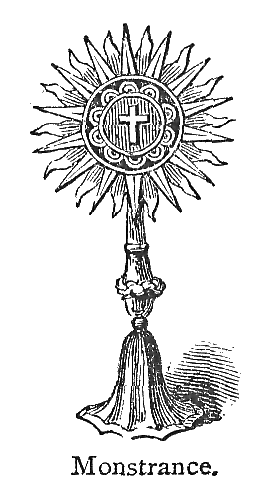
Monstrance, mon′strans, n. the utensil employed in R.C. churches for presenting the consecrated host for the adoration of the people, consisting of a stand and a repository or case with small semicircular holder (lunula).—Also Ostensory. [Fr.,—L. monstrāre, to show, monstrum, an omen.]
Montagnard, mong-ta-nyar′, n. one of the 'Mountain' or the extreme democratic wing of the French Legislative Assembly (1st Oct. 1791-21st Sept. 1792), so called because sitting on the topmost benches.
Montanic, mon-tan′ik, adj. pertaining to mountains: consisting in mountains. [L. montanus—mons, montis, a mountain.]
Montanism, mon′tan-izm, n. a heresy which grew up in the Christian Church in the second half of the 2d century, founded by the prophet and 'Paraclete,' Montanus of Phrygia—an ascetic reaction in favour of the old discipline and severity.—n. Mon′tanist, a supporter of Montanism.—adj. Montanist′ic.
Montant, mont′ant, adj. rising: (her.) increasing.—n. an upright rail or stile, as in a door, &c.: (Shak.) a contraction of montanto, a term in fencing, apparently for an upward blow: a two-handed sword. [Fr.,—monter, to mount—L. mons, montis, a mountain.]
Mont-de-piété, mong′-de-pē-ā-tā′, the Italian Monte di pietà, n. a pawnbroking shop set up by public authority. [Fr. and It., 'fund, bank, of piety.']
Monte, mon′te, n. a shrubby tract, a forest: a Spanish-American gambling game, played with a pack of forty cards.—Three-card monte, a Mexican gambling game, played with three cards, one usually a court-card. [Sp., 'a hill'—L. mons, montis, a mountain.]
Monteith, mon-tēth′, n. a large 18th-century punch-bowl, usually of silver, fluted and scalloped: a cotton handkerchief with white spots on a coloured ground.
Montem, mon′tem, n. a former custom of Eton boys to go every third Whit-Tuesday to a hillock on the Bath road and exact 'salt-money' from passers-by, for the university expenses of the senior scholar or school captain.
Montonegrine, mon-te-neg′rin, adj. and n. relating to Montenegro, or a native thereof: a close-fitting outer garment for women, braided and embroidered.
Montepulciano, mon-te-pul-chä′nō, n. a fine wine produced around Montepulciano, in central Italy.
Montero, mon-tā′ro, n. a huntsman: a horseman's cap. [Sp. montero, a huntsman—monte—L. mons, montis, a mountain.]
Montgolfier, mont-gol′fi-ėr, n. a balloon made by the brothers Montgolfier, Joseph Michel (1740-1810) and Jacques Etienne (1745-99), of Annonay, in 1783.
Month, munth, n. the period from new moon to new moon—a lunation, lunar, or synodic month (=29.5306 days): one of the twelve divisions of the year—a calendar month: one-twelfth part of a tropical year, the time the sun takes to pass through 30°—a solar month=30.4368 days.—n. Month′ling, that which is a month old or which lasts a month.—adj. Month′ly, performed in a month: happening or published once a month.—n. a monthly publication: (pl.) the menses.—adv. once a month: in every month.—Month of Sundays, a period that seems very long; Month's mind (see Mind).—Sidereal, or Stellar, month, the time in which the moon passes round the ecliptic to the same star=27.3217 days; Tropical, or Periodic, month, from the moon's passing the equinox till she again reaches it=27.3216 days. [A.S. mónð—móna, the moon.]
Monticulus, mon-tik′ū-lus, n. a little elevation—also Mon′ticle and Mon′ticule.—adjs. Montic′ulate, Montic′ulous, having small projections.
Montoir, mon-twar′, n. a stone or block used in mounting a horse. [Fr., monter, to mount.]
Monton, mon′ton, n. a Mexican unit of weight for ore, varying from 1800 to 3200 Spanish pounds.
Montre, mon′tėr, n. a flue-stop the pipes of which show from without, usually the open diapason of the great organ: an opening in a kiln wall.
Monture, mon′tūr, n. a mounting, setting, frame. [Fr.]
Monument, mon′ū-ment, n. anything that preserves the memory of a person or an event, a building, pillar, tomb, &c.: a record or enduring example of anything: any distinctive mark.—v.t. to raise a monument in memory of.—adj. Monument′al, of or relating to a monument or tomb: memorial: impressive: amazing.—adv. Monument′ally. [Fr.,—L. monumentum—monēre, to remind.]
Moo, mōō, v.i. to low like a cow. [Imit.]
Mood, mōōd, n. fashion, manner: (gram.) a. form of the verb to express the mode or manner of an action or of a state of being: (logic) the form of the syllogism as determined by the quantity and quality of its three constituent propositions: (mus.) the arrangement of the intervals in the scale, as major and minor (see Mode). [Mode.]
Mood, mōōd, n. disposition of mind: temporary state of the mind: anger, heat of temper.—adv. Mood′ily.—n. Mood′iness, gloominess, peevishness.—adjs. Mood′y, indulging in moods: out of humour: angry: sad: gloomy; Mood′y-mad (Shak.), mad with anger. [A.S. mód, mind; cf. Ger. muth, courage.]
Mooktar, mōōk′tar, n. a native lawyer in India. [Ar. mukhtār, chosen.]
Mool. A Scotch form of mould.
Moola(h). See Molla(h).
Moon, mōōn, n. the secondary planet or satellite which revolves round the earth monthly, shining with reflected light: a satellite revolving about any other planet; a month: anything in the shape of a moon or crescent: (fort.) a crescent-shaped outwork.—v.t. to adorn with moons or crescents.—v.i. to wander about or gaze vacantly at anything.—n. Moon′beam, a beam of light from the moon.—adj. Moon′-blind, dim-sighted, purblind.—ns. Moon′calf, a monster, a deformed creature: a dolt.—n.pl. Moon′-culminā′tions, times of culmination of the limb of the moon with certain neighbouring stars, formerly used in determining longitude.—adj. Mooned, of or like the moon: having the figure of the moon marked upon it.—ns. Moon′er, one who moons about; Moon′eye, a disease affecting horses' eyes: a name of several American fishes; Moon′face, a full, round face—a point of beauty in the East.—adj. Moon′faced.—ns. Moon′-fish, a name applied to various fishes; Moon′-flower, the ox-eye daisy; Moon′-glade, the track of moonlight on water.—adj. Moon′ish, like the moon: variable: inconstant.—n. Moon′-knife, a crescent-shaped knife used by leather-workers in shaving off the fleshy parts of skins.—adj. Moon′less, destitute of moonlight.—n. Moon′light, the light of the moon—sunlight reflected from the moon's surface.—adj. lighted by the moon: occurring during moonlight.—ns. Moon′lighter, one of a band of cowardly ruffians in Ireland who committed agrarian outrages by night about 1880: a moonshiner; Moon′lighting.—adjs. Moon′lit, lit or illumined by the moon; Moon′-loved, loved by the moon.—ns. Moon′-mad′ness, lunacy, supposed to be caused by sleeping in full moonlight; Moon′-rak′er, a silly person; Moon′-rak′ing, the following of crazy fancies; Moon′-sail, a small sail, sometimes carried above the sky-scraper; Moon′-set, the setting of the moon; Moon′shine, the shining of the moon: (fig.) show without reality: poached eggs with sauce: a month: (U.S.) smuggled spirits; Moon′shiner, a smuggler or illicit distiller of spirits.—adj. Moon′shiny, lighted by the moon: visionary, unreal.—n. Moon′-stone, a variety of feldspar presenting a pearly reflection from within.—adj. Moon′struck, affected by the moon, lunatic, crazed.—n. Moon′wort, any fern of the genus Botrychium.—adj. Moon′y, relating to, or like, the moon or a crescent, bearing a crescent: round, as a shield: like moonlight, lighted by the moon: silly: sickly: tipsy.—n. a noodle.—Moonlight flitting, a removal of one's furniture, &c., during night, to prevent it being seized for rent or debt. [A.S. móna; cf. Ger. mond, L. mensis, Gr. mēnē.]