LIST OF ABBREVIATIONS USED IN THIS DICTIONARY. (continued 6)
Reading edition
Frankincense, frangk′in-sens, n. a sweet-smelling vegetable resin from Arabia, used in sacrifices. [O. Fr. franc encens, pure incense.]
Franklin, frangk′lin, n. an old English freeholder, free from feudal servitude to a subject-superior. [Low L. francus, frank.]
Frantic, fran′tik, adj. mad, furious: wild.—advs. Fran′tically, Fran′ticly (Shak.).—adj. Fran′tic-mad, raving mad.—n. Fran′ticness, the state of being frantic. [O. Fr. frenetique—L. phreneticus—Gr. phrenētikos, mad, phrenītis, inflammation of the brain—phrēn, the mind; see Frenzy.]
Franzy, fran′zi, adj. (prov.) cross: particular.
Frap, frap, v.t. to strike: (naut.) to secure by many turns of a lashing. [Fr. frapper, to strike.]
Frappé, fra-pā, adj. iced, cooled. [Fr.]
Fratch, frach, n. (prov.) a quarrel or brawl.—adjs. Fratch′ety, Fratch′y; Fratch′ing. [Imit.]
Frater, frā′ter, n. the refectory of a monastery. [O. Fr. fraitur for refreitor.—Low L. refectōrium.]
Fraternal, fra-tėr′nal, adj. belonging to a brother or brethren: becoming brothers.—ns. Frate (frä′te), a friar:—pl. Frä′ti; Frā′ter, a friar: comrade; Frater′cula, a genus of marine diving-birds, the puffins or masked auks.—adv. Frater′nally.—n. Fraternisā′tion, the associating as brethren.—v.i. Frat′ernise, to associate as brothers: to seek brotherly fellowship.—ns. Frat′erniser; Frater′nity, the state of being brethren: a society formed on a principle of brotherhood; Frat′ry, the common-room of a monastic establishment, the chapter-house—also Frat′ery: a fraternity: a convent of friars. [Fr.,—Low L. fraternalis—frater, a brother, Eng. brother, Gr. phratēr, a clansman, Sans. bhrāta.]
Fratricide, frat′ri-sīd, n. one who kills his brother: the murder of a brother.—adj. Frat′ricidal. [Fr.,—L. frater, fratris, cædĕre, to kill.]
Frau, frow, n. a married woman, a wife.—n. Fräu′lein, a young lady, miss—often in England for a German governess. [Ger.]
Fraud, frawd, n. deceit: imposture: (Milt.) a snare: a deceptive trick: (coll.) a cheat: a fraudulent production.—adj. Fraud′ful, deceptive.—adv. Fraud′fully.—ns. Fraud′ulence, Fraud′ulency.—adj. Fraud′ulent, using fraud: dishonest.—adv. Fraud′ulently.—Fraudulent bankruptcy, a bankruptcy in which the insolvent is accessory, by concealment or otherwise, to the diminution of the funds divisible among his creditors.—Pious fraud, a deception practised with a good end in view: (coll.) a religious humbug. [O. Fr.,—L. fraus, fraudis, fraud.]
Fraught, frawt, n. a load, cargo: the freight of a ship.—v.t. to fill, store.—v.i. (Shak.) to form the freight of a vessel.—p.adj. freighted, laden: filled.—n. Fraught′age (Shak.), loading, cargo. [Prob. Old Dut. vracht. Cf. Freight.]
Fraxinella, frak-si-nel′a, n. a common name for cultivated species of dittany.—n. Frax′inus, the genus of Oleaceæ containing the common ash.
Fray, frā, n. an affray, a brawl.—v.t. (B.) to frighten. [Abbrev. of affray.]
Fray, frā, v.t. to wear off by rubbing: to ravel out the edge of a stuff.—v.i. to become frayed.—n. Fray′ing, the action of the verb fray: ravellings. [Fr. frayer—L. fricāre, to rub.]
Frazil, fräz′il, n. anchor-ice. [Canadian Fr.; prob. Fr. fraisil, cinders.]
Frazzle, fraz′l, v.t. (U.S.) to fray, wear out.—n. state of being worn out.
Freak, frēk, n. a sudden caprice or fancy: sport: an abnormal production of nature, a monstrosity.—ns. Freak′iness, Freak′ishness.—adjs. Freak′ish, Freak′ful, apt to change the mind suddenly: capricious.—adv. Freak′ishly. [A late word; cf. A.S. frícian, to dance.]
Freak, frēk, v.t. to spot or streak: to variegate.—n. a streak of colour.
Freck, frek, adj. (Scot.) prompt, eager.—Also Frack.
Freckle, frek′l, v.t. to spot: to colour with spots.—n. a yellowish or brownish-yellow spot on the skin, esp. of fair-haired persons: any small spot.—n. Freck′ling, a little spot.—adjs. Freck′ly, Freck′led, full of freckles. [Ice. freknur (pl.), Dan. fregne.]
Free, frē, adj. not bound: at liberty: not under arbitrary government: unimpeded: set at liberty: guiltless: frank: lavish: not attached: exempt (with from): having a franchise (with of): gratuitous: bold, indecent: idiomatic, as a translation.—v.t. to set at liberty: to deliver from what confines: to rid (with from, of):—pr.p. free′ing; pa.p. freed.—ns. Free′-ag′ency, state or power of acting freely, or without necessity or constraint upon the will; Free′-ag′ent; Free′-and-eas′y, a kind of public-house club where good fellows gather to smoke and sing; Free′-bench, a widow's right to dower out of her husband's lands, so long as unmarried and chaste; Free′-board, the space between a vessel's line of flotation and the upper side of the deck; Free′booter (Dut. vrijbuiter), one who roves about freely in search of booty: a plunderer; Free′bootery.—adj. Free′booting, acting the part of a freebooter: robbing.—n. the practice of a freebooter: robbery, pillage.—n. Free′booty.—adj. Free′born, born of free parents.—ns. Free′-cit′y, a city having independent government; Free′-cost, freedom from charges; Freed′man, a man who has been a slave, and has been freed or set free; Free′dom, liberty: frankness: separation: privileges connected with a city: improper familiarity: license; Free′-fish′er, one who has a right to take fish in certain waters.—adjs. Free-foot′ed (Shak.) not restrained in movement; Free′-hand, applied to drawing by the unguided hand; Free′-hand′ed, open-handed: liberal; Free′-heart′ed, open-hearted: liberal.—ns. Free′-heart′edness, liberality: frankness; Free′hold, a property held free of duty except to the king; Free′holder, one who possesses a freehold; Free′-lā′bour, voluntary, not slave, labour; Free′-lance, one of certain roving companies of knights and men-at-arms, who after the Crusades wandered about Europe, selling their services to any one; Free′-liv′er, one who freely indulges his appetite for eating and drinking: a glutton; Free′-love, the claim to freedom in sexual relations, unshackled by marriage or obligation to aliment.—adv. Free′ly.—ns. Free′man, a man who is free or enjoys liberty: one who holds a particular franchise or privilege:—pl. Free′men; Free′māson, one of a secret society of so-called speculative masons, united in lodges for social enjoyment and mutual assistance, and laying dubious claim to a connection with the medieval organisations of free operative masons.—adj. Freemason′ic.—n. Freemā′sonry, the institutions, practices, &c. of Freemasons.—adj. Free′-mind′ed, with a mind free or unperplexed: without a load of care.—ns. Free′ness; Free′-port, a port where no duties are levied on articles of commerce; Free′-school, a school where no tuition fees are exacted; Free′-shot (Ger. Freischütz), the name given to a legendary hunter and marksman who gets a number of bullets (Freikugeln) from the devil, six of which always hit the mark, while the seventh is at the disposal of the devil himself.—adjs. Free′-soil, in favour of free territory, opposed to slavery; Free′-spōk′en, accustomed to speak without reserve.—ns. Free′-spōk′enness; Free′stone, an easily quarried stone composed of sand or grit.—adj. having a stone from which the pulp easily separates, as a peach—opp. to Clingstone.—adj. Free′-swim′ming, swimming freely, as an aquatic animal.—ns. Free′thinker, one who professes to be free from conventional authority in religion: a rationalist; Free′thinking, Free′-thought, the habit of mind of a freethinker.—adj. Free′-tongued, free-spoken.—ns. Free′-trade, free or unrestricted trade: free interchange of commodities without protective duties; Free′-trad′er, one who practises or advocates this; Free′-will, freedom of the will from restraint: liberty of choice: power of self-determination.—adj. spontaneous.—Free-cell formation, the formation of several cells from and in the protoplasm of the mother-cell; Free Church, that branch of the Presbyterians in Scotland which left the Established Church in the Disruption of 1843, finding spiritual independence impossible within it: a church whose sittings are open to all: (pl.) a term often applied to the Nonconformist churches generally; Free list, the list of persons admitted without payment to a theatre, &c., or of those to whom a book, &c., is sent; Free on board (F.O.B.), a phrase meaning that goods are to be delivered on the vessel or other conveyance without charge.—Free States, in America, before the Civil War of 1861-65, those of the United States in which slavery did not exist, as opposed to Slave States.—Make free with, to take undue liberties with. [A.S. freo; Ger. frei, Ice. frí.]
Freemartin, frē′mar-tin, n. a cow-calf born as a twin with a bull-calf, usually barren.
Freeze, frēz, v.i. to become ice or like a solid body.—v.t. to harden into ice: to cause to shiver, as with terror:—pr.p. freez′ing; pa.t. frōze; pa.p. froz′en.—adj. Freez′able.—ns. Freez′ing-mix′ture, a mixture, as of pounded ice and salt, producing cold sufficient to freeze a liquid by the rapid absorption of heat; Freez′ing-point, the temperature at which water freezes, marked 32° on the Fahrenheit thermometer, and 0° on the centigrade. [A.S. fréosan, pa.p. froren; Dut. vreizen, Ger. frieren, to freeze.]
Freight, frāt, n. the lading or cargo, esp. of a ship; the charge for transporting goods by water.—v.t. to load a ship.—ns. Freight′age, money paid for freight; Freight′er, one who freights a vessel. [Prob. Old Dut. vrecht, a form of vracht.]
Freischütz. See Free-shot.
Freit, frēt, n. (Scot.) any superstitious belief in things as good or bad omens—also Freet.—adj. Freit′y, Freet′y, superstitious. [Scand.; Ice. frétt, news.]
Fremd, fremd, adj. and n. (Scot.) strange, a stranger—Spenser has Frenne, a stranger.—The fremd, the world of strangers. [M. E. fremd, fremed—A.S. fremde; cf. Dut. vreemd, Ger. fremd.]
Fremescent, frem-es′ent, adj. raging, riotous.—n. Fremes′cence. [L. fremĕre, to roar.]
Fremitus, frem′i-tus, n. a palpable vibration, as of the walls of the chest. [L.]
French, frensh, adj. belonging to France or its people.—n. the people or language of France.—ns. French′-bean, the common kidney bean, eaten, pods and all, as a table vegetable; French′-berr′y, a small berry, the fruit of certain species of buckthorn, used in dyeing yellow; French′-chalk, an indurated clay, extremely dense, and of a smooth glossy surface and white colour; French′ery, French fashions collectively; French′-horn, a musical wind-instrument somewhat resembling a bugle; Frenchificā′tion.—v.t. French′ify, to make French or Frenchlike: to infect with the manner of the French.—ns. French′iness; French′man, a native or naturalised inhabitant of France:—fem. French′woman; French′-pol′ish, a varnish for furniture, consisting chiefly of shellac dissolved in some spirit; French′-pol′isher; French′-pol′ishing, the method of coating furniture with French-polish.—adj. French′y, with an exaggerated French manner.—French merino, a fine twilled cloth of merino wool; French pox (obs.), syphilis; French roof, a modified mansard-roof—really American; French white, finely pulverised talc; French window, a long window opening like a folding-door, and serving for exit and entrance.—Take French leave, to depart without notice or permission, to disappear suspiciously.
Frenetic, -al, fre-net′ik, -al, adj. frenzied: mad: distracted.—Also Phrenet′ic, -al. [See Frantic.]
Frenum, frē′num, n. a ligament restraining the motion of a part.—Also Fræ′num. [L., a bridle.]
Frenzy, fren′zi, n. a violent excitement: mania.—v.t. to render frenzied.—adjs. Fren′zied, Fren′zical, partaking of frenzy. [Through O. Fr. and L.,—from Late Gr. phrenēsis=Gr. phrenitis, inflammation of the brain—phrēn, the mind.]
Frequent, frē′kwent, adj. coming or occurring often.—ns. Frē′quence (Milt.), a crowd, an assembly; Frē′quency, repeated occurrence of anything.—v.t. Frequent′, to visit often.—ns. Frē′quentage, habit of frequenting; Frequentā′tion, the act of visiting often.—adj. Frequent′ative (gram.), denoting the frequent repetition of an action.—n. (gram.) a verb expressing this repetition.—n. Frequent′er.—adv. Frē′quently.—n. Frē′quentness. [L. frequens, frequentis; cog. with farcīre, to stuff.]
Frescade, fres-kād′, n. a cool walk. [Fr.,—It. frescata.]
Fresco, fres′kō, n. a painting executed with colours, consisting chiefly of natural earths, upon walls covered with damp freshly-laid plaster.—v.t. to paint in fresco:—pr.p. fres′cōing; pa.p. fres′cōed.—adj. Fres′coed.—ns. Fres′coer; Fres′coing; Fres′coist. [It. fresco, fresh.]
Fresh, fresh, adj. in a state of activity and health: new and strong, not stale or faded: recently produced or obtained: untried: having renewed vigour: healthy, refreshing, invigorating: brisk: (slang) tipsy: not salt.—n. (Shak.) a small stream of fresh water: (Scot.) a thaw, open weather.—adj. Fresh′-blown, newly blown, as a flower.—v.t. Fresh′en, to make fresh: to take the saltness from.—v.i. to grow fresh: to grow brisk or strong.—ns. Fresh′ener; Fresh′et, a pool or stream of fresh water: the sudden overflow of a river from rain or melted snow.—adj. Fresh′ish.—adv. Fresh′ly.—ns. Fresh′man, one in the rudiments of knowledge, esp. a university student in his first year—also Fresh′er; Fresh′manship, Fresh′erdom.—adj. Fresh′-new (Shak.), unpractised, wholly unacquainted; Fresh′wa′ter, of or pertaining to water not salt: accustomed to sail only on fresh water—hence unskilled, raw. [A.S. fersc; cf. Dut. versch, Ger. frisch.]
Fret, fret, v.t. to wear away by rubbing, to rub, chafe, ripple, disturb: to eat into: to vex, to irritate.—v.i. to wear away: to vex one's self: to be peevish:—pr.p. fret′ting; pa.p. fret′ted, (B.) fret.—n. agitation of the surface of a liquid: irritation: the worn side of the banks of a river.—adj. Fret′ful, peevish.—adv. Fret′fully.—n. Fret′fulness.—p.adj. Fret′ting, vexing.—n. peevishness. [A.S. fretan, to gnaw—pfx. for-, inten., and etan, to eat; Ger. fressen.]
Fret, fret, v.t. to ornament with raised work: to variegate:—pr.p. fret′ting; pa.p. fret′ted. [O. Fr. freter.]
Fret, fret, n. a piece of interlaced ornamental work: (archit.) an ornament consisting of small fillets intersecting each other at right angles: (her.) bars crossed and interlaced.—ns. Fret′-saw, a saw with a narrow blade and fine teeth, used for fret-work, scroll-work, &c.; Frette, a hoop for strengthening a cannon shrunk on its breach.—adjs. Fret′ted, Fret′ty, ornamented with frets.—n. Fret′-work, ornamental work consisting of a combination of frets, perforated work. [O. Fr. frete, trellis-work.]
Fret, fret, n. a short wire on the finger-board of a guitar or other instrument.—v.t. to furnish with frets. [Prob. same as the above.]
Friable, frī′a-bl, adj. apt to crumble: easily reduced to powder.—ns. Frī′ableness, Friabil′ity. [Fr.,—L. friabilis—friāre, friātum, to crumble.]
Friar, frī′ar, n. a member of one of the mendicant monastic orders in the R.C. Church—the Franciscans (Friars Minor or Gray Friars), Dominicans (Friars Major, Friars Preachers, or Black Friars), Carmelites (White Friars), and Augustinians (Austin Friars).—adj. Frī′arly, like a friar.—n. Frī′ary, a monastery.—Friars' balsam (see Benzoin); Friar's cap, the wolf's-bane; Friar's cowl, the wake-robin; Friar's lantern, the ignis-fatuus or Will-o'-the-wisp. [O. Fr. frere—L. frater, a brother.]
Fribble, frib′l, v.i. to trifle.—n. a trifler.—ns. Fribb′ledom; Fribb′leism; Fribb′ler.—adj. Fribb′lish, trifling. [Onomatopœic; prob. influenced by frivol.]
Fricandeau, frik-an-dō′, n. a thick slice of veal, &c., larded. [Fr., perh. from friand, dainty, nice, and perh. ult. conn. with fricassee.]
Fricassee, frik-as-sē′, n. a dish made of fowl, rabbit, &c. cut into pieces and cooked in sauce.—v.t. to dress as a fricassee:—pr.p. fricassee′ing; pa.p. fricasseed′. [Fr. fricassée; origin unknown.]
Friction, frik′shun, n. the act of rubbing: (statics) a force acting in the tangent plane of two bodies, when one slides or rolls upon another, and always in a direction opposite to that in which the moving body tends: difficulty, unpleasantness.—adjs. Fric′ative, produced by friction, used of those consonants which are produced by the breath being forced through a narrow opening; Fric′tional, relating to, moved by, or produced by friction.—n. Fric′tion-gear′ing, a method of imparting the motion of one wheel or pulley to another by mere contact.—adj. Fric′tionless, having no friction.—n.pl. Fric′tion-wheels, wheels that lessen friction. [Fr.,—L. frictionem—fricāre, frictum, to rub.]
Friday, frī′dā, n. the sixth day of the week.—Black Friday, Good Friday, from the black vestments of the clergy and altar in the Western Church: any Friday marked by a great calamity; Good Friday, the Friday before Easter, kept in commemoration of the Crucifixion; Holy Friday, Friday in an ember-week—also Golden Friday, sometimes put for Good Friday itself. [A.S. Frígedæg, day of (the goddess) Fríg—Latinised Frigga—wife of Odin.]
Fridge, frij, v.t. (Sterne) to rub or fray.
Fried, frīd, pa.t. and pa.p. of fry.
Friend, frend, n. one loving or attached to another: an intimate acquaintance: a favourer: one of a society so called: (Scot.) a relative.—v.t. (obs.) to befriend.—adj. Friend′ed, supplied with friends.—n. Friend′ing (Shak.), friendliness.—adj. Friend′less, without friends: destitute.—n. Friend′lessness.—adv. Friend′lily.—n. Friend′liness.—adj. Friend′ly, like a friend: having the disposition of a friend: favourable: pertaining to the Friends or Quakers.—n. Friend′ship, attachment from mutual esteem: friendly assistance.—Friendly societies, or Benefit societies, associations, chiefly among mechanics, &c., for relief during sickness, old age, widowhood, by provident insurance.—Be friends with, to be on intimate or friendly relations with; Have a friend at court, to have a friend in a position where his influence is likely to prove useful; Society of Friends, the designation proper of a sect of Christians better known as Quakers. [A.S. fréond, pr.p. of fréon, to love; Ger. freund.]
Frier, frī′ėr, n. (Milt.) a friar.
Frieze, frēz, n. a coarse woollen cloth with a nap on one side.—adj. Friezed, napped. [Fr. frise.]
Frieze, frēz, n. (archit.) the part of the entablature between the architrave and cornice, often ornamented with figures.—v.t. to put a frieze on. [O. Fr. frize; It. fregio; perh. L. Phrygium, Phrygian.]
Frigate, frig′āt, n. in the Royal Navy, formerly a vessel in the class next to ships of the line, carrying 28 to 60 guns on the maindeck and a raised quarter-deck and forecastle—not now denoting a distinct class of vessels.—ns. Frig′ate-bird, a large tropical sea-bird, with very long wings; Frigatoon′, a small Venetian vessel with square stern and two masts. [O. Fr. fregate—It. fregata; ety. dub.]
Fright, frīt, n. sudden fear: terror: anything inspiring terror or alarm, a figure of grotesque or ridiculous appearance.—vs.t. Fright, Fright′en, to make afraid: to alarm.—adjs. Fright′able, Fright′enable, timid; Fright′ful, terrible: shocking.—adv. Fright′fully.—n. Fright′fulness.—adj. Fright′some, frightful: feeling fright. [A.S. fyrhto; cf. Ger. furcht, fear.]
Frigid, frij′id, adj. frozen or stiffened with cold: cold: without spirit or feeling: unanimated.—n. Frigid′ity, coldness: coldness of affection: want of animation.—adv. Frig′idly.—n. Frig′idness.—adj. Frigorif′ic, causing cold.—Frigid zones, the parts of the earth's surface within the circle drawn with the poles as centre, and a radius of 23½ degrees. [L. frigidus—frigēre, to be cold—frigus, cold.]
Frigot, frig′ot, n. (Spens.). Same as Frigate.
Frijole, frē-hōl′, n. the common Mexican bean. [Sp.]
Frill, fril, v.i. to ruffle, as a hawk its feathers, when shivering.—v.t. to furnish with a frill.—n. a ruffle: a ruffled or crimped edging of linen.—ns. Frilled′-liz′ard, a lizard with an extraordinary frilled membrane attached to the hinder part of the head, neck, and chest, and covering its shoulders; Frill′ing, frilled edging. [Usually conn. with O. Fr. friller, to shiver; but prob. related to furl.]
Frimaire, frē-mār′, n. the third month of the French revolutionary calendar, Nov. 21-Dec. 20. [Fr. frimas, frost.]
Fringe, frinj, n. loose threads forming an ornamental border: anything like a fringe, even a girl's hair cut in front and falling over the brow: the extremity.—v.t. to adorn with fringe: to border.—adjs. Fringed; Fringe′less; Fring′ent, fringing.—n. Fringe′-tree, in the United States, a large shrub with very numerous snow-white flowers in panicled racemes.—adj. Fring′y, ornamented with fringes. [O. Fr. frenge—L. fimbria, threads, fibres, akin to fibra, a fibre.]
Fringillaceous, frin-ji-lā′shi-us, adj. pertaining to the finches or Fringillidæ.—Also Fringil′liform, Fringil′line. [L. fringilla.]
Frippery, frip′ėr-i, n. worn-out clothes: the place where old clothes are sold: useless trifles.—adj. useless: trifling.—n. Fripp′er, one who deals in old clothes. [O. Fr. freperie, frepe, a rag.]
Frisette. See Frizzle.
Friseur, fris-ėr′, n. a hair-dresser.—n. Fris′ure, mode of curling the hair. [Fr. friser, to curl.]
Frisian, friz′i-an, adj. and n. pertaining to the people of Friesland, or to their language.—Also Fries′ian, Fries′ic, Fries′ish.
Frisk, frisk, v.i. to gambol: to leap playfully.—n. a frolic.—n. Frisk′er.—adj. Frisk′ful, brisk, lively.—adv. Frisk′ily.—n. Frisk′iness.—adj. Frisk′ing.—adv. Frisk′ingly.—adj. Frisk′y, lively: jumping with gaiety: frolicsome. [O. Fr. frisque; acc. to Skeat, from Ice. frískr, Sw. and Dan. frisk.]
Frisket, frisk′ėt, n. (print.) the light frame between the tympan and the form, to hold in place the sheet to be printed. [Fr. frisquette.]
Frit, frit, n. the mixed materials of which glass is made, after being heated until they fuse partially without melting.—v.t. to fuse partially without melting:—pr.p. frit′ting; pa.p. frit′ted. [Fr. fritte—It. fritta.—L. frigĕre, frictum, to roast.]
Frit, frit, n. a small fly destructive to wheat.
Frith, frith, Firth, fėrth, n. a narrow inlet of the sea, esp. at a river-mouth. [Ice. fiörðr; Norw. fiord.]
Frith, frith, n. peace.—ns. Frith′borg (A.S. law), one of the tithings or groups of ten men into which the hundred was divided, the members of each being accountable for a fellow-member's misdeeds; Frith′gild, a union of neighbours pledged to one another for the preservation of peace; Frith′soken, the jurisdiction to punish for breaches of the peace; Frith′stool, a chair of sanctuary, placed near the altar in a church—as at Hexham and Beverley. [A.S. frith, peace; Ger. friede.]
Frith, frith, n. forest. [A.S. (ge)fyrhðe.]
Fritillary, frit′il-lar-i, n. a genus of plants of the order Liliaceæ, with drooping purple flowers: a species of butterfly. [L. fritillus, a dice-box.]
Fritter, frit′ėr, n. a piece of meat fried: a kind of pancake, a slice of some fruit sweetened, fried, and served hot: a fragment.—v.t. to break into fragments.—n. Fritt′erer, one who wastes time. [O. Fr. friture—L. frigĕre, frictum, to fry.]
Frivolous, friv′ol-us, adj. trifling: silly.—n. Frivol′ity, act or habit of trifling: levity.—adv. Friv′olously.—n. Friv′olousness. [Fr. frivole—L. frivolus.]
Frizz, Friz, friz, v.t. to curl: to render rough and tangled.—n. a curl, a wig.—adjs. Frizzed, having the hair curled or crisped into frizzes; Frizz′y. [O. Fr. friser, to curl; perh. conn. with frieze, cloth.]
Frizzle, friz′l, v.t. to form in small short curls.—v.i. to go into curls.—n. a curl.—ns. Frizette′, Frisette′, a cluster of small curls worn over the forehead.—adj. Frizz′ly. [Related to frizz and frieze.]
Fro, frō, adv. from: back or backward.—prep. (obs.) from. [A shortened form of from; but perh. directly derived from Ice. frá, from.]
Frock, frok, n. a wide-sleeved garment worn by monks: a loose upper garment worn by men: a sailor's jersey: a gown worn by females: an undress regimental coat.—v.t. to furnish with a frock: to invest with priestly office.—n. Frock′-coat, a double-breasted full-skirted coat for men.—adj. Frocked, clothed in a frock.—n. Frock′ing, cloth suitable for frocks, coarse jean.—adj. Frock′less, wanting a frock. [O. Fr. froc, a monk's frock—Low L. frocus—L. floccus, a flock of wool; or more prob. (acc. to Brachet and Littré) from Low L. hrocus—Old High Ger. hroch (Ger. rock), a coat.]
Frog, frog, n. a genus of tailless amphibians, with webbed feet, remarkable for its rapid swimming and leaping: a soft, horny substance in the middle of the sole of a horse's foot, forking towards the heel: a section of a rail or rails at a point where two lines cross, or of a switch from one line to another.—ns. Frog′-bit, a small aquatic plant, allied to the water-soldier, but with floating leaves; Frog′-eat′er, one who eats frogs, a Frenchman; Frog′-fish, a name for various fishes, esp. the angler; Frog′gery, frogs collectively: a place where frogs abound.—adj. Frog′gy, having or abounding in frogs.—ns. Frog′-hop′per, Frog′-spit (see Froth-fly); Frog′ling, a little frog.—Frog march, a method of carrying a refractory or drunken prisoner face downwards between four men, each holding a limb. [A.S. frogga, frox; cog. with Ice. froskr; Ger. frosch.]
Frog, frog, n. an ornamental fastening or tasselled button for a frock or cloak.—adj. Frogged, in uniforms, of ornamental stripes or workings of braid or lace, mostly on the breast of a coat.
Froise, froiz, n. a kind of pancake or omelette, often with slices of bacon.—Also Fraise. [Fr.]
Frolic, frol′ik, adj. merry: pranky.—n. gaiety: a wild prank: a merry-making.—v.i. to play wild pranks or merry tricks: to gambol:—pr.p. frol′icking; pa.p. frol′icked.—adj. Frol′icsome, gay: sportive.—adv. Frol′icsomely.—n. Frol′icsomeness. [Dut. vrolijk, merry; cf. Ger. fröhlich, joyful, gay.]
From, from, prep. forth: out of, as from a source: away: at a distance: springing out of: by reason of. [A.S. fram, from; akin to Goth. fram, Ice. frá.]
Frond, frond, n. (bot.) a leaf-like expansion in many cryptogamous plants, organs in which the functions of stem and leaf are combined.—adjs. Frond′ed, having fronds; Frond′ent, leafy.—n. Frondes′cence, act of putting forth leaves: the season for putting forth leaves.—adjs. Frondes′cent, springing into leaf; Frondif′erous, bearing or producing fronds; Frondose′, covered with fronds. [L. frons, frondis, a leaf.]
Fronde, frond, n. the name given to certain factions in France during the minority of Louis XIV., hostile to the court and the minister Mazarin.—n. Frond′eur, a member of the Fronde: an irreconcilable. [Fr., a sling—L. funda.]
Front, frunt, n. the forehead: the whole face: the forepart of anything: a kind of wig worn by ladies: the most conspicuous part: boldness: impudence.—adj. of, relating to, or in the front.—v.t. to stand in front of or opposite: to oppose face to face.—v.i. to stand in front or foremost: to turn the front or face in any direction.—n. Front′age, the front part of a building.—adj. Front′al, of or belonging to the front or forehead.—n. a front-piece: something worn on the forehead or face: (archit.) a pediment over a door or window: a hanging of silk, satin, &c., embroidered for an altar—now usually covering only the top, the superfrontal—formerly covering the whole of the front, corresponding to the antependium.—adjs. Front′ate, -d (bot.), growing broader and broader: (zool.) having a prominent frons or forehead; Front′ed, formed with a front; Front′less, void of shame or modesty.—adv. Front′lessly.—n. Front′let, a band worn on the forehead.—advs. Front′ward, -s, towards the front.—Come to the front, to become conspicuous: to attain an important position; In front of, before. [O. Fr.,—L. frons, frontis, the forehead.]
Frontier, front′ēr, n. the boundary of a territory: (Shak.) an outwork.—adj. lying on the frontier: bordering.—v.t. (Spens.) to place on the frontier.—n. Front′iersman, one settled on the borders of a country. [O. Fr. frontier—L. frons.]
Frontispiece, front′i-spēs, n. (archit.) the principal face of a building: a figure or engraving in front of a book.—v.t. to put as a frontispiece, to furnish with such. [Fr.,—Low L. frontispicium—frons, forehead, specĕre, to see; not conn. with piece.]
Fronton, fron′ton, n. (archit.) a pediment.—Also Fron′toon. [Fr.]
Frore, frōr, Froren, frō′ren, adj. frozen, frosty.—adj. Frō′ry (Spens.), frozen. [A.S. froren, pa.p. of fréosan, to freeze.]
Frost, frost, n. the state of the atmosphere in which water freezes: state of being frozen: frozen dew, also called hoar-frost: (slang) a disappointment, a cheat.—v.t. to cover with hoar-frost or with anything resembling hoar-frost: to sharpen (the points of a horse's shoe) that it may not slip on ice.—n. Frost′-bite, the freezing or depression of vitality in a part of the body by exposure to cold.—v.t. to affect with frost.—adjs. Frost′-bit′ten, bitten or affected by frost; Frost′-bound, bound or confined by frost; Frost′ed, covered by frost or any fine powder: injured by frost.—adv. Frost′ily.—ns. Frost′iness; Frost′ing, the composition, resembling hoar-frost, used to cover cake, &c.—adj. Frost′less, free from frost.—n. Frost′-nail, a projecting nail in a horse-shoe serving as an ice-calk.—v.t. to put in such nails.—ns. Frost′-smoke, vapour frozen in the atmosphere, and having a smoke-like appearance; Frost′-work, work resembling hoar-frost on shrubs, &c.—adj. Frost′y, producing or containing frost: chill in affection: frost-like. [A.S. frost, forst—fréosan; cf. Ger. frost.]
Froth, froth, n. the foam on liquids caused by boiling, or any agitation: (fig.) an empty show in speech: any light matter.—v.t. to cause froth on.—v.i. to throw up froth.—ns. Froth′ery, mere froth; Froth′-fly, also Froth′-hop′per, Frog′-hop′per, Frog′-spit, common names for numerous insects parasitic on plants, on which the larvæ and pupæ are found surrounded by a frothy spittle.—adv. Froth′ily.—n. Froth′iness.—adjs. Froth′less, free from froth; Froth′y, full of froth or foam: empty: unsubstantial. [Scand., as in Ice. froða, Dan. fraade.]
Frounce, frowns, v.t. to plait: to curl: to wrinkle up: to frown.—n. a plait or curl.—v.i. (obs.) to frown or wrinkle the brow. [O. Fr. froncier. See Flounce (2), of which it is an older form.]
Frow, frow, n. a Dutchwoman. [Dut. vrouw.]
Froward, frō′ward, adj. (Spens.) turned from: self-willed: perverse: unreasonable—opp. to Toward.—adv. Frō′wardly.—n. Frō′wardness. [A.S. fra, away, with affix -ward.]
Frown, frown, v.i. to wrinkle the brow as in anger: to look angry.—v.t. to repel by a frown.—n. a wrinkling or contraction of the brow in displeasure, &c.: a stern look.—adj. Frown′ing, gloomy.—adv. Frown′ingly. [From O. Fr. froignier (mod. refrogner), to knit the brow; origin unknown.]
Frowy, frow′i, adj. (Spens.) musty, rancid.
Frowzy, frow′zi, adj. rough and tangled.—Also Frow′sy. [Perh. conn. with frounce.]
Frozen, frōz′n, pa.p. of freeze.
Fructidor, fruk-ti-dōr′, n. the twelfth month in the French revolutionary calendar, Aug. 18-Sept. 16. [Fr.,—L. fructus, fruit; Gr. dōron, a gift.]
Fructify, fruk′ti-fī, v.t. to make fruitful: to fertilise.—v.i. to bear fruit.—adj. Fruct′ed (her.), bearing fruit.—n. Fructes′cence, the time for the ripening of fruit.—adj. Fructif′erous, bearing fruit.—ns. Fructificā′tion, act of fructifying, or producing fruit: (bot.) a term denoting sometimes the whole reproductive system, sometimes the 'fruit' itself; Fruc′tose, fruit sugar or levulose; Fruc′tuary, one enjoying the fruits of anything.—adj. Fruc′tuous, full of fruit. [Fr.,—L.,—fructus, fruit.]
Frugal, frōō′gal, adj. economical in the use of means: thrifty.—ns. Fru′galist, one who is frugal; Frugal′ity, economy: thrift.—adv. Fru′gally. [L. frugalis—frugi, fit for food—frux, frugis, fruit.]
Frugiferous, frōō-jif′ėr-us, adj. fruit-bearing.—adj. Frugiv′orous, feeding on fruits or seeds. [L. frux, frugis—ferre, to carry, vorāre, to eat.]
Fruit, frōōt, n. the produce of the earth, which supplies the wants of men and animals: the part of a plant which contains the seed: the offspring of animals: product, consequence, effect, advantage—(Spens.) Fruict.—v.i. to produce fruit.—ns. Fruit′age, fruit collectively: fruits; Fruit′-bud, a bud that produces fruit; Fruit′-cake, a cake containing raisins, &c.; Fruit′erer, one who deals in fruit:—fem. Fruit′eress; Fruit′ery, a place for storing fruit: fruitage.—adj. Fruit′ful, producing fruit abundantly: productive.—adv. Fruit′fully.—ns. Fruit′fulness; Fruit′ing, process of bearing fruit; Fruit′-knife, a knife with a blade of silver, &c., for cutting fruit.—adj. Fruit′less, barren: without profit: useless.—adv. Fruit′lessly.—ns. Fruit′lessness; Fruit′-tree, a tree yielding edible fruit.—adj. Fruit′y, like, or tasting like, fruit.—Small fruits, strawberries, currants, &c. [O. Fr. fruit, fruict—L. fructus—frui, fructus, to enjoy.]
Fruition, frōō-ish′un, n. enjoyment: use or possession of anything, esp. accompanied with pleasure.—adj. Fru′itive, of or pertaining to fruition. [O. Fr. fruition—L. frui, to enjoy.]
Frumentation, frōō-men-tā′shun, n. a largess of grain bestowed on the starving or turbulent people in ancient Rome.—adjs. Frumentā′ceous, made of or resembling wheat or other grain; Frumentā′rious, pertaining to corn. [L. frumentation-em—frumentāri, to provide with corn—frumentum, corn.]
Frumenty, frōō′men-ti, n. food made of hulled wheat boiled in milk.—Also Fur′mety. [O. Fr. frumentee, wheat boiled—frument—L. frumentum.]
Frump, frump, n. a dowdy and cross-grained woman: (obs.) a flout or snub.—v.t. (obs.) to snub.—adjs. Frump′ish, Frump′y, sour-tempered: ill-dressed.
Frumple, frum′pl, v.t. (prov.) to wrinkle.
Frush, frush, v.t. (Shak.) to break, bruise, or crush.—adj. broken or crushed: brittle.—n. an onset, attack. [O. Fr. froissier, to bruise—L. frustum, fragment.]
Frush, frush, n. (prov.) the frog of a horse's foot: a disease in that part of a horse's foot.
Frustrate, frus′trāt, v.t. to make vain or of no effect: to bring to nothing: to defeat.—p.adj. vain, ineffectual, defeated.—adj. Frus′trable, capable of being frustrated.—n. Frustrā′tion, disappointment: defeat.—adjs. Frus′trative, tending to frustrate; Frus′tratory, disappointing. [L. frustrāri, frustrātus—frustra, in vain.]
Frustule, frus′tūl, n. the siliceous two-valved shell of a diatom, with its contents.
Frustum, frus′tum, n. a slice of a solid body: the part of a cone which remains when the top is cut off by a plane parallel to the base. [L. frustum, a bit.]
Frutescent, frōō-tes′ent, adj. becoming shrubby; Fru′tex, a shrub.—adjs. Fru′ticose, Fru′ticous, shrub-like: shrubby; Frutic′ulose, like a small shrub. [L. frutescĕre—frutex, fruticis, a shrub.]
Frutify, frōō′ti-fī, v.t. and v.i. (Shak.)=Fructify.
Fry, frī, v.t. to dress food with oil or fat in a pan over the fire: to vex.—v.i. to undergo the action of heat in a frying-pan: to simmer: (Spens.) to boil:—pr.p. fry′ing; pa.p. fried.—n. a dish of anything fried.—n. Fry′ing-pan, a flat iron vessel or pan for frying with.—Out of the frying-pan into the fire, out of one evil or danger merely to fall into a greater. [Fr. frire—L. frigĕre; cf. Gr. phrygein.]
Fry, frī, n. a swarm of fishes just spawned: a number of small things.—Small fry, small things collectively, persons or things of little importance. [M. E. fri—Ice. frió; Dan. and Sw. frö.]
Fuar. Same as Feuar.
Fub, fub, v.t. (Shak.) to put off, to cheat: to steal.—n. Fub′bery (obs.), deception.—Fub off, to put off or evade by a trick or a lie. [See Fob.]
Fubby, fub′i, Fubsy, fub′zi, adj. chubby. [Ety. dub.]
Fuchsia, fū′shi-a, a plant with long pendulous flowers, native to South America. [Named after Leonard Fuchs, a German botanist, 1501-66.]
Fucus, fū′kus, n. a genus of seaweed containing the wrack and other species: a dye: a disguise.—adj. Fuciv′orous, eating seaweed.—n. Fū′coid, fossil seaweed.—adj. containing fucoids.—adj. Fū′cused, painted. [L. fucus, seaweed.]
Fud, fud, n. (Scot.) a hare's tail: the buttocks.
Fuddle, fud′l, v.t. to stupefy with drink.—v.i. to drink to excess or habitually:—pr.p. fudd′ling; pa.p. fudd′led.—n. intoxicating drink.—ns. Fudd′le-cap, a hard drinker; Fudd′ler, a drunkard.—adj. Fudd′ling, tippling. [Cf. Dut. vod, soft, Ger. prov. fuddeln, to swindle.]
Fudge, fuj, n. stuff: nonsense: an exclamation of contempt.—v.i. and v.t. to botch or bungle anything.—adj. Fud′gy, irritable: awkward.
Fuel, fū′el, n. anything that feeds a fire, supplies energy, &c.—v.t. (arch.) to furnish with fuel.—adj. Fū′elled, furnished with fuel.—n. Fū′eller, one who, or that which, supplies fuel for fires. [O. Fr. fowaille—L. focale—L. focus, a fireplace.]
Fuero, fwā′rō, n. the constitution of certain practically autonomous states and communities in northern Spain and south-western France—the Basque provinces, Navarre, Bearn, &c.: modes and tenures of property, &c., nearly equivalent to the French customary law. [Sp.,—L. forum.]
Fuff, fuf, n. (Scot.) a puff: the spitting of a cat: a burst of anger.—v.t. and v.i. to puff.—adj. Fuff′y, light and soft.
Fugacious, fū-gā′shus, adj. apt to flee away: fleeting.—ns. Fugā′ciousness, Fugac′ity. [L. fugax, fugacis, from fugĕre, to flee.]
Fugitive, fūj′i-tiv, adj. apt to flee away: uncertain: volatile: perishable: temporary: occasional, written for some passing occasion.—n. one who flees or has fled from his station or country: one hard to be caught.—ns. Fū′gie (Scot.), a cock that will not fight, a runaway; Fū′gie-warr′ant, a warrant to apprehend a debtor about to abscond, prob. from the phrase in meditatione fugæ; Fugitā′tion (Scots law), absconding from justice: outlawry.—adv. Fug′itively.—n. Fug′itiveness. [Fr.,—L. fugitivus, fugĕre, to flee.]
Fugleman, fū′gl-man, n. a soldier who stands before a company at drill as an example: a ringleader, mouthpiece of others.—v.i. Fū′gle (Carlyle), to act like a fugleman. [Ger. flügelmann, the leader of a file—flügel, a wing, mann, man.]
Fugue, fūg, n. (mus.) a form of composition in which the subject is given out by one part and immediately taken up by a second, its answer, during which the first part supplies an accompaniment or counter-subject, and so on.—n. Fug′uist, one who writes or plays fugues. [Fr.,—It. fuga—L. fuga, flight.]
Fulcrum, ful′krum, n. (mech.) the prop or fixed point on which a lever moves: a prop:—pl. Ful′crums, Ful′cra.—adj. Ful′crate, supported with fulcrums. [L. fulcrum, a prop, fulcīre, to prop.]
Fulfil, fool-fil′, v.t. to complete: to accomplish: to carry into effect:—pr.p. fulfil′ling; pa.p. fulfilled′.—ns. Fulfil′ler; Fulfil′ling, Fulfil′ment, full performance: completion: accomplishment. [A.S. fullfyllan—full, full, fyllan, to fill.]
Fulgent, ful′jent, adj. shining: bright.—n. Ful′gency.—adv. Ful′gently.—adj. Ful′gid, flashing.—ns. Ful′gor, Ful′gour, splendour.—adj. Ful′gorous, flashing. [L. fulgent, pr.p. of fulgēre, to shine.]
Fulgurate, ful′gū-rāt, v.i. to flash as lightning.—adjs. Ful′gural, pertaining to lightning; Ful′gurant, flashing like lightning.—ns. Fulgurā′tion, in assaying, the sudden and final brightening of the fused globule; Ful′gurīte, a tube of vitrified sand frequent in loose sandhills—prob. due to lightning—adj. Ful′gurous, resembling lightning.
Fulham, ful′am, n. a die loaded at the corner.—Also Full′am, Full′an. [Prob. the place-name Fulham.]
Fuliginous, fū-lij′i-nus, adj. sooty: smoky.—n. Fuliginos′ity.—adv. Fulig′inously. [L., fuligo, soot.]
Full, fool, adj. having all it can contain: having no empty space: abundantly supplied or furnished: abounding: containing the whole matter: complete: perfect: strong: clear: (coll.) drunk: at poker, consisting of three of a kind and a pair.—n. completest extent, as of the moon: highest degree: the whole: time of full-moon.—v.t. to draw up or pucker the cloth on one side more than on the other.—adv. quite: to the same degree: with the whole effect: completely.—adjs. Full′-ā′corned (Shak.), full-fed with acorns; Full′-aged, having reached one's majority.—n. Full′-blood, an individual of pure blood.—adjs. Full′-blood′ed; Full′-bloomed, in perfect bloom; Full′-blown, blown or fully expanded, as a flower; Full′-bott′omed, having a full or large bottom, as a wig.—n. Full′-dress, the dress worn on occasions of state or ceremony.—adjs. Full′-eyed, with large prominent eyes; Full′-faced, having a full or broad face; Full′-fed, fed to plumpness; Full′-fraught (Shak.), full-stored; Full′-grown, grown to maturity; Full′-hand′ed, bearing something valuable, as a gift; Full′-heart′ed, full of heart or courage: elated; Full′-hot (Shak.), heated to the utmost; Full′-length, extending the whole length (n. a portrait showing such); Full-manned (Shak.), having a full crew.—ns. Full′-moon, the moon with its whole disc illuminated, when opposite the sun; Full′ness, Ful′ness, the state of being filled so as to have no part vacant: the state of abounding in anything: completeness: satiety: largeness: force and volume, as of sound: (Shak.) plenty, wealth.—adjs. Full′-orbed, having the orb or disc fully illuminated, as the full-moon: round; Full′-sailed, unbounded, absolute: moving onwards under full sail; Full-split (slang), with all one's might or speed; Full′-summed, complete in all its parts.—n. Full′-swing, the full extent or utmost limit.—adj. Full′-winged (Shak.), having perfect or strong wings.—adv. Full′y, completely: entirely.—Full back (football), see Back.—At the full, at the height, as of one's good fortune, &c.; In full, without reduction; In the fullness of time, at the proper or destined time.—To the full, in full measure, completely. [A.S. full; Goth. fulls, Ice. fullr, Ger. voll.]
Full, fool, v.t. to press or pound cloth in a mill: to scour and thicken in a mill.—ns. Full′age, the charge for fulling cloth; Full′er, a bleacher or cleanser of cloth; Fuller's-earth, a soft earth or clay, capable of absorbing grease, used in fulling or bleaching cloth; Fuller's-thistle, -weed, the teasel; Full′ery, the place or works where fulling of cloth is carried on; Full′ing-mill, a mill in which woollen cloth is fulled. [O. Fr. fuler—Low L. fullāre—L. fullo, a cloth-fuller.]
Fuller, fool′er, n. a half-round set-hammer.
Fulmar, ful′mar, n. a species of petrel inhabiting the Shetland Isles, &c., valuable for its down, feathers, and oil. [Perh. Norse fúll, foul.]
Fulminate, ful′min-āt, v.i. to thunder or make a loud noise: to issue decrees with violence, or with menaces of grave censure.—v.t. to cause to explode: to send forth, as a denunciation—(Milt.) Ful′mine.—n. a compound of fulminic acid with mercury, &c.—adj. Ful′minant, fulminating: (path.) developing suddenly.—n. a thunderbolt, explosive.—adj. Ful′minating, crackling, exploding, detonating.—n. Fulminā′tion, act of fulminating, thundering, or issuing forth: a chemical explosion: a denunciation.—adjs. Ful′minatory; Fulmin′eous, Ful′minous, pertaining to thunder and lightning; Fulmin′ic, pertaining to an acid used in preparing explosive compounds. [L. fulmināre, -ātum—fulmen (for fulgimen), lightning—fulgēre, to shine.]
Fulsome, fool′sum, adj. cloying or causing surfeit: nauseous: offensive: gross: disgustingly fawning.—adj. Ful′somely.—n. Ful′someness. [A.S. full, full, and affix -some.]
Fulvous, ful′vus, adj. deep or dull yellow: tawny.—Also Ful′vid. [L. fulvus, tawny.]
Fum, fum, n. a fabulous Chinese bird, one of the symbols of imperial dignity.—Also Fung.
Fumacious, fū-mā′shi-us, adj. smoky: fond of smoking.
Fumado, fū-mā′do, n. a smoked fish, esp. a pilchard. [Sp.,—L. fumāre, to smoke.]
Fumage, fūm′āj, n. hearth-money.
Fumarole, fūm′a-rōl, n. a smoke-hole in a volcano or sulphur-mine. [Fr. fumerole—L. fumus, smoke.]
Fumble, fum′bl, v.i. to grope about awkwardly: to handle awkwardly: to stammer in speech: to find by groping.—v.t. to manage awkwardly.—n. Fum′bler.—adv. Fum′blingly. [Dut. fommelen, to fumble; cf. Dan. famle, Ice. fâlma, to grope about.]
Fume, fūm, n. smoke or vapour: any volatile matter: heat of mind, rage, a passionate person: anything unsubstantial, vain conceit.—v.i. to smoke: to throw off vapour: to be in a rage: to offer incense to.—n. Fum′atory, a place for smoking or fumigation.—adjs. Fū′mid, smoky; Fumif′erous, producing fumes.—n. Fumos′ity, quality of being fumous: (pl.) the fumes arising from over eating or drinking.—adjs. Fum′ous, Fumose′, Fum′y, producing fumes. [O. Fr. fum—L. fumus, smoke.]
Fumet, fū′met, n. the dung of deer, hares, &c. [O. Fr. fumets, fumer—L. fimāre, to dung.]
Fumette, fū-met′, n. the scent of game when high.—Also Fumet′. [Fr.]
Fumigate, fūm′i-gāt, v.t. to expose to smoke or gas, to expose to fumes, as of sulphur, for purposes of disinfecting: to perfume.—ns. Fumigā′tion, act of fumigating or of applying purifying smoke, &c., to; Fum′igator, a brazier for burning disinfectants, &c.—adj. Fum′igatory. [L. fumigāre, -ātum.]
Fumitory, fūm′i-to-ri, n. a plant of a disagreeable smell.—n. Fum′iter (Shak.). [O. Fr. fume-terre, earth-smoke—L. fumus, smoke, terra, earth.]
Fummel. Same as Funnel.
Fun, fun, n. merriment: sport.—Be great fun, to be very amusing; In fun, in joke, not seriously; Like fun (coll.), in a rapid manner; Not to see the fun of, not to take as a joke. [Prob. a form of obs. fon, to befool. Skeat refers to Ir. fonn, delight.]
Funambulate, fū-nam′bū-lāt, v.i. to walk on a rope.—ns. Funambulā′tion; Funam′bulator, Funam′bulus, Funam′bulist, a rope-walker.—adj. Funam′bulatory. [L. funis, a rope, ambulāre, to walk.]
Function, fungk′shun, n. the doing of a thing: duty peculiar to any office: faculty, exercise of faculty: the peculiar office of any part of the body or mind: power: a solemn service: (math.) a quantity so connected with another that any change in the one produces a corresponding change in the other: the technical term in physiology for the vital activity of organ, tissue, or cell.—adj. Func′tional, pertaining to or performed by functions—opp. to Organic or Structural.—vs.t. Func′tionalise, Func′tionate.—adv. Func′tionally.—n. Func′tionary, one who discharges any duty: one who holds an office.—adj. Func′tionless, having no function. [O. Fr.,—L. function-em—fungi, functus, to perform.]
Fund, fund, n. a sum of money on which some enterprise is founded or expense supported: a supply or source of money: a store laid up: supply: (pl.) permanent debts due by a government and paying interest.—v.t. to form a debt into a stock charged with interest: to place money in a fund.—adj. Fund′able, capable of being converted into a fund or into bonds.—p.adj. Fund′ed, invested in public funds: existing in the form of bonds.—n. Fund′hold′er, one who has money in the public funds.—adj. Fund′less, destitute of supplies or money. [Fr. fond—L. fundus, the bottom.]
Fundamental, fun-da-ment′al, adj. essential, basal, primary: important.—n. that which serves as a groundwork: an essential.—ns. Fund′ament, the lower part or seat of the body; Fundamental′ity.—adv. Fundament′ally. [Fr.,—L. fundamentum, fundāre, to found.]
Fundus, fun′dus, n. the bottom of anything: (anat.) the rounded base of a hollow organ. [L.]
Funeral, fū′nėr-al, n. burial: the ceremony, &c., connected with burial.—adj. pertaining to or used at a burial.—adjs. Funēb′rial, Funēb′ral, Funēb′rious; Fū′nerary, Funēr′eal, pertaining to or suiting a funeral: dismal: mournful. [O. Fr.,—Low L. funeralis—L. funus, funĕris, a funeral procession.]
Funest, fū-nest′, adj. causing or portending death, lamentable. [Fr.,—L. funestus, destructive.]
Fungibles, fun′ji-blz, n.pl. (law) movable effects which perish by being used, and which are estimated by weight, number, and measure. [Low L. fungibilis—L. fungi, to perform. See Function.]
Fungus, fung′gus, n. one of the lowest of the great groups of cellular cryptogams, including mushrooms, toadstools, mould, &c.: proud-flesh formed on wounds:—pl. Fungi (fun′jī), or Funguses (fung′gus-ez).—adjs. Fung′al, Fungā′ceous, like a fungus; Fun′gic (′jik), Fun′giform, having the form of a fungus; Fungiv′orous, feeding on mushrooms; Fung′oid, resembling a mushroom.—ns. Fungol′ogist, a student of fungi; Fungol′ogy, the science of fungi; Fungos′ity, quality of being fungous.—adj. Fung′ous, of or like fungus: soft: spongy: growing suddenly: ephemeral. [L. fungus, a mushroom—Gr. sphonggos, sponggos, a sponge.]
Funicle, fū′ni-kl, n. a small cord or ligature: a fibre.—adj. Fūnic′ūlar.—n. Fūnic′ūlus, the umbilical cord.—Funicular railway, a cable-railway, esp. one ascending a hill. [L. funiculus, dim. of funis, a cord.]
Funk, fungk, n. (coll.) abject terror or fright.—v.i. and v.t. to shrink through fear: to shirk.—adj. Funk′y.
Funk, fungk, n. touchwood: a spark. [Cf. Dut. vonk.]
Funk, fungk, v.t. to stifle with smoke. [Ety. dub.]
Funkia, funk′i-a, n. a genus of Liliaceæ allied to the day lilies, native to China. [From the German botanist, H. C. Funck, 1771-1839.]
Funnel, fun′el, n. a tube or passage for the escape of smoke, &c.: an instrument (smaller at one end than the other) for pouring fluids into bottles, &c.—adj. Funn′elled, provided with a funnel.—n. Funn′el-net, a net shaped like a funnel. [Prob. through Fr. from L. infundibulum—fundĕre, to pour.]
Funnel, fun′el, n. (prov.) the offspring of a stallion and a she-ass.—Also Fumm′el.
Funny, fun′i, adj. full of fun: droll: perplexing, odd.—adv. Funn′ily.—ns. Funn′iness, Funn′iment.—Funny bone, a popular name given to what is really the comparatively unprotected ulnar nerve, which, when struck by a blow, shoots a singular tingling sensation down the forearm to the fingers; Funny man, the clown in a circus.
Funny, fun′i, n. a light clinker-built pleasure-boat, with a pair of sculls.
Fur, fur, n. the short, fine hair of certain animals: their skins with the fur prepared for garments: rabbits, hares, as opposed to partridges, pheasants (feathers): (Milt.) kind or class, from the idea of particular furs being worn by way of distinction: a fur-like coating on the tongue, the interior of boilers, &c.—v.t. to line with fur: to cover with morbid fur-like matter:—pr.p. fur′ring; pa.p. furred.—adj. Furred, made of fur, provided with fur.—ns. Fur′rier, a dealer in furs and fur goods; Fur′riery, furs in general: trade in furs; Fur′ring, fur trimmings: a coating on the tongue: strips of wood fastened on joists, &c., to make a level surface or provide an air-space: strips of wood nailed on a wall to carry lath.—adj. Fur′ry, consisting of, covered with, or dressed in fur. [O. Fr. forre, fuerre, sheath.]
Furacious, fū-rā′shus, adj. thievish.—ns. Furā′ciousness, Furac′ity.
Furbelow, fur′be-lō, n. the plaited border of a gown or petticoat, a flounce. [Fr., It., and Sp. falbala; of unknown origin. The word simulates an English form—fur-below.]
Furbish, fur′bish, v.t. to purify or polish: to rub up until bright: to renovate. [O. Fr. fourbiss-, fourbir, from Old High Ger. furban, to purify.]
Furcate, fur′kāt, adj. forked: branching like the prongs of a fork—also Fur′cated.—ns. Furcā′tion, a forking or branching out; Fur′cifer, a genus of South American deer with furcate antlers.—adjs. Furcif′erous, of insects bearing a forked appendage; Fur′ciform, fork-shaped.—n. Fur′cūla, the united pair of clavicles of a bird, forming a single forked bone—the merry-thought.—adj. Fur′cular, furcate: shaped like a fork. [L., from furca, a fork.]
Furfur, fur′fur, n. dandruff, scurf—also Fur′fair.—adj. Furfūrā′ceous, branny: scaly—also Fur′fūrous.—n. Furfūrā′tion, the falling of scurf. [L.]
Furfurol, fur′fur-ol, n. a volatile oil obtained when wheat-bran, sugar, or starch is acted on by dilute sulphuric acid. [L. furfur, bran.]
Furious, fū′ri-us, adj. full of fury: violent.—adj. Fū′ribund, raging.—ns. Furios′ity, madness; Furiō′so, a furious person.—adv. Fū′riously.—n. Fū′riousness. [O. Fr. furieus—L. furiōsus—furia, rage.]
Furl, furl, v.t. to draw or roll up, as a sail. [Contr. of obs. furdle, from fardel.]
Furlong, fur′long, n. 40 poles: one-eighth of a mile. [A.S. furlang—furh, furrow, lang, long.]
Furlough, fur′lō, n. leave of absence.—v.t. to grant leave of absence. [Dut. verlof; cf. Ger. verlaub.]
Furmenty. See Frumenty.
Furnace, fur′nās, n. an oven or enclosed fireplace for melting ores and other purposes: a time or place of grievous affliction or torment.—v.t. to exhale like a furnace: to subject to the heat of a furnace. [O. Fr. fornais—L. fornax—fornus, an oven.]
Furniment, fur′ni-ment, n. (Spens.). Same as Furniture.
Furnish, fur′nish, v.t. to fit up or supply completely, or with what is necessary: to equip (with).—adj. Fur′nished, stocked with furniture.—n. Fur′nisher.—n.pl. Fur′nishings, fittings of any kind, esp. articles of furniture, &c., within a house: (Shak.) any incidental part.—n. Fur′nishment. [O. Fr. furniss-, furnir—Old High Ger. frummjan, to do.]
Furniture, fur′ni-tūr, n. movables, either for use or ornament, with which a house is equipped: equipage, the trappings of a horse, &c.: decorations: the necessary appendages in some arts, &c.: (print.) the pieces of wood or metal put round pages of type to make proper margins and fill the spaces between the pages and the chase. [Fr. fourniture.]
Furor, fū′ror, n. fury: excitement, enthusiasm.—Also Furō′re. [L.]
Furrow, fur′ō, n. the trench made by a plough: any groove: a wrinkle on the face.—v.t. to form furrows in: to groove: to wrinkle.—n. Furr′ow-weed (Shak.), a weed on ploughed land.—-adj. Furr′owy. [A.S. furh; cf. Ger. furche, L. porca.]
Further, fur′thėr, adv. to a greater distance or degree: in addition.—adj. more distant: additional.—adv. Fur′thermore, in addition to what has been said, moreover, besides.—adjs. Fur′thermost, most remote; Fur′thersome, tending to further or promote.—adv. Fur′thest, at the greatest distance.—adj. most distant.—Wish one further, to wish one somewhere else than here and now. [A.S. furðor, a comp. of fore, with comp. suff.]
Further, fur′thėr, v.t. to help forward, promote.—ns. Fur′therance, a helping forward; Fur′therer, a promoter, advancer.—adj. Fur′thersome, helpful. [A.S. fyrðran.]
Furtive, fur′tiv, adj. stealthy: secret.—adv. Fur′tively. [Fr.,—L. furtivus—fur, a thief.]
Furuncle, fū′rung-kl, n. an inflammatory tumour.—adjs. Furun′cular, Furun′culous. [L. furunculus.]
Fury, fū′ri, n. rage: violent passion: madness: (myth.) one of the three goddesses of fate and vengeance, the Erinyes, or euphemistically Eumenides—Tisiphone, Alecto, and Megæra—hence a passionate, violent woman. [Fr. furie—L. furia—furĕre, to be angry.]
Furze, furz, n. the whin or gorse, a prickly evergreen bush with beautiful yellow flowers.—adjs. Furz′y, Furz′en, overgrown with furze. [A.S. fyrs.]
Fusarole, fū′sa-rōl, n. (archit.) an astragal.—Also Fū′sarol. [Fr.,—L. fusus, spindle.]
Fuscous, fus′kus, adj. brown: dingy—(Charles Lamb) Fusc. [L. fuscus, akin to furvus.]
Fuse, fūz, v.t. to melt: to liquefy by heat.—v.i. to be melted: to be reduced to a liquid.—n. Fusibil′ity.—adjs. Fū′sible, that may be fused or melted—(Milt.) Fū′sile, Fū′sil.—ns. Fū′sing-point, the temperature at which any solid substance becomes liquid; Fū′sion, act of melting: the state of fluidity from heat: a close union of things, as if melted together.—Aqueous fusion, the melting of certain crystals by heat in their own water of crystallisation; Dry fusion, the liquefaction produced in salts by heat after the water of crystallisation has been expelled; Igneous fusion, the melting of anhydrous salts by heat without decomposition. [L. fundĕre, fusum, to melt.]
Fuse, fūz, n. a tube filled with combustible matter for firing mines, discharging shells, &c. [It. fuso—L. fusus, a spindle.]
Fusee, Fuzee, fū-zē′, n. the spindle in a watch or clock on which the chain is wound: a match used for lighting a pipe or cigar in the open air: a fuse: a fusil.—adj. Fū′siform, spindle-shaped: tapering at each end. [O. Fr. fusée, a spindleful—Low L. fusata—L. fusus, a spindle.]
Fusel-oil, fū′zel-oil, n. a nauseous oil in spirits distilled from potatoes, barley, &c. [Ger. fusel, bad spirits.]
Fusil, fū′zil, n. a flint-lock musket. [O. Fr. fuisil, a flint-musket, same as It. focile—Low L. focile, steel (to strike fire with), dim. of L. focus, a fireplace.]
Fusil, fū′zil, n. (her.) an elongated rhomboidal figure. [O. Fr. fusel—L. fusus, a spindle.]
Fusilier, Fusileer, fū-zil-ēr′, n. formerly a soldier armed with a fusil, now simply a historical title borne by a few regiments of the British army (Northumberland, Royal Scots, &c.).
Fusillade, fūz′il-ād, n. a simultaneous or continuous discharge of firearms.—v.t. to shoot down by a simultaneous discharge of firearms.—n. Fusillā′tion, death by shooting. [Fr.,—fusil, a musket.]
Fuss, fus, n. a bustle or tumult: haste, flurry.—v.i. to be in a bustle.—adv. Fuss′ily.—n. Fuss′iness, a needless state of bustle.—adj. Fuss′y. [Imit.]
Fust, fust, n. the shaft of a column. [O. Fr. fust (Fr. fût)—L. fustis, a stick.]
Fust, v.i. See Fusty.
Fustanelle, fus-ta-nel′, n. a white kilt worn by Greek men. [Mod. Gr. phoustani, Albanian fustan—It. fustagno, fustian.]
Fustet, fus′tet, n. the smoke-tree or Venetian sumach, or its wood. [Fr.,—L. fustis, a stick.]
Fustian, fust′yan, n. a kind of coarse, twilled cotton fabric, including moleskin, velveteen, corduroy, &c.: a pompous and unnatural style of writing or speaking: bombast: a liquor made of white wine with yolk of eggs, lemon, spices, &c.—adj. made of fustian: bombastic.—v.i. Fust′ianise (Holmes), to write bombastically.—n. Fust′ianist, one who writes bombast. [O. Fr. fustaigne (Fr. futaine)—It. fustagno—Low L. fustaneum, from Ar. Fostat (a suburb of Cairo) in Egypt, where first made.]
Fustic, fus′tik, n. the wood of a West Indian tree, formerly much used as a dye.—Also Fus′toc. [Fr. fustoc, yellow—Sp. fustoc—L. fustis.]
Fustigation, fus-ti-gā′shun, n. a beating with a stick.—v.t. Fus′tigate, to thrash with a stick. [L. fustigāre, -ātum, to beat with a stick—fustis, a stick.]
Fustilarian, fus-ti-lā′ri-an, n. (Shak.) a low fellow, a scoundrel.—n. Fus′tilugs (prov.), a frowzy woman.
Fusty, fust′i, adj. smelling of the wood of the cask, as wine: ill-smelling.—v.i. Fust (Shak.) to grow or smell mouldy.—adj. Fust′ed, mouldy.—n. Fust′iness. [O. Fr. fust, wood of a cask—L. fustis.]
Fusus, fū′sus, n. a genus of Gasteropods, usually referred to the Murex family. [L.]
Futchel, fuch′el, n. a piece of timber lengthwise of a carriage, supporting the splinter-bar and the pole.
Futhorc, fū′thork, n. the Runic alphabet. [From the first six letters, f, u, þ, o or a, r, k.]
Futile, fū′tīl, adj. useless: unavailing: trifling.—adv. Fū′tilely.—ns. Futilitā′rian, one who gives himself to profitless pursuits; Futil′ity, uselessness. [Fr.,—L. futilis—fundĕre, to pour.]
Futtock, fut′uk, n. one of the separate pieces of timber composing the frame of a ship.—ns. pl. Futt′ock-plates, iron plates with dead-eyes, crossing the sides of the top-rim perpendicularly; Futt′ock-shrouds, short pieces of rope or chain which secure the lower dead-eyes and futtock-plates of topmast rigging to a band round a lower mast. [Perh. corrupted from foot-hooks.]
Future, fūt′ūr, adj. about to be: that is to come: (gram.) expressing what will be.—n. time to come.—n. Fut′ure-per′fect (gram.), a tense expressing action viewed as past in reference to an assumed future time (L. amavero=I shall have loved).—v.i. Fut′urise, to form the future tense.—ns. Fut′urist, one whose chief interests are in what is to come; Futurition (-ish′un), future existence: accomplishment; Futur′ity, time to come: an event or state of being yet to come. [Fr.,—L. futurus, fut.p. of esse, to be.]
Fuze, fūz, n. Same as Fuse.
Fuzz, fuz, v.i. to fly off in minute particles with a fizzing sound like water from hot iron.—n. fine light particles, as dust, down, &c.—n. Fuzz′ball, a kind of fungus, whose head is full of a fine dust. [Ety. dub.]
Fuzzle, fuz′l, v.t. (prov.) to intoxicate.
Fuzzy, fuz′i, adj. covered with fuzz, fluffy.—adv. Fuzz′ily.—n. Fuzz′iness.
Fy, fī, interj. Same as Fie.
Fyke, fīk, n. a bag-net for catching fish. [Dut. fuik.]
Fylfot, Filfot, fil′fot, n. an ancient symbol in the form of a Greek cross, with each arm continued at right angles, called also Gammadion, Gammation, and Svastika. [Prob. fill-foot, meaning a device for filling the foot of a painted window.]
Fyrd, fird, n. the military force of the whole nation, all males capable of bearing arms, in Anglo-Saxon times. [A.S. fyrd, army.]
Fytte. See Fit (3).
the seventh letter of our alphabet, and in the Roman not originally differentiated from C, but substituted there for the disused Z: (mus.) the fifth note of the diatonic scale of C minor—also sol, the scale or key having that note for its tonic: (nat. phil.) a symbol for acceleration of gravity, which is about 32 feet per second: in the medieval system of Roman numerals=400, or G=400,000.
Gab, gab, v.i. (coll.) to chatter, prate.—n. idle talk, prattling: a jest, a witticism: (Scot.) the mouth.—n. Gab′ber, jabber.—adj. Gab′by, garrulous.—Gift of the gab, a talent for talking.
Gab, gab, v.i. to brag. [O. Fr. gabber, to mock.]
Gabbart, gab′ärt, n. a flat river vessel with a long hatchway.—Also Gabb′ard. [Fr. gabare—Prov. and It. gabarra.]
Gabbatha, gab′a-thä, n. the place where Pilate sat at the trial of Jesus, a tessellated pavement outside the prætorium. [Heb., 'platform.']
Gabble, gab′l, v.i. to talk inarticulately: to chatter: to cackle like geese.—ns. Gabb′le; Gabb′ler; Gabb′ling, Gabb′lement. [Freq. of gab.]
Gabbro, gab′ro, n. a rock composed of feldspar and diallage—also Euphotide.—n. Gabb′ronite, a compact variety of scapolite, resembling gabbro. [It.]
Gabelle, gab-el′, n. a tax, impost duty, formerly in France, esp. the tax on salt.—n. Gā′beler. [Fr. gabelle—Low L. gabella, gablum—Teut.]
Gaberdine, gab-er-dēn′, n. a loose upper garment, formerly worn by Jews. [O. Fr. gauvardine; per. Mid. High Ger. wallevart, pilgrimage, whence also Sp. gabardina, &c.]
Gaberlunzie, gab-er-lun′zi, -yi, n. (Scot.) a pouch carried by Scottish beggars: a strolling beggar.
Gabion, gā′bi-un, n. (fort.) a bottomless basket of wicker-work filled with earth, used for shelter from the enemy's fire while digging trenches, or in forming the foundation of a jetty.—ns. Gā′bionade, a work formed of gabions; Gā′bionage, gabions collectively.—adj. Gā′bioned, furnished with gabions. [Fr.,—It. gabbione, a large cage—gabbia—L. cavea, a cage.]
Gable, gā′bl, n. (archit.) the triangular part of an exterior wall of a building between the top of the side-walls and the slopes on the roof—(Scot.) Gā′vel.—adj. Gā′bled.—ns. Gā′ble-end, the end-wall of a building on the side where there is a gable; Gā′blet (dim.), a small gable, as an ornament on buttresses, &c.; Gā′ble-win′dow, a window in the gable-end of a building, or a window with its upper part shaped like a gable. [The northern form gavel is prob. Ice. gafl; Sw. gafvel, Dan. gavl. The southern form gable is prob. through O. Fr. gable, jable from Ice. gafl.]
Gabriel's hounds. See Hound.
Gaby, gā′bi, n. a simpleton. [Hardly related to gape.]
Gad, gad, n. a pointed bar of steel: a tool used in mining: a graver: a rod or stick, a goad: the bar across a Scotch condemned cell, on which the iron ring ran which fastened the shackles—also Gade, Gaid.—n. Gad′ling, one of the spikes on the knuckles of a gauntlet.—Upon the gad (Shak.), upon the spur of the moment. [Ice. gadd-r, a spike.]
Gad, gad, interj. a minced form of God.—interjs. Gad′so, an exclamation of surprise; Gad′zooks, an obsolete minced oath.
Gad, gad, v.i. to rove about restlessly: to wander or ramble in speech, &c., to straggle in growth:—pr.p. gad′ding; pa.p. gad′ded.—ns. Gad, Gad′about, one who walks idly about; Gad′der.—adv. Gad′dingly—n. Gad′dishness. [Prob. conn. with gad in gadfly; or obsolete gadling, vagabond.]
Gadfly, gad′flī, n. a fly which pierces the skin of cattle in order to deposit its eggs: a mischievous gadabout. [From gad, n., fly.]
Gadge, gaj, n. an instrument of torture (Browning).
Gadhelic, gad-el′ik, adj. of or belonging to that branch of the Celtic race which comprises the Erse of Ireland, the Gaels of Scotland, and the Manx of the Isle of Man, as distinguished from the Cymric. [Ir. Gaedheal (pl. Gaedhil), a Gael.]
Gadoid, gā′doid, adj. pertaining to the Gadidæ, or cod-fishes.—n. a fish of this family.—n. Gā′dean, a fish of this family.—adj. Gā′dine.—n. Gā′dus, the typical genus of the same. [Gr. gados.]
Gadolinite, gad′ō-lin-īt, n. a silicate of the yttrium and cerium metals, containing also beryllium and iron. [From the Finnish chemist Gadolin (1760-1852).]
Gadroon, gad-rōōn′, n. one of a set of convex curves or arcs joined at their extremities to form a decorative pattern—in plate, &c.—adj. Gadrooned′.—n. Gadroon′ing. [Fr. godron.]
Gadsman, gadz′man, n. (Scot.) one who drives horses at the plough. [Gad and man.]
Gadwall, gad′wawl, n. a northern fresh-water duck.
Gae, gā, a Scotch form of go.
Gael, gāl, n. a Scotch Highlander.—adj. Gaelic (gāl′ik), pertaining to the Gaels.—n. the Scottish-Highland dialect.—v.t. Gael′icise.—n. Gael′icism. [Gael. Gaidheal.]
Gaff, gaf, n. a hook used esp. for landing large fish after they have been hooked on the line and spent by the skill of the angler: (naut.) the spar to which the head of a fore-and-aft sail is bent.—v.t. to hook or bind by means of a gaff.—n. Gaff′-top-sail, a small sail, the head of which is extended on a small gaff which hoists on the top-mast, and the foot on the lower gaff. [Fr. gaffe.]
Gaff, gaf, n. (slang) a low theatre: a fair.
Gaff, gaf, v.i. (slang) to gamble.—ns. Gaff′er; Gaff′ing.
Gaffer, gaf′ėr, n. originally a word of respect applied to an old man, now familiar: the foreman of a squad of workmen. [Corr. of godfather, as gammer of godmother.]
Gag, gag, v.t. to forcibly stop the mouth: to silence: to choke up: to introduce gag into a piece:—pr.p. gag′ging; pa.p. gagged.—n. something thrust into the mouth or put over it to enforce silence, or distend the jaws during an operation: the closure applied in a debate: a mouthful which produces nausea, the fat of fresh beef boiled: (slang) an actor's interpolation: a joke or hoax.—n. Gag′ger, one who gags. [Prob. imitative of sound made in choking.]
Gag, gag, v.t. (slang) to deceive.—v.i. to practise imposture.—n. a made-up story, lie: (U.S.) a laughing-stock.
Gage, gāj, n. a pledge: something thrown down as a challenge, as a glove.—v.t. to bind by pledge or security: offer as a guarantee: to stake, wager. [O. Fr. guage, from Teut. See Wed.]
Gage. See Gauge.
Gage, gāj, n. name applied to several varieties of plum. [See Greengage.]
Gaggle, gag′l, n. a flock of geese, or of women.—v.i. to cackle.—n. Gagg′ling, cackling.—adj. garrulous.
Gag-tooth, gag′-tōōth, n. a projecting tooth.—adj. Gag′-toothed.
Gaiety, Gaily. See Gay.
Gaikwar, gīk′war, n. name of the ruler of Baroda in India. [Marathi gāe—Sans. go, a cow, bull.]
Gain, gān, v.t. to obtain by effort: to earn: to be successful in: to draw to one's own party, bribe: to reach: to make advance: (N. T.) to escape.—n. that which is gained: profit.—adj. Gain′able.—n. Gain′er.—adj. Gain′ful.—adv. Gain′fully.—n. Gain′fulness.—n.pl. Gain′ings.—adj. Gain′less.—n. Gain′lessness.—Gain ground (see Ground); Gain upon, to overtake by degrees. [O. Fr. gain, gaain, gaigner, gaaignier, from Teut., as in weidenen, to graze, to seek forage, weida, pasture.]
Gain, gān, adj. (prov.) near, straight. [Ice. gegn.]
Gaingiving, gān′giv-ing, n. (Shak.) misgiving.
Gainly, gān′li, adj. agile, handsome. See Ungainly.
Gainsay, gān′sā, v.t. to contradict: to deny: to dispute.—ns. Gain′sayer (B.), an opposer; Gain′saying.—v.t. Gain′strive (Spens.), to strive against. [A.S. gegn, against, and say.]
Gainst, a poetic abbreviation of against.
Gair, gār, n. (Scot.) gore.
Gairfowl. See Garefowl.
Gairish. See Garish.
Gait, gāt, n. way or manner of walking, step, pace.—adj. Gait′ed, having a particular gait. [A special use of gate.]
Gait, gāt, n. (prov.) a sheaf of corn: charge for pasturage.
Gaiter, gāt′ėr, n. a covering of cloth, &c., for the ankle, fitting down upon the shoe. [Fr. guêtre, guietre.]
Gal, gal, n. (prov.) a girl.
Gala, gā′la, n. festivity.—n. Gā′la-dress, gay costume for a gala-day. [Fr. gala, show—It. gala, finery.]
Galactic, ga-lak′tik, adj. pertaining to or obtained from milk: (astron.) pertaining to the Milky-Way.—ns. Galac′tagogue, a medicine which promotes the secretion of milk; Galac′tia, a morbid flow or deficiency of milk; Galac′tin, lactose; Galactom′eter, an instrument for finding the quality of milk by indicating its specific gravity; Galactoph′agist, one who lives on milk.—adjs. Galactoph′agous, living on milk; Galactoph′orous, milk-carrying; Galactopoiet′ic, milk-producing.—n. Galactorrhœ′a, a too abundant flow of milk. [Gr. gala, galaktos, milk.]
Galage, an obs. form of galosh.
Galago, ga-lā′go, n. a genus of large-eared, long-tailed African lemurs, arboreal and nocturnal in habit, living on fruit and insects.
Galangal. See Galingale.
Galantine, gal′an-tīn, n. a dish of poultry or veal, boned, tied up tight, cooked, and served cold. [Fr.,—Low L. galatina for gelatina, jelly. See Gelatine.]
Galanty show, gal-an′ti shō, n. a shadow pantomime produced by throwing shadows of miniature figures on a wall or screen. [Prob. It. galanti, pl. of galante. See Gallant.]
Galatian, ga-lā′shi-an, adj. pertaining to Galatia in Asia Minor—colonised by Gauls in the 3d century B.C.—n. a native of Galatia.
Galaxy, gal′ak-si, n. the Milky-Way, or the luminous band of stars stretching across the heavens: any splendid assemblage. [Through Fr. and L., from Gr. galaxias—gala, milk.]
Galbanum, gal′ban-um, n. a resinous juice obtained from an Eastern plant, used in medicine and in the arts, and by the Jews in the preparation of the sacred incense.—Also Gal′ban. [L.,—Gr. chalbanē, prob. an Eastern word.]
Gale, gāl, n. a strong wind between a stiff breeze and a hurricane: (coll.) a state of noisy excitement. [Prob. elliptical for gale (or gall) wind. Mr Bradley disfavours the Scand. ety., which connects with Dan. gal, mad, Norw. galen, raging.]
Gale, gāl, n. a shrub growing in marshy spots, usually called Sweet-gale. [Prob. A.S. gagel; cf. Ger. gagel, a myrtle-bush.]
Gale, gāl, n. a periodic payment of rent. [Gavel.]
Galeate, -d, gā′le-āt, -ed, adj. (bot., ornith., and anat.) helmeted. [L. galeātus—galea, a helmet.]
Galena, gā-lē′na, n. a mineral which is essentially a sulphide of lead—also Galē′nite.—adjs. Galē′nic, -al, Galē′noid. [L. galena, lead-ore.]
Galenic, -al, gā-len′ik, -al, adj. pertaining to Galen, the 2d-cent. Greek physician, or to his methods and theories.—ns. Gā′lenism; Gā′lenist.
Galeopithecus, gā-li-o-pi-thē′kus, n. a flying lemur.—adjs. Galeopithē′cine, Galeopithē′coid.
Galilean, gal-i-lē′an, adj. of or pertaining to Galileo, a great Italian mathematician (1564-1642).—Galilean law, the law of the uniform acceleration of falling bodies; Galilean telescope, a telescope with a concave lens for its eye-piece.
Galilean, gal-i-lē′an, adj. of or pertaining to Galilee, one of the Roman divisions of Palestine.—n. a native of Galilee: a Christian.
Galilee, gal′i-lē, n. (archit.) a porch or chapel at the west end of some abbey churches, in which penitents were placed, and where ecclesiastics met women who had business with them.—Galilee porch, a galilee which has direct communication with the exterior. [Prob. suggested from Mark, xvi. 7, 'He goeth before you into Galilee.']
Galimatias, gal-i-mā′shi-as, n. nonsense, gibberish: any confused mixture of unlike things. [Fr.]
Galingale, gal′in-gāl, n. the aromatic root of certain E. Indian plants of genera Alpinia and Kæmpferia, formerly much used in medicine and cookery: the tuber of Cyperus longus, of ancient medicinal repute: also the whole plant.—Also Galan′gal. [O. Fr. galingal—Ar. khalanjān—Chin. ko-liang-kiang—Ko, a Chinese province, liang, mild, and kiang, ginger.]
Galiongee, gal-yon-jē′, n. a Turkish sailor. [Turk. qālyūnjī, deriv. of qālyūn—It. galeone, galleon.]
Galipot, gal′i-pot, n. the white resin which exudes from pine, yielding, when refined, white, yellow, or Burgundy pitch. [Fr.]
Gall, gawl, n. the greenish-yellow fluid secreted from the liver, called bile: bitterness: malignity.—ns. Gall-bladd′er, a pear-shaped bag lying on the under side of the liver, a reservoir for the bile; Gall′-stone, a hard concretion in the gall-bladder or biliary ducts.—Gall and wormwood, anything extremely disagreeable and annoying.—In the gall of bitterness, in a state of extreme hostility to God (Acts, viii. 23). [A.S. gealla, gall; cf. Ger. galle, Gr. cholē, L. fel.]
Gall, gawl, n. a light nut-like ball which certain insects produce on the oak-tree, used in dyeing—also Gall′-nut.—v.t. to fret or hurt the skin by rubbing: to annoy: to enrage.—v.i. (Shak.) to act in a galling manner.—ns. Gall′ate, a salt of gallic acid; Gall′fly, an insect which occasions gall on plants by puncturing.—adj. Gall′ing, irritating.—adv. Gall′ingly.—Gallic acid, a crystalline substance obtained from gall-nuts, and used in making ink. [Fr. galle—L. galla, oak-apple.]
Gallant, gal′ant, adj. brave: noble: (rare) gay, splendid, magnificent: courteous or attentive to ladies: amorous, erotic (sometimes gal-ant′).—n. a gay, dashing person: a man of fashion: suitor, seducer.—adv. Gall′antly.—ns. Gall′antness; Gall′antry, bravery: intrepidity: attention or devotion to ladies, often in a bad sense, amorous intrigue: (Shak.) gallants collectively. [Fr. galant—O. Fr. gale, a merrymaking; prob. Teut.]
Galleass, gal′e-as, n. (Shak.) a vessel of the same construction as a galley, but larger and heavier.—Also Gall′iass. [O. Fr. galeace—It. galeaza, augmented from, galea, galley.]
Galleon, gal′i-un, n. a large Spanish vessel with lofty stem and stern, mostly used formerly for carrying treasure. [Sp. galeon. Cf. Galley.]
Gallery, gal′ėr-i, n. a balcony surrounded by rails: a long passage: the upper floor of seats in a church or theatre: the persons occupying the gallery at a theatre: a room for the exhibition of works of art: (fort.) a covered passage cut through the earth or masonry: a level or drive in a mine.—adj. Gall′eried, furnished with, or arranged like, a gallery.—Play to the gallery, to play so as to win the applause of the least intelligent amongst the spectators. [O. Fr. galerie (It. galleria).]
Galley, gal′i, n. a long, low-built ship with one deck, propelled by oars: a state barge: the captain's boat on a war-ship: the place where the cooking is done on board ship: a kind of boat attached to a ship-of-war: (print.) a flat oblong tray in which the compositor places the type he has set up.—ns. Gall′ey-proof, an impression taken from type on a galley; Gall′ey-slave, one condemned for crime to work like a slave at the oar of a galley. [O. Fr. galie—Low L. galea.]
Galliambic, gal-i-am′bik, adj. constituting a galliambus, a verse consisting of four Ionics a minore (), with variations and substitutions. [Used by the Galli, priests of the Phrygian goddess Cybele.]

Galliard, gal′yard, adj. (arch.) brisk, lively.—n. a spirited dance for two, common in the 16th and 17th centuries: a gay fellow.—n. Gall′iardise, gaiety: a merry trick. [O. Fr. gaillard; cf. Sp. gallardo.]
Gallic, gal′ik, adj. pertaining to Gaul or France.—adj. Gall′ican, of or pertaining to France: esp. pertaining to the Roman Catholic Church in France.—n. one holding Gallican doctrines.—n. Gall′icanism, the spirit of nationalism within the French Church—as opposed to Ultramontanism, or the absolute subjection of everything to the personal authority of the pope.—adv. Gallice (gal′i-sē), in French.—n. Gall′icism, the use in English or any other language of a word or idiom peculiar to the French.—vs.t. Gall′icīze, Gall′icīse, to make French in opinions, habits, &c. [L. Gallicus—Gallia, Gaul.]
Galligaskins, gal-i-gas′kinz, n.pl. large open hose or trousers: leggings worn by sportsmen. [A corr. of O. Fr. garguesque—It. Grechesco, Greekish—L. Græcus, Greek.]
Gallimaufry, gal-i-maw′fri, n. (Shak.) any inconsistent or absurd medley: a medley of persons. [O. Fr. galimafrée, a ragout, hash.]
Gallinaceous, gal-in-ā′shus, adj. pertaining to the order of birds to which the domestic fowl, pheasant, &c. belong. [L. gallina, a hen—gallus, a cock.]
Gallinule, gal′i-nūl, n. a genus of aquatic birds closely allied to the coots, of which the common water-hen is a species. [L. gallinula, dim. of gallina, a hen.]
Gallio, gal′i-o, n. a careless, easy-going man who keeps himself free from trouble and responsibility. [From the proconsul of Achaia in 53 A.D., Junius Annæus Gallio, who refused to listen to the Jewish clamour against Paul (Acts, xviii. 12-17).]
Galliot, Galiot, gal′i-ot, n. a small galley: an old Dutch cargo-boat, also a bomb-ketch. [Fr. galiote—Low L. galea, galley.]
Gallipot, gal′i-pot, n. a small glazed pot for containing medicine. [Prob. pottery such as was brought in galleys; not likely to be the Old Dut. gleipot, a glazed pot.]
Gallium, gal′i-um, n. a rare malleable metal, grayish-white, brilliant in lustre.
Gallivant, gal-i-vant′, v.i. to spend time frivolously, esp. in flirting. [Perh. a variation of gallant.]
Gallivat, gal′i-vat, n. a large two-masted Malay boat.
Galliwasp, gal′i-wasp, n. a West Indian lizard.
Gallize, gal′īz, v.t. to treat unfermented grape-juice with water and sugar, so as to increase the quantity of wine produced. [From Dr L. Gall of Treves.]
Galloglass, gal′lo-glas, n. a soldier or armed retainer of a chief in ancient Ireland and other Celtic countries.—Also Gal′lowglass. [Ir. gallóglách—Ir. gall, foreign, óglách, youth.]
Gallomania, gal-o-mā′ni-a, n. a mania for French ways.
Gallon, gal′un, n. the standard measure of capacity=4 quarts. [O. Fr. galun, galon, jalon; app. cog. with Fr. jale, a bowl.]
Galloon, ga-lōōn′, n. a kind of lace: a narrow ribbon made of silk or worsted, or of both.—adj. Gallooned′, adorned with galloon. [Fr. galon, galonner; prob. cog. with gallant.]
Gallop, gal′up, v.i. to move by leaps, as a horse: to ride a galloping horse: to move very fast.—v.t. to cause to gallop.—n. the pace at which a horse runs when the forefeet are lifted together and the hindfeet together: a ride at a gallop.—n. Gall′oper, one who, or that which, gallops.—part. and adj. Gall′oping, proceeding at a gallop: (fig.) advancing rapidly, as in the phrase, 'a galloping consumption.'—Canterbury gallop, a moderate gallop of a horse (see Canter). [O. Fr. galop, galoper; prob. Teut., related to leap. There is a Flemish and a Middle High Ger. walop (n.). The root is seen in Old Fries. walla, to boil; cf. Well (1).]
Gallopade, gal-up-ād′, n. a quick kind of dance—then, the music appropriate to it: a sidewise gallop.—v.i. to move briskly: to perform a gallopade. [Fr.]
Gallovidian, gal-o-vid′yan, adj. belonging to Galloway.—n. a native thereof.
Gallow, gal′lō, v.t. (Shak.) to frighten or terrify. [A.S. a-gǽlwian, to astonish.]
Galloway, gal′o-wā, n. a small strong horse, 13-15 hands high, originally from Galloway in Scotland: a breed of large black hornless cattle.
Gallows, gal′us, n. a wooden frame on which criminals are executed by hanging—a pl. used as a sing., and having (Shak.) the double pl. 'gallowses' (used also coll. originally for a pair of braces for supporting the trousers): (Shak.) a wretch who deserves the gallows: any contrivance with posts and cross-beam for suspending objects: a rest for the tympan of a hand printing-press: the main frame of a beam-engine.—ns. Gall′ows-bird, a person who deserves hanging; Gall′ows-bitts, a frame fixed in a ship's deck to support spare spars.—adj. Gall′ows-free, free from danger of hanging.—n. Gall′owsness (slang), recklessness.—adj. Gall′ows-ripe, ready for the gallows.—n. Gall′ows-tree, a tree used as a gallows.—Cheat the gallows, to escape hanging though deserving it. [M. E. galwes (pl.)—A.S. galga; Ger. galgen.]
Gally, gal′i, v.i. (prov.) to scare, daze.—ns. Gall′y-beg′gar, Gall′icrow, Gall′ycrow, a scarecrow.
Galoot, ga-lōōt′, n. (U.S.) a recruit, a clumsy fellow.
Galop, gal′op, n. a lively round dance of German origin: music for such a dance. [Fr.; cf. Gallop.]
Galopin, gal′o-pin, n. (Scot.) a kitchen boy. [O. Fr.,—galoper, to gallop.]
Galore, ga-lōr′, adv. in abundance, plentifully.—n. abundance. [Ir. go leór, sufficiently—go, an adverbialising particle, leór, sufficient.]
Galosh, ga-losh′, n. a shoe or slipper worn over another in wet weather—also Galoche′, Golosh′. [Fr. galoche—Gr. kalopodion, dim. of kalopous, a shoemaker's last—kālon, wood, pous, the foot.]
Galravage. See Gilravage.
Galt. See Gault.
Galumph, gal-umf′, v.i. to march along boundingly and exultingly. [A coinage of Lewis Carroll.]
Galvanism, gal′van-izm, n. a branch of the science of electricity which treats of electric currents produced by chemical agents.—adj. Galvan′ic, belonging to or exhibiting galvanism.—n. Galvanisā′tion.—v.t. Gal′vanīse, to subject to the action of a galvanic current: to confer a false vitality upon.—ns. Gal′vanist, Gal′vanīser; Galvan′ograph, a printing-surface resembling an engraved copper-plate, produced by an electrotype process from a drawing made with viscid ink on a silvered plate: an impression taken from such a plate; Galvanog′raphy; Galvanol′ogist, a student of galvanology; Galvanol′ogy, the science of galvanic phenomena; Galvanom′eter, an instrument for measuring the strength of galvanic currents; Galvanom′etry.—adj. Galvanoplas′tic.—ns. Galvanoplas′ty, electrotypy; Galvan′oscope, an instrument for detecting the existence and direction of an electric current.—Galvanic battery, a series of zinc or copper plates susceptible of galvanic action; Galvanised iron, the name given to iron coated with zinc to prevent rusting. [From Luigi Galvani, of Bologna, the discoverer (1737-98).]
Galwegian, gal-wē′ji-an, adj. belonging to Galloway.—n. a native thereof.—Also Gallowē′gian.
Gam, gam, v.t. and v.i. to make a call on, to exchange courtesies with: to gather in a flock, as whales.—n. a school or herd of whales. [Prob. a corr. of jam.]
Gam, gam, n. (Scot.) the mouth:—pl. tusks.
Gam, gam, n. (slang) a leg.
Gama-grass, gä′ma-gräs, n. a grass with very large culms, 4 to 7 feet high, grown in Mexico.
Gamash, gam-ash′, n. a kind of leggings or gaiters.
Gamb, gamb, n. a leg or shank: (her.) a beast's whole foreleg=Gamb′a (anat.), the metacarpus or metatarsus of ruminants, &c.: short for viol da gamba. [Low L. gamba, a leg. See Gambol.]
Gambado, gam-bā′do, n. a leather covering for the legs to defend them from mud in riding: boots affixed to the saddle in place of stirrups. [It. gamba, the leg.]
Gambado, gam-bā′do, n. a bound or spring of a horse: a fantastic movement, a caper. [Sp. gambada; cf. Gambol.]
Gambeson, gam′be-son, n. an ancient coat for defence, worn under the habergeon, of leather, or of cloth stuffed and quilted.—Also Gam′bison. [O. Fr.—Low L. gambesōn-em; prob. Teut., as in wambâ, the belly.]
Gambet, gam′bet, n. the redshank.
Gambier, gam′bēr, n. an astringent substance prepared from the leaves of a shrub of the East Indies, and largely used in tanning and dyeing.—Also Gam′bir. [Malayan.]
Gambist, gam′bist, n. a player on the gamba or viol da gamba.
Gambit, gam′bit, n. a mode of opening a game of chess by sacrificing a pawn early in the game for the purpose of making a powerful attack. [It. gambetto, a tripping up—gamba, leg.]
Gamble, gam′bl, v.i. to play for money in games of chance or skill: to engage in wild financial speculations.—v.t. to squander away.—n. a gambling transaction.—ns. Gam′bler, one who gambles, esp. who makes it his business; Gam′bling-house, a house kept for the accommodation of people who play at games of hazard for money. [For gamm-le or gam-le, a freq. which has ousted M. E. gamenen—A.S. gamenian, to play at games—gamen, a game.]
Gamboge, gam-bōj′, or gam-bōōj′, n. a yellow gum-resin used as a pigment and in medicine.—adjs. Gambog′ian, Gambog′ic. [From Cambodia, in Asia, whence brought about 1600.]
Gambol, gam′bol, v.i. to leap, skip: to frisk in sport:—pr.p. gam′bolling; pa.p. gam′bolled.—n. a skipping: playfulness. [Formerly gambold—O. Fr. gambade—It. gambata, a kick—Low L. gamba, leg.]
Gambrel, gam′brel, n. the hock of a horse: a crooked stick used by butchers for suspending a carcass while dressing it.—Gambrel roof, a curved or hipped roof. [O. Fr. gamberel; cf. Fr. gambier, a hooked stick; prob. Celt. cam, crooked.]
Gambroon, gam-brōōn′, n. a twilled cloth of worsted and cotton, or linen. [Prob. Gambroon in Persia.]
Game, gām, n. sport of any kind: an exercise or contest for recreation or amusement, esp. athletic contests: the stake in a game: the manner of playing a game: the requisite number of points to be gained to win a game: jest, sport, trick, artifice: any object of pursuit or desire: (Shak.) gallantry: the spoil of the chase: wild animals protected by law and hunted by sportsmen, the flesh of such—hares, pheasants, partridges, grouse, blackcock.—adj. of or belonging to such animals as are hunted as game: plucky, courageous: (slang) having the spirit to do something.—v.i. to gamble.—ns. Game′-bag, a bag for holding a sportsman's game, also the whole amount of game taken at one time; Game′cock, a cock trained to fight; Game′keeper, one who has the care of game.—n.pl. Game′-laws, laws relating to the protection of certain animals called game.—adv. Gamely.—ns. Game′ness; Game′-preserv′er, one who preserves game on his property for his own sport or profit.—adj. Game′some, playful.—ns. Game′someness, sportiveness: merriment; Game′ster, one viciously addicted to gambling: a gambler; Game′-ten′ant, one who rents the privilege of shooting or fishing over a particular estate or district; Gam′ing, gambling; Gam′ing-house, a gambling-house, a hell; Gam′ing-tā′ble, a table used for gambling.—adj. Gam′y, having the flavour of dead game kept till tainted: (coll.) spirited, plucky.—Big game, the larger animals hunted; Die game, to keep up courage to the last; Make a game of, to play with real energy or skill; Make game of, to make sport of, to ridicule; Red game, the Scotch ptarmigan; Round game, a game, as at cards, in which the number of players is not fixed; The game is not worth the candle (see Candle); The game is up, the game is started: the scheme has failed. [A.S. gamen, play; Ice. gaman, Dan. gammen.]
Game, gām, adj. (slang) crooked, lame. [Most prob. not the Celt. cam, crooked.]
Gamic, gam′ik, adj. having a sexual character, of an ovum—opp. to Agamic.—ns. Gamete (gam-ēt′), a sexual protoplasmic body; Gamogen′esis, sexual reproduction.—adjs. Gamopet′alous (bot.), having the petals united at the base; Gamophyl′lous, having cohering perianth leaves; Gamosep′alous, having the sepals united. [Gr. gamos, marriage.]
Gamin, gam′in, n. a street Arab, a precocious and mischievous imp of the pavement. [Fr.]
Gamma, gam′a, n. the third letter of the Greek alphabet.—ns. Gammād′ion, Gammā′tion (see Fylfot).
Gammer, gam′ėr, n. an old woman—the correlative of gaffer (q.v.).
Gammerstang, gam′er-stang, n. (prov.) a tall, awkward person, esp. a woman: a wanton girl.
Gammock, gam′ok, n. (prov.) a frolic, fun.—v.i. to frolic, to lark.
Gammon, gam′un, n. (mostly coll.) a hoax: nonsense, humbug.—v.t. to hoax, impose upon.—ns. Gamm′oner; Gamm′oning. [A.S. gamen, a game.]
Gammon, gam′un, n. the preserved thigh of a hog. [O. Fr. gambon—gambe, a leg.]
Gammon, gam′un, n. (naut.) the lashing of the bowsprit.—v.t. to lash the bowsprit with ropes.
Gamp, gamp, n. (slang) a large, clumsy, or untidily tied up umbrella.—adj. Gamp′ish, bulging. [So called from Mrs Sarah Gamp, a tippling monthly nurse in Dickens's Martin Chuzzlewit.]
Gamut, gam′ut, n. the musical scale: the whole extent of a thing. [So called from the Gr. gamma, which marked the last of the series of notes in the musical notation of Guido Aretinus, and L. ut, the beginning of an old hymn to St John ('Ut queant laxis') used in singing the scale.]
Ganch, ganch, v.t. to impale.—Also Gaunch. [O. Fr. gancher—It. gancio, a hook.]
Gander, gan′dėr, n. the male of the goose: a simpleton: (U.S.) a man living apart from his wife.—ns. Gan′dercleugh, the place of abode of the hypothetical Jedediah Cleishbotham, editor of the Tales of my Landlord; Gan′derism; Gan′der-par′ty, a social gathering of men only. [A.S. gandra, from ganra, with inserted d; Dut. and Low Ger. gander.]
Ganesa, ga-nē′sa, n. the elephant-headed Hindu god of foresight and prudence.
Gang, gang, n. a number of persons or animals associated for a certain purpose, usually in a bad sense: a number of labourers working together during the same hours: the range of pasture allowed to cattle: a set of tools, &c., used together for any kind of work.—ns. Gang′er, Gangs′man, the foreman of a squad, as of plate-layers. [A.S. gang (Dan. gang, Ger. gang, a going), gangan, to go.]
Gang, gang, v.i. (Scot.) to go.—n.pl. Gang′-days, the three days preceding Ascension Day or Holy Thursday.—n. Gang′er, a walker: a fast-going horse. [A.S. gangan, to go.]
Ganglion, gang′gli-on, n. a tumour in the sheath of a tendon: an enlargement in the course of a nerve: any special centre of nervous action:—pl. Gang′lia, Gang′lions.—adjs. Gang′liac, Gang′lial, Ganglion′ic, pertaining to a ganglion; Gang′liate, -d, provided with a ganglion or ganglia; Gang′liform, Gang′lioform, having the form of a ganglion; Gang′lionary, composed of ganglia.—n. Gang′lion-cell (anat.), a nerve-cell with nucleus and nucleones.—Basal ganglia, ganglia situated at the bottom of the cerebrum. [Gr.]
Gangrel, gang′rel, n. and adj. a vagrant. [From gang—A.S. gangan, to go, walk.]
Gangrene, gang′grēn, n. loss of vitality in some part of the body: the first stage in mortification.—v.t. to mortify.—v.i. to become putrid.—v.i. Gang′renate, to become mortified.—adjs. Gangrenes′cent, becoming mortified; Gang′renous, mortified. [L. gangræna—Gr. gangraina, grainein, to gnaw.]
Gang-saw, gang-saw, n. an arrangement of saws set in one frame.
Gangue, Gang, gang, n. in mining, the stony matrix in which metallic ores occur. [Fr.,—Ger. gang, a vein.]
Gangway, gang′wā, n. a passage or way by which to go into or out of any place, esp. a ship: a way between rows of seats, esp. the cross-passage in the House of Commons, about half-way down the House, giving access to the rear-benches. The members 'above the gangway' are the ministers and ex-ministers, with their more immediate supporters. [A.S. gangweg; cf. gang and way.]
Ganister, Gannister, gan′is-ter, n. a hard, close-grained siliceous stone, which often forms the stratum that underlies a coal-seam.
Ganja, gan′ja, n. an intoxicating preparation of Indian hemp.
Gannet, gan′et, n. a web-footed fowl found in the northern seas, the best-known of which is the solan goose. [A.S. ganot, a sea-fowl; Dut. gent.]
Ganoid, gän′oid, adj. belonging to an order of fishes once very large, but now decadent, including only seven genera (sturgeons, &c.).—adj. Ganoi′dian. [Gr. ganos, brightness, eidos, appearance.]
Gant, gänt, v.i. (Scot.) to yawn—also Gaunt.—n. a yawn.
Gantlet, gant′let, n. a glove. [Same as Gauntlet.]
Gantlet, gant′let, Gantlope, gant′lōp, n. a punishment consisting of driving a criminal through a lane formed by two files of men, who each strike him as he passes.—Run the gantlet, to undergo the punishment of the gantlet: to be exposed to unpleasant remarks or treatment. [Confused with gauntlet, but from Sw. gatlopp—gata (Eng. gate), a street, line of soldiers, lopp (Eng. leap), course.]
Gantry, gan′tri, n. a stand for barrels: a platform for a travelling-crane, &c.—Also Gaun′try.
Ganymede, gan′i-mēd, n. a cup-bearer, pot-boy, from the beautiful youth who succeeded Hebe as cup-bearer to Zeus, being carried off to Olympus by the eagle of Zeus: a catamite.
Gaol, Gaoler, old spellings of Jail, Jailer.
Gap, gap, n. an opening made by rupture or parting: a cleft: a passage: a deep ravine in a mountain-ridge: any breach of continuity.—v.t. to notch: to make a gap in.—adjs. Gap′py, full of gaps; Gap-toothed, lacking some of the teeth.—Stand in the gap, to stand forward in active defence of something; Stop a gap, to repair a defect, close a breach. [M. E. gappe—Ice. gap, an opening.]
Gape, gāp, v.i. to open the mouth wide: to yawn: to stare with open mouth: to be open, like a gap.—n. act of gaping: width of the mouth when opened.—ns. Gap′er; Gapes, a disease of birds, owing to the presence of trematode worms in the windpipe, shown by their uneasy gaping.—adj. Gap′ing, with mouth open in admiration.—adv. Gap′ingly. [Ice. gapa, to open the mouth; Ger. gaffen, to stare.]
Gar, gär, Garfish, gär′fish, n. a long slender fish of the pike family, with a pointed head. [A.S. gár, a dart.]
Gar, gär, v.t. (Scot.) to cause, to compel. [Norse ger(v)a, to make (A.S. gierwan, giarwian), Sw. göra, Dan. gjöre; cf. Yare.]
Garancine, gar′an-sin, n. a manufactured product of madder, used as a dye. [Fr.,—garance, madder.]
Garb, gärb, n. fashion of dress: external appearance.—v.t. to clothe, array. [O. Fr. garbe—It. garbo, grace; of Teut. origin.]
Garb, gärb, n. a sheaf of grain, frequently used in heraldry. [O. Fr. garbe—Teut., as in Old High Ger. garba, a handful (Ger. garbe, Dut. garf).]
Garbage, gär′bāj, n. refuse, as the bowels of an animal: any worthless matter. [Of doubtful origin; prob. O. Fr. garbe, a sheaf; not conn. with garble.]
Garble, gär′bl, v.t. to select what may serve our own purpose, in a bad sense: to mutilate, corrupt, or falsify.—n. Gar′bler, one who selects. [Most prob. It. garbellare—Ar. ghirbál, a sieve.]
Garboard-strake, gär′bōrd-strāk, n. the first range of planks laid on a ship's bottom next the keel. [Dut. gaarboord.]
Garboil, gär′boil, n. (Shak.) disorder, uproar. [O. Fr. garbouil—It. garbuglio, conn. with L. bullīre, to boil.]
Garçon, gär-song′, n. a boy: a waiter. [Fr.]
Gardant, gärd′ant, adj. (her.) said of an animal represented as full-faced and looking forward. [Fr., pr.p. of garder, to look.]
Garden, gär′dn, n. a piece of ground on which flowers, &c., are cultivated: a pleasant spot.—ns. Gar′dener; Gar′den-glass, a bell-glass for covering plants; Gar′dening, the act of laying out and cultivating gardens; Gar′den-par′ty, a party held on the lawn or in the garden of a private house.—Garden of Eden (see Eden); Hanging garden, a garden formed in terraces rising one above another—e.g. those of Nebuchadnezzar at Babylon; Market gardener, a gardener who raises vegetables, fruits, &c. for sale; Philosophers of the garden, followers of Epicurus who taught in a garden. [O. Fr. gardin (Fr. jardin); from Teut.]
Gardenia, gär-dē′ni-a, n. a genus of Cinchonaceæ, tropical and subtropical trees and shrubs, with beautiful and fragrant flowers. [Named from the American botanist, Dr Alex. Garden (died 1791).]
Gardyloo, gär′di-lōō, n. the old warning cry of housewives in Edinburgh before throwing their slops out of the window into the street. [Pseudo-Fr. gare de l'eau—should be gare l'eau, 'beware of the water.']
Gare, gār, adj. (Scot.) greedy, miserly.
Garefowl, gār′fowl, n. the great auk, razor-billed auk. [Ice. geir-fugl.]
Garfish. See Gar (1).
Gargantuan, gär-gan′tū-an, adj. like Gargantua—i.e. enormous, prodigious.—ns. Gargan′tuism; Gargan′tuist. [From Gargantua, the hero of Rabelais, described as a giant of vast appetite.]
Gargarism, gär′ga-rizm, n. a gargle.—v.t. Gar′garise.
Garget, gar′get, n. a swelling in the throat of cattle and pigs: inflammation of a cow's udder.—Also Gar′gil.
Gargle, gär′gl, v.t. to wash the throat, preventing the liquid from going down by expelling air against it.—n. a preparation for washing the throat. [O. Fr. gargouiller—gargouille, the throat.]
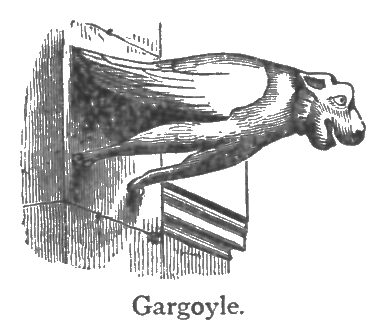
Gargoyle, gär′goil, n. a projecting spout, conveying the water from the roof-gutters of buildings, often representing human or other figures. [O. Fr. gargouille—L. gurgulio, throat.]
Garibaldi, gar-i-bal′di, n. a woman's loose blouse, an imitation of the red shirts worn by the followers of the Italian patriot Garibaldi (1807-1882).
Garish, Gairish, gār′ish, adj. showy: gaudy.—adv. Gar′ishly.—n. Gar′ishness. [Earlier gaurish, gawrish—gaure, to stare, perh. a freq. of gaw, to stare, cf. Ice. gá, to heed.]
Garland, gär′land, n. a wreath of flowers or leaves: a name for a book of extracts in prose or poetry: (Shak.) the thing most prized.—v.t. to deck with a garland.—n. Gar′landāge, a decoration of garlands.—adj. Gar′landless.—n. Gar′landry, garlands collectively.--Civic garland, a crown of oak-leaves bestowed on a Roman soldier who saved a fellow-citizen's life in battle. [O. Fr. garlande; prob. Old High Ger. wiara, fine ornament.]
Garlick, gär′lik, n. a bulbous-rooted plant of genus Allium, having a pungent taste and very strong smell.—adj. Gar′licky, like garlick. [A.S. gárléac—gár, a spear, léac, a leek.]
Garment, gär′ment, n. any article of clothing, as a coat or gown.—v.t. to clothe with a garment.—adjs. Gar′mented; Gar′mentless.—n. Gar′menture, clothing. [O. Fr. garniment—garnir, to furnish.]
Garner, gär′nėr, n. a granary or place where grain is stored up: a store of anything—e.g. experience.—v.t. to store as in a garner.—v.i. (rare) to accumulate.—n. Gar′nerage, a storehouse. [O. Fr. gernier (Fr. grenier)—L. granarium, -ia, a granary.]
Garnet, gär′net, n. a precious stone belonging to a group of minerals crystallising in the cubical system. [O. Fr. grenat—Low L. granatum, pomegranate; or Low L. granum, grain, cochineal, red dye.]
Garnish, gär′nish, v.t. to adorn: to furnish: to surround with ornaments, as a dish.—n. entrance-money: something placed round a principal dish at table, whether for embellishment or relish: a gift of money, esp. that formerly paid by a prisoner to his fellow-prisoners on his first admission.—ns. Gar′nishee, a person warned not to pay money owed to another, because the latter is indebted to the garnisher who gives the warning (v.t. to attach a debtor's money in this way); Garnishee′ment; Gar′nisher, one who garnishes; Gar′nishing, Gar′nishment, Gar′niture, that which garnishes or embellishes: ornament: apparel: trimming; Gar′nishry, adornment. [O. Fr. garniss-, stem of garnir, to furnish, old form warnir, from a Teut. root seen in A.S. warnian, Ger. warnen, Eng. warn.]
Garret, gar′et, n. (Shak.) a watch-tower: a room next the roof of a house.—p.adj. Garr′eted, provided with garrets: lodged in a garret.—ns. Garreteer′, one who lives in a garret: a poor author; Garr′et-mas′ter, a cabinet-maker, locksmith, &c., working on his own account for the dealers. [O. Fr. garite, a place of safety, guarir, warir, to preserve (Fr. guérir)—Teut., Old High Ger. warjan, to defend.]
Garrison, gar′i-sn, n. a supply of soldiers for guarding a fortress: a fortified place.—v.t. to furnish a fortress with troops: to defend by fortresses manned with troops.—Garrison town, a town in which a garrison is stationed. [O. Fr. garison—garir, guerir, to furnish—Teut., Old High Ger. warjan, to defend.]
Garron, gar′on, n. a small horse.—Also Garr′an. [Ir.]
Garrot, gar′ot, n. a name applied to various ducks. [Fr.]
Garrot, gar′ot, n. (surg.) a tourniquet. [Fr.]
Garrotte, Garotte, gar-rot′, n. a Spanish mode of strangling criminals.—v.t. to strangle by a brass collar tightened by a screw, whose point enters the spinal marrow: to suddenly render insensible by semi-strangulation, and then to rob:—pr.p. garrott′ing, garott′ing; pa.p. garrott′ed, garott′ed.—ns. Garrott′er, Garott′er, one who garrottes; Garrott′ing, Garott′ing. [Sp. garrote; cf. Fr. garrot, a stick.]
Garrulous, gar′ū-lus, adj. talkative.—ns. Garrul′ity, Garr′ulousness, talkativeness: loquacity.—adv. Garr′ulously. [L. garrulus—garrīre, to chatter.]
Garter, gär′tėr, n. a band used to tie the stocking to the leg: the badge of the highest order of knighthood in Great Britain, called the Order of the Garter.—v.t. to bind with a garter.—Garter king-of-arms, the chief herald of the Order of the Garter. [O. Fr. gartier (Fr. jarretière)—O. Fr. garet (Fr. jarret), the ham of the leg, prob. Celt. as Bret. gar, the shank of the leg.]
Garth, gärth, n. an enclosure or yard: a garden: a weir in a river for catching fish. [Ice. garðr, a court; cf. A.S. geard; Ger. garten, yard.]
Garuda, gär′ōō-da, n. a Hindu demigod, with the body and legs of a man, the head and wings of a bird, emblem of strength and speed. [Sans.]
Garvie, gär′vi, n. (Scot.) a sprat.—Also Gar′vock. [Gael. garbhag.]
Gas, gas, n. a vaporous substance not condensed into a liquid at ordinary terrestrial temperatures and pressures—esp. that obtained from coal, used in lighting houses: (coll.) frothy talk:—pl. Gas′es.—v.t. to supply with gas: (U.S.) to impose on by talking gas.—v.i. to vapour, talk boastfully.—ns. Gasalier′, Gaselier′, a hanging frame with branches for gas-jets, formed on false analogy from chandelier; Gas′-bag, a bag for holding gas: a boastful, talkative person; Gas′-brack′et, a pipe, mostly curved, projecting from the wall of a room, used for illuminating purposes; Gas′-burn′er, a piece of metal fitted to the end of a gas-pipe, with one or more small holes so arranged as to spread out the flame; Gas′-coal, any coal suitable for making illuminating gas; Gas′-condens′er, an apparatus for freeing coal-gas from tar; Gasē′ity, Gā′seousness.—adj. Gaseous (gā′se-us).—ns. Gas′-en′gine, an engine in which motion is communicated to the piston by the alternate admission and condensation of gas in a closed cylinder; Gas′-fit′ter, one who fits up the pipes and brackets for gas-lighting; Gas′-fix′ture, a bracket or chandelier for gas; Gas′-fur′nace, a furnace of which the fuel is gas; Gas′holder, a large vessel for storing gas; Gasificā′tion, the process of converting into gas.—v.t. Gas′ify, to convert into gas.—ns. Gas′-jet, a gas-burner; Gas′-lamp, a lamp lighted by gas; Gas′-main, one of the principal underground pipes conveying gas from the works to the places where it is consumed; Gas′-man, a man employed in the manufacture of gas: the man who controls the lights of the stage; Gas′-mē′ter, an instrument for measuring the quantity of gas consumed at a particular place in a given time; Gas′ogene (same as Gazogene); Gas′olene, rectified petroleum; Gasom′eter, an instrument for measuring gas: a place for holding gas.—adjs. Gasomet′ric, -al.—ns. Gas′-pipe, a pipe for conveying gas; Gas′sing, idle talking; Gas′-stove, an apparatus in which coal-gas is used for heating and cooking purposes.—adj. Gas′sy, full of gas, gaseous: (slang) given to vain and boastful talk.—ns. Gas′-tank, a reservoir for coal-gas; Gas′-tar, coal-tar.—adj. Gas′-tight, sufficiently close to prevent the escape of gas.—ns. Gas′-wa′ter, water through which coal-gas has been passed; Gas′-works, an establishment where illuminating gas is manufactured. [A word invented by the Dutch chemist J. B. Van Helmont (1577-1644)—the form suggested by Gr. chaos.]
Gasconade, gas-ko-nād′, n. boasting talk.—ns. Gas′con, a native of Gascony; Gas′conism. [Fr.,—Gascon, from their proverbial boastfulness.]
Gash, gash, v.t. to make a deep cut into anything, esp. into flesh.—n. a deep, open wound. [Formerly garse—O. Fr. garser, pierce with a lancet—Low L. garsa. Perh. corrupted from Gr. charassein, to cut.]
Gash, gash, adj. (Scot.) shrewd: talkative: trim.—v.i. to tattle. [Prob. a corr. of sagacious.]
Gash, gash, adj. (Scot.) ghastly, hideous—also Gash′ful, Gash′ly.—n. Gash′liness.—adv. Gash′ly. [From ghastful, through association with gash.]
Gasket, gas′ket, n. (naut.) a canvas band used to bind the sails to the yards when furled: a strip of tow, &c., for packing a piston, &c.—Also Gas′kin. [Cf. Fr. garcette, It. gaschetta; ety. dub.]
Gaskins, gas′kinz, n. (Shak.). See Galligaskins.
Gasp, gasp, v.i. to gape in order to catch breath: to desire eagerly.—n. the act of opening the mouth to catch the breath.—pr.p. and adj. Gasp′ing, convulsive, spasmodic.—adv. Gasp′ingly.—The last gasp, the utmost extremity. [Ice. geispa, to yawn, by metathesis from geipsa, cf. geip, idle talk.]
Gast, gast, v.t. (Shak.) to make aghast, to frighten or terrify. [A.S. gǽstan; cf. Aghast.]
Gasteropod, gas′ter-o-pod, n. one of a class of molluscs, embracing whelks, limpets, snails, &c., having in general a muscular disc under the belly, which serves them as feet—also Gas′tropod:—pl. Gasterop′oda.—adj. Gasterop′odous. [Formed from Gr. gastēr, the stomach, pous, podos, a foot.]
Gastræa, gas-trē′a, n. (biol.) a hypothetic animal form assumed by Hæckel as the ancestor of all metazoic animals:—pl. Gastræ′æ.—n. Gas′trula, that embryonic form of metazoic animals which consists of a two-layered sac enclosing a central cavity and having an opening at one end:—pl. Gras′trulæ.—adj. Gas′trular.
Gastralgia, gas-tral′ji-a, n. pain in the stomach or bowels. [Gr. gastēr, the stomach, algos, pain.]
Gastric, gas′trik, adj. belonging to the stomach—also Gas′tral.—ns. Gastrī′tis, inflammation of the stomach; Gastrol′oger.—adj. Gastrolog′ical.—n. Gastrol′ogy, cookery, good eating.—Gastric fever, a bilious remittent fever; Gastric juice, the digestive liquid secreted by the glands of the stomach. [Gr. gastēr, the belly.]
Gastrocnemius, gas-trok-nē′mi-us, n. a superficial muscle of the posterior tibial region helping to extend the foot. [Gr. gastēr, stomach, knēmē, the leg.]
Gastromancy, gas′tro-man-si, n. a means of divination by ventriloquism: divination by large-bellied glasses. [Gr. gastēr, belly, manteia, soothsaying.]
Gastronome, gas′tro-nōm, n. one who pays great attention to his diet, an epicure—also Gastron′omer, Gastron′omist.—adjs. Gastronom′ic, -al, pertaining to gastronomy.—ns. Gastron′omy, the art or science of good eating; Gas′trophile, Gas′trophilist, Gas′trophilite; Gas′trophilism, love of good eating; Gas′trosoph, one skilled in matters of eating; Gastros′opher; Gastros′ophy. [Gr. gastēr, belly, nomos, law—nemein, to distribute.]
Gastrostomy, gas-tros′to-mi, n. an operation performed in a case of stricture of the gullet, to introduce food into the stomach through an external opening. [Gr. gastēr, belly, stoma, mouth.]
Gastrotomy, gas-trot′o-mi, n. the operation of cutting open the belly. [Gr. gastēr, belly, tomē, a cutting—temnein, to cut.]
Gastro-vascular, gas-trō-vas′kū-lar, adj. common to the functions of digestion and circulation.
Gat, gat (B.) pa.t. of get.
Gat, gat, n. an opening between sandbanks, a strait. [Ice.]
Gate, gāt, n. a passage into a city, enclosure, or any large building: a narrow opening or defile: a frame in the entrance into any enclosure: an entrance.—v.t. to supply with a gate: at Oxford and Cambridge, to punish by requiring the offender to be within the college gates by a certain hour.—adj. Gā′ted, punished with such restriction.—ns. Gate′-fine, the fine imposed for disobedience to such orders; Gate′-house (archit.), a building over or near the gate giving entrance to a city, abbey, college, &c.; Gate′-keep′er, Gate′man, one who watches over the opening and shutting of a gate.—adj. Gate′less, not having a gate.—ns. Gate′-mon′ey, the money taken for entrance to an athletic or other exhibition, sometimes simply 'gate;' Gate′-tow′er, a tower built beside or over a gate; Gate′-vein, the great abdominal vein; Gate′way, the way through a gate: the gate itself: any entrance.—Gate of justice, a gate as of a city, temple, &c., where a sovereign or judge sat to dispense justice; Gates of death, a phrase expressing the near approach of death.—Break gates, at Oxford and Cambridge, to enter college after the prescribed hour; Ivory gate, in poetical imagery, the semi-transparent gate of the house of sleep, through which dreams appear distorted into pleasant and delusive shapes; Stand in the gate (B.), to occupy a position of defence. [A.S. geat, a way; Dut. gat, Ice. gat; not in Goth. and High Ger.; prob. related to get or gate.]