LIST OF ABBREVIATIONS USED IN THIS DICTIONARY. (continued 15)
Reading edition
Kennick, ken′ik, n. the jargon of tramping tinkers.
Kenosis, ken-ō′sis, n. the self-limitation on the part of the Logos in the act of incarnation, his emptying of himself, or his laying aside not only his divine attributes, but even his divine self-consciousness, only to be fully recovered at the ascension.—adj. Kenot′ic.—n. Kenot′icist. [Gr., from the phrase in Phil. ii. 6, 7, 'who, being in the form of God ... emptied himself (ἑαυτὸν ἐκένωσε), taking the form of a servant.']
Kent, kent, n. (Scot.) a pole, pike.—v.i. to propel a boat by a pole. [Prob. a variant of the verb cant.]
Kentish, kent′ish, adj. pertaining to Kent.—ns. Kent′ish-fire, rounds of noisy applause at political meetings—from the anti-Catholic demonstrations in Kent, 1828-29; Kent′ish-rag, a rough fossiliferous limestone found in Kent.
Kentledge, kent′lej, n. pig-iron laid in a ship's hold for ballast.—Also Kint′ledge.
Kep, kep, v.t. (Scot.) to catch. [Keep.]
Kephalic. Same as Cephalic.
Kepi, kep′i, n. a flat-topped forage-cap with a straight peak. [Fr. képi.]
Keplerian, kep-lē′ri-an, adj. pertaining to the great German astronomer, Johann Kepler (1571-1630).—For Kepler's laws, see Law.
Kept, pa.t. and pa.p. of keep.
Keramic. Same as Ceramic.
Kerasine, ker′a-sin, adj. like or made of horn.—ns. Keratī′asis, a morbid condition characterised by warty or horny growths; Ker′atin, a nitrogenous compound, the essential ingredient of horny tissue, as of horns, nails, &c. [Gr. keras, a horn.]
Keratitis, ker-a-tī′tis, n. inflammation of the cornea, either acute or chronic.—n. Keratal′gia, pain in the cornea.
Kerbstone, kėrb′stōn, n. a form of curbstone.
Kerchief, kėr′chif, n. any loose cloth used in dress: (orig.) a square piece of cloth worn by women to cover the head.—v.t. to cover or dress with a kerchief.—adjs. Ker′chiefed, Ker′chieft. [M. E. couerchef—O. Fr. covrechef (Fr. couvrechef)—covrir, to cover, chef, the head.]
Kerf, kerf, n. the groove made by a saw: wool cut off at once by a wool-shearing machine: a single layer of hay, turf, &c., cut.
Kerion, kē′ri-on, n. a suppurative inflammation of the hair-follicles of the scalp. [Gr.]
Kerite, kē′rīt, n. a kind of artificial vulcanite of india-rubber and animal or vegetable oil. [Gr. kēros, wax.]
Kermes, kėr′mēz, n. a dye-stuff which consists of the bodies of the females of a species of coccus. [Pers.]
Kermess, kėr′mes, n. a wake or fair in the Low Countries. [Dut. kermis—kerk, church, mis, mass.]
Kern. See Quern.
Kern, kėrn n. (Scot.) the last sheaf of the harvest: a harvest-home—also Kirn.—n. Kern′-bā′by, an image decorated with blades of corn, &c., carried before reapers at their harvest-home. [A variant of corn.]
Kern, Kerne, kėrn, n. an Irish foot-soldier: a boor.—adj. Kern′ish, clownish. [Ir. ceatharnach.]
Kern, kėrn, v.i. to granulate.
Kern, kėrn, n. (print.) that part of a type which overhangs the stem or shank.
Kernel, kėr′nel, n. anything in a husk or shell: the substance in the shell of a nut: the seed of a pulpy fruit: the important part of anything.—adj. Ker′nelly, full of, or resembling, kernels. [A.S. cyrnel—corn, grain, and dim. suffix -el; Ger. kern, a grain.]
Kerosene, ker′o-sēn, n. an oil obtained from bituminous coal, used for lamps, &c. [Gr. kēros, wax.]
Kersey, kėr′zi, n. a coarse woollen cloth. [Perh. from Kersey in Suffolk.]
Kerseymere, kėr′zi-mēr or kėr-zi-mėr′, n. twilled cloth of the finest wools. [A corr. of cassimere, cashmere.]
Kerve, kėrv, v.t. (Spens.) a form of carve.
Kesar, kē′zar, n. Same as Kaiser.
Kestrel, kes′trel, n. a small species of falcon. [O. Fr. quercerelle—L. querquedula.]
Ket, ket, n. (Scot.) carrion. [Ice. kjöt.]
Ket, ket, n. matted wool. [Scot.]
Ketch, kech, n. a small two-masted vessel, generally used as a yacht or a bomb-vessel. [Corr. from Turk. qaíq, a boat, whence Fr. caïque.]
Ketchup, kech′up, n. a sauce for flavouring soups, meats, &c., flavoured with mushrooms, tomatoes, &c.—Also Catch′up, Cat′sup. [East Ind. kitjap.]
Kettle, ket′l, n. a vessel of metal, for heating or boiling liquids: a cavity like a kettle in rock, sand, &c.: (Shak.) kettle-drum.—ns. Kett′le-drum, a musical instrument now used chiefly in orchestras and in cavalry bands, consisting of a hollow brass hemisphere with a parchment head, sounded by soft-headed elastic drumsticks: a tea-party; Kett′le-drum′mer; Kett′le-hold′er, a little mat, &c., for holding a kettle when hot.—n.pl. Kett′le-pins, skittle-pins.—A kettle of fish, or A pretty kettle of fish, a task of great difficulty, an awkward mess—most probably in this sense connected with kiddle. [A.S. cetel; Ger. kessel, Goth. katils; all perh. from L. catillus, dim. of catinus, a deep cooking-vessel.]
Kex, keks, n. the dry stalk of the hemlock or other umbelliferous plants.—Also Kecks, Keck′sy (prop. adj.), and Keck.
Key, kē, n. an instrument for shutting or opening a lock: that by which something is screwed or turned: the middle stone of an arch: a piece of wood let into another piece crosswise to prevent warping: (mus.) one of the small levers in musical instruments for producing notes: the fundamental note of a piece of music: that which explains a mystery: a book containing answers to exercises, &c.—ns. Key′board, the keys or levers in a piano or organ arranged along a flat board; Key′-bū′gle, a bugle with keys, having a compass of two octaves including semitones.—adjs. Key′-cold (Shak.), cold as a key, lifeless; Keyed, furnished with keys, as a musical instrument: set to a particular key, as a tune.—ns. Key′hole, the hole in which a key of a door, &c., is inserted; Key′note, the key or fundamental note of a piece of music; any central principle or controlling thought; Key′-pin, the pivot on which a pipe-key turns: a pin serving as fulcrum for a key of an organ, &c.; Key′-plate, the escutcheon around a keyhole; Key′ring, a ring for holding a bunch of keys; Key′-seat, a groove for receiving a key, to prevent one piece of machinery from turning on another; Key′stone, the stone at the apex of an arch: the chief element in any system.—Have the key of the street (coll.), to be locked out: to be homeless; Power of the keys, the power to loose and bind, to administer ecclesiastical discipline—a special authority conferred by Christ on Peter (Matt. xvi. 19), or Peter in conjunction with the other apostles, and claimed by the popes as the alleged successors to St Peter. Others explain it as belonging only to the apostles themselves, as descending to the bishops and clergy of the Christian Church, or as belonging to all Christ's disciples alike. [A.S. cæg, a key.]
Key, kē, n. (Dryden). Same as Quay.
Key, kē, n. a low island near the coast.—Also Cay.
Keys, kēz, n.pl. a contraction of House of Keys, a house of 24 representatives constituting the lower branch of the Legislature (Court of Tynwald) of the Isle of Man, self-elective down to 1866. [Manx kiare-as-feed, four-and-twenty.]
Khaki, kä′ki, adj. dust-coloured.—n. a light drab cloth used for some East Indian and other uniforms.
Khalif. See Calif.
Khamsin, kam′sin, n. a hot south-west wind in Egypt, blowing for about fifty days from about the middle of March. [Ar.]
Khan, kan, n. an Eastern inn, a caravansary. [Turk.,—Pers. khāna, a house, a tent.]
Khan, kan, n. in North Asia, a prince or chief: in Persia, a governor.—n. Khan′ate, the dominion or jurisdiction of a khan. [Pers. khān, lord or prince, a Tartar word.]
Khedive, ked-ēv′, n. the title since 1867 of the viceroy or ruler of Egypt.—n. Khedi′viate, the office of the khedive, or his territory. [Fr.,—Pers. khadīw, prince.]
Khel, kel, n. in Afghanistan, a clan or family connection—a sociological group between the tribe and the family.
Khitmutgar, kit′mut-gar, n. a table-servant, under-butler. [Hind.]
Khutbah, kut′ba, n. a Mohammedan prayer and sermon delivered in the mosques on Fridays.—Also Khot′bah.
Kiaugh, kyōh, n. (Scot.) care, trouble.
Kibble, kib′l, n. the bucket of a draw-well.—n. Kibb′le-chain, the chain for drawing up a bucket.
Kibe, kīb, n. a chilblain. [W. cibwst, from cib, a cup, gwst, a disease.]
Kibitka, ki-bit′ka, n. a Russian wagon. [Russ.]
Kiblah, kib′la, n. the point toward which Mohammedans turn in prayer.—Also Keb′lah.
Kick, kik, v.t. to hit with the foot.—v.i. to thrust out the foot with violence: to show opposition or resistance: (of a gun) to recoil violently (see also Bullet): (print.) to work a press by impact of the foot on a treadle.—n. a blow with the foot: the turn of kicking the ball at football, the person who kicks or kicks off: the recoil of a gun: (slang) fashion.—adj. Kick′able.—ns. Kick′er, one who kicks, esp. a horse; Kick′-off, the first kick in a game of football; Kick′-up, a disturbance.—Kick over the traces, to throw off control; Kick, or Strike, the beam, to rise, as the lighter scale of a balance, so as to strike against the beam—hence to be of little weight or importance; Kick the bucket (see Bucket); Kick up a dust or row, to create a disturbance.—Drop kick, a kick made as the ball, dropped from the hand, rebounds from the ground; Place kick, a kick made when the ball is lying on the ground. [M. E. kiken—W. cicio, to kick, Gael. ceig.]
Kickshaws, kik′shawz, n. something uncommon or fantastical that has no name: (cook.) a fantastical dish. [Corr. of Fr. quelque chose, something.]
Kicksy-wicksy, kik′si-wik′si, adj. flickering, uncertain.—n. (Shak.) a wife.
Kid, kid, n. a young goat: (slang) a child, esp. a boy: (pl.) gloves of kid leather.—adj. made of kid leather or imitation kid leather.—v.t. and v.i. to bring forth a goat:—pr.p. kid′ding; pa.p. kid′ded.—ns. Kid′-fox (Shak.), a young fox; Kid′ling, a young kid. [Dan. kid; cf. Ice. kidh; Ger. kitze, a young goat.]
Kid, kid, n. a small tub.—Also Kit.
Kid, kid, n. a fagot, a bundle of sticks. [Prob. W. cidys, fagots.]
Kid, kid, v.t. and v.i. (slang) to hoax—also Kid′dy.—n. a deception. [Perh. conn. with kid, a child.]
Kidder, kid′er, n. a forestaller, huckster.
Kidderminster, kid′ėr-min-stėr, n. a kind of carpet (two-ply or ingrain carpet), from the town.
Kiddle, kid′l, n. a stake-fence set in a stream for catching fish.—Also Kid′el, Kett′le. [O. Fr. quidel; prob. Bret. kidel.]
Kidnap, kid′nap, v.t. to steal, as a human being:—pr.p. kid′napping; pa.t. and pa.p. kid′napped.—n. Kid′napper. [Vulgar kid (old thieves' cant, kinchin—Ger. kindchen), a child, and vulgar nab, to steal.]
Kidney, kid′ni, n. one of two flattened glands, on each side of the loins, which secrete the urine: temperament, humour, disposition—hence, sort or kind, as in 'of the same kidney,' &c.—ns. Kid′ney-bean, a kind of bean shaped like a kidney; Kid′ney-potā′to, one of various kidney-shaped varieties of the common potato; Kid′ney-vetch, a genus of leguminous plants, the only British species being called Lady's Fingers; Kid′ney-wort, a plant of the genus Saxifrage. [M. E. kidnere—Ice. kviðr, the womb, the belly, Ice. nýra (Ger. niere, a kidney).]
Kie-kie, kī′kī, n. a New Zealand high-climbing shrub.
Kieselguhr, kē′zl-gūr, n. the mineral remains of a species of algæ, used in the manufacture of dynamite. [Ger.,—kiesel, flint, guhr, fermentation.]
Kikumon, kik′ōō-mon, n. a badge or crest of the imperial family of Japan, consisting of an open chrysanthemum flower.
Kilderkin, kil′dėr-kin, n. a small barrel: a liquid measure of 18 gallons. [Old Dut. kindeken, kinneken (Scot. kinken), dim. of Dut. kind, a child.]
Kilerg, kil′erg, n. a thousand ergs.
Kiley, kī′le, n. a boomerang.—Also Ky′ley.
Kill, kil, v.t. to put to death, to slay: to nullify or neutralise, to weaken or dilute, to render inactive: to reject, discard: to fascinate, overcome.—n. the act of killing, as game.—ns. Kill′-court′esy (Shak.), a discourteous, boorish person; Kill′-crop, a changeling; Kill′er, one who kills, a slaughterer or butcher: a club for killing fish: a ferocious delphinid which sometimes attacks the whale.—p.adj. Kill′ing, depriving of life: destructive: deadly, irresistible: completely fascinating.—n. and adj. Kill′joy, a mar-sport, austere.—Kill by inches, by gradual means, as by torture; Kill off, to exterminate; Kill time, to consume spare time, as with amusements, &c.; Kill two birds with one stone, to effect one thing by the way, or by the same means with which another thing is done; Kill up (Shak.), to exterminate.—Killing times, the days of the persecution of the Covenanters.—Do a thing to kill, in an irresistible manner. [M. E. killen or cullen—Ice. kolla, to hit on the head—kollr, the head; not a doublet of quell.]
Killadar, kil′a-dar, n. the commandant of a fort or garrison. [Hind.]
Killas, kil′as, n. clay slate, in Cornwall.
Killdee, kil′dē, n. the largest variety of North American ring-plover. [Imit.]
Killock, kil′ok, n. a small anchor, the fluke of such.
Killogie, ki-lō′gi, n. (Scot.) the furnace of a kiln.
Killut, kil′ut, n. in India, a robe of honour given: any ceremonial present.—Also Kell′aut.
Kilmarnock, kil-mar′nok, n. a kind of closely woven broad bonnet, having a peak of the same material at the top, originally made at Kilmarnock.—Kilmarnock cowl, a kind of nightcap.
Kiln, kil, n. a large oven in which corn, bricks, hops, &c. are dried: bricks placed for burning.—v.t. Kiln′-dry, to dry in a kiln.—n. Kiln′-hole, the mouth of a kiln. [A.S. cyln (Ice. kylna, a drying-house for corn)—L. culina, a kitchen.]
Kilogramme, kil′o-gram, n. a French measure of weight, equal to 1000 grammes, or 21⁄5 lb. avoirdupois. [Gr. chilioi, 1000, gramma, a weight.]
Kilolitre, kil′o-lē-tr, n. 1000 litres.
Kilometre, kil′o-mē-tr, n. a French measure, being 1000 metres, or nearly ⅝ of a mile. [Fr.,—Gr. chilioi, 1000, metron, a measure.]
Kilt, kilt, n. a kind of short petticoat or plaited skirt, forming part of the Highland dress.—v.t. (Scot.) to truss up.—adj. Kilt′ed, dressed in a kilt.—n. Kilt′ie, one wearing a kilt, a soldier in a Highland regiment. [Northern Eng. kilt, to tuck up, from Dan. kilte, to tuck up: cf. Ice. kilting, a skirt.]
Kilt, kilt, (Spens.) pa.p. of kill.
Kilter, kil′tėr, n. order, proper condition—in phrase, 'out of kilter.'—Also Kel′ter.
Kimbo, kim′bo, n. Same as Akimbo.
Kimono, ki-mō′nō, n. a loose robe, fastening with a sash, the principal outer garment in Japan.
Kin, kin, n. persons of the same family: relatives: relationship: affinity.—adj. related.—adj. Kin′less, without relations.—Next of kin, the relatives (lineal or collateral) of a deceased person, among whom his personal property is distributed if he dies intestate; Of kin, of the same kin. [A.S. cynn; Ice. kyn, Goth. kuni, family, race; cog. with L. genus, Gr. genos.]
Kinchin, kin′chin, n. a child in thieves' slang.—n. Kin′chin-mort, a child, generally a girl.—Kinchin lay, the robbing of children. [Cf. kidnap.]
Kincob, kin′kob, n. a rich silk-stuff made in India.
Kind, kīnd, n. those of kin, a race: sort or species, a particular variety: nature: style, method of action, character: produce, as distinguished from money.—adj. having the feelings natural for those of the same family: disposed to do good to others: benevolent.—adj. Kind′-heart′ed.—n. Kind′-heart′edness.—adj. Kind′less (Shak.), destitute of kindness, unnatural.—n. Kind′ness.—adj. Kind′-spok′en, spoken kindly: given to speaking kindly.—Kind of (coll.), somewhat, to some extent—used adverbially with adjectives and even verbs.—Do one's kind (Shak.), to act according to one's nature; In a kind, in a way, to some extent; In kind, payment in goods instead of money. [A.S. cynde—cynn, kin.]
Kind, kind, v.t. (Spens.) to beget. [From kin.]
Kindergarten, kin′dėr-gär′tn, n. an infant school on Froebel's principle (1826), in which object-lessons and games figure largely.—n. Kindergart′ner, a teacher in a kindergarten. [Ger. kinder, children, garten, garden.]
Kindle, kin′dl, v.t. to set fire to: to light: to inflame, as the passions: to provoke: to excite to action.—v.i. to take fire: to begin to be excited: to be roused.—ns. Kin′dler; Kin′dling, the act of causing to burn: the materials for commencing a fire. [Ice. kyndyll, a torch—L. candela, candle.]
Kindle, kin′dl, v.t. (Shak.) to bring forth (young). [M. E. kindlen—kinde, kind.]
Kindly, kīnd′li, adj. natural: benevolent: (orig.) belonging to the kind or race.—n. Kind′liness.—adv. Kind′ly.—adj. Kind′ly-nā′tured.—Kindly tenant (Scot.), a tenant of the same stock as his landlord, or who held his lands in succession, from father to son, for several generations.
Kindred, kin′dred, n. relationship by blood, less properly, by marriage: relatives: (pl., B.) families.—adj. related: congenial. [M. E. kinrede—A.S. cynn, kin, and the suffix -ræden, expressing mode or state.]
Kine, kīn, n.pl. (B.) cows. [M. E. ky-en, a doubled plural of A.S. cú, a cow, the plural of which is cý; cf. Scotch kye.]
Kinematics, kin-e-mat′iks, n. the science which treats of motion without reference to force.—adjs. Kinemat′ic, -al. [Gr. kinēma, -atos, motion—kinein, to move.]
Kinematograph, kin-e-mat′o-graf, n. an arrangement by which a numerous series of photographs, taken at rapid intervals, and representing some moving scene, is shown on a screen at the same rapid rate at which they were taken, giving a moving representation of the original scene—less correct but more common form, Cinemat′ograph (sin-). [Gr. kinēma, kinēmatos, motion, graphein, to write.]
Kinesipathy, kin-ē-sip′a-thi, n. a mode of treating disease by muscular movements, movement-cure—-also Kinesither′apy.—adjs. Kinesiat′ric, Kinesipath′ic.—n. Kinesip′athist.
Kinetics, ki-net′iks, n. the science which treats of the action of force in producing or changing motion.—adjs. Kinet′ic, -al.—ns. Kinet′ograph, a device by which a series of photographs of a moving object can be thrown on a screen so as to imitate the motion of the original; Kinet′oscope, an instrument for illustrating the production of kinematic curves by the combination of circular movements of different radii. [Gr. kinētikos—kinein, to move.]
King, king, n. the chief ruler of a nation: a monarch: a playing-card having the picture of a king: the most important piece in chess: a crowned man in draughts: one who is pre-eminent among his fellows:—fem. Queen.—v.t. to play king.—ns. King′-at-arms, or King′-of-arms, a chief officer of the Heralds' Colleges, whose designations are, for England, Norroy, Clarencieux, and Garter; for Scotland, Lyon; and for Ireland, Ulster; King′-bird, an American tyrant fly-catcher; King′crab, the chief or largest of the crab genus, most common in the Molucca Islands; King′craft, the art of governing, mostly in a bad sense; King′cup, the buttercup or upright meadow crowfoot; King′dom, the state or attributes of a king: the territory of a king: government: a region: one of the three grand divisions of Natural History, as the animal, vegetable, or mineral.—adj. King′domed (Shak.), endowed with kingly power, proud.—ns. King′fisher, a bird with very brilliant plumage, feeding on fish, the halcyon; King′hood, kingship: kingliness.—adj. King′less.—ns. King′let, King′ling, a little or petty king: the golden-crested wren.—ns. King′lihood, King′liness.—adj. King′-like.—adj. King′ly, belonging or suitable to a king: royal: noble—also adv.—ns. King′-mak′er, one who has the creating of kings in his power; King′post, a perpendicular beam in the frame of a roof rising from the tie-beam to the ridge; King's′-cush′ion, a seat formed by two people's hands; King's′-ē′vil, a scrofulous disease or evil formerly supposed to be healed by the touch of the king; King′ship, the state, office, or dignity of a king; King's′-hood, the second stomach of a ruminant, sometimes humorously for the human stomach; King's′-spear, a plant of the genus Asphodel; King's′-yell′ow, arsenic trisulphide or orpiment; King′-vul′ture, a large tropical brilliantly-coloured American vulture; King′wood, a beautiful Brazilian wood—also Violet-wood.—King Charles spaniel (see Spaniel); King Log, a do-nothing king, as opp. to King Stork, one who devours his frog-subjects—from Æsop's fable; King Mob, the vulgar multitude; King of beasts, the lion; King of metals, gold; King of terrors, death; King of the forest, the oak; King's Bench, the bench or seat of the king: one of the high courts of law, so called because the king used to sit there, called Queen's Bench during a queen's reign; King's counsel an honorary rank of barristers; King's evidence, a criminal allowed to become a witness against an accomplice.—Kingdom come (slang), the state after death.—Three kings of Cologne, the three Wise Men of the East, Gaspar, Melchior, and Balthazar. [A.S. cyning—cyn, a tribe, with suffix -kin; cog. with kin.]
Kinic, kin′ik, adj. pertaining to cinchona, cinchonic.
Kink, kingk, n. a twist in a string, rope, &c.—also Kink′le.—v.i. and v.t. to twist.—adj. Kink′y, full of kinks: woolly: crotchety. [Scand.; Sw. and Norw. kink.]
Kink, kingk, v.i. to cough loudly, gasp for breath.—n. a convulsive cough or gasp.—n. Kink′cough, whooping-cough, chincough (q.v.).
Kinkajou, kin′ka-jōō, n. a South American quadruped allied to the raccoon.
Kino, kē′no, n. an astringent vegetable exudation resembling catechu. [East Indian.]
Kinsfolk, kinz′fōk, n. folk or people kindred or related to one another.—ns. Kin′ship, relationship; Kins′man, a man of the same kin or race with another:—fem. Kins′woman.
Kiosk, ki-osk′, n. an Eastern garden pavilion: a small shop like a sentry-box for the sale of papers, &c. [Turk.,—Pers. kushk.]
Kip, kip, v.i. (Scot.) to play truant.
Kip, kip, n. the skin of a young animal.—n. Kip′skin, leather made from the skin of young cattle, intermediate between calf-skin and cow-hide.
Kip, kip, n. a level or slight incline at the end of an underground way, on which the tubs of coal stand till hoisted up the shaft.
Kip, kip, n. a house of ill-fame.—Also Kip′shop.
Kipe, kīp, n. (prov.) an osier basket for catching pike.
Kippage, kip′āj, n. (Scot.) a fit of temper, a rage.
Kipper, kip′ėr, n. a male salmon after the spawning season: a salmon split open, seasoned, and dried.—v.t. to cure or preserve, as a salmon or haddock. [Dut. kippen, to seize; Norw. kippa.]
Kirbeh, kir′be, n. a skin for holding water. [Ar.]
Kirimon, kē′ri-mon, n. one of the two imperial crests of Japan, bearing three leaves and three flowers of paulownia.
Kirk, kėrk, n. in Scotland, a church—sometimes 'the Kirk' means the Established Church specially.—ns. Kirk′in, the first attendance of a pair after marriage, of a magistrate after election; Kirk′-sess′ion, the lowest court in Presbyterian churches, being the governing body of a particular congregation; Kirk′ton (Scot.), the village in which the parish church stands; Kirk′yard, a graveyard.—Auld Kirk, the Established Church in Scotland—by association of ideas, (coll.) the whisky bottle, whisky. [A Northern Eng. form of church.]
Kirschwasser, kērsh′väs-ser, n. a liqueur made from the wild cherry. [Ger., 'cherry water.']
Kirtle, kėr′tl, n. a sort of gown or outer petticoat: a mantle.—adj. Kir′tled. [A.S. cyrtel; Dan. kiortel; Ice. kyrtill: perh. conn. with skirt and shirt.]
Kismet, kis′met, n. fate, destiny. [Turk. qismet.]
Kiss, kis, v.t. to press one's lips to in affection or reverence: to treat with fondness: to touch gently: to collide (of two billiard-balls).—v.i. to salute with the lips.—n. a salute with the lips.—ns. Kiss′-curl, a small curl at the side of the forehead; Kiss′er; Kiss′ing-com′fit, a perfumed comfit for sweetening the breath; Kiss′ing-crust, that part of the upper crust of the loaf which, while baking, overhangs the edge and touches another.—n.pl. Kiss′ing-strings, cap or bonnet strings tied under the chin.—n. Kiss′-me, the wild form of Viola tricolor, the pansy: a short veil: a small bonnet—also Kiss′-me-quick.—Kiss hands, to kiss the sovereign's hands on a minister's acceptance of office; Kiss of peace, a kiss of greeting exchanged between the members of the early Church, a shadow of which survives in the kissing of the pax at high mass; Kiss the book, to kiss a copy of the New Testament, in England, after taking a legal oath; Kiss the dust, to be felled to the ground, to be slain or vanquished; Kiss the gunner's daughter, to get a flogging, tied to the breech of a cannon; Kiss the rod, to submit to punishment. [A.S. cyssan, to kiss—coss, a kiss; Ger. küssen, Dan. kys; allied to choose and gust.]
Kist, kist, n. (Scot.) a chest.—Kist o' whistles, an organ. [A.S. cist.]
Kistvaen, kist′vā-en, n. a burial-chamber made of flat stones, and shaped like a chest. [W. cist, chest, maen, stone.]
Kit, kit, n. a small wooden tub: the outfit of necessaries of a soldier, sailor, or mechanic. [Old Dut. kitte, a hooped beer-can.]
Kit, kit, a small pocket violin. [Contracted from A.S. cytere—L. cythara, a guitar.]
Kit, kit, n. a contraction of kitten.—n. Kit′-cat, a game played with sticks and a small piece of wood called a cat.
Kit, kit, n. a family, in phrase 'the whole kit.' [Kith.]
Kitcat, kit′kat, n. the name of a Whig London literary club, which existed from 1700 to about 1720, meeting for some time in the house of a pastry-cook named Christopher Katt: a portrait 36 by 28 inches in size, so called from the portraits of the Kitcat Club painted by Sir G. Kneller.
Kitchen, kich′en, n. a room where food is cooked: a utensil with a stove for dressing food, &c.: anything eaten as a relish with bread, potatoes, &c.—v.t. (Shak.) to regale in the cook-room: to serve as relish to food, to make palatable, to use sparingly, as one would a relish—to make it last.—ns. Kitch′endom, the domain of the kitchen; Kitch′ener, a person employed in the kitchen: a cooking-stove; Kitch′en-fee, the fat which falls from meat in roasting; Kitch′en-gar′den, a garden where vegetables are cultivated for the kitchen; Kitch′en-knave, a scullion; Kitch′en-maid, a maid or servant whose work is in the kitchen; Kitch′en-mid′den (Dan. kjökkenmödding), a prehistoric rubbish-heap in Denmark, the north of Scotland, &c.; Kitch′en-phys′ic, substantial fare (Milt.); Kitch′en-range, a kitchen grate with oven, boiler, &c. attached, for cooking; Kitch′en-stuff, material used in kitchens: kitchen refuse, esp. fat from pots, &c.; Kitch′en-wench, a kitchen-maid. [A.S. cicen; Ger. küche, Fr. cuisine, all from L. coquina—coquĕre, to cook.]
Kite, kīt, n. a rapacious bird of the hawk kind: a rapacious person: a light frame covered with paper for flying in the air, attached to a long cord, by means of which it is steered: a light and lofty sail: an accommodation bill, esp. a mere paper credit.—n. Kite′-fly′ing, the dealing in fictitious accommodation paper to raise money. [A.S. cýta; cf. W. cud, Bret. kidel, a hawk.]
Kite, kīt, n. (Scot.) the belly.—Also Kyte. [A.S. cwith, the womb.]
Kith, kith, n. kindred, acquaintance, obsolete except in the phrase Kith and kin, acquaintances and relatives. [A.S. cúð—cunnan, to know.]
Kitten, kit′n, n. a young cat.—v.i. to bring forth young cats.—n. (Scot.) Kit′ling.—adj. Kitt′enish, frolicsome.—v.i. Kitt′le (Scot.), to bring forth kittens. [M. E. kitoun, dim. of cat.]
Kittiwake, kit′i-wāk, n. a species of gull with long wings and rudimentary hind-toe. [Imit.]
Kittle, kit′l, adj. (Scot.) ticklish, intractable.—v.t. (Scot.) to tickle.—adj. Kitt′ly, easily tickled, sensitive.—n. Kitt′ly-bend′ers (Amer.), running on thin bending ice.
Kiwi, kē′wi, n. a bird of the genus Apteryx found in New Zealand.
Klang, klang, n. (mus.) a complex tone, composed of fundamental and harmonics, as opposed to a simple tone. [Ger.]
Klepht, kleft, n. a Greek or Albanian brigand. [Gr., from kleptein, to steal.]
Kleptomania, klep-to-mā′ni-a, n. a mania for stealing: a morbid impulse to secrete things.—n. Kleptomā′niac. [Gr. kleptein to steal, mania, madness.]
Klick. Same as Click.
Klipdas, klip′das, n. the rock badger.
Klipspringer, klip′spring-ėr, n. a small South African antelope.
Kloof, klōōf, n. a mountain cleft. [S. African Dutch.]
Knack, nak, n. a petty contrivance: a toy: a nice trick: dexterity, adroitness.—n. Knack′iness.—adjs. Knack′ish, Knack′y, cunning, crafty. [Orig. imit.; cf. Gael. cnac, Dut. knak, a crack, Ger. knacken, to crack.]
Knacker, nak′ėr, n. anything that knocks: (pl.) castanets or clappers, bones.
Knacker, nak′ėr, n. a dealer in old horses and dog's-meat: (prov.) a collier's horse. [From Ice. knakkr, a saddle.]
Knag, nag, n. a knot in wood: a peg.—n. Knag′giness, state of being knaggy.—adj. Knag′gy, knotty: rugged. [From a root found in Ir. and Gael. cnag, a knob; cf. Dan. knag, Ger. knagge.]
Knap, nap, v.t. to snap or break with a snapping noise: to break in pieces with blows, as stones: to bite off, nibble:—pr.p. knap′ping; pa.p. knapped.—ns. Knap′bottle, the bladder-campion; Knap′per, one who breaks stones, esp. one who breaks up flint-flakes for gun-flints; Knap′ping-hamm′er (Scot.), a hammer for breaking stones.—v.i. Knap′ple, to nibble. [Dut. knappen, to crack or crush.]
Knap, nap, n. (Bacon) a protuberance, a hillock.—n. Knap′weed, a general name for plants of the genus Centaurea of the composite family—star-thistle, bachelor's buttons. [Conn. with knob, knop.]
Knapsack, nap′sak, n. a provision-sack: a case for necessaries borne by soldiers and travellers. [Dut. knappen, to crack, eat, zak, a sack.]
Knapskull, nap′skul, n. a helmet. [From knap (n.) and skull.]
Knar, när, n. a knot on a tree.—n. Knarl=Gnarl.—adj. Knarred, gnarled, knotty.
Knave, nāv, n. a false, deceitful fellow: a villain: a card bearing the picture of a servant or soldier: (Shak.) a boy.—ns. Knave′-bairn, a male child; Knav′ery, dishonesty; Knave′ship (Scot.), a certain quantity of grain, the due of the miller.—adj. Knav′ish, fraudulent: villainous.—adv. Knav′ishly.—n. Knav′ishness. [A.S. cnafa, cnapa, a boy, a youth; Ger. knabe, knappe.]
Knead, nēd, v.t. to work and press together into a mass, as flour into dough: to operate upon in massage: to mix.—ns. Knead′er; Knead′ing-trough, a trough for kneading. [A.S. cnedan; Ice. knoða, Ger. kneten, to knead.]
Knee, nē, n. the joint between the thigh and shin bones: a piece of timber or metal like a bent knee: (Shak.) a genuflection.—v.t. (Shak.) to kneel to, to go over on one's knees.—n.pl. Knee′-breech′es, breeches extending to just below the knee, as in court-dress.—n. Knee′-cap, the bone above the protuberance of the knee: a cap or strong covering for the knees, used chiefly for horses, to save their knees in case of a fall.—n.pl. Knee′-cords, knee-breeches of corduroy.—adjs. Knee′-crook′ing, obsequious: fawning; Kneed, having knees: (bot.) having angular joints like the knee; Knee′-deep, rising to the knees: sunk to the knees; Knee′-high, rising or reaching to the knees.—ns. Knee′-holl′y, butcher's broom: Knee′-joint, a joint with two pieces at an angle, so as to be very tight when pressed into a straight line; Knee′-pan, a flat, round bone on the front of the knee-joint; Knee′-piece, or -raft′er, an angular piece of timber strengthening a joint where two roof-timbers meet: any defensive appliance covering the knee; Knee′-stop, -swell, a lever worked by the performer's knee, for regulating the wind-supply of a reed-organ, &c.; Knee′-tim′ber, timber bent into a shape suitable for a knee in shipbuilding, &c.; Knee′-trib′ute (Milt.), the homage of kneeling.—Give, or Offer, a knee, to act as second or bottle-holder in a fight, the principal resting on the second's knee during the pauses between the rounds. [A.S. cneów, cneó; Ger. knie, L. genu, Gr. gonu.]
Kneel, nēl, v.i. to bend the knee: to rest or fall on the knee:—pa.t. and pa.p. kneeled, knelt.—n. Kneel′er, one who kneels. [Knee.]
Knell, nel, n. the stroke of a bell: the sound of a bell at a death or funeral.—v.i. to sound as a bell: toll.—v.t. to summon as by a tolling bell. [A.S. cnyllan, to beat noisily; Dut. and Ger. knallen.]
Knelt, nelt, pa.t. and pa.p. of kneel.
Knew, nū, pa.t. of know.
Knickerbockers, nik-ėr-bok′ėrz, n.pl. loose breeches gathered in at the knee.—Also Knick′ers. [From the wide-breeched Dutchmen in 'Knickerbocker's' (Washington Irving's) humorous History of New York, whence Knickerbocker has come to mean the descendant of one of the original Dutch settlers of New York.]
Knick-knack, nik′-nak, n. a trifle or toy.—n. Knick′-knack′ery, knick-knacks collectively. [A doubling of knack.]
Knife, nīf, n. an instrument for cutting: a sword or dagger:—pl. Knives (nīvz).—v.t. to stab with a knife: (Amer.) to try to destroy a political candidate's chances by a treacherous attack.—ns. Knife′-and-fork′, a trencherman; Knife′-board, a board on which knives are cleaned: (coll.) the seat running along the top of an omnibus; Knife′-boy, a boy employed in cleaning knives; Knife′-edge (mech.), a sharp piece of steel like a knife's edge serving as the axis of a balance, &c.; Knife′-grind′er, one who grinds or sharpens knives; Knife′-mon′ey, a knife-shaped bronze currency formerly used in China; Knife′-rest, a glass or metal utensil on which to rest a carving-knife or fork; Knife′-tray, a tray for holding knives.—War to the knife, mortal combat. [A.S. cníf: Ger. kneif, knife, kneifen, to nip.]
Knight, nīt, n. one of gentle birth and bred to arms, admitted in feudal times to a certain honourable military rank: (Shak.) an attendant: a champion: the rank, with the title 'Sir,' next below baronets: a piece used in the game of chess.—v.t. to create a knight.—ns. Knight′age, the collective body of knights; Knight′-bach′elor, one who has been knighted merely, not made a member of any titular order; Knight′-bann′eret, a knight who carried a banner, and who was superior in rank to the knight-bachelor; Knight′-err′ant, a knight who travelled in search of adventures; Knight′-err′antry; Knight′hood, the character or privilege of a knight: the order or fraternity of knights; Knight′hood-err′ant (Tenn.), the body of knights-errant.—adj. Knight′less (Spens.), unbecoming a knight.—n. Knight′liness, the bearing or duties of a knight.—adj. and adv. Knight′ly.—ns. Knight′-mar′shal, formerly an officer of the royal household; Knight′-serv′ice, tenure by a knight on condition of military service.—Knight of industry, a footpad, thief, or sharper; Knight of the carpet, a civil knight, as opposed to a military, so called because created kneeling on a carpet, not the field; Knight of the pestle, an apothecary; Knight of the post, one familiar with the whipping-post or pillory; Knight of the road, a highwayman; Knight of the shire, a member of parliament for a county; Knight's fee, the amount of land with which a knight was invested on his creation; Knights of Labour, in the United States, a national labour organisation; Knights of Malta (see Hospitaller); Knights of St Crispin, shoemakers; Knights of the rainbow, flunkeys from their liveries; Knights of the shears, tailors; Knights of the spigot, tapsters, publicans; Knights of the stick, compositors; Knights of the whip, coachmen; Knights Templars (see Templar). [A.S. cniht Ger. and Dut. knecht, Dan. knegt.]
Knit, nit, v.t. to form into a knot: to tie together: to unite into network by needles: to unite closely, to draw together: to contract.—v.i. to interweave with needles: to grow together:—pr.p. knit′ting; pa.t. and pa.p. knit′ted or knit.—n. (Shak.) a style of knitting.—ns. Knit′ter; Knit′ting, the work of a knitter: union, junction: the network formed by knitting; Knit′ting-machine′, a machine for knitting; Knit′ting-need′le, a long needle or wire used for knitting thread into stockings, &c. [A.S. cnyttan—cnotta, a knot.]
Knitch, nich, n. (prov.) a faggot.
Knittle, nit′l, n. (naut.) a small line made of two or three yarns twisted with the fingers: (pl.) the halves of two yarns in a rope, twisted for pointing.
Knives, pl. of knife.
Knob, nob, n. a hard protuberance: a hard swelling: a round ball.—adj. Knobbed, containing or set with knobs.—n. Knob′biness.—adj. Knob′by, full of knobs: knotty.—n. Knob′stick (slang), a synonym for a blackleg or scab in trades-union slang. [Knop.]
Knobkerrie, nob′ker-i, n. a round-headed stick used as a club and a missile by the Kafirs.
Knock, nok, v.i. to strike with something hard or heavy: to drive or be driven against: to strike for admittance: to rap.—v.t. to strike: to drive against.—n. a sudden stroke: a rap.—adj. Knock′-down, such as to overthrow.—ns. Knock′er, the hammer suspended to a door for making a knock: a goblin inhabiting a mine who points out the presence of ore by knocks; Knock′ing, a beating on a door: a rap.—adj. Knock′-kneed, having knees that knock or touch in walking.—Knock about (slang), to saunter, loaf about; Knock down, to fell with a blow: assign to a bidder with a tap of the auctioneer's hammer; Knock into a cocked hat (see Cock); Knock off, to desist, cease: to accomplish hastily; Knock on the head, to bring to a sudden stop; Knock out, to beat in a boxing match, to overcome generally: to lose the scent—of hounds in fox-hunting; Knock-out auction, an auction where the bidders are largely swindling confederates; Knock together, to get together or construct hastily; Knock under, to give in, yield; Knock up, to rouse by knocking: weary out, or be worn out: to construct hastily: (U.S.) to get with child. [A.S. cnucian, cnocian; imit. like knack; cf. Gael. cnac, cnag, &c.]
Knoll, nōl, n. a round hillock: the top of a hill. [A.S. cnol; Ger. knollen, a knob, lump.]
Knoll, nōl. Same as Knell.
Knop, nop, n. (B.) a knob, a bud. [A.S. cnœp; Dut. knop, Ger. knopf.]
Knosp, nosp, n. the unopened bud of a flower: an architectural ornament resembling such. [Ger. knospe.]
Knot, not, n. a wading-bird much resembling a snipe, sometimes said, but without evidence, to be named from King Cnut or Canute.
Knot, not, n. a bunch of threads or the like entangled or twisted: an interlacement of parts of a cord, &c., by twisting the ends about each other, and then drawing tight the loops thus formed: a piece of ribbon, lace, &c., folded or tied upon itself in some particular form, as shoulder-knot, breast-knot, &c.: anything like a knot in form: a bond of union: a difficulty: the gist of a matter: a cluster: the part of a tree where a branch shoots out: an epaulet: (naut.) a division of the knot-marked log-line: a nautical mile.—v.t. to tie in a knot: to unite closely.—v.i. to form knots or joints: to knit knots for a fringe:—pr.p. knot′ting; pa.t. and pa.p. knot′ted.—n. Knot′-grass, a common weed or grass, so called from the numerous joints or knots of its stem.—adjs. Knot′less, without knots; Knot′ted, full of, or having, knots: having intersecting lines or figures.—n. Knot′tiness.—adj. Knot′ty, containing knots: hard, rugged: difficult: intricate.—n. Knot′work, ornamental work made with knots.—Bowline knot (see Bow); Granny knot (see Granny); Porters' knot, a pad for supporting burdens on the head; Square knot, a knot used in tying reef-points so that the ends come out alongside the standing parts; Surgeons' knot, a square or reef knot used in tying a ligature round a cut artery; True lovers' knot, a kind of double knot with two bows and two ends, an emblem of interwoven affections.—Cut the knot, to solve a problem slap-dash (cf. Gordian). [A.S. cnotta; Ger. knoten, Dan. knude, L. nodus.]
Knout, nowt, n. a whip formerly used as an instrument of punishment in Russia: punishment inflicted by the knout. [Russ. knute.]
Know, nō, v.t. to be informed of: to be assured of: to be acquainted with: to recognise: (B.) to approve: to have sexual commerce with.—v.i. to possess knowledge:—pr.p. knōw′ing; pa.t. knew (nū); pa.p. known (nōn).—n. (Shak.) knowledge.—adj. Know′able, capable of being known, discovered, or understood.—ns. Know′ableness; Know′-all, one who thinks he knows everything; Know′er.—adj. Know′ing, intelligent: skilful: cunning.—adv. Know′ingly.—ns. Know′ingness, the quality of being knowing or intelligent: shrewdness; Know′-noth′ing, one who is quite ignorant: a member of the native American party (1854-56).—adj. completely ignorant.—Know a move or two, to be forearmed against trickery by a knowledge of the tricks; Know on which side one's bread is buttered, to be fully alive to one's own interest; Know the ropes, to understand the detail of any matter, as a sailor does his rigging; Know what's o′clock, Know what's what, to be thoroughly acquainted with something: to be wide awake. [A.S. cnáwan; Ice. kná, L. noscĕre for gnoscere, Gr. gignōskein.]
Knowledge, nol′ej, n. assured belief: that which is known: information, instruction: enlightenment, learning: practical skill.—adj. Knowl′edgeable (coll.), possessing knowledge: intelligent.—n. Knowl′edge-box (slang), the head.—To one's knowledge, so far as one knows. [M. E. knowleche, where -leche is the Northern form of the suffix in wed-lock, being A.S. lác, gift, sport.]
Knub, nub, n. a knob, a small lump: the waste or refuse of silk-cocoons.—Also Knubs.
Knuckle, nuk′l, n. projecting joint of the fingers; (cook.) the knee-joint of a calf or pig.—v.i. to bend the fingers: to touch the forehead as a mark of respect: to yield.—v.t. (rare) to touch with the knuckle.—ns. Knuck′le-bones, a game (called also Dibs); Knuck′le-bow, the curved part of a sword-guard that covers the fingers; Knuck′le-dust′er, a kind of modern cestus, devised as a protection against garrotters; Knuck′le-joint, a joint where the forked end of a connecting-rod is joined by a bolt to another piece of the machinery.—Knuckle down, to apply one's self with vigour to a task: to submit—in this sense, also Knuckle under. [M. E. knokil; cf. Dut. knokkel; prob. Celt., W. cnwc.]
Knurl, nėrl, n. (Burns) a humpback.
Knurl. Same as Gnarl, Knarl.
Knurr, Knur, nur, n. a knot in wood: a wooden ball.—Knur and spell, a game played with a ball (knur), trap (spell), and tripstick, in vogue chiefly in the north of England. [Old Dut. knorre.]
Koa, kō′a, n. a forest-tree of the Sandwich Islands.
Koala, kō-ä′lä, n. an Australian marsupial, called also 'Native Bear.'
Kob, kob, n. an African water-antelope.
Kobalt, n. Same as Cobalt.
Kobang, kō′bang, n. an oblong gold coin, rounded at the corners, once current in Japan.—Also Kō′ban.
Kobold, kō′bold, n. in German folklore, a spirit of the mines. [Akin to goblin.]
Kodak, kō′dak, n. a small portable photographic camera with a continuous roll of sensitised film, on which successive instantaneous negatives are made.—v.t. to take an instantaneous picture of. [The trademark name of the Eastman Kodak Company.]
Koff, kof, n. a small Dutch sailing-vessel.
Koftgar, koft′gär, n. one who inlays steel with gold.—n. Koft′gari, such work—sometimes Koft′work. [Hind.]
Koheleth, kō-hel′eth, n. the Preacher, supposed to be applied to Solomon in Eccles. i. 12.
Kohl, kōl, n. a fine powder of antimony used in the East for staining the eyes. [Ar.]
Kohlrabi, kōl′rā-bi, n. the turnip-cabbage. [Ger.,—It. cavolo rapa, cole-turnip.]
Kokra, kok′ra, n. an Indian wood used for making flutes, &c.—Also Cocus-wood.
Kola, kō′lä, n. an African tree whose nuts or seeds have stimulant properties: a name given to an aerated non-alcoholic beverage.
Kolinsky, ko-lin′ski, n. the Siberian polecat or mink.
Koniscope, kon′i-skōp, n. an instrument for indicating the quantity of dust in the atmosphere. [Gr. konis, dust, skopein, to look.]
Konistra, kō-nis′tra, n. the orchestra or dancing-place in the ancient Greek theatre, a circular area between the stage and the auditorium.
Koodoo, kōō′dōō, n. an African antelope with long spiral horns.
Koorbash, kōōr′bash, n. a whip of hippopotamus or rhinoceros hide, used in Egypt and elsewhere.—Also Kourbash. [Ar. kurbāj.]
Koord, kōōrd, n. Same as Kurd.
Kopeck, kō′pek, n. Same as Copeck.
Kopje, kop′ye, n. a flat-topped hill. [Dut. kop, a top.]
Koran, kō′rän, n. the Mohammedan Scriptures: Alcoran.—adj. Koran′ic. [Ar. qurān, reading.]
Kosher, kō′shėr, adj. pure, clean, according to the Jewish ordinances—as of meat killed and prepared by Jews. [Heb., from yāshar, to be right.]
Kosmos. Same as Cosmos.
Koto, kō′tō, n. a Japanese musical instrument consisting of an oblong box over which thirteen silk strings are stretched.
Kotow, kō-tow′, n. the Chinese ceremony of prostration.—v.i. to perform that ceremony, to abase one's self.—Also Kowtow′. [Chin.]
Kotyliskos, kot-i-lis′kos, n. a small Greek toilet-vase with a small foot.
Koumiss, kōō′mis, n. a Kalmuck intoxicating beverage made from the soured and fermented milk of mares—supposed to be good for pulmonary phthisis. [Russ.,—Tartar.]
Kraal, kräl, n. a Hottentot village or hut [Dut. kraal—Port. curral—L. currĕre.]
Kraken, krä′ken, n. a fabled sea-animal of enormous size. [Scand.]
Krang, krang, n. the carcass of a whale after the blubber has been removed.—Also Kreng. [Dut.]
Krasis, krā′sis, n. the act of adding a little water to the wine used for the Eucharist.—Also called Mixture. [Gr.]
Kreatin. Same as Creatin.
Kreese. Same as Creese.
Kremlin, krem′lin, n. a citadel, specially that of Moscow. [Russ. kremli.]
Kreosote, krē′o-sōt, n. Same as Creosote.
Kreutzer, kroit′zėr, n. a small copper coin of Austria, 100 to the florin or gulden—formerly also in South Germany. [Ger. kreuzer—kreuz, a cross, because formerly stamped with a cross.]
K'ri, krē, n. a marginal reading in the Hebrew Bible, proposed in substitution for a k'thibh, or reading in the text. The word signifies read, and was originally a marginal direction. [Heb.]
Kriegspiel, krēg′spēl, n. the 'war-game' played with metal blocks on a map, to train officers in military manœuvres. [Ger. krieg, war, spiel, game.]
Kris. Same as Creese.
Krishna, krish′na, n. a deity in later Hindu mythology.
Krummhorn, krum′horn, n. a medieval clarinet-like instrument: a reed-stop in the organ. [Ger. krumm.]
Krupsis, krōōp′sis, n. (theol.) the doctrine that Christ, during His state of humiliation, continued to possess in a veiled way the divine attributes of omnipotence, omniscience, &c. [Gr., kryptein, to conceal.]
Kryometer, krī-om′e-tėr, n. a thermometer for measuring very low temperatures. [Gr. kryos, cold, metron, a measure.]
Ksar (Milt.), a former spelling of Czar.
Kshatriya, kshat′ri-ya, n. the second or military caste among the Brahmanic Hindus.
K'thibh, kthēv, n. a textual reading in the Hebrew Scriptures:—opp. to K'ri. The word signifies written, and was originally a marginal note calling attention to the textual form in distinction from the k'ri. [Heb.]
Kudos, kū′dos, n. credit, fame, generally used jocularly. [Gr.]
Kudu. Same as Koodoo.
Kufic. Same as Cufic.
Kuklux, kū′kluks, or Kuklux Klan, a secret organisation in several Southern states after the Civil War of 1861-65, to oppose Northern influence in the South, and to prevent the negroes from enjoying their rights as freemen—crushed by United States forces in 1869. [Gr. kuklos, a circle.]
Kumiss. Same as Koumiss.
Kümmel, küm′el, n. a liqueur flavoured with cumin and caraway seeds. [Ger.]
Kurd, kōōrd, n. an inhabitant of Kurdistan, a region on the east of the upper course of the Tigris.
Kursaal, kōōr′säl, n. the reception-room of a German spa. [Ger., lit. 'cure-saloon.']
Kvass, kvas, n. rye-beer. [Russ. kvasŭ.]
Kyanise, kī′an-īz, v.t. to preserve from dry-rot by injecting corrosive sublimate into the pores of the wood. [From John H. Kyan (1774-1830).]
Kyanite, kī′a-nīt, n. Same as Cyanite.
Kye, Ky, kī, n.pl. Scotch form of the plural of cow. [See Kine.]
Kylix, kī′liks, n. a broad and shallow Greek drinking-vase.
Kyllosis, kil-lō′sis, n. club-foot.
Kyloe, kī′lō, n. one of the cattle of the Hebrides.
Kymograph, kī′mō-graf, n. an instrument for measuring the pressure of fluids, esp. of blood in a blood-vessel.—adj. Kymograph′ic. [Gr. kyma, a wave, graphein, to write.]
Kyrie, kir′i-ē, n. the Kyrie eleïson='Lord have mercy,' including both the words and the music to which they are sung: one of the responses to the commandments in the Anglican ante-communion service.—Kyrie eleïson, a form of prayer which occurs in all the ancient Greek liturgies, and retained in the R.C. mass, following immediately after the introit. [Voc. case of Gr. kyrios, lord.]
Kyriologic, -al, kir-i-o-loj′ik, -al, adj. denoting objects by alphabetical characters or conventional signs. [Gr. kyrios, literal, proper, logos, discourse.]
Kythe, kīth, v.t. (Scot.) to make known.—v.i. to show one's self, to appear. [A.S. cyðan, to make known. See Uncouth.]
the twelfth letter in our alphabet, usually termed a liquid, but more correctly designated as a front palatal: (chem.) the symbol for lithium: in Roman numerals, for 50, but L=50,000.
La, lä, interj. lo! see! behold! ah! indeed!—n. (mus.) in solmisation, the syllable used for the sixth tone of the scale. [A.S. lá.]
Laager, lä′gėr, n. in South African campaigning, a camp made by a ring of ox-wagons set close together, the spaces beneath being filled up with the baggage of the company.—v.t. to arrange in such a defensive enclosure. [Dut., a variant of leger, a camp.]
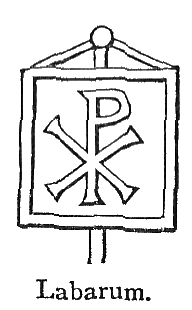
Labarum, lab′a-rum, n. a Roman military standard adopted as the imperial standard after Constantine's conversion. It bore the Greek letters XP (Chr), joined in a monogram, to signify the name of Christ: a similar ecclesiastical banner borne in processions: any moral standard or guide. [Late Gr. labaron, origin unknown. Some make bold to derive from Basque labaria, a standard.]
Labdanum. See Ladanum.
Labefaction, lab-e-fak′shun, n. a weakening decay—also Labefactā′tion.—v.t. Lab′efy, to impair. [L. labefacĕre, to shake.]
Label, lā′bel, n. a small slip of writing affixed to anything to denote its contents, ownership, &c.: (law) a paper annexed to a will, as a codicil: (her.) a fillet with pendants: (archit.) the dripstone over a Gothic window or doorway arch.—v.t. to affix a label to: to describe by or on a label:—pr.p. lā′belling; pa.t. and pa.p. lā′belled. [O. Fr. label (Fr. lambeau); perh. from Old High Ger. lappa (Ger. lappen).]
Labellum, la-bel′um, n. the lower petal of a flower, esp. an orchis. [L., dim. of labium, a lip.]
Labial, lā′bi-al, adj. pertaining to the lips: formed by the lips.—n. a sound formed by the lips: a letter representing a sound formed either by both the lips, or by the upper lip and under teeth—p, b, m, f, v.—v.t. Lā′bialise.—adv. Lā′bially.—n.pl. Labiā′tæ, a natural order of gamopetalous plants, the mint family having four-cornered stems and opposite branches.—adjs. Lā′biate, -d (bot.), having two unequal divisions, as in the monopetalous corolla of the mints.—adj. and n. Labioden′tal, of a sound pronounced both by the lips and teeth: a letter representing such (f, v.).—n. Lā′bium, a lip or lip-like part:—pl. Lā′bia. [Fr.,—L. labium, labrum, a lip.]
Labis, lā′bis, n. the cochlear or eucharistic spoon. [Late Gr. from lambanein, to take.]
Laboratory, lab′or-a-tor-i, n. a chemist's workroom: a place where scientific experiments are systematically carried on: a place for the manufacture of arms and war material: a place where anything is prepared for use. [L. laborāre—labor, work.]
Labour, lā′bur, n. toil or exertion, esp. when fatiguing: work: pains: duties: a task requiring hard work: the pangs of childbirth.—v.i. to undergo labour: to work: to take pains: to be oppressed: to move slowly: to be in travail: (naut.) to pitch and roll heavily.—adj. Labō′rious, full of labour: toilsome: wearisome: devoted to labour: industrious.—adv. Labō′riously.—n. Labō′riousness.—adj. Lā′boured, bearing marks of labour or effort in the execution.—ns. Lā′bourer, one who labours: one who does work requiring little skill; Lā′bourist, one who contends for the interests of workmen.—adjs. Lā′bour-sav′ing, intended to supersede or lessen the labour of men; Lā′boursome (Shak.), made with labour and diligence.—Labour Day, a legal holiday in some parts of the United States, as in New York (the first Monday in September); Labour market, the supply of unemployed labour in relation to the demand for it; Labour of love, work undertaken merely as an act of friendliness, and without hope of emolument; Labour with, to take pains to convince.—Hard labour, compulsory work imposed on certain criminals in addition to imprisonment. [O. Fr. labour, labeur—L. labor.]
Labradorite, lab′ra-dōr-īt, n. one of the group of the Feldspars, and a very important rock-forming mineral. [Labrador.]
Labret, lā′bret, n. a piece of bone, shell, &c. inserted into the lip by savages for ornament.—adj. Lā′brose, having thick lips.—n. Lā′brum, a lip or lip-like part:—pl. Lā′bra. [L. labrum, labium, a lip.]
Laburnum, la-bur′num, n. a small tree with large pendulous racemes of beautiful yellow flowers, a native of the Alps. [L.]
Labyrinth, lab′i-rinth, n. a place full of inextricable windings: (orig.) a building consisting of halls connected by intricate passages: an arrangement of tortuous passages in which it is difficult to find the way out: an inexplicable difficulty, a perplexity: (anat.) the cavities of the internal ear.—adjs. Labyrinth′al, Labyrinth′ian, Labyrinth′ine, pertaining to or like a labyrinth: winding: intricate: perplexing; Labyrinth′iform, having the form of a labyrinth: intricate.—n. Labyrinth′odon, a race of extinct gigantic amphibians found in the Permian, Carboniferous, and Triassic strata, so called from the mazy pattern exhibited on a transverse section of the teeth of some genera. [Fr. labyrinthe—L. labyrinthus—Gr. labyrinthos; akin to laura, a passage.]
Lac, lak, n. the term used in India for 100,000 rupees, the nominal value of which is £10,000.—Also Lakh. [Hind. lak—Sans. laksha, 100,000, a mark.]
Lac, lak, n. a dark-red transparent resin produced on the twigs of trees in the East by the lac insect, used in dyeing.—adj. Laccic (lak′sik).—ns. Laccine (lak′sin), a brittle, translucent, yellow substance, obtained from shell-lac; Lac′-dye, Lac′-lake, scarlet colouring matters obtained from Stick′-lac, the twigs, with attached resin, enclosed insects, and ova; Seed′-lac, the granular portion remaining after removing the resin, triturating with water, and drying; Shell′-lac, Shel′lac, thin plates of resin prepared by melting the seed-lac in cotton-cloth bags, straining, and allowing it to drop on to sticks or leaves. [Pers. lak—Sans. lákshá, the lac insect—rañj, to dye.]
Lace, lās, n. a plaited string for fastening: an ornamental fabric of linen, cotton, silk, or gold and silver threads, made by looping, knotting, plaiting, or twisting the thread into definite patterns, of contrasted open and close structure; three distinct varieties are made, two by handiwork, known respectively as Needle or Point lace and Pillow or Bobbin Lace, and one by machinery.—v.t. to fasten with a lace: to adorn with lace: to streak: to mark with the lash: to intermix, as coffee with brandy, &c.: to intertwine.—v.i. to be fastened with a lace.—ns. Lace′-bark tree, a lofty West Indies tree, the inner bark like coarse lace; Lace′-boot, a boot fastened by a lace.—p.adj. Laced, fastened or adorned with lace.—ns. Lace′-frame, a machine used in lace-making; Lace′-leaf (see Lattice-leaf); Lace′-man, one who deals in lace; Lace′-mend′er, one who repairs lace; Lace′-pā′per, paper stamped or cut by hand with an open-work pattern like lace; Lace′-pill′ow, a cushion on which many various kinds of lace are made, held on the knees.—adj. Lā′cy, like lace.—Alençon lace, a very fine point-lace, the most important made in France; Appliqué lace, lace having sprigs or flowers sewed on net; Balloon-net lace, a form of woven lace in which the freeing threads are peculiarly twisted about the warps; Brussels lace, an extremely fine lace with sprigs applied on a net ground; Duchesse lace, a Belgian pillow-lace having beautiful designs with cord outlines, often in relief; Guipure lace, any lace without a net ground, the pattern being held together by bars or brides; Honiton lace, a lace made at Honiton in Devonshire, remarkable for the beauty of its figures and sprigs; Imitation lace, any lace made by machinery; Mechlin lace, a lace with bobbin ground and designs outlined by thread or flat cord; Spanish lace, needle-point lace brought from Spanish convents since their dissolution—but probably of Flemish origin: cut and drawn work made in convents in Spain, of patterns usually confined to simple sprigs and flowers: a modern black-silk lace with large flower-patterns, mostly of Flemish make: a modern needle-point lace with large square designs; Tambour lace, a modern kind of lace made with needle-embroidery on machine-made net; Torchon lace, peasants' bobbin laces of loose texture and geometrical designs, much imitated by machinery; Valenciennes lace, a fine bobbin lace having the design made with the ground and of the same thread. [O. Fr. las, a noose—L. laqueus, a noose.]
Lacerate, las′ėr-āt, v.t. to tear: to rend: to wound: to afflict.—adjs. Lac′erable, that may be lacerated; Lac′erant, harrowing; Lac′erate, -d, rent, torn: (bot.) having the edges cut into irregular segments.—n. Lacerā′tion, act of lacerating: the rent made by tearing.—adj. Lac′erative, tearing: having power to tear. [L. lacerāre, -ātum, to tear—lacer, torn.]
Lacerta, la-sėr′ta, n. a genus of saurian reptiles, the name properly restricted to slender, active lizards.—n. and adj. Lacer′tian, an animal belonging to the genus Lacerta.—n. Lacertil′ia, an order of reptiles, including the lizards proper, &c.—adjs. Lacertil′ian; Lacertil′ioid; Lacer′tine. [L.]
Laches, läsh′ēz, n. (law) negligence or undue delay, such as to disentitle a person to a certain remedy, any negligence. [O. Fr. lachesse.]
Lachesis, lak′e-sis, n. the one of the three Fates who assigned to each mortal his destiny—she spun the thread of life from the distaff held by Clotho. [Gr.]
Lachrymal, Lacrymal, lak′ri-mal, adj. of or pertaining to tears, secreting tears, as in 'lachrymal duct,' the nasal duct, conveying tears from the eye to the nose.—n. one of the bones of the face, the os unguis, or nail-bone, in man.—adj. Lach′rymary, containing tears.—n. Lach′rymātory, a small slender glass vessel found in ancient sepulchres, apparently filled with the tears of mourners.—adj. Lach′rymose, Lac′rymose, shedding tears, or given to do so: lugubrious, mournful.—adv. Lach′rymosely.—Lachryma Christi, a wine of a sweet but piquant taste, produced from grapes grown on Mount Vesuvius, the best light red. [L. lacryma (properly lacrima), a tear; Gr. dakru, Eng. tear.]
Lacing, lās′ing, n. a fastening with a lace or cord through eyelet-holes: a cord used in fastening: in bookbinding, the cords by which the boards of a book are fastened to the back: in shipbuilding, the knee of the head, or lace-piece, a piece of compass or knee timber secured to the back of the figure-head: in mining, lagging, or cross-pieces of timber or iron placed to prevent ore from falling into a passage.
Lacinia, lā-sin′i-a, n. a long incision in a leaf, &c.—also a narrow lobe resulting from such: in entomology, the apex of the maxilla.—adjs. Lacin′iāte, -d, cut into narrow lobes, fringed; Lacin′iform, fringe-like; Lacin′iolāte, finely fringed. [L., a flap.]
Lack, lak, v.t. and v.i. to want: to be in want: to be destitute of: to miss.—n. want: destitution.—ns. Lack′-all, one who is destitute; Lack′-brain (Shak.), a fool.—adjs. Lack′-lin′en (Shak.), wanting linen; Lack′-lus′tre, wanting brightness.—n. a want of brightness. [From an old Low Ger. root found in Dut. lak, blemish; cf. Ice. lakr, defective.]
Lackadaisical, lak-a-dā′zi-kal, adj. affectedly pensive, sentimental.—interj. Lack′adaisy=Lack-a-day. [Alack-a-day. See Alack.]
Lack-a-day, lak-a-dā′, interj. See Alack-a-day.
Lacker. See Lacquer.
Lackey, lak′i, n. a menial attendant: a footman or footboy.—v.t. and v.i. to pay servile attendance: to act as a footman. [O. Fr. laquay (Fr. laquais)—Sp. lacayo, a lackey; perh. Ar. luka‛, servile.]
Lacmus, lak′mus, n. the same as Litmus (q.v.).
Laconic, -al, la-kon′ik, -al, adj. expressing in few words after the manner of the Laconians, Lacedæmonians, or Spartans: concise: pithy.—adv. Lacon′ically.—ns. Lac′onism, Lacon′icism, a concise style: a short, pithy phrase. [L.,—Gr.]
Lacquer, Lacker, lak′ėr, n. a varnish made of lac and alcohol.—v.t. to cover with lacquer: to varnish.—ns. Lac′querer, one who varnishes or covers with lacquer; Lac′quering, the act of varnishing with lacquer: a coat of lacquer varnish. [Fr. lacre—Port. lacre, laca—Pers. lac, lac.]
Lacrosse, la-kros′, n. a Canadian game of ball, played by two sets of eleven, the ball driven through the opponents' goal by means of the Crosse, a bent stick, 5-6 ft. long, with a shallow net at one end. [Fr.]
Lacteal, lak′te-al, adj. pertaining to or resembling milk: conveying chyle.—n. one of the absorbent vessels of the intestines which convey the chyle to the thoracic ducts.—ns. Lac′tarene, Lac′tarine, a preparation of the caseine of milk, used by calico-printers; Lac′tāte, a salt of lactic acid, and a base; Lactā′tion, the act of giving milk: the period of suckling.—adj. Lac′teous, milky, milk-like.—n. Lactesc′ence.—adjs. Lactesc′ent, turning to milk: producing milk or white juice: milky; Lac′tic, pertaining to milk; Lactif′erous, Lactif′ic, producing milk or white juice.—ns. Lac′tifuge, a medicine which checks the flow of milk; Lac′tocrite, an apparatus for testing the quantity of fatty substance in a sample of milk; Lactom′eter, an instrument for measuring the quality of milk; Lac′toscope, an instrument for testing the purity or richness of milk by its degree of translucency; Lac′tose, a kind of sugar, only moderately sweet, obtained from milk by evaporating whey—also Lac′tine; Lactuca (lak-tū′ka), a genus of herbs of the aster family, with milky juice.—adj. Lactucic (lak-tū′sik).—Lactic acid, an acid obtained from milk. [L. lacteus, milky—lac, lactis, milk; Gr. gala, galaktos, milk.]
Lacuna, la-kū′na, n. a gap or hiatus:—pl. Lacū′næ.—n. Lacū′nar, a sunken panel or coffer in a ceiling or a soffit: a ceiling containing such.—adjs. Lacū′nose, furrowed: pitted; Lacū′nous. [L. lacuna, anything hollow—lacus, a lake.]
Lacustrine, la-kus′trin, adj. pertaining to lakes.—Also Lacus′tral, Lacus′trian. [From L. lacus, a lake.]
Lad, lad, n. a boy: a youth: (Scot.) a lover:—fem. Lass.—n. Lad′die, a little lad: a boy.—Lad's love, a provincial name of the southernwood. [M. E. ladde—Ir. lath, a youth, champion (W. llawd). Mr H. Bradley suggests that M. E. ladde, a servant, coincides with the adjectival form of the past participle of the verb to lead, the original meaning thus being 'one led in the train of a lord.']
Ladanum, lad′a-num, n. a resinous exudation from the leaves of a shrub growing round the Mediterranean.—Also Lab′danum. [L.,—Gr. lēdanon—Pers. lādan. See Laudanum.]
Ladder, lad′ėr, n. a frame made with steps placed between two upright pieces, by which one may ascend a building, &c.: anything by which one ascends: a gradual rise. [A.S. hlǽder; Ger. leiter.]
Lade, lād, v.t. to burden: to throw in or out, as a fluid, with a ladle or dipper.—n. (Scot.) a load: a water-course: the mouth of a river.—n. Lad′ing, the act of loading: that which is loaded: cargo: freight. [A.S. hladan, pt. hlód, hladen, to load, to draw out water; Dut. laden; Ger. be-laden.]
Ladin, la-dēn′, n. a Romance tongue spoken in the Engadine valley in Switzerland and the upper Inn valley in Tyrol. [L. Latinus, Latin.]
Ladino, la-dē′nō, n. the old Castilian tongue: the Spanish jargon of some Turkish Jews: a Central American of mixed white and Indian blood.
Ladle, lād′l, n. a large spoon for lifting out liquid from a vessel: the float-board of a mill-wheel: an instrument for drawing the charge from a cannon.—v.t. to lift with a ladle.—ns. Lad′leful, the quantity in a ladle:—pl. Lad′lefuls.—Ladle furnace, a small gas furnace heated by a Bunsen burner, for melting metals, &c. [A.S. hlædel—hladan, to lade.]
Ladrone, la-drōn′, n. a robber. [Sp.,—L. latro.]
Lady, lā′di, n. the mistress of a house: a wife: a title of the wives of knights, and all degrees above them, and of the daughters of earls and all higher ranks: a title of complaisance to any woman of refined manners:—pl. Ladies (lā′diz).—ns. Lā′dybird, a genus of little beetles, usually brilliant red or yellow—also Lā′dybug, Lā′dycow; Lā′dy-chap′el, a chapel dedicated to 'Our Lady,' the Virgin Mary, usually behind the high altar, at the extremity of the apse; Lā′dyday, the 25th March, the day of the Annunciation of the Virgin; Lā′dyfern, one of the prettiest varieties of British ferns, common in moist woods, with bipinnate fronds sometimes two feet long; Lā′dy-fly (same as Ladybird); Lā′dyhood, condition, character of a lady.—adj. Lā′dyish, having the airs of a fine lady.—ns. Lā′dyism, affectation of the airs of a fine lady; Lā′dy-kill′er, a man who fancies his fascinations irresistible to women: a general lover.—adj. Lā′dy-like, like a lady in manners: refined: soft, delicate.—ns. Lādy-love, a lady or woman loved: a sweetheart; Lādy's-bed′straw, the plant Galium verum; Lā′dy's-bow′er, the only British species of clematis—also Traveller's joy; Lā′dy's-fing′er, a name for many plants: a piece of confectionery; Lā′dyship, the title of a lady; Lā′dy's-maid, a female attendant on a lady, esp. in matters relating to the toilet; Lādy's-man′tle, a genus of herbaceous plants having small, yellowish-green flowers; Lā′dy's-slipp′er, a genus of orchidaceous plants, remarkable for the large inflated lip of the corolla; Lā′dy's-smock, the Bitter Cress, a meadow-plant, with whitish, blush-coloured flowers.—Ladies' companion, a small bag used for carrying women's work; Ladies' man, one fond of women's society.—My ladyship, Your ladyship, a form of expression used in speaking to, or of, one who has the rank of a lady. [A.S. hláf-dige—hláf, a loaf, dǽgee, a kneader, or=hláfweardige (i.e. loaf-keeper, see ward), and thus a contr. fem. of Lord.]
Lætare, lē-tā′rē, n. the fourth Sunday in Lent, named from the first word in the service for the festival. [L. lætāre, to rejoice—lætus, joyful.]
Lag, lag, adj. slack: sluggish: coming behind.—n. he who, or that which, comes behind: the fag-end: (slang) an old convict.—v.i. to move or walk slowly: to loiter.—v.t. (slang) to commit to justice:—pr.p. lag′ging; pa.p. lagged.—adj. Lag′-bell′ied, having a drooping belly.—n. Lag′-end (Shak.), the last or long-delayed end.—adj. Lag′gard, lagging: slow: backward.—ns. Lag′gard, Lag′ger, one who lags behind: a loiterer: an idler.—adv. Lag′gingly, in a lagging manner. [Celt., as W. llag, loose, Gael. lag, feeble; cf. L. laxus, loose.]
Lagena, la-jē′na, n. a wine-vase, amphora: the terminal part of the cochlea in birds and reptiles:—pl. Lagē′næ. [L.]
Lager-beer, lä′ger-bēr, n. a kind of light beer very much used in Germany.—Also La′ger. [Ger. lagerbier—lager, a store-house, bier, beer.]
Laggen, lag′en, n. (Burns) the angle between the side and bottom of a wooden dish.
Lagomys, lā-gō′mis, n. a genus of rodents, much resembling hares or rabbits. [Gr. lagōs, a hare, mys, a mouse.]
Lagoon, Lagune, la-gōōn′, n. a shallow pond into which the sea flows. [It. laguna—L. lacuna.]
Lagophthalmia, lag-of-thal′mi-a, n. inability to close the eye.—adj. Lagophthal′mic.
Lagopus, la-gō′pus, n. a genus of grouse, the ptarmigans.—adj. Lagop′odous, having furry feet.—n. Lagos′toma, hare-lip.—adj. Lagō′tic, rabbit-eared.
Lagrimoso, lag-ri-mō′sō, adj. (mus.) plaintive. [It.]
Lagthing, läg′ting, n. the upper house of the Norwegian parliament. [Norw. lag, law, thing, parliament.]
Laic, Laical, Laicise. See Lay, adj.
Laid, lād, adj. put down, prostrate: pressed down.—Laid paper, such as shows in its fabric the marks of the close parallel wires on which the paper-pulp was laid in the process of its manufacture:—opp. to Wove-paper, that laid on woven flannels or on felts. [Pa.t. and pa.p. of Lay.]
Laidly, lād′li, adj. (prov.) loathly.
Lain, pa.p. of Lie, to rest.
Lair, lār, n. a lying-place, esp. the den or retreat of a wild beast: (Scot.) the ground for one grave in a burying-place. [A.S. leger, a couch—licgan, to lie down; Dut. leger, Ger. lager.]
Lair, lār, v.i. (Scot.) to sink in mud.—n. mire, a bog, a quagmire. [Ice. leir, mud.]
Laird, lārd, n. (Scot.) a landed proprietor, a landlord.—n. Laird′ship, an estate. [Lord.]
Laissez-faire, lās′ā-fār′, n. a letting alone, a general principle of non-interference with the free action of the individual: the let-alone principle in government, business, &c.—Also Laiss′er-faire′. [Fr. laisser—L. laxāre, to relax, faire—L. facĕre, to do.]
Laity, lā-′i-ti, n. the people as distinct from the clergy. [See Lay, adj.]
Lake, lāk, n. a pigment or colour formed by precipitating animal or vegetable colouring matters from their solutions, chiefly with alumina or oxide of tin. [Fr. laque. See Lac (2).]
Lake, lāk, n. a large body of water within land.—ns. Lake′-bā′sin, the whole area drained by a lake; Lake′-law′yer (U.S.), the bowfin: burbot; Lake′let, a little lake; Lā′ker, Lā′kist, one of the Lake school of poetry.—adj. Lā′ky, pertaining to a lake or lakes.—Lake District, the name applied to the picturesque and mountainous region within the counties of Cumberland, Westmorland, and a small portion of Lancashire, containing as many as sixteen lakes or meres; Lake dwellings, settlements in prehistoric times, built on piles driven into a lake; Lake school of poetry, a name applied to the group of illustrious poets who made the Lake District—Wordsworthshire—their home about the beginning of the 19th century. [A.S. lac—L. lacus.]
Lakh, n. See Lac, term used for 100,000.
Lakin, lā′kin, n. (Shak.) a corruption of ladykin, dim. of lady.
Lakshmi, laksh′mē, n. in Hindu mythology, the name of the consort of the god Vishnu (q.v.), considered as his female or creative energy.
Lallan, lal′an, n. the Scotch dialect. [Lowland.]
Lallation, la-lā′shon, n. lambdacism (q.v.).
Lam, lam, v.t. to beat. [Ice. lemja, to beat.]
Lama, n. an animal. [See Llama.]
Lama, lä′ma, n. a Buddhist priest in Tibet.—ns. Lä′maism, the religion prevailing in Tibet and Mongolia, being Buddhism corrupted by Sivaism, and by Shamanism or spirit-worship; Lä′maist; Lä′masery, a Tibetan monastery. [Tib.]
Lamantin, la-man′tin, n. the manatee. [Fr.]
Lamarckism, la-mär′kizm, n. the theory of the French naturalist, J. B. P. A. de Monet de Lamarck (1744-1829), that species have developed by the efforts of organisms to adapt themselves to new conditions—also Lamarck′ianism.—-adj. Lamarck′ian.
Lamb, lam, n. the young of a sheep: the flesh of the young sheep: one innocent and gentle as a lamb: the Saviour of the world.—v.i. to bring forth young, as sheep.—ns. Lamb′-ale, a feast at the time of lamb-shearing; Lamb′kin, Lamb′ling, Lamb′ie (Scot.), a little lamb.—adj. Lamb′-like, like a lamb: gentle.—ns. Lamb′skin, the skin of a lamb dressed with the wool on, for mats, &c.: the skin of a lamb dressed for gloves: a kind of woollen cloth resembling this; Lamb's′-lett′uce (same as Corn-salad); Lamb's′-wool, fine wool: a wholesome old English beverage composed of ale and the pulp of roasted apples, with sugar and spices.—The Lamb, Lamb of God, the Saviour, typified by the paschal lamb. [A.S. lamb; Ger. lamm, Dut. lam.]
Lambative, lam′ba-tiv, adj. to be taken by licking.—n. a medicine of such a kind.
Lambda, lam′da, n. the Greek letter corresponding to Roman l.—n. Lamb′dacism, a too frequent use of words containing l: a defective pronunciation of r, making it like l.—adjs. Lamb′doid, -al, shaped like the Greek capital Λ—applied in anatomy to the suture between the occipital and the two parietal bones of the skull. [Gr.,—Heb. lamedh.]
Lambent, lam′bent, adj. moving about as if touching lightly: gliding over: flickering.—n. Lam′bency, the quality of being lambent: that which is lambent. [L. lambens—lambĕre, to lick.]
Lamboys, lam′boiz, n.pl. kilted flexible steel-plates worn skirt-like from the waist. [O. Fr.]
Lambrequin, lam′bre-kin, n. a strip of cloth, leather, &c., hanging from a window, doorway, or mantelpiece, as a drapery: an ornamental covering, as of cloth, attached to a helmet. [Fr.]
Lame, lām, adj. disabled in the limbs: hobbling: unsatisfactory: imperfect.—v.t. to make lame: to cripple: to render imperfect.—n. Lame′-duck (slang), a bankrupt.—adv. Lame′ly.—n. Lame′ness.—adj. Lam′ish, a little lame: hobbling. [A.S. lama, lame; Dut. lam, Ger. lahm.]
Lamella, lä-mel′a, n. a thin plate or scale:—pl. Lamell′æ.—adjs. Lam′ellar, Lam′ellate.—n.pl. Lamellibranchiā′ta, a class of shell-fishes or molluscs in which the shell consists of two limy plates, lying one on each side of the body.—adjs. Lamellibranch′iate; Lamell′icorn.—n.pl. Lamellicor′nes, a very numerous family of beetles—the cockchafer, &c.—adjs. Lamellif′erous, producing lamellæ; Lamell′iform, lamellar in form; Lamelliros′tral, having a lamellose bill; Lam′ellose, full of lamellæ, lamellated in structure. [L.]
Lament, la-ment′, v.i. to utter grief in outcries: to wail: to mourn.—v.t. to mourn for: to deplore.—n. sorrow expressed in cries: an elegy or mournful ballad.—adj. Lam′entable, deserving or expressing sorrow: sad: pitiful, despicable.—adv. Lam′entably.—n. Lamentā′tion, act of lamenting: audible expression of grief: wailing: (pl., B.) a book of Jeremiah.—p.adj. Lament′ed, bewailed: mourned.—adv. Lament′ingly, with lamentation. [Fr. lamenter—L. lamentāri.]
Lameter, Lamiter, lā′met-ėr, n. a cripple.
Lametta, la-met′a, n. foil of gold, silver, &c. [It.]
Lamia, lā′mi-a, n. in Greek and Roman mythology, a female phantom, a serpent witch who charmed children and youths in order to suck their blood.
Lamiger, lam′i-jėr, n. (prov.) a cripple.
Lamina, lam′i-na, n. a thin plate: a thin layer or coat lying over another:—pl. Lam′inæ.—adjs. Lam′inable; Lam′inar, Lam′inary, in laminæ or thin plates: consisting of, or resembling, thin plates.—n. Laminā′ria, a genus of dark-spored seaweeds, with large expanded leathery-stalked fronds.—adjs. Lam′ināte, -d, in laminæ or thin plates: consisting of scales or layers, over one another.—ns. Laminā′tion, the arrangement of stratified rocks in thin laminæ or layers.—adjs. Laminif′erous, consisting of laminæ or layers; Lam′iniform, laminar.—n. Laminī′tis, inflammation of the laminæ of a horse's hoof. [L. lamina, a thin plate, a leaf.]
Lammas, lam′as, n. the feast of first-fruits on 1st August.—n. Lamm′as-tide, Lammas-day, 1st August. [A.S. hláf-mæsse and hlammæsse—hláf, loaf, mæsse, feast.]
Lammer, lam′ėr, n. (Scot.) amber. [Fr. l'ambre.]
Lammergeier, lam′mėr-gī-ėr, n. the great bearded vulture of the mountains of southern Europe, Asia, and northern Africa. [Ger. lämmergeier—lämmer, lambs, geier, vulture.]
Lammy, lam′i, n. a thick quilted outside jumper worn in cold weather by sailors.—Also Lamm′ie.
Lamp, lamp, n. a vessel for burning oil with a wick, and so giving light: a light of any kind.—v.i. (Spens.) to shine.—ns. Lamp′ad (rare), a lamp or candlestick, a torch; Lamp′adary, in the Greek Church, one who looks after the lamps and carries a lighted taper before the patriarch; Lampaded′romy, an ancient Greek torch-race in honour of Prometheus, &c.; Lamp′adist, one who ran in a torch-race; Lampad′omancy, the art of divining by the flame of a lamp or torch; Lamp′black, the black substance formed by the smoke of a lamp: the soot or amorphous carbon obtained by burning bodies rich in that element, such as resin, petroleum, and tar, or some of the cheap oily products obtained from it; Lamp′-burn′er, that part of a lamp in which the wick is held; Lamp′-chim′ney, Lamp′-glass, a glass funnel placed round the flame of a lamp; Lamp′-fly (Browning), a firefly.—adj. Lamp′ic, pertaining to, or derived from, a lamp or flame.—ns. Lamp′ion, a kind of small lamp; Lamp′-light, the light shed by a lamp or lamps; Lamp′-light′er, a person employed to light street-lamps: that by which a lamp is lighted, as a spill or torch; Lamp′-post, the pillar supporting a street-lamp; Lamp′-shell, a terebratuloid or related brachiopod having a shell like an antique lamp.—Smell of the lamp, to show signs of great elaboration or study. [Fr. lampe—Gr. lampas, -ados—lampein, to shine.]
Lamp, lamp, v.i. (Scot.) to run wild, to scamper: to go jauntily.
Lampas, lam′pas, n. a material of silk and wool used in upholstery. [Fr.]
Lampass, lam′pas, n. (Shak.) a swelling of the roof of the mouth in horses. [Fr. lampas.]
Lampern, lam′pėrn, n. a river lamprey.
Lampoon, lam-pōōn′, n. a personal satire in writing: low censure.—v.t. to assail with personal satire: to satirise:—pr.p. lampōōn′ing; pa.p. lampōōned′.—ns. Lampoon′er, one who writes a lampoon; Lampoon′ry, practice of lampooning: written personal abuse or satire. [O. Fr. lampon, orig. a drinking-song, with the refrain lampons=let us drink—lamper (or lapper, to lap), to drink.]
Lamprey, lam′pre, n. a genus of cartilaginous fishes resembling the eel, so called from their attaching themselves to rocks or stones by their mouths. [O. Fr. lamproie—Low L. lampreda, lampetra—L. lambĕre, to lick, petra, rock.]
Lana, lä′na, n. the tough, close-grained wood of a Guiana tree.
Lanate, -d, lā′nāt, -ed, adjs. woolly: (bot.) covered with a substance resembling wool.—n. Lā′nary, a wool-store. [L. lanatus—lana, wool.]
Lancasterian, lang-kas-tē′ri-an, adj. pertaining to Joseph Lancaster (1778-1838), or the method of teaching younger pupils by those more advanced (monitors) in primary schools.
Lancastrian, lang-kas′tri-an, adj. pertaining to the dukes or the royal house of Lancaster.—n. an adherent of the house of Lancaster, as against the Yorkists, in the Wars of the Roses (1455-85).
Lance, lans, n. (Spens.) balance, poise. [L. lanx, lancis, a dish or scale.]
Lance, lans, n. a long shaft of wood, with a spear-head, and bearing a small flag: the bearer of a lance.—v.t. to pierce with a lance: to open with a lancet.—ns. Lance′-cor′poral, a private soldier doing the duties of a corporal; Lance′let (see Amphioxus); Lan′cer, a light cavalry soldier armed with a lance: (pl.) a popular set of quadrilles, first in England about 1820: the music for such; Lance′-wood, a wood valuable for its strength and elasticity, brought chiefly from Jamaica, Guiana, &c.—adjs. Lancif′erous, bearing a lance; Lan′ciform, lance-shaped. [Fr.,—L. lancea; Gr. longchē, a lance.]
Lancegay, lans′gā, n. (obs.) a kind of spear. [O. Fr.,—lance, a lance, zagaye, a pike. See Assagai.]
Lanceolate, -d, lan′se-o-lāt, -ed, adjs. (bot.) having the form of a lance-head: tapering toward both ends—also Lan′ceolar.—adv. Lan′ceolately. [L. lanceolatus—lanceola, dim. of lancea.]
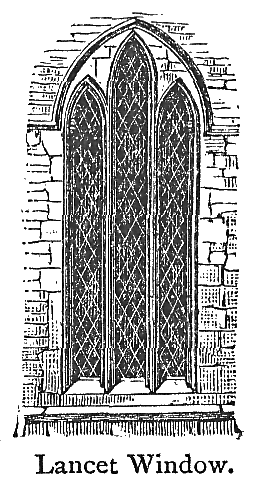
Lancet, lan′set, n. a surgical instrument used for opening veins, abscesses, &c.: a high and narrow window, terminating in an arch acutely pointed, often double or triple, common in the first half of the 13th century. [O. Fr. lancette, dim. of lance.]
Lanch. Same as Launch.
Lancinate, lan′sin-āt, v.t. to lacerate.—n. Lancinā′tion, sharp, shooting pain. [L. lancināre, -ātum, to tear.]
Land, land, n. earth, the solid portion of the surface of the globe: a country: a district: soil: real estate: a nation or people: (Scot.) a group of dwellings or tenements under one roof and having a common entry.—v.t. to set on land or on shore.—v.i. to come on land or on shore.—ns. Land′-ā′gent, a person employed by the owner of an estate to let farms, collect rents, &c.; Land′-breeze, a breeze setting from the land towards the sea; Land′-crab, a family of crabs which live much or chiefly on land.—v.t. Land′damn (Shak.), to banish from the land.—adj. Land′ed, possessing land or estates: consisting in land or real estate.—ns. Land′er, one who lands; Land′fall, a landslip: an approach to land after a voyage, also the land so approached; Land′-fish (Shak.), a fish on land, any one acting contrary to his usual character; Land′-flood, a flooding or overflowing of land by water: inundation; Land′force, a military force serving on land, as distinguished from a naval force; Land′-grab′ber, one who acquires land by harsh and grasping means: one who is eager to occupy land from which others have been evicted; Land′-grab′bing, the act of the land-grabber; Land′-herd, a herd of animals which feed on land; Land′-hold′er, a holder or proprietor of land; Land′-hung′er, greed for the acquisition of land; Land′ing, act of going on land from a vessel: a place for getting on shore: the level part of a staircase between the flights of steps.—adj. relating to the unloading of a vessel's cargo.—ns. Land′ing-net, a kind of scoop-net for landing a fish that has been caught; Land′ing-place, a place for landing, as from a vessel; Land′ing-stage, a platform for landing passengers or goods carried by water, often rising and falling with the tide; Land′-job′ber, a speculator in land; Land′-job′bing; Land′lady, a woman who has property in land or houses: the mistress of an inn or lodging-house.—adj. Land′less (Shak.), without land or property.—v.t. Land′lock, to enclose by land.—-adj. Land′-locked, almost shut in by land, protected by surrounding masses of land from the force of wind and waves.—ns. Land′lord, the owner of land or houses: the master of an inn or lodging-house; Land′lordism, the authority or united action of the landholding class; Land′-lubb′er, a landsman (a term used by sailors); Land′mark, anything serving to mark the boundaries of land: any object on land that serves as a guide to seamen: any distinguishing characteristic; Land′-meas′ure, a system of square measure used in the measurement of land; Land′-meas′uring, the art of estimating the superficial content of portions of land; Land′-own′er, one who owns land; Land′-own′ership.—adj. Land′-own′ing.—ns. Land′-pī′lot, (Milt.), a guide on land; Land′-pī′rate, a highway robber: a fellow who makes a practice of swindling sailors in port; Land′rail, the crake or corncrake, so named from its cry; Land′-rak′er (Shak.), a vagabond; Land′-reeve, the assistant to the land-steward of a great estate; Land′-roll, a clod-crusher; Land′-scrip (U.S.), negotiable government certificate entitling to possession of certain public land by individuals or corporate bodies; Land′-shark, a land-grabber: one who plunders sailors on shore; Land′skip (same as Landscape); Land′slide, Land′slip, a portion of land that falls down, generally from the side of a hill, usually due to the undermining effect of water; Lands′man, Land′man, one who lives or serves on land: one inexperienced in seafaring; Land′-spring, water lying near the surface, easily drawn upon by shallow wells; Land′-stew′ard, a person who manages a landed estate; Land′-survey′ing (see Surveying); Land′-tax, a tax upon land; Land′-turn, a land-breeze; Land′-wait′er, a custom-house officer who attends on the landing of goods from ships.—adv. Land′ward, toward the land.—adj. lying toward the land, away from the sea-coast: situated in or forming part of the country, as opposed to the town: rural.—n. Land′wind, a wind blowing off the land.—Land League, an association founded in Ireland by Michael Davitt in 1879, and organised by C. S. Parnell, to procure reduction and rearrangement of rents, and to promote the substitution of peasant-proprietors for landlords—condemned as an illegal conspiracy in 1881; Landed interest, the combined interest of the land-holding class in a community.—Make the land, to discover the land as the ship approaches it; Set the land, to observe by the compass how the shore bears from the ship. [A.S. land; Dut., Ger. land.]
Landamman, lan′dam-man, n. the president of the Swiss Diet: the head official in some Swiss cantons.
Landau, lan′daw, n. a coach or carriage with a top which may be opened and thrown back. [Ger. landauer, from Landau.]
Lande, land, n. an uncultivated healthy plain, esp. a sandy track along the sea-shore in south-western France. [Fr.]
Landgrave, land′grāv, n. a German graf, count, or earl:—fem. Landgravine (land′gra-vēn).—n. Landgrā′viāte, the territory of a landgrave. [Dut. landgraaf—land, land, graaf, count.]
Land-louper, land′-lowp′ėr, n. a vagabond or vagrant.—Also Land′-lop′er. [Dut. landloopen—land, land, loopen, to ramble; cf. Ger. landläufer.]
Landscape, land′-skāp, n. the appearance of that portion of land which the eye can at once view; the aspect of a country, or a picture representing it.—ns. Land′scape-gar′dening, the art of laying out grounds and so disposing water, buildings, trees, and other plants as to produce the effect of a picturesque landscape; Land′scape-paint′er, one who practises this form of art; Land′scape-paint′ing, the art of representing natural scenery by painting. [Dut. landschap, from land and -schap, a suffix=-ship.]
Landsthing, läns′ting, n. the upper house of the Danish Rigsdag or parliament. [Dan., land, land, thing, parliament.]
Landsturm, lant′stōōrm, n. in Germany and Switzerland, a general levy in time of national emergency—in the former including all males between seventeen and forty-five: the force so called out. [Ger., land, land, sturm, alarm.]
Landtag, lant′tahh, n. the legislative assembly of one of the states forming the modern German empire, as Saxony, Bavaria, &c.: the provincial assembly of Bohemia or Moravia. [Ger., land, country, tag, diet, day.]
Landwehr, länt′vār, n. a military force in Germany and Austria forming an army reserve. [Ger., land, land, wehr, defence.]
Lane, lān, n. an open space between corn-fields, hedges, &c.: a narrow passage or road: a narrow street: a fixed route kept by a line of vessels across the ocean.—A blind lane, a cul-de-sac. [A.S. lane; Scot, loan, lonnin.]
Lane, lān, a Scotch form of lone, alone,
Lang, a Scotch form of long.—n. Lang′syne, time long past.—Think lang, to weary.
Langaha, lan-gä′hä, n. a Madagascar wood-snake, with a flexible scaly extension on the snout.
Langet, lang′get, n. a strong lace used in women's dress in Holland.
Langshan, lang′shan, n. a small black Chinese hen.
Langspiel, lang′spēl, n. a Shetland form of harp.
Language, lang′gwāj, n. that which is spoken by the tongue: human speech: speech peculiar to a nation: style or expression peculiar to an individual: diction: any manner of expressing thought.—v.t. to express in language.—adjs. Lang′uaged, skilled in language; Lang′uageless (Shak.), speechless, silent; Lang′ued (her.), furnished with a tongue.—Dead language, one no longer spoken, as opp. to Living language, one still spoken; Flash language (see Flash). [Fr. langage—langue—L. lingua (old form dingua), the tongue, akin to L. lingēre, Gr. leichein.]
Langue d'oc, long dok, n. collective name for the Romance dialects spoken in the Middle Ages from the Alps to the Pyrenees—the tongue of the troubadours, often used as synonymous with Provençal, one of its chief branches. The name itself survived in the province Languedoc, giving name to a class of wines.—Langue d'oui (long dwē), also Langue d'oil, the Romance dialect of northern France, the language of the trouvères, the dominant factor in the formation of modern French. [O. Fr. langue—L. lingua, tongue; de, of; Prov. oc, yes—L. hoc, this; O. Fr. oui, oïl, yes—L. hoc illud, this (is) that, yes.]
Languette, lang′get, n. a 16th-century hood worn by women: the tongue of a reed of a harmonium or reed-organ: a key of a wind-instrument. [Fr.]
Languid, lang′gwid, adj. slack or feeble: flagging: exhausted: sluggish: spiritless.—adj. Languesc′ent, growing languid.—adv. Lang′uidly.—n. Lang′uidness. [Fr.,—L. languidus—languēre, to be weak.]
Languish, lang′gwish, v.i. to become languid or enfeebled: to lose strength and animation: to pine: to become dull, as of trade.—n. (Shak.) languishment.—adjs. Lang′uished, sunken in languor; Lang′uishing, expressive of languor, or merely sentimental emotion.—adv. Lang′uishingly.—n. Lang′uishment, the act or state of languishing: tenderness of look. [Fr. languir, languiss-,—L. languescĕre—languēre, to be faint.]
Languor, lang′gwur, n. state of being languid or faint: dullness: listlessness: softness.—adj. Lang′uorous, full of languor: tedious: melancholy.—v.t. Lang′ure (Spens.), to languish.
Laniard. Same as Lanyard.
Laniary, lā′ni-a-ri, n. a place of slaughter: shambles.—adj. fitted for lacerating or tearing. [L. laniarium—lanius, a butcher.]
Laniferous, lan-if′ėr-us, adj. wool-bearing.—Also Lanig′erous. [L. lanifer, laniger—lana, wool, ferre, gerĕre, to bear.]
Lank, langk, adj. languid or drooping: soft or loose: thin: shrunken: straight and flat.—v.i. (Shak.) to become lank.—adv. Lank′ly.—n. Lank′ness.—adj. Lank′y, lank and tall. [A.S. hlanc; Dut. slank, Ger. schlank, slender.]
Lanner, lan′ėr, n. a kind of falcon.—n. Lann′aret, the male bird. [Fr. lanier—L. laniarius.]
Lanolin, lan′ō-lin, n. an unctuous substance, a mixture of the ethers of cholesterin with fatty acids, used as a basis for ointments, extracted from wool. [L. lana, wool, oleum, oil.]
Lansquenet, lans′ke-net, n. a 16th-17th cent. mercenary pikeman: a game at cards. [Fr.,—Ger. landsknecht—land, country, knecht, a soldier.]
Lant, lant, n. stale urine, used in wool-scouring.
Lanterloo, lant′ėr-lōō, n. a game at cards, commonly Loo. [Dut. lanterlu.]
Lantern, lant′ėrn, n. a case for holding or carrying a light, the light chamber of a lighthouse: an ornamental structure surmounting a dome to give light and to crown the fabric: the upper square cage which illuminates a corridor or gallery—obs. form, Lant′horn, from the use of horn for the sides of lanterns.—v.t. to furnish with a lantern.—n. Lant′ern-fly, any insect of family Fulgoridæ, supposed to emit a strong light in the dark.—adj. Lant′ern-jawed, thin-faced.—n.pl. Lant′ern-jaws, thin long jaws.—Lantern of the dead, a tower having a small lighted chamber at the top, once common in French cemeteries; Lantern wheel, a kind of cog-wheel, in which a circle of bars or spindles between two heads engages with the cogs of a spur-wheel.—Chinese lantern, a collapsible paper lantern, generally decorated with flowers; Dark lantern, a lantern having an opaque slide, capable of being partly or wholly shut at pleasure; Magic lantern, an optical instrument by means of which magnified images of small pictures are thrown upon a wall or screen. [Fr. lanterne—L. lanterna—Gr. lamptēr—lampein, to give light.]
Lanthanum, lan′tha-num, n. a metal discovered in 1839 in cerite, a hydrated silicate of cerium.—Also Lan′thānium. [Gr. lanthanein, to conceal.]
Lanuginous, la-nū′jin-us, adj. downy: covered with fine soft hair.—n. Lanū′go. [Fr.,—L. lanuginosus—lanugo, down, lana, wool.]
Lanx, lanks, n. a platter or dish for serving meat at a Roman table:—pl. Lan′ces. [L.]
Lanyard, Laniard, lan′yard, n. a short rope used on board ship for fastening or stretching, or for convenience in handling articles. [Fr. lanière, perh. from L. lanarius, made of wool—lana, wool.]
Laocoön, lā-ok′-o-on, n. a famous antique group in marble in the Vatican, representing the Trojan priest Laocoön and his two sons being crushed in the folds of two enormous serpents.
Laodicean, lā-od-i-sē′an, adj. lukewarm in religion, like the Christians of Laodicea (Rev. iii. 14-16).—n. Laodicē′anism, lukewarmness in religion.
Lap, lap, v.t. to lick up with the tongue: to wash or flow against.—v.i. to drink by licking up a liquid: to make a sound of such a kind:—pr.p. lap′ping; pa.t. and pa.p. lapped.—n. a motion or sound like lapping. [A.S. lapian; Low Ger. lappen; L. lambĕre, Gr. laptein.]
Lap, lap, n. the loose or overhanging flap of anything: the part of a substance extending over or partly over the rear of another, or the extent of such extension: the part of the clothes lying on the knees when a person sits down: the part of the body thus covered, esp. with reference to nursing, &c.: a fold: a course or round of the track, as in foot-racing, &c.: at euchre, &c., a carrying over to the next game of a surplus of points from the last: the space over which a steam-engine slide-valve travels after the closing of the steam-passage to or from the cylinder: a rotating disc of lead, copper, leather, &c., charged with an abrasive powder, used in cutting gems, &c.—v.t. to lay over or on.—v.i. to be spread on or over: to be turned over or upon.—ns. Lap′-board, a flat wide board resting on the lap, used by tailors and seamstresses; Lap′-dog, a small dog fondled in the lap: a pet dog; Lap′ful, as much as fills a lap.—adj. Lap′-joint′ed, having joints formed by overlapping edges.—ns. Lap′-stone, a stone which shoemakers hold in the lap to hammer leather on; Lap′-streak, a clinker-built boat—also adj.; Lap′work, work containing lap-joints. [A.S. læppa, a loosely hanging part; Ice. lapa, to hang loose, Ger. lappen, a rag.]
Lap, lap, v.t. to wrap, fold, involve.—ns. Lap′per, one who wraps or folds: in cotton manufacturing, a machine which compacts the scutched cotton into a fleece upon the surface of a roller called a lap-roller; Lap′ping, the process of forming a lap or fleece of fibrous material for the carding-machine: the rubbing or polishing of a metal surface: the process of rubbing away the lands, or metal between the grooves of a rifled gun, to increase the bore. [M. E. wlappen, being a form of wrap.]
Lapel, Lappel, Lapelle, la-pel′, n. the part of the breast of a coat which laps over and is folded back.—adj. Lapelled′. [Dim. of lap.]
Lapidary, lap′i-dar-i, adj. pertaining to stones and the cutting of stones: pertaining to inscriptions and monuments.—n. a cutter of stones, esp. precious stones: a dealer in precious stones—also Lapidā′rian, Lap′idarist, Lap′idist.—v.t. Lap′idate (rare), to pelt with stones.—n. Lapidā′tion, punishment by stoning.—adj. Lapid′eous, stony.—n. Lapidesc′ence.—adj. Lapidesc′ent, becoming stone: petrifying.—adj. Lapidif′ic.—n. Lapidificā′tion.—v.t. Lapid′ify, to make into stone.—v.i. to turn into stone:—pr.p. lapid′ifying; pa.p. lapid′ified.—adj. Lapil′liform, having the form of small stones.—ns. Lapil′lus, a fragment of lava ejected from a volcano:—pl. Lapil′li; Lā′pis, a kind of calico-printing with indigo, the resists acting as methods for other dyes, as madder or quercitron; Lā′pis-laz′uli, a mineral of beautiful ultramarine colour, used largely in ornamental and mosaic work, and for sumptuous altars and shrines.—Lapis-lazuli blue, a deep blue, sometimes veined with gold, used in decoration, and in the manufacture of Sèvres and Oriental porcelain; Lapis-lazuli ware, the name given by Josiah Wedgwood to a particular pebble ware veined with gold upon blue. [L. lapidarius—lapis, lapidis, a stone.]
Lapp, lap, n. a Laplander.—n. Lap′lander, a native or inhabitant of Lapland.—adjs. Lap′landish; Lapp′ish.—n. the language of the Lapps.
Lapper-milk, lap′ėr-milk, n. (Scot.) loppered or curdled milk. [Same word as lopper (obs.)—M. E. loper, curdled, prob. conn. with A.S. hléapan, to leap, run. Cf. rennet, runnet, from run.]
Lappet, lap′et, n. a little lap or flap.—adj. Lapp′eted.—n. Lapp′et-head, a head-dress made with lappets for lace pendants. [Dim. of lap.]
Lapse, laps, v.i. to slip or glide: to pass by degrees: to fall from the faith or from virtue: to fail in duty: to pass to another proprietor, &c., by the negligence of a patron, to become void: to lose certain privileges by neglect of the necessary conditions.—n. a slipping or falling: a failing in duty: a fault.—adj. Lap′sable.—The lapsed, the name applied in the early Christian Church to those who, overcome by heathen persecution, fell away from the faith. [L. labi, lapsus, to slip or fall, lapsus, a fall, akin to lap.]
Laputan, la-pū′tan, adj. pertaining to Laputa, a flying island described in Swift's Gulliver's Travels as inhabited by all sorts of ridiculous projectors: absurd: chimerical.
Lapwing, lap′wing, n. the name of a bird of the plover family, also called peewit, from its peculiar cry. [M. E. lappewinke—A.S. hleápewince—hleápan, to leap or run, and root of wink, to turn.]
Lar, lär, n. one of a class of local deities, originally Etruscan, but in Roman usage usually regarded as the tutelary deities of a house:—pl. Lares (lā′rēz). [L.]
Lar, lär, n. an Etruscan title, really peculiar to the eldest son, but often mistaken for an integral part of the name.—Also Lars. [L.,—Etruscan larth, lord.]
Larboard, lär′bōrd (by sailors, lab′erd), n. an obsolete naval term for the left side of a ship looking from the stern, now, by command of the Admiralty, replaced by the term port, to prevent the mistakes caused by its resemblance in sound to starboard.—adj. pertaining to the port or left side. [Perh. for a conjectural lade-bord, the lading-side—lade, a load, bord, board, side.]
Larceny, lär′sen-i, n. the legal term in England and Ireland for stealing: theft.—n. Lar′cenist, one who commits larceny: a thief.—adj. Lar′cenous.—adv. Lar′cenously.—Grand larceny, in England, larceny of property of the value of one shilling or more; Petty larceny, larceny of property less in value than one shilling; Simple larceny, as opposed to Compound larceny, is larceny uncombined with aggravating circumstances. [O. Fr. larrecin (Fr. larcin)—L. latrocinium—latro, a robber.]
Larch, lärch, n. a genus (Larix) of coniferous trees, distinct from firs (Abies), with perfectly erect and regularly tapering stem, small branches, numerous small leaves deciduous and clustered, growing rapidly, and yielding good timber. [L.,—Gr. larix.]
Lard, lärd, n. the melted fat of the hog.—v.t. to smear with lard: to stuff with bacon or pork: to fatten: to mix with anything.—adj. Lardā′ceous.—ns. Lard′-oil, a lubricating and illuminating oil expressed from lard; Lar′don, Lar′doon, a strip of bacon used for larding.—adj. Lar′dy. [O. Fr.,—L. laridum, lardum; cf. Gr. larinos, fat, laros, sweet.]
Larder, lärd′ėr, n. a room or place where meat, &c., is kept: stock of provisions.—n. Lard′erer, one who has charge of a larder. [O. Fr. lardier, a bacon-tub—L. lardum.]
Lare, lār, n. obsolete form of lore, and of lair.
Large, larj, adj. great in size: extensive: bulky: wide: long: abundant: liberal: diffuse: (Shak., of language) free, licentious.—adv. (naut.) before the wind.—adjs. Large′-ā′cred, possessing much land; Large′-hand′ed, having large hands: grasping, greedy: profuse; Large′-heart′ed, having a large heart or liberal disposition: generous.—adv. Large′ly.—adj. Large′-mind′ed, characterised by breadth of view.—ns. Large′ness; Lar′get, a length of iron cut from a bar and of proper size to roll into a sheet.—At large, without restraint or confinement: fully: as a whole, altogether. [Fr.,—L. largus.]
Largess, Largesse, lärj′es, n. a present or donation: (arch.) liberality.—n. Largit′ion, giving of largess. [Fr.,—L. largitio—largīri, to give freely—largus.]
Largo, lär′gō, adj. (mus.) slow in time.—n. a movement to be performed in such style.—adj. Larghet′to, somewhat slow: not so slow as largo.—n. a movement in somewhat slow time.—adj. Larghis′simo, extremely slow. [It.,—L. largus.]
Lariat, lär′i-at, n. a rope for picketing horses while grazing: a lasso. [Sp. la reata—la, the, reata, a rope for tying animals together.]
Lark, lärk, n. a well-known singing-bird.—v.i. to catch larks.—ns. Lark's′-heel, the Indian cress; Lark′spur, a plant with showy flowers, so called from the spur-shaped formation of calyx and petals. [M. E. laverock—A.S. láwerce; Ger. lerche.]
Lark, lärk, n. a game, frolic.—v.i. to frolic, make sport.—adj. Lar′ky (coll.), frolicsome, sportive. [A.S. lác, play—lácan, to swing, wave, play.]
Larmier, lar′mi-ėr, n. (archit.) another name for the corona (q.v.): a horizontal string-course for preventing rain from trickling down the wall: (zool.) a tear-bag. [Fr. larme, a tear—L. lacrima, a tear.]
Larrikin, lar′i-kin, adj. (Australian) rowdy, disorderly.—n. a rough or rowdy.—n. Larr′ikinism.
Larrup, lar′up, v.t. (coll.) to flog, thrash. [Prob. from Dut. larpen, thresh with flails.]
Larry, lar′i, n. Same as Lorry.
Larum, lar′um, n. alarm: a noise giving notice of danger.—v.t. (obs.) to alarm. [Alarm.]
Larus, lā′rus, n. a genus of Laridæ, the gulls proper.
Larva, lär′va, n. an insect in its first stage after issuing from the egg—i.e. in the caterpillar state: a ghost, spectre:—pl. Larvæ (lär′vē).—adjs. Lar′val; Lar′vate, -d, clothed as with a mask; Lar′viform; Larvip′arous, producing young in a larva-form. [L. larva, a spectre, a mask.]
Larynx, lār′ingks, n. the upper part of the windpipe: the throat:—pl. Lar′ynges, Lar′ynxes (rare).—adjs. Laryn′geal, Laryn′gean.—n. Laryngis′mus, spasm of the glottis.—adj. Laryngit′ic.—n. Laryngī′tis, inflammation of the larynx.—adj. Laryngolog′ical.—ns. Laryngol′ogist; Laryngol′ogy, the science of the larynx; Laryngoph′ony, the sound of the voice as heard through the stethoscope applied over the larynx; Laryng′oscope, a mirror for examining the larynx and trachea.—adj. Laryngoscop′ic.—ns. Laryngos′copist; Laryngos′copy; Laryngot′omy, the operation of cutting into the windpipe to remove obstructions and assist respiration; Laryngotracheot′omy, the operation of cutting into the windpipe through the cricoid cartilage, the cricothyroid membrane, and the upper rings of the trachea. [L.,—Gr. larynx, laryngos.]
Lascar, las′kar, n. a native East Indian sailor or camp-follower. [Hind.,—Pers. lashkari, a soldier.]
Lascivious, las-siv′i-us, adj. lustful: tending to produce lustful emotions.—adv. Lasciv′iously.—n. Lasciv′iousness. [L. lascivus; perh. from the same root as laxus, loose.]
Laser, lā′ser, n. a gum-resin from North Africa, esteemed by the ancients as a deobstruent and diuretic. [L. laser, juice of laserpitium.]
Laserpitium, las-er-pish′i-um, n. a genus of perennial herbs of the parsley family—Las′erwort or herb frankincense.—Also Silphium. [L. laserpicium, a plant yielding laser.]
Lash, lash, n. a thong or cord: the flexible part of a whip: a stroke with a whip or anything pliant: a stroke of satire, a sharp retort: a beating or dashing: an eyelash.—v.t. to strike with a lash: to dash against: to fasten or secure with a rope or cord: to censure severely: to scourge with sarcasm or satire.—v.i. to use the whip.—n. Lash′er, one who lashes or whips: a rope for binding one thing to another; Lash′ing, act of whipping: a rope for making things fast: a great plenty of anything—esp. in pl.—Lash out, to kick out, as a horse: to break out recklessly. [M. E. lasshe; Dut. lasch, Ger. lasche, a joint.]
Lash, lash, adj. (obs.) slow, slack: soft: insipid.—n. Lash′er, the slack water collected above a weir in a river. [M. E. lasche, slack—O. Fr. lasche (Fr. lâche, cowardly)—L. laxus, lax.]
Lasket, las′ket, n. a loop of line at the foot of a sail, to which to fasten an extra sail.
Lass, las, n. (fem. of Lad) a girl, esp. a country girl: a sweetheart: (Scot.) a maid-servant.—(Diminutives) Lass′ie, Lass′ock.—adj. Lass′lorn (Shak.), forsaken by one's mistress. [Prob. a contr. of laddess, formed from lad; or directly from W. llodes, fem. of llawd, a lad. Mr H. Bradley thinks the association with lad merely accidental, the word first appearing about 1300 in northern writings as lasce, evidently representing a Scand. laskw, the fem. of an adj. meaning unmarried; cf. Middle Sw. lösk kona, unmarried woman.]
Lassitude, las′i-tūd, n. faintness: weakness: weariness: languor. [Fr.,—L. lassitudo—lassus, faint.]
Lasso, las′ō, n. a long rope with a running noose for catching wild horses, &c.:—pl. Lass′os, Lass′oes.—v.t. to catch with the lasso:—pr.p. lass′ōing; pa.p. lass′ōed. [Port. laço, Sp. lazo—L. laqueus, a noose.]
Last, last, n. a wooden mould of the foot on which boots and shoes are made.—v.t. to fit with a last.—n. Last′er, one who fits the parts of shoes to lasts: a tool for doing so. [A.S. lást, a trace.]