LIST OF ABBREVIATIONS USED IN THIS DICTIONARY. (continued 21)
Reading edition
Moonshee, mōōn′shē, n. in India, a secretary, interpreter, teacher of languages. [Ar. munshi.]
Moop, mōōp, v.i. (Scot.) to nibble, browse.
Moor, mōōr, n. a large tract of untilled ground, often covered with heath, and having a poor, peaty soil: a heath.—ns. Moor′cock, Moor′fowl, the red grouse or heathcock found in moors; Moor′hen, the female moor-fowl: the water-hen; Moor′-ill (Scot.), a kind of disease among cattle—also Red-water.—adjs. Moor′ish, Moor′y, resembling a moor: sterile: marshy: boggy.—n. Moor′land, a tract of moor. [A.S. mór; Ice. mór, peat.]
Moor, mōōr, v.t. to fasten a ship by cable and anchor: to fix firmly.—v.i. to be fastened by cables or chains.—ns. Moor′age, a place for mooring; Moor′ing, act of mooring: that which serves to moor or confine a ship: in pl. the place or condition of a ship thus moored. [Prob. Dut. marren, to tie, allied to A.S. merran (in compound ámierran), Old High Ger. marrjan, to hinder.]
Moor, mōōr, n. a member of the dark mixed Mauretanian and Arab race inhabiting Morocco and the Barbary coast: one of the Arab and Berber conquerors and occupants of Spain from 711 to 1492—same as Arab or Saracen: a dark-coloured person generally, a negro.—n. Moor′ery, a quarter inhabited by Moors.—adj. Moor′ish. [Fr. more, maure—L. maurus—Gr. mauros, black.]
Moorva, mōōr′va, n. an East Indian silky fibre for cordage.—Also Marool, Bowstring-hemp.
Moose, mōōs, n. the largest deer of America, resembling the European elk. [Algonkin musu.]
Moot, mōōt, v.t. to propose for discussion: to discuss: argue for practice.—adj. discussed or debated.—n. in early English history, the meeting of the assembled freemen, or their representatives, to regulate the affairs of the village or tun, the hundred, or the kingdom—village- or town-moot, hundred-moot, folk-moot.—adj. Moot′able, that can be mooted or debated.—ns. Moot′-case, Moot′-point, a case, point, or question to be mooted or debated: an unsettled question; Moot′-court, -hall, a meeting or court for arguing supposed cases; Moot′-hill, a hill of meeting on which the moot was held. [A.S. mótian—mót, gemót, an assembly, akin to métan, to meet.]
Mop, mop, n. a bunch of rags, &c., fixed, on a handle for washing floors, windows, or the like: anything at all like a mop: (prov.) a hiring-fair.—v.t. to rub or wipe with a mop:—pr.p. mop′ping; pa.t. and pa.p. mopped.—adj. Mop′-head′ed, having a shaggy, unkempt head of hair. [O. Fr. mappe—L. mappa, a napkin.]
Mop, mop, n. a grimace.—v.i. to make such.
Mope, mōp, v.i. to be silent and dispirited: to be dull or stupid.—v.t. to make spiritless.—n. a listless person, a drone—also Mop′us.—adv. Mop′ingly.—adj. Mop′ish, dull: spiritless.—adv. Mop′ishly, in a mopish manner.—n. Mop′ishness. [Dut. moppen, to pout, sulk; Ger. muffen.]
Moppet, mop′et, n. a doll of rags: a young girl—also Mop′sy, an untidy woman.—adj. Mop′sical, short-sighted: stupid.
Moppy, mop′i, adj. (slang) tipsy.
Mops, mops, n. a pug-dog.
Mopstick, mop′stik, n. in an old pianoforte movement, a rod which raises the damper as the key is depressed.—Also Map′stick.
Mopus, mop′us, n. (slang) money.
Moquette, mō-ket′, n. a material for carpets, with a loose velvety pile—the back thick canvas, &c. [Fr.]
Mora, mō′ra, n. (law) delay, esp. unjustifiable. [L.]
Mora, mō′ra, n. an ancient game played from China to Peru, the aim being to guess the number of fingers held out by a player. [It.]
Moraine, mo-rān′, n. a continuous line of rocks and gravel along the edges of glaciers.—adj. Morain′ic. [Fr.—Ger. (Bavarian) mur.]
Moral, mor′al, adj. of or belonging to the manners or conduct of men: conformed to right, ethical, virtuous: capable of knowing right and wrong: subject to the moral law: instructing with regard to morals: supported by evidence of reason or probability—opp. to Demonstrative: belonging to the mind, or to the will: (Shak.) moralising.—n. in pl. manners: the doctrine or practice of the duties of life: moral philosophy or ethics: conduct, esp. sexual conduct: in sing. the practical lesson given by anything: an emblem or allegory: (slang) a certainty, an exact counterpart.—v.i. to moralise.—ns. Mor′aler (Shak.), a moraliser; Moralisā′tion, act of moralising, explanation in a moral sense.—v.t. Mor′alise, to apply to a moral purpose: to explain in a moral sense.—v.i. to speak or write on moral subjects: to make moral reflections.—ns. Mor′aliser; Mor′alism, a moral maxim; moral counsel: morality as distinct from religion; Mor′alist, one who teaches morals, or who practises moral duties: a merely moral as distinguished from a religious man: one who prides himself on his morality.—adj. Moralist′ic.—n. Moral′ity, quality of being moral: that in an action which renders it right or wrong: the practice of moral duties apart from religion: virtue: the doctrine which treats of actions as being right or wrong: ethics: a kind of drama which grew out of mysteries and miracle-plays, and continued in fashion till Elizabeth's time, in which allegorical representations of the virtues and vices were introduced as dramatis personæ.—adv. Mor′ally, in a moral manner: uprightly: to all intents and purposes, practically.—Moral agent, one who acts under a knowledge of right and wrong; Moral certainty, a likelihood so great as to be safely acted on, although not capable of being certainly proved; Moral defeat (see Moral victory); Moral faculty (see Moral sense); Moral law, a law or rules for life and conduct, founded on what is right and wrong: the law of conscience; Moral philosophy, the science which treats of the qualities of actions as being right or wrong, and the duty of mankind with regard to such actions; Moral sense, that power of the mind which knows or judges actions to be right or wrong, and determines conduct accordingly; Moral theology, ethics treated with reference to a divine source; Moral victory, a defeat in appearance, but in some important sense a real victory. [Fr.,—L. moralis—mos, moris, custom.]
Morale, mo-räl′, n. the state of a person's morals: mental state as regards spirit and confidence, esp. of a body of soldiers, &c. [Fr.]
Morass, mo-ras′, n. a tract of soft, wet ground: a marsh.—adj. Morass′y.—Morass ore, bog-iron ore. [Dut. moeras, a marsh.]
Morat, mō′rat, n. a drink made of honey and mulberry juice. [It. morato—moro—L. morum.]
Moratorium, mo-ra-tō′ri-um, n. an emergency act allowing a government bank to suspend payments in specie for a given time.
Moravian, mo-rā′vi-an, adj. pertaining to Moravia or the Moravians.—n. one of a Christian denomination entitled Unitas Fratrum of United Brethren, a small body of Protestants of extraordinary missionary energy, founded in the 15th century.—n. Morā′vianism, the doctrines of the Moravians.
Moray, mō′rā, n. an apodal eel-like fish of the Muræna family.—Also Ma′ray, Mu′ray, Mur′ry.
Morbid, mor′bid, adj. diseased, sickly: not healthful.—n. Morbid′ity, the quality of being morbid: disease: the ratio of sickness in a community.—adv. Mor′bidly.—n. Morbidness, sickliness.—adjs. Morbif′eral, Morbif′erous; Morbif′ic, causing disease.—n. Morbil′lī, measles.—adjs. Morbil′liform, like measles; Morbil′lous, pertaining to measles; Morbose′, proceeding from disease: morbid: not healthy.—n. Mor′bus, disease. [Fr.,—L. morbidus—morbus, disease.]
Morbidezza, mor-bi-det′za, n. that quality of flesh-painting which gives the impression of life. [It.]
Morceau, mor′sō, n. a small bit: a dainty morsel:—pl. Mor′ceaux (-sōz). [Fr.]
Mordacious, mor-dā′shus, adj. given to biting: biting: (fig.) sarcastic: severe.—adv. Mordā′ciously.—n. Mordac′ity, quality of being mordacious: biting severity.—adj. Mor′dant, biting, sarcastic, severe: serving to fix colours.—n. any substance, as alum, used to give permanency or brilliancy to dyes: a glutinous size as a ground for gilding, matter to make gold-leaf adhere: any corrosive liquid by which the biting in etching is effected.—v.t. to treat with a mordant.—adv. Mor′dantly.—ns. Mor′dicancy, Mordicā′tion. [Fr.,—L. mordax, mordacis—mordēre, to bite.]
Mordent, mor′dent, n. a kind of trill in music, or the character indicating it. [It. mordente.]
More, mōr, adj. (serves as comp. of Many and Much) additional: other besides: greater (so in B.).—adv. to a greater degree: again: longer.—n. a greater thing: something further or in addition:—superl. Most (mōst).—adj. Mō′rish. insufficient: such that one wants more.—More and more, continually increasing; More by token, in proof of this, besides; More or less, about: in round numbers.—Any more, something additional: further; Be no more, to have died; No more, nothing in addition. [Including both M.E. mo, more in number—A.S. má, more in number, and M. E. more, larger—A.S. mára, greater.]
More, mōr, n. (Spens.) a root. [A.S. moru, more, a carrot; Ger. möhre.]
More, mō′re, adv. after the manner of. [L., abl. of mos, a custom.]
Moreen, mo-rēn′, n. a stout woollen or cotton and woollen stuff, used for petticoats, curtains, &c. [Fr. moire, mohair.]
Morel, mor′el, or mō-rel′, n. any edible mushroom of the genus Morchella. [Fr. morille; prob. Old High Ger. morhela (Ger. morchel), a mushroom.]
Morello, mō-rel′o, n. a dark-red variety of cherry, much used in cooking and for cherry brandy.—Also Mor′el, or Morel′. [It.,—Low L. morellus, blackish—L. maurus, a blackamoor, or perh. for morulus, blackish—morum, a mulberry.]
Moreover, mōr-ō′vėr, adv. more over or beyond what has been said: further: besides: also.
Moresque, mo-resk′, adj. done after the manner of the Moors.—n. a kind of ornamentation, same as arabesque—(obs.) Mores′co. [Fr.,—It. moresco.]
Morgana (Fata). See Fata.
Morganatic, mor-gan-at′ik, adj. noting a marriage of a man with a woman of inferior rank, in which neither the latter nor her children enjoy the rank or inherit the possessions of her husband, though the children are legitimate—also Left-handed marriage.—adv. Morganat′ically. [Low L. morganatica, a gift from a bridegroom to his bride—Teut.; cf. Ger. morgengabe, A.S. morgengifu, a morning gift.]
Morgay, mor′gā, n. the small spotted dogfish or bounce.
Morglay, mor′glā, n. a claymore—esp. that of the Arthurian hero Sir Bevis.
Morgue, morg, n. a place where bodies found dead are laid out for identification. [Fr.]
Morgue, morg, n. hauteur. [Fr.]
Morian, mō′ri-an, n. a Moor—also Mur′rian (Pr. Bk.)
Moribund, mo′ri-bund, adj. about to die: in a dying state. [L. moribundus—mori, to die.]
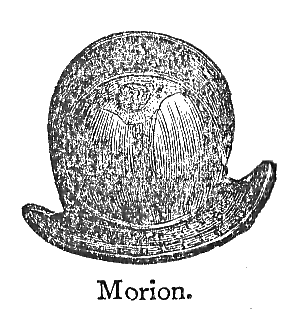
Morion, Morrion, mō′ri-un, n. a open helmet without visor or beaver. [Fr., prob. from Sp. morrion—morra, crown of the head. Diez suggests Basque murua, a hill.]
Morisco, mo-ris′ko, n. the Moorish language: a Moorish dance or dancer: Moorish architecture: one of the Moors who remained in Spain after the fall of Granada in 1492.—adj. Moorish—(obs.) Morisk′.
Morisonian, mor-i-sō′ni-an, n. a member of the Evangelical Union, formed in 1843 by the Rev. James Morison (1816-93), after his separation from the United Secession Church.—n. Morisō′nianism, the religious views of Morison and others—essentially a reaction from the Calvinistic doctrine of the Westminster Confession on predestination and unconditional election and reprobation.
Morkin, mor′kin, n. a beast that has died by accident.
Morling, mor′ling, n. a sheep dead of disease or its wool.
Morlop, mor′lop, n. a New South Wales jasper.
Mormo, mor′mō, n. a genus of noctuoid moths: a bugbear.
Mormon, mor′mon, n. one of a religious sect in Utah, U.S., openly polygamous till 1890, calling itself 'The Church of Jesus Christ of Latter-day Saints,' founded in 1830 by Joseph Smith, whose supplement to the Bible, the Book of Mormon, was given out as translated from the golden plates of one 'Mormon,' but was really adapted from a MS. romance written about 1811 by Solomon Spaulding.—ns. Mor′monism; Mor′monite, Mor′monist.
Mormops, mor′mops, n. a genus of American phyllostomine bats, so called from their repulsive physiognomy. [Gr. mormō, a bugbear, ōps, face.]
Morn, morn, n. the first part of the day: morning.—The morn (Scot.), to-morrow; The morn's morning, to-morrow morning. [M. E. morwen—A.S. morgen; Ger. morgen.]
Morne, mōrn, n. the blunt head of a jousting-lance: a small, rounded hill.—adjs. Morné (mōr-nā′), denoting a lion rampant without teeth or claws; Morned (her.), blunted. [Fr.]
Morning, morn′ing, n. the first part of the day: the early part of anything: the first dram of the day.—adj. pertaining to the morning: taking place or being in the morning.—ns. Morn′ing-dress, dress such as is usually worn in the morning, as opposed to Evening-dress; Morn′ing-gift, a gift made by the husband to the wife on the morning after marriage; Morning-gown, a gown for wearing in the morning; Morn′ing-land, the east; Morn′ing-room, a woman's morning boudoir or sitting-room in English country houses; Morn′ing-sick′ness, nausea and vomiting in the morning, common in the early stages of pregnancy; Morn′ing-star, any of the planets, esp. Venus, when it rises before the sun: a kind of flail with a star-like ball of metal at the end of a chain, formerly used as a weapon of war; Morn′ing-tide, the morning time: early part; Morn′ing-watch, the watch between 4 and 8 A.M. [Contr. of morwen-ing. Cf. Morn.]
Morocco, mo-rok′ō, n. a fine goat-skin leather, tanned with sumac, first brought from Morocco, afterwards from the Levant and elsewhere: a sheep-skin leather in imitation of this: a very strong ale, anciently brewed in Cumberland.—adj. consisting of Morocco.—French morocco, an inferior kind of Levant morocco, with small grain; Levant morocco, a fine quality of morocco, with large grain; Persian morocco, a morocco finished on the grain side.
Morology, mō-rol′o-ji, n. foolish talk. [Gr., mōros, a fool, logia—legein, to speak.]
Morose, mō-rōs′, adj. of a sour temper: gloomy: severe.—adv. Morose′ly.—ns. Morose′ness, quality of being morose—(obs.) Moros′ity. [L. morosus, peevish—mos, moris, manner.]
Morpheus, mor′fūs, n. a god of dreams: sleep.—adjs. Morphē′an, Morphet′ic. [L.]
Morphia, mor′fi-a, n. the chief narcotic principle of opium: a drug which causes sleep or deadens pain—also Mor′phine.—ns. Mor′phinism; Morphiomā′nia; Morphiomā′niac. [Coined from Gr. Morpheus, god of dreams—morphē, shape.]
Morphic, mor′fik, adj. relating to form, morphological.—n. Morphogen′esis, the production of morphological characters.—adj. Morphogenet′ic.—ns. Morphog′eny, the genesis of form: morphology; Morphog′rapher; Morphog′raphy, descriptive morphology.—adjs. Morpholog′ic, -al.—ns. Morphol′ogist, one who is versed in, or who writes upon, morphology; Morphol′ogy, the science of organic form, of the development of the forms of living organisms; Morphon′omy, the laws of morphology; Morphō′sis, morphogenesis.—adj. Morphot′ic. [Gr. morphē, form.]
Morrhua, mor′ōō-a, n. the chief genus of gadoid fishes, including the cod (Gadus).
Morris, Morrice, mor′is, Morr′is-dance, n. a Moorish dance: a dance in which bells, rattles, tambours, &c. are introduced.—v.i. Morr′is, to perform by dancing.—ns. Morr′is-danc′er; Morr′is-pike (Shak.), a Moorish pike.—Nine men's morris, an old English game in which a figure of squares, one within another, was marked out on aboard or on the turf, and eighteen pieces or stones, nine for each side, were moved alternately as at draughts—also Nine men's merils. [Sp. morisco, Moorish—Sp. moro, a Moor.]
Morrow, mor′ō, n. the day following the present: to-morrow: the next following day: the time immediately after any event.—n. To-morr′ow, next day—also adv. [M. E. morwe=morwen; cf. Morn.]
Morse, mors, n. the walrus or sea-horse. [Russ. morjŭ, a morse, prob. from more, the sea.]
Morse, mors, n. the metal fastening of the cope, generally of precious metal, ornamented with jewels—also Pectoral. [L. morsus, a bite.]
Morse, mors, n. (coll.) the Morse-code signalling of telegraph operators, from Sam. F. B. Morse (1791-1872).—Morse alphabet, a system of symbols to be used in telegraphic messages where Morse's indicator is used, consisting of dots and dashes combined in different ways to indicate the different letters.
Morsel, mor′sel, n. a bite or mouthful: a small piece of food: a small quantity of anything which is divided.—ns. Mor′sūre, the act of biting; Mor′sus, a bite. [O. Fr. morsel (Fr. morceau, It. morsello), dim. from L. morsus—mordēre, morsum, to bite.]
Morsing-horn, mor′sing-horn, n. the small horn that used to hold the fine powder used for priming. [Fr. amorcer, to prime a gun.]
Mort, mort, n. death: a flourish sounded at the death of a buck, & c., in hunting.
Mort, mort, n. a great number or amount of anything.
Mort, mort, n. (slang) a woman.
Mortal, mor′tal, adj. liable to die: causing death: deadly: fatal: punishable with death: involving the penalty of spiritual death, as opposed to Venial: extreme, violent, implacable: human: (coll.) very great, very long, confounded, very drunk.—n. a human being.—v.t. Mor′talise, to make mortal.—n. Mortal′ity, condition of being mortal: death: frequency or number of deaths, esp. in proportion to population: the human race.—adv. Mor′tally—(coll.) Mor′tal.—ns. Mort′-cloth, a pall; Mort′-stone, a stone by the wayside on which the bearers lay the bier for a rest during a funeral procession.—Bills of mortality, lists of the numbers of those who have died in any place during any given time; Law of mortality, rules founded on experience or calculation, showing what average proportion of those living at the beginning of a given time will be surviving at its close. [Fr.,—L. mortalis—mori, to die.]
Mortar, mor′tar, n. a vessel in which substances are pounded with a pestle: a short and very thick piece of artillery of large calibre, firing a heavy shell at a fixed angle of 45° or thereabouts, so as to strike vertically: a cement of lime, sand, and water, used to bind together stones or bricks in building.—v.t. to close up or in as with mortar: to pound in a mortar.—n. Mor′tar-board, a square board with a handle beneath for holding mortar which the workman is using: a square-crowned academic cap. [A.S. mortere—L. mortarium, a mortar.]
Mortgage, mor′gāj, n. a conditional conveyance of or lien upon land or other property as security for the performance of some condition, as the payment of money, becoming void on the performance of the condition: the act of conveying, or the deed effecting it.—v.t. to pledge as security for a debt.—ns. Mortgagee′, one to whom a mortgage is made or given; Mort′gager. [O. Fr., mort, dead, gage, a pledge.]
Mortier, mor′tye, n. a cap of state worn by legal functionaries in France.
Mortiferous, mor-tif′ėr-us, adj. death-bringing: fatal. [L. mors, death, ferre, to bring.]
Mortify, mor′ti-fī, v.t. to destroy the vital functions of: to subdue by severities and penance: to vex: to humble: (Scots law) to dispose of by mortification.—v.i. to lose vitality, to gangrene: to be subdued:—pa.t. and pa.p. mor′tified.—ns. Mortificā′tion, act of mortifying or state of being mortified: the death of one part of an animal body: a bringing under of the passions and appetites by a severe or strict manner of living: humiliation: vexation: that which mortifies or vexes: (Scots law) a bequest to some charitable institution; Mor′tifiedness, subjugation of the passions; Mor′tifier, one who mortifies.—adj. Mor′tifying, tending to mortify or humble: humiliating: vexing. [Fr.,—Low L. mortificāre, to cause death to—mors death, facĕre, to make.]
Mortise, mor′tis, n. a cavity cut into a piece of timber to receive the tenon, a projection on another piece made to fit it: stability, power of adhesion—also Mor′tice.—v.t. to cut a mortise in: to join by a mortise and tenon. [Fr. mortaise; ety. unknown.]
Mortmain, mort′mān, n. the transfer of property to a corporation, which is said to be a dead hand, or one that can never part with it again.—Statutes of mortmain, acts of parliament restricting or forbidding the giving of property to religious houses. [Fr. mort, dead, main—L. manus, the hand.]
Mortuary, mort′ū-ar-i, n. adj. belonging to the burial of the dead.—n. a burial-place, place for the temporary reception of the dead: a gift claimed by the minister of a parish on the death of a parishioner. [Low L.,—L. mortuus, dead, mori, to die.]
Morula, mor′ū-la, n. condition of an ovum after complete segmentation: button-scurvy.
Morus, mō′rus, n. a genus of trees or shrubs of the nettle family—the mulberries. [L.]
Mosaic, mö-zā′ik, n. a kind of work in which designs are formed by small pieces of coloured marble, glass, &c. cemented on a ground of stucco, or inlaid upon metal.—adj. relating to, or composed of, mosaic.—adv. Mosā′ically.—n. Mosā′icist.—Mosaic gold, an alloy of copper and zinc—also Ormolu. [Fr.,—L. musæum or musivum (opus), mosaic (work)—Gr. mouseios—Mousa, a muse.]
Mosaic, mō-zā′ik, adj. pertaining to Moses, the great Jewish lawgiver.—n. Mō′saism.—Mosaic Law, the law of the Jews given by Moses at Mount Sinai.
Mosausaurus, mō-sa-saw′rus, n. the typical genus of a group of huge fossil marine reptiles, found in the Cretaceous strata of Europe and America. [L. Mosa, the river Meuse, Gr. sauros, a lizard.]
Moschatel, mos′ka-tel, n. a plant with pale-green flowers and a musky smell. [Fr. moscatelline—Low L. moschatellina—muscus, musk.]
Moschiferous, mos-kif′e-rus, adj. producing musk.
Mose, mōz, n. (Shak.) a disease of horses.—v.i. to have this. [Prob. Old High Ger. māsā, a spot.]
Moselle, mo-zel′, n. light wines from the district of the river Moselle, with an aromatic flavour.
Mosey, mō′zi, v.i. (Amer. slang) to go off quickly: to hurry up.
Moslem, moz′lem, n. a Mussulman or Mohammedan.—adj. of or belonging to the Mohammedans.—n. Mos′lemism. [Ar. muslim, pl. muslimīn—salama, to submit (to God). Doublet Mussulman.]
Moslings, moz′lingz, n.pl. the thin shavings taken off by the currier in dressing skins. [Morsel.]
Mosque, mosk, n. a Mohammedan place of worship. [Fr.,—Sp. mezquita—Ar. masjid—sajada, to pray.]
Mosquito, mos-kē′to, n. a biting gnat, common in tropical countries:—pl. Mosqui′toes.—Mosquito canopy, curtain, net, an arrangement of netting set over a bed, in a window, &c., to keep out mosquitoes. [Sp., dim. of mosca, a fly—L. musca.]
Moss, mos, n. a family of flowerless plants with branching stems and narrow, simple leaves: popularly any small cryptogamic plant, esp. a lichen: a piece of ground covered with moss: a bog.—v.t. to cover with moss.—ns. Moss′-back, an old fish: a person of antiquated views; Moss′-cheep′er (Scot.), the titlark.—adj. Moss′-grown, covered with moss.—ns. Moss′-hag (Scot.), a pit or slough in a bog; Moss′iness; Moss′-land, land abounding in peat-bogs; Moss′-rose, a variety of rose having a moss-like growth on and below the calyx; Moss′troop′er, one of the robbers that used to infest the mosses of the Border.—adj. Moss′y, overgrown or abounding with moss.—Iceland moss (see Iceland). [A.S. meós; Dut. mos, Ger. moos.]
Moss-bunker, mos′-bung-kėr, n. the menhaden. [Dut. mars-banker, the scad or horse-mackerel.]
Most, mōst, adj. (superl. of More), greatest in age, position or rank, number, degree, &c.—adv. in the highest degree.—n. the greatest number or quantity.—advs. Most′ly; Most′what (Spens.), for the most part, mostly.—At (the) most, to the utmost extent; For the most part, chiefly; Make the most of (see Make). [A.S. mǽst; cog. with Ger. meist.]
Mot, mō, n. a pithy or witty saying.—Mot d'ordre, word of command. [Fr.]
Mot, mot, n. a note on the bugle, &c., or its mark in musical notation. [Fr.,—L. muttum, a murmur.]
Motatorious, mō-ta-tō′ri-us, adj. vibratory, excessively mobile—of long-legged spiders and crane-flies, &c. [L. motāre, -ātum to keep moving, freq. of movēre, to move.]
Mote, mōt, n. an archaism for might or must.
Mote, mōt, n. a particle of dust: a speck: a stain or blemish: anything very small.—adjs. Mōt′ed, Mot′ty, containing motes. [A.S. mot; Dut. mot.]
Motet, mo-tet′, n. a sacred cantata of several unconnected movements, as a solo, trio, chorus, fugue, &c.: a choral composition having a biblical or similar prose text.—n. Motet′tist, a composer of such. [Fr.,—It. mottetto—motto, saying.]
Moth., moth, n. a family of insects like butterflies, seen mostly at night: the larva of this insect which gnaws cloth: that which eats away gradually and silently.—v.t. Moth′-eat, to prey upon, as a moth eats a garment.—adj. Moth′-eat′en, eaten or cut by moths.—n. Moth′-hunt′er, a little kind of swallow which hunts moths, &c., called also the Goatsucker.—adj. Moth′y, full of moths.—Death's-head moth, (see Death). [A.S. moþþe, mohþe; Ger. motte.]
Mother, muth′ėr, n. a female parent, esp. one of the human race: a woman in relation to her child: a matron: that which has produced anything: the female head of a religious house: a familiar term of address to an old woman.—adj. received by birth, as it were from one's mother: natural: acting the part of a mother: originating.—v.t. to adopt as a son or daughter.—ns. Moth′er-church, the church from which others have sprung; Moth′er-coun′try, -land, the country of one's birth: the country from which a colony has gone out; Moth′erhood, state of being a mother; Moth′ering, a rural English custom of visiting one's parents on Mid-Lent Sunday; Moth′er-in-law, the mother of one's husband or wife.—adj. Moth′erless, without a mother.—n. Moth′erliness.—adj. Moth′erly, pertaining to, or becoming, a mother: like a mother: parental: tender.—ns. Moth′er-of-pearl′, the nacreous internal layer of the shells of several molluscs, esp. of the pearl-oyster, so called because producing the pearl; Moth′er's-mark, a birth-mark; Moth′er-tongue, a person's native language: a language from which another has its origin; Moth′er-wa′ter, the residual liquid remaining after the chemical substances it contained have been crystallised or precipitated; Moth′er-wit, native wit: common-sense; Moth′er-wort, a labiate plant growing in waste places; Queen′-moth′er, the mother of a reigning sovereign.—Mother Carey's chicken, the stormy petrel, or other bird of the same family; Mother-Hubbard, a woman's loose flowing gown, like that proper to the nursery heroine.—Every mother's son, all, without exception. [A.S. móder; Dut. moeder, Ice. móðir, Ger. mutter, Ir. and Gael. mathair, L. mater, Gr. mētēr, Sans, mátá, mátri.]
Mother, muthėr, n. dregs or sediments, as of vinegar.—v.i. to become concreted.—adj. Moth′ery. [Mud.]
Motif, mō-tēf′, n. an old form of motive: a theme or ground for intellectual action, or a leading subject in a dramatic work: in a musical composition the principal subject on which the movement is constructed. [Fr.,—L. motus, moved.]
Motion, mō′shun, n. the act or state of moving: a single movement: change of posture: gait: power of moving or of being moved: angular velocity—direct when from west to east; retrograde when from east to west: excitement of the mind: any natural impulse, instigation: proposal made, esp. in an assembly: an application to a court, during a case before it, for an order or rule that something be done, esp. something incidental to the progress of the cause rather than its issue: evacuation of the intestine: (pl., B.) impulses.—v.i. to make a significant movement, to offer a proposal.—v.t. to guide by a gesture, &c.: to move.—adj. Mō′tile, capable of spontaneous motion.—n. Motil′ity.—adj. Mo′tional, characterised by motions.—n. Mō′tionist, one who makes a motion.—adj. Mō′tionless, without motion.—Absolute motion, change of absolute place; Accelerated motion, motion of which the velocity is continually increasing; Angular motion, motion regarded as measured by the increase of the angle made with some standard direction by a line drawn from the moving object to a fixed point; Laws of motion, Newton's three laws: (1) Every body continues in its state of rest, or of uniform motion in a straight line, except so far as it may be compelled by force to change that state; (2) Change of motion is proportional to force applied, and takes place in the direction of the straight line in which the force acts; (3) To every action there is always an equal and contrary reaction; Parallel motion (see Parallel); Perpetual motion (see Perpetual); Quantity of motion, momentum. [Fr.,—L.,—movēre, mōtum, to move.]
Motive, mō′tiv, adj. causing motion: having power to cause motion.—n. that which moves or excites to action: inducement: reason.—v.t. to act on as a motive, instigate.—v.t. Mō′tivāte, to act on as a motive, induce.—n. Motivā′tion.—adj. Mōtiveless.—ns. Mō′tivelessness; Mō′tive-power, or -force, the force acting upon a body so as to cause it to move; Motiv′ity, power of producing motion: the quality of being influenced by motion. [Fr., through Low L., from movēre, mōtum to move.]
Motley, mot′li, adj. covered with spots of different colours: consisting of different colours: composed of various parts, heterogeneous.—n. clothes made of pieces of different colours: the dress of a jester: any mixture, esp. of colours.—adj. Mot′ley-mind′ed (Shak.), having fickle and foolish thoughts and feelings.—Man of motley, a jester. [Skeat explains M. E. mottelee as through O. Fr. mattelé, clotted, curdled—Bavarian matte, curds.]
Motmot, mot′mot, n. a sawbill.
Motograph, mō′to-graf, n. a device of Edison's, used as a telephone receiver, &c., by which the variation of the friction between two conductors in relative motion is diminished periodically by the passage of a current of electricity from one to the other across the surface of contact.—adj. Motograph′ic. [L. motus, motion, Gr. graphein, to write.]
Motophone, mō′to-fōn, n. a sound-engine of Edison's actuated by aerial sound-waves. [L. motus, motion, Gr. phōnē, a voice.]
Motor, mō′tor, n. a mover: that which gives motion: a machine by means of which steam or other sources of force can be used to give motion or produce work.—adj. giving or transmitting motion.—ns. Mō′tor-car, a vehicle for the road impelled by steam, electricity, or petrol (petroleum spirit); Mō′tor-dy′namo, a dynamo used as a motor.—adjs. Motō′rial, Mō′tory, giving motion.—n. Motō′rium, that part of the nervous organism instrumental in the exertion of motor influence:—opp. to Sensorium, that which feels or perceives.—adj. Motorpath′ic, belonging to Motor′pathy or the movement cure.—Motor nerve, any nerve which transmits impulse to the muscles.—Air-motor, a machine impelled by compressed air. [Cf. Motive.]
Mottle, mot′l, v.t. to mark with spots as if stained.—n. the arrangement of spots on any mottled surface, in marble, &c.—adjs. Mott′led, marked with spots of various colours or shades; Mott′le-faced.—n. Mott′ling. [Motley.]
Motto, mot′ō, n. a short sentence or phrase prefixed in anything intimating the subject of it: a phrase attached to a coat-of-arms: a paper packet containing a sweetmeat, cracker, &c., together with a scrap of paper bearing a motto—a motto-kiss:—pl. Mottoes (mot′ōz).—adj. Mott′oed. [Low L. muttum—muttīre, to mutter.]
Moucharaby, mōō-shar′a-bi, n. a balcony enclosed with lattice-work: an embattled balcony with parapet and machicolations. [Fr.]
Mouchard, mōō-shär′, n. a police spy in France. [Mouche, a fly.]
Moucher, mow′chėr, n. one who idles about, a loafer, a beggar—same as Micher.—v.i. Mouch, to skulk or sneak about; to live a vagabond life. [O. Fr. muchier (Fr. musser), to hide.]
Mouchoir, mōō-shwor′, n. a pocket-handkerchief. [Fr.]
Moufflon, mōōf′lon, n. a wild sheep in the mountains of Corsica, Greece, &c. [Fr.]
Mought, mowt (Bacon), obsolete pa.t. of may.
Mouille, mōōl-lyā′, adj. sounded in a liquid manner, as certain consonants in many French words. [Fr.]
Mould, mōld, n. dust: soil rich in decayed matter: the matter of which anything is composed: a minute fungus which grows on bodies in a damp atmosphere, so named from often growing on mould: the earth, the ground, the grave, esp. in pl. Mools (Scot.).—v.t. to cover with mould or soil: to cause to become mouldy.—v.i. to become mouldy.—n. Mould′-board, the curved plate in a plough which turns over the furrow.—v.i. Mould′er, to crumble to mould: to turn to dust: to waste away gradually.—v.t. to turn to dust.—ns. Mould′iness; Mould′warp, the mole, which casts up little heaps of mould.—adj. Mould′y, overgrown with mould. [A.S. molde; Ger. mull, Goth. mulda.]
Mould, mōld, n. a hollow form in which anything is cast: a pattern; the form received from a mould, a former or matrix for jellies, &c., also a dish shaped in such: character.—v.t. to form in a mould: to knead, as dough.—adj. Mould′able, that may be moulded.—ns. Mould′-box, a box in which molten steel is hydraulically compressed; Mould′er; Mould′-fac′ing, a fine powder or wash applied to the face of a mould to ensure a smooth casting; Mould′ing, the process of shaping, esp. any soft substance: anything formed by or in a mould: an ornamental edging on a picture-frame, &c., or (archit.) raised above or sunk below the surface of a wall, on cornices, jambs, lintels, &c.—the fillet or list, astragal or bead, ogee, cyma, &c.; Moulding-tā′ble, a table on which a potter moulds his ware; Mould′-loft, a large room in a shipbuilding yard in which the several parts of a ship's hull are laid off to full size from the construction drawings.—Moulding machine, a machine for making wood-mouldings; Moulding plane, a plane used in forming mouldings, a match-plane; Moulding sand, a mixture of sand and loam used by founders in making sand-moulds. [Fr. moule—L. modulus, a measure.]
Moulin, mōō-lang′, n. a cavity formed in a glacier by the running down of surface water, sometimes allowing a cascade to be formed. [Fr.]
Moulinage, mōō′lināj, n. the operation of reeling-off, twisting, and doubling raw silk.
Moulinet, mōō′li-net, n. the drum of a windlass, &c., on which the rope is wound: a machine for bending a crossbow. [Fr., 'a little mill.']
Moult, mōlt, v.i. to change or cast the feathers, &c., as birds, &c.—n. Moult′ing, the act or process of moulting or casting feathers, skin, &c. [L. mutāre, to change, with intrusive l.]
Mound, mownd, n. an artificial mount: a natural hillock, appearing as if thrown up by man's work: (fort.) a bank of earth or stone raised as a protection.—v.t. to fortify with a mound.—n.pl. Mound′-birds, a family of Australasian gallinaceous birds which build large mounds as incubators for their eggs.—n. Mound′-build′er, one of the primitive race which built the vast so-called Indian mounds found in the United States, esp. east of the Mississippi River. [A.S. mund, a defence; cf. Old High Ger. munt, defence, and perh. L. mons, a mount.]
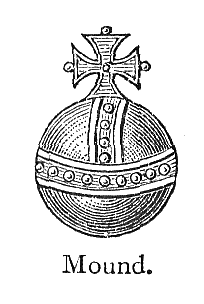
Mound, mownd, n. (her.) the representation of a globe encircled with bands, and surmounted by a cross.—Also Monde. [Fr. monde—L. mundus, the world.]
Mount, mownt, n. ground rising above the level of the surrounding country: a hill: an ornamental mound: that on which anything is mounted for more convenient use or exhibition: a saddle-horse for riding: a step, &c., to give aid in mounting a horse, also a signal for mounting: (her.) a green hillock in the base of a shield: (fort.) a cavalier or raised hillock commanding the surrounding country: one of the seven fleshy cushions in the palm of the hand: (B.) a bulwark for offence or defence.—v.i. to project or rise up: to be of great elevation.—v.t. to raise aloft: to climb: to get upon, as a horse: to put on horseback: to put upon something: to arrange or set in fitting order.—adjs. Mount′able, that may be mounted or ascended; Mount′ed, raised, esp. set on horseback: (her.) raised on steps, generally three, as a cross: furnished, supplied.—ns. Mount′er; Mount′ing, the act of rising or getting higher: the act of mounting or embellishing, as the setting of a gem, &c.: that which mounts; Mount′ing-block, a block or stone to enable one to mount a horse.—Mount guard (see Guard). [A.S. munt—L. mons, montis, a mountain.]
Mountain, mownt′ān, or -′in, n. a high hill: anything very large: a wine made from mountain grapes: the extreme party in the French Revolution (see Montagnard).—adj. of or relating to a mountain: growing or dwelling on a mountain.—ns. Mount′ain-ash, the rowan-tree, with bunches of red berries, common on mountains; Mount′ain-blue, blue carbonate of copper; Mount′ain-bram′ble, the cloudberry; Mount′ain-cat, a catamount, a wild-cat; Mount′ain-chain, a number of mountains connected together in one line; Mount′ain-cork, Mount′ain-leath′er, a very light and whitish variety of asbestos; Mount′ain-deer, the chamois; Mount′ain-dew, whisky.—adj. Mount′ained.—ns. Mountaineer′, an inhabitant of a mountain: a climber of mountains: a rustic; Mountaineer′ing, the practice of climbing mountains; Mount′ain-flax, a fibrous asbestos; Mount′ain-lime′stone (geol.), a series of limestone strata separating the Old Red Sandstone from the coal-measures; Mount′ain-līon, the cougar; Mount′ain-milk, a spongy carbonate of lime.—adj. Mount′ainous, full of mountains: large as a mountain: huge.—ns. Mount′ain-rice, an awnless rice grown without irrigation on the Himalayas, &c.; Mount′ain-sheep, the bighorn of the Rocky Mountains; Mount′ain-soap, a greasy clay-like mineral, a kind of halloysite—also Rock-soap; Mount′ain-tall′ow, a mineral substance, called also Hatchettite; Mount′ain-tea, the American evergreen, Gaultheria procumbens.—Old man of the mountain, a popular name for the chief of the 11th century Hashshāshīn (see Assassin). [O. Fr. montaine—Low L. montana, a mountain—L. montanus—mons, montis.]
Mountant, mownt′ant, adj. (Shak.) rising on high. [Fr. montant, pr.p. of monter, to mount.]
Mountebank, mown′te-bangk, n. a quack-doctor who boasts of his skill and his medicines: a boastful pretender.—adj. pertaining to such, sham.—v.t. to cheat by false pretences, to humbug.—v.i. to play the mountebank.—ns. Moun′tebankery, Moun′tebanking, Moun′tebankism. [It. montambanco—montare, to mount, in, on, banco, a bench.]
Mourn, mōrn, v.i. to grieve: to be sorrowful: to wear mourning.—v.t. to grieve for: to utter in a sorrowful manner.—n. Mourn′er, one who mourns, one who attends a funeral in mourning-dress, esp. one of those related to the deceased.—adj. Mourn′ful, mourning: causing or expressing sorrow: feeling grief.—adv. Mourn′fully.—n. Mourn′fulness.—adj. Mourn′ing, grieving: lamenting.—n. the act of expressing grief: the dress of mourners, or other tokens of mourning.—ns. Mourn′ing-bride, the sweet scabious; Mourn′ing-cloak, an undertaker's cloak, formerly worn at a funeral; Mourn′ing-coach, a closed carriage for carrying mourners to a funeral; Mourn′ing-dove, the common American turtle-dove.—adv. Mourn′ingly.—ns. Mourn′ing-piece, a picture intended to be a memorial of the dead; Mourn′ing-ring, a ring worn in memorial of a dead person; Mourn′ing-stuff, a lustreless black dress fabric, as crape, cashmere, &c., for making mourning clothes. [A.S. murnan, meornan; Old High Ger. mornēn, to grieve.]
Mouse, mows, n. a little rodent animal found in houses and in the fields:—pl. Mice (mīs): one of various animals like the mouse, the flitter-mouse, shrew-mouse: part of a hind-leg of beef, next the round—also Mouse′-butt′ock and Mouse′-piece: a match for firing a cannon or mine: a small cushion for a woman's hair: (slang) a black eye, or discoloured swelling: a term of endearment.—v.t. and v.i. (mowz), to hunt for mice: to pursue slyly: to prowl: to tear as a cat tears a mouse: (naut.) to pass a turn or two of rope yarn round the point of a tackle-hook to prevent its unhooking.—ns. Mouse′-ear, a name of several plants with soft leaves shaped like a mouse's ear; Mouse′-hole, a hole for mice: a small hole or opening; Mouse′-hunt (Shak.), a mouser; Mouse′kin, Mous′ie, a young mouse; Mous′er, a catcher of mice; Mous′ery, a resort of mice; Mouse′-sight, myopia; Mouse′tail, a small plant with a spike of seed-vessels very like the tail of a mouse; Mouse′-trap, a trap for catching mice; Mous′ing, act of catching mice.—adj. given to catching mice.—adj. Mous′y, like a mouse in colour or smell: abounding with mice. [A.S. mús, pl. mýs; Ger. maus, L. and Gr. mus.]
Mousquetaire, mōōs-ke-tār′, n. a musketeer: a woman's cloak trimmed with ribbons, with large buttons, fashionable about 1855: a broad turnover linen collar worn a few years earlier.—Mousquetaire glove, a woman's glove, long-armed, loose at top, without slit lengthwise. [Fr.]
Mousseline, mōō-se-lēn′, n. fine French muslin: a very thin glass for claret-glasses.—n. Mousseline′-de-laine, an untwilled woollen cloth, in many colours and varied patterns. [Fr.]
Moustache, Mustache, mus-tash′, n. the hair upon the upper lip of men: a soldier—also Mustach′io.—n. Moustache′-cup, a cup for drinking tea, &c., having the top partly covered to keep the moustache from being wet.—adjs. Moustached′, Mustach′ioed. [Fr. moustache—It. mostaccio—Gr. mastax, mastakos, the upper lip.]
Mouth, mowth, n. the opening in the head of an animal by which it eats and utters sound: opening or entrance, as of a bottle, river, &c.: the instrument of speaking: a speaker: cry, voice, utterance: taste or flavour in the mouth: a wry face, a grimace:—pl. Mouths (mowthz).—ns. Mouth′-friend (Shak.), one who only professes friendship: Mouth′ful, as much as fills the mouth: a small quantity:—pl. Mouth′fuls; Mouth′-hon′our (Shak.), honour or civility insincerely expressed.—adjs. Mouth′less, without a mouth; Mouth′-made (Shak.), expressed by the mouth, insincere.—n. Mouth′piece, the piece of a musical instrument, or tobacco-pipe, held in the mouth: one who speaks for others.—By word of mouth, by means of spoken words; Down in the mouth, out of spirits: despondent; From hand to mouth (see Hand); Have one's heart in one's mouth (see Heart); Make a mouth, or mouths, to distort the face in mockery, to pout; Make the mouth water (see Water); Stop the mouth, to cause to be silent. [A.S. múth; Ger. mund, Dut. mond.]
Mouth, mowth, v.t. to utter with a voice over loud or swelling.—adjs. Mouth′able, sounding well; Mouthed, having a mouth.—ns. Mouth′er, an affected speaker; Mouth′ing, rant.—adj. Mouth′y, ranting, affected.
Mouton, mōō′ton, n. a sheep: a 14th-cent. French gold coin, weighing about 70 grains. [Fr.]
Movable, mōōv′a-bl, adj. that may be moved, lifted, changed, &c.: not fixed: changing from one time to another.—n. an article of furniture.—ns. Movabil′ity, Mov′ableness.—n.pl. Mo′vables (law), such articles of property as may be moved, as furniture, &c., in opposition to lands and houses.—adv. Mov′ably.
Move, mōōv, v.t. to cause to change place or posture: to set in motion: to impel: to excite to action: to persuade: to instigate: to arouse: to provoke: to touch the feelings of: to propose or bring before an assembly: to recommend.—v.i. to go from one place to another: to change place or posture: to walk, to carry one's self: to change residence: to make a motion as in an assembly: to bow or salute on meeting.—n. the act of moving: a proceeding or step: a movement, esp. at chess.—adj. Move′less, immovable.—ns. Move′ment, act or manner of moving: change of position: motion of the mind, emotion: a series of incidents moving continuously towards one end: particular arrangement of the moving parts in a mechanism, esp. the wheelwork of a clock or watch: (mil.) a strategic change of position: (mus.) melodic progression, accentual character, tempo or pace; Mov′er.—adj. Mov′ing, causing motion: changing position: affecting the feelings: pathetic.—adv. Mov′ingly.—Know a move or two, to be sharp or knowing; On the move, changing or about to change one's place. [O. Fr. movoir (Fr. mouvoir)—L. movēre, to move.]
Mow, mow, n. a wry face.—v.i. to make grimaces. [Fr. moue, a grimace.]
Mow, mow, n. a pile of hay or corn in sheaves laid up in a barn.—v.t. to lay hay or sheaves of grain in a heap:—pr.p. mow′ing; pa.t. mowed; pa.p. mowed or mown.—v.i. Mow′burn, to heat and ferment in the mow. [A.S. múga, heap; Ice. múga, swath.]
Mow, mō, v.t. to cut down with a scythe: to cut down in great numbers:—pr.p. mow′ing; pa.t. mowed; pa.p. mowed or mown.—adjs. Mowed, Mown, cut down with a scythe: cleared of grass with a scythe, as land.—ns. Mow′er, one who mows grass, &c.: a machine for mowing grass; Mow′ing, the act of cutting down with a scythe: land from which grass is cut; Mow′ing-machine′, a machine with revolving cutters for mowing lawns. [A.S. máwan; Ger. mähen; L. metĕre, to reap.]
Moxa, mok′sa, n. a cottony material for cauterising, prepared in China and Japan from Artemisia Moxa, &c.: a cone of cotton-wool placed on the skin and fired at the top for cauterisation.—n. Moxibus′tion, cauterisation by this method.
Moya, moi′ya, n. volcanic mud.
Moyenage, moi′en-äzh, n. the Middle Ages. [Fr.]
Mozarabic, mō-zar′a-bik, adj. pertaining to the Mozarabes or Muzarabes, the Christian Spaniards who lived in the parts of Spain under Moorish rule, retaining their ancient liturgy.—n. Mozar′ab, one of these.
Mozetta, mō-tset′ta, n. a short cape to which a hood may be attached, worn by popes, cardinals, bishops, abbots. [It., mozzo, cut short.]
Mozing, mō′zing, n. the raising of nap on cloth, as in a gig-mill.
M roof. See under letter M.
Mucedinous, mū-sed′i-nus, adj. like mould or mildew.
Much, much, adj. great in size, quantity, or extent: long in duration.—adv. to a great degree: by far: often or long: almost.—n. a great quantity: a strange thing.—adj. Much′el (Spens.), much.—n. Much′ness, state of being much.—Much about it, something like what it usually is; Much of a muchness=just about the same value or amount.—Make much of (see Make); Not so much as, not even; Too much for, more than a match for. [M. E. muche, moche, muchel, mochel—A.S. mic-el; cf. Ice. mjök.]
Mucic, mū′sik, adj. derived from gums.—n. Mū′cate, a salt of mucic acid and a base.
Mucid, mū′sid, adj. slimy, mouldy—also Mū′cidous.—ns. Mū′cidness, Mū′cor.
Muck, muk, n. dung: a mass of decayed vegetable matter: anything low and filthy.—v.t. to manure with muck.—v.i. Muck′er, to make a muddle of anything, to fail.—n. a heavy fall in the mire: a coarse, dirty fellow.—ns. Muck′-heap, a dung-hill; Muck′iness; Muck′-rake, a rake for scraping filth; Muck′-sweat, profuse sweat; Muck′-worm, a worm that lives in muck: one who acquires money by mean devices: a miser.—adj. Muck′y, nasty, filthy. [Scand., Ice. myki, Dan. mög, dung.]
Muck, mistaken form of amuck.
Mucker, muk′ėr, n. a canting person, a hypocrite, esp. a follower of the sect of J. W. Ebel of Königsberg, suspected of dirty practices. [Ger.]
Muckle, a Scotch form of mickle.
Mucronate, -d, mū′kro-nāt, -ed, adj. (bot.) terminating in a short and sharp point.—n. Mū′cro, a spine-like process.—adj. Mucron′ūlate, very mucronate. [L. mucronātus—mucro, mucronis, a sharp point.]
Mucus, mū′kus, n. the slimy fluid from the nose: the viscous fluid secreted by the mucous membrane of animals.—adjs. Mūcif′erous; Mūcif′ic; Mū′ciform.—n. Mū′cigen, a substance secreted by the cells of mucous membrane, converted into mucin.—adjs. Mūcig′enous, Mūcip′arous, secreting mucus.—n. Mū′cilage, the solution of a gum in water: the gum extracted from plants.—adj. Mucilag′inous, pertaining to, or secreting, mucilage: slimy.—n. Mū′cin, an alkaline glutinous fluid forming the chief constituent of mucus.—adjs. Mūciv′orous, feeding on the juices of plants; Mū′coid, like mucus; Mūcopū′rulent, pertaining to mucus and pus.—n. Mucos′ity.—adjs. Muco′so-sac′charine, partaking of the properties of mucilage and sugar; Mū′cous, like mucus: slimy: viscous; Mū′culent, like mucus.—Mucous membrane (see Membrane). [L., cf. L. mungĕre, wipe away.]
Mud, mud, n. wet soft earth.—v.t. to bury in mud: to dirty: to stir the sediment in, as in liquors; to bury in mud.—v.i. to go under the mud like the eel.—ns. Mud′-bath, a kind of mud connected with some mineral springs into which the patient plunges himself; Mud′-boat, -scow, a boat for carrying away the mud dredged from a river, &c.; Mud′-cone, a mud-volcano.—adv. Mud′dily.—n. Mud′diness.—adj. Mud′dy, foul with mud: containing mud: covered with mud: confused: stupid.—v.t. to dirty: to render dull:—pa.t. and pa.p. mud′died.—adjs. Mud′dy-head′ed, having a muddy or dull head or understanding; Mud′dy-mett′led (Shak.), dull-spirited: spiritless.—ns. Mud′-fish, a fish which burrows in the mud; Mud′-flat, a muddy strip of shore submerged at high tide; Mud′-guard, the dash-board of a carriage; Mud′-hole, a place full of mud: an orifice in the bottom of a boiler where the sediment is collected; Mud′-lark, a man who cleans public sewers or who picks up a living along the banks of tidal rivers: a street-arab; Mud′-wall, a wall composed of mud, or one in which mud is used in place of mortar: the bee-eater. [Old Low Ger. mudde, Dut. modder.]
Muddle, mud′l, v.t. to render muddy or foul, as water: to confuse, esp. with liquor: to waste, squander, misuse.—v.i. to potter about.—n. confusion, mess: mental confusion, bewilderment.—n. Mudd′lehead, a blockhead.—adv. Muddlehead′edly.—n. Muddlehead′edness. [Freq. of mud.]
Mudir, mōō′dēr, n. governor of an Egyptian province.
Muezzin, mū-ez′in, n. the Mohammedan official attached to a mosque, whose duty it is to announce the hours of prayer.—Also Mued′din. [Ar.]
Muff, muf, n. a warm, soft cover for the hands in winter, usually of fur or dressed skins.—n. Muffettee′, a small muff worn over the wrist. [Prob. from Dut. mof; cf. Ger. muff, a muff.]
Muff, muf, n. a stupid fellow.—v.t. and v.i. to perform awkwardly, spoil: to act clumsily, esp. in letting a ball slip out of the hands. [Prob. related to Dut. muffen, to dote; Ger. muffen, to sulk.]
Muffin, muf′in, n. a soft, light, spongy cake, eaten hot with butter: a small plate: one who dangles after a young woman: a poor ball-player.—ns. Muff′in-cap, a round flat cap for men; Muffineer′, a dish for keeping muffins hot: a metal cruet for sprinkling salt or sugar on muffins.
Muffle, muf′l, n. the thick naked upper lip and nose, as of a ruminant. [Ger.]
Muffle, muf′l, v.t. to wrap up as with a muff: to blindfold: to cover up so as to render sound dull, as a bell or a drum: to cover from the weather.—n. something used for smothering sound: a boxing-glove: a clay oven, as for firing pottery.—adj. Muff′led, wrapped up closely: dulled or deadened—of sound.—n. Muff′ler, a cover that muffles the face. [Muff.]
Muffle, muf′l, v.i. to mumble.
Mufti, muf′ti, n. a doctor or official expounder of Mohammedan law in Turkey: the dress of an officer off duty. [Ar.]
Mug, mug, n. a kind of earthen or metal cup for liquor, its contents.—ns. Mug′ger (Scot.), a tramping tinker or vendor of earthenware; Mug′-house, an alehouse; Mug′-hunt′er, one who competes at games merely for the prizes. [Ir. mugan, a mug, mucog, a cup.]
Mug, mug, n. the human face, the mouth.
Muggins, mug′inz, n. a children's card-game played with a full pack divided equally, each in turn laying down a card face up, the first one who calls 'Muggins' when one matches another adding his card to the other's pile, the aim being to get out as soon as possible. [Ety. dub.]
Muggletonian, mug-l-tō′ni-an, n. a member of a sect founded in England by John Reeve and Lodowick Muggleton (1607-97), which lingered till well into the 19th cent. They claimed to be the two witnesses of Rev. xi. 3-6, denied the Trinity, holding grotesque anthropomorphist opinions, with many strange doctrines over and above, as that the devil became incarnate in Eve, &c.
Muggy, mug′i, adj. foggy: close and damp, as weather: wet or mouldy, as straw.—Also Mug′gish. [Ice. mugga, mist; cf. Gael. mugach, cloudy.]
Mugwort, mug′wurt, n. a common British species of wormwood.
Mugwump, mug′wump, n. an Indian chief: a person of great importance, or who thinks himself so: a humorous political use of the above. [Algonkin mugquomp, a great man.]
Mulatto, mū-lat′ō, n. the offspring of black and white parents:—fem. Mulatt′ress. [Sp. mulato.]
Mulberry, mul′ber-i, n. the tree the leaves of which form the food of the silkworm: the berry of this tree. [Mul- is A.S. mór- (as in A.S. mórbeám, a mulberry)—L. morus; Gr. mōron.]
Mulch, the same as Mulsh (q.v.).
Mulct, mulkt, n. a fine: a penalty.—v.t. to fine.—adjs. Mulc′tary, Mulc′tūary, imposing a fine: paid as a fine. [L. mulcta, a fine.]
Mule, mūl, n. the offspring of the horse and ass: an instrument for cotton-spinning: an obstinate person.—ns. Mūle′-deer, the black-tail of North America; Mūleteer′, one who drives mules.—adj. Mūl′ish, like a mule: obstinate.—adv. Mūl′ishly.—n. Mūl′ishness. [A.S. mul—L. mulus, mule.]
Muley, mū′li, adj. hornless.—n. any cow.—Also Mool′y, Mul′ley.
Muliebrity, mū-li-eb′ri-ti, n. womanhood: effeminacy, softness.—adj. Mul′ierōse, fond of women.—n. Mulieros′ity. [L.,—mulier, a woman.]
Mull, mul, n. a muddle or mess.—v.t. to break to pieces: to confuse, muddle.
Mull, mul, n. a promontory: a horn snuff-box. [Prob. Gael. maol.]
Mull, mul, n. a soft muslin.—Also Mul′mul. [Hind.]
Mull, mul, v.t. to warm, spice, and sweeten (wine, ale, &c.).—v.i. to toil on, moil: to bustle about.—adj. Mulled.—n. Mull′er. [M. E. molde-ale, a funeral banquet, molde, grave earth, and ale=feast.]
Mullen, Mullein, mul′en, n. any plant of genus Verbascum.—Also Hag-taper, Adam's flannel, Aaron's rod, Shepherd's club.
Muller, mul′ėr, n. a glass pestle for mixing paints: a mechanical pulveriser.
Mullet, mul′et, n. a genus of fishes nearly cylindrical in form, highly esteemed for the table. [Fr. mulet—L. mullus, the red mullet.]
Mullet, mul′et, n. the rowel of a spur: (her.) a five-pointed star—a mark of cadency, indicating the third son. [O. Fr. molette—L. mola, a mill.]
Mulligatawny, mul-i-ga-taw′ni, n. an East Indian curry-soup. [Tamil milagu-tannīr, pepper-water.]
Mulligrubs, mul′i-grubz, n. (coll.) colic: sulkiness.
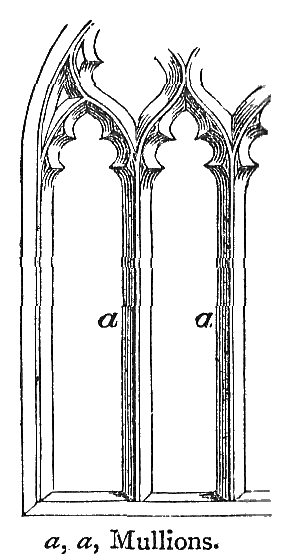
Mullion, mul′yun, n. an upright division between the lights of windows, between panels, &c.—v.t. to shape into divisions by mullions.—adj. Mull′ioned. [Same as munnion, from Fr. moignon, a stump—L. mancus, maimed.]
Mullock, mul′ok, n. rubbish, esp. mining refuse.
Mulse, muls, n. sweetened wine. [L. mulsum—mulcēre, to soothe.]
Mulsh, mulsh, n. loose material, strawy dung, &c., laid down to protect the roots of plants—also Mulch.—v.t. to cover with mulsh.—adj. soft.
Mult. See Multure.
Multangular, mult-ang′gul-ar, adj. having many angles or corners.—adv. Multang′ularly.—n. Multang′ularness.
Multanimous, mul-tan′i-mus, adj. having various faculties and powers of mind, many-sided.
Multarticulate, mul-tar-tik′ū-lāt, adj. many-jointed.—Also Multiartic′ulate.
Multeity, mul-tē′i-ti, n. manifoldness, very great numerousness.
Multiaxial, mul-ti-ak′si-al, adj. having many axes or lines of growth.
Multicamerate, mul-ti-kam′e-rāt, adj. having many chambers or cells.
Multicapitate, mul-ti-kap′i-tāt, adj. having many heads.—Also Multicip′ital.
Multicapsular, mul-ti-kap′sū-lar, adj. having many capsules.
Multicarinate, mul-ti-kar′i-nāt, adj. having many keel-like ridges, as the shells of certain molluscs.
Multicauline, mul-ti-kaw′lin, adj. having many stems.
Multicavous, mul-tik′a-vus, adj. having many holes or cavities.
Multicellular, mul-ti-sel′ū-lar, adj. having many cells.
Multicentral, mul-ti-sen′tral, adj. having many centres, esp. of organic development.
Multicharge, mul′ti-charj, adj. having, or capable of containing, several charges.
Multicipital, mul-ti-sip′i-tal, adj. having many heads, multicapitate.
Multicolour, mul′ti-kul-ur, adj. having many colours—also Mul′ticoloured.—adj. Multicol′ourous, of many colours, parti-coloured.
Multicostate, mul-ti-kos′tāt, adj. (bot.) palmately nerved: (zool.) having many ribs, ridges, or costæ.
Multicuspid, mul-ti-kus′pid, adj. having more than two cusps—also Multicus′pidāte.—n. a multicuspid tooth.
Multicycle, mul′ti-sī-kl, n. a velocipede with more than three wheels, intended to carry several men.
Multidentate, mul-ti-den′tāt, adj. having many teeth or tooth-like processes.—adj. Multidentic′ulate, having many denticulations or fine teeth.
Multidigitate, mul-ti-dij′i-tāt, adj. having many fingers, toes, or digitate processes.
Multidimensional, mul-ti-di-men′shun-al, adj. (math.) of more than three dimensions.
Multifaced, mul′ti-fāst, adj. having many faces.
Multifarious, mul-ti-fā′ri-us, adj. having great diversity: made up of many parts: manifold: (bot.) in many rows or ranks.—adv. Multifā′riously.—n. Multifā′riousness, the state of being multifarious: multiplied variety: (law) the fault of improperly joining in one bill distinct and independent matters, and thereby confounding them. [L. multus, many, varius, diverse.]
Multifid, mul′ti-fid, adj. having many fissions or divisions, cleft into many parts, lobes, or segments.—Also Multif′idous.
Multiflagellate, mul-ti-flaj′e-lāt, adj. having many flagella, or whip-like appendages.
Multiflorous, mul-ti-flō′rus, adj. many-flowered.
Multiflue, mul′ti-flōō, adj. having many flues.
Multifoil, mul′ti-foil, adj. having more than five foils or arcuate divisions.—n. multifoil ornament.
Multifold, mul′ti-fōld, adj. many times doubled.
Multiform, mul′ti-form, adj. having many forms, polymorphic.—n. that which is multiform.—n. Multiform′ity.
Multiganglionate, mul-ti-gang′gli-on-āt, adj. having many ganglia.
Multigenerate, mul-ti-jen′e-rāt, adj. generated in many ways.
Multigenerous, mul-ti-jen′e-rus, adj. of many kinds.
Multigranulate, mul-ti-gran′ū-lāt, adj. having or consisting of many grains.
Multigyrate, mul-ti-jī′rāt, adj. having many convolutions.
Multijugous, mul-ti-jōō′gus, adj. (bot.) consisting of many pairs of leaflets.—Also Multiju′gate.
Multilaminate, mul-ti-lam′i-nāt, adj. having many layers or laminæ.
Multilateral, mul-ti-lat′ėr-al, adj. having many sides.
Multilineal, mul-ti-lin′e-al, adj. having many lines.—Also Multilin′ear.
Multilobate, mul-ti-lō′bāt, adj. having, or consisting of, many lobes.—adjs. Mul′tilobed, having many lobes; Multilob′ular, having many lobules.
Multilocular, mul-ti-lok′ū-lar, adj. having many cells, chambers, or compartments.—Also Multiloc′ulate.
Multiloquence, mul-til′o-kwens, n. verbosity.—adj. Multil′oquent—also Multiloq′uous.
Multinodal, mul-ti-nō′dal, adj. having many nodes.—Also Multinō′date, Multinō′dous.
Multinomial, mul-ti-nō′mi-al, adj. same as Polynomial.
Multinominous, mul-ti-nom′i-nus, adj. having many names or terms.—Also Multinom′inal.
Multinucleate, mul-ti-nū′klē-āt, adj. having many or several nuclei, as a cell—also Multinū′clear, Multinū′cleated.—adj. Multinū′cleolate, having many or several nucleoli.
Multiovulate, mul-ti-ō′vū-lāt, adj. (bot.) containing, or bearing, many ovules.
Multipara, mul-tip′a-ra, n. a woman who has had two or more children:—opp. to Primipara.
Multiparous, mul-tip′a-rus, adj. producing many at a birth.—n. Multipar′ity, plural birth.
Multipartite, mul-ti-pär′tīt, adj. divided into many parts.
Multiped, mul′ti-ped, n. an insect having many feet. [L. multus, many, pes, pedis, foot.]
Multipinnate, mul-ti-pin′āt, adj. (bot.) many times pinnate.
Multiple, mul′ti-pl, adj. having many folds or parts: repeated many times.—n. a number or quantity which contains another an exact number of times.—n. Mul′tiplepoinding (Scots law), a process by which a person who has funds claimed by more than one, in order not to have to pay more than once, brings them all into court that one of them may establish his right.—Common multiple, a number or quantity that can be divided by each of several others without a remainder; Least common multiple, the smallest number that forms a common multiple. [L. multiplex—multus, many, plicāre, to fold.]
Multiply, mul′ti-plī, v.t. to fold or increase many times: to make more numerous: to repeat any given number or quantity as often as there are units in another number.—v.i. to increase: to perform the arithmetical process of multiplication:—pr.p. mul′tiplying; pa.t. and pa.p. mul′tiplied.—adjs. Mul′tiplex, having many folds: manifold: (bot.) with petals lying in folds over each other; Multiplī′able, Mul′tiplicable, that may be multiplied.—n. Mul′tiplicand, a number or quantity to be multiplied by another.—adj. Mul′tiplicāte, consisting of more than one: (bot.) multifold.—n. Multiplicā′tion, the act of multiplying or increasing in number: the rule or operation by which any given number or quantity is multiplied.—adj. Mul′tiplicātive, tending to multiply: having the power to multiply.—ns. Multiplic′ity, the state of being multiplied or various: a great number: Mul′tiplier, Mul′tiplicātor, one who, or that which, multiplies or increases the number or quantity by which another is multiplied.—Multiplication table, a tabular arrangement giving the products of pairs of numbers from 1 to 12.—Multiplying glass, lens, a glass, lens, with a number of facets, causing an object to appear multiplied many times. [Fr.,—L. multiplex. See Multiple.]
Multipolar, mul-ti-pō′lar, adj. having many poles, as a nerve-cell or dynamo.—n. an electro-magnetic machine in which several magnetic poles exist.
Multipotent, mul-tip′o-tent, adj. (Shak.) having power to do many things. [L. multus, many, potens, -entis, powerful.]
Multipresence, mul-ti-prez′ens, n. the power of being present in many places at the same time.—adj. Multipres′ent.
Multiradiate, mul-ti-rā′di-āt, adj. having many rays, polyactinal.
Multiradicate, mul-ti-rad′i-kāt, adj. having many roots.
Multiramified, mul-ti-ram′i-fīd, adj. having many branches.—Also Multirā′mous, Multirā′mose.
Multisaccate, mul-ti-sak′āt, adj. having many sacs.
Multiscient, mul-tish′ent, adj. knowing many things.
Multisect, mul′ti-sekt, adj. having many segments.
Multiseptate, mul-ti-sep′tāt, adj. having many septa or partitions.
Multiserial, mul-ti-sē′ri-al, adj. having many series or rows.—Also Multisē′riate.
Multisiliquous, mul-ti-sil′i-kwus, adj. having many pods or seed-vessels.
Multisonous, mul-tis′ō-nus, adj. having many sounds, sounding much.
Multispiral, mul-ti-spī′ral, adj. having many turns or whorls.
Multistaminate, mul-ti-stam′i-nāt, adj. bearing many stamens.
Multistriate, mul-ti-strī′āt, adj. having many striæ, streaks, or stripes.
Multisulcate, mul-ti-sul′kāt, adj. having many sulci or furrows.
Multisyllable, mul-ti-sil′a-bl, n. a word of many syllables.
Multitentaculate, mul-ti-ten-tak′ū-lāt, adj. having many tentacles.
Multititular, mul-ti-tit′ū-lar, adj. having many titles.
Multituberculate, -d, mul-ti-tū-ber′kū-lāt, -ed, adj. having many tubercles, as teeth.
Multitubular, mul-ti-tū′bū-lar, adj. having many tubes.
Multitude, mul′ti-tūd, n. the state of being many: a great number of individuals: a crowd: the vulgar or common people.—adjs. Multitud′inary (rare); Multitud′inous, consisting of, or having the appearance of, a multitude.—adv. Multitud′inously.—n. Multitud′inousness, the state or quality of being multitudinous. [Fr.,—L. multitudo—multus, many.]
Multivagous, mul-tiv′a-gus, adj. wandering much.—Also Multiv′agant.
Multivalent, mut-tiv′a-lent, adj. (chem.) equivalent in combining or displacing power to a number of hydrogen or other monad atoms.—n. Multiv′alence.
Multivalve, mul′ti-valv, n. a mollusc having a shell of more than two valves.—adj. having many valves—also Multival′vular.
Multiversant, mul-ti-ver′sant, adj. turning into many shapes.
Multivious, mul-tiv′i-us, adj. having many ways or roads.
Multivocal, mul-tiv′o-kal, adj. ambiguous, equivocal.
Multivoltine, mul-ti-vol′tin, adj. having more than two annual broods—of silkworm moths and their larvæ. [L. multus, much, It. volta, a turn, winding.]
Multocular, mul-tok′ū-lar, adj. having more than two eyes.
Multum, mul′tum, n. an adulterant compound in brewing of quassia and liquorice.
Multungulate, mul-tung′gū-lāt, adj. having more than two functional hoofs.—n. a multungulate mammal.
Multure, mul′tūr, n. a grinding of grain, or the grain ground: the toll paid to a miller for grinding, generally in kind: the percentage of ore paid to a pulverising-mill by those using it.—v.t. Mult, to take toll from for grinding corn.—n. Mul′turer. [O. Fr.,—L. molitura, a grinding.]
Mum, mum, adj. silent.—n. silence.—interj. be silent!—interj. Mum′-bud′get, an exclamation enjoining silence.—n. Mum′chance, a silent game with cards or dice: a fool.—adj. silent. [Cf. L. and Gr. mu, the least possible sound made with the lips: imit.]
Mum, mum, n. a peculiar kind of beer made of wheat-malt, to which some brewers add oat and bean meal. [Ger. mumme, from a personal name.]
Mumble, mum′bl, v.i. to speak indistinctly: to chew softly: to eat with the lips close.—v.t. to utter indistinctly or imperfectly: to mouth gently.—ns. Mum′blement, mumbling speech; Mum′ble-news (Shak.), a tale-bearer; Mum′bler, one who mumbles or speaks with a low, indistinct voice.—adj. Mum′bling, uttered with a low, indistinct voice: chewing softly.—adv. Mum′blingly. [Cf. Mum.]
Mumbo-jumbo, mum′bō-jum′bō, n. a god worshipped by certain negro tribes in Africa: any object of foolish worship or fear.
Mumm, mum, v.t. to mask: to make diversion with a mask on.—ns. Mumm′er, one who makes sport in disguise: a masker: a buffoon; Mumm′ery, sport with a mask on or in disguise: great show without reality; Mumm′ing, the sports of mummers.—adj. pertaining to the sports of mummers.—n. Mumm′ock, an old ragged coat. [O. Fr. momer—Old Dut. mommen, to mask, mom, a mask, prob. originating in the word mum, used to frighten children while covering the face.]
Mummy, mum′i, n. a human body preserved by the Egyptian art of embalming, in which wax, spices, &c. were employed: a kind of wax used in grafting: a brown pigment: (obs.) a medicinal gum.—v.t. to embalm and dry as a mummy:—pr.p. mumm′ying; pa.p. mumm′ied.—n. Mummificā′tion.—adj. Mumm′iform.—v.t. Mumm′ify, to make into a mummy: to embalm and dry as a mummy:—pr.p. mumm′ifying; pa.p. mumm′ified.—ns. Mumm′y-case, a case of wood or cartonnage for an Egyptian mummy; Munny-cloth, the linen cloth in which a mummy was wrapped: a modern fabric resembling it, used as a basis for embroidery: a fabric like crape for mourning-dress, having a cotton or silk warp and woollen weft; Mumm′y-wheat, a variety of wheat with compound spikes—Triticum compositum. [O. Fr. mumie—It. mummia—Ar. and Pers. múmáyin, a mummy—Pers. móm, wax.]
Mump, mump, v.t. and v.i. to mumble, mutter, or move the lips with the mouth almost closed: to nibble: to cheat: to play the beggar.—ns. Mump′er, one who mumps: an old cant term for a beggar; Mump′ing-day, St Thomas's Day, 21st Dec.—adj. Mump′ish, having mumps: dull: sullen.—adv. Mump′ishly.—n. Mump′ishness.—n. Mumps, a contagious non-suppurative inflammation of the parotid and sometimes of the other salivary glands: gloomy silence. [Form of mum.]
Mumpsimus, mump′si-mus, n. an error to which one clings after it has been thoroughly exposed. [Corr. of L. sumpsimus, in the mass, by an ignorant priest who refused to correct it.]
Mun, mun, n. a provincial form of man.
Munch, munsh, v.t. and v.i. to chew with shut mouth.—n. Munch′er, one who munches.
Mundane, mun′dān, adj. belonging to the world: terrestrial.—adv. Mun′danely.—n. Mundan′ity. [Fr.,—L. mundanus—mundus, the world.]
Mundify, mun′di-fī, v.t. to cleanse, purify.—adjs. Mun′datory, cleansing; Mundif′icant, cleansing.—n. a cleansing ointment or plaster.—n. Mundificā′tion.—adj. Mun′dificātive. [Fr. mondifier—Low L. mundificāre—L. mundus, clean, facĕre, to make.]
Mundivagant, mun-div′a-gant, adj. wandering over the world.
Munerary, mū′ne-rā-ri, adj. of the nature of a gift.
Mungo, mung′gō, n. the waste produced in a woollen-mill from hard spun or felted cloth, or from tearing up old clothes, used in making cheap cloth.
Mungoose, same as Mongoose.
Municipal, mū-nis′i-pal, adj. pertaining to a corporation or city.—n. Municipalisā′tion.—v.t. Munic′ipalise.—ns. Munic′ipalism; Municipal′ity, a town or city possessed of self-government: a district governed like a city: in France, a division of the country.—adv. Munic′ipally. [Fr.,—L. municipalis—municipium, a free town—munia, official duties, capĕre, to take.]
Munificence, mū-nif′i-sens, n. (Spens.) fortification, means of defence. [L. munīre, to fortify.]
Munificence, mū-nif′i-sens, n. quality of being munificent: bountifulness.—adj. Munif′icent, very liberal in giving: generous: bountiful.—adv. Munif′icently. [Fr.,—L. munificentia—munus, a present, facĕre, to make.]
Muniment, mū′ni-ment, n. that which fortifies: that which defends: a stronghold: place or means of defence: defence: (law) a record fortifying or making good a claim, title-deeds, or charters—preserved in Muniment chests, rooms, or houses: any article carefully preserved for its interest or value.—p.adj. Mun′iting (Bacon), fortifying, strengthening.—n. Muni′tion, materials used in war: military stores of all kinds: (B.) stronghold, fortress. [Fr.,—L. munimentum, from munīre, -itum, to fortify—mænia, walls.]
Munnion, mun′yun. Same as Mullion.
Muræna, mū-rē′na, n. the typical genus of Murænidæ, a family of eels, now limited to the European murry or moray (q.v.). [Gr. muraina, a lamprey.]
Mural, mū′ral, adj. pertaining to, or like, a wall: steep: trained against a wall, as plants.—Mural circle, a large circle marked with degrees, &c., fixed to a wall, for measuring arcs of the meridian; Mural crown, a crown of gold to imitate a battlement, given among the ancient Romans to him who first mounted the wall of a besieged city; Mural painting, a painting executed, especially in distemper colours, upon the wall of a building. [Fr.,—L. muralis, from murus, a wall.]
Muratorian, mū-ra-tō′ri-an, adj. pertaining to the Italian scholar Lodovico Antonio Muratori (1672-1750).—Muratorian fragment or canon, a list of the New Testament writings, apparently drawn up by a contemporary of Irenæus, about 170 A.D., edited by Muratori. It counts four Gospels, Acts, thirteen Pauline epistles (excluding Hebrews), 1 John, then Jude; 2 and 3 John are reckoned among catholic epistles. The Apocalypse is included.
Murder, mur′dėr, n. the act of putting a person to death, intentionally and from malice.—v.t. to commit murder: to destroy: to put an end to.—n. Mur′derer, one who murders, or is guilty of murder:—fem. Mur′deress.—adj. Mur′derous, guilty of murder: consisting in, or fond of, murder: bloody: cruel.—adv. Mur′derously.—n. Mur′dress, a battlement with interstices for firing through.—Murder in the first degree, murder with deliberation and premeditation, or that committed in the furtherance of any arson, rape, robbery, or burglary—in the second degree, murder of all other kinds; Murder will out, murder cannot remain hidden. [A.S. morthor—morth, death; Ger. mord, Goth. maurthr; cf. L. mors, mortis, death.]
Mure, mūr, n. (Shak.) a wall.—v.t. to enclose in walls: to immure. [Fr. mur—L. murus, a wall.]
Murex, mū′reks, n. a shellfish from which the Tyrian purple dye was obtained:—pl. Mū′rexes, Mū′rices. [L.]
Murgeon, mur′jon, n. (Scot.) a grimace. [Cf. Fr. morgue, a wry face.]
Muriatic, mū-ri-at′ik, adj. pertaining to, or obtained from, sea-salt.—n. Mū′riate, a salt composed of muriatic acid and a base.—adj. Muriatif′erous. [L. muriaticus—muria, brine.]
Muricate, -d, mū′ri-kāt, -ed, adj. (bot.) armed with sharp points or prickles. [L. muricatus, from murex, muricis, a pointed stone.]
Muriform, mū′riform, adj. (bot.) resembling the bricks in a wall. [L. murus, a wall, forma, shape.]
Murky, murk′i, adj. dark: obscure: gloomy.—adv. Murk′ily.—n. Murk′iness—(Shak.) Murk.—adjs. Murk′some, Mirk′some (Spens.), darksome. [A.S. murc; Ice. myrkr, Dan. and Sw. mörk.]
Murmur, mur′mur, n. a low, indistinct sound, like that of running water: a complaint in a low, muttering voice.—v.i. to utter a murmur: to grumble:—pr.p. mur′muring; pa.t. and pa.p. mur′mured.—n. Mur′murer.—adj. Mur′muring, making a low continuous noise.—adv. Mur′muringly, with a low murmuring sound: in a murmuring manner.—adj. Mur′murous, attended with murmurs: exciting murmur.—adv. Mur′murously. [Fr.,—L.; imit.]
Murphy, mur′fi, n. (coll.) a potato:—pl. Mur′phies (-fiz). [From the common Irish name Murphy.]
Murra, mur′a, n. an ornamental stone for vases, &c., described by Pliny, most probably fluor-spar; it was first brought to Rome by Pompey, 61 B.C.—adjs. Murr′hine, Murr′ine, Myrr′hine.
Murrain, mur′rān, or -′rin, n. an infectious and fatal disease among cattle, esp. foot-and-mouth disease.—n. Mur′ren (Milt.). [O. Fr. morine, a carcass—L. mori, to die. See Mortal.]
Murrey, mur′i, adj. dark red or reddish brown, of mulberry colour.
Murry, same as Moray (q.v.).
Murther, Murtherer=Murder, Murderer.
Musaceous, mū-zā′shus, adj. relating to an order of plants, of which the genus Mū′sa is the type, the banana or plantain family.
Musang, mū-sang′, n. a paradoxure, or a related civet, esp. the East Indian coffee-rat. [Malay.]
Musca, mus′kä, n. a genus of insects, including the house-fly, &c.—n. Muscatō′rium, a flabellum.—Muscæ volitantes, ocular spectra like floating black spots before the eyes. [L. musca.]
Muscadel, mus′ka-del, n. a rich, spicy wine: also the grape producing it: a fragrant and delicious pear—also Mus′cadine, Mus′cat, Mus′catel.—n.pl. Mus′catels, sun-dried raisins. [O. Fr.,—It. moscadello, dim. of muscato—L. muscus, musk.]
Muscadin, müs-ka-dang′, n. a fop or dandy. [Fr.]
Muscardine, mus′kar-din, n. a fungus destructive to silkworms, also the disease caused by it. [Fr.]
Muscardine, mus′kar-din, n. a dormouse. [Fr.]
Muschelkalk, mush′el-kalk, n. the middle member of the Triassic system as developed in Germany, consisting chiefly of limestone—wanting in Britain. [Ger. muschel, shell, kalk, lime.]
Muschetor, mus′che-tor, n. (her.) a black spot like an ermine spot, but without its three specks.—Also Mus′chetour. [O. Fr.,—L. musca, a fly.]
Muscle, mus′l, n. an animal tissue consisting of bundles of fibres through whose contractility bodily movement is effected, the fibres of the voluntary muscles being striped, those of the involuntary (of intestinal canal, blood-vessels, and of skin) unstriped.—adj. Mus′cled, supplied with muscles.—ns. Mus′cle-read′ing, the interpretation of slight involuntary muscular movements; Mus′cling, the delineation of muscles, as in a picture; Musculā′tion, the arrangement of muscles of a body; Musculos′ity.—adj. Mus′culous, pertaining to muscle: full of muscles, strong. [Fr.,—L. musculus, dim. of mus, a mouse, a muscle.]
Muscoid, mus′koid, adj. (bot.) moss-like.—n. a moss-like, flowerless plant.—ns. Muscol′ogist, one skilled in muscology; Muscol′ogy, the part of botany which treats of mosses; Muscos′ity, mossiness. [L. muscus, moss, Gr. eidos, form.]
Muscovado, mus-kō-vā′do, n. the moist, dark-coloured impure sugar left after evaporating the juice from the sugar-cane and draining off the molasses, unrefined sugar. [Sp. moscabado.]
Muscovite, mus′co-vīt, n. a native or an inhabitant of Moscow, or of Russia: the desman or Muscovitic rat: (min.) potash mica, a silicate of alumina and potash, yellowish, brownish, or greenish, with pearly or almost metallic lustre, its thin transparent plates still used as glass—also Muscovy glass.—adj. of or pertaining to Moscow or to Russia—also Muscovit′ic.—n. Mus′covy-duck (see Musk).
Muscular, mus′kū-lar, adj. pertaining to a muscle: consisting of muscles: having strong muscles: brawny: strong: vigorous.—n. Muscular′ity, state of being muscular.—adv. Mus′cularly.—adjs. Musculocutā′neous, muscular and cutaneous—of certain nerves; Mus′culous, sinewy.—Muscular Christianity, a phrase humorously applied to that vigorous combination of Christian living with devotion to athletic enjoyments associated with Charles Kingsley and his admirers (the name was, however, repudiated by him); Muscular excitability, the contracting property of a muscle; Muscular pile, a voltaic battery employed in biological experiments; Muscular system, the whole of the muscular tissue of a body.
Muse, mūz, v.i. to study in silence: to be absent-minded: to meditate.—n. deep thought: contemplation: absence of mind: the inspiring power, as of a poet.—adj. Mused, bemused, muzzy, fuddled.—n. Mus′er.—adv. Mus′ingly. [Fr. muser, to loiter (It. musare); acc. to Diez and Skeat, from O. Fr. muse (Fr. museau), the snout of an animal. Others explain Fr. muser as from Low L. mussāre—L. mussāre, to murmur.]
Muse, mūz, n. one of the nine goddesses of poetry, music, and the other liberal arts—daughters of Zeus and Mnemosyne: an inspiring poetic inspiration: (Milt.) an inspired poet.—Names of the Muses:—Calliope, of epic poetry; Clio, of history; Erato, of amatory poetry; Euterpe, of lyric poetry; Melpomene, of tragedy; Polyhymnia, of lyric poetry and eloquence; Terpsichore, of dancing; Thalia, of comedy; Urania, of astronomy. [Fr.,—L. musa—Gr. mousa.]
Muset, mūz′et, n. (Shak.) a gap in a fence or thicket through which an animal passes.
Musette, mū-zet′, n. a small oboe: an old French bagpipe: a simple pastoral melody.
Museum, mū-zē′um, n. a collection of natural, scientific, or other curiosities, or of works of art.—ns. Museol′ogy, the science of arranging—Museog′raphy, of describing, museums. [L.,—Gr. mouseion; cf. Muse.]
Mush, mush, n. meal boiled in water, esp. Indian meal: anything pulpy.—adj. Mush′y, soft, pulpy. [Prob. mash.]
Mush, mush, v.t. to notch, a dress-fabric ornamentally at the side with a stamp. [Prob. a form of mesh.]
Mushed, musht, adj. (prov.) worn out, exhausted.
Mushroom, mush′rōōm, n. the common name of certain fungi, esp. such as are edible: (fig.) one who rises suddenly from a low condition: an upstart.—n. Mush′room-spawn, the substance in which the reproductive mycelium of the mushroom is embodied. [O. Fr. mousseron, through mousse, moss—Old High Ger. mos (Ger. moos, moss).]
Music, mū′zik, n. a connected series of sweet sounds: melody or harmony: the science which treats of harmony: the art of combining sounds so as to please the ear: a musical composition: (U.S.) heated argument, also amusement.—adj. Mū′sical, pertaining to, or producing, music: pleasing to the ear: melodious.—adv. Mū′sicallly.—ns. Mū′sicalness; Mū′sic-case, -fō′lio, -hold′er, &c., a roll, cabinet, &c. for carrying sheet music; Mū′sic-demy′, a size of writing-paper, 20¾ in. × 14⅜ in.; Mū′sic-hall, a public hall for musical entertainments, esp. when varied by dancing, variety performances, &c., often with concomitant smoking and drinking; Mū′sic-house, a place for public musical entertainments: a firm dealing in music or musical instruments; Musi′cian, one skilled in music: a performer of music—(obs.) Musi′cianer.—adv. Musi′cianly.—ns. Musi′cianship; Mū′sic-mas′ter, or -mis′tress, a man or a woman who teaches music; Mū′sic-of-the-spheres (see Harmony); Mū′sic-pā′per, paper ruled with staffs for writing music in; Mū′sic-pen, a pen marking at once a series of fine parallel lines for music; Mū′sic-rack, a rack attached to a musical instrument for holding the player's music; Mū′sic-record′er, a device for recording music as played on an organ, pianoforte, &c.; Mū′sic-school, a place where music is regularly taught, a conservatory; Mū′sic-shell, a Gasteropod of the Caribbean Sea, marked with figures like printed music; Mū′sic-stand, a music-rack: a raised platform for a musical band; Mū′sic-stool, a stool or chair, generally adjustable in height, for the performer on the pianoforte, &c.; Mū′sic-wire, wire such as the strings of musical instruments are made of.—Music (-al) box, a case containing a mechanism contrived, when the spring is wound up, to reproduce melodies; Music club, a meeting for practising music.—Musical director, the conductor of an orchestra, &c.; Musical glasses (see Harmonica, under Harmonium). [Fr. musique—L. musica—Gr. mousikē (technē, art), mousa, a muse.]
Musimon, mū′si-mon, n. the moufflon.—Also Mus′mon.
Musing, mūz′ing, n. the act of one who muses: contemplation: meditation.—adj. meditative, preoccupied.—adv. Mus′ingly.
Musive, mū′siv, adj. Same as Mosaic.
Musk, musk, n. a strong perfume, obtained from the male musk-deer, or the odour thereof: a hornless deer, in Tibet and Nepaul, yielding musk.—v.t. to perfume with musk.—ns. Musk (bot.), a name given to a number of plants which smell more or less strongly of musk; Musk′-bag, -ball, a bag, ball, containing musk as a perfuming sachet; Musk′-cat, a civet-cat: a scented effeminate dandy; Musk′-cāv′y, a West Indian echimyine rat-like rodent; Musk′-deer, a hornless deer, native of Central Asia, which produces the perfume called musk; Musk′-duck, the Muscovy-duck, so called from its musky odour; Musk′-gland, a skin-pit in mammals producing a secretion with a musky odour, esp. in the male musk-deer and male beaver.—adv. Musk′ily.—ns. Musk′iness; Musk′-mall′ow, an ornamental species of mallow, with faint odour of musk; Musk′-melon, the juicy edible fruit of a trailing herb (Cucumis melo), or the plant; Musk′-ox, a ruminant of arctic America, with long smooth hair, its horns meeting in a shield over the forehead, exhaling a strong musky smell; Musk′-pear, a fragrant variety of pear; Musk′-plum, a fragrant kind of plum; Musk′-rat, a North American aquatic, arvicoline, rat-like rodent, yielding a valuable fur, and secreting in its gland a substance with a musky smell—also Mus′quash; Musk′-rose, a fragrant species of rose.—adj. Musk′y, having the odour of musk. [Fr. musc—L. muscus, Gr. moschos—Pers. musk—Sans. mushka, a testicle.]
Musket, mus′ket, n. any kind of smooth-bore military hand-gun: a male sparrow-hawk.—ns. Musketeer′, a soldier armed with a musket; Musketoon′, Musquetoon′, a short musket: one armed with a musketoon.—adj. Mus′ket-proof, capable of resisting the force of a musket-ball.—ns. Mus′ket-rest, a fork used as a support for the heavy 16th-century musket—also Croc; Mus′ketry, muskets in general; practice with muskets: a body of troops armed with muskets; Mus′ket-shot, the discharge of a musket, the reach of a musket. [O. Fr. mousquet, a musket, formerly a hawk—It. mosquetto—L. musca, a fly.]
Muslim, mus′lim, n. and adj. Same as Moslem.
Muslin, muz′lin, n. a fine soft cotton fabric resembling gauze in appearance, but woven plain without any looping of the warp threads on the weft—generally uncoloured: a coarser fabric than Indian muslin, printed with coloured patterns, &c.: (U.S.) cotton cloth for shirts, bedding, &c.: a collector's name for several different moths.—adj. made of muslin.—adj. Mus′lined, clothed with muslin.—ns. Mus′linet, a coarse kind of muslin; Mus′lin-kale (Scot.), thin broth made without meat. [Fr. mousseline—It. mussolino, from Mosul in Mesopotamia.]
Musquash, mus′kwosh, n. the musk-rat. [Am. Ind.]
Musrole, muz′rōl, n. the nose-band of a horse's bridle.
Muss, mus, n. (Shak.) a scramble: confusion, disorder.—v.t. (U.S.) to throw into confusion. [O. Fr. mousche, a fly—L. musca, a fly.]
Mussel, Muscle, mus′l, n. a. marine bivalve shellfish, used for food.—n. Mus′cūlite, a petrified mussel or shell. [A.S. muxle; Ger. muschel, Fr. moule; all from L. musculus.]
Mussitation, mus-i-tā′shun, n. the movement of the tongue or lips as if in speech, without producing articulate sounds, muttering.—v.t. Muss′itate, to mutter.
Mussulman, mus′ul-man, n. a Moslem or Mohammedan:—pl. Muss′ulmans (-manz). [Turk. musulmān—Ar. muslim, moslim, Moslem.]
Mussy, mus′i, adj. disordered.—n. Muss′iness.
Must, must, v.i. to be obliged physically or morally. [A.S. mót, móste; Ger. müssen.]
Must, must, n. wine pressed from the grape, but not fermented: potato-pulp prepared for fermentation. [A.S. must—L. mustus, new, fresh.]
Must, must, n. an occasional state of dangerous frenzy in adult male elephants.
Mustache. Same as Moustache.
Mustang, mus′tang, n. the wild horse of the American prairies: (U.S.) a naval officer from the merchant service in the Civil War.
Mustard, mus′tard, n. a plant of the genus Brassica, formerly classed as Sinapis, having a pungent taste: the seed thereof ground and used as a seasoning for meat, as a plaster, &c.—French mustard, mustard prepared for table by adding salt, sugar, vinegar, &c.; Wild mustard, the charlock. [O. Fr. mostarde (Fr. moutarde)—L. mustum, must.]
Mustela, mus-tē′la, n. the typical genus of Mustelidæ, the martens and sables.—adj. Mus′teline, like a marten or weasel: tawny in colour.—n. a musteline mammal.—adj. Mus′teloid, like a weasel. [L.]
Muster, mus′tėr, v.t. to assemble, as troops for duty or inspection: to gather, summon (with up).—v.i. to be gathered together, as troops.—n. an assembling of troops: a register of troops mustered: assemblage: collected show.—ns. Mus′ter-book (Shak.), a book in which military forces are registered; Mus′ter-file (Shak.), a muster-roll; Mus′ter-mas′ter, the master of the muster, or who takes an account of troops, their arms, &c.; Mus′ter-roll, a register of the officers and men in each company, troop, or regiment present at the time of muster.—Pass muster, to pass inspection uncensured. [O. Fr. mostre, monstre—L. monstrum—monēre, to warn.]
Musty, must′i, adj. mouldy: spoiled by damp: sour: foul.—adv. Must′ily.—n. Must′iness. [Doublet of moisty—L. musteus, new.]
Mutable, mū′ta-bl, adj. that may be changed: subject to change: inconstant.—ns. Mutabil′ity, Mū′tableness, state or quality of being mutable.—adv. Mū′tably.—n. Mutan′dum, something to be altered:—pl. Mutan′da.—v.t. Mū′tate, to change a vowel-sound by the influence of a vowel in the following syllable.—n. Mutā′tion, act or process of changing a vowel through the influence of one in the next syllable—the German umlaut: change: succession.—adjs. Mū′tative, Mū′tātory, changing, mutable. [Fr.,—L. mutabilis—mutāre, -ātum, to change—movēre, motum, to move.]
Mutage, mū′tāj, n. a process for arresting fermentation in the must of grapes. [Fr.]
Mutch, much, n. (Scot.) a woman's cap. [Old Dut. mutse; Dut. muts, Ger. mütze.]
Mutchkin, much′kin, n. a Scottish liquid measure of four gills, or forming one-fourth of a Scottish pint. [Scot. mutch, a cap, kin, little.]
Mute, mūt, adj. incapable of speaking: dumb: silent: unpronounced.—n. one dumb, or remaining silent: a person stationed by undertakers at the door of a house at a funeral: a stopped sound, formed by the shutting of the mouth-organs, esp. the surds t, p, k, but also applied to the sonant or voiced consonants d, b, g, and even the nasals n, m, ng: (law) one who refuses to plead.—v.t. to deaden sound.—adv. Mute′ly.—n. Mute′ness. [Fr.,—L. mutus.]
Mute, mūt, v.i. to dung, as birds. [O. Fr. mutir, esmeutir—Old Dut. smelten, to smelt.]
Mutilate, mū′ti-lāt, v.t. to maim: to cut off: to remove a material part of.—ns. Mutilā′tion, act of mutilating: deprivation of a limb or essential part; Mū′tilator, one who mutilates. [L. mutilāre—mutilus—Gr. mutilos, mitulos, curtailed.]
Mutineer, mū-ti-nēr′, n. one guilty of mutiny.—v.i. to mutiny.—n. and v.i. Mū′tine (Shak.).
Mutiny, mū′ti-ni, v.i. to rise against authority in military or naval service: to revolt against rightful authority:—pr.p. mū′tinying; pa.t. and pa.p. mū′tinied.—n. insurrection against constituted authority, esp. naval or military: revolt, tumult, strife.—adj. Mū′tinous, disposed to mutiny: seditious.—adv. Mū′tinously.—n. Mū′tinousness.—Mutiny Act, an act passed by the British parliament from year to year, to regulate the government of the army, from 1689 down to 1879, when it was superseded by the Army Discipline and Regulation Act, modified by the Army Act of 1881. [O. Fr. mutiner, mutin, riotous, meute, a sedition—L. motus, rising—movēre, motum, to move.]
Mutism, mūt′izm, n. the state or habit of being mute.
Mutter, mut′ėr, v.i. to utter words in a low voice: to murmur: to sound with a low, rumbling noise.—v.t. to utter indistinctly.—ns. Mutt′er (Milt.), a murmuring; Mutterā′tion, act of muttering or complaining; Mutt′erer; Mutt′ering.—adv. Mutt′eringly, in a muttering or grumbling manner: with indistinct articulation. [Prob. imit., like prov. Ger. mustern; L. muttīre.]
Mutton, mut′n, n. the flesh of sheep: an old Anglo-French gold coin impressed with a lamb: (slang) a loose woman, hence illicit commerce: a sheep.—n. Mutt′on-chop, a rib of mutton chopped at the small end for broiling or frying.—adj. like a mutton-chop (of whiskers cut round at the ends).—ns. Mutt′on-cut′let, a steak cut usually from a leg of mutton for broiling or frying; Mutt′on-fist, a coarse, big hand; Mutt′on-ham, a salted leg of mutton; Mutt′on-head, a heavy, stupid person.—adj. Mutt′on-head′ed, stupid.—ns. Mutt′on-sū′et, the fat about the kidneys and loins of sheep; Mutt′on-thump′er, a clumsy bookbinder.—adj. Mutt′ony.—Laced mutton (Shak.), a loose woman; Return to one's muttons (coll.), to return to the subject of discussion—a humorous mistranslation of the Fr. proverb, 'Revenons à nos moutons.' [O. Fr. moton (Fr. mouton), a sheep—Low L. multo, acc. to Diez, from L. mutilus, mutilated.]
Mutual, mū′tū-al, adj. interchanged: in return: given and received, equally affecting two or more: common, conjoint, shared alike, as in 'mutual friend.'—ns. Mū′tualism, Mutual′ity.—adv. Mū′tually.—Mutual accounts, accounts in which each of two have charges against the other; Mutual insurance, a reciprocal contract among several persons to indemnify each other against certain designated losses, the system of a company in which policy-holders receive a certain share of the profits, &c.; Mutual wall, a wall equally belonging to each of two houses. [Fr. mutuel—L. mutuus—mutāre, to change.]
Mutule, mūt′ūl, n. a kind of square, flat bracket used in the Doric order of architecture, above each triglyph and each metope, having round projections like nail-heads on the lower surface.
Mutuum, mū′tū-um, n. a bailment consisting of a loan of goods for consumption, as corn, coal, &c., to be returned in goods of the same amount.
Mux, muks, v.t. to spoil, botch.—n. a mess.
Muzhik, mōō-zhik′, n. a Russian peasant.
Muzzle, muz′l, n. the projecting jaws and nose of an animal: a fastening for the mouth to prevent biting, by a strap or a cage: the extreme end of a gun, &c.—v.t. to put a muzzle on: to restrain from biting: to keep from hurting: to gag or silence.—ns. Muzz′le-bag, a canvas bag fixed to the muzzle of a gun at sea, to keep out water; Muzz′le-load′er, a firearm loaded through the muzzle—opp. to Breech-loader.—adj. Muzz′le-load′ing.—n. Muzz′le-veloc′ity, the velocity of a projectile the moment it leaves the muzzle of a gun. [O. Fr. musel (Fr. museau), prob. from L. morsus—mordēre, to bite.]
Muzzy, muz′i, adj. dazed, bewildered, tipsy.—n. Muzz′iness.
My, (when emphatic or distinct) mī, (otherwise) me, poss. adj. belonging to me. [Contr. of mine, A.S. mín, of me.]
Mya, mī′a, n. a genus of bivalve shells: a clam of this genus.—n. Myā′ria, an old name for the Myidæ, a family of dimyarian bivalves.—adj. Myā′rian. [Gr. myax, a sea-mussel.]
Myalgia, mī-al′ji-a, n. a morbid state of a muscle.—adj. Myal′gic. [Gr. mys, muscle, algos, pain.]
Myall, mī′al, n. a hard, scented wood yielded by several Australian acacias, esp. good for tobacco-pipes and whip-handles.
Mycelium, mī-sē′li-um, n. the white thread-like parts from which a mushroom or a fungus is developed: mushroom spawn:—pl. Mycē′lia. [Gr. mykēs, a fungus, ēlos, a nail or wart.]
Mycetes, mī-sē′tēz, n. a kind of South American monkey, called also Howlers. [Gr. mykētēs, bellower.]
Mycetes, mī-sē′tēz, n.pl. mushrooms or fungi.—ns. Mycetol′ogy (same as Mycology); Mycetō′ma, a chronic disease of the feet and hands in India.—n.pl. Mycetozō′a, a group of fungus-like organisms, now mostly contained in the division Myxomycetes or slime-fungi.—adjs. Mycolog′ic, -al.—ns. Mycol′ogist; Mycol′ogy, the science treating of the fungi or mushrooms; Mycoph′agist; Mycoph′agy, the eating of fungi; My′cose, a kind of sugar obtained from certain lichens and fungi, as ergot of rye—also Trehalose; Mycō′sis, the presence of fungus growth within the body.—adj. Mycot′ic. [Gr. mykētēs, pl. of mykēs a mushroom.]
Mydriasis, mi-drī′a-sis, n. morbid dilatation of the pupil of the eye.—adj. Mydriat′ic.—n. a drug causing this.
Myelitis, mī-e-lī′tis, n. inflammation of the substance of the spinal cord.—ns. Myelasthenī′a, spinal exhaustion; Myelatrō′phia, atrophy of the spinal cord.—adjs. Myelit′ic, My′eloid, medullary.—ns. Myelomalā′cia, softening of the spinal cord; Myelomeningī′tis, spinal meningitis; My′elon, the spinal cord.—adjs. My′elonal, Myelon′ic. [Gr. myelos, marrow.]
Mygale, mig′a-lē, n. an American tarantula or bird-catching spider. [Gr. mygalē, a field-mouse.]
Mylodon, mī′lō-don, n. a genus of large fossil sloths.—adj. My′lodont. [Gr. mylē, a mill, odous, odontos, a tooth.]
Mylohyoid, mī-lō-hī′oid, adj. pertaining to the molar teeth and to the hyoid bone.—n. the mylohyoid muscle. [Gr. mylē, a mill.]
Myna, mī′na, n. one of several sturnoid passerine birds of India.—Also Mī′na.
Mynheer, mīn-hār′, n. my lord: Dutch form of Mr or Sir: a Dutchman. [Dut. mijn, my, heer, lord.]
Myoid, mī′oid, adj. like muscle.—n. My′oblast, a cell producing muscle-tissue.—adj. Myoblast′ic.—ns. Myocardī′tis, inflammation of the myocardium; Myocar′dium, the muscular substance of the heart; Myodynā′mia, muscular force; My′ogram, the tracing of a contracting and relaxing muscle by the myograph; My′ograph, an instrument for noting and recording muscular contractions.—adjs. Myograph′ic, -al, relating to myography.—ns. Myog′raphist; Myog′raphy, a description of the muscles of the body.—adj. Myolog′ical.—ns. Myol′ogist; Myol′ogy, the part of anatomy which treats of the muscles; Myō′ma, a tumour composed of muscular tissue; Myonic′ity, the contractile property of muscular tissue. [Gr. mys, myos, muscle.]
Myomancy, mī′o-man-si, n. divination from the movements of mice.—adj. Myoman′tic. [Gr. mys, a mouse, manteia, divination.]
Myopia, mī-ō′pi-a, n. shortness or nearness of sight.—adj. Myop′ic.—ns. My′ops, My′ope, a short-sighted person. [Gr.,—myein, to close, ōps, the eye.]
Myosin, mī′ō-sin, n. an albuminous compound contained in the contractile muscular tissue.
Myosis, mī-ō′sis, n. abnormal contraction of the pupil of the eye.—adjs. Myosit′ic; Myot′ic. [Gr. myein, to close.]
Myositis, mī-o-sī′tis, n. inflammation of a muscle—properly My′itis.
Myosotis, mī-ō-sō′tis, n. a genus of annual or perennial herbs of the borage family, with alternate leaves and simple or branched racemes of bractless blue, pink, or white flowers: a flower of this genus, as the common blue forget-me-not. [Gr. mys, myos, a mouse, ous, ōtos, an ear.]
Myotomy, mī-ot′o-mi, n. the dissection of the muscles. [Gr. mys, myos, muscle, temnein, to cut.]
Myriad, mir′i-ad, n. any immense number.—adj. numberless. [Gr. myrias, myriados, ten thousand.]
Myriapod, mir′i-a-pod, (more correctly) Myr′iopod, n. a worm-shaped animal with many-jointed legs.—n. Myriap′oda, a class of jointed animals, of which some of the lower kinds have an immense number of legs. [Gr. myrios, numberless, pous, podos, a foot.]
Myrica, mi-rī′ka, n. a genus of shrubs of the sweet-gale family, including the bay-berry or wax-myrtle, yielding a tallow used for candles. [Gr. myrikē.]
Myriorama, mir-i-o-rä′ma, n. a picture composed of interchangeable parts which can be combined into a variety of pictures. [Gr. myrios, numberless, horama, a view.]
Myrioscope, mir′i-o-skōp, n. a variety of kaleidoscope, esp. a form of it consisting of mirrors so arranged as by multiplied reflection from a small piece of carpet to show how it looks covering a whole floor. [Gr. myrios, numberless, skopein, to view.]
Myristica, mī-ris′ti-ka, n. a genus of fragrant apetalous trees—the nutmegs: the kernel of the seed of Myristica fragrans, as used in cookery. [Gr. myrizein, to anoint.]
Myrmidon, mėr′mi-don, n. one of a tribe of warriors who accompanied Achilles to Troy: one of a ruffianly band under a daring leader: one who carries out another's orders without fear or pity.—adj. Myrmidō′nian.—Myrmidons of the law, policemen, bailiffs, &c. [L.,—Gr.]
Myrobalan, mī-rob′a-lan, n. the astringent fruit of certain Indian mountain species of Terminalia. [Gr. myron, an unguent, balanos, a corn.]
Myrrh, mėr, n. a bitter, aromatic, transparent gum, exuded from the bark of a shrub in Arabia.—adj. Myr′rhic.—ns. Myr′rhin, the fixed resin of myrrh; Myr′rhol, the volatile oil of myrrh. [O. Fr. mirre (Fr. myrrhe)—L. and Gr. myrrha—Ar. murr.]
Myrrhine. Same as Murrine.
Myrtle, mėr′tl, n. an evergreen shrub with beautiful and fragrant leaves.—n. Myr′tle-wax, wax from the candle-berry. [O. Fr. myrtil, dim. of myrte—L. and Gr. myrtus.]
Myself, mī-self′, or me-self′, pron. I or me, in person—used for the sake of emphasis and also as the reciprocal of me.
Mystagogue, mis′ta-gōg, n. an initiator into religious mysteries, a teacher or catechist—also Mystagō′gus.—adj. Mystagog′ic (-goj′-).—n. Mys′tagogy (-goj-), the practice of a mystagogue: the sacraments. [Gr. mystēs, one initiated, agōgos, a leader.]
Mystery, mis′tėr-i, n. a secret doctrine: anything very obscure: that which is beyond human knowledge to explain: anything artfully made difficult: (pl.) secret rites, in ancient religions rites known only to and practised by initiated persons, as the Eleusinian mysteries in Greece, &c.: a sacrament: a rude medieval drama founded on the historical parts of the Bible and the lives of the saints—the Basque pastorales are a survival.—adj. Mystē′rious, containing mystery: obscure: secret: incomprehensible.—adv. Mystē′riously.—n. Mystē′riousness. [M. E. mysterie—L. mysterium—Gr. mystērion—mystēs, one initiated—muein, to close the eyes.]
Mystery, mis′tėr-i, n. a trade, handicraft. [M. E. mistere—O. Fr. mestier (Fr. métier)—L. ministerium—minister. Prop. mistery; the form mystery is due to confusion with the above.]
Mystic, -al, mis′tik, -al, adj. relating to, or containing, mystery: sacredly obscure or secret: involving a sacred or a secret meaning hidden from the eyes of the ordinary reader, only revealed to a spiritually enlightened mind, allegorical: belonging to mysticism.—n. Mys′tic, one who seeks for direct intercourse with God in elevated religious feeling or ecstasy.—adv. Mys′tically.—ns. Mys′ticalness, the quality of being mystical; Mys′ticism, the doctrine of the mystics, a tendency of religious feeling marked by an effort to attain to direct and immediate communion with God: obscurity of doctrine; Mystificā′tion.—v.t. Mys′tify, to make mysterious, obscure, or secret: to involve in mystery:—pr.p. mys′tifying; pa.t. and pa.p. mys′tified.—Mystic recitation, the recitation of parts of the Greek liturgy in an inaudible voice; Mystical theology, the knowledge of divine things attained by spiritual insight and experience only, without authority, the process of reason, &c. [L. mysticus—Gr. mystikos. Cf. Mystery, a secret doctrine.]
Mytacism, mī′ta-sizm, n. a too recurrent use of the letter m in speech or writing.
Myth, mith, n. a fable, a legend, a fabulous narrative founded on a remote event, esp. those made in the early period of a people's existence: an invented story: a falsehood.—adjs. Myth′ic, -al, relating to myths: fabulous: untrue.—adv. Myth′ically.—ns. Myth′icist, Myth′iciser, an adherent of the mythical theory; Myth′ist, a maker of myths; Mythogen′esis, the production of, or the tendency to originate, myths; Mythog′rapher, a writer or narrator of myths; Mythog′raphy, representation of myths in graphic or plastic art, art-mythology; Mythol′oger, Mytholō′gian, a mythologist.—adjs. Mytholog′ic, -al, relating to mythology, fabulous.—adv. Mytholog′ically.—v.t. Mythol′ogise, to interpret or explain myths: to render mythical.—ns. Mythol′ogiser, one who, or that which, mythologises; Mythol′ogist, one versed in, or who writes on, mythology; Mythol′ogy, the myths or stories of a country: a treatise regarding myths: a collection of myths: the science which investigates myths; Mython′omy, the deductive and predictive stage of mythology; Myth′oplasm, a narration of mere fable; Mythopœ′ist, a myth-maker.—adjs. Mythopoet′ic, Mythopœ′ic, myth-making, tending to generate myth.—n. Myth′us, the same as myth:—pl. Myth′ī.—Mythical theory, the theory of D. F. Strauss (1808-74) and his school, that the Gospels are mainly a collection of myths, developed during the first two centuries, from the imagination of the followers of Jesus; Comparative mythology, the science which investigates myths and seeks to relate those of different races. [Gr. mythos.]
Mytilus, mit′i-lus, n. a genus of bivalves, or an individual bivalve belonging to it.—adjs. Mytil′iform, Myt′iloid.
Myxœdema, mik-sē-dē′ma, n. a diseased condition occurring in adults, generally females, characterised by a thickening of the subcutaneous tissue, most noticeable in the face, with a simultaneous dulling of all the faculties and slowing of the movements of the body. A precisely similar condition occurs in many cases where the thyroid gland has been removed for disease. [Gr. myxa, mucus, and Eng. edema.]
Myxoma, mik-sō′ma, n. a tumour consisting of mucous tissue—also Collonema. [Gr. myxa, mucus.]
Myxomycetes, mik-sō-mī-sē′tēz, n.pl. a class of very simple organisms, often claimed by botanists as fungi, generally regarded by zoologists as primitive Protozoa, living on damp surfaces exposed to air, esp. on rotting wood, and feeding on organic débris forming composite masses or plasmodia. [Gr. myxa, mucus, mykētes, pl. of mykēs, a mushroom.]
Myxopod, mik′so-pod, n. and adj. a protozoan animal having pseudopodia, as distinguished from a mastigopod, which has cilia or flagella.—n.pl. Myxop′oda, protozoans whose locomotive appendages are pseudopodia—the same as Rhizopoda.—adj. Myxop′odous. [Gr. myxa, mucus, pous, podos, a foot.]
Myxosarcoma, mik-sō-sär-kō′ma, n. a tumour composed of mucous and sarcomatous tissue:—pl. Myxosarcō′mata. [Gr. myxa, mucus, sarcōma, a fleshy lump.]
Myzontes, mī-zon′tēz, n.pl. a class of vertebrates with an incomplete cartilaginous skull, no lower jaw, and pouch-like gills—including the lampreys and hags.—adj. and n. suctorial as the lamprey, belonging to the Myzontes. [Gr. myzōn, myzontos, pr.p. of myzein, to suck.]