LIST OF ABBREVIATIONS USED IN THIS DICTIONARY. (continued 14)
Reading edition
Irradicate, i-rad′i-kāt, v.t. to fix firmly.
Irrational, ir-rash′un-al, adj. void of reason or understanding: absurd.—n. Irrational′ity.—adv. Irra′tionally.—Irrational numbers, a term applied to those roots of numbers which cannot be accurately expressed by a finite number of figures—e.g. √2 is an irrational number.
Irrealisable, ir-rē′a-lī-za-bl, adj. not realisable.
Irrebuttable, ir-re-but′a-bl, adj. not to be rebutted.
Irreceptive, ir-re-sep′tiv, adj. not receptive.
Irreciprocal, ir-re-sip′ro-kal, adj. not reciprocal.
Irreclaimable, ir-re-klām′a-bl, adj. that cannot be reclaimed or reformed: incorrigible.—n. Irreclaim′ableness.—adv. Irreclaim′ably.
Irrecognisable, ir-rek′og-nīz-a-bl, adj. that cannot be recognised.—n. Irrecogni′tion, lack of recognition.
Irreconcilable, ir-rek-on-sīl′a-bl, adj. incapable of being brought back to a state of friendship: inconsistent.—ns. Irreconcil′ableness, Irreconcilabil′ity, incapability of being reconciled.—adv. Irreconcil′ably.—adj. Irrec′onciled, not reconciled or brought into harmony.—n. Irrec′oncilement.
Irrecoverable, ir-re-kuv′ėr-a-bl, adj. irretrievable.—n. Irrecov′erableness.—adv. Irrecov′erably.
Irredeemable, ir-re-dēm′a-bl, adj. not redeemable: not subject to be paid at the nominal value.—ns. Irredeem′ableness, Irredeemabil′ity.—adv. Irredeem′ably.
Irredentist, ir-e-den′tist, n. one of an Italian party formed in 1878, its aim to incorporate into Italy all Italian people politically belonging to other countries, as in the Tyrol, Nice, &c.—n. Irreden′tism, the programme of the Irredentist party. [It. irredentista—irredenta (Italia), 'unredeemed'—L. in, not, redemptus, redimĕre, to redeem.]
Irreducible, ir-re-dūs′i-bl, adj. that cannot be reduced or brought from one degree, form, or state to another: not to be reduced by manipulation, as a hernia, &c.—n. Irreduc′ibleness.—adv. Irreduc′ibly.—ns. Irreductibil′ity, Irreduc′tion.
Irreflective, ir-re-flekt′iv, adj. not reflective.—n. Irreflec′tion.
Irreformable, ir-re-for′ma-bl, adj. not reformable, not subject to revision or improvement.
Irrefragable, ir-ref′ra-ga-bl, adj. that cannot be refuted: unanswerable.—ns. Irrefragabil′ity, Irref′ragableness.—adv. Irref′ragably.—n. Irrefrangibil′ity.—adj. Irrefrangible (ir-e-fran′-ji-bl), not to be broken.—adv. Irrefran′gibly.—The Irrefragable Doctor, Alexander Hales (died 1245). [Fr.,—L. in, not, re, backwards, frangĕre, to break.]
Irrefutable, ir-re-fūt′a-bl, or ir-ref′ū-ta-bl, adj. that cannot be refuted.—adv. Irrefūt′ably (also -ref′-).
Irregular, ir-reg′ū-lar, adj. not according to rule: unnatural: unsystematic: vicious: (gram.) departing from the ordinary rules in its inflection: variable: not symmetrical, without regular form—(Shak.) Irreg′ulous.—n. a soldier not in regular service.—n. Irregular′ity, state of being irregular: deviation from a straight line, or from rule: departure from method or order: vice.—adv. Irreg′ularly.
Irrelative, ir-rel′a-tiv, adj. not relative.—adj. Irrelāt′ed.—n. Irrelā′tion.—adv. Irrel′atively.
Irrelevant, ir-rel′e-vant, adj. not relevant.—n. Irrel′evancy.—adv. Irrel′evantly.
Irreligious, ir-re-lij′us, adj. destitute of religion: ungodly.—adv. Irrelig′iously.—ns. Irrelig′iousness, Irrelig′ion, want of religion.
Irremeable, ir-rē′me-a-bl, adj. (Pope) not admitting of return. [L. in, not, remeabilis, remeāre—re, back, meāre, to go, come.]
Irremediable, ir-re-mē′di-a-bl, adj. that cannot be remedied or redressed.—n. Irremē′diableness.—adv. Irremē′diably.
Irremissible, ir-re-mis′i-bl, adj. not to be remitted or forgiven.—ns. Irremiss′ibleness, Irremiss′ion.—adj. Irremiss′ive.
Irremovable, ir-re-mōōv′a-bl, adj. not removable: steadfast.—ns. Irremovabil′ity, Irremov′ableness.—adv. Irremov′ably.
Irrenowned, ir-re-nownd′, adj. (Spens.) not renowned.
Irreparable, ir-rep′ar-a-bl, adj. that cannot be repaired or rectified.—ns. Irreparabil′ity, Irrep′arableness.—adv. Irrep′arably.
Irrepealable, ir-re-pēl′a-bl, adj. that cannot be repealed or annulled.—adv. Irrepeal′ably.
Irreplaceable, ir-re-plās′a-bl, adj. that cannot be replaced.
Irreprehensible, ir-rep-re-hens′i-bl, adj. that cannot be blamed.—n. Irreprehens′ibleness.—adv. Irreprehens′ibly.
Irrepressible, ir-re-pres′i-bl, adj. not to be restrained.—adv. Irrepress′ibly.
Irreproachable, ir-re-prōch′a-bl, adj. free from blame: upright: innocent.—n. Irreproach′ableness, freedom from blame.—adv. Irreproach′ably.
Irreproducible, ir-re-pro-dūs′i-bl, adj. that cannot be reproduced.
Irreprovable, ir-re-prōōv′a-bl, adj. blameless.—n. Irreprov′ableness.—adv. Irreprov′ably.
Irresistance, ir-re-zist′ans, n. want of resistance: passive submission.—adj. Irresist′ible, not to be opposed with success.—ns. Irresist′ibleness, Irresistibil′ity.—adv. Irresist′ibly.
Irresoluble, ir-rez′ol-ū-bl, adj. that cannot be resolved into parts: indissoluble: that cannot be released.
Irresolute, ir-rez′o-lūt, adj. not firm in purpose.—adv. Irres′olutely.—ns. Irres′oluteness, Irresolū′tion, want of resolution.
Irresolvable, ir-re-zolv′-a-bl, adj. that cannot be resolved.—ns. Irresolvabil′ity, Irresolv′ableness.
Irrespective, ir-re-spek′tiv, adj. not having regard to (with of).—adv. Irrespec′tively.
Irresponsible, ir-re-spons′i-bl, adj. not responsible (with for).—n. Irresponsibil′ity.—adv. Irrespons′ibly.—adj. Irrespons′ive.—n. Irrespons′iveness.
Irrestrainable, ir-re-strān′a-bl, adj. not restrainable.
Irresuscitable, ir-re-sus′i-ta-bl, adj. incapable of being resuscitated or revived.—adv. Irresus′citably.
Irretention, ir-re-ten′shun, n. absence of retention or power to retain.—adj. Irreten′tive.
Irretrievable, ir-re-trēv′a-bl, adj. not to be recovered.—n. Irretriev′ableness.—adv. Irretriev′ably.
Irreverent, ir-rev′ėr-ent, adj. not reverent: proceeding from irreverence.—n. Irrev′erence, want of reverence or veneration: want of due regard for the character and authority of the Supreme Being.—adj. Irreveren′tial.—adv. Irrev′erently.
Irreversible, ir-re-vėrs′i-bl, adj. not reversible: that cannot be recalled or annulled.—ns. Irreversibil′ity, Irrevers′ibleness.—adv. Irrevers′ibly.
Irrevocable, ir-rev′o-ka-bl, adj. that cannot be recalled.—n. Irrev′ocableness.—adv. Irrev′ocably.
Irrigate, ir′i-gāt, v.t. to water: to wet or moisten: to cause water to flow upon.—adj. Irr′igable, capable of being irrigated.—ns. Irrigā′tion, a method of producing or increasing fertility in soils by an artificial supply of water, or by inundating them at stated periods: act of watering, esp. of watering lands artificially; Irrigat′or, one who, or that which, irrigates: an appliance for washing a wound, &c.—adj. Irrig′uous, watered: wet. [L. irrigāre, -ātum—in, upon, rigāre, to wet; cf. Ger. regen, Eng. rain.]
Irrision, ir-rizh′un, n. act of laughing at another. [Fr.,—L. irrision-em—in, against, ridēre, risum, to laugh.]
Irritate, ir′i-tāt, v.t. to make angry: to provoke: to excite heat and redness in: (Scots law) to render null and void.—n. Irritabil′ity, the quality of being easily irritated: the peculiar susceptibility to stimuli possessed by the living tissues.—adj. Irr′itable, that may be irritated: easily provoked: (med.) susceptible of excitement or irritation.—n. Irr′itableness.—adv. Irr′itably.—n. Irr′itancy, the state of being irritant: a becoming null and void.—adj. Irr′itant, irritating.—n. that which causes irritation.—n. Irritā′tion, act of irritating or exciting: excitement: (med.) the term applied to any morbid excitement of the vital actions not amounting to inflammation, often, but not always, leading to that condition.—adjs. Irr′itātive, Irr′itātory, tending to irritate or excite: accompanied with or caused by irritation. [L. irritāre, -ātum, prob. freq. of irrīre, to snarl, as a dog.]
Irruption, ir-rup′shun, n. a breaking or bursting in: a sudden invasion or incursion.—adjs. Irrup′ted, broken through with violence; Irrup′tive, rushing suddenly in or upon.—adv. Irrup′tively. [Fr.,—L. irruption-em—in, in, rumpĕre, ruptum, to break.]
Irvingite, ėr′ving-īt, n. a popular name for a member of the so-called Catholic Apostolic Church.—n. Ir′vingism, the doctrine and practice of the Irvingites. [From Edward Irving (1792-1834).]
Is, iz, third pers. sing. pres. of be. [A.S. is; Ger. ist, L. est, Gr. esti, Sans. asti—as, to be.]
Isabel, Isabelle, iz′a-bel, n. a yellowish-gray or drab colour. [From Isabella, daughter of Philip II., wife of the Archduke Albert, who did not change her linen for three years till Ostend was taken.]
Isagogics, ī-sa-goj′iks, n. that part of theological science introductory to exegesis or interpretation of the Scriptures.—adj. Isagog′ic. [Gr. eisagōgē, an introduction—eis, into, agein, to lead.]
Isandrous, ī-san′drus, adj. (bot.) having the stamens similar and equal in number to the divisions of the corolla.
Isantherous, ī-san′ther-us, adj. (bot.) having the anthers equal.
Isanthous, ī-san′thus, adj. (bot.) having regular flowers.
Isapostolic, ī-sap-os-tol′ik, adj. equal to the apostles, as bishops of apostolic creation, the first preachers of Christ in a country, &c. [Gr. isos, equal, apostolikos, apostolic.]
Isatine, ī′sa-tin, n. a substance capable of being crystallised, obtained by oxidising indigo.—adj. Isat′ic.—n. I′sātis, a genus of Cruciferæ.—Isatis tinctoria, woad. [Gr. isatis, woad.]
Ischiadic, is-ki-ad′ik, adj. relating to the region of the hip—also Ischiat′ic and Is′chial.—ns. Ischiag′ra, gout in the hip; Ischial′gia, sciatica; Is′chium, the posterior part of the pelvic arch in vertebrates. [L.,—Gr., from is-chion, the hip-joint.]
Ischuria, is-kū′ri-a, n. a stoppage of urine.—adj. and n. Ischuret′ic. [Gr. ischein, to hold, ouron, urine.]
Isenergic, ī-se-nėr′jik, adj. in physics, denoting equal energy. [Gr. isos, equal, energy.]
Isengrim, ī′sen-grim, n. the name of the wolf in the famous beast-epic of Reynard the Fox.
Isentropic, ī-sen-trop′ik, adj. (phys.) of equal entropy. [Gr. isos, equal, entrope, a turning about—en, in, trepein, to turn.]
Ish, ish, n. (Scot.) issue, liberty of going out.
Ishmaelite, ish′mā-el-īt, n. a descendant of Ishmael: one like Ishmael (Gen. xvi. 12), at war with society.—adj. Ishmaelī′tish.
Isiac, ī-si-ak. See Isis.
Isidium, ī-sid′i-um, n. (bot.) a wart-like excrescence on the thalli of some lichens:—pl. Isid′ia.
Isidorian, is-i-dō′ri-an, adj. of or pertaining to St Isidore of Seville (c. 560-636), or the collection of canons and decretals adopted by him; but esp. applying to the interpolated collection, now called the Pseudo-Isidorian or False Decretals, possibly fabricated in Western Gaul, but published in Spain about 845 by Isidore Mercator, and naturally fathered upon the great Isidore of Seville.
Isinglass, ī′zing-glas, n. a glutinous substance, chiefly prepared from the air-bladders of the sturgeon. [A corr. of Dut. huizenblas—huizen, a kind of sturgeon, blas, a bladder; Ger. hausenblase.]
Isis, ī′sis, n. an Egyptian goddess, wife and sister of Osiris.—adj. I′siac.
Islam, iz′lam, Islamism, iz′lam-izm, n. the proper name of the Mohammedan religion: the whole Mohammedan world.—adjs. Islam′ic, Islamit′ic.—n. Is′lamite.—v.t. Islamīze′, to conform to Mohammedanism. [Ar. islām—salama, to submit to God.]
Island, ī′land, n. the smaller masses of land surrounded with water: a large floating mass.—v.t. to cause to appear like an island: to dot as with islands.—n. Islander (ī′land-ėr), an inhabitant of an island. [M. E. iland—A.S. ígland—íg, an island, and land, land; Dut. and Ger. eiland, Ice. eyland, Sw. and Dan. öland. A.S. íg is from a root which appears in Angles-ea, Aldern-ey, &c., A.S. eá, L. aqua, water, so that it originally means water-land. The s in island is due to a confusion with isle, from L. insula.]
Isle, īl, n. an island.—ns. Isles′man, an islander, esp. an inhabitant of the Hebrides; Islet (ī′let), a little isle. [M. E. ile, yle—O. Fr. isle (Fr. île)—L. insula, considered to be so called because lying in salo, in the main sea, L. salum being akin to Gr. salos, the main sea.]
Ism, izm, n. any distinctive doctrine, theory, or practice—usually in disparagement.—adjs. Ismat′ic, -al, addicted to isms or faddish theories.—n. Ismat′icalness. [From the suffix -ism.]
Ismailian, is-mā-il′i-an, n. one of a sect of Shiite Mohammedans, who claim that Ismail (c. 770) was the seventh and last of the Imâms.—n. Is′mailism.—adj. Ismailit′ic.
Isobar, ī′so-bär, n. an imaginary line connecting places on the earth where the mean height of the barometer at sea-level is the same.—adj. Isobaromet′ric, applied to lines denoting equal barometric pressure. [Gr. isos, equal, baros, weight.]
Isobathytherm, ī-so-bath′i-therm, n. a line connecting points of the same temperature in a vertical section of any portion of the ocean.—adjs. Isobathyther′mal, Isobathyther′mic. [Gr. isos, equal, bathys, deep, thermē, heat.]
Isobilateral, ī-so-bī-lat′e-ral, adj. (bot.) having the flanks of the organ flattened surfaces. [Gr. isos, equal, bilateral.]
Isobrious, ī-sob′ri-us, adj. growing equally in both lobes, of a dicotyledonous embryo.—Also Isodyn′amous. [Gr. isos, equal, brian, to be strong.]
Isobront, ī′so-bront, n. a line on a map connecting points at which a peal of thunder is heard simultaneously. [Gr. isos, equal, brontē, thunder.]
Isochasmic, ī-so-kaz′mik, adj. denoting equality as regards frequency of auroral displays. [Gr. isos, equal, chasma, a gap.]
Isocheimal, ī-so-kī′mal, adj. having the same mean winter temperature—also Isochei′menal.—n. I′socheim, an imaginary line connecting together those places where the mean winter temperature is the same. [Gr. isos, equal, cheima, winter.]
Isochoric, ī-so-kor′ik, adj. pertaining to equal volume or density. [Gr. isos, equal, chōra, space.]
Isochromatic, ī-so-krō-mat′ik, adj. (optics) having the same colour. [Gr. isos, equal, chrōma, colour.]
Isochronal, ī-sok′ron-al, adj. of equal time: performed in equal times—also Isoch′ronous.—n. Isoch′ronism, the quality of being isochronous or done in equal times.—adv. Isoch′ronously. [Gr. isochronos—isos, equal, chronos, time.]
Isochroous, ī-sok′rō-us, adj. of uniform colour.
Isoclinal, ī-so-klī′nal (or Isoclin′ic), Isodynam′ic, and Isogon′ic lines, three systems of lines which being laid on maps represent the magnetism of the globe as exhibited at the earth's surface in three classes of phenomena, the varying dip or inclination of the needle, the varying intensity of the force, and its varying declination from the true meridian. [Gr. isos, equal, dynamis, force, klinein, to bend, gōnia, an angle.]
Isocryme, ī′sō-krīm, n. a line on maps connecting points of the same mean winter temperature.—Also I′socrymal. [Gr. isos, equal, krymos, cold.]
Isodia, ī-sō′di-a, n.pl. the feast of the presentation of Jesus in the Temple. [Gr. eisodos, entrance.]
Isodiametric, ī-so-dī-a-met′rik, adj. being of equal diameters.
Isodicon, ī-sod′i-kon, n. (Gr. Church) a troparion or short anthem sung while the Gospel is being carried through the church. [Gr. eisodos, an entrance.]
Isodimorphous, ī-so-dī-mor′fus, adj. in crystallography, having the quality of isodimorphism or isomorphism between the members of two dimorphous groups.
Isodomon, ī-sod′ō-mon, n. masonry having courses of uniform thickness and length, the vertical joints placed over the middle of the courses below—also Isod′omum:—pl. Isod′oma.—adj. Isod′omous. [Gr. isos, equal, demein, to build.]
Isodont, ī′so-dont, adj. having the teeth all alike, as in the Isodontia—cetacea, &c. [Gr. isos, equal, odous, odontos, a tooth.]
Isoëtes, ī-sō′e-tēz, n. a widely distributed genus of vascular cryptogamous plants, the quillworts—Merlin's Grass, &c. [Gr. isos, equal, etos, a year.]
Isogamy, ī-sog′a-mi, n. (bot.) the conjugation of two protoplasmic masses not clearly differentiated into a male and female element.—adj. Isog′amous. [Gr. isos, equal, gamos, marriage.]
Isogeny, ī-soj′e-ni, n. likeness of origin, a general homology.—adj. Isog′enous. [Gr. isos, equal, genos, kind.]
Isogeothermal, ī-so-jē-o-thėr′mal, adj. of imaginary lines beneath the earth's surface through points having the same degree of heat. [Gr. isos, equal, gē, the earth, thermē, heat—thermos, hot.]
Isognathous, ī-sog′na-thus, adj. having the molar teeth alike in both jaws. [Gr. isos, equal, gnathos, the jaw.]
Isogon, ī′so-gon, n. a figure having equal angles. [Gr. isos, equal, gonia, an angle.]
Isogonic, ī-so-gon′ik, adj. exhibiting Isog′onism, or the production of like generative individuals from differing stocks, as in certain hydroids. [Gr. isos, equal, gonos, offspring.]
Isohyetal, ī-so-hī′e-tal, n. an imaginary line connecting places which have an equal annual rainfall. [Gr. isos, equal, hyetos, rain.]
Isolate, ī′so-lāt, or is′o-lāt, v.t. to place in a detached situation, like an island.—adj. Is′olable (chem.), capable of being separated from any other substance: capable of being obtained pure.—n. Isolā′tion. [It. isolare—isola—L. insula, an island.]
Isomerism, ī-som′er-izm, n. the relation between chemical compounds which are identical in their ultimate or percentage composition, but present difficulties in their chemical properties.—adjs. Isomer′ic, Isom′erous. [Gr. isos, equal, meros, part.]
Isometric, -al, ī-so-met′rik, -al, adj. having equality of measure. [Gr. isos, equal, metron, measure.]
Isomorphism, ī-so-morf′izm, n. a term applied by chemists to those substances which are not only similar in their crystalline form, but are also analogous in their chemical composition.—adj. Isomorph′ous. [Gr. isos, equal, morphē, form.]
Isonomy, ī-son′o-mi, n. equal law, rights, or privileges. [Gr. isonomia—isos, equal, nomos, law.]
Isonym, ī′so-nim, n. a paronym.—adj. Isonym′ic.—n. Ison′ymy.
Isopathy, ī-sop′a-thi, n. the cure of diseases by the same disease or by its virus. [Gr. isos, equal, pathos, disease.]
Isoperimetrical, ī-so-per-i-met′rik-al, adj. denoting figures having equal perimeters or circumferences.—n. Isoperim′etry. [Gr. isos, equal, perimetron, circumference.]
Isopod, ī′so-pod, n. a crustacean whose legs are all alike, any one of the Isop′oda, an order of higher Crustaceans in the division with unstalked eyes.—adjs. I′sopod, Isop′odous. [Gr. isos, equal, pous, podos, a foot.]
Isopolity, ī-so-pol′i-ti, n. equal rights of citizenship in different communities. [Gr. isos, equal, politēs, a citizen.]
Isopterous, ī-sop′te-rus, adj. having the wings equal. [Gr. isos, equal, pteron, a wing.]
Isorrhythmic, ī-sō-rith′mik, adj. in ancient prosody, equal in the number of times for thesis and arsis, as a dactyl and anapæst. [Gr. isos, equal, hrythmos, rhythm.]
Isosceles, ī-sos′e-lēz, adj. (geom.) having two equal sides, as a triangle. [Gr. isoskelēs—isos, equal, skelos, a leg.]
Isoseismal, ī-sō-sīs′mal, n. a curve or line connecting points at which an earthquake shock is felt with equal intensity.—adjs. Isoseis′mal, Isoseis′mic. [Gr. isos, equal, seismos, a shaking.]
Isostatic, ī-so-stat′ik, adj. in hydrostatic equilibrium from equality of pressure. [Gr. isos, equal, statikos, stable.]
Isotheral, ī′so-thēr-al, adj. having the same mean summer temperature.—n. I′sothēre, an imaginary line connecting places on the earth which have the same mean summer temperature. [Gr. isos, equal, theros, summer—therein, to be warm.]
Isothermal, ī-so-thėr′mal, adj. having an equal degree of heat.—n. I′sotherm, an imaginary line connecting places on the earth which have the same mean annual temperature. [Fr. isotherme—Gr. isos, equal, thermē, heat—thermos, hot.]
Isotonic, ī-so-ton′ik, adj. having equal tones. [Gr. isos, equal, tonos, tone.]
Isotropism, ī-sot′rop-izm, n. physical homogeneity or amorphism: identity of elastic forces of propagation of vibration (light, heat, sound), or identity of susceptibility to magnetisation, in all directions.—adjs. Isotrop′ic, Isot′ropous.
I-spy, ī′-spī′, n. a children's game of hide-and-seek, so called from the cry when one is found.
Israelite, iz′ra-el-īt, n. a descendant of Israel or Jacob: a Jew.—adjs. Israelit′ic, Israelīt′ish, pertaining to the Israelites or Jews. [Gr. Israēlitēs—Israēl, Heb. Israēl, contender, soldier of God—sara, to fight, El, God.]
Issue, ish′ū, v.i. to go, flow, or come out: to proceed, as from a source: to spring: to be produced: (law) to come to a point in fact or law: to terminate.—v.t. to send out: to put into circulation: to give out for use.—n. a going or flowing out: act of sending out: that which flows or passes out: fruit of the body, children: produce, profits: circulation, as of bank-notes: publication, as of a book: a giving out for use: ultimate result, consequence: (law) the point of fact in dispute which is submitted to a jury: (med.) an ulcer produced artificially.—adj. Iss′uable, capable of issuing, admitting of an issue.—n. Iss′uance, act of giving out, promulgation.—adjs. Iss′uant (her.), issuing or coming up from another, as a charge or bearing; Iss′ueless, without issue: childless.—n. Iss′uer, one who issues or emits.—At issue, in quarrel or controversy; Feigned issue (law), an issue made up for trial by agreement of the parties or by an order of court, instead of by the ordinary legal procedure; General issue, a simple denial of the whole charge, as 'Not guilty,' instead of a Special issue, an issue taken by denying a particular part of the allegations; Immaterial issue, an issue which is not decisive of any part of the litigation, as opp. to a Material issue, one which necessarily involves some part of the rights in controversy.—Join, or Take, issue, of the two parties taking up the affirmative and the negative on the point in debate. [O. Fr. issuë, issir, to go or flow out—L. exīre—ex, out, īre, to go.]
Isthmus, ist′mus, n. a narrow neck of land connecting two larger portions.—adj. Isth′mian, pertaining to an isthmus, esp. the Isthmus of Corinth.—The Isthmian games were celebrated in the Isthmian sanctuary on the north-east shore of the isthmus. [L.,—Gr. isthmos, a passage, an isthmus, allied to ithma, a step, from root of ienai, to go.]
Istle, is′tl, n. a valuable fibre obtained from a tropical American plant, also from several Mexican species of Agave.—Also Ix′tle.
It, it, pron. the thing spoken of. [M. E. and A.S. hit, neut. of he; Ice. hit, Dut. het, Goth. ita; akin to L. id, Sans. i, pronominal root=here. The t is an old neuter suffix, as in tha-t, wha-t, and cognate with d in L. illu-d, istu-d, quo-d.]
Itacism, Itacist. See Iota.
Itacolumite, it-a-kol′ūm-īt, n. a schistose quartzite, containing scales of mica, talc, and chlorite, often having a certain flexibility.
Italian, i-tal′yan, Italic, i-tal′ik, adj. of or relating to Italy or its people.—n. a native of Italy: the language of Italy.—vs.t. Ital′ianate, Ital′ianise, to make Italian.—vs.i. to play the Italian: to speak Italian.—n. Ital′ianism.—Italian architecture, the style practised by the Italian architects of the 15th, 16th, and 17th centuries, which originated in a revival of the ancient architecture of Rome; Italian warehouseman, a dealer in the finer kinds of groceries, as macaroni, vermicelli, dried fruits, &c.—Italic version, or It′ala, a translation of the Bible into Latin, based on a still older version, called Old Latin, and made probably in the time of Augustine. [It. Italiano, Italico—L. Italia—Gr. italos, a bull.]
Italics, i-tal′iks, n.pl. a kind of types which slope to the right (as in the last four words), so called because first used by an Italian printer, Aldo Manuzio, about 1500, employed for emphasis and other distinctive purposes.—n. Italicisā′tion.—v.t. Ital′icīse, to print in Italics.
Itch, ich, n. an uneasy, irritating sensation in the skin: an eruptive disease in the skin, caused by a parasitic animal: a constant teasing desire.—v.i. to have an uneasy, irritating sensation in the skin: to have a constant, teasing desire.—ns. Itch′iness; Itch′-mite, a mite which burrows in the skin, causing itch or scabies.—adj. Itch′y, pertaining to or affected with itch.—Itching palm, a greed for gain. [A.S. giccan, to itch; Scot. youk, yuck, Ger. jucken, to itch.]
Item, ī′tem, adv. likewise: also.—n. a separate article or particular.—v.t. to make a note of.—v.t. I′temise, to give by items. [L.,—id, that.]
Iterate, it′ėr-āt, v.t. to do again: to repeat, in modern usage replaced by the verb reiterate.—ns. It′erance, Iterā′tion, repetition.—adjs. It′erant, It′erātive, repeating. [L. iterāre, -ātum—iterum, again.]
Ithyphallic, ith-i-fal′ik, adj. pertaining to certain rites: obscene.—n. Ithyphall′us, an erect phallus.
Itinerant, ī-tin′er-ant, adj. making journeys from place to place: travelling.—n. one who travels from place to place, esp. a Methodist preacher: a wanderer.—ns. Itin′eracy, Itin′erancy.—adv. Itin′erantly.—adj. Itin′erary, travelling: done on a journey.—n. a book of travels: a guide-book for travellers: a rough sketch and description of the country through which troops are to march.—v.i. Itin′erāte, to travel from place to place, esp. for the purpose of preaching or lecturing. [L. itinerans, -antis, part. of itinerāri-, -atus, to travel—L. iter, itineris, a journey—īre, ītum, to go.]
Its, its, poss. pron. the possessive of it. [The old form was his, its not being older than the end of the 16th century. Its does not occur in the English Bible of 1611, or in Spenser, rarely in Shakespeare, and is not common until the time of Dryden.]
Itself, it-self′, pron. the neuter reciprocal pronoun, applied to things.—By itself, alone, apart; In and by itself, separately considered.
Ittnerite, it′nėr-īt, n. a dark blue or gray mineral, consisting chiefly of silica, alumina, potash, and soda.
Ivory, ī′vo-ri, n. the hard, white substance composing the tusks of the elephant and of the sea-horse.—adj. made of, or resembling, ivory.—adj. I′voried, made like ivory: furnished with teeth.—ns. I′vory-black, a black powder, originally made from burnt ivory, but now from bone; I′vory-nut, the nut of a species of palm, containing a substance like ivory; I′vory-palm, the tree which bears the ivory-nut; I′vory-por′celain, a fine ware with an ivory-white glaze.—Show one's ivories, to show the teeth. [O. Fr. ivurie (Fr. ivoire)—L. ebur, eboris, ivory; Coptic ebu; Sans. ibhas, an elephant.]
Ivy, ī′vi, n. a creeping evergreen plant on trees and walls.—adjs. I′vied, I′vyed, I′vy-man′tled, overgrown or mantled with ivy.—n. I′vy-bush, a plant of ivy formerly hung over tavern-doors, the ivy being sacred to Bacchus. [A.S. ifig; Old High Ger. ebah; prob. conn. with L. apium, parsley.]
Iwis, Ywis, i-wis′, adv. certainly—sometimes ignorantly written I wis, as if 'I know.' [M. E. ywis, iwis—A.S. gewis, certain; Ger. gewiss (adv.).]
Ixion, ik-sī′on, n. (Gr. myth.) a king of the Lapithæ, bound, for an impious attempt on Hera, hand and foot to a fiery wheel which rolled for ever in the sky.
Ixolite, iks′o-līt, n. a fossil resin, found in bituminous coal, which becomes soft and sticky when heated. [Gr. ixos, birdlime, lithos, a stone.]
Ixtle. See Istle.
the tenth letter in our alphabet, developed from I, the initial form j being specialised to denote the consonantal sound, the medial i being retained for the vowel-sound—not universal in English books before the middle of the 17th century. As a numeral, a variant of I, used in medical prescriptions, as vj, six: representing the mechanical equivalent of heat—from Joule.
Jabber, jab′ėr, v.i. to gabble or talk rapidly and indistinctly: to chatter.—v.t. to utter indistinctly:—pr.p. jabb′ering; pa.p. jabb′ered.—n. rapid indistinct speaking.—n. Jabb′erer.—adv. Jabb′eringly. [From root of gabble.]
Jabble, jab′l, n. (Scot.) an agitation on the surface of water.—v.t. to splash. [Cf. jaup.]
Jabiru, jab′i-rū, n. a kind of large stork. [Brazilian.]
Jaborandi, jab′o-ran′di, n. a Brazilian shrub with sialogogue and diaphoretic properties. [Brazilian.]
Jabot, zha-bō′, n. a frill of lace, &c., worn by women on the bodice.
Jacamar, jak′a-mar, n. a South American bird something like a kingfisher. [Fr.,—Brazilian.]
Jacana, ja-kā′na, n. a tropical bird, allied to the rails, and frequenting swamps. [Brazilian.]
Jacaranda, jak-a-ran′da, n. a South American tree with hard, heavy, brown wood. [Brazilian.]
Jacchus, jak′us, n. a South American marmoset.
Jacent, jā′sent, adj. lying at length.
Jacinth, jā′sinth, n. (B.) a precious stone, a red variety of zircon, now called hyacinth: a reddish-orange colour. [Contr. of hyacinth.]
Jack, jak, n. used as a familiar name or diminutive of John: a saucy or paltry fellow: a sailor: any instrument serving to supply the place of a boy or helper, as a bootjack for taking off boots, a contrivance for turning a spit (smoke-jack, roasting-jack), a screw for raising heavy weights, a figure which strikes the bell in clocks: the male of some animals: a young pike: a support to saw wood on: a miner's wedge: a flag displayed from the bowsprit of a ship: a leather pitcher or bottle: a coat of mail: (coll.) a knave in cards: the small white ball that forms the aim in bowls.—ns. Jack′-a-dan′dy, a dandy or fop, esp. if diminutive; Jack′-a-Lan′tern, the ignis fatuus or Will-o'-the-Wisp; Jack′-a-Lent′ (Shak.), a boy (for Jack of Lent, a kind of puppet formerly thrown at in sport at Lent); Jack′-block, a block of pulleys used for raising and lowering topgallant-masts.—n.pl. Jack′boots, large boots reaching above the knee, to protect the leg, formerly worn by cavalry, and covered with plates of iron.—ns. Jack′-cross′-tree, the cross-tree at the head of a topgallant-mast; Jack′-flag, a flag which is hoisted at the spritsail topmast-head; Jack′-fool, an absolute ass; Jack′-in-off′ice, a conceited and impertinent official; Jack′-in-the-box′, a box with a figure in it that springs up when the lid is lifted; Jack′-in-the-green′, a May-day chimney-sweep almost covered up with green shrubs; Jack′-knife, a large clasp-knife; Jack′-man, a soldier armed with a jack or coat of mail: a retainer; Jack′-nas′ty, a sneak, a sloven; Jack′-of-all′-trades, one who can turn his hand to anything; Jack′-plane, a large, strong plane used by joiners; Jack′-pudd′ing, a merry-andrew, buffoon; Jack′-rabb′it, one of several species of prairie-hares, with very long ears and legs; Jack′-raft′er, a rafter, shorter than the rest, used in hip-roofs; Jack′-sauce (Shak.), a saucy fellow; Jack′-screw, a screw for raising heavy weights; Jack′-slave (Shak.), a low servant, a vulgar fellow; Jack′-smith, a smith who makes jacks for the kitchen; Jack′-snipe, a small species of snipe; Jack′-staff, the staff on which the jack is hoisted.—n.pl. Jack′-stays, ropes or strips of wood or iron stretched along the yards of a ship to bind the sails to.—ns. Jack′-straw, a straw effigy, a low servile fellow; Jack′-tar, a sailor; Jack′-towel, a long endless towel passing over a roller.—Jack Frost, frost personified as a mischievous fellow; Jack Ketch, a public hangman—from one so named under James II.; Jack Sprat, a diminutive fellow.—Cheap Jack (see Cheap); Every man Jack, one and all; Yellow Jack (slang), yellow fever. [Fr. Jacques, the most common name in France, hence used as a substitute for John, the most common name in England; but it is really=James or Jacob—L. Jacobus.]
Jack, Jak, jak, n. a tree of the East Indies of the same genus as the bread-fruit tree. [Port. jaka—Malay tsjaka.]
Jackal, jak′awl, n. a wild, gregarious animal closely allied to the dog—erroneously supposed to act as a lion's provider or hunting scout, hence a tool, a Parasite. [Pers. shaghāl.]
Jackanapes, jak′a-nāps, n. an impudent fellow: a coxcomb. [Jack o' apes, one who exhibited monkeys, with n inserted to avoid the hiatus.]
Jackass, jak′as, n. the male of the ass: a blockhead. [Jack—the male, and ass.]
Jackdaw, jak′daw, n. a species of crow. [Jack and daw.]
Jacket, jak′et, n. a short coat.—adj. Jack′eted, wearing a jacket. [O. Fr. jaquette, a jacket, or sleeveless coat, a dim. of O. Fr. jaque, a coat of mail, prob. ultimately conn. with Jacques.]
Jacobean, jak-o-bē′an, adj. of the period of James I. of England (1603-25).
Jacobin, jak′o-bin, n. a French Dominican monk, so named from their original establishment being that of St Jacques, Paris: one of a society of revolutionists in France, so called from their meeting in the hall of the Jacobin convent: a demagogue: a hooded pigeon.—adjs. Jacobin′ic, -al.—v.t. Jac′obinise.—n. Jac′obinism, the principles of the Jacobins or French revolutionists. [Fr.,—L. Jacobus, James—Gr. Jacobos—Heb. Ya‛aqōb.]
Jacobite, jak′o-bīt, n. an adherent of James II. and his descendants: in Church history, a Syrian monophysite, named after the 6th-century monk, Jacobus Baradæus.—adjs. Jac′obite, Jacobit′ic, -al.—n. Jac′obitism.
Jacob's-ladder, jā′kobz-lad′ėr, n. (naut.) a ladder made of ropes with wooden steps: a garden plant with large blue flowers. [From the ladder which Jacob saw in his dream, Gen. xxviii. 12.]
Jacob's-Staff, jā′kobz-staf, n. a pilgrim's staff: a staff with a cross-head used in surveying: a sword-cane. [Prob. an allusion to the staff of the patriarch Jacob, Gen. xxxii. 10.]
Jacobus, ja-kō′bus, n. a gold coin of James I. worth 20s.
Jaconet, jak′o-net, n. a cotton fabric, rather stouter than muslin. [Fr. jaconas.]
Jacquard loom. See Loom.
Jacqueminot, jak′mi-nō, n. a deep-red hybrid perpetual rose.—Also Jacque and Jack. [From General Jacqueminot of Paris.]
Jacquerie, zhak′e-rē, n. name given to the revolt of the French peasants in 1358. [From Jacques Bonhomme, Goodman Jack, a name applied in derision to the peasants.]
Jactation, jak-tā′shun, n. act of throwing: extreme restlessness in disease: agitation of the body: boasting.
Jactitation (of marriage), jak-ti-tā′shun, n. a false pretence of being married to another. [L. jactitāre, -ātum, to brag, freq. of jactāre, to throw.]
Jaculation, jak-ū-lā′shun, n. the act of throwing or hurling, as a dart.—v.t. Jac′ulate, to dart, throw.—n. Jac′ulātor.—adj. Jac′ulātory, darting or throwing out suddenly: ejaculatory. [L. jaculāri, -ātus, to throw as a dart—jaculum, a dart—jacĕre, to throw.]
Jade, jād, n. a mare, esp. an old and sorry one: a worthless nag: a woman—in contempt or irony.—v.t. to tire: to harass:—pr.p. jad′ing; pa.p. jad′ed.—adv. Jad′edly.—n. Jad′ery, the tricks of a jade.—adj. Jad′ish, worn out: vicious: unchaste—applied to a woman. [Scot. yad, yaud; Ice. jalda, a mare.]
Jade, jād, n. a dark-green stone used for ornamental purposes—applied both to jadeite and nephrite. [Fr.,—Sp. ijada, the flank—L. ilia. It was believed to cure pain of the side.]
Jag, jag, n. a notch: a ragged protuberance: (bot.) a cleft or division: (Scot.) a stab.—v.t. to cut into notches: to stab or pierce:—pr.p. jag′ging; pa.p. jagged.—adjs. Jag′ged, Jag′gy, notched, rough-edged, uneven.—adv. Jag′gedly.—ns. Jag′gedness; Jag′ger, a brass wheel with a notched edge for cutting cakes, &c., into ornamental forms—also Jag′ging-ī′ron. [Celt.; W., Gael., Ir. gag, a cleft.]
Jag, jag, n. a load: a saddle-bag: a quantity: (U.S.) as much liquor as one can carry.—n. Jag′ger, a peddler.
Jaggery, jag′ėr-i, n. a kind of coarse, dark-coloured sugar made in the East Indies from the sap of the coco-nut palm. [Hind. shakkar, Sans. çarkara.]
Jaghir, Jaghire, ja-gēr′, n. the government revenues of a tract of land assigned with power to administer.—n. Jaghir′dar, the holder of such. [Hind.]
Jaguar, jag′ū-är, or jag-wär′, n. a powerful beast of prey, allied to the leopard, found in South America. [Brazilian, jaguara.]
Jah, jä, n. Jehovah. [Heb.]
Jail, jāl, n. a prison.—ns. Jail′-bird, Gaol′-bird, a humorous name for one who is or has been confined in jail; Jail′er, Gaol′er, one who has charge of a jail or of prisoners, called also a turnkey; Jail′-fē′ver, Gaol′-fē′ver, typhus fever, so called because once common in jails.—Break jail, to force one's way out of prison; Commission of Jail Delivery, one of the commissions issued to judges of assize and judges of the Central Criminal Court in England. [O. Fr. gaole (Fr. geôle)—Low L. gabiola, a cage, dim. of Low L. gabia, a cage, a corr. of cavea, a cage—L. cavus, hollow.]
Jain, jān, n. an adherent of Jain′ism, or a member of a heterodox Hindu sect, allied to ancient Buddhism: a style of architecture developed about 450 A.D., with pseudo-arch and dome, built in horizontal courses and of pointed section. [Hind. jina, a deified saint.]
Jakes, jāks, n. (Shak.) a privy.—Also Mrs Jones.
Jalap, jal′ap, n. the purgative root of a plant first brought from Jalapa or Xalapa, in Mexico.—adj. Jalap′ic—n. Jal′apin, a glucoside resin, one of the purgative principles of jalap.
Jalouse, jal-ōōz′, v.i. (Scot.) to suspect. See Jealous.
Jalousie, zhal-oo-zē′, n. a Venetian blind. [Fr.,—jalousie, jealousy.]
Jam, jam, n. a conserve of fruit boiled with sugar. [Ety. dub.; perh. from jam, to squeeze.]
Jam, jam, v.t. to press or squeeze tight:—pr.p. jam′ming; pa.p. jammed.—n. a crush, squeeze. [Cf. champ.]
Jamaica-pepper, ja-mā′ka-pep′ėr, n. Allspice (q.v.).
Jamb, jam, n. the sidepiece or post of a door, fireplace, &c. [Fr. jambe, perh. Celt. cam, bent.]
Jambe, jäm, n. armour for the leg.—ns.pl. Jam′beaus, leggings; Jambieres′, leg-pieces of leather, &c. [Fr. jambe, leg.]
Jambee, jam-bē′, n. an 18th-century light cane.
Jambok, jam′bok, n. a long lash made of hippopotamus hide, &c. [S. Afr.]
Jambone, jam′bōn, n. a lone hand in euchre, played only by agreement, in which the player lays his cards on the table and must lead one chosen by his opponent, scoring 8 points if he takes all the tricks.
Jamboree, jam-bō-rē, n. in euchre, a lone hand of the 5 highest cards, by agreement scoring 16 points for the holder: (slang) a boisterous frolic, a spree.
Jambu, jam′bōō, n. the rose-apple tree.
Jambul, jam′bul, n. a small Indian evergreen tree.
Jamdani, jam-dä′ni, n. a variety of Dacca muslin woven in designs of flowers.
Jamewar, jam′e-war, n. a Cashmere shawl with coloured patterns: the goat's-hair cloth of Cashmere.
Jampan, jam′pan, n. a sedan-chair borne on bamboo poles by four bearers.—n. Jampanee′, its bearer.
Jamrach, jam′rak, n. a place where wild animals are kept for sale—from a London dealer's name.
Jane, jān, n. (Spens.) a small silver Genoese coin: jean. [Low L. Janua, L. Genua, Genoa.]
Jangle, jang′l, v.i. to sound discordantly as in wrangling: to wrangle or quarrel.—v.t. to cause to sound harshly.—n. discordant sound: contention.—ns. Jang′ler; Jang′ling. [O. Fr. jangler; imit., like jingle and chink.]
Janitor, jan′i-tor, n. a doorkeeper: a porter:—fem. Jan′itrix. [L., from janua, a door.]
Janizary, jan′i-zar-i, n. a soldier of the old Turkish foot-guards (c. 1330-1826), formed originally of renegade prisoners and of a tribute of children taken from Christian subjects—also Jan′issary, Jan′izar.—adj. Janizā′rian. [Fr. Janissaire—Turk, yeñi, new, ‛asker, army.]
Janker, jang′ker, n. (Scot.) a long pole on two wheels used for transporting logs.
Jann, jan, n. one of the lowest of the five orders of Mohammedan genii.
Jannock, jan′ok, adj. (prov.) straightforward.
Jannock, jan′ok, n. oaten bread, a cake.
Jansenism, jan′sen-izm, n. a system of evangelical doctrine deduced from Augustine by Cornelius Jansen (1585-1638), Roman Catholic Bishop of Ypres, essentially a reaction against the ordinary Catholic dogma of the freedom of the will and that of merely sufficient grace, maintaining that interior grace is irresistible, and that Christ died for all.—n. Jan′senist, a believer in Jansenism.
Jantily, Jantiness, Janty. See Jaunty, &c.
January, jan′ū-ar-i, n. the first month of the year, dedicated by the Romans to Jan′us, the god of opening, with a double head that looked both ways.—adjs. Jan′uform, two-faced; Jan′us-faced, double-dealing: deceitful. [L. Januarius—Junus.]
Jap, jap, n. and adj. (coll.) for Japanese′, of or belonging to Japan: the language of Japan: a native of Japan.
Japan, ja-pan′, v.t. to varnish after the manner of the Japanese′, or people of Japan: to make black and glossy:—pr.p. japan′ning; pa.p. japanned′.—n. work japanned: the varnish or lacquer used in japanning.—ns. Japan′-earth, or Terra japonica, gambier; Japan′ner.—Japan lacquer, or Black japan, a hard jet-black lacquer, for sheet-metal, made of asphaltum, linseed-oil, and varnish; Japanned leather, same as patent leather (see Patent).
Jape, jāp, v.i. to jest, joke.—v.t. to mock.—n. a jest, joke, trick. [O. Fr. japer.]
Japhetic, ja-fet′ik, adj. a term formerly applied in ethnology to European peoples, the supposed descendants of Japhet, as opposed to Hamitic and Semitic.
Japonica, jap-on′i-ka, n. an abbreviation for Pyrus japonica, the Japanese quince.
Jar, jär, v.i. to make a harsh discordant sound: to dash: to quarrel: to be inconsistent.—v.t. to shake:—pr.p. jar′ring; pa.p. jarred.—n. a harsh rattling sound: clash of interests or opinions: discord.—adv. Jar′ringly. [Imit.; cf. jargon.]
Jar, jär, n. an earthen or glass bottle with a wide mouth: a measure. [O. Fr. jare—Pers. jarrah.]
Jar, jär, n. a turn, used only in the phrase, 'on the jar,' ajar. [See Ajar.]
Jardinière, zhar-dē-nyār′, n. a vessel for the display of flowers, growing or cut: a lappet forming part of an old head-dress. [Fr., 'a flower-stand,' jardinier, a gardener.]
Jargon, jär′gon, n. confused talk: slang.—n. Jar′gonist, one who uses jargon. [Fr. jargon, prob. conn. with L. garrīre, to prattle.]
Jargon, jär′gon, n. a variety of zircon found in Ceylon, transparent, colourless.—Also Jar′goon.
Jargonelle, jär-go-nel′, n. a kind of pear. [Fr.]
Jarkman, järk′man, n. (slang) a swindling beggar, a begging-letter writer.
Jarl, järl, n. a noble, chief, earl. [Scand.]
Jarool, ja-rōōl′, n. the Indian bloodwood.
Jarrah, jar′a, n. the mahogany gum-tree of Australia.
Jarvey, jär′vi, n. (slang) a hackney-coach driver.
Jasey, jā′zi, n. a kind of wig, originally made of worsted. [Corr. of Jersey.]
Jasher, jäsh′ėr, n. one of the lost books of the ancient Hebrews, quoted twice (Josh. x. 13; 2 Sam. i. 18), most probably a collection of heroic ballads.
Jasmine, jas′min, Jessamine, jes′a-min, n. a genus of plants, many species of which have very fragrant flowers. [Fr. jasmin—Ar.,—Pers. yāsmīn.]
Jasper, jas′pėr, n. a precious stone, being a hard siliceous mineral of various colours.—adjs. Jas′pé, having the surface ornamented with veins; Jas′perated, mixed with jasper; Jas′pery, like jasper; Jaspid′ean, Jaspid′eous, Jas′poid. [Fr. jaspe—L. and Gr. iaspis—Ar. yasb.]
Jataka, jä′ta-kä, n. a nativity, the birth-story of Buddha. [Sans.,—jāta, born.]
Jaunce, jäns, v.i. (Shak.) to jolt or shake: to ride hard.—n. a jaunt. [O. Fr. jancer, to stir.]
Jaunder, jän′der, v.i. (Scot.) to talk idly.—n. gossip.
Jaundice, jän′dis, n. a disease, characterised by a yellowness of the eyes, skin, &c., caused by bile.—adj. Jaun′diced, affected with jaundice: prejudiced. [Fr. jaunisse, from jaune, yellow—L. galbinus, yellowish, galbus, yellow.]
Jaunt, jänt, v.i. to go from place to place: to make an excursion.—n. an excursion: a ramble.—adj. Jaunt′ing, strolling: making an excursion.—n. Jaunt′ing-car, a low-set, two-wheeled, open vehicle used in Ireland, with side-seats back to back. [O. Fr. jancer, to stir (a horse); but more prob. Scand.]
Jaunty, Janty, jänt′i, adj. airy: showy: finical.—adv. Jaunt′ily.—n. Jaunt′iness. [Fr. gentil.]
Jaup, jäp, v.t. (Scot.) to spatter.—v.i. to make a sound like water shaken in a vessel.—n. water or mud splashed up.
Javel, jav′el, n. (Spens.) a worthless fellow.
Javelin, jav′lin, n. a spear meant to be hurled, anciently used by both infantry and cavalry. [O. Fr. javelin; prob. Celt.]
Jaw, jaw, n. the bones of the mouth in which the teeth are set: the mouth: anything like a jaw: (slang) talkativeness, scolding.—v.i. (slang) to scold.—ns. Jaw′bone, the bone of the jaw, in which the teeth are set; Jaw′-break′er (slang), a word hard to pronounce.—adj. Jawed, having jaws: denoting the appearance of the jaws, as lantern-jawed.—n. Jaw′fall, a falling of the jaw: (fig.) depression of spirits.—adj. Jaw′-fall′en, depressed in spirits: dejected.—ns. Jaw′-foot, a foot-jaw, maxilliped; Jaw′-lē′ver, an instrument for opening the mouth of a horse or cow to admit medicine; Jaw′-tooth, one of the double teeth, a grinder or molar.—Break-jaw word, a very long word, or one hard to pronounce; Hold one's jaw, to cease from talking or scolding. [Old spelling chaw, akin to chew.]
Jaw, jaw, v.t. (Scot.) to pour out, throw out: splash.—ns. Jaw′-box, Jaw′-hole, a sink.
Jay, jā, n. a bird of the crow family with gay plumage: a wanton woman: an indifferent actor, a stupid chattering fellow. [O. Fr. jay (mod. Fr. geai); from root of gay.]
Jazerant. See Jesserant.
Jealous, jel′us, adj. suspicious of or incensed at rivalry: anxious to defend the honour of.—adv. Jeal′ously.—ns. Jeal′ousy, Jeal′oushood (Shak.), Jeal′ousness. [O. Fr. jalous (mod. Fr. jaloux)—L. zelus—Gr. zēlos, emulation.]
Jeames, jēmz, n. a flunkey. [From Thackeray's 'Jeames de la Pluche.']
Jean, jān, n. a twilled cotton cloth.—n. Jeanette′, coarse jean, for lining.—Satin jean, a smooth, glossy, hard-twilled cotton goods. [Jane.]
Jebusite, jeb′ū-zīt, n. one of a Canaanitish race who long defied the Israelites from their stronghold on Mount Zion.—adj. Jebusit′ic.
Jeddart, jed′dart, n. an old name for Jedburgh.—Jeddart axe, a stout steel-headed pole, four feet long; Jeddart, or Jedwood, justice, hanging first and trying afterwards.
Jedge, jej, n. (Scot.) a gauge or standard.
Jeer, jēr, v.t. to make sport of: to treat with derision.—v.i. to scoff: to deride: to make a mock of.—n. a railing remark: biting jest: mockery.—n. Jeer′er, a scoffer or mocker.—adv. Jeer′ingly. [Acc. to Skeat, from the Dut. phrase den gek scheeren, lit. 'to shear the fool,' to mock, the words gek scheeren (now scheren) being corr. into jeer.]
Jeff, jef, v.i. to gamble with printers' quadrats thrown like dice.
Jeff, jef, n. a rope, in circus slang.
Jeffersonite, jef′er-son-īt, n. a greenish-black variety of pyroxene. [Thomas Jefferson, 1743-1826.]
Jehoiada-box, jē-hoi′a-da-boks, n. a child's savings-bank—from 2 Chron. xxiv. 6-11.
Jehovah, je-hō′va, n. the eternal or self-existent Being, the chief Hebrew name of the Deity.—n. Jehō′vist, one who holds that the vowel-points annexed to the word Jehovah in Hebrew are the proper vowels of the word, some maintaining that they are those of the word Adonai or of Elohim: the supposed writer of the passages in the Pentateuch, in which the name applied to God is Jehovah.—adj. Jehovist′ic. [Heb. Yahōwāh, hardly from hāwāh, to be.]
Jehu, jē′hū, n. (coll.) a driver, esp. a furious whip. [A reference to 2 Kings, ix. 20.]
Jejune, je-jōōn′, adj. empty: void of interest: barren.—adv. Jejune′ly.—ns. Jejune′ness; Jeju′num, the second division of the small intestine between the duodenum and the ileum. [L. jejunus, hungry.]
Jelly, jel′i, n. anything gelatinous: the juice of fruit boiled with sugar.—v.i. Jell, to jelly.—adj. Jell′ied, in the state of jelly.—v.t. Jell′ify, to make into a jelly.—v.i. to become gelatinous.—ns. Jell′y-bag, a bag through which jelly is strained; Jell′y-fish, marine radiate animals like jelly. [Fr. gelée, from geler—L. gelāre, to freeze.]
Jellyby, jel′i-bi, n. a philanthropist who cares only for distant people—from Mrs Jellyby in Bleak House, who busies herself about Borrioboola Gha, while her own household is going to ruin.
Jemidar, jem′i-där, n. a native officer in the Indian army of the rank of lieutenant: an officer of police, customs, &c.—Also Jam′adar. [Hind.]
Jemmy, jem′i, n. a burglar's short crowbar: (slang) a baked sheep's head: a greatcoat.
Jemmy, jem′i, adj. neat, smart, handy—also Gemm′y.—n. Jemm′iness, neatness.
Jenkins, jengk′ins, n. (coll.) a society reporter, toady.
Jennet, jen′et, n. a small Spanish horse.—Also Genn′et, Gen′et. [O. Fr. genette—Sp. ginete; Moorish.]
Jenneting, jen′et-ing, n. a kind of early apple. [Prob. apple of St Jean or John; not from June-eating.]
Jenny, jen′i, n. a female bird, a wren—usually Jenn′y-wren: a female ass: a spinning-jenny. [From the name Jenny; prob. the last sense from gin.]
Jeofail, jef′āl, n. an error in pleadings, or the acknowledgment of a mistake. [O. Fr. je faille, I fail.]
Jeopardy, jep′ard-i, n. hazard, danger.—vs.t. Jeop′ard, Jeop′ardise, to put in jeopardy.—n. Jeop′arder.—adj. Jeop′ardous, exposed to danger or loss.—adv. Jeop′ardously. [Fr. jeu parti, a divided game—Low L. jocus partitus—L. jocus, a game, partitus, divided—partīri, to divide.]
Jerboa, jėr-bō′a, n. a genus of small rodent quadrupeds, remarkable for the length of their hind-legs and their power of jumping. [Ar. yarbū‛.]
Jereed, je-rēd′, n. a kind of blunt javelin used by the Turks in mock-fights. [Ar. jarīd.]
Jeremiad, jer-e-mī′ad, n. a lamentation: a tale of grief: a doleful story. [From Jeremiah the prophet, author of the book of Lamentations.]
Jerfalcon. Same as Gyrfalcon.
Jericho, jer′i-kō, n. a remote place, to which one is humorously consigned—from Jericho in Palestine and the story in 2 Sam. x. 4, 5.
Jerk, jėrk, v.t. to throw with a quick effort: to give a sudden movement.—n. a short, sudden movement: a striking against with a sudden motion: an involuntary spasmodic contraction of a muscle.—ns. Jerk′er; Jerk′iness.—adj. Jerk′y, moving or coming by jerks or starts, spasmodic; capricious, impatient. [A variant of jert and gird, and conn. with yard, a rod.]
Jerk, jėrk, v.t. to search, as a vessel for concealed or smuggled goods—also Jerque.—ns. Jerk′er, Jerqu′er; Jerqu′ing.
Jerk, jėrk, n. meat cut into thin pieces and dried in the sun.—Also Jerk′y. [Chilian charqui.]
Jerkin, jėr′kin, n. a young salmon.—Also Gin′kin.
Jerkin, jėr′kin, n. a jacket, a short coat or close waistcoat.—n. Jer′kin-head (archit.) the combination of a truncated gable with a hipped roof. [Dut., dim. of jurk, a frock.]
Jerkinet, jėr′ki-net, n. a woman's outer jacket.
Jeroboam, jer-o-bō′am, n. a large metal bowl: eight bottles. [Allusion to 1 Kings, xi. 28.]
Jerquer, Jerquing. See Jerk (2).
Jerry-builder, jer′i-bild′ėr, n. one who builds flimsy houses cheaply and hastily, a speculative builder.—n. Jerr′y-build′ing.—adj. Jerr′y-built.—n. Jerr′y-shop, a low dram-shop. [Prob. the personal name.]
Jersey, jėr′zi, n. the finest part of wool: combed wool: a close-fitting woollen shirt, or kind of under-vest, worn in rowing, &c. [From the island Jersey.]
Jerusalem artichoke, pony. See Artichoke, Pony.
Jess, jes, n. a short strap round the legs of a hawk.—adj. Jessed, having jesses on. [O. Fr. ject—L. jactāre, to fling, freq. of jacĕre, to throw.]
Jessamine, jes′a-min. See Jasmine.
Jessamy, jes′sa-mi, n. jasmine: a dandy.
Jessant, jes′ant, adj. (her.) rising from the bottom line of a field or an upper line of an ordinary. [Perhaps a corr. of issuant. Cf. issue.]
Jesse, jes′i, n. a large branched candlestick used in churches, formerly hung up in churches. [From its likeness to the genealogical tree of Christ's descent from Jesse (Is. xi. 1), the father of David, often in medieval churches carried out in stained glass (a jesse window), sculpture, mural decoration, &c.]
Jesserant, jes′e-rant, n. splint armour.—Also Jaz′erant. [O. Fr. gesseron, jazeran—Sp. jacerina.]
Jest, jest, n. something ludicrous: joke: fun: something uttered in sport: object of laughter.—v.i. to make a jest: to joust.—ns. Jest′-book, a collection of funny stories; Jest′er, one who jests: a buffoon: a court-fool.—adj. Jest′ful, given to jesting.—adv. Jest′ingly.—n. Jest′ing-stock, a butt for jests. [Orig. 'a deed, a story,' M. E. geste—O. Fr. geste—L. gesta—gerĕre, to do.]
Jesuit, jez′ū-it, n. a member of the famous religious order, the Society of Jesus, founded in 1534 by Ignatius Loyola: a crafty or insidious person, an intriguer.—v.t. to make a Jesuit of.—adjs. Jesuit′ic, -al.—adv. Jesuit′ically.—ns. Jes′uitism, Jesuitry: the principles and practices of the Jesuits: cunning: deceit; Jesuitoc′racy, government by Jesuits; Jes′uitry, Jesuitism.—Jesuits' bark, cinchona, because introduced to Rome by Jesuit missionaries.
Jesus, jē′zus, n. the Saviour of mankind.—n. Jésus, a size of paper, super-royal.—Company, or Society, of Jesus, the Jesuit order.—Grand jésus, imperial. [Gr. Iēsous—Heb. Yēshū‛a, contr. of Yehōshū‛a, help of Jehovah, the Saviour—yāsha‛, to save.]
Jet, jet, n. a rich black variety of mineral coal, very hard and compact, taking a brilliant polish, used for ornaments.—adj. Jet′-black.—n. Jet′tiness.—adj. Jet′ty, made of jet, or black as jet. [O. Fr. jaet—L.—Gr. gagatēs, from Gagas, a town and river in Lycia, in Asia Minor, where it was obtained.]
Jet, jet, n. a spouting stream: a spout at the end of a gas-pipe emitting the flame.—v.t. to throw out, shoot forth.—v.i. to strut, to encroach arrogantly upon.—n. Jettatu′ra, the Evil-eye. [O. Fr. jetter—L. jactāre, to fling, freq. of jacĕre, to throw.]
Jetsam, jet′sam, n. the throwing of goods overboard to lighten a vessel: the goods so thrown away which remain under water (see Flotsam)—also Jet′som, Jet′son, Jet′tison.—v.t. Jet′tison, to throw overboard, as goods, in time of danger. [Anglo-Fr. jetteson—L. jactation-em, a casting.]
Jetton, jet′on, n. a piece of stamped metal used as a counter in card-playing, &c.
Jetty, jet′i, n. a projection: a kind of pier. [O. Fr. jettée, thrown out. See Jet (2).]
Jew, jōō, n. an inhabitant of Judea: a Hebrew or Israelite: opprobriously used for a usurer, miser, &c.:—fem. Jew′ess.—v.t. and v.i. (coll.) to overreach: cheat.—n. Jew′-bait′ing, the persecuting of Jews.—adj. Jew′ish, belonging to the Jews.—adv. Jew′ishly.—ns. Jew′ishness; Jew's′-ear, a fungus that grows on the elder, and bears some resemblance to the human ear; Jew's' frank′incense, the balsam known as benzoin or gum storax, often used as an incense; Jew's′-harp, a small harp-shaped musical instrument played between the teeth by striking a spring with the finger; Jew's′-mall′ow, a plant much cultivated as a pot-herb by the Jews in Syria; Jew's′-myr′tle, the prickly-leaved plant Ruscus aculeatus; Jew's′-pitch, asphaltum; Jew's′-stone, the fossil spine of a large echinus or sea hedgehog.—Jew's eye, in proverb 'Worth a Jew's eye,' something of high value—from the custom of torturing Jews for money; Jews' houses, in Cornwall, the name given to prehistoric miners' dwellings.—Wandering Jew (see Wander). [O. Fr. Juis—L. Judæus—Gr. Ioudaios—Heb. Yehūdāh, Judah.]
Jewel, jōō′el, n. a precious stone: an ornament of precious stones, worn as a decoration: anything or any one highly valued.—v.t. to dress or adorn with jewels: to fit with a jewel:—pr.p. jew′elling; pa.p. jew′elled, in a watch, having pivot-holes of garnets or any other jewels.—ns. Jew′el-case, a casket for holding jewels; Jew′eller, one who makes or deals in jewels; Jew′ellery, Jew′elry, jewels in general. [O. Fr. jouel (Fr. joyau); either a dim. of Fr. joie, joy, from L. gaudium, joy—gaudēre, to rejoice—or derived through Low L. jocale, from L. jocāri, to jest.]
Jewry, jōō′ri, n. Judea: a district inhabited by Jews.
Jezebel, jez′e-bel, n. a bold and vicious woman, a virago. [From Ahab's wicked wife.]
Jib, jib, n. a triangular sail borne in front of the foremast in a ship, so called from its shifting of itself.—v.t. to shift a boom sail from one tack to the other.—v.i. to move restively.—ns. Jib′-boom, a boom or extension of the bowsprit, on which the jib is spread; Jib′-door, a door flush with the outside wall, intended to be concealed.—The cut of one's jib, appearance. [Dan. gibbe, to jib; cf. Dut. gijpen, to turn suddenly.]
Jibbings, jib′ingz, n.pl. the last milk drawn from a cow.
Jibe. Same as Gibe.
Jiffy, jif′fi, n. (coll.) an instant.
Jig, jig, n. a quick, lively tune: a quick dance suited to the tune.—v.i. to dance a jig:—pr.p. jig′ging; pa.p. jigged.—adj. Jig′gish. [O. Fr. gige, gigue, a stringed instrument—Teut.; Ger. geige; cf. gig.]
Jigamaree, jig-a-ma-rē′, n. anything the name of which one forgets, a thingumbob.—Also Jig′gumbob.
Jigger, jig′gėr, n. a corruption of chigoe.
Jigger, jig′gėr, n. anything that jigs: one of many kinds of subsidiary appliances, as an apparatus for separating ores by jolting in sieves in water, a simple potter's wheel or a template or profile used with it, a warehouse crane, the bridge or rest for the cue in billiards: an old-fashioned sloop-rigged boat: a one-horse street car: a machine for exhibiting on a dial at once the prices at which sales are made, controlled by electric mechanism with a key-board: (slang) a drink of whisky.—v.t. to jerk or shake.
Jiggered, jig′ėrd, p.adj. a meaningless and needless substitute for a profane oath.
Jigging, jig′ing, n. in mining, the process of separating ore by means of a wire-bottomed sieve moved up and down in water.
Jigjog, jig′jog, n. a jolting motion, a jog.—Also Jick′ajog, Jig′ajog. [Reduplicated form of jog.]
Jigot, jig′ot, n. a leg of mutton. See Gigot.
Jill, jil, n. Same as Gill.
Jill, jil, n. a young woman, often associated with Jack. [Short for Gillian—i.e. Juliana.]
Jilt, jilt, n. a woman who encourages a lover and then rejects him.—v.t. to encourage and then discard a lover. [Formerly jillet, dim. of Jill.]
Jimcrack. See Gimcrack.
Jim Crow, jim krō, n. one of the earliest negro-minstrel songs: a kind of generic name for the negro.
Jim-crow, jim′-krō, n. a tool for bending or straightening iron rails or bars.
Jimmy, jim′i, n. (U.S.) a coal-car.
Jimp, jimp, adj. (Scot.) slender, elegant.—adv. Jimp, Jimp′ly, neatly, hardly.—adj. Jimp′y, neat.
Jimson-weed. See Stramonium.
Jingal, jing′gal, n. a large Chinese swivel-musket.
Jingle, jing′l, n. a clinking sound: that which makes a rattling sound: a correspondence of sounds: a covered two-wheeled car.—v.i. to sound with a jingle.—ns. Jing′le-jang′le, a jingling sound; Jing′let, a ball serving as the clapper of a sleigh-bell; Jīng′ling, a game in which blindfolded players within a ring try to catch a player with a bell tied to him. [Imit.]
Jingo, jing′gō, n. a name used in the expletives, 'By Jingo!' 'By the living Jingo!' From its occurrence in a music-hall song of 1878 that conveyed a threat against Russia, Jingo has come to mean a British Chauvinist.—adjs. Jing′o, Jing′oish.—n. Jing′oism. [Often fearlessly derived from Basque Jinkoa, Jainko, God; no doubt conn. somehow with St Gengulphus (died May 11, 760).]
Jink, jingk, v.i. (Scot.) to move nimbly, to dodge.—v.t. to elude: to cheat.—n. a quick, illusory turn.
Jinn, jin, n.pl. (sing. Jin′nee) a class of spirits in Mohammedan mythology, formed of fire, living chiefly on the mountains of Káf which encircle the world, assuming various shapes, sometimes as men of enormous size and portentous hideousness.—Also Djinn, Ginn. The jinn are often called genii by a confusion. A plural Jinns is sometimes erroneously used. [Ar. jinn, pl. jinnīy.]
Jinrikisha, jin-rik′i-shä, n. a small, two-wheeled hooded carriage drawn by men. [Jap. jin, man, riki, power, sha, carriage.]
Job, job, n. a sudden stroke or stab with a pointed instrument like a beak.—v.t. to strike or stab suddenly:—pr.p. job′bing; pa.p. jobbed. [Gael. gob, W. gwp, a bird's beak; conn. with gobble, job.]
Job, job, n. any piece of work, esp. of a trifling or temporary nature: miscellaneous printing-work: any undertaking with a view to profit: a mean transaction, in which private gain is sought under pretence of public service.—adj. of a particular job or transaction, assigned to a special use: bought or sold lumped together.—v.i. to work at jobs: to buy and sell as a broker: to hire or let out by the week or month, esp. horses.—ns. Job′ber, one who jobs: one who buys and sells, as a broker or middleman: one who turns official actions to private advantage: one who engages in a mean lucrative affair; Job′bery, jobbing: unfair means employed to procure some private end; Job′-mas′ter, a livery-stable keeper who jobs out horses and carriages.—A bad job, an unfortunate affair; Odd jobs, occasional pieces of work. [Formerly gob—O. Fr. gob, a mouthful; from the same Celtic root as gobble.]
Job, jōb, n. a monument of patience—from Job in Scripture.—n. Jobā′tion, a tedious scolding.—Job's comforter, one who aggravates the distress of an unfortunate man he has come to comfort; Job's news, bad news; Job's post, the bearer of bad news.
Jockey, jok′i, n. a man (orig. a boy) who rides horses in a race: a horse-dealer: one who takes undue advantage in business.—v.t. to jostle by riding against: to cheat.—ns. Jock′eyism, Jock′eyship, the art or practice of a jockey.—Jockey Club, an association for the promotion and ordering of horse-racing. [Dim. of Jock, northern Eng. for Jack.]
Jockteleg, jok′te-leg, n. (Scot.) a large clasp-knife. [Cf. jack-knife.]
Jocose, jo-kōs′, adj. full of jokes: humorous: merry.—adv. Jocose′ly.—ns. Jocose′ness, Jocos′ity, the quality of being jocose.—adj. Joco-sē′rious, half in jest, half in earnest. [L. jocosus—jocus, a joke.]
Jocular, jok′ū-lar, adj. given to jokes: humorous: droll: laughable.—n. Jocular′ity.—adv. Joc′ularly.—n. Joculā′tor, a professional jester or minstrel.—adj. Joc′ulātory. [L. jocularis—jocus.]
Jocund, jok′und, adj. in a jocose humour: merry: cheerful: pleasant.—ns. Jocund′ity, Jocund′ness.—adv. Joc′undly. [Fr.,—L. jocundus—jocus.]
Jodel, jō′del, v.i. to sing with the falsetto voice in harmonic progressions.—Also n. [Swiss.]
Joe, jō, Joey, jō′i, n. (slang) a fourpenny-bit—from Joseph Hume, M.P., their author, 1836.—Joe Miller, an old or stale jest, a jest-book; Joe Millerism, the habit of retailing stale jests—from Joe Miller (1684-1738), a comedian but notoriously dull fellow, whose name was attached to a collection in 1739.
Joe, or Jo, jō, n. (Scot.) a sweetheart.
Jog, jog, v.t. to shake: to push with the elbow or hand, to stimulate, stir up, as the memory.—v.i. to move by jogs: to travel slowly:—pr.p. jog′ging; pa.p. jogged.—n. a slight shake: a push.—ns. Jog′ger (Dryden), one who moves slowly and heavily; Jog′trot, a slow jogging trot.—Be jogging, to move on, to depart. [A weakened form of shock.]
Joggle, jog′l, n. a notch in joints adapted in fitting stones or pieces of timber together to keep them from sliding. [Dim. of jog, to push.]
Joggle, jog′l, v.t. to jog or shake slightly: to jostle.—v.i. to shake:—pr.p. jogg′ling; pa.p. jogg′led. [Dim. of jog.]
Johannes, jō-han′ēz, n. an old Portuguese gold coin.—Also Joann′es.
Johannine, jō-an′nīn, adj. pertaining to St John.—Also Johan′nēan. [L. Joannes.]
Johannisberger, jō-hän′nis-bėr-gėr, n. a white Rhenish wine grown at Johannisberg ('St John's Mountain'), near Wiesbaden.
John, jon, n. a proper name, one of whose diminutives, John′ny, is sometimes used in slang for a simpleton or a fellow generally.—ns. John′-a-dreams′ (Shak.), a dreamy fellow; John′ian, a member of St John's College, Cambridge; John′ny-cake, a cake of Indian meal toasted; John′ny-raw, a beginner.—John Bull, a generic name for an Englishman from Arbuthnott's History of John Bull, 1712; John Bullism, the typical English character, or any act or word expressive of it; John Chinaman, a Chinaman, the Chinese collectively; John Company, an old colloquial name for the Honourable East India Company; John Dory (see Dory); John Thomas, a generic name for a flunkey.
Johnsonianism, jon-sō′ni-an-izm, n. a peculiarity of Dr Johnson, the lexicographer (1709-83)—also John′sonism.—n. John′sonese, the Johnsonian style, or an imitation of it—ponderous English, full of words of classical origin.
Join, join, v.t. to connect: to unite: to associate: to add or annex.—v.i. to be connected with: to grow together: to be in close contact: to unite (with).—ns. Joind′er, joining; Join′er, one who joins or unites: a carpenter; Join′ery, the art of the joiner; Join′-hand, running hand; Join′ing, the act of joining: a seam: a joint; Joint, a joining: the place where, or mode in which, two or more things join, as two rails, two pieces of timber connected by mortises and tenons, &c.: the flexible hinge of cloth or leather connecting the back of a book with its sides: (geol.) a crack intersecting a mass of rock: a knot: a hinge: a seam: a place of resort for tramps: (U.S.) an opium-den: the place where two bones are joined: (cook.) the part of the limb of an animal cut off at the joint.—adj. joined, united, or combined: shared among more than one.—v.t. to unite by joints: to fit closely: to provide with joints: to cut into joints, as an animal.—v.i. to fit like joints.—adj. Joint′ed, having joints.—ns. Joint′er, the largest kind of plane used by a joiner: a bent piece of iron for riveting two stones together; Joint′ing-rule, a long, straight-edged rule used by bricklayers for keeping their work even.—adv. Joint′ly, in a joint manner: unitedly or in combination: together.—ns. Joint′-oil, the synovia, a viscid secretion for lubricating the articular surfaces; Joint′-stock, stock held jointly or in company; Joint′-stool (Shak.), a stool made of parts inserted in each other; Joint′-ten′ancy, the ownership of land or goods along with one or more persons; Joint′-ten′ant, one who is owner of land or goods along with others; Joint′ure, property joined to or settled on a woman at marriage to be enjoyed after her husband's death.—v.t. to settle a jointure upon.—ns. Joint′ūress, Join′tress, a woman on whom a jointure is settled.—Join battle, to engage in battle.—Out of joint, dislocated, (fig.) disordered; Put one's nose out of joint, to supplant in another's love or confidence; Second joint, the middle piece of a fly fishing-rod: the thigh of a fowl—opp. to the leg or drumstick, the first joint; Universal joint, a contrivance by which one part of a machine is able to move freely in all directions, as in the ball-and-socket joint. [O. Fr. joindre—L. jungĕre, junctum.]
Joist, joist, n. the timbers to which the boards of a floor or the laths of a ceiling are nailed.—v.t. to fit with joists. [O. Fr. giste—gesir—L. jacēre, to lie.]
Joke, jōk, n. a jest: a witticism: something witty or sportive: anything said or done to excite a laugh.—v.t. to cast jokes at: to banter: to make merry with.—v.i. to jest: to be merry: to make sport.—n. Jok′er, one who jokes or jests: a card, generally the highest trump, at euchre.—adv. Jok′ingly, in a joking manner. [L. jocus.]
Jole, another form of jowl.
Jole, Joll, jōl, v.t. (Shak.) to beat against anything, to clash with violence.
Jolly, jol′i, adj. merry: expressing or exciting mirth, jovial: comely, robust.—n. Jollificā′tion, a making jolly: noisy festivity and merriment.—adv. Joll′ily.—ns. Joll′iment (Spens.), merriment; Joll′ity, Joll′iness.—adv. Joll′y (coll.), uncommonly. [O. Fr. jolif, joli—Ice. jol, Yule.]
Jollyboat, jol′i-bōt, n. a small boat belonging to a ship. [Dan. jolle, a boat, and Eng. boat.]
Jolt, jōlt, v.i. to shake with sudden jerks.—v.t. to shake with a sudden shock.—n. a sudden jerk.—ns. Jolt′er; Jolt′-head, Jolt′erhead, a blockhead.—adv. Jolt′ingly, in a jolting manner. [Old form joll, prob. conn. with jowl.]
Jonah, jō′nä, n. an unlucky passenger on shipboard or elsewhere—from the prophet Jonah.
Jonathan, jon′a-than, n. the people of the United States, collectively, or a typical specimen, Brother Jonathan. [Perh. from the sagacious Governor Jonathan Trumbull, 1710-85.]
Jongleur, zhong′gler, n. a minstrel: a mountebank. [O. Fr. jogleor—L. joculator; cf. Juggler.]
Jonquil, jon′kwil, n. a name given to certain species of narcissus with rush-like leaves.—Also Jon′quill. [Fr. jonquille—L. juncus, a rush.]
Jordan, jor′dan, n. (Shak.) a chamber-pot. [Jordan-bottle, a pilgrim's bottle containing Jordan water.]
Jorum, jō′rum, n. a drinking bowl or vessel, also its contents.—Also Jō′ram. [Ety. unknown.]
Joseph, jō′zef, n. one whose chastity is above temptation—from the story of Joseph and Potiphar's wife in Gen. xxxix.: a caped overcoat worn by women in the 18th century for riding—in allusion to Joseph's coat, Gen. xxxvii. 3.
Joskin, jos′kin, n. a clown, yokel. [Thieves' cant.]
Joss, jos, n. a Chinese idol.—ns. Joss′-house, a temple; Joss′-stick, a stick of gum burned as incense to their gods. [Pidgin-English corr. of the Port. deos, god.]
Joss-block, jos′-blok, n. (prov.) a horse-block.
Jostle, jos′l, v.t. to joust or strike against: to drive against. [Freq. of joust.]
Jot, jot, n. the least quantity assignable.—v.t. to set down briefly: to make a memorandum of:—pr.p. jot′ting; pa.p. jot′ted.—ns. Jot′ter, one who jots: a book for memoranda; Jot′ting, a memorandum. [L.,—Gr. iōta—Heb. yōdh, the smallest letter in the alphabet, Eng. i.]
Jotun, yō′tun, n. a giant. [Ice. jötunn.]
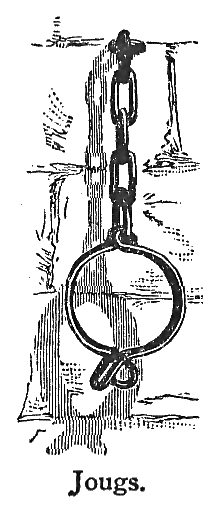
Jougs, joogz, n. an iron neck-ring that constituted the old Scottish pillory. [O. Fr. joug, a yoke—L. jugum.]
Jouisance, jōō′is-ans, n. (Spens.) joyousness. [Fr.,—jouir, to enjoy—L. gaudēre, to rejoice.]
Jouk, Jook, jōōk, v.i. (Scot.) to duck or dodge: to bow.—ns. Jouk′ery, Jook′ery, trickery; Jouk′ery-pawk′ery, low cunning, trickery.
Joule, jōōl, n. the practical unit of electrical energy. [After James Prescott Joule (1818-89).]
Jounce, jowns, v.t. and v.i. to jolt, shake.
Journal, jur′nal, n. a daily register or diary: a book containing an account of each day's transactions: a newspaper published daily or otherwise: a magazine: the transactions of any society.—n. Journalese′, the language of journalism.—v.i. Jour′nalīse, to write articles for a journal.—v.t. to enter in a journal:—pr.p. jour′nalīsing; pa.p. jour′nalīsed.—ns. Jour′nalism, the keeping of a journal: the profession of conducting or writing for public journals; Jour′nalist, one who writes for or conducts a newspaper.—adj. Journalist′ic, pertaining to journalism. [Fr.,—L. diurnalis.]
Journal, jur′nal, n. (mech.) that part of a shaft or axle which rests in the bearings.—v.t. to insert, as a shaft, in a journal-bearing.
Journey, jur′ni, n. any travel: tour: excursion: the weight of finished coins delivered at one time to the Master of the Mint—also Jour′ney-weight.—v.i. Jour′ney, to travel:—pr.p. jour′neying; pa.p. jour′neyed (-nid).—adj. Jour′ney-bat′ed (Shak.), wayworn.—ns. Jour′neyman, one who works by the day: any hired workman: one whose apprenticeship is completed; Jour′ney-work, work done by a journeyman or for hire. [Fr. journée—jour, a day—L. diurnus.]
Joust, jōōst, Just, just, n. the encounter of two knights on horseback at a tournament.—v.i. to run in the tilt. [O. Fr. jouste, joste—L. juxta, nigh to.]
Jovial, jō′vi-al, adj. joyous: full of mirth and happiness.—ns. Jove, Jupiter; Jovial′ity, Jō′vialness, quality of being jovial.—adv. Jō′vially. [L.,—Jupiter, Jovis, Jupiter, an auspicious star.]
Jow, jow, v.t. and v.i. (Scot.) to ring, toll.—n. a stroke of a bell.
Jowl, jowl, n. the jaw or cheek.—n. Jowl′er, a heavy-jawed hound. [M. E. forms are chol, chaul, corr. from chavel, and this again from A.S. ceafl, the jaw.]
Jowl, jōl, v.t. (Shak.). Same as Jole, to beat.
Jowter, jow′tėr, n. a fish-hawker.—Also Jow′der. [Prob. a form of jolter.]
Joy, joi, n. gladness: rapture, mirth: the cause of joy.—v.i. to rejoice: to be glad: to exult:—pr.p. joy′ing; pa.p. joyed.—v.t. Joy (Milt.), to enjoy.—n. Joy′ance (Spens.), gaiety, festivity.—adj. Joy′ful, full of joy: very glad, happy, or merry.—adv. Joy′fully.—n. Joy′fulness.—adj. Joy′less, without joy: not giving joy.—adv. Joy′lessly.—n. Joy′lessness.—adj. Joy′ous, full of joy, happiness, or merriment.—adv. Joy′ously.—n. Joy′ousness.—The Seven Joys of the Virgin:—the Annunciation, the Visitation, the Nativity, the Adoration of the three wise men, the Presentation in the Temple, the Discovery of the child in the Temple amidst the doctors, her Assumption and Coronation. [Fr. joie (It. gioja)—L. gaudium—gaudēre, to rejoice.]
Juba, jōō′ba, n. a negro breakdown or rustic dance, in which the spectators clap hands, slap their thighs, and sing verses with juba as a refrain.
Jubate, jōō′bāt, adj. having a mane.
Jubbah, jub′a, n. a long loose outer garment worn by Mohammedans in India, &c.
Jube, jōō′bē, n. the rood-loft or gallery over the entrance to the choir of a church. [L., imperat. of jubēre, to command.]
Jubilant, jōō′bi-lant, adj. shouting for joy: rejoicing: uttering songs of triumph.—n. Ju′bilance, exultation.—adv. Jubilantly.—v.i. Ju′bilate, to exult, rejoice.—ns. Jubilā′tē, the third Sunday after Easter, so called because the Church Service began on that day with the 66th Psalm, 'Jubilate Deo,' &c.: also the 100th Psalm, which in the English Prayer-Book is a canticle used as an alternative for the Benedictus; Jubilā′tion, a shouting for joy: the declaration of triumph. [L. jubilāre, to shout for joy. Not conn. with Jubilee.]
Jubilee, jōō′bi-lē, n. the year of release among the Jews every fiftieth year, proclaimed by the sound of a trumpet: the celebration of a fiftieth anniversary—e.g. of a king's accession, a bishop's consecration, &c.: in the R.C. Church, a year (every twenty-fifth—Ordinary jubilee) of indulgence for pilgrims and others, an Extraordinary jubilee being specially appointed by the Pope: any season of great public joy and festivity. [Fr. jubilé—L. jubilæus—Heb. yōbel, a trumpet, the blast of a trumpet.]
Jud, jud, n. a mass of coal holed or undercut so as to be thrown down by wedges.
Judaic, -al, jōō-dā′ik, -al, adj. pertaining to the Jews.—adv. Judā′ically.—n. Judaisā′tion.—v.t. Ju′daīse, to conform to or practise Judaism.—ns. Judaī′ser; Ju′daism, the doctrines and rites of the Jews: conformity to the Jewish rites; Ju′daist, one who holds the doctrines of Judaism.—adj. Judaist′ic, pertaining to Judaism.—adv. Judaist′ically. [L. Judaicus—Juda, Judah, a son of Israel.]
Judas, jōō′das, n. a traitor: an opening in a jail-door, &c.—adj. Ju′das-col′oured, red of hair—Judas traditionally being red-haired.—ns. Ju′das-hole, a small hole in a door for watching; Ju′das-kiss, any act of treachery under the guise of kindness (Matt. xxvi. 48, 49); Ju′das-tree, a tree with rose-coloured flowers that appear before the leaves—Judas having hanged himself on one.
Judean, jōō-dē′an, adj. belonging to Judea.—n. a native of Judea.
Judge, juj, v.i. to point out or declare what is just or law: to hear and decide: to pass sentence: to compare facts to determine the truth: to form or pass an opinion: to distinguish.—v.t. to hear and determine authoritatively: to sentence: to decide the merits of: to be censorious towards: to consider: (B.) to condemn.—n. one who judges: a civil officer who hears and settles any cause: an arbitrator: one who can decide upon the merit of anything: in Jewish history, a supreme magistrate having civil and military powers: (pl.) title of 7th book of the Old Testament.—ns. Judge′ship, the office of a judge; Judg′ment, act of judging: the comparing of ideas to elicit truth: faculty by which this is done, the reason: opinion formed: taste: sentence: condemnation: doom; Judg′ment-day, the day on which God will pronounce final judgment on mankind; Judg′ment-debt, a debt evidenced by legal record; Judg′ment-hall, a hall where a court of justice meets; Judg′ment-seat, seat or bench in a court from which judgment is pronounced. [Fr. juger—L. judicāre—jus, law, dicĕre, to declare.]
Judica, jōō′di-ka, n. Passion Sunday—from the opening words of the introit, 'Judica me, Deus' (43d Ps.).
Judicature, jōō′di-kā-tūr, n. power of dispensing justice by legal trial: jurisdiction: a tribunal.—adjs. Ju′dicable, that may be judged or tried; Ju′dicātive, having power to judge; Ju′dicātory, pertaining to a judge: distributing justice.—n. distribution of justice: a tribunal.
Judicial, jōō-dish′al, adj. pertaining to a judge or court of justice: established by statute.—adv. Judic′ially.—Judicial Committee, an offshoot of the Privy Council, forming a court of appeal; Judicial factor, in Scotland, an administrator appointed by the courts to manage the estate of some one under some imperfection; Judicial separation, the separation of two married persons by order of the Divorce Court. [L. judicialis—judicium.]
Judiciary, jōō-dish′i-ar-i, n. the judges taken collectively.—adj. pertaining to the courts of law: passing judgment. [L. judiciarius.]
Judicious, jōō-dish′us, adj. according to sound judgment: possessing sound judgment: discreet.—adv. Judic′iously.—n. Judic′iousness. [Fr. judicieux—Low L. judiciosus—L. judicium.]
Judy, jōō′di, n. Punch's wife in the puppet-show: a native Chinese strumpet. [Corr. of Judith.]
Jug, jug, n. a large vessel with a swelling body and narrow mouth for liquors.—v.t. to boil or stew as in a jug:—pr.p. jug′ging; pa.p. jugged.—Jugged hare (see Hare); Stone jug (slang), jail. [Prob. Judy, jocularly applied to a drinking-vessel; cf. Jack and Jill in a like sense.]
Jug, jug, v.i. to utter the sound jug, as certain birds, esp. the nightingale.—n. Jug-jug. [Imit.]
Jugal, jōō′gal, adj. malar: joining, uniting.—n. a bone of the zygomatic arch, malar bone.
Jugate, -d, jōō′gāt, -ed, adj. (bot.) having the leaflets in pairs: joined as jugata on a coin, &c.—n.pl. Ju′gata, heads shown side by side or overlapping.
Juggernaut, jug′er-nawt, n. an idol of the Hindu god Vishnu, beneath whose car devotees were supposed to immolate themselves; hence the 'car of Juggernaut' stands metaphorically for any Moloch of self-sacrifice. [Sans. Jagannātha, lord of the world.]
Juggins, jug′ginz, n. (slang) a simpleton.
Juggle, jug′l, v.i. to joke or jest: to amuse by sleight-of-hand: to conjure: to practise artifice or imposture.—n. a trick by sleight-of-hand: an imposture.—ns. Jugg′ler, one who performs tricks by sleight-of-hand: a trickish fellow; Jugg′lery, art or tricks of a juggler: legerdemain: trickery.—adv. Jugg′lingly, in a deceptive manner. [O. Fr. jogler—L. joculāri, to jest—jocus, a jest.]
Juglans, jōō′glanz, n. a genus of the walnut family.
Jugular, jug′ū-lar, adj. pertaining to the collar-bone, which joins the neck and shoulders.—n. one of the large veins on each side of the neck. [L. jugulum, the collar-bone—jungĕre, to join.]
Juice, jōōs, n. the sap of vegetables: the fluid part of animal bodies.—adj. Juice′less.—n. Juic′iness.—adj. Juic′y. [Fr.,—L. jus, broth, lit. mixture.]
Jujube, jōō′jōōb, n. a genus of spiny shrubs or small trees, the fruit of which is dried as a sweetmeat: a lozenge made of sugar and gum. [Fr.,—L. zizyphum—Gr. zizyphon—Pers. zīzfun, the jujube-tree.]
Julep, jōō′lep, n. a pleasant liquid medicine in which other nauseous medicines are taken.—Also Ju′lap. [Fr.,—Sp. julepe—Ar. jūlāb—Pers. jūlāb.]
Julian, jōōl′yan, adj. pertaining to C. Julius Cæsar (B.C. 100-44).—Julian year (see Year).
Julienne, zhü-li-en′, n. a clear soup, with shredded herbs. [Julien, a French cook in Boston.]
July, jōō′lī, n. the seventh month of the year—from Caius Julius Cæsar, who was born in it.
Jumart, jōō′mart, n. the offspring of a bull and a mare, or horse and cow. [Fr.,—L. jumentum.]
Jumble, jum′bl, v.t. to mix confusedly: to throw together without order.—v.i. to be mixed together confusedly: to be agitated: to jump at, to accept eagerly.—n. a confused mixture.—n. Jum′ble-sale, a charity bazaar of cast-off clothing, rubbish, &c.—adv. Jum′blingly, in a jumbled or confused manner. [Prob. a freq. of jump.]
Jumbo, jum′bō, n. a colossus.—adj. huge, colossal. [Name of a huge elephant sold in 1882 from the London Zoological Gardens to P. T. Barnum.]
Jump, jump, v.i. to spring upward, or forward, or both: to bound: to pass to as by a leap: to agree, coincide (with).—v.t. to pass by a leap: to skip over: to cause to start, as game:—pr.p. jump′ing; pa.p. jumped.—n. act of jumping: a bound, a hazard.—adv. (Shak.) exactly.—ns. Jump′er, one who jumps: a long iron drill or borer used in quarries and mines: (pl.) a term applied to certain Welsh Methodists (c. 1760), who jumped about in worship: Jump′ing-deer, the black-tailed American deer; Jump′ing-hare, a South African rodent, akin to the jerboas; Jump′-seat, a carriage-seat which may be moved backwards or forwards, so as to be used as single or double: a carriage with a movable seat; Count′er-jump′er, a draper's shopman.—Jump a claim (U.S.), to take land to which another already holds a claim; Jump at, to embrace with eagerness; Jump one's bail, to abscond, forfeiting one's bail; Jump over, to disregard, omit; Jump over the broomstick, to make an irregular marriage. [From a Teut. root seen in Sw. dial. gumpa, Middle High Ger. gumpen, to jump.]
Jump, jump, Jumper, jump′er, n. a loose garment: overall. [More prob. a thing to be jumped or slipped on, than from Fr. jupe, a petticoat, skirt.]
Juncaceous, jun-kā′shus, adj. of or pertaining to the Juncaceæ, a natural order of plants, of which the Jun′cus, or rush, is the type.
Juncate, jungk′āt, n. Same as Junket.
Junco, jung′kō, n. a North American snow-bird.
Junction, jungk′shun, n. a joining, a union or combination: place or point of union. [Join.]
Juncture, jungk′tūr, n. a joining, a union: a critical or important point of time. [L. junctura.]
June, jōōn, n. the sixth month, originally of 26 days, but since Julius Cæsar's time of 30. [L. Junius, the sixth month, prob. from root of L. juvenis, junior.]
Juneating, an erroneous form of jenneting.
Jungermannia, joong-ger-man′i-ä, n. (bot.) a suborder of Hepaticæ. [From a German botanist, Jungermann (1572-1653).]
Jungle, jung′gl, n. land covered with thick brushwood, &c.—ns. Jungle-fē′ver, a severe malarial or remittent fever; Jung′le-fowl, a wild species of genus Gallus, the parent of our barn-door fowl.—adj. Jung′ly. [Sans. jañgala, desert.]
Junior, jōōn′yur, adj. younger: less advanced.—n. one younger or less advanced.—ns. Junior′ity, Jun′iorship; Jun′ior-right, borough-English (q.v.).—Junior optime, a third-class honours man at Cambridge, next to Wranglers and Senior Optimes; Junior soph, an undergraduate of the second year at Cambridge. [Contr. of L. juvenior, younger—juvenis, young.]
Juniper, jōō′ni-pėr, n. an evergreen shrub, the berries of which are used in making gin. [L. juniperus—juvenis, young, parĕre, to bring forth.]
Junk, jungk, n. a Chinese vessel, with high forecastle and poop, sometimes large and three-masted. [Port. junco—Chinese chw‛an, a boat.]
Junk, jungk, n. pieces of old cordage, used for making mats, &c., and when picked to pieces, forming oakum for the seams of ships: salt meat supplied to vessels for long voyages, so called because it becomes as hard as old rope.—ns. Junk′-deal′er, Junk′man, a dealer in junk; Junk′-ring, a metal ring confining a fibrous piston-packing; Junk′-shop, a place where junk is bought and sold. [L. juncus, a rush.]
Junk, jungk, n. a thick piece, chunk. [Chunk.]
Junk-bottle, junk′bot-l, n. a thick, strong bottle, of green or black glass.
Junker, yōōng′kėr, n. a young German noble or squire.—n. Junk′erism, the narrow political and social ideas of the aristocratic party in Prussia called Junkers.
Junket, jung′ket, n. any sweetmeat or delicacy: curds mixed with cream, sweetened and flavoured: a feast or merrymaking, a picnic, a spree.—v.i. to feast, banquet, take part in a convivial entertainment or spree.—v.t. to feast, regale, entertain:—pr.p. junketing; pa.p. jun′keted.—n. Junk′eting, a merry feast or entertainment, picnicking. [It. guincata—L. juncus, a rush.]
Juno, jōō′nō, n. in Roman mythology, the wife of Jupiter, parallel with the Greek Hera, regarded as the special protectress of marriage and the guardian of woman from birth to death: a queenly woman.—adj. Junō′nian.
Junta, jun′ta, n. a meeting, council: a Spanish grand council of state. [Sp.,—L. jungĕre, to join.]
Junto, jun′tō, n. a body of men joined or united for some secret intrigue: a confederacy: a cabal or faction:—pl. Jun′tos. [Sp. junta.]
Jupati-palm, jōō′pa-tē-päm, n. a South American palm yielding the raphia-fibre.
Jupiter, jōō′pi-tėr, n. the chief god among the Romans, the parallel of the Greek Zeus—also Jove: the largest and, next to Venus, the brightest of the planets.—Jupiter's beard, the house-leek. [L., Gr. Zeus patēr, Sans. Dyaus pitar, lit. 'Jove (Zeus) father.']
Jupon, jōō′-pon, n. a sleeveless jacket or close-fitting coat, extending down over the hips: a petticoat.—n. Jupette′, a jupon with very short skirt. [Fr. jupon, jupe, a petticoat.]
Jural, jōō′ral, adj. pertaining to natural or positive right.—adv. Ju′rally.
Jurassic, jōō-ras′sik, adj. (geol.) one of the three divisions of the Mesozoic rocks, including the Lias and Oolites, and so called from its well-developed strata in the Jura Mountains.
Jurat, jōō′rat, n. the official memorandum at the end of an affidavit, showing the time when and the person before whom it was sworn.
Jurat, jōō′rat, n. a sworn officer, as a magistrate.
Jurant, jōō′rant, adj. taking an oath.—n. one who takes an oath.—adj. Ju′ratory, pertaining to an oath.
Juridical, jōō-rid′ik-al, adj. relating to the distribution of justice: pertaining to a judge: used in courts of law.—adv. Jurid′ically. [L. juridicus—jus, juris, law, dicere[typo: dicĕre], to declare.]
Jurisconsult, jōō-ris-kon′sult, n. one who is consulted on the law: a lawyer who gives opinions on cases put to him: a jurist. [L. jus, juris, law, consultus—consultere, to consult.]
Jurisdiction, jōō-ris-dik′shun, n. the distribution of justice: legal authority: extent of power: district over which any authority extends.—adjs. Jurisdic′tional, Jurisdic′tive. [Fr.,—L. jurisdictio.]
Jurisprudence, jōō-ris-prōō′dens, n. the science or knowledge of law.—adj. Jurispru′dent, learned in law.—n. one who is learned in law.—adj. Jurispruden′tial.—Medical jurisprudence, forensic medicine (see Forensic). [Fr.—L., jurisprudentia—jus, juris, law, prudentia, knowledge.]
Jurist, jōō′rist, n. one who is versed in the science of law, esp. Roman or civil law: a civilian.—adjs. Jurist′ic, -al.—adv. Jurist′ically. [Fr. juriste.]
Jury, jōō′ri, n. a body of not less than twelve men, selected and sworn, as prescribed by law, to declare the truth on evidence before them: a committee for deciding prizes at a public exhibition.—ns. Ju′ror, one who serves on a jury—also Ju′ryman; Ju′ry-box, the place in which the jury sit during a trial.—Jury of matrons, a jury of 'discreet' women impanelled to try a question of pregnancy, as where a widow alleges herself to be with child by her late husband, or a woman sentenced to death, to stay execution, pleads that she is with child. [Fr. juré, sworn—jurer—L. jurāre, to swear.]
Jurymast, jōō′ri-mäst, n. a temporary mast raised instead of one lost.—adj. Ju′ry-rigged, rigged in a temporary way.—n. Ju′ry-rudd′er, a temporary rudder for one lost. [Not injury-mast, but O. Fr. ajurie, aid—L. adjutāre, to aid.]
Jus, jus, n. law right.—Jus civile, the civil law; Jus divinum, the divine right of kings; Jus gentium, law of nations; Jus mariti, the right of a husband; Jus naturale, the law of nature, the common sense of justice; Jus primæ noctis, the alleged right of a feudal superior to deflower a young bride.
Jussive, jus′iv, adj. expressing command.—n. a grammatical form or construction expressing commands.
Just, just, n. a tilt. Same as Joust.
Just, just, adv. lawful: upright: exact: regular: true: righteous.—adv. precisely, almost exactly, very lately, (coll.) quite, barely.—adv. Just′ly, in a just manner: equitably: uprightly: accurately: by right.—n. Just′ness, equity: propriety: exactness. [Fr.,—L. justus—jus, law.]
Justice, jus′tis, n. quality of being just: integrity: impartiality: desert: retribution: a judge: a magistrate.—ns. Jus′ticeship, office or dignity of a justice or judge; Justic′iary, Justic′iar, an administrator of justice: a chief-justice.—Justice of the Peace (abb. J.P.), an inferior magistrate; Justices' justice, a term sarcastically applied to the kind of justice sometimes administered by the unpaid and amateur magistracy of England.—Lord Chief-justice, the chief judge of the King's (or Queen's) Bench Division of the High Court of Justice; Lord Justice-clerk, the Scottish judge ranking next to the Lord-Justice-general, presiding over the Outer House or Second Division of the Court of Session, vice-president of the High Court of Justiciary; Lord Justice-general, the highest judge in Scotland, called also the Lord President of the Court of Session.—High Court of Justiciary, the supreme criminal court of justice in Scotland. [Fr.,—L. justitia.]
Justify, jus′ti-fī, v.t. to make just: to prove or show to be just or right: to vindicate: to absolve:—pr.p. jus′tifying; pa.p. jus′tified.—adj. Justifī′able, that may be justified or defended.—n. Justifī′ableness.—adv. Justifī′ably.—n. Justificā′tion, vindication: absolution: a plea of sufficient reason for.—adjs. Jus′tificātive, Jus′tificātory, having power to justify.—n. Jus′tifier, one who defends, or vindicates: he who pardons and absolves from guilt and punishment.—Justification by faith, the doctrine that men are justified by faith in Christ. [Fr.,—L. justificāre—justus, just, facĕre, to make.]
Justle, jus′l, v.t. Same as Jostle.
Jut, jut, v.i. to project:—pr.p. jut′ting; pa.p. jut′ted.—adv. Jut′tingly, projectingly.—n. Jut′-win′dow, a projecting window. [A form of jet.]
Jute, jōōt, n. the fibre of an Indian plant resembling hemp, used in the manufacture of coarse bags, mats, &c. [Orissa jhot, Sans. jhat.]
Jutty, jut′i, n. a projecting part of a building: a pier, a jetty.—v.t. and v.i. (Shak.) to jut. [Jut.]
Juvenal, jōō′ve-nal, n. (Shak.) a youth. [L.]
Juvenescent, jōō-ven-es′ent, adj. becoming young.—n. Juvenesc′ence. [L. juvenescĕre, to grow young.]
Juvenile, jōō′ve-nīl, or -nil, adj. young: pertaining or suited to youth: puerile.—n. a young person: a book written for such: an actor who plays youthful parts.—ns. Ju′venileness, Juvenil′ity. [Fr.,—L. juvenilis—juvenis, young.]
Juxtaposition, juks-ta-pō-zish′un, n. a placing or being placed near: contiguity.—v.t. Juxtapose′, to place side by side. [L. juxta, near, and position.]
Jymold, jī′mold, adj. (Shak.). Same as Gimmal.
the eleventh letter in our alphabet, its sound that of the sharp guttural mute, formed by raising the tongue to the back of the palate: (chem.) the symbol for potassium: (math.) generally a constant coefficient: also a unit vector perpendicular to i and j: as a medieval numeral, 250.
Kaaba, kä′bä, or kā′a-bä, n. Same as Caaba (q.v.).
Kabala, kab′a-la, n. Same as Cabala.
Kabyle, ka-bīl′, n. one of a branch of the great Berber race of North Africa: a dialect of Berber spoken by many of the Kabyles. [Fr.,—Ar. Qabāil, pl. of qabīla, a tribe.]
Kaddish, kad′ish, n. a Jewish form of thanksgiving and prayer, used at funerals, &c. [Heb.]
Kadi, kā′di, n. Same as Cadi.
Kae, kā, n. (Scot.) a jackdaw.—Also Ka.
Kaffiyeh, kaf′i-ye, n. a small shawl worn about the head in Syria.
Kafila, kaf′i-la, n. a camel train, caravan.
Kafir, kaf′ir, n. one of a native race of SE. Africa.—Kafir bread, the pith of a South African plant; Kafir corn, Indian millet. [Ar., unbeliever.]
Kaftan. Same as Caftan.
Kago, kag′ō, n. a Japanese basket with palanquin slung from a pole and carried by men.
Kaiak. Same as Kayak.
Kaif, kīf, n. undisturbed quiescence. [Ar.]
Kail, kāl, n. a ninepin. [Cf. Dut. and Ger. kegel.]
Kail. See Kale.
Kaimakam, kī-ma-kam′, n. a lieutenant-colonel in the Turkish army: the administrator of a subdivision of a vilayet.
Kain, kān, n. in old Scots law, rent paid in kind, e.g. in poultry, to a landlord.
Kainite, kī′nīt, n. a hydrated compound of the chlorides and sulphates of magnesium and potassium, used as a fertiliser. [Gr. kainos, new.]
Kainozoic. Same as Cainozoic.
Kaiser, kī′zėr, n. an emperor, esp. of Germany and Austria.—n. Kai′sership. [Ger.,—L. Cæsar.]
Kaka, kä′ka, n. a New Zealand parrot.—n. Ka′kapo, a nocturnal flightless New Zealand parrot.
Kakemono, kak-e-mō′nō, n. a Japanese wall-picture or decoration, painted on silk, gauze, or paper, and mounted on cylindrical rods.
Kaki, kä′kē, n. the persimmon of Japan, or Chinese date.
Kakistocracy, kak-is-tok′rā-si, n. government by the worst men in the state. [Gr. kakistos, superl. of kakos, bad, kratia, rule.]
Kakodyl. See Cacodyl.
Kala, kä′la, n. time: destiny.—Kâla chakra, the wheel of time. [Sans.]
Kalamdan, kal′am-dan, n. a Persian writing-case, with compartments for ink, reed-pens, knife, &c.
Kalamkari, kal-am-kar′i, n. a method of colouring and decorating by several dyeings or printings, also a chintz so treated. [Pers.]
Kale, Kail, kāl, n. a cabbage with open curled leaves, cabbage generally: broth of which kale is a chief ingredient.—ns. Kail′yard, a kitchen-garden; Kale′-runt, a cabbage-stem.—Kailyard-school, a group of writers of stories of humble Scotch country life—S. R. Crockett, Ian Maclaren, &c. [Cole.]
Kaleidophone, ka-lī′do-fōn, n. an instrument consisting of a rod or thin plate with a knob at the end, for showing the curves corresponding with the musical notes produced by the vibrations. [Gr. kalos, beautiful, eidos, form, phōnē, sound.]
Kaleidoscope, ka-lī′do-skōp, n. an optical toy in which we see an endless variety of beautiful colours and forms.—adj. Kaleidoscop′ic. [Gr. kalos, beautiful, eidos, form, skopein, to see.]
Kalendar, Kalends=Calendar, Calends.
Kalevala, kal-e-vä′lä, n. the great Finnish epic, written in eight-syllabled trochaic verse (from which Longfellow's Hiawatha is imitated), taken down from the lips of the peasantry and pieced together by Dr. Lönnrot of Helsingfors in 1835, in extended form (22,793 verses) in 1849. [Finnish, kaleva, a hero, -la, denoting place.]
Kali, kal′i, or kā′lī, n. the prickly saltwort or glasswort.—adj. Kalig′enous, producing alkalies.—n. Kā′lium, potassium.
Kali, kä′lē, n. a carpet with long nap, also the large carpet covering the centre of a Persian room.
Kali, kä′lē, n. a Hindu goddess, wife of Siva, the dark goddess of destruction—called also Durga.
Kalif, kā′lif, n. Same as Calif.
Kaliyuga, kal-i-yōō′ga, n. in Hindu mythology, the present age of the world, the fourth, characterised by universal degeneracy.
Kalmia, kal′mi-ä, n. a genus of North American evergreen shrubs, including the American mountain laurel. [From Peter Kalm, pupil of Linnæus.]
Kalmuck, kal′muk, n. a member of a Mongolian race.—Also Cal′muck. [Russ.]
Kalology, kal-ol′o-ji, n. the science of beauty in itself considered. [Gr. kalos, beautiful, logia, discourse.]
Kalong, ka-long′, n. a general name of the large fruit-bats, flying foxes, &c.
Kalotype. Same as Calotype.
Kalpa, kal′pa, n. a day of Brahma, a period of 4320 million years.—Also Cal′pa. [Sans., 'formation.']
Kalpis, kal′pis, n. a three-handled water-vase. [Gr.]
Kalsomine, an incorrect form of calcimine, which see under Calcium.
Kalyptra, ka-lip′tra, n. a thin veil worn by Greek women over the hair.
Kam, käm, adj. (Shak.) crooked.
Kama, kä′ma, n. the god of love in the Purânas: impure desire.—Also Cama, Ka′madeva.
Kamera, kam′ė-ra, n. a room. See Camera.
Kames, kāmz, n.pl. (geol.) banks and ridges of gravel, sand, &c., associated with the glacial deposits of Scotland—the same as åsar (q.v.) and eskar.
Kami, kä′mi, n. a Japanese term for a lord, for any of the national gods, demi-gods, or deified heroes, or any of their supposed descendants, as the mikados and the imperial family. [Japanese, 'superior.']
Kamichi, kam′i-chi, n. the horned screamer.
Kamila, Kamela, ka-mē′la, n. an East Indian orange dye-stuff yielded by a common Madras tree of the spurge family.
Kamis, Kamees, ka-mēs′, n. the long loose sleeved shirt worn by men in Mohammedan countries.
Kampong, kam-pong′, n. an enclosed space. [Malay.]
Kamptulicon, kamp-tū′li-kon, n. a ground cork and caoutchouc floorcloth. [Gr. kamptein, to bend.]
Kamsin. See Khamsin.
Kana, kä′na, n. Japanese writing, as distinguished from Japanese written in Chinese characters.
Kanaka, ka-nak′a, n. a Hawaiian or Sandwich Islander: one of the native labourers brought from the Pacific islands, on engagement for a certain fixed number of years, to Australia, &c. [Hawaiian, 'a man.']
Kaneh, kä′ne, n. a Hebrew measure of 6 cubits length.—Also Cā′neh.
Kang, kang, n. a large Chinese water-jar: an oven-like brick structure in northern China, for sleeping on at night, a fire being lighted underneath.
Kangaroo, kang-gar-ōō′, n. a large marsupial mammal of Australia, with very long hind-legs and great power of leaping.—n. Kangaroo′-grass, a valuable Australian fodder grass.
Kans, kanz, n. a common Indian grass, allied to the sugar-cane.
Kanten, kan′ten, n. a gelatinous substance extracted from seaweeds, used for soups and for sizing. [Jap.]
Kantian, kan′shi-an, adj. pertaining to the doctrines of, or belonging to, the great German philosopher, Immanuel Kant (1724-1804).—ns. Kan′tianism, Kant′ism, the doctrines or philosophy of Kant; Kant′ist, a disciple or follower of Kant.
Kantikoy, Canticoy, kan′ti-koi, n. a religious dance among American Indians, a dancing-match.—v.i. to dance as an act of worship.
Kanuck, ka-nuk′, n. (U.S.) a Canadian.—Also Canuck′. [Ind.]
Kaolin, kä′o-lin, n. same as China clay. [From the mountain Kao-ling ('high ridge') in China.]
Kapellmeister, kä-pel′mīs-ter, n. the director of an orchestra or choir, esp. the band of a ruling prince in Germany. [Ger. kapelle, chapel, orchestra, meister, master.]
Kapnography, kap-nog′ra-fi, n. the art of producing decorative designs on a smoked surface with a fine point, shading by successive deposits of carbon from a flame, fixed by varnish.—adj. Kapnograph′ic. [Gr. kapnos, smoke, graphia—graphein, to write.]
Kapok, ka-pok′, n. a cottony or silky fibre covering the seeds of a species of silk-cotton tree, used for stuffing pillows, &c.
Karaite, kā′rä-īt, n. one of a stricter sect of Jews who cling to the literal interpretation of Scripture as against oral tradition. [Heb. karaīm, readers.]
Karma, kär′mä, n. the Buddhist conception of the quality of actions, including both merit and demerit, determining the future condition of all sentient beings by a sort of virtue inherent in the nature of things—by the blind and unconscious but inevitable concatenation of cause and effect: the theory of inevitable consequence generally: the result of the actions of a life.—adj. Kar′mic. [Sans. karma, work.]
Karmathian, kär-mā′thi-an, n. a member of a pantheistic socialistic Mohammedan sect which arose in Turkey about the close of the 9th century. [Karmat, its founder.]
Karob, kar′ob, n. among goldsmiths, the twenty-fourth part of a grain.
Karroo, ka-rōō′, n. a generic name given to the high barren plains of Cape Colony.—Also Karoo′. [Hottentot, karusa, hard.]
Kassu, kas′ōō, n. a kind of catechu made from the fruit of the betel-nut palm.
Kat, kat, n. the chief ancient Egyptian unit of weight, 1⁄50 lb. avoirdupois.
Katabolism, kat-ab′ol-izm, n. (biol.) the discharging or disruptive process to which protoplasm is constantly subject—the opposite of Anabolism, the up-building, constructive process.—Also Catab′olism. [Gr. katabolē, kataballein, to throw down.]
Katakana, kat-a-kä′na, n. one of the two styles of writing the syllabary of 48 letters in use among the Japanese (the other being Hiragana), used chiefly for proper names and foreign words.
Katydid, kā-ti-did′, n. an American insect akin to the grasshopper. [Imit. of its note.]
Kauri-pine, kow′ri-pīn, n. a splendid forest-tree of New Zealand, yielding the well-known Kau′ri-gum, a resin used in making varnish.
Kava, kä′va, n. Piper methysticum, also the narcotic drink prepared from it.—Also A′va.
Kavass, ka-vas′, n. an armed man attendant on a person of distinction in Turkey.—Also Cavass′. [Turk. qawas.]
Kaw. Same as Caw.
Kay. Same as Cay.
Kayak, ka′yak, n. a canoe used in Greenland, made of seal-skins stretched on a frame.
Kea, kē′ä, n. a New Zealand parrot that kills sheep.
Keb, keb, v.i. (Scot.) to cast a lamb prematurely.—n. a ewe which has cast its lamb: a sheep louse or tick.
Kebbie, keb′i, n. (Scot.) a cudgel.
Kebbock, keb′uk. n. (Scot.) a cheese.—Also Kebb′uck. [Gael. cabag, a cheese.]
Keblah. See Kiblah.
Keck, kek, v.i. to retch, feel loathing.—n. a retching.
Keck, Kecksy. See Kex.
Keckle, kek′l, v.t. to preserve or protect by binding with old rope or chains, as a cable:—pr.p. keck′ling; pa.p. keck′led.—n. Keck′ling, rope, chains, &c. used to keckle cables or hawsers.
Kedge, kej, n. a small anchor for keeping a ship steady, and for warping the ship.—v.t. to move by means of a kedge, to warp.—n. Kedg′er, a kedge. [Scand.; cf. Sw. prov. keka, to drive slowly.]
Kedge, kej, adj. (prov.) brisk, lively: pot-bellied.—Also Kedg′y, Kidge.
Kedjeree, kej′e-rē, n. a mess of rice, cooked with butter and the dholl pea, flavoured with spice, shred onion, &c., common all over India, and often served at Anglo-Indian breakfast-tables. [Hind. khichrī.]
Keech, kēch, n. (Shak.) a lump of fat. [Cake.]
Keek, kēk, v.i. (Scot.) to peep.—n. a peep.—ns. Keek′er, an inspector of mining; Keek′ing-glass, a mirror. [M. E. kyken; cf. Dut. kijken, Ger. kucken.]
Keel, kēl, n. the part of a ship extending along the bottom from stem to stern, and supporting the whole frame: a low flat-bottomed boat: a Tyne coal-barge: a ship generally: (bot.) the lowest petals of the corolla of a papilionaceous flower.—v.t. or v.i. to plough with a keel, to navigate: to turn keel upwards.—n. Keel′age, dues for a keel or ship in port.—adj. Keeled (bot.) keel-shaped: having a prominence on the back.—ns. Keel′er, Keel′man, one who works on a barge.—v.t. Keel′haul, to punish by hauling under the keel of a ship by ropes from the one side to the other: to treat a subordinate in a galling manner. [A.S. ceól, a ship; Ger. and Dut. kiel; prob. confused with Ice. kiölr, a keel.]
Keel, kēl, v.t. (Shak.) to cool. [A.S. célan, to chill.]
Keel, kēl, n. (Scot.) red chalk, ruddle.—v.t. to mark with ruddle. [Prob. Gael. cil, ruddle.]
Keelie, kē′li, n. (Scot.) the kestrel: a street Arab or young rough. [Imit.]
Keeling, kē′ling, n. (Scot.) a codfish.
Keelivine, kē′li-vīn, n. (Scot.) a lead pencil.—Also Kee′lyvine. [See keel, ruddle; ety. dub.]
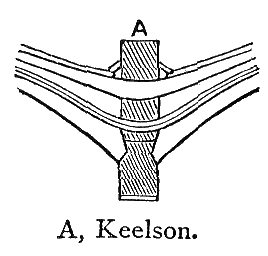
Keelson, Kelson, kel′sun, n. an inner keel placed right over the outer keel of a ship, and securely fastened thereto. [Sw. kölsvin, Norw. kjölsvill, the latter syllable=Ger. schwelle, Eng. sill.]
Keen, kēn, adj. eager: sharp, having a fine edge: piercing: acute of mind: penetrating: intense.—adv. Keen′ly.—n. Keen′ness. [A.S. céne; Ger. kühn, bold; Ice. kænn, wise. Cog. with ken and can.]
Keen, kēn, n. a lamentation over the dead.—v.i. to wail over the dead.—n. Keen′er, a professional mourner. [Ir. caoine.]
Keep, kēp, v.t. to have the care of: to guard: to maintain: to manage: to have in one's service: to hold for one's own use or enjoyment: to remain in: to adhere to: to practise: not to lose: to maintain hold upon: to restrain from departure: to preserve in a certain state: to maintain: to fulfill.—v.i. to remain in any position or state: to remain fresh: to last or endure: to continue: to adhere: to have rooms at college (Cambridge):—-pr.p. keep′ing; pa.t. and pa.p. kept.—n. that which keeps or protects: subsistence: food: the innermost and strongest part of a castle, the donjon: a stronghold.—ns. Keep′er, an attendant, manager, owner: a gamekeeper: socket, guard-ring; Keep′ership, office of a keeper; Keep′ing, care: custody: charge: (Shak.) maintenance, support: just proportion, harmony: (paint.) due proportion of light and shade; Keep′ing-room, a sitting-room, parlour; Keep′sake, something given to be kept for the sake of the giver—the name used often to be applied to the annuals or sumptuous gift-books so much in vogue about 1830.—Keep an act, to hold an academical disputation; Keep an eye on, Keep company, chapel, counsel, distance, hours, house, the peace, &c. (see the nouns); Keep a term (see Term); Keep at it, to persist in anything; Keep back, to withhold: keep down, to repress (see also Dark); Keep body and soul together, to maintain life; Keep down, to restrain; Keep from, to abstain from: to remain away from; Keep going in a thing, to keep one supplied with it; Keep in, to prevent from escaping: to confine a pupil in the schoolroom after school hours: to conceal: to restrain; Keep in with, to maintain the confidence or friendship of some one; Keep off, to hinder from approaching or making an attack; Keep one's countenance, to preserve a calm appearance, hiding one's emotions; Keep one's hand in, to retain one's skill by means of constant practice; Keep the breath to cool one's porridge, to confine attention to one's own affairs; Keep the powder dry, to keep one's energies ready for action; Keep to, to stick closely to: to confine one's self to; Keep under, to hold down in restraint; Keep up, to retain one's strength or spirit: to support, prevent from falling: to continue, to prevent from ceasing: to maintain in good condition. [A.S. cépan, orig. to traffic, hence to store up, keep—ceáp, price.]
Keeve, kēv, n. a large tub. [A.S. cýfe, vat.]
Keg, keg, n. a small cask or barrel. [Ice. kaggi.]
Keir, kēr, n. a bleaching-vat.
Kelk, kelk, v.t. (prov.) to beat.—n. a blow.
Kell, kel, n. (prov.) a film, network.
Kelp, kelp, n. the calcined ashes of seaweed, once used in making glass.—Also Kilp. [Ety. unknown.]
Kelpie, Kelpy, kel′pi, n. (Scot.) a malignant water-sprite haunting fords in the form of a horse.
Kelson. Same as Keelson.
Kelt, kelt, n. a salmon that has just spawned.
Kelt, kelt, n. (Scot.) cloth made of black and white wool mixed and not dyed.—adj. Kel′ter, made of such.
Kelt, Keltic. Same as Celt, Celtic.
Keltie, Kelty, kel′ti, n. (Scot.) a bumper imposed as a penalty on one who does not drink fair.
Kemb, kem, v.t. to comb. [A.S. cemban, to comb.]
Kemp, kemp, n. the coarse rough hairs of wool: (pl.) knotty hair which will not felt.
Kemp, kemp, n. (arch.) a champion: (Scot.) a contest in work, &c.—v.i. to strive for mastery.—ns. Kem′per, Kem′pery-man, a champion, a knight-errant. [A.S. cempa, a warrior. Cf. champion.]
Ken, ken, v.t. to know: (arch.) to see and recognise at a distance.—n. range of knowledge or sight.—n. Ken′ning (Bacon), range of vision: (Scot.) a small portion.—adj. Ken′speckle (Scot.), conspicuous—also Ken′speck. [Ice. kenna, orig. to cause to know. Cf. can and know.]
Ken, ken, n. (slang) a house. [Perh. Pers. khān, a caravansary; not conn. with kennel.]
Kendal-green, ken′dal-grēn, n. green cloth for foresters made at Kendal in Westmorland.
Kennel, ken′el, n. a house for dogs: a pack of hounds: the hole of a fox, &c.: a haunt.—v.t. to keep in a kennel.—v.i. to live in a kennel:—pr.p. kenn′elling; pa.p. kenn′elled. [Norm. Fr. kenil (Fr. chenil)—L. canīle—canis, a dog.]
Kennel, ken′el, n. the water-course of a street: a gutter. [A form of canal.]
Kennel-coal. Same as Cannel-coal.