LIST OF ABBREVIATIONS USED IN THIS DICTIONARY. (continued 10)
Reading edition
Heavy, hev′i, adj. weighty: not easy to bear: oppressive: afflicted: inactive: dull, lacking brightness and interest: inclined to slumber: violent: loud: not easily digested, as food: miry, as soil: having strength, as liquor: dark with clouds: gloomy: expensive: (B.) sad: (theat.) pertaining to the representation of grave or serious parts.—adv. Heav′ily.—n. Heav′iness.—adjs. Heav′y-armed, bearing heavy armour or arms; Heav′y-hand′ed, clumsy, awkward: oppressive; Heav′y-head′ed, having a heavy or large head: dull, stupid, drowsy; Heav′y-heart′ed, weighed down with grief; Heav′y-lād′en, laden with a heavy burden.—n. Heav′y-spar, native sulphate of barium, barytes.—Heavy marching order, the condition of troops fully equipped for field service; Heavy metal, guns or shot of large size: great influence or power; Heavy-weight, one beyond the average weight, esp. in sporting phrase, one placed highest in the ascending scale, feather-weight, light-weight, middle-weight, heavy-weight; Heavy wet, a drink of strong ale or ale and porter mixed.—The heavies (mil.), the heavy cavalry: those who play heavy parts. [A.S. hefig—hebban, to heave; Old High Ger. hebîg.]
Hebdomadal, heb-dom′a-dal, adj. occurring every seven days: weekly—also Hebdom′adary.—n. Heb′domad, the number seven, a group of seven things, a week: in some Gnostic systems, a group of superhuman beings, angels, or divine emanations, the sphere of the Demiurge lower than the ogdoad—from the idea of the seven planets.—adv. Hebdom′adally, from week to week.—n. Hebdom′adary, a member of a chapter or convent who officiates in the choir, &c., on a certain week.—Hebdomadal Council, a board which practically manages the business of the university of Oxford, usually meeting weekly. [L. hebdomadalis—Gr. hebdomas, a period of seven days—hepta, seven.]
Hebe, hē′bē, n. a personification of youth and spring, from the name of the daughter of Zeus and Hera, who was cup-bearer of Olympus.
Heben, heb′n, n. and adj. (Spens.) ebony.
Hebenon, heb′e-non, n. (Shak.) a poisonous juice. [Perh. ebony, or a corr. of henbane.]
Hebetate, heb′e-tāt, v.t. to make dull or blunt.—adj. Heb′etant, making dull.—ns. Hebetā′tion, Heb′etūde; Hebetudinos′ity.—adj. Hebetū′dinous. [L. hebetāre, -ātum—hebes, blunt.]
Hebrew, hē′brōō, n. one of the descendants of Abraham, who emigrated from beyond the Euphrates into Palestine: an Israelite, a Jew: the language of the Hebrews (fem. Hē′brewess, B.): (coll.) unintelligible speech.—adj. relating to the Hebrews.—adjs. Hebrā′ic, -al, relating to the Hebrews or to their language.—adv. Hebrā′ically, after the manner of the Hebrew language: from right to left.—n. Hebrā′icism.—v.t. Hē′braise, to express as in Hebrew: to conform or incline to Hebrew ideals.—ns. Hē′braiser; Hē′braism, a Hebrew idiom; Hē′braist, one skilled in Hebrew.—adjs. Hebraist′ic, -al, of or like Hebrew.—adv. Hebraist′ically.—n. Hē′brewism. [O. Fr. Ebreu—L. Hebræus—Gr. Hebraios—Heb. ‛ibrî, lit. 'one from the other side (of the river).']
Hebridean, hē-brid′ē-an, -i-an, adj. pertaining to the Hebrides—also Hebrid′ian.—n. a native thereof.
Hecate, hek′a-tē, n. a mysterious goddess, in Hesiod having power over earth, heaven, and sea—afterwards identified with many other goddesses, her power above all displayed in the matter of ghosts and bogies. [L.,—Gr. Hekatē—hekas, far.]
Hecatomb, hek′a-tom, n. among the Greeks and Romans, a sacrifice of a hundred oxen: a great public sacrifice: any large number of victims. [Gr. hekatombē—hekaton, a hundred, bous, an ox.]
Hecatontome, hek′a-ton-tōm, n. (Milt.) a very large number of books. [Gr. hekaton, a hundred, tomos, a volume.]
Hech, heh, interj. (Scot.) an exclamation of surprise.
Hecht, heht, Scotch form of hight, v.
Heck, hek, n. (Scot.) a rack in a stable for hay, &c.: a grated contrivance for catching fish: a contrivance in a spinning-wheel, and also in a warping-mill, by which the yarn or thread is guided to the reels.—Live at heck and manger, to be in very comfortable quarters. [A.S. hec, hæc; Dut. hek.]
Heckle, hek′l, v.i. to comb: to put a parliamentary candidate, or the like, through a series of embarrassing questions.—n. the same as Hack′le, Hatch′el.—ns. Heck′le, the long shining feathers on a cock's neck, a feather ornament in the full-dress bonnets of Highland regiments; Heck′ler, one who torments a candidate with catching questions.
Hectare, hek′tär, n. a superficial measure=100 ares, 10,000 sq. metres, or nearly 2½ acres (2.471). [Fr.,—Gr. hekaton, 100, L. area, area.]
Hectic, -al, hek′tik, -al, adj. pertaining to the constitution or habit of body: affected with hectic fever.—n. Hec′tic, a habitual or remittent fever, usually associated with consumption.—adj. Hec′toid, of a hectic appearance.—Hectic fever, the name given to the fever which occurs in connection with certain wasting diseases of long duration. [Fr.,—Gr. hektikos, habitual—hexis, habit.]
Hectogramme, hek′to-gram, n. a weight of 100 grammes, or nearly ¼ lb. (3.527 ounces). [Fr.,—Gr. hekaton, 100, and gramme.]
Hectograph, hek′to-graf, n. a gelatine pad for receiving a copy and therefrom multiplying a writing or drawing.—v.t. to reproduce by means of this.—adj. Hectograph′ic. [Gr. hekaton, a hundred, graph—graphein, to write.]
Hectolitre, hek′to-lit′r, n. a unit of capacity of 100 litres, 22.01 imperial gallons.
Hectometre, hek′to-mēt-ėr, n. a unit of length equal to 100 metres, or about 1⁄16th (.0621) of a mile.
Hector, hek′tor, n. a bully, a street brawler: one who annoys.—v.t. to treat insolently: to annoy.—v.i. to play the bully.—ns. Hec′torer; Hec′torism.—adv. Hec′torly.—n. Hec′torship. [Hector, the Trojan.]
Hectostere, hek′to-stēr, n. a measure of solidity of 100 cubic metres, 3531.56 Eng. cubic feet.
Heddle, hed′l, n. a series of vertical cords or wires, each having in the middle a loop (Hedd′le-eye) to receive a warp-thread, and passing round and between parallel bars.—v.t. to draw warp-threads through heddle-eyes. [An assumed A.S. hefedl, earlier form of hefeld.]
Hedeoma, hē-dē-ō′ma, n. a genus of herbaceous aromatic plants, the best-known species being the American Pennyroyal. [Gr. hēdys, sweet.]
Hedera, hed′er-a, n. a genus of climbing plants, best represented by the common ivy.—adjs. Hederā′ceous; Hed′eral; Hed′erated; Heder′ic; Hederif′erous. [L.]
Hedge, hej, n. a thicket of bushes: a fence round a field, &c.: any means of protection.—v.t. to enclose with a hedge: to obstruct: to surround: to guard: to protect one's self from loss by betting on both sides.—v.i. to shuffle: to be shifty: to skulk.—ns. Hedge′bill, Hedg′ing-bill, a bill or hatchet for dressing hedges.—adj. Hedge′-born, of low birth, as if born under a hedge or in the woods: low: obscure.—ns. Hedge′bote, an old word for the right of a tenant to cut wood on the farm or land for repairing the hedges or fences; Hedge′-creep′er, a sneaking rogue; Hedge′hog, a small prickly-backed quadruped, so called from living in hedges and bushes, and its resemblance to a hog or pig; Hedge′hog-plant, a species of medick, having the pods spirally twisted and rolled up into a ball beset with spines; Hedge′hog-this′tle, hedgehog-cactus; Hedge′-hyss′op, a European perennial plant of the figwort family, with emetic and purgative qualities; Hedge′-knife, an instrument for trimming hedges; Hedge′-mar′riage, a clandestine marriage; Hedge′-mus′tard, a genus of plants of order Cruciferæ, annual or rarely perennial, with small yellow or white flowers; Hedge′-note, a valueless literary attempt; Hedge′-par′son, a mean parson, generally illiterate; Hedge′pig (Shak.), a young hedgehog; Hedge′-priest, an ignorant itinerant priest; Hedg′er, one who dresses hedges; Hedge′row, a row of trees or shrubs for hedging fields; Hedge′-school, an open-air school kept by the side of a hedge in Ireland; Hedge′-shrew, the field-mouse; Hedge′-sparr′ow, Hedge′-war′bler, a little singing bird, like a sparrow, which frequents hedges; Hedge′-writ′er, a Grub-street author; Hedg′ing, the work of a hedger.—adj. Hedg′y. [A.S. hecg, hegg; Dut. hegge, Ger. hecke.]
Hedonism, hēd′ō-nizm, n. in ethics, the doctrine that happiness is the highest good.—adjs. Hedon′ic, Hedonist′ic.—n.pl. Hedon′ics, the doctrine of pleasure.—n. Hē′donist, one who advocates hedonism. [Gr. hēdonē, pleasure.]
Hedyphane, hed′i-fān, n. a colourless mimetite, containing calcium: a variety of green lead ore. [Gr. hēdys, sweet, -phanēs, appearing.]
Heed, hēd, v.t. to observe: to look after: to attend to.—n. notice: caution: attention.—adj. Heed′ful, attentive, cautious.—adv. Heed′fully.—ns. Heed′fulness; Heed′iness (Spens.).—adj. Heed′less, inattentive: careless.—n. Heed′lesshood (Spens.).—adv. Heed′lessly.—n. Heed′lessness.—adj. Heed′y (Spens.), heedful, careful. [A.S. hédan; Dut. hoeden, Ger. hüten.]
Heehaw, hē′hä, v.i. to bray, like an ass. [Imit.]
Heel, hēl, n. the part of the foot projecting behind: the whole foot (esp. of beasts): the covering of the heel, as on a boot: a spur: the hinder part of anything.—v.t. to use the heel: to furnish with heels: to arm with a steel spur, as a fighting cock: to seize by the heels: (U.S.) to supply with money.—v.i. to follow well (of a dog).—n. Heel′-ball, a black waxy composition for blacking the heels and soles of boots, for taking impressions of coins, &c., by rubbing: a shoemaker's last.—p.adj. Heeled, provided with a heel, shod: (U.S.) comfortably supplied with money.—n. Heel′er (U.S.), an unscrupulous hanger-on of a political party; Heel′piece, a piece or cover for the heel; Heel′-tap, a small quantity of beer or spirits left in the glass after drinking.—Heel and toe, with proper walking, as opposed to running; Heels o'er gowdy (Scot.), heels over head; Heels over head, upside down.—At, On, Upon, a person's heels, close behind; Down at heel, having the heels of one's shoes trodden down: slovenly: in poor circumstances; Kick one's heels, to be kept waiting for some time; Lay, Set, Clap, by the heels, to fetter: to put in confinement; Out at heels, having the stockings or shoes worn out at the heels; Show a clean pair of heels, Take to one's heels, to run off with haste: to flee; Trip up (one's) heels, to trip up or overthrow him; Turn on (upon) one's heel, to turn sharply round, to turn back or away. [A.S. héla; Dut. hiel.]
Heel, hēl, v.i. to incline: to lean on one side, as a ship.—v.t. to tilt. [Earlier heeld, A.S. hieldan, to slope; cf. Dut. hellen.]
Heeze, hēz, v.t. (Scot.) a form of hoise.—n. a lift.
Heft, heft, n. heaving: (Shak.) retching: (U.S.) weight: the bulk of.—v.t. to try the weight of.—adj. Heft′y, rather heavy: easy to lift. [Heave.]
Heft (Spens.), obsolete form of heaved.
Heft, heft, v.t. to accustom to a thing or place: (Scot.) to attach. [Cf. Ice. hefdha, Sw. häfda, Dan. hævde.]
Heft, heft, n. a notebook, a number of sheets sewed together. [Ger.]
Hegelianism, hē-gē′li-an-izm, n. the philosophical principles of Wilhelm Friedrich Hegel (1770-1831).—adj. Hēgē′lian, of or pertaining to Hegel.—n. a follower of Hegel.
Hegemony, hē′jem-o-ni, n. leadership: control, esp. of one state over others.—adjs. Hegemon′ic, -al.—ns. Hegū′men, Hegū′menos, the head of a monastery:—fem. Hegū′mene, Hegū′meness. [Gr. hēgemonia—hēgemōn, leader—hēgeisthai, to go before.]
Hegira, Hejira, hej′i-ra, n. the flight of Mohammed from Mecca, 15th July 622 A.D., from which is dated the Mohammedan era: any flight. [Ar. hijrah, flight, hajara, to leave.]
Heifer, hef′ėr, n. a young cow. [A.S. héahfore, héahfru, -fre; prob. 'high-goer,' faran, to go.]
Heigh, hī, interj. a cry of encouragement or exultation—also Hey, Ha.—interj. Heigh′-ho, an exclamation expressive of weariness. [Imit.]
Height, hīt, n. the condition of being high: distance upwards: that which is elevated: a hill: elevation in rank or excellence: utmost degree.—v.t. Height′en, to make higher, to advance or improve: to make brighter or more prominent. [Corr. of highth—A.S. híehtho, héahthu—héah, high.]
Heinous, hā′nus, adj. wicked in a high degree, enormous: atrocious.—adv. Hei′nously.—n. Hei′nousness. [O. Fr. haïnos (Fr. haineux)—haïr, to hate.]
Heir, ār, n. one who inherits anything after the death of the owner: one entitled to anything after the present possessor: a child, offspring:—fem. Heiress (ār′es).—v.t. Heir, to inherit.—ns. Heir′-appā′rent, the one by law acknowledged to be heir; Heir′-at-law, an heir by legal right; Heir′dom, Heir′ship.—adj. Heir′less, without an heir.—ns. Heir′loom, any piece of furniture or personal property which descends to the heir-at-law by special custom; Heir′-presump′tive, one who will be heir if no nearer relative should be born.—Heir by custom, one whose right as heir is determined by customary modes of descent, as gavelkind, &c. [O. Fr. heir—L. hēres, an heir.]
Hejira. See Hegira.
Hel, hel, n. in Northern mythology, the goddess of the dead, the sister of the wolf Fenrir, and daughter of the evil-hearted Loki.
Helcoid, hel′koid, adj. ulcerous.—ns. Helcol′ogy, the branch of pathology concerned with ulcers; Hel′coplasty, the operation of grafting on an ulcer a piece of healthy skin; Helcō′sis, ulceration.—adj. Helcot′ic. [Gr. helkos, an ulcer.]
Held, pa.t. and pa.p. of hold.
Hele, hēl, v.t. (Spens.) to hide, conceal. [A.S. helian, helan, to hide; Ger. hehlen.]
Heliac, hē′li-ak, Heliacal, he-lī′ak-al, adj. (astron.) emerging from the light of the sun or passing into it.—adv. Helī′acally. [Gr. hēliakos—hēlios, the sun.]
Helianthus, hē-li-an′thus, n. a genus of order Compositae, including the common sunflower. [Gr. hēlios, the sun, anthos, a flower.]
Helical, Helicidæ, Helicograph, Helicoid. See Helix.
Heliconian, hel-i-kō′ni-an, adj. pertaining to Helicon, a mountain-range in Bœotia, in ancient Greece, the favourite seat of the Muses.
Heliocentric, -al, hē-li-o-sen′trik, -al, adj. (astron.) referred to the sun as centre.—adv. Heliocen′trically. [Gr. hēlios, the sun, kentron, the centre.]
Heliochromy, hē′li-ok-rō-mi, n. the art of producing photographs in the natural colours.—ns. Hē′liochrome, Heliochrō′motype, a photograph in the natural colours.—adj. Heliochrō′mic.
Heliograph, hē′li-o-graf, n. an apparatus for signalling by means of the sun's rays: an engraving obtained by a process in which a specially prepared plate is acted on chemically by exposure to light: an apparatus for taking photographs of the sun.—v.t. to signal to by means of the sun's rays.—n. Heliog′rapher.—adjs. Heliograph′ic, -al.—adv. Heliograph′ically.—ns. Heliog′raphy, a method of communicating swiftly between distant points by means of the sun's rays reflected from mirrors: photography; Heliogrā′vure (or hā-li-ō-gra-vür′), photo-engraving, or a print obtained by this process. [Gr. hēlios, the sun, graphē, a painting—graphein, to write.]
Heliolatry, hē-li-ol′a-tri, n. worship of the sun.—n. Heliol′ater, a worshipper of the sun.—adj. Heliol′atrous. [Gr. hēlios, the sun, latreia, worship.]
Heliology, hē-li-ol′ō-ji, n. the science of the sun.
Heliometer, hē-li-om′e-tėr, n. an instrument by which the diameters of the heavenly bodies can be measured with great accuracy.—adjs. Heliomet′ric, -al. [Gr. hēlios, sun, metron, a measure.]
Heliophilous, hē-li-of′i-lus, adj. fond of the sun—opp. to Heliophō′bic, fearing or shunning sunlight.
Helioscope, hē′li-o-skōp, n. a telescope for viewing the sun without injury to the eyes, by means of blackened glass or mirrors that reflect only a part of the light.—adj. Helioscop′ic. [Fr. hélioscope—Gr. hēlios, the sun, skopein, to look, to spy.]
Heliostat, hē′li-o-stat, n. an instrument by means of which a beam of sunlight is reflected in an invariable direction. [Gr. hēlios, sun, statos, fixed—histanai, to stand.]
Heliotrope, hē′li-o-trōp, n. a genus of plants of the natural order Boraginaceæ, many species with fragrant flowers, esp. the Peruvian heliotrope, with small lilac-blue flowers and a fragrance resembling vanilla or cherry-pie: (min.) a bloodstone, a variety of chalcedony of a dark-green colour variegated with red: a mirror placed at a distant station and adjusted by clockwork, so that at a particular hour of the day (arranged beforehand) the light of the sun shall be reflected from the mirror directly to the surveyor's station.—adjs. Heliotrop′ic, -al.—adv. Heliotrop′ically.—ns. Heliot′ropism, Heliot′ropy, the tendency that the stem and leaves of a seedling plant have to bend towards, and the roots from, the light when placed in a transparent vessel of water within reach of the light of a window. [Fr.,—L.,—Gr. hēliotropion—hēlios, the sun, tropos, a turn.]
Heliotypy, hē′li-ō-tī-pi, n. a photo-mechanical process in which the gelatine relief is itself used to print from in some form of printing-press, instead of being covered with tinfoil as in the stannotype process.—n. Hē′liotype, a photograph.—v.t. to produce a heliotype picture of.—v.i. to practise heliotypy.—adj. Heliotyp′ic. [Gr. hēlios, sun, typos, impression.]
Heliozoa, hē′li-ō-zō′a, n. a class of Protozoa of the Rhizopod type, with protruding processes of living matter. [Gr. hēlios, the sun, zōon, an animal.]
Helium, hē′li-um, n. a substance discovered by Lockyer in the sun's atmosphere, found by Ramsay in the rare Norwegian mineral cleveite.
Helix, hē′liks, n. a spiral, as of wire in a coil: (zool.) a genus of molluscs including the land-snails: the external part of the ear: a small volute or twist in the capital of a Corinthian column:—pl. Helices (hel′i-sēz).—adj. Hel′ical, spiral.—adv. Hel′ically.—n.pl. Helic′idæ, a large family of terrestrial, air-breathing gasteropods, of which snails are familiar examples.—n. Hel′icograph, a drawing instrument for describing a spiral line.—adjs. Hel′icoid, -al, like a helix, screw-shaped; Helispher′ic, -al, spiral. [L.,—Gr. helix, helissein, to turn round.]
Hell, hel, n. the place or state of punishment of the wicked after death: the place of the dead indefinitely: the abode of evil spirits: the powers of hell: any place of vice or misery: a gambling-house.—adjs. Hell′-black (Shak.), black as hell; Hell′-born, born in hell: of hellish origin; Hell′-bred.—ns. Hell′-broth (Shak.), a composition boiled up for malignant purposes; Hell′-cat, a malignant hag; Hell′-fire, the fire of hell: punishment in hell; Hell′-gate, the entrance into hell.—adj. Hell′-hat′ed (Shak.), hated or abhorred as hell.—n. Hell′hound, a hound of hell: an agent of hell.—adj. Hell′ish, pertaining to or like hell: very wicked.—adv. Hell′ishly.—ns. Hell′ishness; Hell′-kite (Shak.), a kite of infernal breed.—adv. Hell′ward, towards hell. [A.S. hel; Ice. hel, Ger. hölle.]
Hell, hel, v.t. (Spens.) to hide.
He′ll, contraction for he will.
Hellebore, hel′e-bōr, n. a plant of the genus Helleborus (Ranunculaceæ), whose root possesses drastic purgative properties, anciently used as a cure for insanity—varieties are the Black Hellebore or Christmas Rose, the Stinking and the Green Hellebore; similar plants of other genera are the Winter Hellebore and the American False or White Hellebore, known also as Indian Poke or Itch Weed. [Fr. hellébore—L. helleborus—Gr. helleboros.]
Hellenic, hel-len′ik, or hel-lē′nik, Hellenian, hel-lē′ni-an, adj. pertaining to the Hellenes or Greeks: Grecian, in art, esp. of the period from the primitive epoch to the Roman supremacy in Greece (beginning 146 B.C.), sometimes only from the time of Alexander the Great (c. 330 B.C.)—the term Hellenistic applying to later times.—n. Hell′ēne, an ancient Greek: a subject of the modern kingdom of Greece or Hellas:—pl. Hellē′nes, the name of the modern Greeks for themselves.—v.i. Hell′enise, to conform, or show a tendency to conform, to Greek usages.—ns. Hell′enism, a Greek idiom: the spirit of the Greek race; Hell′enist, one skilled in the Greek language: a Jew who used the Greek language and adopted Greek usages, in opposition to the Hebrews properly so called, whether of Palestine or of the Dispersion, and to the Hellenes or Greeks proper—they are called Grecians in the Authorised, Grecian Jews in the Revised Version.—adjs. Hellenist′ic, -al, pertaining to the Hellenists: pertaining to Greek with foreign, esp. Aramaic and Hebrew, idioms—a popular dialect which grew up at Alexandria and perpetuated itself in the Septuagint, and to a less marked degree in the New Testament.—adv. Hellenist′ically. [Gr. Hellēnios, Helēnikos—Hellēnes, a name ultimately given to all the Greeks—Hellēn, the son of Deucalion, the Greek Noah.]
Hellicat, hel′i-kat, adj. giddy-headed: flighty.—n. (Scot.) a wicked creature.
Helm, helm, n. the instrument by which a ship is steered: the station of management or government.—v.t. to direct.—n. Helm′age, guidance.—adj. Helm′less, of a ship, without a helm.—n. Helms′man, the one who steers. [A.S. helma; Ice. hjálm, a rudder, Gr. helm, a handle.]
Helm, helm, Helmet, hel′met, n. a covering of armour for the head: (bot.) the hooded upper lip of certain flowers.—adjs. Helmed, Hel′meted, furnished with a helmet.—n. Hel′met-shell, a genus of gasteropods having thick heavy shells with bold ridges: a cameo-shell. [A.S. helm—helan, to cover; Ger. helm.]
Helminth, hel′minth, n. a worm.—n. Helminth′agogue, a remedy against worms.—adj. Helmin′thic, pertaining to worms: (med.) expelling worms.—n. a medicine for expelling worms.—n. Helmin′thite, a long sinuous mark common on the surfaces of sandstone, and supposed to be the tracks of worms.—adjs. Helmin′thoid, worm-shaped; Helmintholog′ic, -al.—ns. Helminthol′ogist; Helminthol′ogy, that branch of natural history which treats of worms, or more particularly of the parasitic forms.—adj. Helminth′ous. [Gr. helmins, -inthos, a worm.]
Helot, hē′lot, or hel′ot, n. one of a class of slaves among the ancient Spartans.—ns. Hē′lotage, the state of a Helot; Hē′lotism, the condition of the Helots in ancient Sparta: slavery; Hē′lotry, the whole body of the Helots: any class of slaves. [Gr.; said to be derived from Helos, a town in Greece, reduced to slavery by the Spartans.]
Help, help, v.t. to support: to assist: to mitigate: to give means for doing anything: to provide or supply with: to remedy: to prevent, to keep from.—v.i. to give assistance: to contribute:—pa.p. helped, (B.) hōlp′en.—n. means or strength given to another for a purpose: assistance: relief: one who assists: (Amer.) a hired servant, esp. a domestic.—n. Help′er, one who helps: an assistant.—adj. Help′ful, giving help: useful.—n. Help′fulness.—adj. Help′less, without help or power in one's self: wanting assistance.—adv. Help′lessly.—ns. Help′lessness; Help′mate, an assistant: a partner: a wife—also written Help′meet, from Gen. ii. 18.—Help forward, to assist in making progress; Help off, to aid in disposing or getting rid of; Help on, to forward, to lift up; Help out, to aid in finishing a task, eking out a supply, &c.; Help over, to enable to surmount; Help to, to aid in obtaining for some one; Help up, to raise.—God help him, a phrase implying extreme pity or commiseration.—So help me God, a very strong asseveration, implying the willingness of the speaker to let his chance of salvation depend upon his truthfulness. [A.S. helpan, pa.t. healp, pa.p. holpen; Ice. hjálpa, Ger. helfen, to aid.]
Helter-skelter, hel′ter-skel′ter, adv. in a confused hurry: tumultuously.—n. a confused medley: disorderly motion.—adj. confused.—n. Hel′ter-skel′teriness. [Imit.]
Helve, helv, n. the handle of an axe or hatchet: the handle of a forehammer.—v.t. to furnish with a handle, as an axe.—n. Helve′-hamm′er, a trip-hammer. [A.S. hielfe, helfe, a handle.]
Helvetic, hel-vet′ik, adj. pertaining to Switzerland—also Helvē′tian.—Helvetic Confessions, two confessions of faith drawn up by the Swiss theologians in 1536 and 1566, in substance Protestant, Evangelical, moderately Calvinistic, and Zwinglian. [L.,—Helvetia, Latin name of Switzerland.]
Hem, hem, n. the border of a garment doubled down and sewed.—v.t. to form a hem on: to edge:—pr.p. hem′ming; pa.p. hemmed.—n. Hem′-stitch, the ornamental finishing of the inner side of a hem, made by pulling out several threads adjoining it and drawing together in groups the cross-threads by successive stitches.—v.t. to embroider with such.—Hem in, to surround. [A.S. hemm, a border; Ger. hamm, a fence.]
Hem, hem, n. and interj. a sort of half-cough to draw attention.—v.i. to utter the sound hem!—pr.p. hem′ming; pa.p. hemmed. [Imit.]
Hem, hem, (Spens.) them.
Hemeralopia, hem′e-ra-lō′pi-a, n. day-blindness, a defect of vision except in artificial or dim light; also applied to night-blindness. [Gr. hēmera, a day, alaos, blind, ōps, the eye.]
Hemianopsia, hem′i-an-op′si-a, n. complete or partial blindness as to half the field of vision—also Hemianōp′ia, Hemiō′pia, Hemiop′sia, Hem′opsy.—adjs. Hemianop′tic, Hemiop′ic. [Gr. hēmi-, half, an-, neg., opsis, sight.]
Hemicrania, hem-i-krā′ni-a, n. headache confined to one side of the head.—adj. Hemicran′ic.
Hemicycle, hem′i-sī-kl, n. a semicircle, a room with seats so arranged. [Fr.,—Gr.]
Hemihedrism, hem-i-hē′drizm, n. a property of crystals of being Hemihē′dral, or having half the number of symmetrically arranged planes occurring on a holohedron.—n. Hemihē′dron. [Gr. hēmi-, half, hedra, a seat.]
Hemiolic, hem-i-ol′ik, adj. constituting the proportion of 1½ to 1, or of 3 to 2. [Gr. hēmi-, half, holos, whole.]
Hemionus, hē-mī′o-nus, Hemione, hem′i-ōn, n. the half-ass, or dziggetai. [Gr. hēmi-, half, onos, an ass.]
Hemiplegia, hem-i-plē′ji-a, n. paralysis of one side of the face or body—also Hem′iplegy.—adj. Hemipleg′ic. [Gr. hēmi-, half, plēgē, a blow.]
Hemiptera, hem-ip′tėr-a, n. an order of Insecta, in the classification of Linnæus: in later systems, the same as Rhyncota, including aphides, coccus insects, cicadas, bugs, water-scorpions, lice (Ametabola).—n. Hemip′ter.—adjs. Hemip′teral, Hemip′teran, Hemip′terous. [Gr. hēmi-, half, pteron, a wing.]
Hemisphere, hem′i-sfēr, n. a half-sphere: half of the globe or a map of it.—adjs. Hemispher′ic, -al.—n. Hemisphē′roid, the half of a spheroid.—adj. Hemispheroi′dal.—Eastern and Western hemispheres, the eastern and western halves of the terrestrial globe, the former including Europe, Asia, and Africa; the latter, the Americas. [Gr. hēmisphairion—hēmi-, half, sphaira, a sphere.]
Hemistich, hem′i-stik, n. one of the two parts of a line of poetry as divided by the cesura: half a line, an incomplete or unfinished line: an epodic line or refrain.—adj. Hem′istichal. [L. hemistichium—Gr. hēmistichion—hēmi-, half, stichos, a line.]
Hemitrope, hem′i-trōp, n. a form in which one part of a crystal is in reverse position with reference to the other part, a twin-crystal.—adjs. Hem′itrope, Hemit′ropal, Hemitrop′ic, Hemit′ropous.
Hemlock, hem′lok, n. a genus of umbelliferous plants, the most common species being the poisonous spotted hemlock, used in medicine. [A.S. hemlic, the second syllable a weakened form of leác, a plant. Cf. Charlock, Garlic.]
Hemp, hemp, n. a plant with a fibrous bark used for cordage, coarse cloth, &c.: the fibrous rind prepared for spinning.—adj. Hemp′en, made of hemp.—ns. Hemp′-nett′le, a coarse bristly annual weed of the labiate family; Hemp′-palm, a palm of China and Japan, the fibre of the leaves of which is much employed for making cordage—hats, cloaks, and other garments are also made from it; Hemp′-seed, Mrs Quickly's word for homicide (Shak., 2 Henry IV., II. i. 64).—adj. Hemp′y, like hemp: roguish: romping.—n. (Scot.) a rogue.—Hempen collar, and caudle (Shak.), the hangman's noose; Hempen widow, the widow of a man who has been hanged. [A.S. henep, hænep—L. cannabis—Gr. kannabis.]
Hen, hen, n. the female of any bird, esp. of the domestic fowl.—ns. Hen′bane, a coarse annual or biennial herb of the nightshade family, poisonous, esp. to domestic fowls; Hen′coop, a coop or large cage for domestic fowls; Hen′-driv′er, Hen′-harr′ier, a species of falcon, the common harrier.—adj. Hen′-heart′ed, timid as a hen: cowardly.—ns. Hen′-house, a house, coop, or shelter for fowls; Hen′-huss′y, a man who meddles with women's affairs; Hen′-mould, a black, spongy soil; Hen′nery, a place where fowls are kept.—adj. Hen′ny, like a hen, feathered.—v.t. Hen′peck, of a wife, to domineer over her husband.—n. the subjection of a husband to his wife.—adj. Hen′pecked, weakly subject to his wife.—ns. Henpeck′ery, the state of being henpecked; Hen′-roost, a place where poultry roost at night; Hen′wife, Hen′-wom′an, a woman who has the charge of poultry. [A.S. henn—hana, a cock; Ger. hahn, fem. henne.]
Hence, hens, adv. from this place or time: in the future: from this cause or reason: from this origin.—interj. away! begone!—advs. Hence′forth, Hencefor′ward, from this time forth or forward. [M. E. hennes, henne—A.S. heonan, from the base of he; Ger. hinnen,hin, hence; so L. hinc, hence—hic, this.]
Henchman, hensh′man, n. a servant: a page. [Not from haunch-man, but from A.S. hengest, a horse (Ger. hengst), and man.]
Hend, hend, v.t. (Spens.) to seize, to grasp. [Hand.]
Hendecagon, hen-dek′a-gon, n. a plane figure of eleven angles and eleven sides.—adj. Hendecag′onal. [Gr. hendeka, eleven, gōnia, an angle.]
Hendecasyllable, hen′dek-a-sil-a-bl, n. a metrical line of eleven syllables.—adj. Hendecasyllab′ic. [Gr. hendeka, eleven, syllabē, a syllable.]
Hendiadys, hen-dī′a-dis, n. a rhetorical figure in which one and the same notion is presented in two expressions, as 'with might and main'=by main strength. [Gr. hen dia dyoin, lit. 'one by two.']
Henequen, hen′ē-ken, n. a fibre known as sisal-hemp, used for ships' cables, obtained chiefly from Agave Ixtli of Yucatan, also the plant itself.—Also Hen′equin, Hen′iquin. [Sp. jeniquen.]
Henna, hen′a, n. a small Oriental shrub of the loosestrife family, with fragrant white flowers: a pigment made from the shrub for dyeing the nails and hair. [Ar. henna.]
Henotheism, hen′ō-thē-izm, n. the ascribing of supreme power to some one of several gods in turn: the belief in a special supreme god over a particular people—a national or relative monotheism.—adj. Henotheist′ic. [Gr. heis (hen-), one, theos, god, and suff. -ism.]
Henotic, hen-ot′ik, adj. tending to unify or reconcile. [Gr. henōtikos—heis, one.]
Henry, hen′ri, n. (electr.) the practical unit of self-induction—from Joseph Henry, American physicist (1797-1878).
Hent, hent (Spens.), pa.t. of hend.—n. hold.
Hent, hent, v.t. to clear, go beyond. [A.S. hentan, to seize.]
Hep, hep, n. See Hip, the fruit of the dog-rose.
Hep, hep, interj. a cry said to come down from the Crusaders' time, often the cry of the mob in an outrage on the Jews—more probably an abbreviation of Hebrew than formed from the initials of Hierosolyma est perdita=Jerusalem is destroyed.
Hepar, hē′par, n. the name given by the older chemists to various compounds of sulphur, from their brown, liver-like colour.—adj. Hepat′ic, belonging to the liver.—ns.pl. Hepat′ica, medicines which affect the liver and its appendages; Hepat′icæ, the liver-worts, a sub-class of bryophytic or moss-like plants.—n. Hepatisā′tion, consolidation of tissue, as of the lungs in pneumonia, resulting in a liver-like solidification.—v.t. Hep′atise, to convert into a substance resembling liver.—ns. Hep′atīte, a variety of barium sulphate or barite, with a characteristic stink; Hepatī′tis, inflammation of the liver; Hep′atocele, hernia of the liver; Hepatol′ogist, a specialist in diseases of the liver; Hepatol′ogy, the science of, or a treatise on, the liver; Hepatorrhœ′a, a morbid flow of bile; Hepatos′copy, divination by inspection of the livers of animals. [Gr. hēpar, hēpătos, the liver.]
Heptachord, hep′ta-kord, n. in Greek music, a diatonic series of seven tones, containing five whole steps and one half-step: an instrument with seven strings.
Heptade, hep′tad, n. the sum or number of seven: (chem.) an atom, radical, or element having a combining power of seven. [Fr.,—Gr. heptas, heptados—hepta, seven.]
Heptaglot, hep′ta-glot, adj. in seven languages.—n. a book in seven languages. [Gr. heptaglōttos—hepta, seven, glōtta, glōssa, tongue.]
Heptagon, hep′ta-gon, n. a plane figure with seven angles and seven sides.—adj. Heptag′onal. [Gr. heptagōnos, seven-cornered—hepta, seven, gōnia, an angle.]
Heptagynia, hept-a-jin′i-a, n. an order of plants having seven styles.—adj. Heptag′ynous. [Gr. hepta, seven, gynē, a woman.]
Heptahedron, hep-ta-hē′dron, n. a solid figure with seven faces or sides.—adjs. Heptahē′dral, Heptahed′rical; Heptahexahē′dral, having seven ranges of faces one above another, each range containing six faces. [Gr. hepta, seven, hedrā, a seat, a base.]
Heptameride, hep-tam′e-rid, n. anything consisting of seven parts.—adj. Heptam′erous (bot.), consisting of seven members or parts.
Heptameron, hep′tam-e-ron, n. a book containing the transactions of seven days, esp. the 72 stories supposed to be told in seven days, bearing the name of Queen Margaret of Navarre (1492-1549). [Gr. hepta, seven, hēmera, a day.]
Heptameter, hep′tam-e-tėr, n. a verse of seven measures. [Gr. hepta, seven, metron, measure.]
Heptandria, hept-an′dri-a, n. a class of plants having seven stamens.—adj. Heptan′drous. [Gr. hepta, seven, anēr, andros, a man.]
Heptangular, hept-ang′gū-lar, adj. having seven angles. [Gr. hepta, seven, and angular.]
Heptaphyllous, hep-ta-fil′us, adj. having seven leaves.
Heptapody, hep-tap′o-di, n. a verse of seven feet.—adj. Heptapod′ic.
Heptarchy, hep′tär-ki, n. a government by seven persons: the country governed by seven: a period in the Saxon history of England—a misleading term in any other meaning than merely this, that the chief kingdoms at various periods from the 5th to the 9th century were seven—Wessex, Sussex, Kent, Essex, East Anglia, Mercia, and Northumbria.—ns. Hep′tarch, Hep′tarchist.—adj. Heptar′chic. [Gr. hepta, seven, archē, sovereignty.]
Heptaspermous, hep-ta-sper′mus, adj. having seven seeds.
Heptasyllabic, hep-ta-si-lab′ik, adj. seven-syllabled, like the second half of the elegiac pentameter.
Heptateuch, hep′ta-tūk, n. a word sometimes used for the first seven books of the Old Testament—formed on the analogy of Pentateuch and Hexateuch. [Gr. hepta, seven, teuchos, an instrument, a volume.]
Her, hėr, pron. objective and possessive case of she.—adj. belonging to a female. [M. E. here—A.S. hire, gen. and dat. sing. of heó, she.]
Heraclean, Heracleian, her-a-klē′an, adj. pertaining to Hercules.—adj. Heraclī′dan, Heraclei′dan, pertaining to the Heracleidæ or descendants of Heracles (Hercules), the aristocracy of Sparta.—n. Heraclid′, one claiming such descent.
Herald, her′ald, n. in ancient times, an officer who made public proclamations and arranged ceremonies: in medieval times, an officer who had charge of all the etiquette of chivalry, keeping a register of the genealogies and armorial bearings of the nobles: an officer whose duty is to read proclamations, to blazon the arms of the nobility, &c.: a proclaimer: a forerunner: the red-breasted merganser, usually Her′ald-duck.—v.t. to introduce, as by a herald: to proclaim.—adj. Heral′dic, of or relating to heralds or heraldry.—adv. Heral′dically.—ns. Her′aldry, the art or office of a herald: the science of recording genealogies and blazoning coats of arms; Her′aldship.—Heralds' College (see College). [O. Fr. herault; of Teut. origin, Old High Ger. hari (A.S. here, Ger. heer), an army, and wald=walt, strength, sway.]
Herb, hėrb, n. a plant the stem of which dies every year, as distinguished from a tree or shrub which has a permanent stem.—adj. Herbā′ceous, pertaining to, or of the nature of, herbs: (bot.) having a soft stem that dies to the root annually.—n. Herbage (hėrb′āj, or ėrb′āj), green food for cattle: pasture: herbs collectively.—adjs. Herb′aged, covered with grass; Herb′al, pertaining to herbs.—n. a book containing descriptions of plants with medicinal properties, orig. of all plants.—ns. Herb′alist, one who makes collections of herbs or plants: one skilled in plants; Herb′ar (Spens.), an herb; Herbā′rian, a herbalist; Herbā′rium, a classified collection of preserved herbs or plants:—pl. Herbā′riums, Herbā′ria; Herb′ary, a garden of herbs; Herb′-benn′et (see Avens).—adjs. Herbes′cent, growing into herbs, becoming herbaceous; Herbif′erous, bearing herbs.—n. Herb′ist, a herbalist.—n.pl. Herbiv′ora, a name loosely applied to hoofed quadrupeds.—n.sing. Herb′ivore.—adjs. Herbiv′orous, eating or living on herbaceous plants; Herb′less.—ns. Herb′let (Shak.), a small herb; Herb′-of-grace′, or -repent′ance, the common rue, the vervain; Herborisā′tion, the seeking for plants: (min.) the figure of plants.—v.i. Herb′orise, to search for plants: to botanise.—v.t. to form plant-like figures in, as in minerals.—n. Herb′orist, a herbalist.—adjs. Herb′ous, Herb′ose, abounding with herbs.—ns. Herb′-Par′is, Paris quadrifolia, related to wake-robin; Herb′-Pē′ter, the cowslip or primrose; Herb′-Rob′ert, a common kind of geranium; Herb′-trin′ity, the pansy.—adj. Herb′y, of or pertaining to herbs. [Fr. herbe—L. herba, akin to Gr. phorbē, pasture—pherbein, to feed.]
Herculanean, her-kū-lā′nē-an, adj. of or pertaining to Herculaneum, the ancient Roman city buried with Pompeii by the eruption of Vesuvius in 79 A.D.
Herculean, hėr-kū′lē-an, adj. of or pertaining to Hercules: extremely difficult or dangerous, as the twelve labours of the Greek hero Hercules: of extraordinary strength and size.—Hercules beetle, a gigantic Brazilian lamellicorn beetle, 6 in. long, with a long horn on the head of the male and a smaller one on the thorax; Hercules' choice, toil and duty chosen in preference to ease and pleasure—from a famous story in Xenophon's Memorabilia; Hercules club, a stick of great size and weight; Pillars of Hercules, the name given by the ancients to two rocks flanking the entrance to the Mediterranean at the Strait of Gibraltar.
Hercynian, her-sin′i-an, adj. of or pertaining to the forest-covered mountain region of northern Germany—apart the Harz Mountains.
Herd, hėrd, n. a number of beasts feeding together, and watched or tended: any collection of beasts, as distinguished from a flock: a company of people, the rabble.—v.i. to run in herds.—v.t. to tend, as a herdsman.—ns. Herd, one who tends a herd; Herd′groom (Spens.), a shepherd-lad; Herds′-grass, timothy-grass; Herds′man, a man employed to herd or tend cattle—(B.) Herd′man. [A.S. hirde, hierde; Ger. heerde, Sw. hjord.]
Herdic, her′dik, n. a low-hung two or four wheeled carriage with back entrance and side seats. [From the inventor, Peter Herdic of Pennsylvania.]
Here, hēr, adv. in this place: in the present life or state.—advs. Here′about, also -abouts, about this place; Hereaf′ter, after this, in some future time or state.—n. a future state.—advs. Here′at, at or by reason of this; Here′away (coll.), hereabout; Hereby′, not far off: by this; Herein′, in this: in regard to this; Hereinaf′ter, afterward in this (document, &c.):—opp. to Hereinbefore′; Hereof′, of this: as a result of this; Hereon′, on or upon this; Hereto′, till this time: for this object; Heretofore′, before this time: formerly; Hereunto′ (also -un′-), to this point or time; Hereupon′, on this: in consequence of this; Herewith′, with this.—Here and there, in this place, and then in that: thinly: irregularly; Here goes! an exclamation indicating that the speaker is about to do something; Here you are (coll.), this is what you want; Neither here nor there, of no special importance. [A.S. hér, from base of hé, he; Dut. and Ger. hier, Sw. här.]
Heredity, he-red′i-ti, n. the organic relation between generations, esp. between parents and offspring: the transmission of qualities from the parents or ancestors to their offspring.—adj. Hered′itable, that may be inherited.—ns. Heredit′ament, all property of whatever kind that may pass to an heir.—adv. Hered′itarily.—n. Hered′itariness, the quality of being hereditary.—adj. Hered′itary, descending by inheritance: transmitted from parents to their offspring. [L. hereditas, the state of an heir—heres, herēdis, an heir.]
Heresy, her′e-si, n. the adoption and maintaining opinions contrary to the authorised teaching of the religious community to which one naturally belongs: an opinion adopted for one's self in opposition to the usual belief: heterodoxy.—ns. Heresiarch (her′e-si-ärk, or he-rē′zi-ärk), a leader in heresy, a chief among heretics; Heresiog′rapher, one who writes about heresies; Heresiog′raphy, a treatise on heresies; Heresiol′ogist, a student of, or writer on, heresies; Heresiol′ogy, the study or the history of heresies; Her′etic, the upholder of a heresy.—adj. Heret′ical.—adv. Heret′ically.—v.t. Heret′icate, to denounce as heretical. [O. Fr. heresie—L. hæresis—Gr. hairesis—hairein, to take.]
Heriot, her′i-ot, n. (Eng. law) a kind of fine due to the lord of a manor on the death of a person holding land of the manor, and consisting of the best beast, jewel, or chattel that belonged to the deceased.—adj. Her′iotable. [A.S. heregeatu, a military preparation—here, an army, geatwe, apparatus.]
Herisson, her′i-son, n. a beam turning on a pivot and supplied with sharp spikes, for the defence of a gate, &c.: (her.) a hedgehog.—adj. Hérissé, bristled. [A doublet of urchin.]
Heritable, her′i-ta-bl, adj. that may be inherited.—n. Heritabil′ity.—adv. Her′itably.—n. Her′itor, in Scotland, a landholder in a parish.—Heritable property (Scots law), real property, as opposed to movable property or chattels; Heritable security, same as English mortgage. [O. Fr. heritable, hereditable—-Low L. hereditabilis—L. hereditas.]
Heritage, her′it-āj, n. that which is inherited: inherited lot, condition of one's birth: (B.) the children (of God). [O. Fr. heritage, heriter—Late L. hereditāre, to inherit.]
Herling, her′ling, n. the young of the sea-trout.
Hermæ. See Hermes.
Hermandad, ėr-man-dad′, n. a confederation of the entire burgher class of Spain for police and judicial purposes, formed in 1282, and formally legalised in 1485. [Sp., 'brotherhood,' hermano—L. germanus, kindred.]
Hermaphrodite, hėr-maf′rod-īt, n. an animal or a plant in which the two sexual characteristics are united: an abnormal individual in whom are united the properties of both sexes.—adj. uniting the distinctions of both sexes.—ns. Hermaph′rodism, Hermaph′roditism, the union of the two sexes in one body.—adjs. Hermaphrodit′ic, -al, pertaining to a hermaphrodite: partaking of both sexes.—Hermaphrodite brig, a brig square-rigged forward and schooner-rigged aft. [L.,—Gr. Hermaphrodītos, the son of Hermēs and Aphroditē, who, when bathing, grew together with the nymph Salmacis into one person.]
Hermeneutic, -al, hėr-me-nū′tik, -al, adj. interpreting: explanatory: exigetical.—adv. Hermeneu′tically.—n.sing. Hermeneu′tics, the science of interpretation or exegesis, esp. of the Scriptures.—n. Hermeneu′tist, one versed in hermeneutics. [Gr. hermēneu′tikos—hermēneus, an interpreter, from Hermēs, Mercury, the god of art and eloquence.]
Hermes, hėr′mēz, n. the herald and messenger of the gods of Greek mythology, patron of herdsmen, arts, and thieves: a head or bust on a square base, often double-faced:—pl. Hermæ (her′mē): the Egyptian Thoth, identified with the Greek Hermes.
Hermetic, -al, hėr-met′ik, -al, adj. belonging in any way to the the beliefs current in the Middle Ages under the name of Hermes, the Thrice Great: belonging to magic or alchemy, magical: perfectly close.—adv. Hermet′ically.—n.pl. Hermet′ics, the philosophy wrapped up in the Hermetic books, esoteric science: alchemy.—Hermetically sealed, closed completely, said of a glass vessel, the opening of which is closed by melting the glass. [From Hermēs Trismegistos, Hermes 'the thrice-greatest,' the Greek name for the Egyptian god Thoth, who was god of science, esp. alchemy.]
Hermit, hėr′mit, n. one who retires from society and lives in solitude or in the desert for purposes of devotion: one of certain animals of solitary habit.—ns. Her′mitāge, Her′mitary, the dwelling of a hermit: a retired abode: a wine produced near Valence, in Drôme; Her′mit-crab, the name of a family of crustaceans notable for their habit of sheltering themselves in gasteropod shells.—adj. Hermit′ical, relating to a hermit. [M. E. eremite, through Fr. and L. from Gr. erēmitēs—erēmos, solitary.]
Hern. Same as Heron.
Hern, a provincial form for hers.
Hernia, hėr′ni-a, n. a protrusion, through an abnormal or accidental opening, of the abdominal viscera, the condition popularly called rupture.—adjs. Her′nial; Her′niated; Her′nioid.—ns. Herniol′ogy, the branch of surgery which treats of ruptures; Herniot′omy, the operation of cutting for hernia. [L.]
Hernshaw, hėrn′shaw, n. (Spens.). Same as Heronshaw.
Hero, hē′rō, n. a man of distinguished bravery: any illustrious person: the principal figure in any history or work of fiction: (orig.) a demigod:—fem. Heroine (her′ō-in).—adj. Herō′ic, becoming a hero: courageous: illustrious: daring, rash.—n. a heroic verse: (pl.) extravagant phrases, bombast.—adj. Herō′ical.—adv. Herō′ically—(Milt.) Herō′icly.—ns. Herō′icalness, Herō′icness.—adjs. Herō′icomic, -al, consisting of a mixture of heroic and comic: designating the high burlesque.—ns. Her′oism, the qualities of a hero: courage: boldness; Hē′roship, the state of being a hero; Hē′ro-wor′ship, the worship of heroes: excessive admiration of great men.—Heroic age, the semi-mythical period of Greek history, when the heroes or demigods were represented to have lived among men; Heroic medicines, such as either kill or cure; Heroic size, in sculpture, larger than life, but less than colossal; Heroic verse, the style of verse in which the exploits of heroes are celebrated (in classical poetry, the hexameter; in English and German, the iambic of ten syllables; in French, the alexandrine). [Through O. Fr. and L. from Gr. hērōs; akin to L. vir, A.S. wer, a man, Sans. víra, a hero.]
Herodians, he-rō′di-ans, n.pl. a political rather than religious party among the Jews of the apostolic age, adherents of the family of Herod. Herod was represented as a swaggering tyrant in the old dramatic performances—hence 'to out-herod Herod' (Shak.)—to exceed in bombast and passionate grandiloquence.
Heron, her′un, n. a large screaming water-fowl, with long legs and neck.—n. Her′onry, a place where herons breed. [O. Fr. hairon—Old High Ger. heigir.]
Heronshaw, her′un-shaw, n. a young heron. [Properly heronswewe (O. Fr. herounçel), which was confounded with the old form hernshaw, a heronry, from heron, and shaw, a wood.]
Herpes, hėr′pēz, n. the name of a group of diseases of the skin, characterised by the presence of clusters of vesicles on an inflamed base—Catarrhal herpes and Herpes zoster or Shingles.—adj. Herpet′ic, relating to or resembling herpes: creeping. [Gr. herpēs—herpein, to creep.]
Herpestes, her-pes′tez, n. the typical genus of ichneumons or mongooses of the sub-family Herpestinæ, viverroid carnivores, having straight toes, claws not retractile. [Gr.]
Herpetology, her-pet-ol′oj-i, n. the branch of natural history which treats of reptiles.—adjs. Her′petoid, serpent-like; Herpetolog′ic, -al, pertaining to herpetology.—adv. Herpetolog′ically.—n. Herpetol′ogist, one versed in herpetology.
Herr, her, n. lord, master, the German term of address equivalent to Mr. [Ger.]
Herring, her′ing, n. a common small sea-fish of great commercial value, found moving in great shoals or multitudes.—adj. Herr′ing-bone, like the spine of a herring, applied to a kind of masonry in which the stones slope in different directions in alternate rows.—ns. Herr′inger, one whose employment is to catch herring; Herr′ing-fish′ery; Herr′ing-pond, the ocean, esp. the Atlantic or the English Channel.—Herring-bone stitch, a kind of cross-stitch used in embroidery, in mending sails, &c.—Kippered herring, herring smoked and preserved; Red herring, herring cured and dried, and having as the result a red appearance. [A.S. hǽring, héring; cf. Ger. häring, heer.]
Herrnhuter, hern′hut-ėr, n. one of the Moravians or United Brethren, so called from their settlement in 1722 at Herrnhut in Saxony.
Herry, a Scotch form of harry.—n. Herr′yment, harassment.
Hers, hėrz, pron. possessive of she.
Hersal, hėr′sal, n. (Spens.) rehearsal.
Herse, hėrs, n. (fort.) a portcullis: a species of cheval-de-frise.—adj. Hersed, arranged in harrow form. [Hearse.]
Herself, hėr-self′, pron. the emphatic form of she in the nominative or objective case: in her real character: having the command of her facilities, sane.
Hership, hėr′ship, n. the carrying off of cattle: (Scot.) foray. [Here, army, or stem of A.S. herjan, to harry; cf. Ice. herskapr, warfare—herr, army, and -skapr, -ship.]
Hery, hē′ri, v.t. (Spens.) to praise, to regard as holy. [A.S. herian, to praise.]
Hesitate, hez′i-tāt, v.i. to stop in making a decision: to be in doubt: to stammer.—v.t. (rare) to express with hesitation.—ns. Hes′itancy, Hesitā′tion, wavering: doubt: stammering.—adj. Hes′itan't, hesitating.—adv. Hes′itātingly.—adj. Hes′itātive, showing hesitation.—n. Hes′itātor, one who hesitates.—adj. Hes′itātory, hesitating. [L. hæsitāre, -ātum, freq. of hærēre, hæsum, to stick.]
Hesper, hes′pėr, Hesperus, hes′pėr-us, n. the Greek name for Venus as the evening-star.—adj. Hespē′rian, of Hesperus or the west. [L.,—Gr. hesperos, evening.]
Hesperides, hes-per′ī-dēz, n.pl. the name of the three sisters who guarded in their delightful gardens the golden apples which Hera, on her marriage with Zeus, had received from Gæa.
Hesperornis, hes-per-ōr′nis, n. an extinct form of bird, the remains of which have been met with in the American cretaceous deposits. [Gr. hesperos, western, ornis, a bird.]
Hessian, hesh′i-an, adj. of or pertaining to Hesse.—n. a native of Hesse: (pl.) short for Hessian boots, a kind of long boots first worn by Hessian troops.—Hessian fly, a dipterous insect, in its larval state attacking stems of barley, wheat, and rye. [From Hesse, a grand-duchy of the German Empire.]
Hest, hest, n. (Shak.) behest, command. [A.S. hǽs, a command—hátan, to command.]
Hesternal, hes-ter′nal, adj. of yesterday.
Hesvan, hes′van, n. the second month of the Jewish civil year.—Also Hesh′van. [Heb.]
Hesychast, hes′i-kast, n. one of a mystic and contemplative sect of the Greek Church in the 14th century, whose members may be described as the Quietists of the East.—n. Hes′ychasm, their doctrines and practice. [Gr. hēsychastēs—hēsychos, quiet.]
Hetæra, he-tē′ra, Hetaira, he-tī′ra, n. in Greece, a woman employed in public or private entertainment, as flute-playing, dancing, &c.: a paramour or courtesan.—ns. Hetæ′rism, Hetairism (-tī′), concubinage, open commerce between the sexes; Hetæroc′racy, the rule of courtesans.—n. Hetai′rist, one who practises hetærism.—adj. Hetairist′ic. [Gr. hetaira, fem. of hetairos, a companion.]
Heterarchy, het′e-rär-ki, n. foreign rule.
Heterauxesis, het-e-rawk-sē′sis, n. (bot.) irregular or unsymmetrical growth.
Heteroblastic, het-er-o-blas′tik, adj. derived from different cells:—opposed to Homoblastic. [Gr. heteros, other, blastos, bud, germ.]
Heterocarpous, het-e-ro-kar′pus, adj. (bot.) bearing fruit of two sorts.
Heterocercal, het-er-o-sėr′kal, adj. having the upper fork of the tail different from or longer than the lower, as the shark:—opposed to Homocercal.—n. Het′erocercy. [Gr. heteros, different from, kerkos, the tail.]
Heterochromous, het-e-ro-krō′mus, adj. (bot.) having different members unlike in colour.
Heterochrony, het-e-rok′ro-ni, n. (biol.) a divergence in ontogenetic sequence affecting the time of formation of parts or organs—also Heterochrō′nia.—adj. Heterochron′ic.—n. Heteroch′ronism.—adjs. Heterochronist′ic; Heteroch′ronous.
Heteroclite, het′er-o-klīt, adj. irregularly inflected: irregular—also Heteroclit′ic, -al.—n. Het′eroclīte, a word irregularly inflected: anything irregular.—adj. Heteroc′litous. [Gr. heteroklitos—heteros, other, klitos, inflected—klinein, to inflect.]
Heterodactyl, het-e-ro-dak′til, adj. having the digits irregular or peculiar in size, form, or position.—Also Heterodac′tylous.
Heterodont, het′er-o-dont, adj. having different kinds of teeth:—opposed to Homodont.—n.pl. Heterodont′a, an order of bivalves with hinge-teeth (cardinal and lateral) fitting into corresponding cavities in the opposite valve. [Gr. heteros, other, odous, odont-, a tooth.]
Heterodox, het′er-o-doks, adj. holding an opinion other or different from the one generally received, esp. in theology: heretical.—n. Het′erodoxy, heresy. [Gr. heterodoxos—heteros, other, doxa, an opinion—dokein, to think.]
Heterœcism, het-e-rē′sizm, n. the development, as of some parasitic fungi, of different stages of existence on different host-plants.—adjs. Heterœ′cious, Heterœcis′mal. [Gr. heteros, other, oikos, a house.]
Heterogamous, het-e-rog′a-mus, adj. (bot.) bearing two kinds of flowers which differ sexually, as in most Compositæ, &c.—n. Heterog′amy. [Gr. heteros, other, gamos, marriage.]
Heterogeneous, het-er-o-jē′ne-us, adj. of another race or kind: dissimilar: composed of different kinds or parts—also Heterogēn′eal (rare):—opposed to Homogeneous.—ns. Heterogenē′ity, Heterogēn′eousness.—adv. Heterogēn′eously. [Gr. heterogenēs—heteros, other, genos, a kind.]
Heterogenesis, het-er-ō-gen′e-sis, n. (biol.) spontaneous generation, abiogenesis: generation in which the offspring differs in structure and habit from the parent animal or plant, the ancestral characteristics, however, ultimately reappearing—Xenogenesis and Alternate generation are other names—also Heterog′eny.—adj. Heterogenet′ic. [Gr. heteros, other, genesis, generation.]
Heterogonous, het-e-rog′ō-nus, adj. (bot.) having flowers dimorphous or trimorphous as to the relative length of stamens and styles, an adaptation for cross-fertilisation. [Gr. heteros, other, gonos, generation.]
Heterography, het-e-rog′ra-fi, n. heterogeneous spelling.—adj. Heterograph′ic.
Heterology, het-er-ol′oj-i, n. abnormality, want of true morphological affinity.—adj. Heterol′ogous. [Gr. heteros, other, logia, relation.]
Heteromerous, het-e-rom′e-rus, adj. diversiform. [Gr. heteros, other, meros, a part.]
Heteromorphic, het-e-ro-mor′fik, adj. deviating in form from a given type—also Heteromor′phous.—ns. Heteromor′phism; Heteromor′phy. [Gr. heteros, other, morphē, form.]
Heteronomous, het-er-on′o-mus, adj. differentiated from a common type: subject to the rule of another.—n. Heteron′omy, subordination to law imposed by another:—opposed to Autonomy. [Gr. heteros, other, nomos, law.]
Heteronym, het′er-o-nim, n. a word spelled like another, but with a different sound and meaning, as lead, to guide; lead, the metal.—adj. Heteron′ymous.—n. Heteron′ymy. [Gr. heteros, other, onoma, a name.]
Heteroöusian. See Heterousian.
Heteropathy, het-e-rop′a-thi, n. allopathy.—adj. Heteropath′ic.
Heterophemy, het-e-ro-fē′mi, n. the saying of one thing when another is meant.—v.i. Heterophē′mise.—ns. Heterophē′mism; Heterophē′mist.—adj. Heterophemis′tic. [Gr. heteros, other, phēmē, a saying.]
Heterophyllous, het′er-o-fil′us, adj. (bot.) having two different kinds of leaves on the same stem. [Gr. heteros, other, phyllon, a leaf.]
Heteroplasia, het-e-ro-plā′si-a, n. the development of abnormal tissue by diseased action.—adj. Heteroplas′tic.—n. Heteroplas′ty. [Gr. heteros, other, plasis, a forming.]
Heteropoda, het-er-op′o-da, n.pl. pelagic gasteropods in which the 'foot' has become a swimming organ.—n. Het′eropod, one of the Heteropoda. [Gr. heteros, other, pous, podos, a foot.]
Heteroptera, het-e-rop′te-ra, n.pl. a sub-order of Hemiptera.—adj. Heterop′terous. [Gr. heteros, other, pteron, a wing.]
Heteroptics, het-e-rop′tiks, n. perverted vision. [Gr. heteros, other, optikos, optic]
Heteroscian, het-e-rosh′i-an, adj. and n. pertaining to a person living on one side of the equator, as contrasted with one living on the other side. [Gr. heteros, other, skia, a shadow.]
Heterosomata, het-e-ro-sō′ma-ta, n.pl. the flat-fishes.—adj. Heterosō′matous. [Gr. heteros, different, sōma, pl. sōmata, a body.]
Heterosporous, het-e-ro-spō′rus, adj. having more than one kind of asexually produced spores. [Gr. heteros, other, sporos, seed.]
Heterostrophic, het-e-rō-strof′ik, adj. reversed in direction.—n. Heteros′trophy. [Gr. heteros, other, strophē, a turning.]
Heterostyled, het′e-rō-stīld, adj. same as Heterogonous (q.v.).—n. Heterostyl′ism. [Gr. heteros, other, stylos, a pillar.]
Heterotaxis, het-er-o-tak′sis, n. anomalous arrangement of organs.—adj. Heterotax′ic. [Gr. heteros, other, taxis, arrangement.]
Heterotomous, het-er-ot′o-mus, adj. (min.) having a cleavage different from the common variety. [Gr. heteros, other, tomē, a cutting.]
Heterotopy, het-e-rot′o-pi, n. misplacement.—adj. Heterot′opous. [Gr. heteros, other, topos, place.]
Heterotrophy, het-e-rot′rof-i, n. (bot.) an abnormal mode of obtaining nutrition. [Gr. heteros, other, trophē, food.]
Heterousian, het′e-rōō-zi-an, n. and adj. one who believes the Father and Son to be unlike in substance or essence:—opposed to Homoöusian: an Arian.—Also Heteroöu′sian. [Gr. heteros, other, ousia, substance, einai, to be.]
Hetman, het′man, n. the title of the head or general of the Cossacks. [Russ.]
Heugh, Heuch, hūh, n. (Scot.) a crag, a glen with steep sides. [See How, a hill.]
Heulandite, hū′lan-dīt, n. a mineral of the zeolite group—from H. Heuland, an English mineralogist.
Heuristic, hū-ris′tik, adj. serving to find out.—n. the art of discovery in logic: the method in education by which the pupil is set to find out things for himself. [From the root of Gr. heuriskein, to find; also spelt euriskein. See Eureka.]
Hew, hū, v.t. to cut with any sharp instrument: to cut in pieces: to shape.—v.i. to deal blows with a cutting instrument:—pa.p. hewed, or hewn.—n. (Spens.) hacking.—n. Hew′er, one who hews. [A.S. héawan; Ger. hauen.]
Hexachord, hek′sa-kord, n. a diatonic series of six notes, having a semitone between the third and fourth. [Gr. hex, six, chordē, a string.]
Hexad, hek′sad, n. a series of six numbers: (chem.) an element or radical with the combining power of six units—i.e. of six atoms of hydrogen.
Hexadactylous, hek-sa-dak′ti-lus, adj. having six fingers or toes.—n. Hexadac′tylism.
Hexaëmeron, hek-sa-ē′me-ron, n. a period of six days, esp. that of the creation, according to Genesis: a history of the six days of creation. [Late Gr. hexaēmeros—hex, six, hēmera, a day.]
Hexagon, heks′a-gon, n. a figure with six sides and six angles.—adj. Hexag′onal.—adv. Hexag′onally.—v.t. Hex′agonise. [Gr. hexagōnon—hex, six, gōnia, an angle.]
Hexagynia, hek-sa-jin′i-a, n. in the Linnæan system an order of plants having six styles.—adjs. Hexagyn′ian, Hexag′ynous.
Hexahedron, heks-a-hē′dron, n. a cube, a regular solid with six sides or faces, each of these being a square.—adj. Hexahē′dral. [Gr. hex, six, hedra, a base.]
Hexameter, hek-sam′et-ėr, n. a verse of six measures or feet, the first four dactyls or spondees, the fifth a dactyl (sometimes a spondee), the sixth a spondee or trochee.—adj. having six metrical feet.—adjs. Hexamet′ric, -al.—n. Hexam′etrist, a writer of hexameters. [L.,—Gr. hex, six, metron, a measure.]
Hexandria, heks-an′dri-a, n. a Linnæan class of plants having six stamens.—adj. Hexan′drian. [Gr. hex, six, anēr, andros, a man, male.]
Hexangular, hek-sang′gū-lar, adj. having six angles.
Hexapetalous, hek-sa-pet′a-lus, adj. having six petals.
Hexaphyllous, hek-sa-fil′us, adj. having six leaves or leaflets. [Gr. hex, six, phyllon, a leaf.]
Hexapla, heks′a-pla, n. an edition of the Bible in six versions, as that made by Origen of the Old Testament.—adj. Hex′aplar. [Gr. hexapla, pl. neut. of hexaplous, sixfold.]
Hexapod, heks′a-pod, n. an animal with six feet.—n. Hexap′ody, a line or verse of six feet. [Gr. hexapous, -podos—hex, six, pous, a foot.]
Hexastich, heks′a-stik, n. a poem or stanza of six lines. [Gr. hexastichos—hex, six, stichos, a line.]
Hexastyle, heks′a-stīl, adj. having six columns, of a portico or temple having six columns in front. [Gr. hexastylos—hex, six, stylos, a pillar.]
Hexateuch, heks′a-tūk, n. the first six books of the Old Testament.—adj. Hex′ateuchal. [From Gr. hex, six, and teuchos, a book.]
Hey, hā, interj. expressive of joy or interrogation.—interj. Hey′day, expressive of frolic, exultation, or wonder.—n. exaltation of the spirits: the wild gaiety of youth: period of fullest vigour.—n. Hey′deguy (Spens.), a country dance or round.—interjs. Hey′-go-mad, expressing a high degree of excitement; Hey′-pass (Milt.), an expression used by jugglers during their performance. [Imit.]
Heyduck. See Haiduk.
Hi! hī, interj. expressing wonder or derision, or calling attention.
Hiatus, hī-ā′tus, n. a gap: an opening: a chasm: a break in continuity, a defect: (gram.) a concurrence of vowel sounds in two successive syllables. [L.,—hiāre, hiātum, to gape.]
Hibernate, hī′bėr-nāt, v.i. to winter: to pass the winter in torpor: to live in seclusion.—ns. Hiber′nacle, a winter covering; Hibernac′ulum, any part of a plant protecting an embryonic organ during the winter.—adj. Hiber′nal, belonging to winter: wintry.—n. Hibernā′tion, the state of torpor in which many animals pass the winter. [L. hibernāre, -ātum—hibernus, wintry—hiems, winter.]
Hibernian, hī-bėr′ni-an, adj. relating to Hibernia or Ireland.—n. an Irishman.—ns. Hiber′nianism, Hiber′nicism, an Irish idiom or peculiarity.—adv. Hiber′nically.—v.t. Hiber′nicīse, to render Irish.—n. Hibernisā′tion, a making Irish. [L. Hibernia, Ireland.]
Hibiscus, hī-bis′kus, n. a genus of malvaceous plants, mostly tropical. [L.,—Gr. hibiscos, mallow.]
Hic, hik, interj. a syllable expressing the sound made by one affected with a drunken hiccup.
Hiccatee, Hicatee, hik-a-tē′, n. a fresh-water tortoise of Central America.
Hiccup, hik′up, n. the involuntary contraction of the diaphragm, while the glottis is spasmodically closed: the sound caused by this—also, but erroneously, Hic′cough.—v.i. to be affected with hiccup.—v.t. to say with a hiccup:—pr.p. hicc′upping; pa.p. hicc′upped.—adj. Hicc′upy, marked by hiccups. [Imit.; cf. Dut. hik, Dan. hikke, Bret. hik. The spelling hiccough is due to a confusion with cough.]
Hickory, hik′or-i, n. a genus (Carva) of North American nut-bearing trees, with heavy strong tenacious wood, used for shafts of carriages, handles of axes, &c. [Pohickery; of Indian origin.]
Hickwall, hik′-wal, n. (prov.) the green woodpecker.
Hid, Hidden. See Hide.
Hidalgo, hi-dal′gō, n. a Spanish nobleman of the lowest class.—adj. Hidal′goish.—n. Hidal′goism. [Sp., hijo de algo, 'the son of something.']
Hide, hīd, v.t. to conceal: to keep in safety.—v.i. to lie concealed:—pa.t. hid; pa.p. hid′den, hid.—adj. Hid′den, concealed: unknown.—adv. Hid′denly, in a hidden or secret manner: privily—(Scot.) Hid′lins.—adj. Hid′denmost, most hidden.—n. Hid′denness.—ns. Hide′-and-seek′, a children's game, where one seeks the others who have hid themselves; Hide′away, a fugitive.—adj. that hides away.—n. Hid′ing, a place of concealment [A.S. hýdan, to hide; cf. Low Ger. hûden, Gr. keuthein.]
Hide, hīd, n. the skin of an animal, esp. the larger animals, sometimes used derogatorily for human skin.—v.t. to flog or whip.—adj. Hide′-bound, having the hide closely bound to the body, as in animals: in trees, having the bark so close that it impedes the growth: stubborn, bigoted, obstinate.—n. Hid′ing, a thrashing. [A.S. hýd; Ger. haut, L. cutis.]
Hide, hīd, n. in old English law, a certain area of land, from 60 to 100 acres.—n. Hid′age, a tax once assessed on every hide of land. [A.S. híd, contracted from hígid—híw-, híg-, household.]
Hideous, hid′e-us, adj. frightful: horrible: ghastly.—ns. Hideos′ity, Hid′eousness.—adv. Hid′eously. [O. Fr. hideus, hisdos—hide, hisde, dread, prob.—L. hispidus, rough, rude.]
Hidrotic, hid-rot′ik, adj. sudorific.—n. a sudorific.
Hie, hī, v.i. to hasten.—v.t. to urge on: pass quickly over:—pr.p. hie′ing; pa.p. hied. [A.S. hígian.]
Hie, High, hī, n. (prov.) the call to a horse to turn to the left:—opposite of Hup.
Hielaman, hī′la-man, n. the native Australian narrow shield of bark or wood.
Hiems, hī′emz, n. (Shak.) winter.—adj. Hī′emal.—v.t. Hī′emate.—n. Hiemā′tion, hibernation. [L.]
Hieracosphinx, hī-er-ā′ko-sfingks, n. See Sphinx.
Hiera-picra, hī′e-ra-pik′ra, n. a purgative drug from aloes and canella bark.—Also Hickery-pickery, Higry-pigry. [Gr. hiera, fem. of hieros, sacred, pikra, fem. of pikros, bitter.]
Hierarch, hī′ėr-ärk, n. a ruler in sacred matters.—adjs. Hi′erarchal, Hierarch′ical.—adv. Hierarch′ically.—ns. Hī′erarchism; Hī′erarchy, rule in sacred matters: persons that so rule: the body of the clergy: a government by priests: a series of successive terms of different rank; Hieroc′racy, government by priests.—Celestial hierarchy, the collective body of angels, grouped in three divisions and nine orders of different power and glory: (1) seraphim, cherubim, thrones; (2) dominations or dominions, virtues, powers; (3) principalities, archangels, angels. [Gr. hierarchēs—hieros, sacred, archein, to rule.]
Hieratic, hī-ėr-at′ik, adj. sacred: relating to priests, applying to a certain kind of ancient Egyptian writing, which consisted of abridged forms of hieroglyphics; also to certain styles in art. [L. hieraticus—Gr. hieratikos—hieros, sacred.]
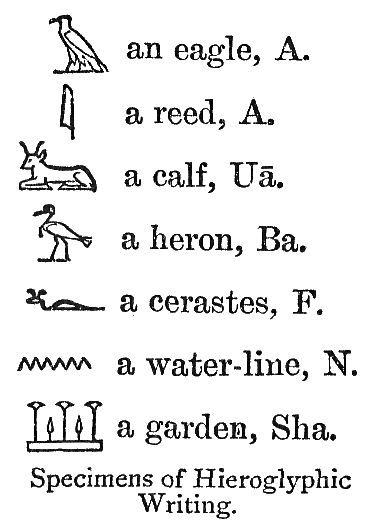
Hieroglyphic, hī-ėr-o-glif′ik, also Hī′eroglyph, n. the sacred characters of the ancient Egyptian language: picture-writing, or writing in which figures of objects are employed instead of conventional signs, like the alphabet—hieroglyphics are either phonetic or ideographic, the former comprising signs which represent sounds, the latter those which represent ideas: any symbolical or enigmatical figure.—v.t. Hī′eroglyph, to represent by hieroglyphs.—adjs. Hieroglyph′ic, -al.—adv. Hieroglyph′ically.—n. Hierog′lyphist, one skilled in hieroglyphics. [Gr. hieroglyphikon—hieros, sacred, glyphein, to carve.]
Hierogram, hī′er-o-gram, n. a hieroglyphic symbol.—adjs. Hierogrammat′ic, -al.—ns. Hierogram′matist, Hierogram′mate, a writer of sacred records; Hī′erograph, a sacred symbol; Hierog′rapher, a sacred scribe.—adjs. Hierograph′ic, -al, pertaining to sacred writing.—n. Hierog′raphy, a description of sacred things. [Gr. hieros, sacred, gramma, a writing.]
Hierolatry, hī-er-ol′a-tri, n. the worship of saints or sacred things.
Hierology, hī-ėr-ol′o-ji, n. the science of sacred matters, esp. ancient writing and Egyptian inscriptions.—adj. Hierolog′ic.—n. Hierol′ogist. [Gr. hierologia—hieros, sacred, legein, to speak.]
Hieromancy, hī-er-o-man′si, n. divination by observing the objects offered in sacrifice.
Hieronymic, hī-e-rō-nim′ik, adj. of or pertaining to St Jerome—also Hieronym′ian.—n. Hieron′ymite, one of the many hermit orders established in the course of the 13th and 14th centuries. [L. Hieronymus, Jerome.]
Hieropathic, hī-er-o-path′ik, adj. consisting in love of the clergy.
Hierophant, hī′ėr-o-fant, n. one who shows or reveals sacred things: a priest.—adj. Hierophant′ic, belonging to or relating to hierophants. [Gr. hierophantēs—hieros, sacred, phainein, to show.]
Hieroscopy, hī-er-os′ko-pi, n. the same as hieromancy.
Hierosolymitan, hī-e-rō-sol′i-mī-tan, adj. of or pertaining to Jerusalem. [L. Hierosolyma, Jerusalem.]
Hierurgy, hī′er-ur′ji, n. a sacred performance.—adj. Hierur′gical.
Higgle, hig′l, v.i. to make difficulty in bargaining: to chaffer.—v.i. Higg′le-hagg′le, a reduplicated variant of higgle.—ns. Higg′ler; Higg′ling. [Prob. a form of haggle.]
Higgledy-piggledy, hig′l-di-pig′l-di, adv. and adj. topsy-turvy: (coll.) upside down. [A word coined to express a meaningless jumble.]
High, hī, adj. elevated: lofty: tall: elevated relatively to something, as upward from a base, in position from the mouth of a river, &c.: eminent in anything: exalted in rank: dignified: chief: noble: ostentatious: arrogant: proud: strong, intensified: extreme in opinion: powerful: angry: loud: violent: tempestuous: shrill: excellent: far advanced: difficult: dear: remote in time: slightly tainted (of game, &c.).—adv. aloft: eminently: powerfully: profoundly: of flesh, on the point of beginning to decay.—ns. High′-ad′miral, a high or chief admiral of a fleet; High′-al′tar, the principal altar in a church; High′-bail′iff, an officer who serves writs, &c., in certain franchises, exempt from the ordinary supervision of the sheriff; High′-bind′er (U.S.), a rowdy, ruffian, blackmailer.—adjs. High′-blest (Milt.), supremely blest or happy; High′-blood′ed, of noble lineage; High′-blown, swelled with wind: (Shak.) inflated, as with pride; High′-born, of high or noble birth; High′-bred, of high or noble breed, training, or family.—ns. High′-church, applied to a party within the Church of England, which exalts the authority of the Episcopate and the priesthood, the saving grace of sacraments, &c. (also adj.); High′-church′ism; High′-church′man.—adj. High′-col′oured, having a strong or glaring colour.—ns. High′-court, a supreme court; High′-cross, a market cross; High′-day, a holiday or festival: (B.) broad daylight.—adj. befitting a festival.—v.t. High′er, to raise higher: to lift.—v.i. to ascend.—n. High′-falū′tin, bombastic discourse.—adj. bombastic: pompous.—adj. High′-fed, fed highly or luxuriously: pampered.—ns. High′-feed′ing; High′-flier, a bird that flies high: one who runs into extravagance of opinion or action.—adjs. High′-flown, extravagant: elevated: turgid; High′-fly′ing, extravagant in conduct or opinion; High′-grown (Shak.), covered with a high growth; High′-hand′ed, overbearing: violent: arbitrary.—n. High′-hand′edness.—adjs. High′-heart′ed, with the heart full of courage; High′-heeled, wearing high heels—of shoes.—n. High′-jinks, boisterous play or jollity: an old Scotch pastime in which persons played various parts under penalty of a forfeit.—adj. High′-kilt′ed, wearing the kilt or petticoat high: indecorous.—n. and adj. High′land, a mountainous district, esp. in pl. that portion of Scotland lying north and west of a line drawn diagonally from Nairn to Dumbarton.—ns. High′lander, High′landman, an inhabitant of a mountainous region; High′-low, a high shoe fastened with a leather thong in front.—adv. High′ly.—n. High′-mass (see Mass).—adjs. High′-mett′led, high-spirited, courageous; High′-mind′ed, having a high, proud, or arrogant mind: having honourable pride: magnanimous.—n. High′-mind′edness.—adjs. High′most, highest; High′-necked, of a dress, cut so as to cover the shoulders and neck.—n. High′ness, the state of being high: dignity of rank: a title of honour given to princes.—adj. High′-pitched, high-strung: haughty.—n. High′-place (B.), an eminence on which idolatrous rites were performed by the Jews—hence the idols, &c., themselves.—adjs. High′-press′ure, applied to a steam-engine in which the steam is raised to a high temperature, so that the pressure may exceed that of the atmosphere; High′-priced, costly.—ns. High′-priest (see Priest); High′-priest′ess; High′-priest′hood.—adjs. High′-prin′cipled, of high, noble, or strict principle; High′-proof, proved to contain much alcohol: highly rectified; High′-raised, raised aloft: elevated; High′-reach′ing, reaching upwards: ambitious.—n. High′-road, one of the public or chief roads: a road for general traffic.—adjs. High′-sea′soned, made rich or piquant with spices or other seasoning; High′-sight′ed (Shak.), always looking upwards; High′-souled, having a high or lofty soul or spirit; High′-sound′ing, pompous: ostentatious; High′-spir′ited, having a high spirit or natural fire: bold: daring: irascible.—n. High′-step′per, a horse that lifts its feet high from the ground.—adjs. High′-step′ping, having a proud or conceited carriage or walk; High′-stom′ached (Shak.), proud-spirited, lofty, obstinate; High′-strung, high-spirited: sensitive.—n. Hight (Milt.), obsolete form of height.—adj. High′-tast′ed, having a strong, piquant taste or relish.—n. High′-tide (rare), a great festival.—adj. High′-toned, high in pitch: dignified.—ns. High′-top (Shak.), a mast-head; High′-trea′son, treason against the sovereign or state.—adj. High′-viced (Shak.), enormously wicked.—ns. High′-wa′ter, the time at which the tide is highest: the greatest elevation of the tide; High′-wa′ter-mark, the highest line so reached; High′way, a public road on which all have right to go: the main or usual way or course; High′wayman, a robber who attacks people on the public way.—adj. High′-wrought, wrought with exquisite skill: highly finished: agitated.—High and dry, of a ship, up out of the water: disabled; High and low, rich and poor, people of every condition; High and mighty, exalted: arrogant; High celebration (see Celebration); High life, the life of fashionable society: the people of this society; High living, over-indulgence in the pleasures of the table; High seas, the open sea, including the whole extent of sea so far as it is not the exclusive property of any particular country; High table, the table in the dining-hall of a college where the dons sit; High tea, a tea with hot meat, &c., as opposed to a plain tea.—A high hand, or arm, might: power: audacity; A high time, A high old time (coll.), a time of special jollity or enthusiasm; Be high time, to be fully time something was done that should have been done well before; Be on one's high horse, to assume an attitude of fancied superiority: to be arrogant.—Highland costume, the fillibeg or kilt, shoulder-plaid, sporran, &c.; Highland regiments, a number of regiments in the British army, wearing the Highland dress and feather-bonnet, or tartan trews and shakos.—In high feather, in high spirits: happy; On high, in or to a height; On the high ropes (coll.), in an elated or highly excited mood; With a high hand, arrogantly. [A.S. héah; Goth. hauhs, Ice. hár, Ger. hoch.]
Hight, hīt, v.t. to command: (Spens.) to call, name.—v.i. (orig. pass.) to be called or named, to have as a name; therefore third pers. sing., Hight=he was or is called. [M. E. highte—A.S. hátte, I was called, pa.t. of hátan, to call, to be called. Cf. Ger. ich heisse, I am named, from heissen, to call.]
Highty-tighty, hī′ti-tī′ti, adj. the same as Hoity-toity (q.v.).
Hijra, Hijrah. Same as Hegira.
Hilar, hī′lar, adj. pertaining to a hilum.
Hilarious, hi-lā′ri-us, adj. gay: very merry.—adv. Hilā′riously.—n. Hilar′ity, gaiety: pleasurable excitement. [L. hilaris—Gr. hilaros, cheerful.]
Hilary, hil′ar-i, adj. a term or session of the High Court of Justice in England; also one of the university terms at Oxford and Dublin—from St Hilary of Poitiers (died 367), festival, Jan. 13.
Hilch, hilch, v.t. (Scot.) to hobble.—n. a limp.
Hildebrandism, hil′de-brand-izm, n. the spirit and policy of Hildebrand (Pope Gregory VII., 1073-85), unbending assertion of the power of the Church, &c.—adj. Hildebrand′ic.
Hilding, hild′ing, n. a mean, cowardly person, a dastard.—adj. cowardly, spiritless. [Prob. hield, to bend down.]
Hill, hil, n. a high mass of land, less than a mountain.—n. Hill′-dig′ger, one who digs into barrows, &c., for buried treasure.—adj. Hilled, having hills.—ns.pl. Hill′-folk, Hill′men, people living or hiding among the hills: the Scotch sect of Cameronians, the Covenanters generally.—ns. Hill′-fort, a prehistoric stronghold; Hill′iness; Hill′ock, a small hill.—adj. Hill′ocky.—ns. Hill′-side, the slope of a hill; Hill′-top, the summit of a hill.—adj. Hill′y, full of hills.—Up hill and down dale, vigorously and persistently. [A.S. hyll; cf. L. collis, a hill, celsus, high.]
Hillo, hil′ō, interj. Same as Hallo.
Hilt, hilt, n. the handle, esp. of a sword.—adj. Hilt′ed, having a hilt.—Up to the hilt, completely, thoroughly, to the full. [A.S. hilt; Dut. hilte, Old High Ger. helza; not conn. with hold.]
Hilum, hī′lum, n. the scar on a seed at the point of union with the placenta: (anat.) the depression at the place where ducts, vessels, and nerves enter an organ.—adj. Hī′lar. [L.]
Him, him, pron. the objective case of he.—pron. Him′self, the emphatic and reflective form of he and him: the proper character of a person. [A.S. him, dat. sing. masc. and neut. of he, it.]
Himation, hi-mat′i-on, n. the ancient Greek outer garment, oblong, thrown over the left shoulder, and fastened either over or under the right. [Gr.]
Himyaritic, him-ya-rit′ik, adj. a name formerly applied to the language of the ancient Sabæan inscriptions in the south-west of Arabia. [Himyar, a traditional king of Yemen.]
Hin, hin, n. a Hebrew liquid measure containing about six English quarts. [Heb.]
Hind, hīnd, n. the female of the stag or red-deer.—n. Hind′berry, the raspberry. [A.S. hind; Dut. and Ger. hinde.]
Hind, hīnd, n. a farm-servant, esp. one having charge of a pair of horses, with cottage on the farm, formerly bound to supply a female field-worker (bondager). [A.S. hína=híwna, gen. pl. of híwan, domestics.]
Hind, hīnd, adj. placed in the rear: pertaining to the part behind: backward:—opp. to Fore.—adj. Hind′er, the older form of hind, but used in the same significations.—n. Hind′er-end, the latter end: (Scot.) buttocks.—n.pl. Hind′erlins (Scot.), the buttocks.—adjs. Hind′ermost, Hind′most, superlative of hind, farthest behind; Hind′-fore′most, the back part in the front place. [A.S. hindan (adv.), back, hinder, backwards; Goth. hindar, Ger. hinter, behind.]
Hinder, hin′dėr, v.t. to put or keep behind: to stop, or prevent progress: to embarrass.—v.i. to be an obstacle.—ns. Hin′derance, Hin′drance, act of hindering: that which hinders: obstacle. [A.S. hindrian; Ger. hindern.]
Hindi, hin′dē, n. and adj. one of the languages of Aryan stock now spoken in Northern India.—Also Hin′dee. [Urdū, Hind, 'India.']
Hindu, Hindoo, hin′dōō, n. a native of Hindustan: now more properly applied to native Indian believers in Brahmanism, as opposed to Mohammedans, &c.—ns. Hin′duism, Hin′dooism, the religion and customs of the Hindus. [Sindhu, Sans. for Indus.]
Hindustani, Hindoostanee, hin-dōō-stan′ē, n. a dialect of Hindi, also called Urdū, the chief official and commercial language of India.—Also adj.
Hinge, hinj, n. the hook or joint on which a door or lid hangs: that on which anything depends or turns.—v.t. to furnish with hinges: to bend.—v.i. to hang or turn as on a hinge: to depend on:—pr.p. hing′ing; pa.p. hinged.—n. Hinge′-joint (anat.), a joint in which the bones move.—Off the hinges, in a state of confusion. [Related to hang.]
Hinny, hin′i, n. the offspring of a stallion and she-ass. [L. hinnus—Gr. ginnos, later hinnos, a mule.]
Hinny, hin′i, n. a Scotch variant of honey.
Hinny, hin′i, v.i. to neigh, whinny.
Hint, hint, n. a distant or indirect allusion: slight mention: insinuation.—v.t. to bring to mind by a slight mention or remote allusion: to allude to.—v.i. to make an indirect or remote allusion: to allude.—adv. Hint′ingly.—Hint at, to allude to obscurely. [A.S. hentan, to seize.]
Hinterland, hint′ėr-land, n. the district behind that lying along the coast, or along a river. [Ger.]
Hip, hip, n. the haunch or fleshy part of the thigh: (archit.) the external angle formed by the sides of a roof when the end slopes backward instead of terminating in a gable.—v.t. to sprain the hip:—pr.p. hip′ping; pa.p. hipped, hipt.—ns. Hip′-bath, a bath to sit in—also Sitz-bath; Hip′-gir′dle, -belt, the 14th-century sword-belt, passing diagonally from waist to hip; Hip′-gout, sciatica; Hip′-joint, the articulation of the head of the thigh-bone with the ilium; Hip′-knob, an ornament placed on the apex of the hips of a roof or on a gable; Hip′-lock, a trick in wrestling by which one throws a leg and hip before the other to throw him; Hip′ping, a napkin wrapped about an infant's hips.—adj. Hip′-shot, having the hip out of joint.—Hip-and-thigh, in phrase, 'smitten hip-and-thigh'=smitten both before and behind, completely overpowered.—Have, Catch, on the hip, to get an advantage over some one—a metaphor from the wrestling-ring. [A.S. hype; Goth. hups, Ger. hüfte.]
Hip, hip, Hep, hep, n. the fruit of the wild brier or dog-rose. [A.S. héope, a hip.]
Hip, Hyp, hip, n. hypochondria.—v.t. to render melancholy.—adjs. Hipped, rendered melancholy; Hip′pish, somewhat hypochondriac. [A corr. of hypochondria.]
Hip, hip, interj. an exclamation to invoke a united cheer—Hip′-hip′-hurr′ah.
Hipparion, hi-pā′ri-on, n. a fossil genus of Equidæ. [Gr. hipparion, dim. of hippos, a horse.]
Hippety-hoppety, hip′e-ti-hop′e-ti, adv. hopping and skipping.—n. Hipp′ety-hop.
Hippiatric, hip-i-at′rik, adj. relating to the treatment of the diseases of horses.—n.pl. Hippiat′rics.—ns. Hippiat′rist; Hippiat′ry.—adj. Hipp′ic, relating to horses.
Hippocampus, hip′o-kam-pus, n. a genus of small fishes with head and neck somewhat like those of a horse, the sea-horse: (anat.) a raised curved trace on the floor of the lateral ventricle of the brain. [Gr. hippokampos—hippos, a horse, kampos, a sea-monster.]
Hippocentaur, hip-o-sent′awr, n. Same as Centaur. [Gr. hippos, a horse, and centaur.]
Hippocras, hip′o-kras, n. an aromatic medicated wine, formerly much used as a cordial.—adj. Hippocrat′ic, pertaining to the Greek physician Hippocrates (born 460 B.C.).—v.t. Hippoc′ratise.—n. Hippoc′ratism.
Hippocrene, hip′o-krēn, n. a fountain on the northern slopes of Mount Helicon, in Greece, sacred to the Muses and Apollo. [L.,—Gr. hippokrēnē—hippos, a horse, krēnē, a fountain.]
Hippocrepian, hip-o-krē′pi-an, adj. horse-shoe shaped. [Gr. hippos, a horse, krēpis, a shoe.]
Hippodame, hip′o-dām, n. (Spens.) the sea-horse.—n. Hippod′amist, a horse-tamer.—adj. Hippod′amous, horse-taming.
Hippodrome, hip′o-drōm, n. the Greek name for a racecourse for horses and chariots: an equestrian circus: (U.S.) a fraudulent athletic game or contest in which the result is prearranged.—v.t. to conduct races in such a way.—adj. Hippodrom′ic.—n. Hippod′romist, a circus trainer or rider. [Fr.,—Gr. hippodromos—hippos, a horse, dromos, a course.]
Hippogriff, Hippogryph, hip′o-grif, n. a fabulous animal represented as a winged horse with the head of a griffin. [Fr. hippogriffe—Gr. hippos, a horse, gryps, a griffin.]
Hippology, hip-ol′o-ji, n. the study of horses.—adj. Hippolog′ical.—n. Hippol′ogist.
Hippomanes, hip-om′an-ēz, n. an ancient love-philtre obtained from a mare or foal.—n. Hipp′omane, a genus of plants of the natural order Euphorbiaceæ, the manchineel-tree. [Gr.]
Hippopathology, hip-o-pa-thol′o-ji, n. the pathology of the horse: the science of veterinary medicine. [Gr. hippos, a horse, and pathology.]
Hippophagy, hip-pof′a-ji, n. the act or practice of feeding on horse-flesh.—n.pl. Hippoph′agi, eaters of horse-flesh.—n. Hippoph′agist, an eater of horseflesh.—adj. Hippoph′agous, horse-eating. [Gr. hippos, a horse, phagein, to eat.]
Hippophile, hip′o-fīl, n. a lover of horses.
Hippopotamus, hip-o-pot′a-mus, n. the river-horse—an African quadruped, of aquatic habits, having a very thick skin, short legs, and a large head and muzzle.—adj. Hippopotam′ic (also -pot′-), like a hippopotamus, clumsy. [L.,—Gr. hippopotamos—hippos, a horse, potamos, a river.]
Hippotomy, hip-ot′o-mi, n. the dissection of the horse.—adj. Hippotom′ical.—n. Hippot′omist.
Hippuric, hip-ū′rik, adj. denoting an acid first obtained from the urine of horses. [Gr. hippos, a horse, ouron, urine.]
Hippurid, hi-pū′rid, n. a plant of natural order Hippurideæ or Haloragaceæ, the typical genus the common mare's tail.
Hippurite, hip′ū-rīt, n. a fossil bivalve mollusc peculiar to the cretaceous strata.—adj. Hippurit′ic. [Gr. hippos, a horse, oura, a tail.]
Hippus, hip′us, n. clonic spasm of the iris.
Hircine, hėr′sīn, adj. goat-like: having a strong goatish smell.—ns. Hircocer′vus, a fabulous creature, half-goat, half-stag; Hircos′ity, goatishness. [Fr.,—L. hircinus—hircus, a he-goat.]
Hirdy-girdy, hėr′di-gėr′di, adv. (Scot.) in confusion.
Hire, hīr, n. wages for service: the price paid for the use of anything.—v.t. to procure the use or service of, at a price: to engage for wages: to grant temporary use of for compensation: to bribe.—adj. Hire′able.—ns. Hire′ling, a hired servant: a mercenary: a prostitute (also adj.); Hir′er; Hire′-sys′tem, a system by which a hired article becomes the property of the hirer after a stipulated number of payments; Hir′ing, the contract of hiring—bailment for hire (in Scotland, location): a fair or market where servants are engaged.—On hire, for hiring. [A.S. hýr, wages, hýrian, to hire; Ger. heuer, Dut. huur.]
Hirmos, hir′mos, n. in the usage of the Greek Church, a standard troparion, forming the first stanza of a canon of odes, and serving as a model for the other stanzas:—pl. Hir′moi.—n. Hirmolō′gion, an office-book containing the hirmoi. [Gr. eirmos, a series.]
Hirple, hėr′pl, v.i. (Scot.) to walk or run as if lame.—n. a limping gait.
Hirrient, hir′i-ent, n. a trilled sound.
Hirsel, hir′sel, n. (Scot.) a multitude, a throng, a flock of sheep.—v.t. to put in different groups.
Hirsle, hir′sl, v.i. (Scot.) to slide or move, resting on the hams: to move forward with a rustling sound.
Hirsute, hir-sūt′, adj. hairy: rough: shaggy: (bot.) having long, stiffish hairs. [L. hirsutus—hirsus, hirtus, shaggy.]
Hirundine, hi-run′din, adj. of or pertaining to the swallow. [L. hirundo, a swallow.]
His, hiz, pron. possessive form of he: (B.) used for its.—Hisn, a contracted form of his own. [A.S. his, possessive of he, and originally of it.]
Hish, hish, v.i. to hiss. [A by-form of hiss.]
Hispanic, his-pan′ik, adj. Spanish.—adv. Hispan′ically.—vs.t. Hispan′icise, Hispan′iolise, to render Spanish.—n. Hispan′icism, a Spanish phrase. [L. Hispania, Spain.]
Hispid, his′pid, adj. (bot.) rough with or having strong hairs or bristles.—n. Hispid′ity. [L. hispidus.]
Hiss, his, v.i. to make a sibilant sound like that of the letter s, as the goose, serpent, &c.: to express contempt, &c., by hissing.—v.t. to condemn by hissing.—n. the sound of the letter s, an expression of disapprobation, contempt, &c.—n. Hiss′ing, the noise of a hiss: object of hissing: object or occasion of contempt. [Imit.]
Hist, hist, interj. demanding silence and attention: hush! silence!—v.t. to urge (a dog, &c.) by making the sound of this word. [Imit.]
Histie, his′ti, adj. (Scot.) dry: barren.
Histioid, his′ti-oid, adj. resembling tissue.—adj. Histogenet′ic.—adv. Histogenet′ically.—ns. Histog′eny, the formation and development of tissues—also Histogen′esis; Histog′raphy, a description of the tissues.—adjs. Histolog′ic, -al, pertaining to histology.—ns. Histol′ogist, one skilled in histology; Histol′ogy, the science which classifies and describes the structural or morphological elements which exist in the solids and fluids of organised bodies; Histol′ysis, degeneration and decay of organic tissue.—adj. Histolyt′ic. [Gr. histos, web.]
History, his′to-ri, n. an account of an event: a systematic account of the origin and progress of a nation: the knowledge of facts, events, &c.: an eventful life, a past of more than common interest, as a 'woman with a history:' a drama representing historical events.—v.t. (rare) to record.—n. His′tōrian, a writer of history.—adjs. Histō′riāted, adorned with figures, esp. of men or animals, as the medieval illuminated manuscripts, capital letters, initials &c.; Histor′ic, -al, pertaining to history: containing history: derived from history: famous in history: authentic.—adv. Histor′ically.—v.t. and v.i. Histor′icise, to make, or represent as, historic.—ns. Historic′ity, historical character; Historiette′, a short history or story.—v.t. Histor′ify, to record in history.—n. Historiog′rapher, a writer of history: a professed or official historian.—adjs. Historiograph′ic, -al, pertaining to the writing of history.—adv. Historiograph′ically.—ns. Historiog′raphy, the art or employment of writing history; Historiol′ogy, the knowledge or study of history.—Historical method, the study of a subject in its historical development; Historical painting, the painting of historic scenes, or scenes in which historic figures are introduced; Historical present, the present tense used for the past, to add life and reality to the narrative, as in 'cometh' in Mark, v. 22.—Ancient history, the history of the world down to the fall of Rome, 476 A.D.; Medieval history, the history of the period between the fall of Rome and the beginning of the 16th century; Modern history, history since the beginning of the 16th century; Natural history, originally an expression including all the concrete sciences, now the science of living things: (in frequent use) zoology, esp. in so far as that is concerned with the life and habits of animals; Profane, Secular, history, the history of secular affairs as opposed to Sacred history, which deals with the events in the Bible narrative. [L.,—Gr. historia—histōr, knowing; cf. eidenai, to know, L. vidēre, Sans. vid, Eng. wit.]
Histrionic, -al, his-tri-on′ik, -al, adj. relating to the stage or stage-players: befitting a theatre: feigned.—ns. His′trio, His′trion, a stage-player.—adv. Histrion′ically.—ns. Histrion′icism, His′trionism, the acts or practice of stage-playing or of pantomime.—n.pl. Histrion′ics, play-acting.—v.i. His′trionise, to act, play a part. [L. histrionicus—histrio, an actor, primary form hister, a player.]
Hit, hit, v.t. to touch or strike: to reach: to suit: fit: conform to.—v.i. to come in contact: to chance luckily: to succeed:—pr.p. hit′ting; pa.t. and pa.p. hit.—n. a lucky chance, a surprising success: a stroke: a happy turn of thought or expression: at backgammon, a move that throws one of the opponent's men back to the entering point, a game won after one or two men are removed from the board.—n. Hit′ter.—adj. Hit′ty-miss′y, random, hap-hazard.—Hit below the belt, to deal a blow disallowable in the rules of the ring: to do an injury to another unfairly; Hit it off(with), to agree with some one; Hit off, to imitate, to describe; Hit-or-miss, reckless, hap-hazard; Hit out, to strike out with the fist; Hit the nail on the head (see Nail); Hit upon, to come upon, discover.—Hard hit, one gravely affected by some trouble, or by love. [A.S. hyttan, app. Ice. hitta, to light on, to find; Sw. hitta, to find, Dan. hitte, to hit upon.]
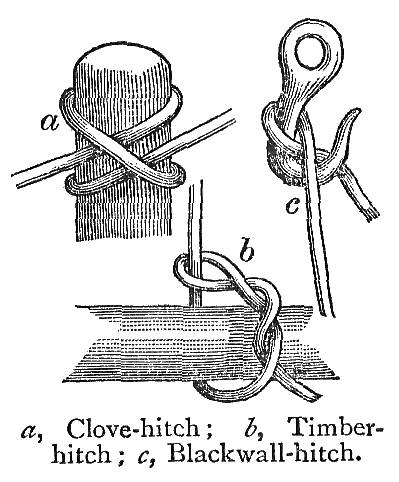
Hitch, hich, v.i. to move by jerks, as if caught by a hook: to be caught by a hook: to be caught or fall into.—v.t. to hook: to catch: to fasten, tether, esp. to make fast a rope.—n. a jerk: a catch or anything that holds: an obstacle: a sudden halt: (naut.) a species of knot by which one rope is connected with another, or to some object—various knots are the Clove-hitch, Timber-hitch, Blackwall-hitch, &c.—n. Hitch′er.—adv. Hitch′ily.—adj. Hitch′y.—Hitch up, to harness a horse to a vehicle. [Ety. dub.; prob. the same as itch.]
Hithe, hīth, n. a small haven. [A.S. hýð.]
Hither, hith′ėr, adv. to this place.—adj. toward the speaker: nearer.—v.i. to come—chiefly in phrase, 'to hither and thither'=to go to and fro.—adj. Hith′ermost, nearest on this side.—n. and adj. Hith′erside, the nearer side.—advs. Hith′erto, to this place or time: as yet; Hith′erward, towards this place.—Hither and thither, back and forward: to and from. [A.S. hider; Goth. hidrê, Ice. hêðra.]
Hitopadesa, hit-ō-pa-dē′sa, n. a famous collection of fables and stories in Sanskrit literature, a popular summary in four books of the Panchatantra.
Hittite, hit′īt, adj. pertaining to the Hittites, a powerful and civilised people, probably not Semitic, of northern Syria. [Heb. Khittīm.]
Hive, hīv, n. a place where bees live and store up honey, whether artificial or natural: a swarm of bees in a box or basket: any busy company.—v.t. to collect into a hive: to lay up in store.—v.i. to take shelter together: to reside in a body.—ns. Hive′-bee, the common honey-bee; Hiv′er; Hive′-nest, a large nest built and occupied by several pairs of birds in common. [A.S. hýf.]
Hives, hīvz, n. a popular term for nettle-rash and other similar skin diseases: laryngitis.
Hizz, hiz, v.i. to hiss.
Ho, Hoa, hō, interj. a call to excite attention: hold! stop!—repeated it expresses derision.
Hoar, hōr, adj. white or grayish-white, esp. with age or frost: mouldy.—n. hoariness: age.—v.i. (Shak.) to become mouldy.—n. Hoar′-frost, white frost: the white particles formed by the freezing of dew.—adjs. Hoar′-head′ed, Hoar′y, white or gray with age: (bot.) covered with short, dense, whitish hairs.—adv. Hoar′ily.—ns. Hoar′iness; Hoar′-stone, an ancient boundary stone. [A.S. hár, hoary, gray; Ice. hárr.]
Hoard, hōrd, n. a store: a hidden stock: a treasure: a place for hiding anything.—v.t. to store: to amass and deposit in secret.—v.i. to store up: to collect and form a hoard.—n. Hoard′er. [A.S. hord; Ice. hodd, Ger. hort.]
Hoard, hōrd, Hoarding, hōrd′ing, n. a hurdle or fence enclosing a house and materials while builders are at work: any boarding on which bills are posted. [From O. Fr. hurdis—hurt, hourt, hourd, a palisade.]
Hoarhound, Horehound, hōr′hownd, n. a plant of a whitish or downy appearance, used as a tonic. [M. E. horehune—A.S. hárhúne, from hár, hoar or white, and húne (acc. to Skeat, meaning 'strong-scented'); cf. L. cunila, Gr. konilē, wild marjoram.]
Hoarse, hōrs, adj. having a harsh, grating voice, as from a cold: harsh: discordant.—adv. Hoarse′ly.—n. Hoarse′ness. [A.S. hás; Ice. háss, this prob. for hárs, throwing light on the M. E. hôrs, hoors, Scot. hairsh, &c.]
Hoast, hōst, n. (prov.) a cough.—v.i. to cough. [Ice. hóste; Dut. hoest.]
Hoastman, hōst′man, n. a member of an old merchant guild in Newcastle, with charge of coal-shipping, &c. [Host, stranger, guest.]
Hoatzin, hō-at′sin, n. a remarkable South American bird, the same as the Touraco (q.v.).—Also Hoact′zin, Hoa′zin. [S. Amer.]
Hoax, hōks, n. a deceptive trick: a practical joke.—v.t. to deceive: to play a trick upon for sport, or without malice.—ns. Hoaxee′; Hoax′er; Hoax′ing. [Corr. of hocus. See Hocus-pocus.]
Hob, hob, n. the projecting nave of a wheel: a projection on the side of a fireplace, on which anything may be laid to keep hot: a game in which coins are placed on the end of a short stick at which stones are thrown, those that fall head up going to the thrower—also the round stick used in this game: a hardened threaded steel mandrel used in forming the cutting ends of screw-chasing tools, &c.—n. Hob′nail, a nail with a thick, strong head, used in horse-shoes, &c.: a clownish fellow.—v.t. to furnish with hobnails: to trample upon with hobnailed shoes.—adj. Hob′nailed. [Cf. Hub.]
Hob, hob, n. a clownish fellow: a rustic: a fairy.—n. Hob′binoll, a rustic.—adj. Hob′bish, clownish.—n. Hobgob′lin, a mischievous fairy: a frightful apparition.—Play hob, to make confusion. [A corr. of Rob for Robin, Robert.]
Hob-a-nob, Hob-and-nob. Same as Hobnob.
Hobbism, hob′izm, n. the doctrine of Thomas Hobbes (1588-1679), that morality is an institution of society.—n. Hobb′ist, a follower of Hobbes.
Hobble, hob′l, v.i. to walk with a limp: to walk awkwardly: to move irregularly.—v.t. to fasten loosely the legs of: to hamper: to perplex.—n. an awkward limping gait: a difficulty, a scrape: anything used to hamper the feet of an animal, a clog or fetter.—ns. Hobb′ler, one who hobbles: an unlicensed pilot, casual labourer in docks, &c.: a man who tows a canal-boat with a rope; Hobb′ling.—adv. Hobb′lingly. [Cf. Dut. hobbelen, hobben, to toss.]
Hobbledehoy, hob′l-de-hoi′, n. an awkward youth, a stripling, neither man nor boy.—adj. Hobbledehoy′ish.—n. Hobbledehoy′ism. [Prob. conn. with hobble, referring to awkward gait.]
Hobbler, hob′lėr, n. a horseman employed for light work, as reconnoitring, &c.: a horse. [O. Fr. hobeler—hobin, a small horse.]
Hobby, hob′i, n. a strong, active horse: a pacing horse: a subject on which one is constantly setting off, as in 'to ride' or 'to mount a hobby:' a favourite pursuit.—n. Hobb′y-horse, a stick or figure of a horse on which boys ride: one of the chief parts played in the ancient morris-dance: (Shak.) a term of contempt for a loose and frivolous person, male or female.—adj. Hobb′y-hor′sical, having a hobby: eccentric.—ns. Hobb′yism; Hobb′yist, one who rides a hobby.—adj. Hobb′yless. [M. E. hobyn, hoby, prob. Hob, a by-form of Rob. Hence also O. Fr. hobin, hobi (Fr. aubin).]
Hobby, hob′i, n. a small species of falcon. [O. Fr. hobé, hobet—Low L. hobetus; prob. O. Fr. hober, to move.]
Hobgoblin. See Hob (2).—ns. Hobgob′linism; Hobgob′linry.
Hobjob, hob′job, n. (prov.) an odd job.—v.i. to work at such.—ns. Hob′jobber; Hob′jobbing.
Hobnail. See Hob (1).
Hobnob, hob′nob, adv. have or not have, a familiar invitation to drink.—v.i. to associate or drink together familiarly.—pr.p. Hobnob′bing.—adj. Hob′nobby. [Hab, nab.]
Hobson-jobson, hob′son-job′son, n. a native festal excitement, esp. the Moharram ceremonies. [A corr. of the wailing 'Yā Hasan! Yā Hosain!' a typical phrase of Anglo-Indian argot, hence adopted as a concise alternative title for Yule and Burnell's admirable Glossary of Anglo-Indian Colloquial Words and Phrases (Lond. 1886).]
Hock, hok, n. and v. See Hough.
Hock, hok, n. properly, the wine made at Hochheim, Germany; now applied to all white Rhine wines.
Hock-day, hok′-dā, n. an old English festival held on the second Monday and Tuesday after Easter Sunday, one of the chief customs being the seizing and binding of passengers until they gave money for their liberty, Monday the men by the women, Tuesday the women by the men.—Also Hock′-tide.
Hockey, hok′i, n. a game at ball played with a club or stick curved at one end, shinty.—Also Hook′ey. [Prob. O. Fr. hoquet, a crook.]
Hockey, hok′i, n. (prov.) harvest-home, the harvest-supper.—Also Hawk′ey, Hork′ey.
Hockle, hok′l, v.t. to hamstring. [See Hough.]
Hocus-pocus, hō′kus-pō′kus, n. a juggler: a juggler's trick.—v.t. Hō′cus, to cheat: to stupefy with drink: to drug:—pr.p. hō′cussing; pa.p. hō′cussed. [The meaningless gibberish of a juggler—no reference to 'hoc est corpus.']
Hod, hod, n. a kind of trough borne on the shoulder, for carrying bricks and mortar: a coal-scuttle: a pewterer's blowpipe.—n. Hod′man, a man who carries a hod: a mason's labourer. [A variant of prov. hot; cf. Fr. hotte, a basket.]
Hoddengray, hod′n-grā, n. coarse cloth made of undyed wool.—adj. Hodd′en, wearing hoddengray: rustic.—n. hoddengray. [Prob. a form of holden, kept, reserved, and gray.]
Hoddle, hod′l, v.i. (Scot.) to waddle.
Hodge, hoj, n. a countryman, rustic. [Hodge, corr. from Roger.]
Hodgepodge, hoj′poj, n. (see Hotchpotch).—n. Hodge′-pudd′ing (Shak.), a pudding made of a mass of ingredients mixed together.
Hodiernal, hō-di-ėrn′al, adj. of or pertaining to the present day. [L. hodiernus—hodie, to-day—hoc die, on this day.]
Hodmandod, hod′man-dod, n. a snail, dodman.
Hodograph, hod′o-graf, n. a curve the radius vector of which represents in direction and magnitude the velocity of a moving particle—a term suggested by Sir W. R. Hamilton. [Gr. hodos, a way, graphein, to write.]
Hodometer, ho-dom′e-tėr, n. an instrument attached to the axle of a vehicle to register the revolutions of the wheels. [Gr. hodos, a way, metron, a measure.]
Hoe, hō, n. an instrument for hewing or digging up weeds and loosening the earth.—v.t. to cut or clean with a hoe: to weed.—v.i. to use a hoe:—pr.p. hoe′ing; pa.p. hoed.—ns. Hoe′-cake (U.S.), a thin cake of Indian meal; Hō′er.—A hard, or long, row to hoe, a hard or wearisome task to perform. [O. Fr. houe—Old High Ger. houwa (Ger. haue), a hoe.]
Hog, hog, n. a general name for swine: a castrated boar: a pig: formerly slang for a shilling: a low filthy fellow.—v.t. to cut short the hair of:—pr.p. hog′ging; pa.p. hogged.—ns. Hog′-back, Hog's′-back, a back rising in the middle: a ridge of a hill of such shape—also Horseback; Hog′gery, hoggishness of character: coarseness; Hog′get, a boar of the second year: a sheep or colt after it has passed its first year.—adj. Hog′gish, resembling a hog: brutish: filthy: selfish.—adv. Hog′gishly.—ns. Hog′gishness; Hog′hood, the nature of a hog; Hog′-mane, a horse's mane clipped short; Hog′-pen, a pig-sty; Hog′-plum, a West Indian tree of the cashew family, the fruit given to hogs; Hog′-reeve, -con′stable, an officer charged with the care of stray swine; Hog′-ring′er, one who puts rings into the snouts of hogs; Hog's′-bean, the henbane.—v.t. Hog′-shou′ther (Scot.), to jostle with the shoulder.—ns. Hog′-skin, leather made of the skin of swine; Hog's′-lard, the melted fat of the hog; Hog′-wash, the refuse of a kitchen, brewery, &c.—Bring one's hogs to a fine market, to make a complete mess of something; Go the whole hog, to do a thing thoroughly or completely, to commit one's self to anything unreservedly. [M. E. hogge, a gelded hog, prob. from hack, to cut; others derive from W. hwch, a sow, Bret. houch, hoch.]
Hog, hog, v.i. to droop at both ends.—n. Hog′-frame, a fore-and-aft frame serving to resist vertical flexure in a ship.—adj. Hogged, of a ship, having a droop at the ends.
Hog, hog, n. in curling, a stone which does not pass the hog-score.—v.t. to play such a shot with a curling-stone.—n. Hog′-score, a line drawn across the rink at a certain distance from the tees—to be cleared, else the shot does not count. [Prob. conn. with hog, a swine.]
Hog, Hogg, hog, n. a young sheep of the second year.—Also Hog′gerel.
Hogan, hog′an, n. a kind of strong liquor. [Corr. of hogen-mogen—Dut. hoog en mogend, high and mighty.]
Hogger, hog′er, n. (prov.) a coal-miner's footless stocking.—n. Hogg′er-pipe, the terminal section of the discharge-pipe of a mining-pump.
Hogmanay, hog-ma-nā′, n. (Scot.) the old name for the last day of the year. [Prob. a corr., through Norman French forms, of O. Fr. aguilanneuf=au-gui-l'an-neuf, 'to the mistletoe! the New Year!' Fr. gui, mistletoe, is from L. viscum.]
Hogshead, hogz′hed, n. (Shak.) a large cask: a measure of capacity=52½ imperial gallons, or 63 old wine gallons; of beer=54 gallons; of claret=46 gallons; of tobacco (U.S.), varying from 750 to 1200 lb. [Corr. of Old Dut. okshoofd, ox-head; from the brand on the cask.]
Hoiden. See Hoyden.
Hoise, hoiz, v.t. to hoist.
Hoist, hoist, v.t. to lift: to raise with tackle: to heave.—n. act of lifting: the height of a sail: an apparatus for lifting heavy bodies to the upper stories of a building.—Hoist with one's own petard, beaten with one's own weapons, caught in one's own trap. [Formerly hoise, or hoyse—Old Dut. hyssen, Dut. hijsschen, to hoist.]
Hoity-toity, hoi′ti-toi′ti, interj. an exclamation of surprise or disapprobation.—adj. giddy, gay, noisy.
Hoky-poky, hō′ki-pō′ki, n. a kind of ice-cream sold on the streets. [From hocus-pocus.]
Holarctic, hol-ärk′tik, adj. entirely arctic.
Hold, hōld, v.t. to keep possession of or authority over: to sustain: to defend: to maintain, support: to occupy: to derive title to: to bind: to confine: to restrain: to stop, as in 'to cry hold:' to continue: to persist in: to contain: to celebrate: to esteem: (Shak.) to endure: (arch.) to bet.—v.i. to remain fixed: to be true or unfailing: to continue unbroken or unsubdued: to adhere: to derive right:—pr.p. hōld′ing; pa.t. held; pa.p. held (obs. hōld′en).—n. act or manner of holding: seizure: power of seizing: something for support: a place of confinement: custody: a fortified place: (mus.) a mark over a rest or note, indicating that it is to be prolonged.—ns. Hold′-all, a general receptacle, esp. a big carpet-bag; Hold′-back, a check: a strap joining the breeching to the shaft of a vehicle; Hold′-beam, one of the beams crossing a ship's hold and strengthening the framework.—Hold′en (B.), old pa.p. of hold.—ns. Hold′er; Hold′-fast, that which holds fast: a long nail: a catch; Hold′ing, anything held: a farm held of a superior: hold: influence: (Scots law) tenure.—Hold forth, to put forward: show: to speak in public, to declaim; Hold hard! stop! Hold in, to restrain, check: to restrain one's self; Hold of (Pr. Bk.), to regard; Hold off, to keep at a distance; Hold on, to persist in something: to continue: to cling; Hold one in hand, to amuse in order to gain some advantage; Hold one's own, to maintain one's position; Hold one's peace, Hold one's tongue, to keep silence; Hold out, to endure, last; Hold over, to postpone, to keep possession of land or a house beyond the term of agreement; Hold the market (see Market); Hold together, to remain united: to cohere; Hold up, to raise: to continue to go at the same rate; Hold water, to be sound and firm, to endure trial; Hold with, to take sides with. [A.S. healdan; Old High Ger. haltan, Goth. haldan.]
Hold, hōld, n. the interior cavity of a ship between the floor and the lower deck, used for the cargo. [Dut. hol, a cavity or hole, with excrescent d.]
Hole, hōl, n. a hollow place: a cavity: an opening in a solid body: a pit: a subterfuge: a means of escape: a difficult situation: a scrape: a place of hiding, a mean lodging, a secret room for some disreputable business: (golf) one of the holes, 4 in. in diameter, into which the ball is played, also the distance between any two holes.—v.t. to form holes in: to drive into a hole.—v.i. to go into a hole.—adj. Hole′-and-cor′ner, secret: underhand.—ns. Hōling-axe, a narrow axe for cutting holes in posts; Hōling-pick, a pick used in under-cutting coal.—A hole in one's coat, a stain on a person's reputation; Put a person in a hole, to put him in a position from which he cannot easily extricate himself; Toad in the hole, meat baked in batter, &c. [A.S. hol, a hole, cavern; Dut. hol, Dan. hul, Ger. hohl, hollow; conn. with Gr. koilos, hollow.]
Hole, adj. (Spens.) whole.
Holibut. See Halibut.
Holiday, hol′i-dā, n. a consecrated day: a religious festival: a day for the commemoration of some event: a day of idleness and amusement.—adj. befitting a holiday: cheerful.—Holiday speeches, fine but empty phrases. [Formerly holy day.]
Holla, hol′a, Hollo, Holloa, hol′ō, or hol-lō′, interj. ho, there! attend! (naut.) the usual response to 'Ahoy!'—n. a loud shout.—v.i. to cry loudly to one at a distance. [Fr. holà—ho and là—L. illac, there; the other forms are due to confusion with halloo.]
Holland, hol′and, n. a coarse linen fabric, unbleached or dyed brown, which is used for covering furniture, &c.: (orig.) a fine kind of linen first made in Holland.
Hollander, hol′and-ėr, n. a native of Holland.—adj. Holl′andish.—n. Holl′ands, gin made in Holland.
Hollow, hol′ō, adj. vacant: not solid: containing an empty space: sunken: unsound: insincere.—n. a hole: a cavity: any depression in a body: any vacuity: a groove: a channel.—v.t. to make a hole in: to make hollow by digging: to excavate.—adv. completely: clean.—adjs. Holl′ow-eyed, having sunken eyes; Holl′ow-heart′ed, having a hollow or untrue heart: faithless: treacherous.—adv. Holl′owly (Shak.), in a hollow or insincere manner.—ns. Holl′owness, the state of being hollow: cavity: insincerity: treachery; Holl′ow-ware, trade name for hollow articles of iron, as pots and kettles.—Beat hollow, to beat wholly. [A.S. holh, a hollow place—hol. See Hole.]
Holly, hol′i, n. an evergreen shrub having leathery, shining, and spinous leaves and scarlet or yellow berries, much used for Christmas decorations. [A.S. holegn; cf. W. celyn, Ir. cuileann.]
Hollyhock, hol′i-hok, n. a kind of mallow, brought into Europe from the Holy Land—(Bacon) Holl′y-oak. [M. E. holihoc—holi, holy, and A.S. hoc, mallows—Celtic, cf. W. hocys.]
Holm, hōlm, or hōm, n. a river-islet: rich flat land beside a river. [A.S. holm, orig. a mound; Ger. holm, &c.]
Holm, hōlm, or hōm, n. (Spens.) holly.—n. Holm′-oak, the ilex or evergreen oak, so called from some resemblance to the holly. [Holm- is a corr. of holin, the M. E. form of holly, which see.]
Holoblastic, hol-o-blas′tik, adj. undergoing segmentation throughout the entire mass, as the ova of mammals.
Holocaust, hol′o-kawst, n. a burnt sacrifice, in which the whole of the victim was consumed. [L.,—Gr. holokauston—holos, whole, kaustos, burnt.]
Holocryptic, hol-o-krip′tik, adj. concealing completely, undecipherable.
Holograph, hol′o-graf, n. a document wholly written by the person from whom it proceeds (also used as adj.).—adj. Holograph′ic. [Gr. holos, whole, graphein, to write.]
Holohedrism, hol-o-hē′drizm, n. (math.) the property of having the full number of symmetrically arranged planes crystallographically possible.—adj. Holohē′dral.—n. Holohē′dron, a form possessing this property. [Gr. holos, whole, hedra, base.]
Holometabolic, hol-o-met-a-bol′ik, adj. undergoing complete metamorphosis, as an insect—opp. of Ametabolic.
Holometer, hol-om′et-ėr, n. an instrument for taking all kinds of measures. [Gr. holos, whole, metron, measure.]
Holomorphic, hol-o-mor′fik, adj. (math.) having the properties of an entire function, being finite, continuous, and one-valued for all finite values of the variable: showing holohedral symmetry. [Gr. holos, whole, morphē, form.]
Holophote, hol′o-fōt, n. an improved optical apparatus now used in lighthouses, by which all the light from the lamp is thrown in the required direction, in the catoptric holophote by reflectors, in the dioptric by refracting lenses, in the catadioptric by both combined.—adj. Holophōt′al. [Gr. holos, whole, phōs, phōtos, light.]