LIST OF ABBREVIATIONS USED IN THIS DICTIONARY.
Reading edition
aor. aorist. geol. geology. perh. perhaps.
abbrev. abbreviation. geom. geometry. pers. person.
abl. ablative. ger. gerundive. pfx. prefix.
acc. according. gram. grammar. phil., philos. philosophy.
accus. accusative. gun. gunnery. philol. philology.
adj. adjective. her. heraldry. phon. phonetics.
adv. adverb. hist. history. phot. photography.
agri. agriculture. hort. horticulture. phrenol. phrenology.
alg. algebra. hum. humorous. phys. physics.
anat. anatomy. i.e. that is. physiol. physiology.
app. apparently. imit. imitative. pl. plural.
arch. archaic. imper. imperative. poet. poetical.
archit. architecture. impers. impersonal. pol. econ. political economy.
arith. arithmetic. indic. indicative. poss. possessive.
astrol. astrology. infin. infinitive. Pr.Bk. Book of Common
astron. astronomy. inten. intensive. Prayer.
attrib. attributive. interj. interjection. pr.p. present participle.
augm. augmentative. interrog. interrogative. prep. preposition.
B. Bible. jew. jewellery. pres. present.
biol. biology. lit. literally. print. printing.
book-k. book-keeping. mach. machinery. priv. privative.
bot. botany. masc. masculine. prob. probably.
c. (circa) about. math. mathematics. Prof. Professor.
c., cent. century. mech. mechanics. pron. pronoun;
carp. carpentry. med. medicine. pronounced;
cf. compare. metaph. metaphysics. pronunciation.
chem. chemistry. mil. military. prop. properly.
cog. cognate. Milt. Milton. pros. prosody.
coll., colloq. colloquially. min. mineralogy. prov. provincial.
comp. comparative. mod. modern. q.v. which see.
conch. conchology. Mt. Mount. R.C. Roman Catholic.
conj. conjunction. mus. music. recip. reciprocal.
conn. connected. myth. mythology. redup. reduplication.
contr. contracted. n., ns. noun, nouns. refl. reflexive.
cook. cookery. nat. hist. natural history. rel. related; relative.
corr. corruption. naut. nautical. rhet. rhetoric.
crystal. crystallography. neg. negative. sculp. sculpture.
dat. dative. neut. neuter. Shak. Shakespeare.
demons. demonstrative. n.pl. noun plural. sig. signifying.
der. derivation. n.sing. noun singular. sing. singular.
dial. dialect, dialectal. N.T. New Testament. spec. specifically.
Dict. Dictionary. obs. obsolete. Spens. Spenser.
dim. diminutive. opp. opposed. subj. subjunctive.
dub. doubtful. opt. optics. suff. suffix.
eccles. ecclesiastical history. orig. originally. superl. superlative.
e.g. for example. ornith. ornithology. surg. surgery.
elect. electricity. O.S. old style. term. termination.
entom. entomology. O.T. Old Testament. teleg. telegraphy.
esp. especially. p., part. participle. Tenn. Tennyson.
ety. etymology. p.adj. participial adjective. Test. Testament.
fem. feminine. paint. painting. theat. theatre; theatricals.
fig. figuratively. paleog. paleography. theol. theology.
fol. followed; following. paleon. paleontology. trig. trigonometry.
fort. fortification. palm. palmistry. ult. ultimately.
freq. frequentative. pa.p. past participle. v.i. verb intransitive.
fut. future. pass. passive. voc. vocative.
gen. genitive. pa.t. past tense. v.t. verb transitive.
gener. generally. path. pathology. vul. vulgar.
geog. geography. perf. perfect. zool. zoology.
Amer. American. Fris. Frisian. Norw. Norwegian.
Ar. Arabic. Gael. Gaelic. O. Fr. Old French.
A.S. Anglo-Saxon. Ger. German. Pers. Persian.
Austr. Australian. Goth. Gothic. Peruv. Peruvian.
Bav. Bavarian. Gr. Greek. Pol. Polish.
Beng. Bengali. Heb. Hebrew. Port. Portuguese.
Bohem. Bohemian. Hind. Hindustani. Prov. Provençal.
Braz. Brazilian. Hung. Hungarian. Rom. Romance.
Bret. Breton. Ice. Icelandic. Russ. Russian
Carib. Caribbean. Ind. Indian. Sans. Sanskrit.
Celt. Celtic. Ion. Ionic. Scand. Scandinavian.
Chal. Chaldean. Ir. Irish. Scot. Scottish.
Chin. Chinese. It. Italian. Singh. Singhalese.
Corn. Cornish. Jap. Japanese. Slav. Slavonic.
Dan. Danish. Jav. Javanese. Sp. Spanish.
Dut. Dutch. L. Latin. Sw. Swedish.
Egypt. Egyptian. Lith. Lithuanian. Teut. Teutonic.
Eng. English. L. L. Low or Late Latin. Turk. Turkish.
Finn. Finnish. M. E. Middle English. U.S. United States.
Flem. Flemish. Mex. Mexican. W. Welsh.
Fr. French. Norm. Norman.
CHAMBERS'S TWENTIETH CENTURY DICTIONARY.
the first letter in our alphabet, its corresponding symbol standing first also in many other alphabets derived from the Phœnician. It originated in the hieroglyphic picture of an eagle (Old Egyptian ahom), the cursive hieratic form of which was the original of the Phœnician aleph, an ox, from a fancied resemblance to its head and horns.—A, as a note in music, is the major sixth of the scale of C; A1, the symbol by which first-class vessels are classed in Lloyd's Register of British and Foreign Shipping, hence first-rate.
A, the indefinite article, a broken-down form of An, and used before words beginning with the sound of a consonant. [An was a new development, after the Conquest, of the A.S. numeral án, one.]
A, ä or ā, a prep., derived from the old prep. on, and still used, as a prefix, in afoot, afield, apart, asleep, nowadays, twice-a-day; also with verbal nouns, as a-building, to be a-doing, to set a-going. It is now admitted only colloquially. [Short for A.S. an, a dialectic form of on, on, in, at. See Prefixes.]
A, ä, a dialectic corruption of he or she, as in quotha, (Shak.) 'A babbled of green fields.'—A, usually written a', Scotch for all; A, a form of the L. prep. ab, from, of, used before consonants, as in Thomas à Kempis, Thomas à Becket, &c.
Aardvark, ard′vark, n. the ground-hog of South Africa. [Dut. aarde, earth; vark, found only in dim. varken, a pig.]
Aardwolf, ard′wōōlf, n. the earth-wolf of South Africa, a carnivore belonging to a sub-family of the Hyænidæ. [Dut. aarde, earth, wolf, wolf.]
Aaronic, -al, ā-ron′ik, -al, adj. pertaining to Aaron, the Jewish high-priest, or to his priesthood.—n. Aa′ron's-rod (archit.), a rod having one serpent twined round it.—Aaron's beard, a popular name for a number of cultivated plants—among the best known, a species of Saxifrage (S. sarmentosa), usually grown in hanging pots, from which hang long stems, bearing clumps of roundish, hairy leaves.
Ab, ab, n. the eleventh month of the Jewish civil year, and the fifth of the ecclesiastical year, answering to parts of July and August. [Syriac.]
Aba, ab′a, n. a Syrian woollen stuff, of goat's or camel's hair, usually striped; an outer garment made of this. [Ar.]
Abaca, ab′a-ka, n. the native name of the so-called Manilla hemp of commerce—really a plantain, much grown in the Philippine Islands.
Aback, a-bak′, adv. (naut.) said of sails pressed backward against the mast by the wind—hence (fig.) Taken aback, taken by surprise, [A.S. on bæc. See On and Back.]
Abacot. See Bycocket.
Abactinal, ab-ak′ti-nal, adj. (zool.) remote from the actinal area, without rays.—adv. Abac′tinally.
Abaction, ab-ak′shun, n. (law) the stealing of a number of cattle at once.—n. Abac′tor, one who does this. [L. abigĕre, abactum, to drive off.]
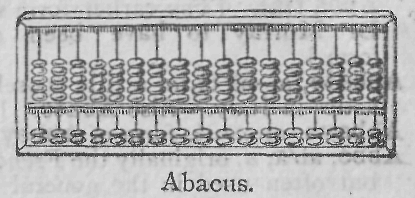
Abacus, ab′a-kus, n. a counting-frame or table: (archit.) a level tablet on the capital of a column, supporting the entablature:—pl. Ab′acī.—ns. Abacis′cus, Abac′ulus, dims. of Abacus; Ab′acist, one who counts with the abacus. [L.—Gr. abax, abakos, a board for reckoning on.]
Abaddon, a-bad′don, n. the destroyer, or angel of the bottomless pit: (Milton) the bottomless pit, or abyss of hell itself. [Heb., from ābad, to be lost.]
Abaft, a-baft′, adv. and prep. on the aft, hind, or stern part of a ship: behind. [Pfx. a-, for A.S. on, on, and bæftan, after, behind; itself made up of pfx. be-, and æftan. See Aft.]
Abalienate, ab-āl′yen-āt, v.t. Same as Alienate.
Abandon, a-ban′dun, v.t. to give up: to desert: to yield (one's self) without restraint (with to).—v.t. Aband′ (Spens.), to abandon.—n. Aban′don (n to be nasalised), freedom from conventional restraints: careless freedom of manners.—adj. Aban′doned, given up, as to a vice: profligate: completely deserted: very wicked.—adv. Aban′donedly.—n. Aban′donment, act of abandoning: state of being given up: enthusiastic surrender of self to a cause: (law) the renunciation of a claim. [O. Fr. bandon, from the Teut. root ban, proclamation, came to mean decree, authorisation, permission; hence à bandon—at will or discretion, abandonner, to give up to the will or disposal of some one. See Ban, Banns.]
Abase, a-bās′, v.t. to cast down: to humble: to degrade.—adjs. Abā′sed, Abaissé (her.), depressed.—n. Abase′ment, state of humiliation. [O. Fr. abaissier, to bring low—L. ad, to, and root of Base, adj.]
Abash, a-bash′, v.t. to confuse with shame or guilt.—pa.p. Abashed′ (with at, of an occasion; by, of a cause).—n. Abash′ment, confusion from shame. [O. Fr. esbhir (Fr. s'ébahir), pr.p. esbahiss-ant, to be amazed—L. ex, out, and interj. bah, expressive of astonishment.]
Abate, a-bāt′, v.t. to lessen: to deduct (with of): to mitigate: (law) to put an end to, do away with, as of an action or a nuisance, to render null, as a writ.—v.i. to grow less.—adjs. Abāt′able, capable of being abated; Abāt′ed, beaten down or cut away, as the background of an ornamental pattern in relief.—n. Abate′ment, the act of abating: the sum or quantity abated: (law) the act of intruding on a freehold and taking possession before the heir, the abandonment of an action, or the reduction of a legacy: (her.) a supposed mark of dishonour on a coat of arms—apparently never actually used.—Abated arms, those whose edges have been blunted for the tournament. [O. Fr. abatre, to beat down—L. ab, from, and batĕre, popular form of batuĕre, to beat: conn. with Beat.]
Abatis, Abattis, a′bat-is, n.sing. and pl. (fort.) a rampart of trees felled and laid side by side, with the branches towards the enemy. [Fr. See Abate.]
Abattoir, a-bat-wär′, n. a public slaughter-house. [Fr. See ety. of Abate.]
Abature, ab′a-tūr, n. the trail of a beast of the chase. [Fr.]
Abb, ab, n. properly woof- or weft-yarn, but sometimes warp-yarn. [Pfx. a-, and Web.]
Abba, ab′a, n. father, a term retained in the Gr. text of the New Testament, together with its translation 'father,' hence Abba father, applied to God the Father: also a bishop in the Syriac and Coptic Churches. [L.—Gr.—Syriac and Chaldee, abbā—Heb. ab, father.]
Abbacy, ab′a-si, n. the office or dignity of an abbot: the establishment under an abbot: an abbey.—adj. Abbā′tial. [The earlier form was abbatie—said by Dr Murray to have been originally a Scotch form.]
Abbate, ab-bä′te, n. a title loosely applied to ecclesiastics in Italy.—Also Abate. [It.]
Abbaye, an arch. form of Abbey.
Abbé, ab′ā, n. originally the French name for an abbot, but often used in the general sense of a priest or clergyman. Before the Revolution, abbés were often merely holders of benefices, enjoying a portion of the revenues, although in minor orders, or even laymen. They were often tutors in noble families, or men of letters, and were marked by a short violet-coloured robe.
Abbess, ab′es, n. the female superior of a religious community of women. [Earlier Abbatess, fem. of Abbot.]
Abbey, ab′e, n. a monastery of persons of either sex presided over by an abbot or abbess: the church now or formerly attached to it: in Newstead Abbey, &c., the name has been retained after the abbatial building had become a private house:—pl. Abb′eys. [O. Fr. abaïe (Fr. abbaye)—L. abbatia, See Abba.]
Abbot, ab′ut, n. the father or head of an abbey:—fem. Abb′ess.—n. Ab′botship. [L. abbas, abbatis—Abba.]
Abbreviate, ab-brē′vi-āt, v.t. to make brief or short: to abridge.—ns. Abbreviā′tion, Abbrē′viature, a shortening, a part of a word put for the whole; Abbrē′viator, one who abbreviates.—adj. Abbrē′viatory. [L. abbreviāre, -ātum—ab, intensive, and brevis, short. See Brief.]
Abc, Abcee, ā-bē-sē′, n. the alphabet from its first letters: a first reading-book (obs.), hence fig. the first rudiments of anything.—ABC book (Shak.), a book to teach the a, b, c, or alphabet.
Abdicate, ab′di-kāt, v.t. and v.i. formally to renounce or give up office or dignity.—adj. Ab′dicant.—n. Abdicā′tion. [L. ab, from or off, dicāre, -ātum, to proclaim.]
Abdomen, ab-dō′men, n. the belly: the lower part of the trunk.—adj. Abdom′inal.—adv. Abdom′inally.—adj. Abdom′inous, pot-bellied. [L.]
Abduce, ab-dūs′, v.t. an earlier form of Abduct.—adj. Abduc′ent, drawing back: separating. [L. abducĕre—ab, from ducĕre, ductum, to draw.]
Abduct, ab-dukt′, v.t. to take away by fraud or violence.—ns. Abduc′tion, the carrying away, esp. of a person by fraud or force; Abduc′tor, one guilty of abduction: a muscle that draws away. [L. abducĕre. See Abduce.]
Abeam, a-bēm′, adv. (naut.) on the beam, or in a line at right angles to a vessel's length. [Pfx. a- (A.S. on), on, and Beam.]
Abear, a-bār′, v.t. (Spens.) to bear, to behave: (prov.) to endure or tolerate.—n. Abear′ance, (obs.) behaviour. [A.S. pfx. a-, and Bear.]
Abecedarian, ā-be-se-dā′ri-an, adj. pertaining to the a, b, c: rudimentary.—Abecedarian Psalms (as the 119th) or Hymns are such as are divided into successive portions according to the letters of the alphabet.
Abed, a-bed′, adv. in bed. [Pfx. a-, on, and Bed.]
Abele, a-bēl′, n. the white poplar-tree. [Dut. abeel; O. Fr. abel, aubel—Late L. albellus, albus, white.]
Aberdevine, ab-ėr-de-vīn′, n. a bird-fancier's name for the siskin. [Ety. uncertain; prob. a fanciful coinage.]
Aberrate, ab′ėr-rāt, v.i. to wander or deviate from the right way:—pr.p. ab′errāting; pa.p. ab′errāted.—ns. Aber′rance, Aber′rancy (rare forms).—adj. Aber′rant (zool. and bot.), wandering, deviating in some particulars from its group.—n. Aberrā′tion, a wandering from the right path: deviation from truth or rectitude: in science, deviation from the type: abnormal structure or development.—Aberration of light, an apparent alteration in the place of a star, arising from the motion of the earth in its orbit, combined with the progressive passage of light. [L. aberrāre, -ātum—ab, from, errāre, to wander.]
Abet, a-bet′, v.t. to incite by encouragement or aid (used chiefly in a bad sense):—pr.p. abet′ting; pa.p. abet′ted.—ns. Abet′ment; Abet′ter, Abet′tor, one who abets. [O. Fr. abeter—à (—L. ad, to), and beter, to bait, from root of Bait.]
Abeyance, a-bā′ans, n. a state of suspension or expectation: temporary inactivity—also Abey′ancy.—The v. to Abey is rare. [Fr.—à (—L. ad, to), and bayer, to gape in expectation, from imitative root ba, to gape.]
Abhominable, an earlier spelling of Abominable.
Abhor, ab-hor′, v.t. to shrink from with horror: to detest: to loathe:—pr.p. abhor′ring; pa.p. abhorred′.—ns. Abhor′rence, extreme hatred; (obs.) Abhor′rency.—adj. Abhor′rent, detesting; repugnant (with of).—ns. Abhor′rer, one who abhors; Abhor′ring (B. and Shak.), object of abhorrence. [L. abhorrēre, from ab, from, and horrēre. See Horror.]
Abib, ā′bib, n. the first month of the Jewish ecclesiastical, the seventh of the civil year, later called Nisan, answering to parts of March and April. [Heb., 'an ear of corn'—ābab, to produce early fruit.]
Abide, a-bīd′, v.t. to bide or wait for: to endure: to tolerate.—v.i. to remain in a place, dwell or stay:—pa.t. and pa.p. abōde′.—n. Abid′ance.—adj. Abid′ing, continual.—n. an enduring.—adv. Abid′ingly. [A.S. ábídan—pfx. á- (= Goth. us = Ger. er), and bídan, to wait.]
Abide, a-bīd′, v.t. (Shak. and Milton) to redeem, pay the penalty for, suffer. [M. E. abyen, confounded with Abide. See Aby.]
Abies, ab′i-ez, n. the silver-fir.—adj. Abiet′ic, pertaining to trees of the genus Abies. [L.]
Abigail, ab′i-gāl, n. a lady's-maid. [From Abigail, 1 Sam. xxv.]
Ability, a-bil′i-ti, n. quality of being able: power: strength: skill.—n.pl. Abil′ities, the powers of the mind. [O. Fr. ableté (Fr. habileté)—L. habilitas—habilis, easily handled, from habēre, to have, hold. See Able.]
Abintestate, ab-in-tes′tāt, adj. inheriting the estate of one who died without having made a will. [L. ab, from, and Intestate.]
Abiogenesis, ab-i-o-jen′es-is, n. the origination of living by not-living matter, spontaneous generation.—adj. Abiogenet′ic—n. Abio′genist, one who believes in such. [Coined by Huxley in 1870; Gr. a, neg., bios, life, genesis, birth.]
Abject, ab-jekt′, v.t. (obs.) to throw or cast down or away. [L. abjicĕre, -jectum—ab, away, jacĕre, to throw.]
Abject, ab′jekt, adj. cast away: mean: worthless: cowering: base.—n. an outcast.—ns. Abjec′tion, Ab′jectness, a mean or low state: baseness: degradation.—adv. Ab′jectly. [L. abjectus, cast away—ab, away, jacĕre, to throw.]
Abjudge, ab-juj′, v.t. (rare) to take away by judicial sentence. [L. ab, from, and Judge.]
Abjudicate, ab-jōō′di-kāt, v.t. to give by judgment from one to another. [L. ab, from, and Judicate.]
Abjure, ab-jōōr′, v.t. to renounce on oath or solemnly: to recant: to repudiate.—n. Abjurā′tion, official renunciation on oath of any principle or pretension.—adj. Abjur′atory.—n. Abjur′er. [L. ab, from, jurāre, -ātum, to swear.]
Abkari, ab-kä′ri, n. the manufacture or sale of spirituous liquors: the excise duty levied on such.—Also Abka′ry. [Pers.]
Ablactation, ab-lak-tā′shun, n. a weaning. [L. ab, from, lactāre, to suckle—lac, lactis, milk.]
Ablation, ab-lā′shun, n. the act of carrying away: (geol.) the wearing away of rock by the action of water.—adj. Ablati′tious. [L. ab, from, latum, supine of ferre, to bear.]
Ablative, ab′lat-iv, adj. used as a noun. The name applied to one of the cases in the declension of nouns and pronouns in the Indo-European languages, retained as in Latin and Sanskrit, or merged in another case, as in the genitive in Greek. Its meaning was to express direction from or time when.—adj. Ablatī′val. [L. ablativus—ab, from, ferre, latum, to take; as if it indicated taking away, or privation.]
Ablaut, ab′lowt, n. (philol.) vowel permutation, a substitution of one root vowel for another in derivation, as in sing, sang, song, sung, distinct from the phonetic influence of a succeeding vowel, as in the Umlaut. It is especially the change of a vowel to indicate tense-change in strong verbs. [Ger., from ab, off, and laut, sound.]
Ablaze, a-blāz′, adj. in a blaze, on fire: gleaming brightly. [Prep. a, and Blaze.]
Able, ā′bl, adj. (comp. A′bler; superl. A′blest) having sufficient strength, power, or means to do a thing: skilful.—adj. A′ble-bod′ied, of a strong body: free from disability, of a sailor, labourer, &c.: robust.—adv. A′bly. [See Ability.]
Ablegate, ab′le-gāt, n. a papal envoy who carries the insignia of office to a newly-appointed cardinal.
Abloom, a-blōōm′, adv. in a blooming state. [Prep. a, on, and Bloom.]
Abluent, ab′lōō-ent, adj. washing or cleaning by a liquid.—n. a medicine which carries off impurities from the system. [L. abluens, -entis, pr.p. of abluĕre, to wash away—ab, from, away, and luĕre = lavāre, to wash. See Lave.]
Ablution, ab-lōō′shun, n. act of washing, esp. the body, preparatory to religious rites: any ceremonial washing, symbolic of moral purification: the wine and water used to rinse the chalice, drunk by the officiating priest.—adj. Ablu′tionary. [L. ablutio—ab, away, luĕre = lavāre, to wash.]
Abnegate, ab′ne-gāt, v.t. to deny.—ns. Abnegā′tion, renunciation; Ab′negator, one who abnegates or renounces. [L. ab, away, and negāre, to deny.]
Abnormal, ab-nor′mal, adj. not normal or according to rule: irregular—also Abnor′mous.—ns. Abnormal′ity, Abnor′mity.—adv. Abnor′mally. [L. ab, away from, and Normal.]
Aboard, a-bōrd′, adv. or prep. on board: in a ship, or in a train (Amer.). [Prep. a, on, and Board.]
Abococke. See Bycocket.
Abode, a-bōd′, n. a dwelling-place: stay. [See Abide.]
Abode, a-bōd′, pa.t. and pa.p. of Abide.
Abodement, a-bōd′ment, n. (obs.) a foreboding: an omen. [From Abode, with suff. -ment. See Bode, Forebode.]
Abolish, ab-ol′ish, v.t. to put an end to: to annul.—adj. Abol′ishable, capable of being abolished.—ns. Abol′ishment (rare); Aboli′tion, the act of abolishing; Aboli′tionism, advocacy of abolitionist principles; Aboli′tionist, one who seeks to abolish anything, esp. slavery. [Fr. abolir, aboliss—from L. abolēre, -itum—ab, from, olēre, to grow. The prep. ab here reverses the meaning of the simple verb.]
Abomasus, ab-ō-mā′sus, n. the fourth stomach of ruminants, lying close to the omasum or third stomach.—Also Abomā′sum. [L. ab, and omasum, paunch.]
Abominate, ab-om′in-āt, v.t. to abhor: to detest extremely.—adj. Abom′inable, hateful: detestable, an old spelling is Abhom′inable, to agree with a fancied etymology in Lat. ab homine.—n. Abom′inableness.—adv. Abom′inably.—n. Abominā′tion, extreme aversion: anything disgusting or detestable. [L. abomināri, -ātus, to turn from as of bad omen. See Omen.]
Abord, a-bōrd′, v.t. (arch.) to accost: (Spens.) astray, at a loss.—n. (Spens.) harbour: act of approaching: manner of approach. [Fr. aborder, à bord. See Aboard and Border.]
Aboriginal, ab-o-rij′in-al, adj. first, primitive, indigenous.—adv. Aborig′inally.
Aborigines, ab-o-rij′in-ēz, n.pl. the original inhabitants of a country. [L. See Origin.]
Abort, ab-ort′, v.i. to miscarry in birth: to remain in a rudimentary state.—n. Abor′tion, premature delivery, or the procuring of such: anything that does not reach maturity: a mis-shapen being or monster.—adj. Abort′ive, born untimely: unsuccessful: producing nothing: brought forth in an imperfect condition: rudimentary.—adv. Abort′ively.—n. Abort′iveness. [L. aborīri, abortus—ab, from, away, orīri, to rise.]
Abound, ab-ownd′, v.i. to overflow, be in great plenty: to possess in plenty (with in): to be filled with (used with with). [O. Fr. abunder—L. abundāre, to overflow, ab, from, unda, a wave.]
About, a-bowt′, prep. round on the outside: around: here and there in: near to: concerning: engaged in.—adv. around: nearly: here and there.—Bring about, to cause to take place; Come about, to take place; Go about, to prepare to do; Put about, disturbed; To be about, to be astir; Turn about, alternately. [A.S. on bútan; on, in, bútan, without, itself compounded of be, by, and útan, locative of út, out.]
Above, a-buv′, prep. on the upside: higher than: more than.—adv. overhead: in a higher position, order, or power.—adjs. Above′-board, open, honourable; Above′-ground, alive: not buried. [A.S. ábúfan—á, on, bufan, above, itself compounded of be, by, ufan, high, upwards, prop. the locative of uf, up.]
Abracadabra, ab-ra-ka-dab′ra, n. a cabbalistic word, written in successive lines, each shorter by a letter than the one above it, till the last letter A formed the apex of a triangle. It was worn as a charm for the cure of diseases. Now used generally for a spell or conjuring word: mere gibberish. [First found in 2d-cent. poem (Præcepta de Medicina) by Q. Serenus Sammonicus; further origin unknown.]
Abrade, ab-rād′, v.t. to scrape or rub off: to wear down by friction. [L. ab, off, radĕre, rasum, to scrape.]
Abraham-man, ā′bra-ham-man, n. originally a lunatic beggar from Bethlehem Hospital in London, marked by a special badge. Many sturdy beggars assumed this, hence the phrase To sham Abraham, to feign sickness, still used among sailors. [The wards in the old Bedlam are said to have been distinguished by the names of saints and patriarchs, as Abraham. Some find the origin of the name in an allusion to the parable of the beggar Lazarus, who found his rest in Abraham's bosom (Luke xvi.).]
Abranchiate, a-brang′ki-āt, adj. having no gills.—Also Abran′chial. [Gr. a, priv., and brangchia, gills.]
Abrasion, ab-rā′zhun, n. the act of rubbing off.—adj. and n. Abrā′sive. [See Abrade.]

Abraxas, a-braks′as, n. a mystic word, or an amulet, consisting of a gem engraved therewith on some part of it, often bearing a mystical figure of combined human and animal form, used as a charm. [Said to be coined by the Egyptian Gnostic Basilides in 2d century to express 365 in Greek letters; thus αβραξας used as numerals = 1 + 2 + 100 + 1 + 60 + 1 + 200. But Mr C. W. King finds its origin in Heb. ha-b'rākāh, 'the blessing,' or 'sacred name,' used as the title of a Gnostic deity representing the 365 emanations of the Divine Plērōma or fullness.]
Abray, a-brā′, Abrayd, a-brād′, v.i. (Spens.) to start out of sleep: to awake.—v.t. and v.i. to arouse, startle.—The more correct form is abraid. [Made up of pfx. a-, and abrédan. A.S. breydan, to twist. See Braid.]
Abreast, a-brest′, adv. with fronts in a line: side by side: (naut.) opposite to. [Prep. a, on, and Breast.]
Abricock. See Apricot.
Abridge, a-brij′, v.t. to make brief or short: to shorten: to epitomise: to curtail, as privileges or authority.—ns. Abridg′ment, Abridge′ment, contraction: shortening of time, labour or privileges: a compendium of a larger work: an epitome or synopsis: (law) the leaving out of certain portions Of a plaintiff's demand, the writ still holding good for the remainder. [O. Fr. abregier (Fr. abréger)—L. abbreviāre. See Abbreviate.]
Abroach, a-brōch′, adv. broached: in a condition to let the liquor run out: in a state to be diffused, afloat: astir. [Prep. a, and Broach.]
Abroad, a-brawd′, adv. on the broad or open space: out of doors: public: in another country. [Prep. a, and Broad.]
Abrogate, ab′ro-gāt, v.t. to repeal (a law): to set aside.—n. Abrogā′tion, act of repealing or setting aside.—adj. Ab′rogative. [L. ab, away, rogāre, -ātum, to ask or propose a law.]
Abrook, a-brook′, v.t. (Shak.) to brook, bear, or endure. [Pfx. a-, and Brook, v.]
Abrupt, ab-rupt′, adj. the opposite of gradual, as if broken off: sudden: unexpected: precipitous: (of style) passing from one thought to another without transitions: (of manners) short, rude.—n. an abrupt place.—n. Abrup′tion, a sudden breaking off: violent separation: (Shak.) interruption, pause.—adv. Abrupt′ly.—n. Abrupt′ness. [L. abruptus—ab, off, rumpĕre, ruptum, to break.]
Abscess, ab′ses, n. a collection of purulent matter within some tissue of the body. [L. abscessus—abs, away, cedĕre, cessum, to go, to retreat.]
Abscind, ab-sind′, v.t. to cut off.—n. Abscis′sion, act of cutting off, or state of being cut off: (rhet.) a figure of speech in which the words demanded by the sense are left unsaid, the speaker stopping short suddenly. [L. abscindo; ab, off, scindo, to cut.]
Absciss, ab′sis, Abscissa, ab-sis′sa, n. the straight line cut off or intercepted between the vertex of a curve and an ordinate, measured along the principal axis:—pl. Absciss′es, Absciss′æ, Absciss′as. [L. abscissus, cut off, pa.p. of abscindĕre—ab, from, scindĕre, to cut.]
Abscond, abs-kond′, v.i. to hide, or quit the country, in order to escape a legal process. [L. abscondĕre, abs, from or away, condĕre, to hide.]
Absent, abs′ent, adj. being away: not present: inattentive—v.t. (abs-ent′) to keep one's self away.—ns. Abs′ence, the state of being away or not present: want: inattention; Absentee′, one who is absent on any occasion: one who makes a habit of living away from his estate or his office; Absentee′ism, the practice of absenting one's self from duty or station, esp. of a landowner living away from his estate.—adv. Ab′sently. [L. absent-, pr.p. of absum—ab, away from, sum, esse, to be.]
Absinth, Absinthe, ab′sinth, n. spirit combined with extract of wormwood.—adjs. Absinth′ian, Absinth′iated, impregnated with absinth. [Fr.—L. absinthium, wormwood—Gr.]
Absolute, ab′sol-ūt, adj. free from limits or conditions: complete: unlimited: free from mixture: considered without reference to other things: unconditioned, unalterable: unrestricted by constitutional checks (said of a government): (gram.) not immediately dependent: (phil.) existing in and by itself without necessary relation to any other being: capable of being conceived of as unconditioned. In the sense of being finished, perfect, it may be considered as opposed to the Infinite; but, in the sense of being freed from restriction or condition, it is evident the Infinite itself must be absolute. Opposite schools differ on the question whether the Absolute can be known under conditions of consciousness.—adv. Ab′solutely, separately: unconditionally: positively: completely.—ns. Ab′soluteness; Absolū′tion, release from punishment: acquittal: remission of sins declared officially by a priest, or the formula by which such is expressed; Ab′solutism, government where the ruler is without restriction; Ab′solutist, a supporter of absolute government.—adjs. Absol′utory, Absolv′atory.—The Absolute, that which is absolute, self-existent, uncaused. [L. absolutus, pa.p. of absolvĕre. See Absolve.]
Absolve, ab-zolv′, v.t. to loose or set free: to pardon: to acquit: to discharge (with from).—ns. Absolv′er, one who gives absolution or acquits; Absolv′itor, a decision favourable to a defender.—v.t. Assoil′zie, in Scots law, to absolve the accused on the grounds that the evidence disproves or does not establish the charge. [L. ab, from, solvĕre, solutum, to loose. See Solve.]
Absonant, ab′so-nant, adj. discordant: absurd: unnatural (with to or from)—opp. to Consonant. [L. ab, from, sonant-, pr.p. of sonāre, to sound.]
Absorb, ab-sorb′, v.t. to suck in: to swallow up: to engage wholly.—n. Absorbabil′ity.—adj. Absorb′able, that may be absorbed.—p.adj. Absorbed′, swallowed up: entirely occupied.—advs. Absorb′edly, Absorb′ingly.—adj. Absorb′ent, imbibing: swallowing.—n. that which absorbs.—n. Absorp′tion, the act of absorbing: entire occupation of mind.—adj. Absorp′tive, having power to absorb.—n. Absorptiv′ity. [Fr.—L. ab, from, sorbēre, -sorptum, to suck in.]
Abstain, abs-tān′, v.i. to hold or refrain from.—ns. Abstain′er, specially one who does not take alcoholic drinks; Absten′tion, a refraining. [Fr. abstenir—L. abs, from, tenēre, to hold. See Tenable.]
Abstemious, abs-tēm′i-us, adj. temperate: sparing in food, drink, or enjoyments.—adv. Abstem′iously.—n. Abstem′iousness. [L. abstemius—abs, from, temetum, strong wine.]
Abstersion, abs-ter′shun, n. act of cleansing or washing away impurities.—v.t. Absterge′, to cleanse, purge.—adjs. Abster′gent, serving to cleanse; Abster′sive, having the quality of cleansing: purgative. [L. abstergēre, -tersum, to wipe away.]
Abstinent, abs′tin-ent, adj. abstaining from: temperate.—n. Abs′tinence, an abstaining or refraining, especially from some indulgence (with from)—also Abs′tinency.—adv. Abs′tinently. [See Abstain.]
Abstract, abs-trakt′, v.t. to draw away: to separate: to purloin.—adj. Abstract′ed, drawn off (with from): removed: absent in mind.—adv. Abstract′edly.—ns. Abstract′edness; Abstrac′tion, act of abstracting: state of being abstracted: absence of mind: the operation of the mind by which certain qualities or attributes of an object are considered apart from the rest: a purloining.—adj. Abstract′ive, having the power of abstracting.—n. anything abstractive: an abstract.—adv. Abs′tractly.—n. Abs′tractness. [L. abs, away from, trahĕre, tractum, to draw. See Trace.]
Abstract, abs′trakt, adj. general, as opposed to particular or individual (the opposite of abstract is concrete—a red colour is an abstract notion, a red rose is a concrete notion; an abstract noun is the name of a quality apart from the thing, as redness).—n. summary: abridgment: essence. [L. abstractus, as if a quality common to a number of things were drawn away from the things and considered by itself.]
Abstruse, abs-trōōs′, adj. hidden: remote from apprehension: difficult to be understood.—adv. Abstruse′ly.—ns. Abstruse′ness; Abstrus′ity (Sir T. Browne). [L. abstrusus, thrust away (from observation)—trudĕre, trusum, to thrust.]
Absurd, ab-surd′, adj. obviously unreasonable or false: ridiculous.—ns. Absurd′ity, Absurd′ness, the quality of being absurd: anything absurd.—adv. Absurd′ly. [L. absurdus—ab, from, surdus, harsh-sounding, deaf.]
Abundance, ab-und′ans, n. ample sufficiency: great plenty.—adj. Abund′ant, plentiful.—adv. Abund′antly. [See Abound.]
Abuse, ab-ūz′, v.t. to use wrongly: to pervert: to revile: to violate.—ns. Abuse (ab-ūs′), ill use: misapplication: reproach: vituperation; Abū′sion (Spens.), abuse: deception: reproach.—adj. Abus′ive, containing or practising abuse: full of abuses: vituperative.—adv. Abus′ively.—n. Abus′iveness. [L. ab, away (from what is right), uti, usus, to use.]
Abut, a-but′, v.i. to end: to border (on):—pr.p. abut′ting; pa.p. abut′ted.—ns. Abut′ment, that which abuts: (archit.) what a limb of an arch ends or rests on; Abut′tal, an abutment: (pl.) the boundaries.—p.adj. Abut′ting, facing each other: front to front. [Fr. abouter, lit. to join end to end (à, to, bout, end). See Butt, the end.]
Aby, Abye, a-bī, v.t. or v.i. (arch.) to pay the penalty: to suffer for: to give satisfaction.—Aby occurs in Spens. with sense of 'abide.' [Pfx. a-, and A.S. bycgan. See Buy.]
Abysm, a-bizm′, n. a form of Abyss.—adj. Abys′mal, bottomless: unending.—adv. Abysm′ally. [O. Fr. abisme, from Lat. abyssimus, superl. of abyssus, bottomless.]
Abyss, a-bis′, n. a bottomless gulf: a deep mass of water.—adj. Abyss′al. [Gr. abyssos, bottomless—a, without, byssos, bottom.]
Acacia, a-kā′shi-a, n. a genus of thorny leguminous plants with pinnate leaves. [L.—Gr. akakia—akē, a sharp point.]
Academe, ak-a-dēm′, n. (obs.) an academy.
Academic, ak-ad-em′ik, n. a Platonic philosopher: a student in a college. [See Academy.]
Academy, ak-ad′em-i, n. (orig.) the school of Plato: a higher school: a society for the promotion of science or art.—adjs. Academ′ic, -al, of an academy: theoretical as opposed to practical.—adv. Academ′ically.—n.pl. Academ′icals, the articles of dress worn by members of an academy or college.—ns. Academic′ian, Acad′emist, a member of an academy, or, specially, of the French Academy, or the Royal Academy in London. [Gr. Akadēmia, the name of the garden near Athens where Plato taught.]
Acadian, a-kā′di-an, adj. of or native to Nova Scotia, Acadia being the name given to the country by the first French settlers in 1604.
Acajou, ak′a-jōō, n. the gum or resin of a kind of red mahogany. [Origin doubtful. See Cashew.]
Acalepha, ak-a-lē′fa, n. a class of Radiate marine animals, consisting of soft gelatinous substance. The name was first applied to the Jelly-fish tribe, but later was made to include the true Medusæ or jelly-fishes, and others.—Other forms are Acaleph and Acalephan. [Gr. akalēphē, a nettle.]
Acanthopterygian, ak-an-thop-tėr-ij′i-an, adj. having spiny fins. [Gr. akantha, thorn, pteryx, pterygos, a wing, a fin.]
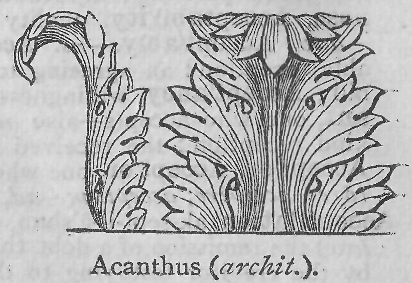
Acanthus, a-kan′thus, n. a prickly plant, called bear's breech or brank-ursine: (archit.) an ornament resembling its leaves used in the capitals of the Corinthian and Composite orders, &c.—also Acan′tha.—adjs. Acan′thine, Acanthā′ceous. [L.—Gr. akanthos—akē, a point, anthos, a flower.]
Acarpous, a-kar′pus, adj. (bot.) without, or not producing, fruit. [Gr. a, neg., and karpos, fruit.]
Acarus, ak′ar-us, n. a genus of minute insects, of the class Arachnides, embracing the mites and ticks:—pl. Ac′arī. [L.; Gr. akares, minute, too small to cut—a, neg., keirein, to cut short.]
Acatalectic, a-kat-a-lek′tik, adj. having the complete number of syllables as a verse: without defect.—n. an acatalectic verse. [L.—Gr. a, not, and Catalectic.]
Acatalepsy, a-kat-a-lep′si, n. incomprehensibility, a term of the sceptic school of Carneades, who thought nothing could be known to certainty by man.—adj. Acatalep′tic. [Gr. akatalēpsia—a, neg., kata, thoroughly, lēpsis, a seizing—lambanein, to take hold.]
Acater, a-kāt′ėr, n. (obs.) a caterer.—n.pl. Acates′, provisions: food. [O. Fr. acateor, achatour (Fr. acheteur)—Low L. accaptātōr-em, accaptare, to acquire—L. ad-, to, and captāre, to seize. See Cates.]
Acaulescent, a-kaw-les′ent, adj. without a stalk: (bot.) having no stem above ground, or only a very short one.—Also Acau′lous. [a, neg., L. caulis, a stalk, formed on pattern of Arborescent.]
Accable, ak-kā′bl, v.t. (obs.) to crush, to encumber. [Fr. accabler, to crush.]
Accadian, a-kā′di-an, adj. of or belonging to Accad, an ancient city mentioned in Gen. x. 10: the language preserved in the earliest form of cuneiform writing.
Accede, ak-sēd′, v.i. to come to, or arrive at, a place or condition: to join one's self, hence to agree or assent (with to).—ns. Acced′er; Acced′ing. [L. accedĕre, accessum, to go near to—ad, to, cedĕre, to go. See Cede.]
Accelerate, ak-sel′ėr-āt, v.t. to increase the speed of: to hasten the progress of.—n. Accelerā′tion, the act of hastening: increase of speed.—adj. Accel′erative, quickening.—n. Accel′erator, one who or that which accelerates: a light van to take mails between a post-office and a railway station.—adj. Accel′eratory. [L. accelerāre, -ātum—ad, to, celer, swift. See Celerity.]
Accend, ak-send′, v.i. (obs.) to kindle.—ns. Accendibil′ity, Accen′sion.—adjs. Accend′ible, Accend′ing.
Accent, ak′sent, n. modulation of the voice: stress on a syllable or word: a mark used to direct this stress: any mode of utterance peculiar to a country, a province, or an individual: (poet.) a significant word, or words generally: (pl.) speech, language.—v.t. Accent′, to express or note the accent.—adj. Accent′ual, relating to accent.—n. Accentual′ity.—adv. Accent′ually.—v.t. Accent′uate, to mark or pronounce with accent: to make prominent.—n. Accentuā′tion, the act of marking or of pronouncing accents. [Fr.—L. accentus, a tone or note—ad, to, canĕre, to sing.]
Accentor, ak-sent′or, n. the so-called 'hedge-sparrow' (q.v.).
Accept, ak-sept′, v.t. to receive: to agree to: to promise to pay: (B.) to receive with favour.—adj. Acceptable (ak-sept′a-bl, or ak′sept-a-bl), to be accepted: pleasing: agreeable.—ns. Accept′ableness, Acceptabil′ity, quality of being acceptable.—adv. Accept′ably.—ns. Accept′ance, a favourable reception: an agreeing to terms: an accepted bill; Accept′ancy, willingness to receive; Accept′ant, one who accepts—also adj.; Acceptā′tion, a kind reception: the received meaning of a word; Accept′er, Accept′or, one who accepts. [L. acceptāre—accipĕre, acceptum—ad, to, capĕre, to take.]
Acceptilation, ak-sept-il-ā′shun, n. (Roman and Scots law) the remission of a debt through an acquittance by the creditor testifying to the receipt of money which never has been paid—a kind of legal fiction for a free remission: (theol.) the doctrine that the satisfaction rendered by Christ was not in itself really a true or full equivalent, but was merely accepted by God, through his gracious good-will, as sufficient—laid down by Duns Scotus, and maintained by the Arminians. [L. acceptilatio.]
Access, ak′ses, or ak-ses′, n. liberty to come to, approach: increase.—n. Accessibil′ity.—adj. Access′ible, that may be approached.—adv. Access′ibly. [See Accede.]
Accessary, ak-ses′ar-i, or ak′ses-ar-i. Same as Accessory. Accessary is now the usual spelling of both the adjective and the noun in their legal sense.
Accession, ak-sesh′un, n. a coming to: increase.—A deed of accession (Scots law), a deed by which the creditors of a bankrupt approve of a trust settlement executed by the debtor for the general behoof, and consent to the arrangement proposed.
Accessory, ak′ses-sor-i, adj. additional: contributing to: aiding: (law) participating in a crime, as in reset of theft, and the like.—n. anything additional: one who aids or gives countenance to a crime.—adj. Accessōr′ial, relating to an accessory.—adv. Ac′cessorily, in the manner of an accessory: by subordinate means.
Accidence, ak′sid-ens, n. the part of grammar treating of the inflections of words (because these changes are 'accidentals' of words and not 'essentials').
Accident, ak′sid-ent, n. that which happens: an unforeseen or unexpected event: chance: an unessential quality or property.—adj. Accident′al, happening by chance: not essential.—n. anything not essential.—ns. Accident′alism, Accidental′ity.—adv. Accident′ally.—The chapter of accidents, the unforeseen course of events. [L. accidĕre, to happen—ad, to, cadĕre, to fall.]
Accite, ak-sīt′, v.t. (Shak.) to cite or call, to summon:—pr.p. accīt′ing; pa.p. accīt′ed. [L. accīre, -citum—ad, to, ciēre, citum, to call.]
Acclamation, ak-klam-ā′shun, n. a shout of applause—(poet.) Acclaim′.—v.t. Acclaim′, to declare by acclamation.—adj. Acclam′atory, expressing acclamation. [L. acclamāre—ad, to, clamāre, -ātum, to shout. See Claim.]
Acclimatise, ak-klīm′at-īz, v.t. to inure to a foreign climate—also Acclim′ate.—n. Acclimatisā′tion, the act of acclimatising: the state of being acclimatised—also Acclimā′tion, Acclimatā′tion, the former anomalous, the second used in French. [Fr. acclimater, from à and climat. See Climate.]
Acclimature, ak-klī′ma-tūr, n. Same as Acclimatisation.
Acclivity, ak-kliv′i-ti, n. a slope upwards—opp. to Declivity, a slope downwards.—adj. Acclī′vous, rising as an acclivity—also Accliv′itous. [L. ad, to, clivus, a slope.]
Accloy, ak-kloi′, v.t. (obs.) to cloy or choke: to fill to satiety: to encumber. [See Cloy.]
Accoast, ak-kōst′, v.t. (Spens.) to fly near the earth. [See Accost.]
Accoil, ak-koil′, v.i. (Spens.) to gather together. [Through Fr.—L. ad, to, colligĕere, to collect. See Coil.]
Accolade, ak-ol-ād′, n. a ceremony used in conferring knighthood, formerly an embrace, a kiss, now a slap on the shoulders with the flat of a sword. [Fr.—L. ad, to, collum, neck.]
Accommodate, ak-kom′mod-āt, v.t. to adapt: to make suitable: to adjust: to harmonise or force into consistency (to): to furnish or supply (with): to provide entertainment for.—p.adj. Accom′modating, affording accommodation: obliging: pliable: easily corrupted.—n. Accommodā′tion, convenience: fitness: adjustment: obligingness: an arrangement or compromise: (theol.) an adaptation or method of interpretation which explains the special form in which the revelation is presented as unessential to its contents, or rather as often adopted by way of compromise with human ignorance or weakness: a loan of money.—adj. Accom′modative, furnishing accommodation: obliging.—ns. Accom′modativeness; Accom′modator.—Accommodation bill, a bill drawn, accepted, or endorsed by one or more persons as security for a sum advanced to another by a third party, as a banker; Accommodation ladder, a stairway at the outside of a ship's gangway to facilitate access to boats. [L. ad, to, commodus, fitting. See Commodious.]
Accompanable, ak-kum′pan-a-bl, adj. (obs.) sociable. [From Accompany.]
Accompany, ak-kum′pan-i, v.t. to keep company with: to attend: to support a singer by singing or playing on any instrument an additional part (with, of music; on, of the instrument).—ns. Accom′panier; Accom′paniment, that which accompanies: (mus.) the assisting of a solo part by other parts, which may consist of a whole orchestra, or a single instrument, or even subservient vocal parts; Accom′panist, one who accompanies a singer on an instrument to sustain his voice. [Fr. accompagner. See Company.]
Accomplice, ak-kom′plis, n. an associate, esp. in crime, in modern use (with of and with before a person, and in or of before the crime). [L. ad, to, complex, -icis, joined.]
Accomplish, ak-kom′plish, v.t. to complete: to bring about: to effect: to fulfil: to equip.—adjs. Accom′plishable, that may be accomplished; Accom′plished, complete in acquirements, especially graceful acquirements: polished.—n. Accom′plishment, completion: ornamental acquirement. [Fr. acomplir—L. ad, to, complēre, to fill up. See Complete.]
Accompt, ak-komt′, n. an almost obsolete form of Account; Accompt′able, of Accountable; Accompt′ant, of Accountant.
Accorage. Same as Accourage.
Accord, ak-kord′, v.i. to agree: to be in correspondence (with).—v.t. to cause to agree: to reconcile: to grant (to, of a person).—n. agreement: harmony.—n. Accord′ance, agreement: conformity—also Accord′ancy.—adj. Accord′ant, agreeing: corresponding.—adv. Accord′antly.—p.adj. Accord′ing, in accordance: agreeing: harmonious.—adv. Accord′ingly, agreeably: suitably: in agreement (with what precedes).—According as, in proportion as, or agreeably as; According to, in accordance with, or agreeably to.—Of one's own accord, of one's own spontaneous motion. [O. Fr. acorder—L. ad, to, cor, cordis, the heart.]
Accordion, ak-kor′di-on, n. a portable musical instrument consisting of a hand-bellows, with keyboard on one side, the keys resting on free metal reeds so arranged that each sounds two notes, one in expanding, the other in contracting the bellows. [From Accord.]
Accost, ak-kost′, v.t. to speak first to: to address.—ns. Accost′, Accost′ing (obs.), address: greeting.—adj. Accost′able, easy of access. [O. Fr. acoster—Low L. accostāre, to be side by side—L. ad, to, costa, a side.]
Accouchement, ak-kōōsh′mong, n. delivery in childbed. [Fr. accoucher. See Couch.]
Accoucheur, ak-kōō-shėr′, n. a man who assists women in child-birth: a medical practitioner with this speciality:—fem. Accoucheuse (ak-kōō-shėz′). [Fr.]
Account, ak-kownt′, v.t. to reckon: to judge, value.—v.i. (with for) to give a reason: to give an account of money held in trust.—n. a counting: statement: value: sake: a reckoning as to money, as in phrases like, 'to render an account,' 'to settle an account,' 'to square accounts' with any one, &c.—adj. Account′able, liable to account, responsible (for, of the thing; to, of the person).—ns. Account′ableness, Accountabil′ity, liability to give account, responsibility to fulfil obligations.—adv. Account′ably.—ns. Account′ancy, the office or work of an accountant; Account′ant, one who keeps, or is skilled in, accounts; Account′antship, the employment of an accountant; Account′-book, a book in which accounts are kept.—Account current, or open account, a course of business dealings still going on between two persons, or a person and a bank.—For account of, on behalf of; For the account, for settlement on the regular fortnightly or monthly settling-day, instead of for cash (of sales on the Stock Exchange).—In account with, in business relations requiring the keeping of an account with some one.—On or To account, an instalment or interim payment.—To make account of, to set value upon; To take into account, to take into consideration; To take no account of, to overlook. [O. Fr. acconter—L. ad, to, computāre, to reckon. See Compute, Count.]
Accouple, ak-kup′l, v.t. (obs.) to couple or link together. [O. Fr. acopler—à, to, cople. See Couple.]
Accourage, ak-kur′āj, v.t. (Spens.) to encourage. [O. Fr. acorager—à (L. ad), and corage (Fr. courage). See Courage.]
Accourt, ak-kōrt′, v.t. (Spens.). Same as Court.
Accoutre, ak-kōō′tėr, v.t. to dress or equip (esp. a warrior):—pr.p. accou′tring; pa.p. accou′tred.—n.pl. Accou′trements, dress: military equipments—(Spens.) Accou′strements. [Fr. accoutrer, earlier accoustrer—of doubtful origin, prob. conn. with O. Fr. coustre, coutre, a sacristan who had charge of sacred vestments—Low L. custor—L. custos, a keeper.]
Accoy, ak-koi′, v.t. (obs.) to still or quieten: to soothe: to subdue. [O. Fr. acoyer—à, to, and coi, quiet—L. quiet-um. See Coy.]
Accredit, ak-kred′it, v.t. to give credit, countenance, authority, or honour to: to furnish with credentials (with to, at): to vouch for anything belonging to some one—to ascribe or attribute it to him (with).—v.t. Accred′itate (obs.).—n. Accreditā′tion, fact of being accredited.—The pa.p. Accred′ited, as adj., recognised. [Fr. accréditer—à, to, crédit, credit. See Credit.]
Accrescent, ak-kres′ent, adj. growing: ever-increasing.—ns. Accres′cence, gradual growth or increase; Accrē′tion, the process of growing continuously: the growing together of parts externally, or continuous coherence: that which has grown in such a way, any extraneous addition.—adj. Accrē′tive. [L. ad, in addition, crescĕre, to grow.]
Accrew, ak-krōō′ (Spens.). Same as Accrue.
Accrue, ak-krōō′, v.i. to spring or grow as a natural result (with from): to fall to any one by way of advantage (with unto, to). [O. Fr. acrewe, what grows up in a wood to the profit of the owner; acreistre—L. accrescĕre.]
Accubation, ak-ku-bā′shun, n. a lying or reclining on a couch. [L. ad, to, and cubare, to lie down.]
Accumbent, ak-kumb′ent, adj. lying down or reclining on a couch. [L. ad, to, cumbĕre, to lie.]
Accumulate, ak-kūm′ūl-āt, v.t. to heap or pile up: to amass: to take degrees by accumulation, to take a higher degree at the same time with a lower, or at a shorter interval than usual.—v.i. to increase greatly: to go on increasing.—n. Accumulā′tion, a heaping up: a heap, mass, or pile.—adj. Accum′ulative, heaping up.—n. Accum′ulator, a thing or person that accumulates, esp. an apparatus for storing electricity. [L.—ad, to, cumulus, a heap.]
Accurate, ak′kūr-āt, adj. done with care: exact.—n. Ac′curacy, correctness: exactness.—adv. Ac′curately.—n. Ac′curateness. [L. accuratus, performed with care (of things)—ad, to, cura, care.]
Accurse, ak-kurs′, v.t. to curse: to devote to misery or destruction.—adj. Accurs′ed, subjected to a curse: doomed: worthy of a curse: extremely wicked. [Pfx. à-, and A.S. cursian, to curse.]
Accusative, ak-kūz′a-tiv, adj. accusing.—n. (gram.) the case which expresses the direct object of transitive verbs (in English, the objective)—primarily expressing destination or the goal of motion.—adj. Accus′atival. [Fr. accusatif—L. accusativus, 'of the nature of accusation,' a translation of the Gr. (ptōsis) aitiatikē, (the case) 'of accusing,' but also 'of or pertaining to what is caused or effected' (aitiaton, effect, aitia, cause); hence, properly, the case of the effect.]
Accuse, ak-kūz′, v.t. to bring a charge against: to blame (with of before the thing charged, sometimes for).—adj. Accus′able, that may be accused.—ns. Accus′al, accusation; Accusā′tion, the act of accusing: the charge brought against any one.—adjs. Accusatō′rial, of an accuser; Accus′atory, containing accusation.—n. Accuse (Shak.), accusation.—p.adj. Accused′, charged with a crime: usually as a n., the person accused.—ns. Accuse′ment (Spens.), a charge; Accus′er, one who accuses or brings a charge against another. [O. Fr. acuser—L. accusāre—ad, to, causa, cause.]
Accustom, ak-kus′tum, v.t. to make familiar by custom: to habituate (with to).—adj. Accus′tomary.—p.adj. Accus′tomed, usual: frequent: habituated.—n. Accus′tomedness. [O. Fr. acostumer (Fr. accoutumer)—à, to, costume, coustume—L. consuetudinem. See Custom.]
Ace, ās, n. the one at dice, also at cards, dominoes, &c.: a single point, an atom. [Fr.—L. as, unity—as, Tarentine Doric form of Gr. heis, one.]
Aceldama, a-sel′da-ma, n. a field of blood—the name given to the field outside Jerusalem bought with the blood-money of Jesus. [Gr.—Aramaic.]
Acephalan, a-sef′a-lan, n. (zool.) one of the Acephala, a class of molluscs, which present no traces of a head.—adj. Aceph′alous, without a head. [Gr. a, neg., kephalē, the head.]
Acerbity, as-ėr′bi-ti, n. bitterness: sourness: harshness: severity.—adj. Acerb′. [Fr.,—L. acerbitat-em—L. acerbus, harsh to the taste—acer, sharp.]
Aceric, a-ser′ik, adj. obtained from the maple. [From L. acer, a maple-tree.]
Acetabulum, as-ē-tab′ū-lum, n. (anat.) the cavity which receives the head of the thigh-bone: also a glandular substance found in the placenta of some animals:—pl. Acetab′ula. [L., a cup-shaped vessel.]
Acetic, as-et′ik, adj. of the nature of vinegar: sour—also Acē′tous, Acetose′.—n. Aces′cence, a tendency to sourness.—adj. Aces′cent.—n. Ac′etate, salt of acetic acid which is the sour principle in vinegar. [L. acetum, vinegar—ac-ēre, to be sour.]
Acetify, as-et′i-fī, v.t. or v.i. to turn into vinegar.—n. Acetificā′tion. [L. acetum, vinegar, and facĕre, to make.]
Acetopathy, as-et-op′a-thi, n. the treating of ailments by the external application of dilute acetic acid. [L. acētum, acid, and Gr. pathos, feeling.]
Acetylene, a-set′i-lēn, n. a powerful illuminant gas (C2H2) produced commercially from carbide of calcium by means of water.
Achæan. See Achean.
Acharnement, ä-shärn′ment (sometimes nasalised as in French), n. thirst for blood, ferocity. [Fr. acharner, refl. sacharner, to thirst for blood.]
Achates, a-kāts′, n.pl. (Spens.). Same as Cates.
Achates, ä-kā′tes, n. trusty comrade, from the 'fidus Achates' of Virgil's Æneid—the constant companion of Æneas in his wanderings after the fall of Troy.
Ache, āk, n. a continued pain.—v.i. to be in continued pain:—pr.p. āch′ing; pa.p. āched.—n. Ach′ing, continued pain or distress. [The verb is properly ake, the noun ache, as in speak and speech. The A.S. noun æce is from the verb ac-an, to ache.]
Achenium, a-kē′ni-um, n. (bot.) a small hard one-seeded fruit, which does not open when ripe, as in the buttercup.—Also Achene′. [From Gr. a, neg., and chainein, to gape.]
Acheron, ak′kėr-on, n. death, hell—from the name of that river in the infernal regions of classical mythology.—adj. Acheron′tic, deadly.
Achieve, a-chēv′, v.t. to bring to a head or end: to perform: to accomplish: to carry out successfully: to gain, win.—adj. Achiev′able, that may be achieved.—n. Achieve′ment, a performance: an exploit: an escutcheon or armorial shield granted in memory of some achievement, applied especially to the escutcheon over the tomb of a dead person, generally called a hatchment. [Fr. achever, from à chief (venir)—Low L. ad caput venire, to come to a head. See Chief.]
Achillean, ak-il-lē′an, adj. like Achilles, the great Greek hero in the Trojan war, brave, swift of foot, unrelenting in wrath.—Achilles tendon, the attachment of the soleus and gastrocnemius muscles of the calf of the leg to the heel-bone, so named from the infant Achilles's mother, Thetis, having held him by the heel when she dipped him into the Styx to make him invulnerable.
Achitophel, ä-hit′ō-fel, n. an able but unprincipled counsellor, from the name of David's sage counsellor who treacherously abetted the rebellion of Absalom. Dryden in his famous satire applied the name to Shaftesbury.—Also Ahith′ophel.
Achromatic, a-krōm-at′ik, adj. transmitting light without colour, of a lens or telescope.—adv. Achromat′ically.—n. Achrom′atism, the state of being achromatic.—v.t. Achrom′atize, to render achromatic. [Gr. a, neg., and chrōma, chromatos, colour.]
Acicular, as-ik′ū-lar, adj. needle-shaped; slender and sharp-pointed.—Also Acic′ulate, Acic′ulated. [L. acicula, dim. of acus, a needle.]
Acid, as′id, adj. sharp: sour.—n. a sour substance: (chem.) one of a class of substances, usually sour, which turn vegetable blues to red, and combine with alkalies, metallic oxides, &c. to form salts.—adj. Acid′ifiable, capable of being converted into an acid.—ns. Acidificā′tion; Acid′ity, the quality of being acid or sour—also Ac′idness.—v.t. Acid′ulate, to make slightly acid. [L. ac-ēre, to be sour—root ak, sharp.]
Acidify, as-id′i-fī, v.t. to make acid: to convert into an acid:—pr.p. acid′ifying; pa.p. acid′ified. [L. acidus, sour, and facĕre, to make.]
Acidimeter, as-id-im′e-tėr, n. an instrument for measuring the strength of acids.—n. Acidim′etry, the act of such measurement. [Acid and Meter.]
Acidulous, as-id′ū-lus, adj. slightly sour: subacid: containing carbonic acid, as mineral waters: (fig.) caustic, sharp. [L. acidulus, dim. of acidus, sour. See Acid.]
Acierage, ā′sē-ėr-āj, n. the covering of an engraved copper-plate with a film of iron to ensure durability. [Fr. acier, steel—L. acies, a sharp point, and -age.]
Aciform, as′i-form, adj. needle-shaped. [L. acus, a needle, and Form, from forma, shape.]
Aciniform, a-sin′i-form, adj. in clusters like grapes, or having the form of grapes. [L. acinus, a grape.]
Acknow, ak-nō′, v.t. (obs.) to know, to recognise.—adj. Acknown (Shak.), known or acquainted. [A.S. on, in, on, cnâwan, to Know.]
Acknowledge, ak-nol′ej, v.t. to own a knowledge of: to own as true: to confess: to admit or give intimation of the receipt of.—adj. Acknow′ledgeable.—adv. Acknow′ledgeably.—n. Acknowledgment, recognition: admission: confession: thanks: a receipt. [From the v. Acknow, with suffix -ledge.]
Aclinic, ak-lin′ik, adj. without inclination, applied to the magnetic equator, which cuts the terrestrial equator, inasmuch as on that line the magnetic needle has no dip, but lies horizontal. [Gr. aklinēs—a, neg., klin-ein, to bend.]
Acme, ak′mē, n. the top or highest point: the culmination or perfection in the career of anything: crisis, as of a disease.—Acme skates, the name given to a kind of skates, formed of steel, fixed to the boot by a mechanical device, permitting them to be quickly fixed on or taken off. [Gr. akmē—akē, a point.]
Acne, ak′nē, n. a common skin disease, an inflammation of the sebaceous follicles of the skin, often occurring on the nose. [A corr. of Gr. akmē, a point.]
Acock, a-kok′, adv. in a cocked manner: defiantly.—A cock-bill (naut.), having the ends pointing upward, as of an anchor hanging by its ring at the cat-head, in a position for dropping; or of the yards when topped up by one lift to an angle with the deck—the symbol of mourning. [Prep. a, and Cock.]
Acœmeti, a-sem′ē-tī, n.pl. a congregation of monks founded in 460 near Constantinople, who by alternating choirs kept divine service going on day and night without intermission in their monastery. [Gr. akoimetoi, sleepless, a, neg., and koimaein, to put to sleep.]
Acold, a-kōld′, adj. (arch.) cold. [A.S. acóled, pa.p. of acólian; pfx. a-, intens., and cólian, to Cool.]
Acolyte, ak′o-līt, Acolyth, ak′o-lith, n. an inferior church officer: an attendant or assistant: (R. C. Church) one ordained to the fourth of the minor orders, next to the sub-deacon. [Gr. akolouthos, an attendant.]
Aconite, ak′o-nīt, n. the plant wolf's-bane or monk's-hood: poison.—adj. Aconit′ic.—n. Acon′itine, the essential principle of aconite. [L. aconitum—Gr. akoniton.]
Acop, a-kop′, adv. (obs.) on the top or head: on high. [Prep. a, and A.S. cop, copp, summit.]
Acorn, ā′korn, n. the seed or fruit of the oak.—adj. A′corned.—n. A′corn-shell, a name for the Balănus (L., acorn), a genus of Cirripedes in the class Crustacea. [A.S. æcern, prob. from æcer, field, hence meaning 'the fruit of the unenclosed land.' The modern form is due to confusion with oak (A.S. ác) and corn.]
Acosmism, a-koz′mizm, n. refusal to believe in the existence of an eternal world. [Gr., a, neg., and kosmos, the world.]
Acotyledon, a-kot-i-lē′dun, n. a plant without distinct cotyledons or seed-lobes.—adj. Acotylē′donous. [Gr. a, neg., and kotylēdōn. See Cotyledon.]
Acoustic, a-kowst′ik, adj. pertaining to the sense of hearing or to the theory of sounds: used in hearing, auditory.—n. Acoust′ics, the science of sound. [Fr.—Gr. akoustikos—akouein, to hear.]
Acoy. Same as Accoy.
Acquaint, ak-kwānt′, v.t. to make or let one to know: to inform a person of a thing (with): to inform (with personal object only).—ns. Acquaint′ance, familiar knowledge: a person whom we know; Acquaint′anceship, familiar knowledge.—p.adj. Acquaint′ed (with), personally known: having personal knowledge of. [O. Fr. acointer—Low L. accognitāre—L. ad, to, cognitus, known.]
Acquest, ak-kwest′, n. an acquisition or thing acquired. [O. Fr.—L. acquisitus, acquirĕre. See Acquire.]
Acquiesce, ak-kwi-es′, v.i. to rest satisfied or without making opposition: to assent (with in).—n. Acquies′cence, quiet assent or submission.—adj. Acquies′cent, resting satisfied: easy: submissive.—advs. Acquies′cently, Acquies′cingly. [L. acquiescĕre—ad, and quies, rest.]
Acquire, ak-kwīr′, v.t. to gain: to attain to.—n. Acquirabil′ity.—adj. Acquir′able, that may be acquired.—ns. Acquire′ment, something learned or got by effort, rather than a gift of nature; Acquisi′tion, the act of acquiring: that which is acquired.—adj. Acquis′itive, desirous to acquire.—n. Acquis′itiveness, propensity to acquire—one of the phrenologists' so-called faculties, with its special organ. [O. Fr. aquerre—L. acquirĕre, -quisitum—ad, to, and quærĕre, to seek.]
Acquist, ak-kwist′, n. (Milton) a form of Acquest.
Acquit, ak-kwit′, v.t. to free: to release: to settle, as a debt: to behave or conduct (one's self): to declare innocent (with of before the thing of which acquitted):—pr.p. acquit′ting; pa.p. acquit′ted.—ns. Acquit′tal, a judicial discharge from an accusation; Acquit′tance, a discharge from an obligation or debt: a receipt in evidence of such a discharge.—v.t. (Shak.), to acquit, clear. [O. Fr. acquiter—L. ad, to, quietāre, to give rest. See Quit.]
Acre, ā′kėr, n. a measure of land containing 4840 sq. yards. The Scotch acre contains 6150.4 sq. yards (48 Scotch—61 imperial acres): the Irish, 7840 sq. yards (50 Irish—81 imperial acres): (pl.) for lands, estates generally: (fig.) large quantities of anything.—n. A′creage, the number of acres in a piece of land.—adj. A′cred, possessing acres or land. [A.S. æcer; Ger. acker, L. ager, Gr. agros, Sans. ajras, a plain.]
Acrid, ak′rid, adj. biting to the taste: pungent: bitter.—ns. Acrid′ity, Ac′ridness, quality of being acrid: a sharp, bitter taste. [L. acer, acris, sharp—root ak, sharp.]
Acrimony, ak′ri-mun-i, n. bitterness of feeling or language.—adj. Acrimō′nious, sharp, bitter.—n. Acrimō′niousness, the state or quality of being acrimonious: severity. [L. acrimonia—acer, sharp.]
Acritochromacy, a-krit-o-krō′ma-si, n. inability to distinguish between colours: colour-blindness. [From Gr. akritos, undistinguishable (—a, neg., and krinein, to separate), and chrōma, -atos, colour.]
Acritude, ak′ri-tūd, n. the quality of being acrid: a sharp bitter taste: bitterness of temper or language. [L. acritudo—acer, sharp.]
Acroamatic, -al, ak-ro-a-mat′ik, -al, adj. oral, esoteric, secret—applied to the lectures of Aristotle delivered to a select circle of students as opposed to his more popular lectures. [Gr. akroamatikos—akroasthai, to hear.]
Acrobat, ak′ro-bat, n. a rope-dancer: a tumbler: a vaulter.—adj. Acrobat′ic.—n. Acrobat′ism, the art of the acrobat. [Gr. akrobatos, walking on tiptoe; akros, point, batos—bainein, to go.]
Acrogen, ak′ro-jen, n. a plant that grows at the top chiefly, as a tree-fern.—adj. Acrog′enous. [Gr. akros, top, genēs, born.]
Acrolith, ak′ro-lith, n. a statue of the earlier Greek artists having the trunk made of wood and the extremities of stone. [Gr. akrolithos—akros, extreme, and lithos, stone.]
Acronycal, a-kron′ik-al, adj. midnight, applied to stars that rise at sunset and set at sunrise, or opposite to the sun.—adv. Acron′ycally. [Gr. akros, summit, middle (of time), and nyx, nyktos, night.]
Acropolis, a-kro′pol-is, n. a citadel, esp. that of Athens. [Gr. akropolis—akros, the highest, polis, a city.]
Acrospire, ak′ro-spīr, n. (bot.) the first leaf that appears when corn sprouts. [Gr. akros, summit, end, speira, anything twisted round.]
Across, a-kros′, prep. or adv. crosswise: from side to side. [Prep. a, and Cross.]
Acrostic, a-krō′stik, n. a poem of which, if the first or the last letter of each line be taken in succession, they will spell a name or a sentence.—adj. Acrō′stical.—adv. Acrō′stically.—n. Acrō′sticism, method of acrostics. [Gr. akros, extreme, and stichos, a line.]
Act, akt, v.i. to exert force or influence: to produce an effect: to behave one's self: to feign.—v.t. to perform: to imitate or play the part of.—n. something done or doing: an exploit: the very process of doing something: a law or decision of a prince or legislative body: an instrument in writing for verification: (theol.) something done once for all, in opposition to a work: a distinct section of a play: in universities, a public disputation or lecture maintained by a candidate for a degree.—n. Act′ing, action: act of performing an assumed or a dramatic part: feigning.—adj. performing some duty temporarily, or for another.—n. Act′or, one who acts: a stage-player:—fem. Act′ress.—Act of God, a result of natural forces, unexpected and not preventable by human foresight.—In act to, on the very point of doing something.—To act on, to act in accordance with; To act up to, to come up in practice to some expected standard: to fulfil. [L. agĕre, actum; Gr. agein, to put in motion; Sans. aj, to drive.]
Acta, ak′ta, n.pl. proceedings in a court civil or ecclesiastical, or the minutes of such.—Acta Martyrum, the early accounts of the martyrs; Acta Sanctorum, a general name for collections of accounts of saints and martyrs, especially of the great collection of the Bollandists, begun in 1643, interrupted in 1794 at the fifty-third vol. (Oct. 6), but resumed in 1845.
Actinia, ak-tin′i-a, n. a genus of marine animals of the class Polypi, growing on rocks or shells, with numerous tentacles or rays like the petals of a flower, from which they are often called animal flowers or sea-anemones. [From Gr. aktis, aktinos, a ray.]
Actiniform, ak-tin′i-form, adj. having a radiated form. [Gr. aktis, aktinos, ray, and Form.]
Actinism, ak′tin-izm, n. the chemical force of the sun's rays, as distinct from light and heat.—adj. Ac′tinic. [Gr. aktis, aktinos, a ray.]
Actinolite, ak-tin′ō-līt, n. a green variety of hornblende. [Gr. aktis, aktīnos, a ray, lithos, a stone.]
Actinometer, ak-tin-om′e-tėr, n. an instrument for measuring the heat-intensity of the sun's rays or the actinic effect of light-rays. [Gr. aktis, aktinos, ray, and Meter.]
Actinomyces, ak-ti-no-mī′sez, n. the tiny ray-fungus.—n. Actinomycō′sis, an inflammatory disease in cattle, swine, and sometimes man, caused by that fungus. [Gr. aktis, aktinos, ray, and myces, mushroom.]
Actinozoa, ak′tin-ō-zō′a, n.pl. one of the three classes of Cœlenterata, including sea-anemones, dead-men's fingers, corals, &c. [Gr. aktis, -inos, a ray; zōa, animals.]
Action, ak′shun, n. a state of acting: activity in the abstract: a deed: operation: gesture: a battle: a lawsuit, or proceedings in a court: the movement of events in a drama, novel, &c.—adj. Ac′tionable, liable to a lawsuit.—n. Ac′tion-tak′ing (Shak.), resenting an injury by a lawsuit instead of fighting it out like a man of honour.
Activate, ak′ti-vāt, v.t. (Bacon) to make active:—pr.p. ac′tivāting; pa.p. ac′tivāted.
Active, akt′iv, adj. that acts: busy: nimble: practical, as opposed to speculative: effective: (gram.) transitive.—adv. Act′ively.—ns. Activ′ity, Act′iveness.
Acton, ak′tun, n. a stuffed leather jacket which used to be worn under a coat of mail. [O. Fr. auqueton, through Sp. from Ar. al-qūtun.]
Actual, akt′ū-al, adj. real: existing in fact and now, as opp. to an imaginary or past state of things.—v.t. Act′ualise, to make actual: to realise in action.—n. Actual′ity.—adv. Act′ually.
Actuary, akt′ū-ar-i, n. a registrar or clerk: one who makes the calculations connected with an insurance office.—adj. Actua′rial. [L. actuarius (scriba), an amanuensis, a clerk.]
Actuate, akt′ū-āt, v.t. to put into or incite to action: to influence.—n. Actuā′tion. [L. actus, action. See Act.]
Aculeated, ak-ūl-e-āt′ed, p.adj. pointed: (fig.) pungent, incisive. [L. aculeatus, aculeus, dim. of acus, needle.]
Acumen, ak-ū′men, n. sharpness: quickness of perception: penetration. [L. See Acute.]
Acuminate, a-kū′min-āt, adj. (bot.) having a long tapering point—also Acū′minated.—v.t. Acū′minate, to sharpen: (fig.) give point to.—n. Accuminā′tion. [L. acuminatum, pa.p. of acumināre, to make pointed—acumen, a point. See Acumen.]
Acupressure, ak-ū-presh′ūr, n. a mode of arresting hemorrhage from cut arteries, by inserting a needle into the flesh so as to press across the mouth of the artery. [L. acus, a needle, and Pressure.]
Acupuncture, ak-ū-pungkt′ūr, n. an operation for relieving pain by puncturing the flesh with needles. [L. acus, a needle, and Puncture.]
Acute, ak-ūt′, adj. sharp-pointed: keen: opp. of dull: shrewd: shrill: critical.—adv. Acute′ly.—n. Acute′ness.—Acute angle, an angle less than a right angle (see Angle); Acute disease, one coming to a violent crisis, as opp. to Chronic. [L. acutus, pa.p. of acuĕre, to sharpen, from root ak, sharp.]
Adage, ad′āj, n. an old saying: a proverb. [Fr.—L. adagium, from ad, to, and root of aio, I say.]
Adagio, a-dā′gī-o, adv. (mus.) slowly.—n. a slow movement: a piece in adagio time. [It. ad agio, at ease.]
Adam, ad′am, n. the first man: unregenerate human nature: a gaoler.—n. Ad′amite, one descended from Adam: one of a 2d-century heretical sect in Northern Africa, and in the 15th in Germany, whose members, claiming the primitive innocence of Eden, went about naked.—adjs. Adamit′ic, -al.—n. Ad′amitism.
Adamant, ad′a-mant, n. a very hard stone: the diamond.—adjs. Adamantē′an (Milton), hard as adamant; Adaman′tine, made of or like adamant: that cannot be broken or penetrated. [L. and Gr. adamas, -antos—a, neg., and damaein, to break, to tame. See Tame.]
Adamic, a-dam′ik, adj. relating to Adam.
Adam's-apple, ad′amz-ap′pl, n. the angular projection of the thyroid cartilage of the larynx in front of the throat, so called from an idea that part of the forbidden fruit stuck in Adam's throat.—Adam's ale or wine, water.
Adansonia, ad-an-sō′ni-a, n. the baobab, monkey-bread, or calabash-tree of West Africa. [So called from Adanson, a French botanist (1727-1806).]
Adapt, ad-apt′, v.t. to make apt or fit: to accommodate (with to or for).—ns. Adaptabil′ity, Adapt′ableness.—adj. Adapt′able, that may be adapted.—n. Adaptā′tion, the act of making suitable: fitness: (biol.) the process of advantageous variation and progressive modification by which organisms are adjusted to the conditions of their life—the perfected result of adaptation being a life in harmony with the environment. [Fr.—L. adaptāre—ad, to, and aptāre, to fit.]
Adar, ā′dar, n. the twelfth month of the Jewish ecclesiastical, the sixth of the civil, year, corresponding to the later part of February and the first part of March. [Heb. adār.]
Adays, a-dāz′, adv. nowadays: at the present time. [Prep. a, and gen. sing. of Day, A.S. ondæye.]
Add, ad, v.t. to put (one thing) to (another): to sum up (with to): to increase.—adjs. Add′able, Add′ible.—ns. Addibil′ity; Addit′ament (Charles Lamb), an addition; Addi′tion, the act of adding: the thing added: the rule in arithmetic for adding numbers together: title, honour.—adj. Addi′tional, that is added. [L.—addëre—ad, to, dãre, to put.]
Addax, ad′aks, n. a species of large antelope found in Africa, with long twisted horns. [African word.]
Addeem, ad-dēm′, v.t. to deem: to adjudge: to award. [Pfx. ad-, and Deem.]
Addendum, ad-den′dum, n. a thing to be added: an appendix:—pl. Adden′da. [L. See Add.]
Adder, ad′ėr, n. the popular English name of the viper.—ns. Ad′der's-tongue, a genus of ferns the seeds of which grow on a spike resembling a serpent's tongue; Ad′der's-wort, a wort or plant, so called from its being supposed to cure the bite of serpents—also called Snakeweed. [A.S. nædre; cf. Ger. atter for natter. An adder came by mistake into use for a nadder; the reverse mistake is a newt for an ewt or eft.]
Addict, ad-dikt′, v.t. to give (one's self) up to (generally in a bad sense): (B.) to devote or dedicate one's self to.—adjs. Addict′, Addict′ed, given up to (with to).—ns. Addict′edness, Addic′tion. [L. addicĕre, addictum—ad, to, dicĕre, to declare.]
Addle, ad′dl, Addled, ad′dld, adj. diseased: putrid: barren, empty.—adjs. Ad′dle-head′ed, Ad′dle-pat′ed, having a head or pate with addled brains.—n. Ad′dlement. [M.E. adele—A.S. adela, mud; cf. Scot, eddle, liquid manure.]
Addoom, ad-dōōm′, v.t. (Spens.) to doom, to adjudge, to award. [Pfx. a-, and Doom.]
Addorsed, ad-dorst′, p.adj. (her.) turned back to back.
Address, ad-dres′, v.t. to direct (with to): to speak or write to: to court: to direct in writing: to arrange properly: (arch.) to don: (refl.) to turn one's skill or energies towards.—n. a formal communication in writing: a speech: manners: dexterity: direction of a letter:—pl. Address′es, attentions of a lover.—To address one's self to a task, to set about it. [Fr. adresser—Low L. addirectiāre—L. ad, to, directum, straight. See Dress, Direct.]
Adduce, ad-dūs′, v.t. to bring forward: to cite or quote.—adj. Addūc′ent, drawing forward or together, as of the adductor muscles.—n. Addūc′er.—adj. Addūc′ible.—n. Adduc′tion, the act of adducing or bringing forward: the movement by which a part of the body is drawn forward by muscles.—adj. Adduc′tive, tending to bring forward. [L. adducĕre—ad, to, and duc˘ere, to bring.]
Adductor, ad-dukt′ur, n. a muscle which draws one part towards another. [See Abductor.]
Addulce, ad-duls′, v.t. (obs.) to make sweet. [O. Fr. adoulcir—L. ad, to, dulcis, sweet.]
Adelphous, a-del′fus, adj. (bot.) united in brotherhoods or bundles, as stamens. [Gr. adelphos, brother.]
Adenitis, ad-en-ī′tis, n. inflammation of the lymphatic glands. [Gr. adēn, a gland, -itis, denoting inflammation.]
Adenoid, -al, ad′en-oid, -al, adj. of a gland-like shape: glandular. [Gr. adēn, a gland, eidos, form.]
Adenotomy, ad-en-ot′o-mi, n. a cutting or incision of a gland. [Gr. adēn, a gland, tomē, a cutting.]
Adept, ad-ept′, or ad′ept, adj. completely skilled (in).—n. a proficient.—n. Adep′tion (Bacon), attainment. [L. adeptus (artem), having attained (an art), pa.p. of adipisci, to attain—ad, to, and apisci.]
Adequate, ad′e-kwāt, adj. equal to: proportionate: sufficient.—adv. Ad′equately.—ns. Ad′equateness, Ad′equacy, state of being adequate: sufficiency. [L. adæquatus, made equal—ad, to, and æquus, equal.]
Ades, n. an obsolete variant of Hades.
Adhere, ad-hēr′, v.i. to stick to: to remain fixed or attached (with to): (Shak.) to be consistent: (Scots law) to affirm a judgment.—n. Adher′ence, state of adhering: steady attachment.—adj. Adher′ent, sticking to.—n. one who adheres: a follower: a partisan (with of)—a less common form is Adher′er. [L. ad, to, hærēre, hæsum, to stick.]
Adhesion, ad-hē′zhun, n. the act of adhering or sticking to: steady attachment: (path.) a vital union between two surfaces of a living body which have been either naturally or artificially separated.—adj. Adhes′ive, sticky: apt to adhere.—adv. Adhes′ively.—n. Adhes′iveness. [See Adhere.]
Adhibit, ad-hib′it, v.t. to apply to: to use: to attach: to admit: to devote to: to administer.—n. Adhibi′tion, application: use. [L. adhibēre, -itum—ad, to, and habēre, to hold.]
Adiantum, ad-i-an′tum, n. maidenhair, a large genus of ferns. [Gr. adiantos, a, neg., and diantos, capable of being wetted.]
Adiaphoron, a-di-af′or-on, n.pl. in theology and ethics, things indifferent—any tenet or usage which is considered as non-essential—also Adiaph′ora.—n. Adiaph′orism, tolerance in regard to non-essential points in theology.—adj. Adiaph′orous. [Gr., from a, neg., and diaphoros, differing—dia, apart, pherein, to carry.]
Adiathermic, ā-dī-a-thėr′mik, adj. impervious to radiant heat. [Gr. a, neg., dia, through, thermos, heat.]
Adieu, a-dū′, adv. (I commend you) to God: farewell.—n. a farewell:—pl. Adieus or Adieux (a-dūz′). [Fr. à Dieu, to God.]
Adipocere, ad′i-pō-sēr, n. a fatty, waxy substance resulting from the decomposition of animal bodies in moist places or under water, but not exposed to air. [Through Fr. from L. adeps, adipis, soft fat, and cera, wax.]
Adipose, ad′i-pōz, adj. fatty.—Adipose tissue, the vesicular structure in the animal body which contains the fat. [L. adeps, adipis, soft fat.]
Adit, ad′it, n. an opening or passage, esp. into a mine. [L. aditus—ad, to, īre, itum, to go.]
Adjacent, ad-jās′ent, adj. lying near to: contiguous.—n. Adjac′ency, the state of being near: that which is adjacent.—adv. Adjac′ently. [L. ad, to, jacēre, to lie.]
Adjective, ad′jek-tiv, n. a word added to a noun to qualify it, or limit it by reference to quality, number, or position.—adj. Adjectīv′al.—adv. Ad′jectively. [L. adjectivum (nomen), an added (noun)—adjicĕre, -jectum, to throw to, to add—ad, to, jacĕre, to throw.]
Adjoin, ad-join′, v.i. to lie next to.—adj. Adjoin′ing, joining to: near: adjacent.—n. Ad′joint, a civil officer who assists a French maire: an assistant professor in a French college. [Through Fr. from L. adjungĕre. See Join.]
Adjourn, ad-jurn′, v.t. to put off to another day: to postpone: to discontinue a meeting in order to reconstitute it at another time or place.—v.i. to suspend proceedings and disperse for any time specified, or sine die, without such time being specified.—n. Adjourn′ment, the act of adjourning: the interval it causes.—(obs.) Adjourn′al. [O. Fr. ajorner—Low L. adiurnāre—L. ad, to, Low L. jurnus, L. diurnus, daily. See Journal.]
Adjudge, ad-juj′, v.t. to decide: to assign.—n. Adjudg′ment, the act of adjudging: sentence. [O. Fr. ajuger—L. adjudicāre. See Judge.]
Adjudicate, ad-jōō′di-kāt, v.t. to determine judicially: to pronounce.—v.i. to pronounce judgment.—ns. Adjudicā′tion (Eng. law), an order of the Bankruptcy Court, adjudging the debtor to be a bankrupt, and transferring his property to a trustee; Adjū′dicator. [L. adjudicāre, -ātum.]
Adjunct, ad′junkt, adj. joined or added to.—n. the thing joined or added, as a qualifying addition to a name expressing any personal quality, or the like: a person joined to another in some office or service: (gram.) any word or clause enlarging the subject or predicate: (logic) any accompanying quality or non-essential attribute.—n. Adjunc′tion, the act of joining: the thing joined.—adj. Adjunct′ive, joining.—advs. Adjunct′ively, Adjunct′ly, in connection with. [L. See Join.]
Adjuration, ad-jōōr-ā′shun, n. the act of adjuring: the charge or oath used in adjuring.—adj. Adjur′atory, containing an adjuration.—p.adj. Adjur′ing, acting as an adjuration. [Fr.—L. adjuration-em.]
Adjure, ad-jōōr′, v.t. to charge on oath or solemnly: to cause to swear (B. and Milton). [L.—ad, to, jurāre, -ātum, to swear.]
Adjust, ad-just′, v.t. to arrange properly (with to): to regulate: to settle.—adj. Adjust′able.—n. Adjust′ment, arrangement. [O. Fr. ajouster—Low L. adjuxtāre, to put side by side—L. juxta, near].
Adjutage, ad′joo-tāj, n. Same as Ajutage.
Adjutant, ad′joot-ant, n. a regimental staff officer not above the rank of major, specially appointed to assist the commanding officer of a garrison or regiment—there are also adjutants of auxiliary forces, of depôts, of brigade, &c.: a large species of stork or crane found in India.—ns. Ad′jutancy, the office of an adjutant: assistance; Ad′jutant-gen′eral, the head of his department on the general staff of the army, the executive officer of the commander-in-chief. [L. adjutāre = adjuvāre—ad, to, juvāre, to assist.]
Admeasure, ad-mezh′ūr, v.t. to measure: to apportion:—pr.p. admeas′ūring; pa.p. admeas′ūred.—n. Admeas′urement (see Measurement). [Fr.—Late L. admensurāre—L. ad, to, mensura, Measure.]
Adminicle, ad-min′i-kl, n. anything that aids or supports: an auxiliary: (law) any corroboratory evidence.—adj. Adminic′ular.—v.t. and v.i. Adminic′ulate. [L. adminiculum, a support—ad, to, manus, hand.]
Administer, ad-min′is-tėr, v.t. to manage as a steward, substitute, or executor: to supply: to conduct or execute, as offices of religion: to apply: to impose.—v.i. to bring aid (with to).—adjs. Admin′istrable, that may be administered; Admin′istrant.—n. Administrā′tion, the act of administering: management: dispensation of sacraments: the power or party that administers the government of the country.—adj. Admin′istrative, that administers.—n. Administrā′tor, one who manages or directs: the person to whom is committed, under a commission entitled Letters of Administration, the administration or distribution of the personal estate of any one dying intestate or leaving a will in which no executor is named:—fem. Administrā′trix.—n. Administrā′torship. [Through Fr. from L. administrāre—ad, to, and ministrāre, to minister.]
Admiral, ad′mir-al, n. the chief commander of a navy—the ancient English title of Lord High Admiral is now in abeyance, his functions falling to the five Lord Commissioners of the Admiralty, and the High Court of Admiralty: a naval officer of the highest rank. In the British navy, admirals are distinguished into three classes—Ad′mirals, Vice′-ad′mirals, and Rear′-ad′mirals; the admiral carrying his colour at the main, the vice-admiral at the fore, and the rear-admiral at the mizzen mast-head. In former times each grade was subdivided into three sections, known as admirals (or vice- or rear-admirals) of the Red, of the White, and of the Blue, respectively: admiral-ship (Milton's ammiral) or flag-ship: the chief ship in a fleet of merchantmen.—ns. Ad′miralship, the office of an admiral; Ad′miralty, the board of commissioners for the administration of naval affairs: the building where these transact business. [Through Fr. from Ar. amīr, a lord, a chief.]
Admire, ad-mīr′, v.t. to have a high opinion of: to love.—v.i. (arch.) to be affected with wonder at.—adj. Ad′mirable, worthy of being admired.—n. Ad′mirableness.—adv. Ad′mirably.—ns. Admir′ance (Spens.), admiration; Admirā′tion, the act of admiring: wonder, together with esteem, love, or veneration: (B., Shak., and Milton) astonishment.—adj. Ad′mirative.—n. Admīr′er, one who admires: a lover.—adv. Admīr′ingly. [Fr. admirer—L. ad, at, mirāri, to wonder.]
Admit, ad-mit′, v.t. to allow to enter: to let in: to concede: to acknowledge: to be capable of:—pr.p. admit′ting; pa.p. admit′ted.—n. Admissibil′ity.—adj. Admis′sible, that may be admitted or allowed (generally, or specially as legal proof).—ns. Admis′sion, Admit′tance, the act of admitting: anything admitted or conceded: leave to enter.—adj. Admit′table, that may be admitted.—adv. Admit′tedly. [Through Fr. from L. admittĕre, -missum—ad, to, mittĕre, to send.]
Admix, ad-miks′, v.t. to mix with something else.—n. Admix′ture, what is added to the chief ingredient of a mixture. [L. ad, to, and Mix.]
Admonish, ad-mon′ish, v.t. to warn: to reprove mildly.—n. Admon′ishment, admonition. [O. Fr. admonester—Late L. admonestāre—admonere—ad, to, monere, to warn.]
Admonition, ad-mon-ish′un, n. kind reproof: counsel: advice: ecclesiastical censure.—adjs. Admon′itive, Admon′itory, containing admonition.—n. Admon′itor. [L. admonition-em. See Admonish.]
Adnascent, ad-nas′ent, adj. growing to or upon. [L. adnascens, -entis, pr.p. of adnasci—ad, to, nasci, natus, to grow.]
Adnate, ad-nāt′, adj. (bot.) growing close to the stem. [L. adnatus, usually agnatus—ad, to, (g)natus, born.]
Ado, a-dōō′, n. a to do: bustle: trouble: difficulty: stir or fuss. [Contr. of at do = to do, a form of the infin. borrowed from the Scandinavian.]
Adobe, a-dō′bā, n. and adj. a sun-dried brick, or made of such. [Sp. adobar, to plaster.]
Adolescent, ad-o-les′ent, adj. growing to manhood.—n. Adoles′cence, the period of youth, in man, from 14 to 25; in woman, from 12 to 21. [Through Fr. from L. adolescent-em, adolescĕre, to grow, adolēre, to magnify.]
Adonis, a-dō′nis, n. a beautiful youth, beloved by Aphrodite (Venus): a beau or dandy.—v.t. and v.i. Ad′onise, to make beautiful.
Adoors, a-dōrz′, adv. (obs.) at doors: at the door. [Prep, a, at, and Door.]
Adopt, ad-opt′, v.t. to choose: to take up or embrace: to take into any relationship: to take as one's own what is another's, as a child, &c.—ns. Adop′tianism, an 8th-century heresy akin to Nestorianism, that Christ, in respect of his divine nature, was doubtless the Son of God; but that, as to his human nature, he was only declared and adopted to be the first-born Son of God; Adop′tion, the act of adopting: the state of being adopted: assumption: the taking into one language of words from another: formal acceptance: choice: (theol.) an act of divine grace by which the redeemed in Christ are admitted to the privileges of the sons of God.—adjs. Adop′tious (Shak.), adopted; Adopt′ive, that adopts or is adopted. [L. adoptāre—ad, to, and, optāre, to choose.]
Adore, ad-ōr′, v.t. to worship: to love intensely.—adj. Ador′able, worthy of being adored.—n. Ador′ableness.—adv. Ador′ably.—ns. Adorā′tion, divine worship, homage: profound regard; Ador′er, one who adores: a lover.—adv. Ador′ingly. [L. ad, to, orāre, to pray. See Oracle.]
Adorn, ad-orn′, v.t. to deck or dress: to embellish.—n. (Spens.) adornment.—adj. (Milton) adorned, ornate.—n. Adorn′ment, ornament: decoration. [O. Fr. aörner, adorner—L. adornāre—ad, to, ornāre, to furnish.]
Adown, a-down′, adv. and prep. down. [A.S. of-dúne—of, from, dun, a hill. See Down, a bank.]
Adrad, a-drad′, Adread, a-dred′, adj. (obs.) in a state of fear. [Prob. from A.S. of-drad, of-drede, to terrify. See Dread.]
Adrift, a-drift′, adj. or adv. floating as driven (by the wind): moving at random. [Prep. a, and Drift.]
Adroit, a-droit′, adj. dexterous: skilful.—adv. Adroit′ly.—n. Adroit′ness. [Fr. à droit, according to right—L. directus, straight. See Direct.]
Adry, a-drī′, adv. thirsty. [Pfx. a-, and Dry.]
Adscititious, ad-sit-ish′us, adj. added or assumed: additional. [L. adsciscĕre, -scītum, to take or assume—ad, to, sciscĕre, to inquire—scīre, to know.]
Adscript, ad′skript, adj. written after: attached to the soil, of feudal serfs—in this sense also used as a noun. [L. adscriptus—ad, to, scribĕre, to write.]
Adulate, ad′ū-lāt, v.t. to fawn upon, to flatter:—pr.p. ad′ūlāting; pa.p. ad′ūlāted.—n. Ad′ulator, a servile flatterer.—adj. Adulatory (ad′ū-lā-tor-i). [L. adulāri, adulatus, to fawn upon.]
Adulation, ad-ū-lā′shun, n. fawning: flattery. [L. adulāri, adulatus, to fawn upon.]
Adullamite, ad-ul′am-īt, adj. an inhabitant of Adullam, where was a cave to which flocked from all sides to David in exile men in debt, distress, or discontent (1 Sam. xxii. 1, 2). The name was applied by John Bright in 1866 to a Whig secession from the Liberal party.
Adult, ad-ult′, adj. grown: mature.—n. a grown-up person.—n. Adult′ness. [L. adultus—adolescĕre, to grow. See Adolescent.]
Adulterate, ad-ult′ėr-āt, v.t. to corrupt: to make impure (by mixing).—v.i. (obs.) to commit adultery.—adj. defiled by adultery: spurious: corrupted by base elements.—ns. Adult′erant, the person or substance that adulterates; Adulterā′tion, the act of adulterating: the state of being adulterated. [See Adultery.]
Adultery, ad-ult′ėr-i, n. violation of the marriage-bed, whether one's own or another's: in Scripture applied loosely to unchastity generally.—n. Adult′erer, a man guilty of adultery:—fem. Adult′eress.—adj. Adult′erine, resulting from adultery: spurious.—n. the offspring of adultery.—v.t. and v.i. Adult′erise (arch.).—adj. Adult′erous, guilty of adultery. [O. Fr. avoutrie, avoutre, an adulterer—L. adulterum, prob. from ad, to, and alter, another. The modern form of the word is due to a later approximation to the Latin form.]
Adumbrate, ad-um′brāt, or ad′-, v.t. to give a faint shadow of: to exhibit imperfectly.—adjs. Adum′brant, Adum′brative, adumbrating or giving a faint shadow.—n. Adumbrā′tion. [L. adumbratus, adumbrāre—ad, to, umbra, a shadow.]
Adust, a-dust′, adj. burnt up or scorched; browned with the sun. [L. adustus, pa.p. of adurĕre, to burn up.]
Advance, ad-vans′, v.t. to put forward: to promote to a higher office: to encourage the progress of: to propose: to supply beforehand: to pay before the money is legally due, to pay on security.—v.i. to move or go forward: to make progress: to rise in rank or in value.—n. progress: improvement: a rise in price or value: a giving beforehand, also the sum so given: a loan.—n. Advance′ment, promotion: improvement: payment of money in advance.—In advance, beforehand. [O. Fr. avancer—Late L. abante (Fr. avant)—L. ab ante, from before.]
Advantage, ad-vant′āj, n. superiority over another: gain or benefit: at tennis, the point gained by either side after deuce, when both sides stand at an equal score (more commonly Vant′age).—v.t. to benefit or profit.—adjs. Advan′tageable, profitable: convenient (rare); Advantā′geous, of advantage: useful (with to and for).—adv. Advantā′geously.—n. Advantā′geousness.—To have the advantage of any one, to be known by a person without one's self knowing him; To take at advantage, to avail one's self of any opportunity, often implying an unfair sense. [Fr. avantage (It. vantaggio)—Fr. avant, before. See Advance.]
Advene, ad-vēn′, v.i. to accede: to be superadded to. [Through Fr. from L. advenīre, to come to.]
Advent, ad′vent, n. a coming or arrival: the first or the second coming of Christ: the period immediately before the festival of the Nativity, including four Sundays—from the first after St Andrew's Day (November 30) to Christmas eve.—n. Ad′ventist, one who believes in the second coming of Christ to set up a kingdom on the earth: a millenarian—adj. Advent′ual (obs.), relating to Advent. [Through Fr. from L. adventus—ad, to, venīre, to come.]
Adventitious, ad-vent-ish′us, adj. accidental: additional: foreign: appearing casually.—adv. Adventi′tiously.—adj. Advent′ive (Bacon), adventitious.—n. a thing or person coming from without. [See Advent.]
Adventure, ad-vent′ūr, n. a risk or chance: a remarkable incident: an enterprise: trial of the issue: risk: a commercial speculation: the spirit of enterprise.—v.i. to attempt or dare.—v.t. to risk or hazard: (refl.) to venture.—v.i. to risk one's self (with on, into, upon): to dare, go so far as to.—n. Advent′urer, one who engages in hazardous enterprises: a soldier of fortune, or speculator: one who pushes his fortune by equivocal means, as false pretences, &c.:—fem. Advent′uress.—adjs. Advent′urous, Advent′uresome, enterprising: ready to incur risk.—adv. Advent′urously.—n. Advent′urousness. [O. Fr.—L. adventurus, about to happen, fut. perf. of advenīre. See Advent.]
Adverb, ad′vėrb, n. a word added to a verb, adjective, or other adverb to express some modification of the meaning or an accompanying circumstance.—adj. Adverb′ial, pertaining to an adverb—used also as a n.—adv. Adverb′ially. [L. ad verbium—ad, to, verbum, a word. It is so called, not because it is added to a verb, but because it is a word (verbum) joined to, or supplemental of, other words.]
Adversaria, ad-vėrs-ār′i-a, n.pl. collections of miscellaneous things in a commonplace-book: consecutive notes on any book. [L., lit. things written on the opposite sides of the paper, from adversus, against.]
Adversary, ad′vėrs-ar-i, n. an opponent: an enemy: Satan, as the general adversary of mankind. [O. Fr. aversier—L. adversarius. See Adverse.]
Adversative, ad-vėrs′a-tiv, adj. denoting opposition, contrariety, or variety. [See Adverse.]
Adverse, ad′vėrs, adj. acting in a contrary direction (with to): opposed to: unfortunate: injurious.—adv. Ad′versely.—ns. Ad′verseness, Advers′ity, adverse circumstances: affliction: misfortune. [Through Fr. from L. adversus—ad, to, and vertĕre, versum, to turn.]
Advert, ad-vėrt′, v.i. to turn the mind to (with to): to refer to: (obs.) to regard or observe.—ns. Advert′ence, Advert′ency, attention to: heedfulness: regard.—adj. Advert′ent, attentive: heedful.—adv. Advert′ently. [O. Fr. avertir, avertiss-ant—L. advertĕre—ad, to, and vertĕre, to turn.]
Advertise, ad-vėrt-īz′, or ad′-, v.t. to turn one's attention to: to inform: to give public information or announcement of: (obs.) to instruct.—ns. Advert′isement, the act of advertising or making known: a public notice in a newspaper or periodical: notoriety: (obs.) news; Advertīs′er, one who advertises: a paper in which advertisements are published.—p.adj. Advertīs′ing (Shak.), attentive. [Fr., from L. See Advert.]
Advice, ad-vīs′, n. counsel: intelligence (usually in pl.): formal official intelligence about anything: specially skilled opinion, as of a physician or lawyer.—n. Advice′-boat, a swift vessel employed in conveying despatches.—adjs. Advice′ful, Avize′full (Spens.).—The form Adviso, advice, counsel (Sir T. Browne), and in Caraval of adviso = an advice-boat (Fuller), is obsolete—modern form Aviso. [O. Fr. advis (Fr. avis)—L. ad visum, according to what is seen or seems best.]
Adview. Same as Aview.
Advise, ad-vīz′, v.t. to give advice or counsel to: to recommend: to inform (usually with of).—v.i. to consult (with): (obs.) to deliberate:—pr.p. advīs′ing; pa.p. advīsed′.—ns. Advisabil′ity, Advis′ableness.—adj. Advis′able, that may be advised or recommended: prudent: expedient: open to advice.—adv. Advis′ably.—adjs. Advis′atory (rare); Advised′, cautious: deliberate, as in well-advised and ill-advised.—adv. Advis′edly, intentionally.—ns. Advis′edness, deliberate consideration: prudent procedure; Advise′ment (obs. or arch.), counsel, deliberation; Advis′er, one who advises or gives advice; Advis′ing (Shak.), counsel, advice. [O. Fr. aviser, from advis or avis. See Advice.]
Advocacy, ad′vo-ka-si, n. the function of an advocate: a pleading for: defence. [See Advocate.]
Advocate, ad′vo-kāt, n. an intercessor or defender: one who pleads the cause of another, esp. in a court of law in Scotland and France.—v.t. to plead in favour of: to recommend.—ns. Advocā′tion; Ad′vocator.—Lord Advocate, the first law-officer of the crown and public prosecutor of crimes for Scotland. [O. Fr. avocat—L. advocatus—advocāre, -ātum—ad, to, vocāre, to call: to call in (another to help, as in a lawsuit or in sickness).]
Advoutrer, ad-vow′trėr, n. (obs.) an adulterer:—fem. Advou′tress. [See Advoutry.]
Advoutry, ad-vow′tri, n. (obs.) adultery. [O. Fr. avoutrie—L. adulterium.]
Advowson, ad-vow′zun, n. the right of patronage or presentation to a church benefice.—n. Advowee′, one who has the right of advowson. [O. Fr. avoëson—L. advocation-em, right of the patron—L. advocatus, a patron.]
Adynamic, ā-di-nam′ik, adj. without strength: (phys.) characterised by the absence of force. [Gr. a, neg., and dynamis, strength.]
Adytum, ad′i-tum, n. the most sacred part of a heathen temple: the chancel of a church:—pl. Ad′yta. [L.—Gr. adyton—a, neg., and dyein, to enter.]
Adze, Adz, adz, n. a carpenter's tool consisting of a thin arched blade with its edge at right angles to the handle. [A.S. adesa; ultimate origin unknown.]
Ae, ā, or yā, modern Scotch form of A.S. án, one, used as an adjective.
Ædile, Edile, ē′dīl, n. a magistrate in ancient Rome who had the charge of public buildings, games, markets, police, &c.—n. Æ′dileship. [L. ædīlis, ædes, -is, a building.]
Ægis, ē′jis, n. (orig.) a shield given by Jupiter to Minerva: anything that protects. [L.—Gr. aígis.]
Æglogue, an archaic form of Eclogue.
Ægrotat, ē′grō-tät, n. in the English universities, a medical certificate of inability from illness to attend lectures or examinations.—n. Æger (ē′jėr), sick, the word used at Oxford and Cambridge in excusing absence on account of illness, hence a note certifying a student to be æger or sick. [L., 'he is sick,' 3d pers. sing. pres. indic. of ægrotāre, to be sick; æger, sick.]
Æneid, ē′nē-id, n. an epic poem written by Virgil, the hero of which is Æneas. [L. Æneis, -idos.]
Æolian, ē-ō′li-an, adj. pertaining to or acted on by the wind: aerial: of Æolis or Æolia, a district of Asia Minor colonised by the Greeks.—Also Æ′ōlic. [Æolus, the god of the winds.]
Æolipile, ē-ol′i-pīl, n. an instrument consisting of a hollow ball of metal partly filled with water, and having a small orifice through which steam escapes on the application of heat, thus turning the ball. It is the first instrument on record for showing the power of steam. [From L. Æolus, and pila, ball.]
Æon, Eon, ē′on, n. a period of time, an age or one of a series of ages, eternity: the personification of an age, a power emanating from the supreme Deity, with its share in the creation and government of the universe.—adj. Æō′nian, eternal. [Gr. aiōn.]
Aerate, ā′ėr-āt, v.t. to put air into: to supply, or cause to mix, with carbonic acid or other gas, as Aerated waters.—ns. A′erator, an apparatus for such purpose; Aerā′tion, exposure to the action of air: the mixing or saturating with a gas: the oxygenation of the blood by respiration. [L. aër, air.]
Aerial, ā-ēr′i-al, adj. belonging to the air: inhabiting or existing in the air: elevated, lofty, ethereal.—ns. Aerial′ity, Aer′ialness.—adv. Aer′ially.
Aerie, ā′ri, or ē′ri, n. the nest of any bird of prey, esp. an eagle: a house perched on some high or steep place: (Shak.) the brood in the nest, or a stock of children.—Also Aery, Eyrie, Eyry. [O. Fr. aire; Low L. aeria, aerea—L. area, a spot of level ground. The form Eyry seems to have been originally due to a confusion with M. E. ey, an egg.]
Aeriferous, ā-ėr-if′ėr-us, adj. carrying or containing air. [L. aër, air, and ferre, to carry.]
Aeriform, ā′ėr-i-form, adj. having the form or nature of air or gas: unsubstantial, unreal. [L. aër, air, and forma, form.]
Aerify, ā′ėr-i-fī, v.t. to change from a solid or liquid state into air or gas: to fill or combine with air.—n. Aerificā′tion, act of being aerified or changed from a solid or liquid state into air or gas: act of combining air with anything: state of being filled with air. [L. aër, air, and facĕre, to make.]
Aerobia, ā-ėr-ō′bi-a, n.pl. (biol.) bacteria that require free oxygen for the maintenance of their vitality.—adj. Aerō′bic.
Aerodynamics, ā-ėr-o-di-nam′iks, n. the science of the motion of the air and other gases, and of their mechanical effects when in motion. [Gr. aēr, aeros, air, and dynamis, power.]
Aerolite, ā′ėr-o-līt, n. a meteoric stone or meteorite—also A′erolith.—n. Aerolithol′ogy, that branch of science which treats of aerolites.—adj. Aerolit′ic. [Gr. aēr, air, lithos, a stone.]
Aerology, ā-ėr-ol′o-ji, n. the branch of science which treats of the atmosphere.—adj. Aerolog′ical.—n. Aerol′ogist. [Gr. aēr, aeros, air, logos, discourse.]
Aeromancy, ā-ėr-om′an-si, n. divination by means of atmospheric phenomena: weather forecasting. [Fr.—L.—Gr. aēr, air, manteia, divination.]
Aerometer, ā-ėr-om′e-tėr, n. an instrument for measuring the weight or density of air and gases. [Gr. aēr, and Meter.]
Aerometry, ā-ėr-om′e-tri, n. the measuring of the air, now called pneumatics.—adj. Aeromet′ric. [Gr. aēr, aeros, air, metron, a measure.]
Aeronaut, ā′ėr-o-nawt, n. one who makes ascents in a balloon.—adjs. Aeronaut′ic, Aeronaut′ical.—n. Aeronaut′ics, the science or art of aerial navigation. [Gr. aēr, air, nautēs, sailor.]
Aerophyte, ā′ėr-o-fīt, n. a plant nourished by the air, as epiphytal orchids and many lichens. [Gr. aēr, air, phyton, a plant.]
Aerostat, ā′ėr-o-stat, n. a machine formed to sustain weights in the air: a flying machine—sometimes applied in the newspapers to the aeronaut himself.—adj. Aerostat′ic—n. Aerostā′tion, the art of raising and guiding balloons. [Gr. aēr, aeros, air, and statos, standing—histēmi, I cause to stand.]
Aerostatics, ā-ėr-o-stat′iks, n. the science of the equilibrium of air or of elastic fluids: the science of raising and guiding balloons. [Gr. aēr, air, statikos, relating to equilibrium. See Statics.]
Æruginous, ē-roo′ji-nus, adj. pertaining to or like copper-rust or verdigris. [L. æruginosus—ærugo, æruginis, rust of copper—æs, æris, brass, copper.]
Aery, ā′ėr-i, adj. aerial, incorporeal, spiritual, visionary.—adj. Ae′rylight (Milton), light as air.—As a noun, Aery is a variant spelling of Aerie.
Æsthetics, ēs-thet′iks, n. the feeling of beauty in objects, the principles of taste and of art: the philosophy of the fine arts.—n. Æs′thete, a professed disciple of æstheticism, one who affects an extravagant love of art.—adjs. Æsthet′ic, Æsthet′ical, pertaining to æsthetics.—adv. Æsthet′ically.—ns. Æstheti′cian, Æsthet′icist, one devoted to æsthetics; Æsthet′icism, the principles of æsthetics: the cult of the beautiful, applied esp. to an art movement in London in the last quarter of the 19th century, which aimed at carrying art into every home and every relation of life, but made itself ridiculous by its fantastic and superficial dogmatism, and its puerility.—v.t. Æsthet′icize, to render æsthetic, to refine. [Gr. aisthētikos, perceptive—aisthanesthai, to feel or perceive.]
Æstival, es-tī′val, adj. pertaining to the summer. [L. æstivalis—æstas, summer.]
Æstivation, es-ti-vā′shun, n. (bot.) the manner of folding of the petals in the flower-bud: (zool.) the act of remaining dormant during the dry season—opposed to Hibernation: (Bacon) the passing of the summer: a summer retreat. [L. æstivus, relating to summer—æstas, summer.]
Æthrioscope, ē′thri-o-skōp, n. an instrument for measuring the minute variations of temperature due to the condition of the sky. [Gr. aithria, the open sky, skopos, an observer.]
Ætiology, ē-ti-ol′o-ji, n. the science or philosophy of causation, esp. an inquiry into the origin and causes of a disease.—adj. Ætiolog′ical. [L.—Gr. aitiologia—aitia, cause, logos, discourse.]
Afar, a-fär′, adv. from a far distance (usually preceded by from): to a distance (usually followed by off). [A.S. feor, with prep. of or on. See Far.]
Afear, Affear, a-fēr′, v.t. (obs.) to terrify.—adj. Afeard′ (Shak.), affected with fear, afraid. [Pfx. a-, and A.S. færan, to frighten.]
Affable, af′fa-bl, adj. condescending: easy to be spoken to (used with to).—ns. Affabil′ity, Af′fableness.—adv. Af′fably. [Fr.—L. affabilis—affāri, to speak to—ad, to, and fāri, to speak.]
Affair, af-fār′, n. that which is to be done: business: any small matter: a battle of minor importance: a matter of intimate personal concern, as a duel—a so-called affair of honour, or an intrigue: (pl.) transactions in general: public concerns. [O. Fr. afaire (Fr. affaire)—à and faire—L. ad, and facĕre, to do. Cf. Ado.]
Affamish, af-fam′ish, v.t. and v.i. (obs.) to cause to perish from hunger. [Fr. affamer—L. ad, to, fames, hunger.]
Affect, af-fekt′, v.t. to act upon: to produce a change upon: to move the feelings: to assign, apply (only in pass.).—adj. Affect′ed, touched with a feeling either for or against (with by): full of affectation: feigned.—adv. Affect′edly.—n. Affect′edness.—adj. Affect′ing, having power to move the passions: pathetic.—adv. Affect′ingly. [L. afficĕre, affectum—ad, to, facĕre, to do.]
Affect, af-fekt′, v.t. to make a show or pretence of, to assume, to counterfeit or pretend to, to take upon one's self to: (obs.) to aim at, seek to obtain: (arch.) have a liking for, to love: to practise, wear, or frequent: to haunt or inhabit by preference.—n. Affectā′tion, a striving after, or an attempt to assume, what is not natural or real: pretence. [L. affectāre, freq. of afficĕre. See Affect above.]
Affection, af-fek′shun, n. kindness or love: attachment: (Shak.) affectation: an attribute or property: a disposition of mind: a disease or abnormal state of body or mind.—adjs. Affec′tional; Affec′tionate, full of affection: loving: (obs.) eager, passionate, well inclined to; Affec′tionated (obs.).—adv. Affec′tionately.—n. Affec′tionateness.—adj. Affec′tioned (B.), affected, disposed: (Shak.) full of affectation. [L. See Affect.]
Affeer, af-fēr′, v.t. to fix the market value of: to reduce to a certain fixed sum.—adj. Affeered′ (Shak.), confirmed.—n. Affeer′ment. [O. Fr. affeurer—Low L. afforāre—L. ad, to, forum, a market.]
Afferent, af′fėr-ent, adj. (anat.) bringing to, applied to the nerves that convey sensations to the nerve centres. [L. afferens—ad, to, and ferre, to carry.]
Affettuoso, af-fet-tōō-ō′so, adj. and adv. (mus.) tender, tenderly, with feeling—used as a noun by Burke.
Affiance, af-fī′ans, n. faith pledged to: marriage contract: trust: affinity (in, on).—v.t. to pledge faith: to betroth.—adj. and n. Affī′anced, betrothed. [O. Fr. afiance, afier—L. ad, to, fides, faith.]
Affidavit, af-fi-dā′vit, n. a written declaration on oath. [Affidavit, 3d pers. sing. perf. of a Low L. affidāre, to pledge one's faith.]
Affied (arch.), pa.p. of Affy.
Affiliate, af-fil′i-āt, v.t. to receive into a family as a son, or into a society as a member: to attach to, or connect with, as minor colleges with a university: to impute paternity to, to attribute to, to father on or upon.—n. Affiliā′tion, the act of receiving into a family or society as a member: (law) the assignment of an illegitimate child to its father, the assignment of anything to its origin. [L. affiliāre, to adopt—ad, to, filius, a son.]
Affine, af-fīn′, n. (obs.) a relation, connection.—adjs. Affine′, Affined′, related, bound by some tie. [O. Fr.—L. affinis, neighbouring—ad, to, at, finis, a boundary.]
Affinity, af-fin′i-ti, n. nearness of kin, agreement, or resemblance: causal relationship: structural resemblance between languages of ultimately common origin: structural resemblance between plants, animals, or minerals pointing to identity of stock: relationship by marriage, opposed to consanguinity or relationship by blood: (B.) social relationship: the spiritual relationship between sponsors and their godchild: a mysterious attraction supposed to exist between two persons: (chem.) the peculiar attraction between the atoms of two simple substances that makes them combine to form a compound.—adj. Affin′itive. [Fr.—L. affinitas—affinis, neighbouring—ad, at, finis, boundary.]
Affirm, af-fėrm′, v.t. to assert confidently or positively: to ratify a judgment: to confirm or maintain a statement of one's own or another's: (log.) to make a statement in the affirmative: (law) to make a formal declaration or affirmation, without an oath.—adj. Affirm′able, that may be affirmed (with of).—n. Affirm′ance, affirmation, assertion, confirmation.—adj. Affirm′ant—also n., one who affirms.—n. Affirmā′tion, act of asserting: that which is affirmed: (law) the solemn declaration made by Quakers and others incapable of taking an oath.—adj. and n. Affirm′ative, that affirms or asserts: positive, not negative: dogmatic.—adv. Affirm′atively.—adj. Affirm′atory. [O. Fr. afermer—L. affirmāre—ad, firmus, firm. See Firm.]
Affix, af-fiks′, v.t. to fix to: to add: to attach (to, on, upon).—n. Af′fix, an addition to a root, stem, or word, to modify its meaning or use, whether prefix or suffix: any appendage or addition. [L. affigĕre, -fixum—ad, to, figĕre, to fix. See Fix.]
Afflation, af-flā′shun, n. a breathing upon.—p.adj. Afflat′ed, inspired. [From L. afflāre, flātum—ad, to, and flāre, to breathe.]
Afflatus, af-flā′tus, n. inspiration, as of the poet or orator: esp. religious inspiration, the divine afflatus = L. afflatus divinus. [See Inflation.]
Afflict, af-flikt′, v.t. to give continued pain, distress, or grief: to harass, or vex.—pa.p. Afflict′ed, harassed by disease of body or mind: suffering.—adj. Afflict′ing, distressing.—n. Afflic′tion, state or cause of pain or distress: misery: loss of friends, sickness, persecution. &c.—adj. Afflict′ive, causing distress. [L. affligĕre, flictum—ad, to, fligĕre, to dash to the ground.]
Affluent, af′flōō-ent, adj. abounding: wealthy (with in).—n. a stream flowing into a river or lake.—ns. Af′fluence, abundance: wealth; Af′fluency (obs.).—adv. Af′fluently.—n. Af′fluentness. [L. affluĕre, affluent-em—ad, to, fluĕre, to flow.]
Afflux, af′fluks, Affluxion, af-flux′shun, n. a flowing to: an accession. [L. affluĕre, affluxum. See Affluent.]
Afforce, af-fōrs′, v.t. (law) to reinforce a jury or other deliberative body by specially skilled persons.—n. Afforce′ment. [O. Fr. aforcer—Low L. exfortiāre—L. fortis, strong.]
Afford, af-fōrd′, v.t. to yield or produce: to be able to sell, to expend, or to bear the expense of. [M. E. aforthen, from A.S. geforthian or forthian, to further or cause to come forth.]
Afforest, af-for′est, v.t. to turn land into forest.—n. Afforestā′tion. [Low L. afforestāre—L. ad, to, and foresta. See Forest.]
Affranchise, af-fran′chiz, v.t. to free from slavery, or from some obligation. [O. Fr. afranchir, afranchiss-, from à, to, franchir, to free, franc, free. See Frank.]
Affrap, af-frap′, v.t. or v.i. (Spens.) to strike or strike down. [It. affrappare—af (ad), to, and frappāre (Fr. frapper), to strike.]
Affray, af-frā′, n. a fight causing alarm: a brawl or fray: terror (Spens.).—v.t. to startle: to frighten: esp. in pa.p. Affrayed′ = afraid. [O. Fr. afrayer, esfreer (Fr. effrayer)—Low L. exfrediāre, to break the king's peace—L. ex, and Old High Ger. fridu (Ger. friede), peace.]
Affret, af-fret′, n. (Spens.) a furious onset. [Prob. from It. affrettare, to hasten.]
Affriended, af-frend′ed, adj. (Spens.) made friends: reconciled.
Affright, af-frīt′, v.t. to frighten—also Affright′en.—n. Affright′, sudden terror.—pa.p. Affright′ed, frightened.—adv. Affright′edly.—adj. Affright′ful (arch.).—n. Affright′ment, sudden fear. [A.S. afyrhtan. See Fright.]
Affront, af-frunt′, v.t. to meet face to face: to insult openly: (Shak.) to throw one's self in the way of.—n. contemptuous treatment: an open insult: disgrace.—adj. Affronté, fem. Affrontée, facing each other: (her.) of animals represented front to front, or expectant—opp. to Addorsed; also looking frontwise, or toward the beholder.—p.adj. Affront′ed, insulted, offended.—adj. Affront′ive.—To put an affront upon, To offer an affront to = to openly insult a person. [O. Fr. afronter—Low L. affrontāre—L. ad, to, front-, the forehead.]
Affusion, af-fū′zhun, n. the act of pouring upon or sprinkling.—Baptism by affusion is effected by the pouring of water on the subject, as distinct from baptism by dipping, or baptism by sprinkling. [L. affusion-em, affundĕre—ad, to, fundĕre, fusum, to pour.]