LIST OF ABBREVIATIONS USED IN THIS DICTIONARY. (continued 10)
Reading edition
Calumny, kal′um-ni, n. false accusation: slander.—v.t. Calum′niāte, to accuse falsely: to slander.—v.i. to spread evil reports.—ns. Calum′niātion; Calum′niātor.—adjs. Calum′niātory, Calum′nious, of the nature of calumny: slanderous.—adv. Calum′niously.—Oath of calumny, a method in the law of Scotland for the prevention of calumnious and unnecessary suits, by which both parties at the beginning of a cause swear, either by themselves or their counsel, that the facts set forth by them are true—usual only in actions of divorce, &c. [L. calumnia, prob. for calvomnia, from calvi, calvĕre, to deceive.]
Calvary, kal′va-ri, n. the name of the place where Jesus was crucified: (R.C.) a series of representations of the various scenes of Christ's crucifixion: an eminence crowned with one or three crosses bearing life-size figures of Jesus and the two thieves. [The Anglicised form of the Vulgate calvaria, which was the L. rendering of the Gr. kranion, as that again of the Aramaic gogulthō or gogolthā (Heb. gulgōleth—Græcised form golgotha), all three words meaning skull.]
Calve, käv, v.i. to bring forth a calf. [A.S. cealfian. See Calf.]
Calvered, kal′verd, p.adj. from obsolete verb Cal′ver, to prepare salmon or other fish when freshly caught. [Prob. the same as Scot. Caller.]
Calvinism, kal′vin-izm, n. the doctrines of the great Genevan religious reformer, John Calvin (1509-1564), as these are given in his Institutio, esp. as regards particular election, predestination, the incapacity for true faith and repentance of the natural man, efficacious grace, and final perseverance.—n. Cal′vinist, one who holds the doctrines of Calvin.—adjs. Calvinist′ic, -al, pertaining to Calvin or Calvinism.
Calvities, kal-vish′i-ēz, n. baldness. [L.,—calvus, bald.]
Calx, kalks, n. chalk or lime: the substance of a metal or mineral which remains after being subjected to violent heat:—pl. Calxes (kalk′sēz), or Calces (kal′sēz). [L. calx, lime.]
Calycanthus, kal-i-kan′thus, n. a small order of square-stemmed aromatic shrubs, natives of North America and Japan. [Made up of Calyx and Gr. anthos.]
Calyptra, ka-lip′tra, n. a hood, covering, esp. that of the theca or capsule of mosses.—adjs. Calyp′trate, furnished with such; Calyp′triform, Calyptrimor′phous, having the form of a calyptra.—n. Calyp′trogen, the root-cap. [Gr., a veil.]
Calyx, Calix, kal′iks, or kā′liks, n. the outer covering or cup of a flower, its separate leaves termed sepals:—pl. Calyces, or Calyxes.—adjs. Cal′ycate, having a calyx; Calycīf′erous, bearing the calyx; Calyciflō′ral, Calyciflō′rate, Calyciflō′rous, having the petals and stamens borne upon the calyx; Calyc′iform, having the form of a calyx; Cal′ycine, Calyc′inal, pertaining to a calyx.—n. Cal′ycle, an accessory calyx outside the true one.—adjs. Cal′ycled, having a calycle; Cal′ycoid, Calycoi′deous, like a calyx. [L.,—Gr. kalyx—kalyptein, to cover.]
Cam, kam, n. (mech.) a device for changing a regular rotary motion into a reciprocating motion, various forms of which are the cam-wheel and shaft, the heart-wheel, the wiper-wheel, and the eccentric. [Dut. kam.]
Camaieu, kam′ī-ū, n. a cameo: a painting in monochrome, or in simple colours not imitating nature: a style of printing pictures producing the effect of a pencil-drawing.—Also Cam′ayeu. [Fr. See Cameo.]
Camaraderie, kam-a-rad-rē′, n. good-fellowship: the intimacy of comradeship. [Fr.]
Camarilla, kam-ar-il′a, n. a body of secret intriguers, esp. of a court party against a king's legitimate ministers: a small room. [Sp. dim. of camara, a chamber.]
Camass, ka-mas′, n. a small plant growing in the north-western United States, also its nutritious bulb.—ns. Camass′ia, a genus of liliaceous plants nearly related to the European Scilla; Camass′-rat, a small gopher rodent which devours the bulbs of the camass.
Camber, kam′bėr, n. a convexity upon an upper surface, as of a deck amidships, a bridge, or lintel: the curve of a ship's plank: a small dock in the royal yards where timber is loaded and discharged.—v.t. to curve ship-planks, to arch slightly. [Fr.—L. camerāre, to vault.]
Cambist, kam′bist, n. one skilled in the science of exchange.—ns. Cam′bism, Cam′bistry. [It—L. cambīre, to exchange.]
Camberwell beauty, kam′ber-wel bū′ti, n. (Vanessa antiopa) a fancy name for one of the largest and most beautiful of British butterflies.
Cambium, kam′bi-um, n. a layer of vascular tissue formed between the wood and the bark of exogens, in which the annual growth is formed. [Low L.—cambium—L. cambīre, to change.]
Camboge, obsolete form of Gamboge.
Cambrel, kam′brel, n. a bent piece of wood or iron on which butchers hang the carcasses of animals: the hock of a horse. [Prob. conn. with Camber.]
Cambrian, kam′bri-an, adj. pertaining to Cambria or Wales: Welsh: the name given by Sedgwick in 1836 to a group or series of sedimentary deposits which come next in order to the Archæan System.—n. an inhabitant of Cambria, or Wales. [Formed from Cymry, Welshmen, or Cymru, Wales.]
Cambric, kām′brik, n. a kind of fine white linen, originally manufactured at Cambrai in the French department of Nord.
Cambuca, kam-bū′ka, n. a pastoral staff: a curved stick used in the game of pall-mall.—Also Cambut′ta. [Low L., of Celt. origin.]
Came, kām, did come pa.t. of Come.
Camel, kam′el, n. an animal of Asia and Africa with one or two humps on its back, used as a beast of burden and for riding.—adj. Cam′el-backed, hump-backed.—ns. Cam′eleer, one who drives or rides a camel; Cam′eline, camlet.—adj. Cam′elish, like a camel, obstinate.—n. Cam′elry, troops mounted on camels.—Camel's hair, the hair of the camel: the hair of the squirrel's tail used for paint-brushes; Camel's thorn, a shrub of the bean family which camels eat greedily. [L. camelus—Gr. kamēlos—Heb. gāmāl.]
Cameleon. See Chameleon.
Camellia, ka-mel′ya, n. a species of evergreen shrubs, natives of China and Japan, noted for the singular beauty of their flowers. [Named from Kamel, Latinised Camellus, a Moravian Jesuit, who collected plants in the Philippine Islands in 1639.]
Camelopard, kam′el-ō-pärd, or kam-el′ō-pärd, n. the giraffe. [L.,—Gr. camēlopardalis; from Gr. kamēlos, the camel, and pardalis, the panther.]
Camelot, kam′lot, n. Same as Camlet.
Cameo, kam′ē-ō, n. an engraved gem in which the figure or subject is carved in relief. [It. camméo (Fr. camée)—Low L. cammæus traced by Littré to Gr. kamnein, to work; by the late Mr C. W. King through an Ar. form, 'an amulet,' from Pers. camahen, loadstone, the usual material for Babylonian cylinders.]
Camera, kam′ėr-a, n. the variety of camera-obscura used by photographers.—ns. Cam′era-lū′cida, an instrument by which the rays of light from an object are reflected by a specially shaped prism, forming an image on the paper underneath; Cam′era-obscū′ra, an instrument for throwing the images of external objects on a white surface placed within a dark chamber or box. [L.]
Camera, kam′ėr-a, n. a vaulted room: the judge's private chamber (In camera, of a case heard there rather than in public court).—adj. Cam′erāted, divided into chambers: arched or vaulted.
Cameronian, kam-er-ōn′i-an, n. a follower of the Covenanter Richard Cameron, killed at Airds Moss in 1680, a member of the Reformed Presbyterian Church.—adj. pertaining to this party, or to the famous Cameronian regiment (26th Foot, now the First Battalion of Scottish Rifles) in the British army, which had its origin in a body of Cameronians (1689).
Camis, kam′is, n. (Spens.) a loose robe made of some light material, as silk, &c.: a chemise. [See Chemise.]
Camisade, kam-i-sād′, n. a night attack, probably because shirts were often put on over the armour.—Also Camisad′o. [Sp., from camisa, a shirt.]
Camisards, kam′is-ar, n.pl. the insurgent Huguenots of the Cevennes, so called from the camise or blouse worn by the peasants.
Camise, kam′ēs, n. the usual Arab shirt.—Also Cam′iso, Cam′ese.
Camisole, kam′is-ōl, n. a sleeved jacket, a woman's loose morning gown or jacket.
Camlet, kam′let, n. a cloth originally made of camel's hair, but now chiefly of wool and goat's hair. [Fr.—Low L. camelotum—L. camelus.]
Camomile, Chamomile, kam′o-mīl, n. a plant, or its dried flowers, used in medicine, affording a bitter stomachic and tonic. [Fr.—L.—Gr. chamaimēlon, the earth-apple, from the apple-like smell of its blossoms—chamai, on the ground, mēlon, an apple.]
Camorra, kam-or′a, n. the name of a secret society in the former kingdom of Naples, whose members, the Camorristi, for many years terrorised the country.—ns. Camorr′ism; Camorr′ist. [It.]
Camp, kamp, n. the ground on which an army pitch their tents: the tents of an army, quarters generally, a permanent military station, as at Aldershot: any fortified site in which a force once defended itself, as a Roman or British camp: any temporary quarters for travellers, &c.—v.i. to encamp or pitch tents.—ns. Camp′-foll′ower, any one who follows in the train of an army, but takes no part in battle; Camp′meet′ing, a religious gathering held in the open air or in a temporary encampment in the fields; Camp′-shed′ding, -sheet′ing, -shot, an erection of piles, &c., along the bank of a river or an embankment, for strengthening; Camp′-stool, or -bed′stead, a portable folding-stool, a trestle-bed. [Fr. camp, a camp—L. campus, a plain.]
Camp, kamp, n. (obs.) conflict: an old form of the game of football.—v.i. to fight, struggle.—v.i. Cam′ple, to wrangle. [A.S. camp, battle; cf. Ger. kampf.]
Campagnol, kam-pa-nyol′, n. a French name for several species of field-mice or voles.
Campaign, kam-pān′, n. a large open field or plain: the time during which an army keeps the field: an excursion into the country: an organised series of operations in the advocacy of a political or social cause.—v.i. to serve in a campaign.—ns. Campagn′a, once equivalent to champaign, now used only of the Campagna, an undulating, mostly uncultivated and unhealthy plain around Rome; Campaign′er, one who has served in several campaigns. [Fr. campagne—L. campania—campus, a field.]
Campanero, kam-pa-nē′ro, n. one of the South American bell-birds, the arapunga, &c. [Sp., a bellman.]
Campanile, kam-pan-ē′lā (sometimes also kam-pan-ēl′, and even kam′pan-il and kam′pan-īl), n. a name adopted from the Italian to signify a bell-tower of the larger kind, and usually applied only to such as are detached from the church: (pl. usually Campaniles, but sometimes the It. Campanili). [It., from campana, a bell.]
Campanology, kam-pan-ol′o-ji, n. the subject or science of bells or bell-ringing.—ns. Cam′panist, Campanol′ogist, one skilled in the same.—adj. Campanolog′ical. [It. campana, a bell, and Gr. logos, a discourse.]
Campanula, kam-pan′ū-la, n. a genus of flowers, commonly known as bell-flowers or bells, usually blue or white, the best-known species the harebell and Scotch bluebell.—The Canterbury Bells is a biennial species—seen in many florists' varieties.—adjs. Campan′iform, Campan′ulate, Campan′ular.—n. Campanulā′ria, a common genus of Hydroids, with stems simple or branched, the nutritive polyps surrounded by transparent bell-shaped sheaths. [It. campana, a bell.]
Campbellite, kam′bel-īt, n. a follower of Alexander Campbell (1788-1866), founder of the sect known as the 'Disciples of Christ.'
Campeachy, kam′pēch-i, adj. pertaining to the red dye-wood better known as Logwood, first exported from Campeachy in Yucatan.
Campeador, kam-pe-a-dōr′, n. a warrior. [Sp.]
Campestral, kam-pes′tral, adj. growing in or pertaining to fields.—Also Campes′trian. [L. campestris, from campus.]
Camphine, kam′fīn, n. rectified oil of turpentine.—Also Cam′phene.
Camphor, kam′for, n. a solid essential oil, mostly obtained from the camphor laurel of India, China, and Japan, having a peculiar hot aromatic taste and a pleasant smell.—adj. Camphorā′ceous, like camphor.—v.t. Cam′phorate, to impregnate with camphor.—adjs. Cam′phorate, Camphor′ic, pertaining to camphor. [Fr. camphre—Low L. camphora—Malay kapur, chalk.]
Campion, kam′pi-un, n. the common name of plants belonging to the genera Lychnis and Silene. [Perh. from L. campus, a field.]
Campo santo, kam′po sant′o, n. the Italian name for a cemetery or burying-ground, esp. for one enclosed by an arcade. [Lit. 'holy ground,' the earth of that at Pisa having been brought from Palestine.]
Campylospermous, kam-pi-lō-sper′mus, adj. (bot.) having the albumen of the seed curved at the margin so as to form a longitudinal furrow on the ventral face. [Gr. kampylos, curved, sperma, a seed.]
Campylotropal, kam-pi-lot′rō-pal, adj. (bot.) curved so as to bring the true apex close to the base—of an ovule or seed.—Also Campylot′ropous. [Gr. kampylos, curved, trepein, to turn.]
Camstairy, kam-stār′i, adj. perverse, unruly. [Ety. dub.; first part at any rate cam, crooked.]
Camstone, kam′stōn, n. a kind of clay used to whiten doorsteps, &c.
Cam-wood, kam′-wood, n. a dye-wood obtained from Baphia nitida, a leguminous tree, a native of Angola. It is at first white, but turns red on exposure to air. [Perh. from African name kambi.]
Can, kan, v.i. to be able: to have sufficient power:—pa.t. Could.—Can is used for gan in M. E. and even in Spenser. [A.S. cunnan, to know (how to do a thing), to be able, pres. indic. can; Goth. kunnan, Ger. können, to be able. See Know.]
Can, kan, n. a vessel for holding or carrying liquids, generally of tinned iron, with a handle over the top: a chimney-pot: a vessel of tin-plate in which meat, fruit, &c. are hermetically sealed for exporting—in England usually called a tin: a drinking-mug.—v.t. to put up for preservation in cans.—n.pl. Canned′-goods, meat, fruit, &c. so prepared for preservation.—n. Can′nery, a place where meat, fish, fruit, &c. are canned. [A.S. canne; cf. L. canna, a reed, Gr. kannē, a reed.]
Canaanite, kā′nan-īt, n. a descendant of Canaan, the son of Ham: a native of the land of Canaan.—adj. Cā′naanitish.
Cañada, kan′ya-da, n. a narrow cañon. [Sp.]
Canadian, ka-nā′di-an, adj. and n. pertaining to Canada: a native of Canada.—Canada balsam (see Balsam).
Canaigre, ka-nā′ger, n. a Texan dock whose root is used in tanning,
Canaille, ka-nāl′, n. the mob, the vulgar rabble. [Fr., a dog—L. canis.]
Canakin. See Cannikin.
Canal, kan-al′, n. an artificial watercourse for navigation: a duct in the body for any of its fluids.—n. Canal′-boat, a boat for canal traffic.—adjs. Canalic′ular, canal-shaped; Canalic′ulate, -d, channelled, grooved.—ns. Canalic′ulus (anat.), a small furrow or channel; Canalisā′tion, the construction of canals.—v.t. Canal′ise, to make a canal through: to convert into a canal. [L. canalis, a water-pipe.]
Canard, ka-när′, or ka-närd′, n. an extravagant or lying story. [Fr., lit. 'duck.']
Canary, ka-nā′ri, n. a light sweet wine from the Canary Islands: a bird originally from the Canary Islands: a lively dance.—adj. canary-coloured, bright yellow.—ns. Canā′ry-bird, a canary: (slang) a jail-bird: a mistress; Canā′ry-grass, a grass of which the seed is much used as food for canary-birds; Canā′ry-wood, the dark-coloured timber of two lauraceous trees of the Azores and Madeira.
Canarese, kan-a-rēz′, adj. pertaining to Canara in western India.—n. a native thereof: the language of the Dravidian group, allied to Telegu.—Also Kanarese′.
Canaster, ka-nas′tėr, n. a kind of tobacco, so called from the rush basket in which it was originally brought from Spanish America. [Sp. canastra—L.—Gr. kanastron.]
Can-can, kan-kan, n. a dance in some public balls at Paris and elsewhere, characterised by immodest gestures and postures. [Usually referred to L. quamquam, the pronunciation of which was long hotly disputed in the French schools; Littré quotes an O. Fr. caquehan, a noisy assembly.]
Cancel, kan′sel, v.t. to erase or blot out by crossing with lines: to annul or suppress, as a printed page, &c.: to obliterate: to frustrate: to counterbalance or compensate for: to remove equivalent quantities on opposite sides of an equation:—pr.p. can′celling; pa.p. can′celled.—n. the suppression of a printed page or sheet, the page so cancelled, or the new one substituted. [Fr. canceller—L. cancell-āre, from cancelli, railings, lattice-work, dim. of cancer.]
Cancelli, kan-sel′ī, n.pl. cross-pieces forming a lattice-work or grating, as in the division between the choir and the body of a church: (anat.) reticulations.—adjs. Can′cellate, -d, marked latticewise, reticulated.—n. Cancellā′tion.—adj. Can′cellous. [L., a lattice.]
Cancer, kan′sėr, n. the name for an important group of malignant tumours, divided into two groups, Carcinomata and Sarcomata, the name being now strictly used only of the former: a constellation between Gemini and Leo, and a sign of the zodiac showing the limits of the sun's course northward in summer: the typical genus of the family Cancridæ—v.i. Cancer′ate, to become cancerous.—ns. Cancerā′tion; Can′cerite, a petrified crab.—adj. Can′cerous, of or like a cancer.—adv. Can′cerously.—n. Can′cerousness.—adjs. Can′criform, Can′croid, crab-like. [L. cancer; cog. with Gr. karkinos, a crab.]
Cancionero, kan-thē-on-ē′ro, n. a collection of songs. [Sp.]
Candelabrum, kan-de-lā′brum, n. a branched and ornamented candlestick:—pl. Candelā′bra. [L.]
Candent, kan′dent, adj. making white: glowing with heat.
Candescence, kan-des′ens, n. a white heat.—adj. Candes′cent. [L. candesc-ĕre, inceptive of cand-ēre, to glow.]
Candid, kan′did, adj. frank, ingenuous: free from prejudice: fair, impartial.—adv. Can′didly.—n. Can′didness. [Fr. candide—L. candidus, white—cand-ēre, to shine.]
Candidate, kan′di-dāt, n. one who offers himself for any office or honour, so called because, at Rome, the applicant used to dress in white.—ns. Can′didature, Can′didateship, Can′didacy. [L. candidatus, from candidus.]
Candied. See Candy.
Candle, kan′dl, n. wax, tallow, or other like substance surrounding a wick: a light.—ns. Can′dle-berr′y, the wax-myrtle, also its fruit: the fruit of Aleurites triloba, the candle-berry tree; Can′dle-bomb, a small glass bomb filled with water, exploding on being held in a candle-flame; Can′dle-coal (same as Cannel-coal); Can′dle-dip′ping, the method of making candles by dipping instead of moulding; Can′dle-end, the end-piece of a burnt-out candle; Can′dle-fish, the eulachon, a deep-sea fish of the smelt family found along the north-west coast of America, producing eulachon oil: another West American fish, resembling a pollock—the black candle-fish or horse-mackerel; Can′dle-hold′er, one who holds a candle to another while working—hence one who renders another slight assistance, or humours him; Can′dle-light, the light of a candle, illumination by means of candles: the time when candles are lighted; Can′dle-light′er, one whose business is to light the candles: a spill; Can′dle-pow′er, the illuminating power of a standard sperm candle—a unit of luminosity; Can′dlestick, an instrument for holding a candle, originally a stick or piece of wood; Can′dle-wast′er, one who studies late; Can′dle-wood, the wood of various West Indian and Mexican resinous trees.—Burn the candle at both ends, to waste in two directions at once.—Not fit to hold a candle to, not fit even to be some one's inferior, not to be compared with.—Sell by the candle, to offer for sale as long as a small piece of candle burns, the bid made just before it goes out being successful.—The game is not worth the candle, the thing is not worth the labour or expense of it. [A.S. candel—L. candela, from cand-ēre, to glow.]
Candlemas, kan′dl-mas, n. a festival of the R.C. Church in honour of the purification of the Virgin Mary, on 2d February, and so called from the number of candles used. [Candle and Mass.]
Candock, kan′dok, n. the yellow water-lily. [Can (n.) and Dock.]
Candour, kan′dur, n. freedom from prejudice or disguise: sincerity: justice: openness. [L. candor, whiteness, from candēre, to be shining.]
Candy, kan′di, Sugar-candy, shoog′ar-kan′di, n. a sweetmeat made of sugar: anything preserved in sugar.—v.t. to preserve or dress with sugar: to congeal or crystallise as sugar.—v.i. to become congealed.—p.adj. Can′died, encrusted with candy or sugar: (fig.) sugared, flattering. [Fr. candi, from Ar. qandah, candy.]
Candy, kan′di, n. a South Indian weight, generally containing 20 maunds, about 500 pounds English.—Also Can′die and Kan′dy. [Tamil.]
Cane, kān, n. the stem of one of the smaller palms—the calamus or rattan, or the larger grasses—bamboo and sugar-cane: a walking-stick.—v.t. to beat with a cane.—ns. Cane′-brake, a brake or thicket of canes; Cane′-chair, a chair made of rattan; Cane′-mill, a mill for bruising sugar-canes for the manufacture of sugar; Cane′-sū′gar, sugar obtained from the sugar-cane; Cane′-trash, refuse of sugar-cane used for fuel in boiling the juice; Cān′ing, a thrashing with a cane.—adj. Cān′y, made of cane.—Malacca cane, a walking-cane made without removing the bark from the brown-mottled or clouded stem of the palm, Calamus Scipionum, brought from Singapore or Sumatra. [Fr. canne—L. canna—Gr. kannē, a reed.]
Canella, kan-el′a, n. a genus of low aromatic trees, one species the whitewood of wild cinnamon of the West Indies, yielding canella or white cinnamon bark.
Canephor, kan′e-fōr, n. (archit.) a female figure bearing a basket on her head. [Gr. kanēphoros, one of the bearers upon their heads at the Panathenaic festival of the baskets containing the sacrificial implements.]
Canescent, ka-nes′ent, adj. tending to white: hoary. [L. canescens—canēre—canus, hoary.]
Cangue, Cang, kang, n. a Chinese portable pillory borne on the shoulders by petty offenders. [Fr. cangue—Port. cango, a yoke.]
Canicular, ka-nik′ū-lar, adj. pertaining to the Dog-star (Canic′ula) or to the Dog-days: (coll. and hum.) pertaining to a dog. [L. canicularis, canicula, dim. of canis, a dog.]
Canine, ka-nīn′, adj. like or pertaining to the dog.—Canine appetite, an inordinate appetite; Canine letter = R; Canine teeth, the four sharp-pointed tearing teeth in most mammals, one on each side of the upper and lower jaw, between the incisors or cutting teeth and the molars or grinders. [L. caninus, canis, a dog.]
Canister, kan′is-tėr, n. a box or case, usually of tin, for holding tea, shot, &c.: short for canister-shot, or case-shot.—n. Can′ister-shot (same as Case-Shot, q.v.). [L. canistrum, a wicker-basket; Gr. kanastron—kannē, a reed.]
Canities, ka-nish′i-ēz, n. whiteness of the hair.
Canker, kang′kėr, n. an eating sore: a gangrene: a disease in trees, or in horses' feet: anything that corrupts, consumes, irritates, or decays.—v.t. to eat into, corrupt, or destroy: to infect or pollute: to make sour and ill-conditioned.—v.i. to grow corrupt: to decay.—adj. Cank′ered, corroded: venomous, malignant: soured: crabbed.—adv. Cank′eredly.—n. Cank′eredness.—adj. Cank′erous, corroding like a canker.—n. Cank′er-worm, a worm that cankers or eats into plants.—adj. Cank′ery, affected with canker: (Scot.) crabbed. [L. cancer, a crab, gangrene.]
Canna, kan′na, n. a genus of reed-like plants—Indian shot: the upright stem of a candlestick, &c.: the tube by which the wine was taken from the chalice. [L., a reed.]
Canna, kan′na, n. cotton-grass. [Gael. cánach.]
Cannabic, kan′a-bik, adj. pertaining to hemp.—ns. Cann′abin, a resin obtained from the plant Cannabis Indica; Cann′abis, a genus of urticaceous plants, yielding bhang.
Cannel, kan′el, n. a bituminous coal that burns with a bright flame, and is much used for making coal oils and gas.—Also Cann′el-coal, Can′dle-coal. [Prob. conn. with Candle, because of the similarity in burning.]
Cannelure, kan′e-lūr, n. a groove or a fluting: a groove round the cylindrical part of a bullet. [Fr.]
Cannibal, kan′i-bal, n. one who eats human flesh.—adj. relating to cannibalism.—n. Cann′ibalism, the practice of eating human flesh.—adj. Cannibalist′ic—adv. Cann′ibally (Shak.). [Sp., a corr. of Caribals (Eng. Caribs), the native name of the West India Islanders, who ate human flesh.]
Cannikin, kan′i-kin, n. a small can. [Dim. of Can.]
Cannon, kan′un, n. a great gun used in war: a stroke in billiards in which the player hits both the red and his opponent's ball.—v.i. to cannonade: to make a cannon at billiards: to collide.—n. Cannonade′, an attack with cannon.—v.t. to attack or batter with cannon.—ns. Cannonad′ing; Cann′on-ball, a ball usually made of cast-iron, to be shot from a cannon; Cann′on-bit, or Cann′on, a smooth round bit; Cann′on-bone, the long bone between the knee and the foot of a horse; Cannoneer′, Cannonier′, one who manages cannon; Cann′on-game, a form of billiards in which, the table having no pockets, the game consists in making a series of cannons; Cann′on-met′al, an alloy of about 90 parts of copper and 10 of tin, from which cannon are manufactured.—adj. Cann′on-proof, proof against cannon-shot.—ns. Cann′onry, cannonading: artillery; Cann′on-shot, a cannon-ball: the distance to which a cannon will throw a ball. [Fr. canon, from L. canna, a reed.]
Cannot, kan′ot, v.i. to be unable. [Can and Not.]
Cannula, kan′ū-la, n. a surgical tube, esp. that enclosing a trocar or perforator, and the breathing-tube inserted in the windpipe after tracheotomy.—adj. Cann′ulate. [Dim. of canna, a reed.]
Canny, kan′i, adj. (Scot.) knowing: shrewd: having supernatural power (see Uncanny): comfortable: careful in money matters: gentle: sly or pawky.—adv. Cann′ily.—n. Cann′iness.—To ca' canny, to go or act cautiously. [From Can, to be able.]
Canoe, ka-nōō′, n. a boat made of the hollowed trunk of a tree, or of bark or skins: a skiff driven by paddling.—v.t. to paddle a canoe.—n. Canoe′ist. [Sp. canoa—Haytian canoa.]
Cañon, kan-yon′, n. a deep gorge or ravine between high and steep banks, worn by watercourses. [Sp. cañon, a hollow, from root of Cannon.]
Canon, kan′un, n. a law or rule, esp. in ecclesiastical matters: a general rule: standard: the books of Scripture accepted as the standard or rule of faith by the Christian Church: a species of musical composition: one bound by certain vows over and above those binding upon regular members of his community—a canon regular: a clerical dignitary belonging to a cathedral, enjoying special emoluments, and obliged to reside there part of the year: a list of saints canonised: (print.) a large kind of type.—n. Can′oness, a female beneficiary of a regular religious college.—adjs. Canon′ic, -al, according to or included in the canon: regular: ecclesiastical.—adv. Canon′ically.—n.pl. Canon′icals, the official dress of the clergy, regulated by the church canons.—ns. Canonic′ity, the state of belonging to the canon of Scripture; Canonisā′tion.—v.t. Can′onise, to enrol in the canon or list of saints.—n. Can′onist, one versed in the canon law.—adj. Canonist′ic.—ns. Can′on-law, a digest of the formal decrees of councils, œcumenical, general, and local, of diocesan and national synods, and of patriarchal decisions as to doctrine and discipline; Can′onry, the benefice of a canon.—Canon of the mass, that part of the mass which begins after the 'Sanctus' with the prayer 'Te igitur,' and ends just before the 'Paternoster;' Canon residentiary, a canon obliged to reside at a cathedral and take a share in the duty; Honorary canon, one having the titular rank of canon in a cathedral, but without duties or emoluments; Minor canon, a cleric in orders, attached to a cathedral, his duty being to assist the canons in singing divine service. [A.S., Fr., from L. canon—Gr. kanōn, a straight rod—kannē, a reed.]
Canophilist, ka-nof′i-list, n. a lover of dogs. [L. canis, a dog, Gr. philein, to love.]
Canopus, ka-nō′pus, n. a bright star in the southern constellation Argo navis: an Egyptian vase for holding the entrails of the body embalmed.—adj. Canop′ic. [L.,—Gr.]
Canopy, kan′o-pi, n. a covering over a throne or bed: a covering of state stretched over the head: any covering, as the sky: a roof-like projection over a niche, tomb, statue, &c.: the wooden covering over prebends' stalls in cathedrals, pulpits, altars, &c.—v.t. to cover with a canopy:—pr.p. can′opying; pa.p. can′opied. [Fr. canapé—Low L. canopeum—Gr. kōnōpeion, a mosquito curtain—kōnōps, a mosquito.]
Canorous, kan-ō′rus, adj. musical: melodious.—adv. Canō′rously.—n. Canō′rousness. [L. canorus, from canor, melody—canĕre, to sing.]
Canstick, kan′stik, n. (Shak.) a candlestick.
Cant, kant, v.i. to speak in a conventional manner: to use the language of thieves, &c.: to talk in an affectedly solemn or hypocritical way.—n. a hypocritical or affected style of speech: the language peculiar to a sect: odd or peculiar talk of any kind: slang: a common saying: affected use of religious phrases or sentiments.—n. Cant′er, one who cants, a beggar: one who makes hypocritical professions.—adj. Cant′ing, whining, pretending to piety: (her.) allusive (see Allusive). [L. cantāre, freq. of canĕre, to sing.]
Cant, kant, n. an inclination from the level: a toss or jerk: a sloping or tilted position: one of the segments forming a side-piece in the head of a cask: a ship's timber lying obliquely to the line of the keel.—v.t. to turn on the edge or corner: to tilt or toss suddenly.—ns. Cant′ing, tilting; Cant′ing-coin; Cant′ing-wheel; Cant′-rail, a timber running along the tops of the upright pieces in the sides of the body of a railway-carriage and supporting the roof and roof-sticks. [Prob. conn. with Dut. kant; Ger. kante, corner.]
Cant, kant, n. sale by auction.—v.t. to sell by auction. [O. Fr. encant, auction; der. uncertain, cf. Low L. incantāre, to put up to auction.]
Cant, kant, adj. brisk: lively. [Scot.; der. unknown. See Canty.]
Can't, känt, a colloquial contraction for Cannot.
Cantab, kan′tab, for Cantabrigian, adj. of or pertaining to Cambridge—Latinised Cantabrigia.
Cantabank, kan′ta-bangk, n. a strolling singer. [It. cantambanco.]
Cantaloup, kan′ta-loop, n. a small, ribbed variety of musk-melon. [Fr.,—It. Cantalupo, a town near Rome, where it was first grown in Europe.]
Cantankerous, kan-tang′kėr-us, adj. cross-grained: perverse in temper.—adv. Cantan′kerously.—n. Cantan′kerousness. [M. E. contak, quarrelling.]
Cantar, kan′tär, n. a Turkish weight of 100 rotls or pounds.
Cantata, kan-tä′ta, n. originally the name applied to a sort of musical narrative by one person, accompanied by a single instrument; subsequently an air was introduced—the modern concert-aria: now also a choral work, either sacred, and similar to, but shorter than the oratorio, or secular, either lyric or dramatic, but not intended for the stage.—ns. Canta′te, the 98th Psalm, from its opening words in Latin, 'Cantate Domino;' Can′tatrice, a female singer. [It.,—L. cantāre, freq. of canĕre, to sing.]
Canteen, kan-tēn′, n. a tin vessel used by soldiers for holding liquors: a barrack-tavern, or refreshment-house for the use of the soldiers. [Fr. cantine—It. cantina, a cellar; further der. uncertain.]
Canter, kan′tėr, n. an easy gallop.—v.i. to move at an easy gallop.—v.t. to make to canter. [Orig. Canterbury-gallop, from the easy pace at which the pilgrims rode to the shrine at Canterbury.]
Canterbury, kan′tėr-ber-ri, n. a stand with divisions in it for holding books, music, &c.—Canterbury Bells (see Campanula).
Cantharides, kan-thar′i-dēz, n.pl. Spanish flies, used for blistering.—adjs. Canthar′idal, Cantharid′ian, Cantharid′ic, composed of cantharides.—n. Canthar′idine, the active principle of blistering-flies. [L. cantharis, beetle, pl. cantharides.]
Cantharus, kan′tha-rus, n. a large two-handled drinking-cup: a laver in the atrium before ancient churches;—pl. Can′tharī, [L.]
Canthus, kan′thus, n. the angle formed by the junction of the eyelids: one of the upper and lower or anterior and posterior extremities of the compound eyes of insects:—pl. Can′thi (-thī). [Gr. kanthos, corner of the eye.]
Canticle, kan′ti-kl, n. a song: a non-metrical hymn, esp. one of those used in the public services of the church, as the Benedicite: (pl.) the Song of Solomon.—n. Can′ticum, a canticle: a part-song in an ancient play. [L. canticulum, dim of canticum.]
Cantilena, kan-ti-lē′na, n. a ballad or light song: a cantus firmus or melody for church use: a singing exercise or solfeggio. [L.]
Cantilever, kan′ti-lēv-ėr, n. a large bracket used in architecture for supporting cornices, balconies, and even stairs—the principle has been applied in the construction of bridges to support enormous weights.—Also Can′taliver. [Prob. made up of Cant, angle, and Fr. lever, to raise.]
Cantillate, kan′ti-lāt, v.t. and v.i. to chant, intone.—n. Cantillā′tion.—adj. Can′tillatory.
Cantion, kan′shun, n. (Spens.) a song.
Cantle, kan′tl, n. a fragment or edge of anything: the protuberant part of the back of a saddle: (Scot.) the top of the head.—v.t. to cut a piece from: to divide.—ns. Cant′let, a fragment, cantle; Cant′ling, the lower course of bricks enclosing a brick-clamp. [Cant, edge.]
Canto, kan′tō, n. division of a song or poem: the treble or leading melody.—n. Can′tor, the leader of the singing in a church, a precentor.—adjs. Cantō′rial; Cantō′ris (gen. of L. cantor), of or belonging to the cantor or precentor.—n. Can′tus, a melody, esp. an ecclesiastical style of music.—Canto fermo, the simple melody of the hymns and chants used in the Christian Church of the West from the earliest times. [It.,—L. cantus—canĕre, to sing.]
Canton, kan′tun, n. a division of territory, constituting in Switzerland a separate government, in France a subdivision of an arrondissement: (her.) an ordinary of a shield, being a square occupying generally the dexter, sometimes the sinister, chief of the field.—v.t. to divide into cantons: to allot quarters to troops.—adjs. Can′tonal, pertaining to or divided into cantons; Can′toned (archit.), ornamented at the corners with projecting pilasters: (her.) placed in the midst of charges occupying the corners.—n. Can′tonment (also pronounced can-tōōn′ment), the temporary quarters of troops when taking part in manœuvres or active operations: in India, permanent military towns, distinct and at some little distance from the principal cities. [O. Fr. canton; It. cantone, corner, district—canto, a corner: cf. Cant (2).]
Cantor. See under Canto.
Cantred, kan′tred, n. a division of the country: a hundred. [W. cantref—cant, hundred, and tref, town.]
Cantrip, kan′trip, n. a freak or wilful piece of trickery: a witch's spell. [Scot.; ety. unknown; Jamieson suggested cant, to turn over, raip, a roap.]
Cantuarian, kan-tū-ā′ri-an, adj. pertaining to Canterbury as the archiepiscopal see of the primate of the Church of England. [Low L. Cantuarius, Cantuarensis—A.S. Cantware (pl.), the people of Kent.]
Canty, kan′ti, adj. cheerful, lively.—n. Can′tiness. [Scot.; cf. Low Ger. kantig.]
Canvas, kan′vas, n. a coarse cloth made of hemp, used for sails, tents, &c., and for painting on: the sails of a ship.—v.t. to cover with canvas.—ns. Can′vas-back, a North American duck, very good eating, its back ashy white, crossed by broken, zigzag, dark lines; Can′vas-climb′er (Shak.), a sailor; Can′vas-stretch′er, a wooden frame on which canvas is stretched for oil-painting; Can′vas-work, embroidery upon cloth over which canvas has been laid to guide the stitches: an embroidery in Berlin wool on silk canvas with plush-stitch.—Under canvas, having the sails unfurled, under sail: living in tents. [O. Fr. canevas—L. and Gr. cannabis, hemp.]
Canvass, kan′vas, v.t. to sift, examine: to discuss: to solicit votes, contributions, &c.—v.i. to solicit votes, &c. (with for).—n. close examination: a seeking or solicitation.—n. Can′vasser. [From Canvas.]
Cany, kān′i, adj. (Milton) made of canes.
Canyon. Same as Cañon.
Canzone, kan-zō′nā, n. a song or air in two or more parts, with passages of fugue and imitation: a series of stanzas in Italian poetry, of various metrical arrangements, and restricted to no set themes—(dim.) Canzonet′, Canzonette′. [It., a song (Fr. chanson), L. cantion-em, canĕre, to sing.]
Caoutchouc, kow′chuk, n. the highly elastic juice or gum of a plant which grows in South America and Asia: india-rubber. [Fr.—Carib. cahuchu.]
Cap, kap, n. a woman's head-dress of muslin, or the like: a boy's head-dress, any kind of unbrimmed covering for the head: a cap-like covering of any kind: a cover: the top.—v.t. to put on a cap, as the official cap of a degree in some colleges: to outdo or surpass: to cover the end or top: to raise the cap in token of respect:—pr.p. cap′ping; pa.p. capped.—n. Cap′-case, a small travelling-case, a chest.—Cap and bells, the characteristic marks of a professional jester; Cap a story, quotation, verse, &c., to follow one up with another, or with its proper continuation or conclusion; Cap in hand, symbolic of reverence or submission; Cap of liberty, or Phrygian bonnet, the conical cap given to a Roman slave on enfranchisement, now the symbol of republicanism; Cap of maintenance (see Maintenance).—A feather in one's cap, something giving distinction: something to be proud of.—Black cap, that put on by the judge before pronouncing sentence of death; College cap, the so-called square mortarboard, or trencher-cap, worn at English colleges.—Percussion cap, a small copper cylinder, closed at one end, for conveniently holding the detonating powder which is exploded by the act of percussion in percussion-arms.—Set one's cap at, of a woman, to set herself to captivate a man's fancy.—The cap fits, the allusion hits or suits; Throw up one's cap, in token of immoderate joy. [A.S. cæppe—Low L. cappa, a cape or cope.]
Cap, kap, n. a wooden drinking-bowl, with two handles. [Scot., prob. from A.S. copp, a cup; prob. Scand. koppr.]
Capa, kä′pa, n. a Spanish cloak: fine Cuban tobacco for the outsides of cigars. [Sp.]
Capable, kāp′a-bl, adj. having ability, power, or skill to do: qualified, competent.—ns. Capabil′ity, Cap′ableness. [Fr.,—Low L. capabilis—L. capĕre, to hold, take.]
Capacity, kap-as′i-ti, n. power of holding or grasping a thing: room: volume: power of mind: character: position enabling one to do something.—adj. Capā′cious, including much: roomy: wide: extensive.—adv. Capā′ciously.—n. Capā′ciousness.—v.t. Capac′itate, to make capable: to qualify; Capacity for heat, power of absorbing heat.—Legal capacity, the power to alter one's rights or duties by the exercise of free-will, or responsibility to punishment for one's acts. [Fr.,—L. capacitas,—capĕre, to take, hold.]
Cap-à-pie, kap-a-pē′, adv. from head to foot, referring to arming, as a knight. [O. Fr. cap a pie (mod. de pied en cap)—L. caput, head, and pes, foot.]
Caparison, ka-par′is-un, n. the covering of a horse: a rich cloth laid over a war-horse: dress and ornaments generally.—v.t. to cover with a cloth, as a horse: to dress very richly.—adj. Capar′isoned. [Fr. caparaçon—Sp. caparazon, augmentative of capa, a cape, cover—Low L. cappa.]
Cape, kāp, n. a covering for the shoulders attached as a tippet to a coat or cloak: a sleeveless cloak. [O. Fr. cape—Low L. cappa.]
Cape, kāp, n. a head or point of land running into the sea: a headland: a wine produced in Cape Colony.—v.i. (naut.) to keep a course.—The Cape, for the Cape Colony. [Fr. cap—L. caput, the head.]
Capelin, kap′e-lin, n. a small fish of the smelt family, extremely abundant on the coasts of Newfoundland, and much used as bait in the cod-fishery.—Also Cap′lin. [Fr. and Sp. capelan.]
Capeline, kap′e-lin, n. a small iron skull-cap worn by archers in the middle ages: a light woollen hood worn by ladies going out to an evening party: a surgical bandage for the head.—Also Cap′elline. [Fr.,—Low L. capella—capa, a cap.]
Capellet, kap′e-let, n. a wen-like swelling on a horse's elbow, or on the back part of his hock. [Fr.,—Low L. capella—capa, a cap.]
Capell-meister. Same as Kapellmeister (q.v.).
Caper, kā′pėr, n. the pickled flower-bud of the caper-shrub, much grown in Sicily. It has an agreeable pungency of taste, with a slight bitterness, and is much used in sauces, along with boiled mutton, &c.—n. Cā′per-tea, a black tea with a knotty curled leaf. [L. and Gr. capparis.]
Caper, kā′pėr, v.i. to leap or skip like a goat: to dance in a frolicsome manner.—n. a leap: a prank.—n. Cā′perer, a dancer.—To cut a caper, to dance or act fantastically. [See Capriole.]
Capercailzie, kā-per-kāl′yi, n. a species of grouse, almost equal in size to a turkey, and the largest of the gallinaceous birds of Europe.—Also Capercail′lie. [Gael. capull coilie, large woodcock.]
Capernaite, kap-er′na-īt, n. a polemical term applied to a believer in transubstantiation—from John, vi. 52.—adj. Capernait′ic.—adv. Capernait′ically. [Capernaum, a town in Galilee.]
Capernoitie, kap-er-noi′ti, n. (Scot.) head, noddle.—n. Capernoi′tedness.—adjs. Capernoi′ty, Capernoi′ted, peevish: crabbed.
Capias, kā′pi-as, n. a judicial writ, commanding the sheriff to arrest the person named in it. [L. capias, thou mayst take—L. capĕre, to take.]
Capibara. Same as Capybara.
Capillaire, kap-il-lār′, n. (orig.) a syrup extracted from the maiden-hair fern: a simple syrup flavoured with orange-flower water. [Fr., 'maiden-hair'—L. capillaris. See Capillary.]
Capillament, ka-pil′a-ment, n. a filament or fine fibre. [L. capillamentum—capillus, hair.]
Capillary, kap′il-a-ri, or ka-pil′a-ri, adj. as fine or minute as a hair: having a very small bore, as a tube.—n. a tube with a bore as fine as a hair: (pl.) the minute vessels that unite the veins and arteries in animals.—adj. Capillaceous (kap-i-lā′shi-us), hair-like, capillary.—n. Capillar′ity, a name given to certain phenomena which appear when open tubes, having a very small bore, are placed in vessels containing liquids—e.g., if placed in water, the level of the water in the tube will be above that of the general surface.—adj. Cap′illose, hairy. [L. capillaris—capillus, hair, akin to caput, the head, akin to Eng. Head.]
Capital, kap′it-al, adj. relating to the head: involving the loss of the head; chief: principal: excellent.—n. the head or top part of a column or pillar: the chief or most important thing: the chief city of a country: a large letter, such as used on title-pages, &c.: the stock or money for carrying on any business.—n. Capitalisā′tion, the act of converting into capital: printing with capital letters.—v.t. Cap′italīse, to convert into capital or money.—ns. Cap′italism, condition of possessing capital: the economic system which generates capitalists; Cap′italist, one who has capital or money.—adv. Cap′itally, chiefly: principally: excellently: by capital punishment.—adj. Cap′itate (bot.), growing in or shaped like a head.—ns. Capitā′tion, a numbering of every head or individual: a tax on every head; Capite (kap′it-i), an ancient English tenure (Shak.).—Circulating or Floating capital consists of the wages paid to the workmen, and of the raw material used up in the processes of industry, &c.; Fixed capital consists of buildings, machines, tools, &c.—Hold lands in capite, to hold them directly from the sovereign.—Make capital out of, to turn to advantage. [O. Fr. capitel—L. capitalis—caput, the head.]
Capitan, kap-i-tan′, or kap′i-tan, n. the chief admiral of the Turkish fleet.—n. Capitan′o, a head-man. [See Captain.]
Capitol, kap′it-ol, n. the temple of Jupiter at Rome, built on the Capitoline hill: (U.S.) the house where Congress meets.—adjs. Capitō′lian, Capit′oline. [L. Capitolium—caput, the head.]
Capitular, kap-it′ūl-ar, n. a statute passed in a chapter or ecclesiastical court: a member of a chapter—also Capit′ulary.—adj. relating or belonging to a chapter in a cathedral.—adv. Capit′ularly. [See Chapter.]
Capitulate, kap-it′ūl-āt, v.i. to treat: to draw up terms of agreement: to yield or surrender on certain conditions or heads.—ns. Capit′ulant; Capitulā′tion.—adj. Capit′ulatory, recapitulatory. [Low L. capitulatus, pa.p. of capitulāre, to arrange under heads—capitulum, a chapter.]
Capitulum, ka-pit′ū-lum, n. (bot.) a close head of sessile flowers, as in Compositæ: (anat.) the head of a bone, esp. of a rib—also Capitel′lum.—adj. Capit′ular. [L., dim. of caput, head.]
Caple, Capul, kā′pl, n. a horse. [M. E. capel; cf. Ice. kapall; Ir. capall; prob. from Low L. caballus, a horse.]
Capnomancy, kap′no-man-si, n. divination by means of smoke. [Gr. kapnos, smoke, manteia, divination.]
Capocchia, ka-pok′ia, n. (Shak.) a fool. [It.]
Capon, kā′pn, n. a castrated cock: a fish: a letter.—v.t. Cā′ponise. [A.S. capun; L. capon-em, Gr. kapōn—koptein, to cut. See Chop.]
Caponiere, kap-ō-nēr′, n. a covered passage across the ditch of a fortified place.—Also Caponier′. [Fr.]
Caporal, kap-or-al′, n. a kind of shag tobacco. [Fr.]
Capot, ka-pot′, n. the winning of all the tricks at the game of piquet, and scoring forty.—v.i. to win all the tricks in piquet. [Fr.]
Capote, ka-pōt′, n. a long kind of cloak or mantle. [Fr., dim. of cape, a cloak.]
Cappagh-brown, kap′a-brown, n. a brown pigment yielded by a bituminous earth from Cappagh near Cork.—Also Capp′ah-brown.
Capric, kap′rik, adj. in Capric acid, a fatty acid obtained from butter, &c., having a slightly goat-like smell.—ns. Cap′rin, Cap′rine, a compound of capric acid and glycerine found in butter. [L. caper, a goat.]
Caprice, ka-prēs′, n. a change of humour or opinion without reason: a freak: changeableness.—ns. Capriccio (ka-prēt′cho), a sportive motion: (mus.) a species of free composition, not subject to rule as to form or figure; Capriccio′so, a direction in music for a free style.—adj. Capri′cious (Shak.), humorous: full of caprice: changeable.—adv. Capri′ciously.—n. Capri′ciousness. [Fr. caprice—It. capriccio; perh. from L. capra, a she-goat.]
Capricorn, kap′ri-korn, n. one of the twelve signs of the zodiac, like a horned goat. [L. capricornus—caper, a goat, cornu, a horn.]
Caprification, kap-ri-fi-kā′shun, n. a method supposed to hasten the ripening of figs, by puncturing.—adj. Cap′riform, goat-shaped. [L. caprificus, the wild fig—caper, a goat, and ficus, a fig.]
Caprin, Caprine. See Capric.
Caprine, kap′rin, adj. like a goat.
Capriole, kap′ri-ōl, n. a caper: a leap without advancing.—v.i. to leap: to caper. [O. Fr. capriole—It. capriola—L. caper, capra, a goat.]
Capsicum, kap′si-kum, n. a tropical plant or shrub, from which cayenne pepper is made.—n. Cap′sicine, the active principle of capsicum. [From L. capsa, a case, its berries being contained in pods or capsules—capĕre, to take, hold.]
Capsize, kap-sīz′, v.t. to upset.—v.i. to be upset. [Ety. dub.; Prof. Skeat suggests Sp. cabezar, to nod, pitch.]
Capstan, kap′stan, n. an upright machine turned by spokes so as to wind upon it a cable which draws something, generally the anchor, on board ship. [Fr. cabestan, capestan, through Low L. forms from L. capĕre, to take, hold.]
Capsule, kap′sūl, n. the seed-vessel of a plant: a small dish.—adjs. Cap′sular, Cap′sulary, hollow like a capsule: pertaining to a capsule; Cap′sulate, -d, enclosed in a capsule. [Fr.,—L. capsula, dim. of capsa, a case—capĕre, to hold.]
Captain, kap′tān, or kap′tin, n. a head or chief officer: the commander of a troop of horse, a company of infantry, or a ship: the overseer of a mine: the leader of a team or club: the head-boy of a school.—v.t. to lead.—ns. Cap′taincy, the rank or commission of a captain; Cap′tain-gen′eral, chief commander of an army; Cap′tainship, Cap′tainry (obs.), rank or condition of a captain: skill in commanding. [O. Fr. capitaine—Low L. capitaneus, chief—L. caput, head.]
Caption, kap′shun, n. the act of taking: an arrest: (Eng. law) the formal title of indictments and depositions which shows the authority under which it is executed or taken: in Scotland, prior to 1837, the name given to the formal warrant to apprehend a debtor or other defaulting obligant, which was given in the Bill Chamber after letters of horning had been executed.—adj. Cap′tious, ready to catch at faults or take offence: critical: peevish.—adv. Cap′tiously.—n. Cap′tiousness. [L. captionem—capĕre, to take.]
Captivate, kap′tiv-āt, v.t. to charm: to engage the affections.—adj. Cap′tivāting, having power to engage the affections. [See Captive.]
Captive, kap′tiv, n. one taken: a prisoner of war: one kept in bondage.—adj. taken, or kept prisoner in war; charmed or subdued by anything.—ns. Cap′tivaunce (Spens.), captivity; Captiv′ity; Cap′tor, one who takes a prisoner or a prize; Cap′ture, the act of taking: the thing taken: an arrest.—v.t. to take as a prize: to take by force. [L. captivus—capĕre, captum.]
Capuccio, ka-pōōch′i-o, n. (Spens.) a hood. [It.]
Capuche, ka-pūsh′, n. a hood, esp. that worn by the Capuchins.—n. Capuchin, (kap′ū-chin or kap-ōō-shēn′), a Franciscan monk, so called from the hood he wears: a hooded pigeon. [Fr. capucin, It. cappucino, a small cowl—Low L. cappa. See Cap, Cape.]
Capul. See Caple.
Caput, käp′ut, n. a head.—Caput mortuum, the residuum after distillation: worthless residue.
Capybara, kap-i-bär′a, n. the largest of rodent quadrupeds, native to South America, allied to the guinea-pig. [Brazilian.]
Car (old form Carr), kär, n. a vehicle moved on wheels, applied to very various forms—a large and splendid vehicle, as a triumphal car, a funeral car, the two-wheeled Irish jaunting-car; in Birmingham, a four-wheeled cab, as opposed to a hansom (cab); in America, applied to all vehicles for railway travelling, as passenger-car, palace-car, freight-car, &c.; in England, applied only to the carriages of street tramways: a railway carriage: (poet.) a chariot: the part of a balloon in which the aeronauts sit.—n. Car′man, a man who drives a car or cart: a carter. [O. Fr. car—Low L. carra, carrus, itself a Celt. word, seen in Ir. carr, Bret. karr.]
Carabine. Sec Carbine.
Caracal, kar′a-kal, n. the Persian lynx. [Fr., prob. Turk. qara, qulaq, black ear.]
Caracara, kar-a-kar′a, n. a popular name for the South American Polyborinæ, a sub-family of Falconidæ, resembling the vultures. [Imit.]
Carack. See Carrack.
Caracole, kar′a-kōl, n. the half-turn or wheel made by a horseman: a winding stair.—v.i. to turn half-round, as cavalry in wheeling: to prance about.—p.adj. Car′acoling. [Fr. caracole—It. caracollo—Sp. caracol, the spiral shell of a snail.]
Caract, kar′akt, n. mark: sign: character (q.v.).
Carafe, ka-raf′, n. a water-bottle for the table, [Fr. carafe, prob. from Ar. gharafa, to draw water.]
Carambola, ka-ram′bō-la, n. the acrid pulpy fruit of a small East Indian tree, used for tarts, &c.: the tree itself.
Carambole. See Carom.
Caramel, kar′a-mel, n. a dark-brown substance produced by the action of heat on sugar, used in colouring whisky, wines, &c.: a kind of confection, usually of chocolate, sugar, and butter.—Also Car′omel. [Fr.—Sp. caramelo; further origin dubious.]
Carapa, kar′a-pa, n. a genus of tropical trees of natural order Meliaceæ, a South American species yielding the useful carap-oil or crab-oil. [Caraipi, the native Guiana name.]
Carapace, kar′a-pās, n. the shell of the crab, tortoise, &c.—adj. Carapā′cial. [Fr.—Sp. carapacho.]
Carat, kar′at, n. a weight of 4 grains: a proportional measure of 1⁄24 in stating the fineness of gold. [Fr.,—Ar. qīrāt, perh. from Gr. keration, a seed or bean used as a weight.]
Carauna, ka-raw′na, n. an aromatic resinous substance yielded by a tree on the Amazon, formerly used in plasters.—Also Caran′na.
Caravan, kar′a-van, n. a company of travellers associated together for security in crossing the deserts in the East: a company of people: a large close carriage, or any kind of house on wheels.—ns. Caravaneer′, the leader of a caravan; Caravan′sary, Caravan′sera, a kind of unfurnished inn where caravans stop. [Pers. kārwānsarāī—kārwān, caravan, sarāi, inn.]
Caravel, kar′av-el, n. a kind of light sailing-vessel. [Fr.,—It. caravelia; cf. Low L. carabus, Gr. karabos, a bark.]
Caraway, kar′a-wā, n. a plant with aromatic seeds, used as a tonic and condiment.—n. Car′away-seed. [Prob. through Sp. from Ar. karwiyā; cf. Gr. karon.]
Carbazotic, kar-bā-zot′ik, adj. consisting of carbon and azote.
Carbide. See Carbon.
Carbine, kär′bīn, n. a short light musket—also Car′abine.—ns. Carbineer′, Carabineer′, a soldier armed with a carbine. [Fr. carabine, O. Fr. calabrin, a carbineer—calabre, a machine for casting stones—Low L. chadabula, Gr. katabolē, overthrow. Thus Diez; Littré thinks calabrin from Calabrian.]
Carbolic acid, kar-bol′ik as′id, n. an acid produced from coal-tar, used as a disinfectant. [L. carbo, coal.]
Carbon, kär′bon, n. an elementary substance, widely diffused, of which pure charcoal is an example.—n. Car′bide, a compound of carbon with a metal, formerly called Car′buret.—adjs. Carbonā′ceous, Carbon′ic, pertaining to or composed of carbon.—n. Car′bonate, a salt formed by the union of carbonic acid with a base.—adjs. Car′bonated, combined or impregnated with carbonic acid; Carbonif′erous, producing carbon or coal.—n. Carbonisā′tion—v.t. Car′bonise, to make into carbon.—Carbonic acid, an acid formed of carbon and oxygen, generally gaseous, and evolved by respiration and combustion. [Fr. carbone—L. carbon-em, coal.]
Carbonado, kär-bon-ā′do, n. (obs.) a piece of meat cut crossways for broiling on coals.—v.t. to cut crossways for broiling: to slash. [Sp. carbonada.]
Carbonari, kär-bon-är′i, n.pl. members of a secret society in Italy at the beginning of this century, founded to help forward a republican government.—n. Carbonar′ism. [It., lit. 'charcoal burners.']
Carboy, kar′boi, n. a large bottle of green or blue glass, protected with a frame of basket-work or wood, used for holding sulphuric acid or the like. [Pers. qarābah.]
Carbuncle, kär′bung-kl, n. a fiery-red precious stone: an inflamed ulcer: a pimple on the nose.—adjs. Car′buncled, set with the gem carbuncle; afflicted with carbuncles: having red inflamed spots; Carbun′cular, belonging to or like a carbuncle: red: inflamed. [L. carbunculus, dim. of carbo, a coal.]
Carburet, same as Carbide (q.v. under Carbon).—adj. Car′buretted.—n. Carburet′ter, or Carburet′tor, an apparatus for charging gases with carbon.
Carcajou, kär′ka-jōō, n. the American wolverine.
Carcake, kar′kāk, n. a kind of cake for Shrove Tuesday. [Scot.—A.S. caru, grief, and Cake.]
Carcanet, kär′ka-net, n. a collar of jewels. [Carcan, an obsolete word for an iron collar used for punishment—Low L. carcannum, from Teut.]
Carcass, Carcase, kär′kas, n. a dead body or corpse, no longer used of the human body: the framework of anything: a ruin: a kind of bombshell. [Fr. carcasse, a skeleton (It. carcasso, a quiver), prob. from Late Gr. tarkasion, which is perh. the Pers. tarkash, a quiver.]
Carcinology, kär-si-nol′ō-ji, n. that department of zoology which treats of crabs and other crustaceans.—adj. Carcinolog′ical.—n. Carcinol′ogist. [Gr. karkinos, a crab, logia-legein, to speak.]
Carcinoma, kar-si-nōma, n. a cancer (see Cancer).—adj. Carcinō′matous.—n. Carcinō′sis, the growth and development of cancer. [Gr.]
Card, kärd, n. a piece of pasteboard marked with figures for playing a game, or with a person's address upon it: a note.—ns. Card′-board, a stiff, finely finished pasteboard; Card′-case, a case for carrying visiting-cards; Card′-sharp′er, one who cheats at cards; Card′-tā′ble, a table for playing cards on.—A knowing card (slang), one who is wide awake; A sure card, an undertaking which will be sure to succeed.—Have the cards in one's hands, to have everything under one's control; House of cards, something flimsy or unsubstantial; On the cards, likely to turn up; Play one's cards well, or badly, to make, or not to make, the best of one's chances; Show one's cards, to expose one's secrets or designs; Speak by the card, to speak with elegance and to the point; Throw up the cards, to give in: to confess defeat. [Fr. carte—L. charta, Gr. chartēs, paper. Carte is a doublet.]
Card, kärd, n. an instrument for combing wool or flax.—v.t. to comb wool, &c.—n. Card′er, one who has to do with carding wool. [Fr. carde—L. carduus, a thistle.]
Cardamine, kär′da-mīn, n. a genus of cress, including the cuckoo-flower or lady's smock, &c. [Gr. kardaminē—kardamon, cress.]
Cardamom, kär′da-mom, n. the capsules of certain tropical plants, which form an aromatic, pungent spice. [L. cardamomum—Gr. kardamōmon.]
Cardecu, kar′de-kū, n. (obs.) an old French silver coin. [Fr. quart d'écu, quarter of a crown.]
Cardiac, kär′di-ak, adj. belonging to the heart: cordial, reviving—also Cardiac′al.—ns. Car′diac, a disease of the heart: a cordial; Car′dialgy, Cardial′gia, an uneasy sensation or burning pain at the upper orifice of the stomach, apparently at the heart—hence called heartburn; Car′diograph, an apparatus for recording by a tracing—Car′diogram—the movements of the heart; Car′dioid, a geometrical curve, so called from its heart-like form; Cardīt′is, inflammation of the heart. [L.—Gr. kardiakos—kardia, the heart.]
Cardigan, kar′de-gan, n. a knitted woollen jacket, named from the Crimean hero, the Earl of Cardigan (1797-1868).
Cardinal, kär′din-al, adj. denoting that on which a thing hinges or depends: principal; of a deep scarlet colour, like a cardinal's cassock.—n. one of the seventy princes of the church constituting the sacred college at Rome, to whom pertains the right of electing a new pope: a short cloak, formerly worn by ladies.—ns. Car′dinalate, Car′dinalship, the office or dignity of a cardinal; Car′dinal-bird, a species of grosbeak, one of the finest song-birds of America, probably so called from its red plumage.—adv. Car′dinally, fundamentally: (Shak., Measure for Measure, II. i. 81) carnally.—Cardinal flower (see Lobelia); Cardinal numbers, numbers expressing how many; Cardinal points, the four chief points of the compass—north, south, east, and west; Cardinal virtues, justice, prudence, temperance, fortitude, so called because the whole of human nature was supposed to hinge or turn upon them—the natural as distinguished from the theological virtues. [Fr.—L. cardinalis—cardo, cardinis, a hinge.]
Cardoon, kar-dōōn′, n. a perennial plant, the prickly artichoke of the Mediterranean region.—Also Chardoon′. [O. Fr.,—L. carduus, a thistle.]
Carduus, kar′dū-us, n. (Shak.) a thistle.—n. Cardō′phagus, a thistle-eater, a donkey. [L.,—Gr. kardos, thistle; phagos, eater.]
Care, kār, n. anxiety, heedfulness: charge, oversight: the object of anxiety.—v.i. to be anxious: to be inclined: to have regard.—adjs. Care′-crazed (Shak.), crazed or broken with care and solicitude; Care′ful, full of care: heedful: (B.) anxious: (Spens.) dreadful.—adv. Care′fully.—n. Care′fulness.—adj. Care′less, without care: heedless, unconcerned.—ns. Care′lessness; Care′-tak′er, one put in charge of anything, esp. of an Irish farm from which a tenant has been evicted.—adj. Care′worn, worn or vexed with care.—Take care, to be careful or cautious; Take care of, to look after with care. [A.S. caru; Goth. kara, sorrow; Ice. kæra, to lament; Celt. car, care; allied to L. carus, dear.]
Careen, ka-rēn′, v.t. to lay a ship on her side to repair her bottom and keel.—v.i. of a ship, to move with an inclination to one side.—n. the position of a ship laid on one side.—n. Careen′age, a place where ships are careened: the cost of careening. [Fr. carène—L. carina, the bottom of a ship, the keel.]
Career, ka-rēr′, n. a racecourse: a race: course of action: manner of life; v.i. to gallop: to move or run rapidly. [Fr. carrière, a racecourse. See Car.]
Carême, kar-ām′, n. Lent. [Fr.]
Caress, ka-res′, v.t. to treat with affection: to fondle: to embrace.—n. any act or expression of affection. [Fr. caresser—It. carezza, an endearment; Low L. caritia—L. carus, dear.]
Caret, kā′ret, n. a mark, ^, used in writing when a word is left out. [L. caret, there is wanting.]
Carex, kā′reks, n. a genus of plants including the sedges. [L. carex, reed-grass, sedge.]
Carfax, -fox, kär′faks, -foks, n. a place where four roads meet—now used only of particular examples, as at Oxford. [Fr.—L. quadrifurc-us, four-forked.]
Cargo, kär′go, n. what a ship carries: its load. [Sp., from root of Car.]
Cargoose, kar′gōōs, n. the crested grebe. [Scand.; Ice. kjarr, copse wood, and Goose.]
Cariacou, kar′i-a-kōō, n. the Virginian deer of North America.—Also Car′jacou.
Cariama, kär-i-ä′ma, n. a South American bird of prey of large size. [Braz. cariama.]
Carib, kar′ib, n. one of a native race inhabiting parts of Central America and the north of South America—also Car′ibbee.—adj. Caribbē′an.
Caribou, kar-i-bōō′, n. the American reindeer. [Can.Fr.]
Caricature, kar′i-ka-tūr, n. a likeness of anything so exaggerated or distorted as to appear ridiculous.—v.t. to turn into ridicule by overdoing a likeness: to burlesque. Formerly spelt Caricatū′ra.—n. Caricatur′ist, one who caricatures. [It. caricatura—carricare, to load, from root of Car.]
Caries, kā′ri-ēz, n. rottenness or decay of a bone.—adj. Cā′rious, decayed. [L.]
Carillon, kar′il-yong, n. a suite of musical bells for playing tunes: the melody played on these. [Fr.,—Low L. quadrilion-em, a quaternary, because carillons were formerly rung on four bells.]
Carinate, kar′i-nāt, p.adj. keel-shaped: having a prominence on the outer surface. [L. carinatus—carina, a keel.]
Cariole, Carriole, kar′i-ōl, n. a small open carriage: a light cart. [Fr. carriole—root of Car.]
Cark, kärk, n. (arch.) care, anxiety, or solicitude.—v.t. to burden, harass.—v.i. to be anxious.—adj. Cark′ing, distressing, causing anxiety. [A.S. cearig, careful, anxious—caru, cearu, care. See Care.]
Carl, kärl, n. a husbandman, a clown: a churl: (Scot.) a niggard.—ns. Car′line, an old woman: a witch; Car′lot (Shak.), a churl, peasant. [Scand., Ice. karl, a man, a male. See Churl.]
Carline, kar′lin, n. a genus of plants closely allied to the true thistles. [From a legend that an angel showed the root of one to Charlemagne as a remedy for a plague.]
Carlist, kar′list, n. a supporter of the claims of the Spanish pretender Don Carlos de Bourbon (1788-1855), second son of Charles IV., and his representatives, as against Queen Isabella, daughter of Ferdinand VII., and her descendants.—n. Car′lism, devotion to the Carlist cause.
Carlock, kar′lok, n. a Russian isinglass obtained from the bladder of the sturgeon. [Russ.]
Carlovingian, kär-lo-vin′ji-an, adj. relating to a dynasty of Frankish kings, so called from Carl the Great or Charlemagne (742-814).
Carlylese, kar-līl′ēz, n. the vigorous, irregular, hypermetaphorical literary style and phraseology peculiar to Thomas Carlyle (1795-1881).—adjs. Carlyl′esque, Carlyl′ēan.—n. Carlyl′ism.
Carmagnole, kar′man-yōl, n. a. popular song and dance of the French Revolution: a kind of jacket worn by revolutionists at that time, with short skirts, a broad collar and lapels, and several rows of buttons. [Prob. from Carmagnola in Piedmont.]
Carmelite, kär′mel-īt, n. a monk of the order of Our Lady of Mount Carmel, in Syria, founded there about 1156, made a mendicant order in 1247—the habit brown, with white cloak and scapular, hence the Carmelites were popularly known as the White Friars: a monk or nun of discalced or reformed branch established by St Teresa—the barefooted Carmelites: a variety of pear; a fine woollen stuff like beige.
Carminative, kar-min′a-tiv, adj. a medicine to relieve flatulence and pain in the bowels, such as cardamoms, peppermint, ginger, and other stimulating aromatics. [L. carmināre, to card—carmen, a card for wool.]
Carmine, kär′mīn, n. the red colouring principle obtained from the cochineal insect. [Fr. or Sp. carmin—Sp. carmesí, crimson—Ar. qirmazi, crimson. Same root as Crimson.]
Carnage, kär′nāj, n. (obs.) a heap of slain: slaughter. [Fr.,—It. carnaggio, carnage—L. caro, carnis, flesh.]
Carnal, kär′nal, adj. fleshly: sensual: unspiritual: (Shak.) murderous, flesh-eating.—v.t. and v.i. to convert into flesh, to become fleshy.—v.t. Car′nalise, to make carnal: to debase carnally:—pr.p. cär′nalīsing; pa.p. cär′nalīsed.—ns. Car′nalist, a sensualist: a worldling; Carnal′ity state of being carnal.—adv. Car′nally,—adjs. Car′nal-mind′ed, worldly-minded; Car′neous, Carnose′, fleshy: of or like flesh.—n. Car′nifex, executioner.—adj. Carnific′ial.—n. Carnos′ity, a fleshy excrescence growing in and obstructing any part of the body. [L. carnalis—caro, carnis, flesh.]
Carnallite, kär′nal-īt, n. a milk-white or pinkish hydrous chloride of potassium and magnesium found in the salt-mines of Stassfurt in Prussia. [Named from the mineralogist Von Carnall (1804-74).]
Carnation, kar-nā′shun, n. flesh-colour: one of the finest of florists' flowers, a double-flowering variety of the clove pink, and existing only in a state of cultivation.—adj. Carnā′tioned, having a flesh-like colour. [L. carnatio, fleshiness.]
Carnauba, kär-nä-ōō′ba, n. a Brazilian palm yielding a yellowish wax: the wax—also Brazilian wax. [Braz.]
Carnelian, kar-nē′li-an, n. the name given to the finer varieties of chalcedony, blood-red or flesh-colour, reddish-brown, reddish-white, or yellow, more rarely milk-white.—Also Cornē′lian.
Carnival, kär′ni-val, n. a feast observed by Roman Catholics just before the fast of Lent: any season of revelry or indulgence: riotous feasting, merriment, or amusement. [It. carnevale—Low L. carnelevarium, apparently from L. carnem levare, to put away flesh.]
Carnivora, kar-niv′ō-ra, n.pl. order of flesh-eating animals.—n. Car′nivore, a carnivorous animal.—adj. Carniv′orous, flesh-eating.—adv. Carniv′orously.—n. Carniv′orousness. [L. caro, carnis, flesh, vorus, devouring.]
Carny, Carney, kär′ni, v.t. (prov.) to coax, wheedle.—v.i. to act in such a way.—n. flattery.
Carob, kar′ob, n. the algaroba or locust-tree, a tree of the order Leguminosæ, native to the Mediterranean countries. [Through Fr. from Ar. kharrūbah.]
Caroche, ka-rōsh′, n. a coach or carriage. [Fr.,—It. caraccio, carro—L. carrus, car.]
Carol, kar′ol, n. a song of joy or praise.—v.i. to sing a carol: to sing or warble.—v.t. to praise or celebrate in song:—pr.p. car′olling; pa.p. car′olled.—n. Car′olling, the act of the verb to carol. [O. Fr. carole; It. carola, orig. a ring-dance; acc. to Diez, a dim. of L. chorus.]
Carolingian, kar-ō-lin′ji-an, adj. Same as Carlovingian (q.v.).
Carolus, kar′ol-us, n. a gold coin of the time of Charles I.—adj. Car′oline, belonging to the time of Charles. [L. Carolus, Charles.]
Carom, kar′om, n. an abbreviation for Carambole, the same as Cannon in billiards.
Carotid, ka-rot′id, adj. relating to the two great arteries of the neck. [Gr. karōtides—karos, sleep, the ancients supposing that deep sleep was caused by compression of them.]
Carouse, kar-owz′, n. a drinking-bout: a noisy revel.—v.i. to hold a drinking-bout: to drink freely and noisily.—ns. Carous′al, a carouse: a feast; Carous′er, one who carouses.—adv. Carous′ingly. [O. Fr. carous, Fr. carrousse—Ger. gar aus, quite out!—that is, empty the glass.]
Carousel, kar-ōō′zel, n. a tilting match or tournament, to which were added games, shows, and allegorical representations. [Fr.]
Carp, kärp, v.i. to catch at small faults or errors (with at).—ns. Carp′er, one who carps or cavils; Carp′ing, cavilling: fault-finding.—adv. Carp′ingly. [Most prob. Scand., Ice. karpa, to boast, modified in meaning through likeness to L. carpĕre, to pluck, deride.]
Carp, kärp, n. a fresh-water fish common in ponds. [O. Fr. carpe—Low L. carpa, prob. Teut.]
Carpal, kär′pal, adj. pertaining to the wrist. [Gr. karpos, the wrist.]
Carpel, kär′pel, n. a modified leaf forming the whole or part of the pistil of a flower.—adj. Car′pellary. [Gr. karpos, fruit.]
Carpenter, kär′pent-ėr, n. a worker in timber as used in building houses, ships, &c.—v.i. to do the work of a carpenter.—ns. Car′penter-bee, a bee that excavates its nest in wood; Car′pentry, the trade or work of a carpenter, [O. Fr. carpentier—Low L. carpentarius—carpentum, a car, from root of Car.]
Carpet, kär′pet, n. the woven or felted covering of floors, stairs, &c.—v.t. to cover with a carpet:—pr.p. car′peting; pa.p. car′peted.—ns. Car′pet-bag, a travelling-bag, so called because usually made of carpeting; Car′pet-bag′ger, one who comes to a place for political or other ends, carrying his whole property qualification for citizenship with him in his carpet-bag; Car′pet-beat′ing, the removing of dust from carpets by beating; Car′pet-bed′ding, a system of horticulture in which plants are arranged in mosaic or geometrical designs; Car′peting, material of which carpets are made: carpets in general; Car′pet-knight, one dubbed a knight by mere court favour, not on account of his military exploits—hence an effeminate person; Car′pet-mong′er (Shak.), an effeminate person; Car′pet-rod, one of the narrow rods used to keep a stair carpet in its place.—On the carpet, under discussion. [O. Fr. carpite (Fr. carpette)—Low L. carpeta, a coarse fabric made from rags pulled to pieces—L. carpĕre, to pluck.]
Carpolite, kär′po-līt, n. fruit petrified or converted into stone.—n. Carpol′ogy, the part of botany which treats of the structure of fruits and seeds. [Gr. karpos, fruit, lithos, a stone, logos, a discourse.]
Carrack, kar′rak, n. a large ship of burden, which is also fitted for fighting.—Also Car′ack. [O. Fr. carraque—Low L. carraca. Ety. dub.]
Carrageen, kar-ra-gēn′, n. Carrageen moss, or Irish moss—marine alga, common on the British coasts, used for making a highly digestible soup and a kind of blanc-mange, as well as size. [From Carragheen, near Waterford in Ireland, where it is found abundantly.]
Carrat. Same as Carat.
Carraway. Same as Caraway.
Carriage, kar′ij, n. act or cost of carrying: a vehicle for carrying: behaviour: bearing: (Shak.) burden: (B.) baggage.—adj. Carr′iageable, that may be conveyed in carriages.—ns. Carr′iage-com′pany, or -peo′ple, people who keep their carriages; Carr′iage-drive, a road for carriages through parks, &c.; Carr′iage-horse, a horse that draws a carriage.—Carriage and pair, a turn-out of a carriage and two horses; Carriage free, tree of charge for carrying. [See Carry.]
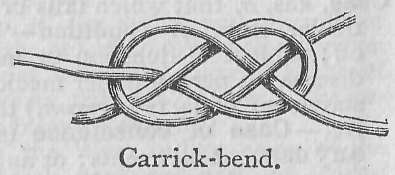
Carrick-bend, kar′ik-bend, n. (naut.), a kind of knot, formed on a bight by putting the end of a rope over its standing part, and then passing it. [Perh. conn. with Carrack, and the root of Bind.]
Carriole. See Cariole.
Carrion, kar′i-un, n. the dead and putrid body or flesh of any animal: anything vile.—adj. relating to, or feeding on, putrid flesh.—n. Carr′ion-crow, a species of crow which feeds on carrion, small animals, &c. [Fr. carogne—Low L. caronia—L. caro, carnis, flesh.]
Carritch, kar′itch, n. (Scot.) a corrupted form of the word catechism.—n. Carr′iwitchet, a quibble.
Carronade, kar-un-ād′, n. a short cannon of large bore, first made at Carron in Scotland.
Carron-oil, kar′on-oil, n. a liniment composed of linseed-oil and lime-water. [From its use for burns at Carron Ironworks in Stirlingshire.]
Carrot, kar′ut, n. a genus of Umbelliferæ, having a tapering root of a reddish or yellowish colour: the root itself, which is edible and sweet.—adj. Carr′oty, carrot-coloured, applied to the hair. [Fr. carotte—L. carota.]
Carry, kar′i, v.t. to convey or bear: to lead or transport: to take by force: to effect: to behave or demean: (of money) to be sufficient for a certain purpose: to gain the election of a candidate: to get a bill passed by a majority.—v.i. (of a gun, &c.) to reach, indicating the range of its shot:—pr.p. carr′ying; pa.p. carr′ied.—n. the distance a golf-ball goes when struck till it touches the ground: range: the portage of a boat: land across which a boat has to be carried between one navigable stream and another: the position of 'carry arms,' &c.: (prov.) the sky, cloud-drift.—ns. Carr′ier, one who carries, esp. for hire; Carr′y-all, a light, four-wheeled, one-horsed carriage; Carr′ying, the act of one who carries; Carr′y-tale (Shak.), a tale-bearer.—Carry all before one, to bear down all obstacles; Carry away, to carry off: to excite the feelings: to transport; Carry off, to cause the death of: to gain, to win, as a prize: to cause to pass muster, to make to pass by assurance or dissimulation; Carry on, to promote: to continue: to behave in a certain fashion (a term of mild reprobation); Carry one's point, to overrule objections in favour of one's plan; Carry out, to accomplish fully: to carry out for burial; Carry out one's bat (cricket), to leave the wickets without having been put out; Carry over, to induce to join the other party; Carry the day, or Carry it, to be successful: to win the day; Carry through, to succeed in accomplishing; Carry too far, to exceed reasonable limits; Carry up, to continue a building to a certain height: to trace back; Carry weight, to possess authority: to have force.—Be carried, to be highly excited: to have the head turned. [O. Fr. carier,—Low L. carricāre, to cart—L. carrus, a car.]
Carse, kärs, n. in Scotland, a stretch of alluvial land along the banks of some rivers. [Scot.; perh. from an obsolete word car, a fen; cf. Dan. kjær.]
Cart, kärt, n. a two-wheeled vehicle without springs, used for farm purposes, and for conveying heavy loads.—v.t. to convey in a cart: to carry publicly in a cart as a punishment—formerly done to bawds.—ns. Cart′age, the act or cost of carting; Cart′er, one who drives a cart; Cart′-horse, a horse used for drawing a cart; Cart′-house, a shed for keeping carts; Cart′-load, as much as a cart can carry; Cart's-tail, the hind part of a cart; Cart′way, a road or way by which carts may pass; Cart′wright, a carpenter who makes carts; T′-cart, a four-wheeled open phaeton, seated for four, its ground-plan resembling a T—see also Dog-cart, Mail-cart, Tax-cart, &c.—Put the cart before the horse, to reverse the natural order of things.—Village Cart, an uncovered two-wheeled carriage for one horse, with a low body and one seat; Whitechapel cart, or Chapel cart, a light two-wheeled spring-cart much used by butchers in delivering goods to their customers. [Ety. uncertain; from A.S. cræt, or Ice. kartr.]
Carte, kärt, n. the fourth position of the wrist in fencing. [Fr. quart—L. quartus, fourth.]
Carte, kärt, n. a bill of fare: (Scot.), a playing-card: short for carte-de-visite.—ns. Carte-blanche′, a blank paper, duly signed, and given to a person, to be filled up at his pleasure; Carte-de-visite′, a small photographic portrait pasted on a card; Cart′el, a challenge: an agreement for exchange of prisoners; a card with writing on it.—Have carte-blanche, to have a commission to act with full discretionary powers. [Fr.,—L. charta. See Card.]
Cartesian, kar-tē′zhi-an, adj. relating to the French philosopher René Descartes (1596-1650), or his philosophy.—Cartesian devil, diver, or bottle-imp, a scientific toy named after Descartes, illustrating the principle of specific gravity.
Carthamine, kär′tha-min, n. a dye obtained in crystals by a chemical process from safflower. [Low L. carthamus—Ar. qartum, saffron.]
Carthusian, kar-thū′zi-an, n. one of an order of monks founded by St Bruno in 1086, noted for their strictness: a scholar of the Charterhouse School.—adj. of or pertaining to the order. [L. Cartusianus—Catorissium, Chatrousse, a village in Dauphiné, near which their first monastery was founded.]
Cartilage, kär′ti-lāj, n. in vertebrate animals, a firm elastic substance, of a pearly whiteness, presenting to the unaided eye a uniform and homogeneous appearance: gristle.—adj. Cartilagi′nous, pertaining to or consisting of cartilage, gristly. [Fr.,—L. cartilago; cog. with crates, Gr. kartalos.]
Cartography, kar-tog′ra-fi, n. the art of preparing charts or maps. [L. charta, chart, map, and Gr. graphia, graph-ein, to write.]
Cartomancy, kär′tō-man-si, n. a divination by playing-cards. [Low L. carta, a card, Gr. manteia, divination.]
Carton, kär′ton, n. a thin pasteboard, a box made from such: a small disc within the bull's-eye of the target, a shot that strikes this.—ns. Car′tonnage, pasteboard: the outer covering of a mummy; Car′ton-pierre′, statuary pasteboard, a kind of papier-maché. [Fr. See Cartoon.]
Cartoon, kär-tōōn′, n. a preparatory drawing on strong paper to be transferred to frescoes, tapestry, &c.: any large sketch or design on paper, esp. a representation of current events in a comic paper.—v.t. to make a cartoon or working design: to caricature by a cartoon.—n. Cartoon′ist, one who makes cartoons. [Fr. carton (It. cartone), augmentative of Carte.]
Cartouche, kär-tōōsh′, n. a case for holding cartridges: formerly a case containing bullets to be discharged from a mortar, but now merely a waterproof canvas case for holding the cartridges of a field battery, one to each ammunition-box: (archit.) an ornament resembling a scroll of paper with the ends rolled up: an oval figure on ancient Egyptian monuments or papyri enclosing characters expressing royal or divine names.—Also Cartouch′. [Fr.,—It. cartoccio—L. charta, paper.]
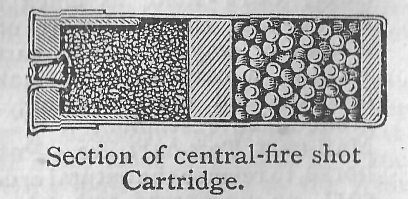
Cartridge, kär′trij, n. a case made of paper, pasteboard, metal, &c., containing the charge for a gun—Blank′-car′tridges contain powder only; Ball′-cartridges contain a bullet as well.—ns. Car′tridge-bag, a bag of flannel, merino, &c., for holding a charge for a cannon; Car′tridge-belt, a belt having pockets for cartridges; Car′tridge-box, a small box for holding cartridges, carried by soldiers; Car′tridge-pā′per, a light-coloured, strong paper, originally manufactured for making cartridges. [A corr. of Cartouche.]
Cartulary, kär′tū-lar-i, n. a register-book of a monastery, &c.: one who kept the records: the place where the register is kept. [Low L. chartularium—L. chartula, a document—charta, paper.]
Carucate, kar′u-kāt, n. originally an amount of land such as one team of oxen could plough in a season.—n. Car′ucage, a tax on the carucate, first imposed by Richard I. in 1198. [Low L. carrucāta, ploughland—carruca, plough, from root of Car.]
Caruncle, kar-unk′l, n. a small fleshy excrescence, as the wattles of the turkey-cock.—adjs. Carun′cular, Carun′culate, Carun′culous. [Fr.—L. caruncula.]
Carus, kä′rus, n. complete insensibility. [Gr. karos, stupor.]
Carve, kärv, v.t. to cut into forms, devices, &c.: to make or shape by cutting: to cut up (meat) into slices or pieces: to apportion or distribute: (Shak.) to speak with suavity.—v.i. to exercise the trade of a sculptor.—p.adj. Carv′en, carved.—ns. Carv′er, one who carves: a sculptor: a carving-knife; Carv′ing, the act or art of carving, a branch of sculpture usually performed on wood or ivory: the device or figure carved: the act or art of cutting up meat at table.—Carve out, to hew out: to gain by one's exertions.—Cut and carve, to refine. [A. S. ceorfan, to cut; Dut. kerven; Ger. kerben, to notch.]
Carvel, kär′vel, n. older form of Caravel.—adj. Car′vel-built, as distinguished from clinker-built (q.v. under Clink).
Carvy, kär′vi′, n. Scotch form of Caraway.
Caryatid, kar-i-at′id, n. a female figure used instead of a column to support an entablature:—pl. Caryat′ides.—adjs. Caryat′ic, Caryat′idal, Caryatidē′an, Caryatid′ic. [Gr. Karyatides.]
Caryophyllaceous, kar-i-ō-fi-lā′shi-us, adj. belonging to the natural order Caryophyllaceæ;, applied esp. to flowers having five petals with long claws, as in the clove-pink. [Gr. karyophyllon, the clove-pink.]
Cascabel, kas′ka-bel, n. the whole rear part behind the base-ring of a cannon. [Sp.]
Cascade, kas-kād′, n. a waterfall: a trimming of lace or other material in a loose wavy fall.—v.i. to fall in cascades. [Fr.,—It.—L. cadĕre, to fall.]
Cascara, kas′ka-ra, n. the Cascara sagrada, a Californian bark used as a tonic aperient: the Cascara amarga, a bitter Honduras bark.—n. Cascarill′a, the aromatic bitter bark of the West Indian Croton Eleuteria. [Sp.]
Casco, kas′kō, n. a form of boat used at Manila for lading and unlading ships.
Case, kās, n. a covering, box, or sheath: a set: an outer coating for walls: in bookbinding, the boards and back, separate from the book: the frame in which a compositor has his types before him while at work.—v.t. to supply with a case.—n. Case′-bott′le, a bottle made to fit into a case with others.—v.t. Case′-hard′en, to convert the surface of certain kinds of malleable iron goods into steel, thereby making them harder, less liable to rust, and capable of taking on a better polish.—ns. Case′-hard′ening; Case′-knife, a large knife kept in a case; Case′maker, one who makes cases or covers for books; Case′ment, the case or frame of a window: a window that opens on hinges: a hollow moulding.—adj. Case′mented, having casements.—ns. Case′-shot, canister-shot, an artillery projectile for use at close quarters; Case′-worm, the caddice; Cas′ing, the act of the verb Case: an outside covering of any kind, as of boards, plaster, &c. [O. Fr. casse—L. capsa—capĕre, to take.]
Case, kās, n. that which falls or happens, event: particular state or condition—'in good case' = well off: subject of question or inquiry: an instance of disease: a person under medical treatment: a legal statement of facts: (gram.) the inflection of nouns, &c.—Case of conscience (see Conscience).—In any case, at all events: at any rate; In case, in the event that; In case to, in fit condition for; Make out one's case, to give good reasons for one's statements or position; Put the case, to suppose an instance: to take for example; The case, the fact, the reality. [O. Fr. cas—L. casus, from cadĕre, to fall.]
Casein, Caseine, kā′sē-in, n. an organic substance, contained in milk and cheese.—adjs. Cā′sēic; Cā′sēous, pertaining to cheese. [Fr.,—L. caseus, cheese.]
Casemate, kās′māt, n. any bomb-proof vaulted chamber, even when merely used as quarters for the garrison: (orig.) a loopholed gallery, from which the garrison of a fort could fire upon an enemy who had obtained possession of the ditch.—adj. Case′mated. [Fr.; der. uncertain.]
Caseous. See Casein.
Casern, ka-sėrn′, n. a lodging for troops in a town: a barrack. [Fr.,—Sp. caserna—casa, a house.]
Cash, kash, n. coin or money: ready money.—v.t. to turn into or exchange for money: to pay money for.—ns. Cash′-account′, an account to which nothing is carried but cash: a form of account with a bank, by which a person is entitled to draw out sums as required by way of loan to a stipulated amount—also called Cash′-cred′it; Cash′-book, a book in which an account is kept of the receipts and disbursements of money; Cashier′, a cash-keeper: one who has charge of the receiving and paying of money; Cash′-pay′ment, payment in ready money; Cash′-rail′way, a mechanical device adopted in large shops and warehouses for the interchange of cash between the counters and the cash-desk.—Hard cash, ready money; Out of cash, or In cash, without or with money: out of, or in, pocket. [A doublet of Case, a box—O. Fr. casse, a box.]
Cashew, ka-shōō′, n. a spreading tree of no great height, in both the East and West Indies, the fruit of which is a kidney-shaped nut at the end of a pear-shaped fleshy stalk, the kernel of this nut and the fleshy stalk (called the Cashew′-app′le) being both used as food. [Fr. acajou—Brazilian acajoba.]
Cashier, kash-ēr′, v.t. to dismiss from a post in disgrace: to discard or put away: to annul.—ns. Cashier′er, one who cashiers; Cashier′ing, a punishment for officers in the army and navy, severer than dismissal, inasmuch as it disqualifies from entering the public service in any capacity; Cashier′ment, dismissal. [Dut. casseren, to cashier—L. cassāre, cassus, void, empty.]
Cashmere, kash′mēr, n. a rich kind of shawl made from the Cashmere goat: any similar shawl.
Casino, kas-ē′nō, n. a room for public dancing: a card-game. [It.; from L. casa, a cottage.]
Cask, kask, n. a hollow round vessel for holding liquor, made of staves bound with hoops: a measure of capacity: (obs.) a casque,—v.t. to put in a cask. [Fr. casque—Sp. casco, skull, helmet, cask.]
Casket, kask′et, n. a little cask or case: a small case for holding jewels, &c.: (U.S.) a coffin. [Ety. uncertain; hardly a dim. of Cask.]
Casque, Cask, kask, n. a cover for the head: a helmet. [A doublet of Cask.]
Cassandra, kas-an′dra, n. a daughter of Priam, king of Troy, beloved by Apollo, who gave her the gift of prophecy, but not of being believed—hence any one who takes gloomy views of the political or social future.
Cassareep, kas′a-rēp, n. a sauce or condiment made from the juice of the cassava, the chief ingredient in the West Indian pepper-pot.
Cassation, kas-sā′shun, n. the act of making null or void: (French law) the act of annulling the decision of a court or judicial tribunal—hence Court of Cassation, the supreme tribunal. [Low L. cassation-em—cassāre, to bring to nought.]
Cassava, kas-sä′va, n. the West Indian name of the manioc, and the starch produced from it, called Brazilian Arrowroot, or Tapioca.
Casserole, kas′e-rōl, n. a stew-pan: the outer part of several dressed dishes. [Fr.]
Cassia, kash′ya, n. a coarser kind of cinnamon—also Cass′ia-bark: the tree which yields the foregoing: a fragrant plant mentioned in Ps. xlv. 8 (Heb. qeçî'ôth, prob. the Ind. orris or costus): a genus of shrubs of the bean family (Leguminosæ), the leaves of several species yielding senna, while the drug known as cassia fistula or purging cassia is derived from the pod of Cassia fistula, the bark of which is used in tanning. [L. casia—Gr. kasia—Heb.]
Cassimere, kas-i-mēr′, n. a twilled cloth of the finest wools.—Also Kerseymere′. [Corr. of Cashmere.]
Cassino, kas-sē′no, n. a game at cards. [See Casino.]
Cassiopeia, kas-i-ō-pē′ya, n. a constellation in the northern hemisphere, near the North Pole, named after the mother of Andromeda in Greek mythology.
Cassiterite, ka-sit′e-rīt, n. a brown native tin dioxide. [L. cassiterum—Gr. kassiteros, tin.]
Cassock, kas′ok, n. a long loose black robe or outer coat, formerly in common wear, but now worn only by clergy and choristers: a shorter garment, usually of black silk, worn under the Geneva gown by Scotch ministers.—adj. Cass′ocked. [Fr. casaque—It. casacca, prob. from L. casa, a cottage, a covering. Some explain Fr. casaque, casaquin, It. casacchino, as from Ar. kazāyand, a padded jerkin.]
Cassolette, kas′ō-let, n. a censer: a perfume-box with perforated lid. [Fr.,—Sp. cazoleta—cazo, a saucepan.]
Cassonade, kas-o-nād′, n. raw or unrefined sugar. [Fr.]
Cassowary, kas′ō-war-i, n. a genus of running birds, nearly related to the true ostrich, and nearer to the American rhea. [Malay kasuārī or kasavārī.]
Cast, kast, v.t. to throw or fling: to throw off, shed, drop: to throw down: to throw together or reckon: to mould or shape: (B.) to consider, to cast or throw up.—v.i. to warp:—pa.t. and pa.p. cast.—n. act of casting: a throw of anything, as the sounding-lead, a fishing-line: the thing thrown, esp. in angling: the distance thrown: a motion, turn, or squint, as of the eye: a chance: a mould: the form received from a mould: manner, stamp, or quality: a shade of colour, a degree of guilt, &c.: the assignment of the various parts of a play to the several actors: the company of actors to whom such have been assigned.—n. Cast′away, one cast away, an outcast.—adj. worthless, rejected.—adjs. Cast (B.), Cast′ed (Shak.), cast off.—ns. Cast′ing, act of casting or moulding: that which is cast: a mould; Cast′ing-net, a species of net for fishing; Cast′ing-vote, the voice or vote of the president of a meeting, by which he is enabled, when the other votes are equally divided, to cast the balance on the one side or the other; Cast′ing-weight, the weight which makes the balance cast or turn when exactly poised.—adj. Cast′-off, laid aside or rejected.—n. anything thrown aside.—n. Cast′-steel, steel that has been melted, cast into ingots, and rolled out into bars.—Cast about, to contrive, to look about, to search for, as game: (B.) to turn, to go round; Cast a nativity, to make an astrological calculation; Cast anchor, to moor a ship; Cast an eye, a glance, to look at; Cast a thing in one's teeth, to bring a reproach against some one; Cast away, to wreck, to waste; Cast down, to deject or depress in mind: to turn the eyes downward; Cast loose, to set loose or adrift; Cast up, to throw up, to bring up anything as a reproach.—Be cast (law), to be defeated.—The last cast, the last venture. [Scand.; as Ice. kasta, to throw.]
Castalian, kas-tā′li-an, adj. pertaining to Castalia, a fountain in Parnassus, sacred to Apollo and the Muses.
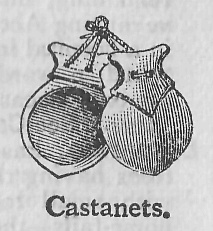
Castanet, kas′ta-net, n. a musical instrument of percussion in the form of two hollow shells of ivory or hard wood, which are bound together by a band fastening on the thumb, and struck by the fingers to produce a trilling sound in keeping with the rhythm of the music—much used in Spain as an accompaniment to dances and guitars. [Sp. castañeta—L. castanea, a chestnut.]
Caste, käst, n. a term applied chiefly to distinct classes or sections of society in India, and, in a modified sense, to social distinctions of an exclusive nature among other nations.—Lose caste, to descend in social rank. [A name given by the Portuguese to the classes of people in India; Port. casta, breed, race.—L. castus, pure, unmixed.]
Castellan, Castellated. See Castle.
Castigate, kas′tig-āt, v.t. to chastise: to correct: to punish with stripes.—ns. Castigā′tion, act of castigating: chastisement: severe punishment; Cas′tigātor, one who castigates.—adj. Cas′tigātory. [L. castigāre, -ātum, from castus, pure.]
Castilian, kas-til′yan, adj. and n. of or belonging to Castile, a native of Castile, or the language thereof, standard Spanish.—Castile soap, a hard soap made with olive-oil and soda.
Cast-iron. See Iron.
Castle, kas′l, n. a fortified house or fortress: the residence of a prince or nobleman, or a large country mansion generally: anything built in the likeness of such: a defensive tower borne on an elephant's back: a large ship, esp. of war.—v.t. to enclose or fortify with a castle.—v.i. (chess) to bring the castle or rook up to the square next the king, and move the king to the other side of the castle.—n. Cas′tellan, governor or captain of a castle.—adj. Cas′tellated, having turrets and battlements like a castle.—n. Cas′tle-build′ing, the act of building castles in the air or forming visionary projects.—adj. Cas′tled, furnished with castles.—n. Cas′tle-guard, the guard for the defence of a castle.—Castles in the air, or in Spain, groundless or visionary projects.—The Castle, Dublin Castle, the seat of the viceroy and the executive—Castle influence, &c. [A.S. castel—L. castellum, dim. of castrum, a fortified place.]
Castor, kas′tor, n. the beaver: a hat made of its fur. [L.,—Gr. kastōr; cf. Sans. kasturi, musk.]
Castor, kast′or, n. a small wheel on the legs of furniture: a small vessel with perforated top for pepper, &c.—also Cast′er. [From Cast.]
Castor-oil, kas′tor-oil, n. a medicinal oil obtained from a tropical plant, the Ricinus communis. [Ety. dub.; prob. from castor or castoreum, the unctuous substance obtained from two pear-shaped glands in the beaver, formerly much used in midwifery.]
Castral, kas′tral, adj. belonging to the camp. [L. castra.]
Castrametation, kas-tra-me-tā′shun, n. the act or art of encamping. [L. castra, a camp, metāri, -atus, to measure off—meta, a boundary.]
Castrate, kas′trāt, v.t. to deprive of the power of generation, to remove the testicles, geld, emasculate: to take from or render imperfect.—adj. Cas′trated, expurgated.—ns. Castrā′tion, gelding, expurgation; Castrato (kas-trä′tō), a male singer castrated in boyhood so as to preserve a soprano or alto voice:—pl. Castra′ti. [L. castrāre, -ātum.]
Casual, kash′ū-al, adj. accidental: unforeseen: occasional.—n. a chance or occasional visitor, labourer, pauper, &c.—n. Cas′ualism, the belief that chance governs all things.—adv. Cas′ually, in a casual manner.—n. Cas′ualty, that which falls out: an accident: a misfortune: (pl.) losses of a military force by death, desertion, &c.: an incidental charge or payment.—Casualties of superiority, in the feudal law of Scotland, such emoluments arising to the superior as depend on uncertain events—those of non-entry, relief or composition, and escheat alone remaining, but considerably modified by the Conveyancing Act of 1874.—Casualty ward, the ward in a hospital in which accidents are treated; Casual ward, a ward set apart for the use of those who are only occasionally in destitution. [L. casualis—casus. See Case.]
Casuarina, kas-ū-ar-ēn′a, n. a genus of Australian trees having thread-like, jointed, pendent branches, with small toothed sheaths at the joints, like the horse-tails—the Swamp-oak and She-oak belong to it, and its wood is the well-known Beef-wood.
Casuist, kaz′ū-ist, n. one who studies and resolves cases of conscience.—adjs. Casuist′ic, -al, relating to cases of conscience.—n. Cas′uistry, the science or doctrine of cases of conscience, or the reasoning which enables a man to decide in a particular case between apparently conflicting duties. [Fr. casuiste—L. casus. See Case.]
Casula, kas′ū-la, n. a chasuble.
Cat, kat, n. a common domestic animal kept to devour mice: a spiteful woman: a movable pent-house used for their protection by besiegers: a double tripod with six legs: a piece of wood tapering at each end, struck with the Cat-stick in the game of tip-cat, this game itself: short for the Cat-o'-nine′-tails, an instrument of punishment consisting of a whip with nine tails or lashes, with three or four knots on each, once used in the army and navy.—v.t. to raise the anchor to the cathead.—ns. Cat′amount, a common name in the United States for the cougar or puma—also called Panther, Painter, and American lion; Catamoun′tain, or Cat o' mountain, a leopard, panther, or ocelot: a wild mountaineer.—adj. ferocious, savage.—adj. Cat-and-dog, used attributively for quarrelsome.—ns. Cat′-bird, an American bird of the thrush family, so called on account of the resemblance of its note to the mewing of a cat; Cat′-call, a squeaking instrument used in theatres to express dislike of a play: a shrill whistle or cry.—v.i. to sound a cat-call.—v.t. to assail with such.—adj. Cat′-eyed, having eyes like a cat: able to see in the dark.—n. Cat′gut, a kind of cord made from the intestines of animals, and used as strings for violins, harps, guitars, &c., the cords of clock-makers, &c.: the violin or other stringed instrument: a coarse corded cloth.—adj. Cat′-hammed, with thin hams like a cat's.—ns. Cat′head, one of two strong beams of timber projecting from the bow of a ship, on each side of the bowsprit, through which the ropes pass by which the anchor is raised; Cat′-hole, one of two holes in the after part of a ship, through which hawsers may pass for steadying the ship or for heaving astern; Cat′hood, state of being a cat or having the nature of a cat; Cat′kin, a crowded spike or tuft of small unisexual flowers with reduced scale-like bracts, as in the willow, hazel, &c.; Cat′-lap, any thin or poor drink.—adj. Cat′-like, noiseless, stealthy.—ns. Cat′ling, a little cat, a kitten: the downy moss on some trees, like the fur of a cat: (Shak.) a lute-string; Cat′mint, a perennial plant resembling mint, said to be so called from the fondness cats have for it; Cat's′-crā′dle, a game played by children, two alternately taking from each other's fingers an intertwined cord, so as always to maintain a symmetrical figure; Cat's′-eye, a beautiful variety of quartz, so called from the resemblance which the reflection of light from it bears to the light that seems to emanate from the eye of a cat; Cat's-foot, a plant, called also Ground-ivy; Cat′-sil′ver, a variety of silvery mica; Cat's′-meat, horses' flesh, or the like, sold for cats by street dealers; Cat's′-paw (naut.), a light breeze: the dupe or tool of another—from the fable of the monkey who used the paws of the cat to draw the roasting chestnuts out of the fire; Cat's′-tail, a catkin: a genus of aquatic plants of the reed kind, the leaves of which are sometimes used for making mats, seating chairs, &c.: a kind of grass.—adj. Cat′-wit′ted, small-minded, conceited, and spiteful.—Catted and fished, said of an anchor raised to the cathead and secured to the ship's side.—Bell the cat (see Bell).—Care killed the cat, even with his proverbial nine lives.—Cheshire cats are proverbially notable for grinning, and Kilkenny cats proverbially fight till each destroys the other.—Rain cats and dogs, to pour down heavily.—See which way the cat jumps, to watch how things are going to turn before committing one's self.—Turn the cat in the pan, to change sides with dexterity.—For Gib-cat, Tabby-cat, Tom-cat, see under Gib, Tabby, &c. [A.S. cat; found also in Celt., Slav., Ar., Finn, &c.]
Cat, kat, n. an old name for a coal and timber vessel on the north-east coast of England.—adj. Cat′-rigged, having one great fore-and-aft mainsail spread by a gaff at the head and a boom at the foot, for smooth water only.
Catabolism. See Katabolism.
Catacaustic, kat-a-kaws′tik, adj. (geom.) belonging to caustic curves formed by reflection (see Caustic). [Gr. kata, against, and Caustic.]
Catachresis, kat-a-krē′sis, n. (rhet.) a figure by which a word is used in a sense different from, yet analogous to, its own: a harsh or far-fetched metaphor.—adjs. Catachres′tic, -al.—adv. Catachres′tically. [L.,—Gr. katachrēsis, misuse.]
Cataclysm, kat′a-klizm, n. a flood of water: a deluge: great revolution.—adj. Cataclys′mic. [Gr. kataklysmos—kata, downward, klyzein, to wash.]
Catacomb, kat′a-kōm, n. a subterranean excavation used as a burial-place, esp. the famous Catacombs near Rome, where many of the early Christian victims of persecution were buried: any place built with crypt-like recesses for storing books, wine, &c.—adj. Cat′acumbal. [It. catacomba—Late L. catacumbas (prob. from ad catacumbas), prob. from Gr. kata, downward, and kymbē, a hollow.]
Catacoustics, kat-a-kows′tiks, n. the part of acoustics which treats of echoes or sounds reflected. [Gr. kata, against, and Acoustics.]
Catadioptric, -al, kat-a-di-op′trik, -al, adj. pertaining to instruments by which rays of light are both reflected and refracted. [See Catoptric.]
Catadromous, kat-ad′rom-us, adj. of fishes, descending periodically for spawning to the lower parts of a river or to the sea. [Gr. kata, down, dromos, running.]
Catafalque, kat-a-falk′, n. a temporary structure of carpentry representing a tomb or cenotaph placed over the coffin during a lying-in-state: a tomb of state, a funeral car.—Also Catafal′co. [Fr.,—It. catafalco. See Balcony and Scaffold.]
Catalan, kat′al-an, adj. of or belonging to Catalonia or its language, a dialect of Provençal.—n. a native of Catalonia, or the language thereof.
Catalectic, kat-a-lek′tik, adj. incomplete: applied to a verse wanting one syllable at the end, or terminating in an imperfect foot. [Gr. katalēktikos, incomplete—katalēgein, to stop.]
Catalepsy, kat′a-lep-si, n. a state of more or less complete insensibility, with absence of the power of voluntary motion, and statue-like fixedness of the body and limbs.—adj. Catalep′tic. [Gr., from kata, down, lambanō, lēpsomai, I seize.]
Catallactic, kat-al-ak′tik, adj. pertaining to exchange.—adv. Catallac′tically.—n. Catallac′tics, political economy as the science of exchanges. [Made up from Gr. katalassein, to exchange.]
Catalogue, kat′a-log, n. a list of names, books, &c.—v.t. to put in a catalogue:—pr.p. cat′aloguing; pa.p. cat′alogued.—v.t. Cat′aloguise. [Fr.—Late L.—Gr. katalogos, from kata, down, legein, to choose.]
Catalpa, kat-al′pa, n. a genus of hardy trees native to the United States and Japan, marked by a low habit, profuse blossoms, and long cigar-like pendent pods.—The common Catalpa, known also as the Bean-tree, Catawba, Indian bean, and Cigar-tree, yields a durable wood; as also the western Catalpa or Shawnee wood. [From the native Ind. name.]
Catalysis, ka-tal′i-sis, n. (chem.) the decomposition of a compound and the recomposition of its elements, by the presence of a substance which does not itself suffer change, as in fermentation.—adj. Catalyt′ic. [Gr. katalysis—kata, down, lyein, to loosen.]
Catamaran, kat′a-mar-an′, or kat-am′ar-an, n. a raft of three pieces of wood lashed together, the middle piece being longer than the others, and serving as a keel—on this the rower squats, and works a paddle—much used in the Madras surf: an old kind of fire-ship, long superseded; an ill-natured woman. [Tamil, 'tied wood.']
Catamenia, kat-a-mē′ni-a, n. the menstrual discharge.—adj. Catamē′nial. [Gr. katamēnios—kata, again, mēn, mēnos, a month.]
Catamite, kat′a-mīt, n. a boy kept for unnatural purposes—a corruption of Ganymede (q.v.).
Catamount. See Cat.
Catapan, kat′a-pan, n. the governor of Calabria and Apulia for the Byzantine emperor. [Acc. to Littré, from Gr. katepanō tōn axiōmatōn, 'he who is placed over the dignities.']
Cataphonics, kat-a-fon′iks, n. the science of reflected sounds.—adj. Cataphon′ic. [Gr. kata, against, phonē, sound.]
Cataphract, kat′a-frakt, n. (Milton) a soldier in full armour. [Gr. kataphraktēs, a coat-of-mail—kata, inten., and phrass-ein, to enclose, protect.]
Cataphyllary, kat-a-fil′ar-i, adj. pertaining to such rudimentary scale-leaves as are found on various parts of plants, esp. underground.—n. Cataphyll′um. [Gr. kata, down, phyllon, leaf.]
Cataphysical, kat-a-fis′i-kal, adj. (rare) unnatural. [Gr. kata, down, against, physis, nature.]
Cataplasm, kat′a-plazm, n. a plaster or poultice. [Gr. kataplasma, a plaster—kata-plassein, to plaster over.]
Cataplexy, kat′a-plex-i, n. the kind of mesmeric sleep of animals under a sudden shock of terror—the state of 'shamming death.'—adj. Cataplec′tic. [Gr. kataplēssein, to strike down.]
Catapult, kat′a-pult, n. anciently an engine of war, resembling the ballista, for throwing stones, arrows, &c.: a small forked stick having an elastic string fixed to the two prongs, used by boys for throwing small stones.—adj. Catapul′tic.—n. Catapultier′. [L. catapulta—Gr. katapeltēs—kata, down, pallein, to throw.]
Cataract, kat′a-rakt, n. a great fall of water, water-spout, &c.: a waterfall or cascade: an opaque condition of the lens of the eye, painless, unaccompanied by inflammation, occasioning blindness, simply by obstructing the passage of the light. [L. cataracta—Gr. kata, down, arass-ein, to dash, to rush.]
Catarrh, kat-är′, n. a discharge of fluid from the inflammation of a mucous membrane, esp. of the nose, caused by cold in the head: the cold itself.—adjs. Catarrh′al, Catarrh′ous. [L. catarrhus—Gr. katarrhous—kata, down, rheēin, to flow.]
Catarrhine, Catarhine, kat′ar-īn, adj. pertaining to that one of the two divisions of Quadrumana, including all the Old-World monkeys, having a narrow partition between the nostrils. [Gr. kata, down, hris, hrinos, nose.]
Catasta, kat-äs′ta, n. a block on which slaves were exposed for sale: a stage or place for torture. [L.]
Catastasis, kat-as′tas-is, n. the part of the Greek drama in which the development of the action has reached its height: (rhet.) that part of a speech which states the subject to be discussed. [Gr.]
Catastrophe, kat-as′trō-fē, n. an overturning: a final event: an unfortunate conclusion: a calamity.—adj. Catastroph′ic—ns. Catas′trophism, the theory in geology that accounts for 'breaks in the succession' by the hypothesis of vast catastrophes—world-wide destruction of floras and faunas, and the sudden introduction or creation of new forms of life, after the forces of nature had sunk into repose; Catas′trophist, a holder of the foregoing, as opposed to the uniformitarian theory. [Gr., kata, down, strephein, to turn.]
Catawba, ka-taw′ba, n. a light sparkling wine, produced from a grape of the same name, first found on the banks of the Catawba River in Carolina.
Cat-bird. See Cat.
Cat-call. See Cat.
Catch, kach, v.t. to take hold of: to apprehend or understand: to seize after pursuit: to trap or ensnare: to take a disease by infection: to take up anything by sympathy or imitation.—v.i. to be contagious: to be entangled or fastened in anything;—pa.t. and pa.p. caught (kawt).—n. seizure: anything that seizes or holds: that which is caught: anything worth catching: a sudden advantage taken: a specially English form of musical composition, written generally in three or four parts, and in the canon form—originally synonymous with the round.—adj. Catch′able, that may be caught.—ns. Catch′er, one who catches; Catch′fly, a popular name of several plants belonging to the genus Silene, and of Lychnis Viscaria, whose glutinous stems often retain insects settling on them; Catch′ing, the action of the verb 'to catch:' a nervous or spasmodic twitching.—adj. infectious: captivating, attractive.—ns. Catch′ment-bās′in, a term applied to all that part of a river-basin from which rain is collected, and from which, therefore, the river is fed; Catch′penny, any worthless thing, esp. a publication, intended merely to gain money—also adj.; Catch′word, among actors, the last word of the preceding speaker—the cue: the word at the head of the page in a dictionary or encyclopædia: the first word of a page given at the bottom of the preceding page: any word or phrase taken up and repeated as the watchword or symbol of a party.—adj. Catch′y, attractive, deceptive, readily caught up, as an air, &c., fitful.—Catch at, to snatch at; Catch fire, to become ignited, to be inspired by passion or zeal; Catch hold of, to seize; Catch it, to get a scolding or the like; Catch me! an emphatic colloquial phrase implying that there is not the remotest possibility of my doing something suggested; Catch on, to comprehend: to catch the popular fancy; Catch out, to put a batsman out at cricket by catching the ball he has batted; Catch sight of, suddenly to get a glimpse of; Catch up, to overtake; Catch up, or away, to lay hold of forcibly. [From O. Fr. cachier—Late L. captiāre for captāre, inten. of capĕre, to take. See Chase.]